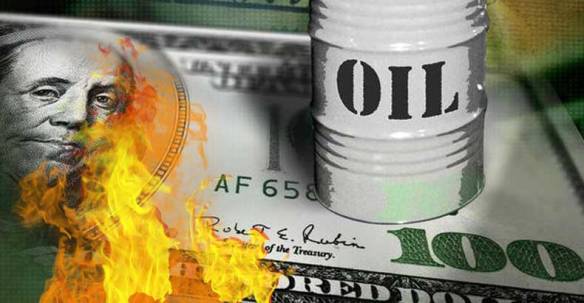
The Top 10 Outrageous Things About ISIS the Western Mainstream Media Ignores

By Robert Bridge

Source: Strategic Culture Foundation

Last week, the US said it was working to create “alternative government authorities” on Syrian territory. This latest move, aside from demonstrating once again that the US has no respect for Syria’s territorial integrity, indicates we may be seeing more from that group of mercenaries known as Islamic State.

Thus, it seems to be an appropriate time to reflect upon a set of very strange circumstances that led to the rise of this loathsome terrorist group. Here are the top 10 reasons, in no particular order, as to why we should be very suspicious about this group.

10. Convenient Timing

In late August 2013, the United States was on the verge of initiating a massive attack on the government of Syrian President Bashar Assad over a deadly chemical attack that had occurred in the town of Ghouta just days earlier. Although it would have made no sense for Assad to have resorted to such dirty tactics, Washington had found its casus belli. It should be noted that at this time the so-called Islamic State of Iraq and the Levant was largely unknown. That would change soon enough.

Meanwhile, a terrible thing happened on the way to this jolly little war. UK Prime Minister David Cameron suffered a stunning defeat in the House of Commons, voting down his effort to join the Americans in Syria. Apparently the British were America’s obedient poodle no longer.

The setback had an apparent sobering effect on Barack Obama, who suddenly – in a feigned nod to democratic procedure and all that – called for Congress to decide whether or not to use military force against Syrian. Tellingly, that vote never materialized.

What did materialize, however, and with alarming speed and viciousness, was a terrorist group that rose up like a phoenix from the ashes of Iraq known as Islamic State (ISIS)*, with evil designs to create an Islamic caliphate across a wide swath of Iraq and Syria.

In other words, the perfect casus belli for the US in Syria that would require no need for a vote from Congress.

9. Journalist Killings

As if to draw gratuitous attention to itself more than anything else, the Sunni terrorist group ISIS, under the leadership of one Abu Bakr al Baghdadi, began to grab world headlines not by its battlefield exploits, but by carrying out videotaped executions of Western journalists, as well as destroying cultural heritage sites. I still can’t help wondering: Why didn’t the group just let its fighting skills speak for itself? Why the apparent need for such outrageous publicity stunts? Was this compensation for something the group was desperately lacking?

In any case, starting in August 2014, almost one year to the day that Obama was forced to put the brakes on his Syrian attack, the beheadings began in earnest.

On August 19, US journalist James Foley, seen kneeling on the ground in some undetermined location next to his apparent executioner, ‘Jihadi John,’ reads out a short statement before being beheaded by his captor. However, Islamic State spared its audience the gore by not showing the moment of the actual beheading; the video only shows a head lying on a body following the purported act.

Even Western mainstream publications admitted that something didn’t seem quite right.

Under the headline, ‘Foley murder video may have been staged’ the Telegraph, a reputable British newspaper, interviewed forensic experts who called into question the moment in the video when Foley is allegedly being beheaded by his captor.

“After enhancements, the knife can be seen to be drawn across the upper neck at least six times, with no blood evidence to the point the picture fades to black,” the expert said.

Another expert who examined the video for the newspaper said: “I think it has been staged. My feeling is that the execution may have happened after the camera was stopped.”

Incredibly, every subsequent beheading video put out by Islamic State attracted the same amount of scepticism – not just from alternative websites, who were also noticing the many irregularities contained in the videos, but from mainstream media news sources.

Following the release of the video purported to show the beheading of Steve Sotloff, a journalist who worked with the Jerusalem Post, The Australian newspaper reported that “the apparent beheading on camera of a second US hostage by a man with a British accent was again staged, according to forensic analysis.”

Then there was the video of 21 Egyptian Coptic Christians, dressed in impeccably clean orange jumpsuits, being led along a Libyan beach by black-clad members of ISIS, all of whom appear to be members of some NBA basketball team.

Veryan Khan, editorial director of the Florida-based Terrorism Research & Analysis Consortium, told Fox News that “the speaker, “Jihad Joseph” is much larger than the sea in both the close up and wide shots, and his head is bizarrely out of proportion, meaning he was filmed indoors and the sea added behind him… In addition, the jihadists featured in the film look to be more than 7 feet tall, towering as much as two feet above their victims…”

In July 2015, yet another strange report emerged, CyberBerkut, a Ukrainian group of hackers, said it hacked John McCain’s laptop while he was on an official visit to Kiev around the first week of June 2015. In a report by TechWorm, what they purported to find was a fully staged production of an ISIS execution video, with an actor portraying an executioner who is holding a knife in preparation to behead the prisoner.

The authenticity of this video has not been independently verified.

None of this proves that the individuals in all of the ISIS beheading videos did not go on to meet some grisly fate. However, it seems worth noting that so many forensic experts have spoken out on the “staged” nature of these videos, and that the actual moment of execution during these film productions is never actually shown. Why would such a barbarous group of villains like ISIS need to script and censor their videos?

8. ISIS freedom of movement

Despite employing state-of-the-art fighter jets, like the F-16 Fighting Falcon and A-10 Warthog, the US campaign to destroy Islamic State was largely an exercise in utter futility. There is no other way to explain it. In June 2014, a convoy of hundreds of ISIS fighters drove through 200 km of the Syro-Arabian Desert in fresh-off-the-lot Toyota pickup trucks on the way to Syria. For any modern military, eliminating such a target would have been the equivalent of a lazy afternoon at the shooting range, or shooting fish in a barrel. The fact that these terrorists made it to Syria unmolested tells us everything we need to know about America’s real agenda.

“With state of the art jet fighter aircraft … it would have been – from a military standpoint – ‘a piece of cake’, a rapid and expedient surgical operation, which would have decimated the Islamic State convoys in a matter of hours,” Michel Chossudovsky wrote in Global Research.

“Instead what we have witnessed is an ongoing drawn out six months of relentless air raids and bombings, and the terrorist enemy is apparently still intact.”

“And we are led to believe that the Islamic State cannot be defeated by a powerful US led military coalition of 19 countries,” he added.

The only reasonable conclusion to make from all of this is that the air campaign was not designed to eliminate Islamic State.

7. SITE Security Group

In 2002, Rita Katz and Josh Devon founded Search for International Terrorist Entities Institute (SITE), which, according to its website, is “the world’s leading non-governmental counterterrorism organization specializing in tracking and analyzing online activity of the global extremist community.”

In 2006, in a New Yorker article entitled, “Private Jihad: How Rita Katz got into the spying business,” it was mentioned how SITE spoke directly with jihadists via various message boards:

“Katz has a testy relationship with the government, sometimes acting as a consultant and sometimes as an antagonist. About a year ago, a SITE staffer, under an alias, managed to join an exclusive jihadist message board that, among other things, served as a debarkation point for many would-be suicide bombers.

For months, the staffer pretended to be one of the jihadis, joining in chats and watching as other members posted the chilling messages known as “wills,” the final sign-offs before martyrdom. The staffer also passed along technical advice on how to keep the message board going.

When Katz called officials in Washington, she was reportedly met with resistance: ‘Oh, Rita, I’m not sure you should even be communicating with them—you might be providing material support!,” they told her.

In an interview with CNN, Katz admitted that her group was able to “beat [ISIS] with a release” of a video before it had even been disseminated.

In 2007, SITE came under fire for obtaining an alleged Bin Laden video a month prior to its formal release.

Some have raised questions as to how this small group is able to do what the government has not been able to: track ISIS and other terrorist groups with uncanny efficiency.

6. Toyota Trucks

Watching mainstream media reports detail the adventures of Islamic State as they speed carefree across wide-open desert, beards blowing in the wind, one would be forgiven for thinking they were watching a Toyota commercial.

The Times of Israel went so far as to ridicule the leaders of the West for expressing such fear over these militants in their Toyotas like hell raising teenagers speeding around the parking lot of McDonald’s on a Friday night to impress their friends.

“It’s almost unbelievable,” Avi Issacharoff wrote. “They used to say in the IDF that ‘the man in the tank will win,’ justifying the preference for armor over infantry. Now we hear that, from a US source no less, ‘the man in the Toyota’ will defeat the West.”

Somehow we are expected to believe that these shiny new trucks, along with over 2,000 Humvee vehicles, fell into the terrorists’ control by winning some battles in Iraq, like in Mosul and Palmyra. That absurd explanation falls very wide of the mark and needs far more inquiry.

5. Drone attack on Russia

On New Year’s Eve and on January 6, 2018, Russia’s Khmeimim Airbase in Syria was attacked. The first incident involved militants armed with mortars that resulted in the death of two Russian soldiers and damage to several aircraft. The second attack involved a swarm of 13 drones armed with bomblets, which Russian forces countered by means of electronic warfare and air-defense systems. Around half of the drones were electronically hijacked by Russian forces, while the others were shot down without incident. Nevertheless, the attack required a high level of expertise from a “technologically advanced country,” according to Russia.

The United States countered the claim, suggesting that such technology can be easily purchased. Pentagon spokesman Maj. Adrian Rankin-Galloway said the “devices and technologies can easily be obtained in the open market.”

Meanwhile, however, President Putin never mentioned Islamic State when he discussed the incident with the media.

“Those aircraft were only camouflaged – I want to emphasize this – to look like handicraft production. In fact, it is quite obvious that there were elements of high-tech nature there,” the Russian leader said.

So are we expected to believe that Islamic State terrorists were able to buy these UAV drones, or is it more realistic to believe, along with the Russians, that some outside major power was needed to provide the know-how?

4. Never attacked mainland Israel

In March 2016, the warriors of Islamic State picked up their pens in an effort to explain away a question that has been perplexing many observers: why don’t they ever attack Israel?

In the article, translated by a group called MEMRI, the group said it holds to the position that the Palestinian cause does not take precedence over any other jihadi struggle.

“If we look at the reality of the world today, we will find that it is completely ruled by polytheism and its laws, except for the regions where Allah made it possible for the Islamic State to establish the religion…. Therefore, jihad in Palestine is equal to jihad elsewhere,” the article said.

“The apostate [tyrants] who rule the lands of Islam are graver infidels than [the Jews], and war against them takes precedence over war against the original infidels,” the article said, as reported in the Times of Israel.

Whatever the case may be, this seems to be the first time in modern history that a radical jihadist group has had no reason to quarrel with Israel.

3. Oil Export Business

After Islamic State managed to make it across the vast desert between Iraq and Syria without attracting so much as a damaged fender, it managed to do the unthinkable: it set up a very lucrative oil-export business practically overnight in the north of the country. And this was not some small-time operation.

According to one estimate, the motley crew of mercenaries was generating profits of more than £320million a year from oil exports, or about 40,000 barrels of crude every single day.

Are we really expected to believe that a 19-member military organization led by the United States was powerless to put this rag-tag operation out of business?

The reason why the story is so utterly preposterous is that Russia, in a matter of several days, was able to do what this multinational outfit could not do in over a year. In mid-November 2015, Russia had announced that it had destroyed in a matter of days some 500 fuel trucks – and there is plenty of videotape of the Russian attacks for the naysayers who doubt the Kremlin’s claim.

According to Russian General Staff spokesman Colonel General Andrey Kartapolov: “In just the first few days, our aviation has destroyed 500 fuel tanker trucks, which greatly reduced illegal oil export capabilities of the militants and, accordingly, their income from oil smuggling.”

2. Islamic State’s Israeli medical plan

In March 2015, The Wall Street Journal reported a rather stunning revelation that Israel was treating “Al-Qaeda* fighters wounded in the Syria civil war.”

Since the outbreak of the Syrian civil war, Israel has provided medical assistance to nearly 2,000 Syrians.

The Wall Street Journal quoted “an Israeli military official” who said no questions were asked of the patients.

“We don’t ask who they are, we don’t do any screening,” the official said. “Once the treatment is done, we take them back to the border and they go on their way.”

Amos Yadlin, the former military intelligence chief, told the Journal that Hezbollah and Iran “are the major threat to Israel, much more than the radical Sunni Islamists, who are also an enemy.”

“Those Sunni elements who control some two-thirds to 90% of the border on the Golan aren’t attacking Israel. This gives you some basis to think that they understand who is their real enemy – maybe it isn’t Israel.”

The Jerusalem Post repeated a joke allegedly told by Syrian President Bashar Assad to Foreign Affairs, ‘How can you say that al-Qaida doesn’t have an air force? They have the Israeli air force…They are supporting the rebels in Syria. It is very clear.”

1. The Pentagon report that speak volumes

In May 2015, a declassified Pentagon document provided shocking evidence that the US-led campaign in Syria not only contributed directly to the rise of the Islamic State (IS), but that Washington was perfectly satisfied with such an outcome.

The US Defence Intelligence Agency (DIA) report, obtained by Judicial Watch, dated August 2012, states that the “major forces driving the insurgency in Syria” comprise “the Salafist, the Muslim Brotherhood, and AQI [al-Qaeda in Iraq].”

Furthermore, it states, these forces are being supported by a Western-led coalition – “The West, Gulf countries and Turkey support the opposition.”

It went on to predict that the takeover of Hasaka and Deir Ezzor would possibly create a militant Islamist political entity in eastern Syria:

“If the situation unravels there is the possibility of establishing a declared or undeclared Salafist Principality in eastern Syria (Hasak and Der Zor), and this is exactly what the supporting powers want, in order to isolate the Syrian regime, which is considered the strategic depth of the Shia expansion (Iraq and Iran).”

According to Nafeed Ahmez from Middle East Eye, “This extraordinary passage confirms that at least three years ago, the Pentagon anticipated the rise of a ‘Salafist Principality’ as a direct consequence of its Syria strategy – and that the ‘supporting powers’ behind the rebels ‘wanted’ this outcome ‘to isolate the Syrian regime,’ and weaken Shiite influence via Iraq and Iran.”

Let that sink in for a moment. The US-backed coalition, which seemed so inexplicably lacklustre in its fight against Islamic State, to the point where this group was actually able to open an oil export business, not to mention drive its Toyota trucks across wide-open desert unmolested, was more content to let a band of terrorists occupy Syria than the legitimate government in Damascus.

It seems safe to say, based on the findings of this incredible document, that such a rationale is exactly what guided Washington’s hand not only in Syria, but in other regime-change war zones, like Iraq and Libya. Democracy building was not the desired result in these fated places, but absolute chaos.

* Terrorist organization, banned in Russia by court order.

Financial Tyranny: ‘We the People’ Are the New Permanent Underclass in America

By John W. Whitehead

Source: The Rutherford Institute

“When plunder becomes a way of life for a group of men in a society, over the course of time they create for themselves a legal system that authorizes it and a moral code that glorifies it.” ― Frédéric Bastiat, French economist

Americans can no longer afford to get sick and there’s a reason why.

That’s because a growing number of Americans are struggling to stretch their dollars far enough to pay their bills, get out of debt and ensure that if and when an illness arises, it doesn’t bankrupt them.

This is a reality that no amount of partisan political bickering can deny.

Many Americans can no longer afford health insurance, drug costs or hospital bills. They can’t afford to pay rising healthcare premiums, out-of-pocket deductibles and prescription drug bills.

They can’t afford to live, and now they can’t afford to get sick or die, either.

To be clear, my definition of “affordable healthcare” is different from the government’s. To the government, you can “afford” to pay for healthcare if your income falls above the poverty line. That takes no account of rising taxes, the cost of living, the cost to clothe and feed a household, the cost of transportation and communication and education, or any of the other line items that add up to a life worth living.

As Helaine Olen points out in The Atlantic:

Just because a person is insured, it doesn’t mean he or she can actually afford their doctor, hospital, pharmaceutical, and other medical bills. The point of insurance is to protect patients’ finances from the costs of everything from hospitalizations to prescription drugs, but out-of-pocket spending for people even with employer-provided health insurance has increased by more than 50 percent since 2010.”

For too many Americans, achieving any kind of quality of life has become a choice between putting food on the table and paying one’s bills or health care coverage.

It’s a gamble any way you look at it, and the medical community is not helping.

Healthcare costs are rising, driven by a medical, insurance and pharmaceutical industry that are getting rich off the sick and dying.

Indeed, Americans currently pay $3.4 trillion a year for medical care. We spent more than $10,000 per person on health care in 2016. Those attempting to shop for health insurance coverage right now are understandably experiencing sticker shock with premiums set to rise 34% in 2018. It’s estimated that costs may rise as high as $15,000 by 2023.

As Bloomberg reports, “Rising health-care costs are eating up the wage gains won by American workers, who are being asked by their employers to pick up more of the heftier tab… The cost of buying health coverage at work has increased faster than wages and inflation for years, pressuring household budgets.”

Appallingly, Americans spend more than any developed country on healthcare and have less to show for it. We don’t live as long, we have higher infant mortality rates, we have fewer hospital and physician visits, and the quality of our healthcare is generally worse. We also pay astronomical amounts for prescription drugs, compared to other countries.

Whether or not you’re insured through an employer, the healthcare marketplace, a government-subsidized program such as Medicare or Medicaid, or have no health coverage whatsoever, it’s still “we the consumers” who have to pay to subsidize the bill whenever anyone gets sick in this country. And that bill is a whopper.

While Obamacare (a.k.a. the Affordable Care Act) may have made health insurance more accessible to greater numbers of individuals, it has failed to make healthcare any more affordable.

Why?

As journalist Laurie Meisler concludes, “One big reason U.S. health care costs are so high: pharmaceutical spending. The U.S. spends more per capita on prescription medicines and over-the-counter products than any other country.”

One investigative journalist spent seven months analyzing hundreds of bills from hospitals, doctors, drug companies, and medical equipment manufacturers. His findings confirmed what we’ve known all along: health care in America is just another way of making corporations rich at consumer expense.

An examination of an itemized hospital bill (only available upon request) revealed an amazing amount of price gouging. Tylenol, which you can buy for less than $10 for a bottle, was charged to the patient at a rate of $15 per pill, for a total of $345 for a hospital stay. $8 for a plastic bag to hold the patient’s personal items and another $8 for a box of Kleenex. $23 for a single alcohol swab. $53 per pair for non-sterile gloves (adding up to $5,141 for the entire hospital stay). $10 for plastic cup in which to take one’s medicine. $93 for the use of an overhead light during a surgical procedure. $39 each time you want to hold your newborn baby. And $800 for a sterile water IV bag that costs about a dollar to make.

This is clearly not a problem that can be remedied by partisan politics.

The so-called Affordable Care Act pushed through by the Obama administration is proving to be anything but affordable for anyone over the poverty line. And the Trump administration’s “fixes” promise to be no better. Indeed, for too many Americans who live paycheck to paycheck and struggle just to get by, the tax penalty for not having health insurance will actually be cheaper than trying to find affordable coverage that actually pays for care.

This is how the middle classes, who fuel the nation’s economy and fund the government’s programs, get screwed repeatedly.

When almost 60% of Americans are so financially strapped that they don’t have even $500 in savings and nothing whatsoever put away for retirement, and yet they are being forced to pay for government programs that do little to enhance their lives, we’re not living the American dream.

We’re living a financial nightmare.

We have no real say in how the government runs, or how our taxpayer funds are used, but that doesn’t prevent the government from fleecing us at every turn and forcing us to pay for endless wars that do more to fund the military industrial complex than protect us, pork barrel projects that produce little to nothing, and a police state that serves only to imprison us within its walls.

We have no real say, but we’re being forced to pay through the nose, anyhow.

George Harrison, who died 16 years ago this month, summed up this outrageous state of affairs in his song Taxman:

If you drive a car, I’ll tax the street,
If you try to sit, I’ll tax your seat.
If you get too cold I’ll tax the heat,
If you take a walk, I’ll tax your feet.

Don’t ask me what I want it for
If you don’t want to pay some more
‘Cause I’m the taxman, yeah, I’m the taxman

Now my advice for those who die
Declare the pennies on your eyes
‘Cause I’m the taxman, yeah, I’m the taxman
And you’re working for no one but me.

In other words, in the eyes of the government, “we the people, the voters, the consumers, and the taxpayers” are little more than indentured servants and sources of revenue.

If you have no choice, no voice, and no real options when it comes to the government’s claims on your property and your money, you’re not free.

Consider: The government can seize your home and your car (which you’ve bought and paid for) over nonpayment of taxes. Government agents can freeze and seize your bank accounts and other valuables if they merely “suspect” wrongdoing. And the IRS insists on getting the first cut of your salary to pay for government programs over which you have no say.

It wasn’t always this way, of course.

Early Americans went to war over the inalienable rights described by philosopher John Locke as the natural rights of life, liberty and property.

It didn’t take long, however—a hundred years, in fact—before the American government was laying claim to the citizenry’s property by levying taxes to pay for the Civil War. As the New York Times reports, “Widespread resistance led to its repeal in 1872.”

Determined to claim some of the citizenry’s wealth for its own uses, the government reinstituted the income tax in 1894. Charles Pollock challenged the tax as unconstitutional, and the U.S. Supreme Court ruled in his favor. Pollock’s victory was relatively short-lived. Members of Congress—united in their determination to tax the American people’s income—worked together to adopt a constitutional amendment to overrule the Pollock decision.

On the eve of World War I, in 1913, Congress instituted a permanent income tax by way of the 16th Amendment to the Constitution and the Revenue Act of 1913. Under the Revenue Act, individuals with income exceeding $3,000 could be taxed starting at 1% up to 7% for incomes exceeding $500,000.

It’s all gone downhill from there.

Unsurprisingly, the government has used its tax powers to advance its own imperialistic agendas and the courts have repeatedly upheld the government’s power to penalize or jail those who refused to pay their taxes.

Irwin A. Schiff was one of the nation’s most vocal tax protesters. He spent a good portion of his life arguing that the income tax was unconstitutional. He paid the price for his resistance, too: Schiff served three separate prison terms (more than 10 years in all) over his refusal to pay taxes. He died at the age of 87 serving a 14-year prison term. As constitutional activist Robert L. Schulz noted in Schiff’s obituary, “In a society where there is so much fear of government, and in particular of the I.R.S., [Schiff] was probably the most influential educator regarding the illegal and unconstitutional operation and enforcement of the Internal Revenue Code. It’s very hard to speak to power, but he did, and he paid a very heavy price.”

It’s still hard to speak to power, and those who do are still paying a very heavy price.

All the while the government continues to do whatever it likes—levy taxes, rack up debt, spend outrageously and irresponsibly—with little thought for the plight of its citizens.

The national debt is $20 trillion and growing. The amount this country owes is now greater than its gross national product (all the products and services produced in one year by labor and property supplied by the citizens). We’re paying more than $270 billion just in interest on that debt annually. And the top two foreign countries who “own” our debt are China and Japan.

To top it all off, all of those wars the U.S. is so eager to fight abroad are being waged with borrowed funds. As The Atlantic reports, “For 15 years now, the United States has been putting these wars on a credit card… U.S. leaders are essentially bankrolling the wars with debt, in the form of purchases of U.S. Treasury bonds by U.S.-based entities like pension funds and state and local governments, and by countries like China and Japan.”

If Americans managed their personal finances the way the government mismanages the nation’s finances, we’d all be in debtors’ prison by now.

Still, the government remains unrepentant, unfazed and undeterred in its money grabs.

While we’re struggling to get by, and making tough decisions about how to spend what little money actually makes it into our pockets after the federal, state and local governments take their share (this doesn’t include the stealth taxes imposed through tolls, fines and other fiscal penalties), the police state is spending our hard-earned tax dollars to further entrench its powers and entrap its citizens.

For instance, American taxpayers have been forced to shell out $5.6 trillion since 9/11 for the military industrial complex’s costly, endless so-called “war on terrorism.” That translates to roughly $23,000 per taxpayer to wage wars abroad, occupy foreign countries, provide financial aid to foreign allies, and fill the pockets of defense contractors and grease the hands of corrupt foreign dignitaries.

Mind you, that staggering $6 trillion is only a portion of what the Pentagon spends on America’s military empire.

That price tag keeps growing, too.

The 16-year war in Afghanistan, which now stands as the longest and one of the most expensive wars in U.S. history, is about to get even longer and more costly, thanks to President Trump’s promise to send more troops over.

In this way, the military industrial complex will get even richer, and the American taxpayer will be forced to shell out even more funds for programs that do little to enhance our lives, ensure our happiness and well-being, or secure our freedoms.

As Dwight D. Eisenhower warned in a 1953 speech:

Every gun that is made, every warship launched, every rocket fired signifies, in the final sense, a theft from those who hunger and are not fed, those who are cold and are not clothed. This world in arms is not spending money alone. It is spending the sweat of its laborers, the genius of its scientists, the hopes of its children. The cost of one modern heavy bomber is this: a modern brick school in more than 30 cities. It is two electric power plants, each serving a town of 60,000 population. It is two fine, fully equipped hospitals. It is some fifty miles of concrete pavement. We pay for a single fighter plane with a half million bushels of wheat. We pay for a single destroyer with new homes that could have housed more than 8,000 people. This is, I repeat, the best way of life to be found on the road the world has been taking. This is not a way of life at all, in any true sense. Under the cloud of threatening war, it is humanity hanging from a cross of iron. […] Is there no other way the world may live?

This is still no way of life.

Yet it’s not just the government’s endless wars that are bleeding us dry.

We’re also being forced to shell out money for surveillance systems to track our movements, money to further militarize our already militarized police, money to allow the government to raid our homes and bank accounts, money to fund schools where our kids learn nothing about freedom and everything about how to comply, and on and on.

Are you getting the picture yet?

The government isn’t taking our money to make our lives better. Just take a look at the nation’s failing infrastructure, and you’ll see how little is being spent on programs that advance the common good.

We’re being robbed blind so the governmental elite can get richer.

This is nothing less than financial tyranny.

“We the people” have become the new, permanent underclass in America.

It’s tempting to say that there’s little we can do about it, except that’s not quite accurate.

There are a few things we can do (demand transparency, reject cronyism and graft, insist on fair pricing and honest accounting methods, call a halt to incentive-driven government programs that prioritize profits over people), but it will require that “we the people” stop playing politics and stand united against the politicians and corporate interests who have turned our government and economy into a pay-to-play exercise in fascism.

We’ve become so invested in identity politics that label us based on our political leanings that we’ve lost sight of the one label that unites us: we’re all Americans.

As I make clear in my book Battlefield America: The War on the American People, the powers-that-be want to pit us against one another. They want us to adopt an “us versus them” mindset that keeps us powerless and divided. Trust me, the only “us versus them” that matters anymore is “we the people” against the police state.

We’re all in the same boat, folks, and there’s only one real life preserver: that’s the Constitution and the Bill of Rights.

The Constitution starts with those three powerful words: “We the people.”

The message is this: there is power in our numbers.

That remains our greatest strength in the face of a governmental elite that continues to ride roughshod over the populace. It remains our greatest defense against a government that has claimed for itself unlimited power over the purse (taxpayer funds) and the sword (military might). As Patrick Henry declared in the last speech before his death, “United we stand, divided we fall. Let us not split into factions … or … exhaust [our strength] in civil commotions and intestine wars.”

This holds true whether you’re talking about health care, war spending, or the American police state.

The Public Are All Alone: Understanding How the Enemy of Your Enemy Is Not Your Friend

By Eric Zuesse

Source: Strategic Culture Foundation

In political matters, the public are taught to believe that some political Party is ‘good’, and that the others are “bad”; but the reality in recent times, at least in the United States, has instead been that both Parties are rotten to the core (as will be clear from the linked documentation provided here).

Belief in this myth (that the opposition between Parties is between ‘good’ ‘friend’ versus ‘bad’ ‘enemy’) is based upon the common adage that “The enemy of my enemy is my friend.” One side is believed, and ones that contradict it are disbelieved — considered to be lying, distorting: bad. But, maybe, both (or all) Parties are deceiving; maybe all of them are enemies of the public, but just in different ways; maybe each of them is trying to control the country in the interests of (and so to obtain the most financial support from) the aristocracy, while all of them are actually against the public.

Can it really be false that “The enemy of my enemy is my friend?” Not only can be, but often is. And no one is able to vote intelligently without recognizing this fundamental political fact.

It’s true between entire nations, too — not only within nations.

For example: Hitler and Stalin were enemies of each other, but neither of them was a friend of America (except that Stalin did more than anyone else to defeat Hitler, and thereby saved the world, though the U.S. — far less a factor than the U.S.S.R. was in defeating Hitler — still refuses to acknowledge the fact that Stalin did more than anyone else did to prevent the entire world’s becoming dictatorships; so, whatever democracy exists today, is a result of that dictator, Stalin, even more than it’s a result of either FDR or Churchill).

What about internally, then?

Hillary Clinton and Donald Trump became enemies of each other, but neither of them had ever really been a friend of the American public: both of them were instead liars who would, and did, do everything they could to grab control (on the aristocracy’s behalf, who financed their respective campaigns) over what is supposed to be our Government, in a democracy. That’s just a sad fact about reality, which both of America’s political Parties deny (because they both need those voters, not merely those mega-donations; they need the public to believe that the Party cares about them).

Most of the American public have been successfully deceived by the ‘news’media, and by the ‘history’-books (likewise published by agents for the aristocracy), to believe that the U.S. Government serves the public-interest, and not the interest of the centi-millionaires and especially billionaires, who finance political campaigns. But it’s no truer than it’s true that the enemy of your enemy is necessarily your friend: both enemies of each other can be your enemies, too. The difference here is that the enmity between the aristocracy and the public is basically intrinsic, whereas the enmities between (Republican versus Democratic, or any other divisions between) aristocrats, are basically personal — these are matters of business, instead of matters of state. They are, in a sense, different business-plans — competing business-plans. But they are all assisting the aristocracy, to control the public, so as to advance the interests of the aristocracy. They’re all competing for the aristocracy’s support, and deceiving for the public’s support. Two blatant recent examples displaying this were America’s invasion in 2003 that destroyed Iraq, and America’s invasion in 2011 that destroyed Libya. Did either of those invasions advance the interests of the American public? But the owners of Lockheed Martin and other ‘defense’ contractors blossomed after 9/11. In fact: U.S. arms-exports are at record highs.

The now-proven reality in America is that the U.S. Government really does represent those billionaires and centi-millionaires, and not the public. It’s a now-proven reality, that the U.S. isn’t a democracy but a dictatorship — albeit, a two-Party one, with a real competition between billionaire and centi-millionaire Republicans on the one hand, versus billionaire and centi-millionaire Democrats on the other. But all billionaires and centi-millionaires are takers (that’s how they came to be super-rich, even the ones who didn’t inherit it from their parents), who (notwithstanding any ‘charity’ they may establish to avoid taxes while extending their control) receive from the public far more than they give to the public; and, so, there is actually an intrinsic class-war — not at all like Karl Marx famously said, between the bourgeoisie (including small-business owners) versus the proletariat (including some centi-millionaires and billionaires who became super-wealthy from being movie-stars or athletic stars and who don’t necessarily actually control any business at all, and so they’re “proletariats”), but instead between the aristocracy versus the public: the ancient and permanent class-conflict. It’s the entire aristocracy-of-wealth (which is maybe half of the nation’s wealth) that’s arrayed against the public (the poorer 99+% of the people). (In fact, Marx — the promoter of the view that the bourgeoisie are the public’s enemies — had aristocratic sponsors, and he would have remained obscure and died poor, if he had instead blamed the aristocracy, not “the bourgeoisie” — which is mainly the middle class — as being the exploiting-class. Marx, too, was an agent of aristocracy. He succeeded and became famous because he had aristocratic sponsors. Otherwise, his name would have simply been forgotten.)

Anyway, the American public are now alone. No Government represents our interests. It’s now been proven that America’s Government doesn’t represent us; and it’s not even the business of any other Government in the world to represent us; so, no foreign government does, either. No Government represents us.

In order to understand any aristocracy, one must understand what gives rise to almost all wars, because almost all wars throughout history have been between contending aristocracies — between the aristocracies of different nations. Each aristocracy needs to be able to fool its national public, to believe that they’re fighting against the foreign public, when, in fact, they’re fighting against the foreign aristocracy, and they’re fighting for the home-nation’s aristocracy — they are, almost always, fighting for one aristocracy, against another aristocracy. Any public who would know that this is the reality, would just as soon commit a democratic revolution, against the local aristocracy, as go to war for the local one, against the foreign ones. This is the reason why, in every dictatorship, the local centi-millionaires and billionaires buy up all of the ‘news’media that inform, or (on essential matters) misinform, their audiences about international relations, and about who did what to whom and why. They hire only ‘reporters’ who comply with whatever deceptions the owners feel to be necessary, in order to be able to attract sponsorships from other aristocrats’ corporations and ‘charities’. But, the aristocrats themselves are actually all in this together, because their mutually shared enemy is the public. Without deceiving the public about essential matters, no national news-medium would be able to attract the sponsorships it needs in order to grow, or even to survive.

The public thinks it’s fighting an international war, when, in fact, they’re fighting for the local aristocracy (and its allied aristocracies), against foreign aristocracies (and their allied aristocracies). This has been true since the dawn of human civilization. Only the weapons are bigger now, and the alliances (in the World Wars) are now global. (But, of course, if there is another World War, then all of human civilization will immediately end, and not long thereafter, all human and most other forms of life will also end.)

An excellent example of the real class-war, and of its international nature, is James Bamford’s 3 April 2012 masterful and pioneering article in Wired, “Shady Companies With Ties to Israel Wiretap the U.S. for the NSA”. He documented that even very high-up people in America’s NSA were kept out of the loop when joint U.S.-and-Israeli intelligence-agencies and private corporations were creating the present 1984-ish, “Big Brother” reality, in (at least) those countries (but, actually, the Sauds, and probably a few others, were also on the inside — the aristocracies not merely of those two countries, U.S. and Israel, are in the alliance).

The “Deep State” isn’t merely one nation’s aristocracy and its agents; it is basically a form of actually international gang-warfare. That’s what got us into invading and destroying Iraq 2003, Libya 2011, Syria 2012-, Ukraine (by coup 2014), and so many other nations. It wasn’t done in order to serve the American public’s interests. That’s just the standard lie — and it keeps going on, and on. Maybe until we invade Russia.

Mainstream Media & FBI Push Fake Terror Attack Even After Their Patsy Refused to Do It

The mainstream media is praising the FBI after their agents targeted a “terrorist” who refused to go through with an attack they were attempting to set up.

By Rachel Blevins

Source: The Free Thought Project

It is no secret that agents from the Federal Bureau of Investigation often look for and take advantage of vulnerable individuals on the internet by gaining their trust and convincing them to carry out attacks—but even in a case where the “terrorist” backed out of the attack, the mainstream media is still celebrating the FBI’s diligence in the War on Terror.

FBI thwarts alleged plan to carry out terrorist attack in San Francisco on Christmas,” the Washington Post reported, claiming that the agency was able to prevent a possible terrorist attack at San Francisco’s Pier 39 after arresting a man who told undercover agents he wanted to carry out an Islamic State-inspired suicide bombing at the popular tourist destination on Christmas Day.”

The New York Post joined in with the headline “FBI thwarts ISIS-inspired Christmas terror attack on San Francisco,” and the claim that the suspect was “former US Marine sharpshooter” Everitt Aaron Jameson, 26, who was discharged from the military for fraudulent enlistment, and now works as a tow truck driver.

The Department of Justice released a statement confirming that Jameson has been arrested for “attempting to provide material support to a foreign terrorist organization.” If convicted, he faces up to 20 years in prison and $250,000 in fines.

“According to court documents, Jameson had several online interactions with a confidential source in which he expressed support for the October 31, 2017, terrorist attack in New York City and offered his services for ‘the cause.’  In subsequent communications with an undercover agent, Jameson referred to his training in the U.S. military and noted he had been trained for combat and war.  Jameson later met with another undercover agent whom he believed to be associated with the senior leadership of the foreign terrorist organization, ISIS (the Islamic State of Iraq and al-Sham, also known as ISIL).  During his interactions with this undercover agent, Jameson offered to carry out violent acts and to provide financial support for the terrorist organization.”

Now, the question is—how did FBI agents find Jameson, and did he actually pose a threat of carrying out a terrorist attack?

The Los Angeles Times reported that Jameson began studying Islam one year ago, after he became “depressed and even suicidal over losing custody of his children.” However, his family insisted that he did not have violent tendencies, and had never mentioned anything about becoming involved with the Islamic State.

“He just ain’t no terrorist, no way,” Jameson’s father said. “He would never hurt people. Not ever. It’s just unbelievable. That’s not who he is.”

The criminal complaint filed against Jameson claimed that he first caught the agency’s attention when a “credible FBI Confidential Human Source” flagged his Facebook account as suspicious on Sept. 19, for “Liking” and “Loving” posts that were “pro-ISIS and pro-terrorism.”

“To provide an example of the types of posts Jameson was ‘Liking’ and ‘Loving’ during this time period, the CHS reported to the FBI that Jameson “loved” a post on November 29, 2017 that is an image of Santa Claus standing in New York with a box of dynamite. The text of the post reads, ‘ISIS post image of Santa with dynamite threatening attack on New York.’ The Propaganda poster shows Santa Claus standing on a roof next to a box of dynamite looking out over a crowd of shoppers with the words ‘We meet at Christmas in New York… soon.’ Under this post, Jameson selected the ‘Like’ option and then selected the “Heart” option to signify that he ‘Loved’ the post.”

However, the fact that Jameson “liked” a post on Facebook about an ISIS attack in the United States on Christmas day, does not guarantee that he would have actually carried out such an attack by himself.

While the complaint does detail the conversations Jameson had with FBI informants, and it shows that he appeared eager to provide supplies for an attack on a crowded area, and willing to carry out, he was never in contact with a suspected member of ISIS.

It is also important to consider the context. FBI informants were holding bait in front of a depressed, suicidal man, and were giving him a sense of attention and companionship that he was likely lacking in his own life. Ultimately, two days after meeting with FBI informants in person, the criminal complaint noted that Jameson sent a message on Dec. 18, saying, “I don’t think I can do this after all. I’ve reconsidered.”

It was too late. Even though he had not harmed anyone, and had declined to carry out the attack the agents were trying to talk him into, the FBI obtained a search warrant for Jameson’s home the next day. They seized a letter signed by “Abdullah Abu Everitt,” a last will and testament, and a series of weapons including “a Winchester .22 caliber rifle, a Ruger M77, a Ruger 9mm handgun, magazines, ammunition and fireworks.”

Everitt Jameson now faces up to 20 years in prison for engaging in conversations online with FBI informants who intentionally targeted his weaknesses, as the mainstream media celebrates the fact that the FBI has foiled yet another FBI terror plot, and the agents who are responsible for ruining an innocent man’s life, look for their next victim.

If Jameson never had any intention of carrying out a terror attack and the entire idea was forced on him by the FBI, why on Earth would this be on the news and touted as some foiled plot?

Well, the answer to that is simple.

Former FBI assistant director Thomas Fuentes actually reveals the answer as he defends the tactics used by the FBI to set up poverty-stricken, mentally ill men by offering them large sums of money and weapons to commit crimes.

After he defended the FBI’s role in bribing poor, mentally diminished people to get them to commit crimes, he let out a bombshell statement, confirming what many of us already know.

“If you’re submitting budget proposals for a law enforcement agency, for an intelligence agency, you’re not going to submit the proposal that ‘We won the war on terror and everything’s great,’ cause the first thing that’s gonna happen is your budget’s gonna be cut in half,” states Fuentes. “You know, it’s my opposite of Jesse Jackson’s ‘Keep Hope Alive’—it’s ‘Keep Fear Alive.’ Keep it alive.”

There you have it. The FBI puts Americans in danger by grooming otherwise entirely innocent people into doing harm — so they can keep fear alive.

But what would’ve happened if Jameson would’ve actually carried out this attack that the FBI was trying to force on him? Would the FBI still claim they had informants attempting to groom him? Would they admit their role in his life at all?

David Steele, a 20-year Marine Corps intelligence officer, the second-highest-ranking civilian in the U.S. Marine Corps Intelligence, and former CIA clandestine services case officer, had this to say about these most unscrupulous operations:

“Most terrorists are false flag terrorists, or are created by our own security services. In the United States, every single terrorist incident we have had has been a false flag, or has been an informant pushed on by the FBI. In fact, we now have citizens taking out restraining orders against FBI informants that are trying to incite terrorism. We’ve become a lunatic asylum.”

Indeed, we’ve become a lunatic asylum.


The Pentagon’s New Wonder Weapons for World Dominion

Or Buck Rogers in the 21st Century

By Alfred McCoy

Source: The Unz Review

[This piece has been adapted and expanded from Alfred W. McCoy’s new book, In the Shadows of the American Century: The Rise and Decline of U.S. Global Power.]

Not quite a century ago, on January 7, 1929, newspaper readers across America were captivated by a brand-new comic strip, Buck Rogers in the 25th Century. It offered the country its first images of space-age death rays, atomic explosions, and inter-planetary travel.

“I was twenty years old,” World War I veteran Anthony “Buck” Rogers told readers in the very first strip, “surveying the lower levels of an abandoned mine near Pittsburgh… when suddenly… gas knocked me out. But I didn’t die. The peculiar gas… preserved me in suspended animation. Finally, another shifting of strata admitted fresh air and I revived.”

Staggering out of that mine, he finds himself in the 25th century surrounded by flying warriors shooting ray guns at each other. A Mongol spaceship overhead promptly spots him on its “television view plate” and fires its “disintegrator ray” at him. He’s saved from certain death by a flying woman warrior named Wilma who explains to him how this all came to be.

“Many years ago,” she says, “the Mongol Reds from the Gobi Desert conquered Asia from their great airships held aloft by gravity Repellor Rays. They destroyed Europe, then turned toward peace-loving America.” As their disintegrator beams boiled the oceans, annihilated the U.S. Navy, and demolished Washington, D.C. in just three hours, “government ceased to exist, and mobs, reduced to savagery, fought their way out of the cities to scatter and hide in the country. It was the death of a nation.” While the Mongols rebuilt 15 cities as centers of “super scientific magnificence” under their evil emperor, Americans led “hunted lives in the forests” until their “undying flame of freedom” led them to recapture “lost science” and “once more strike for freedom.”

After a year of such cartoons filled with the worst of early-twentieth-century Asian stereotypes, just as Wilma is clinging to the airship of the Mongol Viceroy as it speeds across the Pacific , a mysterious metallic orb appears high in the sky and fires death rays, sending the Mongol ship “hissing into the sea.” With her anti-gravity “inertron” belt, the intrepid Wilma dives safely into the waves only to have a giant metal arm shoot out from the mysterious orb and pull her on board to reveal — “Horrors! What strange beings!” — Martians!

With that strip, Buck Rogers in the 25th Century moved from Earth-bound combat against racialized Asians into space wars against monsters from other planets that, over the next 70 years, would take the strip into comic books, radio broadcasts, feature films, television serials, video games, and the country’s collective conscious. It would offer defining visions of space warfare for generations of Americans.

Back in the 21st Century

Now imagine us back in the 21st century. It’s 2030 and an American “triple canopy” of pervasive surveillance systems and armed drones already fills the heavens from the lower stratosphere to the exo-atmosphere. It can deliver its weaponry anywhere on the planet with staggering speed, knock out enemy satellite communications at a moment’s notice, or follow individuals biometrically for great distances. It’s a wonder of the modern age. Along with the country’s advanced cyberwar capacity, it’s also the most sophisticated military information system ever created and an insurance policy for global dominion deep into the twenty-first century.

That is, in fact, the future as the Pentagon imagines it and it’s actually under development, even though most Americans know little or nothing about it. They are still operating in another age, as was Mitt Romney during the 2012 presidential debates when he complained that “our Navy is smaller now than at any time since 1917.”

With words of withering mockery, President Obama shot back: “Well, Governor, we also have fewer horses and bayonets, because the nature of our military’s changed… the question is not a game of Battleship, where we’re counting ships. It’s what are our capabilities.” Obama then offered just a hint of what those capabilities might be: “We need to be thinking about cyber security. We need to be talking about space.”

Indeed, working in secrecy, the Obama administration was presiding over a revolution in defense planning, moving the nation far beyond bayonets and battleships to cyberwarfare and the future full-scale weaponization of space. From stratosphere to exosphere, the Pentagon is now producing an armada of fantastical new aerospace weapons worthy of Buck Rogers.

In 2009, building on advances in digital surveillance under the Bush administration, Obama launched the U.S. Cyber Command. Its headquarters were set up inside the National Security Agency (NSA) at Fort Meade, Maryland, and a cyberwar center staffed by 7,000 Air Force employees was established at Lackland Air Base in Texas. Two years later, the Pentagon moved beyond conventional combat on air, land, or sea to declare cyberspace both an offensive and defensive “operational domain.” In August, despite his wide-ranging attempt to purge the government of anything connected to Barack Obama’s “legacy,” President Trump implemented his predecessor’s long-delayed plan to separate that cyber command from the NSA in a bid to “strengthen our cyberspace operations.”

And what is all this technology being prepared for? In study after study, the intelligence community, the Pentagon, and related think tanks have been unanimous in identifying the main threat to future U.S. global hegemony as a rival power with an expanding economy, a strengthening military, and global ambitions: China, the home of those denizens of the Gobi Desert who would, in that old Buck Rogers fable, destroy Washington four centuries from now. Given that America’s economic preeminence is fading fast, breakthroughs in “information warfare” might indeed prove Washington’s best bet for extending its global hegemony further into this century — but don’t count on it, given the history of techno-weaponry in past wars.

Techno-Triumph in Vietnam

Ever since the Pentagon with its 17 miles of corridors was completed in 1943, that massive bureaucratic maze has presided over a creative fusion of science and industry that President Dwight Eisenhower would dub “the military-industrial complex” in his farewell address to the nation in 1961. “We can no longer risk emergency improvisation of national defense,” he told the American people. “We have been compelled to create a permanent armaments industry of vast proportions” sustained by a “technological revolution” that is “complex and costly.” As part of his own contribution to that complex, Eisenhower had overseen the creation of both the National Aeronautics and Space Administration, or NASA, and a “high-risk, high-gain” research unit called the Advanced Research Projects Agency, or ARPA, that later added the word “Defense” to its name and became DARPA.

For 70 years, this close alliance between the Pentagon and major defense contractors has produced an unbroken succession of “wonder weapons” that at least theoretically gave it a critical edge in all major military domains. Even when defeated or fought to a draw, as in Vietnam, Iraq, and Afghanistan, the Pentagon’s research matrix has demonstrated a recurring resilience that could turn disaster into further technological advance.

The Vietnam War, for example, was a thoroughgoing tactical failure, yet it would also prove a technological triumph for the military-industrial complex. Although most Americans remember only the Army’s soul-destroying ground combat in the villages of South Vietnam, the Air Force fought the biggest air war in military history there and, while it too failed dismally and destructively, it turned out to be a crucial testing ground for a revolution in robotic weaponry.

To stop truck convoys that the North Vietnamese were sending through southern Laos into South Vietnam, the Pentagon’s techno-wizards combined a network of sensors, computers, and aircraft in a coordinated electronic bombing campaign that, from 1968 to 1973, dropped more than a million tons of munitions — equal to the total tonnage for the whole Korean War — in that limited area. At a cost of $800 million a year, Operation Igloo White laced that narrow mountain corridor with 20,000 acoustic, seismic, and thermal sensors that sent signals to four EC-121 communications aircraft circling ceaselessly overhead.

At a U.S. air base just across the Mekong River in Thailand, Task Force Alpha deployed two powerful IBM 360/65 mainframe computers, equipped with history’s first visual display monitors, to translate all those sensor signals into “an illuminated line of light” and so launch jet fighters over the Ho Chi Minh Trail where computers discharged laser-guided bombs automatically. Bristling with antennae and filled with the latest computers, its massive concrete bunker seemed, at the time, a futuristic marvel to a visiting Pentagon official who spoke rapturously about “being swept up in the beauty and majesty of the Task Force Alpha temple.”

However, after more than 100,000 North Vietnamese troops with tanks, trucks, and artillery somehow moved through that sensor field undetected for a massive offensive in 1972, the Air Force had to admit that its $6 billion “electronic battlefield” was an unqualified failure. Yet that same bombing campaign would prove to be the first crude step toward a future electronic battlefield for unmanned robotic warfare.

In the pressure cooker of history’s largest air war, the Air Force also transformed an old weapon, the “Firebee” target drone, into a new technology that would rise to significance three decades later. By 1972, the Air Force could send an “SC/TV” drone, equipped with a camera in its nose, up to 2,400 miles across communist China or North Vietnam while controlling it via a low-resolution television image. The Air Force also made aviation history by test firing the first missile from one of those drones.

The air war in Vietnam was also an impetus for the development of the Pentagon’s global telecommunications satellite system, another important first. After the Initial Defense Satellite Communications System launched seven orbital satellites in 1966, ground terminals in Vietnam started transmitting high-resolution aerial surveillance photos to Washington — something NASA called a “revolutionary development.” Those images proved so useful that the Pentagon quickly launched an additional 21 satellites and soon had the first system that could communicate from anywhere on the globe. Today, according to an Air Force website, the third phase of that system provides secure command, control, and communications for “the Army’s ground mobile forces, the Air Force’s airborne terminals, Navy ships at sea, the White House Communications Agency, the State Department, and special users” like the CIA and NSA.

At great cost, the Vietnam War marked a watershed in Washington’s global information architecture. Turning defeat into innovation, the Air Force had developed the key components — satellite communications, remote sensing, computer-triggered bombing, and unmanned aircraft — that would merge 40 years later into a new system of robotic warfare.

The War on Terror

Facing another set of defeats in Afghanistan and Iraq, the twenty-first-century Pentagon again accelerated the development of new military technologies. After six years of failing counterinsurgency campaigns in both countries, the Pentagon discovered the power of biometric identification and electronic surveillance to help pacify sprawling urban areas. And when President Obama later conducted his troop “surge” in Afghanistan, that country became a frontier for testing and perfecting drone warfare.

Launched as an experimental aircraft in 1994, the Predator drone was deployed in the Balkans that very year for photo-reconnaissance. In 2000, it was adapted for real-time surveillance under the CIA’s Operation Afghan Eyes. It would be armed with the tank-killing Hellfire missile for the agency’s first lethal strike in Kandahar, Afghanistan, in October 2001. Seven years later, the Air Force introduced the larger MQ-9 “Reaper” drone with a flying range of 1,150 miles when fully loaded with Hellfire missiles and GBU-30 bombs, allowing it to strike targets almost anywhere in Europe, Africa, or Asia. To fulfill its expanding mission as Washington’s global assassin, the Air Force plans to have 346 Reapers in service by 2021, including 80 for the CIA.

Between 2004 and 2010, total flying time for all unmanned aerial vehicles rose sharply from just 71 hours to 250,000 hours. By 2011, there were already 7,000 drones in a growing U.S. armada of unmanned aircraft. So central had they become to its military power that the Pentagon was planning to spend $40 billion to expand their numbers by 35% over the following decade. To service all this growth, the Air Force was training 350 drone pilots, more than all its bomber and fighter pilots combined.

Miniature or monstrous, hand-held or runway-launched, drones were becoming so commonplace and so critical for so many military missions that they emerged from the war on terror as one of America’s wonder weapons for preserving its global power. Yet the striking innovations in drone warfare are, in the long run, likely to be overshadowed by stunning aerospace advances in the stratosphere and exosphere.

The Pentagon’s Triple Canopy

As in Vietnam, despite bitter reverses on the ground in Iraq and Afghanistan, Washington’s recent wars have been catalysts for the fusion of aerospace, cyberspace, and artificial intelligence into a new military regime of robotic warfare.

To effect this technological transformation, starting in 2009 the Pentagon planned to spend $55 billion annually to develop robotics for a data-dense interface of space, cyberspace, and terrestrial battle space. Through an annual allocation for new technologies reaching $18 billion in 2016, the Pentagon had, according to the New York Times, “put artificial intelligence at the center of its strategy to maintain the United States’ position as the world’s dominant military power,” exemplified by future drones that will be capable of identifying and eliminating enemy targets without recourse to human overseers. By 2025, the United States will likely deploy advanced aerospace and cyberwarfare to envelop the planet in a robotic matrix theoretically capable of blinding entire armies or atomizing an individual insurgent.

During 15 years of nearly limitless military budgets for the war on terror, DARPA has spent billions of dollars trying to develop new weapons systems worthy of Buck Rogers that usually die on the drawing board or end in spectacular crashes. Through this astronomically costly process of trial and error, Pentagon planners seem to have come to the slow realization that established systems, particularly drones and satellites, could in combination create an effective aerospace architecture.

Within a decade, the Pentagon apparently hopes to patrol the entire planet ceaselessly via a triple-canopy aerospace shield that would reach from sky to space and be secured by an armada of drones with lethal missiles and Argus-eyed sensors, monitored through an electronic matrix and controlled by robotic systems. It’s even possible to take you on a tour of the super-secret realm where future space wars will be fought, if the Pentagon’s dreams become reality, by exploring both DARPA websites and those of its various defense contractors.

Drones in the Lower Stratosphere

At the bottom tier of this emerging aerospace shield in the lower stratosphere (about 30,000 to 60,000 feet high), the Pentagon is working with defense contractors to develop high-altitude drones that will replace manned aircraft. To supersede the manned U-2 surveillance aircraft, for instance, the Pentagon has been preparing a projected armada of 99 Global Hawk drones at a mind-boggling cost of $223 million each, seven times the price of the current Reaper model. Its extended 116-foot wingspan (bigger than that of a Boeing 737) is geared to operating at 60,000 feet. Each Global Hawk is equipped with high-resolution cameras, advanced electronic sensors, and efficient engines for a continuous 32-hour flight, which means that it can potentially survey up to 40,000 square miles of the planet’s surface daily. With its enormous bandwidth needed to bounce a torrent of audio-visual data between satellites and ground stations, however, the Global Hawk, like other long-distance drones in America’s armada, may prove vulnerable to a hostile hack attack in some future conflict.

The sophistication, and limitations, of this developing aerospace technology were exposed in December 2011 when an advanced RQ-170 Sentinel drone suddenly landed in Iran, whose officials then released photos of its dart-shaped, 65-foot wingspan meant for flights up to 50,000 feet. Under a highly classified “black” contract, Lockheed Martin had built 20 of these espionage drones at a cost of about $200 million with radar-evading stealth and advanced optics that were meant to provide “surveillance support to forward-deployed combat forces.”

So what was this super-secret drone doing in hostile Iran? By simply jamming its GPS navigation system, whose signals are notoriously susceptible to hacking, Iranian engineers took control of the drone and landed it at a local base of theirs with the same elevation as its home field in neighboring Afghanistan. Although Washington first denied the capture, the event sent shock waves down the Pentagon’s endless corridors.

In the aftermath of this debacle, the Defense Department worked with one of its top contractors, Northrop Grumman, to accelerate development of its super-stealth RQ-180 drone with an enormous 130-foot wingspan, an extended range of 1,200 miles, and 24 hours of flying time. Its record cost, $300 million a plane, could be thought of as inaugurating a new era of lavishly expensive war-fighting drones.

Simultaneously, the Navy’s dart-shaped X-47B surveillance and strike drone has proven capable both of in-flight refueling and of carrying up to 4,000 pounds of bombs or missiles. Three years after it passed its most crucial test by a joy-stick landing on the deck of an aircraft carrier, the USS George H.W. Bush in July 2013, the Navy announced that this experimental drone would enter service sometime after 2020 as the “MQ-25 Stingray” aircraft.

Dominating the Upper Stratosphere

To dominate the higher altitudes of the upper stratosphere (about 70,000 to 160,000 feet), the Pentagon has pushed its contractors to the technological edge, spending billions of dollars on experimentation with fanciful, futuristic aircraft.

For more than 20 years, DARPA pursued the dream of a globe-girding armada of solar-powered drones that could fly ceaselessly at 90,000 feet and would serve as the equivalent of low-flying satellites, that is, as platforms for surveillance intercepts or signals transmission. With an arching 250-foot wingspan covered with ultra-light solar panels, the “Helios” drone achieved a world-record altitude of 98,000 feet in 2001 before breaking up in a spectacular crash two years later. Nonetheless, DARPA launched the ambitious “Vulture” project in 2008 to build solar-powered aircraft with hugewingspans of 300 to 500 feet capable of ceaseless flight at 90,000 feet for five years at a time. After DARPA abandoned the project as impractical in 2012, Google and Facebook took over the technology with the goal of building future platforms for their customers’ Internet connections.

Since 2003, both DARPA and the Air Force have struggled to shatter the barrier for suborbital speeds by developing the dart-shaped Falcon Hypersonic Cruise Vehicle. Flying at an altitude of 100,000 feet, it was expected to “deliver 12,000 pounds of payload at a distance of 9,000 nautical miles from the continental United States in less than two hours.” Although the first test launches in 2010 and 2011 crashed in midflight, they did briefly reach an amazing 13,000 miles per hour, 22 times the speed of sound.

As often happens, failure produced progress. In the wake of the Falcon’s crashes, DARPA has applied its hypersonics to develop a missile capable of penetrating China’s air-defenses at an altitude of 70,000 feet and a speed of Mach 5 (about 3,300 miles per hour).

Simultaneously, Lockheed’s secret “Skunk Works” experimental unit is using the hypersonic technology to develop the SR-72 unmanned surveillance aircraft as a successor to its SR-71 Blackbird, the world’s fastest manned aircraft. When operational by 2030, the SR-72 is supposed to fly at about 4,500 mph, double the speed of its manned predecessor, with an extreme stealth fuselage making it undetectable as it crosses any continent in an hour at 80,000 feet scooping up electronic intelligence.

Space Wars in the Exosphere

In the exosphere, 200 miles above Earth, the age of space warfare dawned in April 2010 when the Defense Department launched the robotic X-37B spacecraft, just 29 feet long, into orbit for a seven-month mission. By removing pilots and their costly life-support systems, the Air Force’s secretive Rapid Capabilities Office had created a miniaturized, militarized space drone with thrusters to elude missile attacks and a cargo bay for possible air-to-air missiles. By the time the second X-37B prototype landed in June 2012, its flawless 15-month flight had established the viability of “robotically controlled reusable spacecraft.”

In the exosphere where these space drones will someday roam, orbital satellites will be the prime targets in any future world war. The vulnerability of U.S. satellite systems became obvious in 2007 when China used a ground-to-air missile to shoot down one of its own satellites in orbit 500 miles above the Earth. A year later, the Pentagon accomplished the same feat, firing an SM-3 missile from a Navy cruiser to score a direct hit on a U.S. satellite 150 miles high.

Unsuccessful in developing an advanced F-6 satellite, despite spending over $200 million in an attempt to split the module into more resilient microwave-linked components, the Pentagon has opted instead to upgrade its more conventional single-module satellites, such as the Navy’s five interconnected Mobile User Objective Systems (MUOS) satellites. These were launched between 2013 and 2016 into geostationary orbits for communications with aircraft, ships, and motorized infantry.

Reflecting its role as a player in the preparation for future and futuristic wars, the Joint Functional Component Command for Space, established in 2006, operates the Space Surveillance Network. To prevent a high-altitude attack on America, this worldwide system of radar and telescopes in 29 remote locations like Ascension Island and Kwajalein Atoll makes about 400,000 observations daily, monitoring every object in the skies.

The Future of Wonder Weapons

By the mid-2020s, if the military’s dreams are realized, the Pentagon’s triple-canopy shield should be able to atomize a single “terrorist” with a missile strike or, with equal ease, blind an entire army by knocking out all of its ground communications, avionics, and naval navigation. It’s a system that, were it to work as imagined, just might allow the United States a diplomatic veto of global lethality, an equalizer for any further loss of international influence.

But as in Vietnam, where aerospace wonders could not prevent a searing defeat, history offers some harsh lessons when it comes to technology trumping insurgencies, no less the fusion of forces (diplomatic, economic, and military) whose sum is geopolitical power. After all, the Third Reich failed to win World War II even though it had amazingly advanced “wonder weapons,” including the devastating V-2 missile, the unstoppable Me-262 jet fighter, and the ship-killing Hs-293 guided missile.

Washington’s dogged reliance on and faith in military technology to maintain its hegemony will certainly guarantee endless combat operations with uncertain outcomes in the forever war against terrorists along the ragged edge of Asia and Africa and incessant future low-level aggression in space and cyberspace. Someday, it may even lead to armed conflict with rivals China and Russia.

Whether the Pentagon’s robotic weapon systems will offer the U.S. an extended lease on global hegemony or prove a fantasy plucked from the frames of a Buck Rogers comic book, only the future can tell. Whether, in that moment to come, America will play the role of the indomitable Buck Rogers or the Martians he eventually defeated is another question worth asking. One thing is likely, however: that future is coming far more quickly and possibly far more painfully than any of us might imagine.

Demise Of The Petrodollar Has The Potential To Reshape The Geopolitical World

By James ONeill

Source: New Eastern Outlook

In the early 1970s President Richard Nixon instigated two changes that had profound effects. The first of these was taking United States off the gold standard; i.e. henceforth US dollars would no longer be convertible to Gold. Ordinarily this might have been expected to have significant ramifications for the value of the US dollar.

Deleterious effects however, were avoided by another equally profound change. Nixon’s National Security Adviser Henry Kissinger negotiated an agreement with Saudi Arabia that henceforth all oil(initially from Saudi Arabia but rapidly extended to all OPEC) countries would be traded only in US dollars, the birth of the so called petrodollar.

It was a classic mafia style arrangement. In exchange for Saudi Arabia’s agreement to the sole use of the dollar for oil transactions, the US underwrote Saudi Arabia’s security thereby ensuring the continuity of one of the world’s most corrupt and repressive regimes.

Also unknown at the time, the US and Saudi Arabia entered an arrangement whereby Islamist terrorist groups (as long as they were Sunni) would be financed by Saudi Arabia and armed by the Americans and then used in pursuit of US geopolitical goals. Operation Cyclone, begun under the Carter administration in the 1970s was an early forerunner of this tactic, but it has been refined and utilized in different formats in a wide number of countries ever since.

The objective was always fundamentally the same: to undermine and if necessary replace governments that were insufficiently compliant with US geopolitical aims. As and when necessary, US troops and their “coalition” allies would be inserted into the target countries. The destruction of Afghanistan (2001 and continuing) Iraq (2003 and continuing) Libya (2011 and continuing) are only three of the better-known examples.

The huge financial cost of these military and geopolitical ventures did not impose a proper price upon the US because of the hegemonic role of the US dollar. The US, in effect, had their multiple wars of choice paid for by other countries as the dollar’s role in world trade created a constant demand for US Treasury bonds.

The role of the US dollar also permitted the US to impose sanctions on recalcitrant countries. The selective nature of the sanctions, always directed toward a US geopolitical or commercial advantage, were clearly an instrument of repressive power. Notwithstanding claims that they were to “punish” the alleged misconduct of the specified country, their actually use betrayed their geopolitical purpose.

Sanctions against Russia for its” invasion” of Ukraine “annexation” of Crimea, and against Iran for its “nuclear program” are two of the better known illustrations of sanctions being justified on spurious grounds..

The use and abuse of the dollar’s power is clearly unacceptable, but the capacity to invoke countermeasures was until quite recently severely limited. The single most important countervailing force is the rise of China as the economic powerhouse of the world, and importantly, the creation of alternative structures in trade, finance and security, that translate China’s economic power into a force for major change.

That change is assisted by the number of collateral developments. In 1990, the G7 nations (Canada, France, Germany, Italy, Japan, the US and UK) had a combined GDP approximately six times greater then the seven economically most important emerging nations (Brazil, China, India, Indonesia, Mexico, Russia and South Korea).

By 2013 the “emerging seven” had surpassed the G7’s GDP total and according to the IMF’s estimates for 2017, the GDP of the two groups will be $47 .5 trillion and $37.8 trillion for the emerging seven and the G7 respectively. Turkey, which is growing at 5% per annum, has replaced Mexico in the top emerging seven.

BRICS, which contains four of the emerging seven nations and the Shanghai Corporation Organisation (SCO), which includes China, India and Russia, are working together on the architecture of a monetary alternative to the dollar. The SCO alone contains 42% of the world’s population.

India’s role in BRICS and the SCO is one reason it is being assiduously cultivated by Australia, Japan and the United States in an attempt to set up a “quadrilateral four” to slow and undermine the role of China and Russia in creating an alternative to longstanding western domination and exploitation.

It was in this context that Russia’s President Putin at the recent BRICS meeting in Xiamen, China said that

“Russia shares the BRICS countries concerns over the unfairness of the global financial and economic architecture, which does not give due regard to the growing weight of the emerging economies.”

This speech developed a theme that Putin had developed in an article published prior to the BRICS meeting. Putin bluntly vowed to destroy the US led financial system, aiming to reform a system that gives excessive domination to a limited number of reserve (i.e. predominantly western) currencies.

China has developed a new Cross Border Interbank Payments System (CIPS) to replace the US dominated SWIFT system, itself used as a tool for financial bullying by the US. Russia has also taken steps to insulate itself from the ill effects of being excluded from SWIFT.

Other major changes are also occurring. Venezuela, with the world’s largest known oil reserves, has ceased accepting payment in US dollars. In the past US retaliation through regime change would have been immediate as happened to Libya’s Gaddafi (confirmed by Clinton’s leaked emails) and the Iraq’s Saddam Hussein who had announced that he would henceforth accept payment in euros and not dollars.

China and Qatar recently concluded a $50 billion deal denominated in Yuan. There were immediate threats and absurd demands from Saudi Arabia, undoubtedly acting as the voice of the US administration, but nothing more serious. The lack of military intervention or attempted regime change was probably attributable to Turkey’s military intervention, a series of agreements with Iran, and the probable implied threat of Chinese intervention should the Saudis further demonstrate their military incompetence (as in Yemen) by anything as rash as direct military moves against Qatar.

Saudi Arabia is rapidly reaching a crunch point in its relationship with China, a huge purchaser of Saudi Arabia’s oil. It is widely known that China wants future oil contracts denominated in Yuan. The attraction for Saudi Arabia is that the Chinese guarantee their Yuan with gold traded on the Hong Kong and Shanghai exchanges. Ironically, this puts China in the same position as the United States prior to Nixon’s withdrawal from the gold backed dollar.

The dilemma for the Saudis is that if they comply with the Chinese demands they risk losing the Americans underwriting their security. US instigated regime change in Saudi Arabia is a very real possibility and the recent maneuverings by Mohammad bin Salman to consolidate his power can be interpreted as a response to that possibility.

Typically, the western media focused on relative trivialities, such as women being able to drive motor vehicles from 2018 (in limited circumstances), rather than examining the underlying geopolitical power struggle.

The other major development worth mentioning in this context is the rapid increase in the number of countries doing deals with China using the Yuan or their own national currencies as the medium of exchange. China’s Belt and Road Initiative, currently involving 65 nations, will undoubtedly accelerate this trend. Russia and China are already each other’s critically important trading partners and all agreements between them are being denominated in either Yuan or Rubles.

It would be naïve to assume that this is all going to occur without a massive rearguard action by the Americans who know full well that their ability to defy economic logic is only possible because of the dollar’s unique role, allowing in turn military interventions to prop up their now rapidly declining power.

The United States’ aggressive and provocative actions in the South China Sea, North Korea, Ukraine, Syria and elsewhere our best interpreted as the flailing’s of a declining empire. The real question is will the United States accept the disappearance of the unique power that it has wielded since the Bretton Woods agreement of 1944 and adjust its policies accordingly, or destroy us all in their attempts to recapture a lost world.

Perpetual Prosperity And The ‘Strategy of Tension’

By Graham Vanbergen

Source: TruePublica

Marco Rubio, the American politician, attorney and former Speaker of the Florida House of Representatives once said; “Every nation on the Earth that embraces market economics and the free enterprise system is pulling millions of its people out of poverty. The free enterprise system creates prosperity, not denies it.”

Statements such as these are common amongst politicians, especially wealthy ones who hold wealth driven values. But one man’s prosperity is another man’s misery in a world blighted by an economic model that demands eternal growth.

The only one constant that sits well with this model is that world population continues to increase, but even that is tailing off. Global population currently sits at 7.5 billion and rising at a rate of 80 million per year. The rate of population increase was 2.19 percent at its peak in 1963, which has now halved.

Concerns of the Fourth Industrial Revolution fusing the physical, digital and biological worlds, and impacting all disciplines, economies and industries emanate from the corporations who now see their future declining revenue potential being rescued through reduced reliance on human labour.

Get Briefed, Get Weekly Intelligence Reports – Essential Weekend Reading – Safe Subscribe

Subscribe!

To keep prosperity on a perpetual upward trajectory in the backdrop of a continually shrinking and less well off consumer base, the most politically influential now work in concert with the corporate behemoths – the new rulers of the world.

The strategies adopted to keep the ball rolling over the last few decades centre around a financial architecture that requires drastic anti-democratic political support. As Noam Chomsky warns “The very design of neoliberal principles is a direct attack on democracy.

One does not have to look far to see these principles at work. Trillions of desperately needed taxes to support a decaying system of civil society are illegally offshored by household named corporations and individuals. Unfortunately, this form of extreme neoliberalism still isn’t enough to keep the ball rolling.

Naomi Klein’s 2007 book ‘Shock Doctrine, the rise of Disaster Capitalism’ exploded the myth that the global free market triumphed democratically. Klein highlights how the “puppet strings behind the world-changing crises and wars of the last four decades is the real story of how America’s “free market” policies came to dominate the world, through the exploitation of disaster-shocked people and countries.”

Then, one year later, Klein’s prognosis saw the 2008 financial crisis offering up more disaster shocked peoples at the global level as neoliberalism wriggled free from the remnants of regulation to reach a new pinnacle for the few and a created an even greater crisis of daily life for the hundreds of millions left behind.

This erroneous ideology delivered little more than world economic stagnation, crippling austerity, peak inequality, a global environmental crisis, the slowest economic recovery in history and monumental debt of every country it infected. This was no mistake, no unforeseen event, that we were told stunned our leaders and their captains.

The problem always existed that extreme wealth was never going to come from a global post-war peace through globalisation – so a ‘strategy of tension’, an Anglo/American innovation, was invented to keep the exploitation model alive.

The actual definition of this strategy is that “Western governments during the Cold War used tactics that aimed to divide, manipulate and control public opinion using fear, propaganda, disinformation, psychological warfare, agents provocateurs, and terrorist actions in order to achieve their strategic aims.

Amongst many, one of those aims was financial domination.

During the closing days of the Cold War, the UK, US and other western governments along with the secret services colluded to engineer terrorist attacks inside Western Europe, to be blamed on Russia. This is now so well documented it needs no elaboration here (1).

However, the objective was always clear. By mobilising public opinion against left-wing parties (and their policies) and legitimising war, capitalism was to be forever invigorated. Ultimately though, this required the denying of national independence movements, mainly in the third world, to fund new forms of Western wealth.

The Cold War, stoked and fuelled by a deliberate strategy of tension gave us ‘Red Russia’ and the potential for nuclear Armageddon. When that ran its course, imaginary foes such as Saddam Hussein and Gaddafi were invented. The war on terror was used as a means to an end. Today, Red Russia is back on the agenda once again.

Dr Nafeez Ahmed, the award winning investigative journalist wrote about this Strategy of Tension:

The immense fear and chaos generated by the impact of this phenomenon throughout Western Europe was instrumental in legitimising the interventionist policies of the Anglo-American alliance throughout the Cold War period. The number of people killed across the third world as a consequence of this militarisation process is shocking, its implications genuinely difficult to absorb.” (2)

Ahmed goes on to say that 12 to 15 million people since WW2 have been sacrificed for this strategy with many millions more suffering as their economies were destroyed and denied the right to restructure whilst Western corporations made fortunes at their ultimate expense.

Dr Daniele Ganser, a Swiss historian who specialises in contemporary history, international politics, covert warfare, resource wars and geo-strategy confirms that this strategy is very much alive and in use to this day.

“What you may have, if you translate our experience from the Cold War to the current day situation, is that a strategy of tension is still being implemented, but this time against Muslims,” Ganser says. “We all know that the west is dependent upon oil, and a pretext is needed to develop more operations in Iran, Iraq etc. We can’t just go there and invade them, so we have to have this idea that they’re trying to kill us, then it’s possible, or at least imaginable that a strategy of tension in which the Muslims are playing the role that the communists played in the Cold War, is happening.”

The result is that the world is facing a new desperate multi-faceted game of thrones – as it morphs into something even more destructive.

Conflict and change is now the new norm. Global peace and domestic security is fading as the world order spirals out of control. This engineered spiral is going to prove to be a disaster for everyone, in what looks a lot like a coming global collapse on every front.

Civil society is now shrouded in a cycle of fear, terrorism, surveillance and experiencing a perpetual loss of rights and liberties as the world order disintegrates.

Today, we are now unable to make reasonable predictions of our near future as war, lawlessness, terrorism and now threats of nuclear annihilation become ever more real.

Even hope is diminishing. People of the West are now so afraid they want to stop perceived threats from foreigners, they want them expelled. Manufactured geo-political tensions have created a migration of people in the 21st century even greater than mankind’s greatest tragedy – the last world war. This is no mistake, no unforeseen event either.

China was once the greatest economic power on earth, followed by India, Britain and then America. Not once has the continent of Africa produced a global GDP exceeding 5% in its history, with 16% of the world’s population.

Having deprived this entire continent any possible chance of progression, a migrant surge is now destabilising the very regions responsible for pillaging it.

Alongside all of these pressures, environmental collapse seems inevitable when extreme capitalism sees natural catastrophic events such as the oil industry viewing melting ice caps as nothing more than an investment opportunity.

America is still fighting wars in the Middle East, threatening China, Iran, Korea, India, and even the European Union. The EU is breaking down into four distinct regions as the fifty-year unity project is visibly disintegrating. Is this just a fight for dwindling resources or something else?

Total global debt is now $227 trillion – or 327 percent of global GDP and something like 45 percent higher than the 2008 apex of the financial meltdown.

The Bank of International Settlements urged just two months ago that policymakers need to press on with rate rises notwithstanding the financial market turbulence it will cause.

The world’s six largest pension saving systems – the US, UK, Japan, Netherlands, Canada and Australia – are expected to reach a $224 trillion gap by 2050, a new study by the World Economic Forum shows. Implosion is its only obvious trajectory as there is nowhere near than amount of money anywhere in the world to plug such a gap as that (3).

Total US household debt surged by $460 billion last year, the sharpest one-year rise ever, with an eye-watering $13 trillion outstanding (4). Britain’s household debt is rising at 10 percent per year, five times the rate of earnings growth and has just surpassed the 2008 level of debt as households struggle to keep afloat (5).

The World Economic Forum has also determined that unemployment, an energy price shock, fiscal crisis, failure of national governance and profound social instability makes up the top five global risks to economic performance (6).

To rid the world of its debt’s, kick-start the world economy and take advantage of the shifting global chess board, some believe conflict is the only consequential route left. NATO’s threats to Russia supported by mass media hysteria only adds to the WEF global risks list.

We have a lot to be fearful of. The fact that any combination of the risk list could happen at the same time in today’s world is no longer the conspiratorial thinking of doom-mongers but the architecture of a strategy that the world has seen before.

Public intellectual Tariq Ali wrote a warning in his 2010 book “The Obama Syndrome: Surrender at Home, War Abroad:

This is the permanent tension that lies at the heart of a capitalist democracy and is exacerbated in times of crisis. In order to ensure the survival of the richest, it is democracy that has to be heavily regulated rather than capitalism.”

Seven years after Ali’s book we are experiencing a never-ending relay of crisis after crisis; democracy under threat, capitalism out of control and the very real threat of facing another human catastrophe.

In his sobering analysis, Professor Ugo Bardi, a professor in Physical Chemistry at the University of Florence and president of the Association for the Study of Peak Oil (ASPO), dissects historical statistics on war to unpick the patterns of the violence of the past. He warns that statistical data suggests we are on the brink of heading into another round of major wars resulting, potentially, in mass deaths on a scale that could rival what we have seen in the early 20th century. This is confirmation indeed that a ‘Strategy of Tension’, controlled or not, is heading towards its ultimate apogee. At this juncture, it is reasonable to conclude we are all in trouble.


(1) Operation Gladio (see Post war creation) https://en.wikipedia.org/wiki/Operation_Gladio

(2) Nafeez Ahmed – Strategy of Tension: http://www.nafeezahmed.com/2007/05/strategy-of-tension.html

( 3 ) Global pension funding gap: https://www.weforum.org/press/2017/05/global-pension-timebomb-funding-gap-set-to-dwarf-world-gdp/

(4) US household debt: https://www.wsws.org/en/articles/2017/02/20/debt-f20.html

(5) UK household debt: http://www.telegraph.co.uk/business/2017/07/31/growing-risk-uk-household-debts-warns-moodys-amid-lending-boom/

(6) World Economic Forum – Global Risks: http://reports.weforum.org/global-risks-2017/global-risks-of-highest-concern-for-doing-business-2017/

“The Richest Nation On Earth” Why Are Many Americans Broke?

By Timothy Gatto

Source: OpEdNews.com

I’m going to talk about some things that many people take for granted and that most writers not will write about. I’m going to throw a lot of information and figures out in this article and I really hope that people start to think about what these facts and figures really mean.

I want to preface this that I am not a mathematician nor am I an economist. I am however, someone who can read and the figures on going to give you come directly from the government. I didn’t make these numbers up.

Many people have read some of my articles know that I detest the fact that 55% of our national budget is comprised of our so-called “defense budget”. Many Americans have written and talked about the fact that this nation is involved “in endless war”. What most people don’t realize is how much of our national treasure is devoted to our military.

Let me start by telling how much this nation spends on our so-called “defense budget”. This money that we spend isn’t to defend people of the United States, these funds go to enrich the defense contractors and the people who fund our politicians in Congress.

This is the part where I throw the amounts that fund our so-called “defense budget”:

$2,988,083.00 is the total amount for the US budget. Out of this almost $3 trillion, $582 billion dollars go to the Department of Defense. This doesn’t include all the money that goes to the defense investigative agency the DIA, or to the CIA, or to the NSA, or to the FBI or any other intelligence agencies.

The number of people in the United States in 2017 is 326,474,083. If Congress cut the defense budget for 25% by closing overseas bases and cutting the number military that serve in our endless war machine, we would save $145 billion dollars. If you divide that number by the number of people living in the United States, every man woman and child, it would come out to almost $485,260,952. If Congress only returned 5% of that money “as a dividend” to the American people that would mean a windfall of almost $25,000. A family of four would receive hundred thousand dollars.

I’m not supposing that the government would do anything of the sort, I’m just throwing some numbers around to make people think. We always hear the United States is the richest nation on earth, and this just illustrates where all our wealth is going. Many people explain that the defense industry and shore up our economy and we stop producing arms and having a large military it would hurt the United States economically. What I’m saying is that if we cut the military spending by 25% we would not only give a windfall to the American people, but we could also rebuild our infrastructure and pay down our national debt.

If people honestly looked at those numbers, it should make them angry. How many aircraft carriers do we need to defend the people of the United States? How many cruise missiles do we need to protect the people of the United States? How many spy agencies do we need to protect us from our so-called enemies? We have an ocean on each side of the United States. We have enemies across the world that we ourselves have created. One only must look at the demonization of Russia to understand how United States makes an enemy. The United States needs an enemy to justify the amount of money spent on the military. We are all being sold a giant bill of goods that is unjustifiable and really is criminal when you look at how much money we spend.

I am not isolationist nor my pacifist, I’m just someone who holds citizenship in a country that has lost its perspective.

I would also like to point out that the recent fires in California should be looked at by every citizen in the United States. There are anomalies about these fires vaporizing brick, melting glass and vaporizing steel. There also anomalies where houses were demolished by this fire, yet trees next to these houses were not touched by fire. There also videos on YouTube that showed a tree burning from the inside out. What disturbs me is that many of the videos I looked at looked much like the anomalies that happened at the World Trade Center. I’m not explaining the fires, but I would like people to look at these videos and judge for yourself. I wasn’t going to write about this, but I felt an obligation to at least mention it.

Instead of just accepting the way America puts its money into our war Department, we should demand accountability and justification for all that they do. As a retired servicemember with over 20 years in the United States Army I feel that the military is out of control. Never in my lifetime have I seen military spending on the scale with no discernible enemy creeping up on our shores. As citizens I believe that every American should hold count Congress accountable for this wasteful military spending that should really go to rebuilding United States infrastructure and creating an economy that consumes things instead of just treading water to stay alive. “As the richest nation on earth” we should be helping our citizens instead of interfering in the affairs of other nations. As an American citizen I am angry as hell and I believe that every citizen should feel the same anger that I feel.


Tim Gatto is Ret. US Army and has been writing against the Duopoly for the last decade. He has two books on Amazon, “Kimchee Days, or Stoned-Cold Warriors” and “Complicity to Contempt”.