
Digitizing Your Identity Is the Fast-Track to Slavery: How Can You Defend Your Freedom?

By Robert J. Burrowes

Throughout your lifetime, you or someone you trusted has unwittingly given up many aspects of your biometric and other personal data so that your digital identity can be created. Over time, this digital identity is being progressively defined and is replacing your actual physical, intellectual, emotional and spiritual identity. What you are allowed to do, and not do, will increasingly depend on your technological identity rather than your moral character, intellectual and/or physical abilities, your emotional suitability, religious beliefs and the many other attributes that define your unique personality.

Starting with your birth certificate, which identifies your name, birth date and birth location, as well as parenting, an endless series of details about your personal life has been accumulated and stored, sometimes with your knowledge and consent. Far more often it has been done without either.

Do you remember having your photo taken for a student and/or employee identity card, your vehicle license and/or a passport? Do you remember being finger and/or palm-printed, submitting to an iris scan, agreeing to a recording of your voice, offering data for ‘two-factor’ authentication, and requesting an ancestry search by submitting a sample of your DNA? Most often you had no choice: It was ‘legally required’. Other times, you were probably offered something in return, such as admission to an educational institution, ‘secure’ access to an account or information you wanted. But whatever other price you paid, you also paid an ‘identity cost’.

Moreover, none of that information has ceased to exist and there is a lot more interest in it now than there was when you, or someone, innocently agreed to tender it all those years ago. And it is being added to all of the time with information you have surrendered or that has been obtained about you, up until this morning. In addition, it will be added to by information gathered about you tomorrow.

Your bank account(s), academic and employment records, health records (including vaccination record), legal record (including traffic violations), internet search history, and any other information compiled by or submitted to a government authority, corporation or other entity has been recorded, compiled and systematically stored in data banks of which you have never even heard. And they are being used to generate your ‘social credit score’ which, depending on the country in which you live, is already or will be soon, used to determine what you can, and cannot, do.

In addition, facial recognition technology is vastly expanding the capacity of the surveillance state, and those corporations and entities that work with it, to identify and track you. And it is doing this already in the most obvious places such as on the street and in shopping centres. See, for example, ‘Microsoft partners with banks to introduce facial recognition: More invasive technology’.

Sometimes, an apparently desirable application is used as a trojan horse to have it introduced even more widely. See ‘Australian clubs call for facial recognition tech to watch drinkers and gamblers: More privacy invasion’.

Beyond that, of course, existing technologies already enable many aspects of your unique identity to be imitated precisely. Think you voice is unique? Not once they clone it so they can present some technological imitation as your voice. See ‘Voice Cloning for Content Creators’.

And you are no doubt well aware of simple ways that photos of you can be replicated. Or altered by ‘photoshopping’, to put you in an entirely different context or location.

Does this matter?

This has all been done, fundamentally, so that one day soon now you can be locked in the technological prison that is being created around you. This technological prison, being promoted under the guise of ‘smart cities’, is being built around you as cities are converted to ‘smart’ by installing 5G and the other technologies necessary for comprehensive surveillance and control. But the Saudis are building a ‘smart city’ in the desert too. You can watch their promotional video here: Neom.

Despite the positive spin endlessly put on these projects by governments and corporations – see ‘Smart cities: The cities of the future’ – the fundamental outcome is that you will require a digital ID to do those particular things that the elite has decided you will be allowed to do. And you won’t be able to do anything else. This is usually called ‘slavery’ except that, in this new technological world, virtually all of the slaves will be transhuman with no independent will of their own.

How has this happened?

In a report published by the World Economic Forum in 2016, the authors wrote ‘Consistent with the World Economic Forum’s mission of applying a multi‐stakeholder approach to address issues of global impact, the creation of this report involved extensive outreach and dialogue with the financial services community, innovation community, technology community, academia and the public sector…. The mandate of this project was to explore digital identity and understand the role that Financial Institutions should play in building a global standard for digital identity. Identity is a critical topic in Financial Services today. Current identity systems are limiting Fintech innovation (as) well as secure and efficient service delivery in Financial Services and society more broadly. Digital identity is widely recognized as the next step in identity systems. However, while many efforts are underway to solve parts of the identity challenge and create true digital identity, there is a need for a concerted and coordinated effort to build a truly transformational digital identity system.’

See ‘A Blueprint for Digital Identity: The Role of Financial Institutions in Building Digital Identity’.

By 2018, another report by the World Economic Forum was proclaiming ‘Our identity is, literally, who we are, and as the digital technologies of the Fourth Industrial Revolution advance, our identity is increasingly digital. This digital identity determines what products, services and information we can access – or, conversely, what is closed off to us.’

See ‘Identity in a Digital World: A new chapter in the social contract’.

But one primary motivation for their interest in digital identity was reported in a World Economic Forum article in August 2022. Citing research conducted by the consultancy Cebr – see ‘The digital trust index’ – the World Economic Forum noted that ‘our global digital economy can unleash trillions of dollars of opportunities. But if we don’t know for certain who we are interacting with online, we cannot have trust. Digital identity must therefore be the foundational element to our digital economy….’ Moreover, according to the WEF: ‘Consumers also told us they would trust banks and financial services firms the most to create and maintain an identity system.’

See ‘Digital trust: How to unleash the trillion-dollar opportunity for our global economy’.

Of course, the World Economic Forum is not the only institution planning our digital identity prison. In a 2019 report, the United Nations stated ‘We recommend that by 2030, every adult should have affordable access to digital networks, as well as digitally-enabled financial and health services, as a means to make a substantial contribution to achieving the Sustainable Development Goals.’

See ‘The Age of Digital Interdependence’.

In addition, that long-standing bastion of economic exploitation known as the World Bank has had a long-running involvement in digitizing identity, publishing a report on the subject in 2017 which was updated in 2021 and, unsurprisingly, linked to its notion of ‘sustainable development’: ‘Every person has the right to participate fully in their society and economy and to be recognized as a person before the law. Yet, as many as 1 billion people across the world do not have basic proof of identity, which is essential for protecting their rights and enabling access to services and opportunities.’

See ‘Principles on Identification for Sustainable Development: Toward the Digital Age’.

This report goes on to outline a set of ten principles – universal access, accuracy, security, privacy… – to guide the nature of digital identity, in various categories, that sound wonderful.

But fundamental issues are left unaddressed.

Why the rights to participation in society and the economy, and recognition before the law, suddenly requires ‘basic proof of identity’ and is ‘essential for protecting their rights and enabling access to services and opportunities’ is not explained. Nor is it explained why those same rights enshrined in the Universal Declaration of Human Rights in 1948 – on which the world has so spectacularly failed to deliver since that time (and particularly for those billions of people marginalized by the global capitalist economy) – will now be magically delivered by a digitized identity.

As is often the case, the delusional rhetoric sounds good despite being a vast distance from the truth.

But the World Bank continues its rhetoric in a more recent report: ‘Vulnerable and marginalized groups are often the least likely to have proof of their identity, but also the most in need of the protection and services linked to identification.’

See ‘Principles on Identification for Sustainable Development: Toward the Digital Age’.

Moreover, according to the World Bank, experience has supposedly ‘shown that there are key actions countries can take to unlock their own paradigm shift towards building digital ID and G2P [government-to-person] payments ecosystems that empower people and support sustainable development outcomes’.

See ‘Identification for Development (ID4D) and Digitalizing G2P Payments (G2Px) Annual Report 2021’.

Really? How does this happen?

Of course, the documents go on to outline why identity is important to access certain rights and services – banking, voting, owning property, particular transactions… – but do not specify why a digital version of identity is necessary. A sleight of hand made necessary by the complete absence of any genuine reason for moving beyond long-accepted means of establishing identity, where they are appropriately useful.

Beyond international organizations such as these, major Non-Government Organizations including the Bill and Melinda Gates Foundation and Rockefeller Foundation, as well as corporations, are predictably behind the moves to digitize identity for reasons explained in the ID2020 Manifesto. For example, as Peggy Johnson of Microsoft Corporation noted: ‘… it’s exciting to imagine a world where safe and secure digital identities are possible, providing everyone with an essential building block to every right and opportunity they deserve.’

See ‘ID2020’ and ‘ID2020 Manifesto’.

Again, why rights and opportunities, theoretically long-ago enshrined in a multitude of human rights laws, should now somehow be accessed through a digitized identity is, obviously, not explained.

With such a predatory list of sponsors – the World Economic Forum, World Bank, United Nations, major corporations, particular NGOs – clearly endorsing digital identity and the complete absence from any consultation process of those of us who might identify (not digitally, of course) as ‘ordinary’ people, it is obvious why those who understand the rapidly advancing technocratic agenda have issued a multitude of warnings about participating in the ongoing efforts to digitize your identity.

What, precisely, is at stake?

Your identity itself. Your freedom. Your privacy. Your human rights generally, including the right to choose what you eat and how you obtain it. And everything else that matters to you. Gone forever, if this global push is successful.

Let me explain this in a little more detail.

All over the world, countries have been implementing processes to digitize the identities of their citizens. Here, for example, are progress reports on what is happening in Nigeria and Greece: ‘Nigeria will be a testing ground for Microsoft’s digital ID tech’ and ‘Greece rolls out digital “wallet” for citizens; ID and driving license now on phone’.

Beyond this, did you know that people in Australia started getting microchipped in 2016? See ‘Australia Has Started Microchipping People’ and ‘Australia Becomes World’s Most Microchipped Nation’.

But other countries, like Sweden, are not far behind. See ‘Thousands of Swedish people are swapping ID cards for microchips’.

And while digitizing your identity in this way might appear to be technologically savvy and even more convenient – after all, opening a door without a key is a pretty slick move hey? – the problem is that once your identity is linked to other more important functions, control of your life is soon easily taken from you.

As John Adams noted in a recent interview by Martin North, once you link a microchipped identity with the soon-to-be-introduced Central Bank Digital Currency (CBDC), the Central Bank can simply reprogram your personal chip (or the chips of millions of people) to prevent you from engaging in a particular type of commerce if you do not comply with whatever mandatory requirements are in force at the time. Beyond this, of course, what else will the chip be used to control? Do you know? Watch ‘Australia’s banks want you MICROCHIPPED!’

And what if, as planned, your identity chip is linked to your driver’s licence and your car? How far do you think you will be able to travel from home? To go shopping for food? To travel to work? Will you be allowed to go on holiday?

Beyond these simple examples, what if your digital identity is linked to your health records (including vaccination status), your legal records, and anything else they decide to add – such as carbon credits – so that you can be given a ‘social credit score’? Perhaps you will be deemed unsuitable to be a parent and have your children taken away.

But the answers to these questions, as well as others, are already known and you can watch a fuller explanation of just how securely you are already locked in this digital ID prison in this video presentation by technology expert Aman Jabbi – see ‘Facial Recognition: Digital ID or Digital Dictatorship?’ – who spells it out in gruesome detail.

By the end of 2022, there will be more than twenty billion data collection (not just simple surveillance) cameras (of many types) in the world keeping track of the nearly eight billion people on Earth. As Jabbi observes: Under the guise of privacy, security and convenience, ‘We are being monitored everywhere and all the time’ by the ‘Internet of Eyes and Ears’ linked to artificial intelligence and a vast array of technological devices, such as smart street poles and lights which gather data via facial recognition cameras and environmental sensors, display digital signage, use speakers to instruct the immediate population how to behave, include ‘drone charging stations’ because drones ‘are going to be the new aerial police’ with everything wirelessly connected to each other and the Internet of Things (IoT). This comprehensive network will be used to collect your data and control your behaviour, including by use of LED (light-emitting diode) incapacitators (which Jabbi calls ‘puke guns’) which emit high-intensity beams of different frequencies that can make you vomit or inflict other forms of behavioural control. In short, behavioural compliance will be enforced not by human guards, but by artificial intelligence and electromagnetic weapons.

The digital identity they say is a new chapter in the social contract. It’s a social contract that nobody signed up for and nobody wants. But they are… going to force this on us.

Every entity, person, device and thing is going to have a digital identity and once you sign on to a digital identity, the only way you can access healthcare or your bank finances, ability to travel, ability to access the internet, to go to social platforms or do anything in your life, to buy food, you need a digital identity. And how will that digital identity be authenticated? Through your face. So your face is the key to unlocking access to life.

And this key is going to be linked to a new type of financial system which is going to be a combination of carbon credits, your social credits or social score… ‘reputation capital’, and then of course your status with respect to vaccines and boosters…. And if you don’t have enough carbon score and you don’t have enough social score or you haven’t taken your latest booster, your face will not be able to unlock your digital identity and therefore you cannot access stuff.

You’ll be locked out of the whole new matrix system. And this is what they call central bank digital currencies (CBDCs)….

This is essentially the key to understanding what sort of a new world that is going to be upon us once the final switches are turned on….

Your digital identity is really a digital prison and your face is used to unlock the digital prison if you behave well….

And how are they going to implement this? There is a new protocol called ‘Zero Trust in Cyber Security’… so by default we are going from a world of implicit ‘allow’ to default ‘deny’.

So as an example, when you log into your computer you type in a password… and you have access to your browser, your files, your applications but now this zero trust is about ‘default deny’ which means ‘we don’t trust you and for everything you need to do you’ll be denied initially until you can prove that you’re trustworthy’ and that trust will come from face recognition and from digital identity. (If you want to read more about ‘digital trust’, here is the Callsign report: ‘The digital trust index’.)

Beyond the above, by using ‘geofencing’ (both digitally and geographically), your access to everything, including who you can contact, how you can travel and how far, what media you can access or book you can read… can be controlled through your digital identity. ‘So the goal is to lockdown humanity in these smart cities and not allow them to move anywhere…. So the digital identity is inside the Trojan horse of security and privacy. I can’t stress this enough…. And this will result in total control of humans because people will comply in order to unlock access to life.’ In addition, ‘they can even be monitoring the emotional state of a child and the algorithms can decide whether child abuse is happening at home and then they can come for the children, which they will.’

Jabbi also points out that in late April 2022, the World Economic Forum and the United Nations took over the internet which means that, soon enough, ‘If you don’t accept a digital ID, you cannot get onto the internet and you cannot open your phone’. And he emphasizes that ‘Banning facial recognition means nothing because neither your government, nor your state or local officials are doing facial recognition so banning it is pointless because facial recognition is going to be done in the cloud on Amazon and Google servers with artificial intelligence algorithms, with cameras installed by private companies on public lands which are now owned by private corporations.’

Apart from Aman Jabbi, other scholars have also thoughtfully researched what is happening regarding digital identity and how it relates to other features of the overall elite plan.

After exhaustive research leading to their extensive report ‘Paving a Digital Road to Hell? A Primer on the Role of the World Bank and Global Networks in Promoting Digital ID’, scholars at the Center for Human Rights and Global Justice at the New York University School of Law concluded as follows in relation to digital ID:

As outlined in this primer, and as many of our partners and colleagues have documented, the World Bank and a wider network of global actors are promoting a specific model of digital ID. This model privileges economic identity, is disconnected from legal status, and steers attention away from civil registration. Contrary to the human rights and inclusive development language used to promote this vision of digital ID, this model threatens a range of fundamental rights, from the right to social security to the right to privacy. The purported benefits remain mostly unsubstantiated in the absence of serious baseline studies, cost-benefit and value for money analyses, and impact assessments. Meanwhile, researching and revealing the impacts of these systems has mostly been outsourced to an already overburdened and under-resourced community of human rights organizations, advocates, scholars, journalists, and other civil society actors.

The report includes three recommendations for addressing concerns about digital ID, given the transformational nature of the change intended: 1. detailed investigation and research, consideration (particularly of possible harms and their mitigation), cost-benefit analysis and impact assessments; 2. thorough discussion in democratic fora based on detailed knowledge of plans, actors involved in the scheme and roles played by foreign governments and international organizations; and 3. engagement of all stakeholders, including us, not just ‘technical experts’ in the deliberations.

Researcher Lynn Corey has also written an insightful four-part series of reports which are published on her website and as a book. In the second report – see ‘The Global Landscape on Vaccine ID Passports Part 2: How Your Digital Identity is Moving to The Blockchain for Full Control Over Humans’ – Corey identifies key players driving the long-term plan that is currently being implemented, particularly noting the importance of central banks but also other key elite agencies such as the World Economic Forum and United Nations. Their aim is to institute ‘complete digital control… over the world and all human beings’ and Corey observes that different agents ‘have their areas of expertise when it comes to building the digital identities, which is the key to making this all happen.’

Investigative journalist Jesse Smith bluntly observes:

With the evidence being provided openly, there is little reason to doubt that humanity is being ushered into a new era of surveillance and control through digital ID systems. This effort is being pushed by governments, banks, multinational corporations, and global governance organizations like the World Health Organization, World Trade Organization, and the United Nations.

But digital IDs only represent one aspect of the digital revolution….

A whole world is being created to enslave us in a perpetual digital panopticon including the metaverse, digital currency (CBDCs), mass surveillance, AI and biometrics, and body implants while blockchain technology records everything we do.

See ‘The Global Digital ID Surveillance Plan Accelerates – Urgent Resistance Needed’.

Beyond these scholars and organizations, there are other fine analysts who have explained why digital ID promises to inflict great harm on humanity. You can watch, for example, the excellent video report by James Corbett: ‘The Global Digital ID Prison’ and read the critique by Derrick Broze ‘Exposing The “Digital ID Is A Human Right” Scam’.

These and other scholars, such as Peter Koenig – see ‘Digital Identity – Absolute and Total Control via the QR Code: Open Letter to the Swiss Federal Council’ – have also explained why there is zero intention to meaningfully engage ‘ordinary people’ in consideration of the plan: The explicit intention is to impose it on us.

In addition, we also have the experience of India to consider, as documented in the report ‘Busting the Dangerous Myths of Big ID Programs: Cautionary Lessons From India’ which offers this summary before going on to expose how India’s digital ID system, introduced some years ago, has spectacularly failed to deliver gains for ‘ordinary’ people in twelve key areas, noting that ‘ID systems often promise a technological solution for a political problem’.

Around the world, the quickly expanding ‘Big ID’ industry has driven the adoption of centralized digital identity programs that severely undermine human rights. Governments, companies, and international agencies sell the idea of implementing a Big ID project as the silver bullet for solving a host of problems…. without ever presenting evidence that these tools will actually be effective at meeting people’s needs.… Aadhaar, India’s flagship Big ID project, is a clear example of this approach. Despite all the positive propaganda in its favor, Aadhaar has had a disastrous impact.

Despite the solidly documented negative experiences in relation to digitized identity and the many expert warnings against it, a range of powerful elite agents has a comprehensive program to impose this technocratic nightmare upon us. Consequently, it will require many people resisting strategically if it is to be defeated.

But if you remain sceptical of the risks and dangers of the technological world being constructed to imprison us, any time spent reading such books as the following should inspire you to consider ways to defend your true identity and, wherever possible, erase the existing elements of your digital identity, among many other responses: Shoshana Zuboff’s The Age of Surveillance Capitalism: The Fight for a Human Future at the New Frontier of Power, John W. Whitehead’s Battlefield America: The War on the American People, Derrick Broze’s How to Opt-Out of the Technocratic State as well as the several books on technocracy written by Patrick Wood and his articles posted on his website ‘Technocracy News and Trends’.

The bottom line is simple: Every time you submit to participation in some technological convenience, you  give up some control over your own life. And there is no easy way to reclaim it, assuming that you even can.

What can we do about this?

First, remember that despite the rhetoric to which we are routinely subjected about digital identity and other aspects of the elite’s technological prison (benignly labeled measures to enhance our ‘privacy, security and convenience’), the vast range of inconsistencies, illogical arguments and ongoing efforts to kill or enslave us – see ‘The Final Battle for Humanity: It Is “Now or Never” in the Long War against Homo Sapiens’ – are functions of elite insanity. See ‘The Global Elite is Insane Revisited’ with further detail in ‘Why Violence?’ and ‘Fearless Psychology and Fearful Psychology: Principles and Practice’.

This does not mean that we do not face a profound threat. We do. But it means that we cannot rely on reason or thoughtfulness alone to get us out of this mess: You cannot reason with insanity. And because the Global Elite controls international and national political processes, the global economy and legal systems, efforts to seek redress through those channels must fail.

See ‘The Elite Coup to Kill or Enslave Us: Why Can’t Governments, Legal Actions and Protests Stop Them?’

Moreover, if we are going to defeat this long-planned, complex and multifaceted threat, we must defeat its foundational components, not delude ourselves that we can defeat it one threat at a time or even by choosing those threats we think are the worst and addressing those first.

This is because the elite program, whatever its flaws and inconsistencies, as well as its potential for technological failure at times, is deeply integrated so we must direct our efforts at preventing or halting those foundational components of it that make everything else possible. This is why random acts of resistance will achieve nothing. Effective resistance requires the focused exercise of our power. In simple terms, we must be ‘strategic’.

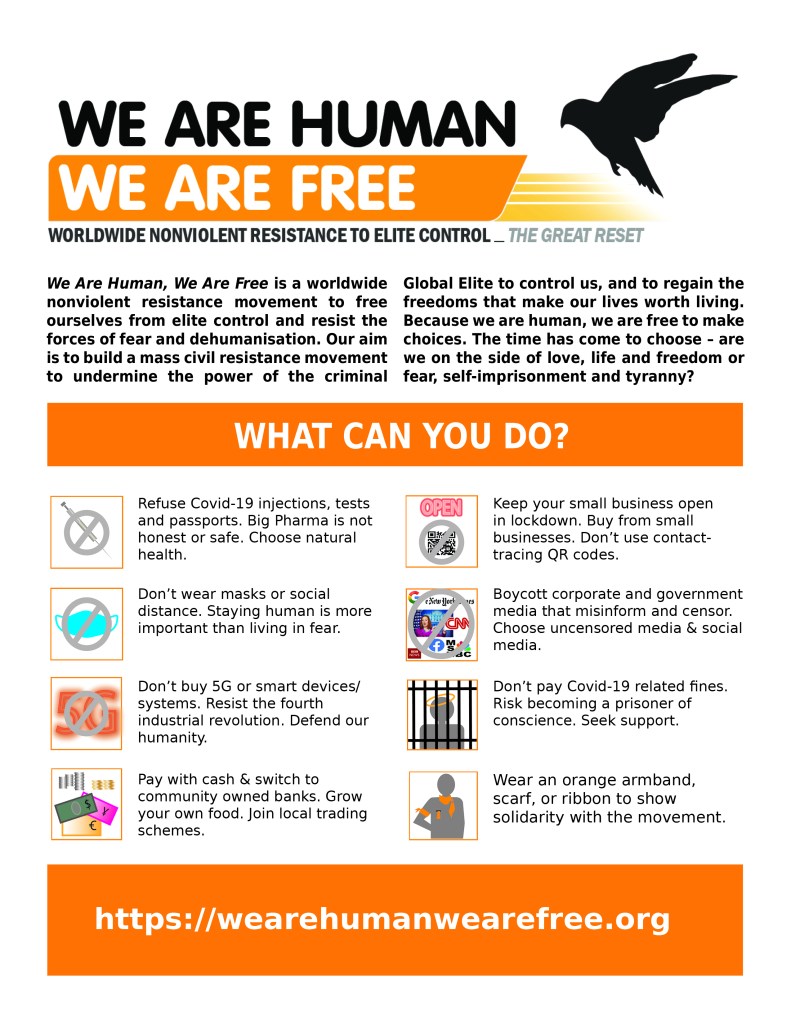
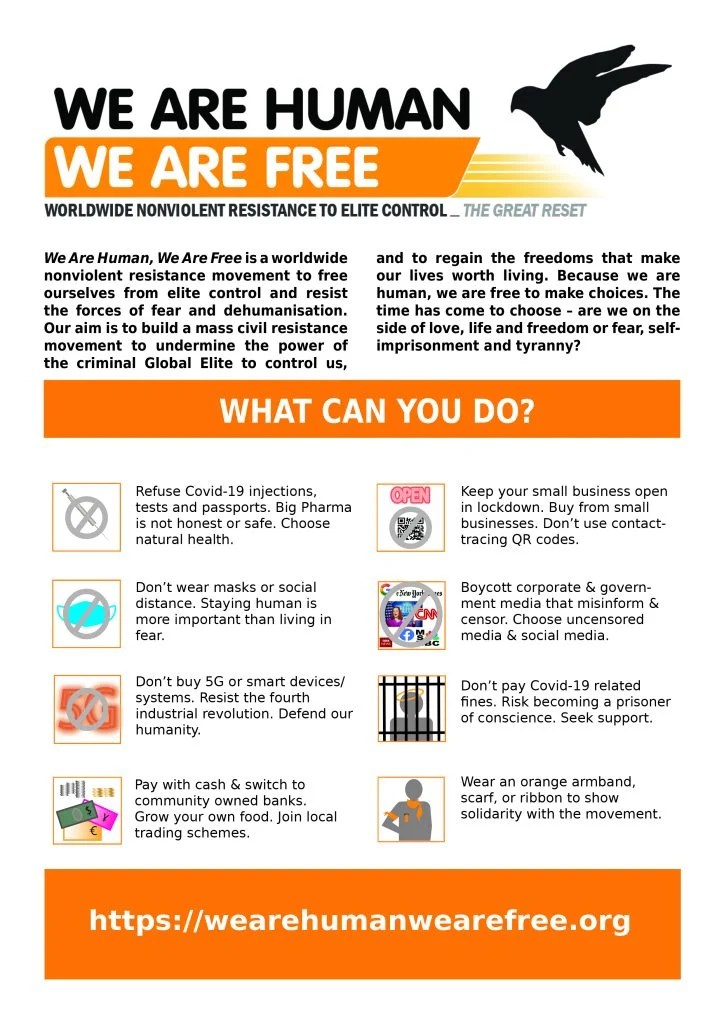
If you are interested in being strategic in your resistance to the ‘Great Reset’ and its related agendas, you are welcome to participate in the ‘We Are Human, We Are Free’ campaign which identifies a list of 30 strategic goals for doing so.

In addition and more simply, you can download a one-page flyer that identifies a short series of crucial nonviolent actions that anyone can take. This flyer, now available in 20 languages (Chinese, Czech, Danish, Dutch, English, Finnish, French, German, Greek, Hebrew, Hungarian, Italian, Japanese, Polish, Portuguese, Romanian, Russian, Serbian, Spanish & Slovak) with several more languages in the pipeline, can be downloaded from here:

‘The 7 Days Campaign to Resist the Great Reset’.

If this strategic resistance to the ‘Great Reset’ (and related agendas) appeals to you, consider joining the ‘We Are Human, We Are Free’ Telegram group (with a link accessible from the website).

And if you want to organize a mass mobilization, such as a rally, at least make sure that one or more of any team of organizers and/or speakers is responsible for inviting people to participate in this campaign and that some people at the event are designated to hand out the one-page flyer about the campaign.

If you like, you can also watch, share and/or organize to show, a short video about the campaign here:

‘We Are Human, We Are Free’ video.

Finally, while the timeframe for this to make any difference is now in doubt, if you want to raise children who are powerfully able to investigate, analyze and act, you are welcome to make

‘My Promise to Children’.

Conclusion

Resisting the digitization of your identity is an important element of effective resistance to the Elite’s ‘Great Reset’ program.

While there are some elements of this that are very difficult to avoid, such as facial recognition cameras that are virtually everywhere, it certainly includes not signing up for a digital identity or participating unthinkingly in those programs, such as using a QR code, getting a ‘vaccine passport’ or willingly submitting to efforts to palm-print or microchip you, that are linked to it.

But, as I have already noted, just resisting digitization of your identity is not enough.

We must strategically resist the foundational components of the Elite program.

The alternatives are death or slavery.
Robert J. Burrowes has a lifetime commitment to understanding and ending human violence. He has done extensive research since 1966 in an effort to understand why human beings are violent and has been a nonviolent activist since 1981. He is the author of ‘Why Violence?’ His email address is flametree@riseup.net and his website is here.
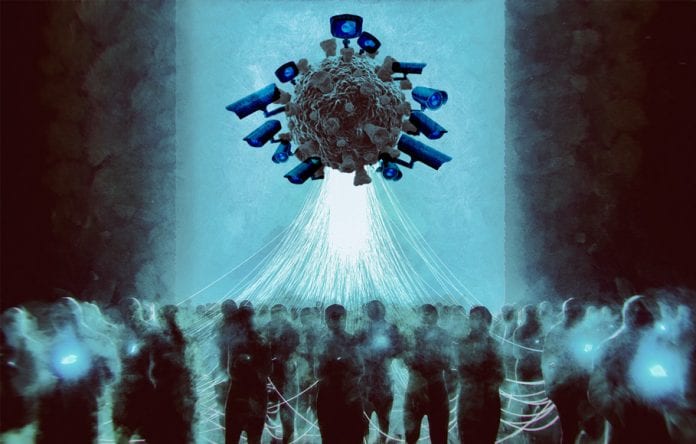
Digital Authoritarianism: AI Surveillance Signals the Death of Privacy

Illustration: Prathap Ravishankar

By John W. Whitehead & Nisha Whitehead

Source: The Rutherford Institute

“There are no private lives. This a most important aspect of modern life. One of the biggest transformations we have seen in our society is the diminution of the sphere of the private. We must reasonably now all regard the fact that there are no secrets and nothing is private. Everything is public.” ― Philip K. Dick

Nothing is private.

We teeter on the cusp of a cultural, technological and societal revolution the likes of which have never been seen before.

While the political Left and Right continue to make abortion the face of the debate over the right to privacy in America, the government and its corporate partners, aided by rapidly advancing technology, are reshaping the world into one in which there is no privacy at all.

Nothing that was once private is protected.

We have not even begun to register the fallout from the tsunami bearing down upon us in the form of AI (artificial intelligence) surveillance, and yet it is already re-orienting our world into one in which freedom is almost unrecognizable.

AI surveillance harnesses the power of artificial intelligence and widespread surveillance technology to do what the police state lacks the manpower and resources to do efficiently or effectively: be everywhere, watch everyone and everything, monitor, identify, catalogue, cross-check, cross-reference, and collude.

Everything that was once private is now up for grabs to the right buyer.

Governments and corporations alike have heedlessly adopted AI surveillance technologies without any care or concern for their long-term impact on the rights of the citizenry.

As a special report by the Carnegie Endowment for International Peace warns, “A growing number of states are deploying advanced AI surveillance tools to monitor, track, and surveil citizens to accomplish a range of policy objectives—some lawful, others that violate human rights, and many of which fall into a murky middle ground.”

Indeed, with every new AI surveillance technology that is adopted and deployed without any regard for privacy, Fourth Amendment rights and due process, the rights of the citizenry are being marginalized, undermined and eviscerated.

Cue the rise of digital authoritarianism.

Digital authoritarianism, as the Center for Strategic and International Studies cautions, involves the use of information technology to surveil, repress, and manipulate the populace, endangering human rights and civil liberties, and co-opting and corrupting the foundational principles of democratic and open societies, “including freedom of movement, the right to speak freely and express political dissent, and the right to personal privacy, online and off.”

The seeds of digital authoritarianism were planted in the wake of the 9/11 attacks, with the passage of the USA Patriot Act. A massive 342-page wish list of expanded powers for the FBI and CIA, the Patriot Act justified broader domestic surveillance, the logic being that if government agents knew more about each American, they could distinguish the terrorists from law-abiding citizens.

It sounded the death knell for the freedoms enshrined in the Bill of Rights, especially the Fourth Amendment, and normalized the government’s mass surveillance powers.

Writing for the New York Times, Jeffrey Rosen observed that “before Sept. 11, the idea that Americans would voluntarily agree to live their lives under the gaze of a network of biometric surveillance cameras, peering at them in government buildings, shopping malls, subways and stadiums, would have seemed unthinkable, a dystopian fantasy of a society that had surrendered privacy and anonymity.”

Who could have predicted that 50 years after George Orwell typed the final words to his dystopian novel 1984, “He loved Big Brother,” we would come to love Big Brother.

Yet that is exactly what has come to pass.

After 9/11, Rosen found that “people were happy to give up privacy without experiencing a corresponding increase in security. More concerned about feeling safe than actually being safe, they demanded the construction of vast technological architectures of surveillance even though the most empirical studies suggested that the proliferation of surveillance cameras had ‘no effect on violent crime’ or terrorism.”

In the decades following 9/11, a massive security-industrial complex arose that was fixated on militarization, surveillance, and repression.

Surveillance is the key.

We’re being watched everywhere we go. Speed cameras. Red light cameras. Police body cameras. Cameras on public transportation. Cameras in stores. Cameras on public utility poles. Cameras in cars. Cameras in hospitals and schools. Cameras in airports.

We’re being recorded at least 50 times a day.

It’s estimated that there are upwards of 85 million surveillance cameras in the U.S. alone, second only to China.

On any given day, the average American going about his daily business is monitored, surveilled, spied on and tracked in more than 20 different ways by both government and corporate eyes and ears.

Beware of what you say, what you read, what you write, where you go, and with whom you communicate, because it will all be recorded, stored and used against you eventually, at a time and place of the government’s choosing.

Yet it’s not just what we say, where we go and what we buy that is being tracked.

We’re being surveilled right down to our genes, thanks to a potent combination of hardware, software and data collection that scans our biometrics—our faces, irises, voices, genetics, microbiomes, scent, gait, heartbeat, breathing, behaviors—runs them through computer programs that can break the data down into unique “identifiers,” and then offers them up to the government and its corporate allies for their respective uses.

As one AI surveillance advocate proclaimed, “Surveillance is no longer only a watchful eye, but a predictive one as well.” For instance, Emotion AI, an emerging technology that is gaining in popularity, uses facial recognition technology “to analyze expressions based on a person’s faceprint to detect their internal emotions or feelings, motivations and attitudes.” China claims its AI surveillance can already read facial expressions and brain waves in order to determine the extent to which members of the public are grateful, obedient and willing to comply with the Communist Party.

This is the slippery slope that leads to the thought police.

The technology is already being used “by border guards to detect threats at border checkpoints, as an aid for detection and diagnosis of patients for mood disorders, to monitor classrooms for boredom or disruption, and to monitor human behavior during video calls.”

For all intents and purposes, we now have a fourth branch of government: the surveillance state.

This fourth branch came into being without any electoral mandate or constitutional referendum, and yet it possesses superpowers, above and beyond those of any other government agency save the military. It is all-knowing, all-seeing and all-powerful. It operates beyond the reach of the president, Congress and the courts, and it marches in lockstep with the corporate elite who really call the shots in Washington, DC.

The government’s “technotyranny” surveillance apparatus has become so entrenched and entangled with its police state apparatus that it’s hard to know anymore where law enforcement ends and surveillance begins.

The short answer: they have become one and the same entity. The police state has passed the baton to the surveillance state, which has shifted into high gear with the help of artificial intelligence technologies. The COVID-19 pandemic helped to further centralize digital power in the hands of the government at the expense of the citizenry’s privacy rights.

“From cameras that identify the faces of passersby to algorithms that keep tabs on public sentiment online, artificial intelligence (AI)-powered tools are opening new frontiers in state surveillance around the world.” So begins the Carnegie Endowment’s report on AI surveillance note. “Law enforcement, national security, criminal justice, and border management organizations in every region are relying on these technologies—which use statistical pattern recognition, machine learning, and big data analytics—to monitor citizens.”

In the hands of tyrants and benevolent dictators alike, AI surveillance is the ultimate means of repression and control, especially through the use of smart city/safe city platforms, facial recognition systems, and predictive policing. These technologies are also being used by violent extremist groups, as well as sex, child, drug, and arms traffickers for their own nefarious purposes.

China, the role model for our dystopian future, has been a major force in deploying AI surveillance on its own citizens, especially by way of its social credit systems, which it employs to identify, track and segregate its “good” citizens from the “bad.”

Social media credit scores assigned to Chinese individuals and businesses categorize them on whether or not they are worthy of being part of society. A real-name system—which requires people to use government-issued ID cards to buy mobile sims, obtain social media accounts, take a train, board a plane, or even buy groceries—coupled with social media credit scores ensures that those blacklisted as “unworthy” are banned from accessing financial markets, buying real estate or travelling by air or train. Among the activities that can get you labeled unworthy are taking reserved seats on trains or causing trouble in hospitals.

In much the same way that Chinese products have infiltrated almost every market worldwide and altered consumer dynamics, China is now exporting its “authoritarian tech” to governments worldwide ostensibly in an effort to spread its brand of totalitarianism worldwide. In fact, both China and the United States have led the way in supplying the rest of the world with AI surveillance, sometimes at a subsidized rate.

This is how totalitarianism conquers the world.

While countries with authoritarian regimes have been eager to adopt AI surveillance, as the Carnegie Endowment’s research makes clear, liberal democracies are also “aggressively using AI tools to police borders, apprehend potential criminals, monitor citizens for bad behavior, and pull out suspected terrorists from crowds.”

Moreover, it’s easy to see how the China model for internet control has been integrated into the American police state’s efforts to flush out so-called anti-government, domestic extremists.

According to journalist Adrian Shahbaz’s in-depth report, there are nine elements to the Chinese model of digital authoritarianism when it comes to censoring speech and targeting activists: 1) dissidents suffer from persistent cyber attacks and phishing; 2) social media, websites, and messaging apps are blocked; 3) posts that criticize government officials are removed; 4) mobile and internet access are revoked as punishment for activism; 5) paid commentators drown out government criticism; 6) new laws tighten regulations on online media; 7) citizens’ behavior monitored via AI and surveillance tools; 9) individuals regularly arrested for posts critical of the government; and 9) online activists are made to disappear.

You don’t even have to be a critic of the government to get snared in the web of digital censorship and AI surveillance.

The danger posed by the surveillance state applies equally to all of us: lawbreaker and law-abider alike.

When the government sees all and knows all and has an abundance of laws to render even the most seemingly upstanding citizen a criminal and lawbreaker, then the old adage that you’ve got nothing to worry about if you’ve got nothing to hide no longer applies.

As Orwell wrote in 1984, “You had to live—did live, from habit that became instinct—in the assumption that every sound you made was overheard, and, except in darkness, every movement scrutinized.”

In an age of too many laws, too many prisons, too many government spies, and too many corporations eager to make a fast buck at the expense of the American taxpayer, we are all guilty of some transgression or other.

No one is spared.

As Elise Thomas writes for Wired: “New surveillance tech means you’ll never be anonymous again.”

It won’t be long before we find ourselves looking back on the past with longing, back to an age where we could speak to whomever we wanted, buy whatever we wanted, think whatever we wanted, go wherever we wanted, feel whatever we wanted without those thoughts, words and activities being tracked, processed and stored by corporate giants, sold to government agencies, and used against us by militarized police with their army of futuristic technologies.

Tread cautiously: as I make clear in my book Battlefield America: The War on the American People and in its fictional counterpart The Erik Blair Diaries1984 has become an operation manual for the omnipresent, modern-day AI surveillance state.

Without constitutional protections in place to guard against encroachments on our rights when power, AI technology and militaristic governance converge, it won’t be long before Philip K. Dick’s rules for survival become our governing reality: “If, as it seems, we are in the process of becoming a totalitarian society in which the state apparatus is all-powerful, the ethics most important for the survival of the true, free, human individual would be: cheat, lie, evade, fake it, be elsewhere, forge documents, build improved electronic gadgets in your garage that’ll outwit the gadgets used by the authorities.”

Controlling The Savages: COVID, Lockdowns, Shortages, and The Great Reset

By Brandon Turbeville

Source: Activist Post

Who controls the food supply controls the people. Who controls the energy can control whole continues. Who controls money can control the whole world. – Henry Kissinger

Around 1868, the Indian Wars had briefly paused and the soon to be butchered treaties remained in force. However, the US Federal government and private interests were well aware that the “Indian Question” and “problem of the savages” was still unanswered. In other words, the “problem of the savages” was that the savages still existed. Those “savages” had been beaten back for years by the US regular army but they were not completely vanquished. In fact, despite being outmanned and outgunned and with little to no competition for the advancements in weaponry of the US Army, the Native Americans routinely routed the American military, at times slaughtering whole detachments.

But now that the secessionists had been dealt with, it became apparent that it was now time to remove the gloves from the iron fist of the coming settlements and that the Native Americans had to be annihilated, subjugated, or displaced from their native lands. Railroads, telegraphs, mines, and the like were all being hampered by the very existence of Native Americans.

Enter William Sherman, the general famous for his brutal March to the Sea, the burning of Atlanta, and the destruction of civilian infrastructure in the US Civil War. Say what you want about Sherman, the man knew how to win a war. He knew that breaking the backs of the civilian population and the ability of the society as well as military to sustain itself was a successful method of warfare. He also knew that the Native Americans relied upon buffalo for food and shelter and indeed their very survival. In a letter penned in 1868, he wrote that as long as the buffalo were alive, “Indians will go there. I think it would be wise to invite all the sportsmen of England and America there this fall for a Grand Buffalo hunt, and make one grand sweep of them all.”

And so it became unofficial Federal policy that the buffalo had to be extinguished in order to solve the vexing “Indian problem.” Over the next ten years, the buffalo were hunted by privateers, highly encouraged by the US government, to the point of near extinction. Where buffalo once numbered about 30 million, by the end of the 1800s, that number had been reduced to just a few hundred.

In Andrew C. Isenberg’s book, The Destruction Of The Bison, Isenberg writes of a reporter who asks a railroad worker, “Do the Indians make a living gathering these bones?’ Yes, replied a railroad inspector, ‘but it is a mercy that they can’t eat bones. We were never able to control the savages until their supply of meat was cut off.”

Fast forward to 2022. After nearly three years of COVID hysteria, lockdowns, economic disruptions, and schizophrenic government responses, the United States as a whole, as well as the rest of the world, is facing a food shortage. Claims that once belonged only to “preppers” and “conspiracy theorists” are now mainstream news items, with corporate media outlets reporting that some items may be in short supply or simply not available at all. All that is necessary is a brief internet search to see a myriad of mainstream reports of shortages of meat, vegetables, baby formula and many other staple items. Just a cursory walk around the local grocery store will reveal a fairly obvious shortage of many items though the pain is now mostly at the point of being an inconvenience moreso than a reason for panic. For now.

But talk of a food shortage is more than scattered news reports. Even the United Nations is warning of  one, but not just in the United States. The UN is warning of a global food shortage. As ABC News reports,

The head of the United Nations warned Friday that the world faces “catastrophe” because of the growing shortage of food around the globe.

U.N. Secretary-General Antonio Guterres said the war in Ukraine has added to the disruptions caused by climate change, the coronavirus pandemic and inequality to produce an “unprecedented global hunger crisis” already affecting hundreds of millions of people.

“There is a real risk that multiple famines will be declared in 2022,” he said in a video message to officials from dozens of rich and developing countries gathered in Berlin. “And 2023 could be even worse.”

Guterres noted that harvests across Asia, Africa and the Americas will take a hit as farmers around the world struggle to cope with rising fertilizer and energy prices.

“This year’s food access issues could become next year’s global food shortage,” he said. “No country will be immune to the social and economic repercussions of such a catastrophe.”

Notice that Gueterres also mentions the rising prices of fuel and fertilizer. This is something else that is being experienced worldwide, not just in the United States. Of course, Western media and the ruling party would have the population believe that Vladmir Putin is hoarding all the world’s gas via Ukraine, imposing restrictions and taxes on the vulnerable people of the United States who were on their way to energy independence just three short years. Now, however, they somehow woke up begging other countries for fuel, licking the boots of the Saudis, and blaming Vlad for the doubling of the price at the pump. Clearly, it has nothing to do with intentionally shutting off oil pipelines and punishing businesses and working people on behalf of the climate and faulty notion that man-made CO2 is causing temperatures to rise and the planet to reach a point of irreversible calamity.

Again, however, fuel prices aren’t just rising in the United States. They are rising across the world along with fertilizer and food costs and along with the price of just about any consumer good. Inflation, too – the hidden tax that is making itself well known in the United States – is popping up in the majority of countries across the globe. Who knew printing large amounts of money would cause that money to be worth less and thus cause prices to rise to compensate?

Living standards, too, are dropping all across the world with polio now rearing its head in the UK again for the first time since the 1980s. Polio, of course, is a disease that thrives on the low living standards and poor sanitation of the third world, a world which was partially imported to the UK all the while the standards of living (healthcare, sanitation, nutrition, etc.) have been gradually eroded. It’s not just the UK either. Living standards have been falling in the US for decades but accelerating recently. That is, of course, unless one chooses to believe silly “happiness indexes” repeated out of the UN to promote globalism and Free Trade policies.

Even basic services are falling apart. Labor shortages from pilots to the service industry are causing disruptions in the economy, rising prices, and chaos at airports. All happening globally.

Food shortages are happening globally. Food prices are rising globally. Fuel and fertilizer are rising globally. Living standards are falling globally. Inflation is rising globally. Labor shortages are global. Transportation is falling apart globally. See a pattern yet?

Everything disruption happening nationally is also happening globally. Are we expected to believe that every government across the world simply made the same stupid decisions at the same time? That none of them could figure out the source of the problem? Shouldn’t at least one of them have stumbled on the right path forward and lead the others through the mist? Or should we assume that there are more factors at play here and remember that anytime we see the same thing happening across the world at the same time agendas that are global in nature and have no respect for national boundaries are marching forward? I would argue the latter.

Keep in mind, all of these “global crises” came to be out of the “global pandemic,” itself at best an opportunity that was not allowed to go to waste. At worst, a global hoax designed to usher in the Great Reset. COVID, after all, is still a virus that has yet to be fully identified in a lab, yet the entire world was locked down at the same time, a prison planet brought in to being, upon this dubious evidence and weak justifications. Regardless, COVID’s biggest casualty was freedom.

None of the current crises have arisen on the basis of a chain of befuddled reactionaries acting in ignorant unison across the globe to an emerging “pandemic.” In fact, the only ones ignorant of the pandemic and coming responses were the unsuspecting civilians who willingly gave up their most basic rights over fear of a virus that has never been isolated in a lab and still is not able to be accurately tested for.

Still think COVID just surprised everyone in power as much as it did the unsuspecting citizens? Consider briefly how, in the months before the alleged pandemic arose, a simulation exercise was held at Johns Hopkins Center for Health Security in concert with the World Economic Forum and the Bill and Melinda Gates Foundation regarding the emergence of a global coronavirus pandemic that results in mass disruption of life and culture as we know it, economic chaos, and disruption of basic services.

As Tim Hinchcliffe wrote in his article, “A Timeline Of The Great Reset Agenda: From Foundation To Event 201 And The Pandemic of 2020,

On May 15, 2018, Johns Hopkins Center for Health Security hosted the “Clade X” pandemic exercise in partnership with the WEF.

The Clade X exercise included mock video footage of actors giving scripted news reports about a fake pandemic scenario

. . . . .

The Clade X event also included discussion panels with real policymakers who assessed that governments and industry were not adequately prepared for the fictitious global pandemic.

“In the end, the outcome was tragic: the most catastrophic pandemic in history with hundreds of millions of deaths, economic collapse and societal upheaval,” according to a WEF report on Clade X.

“There are major unmet global vulnerabilities and international system challenges posed by pandemics that will require new robust forms of public-private cooperation to address” — Event 201 pandemic simulation (October, 2019)

Then on October 18, 2019, in partnership with Johns Hopkins and the Bill and Melinda Gates Foundation, the WEF ran Event 201.

During the scenario, the entire global economy was shaken, there were riots on the streets, and high-tech surveillance measures were needed to “stop the spread.”

. . . . .

Two fake pandemics were simulated in the two years leading up to the real coronavirus crisis.

“Governments will need to partner with traditional and social media companies to research and develop nimble approaches to countering misinformation” — Event 201 pandemic simulation (October, 2019)

The Johns Hopkins Center for Health Security issued a public statement on January 24, 2020, explicitly addressing that Event 201 wasn’t meant to predict the future.

“To be clear, the Center for Health Security and partners did not make a prediction during our tabletop exercise. For the scenario, we modeled a fictional coronavirus pandemic, but we explicitly stated that it was not a prediction. Instead, the exercise served to highlight preparedness and response challenges that would likely arise in a very severe pandemic.”

Intentional or not, Event 201 “highlighted” the “fictional” challenges of a pandemic, along with recommendations that go hand-in-hand with the great reset agenda that has set up camp in the nefarious “new normal.”

“The next severe pandemic will not only cause great illness and loss of life but could also trigger major cascading economic and societal consequences that could contribute greatly to global impact and suffering” — Event 201 pandemic simulation (October, 2019)

Together, the Johns Hopkins Center for Health Security, the World Economic Forum, and the Bill and Melinda Gates Foundation submitted seven recommendations for governments, international organizations, and global business to follow in the event of a pandemic.

The Event 201 recommendations call for greater collaboration between the public and private sectors while emphasizing the importance of establishing partnerships with un-elected, global institutions such as the WHO, the World Bank, the International Monetary Fund, and the International Air Transport Organization, to carry out a centralized response.

. . . . .

One of the recommendations calls for governments to partner with social media companies and news organization to censor content and control the flow of information.

“Media companies should commit to ensuring that authoritative messages are prioritized and that false messages are suppressed including though [sic] the use of technology” — Event 201 pandemic simulation (October, 2019)

According to the report, “Governments will need to partner with traditional and social media companies to research and develop nimble approaches to countering misinformation.

“National public health agencies should work in close collaboration with WHO to create the capability to rapidly develop and release consistent health messages.

“For their part, media companies should commit to ensuring that authoritative messages are prioritized and that false messages are suppressed including though [sic] the use of technology.”

Sound familiar?

Throughout 2020, Twitter, Facebook, and YouTube have been censoring, suppressing, and flagging any coronavirus-related information that goes against WHO recommendations as a matter of policy, just as Event 201 had recommended.

Big tech companies have also deployed the same content suppression tactics during the 2020 US presidential election — slapping “disputed” claims on content that question election integrity.

Take a look at the predictions made by Event 201:

  • Governments implementing lockdowns worldwide
  • The collapse of many industries
  • Growing mistrust between governments and citizens
  • A greater adoption of biometric surveillance technologies
  • Social media censorship in the name of combating misinformation
  • The desire to flood communication channels with “authoritative” sources
  • A global lack of personal protective equipment
  • The breakdown of international supply chains
  • Mass unemployment
  • Rioting in the streets (see source)

Only the last two are yet to have checkmarks beside them, though mainstream economists are pointing toward September as a possible date for the mass unemployment. Surely, unless there is some inflationary printing by governments, the riots will then follow.

At the core of the COVID scam as well as the subsequent crises mentioned above is the ushering in of an entirely new society, that depicted by UN Agenda 21 and the Great Reset, itself the beginning of a global society reminiscent of that depicted in the The Hunger Games.

So what is the Great Reset? Essentially, the term comes from both a June 3, 2020 event sponsored by the WEF entitled The Great Reset which featured statements from leaders of the IMF, World Bank, and members of the corporate and banking sectors of the United States and UK as well as book written by Klaus Schwab, founder of the WEF, entitled COVID19: The Great Reset. Both the book and the event echoed the same sentiment, i.e. that the world economy must be shut down and “reset” in order to usher in a new economy based upon the ideals of Agenda 21 and the Green New Deal.

Hinchcliffe again, in a separate article, “’The Great Reset Will Dramatically Expand The Surveillance State Via Real-Time Tracking’: Ron Paul,” writes,

The overall goal of the WEF’s so-called great reset agenda has always been to reshape the global economy and revamp every aspect of society, with or without COVID.

Trust becomes a major concern when you realize that the idea of tracking and tracing every human being on the planet was already championed by the WEF Founder Klaus Schwab years before COVID-19 arrived on the scene.

Another concern is whether to believe that the lockdowns, the limited mobility, the destruction of small businesses, the crashing of the economy, the home evictions, and the largest transfer of wealth in the history of the world are all necessary to stop an “invisible enemy,” along with the subsequent curtailing of freedom that hasn’t been seen in the free world since the beginning of the so-called War on Terror.

“This digital identity determines what products, services and information we can access – or, conversely, what is closed off to us” — WEF report

According to Schwab, the post-COVID fourth industrial revolution will lead to “a fusion of our physical, our digital, and our biological identities.”

In his books, “COVID-19: The Great Reset,” (2020) and “The Fourth Industrial Revolution” (2017), Schwab envisioned a future of tracking and tracing every individual through digital identities connected to the Internet of Bodies (IoB) ecosystem.

For example, in “The Fourth Industrial Revolution,” Schwab noted:

Any package, pallet or container can now be equipped with a sensor, transmitter or radio frequency identification (RFID) tag that allows a company to track where it is as it moves through the supply chain—how it is performing, how it is being used, and so on.

In the near future, similar monitoring systems will also be applied to the movement and tracking of people.

. . . . .

The digital identity agenda picked-up speed throughout 2020, starting with contact tracing and continuing with immunity passports to monitor and control citizen mobility for the greater good.

After attempting to justify mass surveillance in the interest of public health and safety, Schwab wrote in “COVID-19: The Great Reset” that in the post-pandemic era “the genie of tech surveillance will not be put back in the bottle,” and that “dystopian scenarios are not a fatality.”

Below are just a few quotes from “COVID19: The Great Reset:”

Now that information and communication technologies permeate almost every aspect of our lives and forms of social participation, any digital experience that we have can be turned into a “product” destined to monitor and anticipate our behavior.

. . . . .

The pandemic could open an era of active health surveillance made possible by location-detecting smartphones, facial-recognition cameras and other technologies that identify sources of infection and track the spread of a disease in quasi real time.

. . . . .

Dystopian scenarios are not a fatality. It is true that in the post-pandemic era, personal health and wellbeing will become a much greater priority for society, which is why the genie of tech surveillance will not be put back into the bottle.

. . . . .

The combination of AI, the IoT and sensors and wearable technology will produce new insights into personal well-being. They will monitor how we are and feel, and will progressively blur the boundaries between public healthcare systems and personalized health creation systems – a distinction that will eventually break down.

Hinchcliffe also writes:

Between 2014 and 2017, the WEF called to reshape, restart, reboot, and reset the global order every single year, each aimed at solving various “crises.”

2014: WEF publishes meeting agenda entitled “The Reshaping of the World: Consequences for Society, Politics and Business.”

2015: WEF publishes article in collaboration with VOX EU called “We need to press restart on the global economy.”

2016: WEF holds panel called “How to reboot the global economy.”

2017: WEF publishes article saying “Our world needs a reset in how we operate.”

In 2020, the coronavirus was the catalyst needed to enact the great reset plan that had been bubbling under the surface for years, and immunity passports are just another step in the overall plan to track and trace every citizen through their digital identity.

Without digressing too far, I would suggest reading my article, “Social Media, Universal Basic Income, and Cashless Society: How China’s Social Credit System Is Coming To America,” to see just how far characters like Klaus would like to drag the world’s population. It truly is essential reading at this stage of the game.

One of the few statements made by the WEF related to its future goals was a bizarre article published by Forbes entitled, “ Welcome To 2030: I Own Nothing, Have No Privacy And Life Has Never Been Better,” where the WEF contributor describes a futuristic society (eight years away) that resembles a feudalist communist utopia where there is no such thing as privacy or private property and AI runs society. The article is so bizarre because, while it attempts to paint a utopia, even the fictional narrator can’t seem to keep from sounding like a brainwashed cult member. It reads

My biggest concern is all the people who do not live in our city. Those we lost on the way. Those who decided that it became too much, all this technology. Those who felt obsolete and useless when robots and AI took over big parts of our jobs. Those who got upset with the political system and turned against it. They live different kind of lives outside of the city. Some have formed little self-supplying communities. Others just stayed in the empty and abandoned houses in small 19th century villages.

Once in a while I get annoyed about the fact that I have no real privacy. Nowhere I can go and not be registered. I know that, somewhere, everything I do, think and dream of is recorded. I just hope that nobody will use it against me.

All in all, it is a good life. Much better than the path we were on, where it became so clear that we could not continue with the same model of growth. We had all these terrible things happening: lifestyle diseases, climate change, the refugee crisis, environmental degradation, completely congested cities, water pollution, air pollution, social unrest and unemployment. We lost way too many people before we realized that we could do things differently.

Combined with the Social Credit System, UBI, and digital passports, UN Agenda 21, mentioned above, the next step after the world’s economic and cultural systems are “reset,” will be implemented, creating what is essentially a global version of the Soviet Union, gulags and all. For those who are unaware, UN Agenda 21 is an established and published plan developed by the United Nations Department of Economic and Social Affairs, Division for Sustainable Affairs. The plan, according to the UN website, is a “comprehensive plan of action to be taken globally, nationally and locally by organizations of the United Nations system, government, and major groups, in every area in which humans have impact on the environment.”

The plan essentially calls for government control of all land, where human and animal lifestyle and activity is strictly limited and controlled, humans rounded up into “habitat areas,” and individual rights are a thing of the past. Travel will be restricted to essential vehicles only and diet will be mandated by the dictates of the “needs” of the environment.

This is precisely why we are seeing chaos at airports for lack of pilots, why the supply chain is broken and why food is becoming scarce. This is not by accident. In fact, food-processing facilities have been burned,vandalized, and rendered inoperable all across the United States in seemingly random acts. But how random are they? Did a sudden mass psychosis take hold which prodded people into carrying out attacks against food-processing facilities? Or, again, is there an agenda afoot?

Is it any coincidence that the very goals set forth by Agenda 21 and the Great Reset have been met one by one in the last two years?

  • Economic shutdown and “reset” – COVID Lockdowns and furloughs, artificial labor shortages.
  • Food shortages – disruption of supply chain by lockdowns, labor shortage, “random” attacks on    food facilities, destruction of crops, culling of farm animals, rising fuel prices.
  • Restriction of travel – rising fuel prices, fewer cars functional due to trade disruption, harder to find parts, COVID travel restrictions, vaccine passports, digital monitoring of travel, pilot  shortages.
  • Loss of individual rights – slow burn for decades but COVID lockdowns, vaccine passports,   travel restrictions, right to gather all drastically infringed upon under “emergency measures” have eviscerated the concept of individual rights.
  • Unemployment – global economy already struggling before COVID, after the “pandemic,” however, many businesses simply disappeared.

But there is some light in all this. Where many people simply panicked at the outset of the “pandemic” and willingly gave up their rights and their critical thinking skills, the subsequent infringement upon their daily lives for such a sustained amount of time with little to no logical standards for actually preventing disease, many eventually began opening their eyes to the fact that another agenda was being put in place. In fact, more people than ever before have begun to openly question and oppose what their governments are doing in the name of keeping them safe and healthy.

So, after two years of having their most basic rights shredded and destroyed, the savages have become restless. They’ve started to realize that the treaties of the status quo between themselves and the global ruling glass were not being honored and so they began to question the legitimacy of that ruling class. They voted, they protested, they demonstrated, and refused to comply.

And what is the response of the ruling class? “We were never able to fully control the savages until their supply of meat was cut off.” It’s not very inventive but it is effective. So the question dear reader is, if you are a savage and your meat supply is being cut off, what should you do? Well, ask yourself what should the native Americans have done? I’ll leave that up to you but, I think you already know the answer.

UNCONSCIOUS BECOMING CONSCIOUS: UNDERSTANDING THE NATURE OF NEGATIVE FORCES

By Kingsley L. Dennis

Source: Waking Times

What people of the fifth post-Atlantean epoch must learn to recognise is the fully conscious struggle against the evil rising up in the evolution of humanity.’ ~Rudolf Steiner, 18 November 1917

According to Austrian metaphysician Rudolf Steiner, the task of humanity in this epoch is to comprehend the relation of good and evil; especially, the human choice between good and evil, and the challenge of evil to make humanity more aware of spirit-consciousness. In our present age, we are to experience the negative counterforces in order to move through to greater development. Steiner stated that the ‘forces of evil’ exist in the world so that humanity might, at the appropriate time, break through into a ‘life of the spirit.’[1]

The presence of the counterforces gives humanity an opportunity to gain insight into the human condition, as well as the life conditions in this earthly domain. By having some understanding of the intention of opposing forces, a person is better prepared for continuing their own journey. That is, we each can learn from our encounters with negating forces; we can take these encounters as an opportunity to connect more strongly with our own force of will. In the words of philosopher Sergei O. Prokofieff:

In addition to working intensely on oneself, especially with regard to eradicating falsehood of any kind and all aspects of fear, together with all overt and secret inclinations towards materialism – something different is required, namely, a working together of human beings in the social realm that is based on spiritual principles.[2]

In advocating the coming together of spiritually minded people, it is not our responsibility to be concerned with those who Steiner called the ‘soulless’ ones. Rather than being pulled into the influence of such people (with their lower vibrational energies), it is more beneficial for a person to transform their immediate environment into a more harmonious energy. Another way of saying this is that the presence of negativity is to be transmuted into that which is not negative or counterproductive. This is akin to an alchemical procedure.

The 21st century is a transformatory epoch, where we shall have to face our shadows and deal with them. Without this acknowledgement, and cleansing, we will be dominated by the forces of stagnation. Later, when this catharsis or ‘cleansing’ has been achieved, we may collectively move into a stage of transmutation where the negative is transmuted into constructive forces. The spirit of our times, therefore, is one of transmutation and transformation. And until counterforces are transmuted, there is no real or lasting transformation. This ‘transmutation of the negative/shadow’ is the leitmotif of our epoch, and it cannot be done without passing through ‘the valley of the shadow of death;’[3] experiencing and, above all, understanding both the forces of negation and those of development. As author Terry Broadman writes:

In saying that, we immediately meet a paradox, because we need to recognise that without the resistance posed to our development by these counterforces, there would be no human freedom possible and therefore, ultimately no possibility for love either. No great drama, especially the great drama of the story of mankind, is possible without the challenge from forces of darkness within us.[4]

By casting light upon those forces that oppose human freedom, we may also see that, somewhat paradoxically, it is these same forces that make freedom possible. And yet, we need to gain this realization so we can know what we are up against.

Entropic counterforces attempt to control and manage human thinking and cultural narratives through arid materialism – the forces of limitation, indifference, rational logic, and consumption, for example. Such arid forces seek to constrain and contain human thinking by limiting it to the physical domain. That is, by negation and denial of the metaphysical background to life; a worldview that recognises no spirit-consciousness or genuine inspiration from beyond the material realm. It can be said that such counter-evolutionary forces wish to ensure that humanity remains at the level of the ‘lower ego;’ that is, our base level ‘everyday’ selves, ruled by passions, possessions, promises, and pseudo-truths. We have already seen how modern life is rife with the self-centred materialist concerned only for their physical pleasures and gains.

This is the false-polished underbelly of a capitalist-fed globalist agenda. This is the sphere where the tightly controlled culture industry provides ultimate dissonance through glamour-distraction. Cacophonous music, jarring rhythms, and discordant lyrics appeal to the basest impulses within the tranced modern listener. It is little wonder then that there is resistance to those people who wish to develop their inner senses and modes of perception. The everyday environment is not conducive to the development of spirit-consciousness. And yet, it is the role of awakened individuals to assist the unconscious in becoming conscious.

Entropic forces can be regarded as forces of hindrance. For various reasons, they have not fulfilled their developmental potentials; they have faltered in their path, and thus ‘fallen by the wayside.’ And as wayside creatures, they hinder and disrupt all other wanderers and walkers upon the path. It can be said that they belong to our realm but are no longer upon our developmental path. Such counterforces are not creative; that is, they are not a creative principle in the universe, and so they need to make use of – or usurp – existing impulses to be able to act in the physical world. Such forces operate by distorting, and demonising, other processes and/or vessels in order to function.

We need to be aware of those beliefs, idealisms, organizations, groupings, etc, that show a deliberate antipathy and hostility towards aspects of spirit-consciousness and the metaphysical. These may be collective, and/or concealed, forces aiming to divert humanity’s path of growth. The materialistic route is a caricature of what now needs to be the human being’s present state. Total materialization, including the digital-virtual domains (such as the Metaverse) represent a paralysis of growth in spirit-consciousness. A total materialization of human consciousness is taking place across the world and is especially dominant within the technologically advanced nations.

Modern life has been turned upon itself to become a parody. Nothing can be taken at face value for the outer expressions have become corrupted. Pseudo-truths are the caricature of relative truths; deep fakes are the travesty of genuine selves; and the lines between knowing and unknowing have been deliberately smeared. The outer life, on its own, exists as a tarnished kingdom. The only thing to do is to extract oneself from this polluting sphere and to re-wire one’s alignments, attachments, and allegiances. In previous epochs, the human being’s inner authority was undermined by subjugating it to exterior bodies of authority – such as institutionalized religions.

When the masses moved out of illiteracy and became educated enough to read, research, and learn for themselves, the exterior forms of authority shifted from the sacred to the secular. Secular institutions came to regulate social norms, thinking patterns, and modes of accepted behaviour. In present times, as conscious awareness and perceptive understanding expands rapidly, the exterior bodies of authority are attempting to gain leverage by gaining interior access to our bodies and minds – what I have referred to as the new forms of biopower. These interventions into the physical integrity of the human being have serious consequences for the natural expression of spirit-consciousness. If the human vessel is unbalanced, or bio-chemically – or even genetically – interfered with, then the incarnated spirit-consciousness will have trouble in manifesting within the physical.

This intervention can be taken to the extreme through advancements in the biological-genetic sciences. The process of human cloning is a further step in this domain. If a physical body is cloned, then it is basically manufactured – it has not been brought into life through an organic birthing process (regardless of how the fertilized egg was delivered into the female body). In a metaphysical sense, it can be said that the physical body is not capable of receiving spirit-consciousness for it is not vibrationally aligned. It is an empty vessel, in a spiritual sense. From this, it may be inferred that other entities or forces could inhabit such a physical vessel. Why is human science increasingly moving towards the automation, the techno-hybrid, the slicing and dicing with DNA and human genetics? In this, there is a shift toward splintering the human being from its metaphysical origins and from the domain of spirit. If anything, this is the definition of evil – the isolation of the physical from its metaphysical source.

The counter-developmental forces are acting against the human mind (psyche), the heart (emotions), and the body (will). These three aspects can be related to imagination, inspiration, and intuition. And these three aspects have been targets for manipulation for quite some time. In our current age, the imagination is targeted through the media, video games, propaganda, digital life, and augmented reality, for example. The faculties of inspiration are being distorted through a controlled culture-industry (music, literature, art). And the intuition is deadened through a weakening of the human will as well as interventions and violations against the physical body. All these forces aim to press down upon the human being in a way that increases its immersion in materiality whilst bringing forth more animalistic, or primitive drives. How much more difficult it is for spirit-consciousness to come into a life experience, only to find that everything is subordinated to a material perspective – a world that is almost oblivious to the reality of the spirit.

The more a person comes under the powers of this world, under the laws set within this materiality, the less a person can act from an inner place of personal and spiritual will. A human being can no longer truly become their essential self if they are wholly invested in a consensus reality that is averse to metaphysical truths. As Christ famously stated: ‘My Kingdom is not of this world.’ (John 18:36) Although not of this world, it must work in this world. Our point of interaction – participation and action – are within this world, yet our foundation does not originate from within this world. And this combination, this merger, is what creates a strength to be in this world and not to be worn down by it.

The expression of spirit-consciousness is a fusion – and the human being is the vessel (the receptor as well as the carrier). Being the carrier for that which is also beyond the physical means also that the person needs to strengthen their interior world – their inner environment. A fully exteriorized person is too much attached with events and influences of the material world, and this can become a hindrance. There needs to be enough capacity within each person to exercise internal creative imaginations so that received inspirations have a vessel, a protected space, in which to gestate before outward expression. A ‘new world’ can come into being, yet it must come through the human being and not to be forced upon it. This is why it is said that a new world is birthed rather than built. The outer actions may be that of building, yet the initial impulses are birthed from within. It is in this way that metaphysical influences can enter into the domain of the physical – through receptive individuals.

The act of transmuting counteractive forces into constructive ones requires that humanity shifts from a place of outward dominance, under the sway of external influences, and into spaces of inward receptivity to inspirational impulses. In this, it can be said that the transformative process is one of the unconscious becoming conscious.

Virtual Beauty, Virtual Freedom, Virtual Love: Is the Metaverse Our Future?

By Robert J. Burrowes

When is the last time you were outside in the morning to experience a glorious dawn? Or sat watching the sun set across the ocean horizon?

How do you feel when you touch the skin of someone you love? A grandparent, parent, lover or child?

Have you ever seen a spider’s web full of morning dew, or after the rain, when the sun is shining through the droplets in the web to reveal the flashing diamonds, sapphires, rubies and emeralds hidden within?

Have you ever stood in a natural environment – a beach, desert, rainforest… – far from a city and noticed that strange and subtle feeling of freedom tremor through your body?

Have you ever marveled at the breath of wind that cools your face on a hot Summer’s day? Or been intoxicated by the smell of blossom in Spring?

Have you gaped in wonder at the birth of new life: a chick pecking out of its shell, a seed germinating or a baby being born?

Or paused to ponder the sheer magic of being alive yourself?

Or do you find life in the real physical world too constricting, painful, frightening and demanding: something from which you seek to escape, with some distraction or another (work, television, sport, a novel, a drug…), as often as you can?

Well, very soon now, we are promised, you will be able to escape reality far more effectively than those primitive means of distraction made possible previously. And far more effectively than even the outcomes promised in those dystopian novels.

So the fundamental questions we must ask ourselves are simple: Do you want real life, with all of the pains, sorrows, fear and fury that go along with beauty, freedom and love? Or do you believe what they tell us and want everything unpleasant to go away? Permanently. And to live in delusion thereafter, given synthetic versions of all of the pleasant feelings and experiences described above?

Remember the dialogue between the Savage and Mustapha Mond during the closing stages of Aldous Huxley’s dystopian novel Brave New World?

‘But I don’t want comfort. I want God, I want poetry, I want real danger, I want freedom, I want goodness. I want sin.’

‘In fact,’ said Mustapha Mond, ‘you’re claiming the right to be unhappy.’

‘All right then,’ said the Savage defiantly, ‘I’m claiming the right to be unhappy.’

‘Not to mention the right to grow old and ugly and impotent; the right to have syphilis and cancer; the right to have too little to eat; the right to be lousy; the right to live in constant apprehension of what may
happen to-morrow; the right to catch typhoid; the right to be tortured by unspeakable pains of every kind.’

There was a long silence.

‘I claim them all,’ said the Savage at last.

Well, after nearly one hundred years, the dystopian future described by Huxley is almost upon us and, if we are to defeat it, we need a lot more ‘savages’ willing to forego the promised ‘comforts’.

Because if those who see themselves as our global masters get their way, we are about to enter a virtual world that will become more complete by the day and from which there will be no escape.

The Metaverse

Based on many years of effort, the World Economic Forum (WEF) has recently launched its plan to create our new all-digital world, called the ‘metaverse’. See ‘Defining and Building the Metaverse’.

So if you find natural phenomena – ranging from rainforests, beaches and weather variations to ill-health, danger and unhappiness – annoying, you will soon be able to escape them, compliments of the metaverse. Or so we are promised. And you won’t be troubled by anything resembling what might be called ‘free will’ either. You will be content to do as you are told, even more than you are content to do already. See ‘Terrified of Freedom: Why Most Human Beings are Embracing the Global Elite’s Technotyranny’.

After all, your mind will no longer be your own. And while the usual descriptions, written by elite agents, fail to mention it, a quick flash of metaverse-induced fear will make sure that you comply, whatever you are required to do. The point is this: You won’t be escaping all of those unpleasant feelings after all. They can just be used to control you more directly, to fulfill an elite-determined purpose. But that is a fact they are not advertising.

In their iconic hit song ‘In the Year 2525’, written in 1964 by Rick Evans and later recorded by he and Denny Zager to become a No.1. hit around the world in 1969, Evans captured key elements of what is already upon us somewhat ahead of the schedule mapped out in the song.

[Chorus 2]
In the year 3535
Ain’t gonna need to tell the truth, tell no lies
Everything you think, do, and say
Is in the pills you took today

[Chorus 3]
In the year 4545
Ain’t gonna need your teeth, won’t need your eyes
You won’t find a thing to chew
Nobody’s gonna look at you

[Chorus 4]
In the year 5555
Your arms are hanging limp at your sides
Your legs got nothing to do
Some machine’s doing that for you

[Chorus 5]
In the year 6565
Ain’t gonna need no husband, won’t need no wife
You’ll pick your sons, pick your daughters too
From the bottom of a long glass tube
Whoa-oh-oh

So what is the Metaverse?

According to the WEF: ‘The metaverse is a future persistent and interconnected virtual environment where social and economic elements mirror reality. Users can interact with it and each other simultaneously across devices and immersive technologies while engaging with digital assets and property.’ See ‘Defining and Building the Metaverse’.

Moreover, ‘if technologists are right that 2022 will separate thinkers from builders, then last years’ technical advances will produce this year’s first steps towards making the metaverse a reality….

‘But from the perspective of the human experience, one development stands out above all others: extended reality (XR) technologies. These include virtual reality (VR), augmented reality (AR), and brain-computer interfaces (BCI), which together position themselves as the next computing platforms in their own right.’

Nevertheless, it is clear that a precise definition of the term ‘metaverse’ (for a start: is it a product, service, place or moment in time?), upon which there is broad agreement even among those who routinely use the term, is yet to emerge. See ‘3 technologies that will shape the future of the metaverse – and the human experience’.

Having written that, here is one definition elaborated in the article above that reveals just how far some of those heavily involved in this work have become disconnected from any sense of themselves and, hence, reality: ‘Specifically, the metaverse is the moment at which our digital lives – our online identities, experiences, relationships, and assets – become more meaningful to us than our physical lives.’ The original quotation can be read here: ‘Spheres of Self: Performativity and Parasociality in the Metaverse’.

And, as Cathy Li describes it, the metaverse is ‘most useful as a lens through which to view ongoing digital transformation. The belief is that virtual worlds, incorporating connected devices, blockchain and other tech, will be so commonplace that the metaverse will become an extension of reality itself.’ See ‘Who will govern the metaverse?

Let me reiterate two points from the paragraphs immediately above: ‘our digital lives… become more meaningful to us than our physical lives.’ And ‘the metaverse will become an extension of reality itself.’

Really?

While statements such as these reveal the breathtaking level of insanity that underpins this entire enterprise – see ‘The Global Elite is Insane Revisited’ – it does not mean that we are not under enormous threat. Just as vast arsenals of nuclear weapons, by some insane ‘logic’, are supposed to provide us with ‘security’ while actually threatening the existence of all life on Earth, the metaverse is part of a substantial package of measures that will reduce human life to one not worth living.

Why? Well, as noted by authors such as Tom Valovic: The metaverse is one element in the path to implementing technocratic governance over all of humanity.

‘As Planet Earth and our physical world continue to experience massive biospheric degradation and disruption, the elites that are now in many cases pulling the strings of governance at the country level are heading for the exit doors. Elon Musk and Jeff Bezos are exploring the realm of space and Musk has a Mars mission planned. Globally oriented elites… looked out for themselves which is what they do best….

‘Paralleling the notion of space flight as a form of existential escapism is the metaverse. So what if our cities are crumbling, infrastructures falling apart, and the biosphere is seriously degrading? So what if our wasteful consumer-driven lifestyle has created unprecedented levels of pollution so extensive that it’s now the number one cause of health problems globally? No problem… we’ll just kick back and don our Meta headsets (or worse get a brain implant) and escape into an artificially fabricated world that lets us turn our back on the massive ecological and environmental problems we now face.’ See ‘Why We Should Reject Mark Zuckerberg’s Dehumanizing Vision of a “Metaverse”’.

‘Education’ in the Metaverse

Of course, the metaverse is deeply interwoven with other components of their plan, such as those in relation to what they call ‘education’, which is more accurately described as the process by which young transhuman slaves are programmed to perform their function in the technocratic economy that is being imposed upon us. Of course, ‘education’ sounds better than ‘virtual programming of young transhuman slaves’ so, in the interests of not raising obvious concerns, the word ‘education’ has been used.

As noted by Dr. Michael Nevradakis, discussions on this subject at the recent gathering of the World Economic Forum emphasized the importance of virtual reality (VR) and artificial intelligence (AI) technologies with participants touting the purported educational and economic benefits that would derive from use of these technologies in the classroom by helping, according to Dr. Ali Saeed Bin Harmal Al Dhaheri & Dr. Mohamad Ali Hamade, to ‘increase accessibility, enhance quality and improve the affordability of education globally’. See ‘Experiential learning and VR will reshape the future of education’.

However, as Nevradakis also noted, these discussions had ‘little to say about the need to protect children’s data or digital identities – or, for that matter, providing the types of early-life experiences children require as part of their socialization.’ See ‘Future of Education? WEF’s Vision – Heavy on Virtual Reality and AI Technologies, Light on Privacy Concerns’.

Of course, there is no need for concern about the ‘early-life experiences’ of those young transhumans who are being programmed for decades of servitude prior to being terminated when they are no longer functional.

Beyond claimed educational and economic benefits, however, some authors argue that digitalizing education can play a role in easing pressures on the environment and climate. How so? Nevradakis again: ‘Indeed, the WEF said the use of “textbooks, notebooks and pencils as critical learning tools” is on the way out, due to “environmental pressures and COP26 goals (from the 2021 United Nations Climate Change Conference),” which “will drive the digitalizing of education streams.”’ See ‘Future of Education? WEF’s Vision – Heavy on Virtual Reality and AI Technologies, Light on Privacy Concerns’

But it is clearly delusional to suggest that the use of textbooks, notebooks and pencils has greater adverse impact on the environment and climate than the environmental cost and climate impact of producing sophisticated technology for each student. And despite claims of ‘improved affordability’ it is equally delusional to ignore the economic and social cost, for example, to the child ‘laborers’ in the Congo working in appalling conditions to extract strategic minerals to produce this technology. See ‘Humanity’s “Dirty Little Secret”: Starving, Enslaving, Raping, Torturing and Killing our Children’.

Besides, as touched on below, education is already a monstrous experience, destroying the Selfhood of the child so that they become submissively obedient. Removing the bulk of education’s remaining social component by technologizing it can only make it even worse.

Babies in the Metaverse

Then again, maybe ‘children’ will no longer be put through school. It simply won’t be necessary because children, for transhuman slaves at least, will no longer exist.

By 2070, the metaverse will offer you virtual babies, ‘environmentally-friendly digital children’, according to UK artificial intelligence (AI) expert Catriona Campbell. ‘Parents will see and interact with their offspring through next-generation AR [augmented reality] glasses and haptic gloves.’ The latter devices enable users to experience ‘a realistic sense of touch when handling virtual or holographic objects’. As a bonus, these children take up no space, cost nothing to feed and remain healthy, if that is what you want, for as long as they are programmed to ‘live’. A subscription might cost as little as $25 each month.

And if this seems like a monumental leap out of reality to you, Campbell also believes that ‘within 50 years technology will have advanced to such an extent that babies which exist in the metaverse are indistinct from those in the real world…. As the metaverse evolves, I can see virtual children becoming an accepted and fully embraced part of society in much of the developed world.’ See ‘“Virtual babies” who grow up in real time will be commonplace by 2070, expert predicts’.

That’s right, Campbell is claiming that ‘within 50 years… babies which exist in the metaverse are indistinct from those in the real world’! Pause a moment. How does that sound to you?

Just in case you cannot wait, you are welcome to start using early versions now. See, for example, Virtual Baby, Adopt a Virtual Baby and My Virtual Child.

Oh, and by the way, you won’t be having sex either, whether for reproductive purposes or otherwise. You will prefer virtual sex. See ‘Sex And Pornography Aim To Strike Gold In The Metaverse’.

Critiquing the Metaverse

Beyond the criticisms already noted above, there are a great many other criticisms of the metaverse and the role it will play in the overall elite program being implemented under what the WEF calls its ‘Great Reset’. This comprehensive program will transform human society and human life for those people left alive after the eugenics component has been fully implemented. See ‘The Final Battle for Humanity: It is “Now or Never” in the Long War Against Homo Sapiens’.

If you like, you can read a little more about what the masters of this metaverse intend for us, as well as critiques of it, by authors such as these.

Derrick Broze: While some people ‘may not intend for The Metaverse to become an all encompassing reality that supersedes physical reality, for the Zuckerbergs, Microsofts, and WEFs of the world, that is exactly what they intend for The Metaverse…. For the billionaire class and their puppet organizations, such as the WEF and the United Nations, the Metaverse offers up the potential to commandeer all life into digital prisons where the people can be charged for services and products in the digital realm…. With the people of the world safely tucked into their digital beds, the Technocrats could complete their total takeover of natural resources, the economy, and humanity itself.’ See ‘The Great Narrative And The Metaverse, Part 2: Will The Metaverse End Human Freedom?

Dr. Michael Nevradakis: ‘Who will govern the “metaverse”?… According to the WEF, “real-world governance models” represent one possible option for metaverse governance. However, far from referring to constitutionally defined institutions of governance, with checks and balances, the WEF cites Facebook’s “Oversight Board” as an example of such a “real-world governance model.”’ See ‘WEF Launches “Metaverse” Initiative, Predicts Digital Lives Will Become “More Meaningful to Us Than Our Physical Lives”’.

But an earlier World Economic Forum report from its Global Redesign Initiative was more blunt: ‘The report postulates that a globalized world is best managed by a coalition of multinational corporations, governments (including through the UN system) and select civil society organizations (CSOs).’ See Sustainable Development Goals and Human Rights p. 209, citing ‘Everybody’s Business: Strengthening International Cooperation in a More Interdependent World’.

So if you believe that you and I are destined to have a say in the metaverse that is unfolding, you would be wise to keep investigating. Elite proposals are invariably very distant from the type of governance models usually considered by ‘ordinary’ people in a multiplicity of contexts, where the emphasis is on facilitating widespread grassroots participation, not rule by technocrats.

You can read considerably more about what our technocratic overlords have in mind – including the existing trade in such things as virtual real estate, virtual clothing and virtual art – and what is wrong with it, in the articles on the metaverse published by Patrick Wood on ‘Technocracy News & Trends’: ‘Metaverse’. And there is more in articles such as these: ‘The Top 10 Creepiest and Most Dystopian Things Pushed by the World Economic Forum (WEF)’ and ‘How Our Lives Could Soon Look”: The World Economic Forum Posts An Insane Dystopian Video’.

And here’s another simple issue to ponder. Remember how I mentioned above that a quick flash of metaverse-induced fear would ensure that you complied with an elite-determined directive, how does the idea of eating bugs, processed sewage and human flesh appeal? Well, given that your mind will no longer be your own, what appeals now, or doesn’t, will be irrelevant once the metaverse is determining how you perceive things. See ‘Canadian Company Pledges To Produce TWO BILLION BUGS Per Year For Human Consumption’ and ‘Will You Eat Cultured Meat Grown From Human Cells?’

You will eat ‘Soylent Green’ because that is what the program tells you.

So why are people embracing the Metaverse?

In a recent article in which he described taking his son to watch a film through 3D glasses, Charles Eisenstein noted ‘The on-screen reality was so vivid, stimulating and intense that it made the real world seem boring by comparison.’ See ‘Transhumanism and the Metaverse’.

How can this happen?

Because we terrorize our children into submissive obedience, devoid of the unique and powerful individual Self they were gifted by evolution at birth. See ‘Why Violence?’,‘Fearless Psychology and Fearful Psychology: Principles and Practice’and ‘Do We Want School or Education?’ Why? Essentially to keep them performing tasks that bore them senseless throughout their school and working life.

Fundamentally, this terrorization works because it compels our children into suppressing awareness of how they feel. As a result, only the most intense experiences register emotionally: The capacity to experience a subtle feeling has been lost. And without this capacity, they cannot develop into the powerful, courageous Self-willed individuals that evolution intended. They are human relics. Ready and willing to be turned into a transhuman slave in the unconscious hope they will be finally able to experience, in the metaverse, what was taken from them in the real world as a child.

But they won’t get that experience, even in the metaverse. It is not what the elite has in mind for us.

Resisting the Metaverse

Of course, the metaverse is just one feature of the Global Elite agenda that is being imposed upon us. And it is not enough to resist individual features of the ‘Great Reset’ program. We must strategically resist its most fundamental elements so that the entire agenda is defeated.

If you are inclined to join those strategically resisting the ‘Great Reset’ and its related agendas, you are welcome to participate in the ‘We Are Human, We Are Free’  campaign which identifies a list of 30 strategic goals for doing so.

In addition and more simply, you can download a one-page flyer that identifies a short series of crucial nonviolent actions that anyone can take. This flyer, now available in 17 languages (Czech, Danish, Dutch, English, Finnish, French, German, Greek, Hebrew, Hungarian, Italian, Polish, Romanian, Russian, Serbian, Spanish & Slovak) with more languages in the pipeline, can be downloaded from here: ‘The 7 Days Campaign to Resist the Great Reset’.

If strategically resisting the ‘Great Reset’ (and related agendas) appeals to you, consider joining the ‘We Are Human, We Are Free’ Telegram group (with a link accessible from the website).

And if you want a child who is powerfully able to perceive the dysfunctional lure of the metaverse, and is able to join you in resisting it, consider making ‘My Promise to Children’.

CONCLUSION

So, for just a little longer, the choice is yours.

You can live your life with all its challenges and problems, joys and achievements. Or you can live the virtual life that someone else programmed for you, including whatever comes with it that they didn’t tell you about.

In short, like Neo in the film ‘The Matrix’, you have a choice. You can choose the Blue Pill and proceed to live in a synthesized, fictional, computer-generated world. Or you take the Red Pill and, in this case, join the fight with those of us determined to defend the real world and avert descent into the metaverse.

But you must make that choice while you still have free will.

So you must make that choice soon.

Biodata: Robert J. Burrowes has a lifetime commitment to understanding and ending human violence. He has done extensive research since 1966 in an effort to understand why human beings are violent and has been a nonviolent activist since 1981. He is the author of ‘Why Violence?’ His email address is flametree@riseup.net and his website is here.

Saturday Matinee: Lo and Behold

Lo and Behold, Reveries of the Connected World

A bold and multidimensional documentary about the glories and the drawbacks of the Internet.

By Frederic and Mary Ann Brussat

Source: Spirituality & Practice

Werner Herzog is an inimitable documentary filmmaker whose curiosity, wonder and awe for the mysteries and eccentricities of our world is unbounded. One of the hallmarks of his work is his unmistakable voice-overs (with a distinctive German accent) which serve as the narrative threads holding the materials together. Here are five of his most recent documentaries which illustrate the diversity of themes that interest him:

  • Cave of Forgotten Dreams: A 3-D tour of the Chauvet Cave which houses art that is 30,000 years old.
  • Encounters at the End of the World: A visually stunning documentary about the scientists, dreamers, adventurers, philosophers, and creatures of Antarctica.
  • Grizzly Man: A mesmerizing documentary about a young man obsessed with grizzly bears in the Alaskan wilderness.
  • Into the Abyss: A daring examination of capital punishment filled with small and humble human touches.
  • Wheel of Time: An exotic look at a Buddhist ritual held in Bodh Gay, India, and Graz, Austria in 2002 that attracted thousands of pilgrims.

In Lo and Behold, Reveries of the Connected World, Herzog tackles the complex, controversial, and mysterious Internet. He refers to this technological tool as “one of the greatest revolutions” in human history. This bold and multidimensional film is divided into 10 chapters:

  • The Early Days
  • The Glory of the Net
  • The Dark Side
  • Life without the Net
  • The End of the Net
  • Earthly Invaders
  • Internet on Mars
  • Artificial Intelligence
  • The Internet of Me
  • The Future

Here you will discover a breadth of material that ranges from the very serious to the extremely quirky and odd. Herzog begins with a terse history of the Internet’s beginnings at U.C.L.A. during the 1960s. Leonard Kleinrock, a professor of computer science, takes us into the “holy room” where the first Internet computer remains. He recalls his feelings when a message was transmitted from this computer to the Stanford Research Institute on October 29, 1969. Programmers were on the phone confirming that the login was happening. Stanford replied that they had received the “L” and the “o.” Then its computer crashed. So the first Internet message was “Lo.” This documentary chronicles what happened beyond that.

Danny Hillis, another scientist, reminisces about a time when all the users of this technology could be identified in one directory. Now, he states, the global directory would be 72 miles thick. Another statistic which stands out is: “Today, about 3.2 billion people use the internet around the world.” Herzog chimes in that CDs containing a single day’s worth of global data would stretch “to Mars and back.”

Here are some observations made in interviews with computer and robot specialists, hackers, technicians, programmers, gamers, and professors.

  • Elon Musk, the entrepreneur behind Telsa, is now interested in colonizing Mars; he also reflects on cyberwarfare or other earth catastrophes.
  • Kevin Mitnick, a legendary hacker, reveals the mayhem and the mischief that can take place by those who can get into large computer systems; cyberwarfare now puts smaller states on the same level as larger ones.
  • Joydeep Biswas, an engineer who has put together a robotic soccer team, shows how they work together and even reveals his favorite robot player.
  • Sebastian Thrun, an online-learning pioneer, notes that self-driving cars can all learn from the collective experiences of other cars and their mistakes, unlike human drivers.

Also included is an account of abusive cyber behavior ending with a mother calling the Internet “a work of the Devil” after pictures of her dead child were widely circulated online. Herzog talks with several persons who are sensitive to electromagnetic waves and get radiation sickness; they now live in an isolated area totally off the grid. A segment on video-game addicts reveals that many of them have completely stopped being present to the real world; some have developed blood clots in their legs after sitting so long at their computers. Astronomers explain that a large solar flare, which has not happened in many years, could disrupt Internet communication worldwide, affecting all the food supply, water and other systems supporting modern life.

In a telling scene, we see a group of Buddhist monks standing in front of a city skyline and the question is posed, “Have the monks stopped meditating?” We see that they are not bowing their heads in prayer or meditation. All of them are totally focused on their cell phones. Herzog quotes a startling statistic: There will be 31 billion devices connected to the Internet by 2020.

A famous New Yorker cartoon by Peter Steiner shows two dogs by a computer. The caption reads: “On the Internet, nobody knows you’re a dog.” It’s good for a laugh, and it’s also a reminder that Internet technology is raising many spiritual questions. Who are you? Where do you really live? And who are your companions? Don’t miss this thought-provoking documentary!

The War in Ukraine Marks the End of the American Century. “What’s Left is a Steaming Pile of Dollar Denominated Debt”

By Mike Whitney

Source: Global Research

“The ferocity of the confrontation in Ukraine shows that we’re talking about much more than the fate of the regime in Kiev. The architecture of the entire world order is at stake.” Sergei Naryshkin, Director of Russia’s Foreign Intelligence.

***

Here’s your ‘reserve currency’ thought for the day: Every US dollar is a check written on an account that is overdrawn by 30 trillion dollars.

It’s true. The “full faith and credit” of the US Treasury is largely a myth held together by an institutional framework that rests on a foundation of pure sand. In fact, the USD is not worth the paper it is printed onit is an IOU flailing in an ocean of red ink.

The only thing keeping the USD from vanishing into the ether, is the trust of credulous people who continue to accept it as legal tender.

But why do people remain confident in the dollar when its flaws are known to all? After all, America’s $30 trillion National Debt is hardly a secret, nor is the additional $9 trillion that’s piled up on the Fed’s balance sheet. That is a stealth debt of which the American people are completely unaware, but they are responsible for all the same.

In order to answer that question, we need to look at how the system actually works and how the dollar is propped up by the numerous institutions that were created following WW2. These institutions provide an environment for conducting history’s longest and most flagrant swindle, the exchange of high-ticket manufactured goods, raw materials and hard-labor for slips of green paper with dead presidents on them.

One can only marvel at the genius of the elites who concocted this scam and then imposed it wholesale on the masses without a peep of protest. Of course, the system is accompanied by various enforcement mechanisms that swiftly remove anyone who tries to either break free from the dollar or, God help us, create an alternate system altogether. (Saddam Hussein and Muammar Qaddafi come to mind.) But the fact is– aside from the institutional framework and the ruthless extermination of dollar opponents– there’s no reason why humanity should remain yoked to a currency that is buried beneath a mountain of debt and whose real value is virtually unknowable.

It wasn’t always like this. There was a time when the dollar was the strongest currency in the world and deserved its spot at the top of the heap. Following WW1, the US was “the owner of the majority of the world’s gold” which was why an international delegation “decided that the world’s currencies would no longer be linked to gold but could be pegged to the U.S. dollar, “because the greenback was, itself, linked to gold.” Here’s more from an article at Investopedia:

“The arrangement came to be known as the Bretton Woods Agreement. It established the authority of central banks, which would maintain fixed exchange rates between their currencies and the dollar. In turn, the United States would redeem U.S. dollars for gold on demand….

The U.S dollar was officially crowned the world’s reserve currency and was backed by the world’s largest gold reserves thanks to the Bretton Woods Agreement. Instead of gold reserves, other countries accumulated reserves of U.S. dollars. Needing a place to store their dollars, countries began buying U.S. Treasury securities, which they considered to be a safe store of money.

The demand for Treasury securities, coupled with the deficit spending needed to finance the Vietnam War and the Great Society domestic programs, caused the United States to flood the market with paper money….

The demand for gold was such that President Richard Nixon was forced to intervene and de-link the dollar from gold, which led to the floating exchange rates that exist today. Although there have been periods of stagflation, which is defined as high inflation and high unemployment, the U.S. dollar has remained the world’s reserve currency.” (“How the U.S. Dollar Became the World’s Reserve Currency”, Investopedia)

But now the gold is gone and what’s left is a steaming pile of debt. So, how on earth has the dollar managed to preserve its status as the world’s preeminent currency?

Proponents of the dollar system, will tell you it has something to do with “the size and strength of the U.S. economy and the dominance of the U.S. financial markets.” But that’s nonsense.

The truth is, reserve currency status has nothing to do with “the size and strength” of America’s post-industrial, service-oriented, bubble-driven, third-world-sh**hole economy. Nor does it have anything to do with the alleged safety of US Treasuries” which– next to the dollar– is the biggest Ponzi flim-flam of all time.

The real reason the dollar has remained the world’s premier currency is because of the cartelization of Central Banking.

The Western Central Banks are a de facto monopoly run by a small cabal of inter-breeding bottom-feeders who coordinate and collude on monetary policy in order to preserve their maniacal death-grip on the financial markets and the global economy. It’s a Monetary Mafia and– as George Carlin famously said: “You and I are not in it. You and I are not in the big club.” Bottom line: It is the relentless manipulation of interest rates, forward guidance and Quantitative Easing (QE) that has kept the dollar in its lofty but undeserved spot.

But all that is about to change due entirely to Biden’s reckless foreign policy which is forcing critical players in the global economy to create their own rival system. This is a real tragedy for the West that has enjoyed a century of nonstop wealth extraction from the developing world.

Now– due to the economic sanctions on Russia– an entirely new order is emerging in which the dollar will be substituted for national currencies (processed through an independent financial settlement system) in bilateral trade deals until– later this year– Russia launches an exchange-traded commodities-backed currency that will be used by trading partners in Asia and Africa.

Washington’s theft of Russia’s foreign reserves in April turbo-charged the current process which was further accelerated by banning of Russia from foreign markets. In short, US economic sanctions and boycotts have expanded the non-dollar zone by many orders of magnitude and forced the creation of a new monetary order.

How dumb is that? For decades the US has been running a scam in which it exchanges its fishwrap currency for things of genuine value. (oil, manufactured goods and labor) But now the Biden troupe has scrapped that system altogether and divided the world into warring camps.

But, why?

To punish Russia, is that it?

Yes, that’s it.

But, if that’s the case, then shouldn’t we try to figure out whether the sanctions actually work or not before we recklessly change the system?

Too late for that. The war on Russia has begun and the early results are already pouring in. Just look at the way we’ve destroyed Russia’s currency, the ruble. It’s shocking! Here’s the scoop from an article at CBS:

“The Russian ruble is the best-performing currency in the world this year….

Two months after the ruble’s value fell to less than a U.S. penny amid the swiftest, toughest economic sanctions in modern history, Russia’s currency has mounted a stunning turnaround. The ruble has jumped 40% against the dollar since January.

Normally, a country facing international sanctions and a major military conflict would see investors fleeing and a steady outflow of capital, causing its currency to drop….

The ruble’s resiliency means that Russia is partly insulated from the punishing economic penalties imposed by Western nations after its invasion of Ukraine…” (“Russia’s ruble is the strongest currency in the world this year“, CBS News)

Huh? You mean the attack on the ruble didn’t work after all?

Sure looks that way. But that doesn’t mean the sanctions are a failure. Oh, no. Just at look at the effect they’ve had on Russian commodities. Export receipts are way-down, right? Here’s more from CBS:

“Commodity prices are currently sky-high, and even though there is a drop in the volume of Russian exports due to embargoes and sanctioning, the increase in commodity prices more than compensates for these drops,” said Tatiana Orlova, lead emerging markets economist at Oxford Economics.

Russia is pulling in nearly $20 billion a month from energy exports. Since the end of March, many foreign buyers have complied with a demand to pay for energy in rubles, pushing up the currency’s value.” (“Russia’s ruble is the strongest currency in the world this year“, CBS News)

You’re kidding me? You mean the ruble is surging and Putin is raking in more dough on commodities than ever before?

Yep, and it’s the same deal with Russia’s trade surplus. Take a look at this excerpt from an article in The Economist:

“Russia’s exports… have held up surprisingly well, including those directed to the West. Sanctions permit the sale of oil and gas to most of the world to continue uninterrupted. And a spike in energy prices has boosted revenues further.

As a result, analysts expect Russia’s trade surplus to hit record highs in the coming months. The IIF reckons that in 2022 the current-account surplus, which includes trade and some financial flows, could come in at $250bn (15% of last year’s GDP), more than double the $120bn recorded in 2021. That sanctions have boosted Russia’s trade surplus, and thus helped finance the war, is disappointing, says Mr Vistesen. Ms Ribakova reckons that the efficacy of financial sanctions may have reached its limits. A decision to tighten trade sanctions must come next.

But such measures could take time to take effect. Even if the EU enacts its proposal to ban Russian oil, the embargo would be phased in so slowly that the bloc’s oil imports from Russia would fall by just 19% this year, says Liam Peach of Capital Economics, a consultancy. The full impact of these sanctions would be felt only at the start of 2023—by which point Mr Putin will have amassed billions to fund his war.” ( “Russia is on track for a record trade surplus”, The Economist)

Let me get this straight: The sanctions are actually hurting the US and helping Russia, so the experts think we should impose more sanctions? Is that it?

Precisely. Now that we have shot ourselves in the foot, the experts think it would be wise to shoot the other one too.

Am I the only one who is struck by the insanity of this policy? Check out this clip from an article at RT:

Russia could earn a record $100 billion from gas sales to European countries in 2022 due to the sharp rise in energy prices, French newspaper Les Echos reported this week, citing Citibank analysts.

According to the paper, the projected income from gas sales will be almost twice as much as last year. The analysis does not take into account profits from the sale of other Russian commodities, such as oil, coal, and other minerals.

Les Echos reports that, despite sanctions and warnings of a sweeping embargo on Russian energy, the 27 EU countries continue to send roughly $200 million per day to Gazprom.”(“Russian gas revenues projected to hit new highs”, RT)

So the revenues from gas and oil sales are literally flooding Moscow’s coffers like never before. Meanwhile, energy prices in the EU and America have skyrocketed to 40-year highs.

Can you see how counterproductive this policy is?

The EU is sinking into recession, supply lines have been severely disrupted, food shortages are steadily emerging, and gas and oil prices are through-the-roof. By every objective standard, the sanctions have not only failed, but backfired spectacularly. Can’t the Biden people see the damage they’re doing? Are they completely divorced from reality?

Imagine if the Ukrainians use Biden’s new artillery battery (HIMARS) to shell cities in Russia? Then what?

Then Putin takes off the gloves and shuts off the flow of hydrocarbons to Europe immediately. That’s what’s going to happen if Washington continues to escalate. You can bet on it. If Russia’s “Special Military Operation” suddenly becomes a war, the lights across Europe will go dark, homes will begin to freeze, factories will go silent, and the continent will slide headlong into a protracted and painful depression.

Does anyone in Washington think about these things or are they all so drunk on their own press clippings they’ve completely lost touch with reality?

Here’s more from an article at RT:

“Even as the collective West continues to insist – against all observable reality – that the conflict in Ukraine is going well for Kiev, major media outlets are becoming increasingly uneasy with the situation on the economic front. More and more observers are admitting that the embargoes imposed by the US and its allies aren’t crushing the Russian economy, as originally intended, but rather their own.

“Russia is winning the economic war,” the Guardian’s economics editor Larry Elliott declared on Thursday. “It is now three months since the west launched its economic war against Russia, and it is not going according to plan. On the contrary, things are going very badly indeed,” he wrote…

In a May 30 essay, Guardian columnist Simon Jenkins also said that the embargo had failed…

As Jenkins points out, the sanctions have actually raised the price of Russian exports such as oil and grain – thus enriching, rather than impoverishing, Moscow while leaving Europeans short of gas and Africans running out of food.” (“As sanctions fail to work and Russia’s advance continues, Western media changes its tune on Ukraine”, RT)

Did you catch that part about “Russia winning the economic war”? What do you think that means in practical terms?

Does it mean that Washington’s failed attempt to maintain its global hegemony by “weakening” Russia is actually putting enormous strains on the Transatlantic Alliance and NATO that will trigger a re-calibration of relations leading to a defiant rejection of the “rules-based system.”

Is that what it means? Is Europe going to split with Washington and leave America to sink beneath its $30 trillion ocean of red ink?

Yes, that’s exactly what it means.

Uncle Sam’s 30 Year Bender

Proponents of Washington’s proxy-war have no idea of the magnitude of their mistake or how much damage they are inflicting on their own country. The Ukraine debacle is the culmination of 30 years of bloody interventions that have brought us to a tipping point where the nation’s fortunes are about to take a dramatic turn-for-the-worse. As the dollar-zone shrinks, standards of living will plunge, unemployment will soar, and the economy will go into a downward-death spiral.

Washington has greatly underestimated its vulnerability to catastrophic geopolitical blowback that is about to bring the New American Century to a swift and excruciating end.

A wise leader would do everything in his power to pull us back from the brink.

Livelihoods in a Degrowth Economy

By Charles Hugh Smith

Source: Of Two Minds

Let’s consider livelihood options in an unsustainable economy of extremes that are unraveling, an economy that is being forced to transition to Degrowth.

Nassim Taleb’s book Antifragile explains the differences between fragile systems (systems that cannot survive instability), resilient systems (systems that can survive instability and stay the same) and antifragile systems (systems that adapt and emerge stronger).

The ideal way of life is antifragile: resilient enough to survive adversity and adaptable enough to evolve solutions to whatever comes our way.

The key antifragile traits are adaptability and rapid, flexible evolution. Adversity puts selective pressure on organisms: only those organisms which adapt successfully survive.

The more antifragile our livelihood and way of life, the better prepared we will be to recognize and pursue opportunities.

An unsustainable, unstable economy puts a great deal of pressure on its participants. Only those with the skills and agency to move, adapt and experiment will emerge stronger.

Adaptability requires agency. Those without much control are stuck with the consequences of others’ decisions and actions.

In my experience, self-reliance is integral to an antifragile way of life.Self-reliance and self-sufficiency are similar but not identical.

Self-sufficiency means reducing our dependence on resources provided by others: growing our own food, doing our own repairs, etc. Self-sufficiency can also be understood as shortening dependency chains.

Compare being dependent on food shipped thousands of miles to relying mostly on food grown within 50 miles of home. There are so many ways long supply chains can break down because the entire system breaks down if even one link in the dependency chain breaks.

Total self-sufficiency isn’t practical. We all rely on industrial production of metals, tools, plastics, fertilizers, etc. But reducing our dependence on systems that are fragile by consuming less and wasting nothing increases our antifragility.

Self-reliance is being able to take care of oneself, being independent in thought and action, and maintaining control of decision-making–what I’ve been calling agency.

Self-reliance means being able to go against the crowd. This requires independence and confidence in one’s inner compass.

Being able to take care of oneself means drawing upon inner resources, being able to identify the essentials of a situation and coming up with solutions that are within reach.

Since households with multiple incomes are far more resilient than households with all their eggs in one basket, our goal is to develop income streams that we control. The ownership is more important than the scale of the income. A modest income we control is far more antifragile than a larger income we have little control over.

Developing income streams is easier if we approach the task with an entrepreneurial mindset.

This mindset looks at work in terms of markets, unmet demand, pricing power, networks of trustworthy peers, trial and error (experiments), optimizing new skills, seeking mentors, learning to make clear-eyed assessments of what’s working and what isn’t, and then acting decisively on the conclusions.

All these skills can be developed. They are very useful in navigating unstable conditions because they prepare us to act decisively rather than passively await others to decide what happens to us.

Some skills can be applied to virtually every field: project management, bookkeeping, working well with others, computer skills and communicating clearly. Being a fast learner is valuable in every field.

In my books and blog posts, I’ve covered the difference between tradable work–work that can be done anywhere–and untradable work, work that can only be done locally. Having skills that are untradable is advantageous, as the competition is local rather than global.

Skills that can’t be automated are also advantageous. Robots are optimized for repetitive tasks and factory / warehouse floors with sensors. They are not optimized for tasks that must be figured out on the fly and that require multiple skills.

Who fixes the robot when it fails out in the field? Another robot? Who replaces the dead battery in the drone? Another drone? The point is there are real-world limits on robotics, artificial intelligence, machine learning and automation that proponents gloss over or ignore.

Those with multiple skills who can problem-solve on the fly will continue to be valuable.

The models of work are changing, and this offers a wider range of options which is especially valuable to those emerging from burnout.

Combining various kinds and modes of work is called hybrid work. This could be mixing work from home (remote work) with occasional visits to an office, or it could be mixing a part-time job with self-employment.

I’ve written about one example in Japan called Half Farmer, Half X, where young urban knowledge workers move to the countryside to pursue small-scale farming while keeping a part-time, high-pay tech job they do online. Since the cost of living is so much lower in the countryside, these hybrid workers don’t need to work many hours remotely to cover their expenses, nor do they need their small-scale farming to be highly profitable.

Not all work is paid. Indeed, only a slice of human work globally is paid. The work that gives us the greatest fulfillment may well be unpaid or poorly paid. We may have to do some work to pay the bills while looking forward to the work we do that doesn’t earn much money.

Personally, I have always been drawn to both knowledge work and hands-on work. I worked my way through my university with a part-time job in construction. This was the ideal mix for my enthusiasms. Whenever I’ve been limited to one or the other, I feel dissatisfied. For me, hybrid work means having both knowledge work and hands-on physical labor, and having control of both.

Many people believe they need additional credentials to expand their opportunities. The alternative is to accredit yourself.

Since I’m enthusiastic about working with fruit trees and vegetable gardens, let’s say I decide to offer my services to potential customers.

One avenue is to spend money and time to get a certificate in horticulture. Alternatively, I could take photos of my own yard to document the trees I planted and how fast they’ve grown under my care. In other words, I could accredit myself, providing direct evidence of my skills and experience.

Employers have learned that completing a credential doesn’t mean the graduate will be productive. The diploma doesn’t prove the graduate learned much or has what it takes to work well with others.

The diploma actually tells us very little about the graduate. We learn much more from someone who accredits themselves by documenting projects they’ve completed.

The only real source of prosperity is improving productivity: doing more with fewer resources and labor. Economists expected the adoption of computers and the Internet to boost productivity. Instead, productivity gains have been extremely modest, 1% or 2% per year, far lower than the 10% annual gains achieved during industrialization.

This productivity paradox has puzzled economists for decades. One reason why the productivity of knowledge work ((white-collar work) has barely improved when compared to factory productivity (blue-collar work) is the methodical optimization of tasks is more difficult to apply to knowledge work. Much of this work is done by rule of thumb and what was passed down by senior workers.

There are a number of reasons for this. One is it’s easier to study the assembly of products than it is to break down the production of services.

Another is that many fields of knowledge work are so new that it’s difficult to optimize tasks because they’re constantly changing.

A third factor is that we’ve been wealthy enough to waste labor and capital on unproductive bureaucratic friction. Just as we waste water when it’s abundant and free, we also waste energy and money when they’re abundant.

In Global Crisis, National Renewal I describe the changes in the process of obtaining a building permit in the past 40 years.

In the early 1980s, I could submit a set of plans for a modest house in the morning and pick up the approved plans and building permit that afternoon. Now the process takes many months, even though the house being built hasn’t changed much at all. What changed was the permit approval process became terribly inefficient.

Since there’s few incentives to improve efficiencies in bureaucracies, it now takes a decade or longer to approve a bridge or landfill While the number of professors and doctors has increased modestly, the number of university and hospital administrators has soared.

Now that energy will no longer be cheap over the long term, incentives to improve the productivity of knowledge work will increase.

Unsustainable economies are prone to sudden changes in finance and the availability of essentials. We’re accustomed to predictable stability, and so few are prepared to respond effectively to instability.

If our lives only work when things are stable, our way of life is fragile. Recall Sun Tzu’s advice: “If a battle cannot be won, do not fight it.” If we’re only prepared for everything to stay the same, we’re fighting a battle we can’t win. We want to be prepared for sudden changes and scarcities by planning ahead and being flexible, nimble and responsive.

One facet of being antifragile is having a buffer or cushion against sudden shocks. In a 2018 interview, Nassim Taleb said, “Money can’t buy happiness, but the absence of money can cause unhappiness. Money buys freedom… to choose what you want to do professionally.”

Taleb went on to note that it takes great discipline to keep enough money stashed to give us the freedom to maintain our agency when faced with adversity. Self-reliance requires a buffer so we have time to figure out solutions and the means to pursue them.

In my experience, our willingness to consider all options, our ability to make careful decisions and take decisive action are just as important as a cushion of cash. Cash widens our options, but if we’re frozen by inexperience and fear then our options are severely limited.

The wider our range of skills, the greater our opportunities to add value. The basic needs of human life must be met and so those who can meet those needs will always be valued. This range of skills is also a buffer because it gives us more options in adversity.

How much money do we need as a cushion? The less we need, the lighter our expenses and the more options we have. If we need $10,000 a month just to pay our basic expenses, that demands a large cushion. If we’ve simplified and downsized our way of life so $1,000 a month is enough to keep us going, our cushion can be much smaller.

In other words, frugality, self-reliance and simplicity are key parts of antifragility, for they lower the cost of freedom. Money can lose its value in crisis, but our buffer of skills and self-reliance cannot be taken from us or devalued by a global crisis.

One final consideration is timing. The sooner we start preparing for degrowth, the better off we’ll be. A Chinese proverb captures this succinctly: By the time you’re thirsty, it’s too late to dig a well.