The Real Reason U.S. Government Targets Whistleblowers

BHO Prosecutes Whistleblowers_thumb[1]

I’ve mentioned in past posts such as this my thoughts on reasons behind the government’s war on whistleblowers, and it has nothing to do with protecting national security (except in the sense of protecting criminals working within the national security state). Recently, Washington’s Blog supported this view in greater detail with an abundance of documentation and the following commentary:

…Indeed, the worse the acts by officials, the more they say we it must be covered up … for “the good of the country”.

…Obviously, the government wants to stop whistleblowers because they interfere with the government’s ability to act in an unaccountable manner. As Glenn Greenwald writes:

It should not be difficult to understand why the Obama administration is so fixated on intimidating whistleblowers and going far beyond any prior administration – including those of the secrecy-obsessed Richard Nixon and George W Bush – to plug all leaks. It’s because those methods are the only ones preventing the US government from doing whatever it wants in complete secrecy and without any accountability of any kind.

But whistleblowers also interfere with the government’s ability to get away with hypocrisy. As two political science professors from George Washington University (Henry Farrell and Martha Finnemore) show, the government is so hell-bent to punish Manning and Snowden because their leaks are putting an end to the ability of the US to use hypocrisy as a weapon:

The U.S. establishment has often struggled to explain exactly why these leakers [Manning, Snowden, etc.] pose such an enormous threat.

The deeper threat that leakers such as Manning and Snowden pose is more subtle than a direct assault on U.S. national security: they undermine Washington’s ability to act hypocritically and get away with it. Their danger lies not in the new information that they reveal but in the documented confirmation they provide of what the United States is actually doing and why. When these deeds turn out to clash with the government’s public rhetoric, as they so often do, it becomes harder for U.S. allies to overlook Washington’s covert behavior and easier for U.S. adversaries to justify their own.

As the United States finds itself less able to deny the gaps between its actions and its words, it will face increasingly difficult choices — and may ultimately be compelled to start practicing what it preaches. Hypocrisy is central to Washington’s soft power — its ability to get other countries to accept the legitimacy of its actions — yet few Americans appreciate its role.

Manning’s and Snowden’s leaks mark the beginning of a new era in which the U.S. government can no longer count on keeping its secret behavior secret. Hundreds of thousands of Americans today have access to classified documents that would embarrass the country if they were publicly circulated. As the recent revelations show, in the age of the cell-phone camera and the flash drive, even the most draconian laws and reprisals will not prevent this information from leaking out. As a result, Washington faces what can be described as an accelerating hypocrisy collapse — a dramatic narrowing of the country’s room to maneuver between its stated aspirations and its sometimes sordid pursuit of self-interest. The U.S. government, its friends, and its foes can no longer plausibly deny the dark side of U.S. foreign policy and will have to address it head-on.

The era of easy hypocrisy is over.

Professors Farrell and Finnemore note that the government has several options for dealing with ongoing leaks. They conclude that the best would be for the government to actually do what it says.

What a novel idea …

As examples of the hypocrisy Farrell and Finnemore were talking about, Washington’s Blog listed the following:

  • Labeled indiscriminate killing of civilians as terrorism. Yet the American military indiscriminately kills innocent civilians (and see this), calling it “carefully targeted strikes”. For example, when Al Qaeda, Syrians or others target people attending funerals of those killed – or those attempting to rescue people who have been injured by – previous attacks, we rightfully label it terrorism. But the U.S. government does exactly the same thing (more), pretending that it is all okay
  • Scolded tyrants who launch aggressive wars to grab power or plunder resources. But we ourselves have launched a series of wars for oil (and here) and gas

Read the complete article here: http://www.washingtonsblog.com/2013/10/the-real-reason-u-s-targets-whistleblowers.html

Why ‘I Have Nothing to Hide’ Is the Wrong Way to Think About Surveillance

verizon-we-can-hear-you-now

A common defense of mass surveillance used by apologists is “if you have nothing to hide, why worry?” Nevermind that there’s many things that are perfectly legal that we might not “hide” but choose not to reveal indiscriminately (ie. credit card numbers, medical records, nakedness, etc.), we may in fact have something to hide but not even know it. As noted by Moxie Marlinspike of Wired.com:

If the federal government can’t even count how many laws there are, what chance does an individual have of being certain that they are not acting in violation of one of them?

For instance, did you know that it is a federal crime to be in possession of a lobster under a certain size? It doesn’t matter if you bought it at a grocery store, if someone else gave it to you, if it’s dead or alive, if you found it after it died of natural causes, or even if you killed it while acting in self defense. You can go to jail because of a lobster.

If the federal government had access to every email you’ve ever written and every phone call you’ve ever made, it’s almost certain that they could find something you’ve done which violates a provision in the 27,000 pages of federal statues or 10,000 administrative regulations. You probably do have something to hide, you just don’t know it yet.

He also makes a compelling argument for why we should have something to hide:

Over the past year, there have been a number of headline-grabbing legal changes in the U.S., such as the legalization of marijuana in Colorado and Washington, as well as the legalization of same-sex marriage in a growing number of U.S. states.

As a majority of people in these states apparently favor these changes, advocates for the U.S. democratic process cite these legal victories as examples of how the system can provide real freedoms to those who engage with it through lawful means. And it’s true, the bills did pass.

What’s often overlooked, however, is that these legal victories would probably not have been possible without the ability to break the law.

The state of Minnesota, for instance, legalized same-sex marriage this year, but sodomy laws had effectively made homosexuality itself completely illegal in that state until 2001. Likewise, before the recent changes making marijuana legal for personal use in Washington and Colorado, it was obviously not legal for personal use.

Imagine if there were an alternate dystopian reality where law enforcement was 100% effective, such that any potential law offenders knew they would be immediately identified, apprehended, and jailed. If perfect law enforcement had been a reality in Minnesota, Colorado, and Washington since their founding in the 1850s, it seems quite unlikely that these recent changes would have ever come to pass. How could people have decided that marijuana should be legal, if nobody had ever used it? How could states decide that same sex marriage should be permitted, if nobody had ever seen or participated in a same sex relationship?

…We can only desire based on what we know. It is our present experience of what we are and are not able to do that largely determines our sense for what is possible. This is why same sex relationships, in violation of sodomy laws, were a necessary precondition for the legalization of same sex marriage. This is also why those maintaining positions of power will always encourage the freedom to talk about ideas, but never to act.

Read the full article here: http://www.wired.com/opinion/2013/06/why-i-have-nothing-to-hide-is-the-wrong-way-to-think-about-surveillance/

The East German STASI regime also put their citizens under mass surveillance allegedly for their own good. The information collected was used as leverage by authorities to force informants to betray friends, neighbors and family members.  Trust throughout the society crumbled and eventually the government itself crumbled.

Obama Picks Terrorist War Criminal To Head Department Of Homeland Security

October 19, 2013

Source: Lee Rogers, Blacklisted News

Barack Obama has nominated Jeh Johnson to head the Department of Homeland Security.  Johnson is actually a perfect choice for the Washington DC war criminals considering his prior track record.  Since 2009 he has worked in the Department of Defense as their general counsel.  In this role he has provided the legal justification for the Obama regime’s foreign military interventions including drone strikes that have killed numerous civilians.  Johnson has also claimed that the Obama regime has the legal authority to kill American citizens if they take up arms with Al-Qaeda.  Through these and other ridiculous legal assertions, Johnson has proven that he himself is a terrorist war criminal.  Considering that the American economy is edging closer and closer to a total collapse they will need someone in charge of Homeland Security who is not afraid to give orders to kill Americans.  Johnson as a terrorist war criminal will fit very nicely into this role.

According to a recent Washington Post article, Johnson was responsible for the prior legal review and approval of all military operations executed by the Obama regime.  This makes Johnson an incredibly evil man.  The Obama regime has been responsible for a number of war crimes including the authorization of drone strikes that have killed many civilians.  Even women and children have been killed by some of these strikes.  It is also worth noting that the Obama regime launched an unprovoked attack against the sovereign nation of Libya which by the standards set after World War II is a war crime.  Of course they almost did the same thing in Syria until it became clear that such an operation had no real support domestically or amongst the international community.  It is hard to believe that anyone could possibly find an appropriate legal justification for such horrible atrocities but apparently if you are a criminal like Johnson this comes easy.

It is no secret that Al-Qaeda is just a brand name used to describe proxy forces of Islamic fanatics run and managed by the United States.  These forces are either used to destabilize foreign governments as we have seen with Libya and Syria or they are used as an excuse for foreign military intervention.  In a sense there is no group officially named Al-Qaeda and any group labeled as such is manufactured for the purpose of expanding American influence.  As stated previously, Johnson believes that the federal government has the authority to kill American citizens if they align themselves with Al-Qaeda.  In other words, if the Obama regime says you are with Al-Qaeda, Johnson believes they have the right to kill you.  Even though the Obama regime runs Al-Qaeda, the legal framework supported by Johnson gives them the ability to link their domestic enemies with Al-Qaeda to justify killing them.  The entire thing is such a sick joke that it defies any sort of rational comprehension.

Previously there has been numerous propaganda stories planted in the corporate press talking about the so-called emergence of a domestic white Al-Qaeda threat.  As the American public becomes increasingly upset with the Obama regime’s criminal policies, we will likely see this type of disinformation revisited.  Obama’s political opponents will be labeled as terrorists.  In fact we have already started to see some of this.  During the recent debt ceiling and government shutdown fiasco some of Obama’s cronies labeled certain Republicans and Tea Party members as such.

The further things get out of control domestically, the more important Johnson’s role could become.  He could eventually be in charge of putting down any sort of domestic rebellion that will inevitably occur as we see America fall further and further into an economic abyss.  His track record at the Pentagon suggests that he will have no problem authorizing deadly force to kill Americans who pose any sort of threat to the Obama regime.  After all, they will just label these people as domestic terrorists.  Under former Department of Homeland Security head Janet Napolitano, the agency purchased all sorts of goodies to wage war against the American people including armored vehicles and billions of bullets.  There is a very good possibility that once Johnson’s nomination is confirmed that he could be the one to ordering the deployment of these assets against regular Americans.

Johnson has even made the ridiculous claim that Martin Luther King would have supported military intervention in Afghanistan and Iraq.  King was staunchly anti-war and strongly opposed the Vietnam War throughout the 1960s.  This type of blatant historical revisionism says all we need to know about this man’s credibility.  He will lie, fabricate or do whatever it takes to legally justify the Obama regime’s criminal policies.

So there you have it.  The Obama regime’s future head of the Department of Homeland Security is nothing more than a terrorist war criminal.  There’s no question that this man is evil and because of that it is pretty much assured that he will have no problem getting approved through the Congressional nomination process.

Building Bridges: Top 10 Issues That 99% Can Agree On

building_bridges

On a recent episode of PBS Newshour, Jeffrey Brown hosted a roundtable discussion exploring the dangers of polarized politics for American Governance. The guests were Eric Liu, Steven Hayward and Beverly Gage. Most of the discussion was an analysis of the recent government shutdown from a typical left vs. right perspective, but I thought their view of reactions of average citizens was interesting:

JEFFREY BROWN: And so, Eric Liu, let me ask you, because I know you’re very — you’re trying to engage people in the act of citizenship. What do you see the effect of all of this? Are they more engaged? Are they just more disgusted and turned off?

ERIC LIU: Well, I don’t think those are mutually exclusive. There is disgust.

(LAUGHTER)

ERIC LIU: But, because of the disgust, there’s actually more engagement.

And that’s true on both the left and the right. Look, I think the reality is, when Steven was speaking a moment ago about the kind of encroachment of ever-growing and ever-larger government, we can have reasonable debates in this country about what the proper size and scope of government ought to be, but we ought to regard those debates not as “on/off, yes/no, my way or we shut the whole thing down” kind of debates.

…so people from both left and right watching these last two weeks are ready for something different.

They’re ready to actually hear each other and see one another and not the caricatures of one another, and try to figure out, well, where is it that we can manage to agree on the role of government, and where we can’t agree, how can we recognize that to be a citizen isn’t just a single-shot sudden death game. It’s infinite repeat play, and you’re going to win some, and I’m going to win some.

JEFFREY BROWN: All right, let me ask Steven Hayward to respond to this.

Do you see the result of this as people ready to work together or more divisions that ever more polarizes?

STEVEN HAYWARD: Well, I think there’s two things to think about here.

One is, is we have divided government once again. The voters, God bless them, have a lot of cognitive dissonance. Right? In the last week, what you saw is people say, I don’t like Obamacare, but I don’t want the government shut down. I don’t want it to be a matter of a budget fight the way it’s become. And that’s why Republicans lost this proximate battle.

But if you look at some of the poll numbers right now, I think they ought to be very worrying for everybody, but I think more worrying ultimately for liberals, for this reason. You have seen record high numbers of people who now say — I think 65 percent in one poll — that government is a threat to their rights.

You have seen a long-term trend going back really to the 1960s of the number of people saying they have confidence that the federal government will do the right thing down in 15 percent, 20 percent, when it used to be in the ’50s up around 60 to 70 percent. And to the extent that if you’re liberal and that you believe in political solutions to our social problems or government engagement with our problems, you want the public to have confidence in the federal government’s capacities.

And so it seems to me that, as much as this might have been a train wreck for Republicans, the long-term effect of this might not necessarily play out that way.

JEFFREY BROWN: Well, Beverly, when you look back at political — what could be called political crises of the past, what does it — what happens in terms of public response to those?

BEVERLY GAGE: Well, I think to some degree, Steven’s quite right, in that I would kind of like to subscribe to Eric’s view that we’re going to have a much more serious conversation, a much more bipartisan conversation.

But I think it’s equally possible that you’re actually going to see people throw their hands up and say, oh, it’s all such a mess. I don’t really want to make sense of it. I don’t want to deal with it. And, in that way, it sort of serves an anti-government message, and in some ways, even serves sort of the Tea Party message in ways that maybe were intended and maybe weren’t.

But I think there’s also a danger for the Republican Party in all of this, which is to say that these divisions that we’re seeing right now within the Republican Party between moderates and Tea Party conservatives and also between a sort of establishment business class, which is very, very alarmed about what’s happening, and this more right-wing part of the party, that actually may in fact spell destruction for the Republican Party.

Those are divisions that have been there for a long time. They have often been papered over. But when you’re on the brink of financial catastrophe in the way that we were, we may not see them be papered over, and we may in fact see some sort of political realignment coming out of this.

You can read the complete transcript here: http://www.pbs.org/newshour/bb/politics/july-dec13/governing_10-17.html

All three guests made good points, though the views of conservatives and liberals are typically generalized in such discussions and I think issues of most concern to citizens on a grassroots level are often not the ones being debated enough in Washington D.C. There definitely needs to be more political discussion between left and right not just within government but among the general public. Increased communication and education is the best defense against “divide and conquer” tactics but of course this is easier said than done because politics has become a taboo subject for many, mainly due to fear of getting into heated arguments. But perhaps this fear is unwarranted because there’s many issues that the left and right can agree on (though motives and priorities may differ). These are just some of the more topical examples:

  1. End the Wars – As demonstrated by widespread negative reaction to war threats against Syria, people are perhaps becoming more aware of political trickery thus becoming harder to persuade. Also, as living standards drop for more people, the connection between costly foreign policy and the nation’s declining economy and infrastructure has never been more obvious.
  2. Stop the Surveillance State – Privacy is a universal human need. Mass spying on citizens is illegal and unethical whether online or through drones and informants.
  3. End Unjust Trade Agreements – Agreements such as NAFTA and the Trans-Pacific Partnership (TPP) hurt working people and endangers health and safety, the environment, and national sovereignty.
  4. End the Fed – We’ve endured 100 years of a “Federal” Reserve run by private bankers and all we have to show for it is a debt of tens of trillions of dollars. It will never be paid off as long as we continue to use interest-bearing federal reserve notes as currency.
  5. Create Affordable Health Care – It can be argued that Obamacare is an incremental improvement but everyone knows it’s not enough and is far more beneficial for greedy insurance companies than the poor.
  6. End the Drug War – We can all agree the Drug War is a colossal failure (when it comes to the stated purpose of reducing drug addiction). It has only increased incarceration rates while enriching the prison-industrial complex and drug cartels. We need to adopt policies that have proven to be effective such as legalization, decriminalization and harm-reduction.
  7. Stop GMOs – GMOs are unnecessary, physically and economically harmful to farmers, may have potentially catastrophic effects on the ecosystem, and only serves to increase profits for companies like Monsanto.
  8. End Obscene Economic Inequality – Complete economic equality might not be possible, but when economic inequality reaches absurd and unsustainable levels as they have today, obviously something needs to change.
  9. Protect Internet Freedom – Legislation such as the NDAA, SOPA and PIPA indicate that government and corporations are threatened by the internet. Attacks against internet freedom are attacks against freedom of speech, freedom of information and cognitive liberty.
  10. Ignore Corporate News – Another point of agreement between right and left is the corporate news media’s increasing irrelevancy and bias. Today it is not so much a liberal or conservative bias as it is a neoliberal and neoconservative bias.

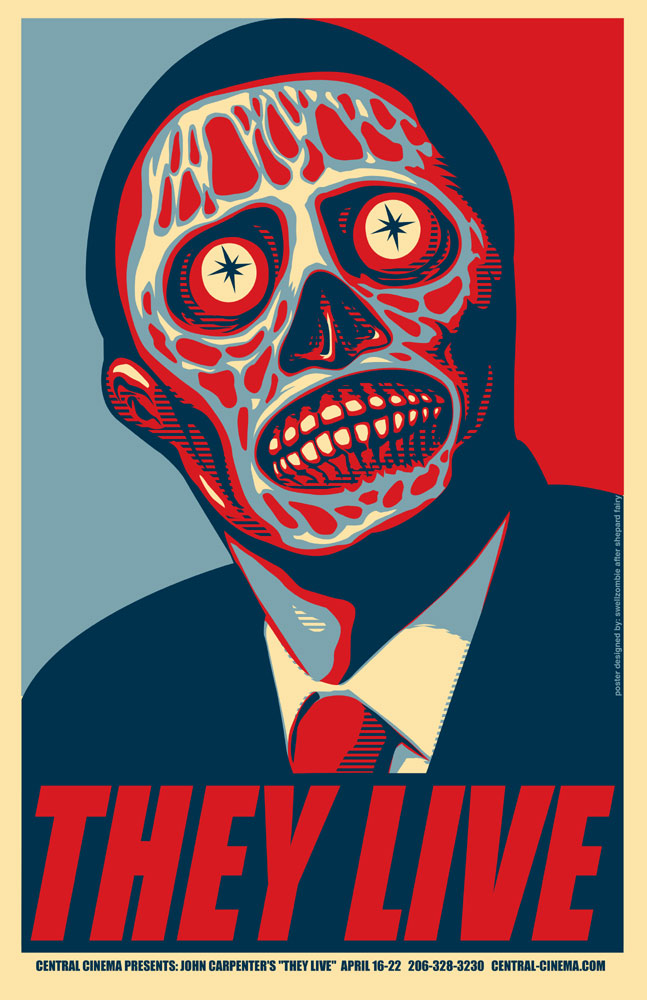
Life Imitates “They Live”

Obama-They-Live

Melissa Melton of Truthstream Media recently posted a story about former wrestler and actor Roddy Piper going public about his Libertarian and pro-Second Amendment beliefs via twitter. Quoting from the tweets:

They can’t have my Guns! Nobody! If you try and take my Gun, I’d be all out of Bubble Gum!

[…]I need to clean something up! When I say you take my gun I’m all out of gum….I’M NOT TRYING TO BE FUNNY!! It’s a FREEDOM STATEMENT!

[…]They Live is a documentary!!

For those who haven’t seen the film They Live, this is the famous “bubblegum scene” Piper is referencing:

They Live is a cult classic sci-fi/action buddy film based on the short story Eight O’Clock in the Morning by Ray Faraday Nelson (who happened to be one of Philip K. Dick’s closest friends). Roddy Piper plays Nada, a drifter searching for work during a recession who accidentally stumbles across an alien plot to take over the world by programming the masses to obey and consume using subliminal messages. Widely considered one of director John Carpenter’s best and smartest films, it was also part of a late 80s sub-genre of films containing as a subtext sharp critiques of U.S. government policies and the Reagan administration in particular. Other films include Wes Craven’s “The People Under the Stairs”, Paul Verhoeven’s “Robocop” and Dan O’Bannon’s “Return of the Living Dead”.

Just this past May, John Carpenter did a Q&A for a 25th anniversary screening of They Live as part of The Hero Complex Film Festival in Los Angeles. He had this to say about the film:

By the end of the ’70s there was a backlash against everything in the ’60s, and that’s what the ’80s were, and Ronald Reagan became president, and Reagonomics came in,” Carpenter told the sold-out theater at the Chinese 6 Theatres in Hollywood. “So a lot of the ideals that I grew up with were under assault, and something called a yuppie came into existence, and they just wanted money. And so by the late ’80s, I’d had enough, and I decided I had to make a statement, as stupid and banal as it is, but I made one, and that’s ‘They Live.’ … I just love that it was giving the finger to Reagan when nobody else would.

Read the full article here: http://herocomplex.latimes.com/movies/john-carpenter-they-live-was-about-giving-the-finger-to-reagan/#/0

Unfortunately, since the release of They Live, the state of the union has regressed to the point where the systemic criminality of the Reagan era seems mild and quaint in comparison. In certain ways, They Live does seem like a documentary because it contains images and ideas straight out of the headlines. Scenes of the protagonists’ tent city being bulldozed look exactly like the destruction of Occupy Movement encampments and forced closures of tent cities for the homeless across the country. Images of the aliens’ secret surveillance drones are prescient as well.

Melton’s Truthstream Media post also included this analysis of subliminal messages eerily reminiscent of They Live embedded in an old video clip used as nightly “sign-offs” for national television networks:

Read the full post here: http://truthstreammedia.com/?p=6717

Podcast News Updates

the-5th-horseman

There’s been another string of relevant news podcasts in the past few days so it’s time for another roundup post.

Last week Rob Kall of OpEdnews.cominterviewed Peter Ludlow a professor of linguistics and philosophy, on topics including systemic evil, whistleblowers and hacktivism:

https://itunes.apple.com/us/podcast/rob-kall-bottom-up-radio-show/id359765013

On Friday, Abby Martin of Breaking the Set did an excellent job deconstructing the corporatocracy on Coast to Coast AM with John Wells:

http://www.mediaroots.org/abby-martin-deconstructs-the-corporatocracy-on-coast-to-coast-am/

On Monday Nellie Bailey and Glen Ford of Black Agenda Report covered a wide range of important topics including an update on the corporate plan for Detroit (an American apartheid), the struggle to raise the minimum wage in Seattle, and Dave Swanson’s (of WarIsACrime.org) analysis of the multitude of lies in Obama’s recent UN speech : Listen to Black Agenda Radio on the Progressive Radio Network, with Glen Ford and Nellie Bailey – Week of 9/30/13.

From Traces of Reality there were two great consecutive shows. On 9/30 host Guillermo Jimenez interviewed Kevin Gallagher, director of Free Barrett Brown.  Brown is the journalist who faces a 105 year sentence, the bulk of which is related to charges associated with pasting a link in a chat room. On the 10/1 episode, Guillermo is joined by Vice President of The Future of Freedom Foundation, Sheldon Richman. They cover topics including the “government shutdown”, the national debt, taxation, private property, the “social contract,” and the fallacy of the “consent of the governed.”:

9/30

10/1

Does the Government Only Label Bad Guys As Terrorists?

Perhaps, if one’s definition of a “bad guy” is so broad it becomes meaningless.

Among the findings in this must-read article recently posted at Washington’s Blog, Does the Government Only Label Bad Guys As Terrorists?, the following characteristics could get you labeled as a terrorist by the  government:

As you can see the list is pretty long, but sure to get longer as the government becomes even more corrupt, ineffectual, and fearful of revolt. Having such a loose definition of “terrorist” will do nothing to make anyone any safer (except perhaps the wealthy elite). In fact, it will only discourage dissent and encourage obedience to the corporate state which ultimately endangers the health of society.

fusion-center