Nick Margerrison on Revolutionary Self-Help

meditation-6

Last week Nick Margerrison posted a follow-up to his inspiring essay, The Global Awakening published last year on Disinfo.com. In Improve Yourself First, he reminds us of the importance of inner development as a means to avoid violent revolutions which replace one form of tyranny with another. He also makes the connection between today’s internet-based self-improvement movement and how printed culture facilitated the age of enlightenment. In his words: “the most important revolutionary aspect of the printed page: it allowed people to learn how to improve themselves and change the way they thought. This is the driving force behind any meaningful long term social change ever experienced in any society“. For these reasons, authoritarians love censorship, controlling what people think and controlling how to think.

Based on trends he has observed, he writes “the entire notion of a hierarchical dictatorship is coming apart” in part because “leaders lead by controlling information and the communications revolution makes this impossible.” Furthermore, “victory in the oncoming ‘war on information’ is beyond their power, no matter how hard they try, just like the ‘war on drugs’. The Western World’s massive financial difficulties limit their ambitions for now but make no mistake, the internet is causing them to lose their grip on reality.

As an antidote, he encourages the practice of questioning ideas requiring others to follow orders and suggestions (even his own). In other words, thinking critically and independently, which an uncensored internet facilitates. The true path for a revolution in Margerrison’s view begins with self improvement and learning “not what to think but how to thinkThe biggest most important changes that you can make to your world are the ones you can make right now to yourself and the way you think.” In his long-term view, the more people who take up the challenge of self improvement, the less unlikely the wider changes needed in society will be. By making such personal efforts in myriad ways, “we might well all move in different directions but the definition of the word “revolution” will move away from something which involves violence and brings long term suffering.”

News Video Roundup

12/11 A short but informative primer on the TPP:

12/11 Abby Martin critiques a New York Magazine article distorting and dismissing CIA drug smuggling operations:

12/12 Retired Marine General Michael Lehnert on why Guantanamo is a mistake and should be shut down:

12/12 Activist pranksters hijack a Shell Oil greenwashing event in Berlin (click “CC” icon for subtitles):

12/13 Joy Camp selling RFID chips in the style of a pharmaceutical commercial:

12/13 James Corbett on how to nullify the NSA and other tyrannical government agencies:

12/14 We Are Change interviews the Florida cop arrested for refusing to remove a Guy Fawkes mask:

Sandy Hook One Year After

By James F. Tracy

Originally published at the Memory Hole

As the nation approaches the first anniversary of the Sandy Hook Elementary School massacre, mainstream media are predictably excluding from their tragedy porn any substantive analysis of the idiosyncratic, misleading, and in some cases flagrantly propagandistic reportage of the event that might call the official story into question.

As with a majority of scandals and coverups over the past several decades where powerful interests are implicated, American journalism has become more and more complicit if not actively involved in delivering dubious information that establishes a dominant narrative, while thereafter failing to vigorously interrogate and amend faulty coverage that leads to vast public misconceptions.

The assassination of JFK, the falsely-reported Tonkin Gulf incident that sparked the costly Vietnam War, and the similarly questionable events of 9/11 that have together brought the US to the present national and geopolitical impasse all come to mind. One is left to ponder how the behavior of a wholly government-controlled media system would differ from our corporate-run consciousness industry that routinely and shamelessly showboats its First Amendment protections.

The consequences of such a communication breakdown are vast, with countless lives and entire nations having been undermined and destroyed. Moreover, the “first drafts of history” become plagued by myth and distortion that eventually cohere as collective memory, thus robbing a people of their self-determination, nullifying their humanity, and ensuring that the cycle repeats interminably.

Those rationally dissenting from the official record and who occupy positions to alter public opinion are usually written off by establishment-controlled media outlets as “conspiracy theorists,” “wackos,” and so on. If such individuals cannot be neutralized through defamation or blackmail, and if they possess information or occupy positions where they are capable of posing a serious and immediate threat to official fictions and thus the power structure itself, they are prone to becoming oddly “suicidal,” (see, for example, here, here, here, here, here, here, and here), or are simply killed outright (e.g. here, here, here, here, here, here, and here and here).

What else won’t we see in the corporate media’s series of heart-tugging memorials devoted to the anniversary of Sandy Hook? The two most recent and obvious indications that the event itself is at the very least a coverup include, first, the wholly unreported story of the Obama administration’s $2.5 million payout (read: bribe) to state and local law enforcement agencies directly involved in responding to the incident, and second, what is by almost any measure the entirely illegal destruction of pertinent evidence in the demolition of the crime scene itself.

Empowered by the internet as their primary means of communication, a broad array of independent researchers have conduced an impromptu “truth commission” that together calls the Sandy Hook narrative presented by corporate news media into serious question. For those with eyes to see and the ability to think critically they have also shamed the mainstream journalists directly involved in (mis)representing the event to the American public.

Yet without a genuinely independent investigation of the incident apart from the oversight and influence of the [Governor Dannel] Malloy and Obama administrations, the broader public will likely never know what actually took place on December 14, 2012 in Newtown Connecticut. As has too often been the case throughout the last half century, the prospects are high that yet another “big lie” has again taken root in the ever-malleable and somnambulent public mind.

SandyHookActorsObama

Gallery of Creepy NRO Satellite Logos

BawJ5tCCEAAQ6AN

Last Thursday, the Office of the Director of National Intelligence live-tweeted the launch of a US National Reconnaissance Office surveillance satellite from Vandenberg Air Force Base in California. What made the tweet quickly go viral was the attachment of the mission’s ominous and unsubtle logo: a giant malevolent octopus with it’s tentacles all over the planet. As reported by RT:

Along with the National Security Agency and more than a dozen others, the NRO is one of 16 federal offices under the directive of DNI James Clapper and is responsible for building and operating the spy satellites used to collect intelligence around the world. NRO-gathered intelligence was reportedly instrumental in the mission that brought US Navy SEAL’s to the home of former al-Qaeda leader Osama bin Laden in 2011, and decades earlier the agency launched a school-bus sized satellite into orbit to spy on Soviets at the height of the Cold War.

This time around the ODNI says the satellite’s payload is mostly classified, but did admit over Twitter that around a dozen mini satellites funded by both the NRO and NASA will be brought along to orbit as well. Another thing they didn’t bother to acknowledge, of course, is how the lack-of-subtlety apparent in the Earth-strangling octopus emblem could quickly be used by critics of the US intelligence community as fodder to further condemn the government for admitting to their sheer and unmatched ability to control the world’s information.

…”You may want to downplay the massive dragnet spying thing right now,” Chris Soghoian, the chief technologist at the American Civil Liberties Union, tweeted Thursday. “This logo isn’t helping.”

Andy Cush of AnimalNewYork uncovered a number of equally disturbing logos for past N.R.O. spy satellite missions including the following:

National Reconnaissance Office Launch 49, January 2011:  To celebrate its 50th anniversary, the NRO launches six satellites into space in 2010 and 2011. One of them, NROL-49, gets a black hawk rising from flames in front of the American flag for a logo. Its motto: melior diabolus quem scies, or “Better the devil you know.”

National Reconnaissance Launch 66, February 2011: One month after NROL-49, launch 66 took the devilish into goofier territory, featuring a satanic-looking minotaur flying over the Earth holding a modified Route 66 sign.

National Reconnaissance Office Launch 19, September 2003: NROL-19′s patch features the world’s most patriotic dragon clutching the globe with a diamond wrapped in its tail.

National Reconnaissance Office Launch 11, August 2000: This patch, featuring the eyes of what looks like an owl hovering over a darkened planet, could have used some cleaner design. Still, “We Own The Night” is an appropriately terrifying sentiment. Animals in space is beginning to feel like a theme.

National Reconnaissance Launch 38, June 2012: This three headed, world-destroying dragon is made only slightly less threatening by its latin motto, non morieris bello, which means something like “you will not die at war.” An alternate patch depicts the Egyptian god Anubis with a giant spear.

National Reconnaissance Office Launch 32, November 2010: The most illuminati-esque of the bunch, this terrible gradient-laden design puts an all-seeing eagle’s eye on top of a golden pyramid.

National Reconnaissance Launch 16, April 2005: The patch for NROL-16 may have marked the first time the U.S. government used a gorilla as a patriotic symbol.

National Reconnaissance Office Launch 10, December 2000: Last but not least, the “Great Bear” patch for NROL-10 is perhaps creepiest of all. What’s this jolly, star-covered guy doing as the symbol of a spy mission? We may never know.

Jeremy Hammond Speaks Out on FBI Entrapment

Jeremy Hammond Photo: Jim Newberry, FreeHammond.com

Jeremy Hammond Photo: Jim Newberry, FreeHammond.com

By Sparrow Media and Jeremy Hammond

[NEW YORK, NY] Jeremy Hammond, a 28-year-old political activist, was sentenced today to 10 years in prison after pleading guilty to participating in the Anonymous hack into the computers of the private intelligence firm Strategic Forecasting (Stratfor). The Ceremonial Courtroom at the Federal Court for the Southern District of New York was filled today with an outpouring of support by journalists, activists and other whistleblowers who see Jeremy Hammond’s actions as a form of civil disobedience, motivated by a desire to protest and expose the secret activities of private intelligence corporations.

The hearing opened with arguments as to what sections of the court record will remain redacted after sentencing. While Jeremy’s attorneys initially erred on the side of caution in previous memorandums and kept large pieces of the record redacted, both the defense and prosecution agreed this morning that many of the sections should now be made available for public view. The prosecution, however took stiff exception to portions of the court record being made public that indicate victims, specifically foreign governments, that Jeremy allegedly hacked under the direction of Hector “Sabu” Monsegur, the FBI informant at the helm of Jeremy’s alleged actions. Judge Preska ordered that the names of these foreign governments remain sealed.

Jeremy’s counsel, Sarah Kunstler, who is 9 months pregnant and due to give birth today, delivered a passionate testimonial as to the person that Jeremy is, and the need for people like Jeremy during this era of exponential changes in our socio-political landscape. (Read Sarah Kunstler’s complete argument HERE) She was followed by co-counsel, Susan Kellman, who wept as she recalled her own experiences reading the hundreds of letters from supporters to the court detailing Jeremy Hammond’s unbridled selflessness and enthusiastic volunteerism. She pointed out that it was this same selflessness that motivated Jeremy’s actions in this case. She closed her testimony by underscoring that, “The centerpiece of our argument is a young man with high hopes and unbelievably laudable expectations in this world.”

Susan was followed by Jeremy Hammond himself, who gave a detailed, touching and consequential allocution to the court. The following is Jeremy’s statement to the court. We have redacted a portion [marked in red] upon the orders of Judge Preska. While we believe the public has a right to know the redacted information therein, we refuse to publish information that could adversely effect Jeremy or his counsel.

JEREMY HAMMOND’S SENTENCING STATEMENT | 11/15/2013

Good morning. Thank you for this opportunity. My name is Jeremy Hammond and I’m here to be sentenced for hacking activities carried out during my involvement with Anonymous. I have been locked up at MCC for the past 20 months and have had a lot of time to think about how I would explain my actions.

Before I begin, I want to take a moment to recognize the work of the people who have supported me. I want to thank all the lawyers and others who worked on my case: Elizabeth Fink, Susan Kellman, Sarah Kunstler, Emily Kunstler, Margaret Kunstler, and Grainne O’Neill. I also want to thank the National Lawyers Guild, the Jeremy Hammond Defense Committee and Support Network, Free Anons, the Anonymous Solidarity Network, Anarchist Black Cross, and all others who have helped me by writing a letter of support, sending me letters, attending my court dates, and spreading the word about my case. I also want to shout out my brothers and sisters behind bars and those who are still out there fighting the power.

The acts of civil disobedience and direct action that I am being sentenced for today are in line with the principles of community and equality that have guided my life. I hacked into dozens of high profile corporations and government institutions, understanding very clearly that what I was doing was against the law, and that my actions could land me back in federal prison. But I felt that I had an obligation to use my skills to expose and confront injustice—and to bring the truth to light.

Could I have achieved the same goals through legal means? I have tried everything from voting petitions to peaceful protest and have found that those in power do not want the truth to be exposed. When we speak truth to power we are ignored at best and brutally suppressed at worst. We are confronting a power structure that does not respect its own system of checks and balances, never mind the rights of it’s own citizens or the international community.

My introduction to politics was when George W. Bush stole the Presidential election in 2000, then took advantage of the waves of racism and patriotism after 9/11 to launch unprovoked imperialist wars against Iraq and Afghanistan. I took to the streets in protest naively believing our voices would be heard in Washington and we could stop the war. Instead, we were labeled as traitors, beaten, and arrested.

I have been arrested for numerous acts of civil disobedience on the streets of Chicago, but it wasn’t until 2005 that I used my computer skills to break the law in political protest. I was arrested by the FBI for hacking into the computer systems of a right-wing, pro-war group called Protest Warrior, an organization that sold racist t-shirts on their website and harassed anti-war groups. I was charged under the Computer Fraud and Abuse Act, and the “intended loss” in my case was arbitrarily calculated by multiplying the 5000 credit cards in Protest Warrior’s database by $500, resulting in a total of $2.5 million.My sentencing guidelines were calculated on the basis of this “loss,” even though not a single credit card was used or distributed – by me or anyone else. I was sentenced to two years in prison.

While in prison I have seen for myself the ugly reality of how the criminal justice system destroys the lives of the millions of people held captive behind bars. The experience solidified my opposition to repressive forms of power and the importance of standing up for what you believe.

When I was released, I was eager to continue my involvement in struggles for social change. I didn’t want to go back to prison, so I focused on above-ground community organizing. But over time, I became frustrated with the limitations, of peaceful protest, seeing it as reformist and ineffective. The Obama administration continued the wars in Iraq and Afghanistan, escalated the use of drones, and failed to close Guantanamo Bay.

Around this time, I was following the work of groups like Wikileaks and Anonymous. It was very inspiring to see the ideas of hactivism coming to fruition. I was particularly moved by the heroic actions of Chelsea Manning, who had exposed the atrocities committed by U.S. forces in Iraq and Afghanistan. She took an enormous personal risk to leak this information – believing that the public had a right to know and hoping that her disclosures would be a positive step to end these abuses. It is heart-wrenching to hear about her cruel treatment in military lockup.

I thought long and hard about choosing this path again. I had to ask myself, if Chelsea Manning fell into the abysmal nightmare of prison fighting for the truth, could I in good conscience do any less, if I was able? I thought the best way to demonstrate solidarity was to continue the work of exposing and confronting corruption.

I was drawn to Anonymous because I believe in autonomous, decentralized direct action. At the time Anonymous was involved in operations in support of the Arab Spring uprisings, against censorship, and in defense of Wikileaks. I had a lot to contribute, including technical skills, and how to better articulate ideas and goals. It was an exciting time – the birth of a digital dissent movement, where the definitions and capabilities of hacktivism were being shaped.

I was especially interested in the work of the hackers of LulzSec who were breaking into some significant targets and becoming increasingly political. Around this time, I first started talking to Sabu, who was very open about the hacks he supposedly committed, and was encouraging hackers to unite and attack major government and corporate systems under the banner of Anti Security. But very early in my involvement, the other Lulzsec hackers were arrested, leaving me to break into systems and write press releases. Later, I would learn that Sabu had been the first one arrested, and that the entire time I was talking to him he was an FBI informant.

Anonymous was also involved in the early stages of Occupy Wall Street. I was regularly participating on the streets as part of Occupy Chicago and was very excited to see a worldwide mass movement against the injustices of capitalism and racism. In several short months, the “Occupations” came to an end, closed by police crackdowns and mass arrests of protestors who were kicked out of their own public parks. The repression of Anonymous and the Occupy Movement set the tone for Antisec in the following months – the majority of our hacks against police targets were in retaliation for the arrests of our comrades.

I targeted law enforcement systems because of the racism and inequality with which the criminal law is enforced. I targeted the manufacturers and distributors of military and police equipment who profit from weaponry used to advance U.S. political and economic interests abroad and to repress people at home. I targeted information security firms because they work in secret to protect government and corporate interests at the expense of individual rights, undermining and discrediting activists, journalists and other truth seekers, and spreading disinformation.

I had never even heard of Stratfor until Sabu brought it to my attention. Sabu was encouraging people to invade systems, and helping to strategize and facilitate attacks. He even provided me with vulnerabilities of targets passed on by other hackers, so it came as a great surprise when I learned that Sabu had been working with the FBI the entire time.

On December 4, 2011, Sabu was approached by another hacker who had already broken into Stratfor’s credit card database. Sabu, under the watchful eye of his government handlers, then brought the hack to Antisec by inviting this hacker to our private chatroom, where he supplied download links to the full credit card database as well as the initial vulnerability access point to Stratfor’s systems.

I spent some time researching Stratfor and reviewing the information we were given, and decided that their activities and client base made them a deserving target. I did find it ironic that Stratfor’s wealthy and powerful customer base had their credit cards used to donate to humanitarian organizations, but my main role in the attack was to retrieve Stratfor’s private email spools which is where all the dirty secrets are typically found.

It took me more than a week to gain further access into Stratfor’s internal systems, but I eventually broke into their mail server. There was so much information, we needed several servers of our own in order to transfer the emails. Sabu, who was involved with the operation at every step, offered a server, which was provided and monitored by the FBI. Over the next weeks, the emails were transferred, the credit cards were used for donations, and Stratfor’s systems were defaced and destroyed. Why the FBI would introduce us to the hacker who found the initial vulnerability and allow this hack to continue remains a mystery.

As a result of the Stratfor hack, some of the dangers of the unregulated private intelligence industry are now known. It has been revealed through Wikileaks and other journalists around the world that Stratfor maintained a worldwide network of informants that they used to engage in intrusive and possibly illegal surveillance activities on behalf of large multinational corporations.

After Stratfor, I continued to break into other targets, using a powerful “zero day exploit” allowing me administrator access to systems running the popular Plesk webhosting platform. Sabu asked me many times for access to this exploit, which I refused to give him. Without his own independent access, Sabu continued to supply me with lists of vulnerable targets. I broke into numerous websites he supplied, uploaded the stolen email accounts and databases onto Sabu’s FBI server, and handed over passwords and backdoors that enabled Sabu (and, by extension, his FBI handlers) to control these targets.

These intrusions, all of which were suggested by Sabu while cooperating with the FBI, affected thousands of domain names and consisted largely of foreign government websites, including those of XXXXXXX, XXXXXXXX, XXXX, XXXXXX, XXXXX, XXXXXXXX, XXXXXXX and the XXXXXX XXXXXXX. In one instance, Sabu and I provided access information to hackers who went on to deface and destroy many government websites in XXXXXX. I don’t know how other information I provided to him may have been used, but I think the government’s collection and use of this data needs to be investigated.

The government celebrates my conviction and imprisonment, hoping that it will close the door on the full story. I took responsibility for my actions, by pleading guilty, but when will the government be made to answer for its crimes?

The U.S. hypes the threat of hackers in order to justify the multi billion dollar cyber security industrial complex, but it is also responsible for the same conduct it aggressively prosecutes and claims to work to prevent. The hypocrisy of “law and order” and the injustices caused by capitalism cannot be cured by institutional reform but through civil disobedience and direct action. Yes I broke the law, but I believe that sometimes laws must be broken in order to make room for change.

In the immortal word of Frederick Douglas, “Power concedes nothing without a demand. It never did and it never will. Find out just what any people will quietly submit to and you have found out the exact measure of injustice and wrong which will be imposed upon them, and these will continue till they are resisted with either words or blows, or both. The limits of tyrants are prescribed by the endurance of those whom they oppress.”

This is not to say that I do not have any regrets. I realize that I released the personal information of innocent people who had nothing to do with the operations of the institutions I targeted. I apologize for the release of data that was harmful to individuals and irrelevant to my goals. I believe in the individual right to privacy – from government surveillance, and from actors like myself, and I appreciate the irony of my own involvement in the trampling of these rights. I am committed to working to make this world a better place for all of us. I still believe in the importance of hactivism as a form of civil disobedience, but it is time for me to move on to other ways of seeking change. My time in prison has taken a toll on my family, friends, and community. I know I am needed at home. I recognize that 7 years ago I stood before a different federal judge, facing similar charges, but this does not lessen the sincerity of what I say to you today.

It has taken a lot for me to write this, to explain my actions, knowing that doing so — honestly — could cost me more years of my life in prison. I am aware that I could get as many as 10 years, but I hope that I do not, as I believe there is so much work to be done.

STAY STRONG AND KEEP STRUGGLING!

To schedule interviews with Jeremy Hammond’s attorneys and supporters following today’s sentencing please contact Andy Stepanian, 631.291.3010, andy@sparrowmedia.net.

The Jeremy Hammond Defense Committee is a coalition of family members, activists, lawyers, and other supporters who are working together to protect free speech and to support Jeremy Hammond. The committee’s goal is to provide information to the public and the press, to organize events related to Jeremy’s case, and to support Jeremy while he is in jail. For more information, please visit http://freejeremy.net.


sparrow donate

Public Outrage Forces Seattle Officials to Backtrack on DHS Surveillance Grid

index

Last week, Seattle’s alternative weekly paper The Stranger published an exposé on their city’s new wireless mesh network, part of a $2.7 million project purchased by the Department of Homeland Security. The Seattle Police Department refused to answer more than a dozen questions about the network (which was fast-tracked by Seattle City Council with very little process for review and approval) including whether it’s operational, who can access its data, what it might be used for, whether the SPD has used or intends to use it to geo-locate people’s devices via MAC addresses or other identifiers, and how accurately it would be able to track people.

On November 12, Anthony Gucciardi and Mikael Thalen released reports on Infowars and Storyleak featuring leaked documents on the surveillance mesh posted by an anonymous whistleblower earlier this year. Some of the findings are recapped in the video below:

Shortly after the leaks went public (Tuesday evening) Seattle Police Spokesperson Sgt. Sean Whitcomb announced “The wireless mesh network will be deactivated until city council approves a draft policy and until there’s an opportunity for vigorous public debate.” While it’s fortunate they were forced to do this due to public pressure, it contradicted previous statements SPD had made to the local press in the wake of The Stranger article. As reported by RT:

The SPD told The Stranger previously that the system was not being used, but anyone with a smart phone who wandered through the jurisdiction covered by the digital nodes could still notice that their devices were being discovered by the internet-broadcasting boxes, just as a person’s iPhone or Android might attempt to connect to any network within reach. In theory, law enforcement could take the personal information transmitted as the two devices talk to each other and use that intelligence to triangulate the location of a person, even within inches.

When the SPD was approached about the system last week, they insisted that it wasn’t even in operation yet. David Ham of Seattle’s KIRO-7 News asked, however, how come “we could see these network names if it’s not being used?”

Well, they couldn’t give us an explanation,” Ham said at the time.

They now own a piece of equipment that has tracking capabilities so we think that they should be going to city council and presenting a protocol for the whole network that says they won’t be using it for surveillance purposes,” Jamela Debelak of the American Civil Liberties Union told the network.

Now just days later, the SPD has admitted to The Stranger that indeed the mesh network was turned on — it just wasn’t supposed to be.

SPD maintains it has not been actively using the network — it was operational without being operated, having been turned on for DHS grant-mandated testing and then never turned off — so shutting it down won’t hamper any current SPD activities,” The Stranger reported.

Are we supposed to believe the SPD “forgot” to shut the system off or trust that they would leave it operational without anyone operating it in light of the fact that they lied to reporters about the system being on a few days earlier? Both seem unlikely, as does promises that they’ll have enough safeguards in place to prevent misuse of the information they collect.

As RT previously reported, the DHS has been quietly rolling out similar surveillance grids in other cities including Oakland and Las Vegas. At this point, all Americans must remain extra vigilant to stay on top of such Orwellian schemes and do everything within power to shut them down.

UPDATE 11/28: Infowars just released this follow-up report revealing SPD had in fact NOT shut down the surveillance grid after publicly announcing that they would. This is further evidence that government lies and/or is incompetent at doing anything not a high priority for them (like shutting off surveillance grids), as if anyone needed more evidence.

UPDATE 12/9: Seattle police just announced today that the last of the surveillance nodes had finally been shut off last Friday (12/6). According to The Stranger:

Today, an SPD spokesperson said the department had turned off the final nodes in the network on Friday—156 could be disabled remotely, which happened weeks ago (though 19 had to be double-checked in person), but 8 had to be deactivated manually by a technician. Those are now off.

Today, I also received a copy of a letter sent from SPD Chief Jim Pugel to city councilperson Bruce Harrell about the mesh network. The full text is below the jump, but the relevant points are: (a) the department says the technology needs “more vetting with the ACLU and other stakeholders before a public hearing” and (b) Chief Pugel’s assertion that the network does not have the capability to track or record a person’s movements, but that SPD’s draft policies about its use “will cover any non-video technology” anyway.

The department, Pugel says, should be ready for a briefing with the council member earlier next year.

On Typhoon Haiyan and Veterans Day

View of Typhoon Haiyan from the International Space Station. PHOTO: AP

View of Typhoon Haiyan from the International Space Station. PHOTO: AP

While I mean no disrespect towards veterans, I feel Veterans Day has become so archaic and obsolete it should no longer be observed. Veterans Day is an artifact of simpler times, when America was seen by the world as an honorable and benevolent country and when many still believed in “good wars”. However, the more historical truths are revealed over time, the more apparent it becomes that all wars are based on deception. This fact in no way diminishes the sacrifice and courage of those who enlisted and fought, though it adds a dimension of tragedy to realize the ideals many believed in were not necessarily those of the government and corporate interests that put them in jeopardy.

Because of the National Defense Authorization Act (NDAA), anyone including U.S. citizens can potentially be declared an “enemy combatant”, tortured, detained indefinitely or killed. Everyone is now spied on by intelligence agencies such as the FBI, CIA and NSA. Because we are all treated by government as potential “enemy combatants” does that not also make everyone of a certain age “veterans” of a perpetual war?

The main reason I don’t feel a need to celebrate Veterans Day nor Memorial Day and the Fourth of July, is because I don’t believe in American exceptionalism. Every government would like their people to believe their country is exceptional in some way. Some might be better in some respects than others, but the danger of believing one’s country to be exceptional and superior is that it often misleads people to believe the lives of citizens of one particular nation to be of more inherent value than others. In this day and age, we need to understand that those who facilitate military-industrial agendas by killing or dominating others are objectively no better than armies and civilians of other countries. It’s true that veterans do deserve more appreciation from systems that benefit most from their actions (ie. government and corporations), but it makes little sense for average Americans, who are in many ways oppressed by those systems and treated similarly to enemies of the state, to applaud and celebrate the military. The true heroes are those who value all life and do the most to put a stop to the insanity: war resisters (including some current and former soldiers), whistleblowers, activists, independent journalists, freethinkers, etc.

That being said, the people we should be paying our respects to today are the ~10,000 dead and hundreds of thousands displaced by Typhoon Haiyan. When Haiyan first hit the Philippines last Friday it was a maximum category 5 storm. Fortunately it has been weakening as it went over Vietnam earlier today and continues towards China. The following images from the UK’s Daily Mail online convey the scope of the devastation and suffering:

City of the dead: Dazed survivors survey the damaged houses in Tacloban city, Leyte province. At least 10,000 people are believed to have died there

City of the dead: Dazed survivors survey the damaged houses in Tacloban city, Leyte province. At least 10,000 people are believed to have died there

Force of nature: One of the many ships which have been swept into the Tacloban by the power of the typhoon

Force of nature: One of the many ships which have been swept into the Tacloban by the power of the typhoon

A Filipino father and his children wait for food relief outside their makeshift tent.

Desperate measures: A Filipino father and his children wait for food relief outside their makeshift tent. Survivors have foraged for food as supplies dwindled, with some uncovering the bodies of the dead

Trail of destruction: Those who escaped the awesome power of Haiyan now face a grim battle to rebuild their lives among the sprawling wreckages

Trail of destruction: Those who escaped the awesome power of Haiyan now face a grim battle to rebuild their lives among the sprawling wreckages

Survivors in Tacloban told reporters they are so desperate for food that they have been forced to loot shops and steal from the dead

Survivors in Tacloban told reporters they are so desperate for food that they have been forced to loot shops and steal from the dead

Action: President Benigno Aquino has deployed troops to the area in a bid to restore calm after Philipine Red Cross aid trucks were attacked by hungry mobs

Action: President Benigno Aquino has deployed troops to the area in a bid to restore calm after Philipine Red Cross aid trucks were attacked by hungry mobs

Aftermath: Resident gather in the remains of a structure in Tacloban. Those left homeless have been forced to plunder the houses belonging to the dead. One local councillor admitted he has stepped on corpses in a desperate bid to find food

Aftermath: Resident gather in the remains of a structure in Tacloban. Those left homeless have been forced to plunder the houses belonging to the dead. One local councillor admitted he has stepped on corpses in a desperate bid to find food saying: ‘If you have not eaten in three days, you do shameful things to survive’

Remains: Survivors have begun to rummage through the wreckages of houses in a bid to find food to feed their families

Remains: Survivors have begun find corpses as they rummage through the wreckages of houses in a bid to find food to feed their starving families

Making do: Survivors have been forced to forage for food and supplies after many homes were submerged by flood water and landslides

Making do: Survivors have been forced to forage for food and supplies after many homes were submerged by flood water and landslides

The Philippines president is considering introducing martial law in Tacloban city (pictured), where up to 10,000 people are feared dead, to enforce security after serious looting

The Philippines president is considering introducing martial law in Tacloban city (pictured), where up to 10,000 people are feared dead

Holy house: Churches in the storm torn city have become temporary aid centres offering washing facilities and handing out emergency food supplies

Holy house: Churches in the storm torn city have become temporary aid centres offering washing facilities and handing out emergency food supplies

Shelter from the storm: While the Catholic church in Tacloban has welcomed victims, many buildings have been broken into by desperate looters

Shelter from the storm: While the Catholic church in Tacloban has welcomed victims, many buildings have been broken into by desperate looters

This image taken by astronaut Karen L. Nyberg and released by NASA shows Super Typhoon Haiyan from the International Space Station yesterday

This image taken by astronaut Karen L. Nyberg and released by NASA shows Super Typhoon Haiyan from the International Space Station yesterday

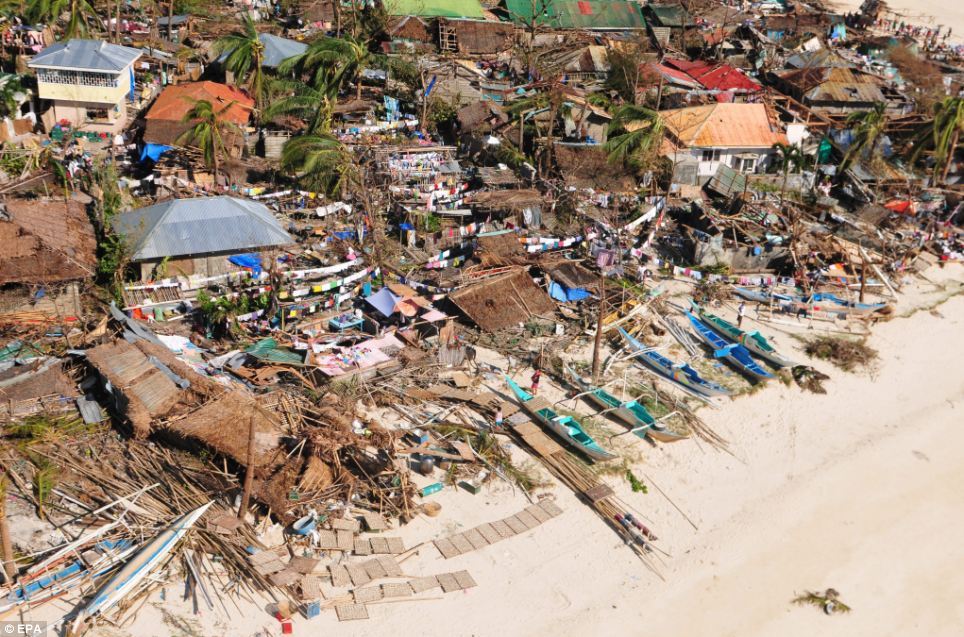
Washing still hangs on the lines but dozens of bamboo houses have been flattened by the storm in Baladian in the municipality of Concepcion, Iloilo Province

Washing still hangs on the lines but dozens of bamboo houses have been flattened by the storm in Baladian in the municipality of Concepcion, Iloilo Province

Loss: A mother weeps beside the dead body of her son at a chapel in the aftermath of Typhoon Haiyan in Tacloban

Loss: A mother weeps beside the dead body of her son at a chapel in the aftermath of Typhoon Haiyan in Tacloban

A ship was washed ashore in the huge storm. Surging sea water strewed debris for miles and survivors said the devastation was like a tsunami

A ship was washed ashore in the huge storm. Surging sea water strewed debris for miles and survivors said the devastation was like a tsunami

The storm is one of the most powerful ever recorded

The storm is one of the most powerful ever recorded and huge waves swept away entire coastal villages and destroyed up to 80 per cent of the area in its path

More than 330,900 people were displaced and 4.3million 'affected' by the typhoon in 36 provinces, the U.N. has said

More than 330,900 people were displaced and 4.3million ‘affected’ by the typhoon in 36 provinces, the U.N. has said

Residents try to salvage belongings in Tacloban city, Leyte province.

Residents try to salvage belongings in Tacloban city, Leyte province. Rescuers have not even been able to contact some towns on the coast where the storm first hit

Villagers walk past a body of victim laying on a pier in the super typhoon devastated city of Tacloban, Leyte province

Villagers walk past a body of victim laying on a pier in the super typhoon devastated city of Tacloban, Leyte province

This afternoon, the Typhoon Haiyan - believed to be the strongest storm to ever hit land - made landfall in Sanya in south China's Hainan province.

This afternoon, Typhoon Haiyan – believed to be the strongest storm to ever hit land – made landfall in Sanya in south China’s Hainan province

Workers remove a tree that has fallen onto a car in the aftermath of Typhoon Haiyan after it struck Sanya

Workers remove a tree that fell onto a car during the deadly storm, which is the 30th typhoon to strike China this year

Vehicles move slowly by a fallen billboard in Sanya in south China's Hainan province

The typhoon is now making its way towards Vietnam and mainland China – with locals bracing themselves for the onslaught of the deadly typhoon

Heavy winds had already caused damage to China's Hainan island before the super typhoon made landfall this afternoon. Above, a billboard is blown over by the strong winds

Heavy winds had already caused damage to China’s Hainan island before the super typhoon made landfall. Above, a billboard is blown over by the strong winds

A man carries boxes of milk as he passes by ships washed ashore by enormous waves in Tacloban city, Leyte province

A man carries boxes of milk as he passes by ships washed ashore by enormous waves in Tacloban city, Leyte province

One survivor said the scenes of utter devastation caused by the typhoon was 'like the end of the world'

One survivor said the scenes of utter devastation caused by the typhoon was ‘like the end of the world’

Aid agencies have made emergency appeals for funds and are trying to reach survivors who are in desperate need of clean water and shelter

Aid agencies have made emergency appeals for funds and are trying to reach survivors who are in desperate need of clean water and shelter

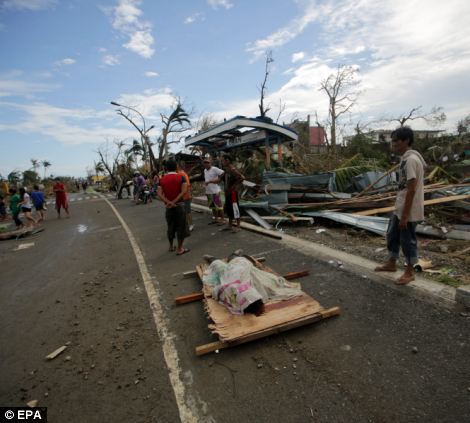
Bodies still lie in the roads and thousands of homes lie destroyed near the fish port after super Typhoon Haiyan battered Tacloban city

Bodies still lie in the roads and thousands of homes lie destroyed near the fish port after super Typhoon Haiyan battered Tacloban city

This NASA MODIS Aqua satellite image shows what is possibly the strongest storm ever - Super Typhoon Haiyan

This NASA MODIS Aqua satellite image shows what is possibly the strongest storm ever – Super Typhoon Haiyan

Local and foreign medical teams prepare to board a Philippines air force C-130 transport plane in Manila

Local and foreign medical teams prepare to board a Philippines air force C-130 transport plane in Manila

Survivors walk towards the evacuation center to get relief goods after super Typhoon Haiyan battered Tacloban city, central Philippines

Survivors walk towards the evacuation center to get relief goods after super Typhoon Haiyan battered Tacloban city, central Philippines

City administrators in Tacloban said about 400 bodies have been collected so far but said the death toll in the city alone could be 10,000

City administrators in Tacloban said about 400 bodies have been collected so far but said the death toll in the city alone could be 10,000

A girl looks out from a makeshift shelter in Tacloban.

A girl looks out from a makeshift shelter in Tacloban. The World Food Programme said it was airlifting 40 tonnes of high-energy biscuits to the region

A woman holds her umbrella stands on debris of houses in Tacloban

A woman holds her umbrella stands on debris of houses in Tacloban. Millions of people are believed to have been ‘affected’ by the storm, including hundreds of thousands who have lost their homes

Children pull sacks of goods they recovered from abandoned stores as they go past the rubble of houses in Tacloban

Children pull sacks of goods they recovered from abandoned stores as they go past the rubble of houses in Tacloban

A woman mourns in front of her husband's dead body, which lies no the street under tarpaulin alongside other bodies

A woman mourns in front of her husband’s dead body, which lies no the street under tarpaulin alongside other bodies

An injured Filipino boy stand in front of the rubble of houses in Tacloban - destroyed by the typhoon that has left thousands of people dead

An injured Filipino boy stand in front of the rubble of houses in Tacloban – destroyed by the typhoon that has left thousands of people dead

A man with an injured leg is carried through the devastation of former residential roads in Tacloban

A man with an injured leg is carried through the devastation of former residential roads in Tacloban

Operation: A Vietnamese soldier carries a young girl from a lorry as villagers are evacuated to a safe place by the military

Operation: A Vietnamese soldier carries a young girl from a lorry as villagers are evacuated to a safe place by the military


Desolation: This heartbreaking picture shows an flattened area of Tacloban city covered by debris and flood water

Desolation: This picture shows an flattened area of the destroyed Tacloban city covered by debris and flood water

Flattened: A Filipino boy stands among the debris in Tacloban, Leyte province - one of the worst hit areas of Typhoon Haiyan

Flattened: A Filipino boy stands among the debris in Tacloban, Leyte – one of the worst areas hit by category five storm Typhoon Haiyan

Death: It has been estimated by the Red Cross that 1,000 of the 1,200 people killed by the typhoon were residents of Tacloban

Death: It has been estimated by the Red Cross that 1,000 of the 1,200 people killed by the typhoon were residents of Tacloban

Widespread: This picture shows acres of flooded rice fields in the Iloilo Province

Widespread: This picture shows acres of flooded rice fields in the Iloilo Province, another area devastated by the typhoon

Assistance: An elderly woman is evacuated from her home by Red Cross staff in Vietnam
Plans: The Vietnamese Government has started to evacuate more than 100,000 people from the path of Typhoon Haiyan, according to state media

Plans: An elderly woman is taken from her home in Danang, Vietnam, as the government begins to evacuate 100,000 people lying in the path of typhoon Haiyan

From above: An aerial view shows badly damaged houses, including many without a roof, and blocked roads in the Philippine province of Iloilo

From above: An aerial view shows badly damaged houses, including many without a roof, and blocked roads in the Philippine province of Iloilo

Residents return to their houses after leaving an evacuation site in the aftermath of Super Typhoon Haiyan
Residents sit outside their damaged house

Recovery: A child is lifted to safety from a house in Tacloban, left, and two residents sit on the pavement in front of their home in the same city, right

Flattened: The typhoon has ravaged most of the city of Tacloban and destroyed the airport

Flattened: The typhoon has ravaged most of the city of Tacloban and destroyed the airport

Ruins: A resident sifts through rubbish inside his home that has been flattened by 235mph winds in the devastated city of Tacloban

Ruins: A resident sifts through rubbish inside his ruined home, flattened by 235mph winds in the devastated city of Tacloban

Scale: This image shows Typhoon Haiyan taken by Astronaut Karen L. Nyberg aboard the Internatioal Space Station

Scale: This image shows the enormous Typhoon Haiyan taken by Astronaut Karen L. Nyberg aboard the Internatioal Space Station

Satellite: A picture posted on Twitter by NASA at 8.00pm GMT shows the centre of the moving across the South China Sea towards the coast of Vietnam

Satellite: A picture posted on Twitter by NASA at 8.00pm GMT shows the centre of the moving across the South China Sea towards the coast of Vietnam

Path: Once the typhoon has reached the coast of Vietnam it is expected to moved towards the capital, Hanoi, with parts of Laos and Cambodia also likely to be affected

Path: Once the typhoon has reached the coast of Vietnam it is expected to moved towards the capital, Hanoi, with parts of Laos and Cambodia also likely to be affected

 Typhoon Haiyan
A boy walks past the devastation brought about by powerful typhoon Haiyan at Tacloban city

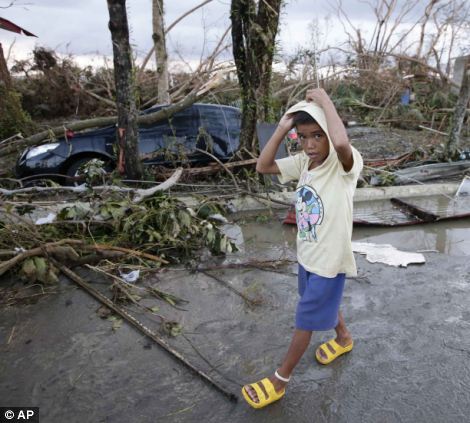
Loss: A pregnant woman, left, walks around the remains of her home while a young boy, right, walks past a crushed car in the destroyed town of Tacloban

Biggest storm in history Typhoon Haiyan flattens Philippines

Bodies wrapped in blankets are placed inside a damaged chapel
A Filipino elderly woman views the recovered victims in the typhoon

Temporary: Bodies of victims lay in a deserted chapel in Tacloban. A woman and child, right, view the distressing scene

Flooding: Locals in Coron, Palawan walk among damaged buildings after the typhoon - the most powerful in three decades

Flooding: Locals in Coron, Palawan, walk among damaged buildings and flooded streets after the typhoon – one of the most powerful to ever hit land

Terrifying: Filipino children are seen in the city of Tacloban, Leyte. Behind them is a scene of devastation with homes flattened and debris lying in the street

Terrifying: Filipino children are seen in the city of Tacloban, Leyte. Behind them is a scene of devastation with homes flattened and debris lying in the street

Picking up the pieces: Some residents try to go about their daily business despite the large-scale destruction

Picking up the pieces: Some residents try to go about their daily business despite the large-scale destruction

Victim
 resident recover a body of a victim

Tragedy: Bodies of residents can be seen in the streets of Tacloban, while one local is forced to transport a body in a wheelbarrow

Collapsed: A resident walks past her destroyed home - flattened by piles of wood and branches from nearby trees - in Tacloban city

Collapsed: A resident walks past her destroyed home – flattened by piles of wood and branches from nearby trees – in Tacloban city

Workers: Local Red Cross staff place sand bags on the roof of a house in Danang, Vietnam

Workers: Local Red Cross staff place sand bags on the roof of a house in Danang, Vietnam

Debris: Helicopters hover over the damaged area of Tacloban city, which was battered with strong winds yesterday

Debris: Helicopters hover over the damaged area of Tacloban city, which was battered with strong winds yesterday

Victim: A resident walks past dead bodies that lie on the street in Tacloban city, Leyte province

Victim: A resident walks past dead bodies that lie on the street in Tacloban city, Leyte province

Under water: Residents wade through a flooded street in Mindoro, Philippines this morning following the typoon

Under water: Residents wade through a flooded street in Mindoro, Philippines this morning following the typoon

Pile up: Vehicles and rubbish are pictured strewn across a flooded street in Tacloban, Leyte

Pile up: Vehicles and rubbish are pictured strewn across a flooded street in Tacloban, Leyte

Upside down: A devastated airport in Tacloban city, Leyte province - where roofs were ripped on hundreds of houses

Upside down: A devastated airport in Tacloban city, Leyte province – where roofs were ripped on hundreds of houses

 Coron, Palawan
 Coron, Palawan

Shock: These two pictures show the devastation in Coron, Palawan where buildings have been flattened, left and right, leaving residents helplessly walking the streets.

‘We thought is was a Tsunami’ – panic as storm lashes Philippines

Space: A digital composite of Typhoon Haiyan approaching the Philippines, made using images captured at 1pm

Space: A digital composite of Typhoon Haiyan approaching the Philippines, made using images captured geostationary satellites of the Japan Meteorological Agency

Rebuilding their lives: Two men in Iloilo move some of their belongings through flood waters covering the streets

Rebuilding their lives: Two men in Iloilo move some of their belongings through flood waters covering the streets

Devastation: Debris which was washed in by the storm litters the road by the coastal village in Legazpi city. Residents now face a long clean up operation to repair the damage to their homes

Devastation: Debris which was washed in by the storm litters the road by the coastal village in Legazpi city. Residents now face a long clean up operation

No chance: A house is engulfed by the storm surge brought about by powerful typhoon Haiyan, many homes like it could not stand up to the force of the gales
A fisherman secures his wooden fishing boat along the sea wall amidst strong winds as Typhoon Haiyan hit the city of Legaspi, Albay province, south of Manila

Hanging on: A fisherman in Manila is forced to cling on to his equipment, left, while there was little hope for other less stable buildings in the storm’s path, right

Higher ground: Residents of Legaspi, Albay province, south of Manila resident, were forced to flee the coast as Haiyan continued to pound the sea wall today

Higher ground: Residents of Legaspi, Albay province, south of Manila resident, were forced to flee the coast as Haiyan continued to pound the sea wall today

Downpour: As well as strong winds, the typhoon brought with it torrential rain which caused landslides in rural parts of the country

Downpour: As well as strong winds, the typhoon brought with it torrential rain which caused landslides in rural parts of the country

Terrifying: Residents run for their lives as the terrible gusts of the typhoon rush buffet the popular tourist city of Cebu

Terrifying: Residents run for their lives as the terrible gusts of the typhoon buffet the popular tourist city of Cebu. Trees and roofs were torn off by the storm

Blocked: Residents clear the road in the island province of Cebu after a tree was toppled by strong winds during typhoon Haiyan

Blocked: Residents clear the road in the island province of Cebu after a tree was toppled by strong winds during typhoon Haiyan

TYPHOON HAIYAN aftermath: Two dead, thousands displaced

Aid effort: Volunteers pack relief goods inside a Department of Social Welfare and Development warehouse before shipping out to devastated provinces

Aid effort: Volunteers pack relief goods inside a Department of Social Welfare and Development warehouse before shipping out to devastated provinces

Shelter: Filipino residents sleep on the floor of a gymnasium turned into an evacuation center in Sorsogon City in the Bicol region

Shelter: Filipino residents sleep on the floor of a gymnasium turned into an evacuation center in Sorsogon City in the Bicol region

If you would like to help: Médecins Sans Frontières (MSF)

Remember, Remember, the 5th of November

v-for-vendetta-5-11-10-kc

In honor of Guy Fawkes Day I’d like to bring attention to a few intriguing statements from Alan Moore (writer of the graphic novel V for Vendetta) on the connections between his fictions and reality from an interview he did shortly after the start of the Occupy Movement.

Via The Guardian:

I suppose I’ve gotten used to the fact that some of my fictions percolate out into the material world.

…I suppose when I was writing V for Vendetta I would in my secret heart of hearts have thought: wouldn’t it be great if these ideas actually made an impact? So when you start to see that idle fantasy intrude on the regular world… It’s peculiar. It feels like a character I created 30 years ago has somehow escaped the realm of fiction.

…And when you’ve got a sea of V masks, I suppose it makes the protesters appear to be almost a single organism – this “99%” we hear so much about. That in itself is formidable. I can see why the protesters have taken to it. It turns protests into performances.

The mask is very operatic; it creates a sense of romance and drama. I mean, protesting, protest marches, they can be very demanding, very grueling. They can be quite dismal. They’re things that have to be done, but that doesn’t necessarily mean that they’re tremendously enjoyable – whereas actually, they should be.

I think it’s appropriate that this generation of protesters have made their rebellion into something the public at large can engage with more readily than with half-hearted chants, with that traditional, downtrodden sort of British protest. These people look like they’re having a good time. And that sends out a tremendous message.

The reason V’s fictional crusade against the state is ultimately successful is that the state, in V for Vendetta, relies upon a centralised computer network which he has been able to hack. Not an obvious idea in 1981, but it struck me as the sort of thing that might be down the line. This was just something I made up because I thought it would make an interesting adventure story. Thirty years go by and you find yourself living it.

I have no particular connection or claim to what [the protesters] are doing, nor am I suggesting that these people are fans of mine, or of V for Vendetta…So there’s always… Now I didn’t feel responsible, but…at the moment, the demonstrators seem to me to be making clearly moral moves, protesting against the ridiculous state that our banks and corporations and political leaders have brought us to.

…It would probably be better if the authorities accepted this is a new situation, that this is history happening. History is a thing that happens in waves. Generally it is best to go with these waves, not try to make them turn back – the Canute option. I’m hoping that the world’s leaders will realise this.

Vox populi, Voice of the people. And I think that if the mask stands for anything, in the current context, that is what it stands for. This is the people. That mysterious entity that is evoked so often – this is the people.

Read the full article here: http://www.theguardian.com/books/2011/nov/27/alan-moore-v-vendetta-mask-protest

Last July Moore was interviewed by Salon.com to talk about his new Kickstarter project, Jimmy’s End, but he also shared the following relevant observations about emerging NSA revelations, the surveillance state and technology:

There seems to be something going on, even from the briefest appraisal of the news, with the amount of events transpiring. This is such a connected world, it’s useless to isolate any part of it as a discrete phenomenon. You can’t really talk about the problems in Syria, because its problems are global. The waves of discontent and outrage — whether in the Arab countries, or in Brazil, or in America and Europe over the degrees to which its citizens are being monitored — are not separate phenomena. They are phenomena of an emergent world, and the existence of the Internet is one of its major drivers. We have got no idea how it’s going to turn out, because the nature of our society is such that if anything can be invented, then we will invent it. Sooner or later, if it is possible.

So the Internet is changing everything, but I wouldn’t yet want to say for good or ill. I suspect, as ever, that it will be an admixture of both. But we are all along for the ride, even those people like me who do not have Internet connections, mobile phones or even functioning televisions. I’m slowly disconnecting myself. Basically, it’s a feeling that if we are going to subject our entire culture to what is an unpredictable experiment, then I’d like to try to remain outside the petri dish. [Laughs] It’s only sensible to have somebody as a control.

To me, one of the biggest surprises of these recent surveillance revelations is how surprised people are. The level of surveillance we’ve had over here for the past 20 years now is ridiculous — and useless, I would add. Eerily enough, the security cameras on every street corner of Britain was instigated by the incoming Blair government in 1997, which was when I decided, back in 1982 or so, to set the first episode of “V for Vendetta,” which had cameras on every street corner. So yeah, we’ve had those for awhile; they’ve proliferated and multiplied for decades. More recently, there have been troops of police who have said that all these things are useful for is alienating the public. [Laughs] They are not actually useful in the prevention of crimes, or even actually apprehending their suspects.

Here’s the thing: If you’re monitoring every single thing that goes on in a given culture, if you have all the information that is there to be had, then that is the equivalent of having none of it. [Laughs] How are you going to process that amount of information? That’s when you get all these wonderful emerging paradoxes. Recently over here, there was a case where it was suspected that the people who monitor security screens were taking unnecessary toilet breaks and gossiping when they should be watching us. So it was decided that the only sensible thing to do was to put a security camera in the monitor room. [Laughs] This is answering the question that Juvenal asked so succinctly all those years ago: Who watches the watchmen? The answer is more watchmen! And yet more watchmen watch them, and of course it will eventually occur to them to ask: Can those people who are watching the people doing the watching really be trusted? Much better if they were under surveillance.

That’s the level of absurdity these Orwellian solutions bring to our increasingly complex world. George Orwell’s vision was 1947. Yes, the world was more complex than it had been, but nowhere near as complex as it was going to get. We currently have in Northampton — and I think we might be the first to have it — security cameras in some places that actually talk to you. “Pick that cigarette end up! Yes, you!” [Laughs] Which is so much like Patrick McGoohan’s vision for the Village in “The Prisoner,” all those years ago.

…Technology is always a two-edged sword. It will bring in many benefits, but also many disasters. Because of the complexity of our situation, we cannot predict what things will be until they happen. It’s just part of our responsibility as people in the modern world to do our very, very best to deal with them, and think them through, as they occur. While I’m remote from most technology to the point that I’m kind of Amish, I have played a couple of computer games — until I realized I was being bloodied with adrenalin over something that wasn’t real. At the end of a couple of hours of very addictive play, I may have procured the necessary amount of mushrooms to save a princess, but I also wasted hours of my life that I’ll never be able to get back. This is the reason I am not on the Internet. I am aware of its power as a distraction, and I don’t have the time for that.

Despite the constant clamor for attention from the modern world, I do believe we need to procure a psychological space for ourselves. I apparently know some people who try to achieve this by logging off, or going without their Twitter or Facebook for a limited period. Which I suppose is encouraging, although it doesn’t seem that remarkable from my perspective. I think that people need to establish their own psychological territory in face of the encroaching world.

Read the full interview here: http://www.salon.com/2013/07/07/alan_moore_the_revolution_will_be_crowd_funded/

Despite the fact that Moore said he disowned all Hollywood adaptations of his works, in my opinion the quality of his writing can transcend limitations inherent in such attempts, retaining power and resonance even in “watered down” form. Though I was disappointed by the film version of V for Vendetta overall, many who would not have otherwise been exposed to Moore’s work were able to absorb important aspects of his message through it and viral clips such as this: