
Death Of Russiagate: Mueller Team Tied To Mifsud’s Network

By Elizabeth Vos

Source: Disobedient Media

In April last year, Disobedient Media broke coverage of the British involvement in the Trump-Russia collusion narrative, asking why All Russiagate Roads Lead To London, via the quasi-scholar Joseph Mifsud and others.

The issue was also raised by WikiLeaks’s Julian Assange, just days before the Ecuadorian government silenced him last March. Assange’s Twitter thread cited research by Chris Blackburn, who spoke with Disobedient Media on multiple occasions covering Joseph Mifsud’s ties to British intelligence figures and organizations, as well as his links to Hillary Clinton’s Presidential campaign, the FBI, CIA and the private cyber-security firm Crowdstrike.

We return, now, to this issue and specifically the research of Chris Blackburn, to place the final nail in the coffin of the Trump-Russia collusion charade. Blackburn’s insights are incredible not only because they return us to the earliest reporting on the role of British intelligence figures in manufacturing the Trump-Russia collusion narrative, but because they also implicate members of Mueller’s investigation. What we are left with is an indication of collusion between factions of the US and UK intelligence community in fabricating evidence of Trump-Russia collusion: a scandal that would have rocked the legacy press to its core, if Western establishment-backed media had a spine.

In Disobedient Media’s previous coverage of Blackburn’s work, he described his experience in intelligence:

“I’ve been involved in numerous investigations that involve counter-intelligence techniques in the past. I used to work for the 9/11 Families United to Bankrupt Terrorism, one of the biggest tort actions in American history. I helped build a profile of Osama bin Laden’s financial and political network, which was slightly different to the one that had been built by the CIA’s Alec Station, a dedicated task force which was focused on Osama bin Laden and Al-Qaeda. Alec Station designed its profile to hunt Osama bin Laden and disrupt his network. I thought it was flawed. It had failed to take into account Osama’s historical links to Pakistan’s main political parties or that he was the figurehead for a couple of organizations, not just Al-Qaeda.”

“I also ran a few conferences for US intelligence leaders during the Bush administration. After the 9/11 Commission published its report into the attacks on the World Trade Center and the Pentagon it created a public outreach program. The US National Intelligence Conference and Exposition (Intelcon) was one of the avenues it used. I was responsible for creating the ‘View from Abroad’ track. We had guidance from former Senator Slade Gorton and Jamie Gorelick, who both sat on the 9/11 Commission. We got leaders such as Sir John Chilcot and Baroness Pauline Neville Jones to come and help share their experiences on how the US would be able to heal the rifts after 9/11.”

“The US intelligence community was suffering from severe turf wars and firewalls, which were hampering counter-terrorism efforts. They were concentrating on undermining each other rather than tackling terrorism. I had mainly concentrated on the Middle East, but in 2003 I switched my focus to terrorism in South Asia.”

Counter Terrorism, Not Counter Intelligence, Sparked Probe

In an article published by The Telegraph last November, the paper acknowledged the following:

“It forces the spotlight on whether the UK played a role in the FBI’s investigation launched before the 2016 presidential election into Trump campaign ties to the Kremlin… Mr. Trump’s allies and former advisers are raising questions about the UK’s role in the start of the probe, given many of the key figures and meetings were located in Britain… One former top White House adviser to Mr. Trump made similar insinuations, telling this newspaper: “You know the Brits are up to their neck.” The source added on the Page wiretap application: “I think that stuff is going to implicate MI5 and MI6 in a bunch of activities they don’t want to be implicated in, along with FBI, counter-terrorism and the CIA.” [Emphasis Added]

The article cites George Papadopoulos, who asked why the “British intelligence apparatus was weaponized against Trump and his advisers.” Papadopoulos has also addressed the issue at length via Twitter. In response to the Telegraph’s coverage of the issue, Chris Blackburn wrote via Twitter: “The Telegraph story on Trump Russia acknowledges that activities involving counter-terrorism are at the heart of the scandal…not counter-intelligence. If the [London Centre for International Law Practice] was British state, not private, some Commonwealth countries are going to be seriously pissed off.”

Blackburn spoke with Disobedient Media, saying: “If you factor in the dreadful reporting to discredit Joseph Mifsud and leaks, it is pretty clear something rather strange happened to George Papadopoulos during the campaign while he was shuttling around Europe and the Middle East. He was working with people who have intelligence links at the London Centre of International Law Practice. A recent article in The Telegraph also alludes to MI5, MI6, and CIA using counter-terrorism assets which would tie into the London Centre of International Law Practice (LCILP), and its sister organizations, doing counter-terrorism work for the Australian, UK and US governments. They quote anonymous officials who believe that their intelligence agencies used counter-terrorism personnel to kick start the investigation/scandal.” [Emphasis Added]

Blackburn discussed this differentiation with Disobedient Media: “Counter-terrorism is obviously involved in more kinetic, violent political actions-concerning mass casualty events, bombings, assassinations, poisonings, and hacking. But, the lines are blurring between them. Counter-intelligence cases have been known to stretch for decades- often relying on nothing more than paranoia and suspicion to fuel investigations. Counter-terrorism is also a broader discipline as it involves tactical elements like hostage rescue, crime scene investigations, and explosive specialists. Counter-Terrorism is a collaborative effort with counter-terrorism officers working closely with local and regional police forces and civic organizations. There is also a wider academic field around countering violent, and radical ideology which promotes terrorism and insurgencies. Cybersecurity has become the third major discipline in intelligence. The London Center of International Law Practice, the mysterious intelligence company that employed both Papadopoulos and Mifsud, had also been working in that area.”

Continuing, Blackburn pinpointed the significance of defining counter-terrorism as the starting point of the investigation, saying: “It shows that there is a high probability that intelligence was deliberately abused to make Papadopoulos’ activities look like they were something else. As counter-terrorism and counterintelligence are close in tactics and methods, it would seem that they were used because they share the same skill sets – covert evidence gathering and deception. It’s basically sleight of hand. A piece of theatre would be more precise. However, we don’t know if the FBI knew it was real or make-believe. It’s more likely that the CIA played the FBI with the help of close allies who were suspicious and frightened of a Trump presidency.”

Mueller’s Team And Joseph Mifsud

Zainab Ahmad, a member of Mueller’s legal team, is the former Assistant United States Attorney in the Eastern District of New York. As pointed out by Blackburn, Ahmad attended a Global Center on Cooperative Security event in 2017. In recent days, Blackburn wrote via Twitter: “Zainab Ahmad is a major player in the Russiagate scandal at the DOJ. Does she work for SC Mueller? She was at a GCCS event in May 2017. Arvinder Sambei, a co-director of the [London Centre of International Law Practice], worked with Joseph Mifsud, [George Papadopoulos] and [Simona Mangiante]. She’s a GCCS consultant.”

Blackburn told this author: “Zainab Ahmad was one of the first DOJ prosecutors to have seen the Steele dossier. In May 2017, she attended a counter-terrorism conference in New York with the Global Center on Cooperative Security (GCCS), an organization which Joseph Mifsud, the alleged Russian spy, had been working within London and Riyadh, Saudi Arabia.”

“Richard Barrett, the Former Chief of Counter-Terrorism at MI6, Britain’s foreign intelligence department traveled with Mifsud to Saudi Arabia to give a talk on terrorism in 2017. Ex-CIA officers, US Defense, and US Treasury officials were also there. The London Centre of International Law Practice’s relationship to the Global Center had been established in 2014. The Global Center on Cooperative Security made Martin Polaine and Arvinder Sambei consultants, they then became directors at the London Centre of International Law Practice.”

“The Global Center on Cooperative Security’s first major UK conference was at Joseph Mifsud’s London Academy of Diplomacy (LAD). Mifsud then followed Arvinder Sambei and Nagi Idris over to the London Centre of International Law Practice. Sources have told me that Mifsud was moonlighting as a specialist on counter-terrorism and Islamism while working at LAD which explains why he went to work in counter-terrorism after LAD folded.”

“I don’t think it’s a coincidence that Global Center on Cooperative Security is connected to various elements that popped up in the Papadopoulos case. The fact that a prosecutor on Mueller’s team was at Global Center before Mueller was appointed as special counsel is also troubling.”

Days ago, The Hill reported on Congressional testimony by Bruce Ohr, revealing that when served as a DOJ official, he warned FBI and DOJ figures that the Steele dossier was problematic and linked to the Clintons. Critically, The Hill writes:

“Those he briefed included Andrew Weissmann, then the head of DOJ’s fraud section; Bruce Swartz, longtime head of DOJ’s international operations, and Zainab Ahmad, an accomplished terrorism prosecutor who, at the time, was assigned to work with Lynch as a senior counselor. Ahmad and Weissmann would go on to work for Mueller, the special prosecutor overseeing the Russia probe.” [Emphasis Added]

This point is essential, as it not only describes Ahmad’s role in Mueller’s team but places her at a crucial pre-investigation meeting.

Last year, Blackburn noted the connection between Mifsud and Arvinder Sambei, writing: “LCILP director and FBI counsel, works with Mike Smith at the Global Center. They ran joint counter-terrorism conferences and training with Mifsud’s London Academy. Sambei then brought Mifsud over to the [London Centre of International Law Practice]. [Global Center works with Aussies, UK and US State too.”

Sambei has been described elsewhere as a “Former practising barrister, Senior Crown Prosecutor with the Crown Prosecution Service of England & Wales, and Legal Adviser at the Permanent Joint Headquarters (PJHQ), Ministry of Defence.” [British spelling has been retained]

That Sambei has been so thoroughly linked to organizations where Mifsud was a central figure is yet another cause of suspicion regarding allegations that Joseph Mifsud was a shadowy, unknown Russian agent until the summer of 2016. She is also a direct link between Robert Mueller and Mifsud.

Blackburn wrote via Twitter: “Arvinder Sambei helped to organize LCILP’s counter-terrorism and corruption events. She used her contacts in the US to bring in Middle Eastern government officials that were seen to be vulnerable to graft. Lisa Osofsky, former FBI Deputy General Counsel, was working with her.” Below, Arvinder is pictured at a London Centre of International Law Practice (LCILP) event.

As Chris Blackburn told this author: “Mifsud and Papadopoulos’s co-director Arvinder Sambei was also the former FBI British counsel working 9/11 cases for Robert Mueller. She also runs a consultancy which deals with Special Investigative Measure (SIMs) which is just a posh description for covert espionage and evidence gathering. She has worked for major intelligence and national law agencies in the past. She wore two hats as a director of London Centre and a consultant for the Global Center on Cooperative Security (GCCS), a counter-terrorism think tank which is sponsored by the Australia, Canada, UK and US governments. Alexander Downer’s former Chief of Staff while at the Australian Department of Foreign Affairs and Trade now works for the Global Center. Mifsud was also due to meet with Australian private intelligence figures in Adelaide in March 2016. So. Australia is certainly a major focus for the investigation.” [Emphasis Added]

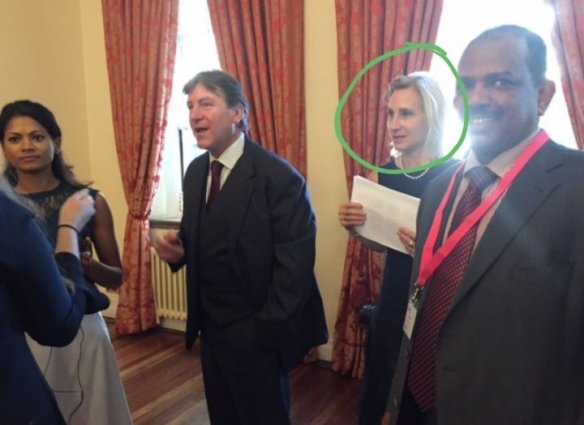
Below, former FBI Deputy General Counsel Lisa Osofsky is pictured at a London Centre for International Law Practice event. Osofsky also served as the Money Laundering Reporting Officer with Goldman Sachs International. Since 2018, she has served as the Director of the UK’s Serious Fraud Office (SFO).
An Embarrassment For John Brennan?

Disobedient Media previously reported that Robert Hannigan, then head of British spy agency GCHQ, flew to Washington DC to share ‘director-to-director’ level intelligence with then-CIA Chief John Brennan in the summer of 2016. This writer noted that “The Guardian reported Hannigan’s announcement that he would step down from his leadership position with the agency just three days after the inauguration of President Trump, on 23 January 2017. Jane Mayer, in her profile of Christopher Steele published in the New Yorker, also noted that Hannigan had flown to Washington D.C. to personally brief the then-CIA Director John Brennan on alleged communications between the Trump campaign and Moscow. What is so curious about this briefing “deemed so sensitive it was handled at director-level” is why Hannigan was talking director-to-director to the CIA and not Mike Rogers at the NSA, GCHQ’s Five Eyes intelligence-sharing partner.”

Blackburn told Disobedient Media: “Former Congressman Trey Gowdy, who has seen most of the information gathered by Congress from the intelligence community concerning the Russia investigation, said that if President Trump were to declassify files and present the truth to the American public, it would “embarrass John Brennan.” I think that is pretty concrete for me, but it’s not definitive. I know the polarization and spin in Washington has become perverse, but that statement is pretty specific for me. If Brennan is involved, it is most probably through Papadopoulos who sparked off the ‘official’ investigation at the FBI. He also made sure the Steele dossier was spread through the US government.”

Blackburn added: “Chris Steele was also working on FIFA projects, and a source has told me that he was working to investigate the Russian and Qatari World Cup bids. The London Centre of International Law Practice has been working with Majed Garoub, the former Saudi legal representative of FIFA, the world governing body for soccer. He’s also been working against the Qatari bid. Steele likes to get paid twice for his investigations.”

“Mifsud has also been associated with Prince Turki the former Saudi intelligence chief, Mifsud and the London Academy of Diplomacy used to train Saudi diplomats and intelligence figures while Turki was the Saudi Ambassador to London. Turki is a close friend of Bill Clinton and John Brennan. Nawaf Obaid was also courting Mifsud and tried to get him a cushy job working with CNN’s Freedom Project at Link Campus in Rome. He also knows John Brennan. Intelligence agencies like to give out professional gifts like this plum academic position for completing missions. In the US, it is widely known that intelligence agencies gift the children of assets to get them into prestigious Ivy League schools.”

At minimum, we can surmise that Mifsud was not a Russian agent, but was an asset of Western intelligence agencies. We are left with the impression that the Mifsud saga served as a ploy, whether he participated knowingly or not. It seems reasonable to conclude that the gambit was initially developed with participation of John Brennan and UK intelligence. Following this, Mueller inherited and developed the Mifsud narrative thread into the collusion soap opera we know today.

Ultimately, we are faced with the reality that British and US interests worked together to fabricate a collusion scandal to subvert a US Presidency, and in doing so, intentionally raised tensions between the West and a nuclear-armed power.

A N.Y. Times Story Just Accidentally Shredded the Russiagate Hysteria

By Lee Camp

Source: TruthDig

Every once in a while, one of those stories comes along that makes the mainstream corporate media look like a bunch of middle-school kids filming their “news show” on an iPhone with their neck ties crooked. Recently, one of those stories splashed down into the middle of our cultural zeitgeist like a small meteor landing in the middle of an elite dinner party.

It made our mass media pundits look like hardened fools. But they have kept spouting their nonsense anyway, hoping no one notices the soup dripping down their faces.

But to talk about that, I have to talk about this: Last month we finally got to see the Senate report spelling out the Russian meddling in our last election. And it was a bombshell. It rocked the heart of our country. It shredded the inflamed mucousy core of our palpitating democracy.

As Dan Cohen reported for the Grayzone Project, the report said that “…everything from the Green Party’s Jill Stein to Instagram to Pokemon Go to the African American population had been used and confused by the deceptive Facebook pages of a private Russian troll farm called the Internet Research Agency.”

That’s right. Russia even used Pokémon Go to pulverize the previously pristine 2016 election. That’s ever so frightening, since Pokémon Go is CIA-backed. (I guess it’s high time we just accept that the CIA has been taken over by those ruthless vodka drinkers.)

Back to the point—we learned from the report last month that the Russian Internet Research Agency manipulated every one of us with Facebook ads. If you don’t mind though, the Senate and the corporate media (and anybody else who knows the secret oligarchy handshake) would really prefer you just ignore the fact that Facebook clearly stated: “…56% [of the Russian ads] were after the election” and “…roughly 25% of the ads were never shown to anyone.”

But like an overweight man dressed like Wolverine at a Comic-Con, our brave congressmen and -women are not about to be dissuaded by reality. After the reports came out, Sen. Mark Warner tweeted, “Incredible. These bombshell reports demonstrate just how far Russia went to exploit the fault lines of our society and divide Americans, in an attempt to undermine and manipulate our democracy.”

Just after posting that, Warner patriotically pissed his red, white and blue Underoos.

So who are these amazing nonpartisan unbiased sleuths who put together this legitimate and nonpartisan unbiased Senate report? The New York Times found out they are a group called New Knowledge (which sounds like a terrible boy band). New Knowledge was founded by two veterans of the Obama administration, Jonathon Morgan and Ryan Fox. …So, I guess we’re, um, doing away with the “nonpartisan unbiased” thing.

Well, in that case—I say go hard or go home. I want MORE bias!

The Grayzone Project pointed out that besides working for Obama and the State Department, “… Morgan also developed technology for the Defense Advanced Research Projects Agency (DARPA), the arm of the Department of Defense created for basic, applied technological research, and futuristic war toys.”

All right, all right, not bad. But I know what you’re thinking. “Lee, that might be a great bias appetizer, but we want the full bias entree!”

OK, how about this?

Ryan Fox is a 15-year veteran of the NSA and was a computer analyst for the Joint Special Operations Command (JSOC) military unit. JSOC is notorious for its spree of atrocities across the Middle East. …

Hell yeah! You can feel that bias in my toes, can’t ya? But, the truth is, we’re still only at a 45 percent bias rating. I say we get it up to at least 65 percent. Back to Dan Cohen:

The report … was overseen by Renee DiResta, a former Wall Street trader and tech specialist who was recruited by Obama’s State Department to devise strategies for combating online ISIS propaganda.

So now we’ve got former Wall Street, former State Department, former Obama White House, former NSA, former DARPA, and former JSOC writing this completely legitimate completely factual report for the Senate about the powerful Russian impact of Facebook ads that no one ever saw.

I love it. This is like a report written by a hungry virus telling you not to wash your hands.

But hold on, it’s not only this Senate report that showed nefarious Russian meddling. It’s also all of those evil Russian bots. How do we know there are evil Russian bots? Well, most outlets quote Hamilton 68, which tracked Russian influence operations on Twitter.

Outlets like MSNBC, The Washington Post, The New York Times, Mother Jones and Tiger Beat. They’re all quoting Hamilton 68 or people who are referencing work done by Hamilton 68. Well, who the hell made Hamilton 68, and why does it sound like a ’90s alt-rock band that opened for Blink 182?

Oh, what do you know! Our old friend “[Jonathon] Morgan is also one the developers of Hamilton 68. … Funded by the German Marshall Fund’s Alliance for Securing Democracy—which is itself backed by NATO and USAID.”

Well OK, that sounds pretty serious. Clearly these people have found a special device that locates Russian bots on the interwebs, and it most likely resembles the thing Egon used in the “Ghostbusters” movies. So, shouldn’t we just congratulate Morgan on helping to develop the holy grail for spotting Russian bots and then call it a day? Well, there’s one itsy bitsy problem:

 … one of Hamilton 68’s founders, Clint Watts, admitted that the Twitter accounts it follows may actually be real people who are not Russian at all.

Real people? Who aren’t Russian? Call me crazy, but what I personally look for in a Russian bot is something that is at least Russian. And if not that, then a bot. And if neither, then you don’t have much of a goddamn Russian bot, do ya? Claiming these are Russian bots is like saying, “I just met the Queen of England, except she may have been a small Icelandic goat.”

Then, a few weeks ago The New York Times revealed that New Knowledge carried out an elaborate false flag operation to hurt the election chances of Judge Roy Moore in Alabama. You might recall that Roy Moore is an accused pedophile and a proven dipshit. And I don’t believe he should be elected to pick the bedbugs out of Rush Limbaugh’s armpits. But that doesn’t mean I think these New Knowledge charlatans shouldn’t be revealed for what they are.

So here’s how New Knowledge’s game worked, according to the Times. New Knowledge created a fake Facebook page in order to get conservatives in Alabama to support patio supply salesman Mac Watson instead of Roy Moore.

New Knowledge then tried to make everyone think that Moore’s campaign was working with the Kremlin by showing that he had thousands of Russian bots following his Twitter account. Many in the mainstream media ran with this outlandish idea. Mother Jones’s well-researched (sarcasm) article on the topic was titled “Russian Propagandists Are Pushing for Roy Moore to Win!” In the article they sourced (Can you guess?) Hamilton 68.

So to rehash: Hamilton 68, using their “Ghostbusters” device (patent pending), found that Russian bots (which may not be Russian and may not be bots and may not be Russian bots) were simply in love with alleged pedophiliac Alabama judges. So much so, that a majority of their tweets (meaning at least 51 percent) were in support of Roy Moore.

But as The New York Times has revealed, New Knowledge’s own internal report said, “We orchestrated an elaborate ‘false flag’ operation that planted the idea that the Moore campaign was amplified on social media by a Russian botnet.”

After these revelations came out a few weeks ago, Facebook suspended some of the accounts. So now The New York Times found itself in a quandary. They must have been thinking, “We need to report on this huge development in which the core authors of the Senate report on Russian meddling and the co-founder of Hamilton 68 were involved in lying, bullshitting, and false-flagging in order to help the Democratic party. But that completely undermines the Russiagate hysteria we have anchored our ship to. What do we do?”

Well, kids, take notes. This is how you do it. This is how you have your yellowcake uranium story and eat it too.

The New York Times headline was “Facebook Closes 5 Accounts Tied to Russia-Like Tactics in Alabama Senate Race”

Russia-like tactics?! This is literally an article about how Russia was NOT involved in the Alabama senate race false flag. In fact, it’s an article on how the guy who helped write the Senate report on the so-called Russian tactics is also one of the top people at New Knowledge, which either created or pushed pretend Russian bots to support Roy Moore so that they could leak to the press, “Russian bots are supporting Roy Moore!”

Sometimes the ability of the legacy media to believe (or at least regurgitate) their own bullshit is truly breathtaking.

To sum up this fuck de cluster:

1) The Senate report is laughable.

2) Any journalist who quotes Hamilton 68 should have their face sewn to the carpet.

3) If you want ridiculous pathetic reporting on nonsense that seduces us all to the edge of nuclear annihilation, turn to your mainstream corporate media.

4) If you want someone to actually put together the truth about these issues, you’ll have to turn to alternative outlets like Truthdig or the Grayzone Project.

5) Bill Murray and the Ghostbusters were ahead of their time.

If you think this column is important, please share it. To find out about all of Lee Camp’s columns, subscribe to his free newsletter here

 This column is based on a monologue Lee Camp wrote and performed on his TV show “Redacted Tonight.”


US Backs Coup in Oil-Rich Venezuela, Right-Wing Opposition Plans Mass Privatization and Hyper-Capitalism

The US has effectively declared a coup in Venezuela. Trump recognized unelected right-wing opposition leader Juan Guaidó as new “president,” who plans mass privatization and neoliberal capitalist policies.

By Ben Norton

Source: GrayZone

The United States has effectively declared a political coup d’état in Venezuela, from abroad. Trump announced on January 23 that the US recognizes the unelected, illegitimate right-wing opposition leader Juan Guaidó as the supposed new “interim president” of Venezuela’s supposed new “government.”

Venezuela’s US-backed opposition has pledged to carry out a mass privatization of state assets and to implement harsh neoliberal capitalist policies. The opposition-controlled legislatures declared in its “transition” plans that the “centralized model of controls of the economy will be replaced by a model of freedom and market based on the right of each Venezuelan to work under the guarantees of property rights and freedom of enterprise.”

The US has also hinted at violence in Venezuela. During a background briefing after Trump’s declaration, journalist Dan Cohen heard a US official declare that if the government of actual President Nicolás Maduro responds with any violence, “They have no immediate future, they have no immediate livelihood. One way or another they have their days counted.”

Trump administration officials added, “When we say all options are on the table, all options are on the table… Let’s hope Maduro and his cronies see the magnitude of the message.”

Region’s Right-Wing Countries Join US in Recognizing Coup

Canada’s Liberal government, led by Prime Minister Justin Trudeau; Brazil’s new far-right leader Jair Bolsonaro; and the overtly pro-US Organization of American States (OAS) and its Secretary General Luis Almagro have joined Trump in endorsing this diplomatic coup in Venezuela.

Likewise, the right-wing, US-allied countries in Latin America, including Argentina, Chile, Colombia, Costa Rica, and Ecuador have joined Trump in anointing Guaidó as leader.

The region’s few remaining leftist governments, Bolivia, Cuba, and Nicaragua, have continued recognizing Venezuela’s legitimate government, as has Mexico’s newly elected left-wing President Andrés Manuel López Obrador.

Bolivian President Evo Morales warned that “the claws of imperialism again seek to fatally wound the democracy and self-determination of the peoples of South America,” adding, “No longer will we be the backyard of the US.”

The US government, its right-wing allies, and an obeisant corporate media have repeatedly referred to Venezuela’s actual president, Nicolás Maduro, as an “authoritarian dictator.” What they have failed to mention is that Venezuela still has regular elections, but the US-backed right-wing opposition, which is notoriously disunited and incompetent, has chosen to boycott these elections, preferring to call for foreign-backed military coups instead.

One of the only elected officials in the US who has spoken out against the coup is left-wing California Congressman Ro Khanna. Other progressive and anti-Trump US politicians, including self-declared “democratic socialists,” have remained silent on Trump’s effective declaration of a coup in Latin America.

Opposition Plans for Privatized ‘Free Market’ Economy

While supporters of regime change in Venezuela insist this blatantly undemocratic move is necessary to “defend democracy,” make no mistake, the upheaval is clearly not motivated by resistance to authoritarianism.

Venezuela, which has the world’s largest oil reserves and has challenged the hegemony of the US dollar, has long been a target of US aggression. In 2002, the United States supported a military coup that briefly ousted democratically elected President Hugo Chávez and replaced him with the right-wing oligarch Pedro Carmona. US intervention, including crippling economic sanctions, has only continued since then.

Elements of Venezeula’s opposition have portrayed themselves to credulous foreign observers as “social democratic,” but their real intentions are very clear: The opposition-controlled legislature has demanded mass privatization of state assets and a return to a capitalist oligarch-controlled economic system built on “property rights and freedom of enterprise.”

In 2017, the Venezuelan government declared the creation of the Constituent Assembly, to rewrite the constitution. Venezuela’s opposition refused to recognize this body and boycotted the elections. The opposition instead remained in control of the National Assembly and decided to run it as a separate parallel legislature.

The opposition-controlled National Assembly drafted a “transition” law that openly outlines what policies the opposition, led by Juan Guaidó, would pursue in its illegitimate, US-recognized “government” in Venezuela. Analyst Jorge Martín, explained what this means in an article published by VenezuelaAnalysis:

The “transition law” drafted by the Assembly National (in contempt) is explicit about the central objectives of the coup in the political and economic field:

“[C]entralized controls, arbitrary measures of expropriation and other similar measures will be abolished… For these purposes, the centralized model of controls of the economy will be replaced by a model of freedom and market based on the right of each Venezuelan to work under the guarantees of property rights and freedom of enterprise.”

In other words, the nationalised companies will be returned to their former private owners (including telecommunications, electrical, SIDOR, cement, etc), as will expropriated landed estates. It is noteworthy that there is a lot of talk of property and business rights, but no mention is made of workers’ rights, which would certainly be abolished. It continues:

“Public companies will be subject to a restructuring process that ensures their efficient and transparent management, including through public-private agreements.”

What this means, in plain language, is massive dismissal of workers from state companies and the entry of private capital into them: a policy of looting which has already proved to be a disaster in all countries where it has been applied.

The model of the opposition’s new coup regime in Venezuela — backed by the US, Canada, and Brazil — is the reimposition of neoliberal capitalism and the recolonization of Latin America. Any bluster about restoring democracy is a mere pretense at this point.

Degrowth: closing the global wealth divide

Contradicting the dominant paradigm that economic growth equals development, degrowth theorists argue that serious cutbacks are crucial to protect life on our planet.

By Riccardo Mastini

Source: ROAR

Today, some 4.3 billion people — more than 60 percent of the world’s population — live in debilitating poverty, struggling to survive on less than the equivalent of $5 per day (which is the mean average of all the national poverty lines in the Global South). Half do not have access to enough food. And these numbers have been growing steadily over the past few decades.

With these data, Jason Hickel, an anthropology professor and global development expert, starts his controversial book, The Divide: A Brief Guide to Global Inequality and Its Solutions, in which he meticulously and convincingly debunks the narrative told by the UN and the likes of Bill Gates and Steven Pinker. In fact, while the good-news story leads us to believe that poverty has been decreasing around the world, in reality the only places this holds true are in China and East Asia. And these are some of the only places in the world where free-market capitalism was not forcibly imposed by the World Bank and the IMF, allowing these governments to pursue state-led development policies and gradually liberalize their economies on their own terms.

Development agencies, NGOs and the world’s most powerful governments explain that the plight of poor countries is a technical problem — one that can be solved by adopting the right institutions and the right economic policies, by working hard and accepting a bit of help. As Hickel writes: “It is a familiar story, and a comforting one. It is one that we have all, at one time or another, believed and supported. It maintains an industry worth billions of dollars and an army of NGOs, charities and foundations seeking to end poverty through aid and charity.” But it’s against this narrative that Hickel takes aim.

ECONOMIC UNEQUAL EXCHANGE OVER THE CENTURIES

The main argument presented in the book is that the discourse of aid distracts us from seeing the broader picture. It hides the patterns of extraction that are actively causing the impoverishment of the Global South today and actively impeding meaningful development. “The charity paradigm obscures the real issues at stake: it makes it seem as though the West is ‘developing’ the Global South, when in reality the opposite is true. Rich countries aren’t developing poor countries; poor countries are effectively developing rich countries — and they have been since the late 15th century,” argues Hickel.

In the book it is laid bare for all to see that underdevelopment in the Global South is not a natural condition, but a consequence of the way Western powers have organized the world economic system.

It’s not that the $128 billion in aid disbursements that the West gives to the Global South every year doesn’t exist — it does. But if we broaden our view and look at it in context, we see that it is vastly outstripped by the financial resources that flow in the opposite direction.

If all of the financial resources that get transferred between rich and poor countries each year are tallied up, we find that in 2012, the last year of recorded data, developing countries received a little over $2 trillion, including all aid, investment and income from abroad. But more than twice that amount, some $5 trillion, flowed out of them in the same year. In other words, developing countries “sent” $3 trillion more to the rest of the world than they received.

What do these large outflows from the Global South consist of? “Well, some of it is payments on debt. Today, poor countries pay over $200 billion each year in interest alone to foreign creditors, much of it on old loans that have already been paid off many times over, and some of it on loans accumulated by greedy dictators,” states Hickel. Another major contributor is the income that foreigners make on their investments in developing countries and then repatriate. Think of all the profits that Shell extracts from Nigeria’s oil reserves, for example, or that Anglo American pulls out of South Africa’s gold mines.

But by far the biggest chunk of outflows has to do with capital flight. A big proportion of this takes place through “leakages” in the balance of payments between countries. Another takes place through an illegal practice known as “trade misinvoicing.” Basically, corporations report false prices on their trade invoices in order to spirit money out of developing countries directly into tax havens and secrecy jurisdictions. A similarly large amount flows out annually through “abusive transfer pricing”, a mechanism that multinational companies use to steal money from developing countries by shifting profits illegally between their own subsidiaries in different countries. But perhaps the most significant loss has to do with exploitation through trade.

Hickel explains that “from the onset of colonialism through to globalization, the main objective of the North has been to force down the cost of labor and goods bought from the South. In the past, colonial powers were able to dictate terms directly to their colonies. Today, while trade is technically “free,” rich countries are able to get their way because they have much greater bargaining power.” On top of this, trade agreements often prevent poor countries from protecting their workers in ways that rich countries do. And because multinational corporations now have the ability to scour the planet in search of the cheapest labor and goods, poor countries are forced to compete to drive costs down. As a result of all this, there is a yawning gap between the “real value” of the labor and goods that poor countries sell and the prices they are actually paid for them. This is what economists call “unequal exchange.”

Since the 1980s, countries of the West have been using their power as creditors to dictate economic and trade policies to indebted countries in the South, effectively governing them by remote control, without the need for bloody interventions. “Leveraging debt,” argues Hickel, “they imposed “structural adjustment programs” that reversed all the economic reforms that Global South countries had painstakingly enacted in the previous two decades. In the process, the West went so far as to ban the very protectionist and Keynesian policies that it had used for its own development, effectively kicking away the ladder to success.”

DEGROWTH FOR SUSTAINABLE AND FAIR LIVELIHOODS

Hickel then ponders over how — if these unfair trade and business practices were amended — poor countries could actually go about developing their economies following the same path as the one embraced by the Global North over the past two centuries. He references a study by the economist David Woodward in which the latter shows that given our existing economic model, poverty eradication can’t happen. Not that it probably won’t happen, but that it physically can’t. It is a structural impossibility.

He explains that:

Right now, the main strategy for eliminating poverty is to increase global GDP growth. The idea is that the yields of growth will gradually trickle down to improve the lives of the world’s poorest people. But all the data we have shows quite clearly that GDP growth doesn’t really benefit the poor. While global GDP per capita has grown by 65 percent since 1990, the number of people living on less than $5 a day has increased by more than 370 million. Why does growth not help reduce poverty? Because the yields of growth are very unevenly distributed. The poorest 60 percent of humanity receive only 5 percent of all new income generated by global growth. The other 95 percent of the new income goes to the richest 40 percent of people. And that’s under best-case-scenario conditions.

Given this distribution ratio, Woodward calculates that it will take more than 100 years to eradicate absolute poverty at $1.25 a day. At the more accurate level of $5 a day, eradicating poverty will take 207 years. To eradicate poverty at $5 a day, global GDP would have to increase to 175 times its present size. In other words, we need to extract, produce and consume 175 times more commodities than we presently do. It is worth pausing for a second to think about what this means. Even if such outlandish growth were possible, the consequences would be disastrous. We would quickly chew through our planet’s ecosystems, destroying the forests, the soils and, most importantly, the climate.

According to data compiled by researchers at the Global Footprint Network in Oakland, our planet only has enough ecological capacity for each of us to consume 1.8 “global hectares” annually — a standardized unit that accounts for resource use, waste, pollution and emissions. Anything over this means a degree of resource consumption that the Earth cannot replenish, or waste that it cannot absorb; in other words, it locks us into a pathway of progressive degradation. The figure of 1.8 global hectares is roughly what the average person in Ghana or Guatemala consumes.

By contrast, Europeans consume 4.7 global hectares per person, while in the US and Canada the average person consumes 8 — many times their fair share. To get a sense of how extreme this overconsumption is: if we were all to live like the average citizen of the average high-income country, we would require the ecological capacity equivalent to 3.4 Earths. Hickel elaborates:

Scientists tell us that even at existing levels of aggregate global consumption we are already overshooting our planet’s ecological capacity by about 60 percent each year. And all of this is just at our existing levels of aggregate economic activity — with the existing levels of consumption in rich and poor countries. If poor countries increase their consumption, which they will have to do to some extent in order to eradicate poverty, they will only tip us further towards disaster. Unless, that is, rich countries begin to consume less.

If we want to have a chance of keeping within the 2°C threshold — which the Paris Agreement on climate change sets as an absolute cap — we can emit no more than another 805 gigatons of CO2 at the global level. Now, let’s accept that poor countries will need to use a portion of this carbon budget in order to grow their incomes enough to eradicate poverty; after all, we know that for poor countries human development requires an increase in emissions, at least up to a relatively lowish point. This principle is already widely accepted in international agreements, which recognize that all countries have a “common but differentiated responsibility” to reduce emissions. Because poor countries did not contribute much to historical emissions, they have a right to use more of the carbon budget than rich countries do — at least enough to fulfill basic development goals (as I also argue in this article). This means that rich countries have to figure out how to make do with the remaining portion of the budget.

Professor Kevin Anderson, one of Britain’s leading climate scientists, has been devising potential scenarios for how to make this work. If we want to have a 50 percent chance of staying under 2°C, there’s basically only one feasible way to do it — assuming, of course, that negative emissions technologies is not a real option. In this scenario, poor countries can continue to grow their economies at the present rate until 2025, using up a disproportionate share of the global carbon budget. That’s not a very long time, so this strategy will only work to eradicate poverty if the gains from growth are distributed with a heavy bias towards the poor.

As Hickel writes: “The only way for rich countries to keep within what’s left of the carbon budget is to cut emissions aggressively, by about 10 percent per year. Efficiency improvements and clean energy technologies will contribute to reducing emissions by at most 4 percent per year, which gets them part of the way there. But to bridge the rest of the gap, rich countries are going to have to downscale production and consumption by around 6 percent each year. And poor countries are going to have to follow suit after 2025, downscaling economic activity by about 3 percent per year.” This strategy of downscaling the production and consumption of a country is called “degrowth.”

Hickel describes this visionary idea as follows: “All it means is easing the intensity of our economy, cutting the excesses of the very richest, sharing what we have instead of plundering the Earth for more, and liberating ourselves from the frenetic consumerism that we all know does nothing to improve our wellbeing or happiness.” And since the book first came out in 2017, Hickel has been developing an increasingly clearer position on how we can go about making such changes happen.

His thinking on degrowth was recently encapsulated in a captivating blog exchange he had with Branko Milanović, another global development expert. But Milanović still maintains that economic growth should be at the core of poverty relief. Paraphrasing a passage from Kate Raworth’s Doughnut Economics, we could summarize Milanović’s position as “economic growth is still necessary, and so it must be possible,” while Hickel argues that “economic growth is no longer possible, and so it cannot be necessary.” I side with the latter, simply because the laws of physics trump the laws of economics.

In light of this, perhaps we should regard countries like Costa Rica not as underdeveloped, but rather as appropriately developed. We should look at societies where people live long and happy lives at low levels of income and consumption not as backwaters that need to be developed according to Western models, but as exemplars of efficient living — and begin to call on rich countries to cut their excess consumption.

US plotting coups in Venezuela, Cuba and Nicaragua?

By Stephen Lendman

Source: Intrepid Report

The US wants all nations worldwide colonized, their resources looted, their people exploited as serfs, including ordinary Americans.

Sovereign independent governments everywhere are targeted for regime change—by coups d’état or wars.

That’s what imperialism is all about, a diabolical plot for unchallenged global dominance by whatever it takes for the US to achieve its aims, Republicans and undemocratic Dems allied for the same geopolitical objectives.

Humanitarian intervention, responsibility to protect, and democracy building are code words by both right wings of America’s war party for wanting fascist tyranny replacing governance of, by, and for everyone equitably everywhere—legitimate governments replaced by US-controlled puppet ones.

Post-9/11 alone, the US orchestrated coups in Haiti, Honduras, Paraguay, Brazil, Ukraine, Egypt, and elsewhere in the Middle East.

The so-called Arab spring was made in the USA. Uprisings were orchestrated. Nothing was spontaneous. CIA dirty hands were involved in replacing unpopular regimes with despotic ones considered more reliable.

Spring never bloomed, just the illusion of change for the better. It was pure deception. Everything changed in targeted countries but stayed the same.

In Egypt, Yemen and elsewhere things worsened, notably in Occupied Palestine. No spring bloomed there or anywhere else in the Middle East.

Plan Colombia was and remains all about Washington’s aim to control Latin America, eliminating opposition to regimes it controls, plotting coups against ruling authorities unwilling to bend to its will, along with pursuing anti-Sino/Russian regional policies.

Since Soviet Russia’s dissolution, the US escalated wars on humanity, using NATO as a killing machine. Republicans and Dems colluded to thirdworldize America, banana republicanize it, wrecking the economy, handing its wealth to Wall Street, war-profiteers and other corporate predators.

Both right wings of duopoly governance mock democratic values and rule of law principles they abhor, governing under a police state apparatus, hardened over time, risking global war to achieve its aims.

Venezuela, Cuba, Nicaragua, and Bolivia are the remaining sovereign independent Latin and Central American nations.

Trump regime hardliners want fascist tyranny replacing their legitimate governments. In early January, State Department deputy spokesman Robert Palladino turned truth on its head, saying the US “support[s] the people of Venezuela, Cuba and Nicaragua in restoring democratic governance and their human rights”—notions Washington abhors.

Venezuelan Bolivarian social democracy is the Trump regime’s top Latin American target for regime change. Pompeo made US intentions clear.

He turned truth on its head, saying President Nicolas Maduro is “illegitimate and the United States will continue . . . to work diligently to restore a real democracy to that country,” adding, “We are very hopeful that we can be a force for good to allow the region to come together to deliver that.”

Fact: Last May, Maduro was overwhelmingly re-elected by a two-thirds majority.

Fact: Scores of international observers from 30 countries monitored the election, judging it open, free and fair.

Fact: Venezuela’s political process is the world’s best.

Fact: It’s polar opposite America’s money-controlled system, one-party rule with two right wings, ordinary people having no say over how they’re governed.

Fact: US democracy is pure fantasy. Venezuelans have the real thing, why Republicans and Dems want its government toppled, their eyes on the prize—the world’s largest oil reserves they want handed to Big Oil.

On January 10, Maduro was inaugurated for a second six-year term, saying he’s committed to continue “fight[ing] for social and economic prosperity and to build 21st century socialism”—despite relentless US political, economic, financial, and propaganda war against the country’s social democracy.

Despite the Trump regime’s all-out efforts to mobilize international opposition to his legitimate rule, delegations from over 90 countries attended the inaugural ceremonies—including from Russia, China, Cuba, Nicaragua, Bolivia, Mexico, El Salvador, Iran, Turkey, and Ireland’s Sinn Fein.

Representatives from US colonized EU nations were absent, a spokeswoman for foreign policy chief Federica Mogherini lied saying that “the presidential elections were not free nor fair”—a falsified statement, serving US imperial interests.

Representatives from the African Union, CARICOM, the Arab League, the ALBA Bolivarian Alliance for the Peoples of Our Americas, OPEC, and the UN also attended.

In his inaugural address, Maduro said, “I tell the people. This presidential sash is yours. This power is yours. It does not belong to the oligarchy or to imperialism. It belongs to the sovereign people of Venezuela.”

He denounced the diabolical aims of “the most powerful empire in history,” urging dialogue to serve Venezuelan interests, including UN support for “peace, mutual recognition, harmony, (and) coexistence of different political visions,” adding: “I would like to sit down with the opposition, stop the sterile, useless, unnecessary conflict, talk about economic issues; with the experience of the UN we can achieve it.”

Trump regime hardliners falsely call genuine democracies dictatorships, how neocon John Bolton reacted to Maduro’s inauguration, saying the US “will not recognize” his legitimacy to rule.

The US-controlled Organization of American States (OAS), headquartered in Washington, reacted the same way. Most of its member states support longstanding US plans for regime change.

The US-controlled 13-nation Lima Group issued a statement, refusing to recognize Maduro’s legitimacy.

Caracas slammed what it called a “humiliating subordination” to US imperial interests—applying to all nations allied with Washington against Venezuela’s social democracy and sovereign independence.

On January 12, State Department deputy spokesman Palladino openly called for regime change, saying, “It is time to begin the orderly transition to a new government.”

Previous US orchestrated coup attempts failed—against Hugo Chavez and Maduro. Will the Trump regime try again in the new year?

If unable to succeed by coup d’etat, will an attempt be made to assassinate Maduro? If economic, financial, political, and other tactics fail, will military intervention be the Trump regime’s fallback option?

Will Iran be targeted the same way in the new year? Imperialism isn’t pretty.

Endless US belligerence and state-sponsored terrorism is virtually certain ahead, the way hardliners in Washington always operate—hostile to peace, stability, equity and justice at home and abroad.

Two New Reports Point to Further US Decline & Higher Risk of War

By James ONeill

Source: New Eastern Outlook

Two recent reports from the United States strongly suggest the United States is planning a major war with Russia and China, but are far from certain that they could in fact succeed in such a war. The reports also provide insights into how the United States will meet the budgetary demands of such war preparations, but almost zero appreciation of the social and human costs of such policies.

The first of these reports is entitled “Providing for the Common Defence” (November 2018). It is the report prepared for the purpose of assessing the National Defence Strategy document released in early 2018.

It acknowledges that changes “at home and abroad are diminishing US military advantages,” and that this diminution of these “advantages” poses a threat to “vital United States interests.”

Geopolitical shifts in the regional power structures are “undermining deterrence of United States adversaries and confidence of United States allies, thus increasing the likelihood of military conflict”. Should such a conflict eventuate, the United States could “suffer unacceptably high casualties and a loss of major capital assets.”

The report says that “America is losing its advantage in key war fighting areas such as air and missile defence, cyber and space operations, anti-surface and anti- submarine warfare, long range ground-based fires, and electronic warfare”.

It further acknowledges that “America’s edge is diminishing or has disappeared in many key technologies that underpin US military superiority”.

Such frankness is not without precedent in US strategy papers and the implications of the above quotations are a probable reason why the report has received almost zero coverage in the western mainstream media.

Acknowledgements of technological deficiency and strategic disadvantage do not sit comfortably with the image of an all-powerful America willing and able to defeat any threat to its own global interests or those of its allies. The latter prefer the comfortable delusion of an omnipotent US “umbrella.”

The Commission’s strategy for addressing this perceived falling behind and consequent loss of military omnipotence is however itself fatally flawed. The proposed “solution” is to spend vastly greater sums of money at a rate of 3-5% above inflation.

That means that a significantly greater share of the federal budget would have to be devoted to military spending. The only way that could be achieved, given that the United States government already has a huge growing deficit ($22 trillion and counting) would have to come, the report acknowledges, by cuts to social spending such as pensions, Medicare and social security. The “trade-offs” the report acknowledges will be “difficult”, a statement that seriously under- estimates the social devastation that such cuts would bring about.

This argument is put forward in a society which already spends more on defence than that spent by the next eight national military budgets combined. United States national infrastructure, in everything from bridges to schools is already crumbling; and these proposals will only accelerate that downward trend.

It does not seem to occur to the report writers that the entire premise that the United States should maintain its attempt to control the world for the benefit of the United States is neither desirable nor wanted by the vast majority of the worlds nations as evidenced by multiple UN General Assembly resolutions.

The second report is issued by the United States Government Accountability Office (GAO) and is entitled: National Security: Long Range Emerging Threats Facing the United States as Identified by Federal Agencies (December 2018.) It has received even less publicity then the ‘Providing for the Common Defence’ document.

The probable reason for this mainstream media reticence is because the GAO report actually details where the United States is lagging in military capability viz a viz its two perceived principal rivals: Russia and China.

The fact of relative military weakness is not new. Andrei Martyanov in his book Losing Military Supremacy (2018) provided a detailed analysis of why Russian military technology was superior to the United States in several important fields. What Martyanov said about Russia applies with equal validity to Chinese technology.

Martyanov’s argument was dramatically illustrated by President Putin’s 1st March 2018 address to the Russian Parliament. The initial American reaction was to discount Putin’s claims, although within days the military industrial complex was demanding more funds to counteract the superiority of Russian weaponry outlined in Putin’s speech.

The GAO Report now provides an authoritative acknowledgement that Putin was not bluffing. Under the section of the report headed “Weapons” it has this to say:

Hypersonic weapons. China and Russia are pursuing hypersonic weapons because their speed, altitude, and maneuverability may defeat most missile defence systems, and they may be used to improve long range conventional and nuclear strike capabilities. There are no existing countermeasures.

Missiles. Adversaries are developing missile technology to attack the United States in novel ways and challenge US missile defence, including conventional and nuclear ICBMs, sea launched land attack missiles, and space based missiles that could orbit the earth.

Aircraft. China and Russia are developing new aircraft, including stealth aircraft, which could fly faster, carry advanced weapons, and achieve greater ranges. Such aircraft could force US aircraft to operate at further distances and put more US targets at risk.

There is more in the same vein. The only caveat to add to those points is the use of the conditional tense. The use of such words as “may” or “could” is redundant. That technology is already operational (www.thesaker.is 1 March 2018).

A number of commentators have argued that the technology gap between Russian and Chinese systems and that of United States is now measured in decades. There is no evidence to suggest this gap could be bridged in the foreseeable future. A more likely scenario is that the technological gap could widen.

Although there are powerful voices in the United States administration and ‘deep state’ generally sufficiently delusional and frankly crazy enough to believe that the United States could “win” a nuclear war with Russia and/or China, the GAO report should act as a constraint on their wilder ambitions.

History demonstrates that it is unwise to underestimate the extent to which the United States will go to maintain its self appointed role is the world’s dominant hegemon, (see Michael Pembroke’s Korea (2018). The reality is that the era of United States dominance is now well past.

Rather than risk a nuclear war that would wreak unimaginable losses upon all the world’s peoples, including for the first time the United States, the more likely scenario will be an intensification of what Andrei Korybko calls ‘hybrid warfare.’ A current illustration of this is the campaign being waged against Huawei, ostensibly because of the potential for Chinese cyber espionage but in reality to weaken and undermine China’s 2025 program for leadership in artificial intelligence, quantum information and other sophisticated technologies, and enforce America’s allies to buy their inferior products.

Proxy wars in the Middle East, Africa, Asia and Latin America are also likely to increase exponentially.

These two reports demonstrate that the United States has lost its previous technological and military superiority, but equally, that it is willing to go to extraordinary lengths to prevent any further erosion of its world wide role and its replacement by the two emerging countervailing superpowers, Russia and China. Whether or not that American determination will tip the world into a catastrophic nuclear exchange will be one of the major questions for 2019.

State Secrets and the National-Security State

By Jacob G. Hornberger

Source: Activist Post

Inadvertently released federal documents reveal that U.S. officials have apparently secured a secret indictment against Julian Assange, the head of WikiLeaks who released secret information about the internal workings of the U.S. national-security establishment. In any nation whose government is founded on the concept of a national-security state, that is a cardinal sin, one akin to treason and meriting severe punishment.

Mind you, Assange isn’t being charged with lying or releasing false or fraudulent information about the U.S. national-security state. Everyone concedes that the WikiLeaks information was authentic. His “crime” was in disclosing to people the wrongdoing of the national-security establishment. No one is supposed to do that, even if the information is true and correct.

It’s the same with Edward Snowden, the American contractor with the CIA and the NSA who is now relegated to living in Russia. If Snowden returns home, he faces federal criminal prosecution, conviction, and incarceration for disclosing secrets of the U.S. national-security establishment. Again, his “crime” is disclosing the truth about the internal workings of the national-security establishment, not disseminating false information.

Such secrecy and the severe punishment for people who disclose the secrets to the public were among the things that came with the conversion of the federal government to a national-security state.

Recall that when the U.S. government was called into existence by the Constitution, it was a type of governmental structure known as a limited-government republic. Under that type of governmental structure, the federal government’s powers were extremely limited. The only powers that federal officials could lawfully exercise were those few that were enumerated in the Constitution itself.

Under the republic form of government, there was no enormous permanent military establishment, no CIA, and no NSA, which are the three components of America’s national-security state. The last thing Americans wanted was that type of government. In fact, if Americans had been told that the Constitution was going to bring into existence a national-security state, they never would have approved the deal and would have continued operating under the Articles of Confederation, a type of governmental system where the federal government’s powers were so few that it didn’t even have the power to tax.

Under the republic, governmental operations were transparent. There was no such thing as “state secrets” or “national security.” Except for the periodic backroom deals in which politicians would make deals, things generally were open and above-board for people to see and make judgments on.

That all changed when the federal government was converted from a limited-government republic to a national-security state after World War II. Suddenly, the federal government was vested with omnipotent powers, so long as they were being exercised by the Pentagon, the CIA, or the NSA in the name of “national security.”

Interestingly enough, the conversion of the federal government to a national-security state was not done through constitutional amendment. Nonetheless, the federal judiciary has long upheld or simply deferred to the exercise of omnipotent powers by the national-security establishment.

An implicit part of the conversion was that the Pentagon, the CIA, and the NSA would be free to exercise their omnipotent powers in secret. Secrecy has always been a core element in any government that is structured as a national-security state, especially when it involves dark, immoral, and nefarious powers that are being exercised for the sake of “national security.”

One action that oftentimes requires the utmost in secrecy involves assassination, which is really nothing more than legalized murder. Not surprisingly, many national-security officials want to keep their role in state-sponsored murder secret. Another example is coups initiated in foreign countries. U.S. officials bend over backwards to hide their role in such regime-change operations. And then there are the surveillance schemes whereby citizens are foreigners are spied up and monitored. Kidnapping, indefinite detention, and torture are still more examples.

Of course, these are the types of things that we ordinarily identify with totalitarian regimes. The reason for that is that a national-security state governmental system is inherent to totalitarian regimes. For example, the Nazi government, which was a national-security state too, had an enormous permanent military establishment and a Gestapo, which wielded the powers of assassination, indefinite detention, torture, and secret surveillance. And not surprisingly, to disclose the secrets of German’s national-security state involved severe punishment.

But it’s not just Nazi Germany. There are many other examples of totalitarian regimes that are based on the concept of national security and structured as a national-security state. Chile under Pinochet. The Soviet Union. Communist China. North Korea. Vietnam. Egypt. Pakistan. Iraq. Afghanistan. Saudi Arabia. Turkey, Myanmar. And the United States. The list goes on and on.

And every one of those totalitarian regimes has a state-secrets doctrine, the same doctrine that the Pentagon, CIA, and NSA have.

A newspaper in Vietnam, which of course is ruled by a communist regime, reported that a Vietnamese citizen named Phan Van Anh Vu was sentenced to 9 years in prison for “deliberately disclosing state secrets.”

A website for the Committee to Protect Journalists reported that the Chinese communist regime charged a Chinese journalist named Yang Xiuqiong with “illegally providing state secrets overseas.” The Chinese Reds have also charged a prominent environmental activist named Liu Shu with “revealing state secrets related to China’s counterespionage work.”

The military dictatorship in Myanmar convicted two Reuters reporters for violating the country’s law that prohibits the gathering of secret documents to help an enemy.

RT reports that the Russian military will “launch obligatory courses on the protection of state secrets starting next year.

US News reports that the regime in Turkey is seeking the extradition from Germany of Turkish journalist Can Dunbar, who was convicted of revealing state secrets.

Defenders of Assange and Snowden and other revealers of secrets of the U.S. national security state point to the principles of freedom of speech and freedom of the press to justify their disclosures.

I’ve got a better idea: Let’s just dismantle America’s decades-long, nightmarish Cold War-era experiment with the totalitarian structure known as a national-security state and restore a limited-government republic to our land.


A New Narrative Control Firm Works To Destroy Alternative Media

By Caitlin Johnstone

Source: CaitlinJohnstone.com

The frenzied, hysterical Russia narrative being promoted day in and day out by western mass media has had two of its major stories ripped to shreds in the last three days.

A report seeded throughout the mainstream media by anonymous intelligence officials back in September claimed that US government workers in Cuba had suffered concussion-like brain damage after hearing strange noises in homes and hotels with the most likely culprit being “sophisticated microwaves or another type of electromagnetic weapon” from Russia. A recording of one such highly sophisticated attack was analyzed by scientists and turned out to be the mating call of the male indies short-tailed cricket. Neurologists and other brain specialists have challenged the claim that any US government workers suffered any neurological damage of any kind, saying test results on the alleged victims were misinterpreted. The actual story, when stripped of hyperventilating Russia panic, is that some government workers heard some crickets in Cuba.

Another report which dominated news headlines all of yesterday claimed that former Trump campaign manager Paul Manafort (the same Paul Manafort who the Guardian falsely claimed met with Julian Assange in the Ecuadorian embassy) had shared polling data with a Russian associate and asked him to pass it along to Oleg Deripaska, who is often labeled a “Russian oligarch” by western media. The polling data was mostly public already, and the rest was just more polling information shared in the spring of 2016, but Deripaska’s involvement had Russiagaters burning the midnight oil with breathless excitement. Talking Points Memo‘s Josh Marshall went so far as to publish an article titled “The ‘Collusion’ Debate Ended Last Night”, substantiating his click-generating headline with the claim that “What’s crystal clear is that the transfer to Kilimnik came with explicit instructions to give the information to Deripaska. And that’s enough.”

Except Manafort didn’t give any explicit instructions to share the polling data with Deripaska, but with two Ukrainian oligarchs (who are denying it). The New York Times was forced to print this embarrassing correction to the story it broke, adding in the process that Manafort’s motivation was likely not collusion, but money.

These are just the latest in a long, ongoing pattern of terrible mass media debacles as reporters eager to demonstrate their unquestioning fealty to the US-centralized empire fall all over themselves to report any story that makes Russia look bad without practicing due diligence. The only voices who have been questioning the establishment Russia narrative that is being fed to mass media outlets by secretive government agencies have been those which the mass media refuses to platform. Alternative media outlets are the only major platforms for dissent from the authorized narratives of the plutocrat-owned political/media class.

Imagine, then, how disastrous it would be if these last strongholds of skepticism and holding power to account were removed from the media landscape. Well, that’s exactly what a shady organization called NewsGuard is trying to do, with some success already.

A new report by journalist Whitney Webb for MintPress News details how NewsGuard is working to hide and demonetize alternative media outlets like MintPress, marketing itself directly to tech companies, social media platforms, libraries and schools. NewsGuard is led by some of the most virulently pro-imperialist individuals in America, and its agenda to shore up narrative control for the ruling power establishment is clear.

The product which NewsGuard markets to the general public is a browser plugin which advises online media consumers whether a news media outlet is trustworthy or untrustworthy based on a formula with a very pro-establishment bias which sees outlets like Fox News and the US propaganda outlet Voice of America getting trustworthy ratings while outlets like RT get very low ratings for trustworthiness. This plugin dominates the bulk of what comes up when you start researching NewsGuard, but circulating a plugin which individual internet users can voluntarily download to help their rulers control their minds is not one of the more nefarious agendas being pursued by this company. The full MintPress article gives a thorough breakdown of the yucky things NewsGuard has its fingers in, but here’s a summary of five of its more disturbing revelations:

1. The company has created a service called BrandGuard, billed as a “brand safety tool aimed at helping advertisers keep their brands off of unreliable news and information sites while giving them the assurance they need to support thousands of Green-rated [i.e., Newsguard-approved] news and information sites, big and small.” Popularizing the use of this service will attack the advertising revenue of unapproved alternative media outlets which run ads. NewsGuard is aggressively marketing this service to “ad tech firms, leading agencies, and major advertisers”.

2. NewsGuard’s advisory board reads like the fellowships list of a neocon think tank, and indeed one of its CEOs, Louis Gordon Crovitz, is a Council on Foreign Relations member who has worked with the American Enterprise Institute and Heritage Foundation. Members of the advisory board include George W Bush’s Secretary of Homeland Security Tom Ridge, deep intelligence community insider Michael Hayden, and the Obama administration’s Richard Stengel, who once publicly supported the need for domestic propaganda in the US. All of these men have appeared in influential think tanks geared toward putting a public smiley face on sociopathic warmongering agendas.

3. Despite one of its criteria for trustworthy sources being whether or not they are transparent about their funding, the specifics of NewsGuard’s financing is kept secret.

4. NewsGuard is also planning to get its news-ranking system integrated into social media outlets like Facebook and Twitter, pursuing a partnership which will make pro-establishment media consumption a part of your experience at those sites regardless of whether or not you download a NewsGuard app or plugin.

5. NewsGuard markets itself to state governments in order to get its plugin installed in all of that state’s public schools and libraries to keep internet users from consuming unauthorized narratives. It has already succeeded in accomplishing this in the state of Hawaii, with all of its library branches now running the NewsGuard plugin.

https://twitter.com/Daniel_Rubino/status/1081271640925921280

We may be absolutely certain that NewsGuard will continue giving a positive, trustworthy ranking to the New York Times no matter how many spectacular flubs it makes in its coverage of the establishment Russia narrative, because the agenda to popularize anti-Russia narratives lines up perfectly with the neoconservative, government agency-serving agendas of the powers behind NewsGuard. Any attempt to advance the hegemony of the US-centralized power establishment will be rewarded by its lackeys, and any skepticism of it will be punished.

Whoever controls the narrative controls the world. Ruling power’s desire to regulate people’s access to information is so desperate that it has become as clumsy and ham-fisted as a teenager pawing at his date in the back seat of a car, and it feels about as enjoyable. They’re barely even concealing their desire to control our minds anymore, so it shouldn’t be too difficult to wake everyone up to their manipulations. We need to use every inch of our ability to communicate with each other before it gets shut down for good.