Is Real-World Activism Part of our Spiritual Journey?

By Richard Enos

Source: Collective Evolution

We are living through a time that is shaking us down to our foundations. This ‘Pandemic’ has led to actions being taken by our governments that seem to completely disregard the rights of citizens and the rule of law. And there is mounting evidence that the severe measures being employed have not had any positive impact on our collective health and safety, and in fact are only serving an agenda to strengthen the grip of control enjoyed by the ruling class.

I don’t begrudge people who still believe that all we have to do to return to some form of normalcy is continue obeying protocols, but support for that idea is dwindling, as more people start to wonder if compliance is really the answer or if it is actually the problem itself. Questions surrounding these measures are being asked everywhere we turn: Why are small businesses being shut down, while multinational corporations that pose just as much ‘risk’ are able to open? Why are children being forced to wear masks and distance within schools when the science and statistics indicate that such measures are unnecessary and even harmful? Why are our governments trying to convince us that the Covid vaccine will solve the problem, while telling us that we will still have to wear masks after receiving it?

A Spiritual Battle

It is healthy to question things that don’t make sense to us, and we deserve answers. We have every right to defy commands we feel are unjustified–especially when our government oversteps and ignores the very laws it is supposed to uphold. And rather than heeding the growing discontent, and giving even the faintest impression that they are trying to ‘serve the public,’ the government is pushing back on our defiance like never before.

Let there be no doubt: we are in the midst of a spiritual battle.

But have courage. I believe that everything that is happening around us, as nefarious as it may be at some level, is being guided by a higher intelligence. And that higher intelligence has brought forth a situation that gives us an opportunity to begin to take charge of what is happening on the planet.

At this moment in history humanity is emerging from a state of adolescence and moving into adulthood, where we are starting to take responsibility, individually and collectively, for the condition the world is in. It is when a critical mass of people adopt this mindset that we will be able to turn this ship around, and get out from under the thumb of the ‘father figure’ of our adolescence, the current self-serving ruling class.

Confronting Our Fear

Indeed, one of the major stumbling blocks many of us face in standing up against what is going on is overcoming our fear of authority. Most of us first experienced a fear of authority at the hands of our parents, and as Edward Snowden explains in the short clip below, the ruling class has created a system that continues to stoke this fear and force our compliance from the time we enter school until we die.

As individuals, it is certainly worthwhile to ask ourselves if any trust we still have in our authority figures is justified, or if our compliance is just fear-based programming. Do we feel afraid to stand out or speak out, are we worried that we will be shamed by family, shunned by friends, unable to fit in at work or school? To truly act as free individuals we need to become still and grounded when we ask these questions, so that we can hear the quiet but reassuring voice of our higher self, reminding us of who we really want to be and what we want to do. This is the only authority you really need to follow.

Now certainly I don’t presume to tell anyone what ‘right action’ is for them. In fact it is no longer a time for you to blindly follow anyone, as I illustrated in my documentary ‘The Leaderless Movement.’ So we shouldn’t be guilted or shamed into defiance any more than we should be guilted or shamed into compliance. It’s time for each of us to find our center. From there, you do whatever feels right to you. That might very well mean doing nothing at the moment. But if you happen to notice, when you get into a state of stillness, that your inner voice has been gently coaxing you to stand up for your principles and be active in the world, then you owe it to yourself (and the rest of humanity, I might add) to overcome whatever fear you might have and follow through.

What is Real-World Activism?

When we think of real-world activism the first thing that often comes to mind is our right to assemble and protest. Some may dismiss this out of hand because it evokes unpleasant images of fighting and violence. But that is not an inherent quality of standing up for our personal rights and freedoms. The vast majority of gatherings and demonstrations in Canada and around the world regarding pandemic measures have been peaceful, and that’s the only way they are going to be effective. Certainly the time for pitchforks and streetside guillotines has long passed us by. If we decide that our only objective is to tear down the ruling class and subject them to bloody retribution then we are just perpetuating the division that the ruling class has used this whole time to keep their small elite group running the show.

Real-world activism does not actually require you to stand against anything. Of course many of us are angry about what we see going on in the world and we don’t like it. And that is a healthy thing. Our anger awakens us out of complacency and into action. But once we are activated, it’s important to move on to the next emotional stage, which is a firm resolve to stand for something, like the basic principles of personal freedom and human dignity that we all share. This opens us up to our connection with each other and fuels our desire to improve not only our own lives but those of our fellow human beings as well. This eventually leads us to looking at the way the entire planet is being governed and wondering why we are continuing to give our consent to it.

And of course real-world activism is not limited to participating in demonstrations and protests. It could simply be the way we conduct ourselves in our daily lives when we deal with those in some position of authority. Usually it is something that affects us personally that spark us to action. In my case, I remember the day clearly, when I read that my grade 1 son would be required to wear a mask in school. That is the day I jumped out of my chair and put the time and effort into researching the matter and then contacting those involved. This eventually led to a string of frustrating and uncomfortable conversations with people of authority from a principal to a director of education, documented in my article ‘How I Obtained a Conscientious Exemption From Mask-wearing at School for my Child.’ Early on, I had a sense that the whole exercise was not only done for my son, as I had decided after losing trust in the system that I was not willing put him through a single day at school; I also felt I wanted to learn how to stand up for my rights so that I could help others who were in the same situation.

Effective activism always has a spiritual component. It requires us to look at ourselves in the mirror and do the inner work that builds self-responsibility and changes the way we show up in the world. It requires us to look at the world with more discernment and a devotion to truth. We have long been divided by deception, but the singularity of truth unites us, and the sharing of truth empowers us and sets us free.

The Takeaway

What is unprecedented about the events that we are living through right now is that we are all personally affected one way or another. Nobody has been left untouched, and that makes it more difficult for people to continue sitting this one out. We are all being called to some form of engagement, and it’s likely that things in the world will keep getting worse until enough of us are involved. And this is why I believe that higher intelligence is orchestrating this. For when we reach a critical mass and the behemoth that I call the ruling class finally falls, we will have learned how to take responsibility for the condition of the world, we will be more educated in the deceptive ways of power, and we will have begun to connect to each other and unite at a deep level. This will put us in a position where we will already have the tools to start creating a world that serves us all.

THE INDIVISIBILITY OF LIFE

By Julian Rose

Source: Waking Times

‘Know Thyself.’ On a tombstone in an English churchyard is the following inscription, “Here lies John Bailey. The fact that he died does not guarantee that he lived.”

And that is surely the point. ‘To Live’ is the dynamic expression of existence; not being stuck in some soulless routine permanently in fear of stepping out of line with a sterile status quo.

The art of living involves the assertion of freedom, creativity and empathy with and for fellow humans and all living beings. It is our deepest self expression of an organic sense of purpose. The will to live is expressed through the flow of that warm inner feeling called ‘love of life’.

When, within the human experience, attempts are made to block this flow by forces opposed to Life, our ‘love of life’ causes us to adopt an unwavering commitment to fight for the preservation of all that is good, real and humane. In other words, to defend the basic tenets of a civilised society. Many actively engaged individuals find themselves in this position today.

But why such a high proportion of humanity fails to respond to this ‘Life-call’, preferring instead a ‘no risk’ three dimensional sub-existence – is an unsolved conundrum – in spite of thousands of divergent explanations being put forward?

However, one thing we do know is that when some form of material wealth or power is experienced by those who have sidelined their innate spirituality, it becomes an addiction around which a fixated dependency immediately forms. From there on, such individuals only experience existence as a sterile ambition-chasing game.

In these circumstances, Life becomes reduced to a competition to build and protect material wealth and status; and all those who reject such extremity – but nevertheless remain essentially passive – serve as fuel for the ambitions of these vampires.

The present pyramid of top-down economic and political oppression is built upon this catastrophic deviation from the organic, spirit led, path of Life.

The net result of this deviation from truth is the manifestation of a compensatory expression of the suppressed life-force. The original expression, blocked from following its organic path, turns in on itself and starts to devour that which would otherwise have guided the individual to the light.

Whereas, to openly give free voice to that Divine source of which we are all descendants, is the supreme individual expression of the life force with which we have all been blessed.

We are living through a time of open manifestation of the domineering anti-life materialistic obsession, stripped of all spiritual energy. What we are seeing on a daily basis today, emanating from the top end of the ‘competition pyramid’, is a ‘pandemic’. But it has nothing to do with a virus and everything to do with a feverish grasping for ultimate power and control over others – which includes all life forms down to the very DNA of life itself.

Taken at its face value, this is an abject expression of clinical insanity. If such an extremity was expressed within a family unit, the perpetrator would be recognised as deeply disturbed and in need of serious help and quite possibly of being isolated for fear of causing serious harm to others.

But when the same symptoms are displayed by politicians, bankers, media editors, corporate directors, the police and so forth – it is not recognised as insanity or even megalomania – but as an  ‘acceptable’ type of eccentric behaviour, which is grudgingly seen as ‘par for the course’.

This should lead us all to reflect on how such a stark departure from a human path of life could ever have been engineered into existence.

How a set of values applied to leadership within a family and to political/corporate ‘leadership’ – could be so starkly different. And how such a schizophrenic state of affairs could be allowed to continue to prevail in every corner of the world?

My conclusion is that such a gross imbalance exists due to the engineered separation of primary values within the greater social community, so as to create a divide and conquer controlling agent within society. Once this is in place, schizophrenic actions are not seen for what they are, they are taken as the norm.

In reality, there is no such division between values and responsibilities we see as important within families and those we see as important within political and business affairs. They are indivisible. That which expresses truth – and guidance based upon this truth – has Divine origins. The Divine is whole.

But by the time formal education and parental ambition (for siblings) has weighed-in, a separation of the material and the spiritual/social is all too often made manifest. It is as though these two realms were innately antagonistic.

This state of affairs is the signature of a bankrupt society. An engineered split that looks distinctly like the work of demons; as there is no natural explanation for why antagonism should exist between material and spiritual realms.

All animate and inanimate life is built of spirit and matter – ‘spirit-matter’ – which cannot be separated into opposing elements. But that separation is exactly what the proponents of an increasingly robotic human race have set their sights on.

To reinstate the wholeness which is our natural birthright, and to ensure its continuity throughout the life cycles that proceed from childhood through adolescence and into adulthood, is the essential task all caring, humanitarian and feeling individuals cannot turn away from.

‘Living’ means bringing a better world into being. Encouraging the spark of Life to rise up out of the ashes of a dystopian wilderness. To let Life educate us rather than those who police the status quo.

The verb ‘to educate’ comes from the Latin ‘e-ducare’ meaning ‘to draw out from’. This is a direct reference to encouraging the manifestation of our innate creativity.  Not the ‘fact absorbing’ mission that has been forced on young people during decades of ‘schooling’. The real meaning of such words has been deliberately obfuscated.

The imperative for getting this new dynamic moving cannot be overstated. Much of humanity is on the brink of psychological, psychotic and schizophrenic imprisonment. A state which cannot help but deeply imbalance the very fabric of our living planet.

Faced by this dramatic challenge to create unity out of disunity, we have to draw strongly upon the well of our deeper selves. For the ‘real me’ and the ‘real you’ are the only forces that can rise-up and radiate enough light to penetrate and dissolve the false clouds hanging over this world.

But how can one exert light, freedom and justice when all around fellow humans are covering their faces with a mask of anxiety and fear? When every news item inflates a lie? When the whole world seems turned up-side-down by demonic double speak?

Yes, that is the predominant question on millions of minds right at this moment.

The answer lies in the expression “know thyself”. “Thyself” as an eternal spirit/being of cosmic origins which has – temporarily – taken on a human form and is currently resident on Planet Earth.

‘A cosmic being having an earthly experience’.

Once you and I can detach ourselves from living the lie and primarily identify ourselves with a state of ‘non-attachment’ to the material and ego-led realm, we are free. We cannot be destroyed. We have become eternal. At one with our Creator.

This is a place completely out of reach of our oppressors – whatever form they may take. From here we can go into battle for planet Earth and planet people with not a trace of fear; knowing that when we give all for the cause of truth, Truth returns all to us – with a bonus!

This is how we are to defeat the demonic entities which we have allowed to occupy and rule this planet. They are but mirrors of our failure to follow the call of truth. To BE our true selves. To listen and respond to the inner voice of deeper guidance.

We have the will to quite simply dump our old false existence and transform from pseudo-humans into real humans, indivisible from the divine wellspring of Life. For each one of us, that is our uniquely individual challenge. When expressed collectively, it forms the foundation of a new society.

Of such beings, when they finally pass, it will be stated “The fact that this brave soul had a human experience is here recorded. May that soul continue its great exploration of the divine infinite from whence it came.”

RUDOLF STEINER: DWELLER ON THE THRESHOLD

By Gary Lachman

Source: Waking Times

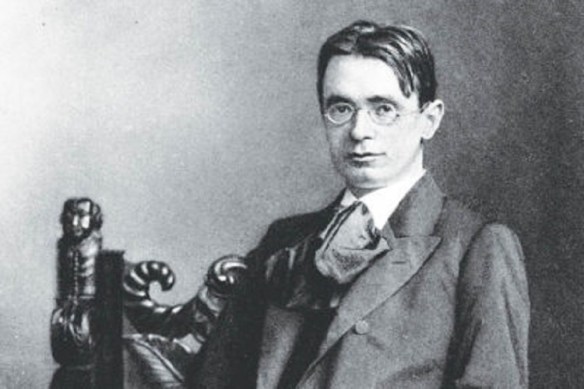
The most enigmatic figure to emerge from the “occult revival” of the early twentieth century was also the most successful, the Austrian “spiritual scientist” Rudolf Steiner (1861-1925). Although many of his contemporaries were outwardly more eccentric – think of Madame Blavatsky, Gurdjieff or Aleister Crowley – it’s precisely Steiner’s sobriety that is so striking, making him seem somewhat out of place in the often flamboyant world of the esoteric.

We generally associate ideas of the occult, higher consciousness and spiritual worlds with exotic, extraordinary characters with something of the trickster about them; Blavatsky, Gurdjieff and Crowley would certainly fall into this category. Steiner was precisely the opposite. Standing at the lectern with his pince-nez in hand, he projected an image of irreproachable rectitude. Steiner was earnestness incarnate, his one gesture of bohemian extravagance the flowing bow ties he was fond of wearing, a remnant of his early student days. Where Blavatsky, Gurdjieff and Crowley each took pains to present a formidable self-image, there was something simple and peasant-like about Steiner. Combined with this wholesomeness was an encyclopedic erudition. If we were to use an archetype to describe Steiner, it would have to be that of “the Professor” – or more precisely, “the Doctor,” as he was known by those around him. Commenting on her magnum opus, The Secret Doctrine, Madame Blavatsky once remarked that she “wrote, wrote, wrote” like the Wandering Jew “walks, walks, walks.” Steiner too wrote a great deal, but his main mode of disseminating his ideas was lecturing, and in the years between 1900 and 1925, he lectured, lectured, lectured, delivering more than 6,000 talks across Europe.

In a dry and often pedantic style, Steiner informed his audience of the results of his spiritual research, his “supersensible” readings of the occult history of the world made available to him through what is called “the Akashic Record.” In matter-of-facts terms, he introduced them to his teaching, Anthroposophy, telling them along the way about ancient Atlantis, life after death, astral and etheric bodies, the true meaning of Christianity and much, much more. Yet this humble, self-effacing character became one of the most influential, and simultaneously vilified, forces in the spiritual and cultural life of early twentieth century Europe, and his ideas are still relevant today.

Steiner’s efforts to lead “the Spiritual in the human being to the Spiritual in the Universe” have produced remarkably concrete results. Since his death, more than 1,000 schools around the world work with Steiner’s pedagogical principles, not to mention the many special-needs schools, working along lines developed by Steiner a century ago. There are also the hundreds of “bio-dynamic” farms, employing Steiner’s agricultural insights, developed decades in advance of our interest in ecology and organic foods. The practical application of Steiner’s ideas had also informed very successful avenues in holistic healing, the arts, architecture, economics, religion and other areas.

Given these achievements in the “real world,” which certainly exceed those of other esoteric teachers, why isn’t Steiner better known? You would reasonably expect the average educated person to have some idea of who, say, Jung is, or Krishnamurti, or the Dalai Lama; possibly even Blavatsky, Gurdjieff or Crowley. But Steiner? He remains something of a mystery, a name associated with a handful of different disciplines and endeavours, but not solidly linked to any one thing. He remains, as one of his most eloquent apologists, the Inkling Owen Barfield, called him “the best kept secret of the twentieth century.” It’s certainly time that he was better known.

Rudolf Steiner was born on 27 February 1861, in the small rural town of Kraljevec in what was then Hungary but is today part of Croatia. His father was a telegraph operator for the Southern Austrian Railway, and Steiner spent his first years amidst magnificent scenery: mountain ranges and green plains were his playgrounds. Steiner felt that it was significant that he grew up in a part of Europe where East meets West, as it was also significant that childhood had an equal measure of natural beauty and modern technology – at the time, both the railways and the telegraph were relatively new innovations.

In Knowledge of the Higher Worlds and its Attainment (1905), Steiner relates that a crucial experience on the path of higher consciousness is an encounter with the Guardian of the Threshold, a spiritual being embodying one’s unredeemed karma. Well before his career as an esoteric teacher, Steiner was himself a dweller on several thresholds, having one foot in the mysteries of nature, the other in the methodology of science. It was this combination of mystic visionary and disciplined thinker that gave Steiner’s later career its peculiar character.

When Steiner was eight, his father was transferred to Neudörfl, near the border with Lower Austria. An argument with the local teacher led his father to educate the boy himself, and this meant that he spent a great deal of time on his own at the railway station where his father worked. Young Steiner was deeply introverted; as he admits in his Autobiography (1925), he had great difficulty relating to the outer world. He also had an inquisitive mind and was obsessed with many questions the adults he knew seemed unable to answer. This subjectivity might have taken a morbid turn were it not for his discovery of mathematics. When Steiner came upon a book of geometry, it was a revelation. “That one can work out forms which are seen purely inwardly, independent of the outer senses, gave me a feeling of deep contentment. I found consolation for the loneliness caused by the many unanswered questions. To be able to grasp something purely spiritual brought me an inner joy. I know that through geometry I first experienced happiness.”1

Steiner’s joy upon discovering geometry may strike us as odd, yet the experience was essential in getting him through an early crisis. What impressed Steiner so greatly about geometry was that it seemed to offer proof that within the mind there existed a kind of “soul space,” an inner equivalent of the external space of the natural world. The soul space was “the setting for spiritual beings and events.” Thoughts for the young Steiner were not “mere pictures we form of things”; they were rather the “revelations of a spiritual world seen on the stage of the soul.” Geometry, Steiner believed, although produced by the human mind, had an objective reality independent of it, and for him this meant that the soul space in which it was revealed was also real.2

Rather precocious stuff, perhaps, but Steiner’s early years included an event that made him question the outer world’s monopoly on reality.

A Paranormal Encounter

One day at the railway station, he had a paranormal experience, an early manifestation of his psychic abilities. Sitting in the waiting room, he saw a strange woman enter; although he didn’t know her, he felt she resembled other members of his family. Standing in the middle of the room, the woman spoke to the boy. “Try to help me as much as you can – now as well as in later life,” she said. Then she walked into the stove and disappeared. Steiner decided not to tell his parents, afraid that they would scold him for lying. But he noticed that his father was sad, and he later discovered that a female relative who lived in the neighbouring town had committed suicide at the same time that he had had his vision.

This early experience marks for Steiner the beginning of a life-long involvement with the dead. Much of his later esoteric teaching involves accounts of the soul’s experiences in the afterlife and of the machinery of karma and reincarnation, the balancing of the spiritual books that casts the departed back into the stream of life in order to complete their tasks. While other boys of his age were fantasising about the Austrian equivalent of cowboys and Indians, Steiner was preoccupied with the reality of the spirit worlds and the soul’s encounter with the beings that inhabit them.

Later, as a young man, Steiner would on two occasions have unusual opportunities to verify some of his ideas about the meaning of death. Twice he would come into intimate contact with families in which the father was a recluse who would die soon after Steiner made their acquaintance. Yet on both occasions, although never actually meeting the man, Steiner formed a profound intuitive relation with the deceased, so deep and insightful in fact that he was asked by both families to give the funeral orations. Later still, during his years as an esoteric teacher, Steiner informed his followers that one means of helping the dead in their spiritual journeys was to read to them from his writings.

When Steiner was eighteen, his father was transferred once again, this time to Inzersdorf. His new location had the advantage of being close to Vienna, and it was decided that Steiner would study at the Technical School there. Although he had leanings toward literature and philosophy, he chose instead to work towards becoming a science teacher.

One day on the train to Vienna, he met a man who would have a profound influence on his life. Felix Koguzki was a herb-gatherer who travelled to Vienna regularly to sell his wares. It’s not known how they fell into conversation, but the teenaged Steiner soon discovered that this simple, uneducated man had strange experiences like his own, and a deep, personal knowledge of the other worlds. He was the first person with whom he could speak about his spiritual visions, and their talks boosted Steiner’s confidence; more than likely, they also convinced him that he wasn’t crazy.

Meeting a Master

Around the same time, Steiner had an encounter with another individual whose name has not come down to us. Steiner refers to him only as “the Master.” The French writer Edouard Schuré, author of the bestselling The Great Initiates (1889), and later a friend and follower of Steiner, remarked that the Master was “one of those potent personalities who are on Earth to fulfil a mission under the mask of some homely occupation.” Steiner had by this time read widely in philosophy, specifically the German Idealists, and had worked his way through Hegel, Schelling and several others, absorbing Kant’s Critique of Pure Reason during his history class, which bored him. Steiner was obsessed, then and later, with refuting scientific materialism, and this became the impulse that drove his philosophical studies.

Although he doesn’t mention this episode in his Autobiography, in a lecture given in Berlin in 1913, Steiner spoke of the experience. Speaking in the third person, he told his audience: “from that time onward a soul-life began to develop in the boy which made him entirely conscious of worlds from which not only external trees or mountain speak to the human soul, but also the Beings who live behind them…”3

What little we know of the Master is that he pointed out some passages in the work of Johann Gottlieb Fichte, one of Kant’s most important followers, which helped Steiner in his quest. Fichte’s work focused on the centrality of the human ego, the “I,” the locus of consciousness and the self that scientific materialism argued was mere illusion. Steiner’s spiritual experiences convinced him that this was palpably false and the “I,” rather than being an illusion, was a concrete, irreducible reality. For the next twenty years, until Steiner’s re-invention as a spiritual leader, his work would focus on developing a methodical epistemology proving this fact.

Introduction to Goethe

The single most important influence on his ideas, however, was the work of Johann Wolfgang von Goethe. Goethe is best known for his drama Faust (1808-1832), which takes a cautionary tale about a pact with the Devil and transforms it into an archetype of Western consciousness. Although he’s never enjoyed the same reputation among English speakers, Goethe is one of the Olympians of Western literature, sharing the top shelf with Plato, Dante and Shakespeare (Jung too thought Goethe a key figure, even to the extent of sometimes believing he was an illegitimate descendent of the great man.) Often regarded as the last true Renaissance man, Goethe was not just a giant of literature but also a statesman, traveller, and most important for Steiner, a scientist, making important contributions to botany, anatomy, mineralogy, and optics. Through his literature tutor Karl Schröer, who opened his mind to Goethe’s importance, Steiner was offered what must have seemed the chance of a lifetime. At twenty-two, he was head-hunted as the editor of Goethe’s scientific writings for a major edition of the polymath’s work.

For an unknown rural scholar to be offered such a position might seem unusual, but the general consensus on Goethe’s scientific musings at this point was that they were useless as science and dreary as literature; in truth, no one else wanted the job of editing them. Aside from his early success in proving that the human upper jaw contained the intermaxillary bone found in other mammals – Goethe was, in a different way, an evolutionist long before Darwin – most scientists found Goethe’s attempts to disprove Newton’s theory of colour, or to demonstrate the existence of what he called the Urpflanze, the archetypal plant from which others emerged, muddleheaded if not insane.

Yet for Steiner, Goethe’s science was the prototype for what would become his own phenomenology of the spirit worlds. Instead of the conventional scientist’s cold, dispassionate eye regarding the world as mere matter, passive to his intrusions, Goethe called instead for “objective imagination,” an active participation in the reality under scrutiny. The subjectivity of the scientist – his state of consciousness – was vastly more important than the increasingly hair-splitting exactitude provided by his instruments. This “objective imagination” became for Steiner the basis for his own “supersensible cognition.”

Encountering Nietzsche

Steiner’s work on Goethe opened many doors. One led to Weimar, Goethe’s city, where he was asked to work on the Goethe Archive, another prestigious task. Although Steiner found few congenial colleagues, the work had other compensations. He was introduced to the city’s literary and cultural life and made many acquaintances. One in particular led to a momentous meeting. Elizabeth Forster Nietzsche, sister of the ill-fated philosopher, approached Steiner to work with her in establishing a Nietzsche Archive. This led to Elizabeth introducing Steiner to her brother, who had been insane from syphilis for several years. Elizabeth had taken to dressing the defenceless Friedrich in a toga, and positioning him by the window, where his blank stare and unkempt appearance provided the impression of a great prophet. Steiner, aware of Nietzsche’s madness, was nevertheless impressed – not with the figure before him, but with its spiritual aura. He saw Nietzsche’s soul “hovering over his head, infinitely beautiful in its spiritual sight…” It was a soul that “brought from former lives on Earth golden riches of great spirituality…”4

If mention of Nietzsche’s “soul” brimming with “golden riches of great spirituality” suggests to readers familiar with the author of Beyond Good and Evil and The Antichrist that Steiner was as ignorant of Nietzsche’s philosophy as his sister Elizabeth notoriously was, they should have a look at Steiner’s book Friedrich Nietzsche: Fighter for Freedom (1895), a remarkable perceptive study which at times even reads like Nietzsche. Throughout his career, Steiner had an uncanny knack for entering into and defending the ideas of thinkers with whom he had profound disagreements – like the staunch materialist Ernst Haeckel – a critical sympathy that often led to much misunderstanding.

When his work at Weimar was ending, rather than embark on academic career (Steiner had received his doctorate in philosophy during his stay and could easily have found a comfortable niche somewhere), he decided instead to move to Berlin, home of Germany’s nascent avant-garde. He had by this time published what many believe to be his most important book, The Philosophy of Freedom (1894), an exhilarating, if often difficult work of epistemology which Steiner believed established beyond doubt the reality of the human “I.” Others, like the influential philosopher Eduard von Hartmann, author of the once immensely popular The Philosophy of the Unconscious, were less convinced and suggested he had muddled the question. Steiner, however, was undaunted and believed he had a mission to disseminate his ideas. He also needed to find work. Although his followers tend to see Steiner’s life as the undeviating unfolding of a pre-ordained destiny – and Steiner himself, we must admit, contributes to this belief – like the rest of us, he was looking for his place in the world and the means to get on in it. He was also filled – rightly so – with the conviction of his own genius. The literary and cultural world of Berlin might offer opportunities not available elsewhere.

Steiner, however, made the thoroughly impractical decision of buying a moribund periodical, The Magazine for Literature. His previous brief catastrophic experience in Vienna as an editor of a political magazine seemingly forgotten, Steiner proceeded to run the already failing Magazine for Literature into the ground, alienating its readers with his persistent exhortations regarding the spiritual life. In the age of Strindberg, Wilde, Ibsen, Wedekind, and Shaw, Steiner’s idealism seemed a stale leftover from a forgotten time.

Yet, although he bemoaned the burden destiny had placed on him, Steiner seems to have enjoyed hobnobbing with bohemians: his acquaintances include poets, playwrights, novelists and political activists. In fact, his reputation among the demi-monde caused academics to cancel their subscriptions, and Steiner earned the unique distinction of being the one esoteric teacher – as far as I know – to have a periodical banned in Czarist Russia, because its editor was known to socialise with anarchists.

It was also in Berlin that Steiner married his first wife, although one gets the impression that the relationship with Anna Eunicke was little more than platonic. Anna had been Steiner’s landlady in Weimar, and when he moved to Berlin she followed him. There he moved in with her again, and, almost as an afterthought, married her in 1899 in a civil ceremony. (It was in the Eunicke household in Weimar that Steiner had had one of his experiences with the death of a reclusive father.) Anna, not particularly well-educated or cultured, was apparently very happy to have Herr Doctor Steiner under her roof; Steiner, for his part, thus avoided the “misery of living alone,” as well as that of the cheap lodgings and bad food he had endured up till then. Anna was ten years older than Rudolf, and their relationship raises the question of Steiner’s sexuality, of which there is no mention in the entire 406 pages of his Autobiography. I do have it on the authority of one Steiner scholar, Christopher Bamford, that the Doctor was indeed celibate.

Berlin & Theosophy

But it was in Berlin that Steiner’s real career began. For a time he seemed willing to speak to any group who would listen to him. He lectured on history and other subjects at the Workingman’s College, surreptitiously slipping large doses of Idealism to budding Marxist materialists. He also lectured to the Giordano Bruno Society and The Coming Day, a quasi-Nietzschean cultural group. He managed, however, to alienate all of this (as well as Anna Eunicke, whom he soon left) when he accepted a request to lecture to the Berlin Theosophical Society. For years, Steiner had tried to express his insights into the spiritual worlds under the cover of philosopher. Now, at the turn of the century and the age of forty, he decided to forgo the camouflage and speak directly of his experiences.

Steiner quickly rose to prominence among the Theosophists and was soon made head of the society’s branch. One member of his audience was particularly struck. Marie von Sivers, who became Steiner’s second wife in 1914, was a Baltic Russian actress. She asked if it weren’t time for a new spiritual movement to arise in Europe. More to the point, didn’t Steiner think he should lead it? Steiner did, but he insisted that any such movement would be firmly based on Western esoteric sources. Steiner had recently passed through a spiritual crisis which convinced him that the “Christ event” was the single most important incident in human history. He had no time for “Eastern wisdom” or mystic Mahatmas. He more or less adopted the cosmic evolutionary framework of Madame Blavatsky’s Secret Doctrine and informed it with large helpings of German Idealist philosophy and Christian mysticism, developing a peculiarly idiosyncratic neo-Rosicrucian system of esoteric thought, aided by his own readings of the Akashic Record. In light of this it’s difficult to ignore the occult historian James Webb’s remark that Steiner joined the Theosophical Society in order to take it over.

His relationship to the society was rocky, and in 1913 he and its head, the ex-Fabian Annie Besant, came to rhetorical blows over C.W. Leadbeater’s advocacy of the Indian boy Krishnamurti as the second coming of Christ. Steiner was disgusted at the idea, and even more so at Leadbeater’s known paedophilic predilections. He demanded Besant’s resignation; she retaliated by ex-communicating him. Steiner left with much of his flock – by this time several thousand – and started his own group, the Anthroposophical Society. As opposed to Theosophy, which spoke of the wisdom of the gods, anthroposophy was concerned with the wisdom of the human being.

Building a New Movement & the Goetheanum

Practically the first thing Steiner did was to build a temple for his new movement. Land was secured in Dornach, Switzerland, and during WWI Steiner gathered a community of followers from several different countries to construct the Goetheanum, a weirdly beautiful fusion of art nouveau and Expressionist architecture that Steiner himself designed. His lecturing was curtailed by the fighting, but his greatest popularity came with the war’s end. Steiner’s plan to reconstruct Europe, The Threefold Commonwealth (1922), sold some 80,000 copies in its first edition, and audiences for his public appearances were now in the thousands; on one occasion the crowds outside a Berlin auditorium were so great they stopped traffic.

This period, however, also saw the start of the anti-Steiner campaign that would plague him henceforth. Practically everybody hated him: Catholics, Protestants, Marxists, proto-Nazis, not to mention other esotericists. There were at least two attempts on his life, and the number of occult attacks fomented by the “black brotherhoods” is unknown. One clear victory from this time was the establishment of the first Steiner school in Stuttgart in 1919. Based on pedagogical principles developed over decades of tutoring – in Vienna he had cured a retarded hydrocephalic boy to the extent that child grew up to earn a medical degree – Steiner’s educational ideas earned him deserved renown, and an international reputation among experts that continues today.

Steiner endured vilification in the press and disruption at his lectures with equanimity, but one victim of the attacks was, many believe, the Goetheanum, which burned to the ground on New Year’s Eve 1922. Arson by right-wing proto-Nazis is the common assumption, although an electrical fault remains a possibility. In any case, a decade’s effort, not to mention an architectural wonder, was lost overnight: the building was made of the same wood as that used in making violins and burned fiercely. Steiner took the tragedy as a sign that some changes in the society were necessary. His original occult teachings, based on the idea of an evolution of consciousness and the ability to achieve “supersensible thinking,” were, he felt, obscured by the success of subsequent initiatives.

Steiner education, the Christian Community (a religious group using Steiner’s ideas), the Threefold Movement for social change, eurythmy – a form of what he called “visible speech” – and newer developments like bio-dynamic farming and anthroposophical medicine were taking centre stage. Steiner had attracted many younger followers after the war, eager to rebuild society, and these clashed with his older, more esoterically inclined devotees. Bickering within the Anthroposophical Society, whose numbers had swollen in the post-war years, threatened to undo much that had been achieved. On the first anniversary of the Goetheanum’s destruction, Steiner announced plans for a second temple; it stands today in Dornach, defiantly made of concrete. He also told his followers that he was reconstructing the society as well. Although he had not previously even been a member of the society, remaining only its spiritual guide and adviser, he now declared himself president of the newly formed General Anthroposophical Society which, although most successful in Germany, today has branches around the world.

Ahriman & Coming World Inferno

Steiner’s last years were spent in sowing as many seeds as possible for future work; they were also darkened by his belief in a coming world conflagration, when the archangel Michael, overseer of the current stage of human consciousness, would face off against the power of Ahriman, a spiritual being who seeks to prevent humanity’s development. Steiner spoke ominously of the incarnation of Ahriman, an Antichrist-like figure, whose display of miraculous powers would precede a catastrophic “war of all against all.” Steiner believed this unavoidable destiny would take some time to unfold – Ahriman is scheduled to arrive in the 3000s – yet many of his followers suspect that in recent years the process has been speeded up. Steiner himself had grave doubts about the growing pace of technological development, warning his followers that materialist science gains its great power through unwittingly releasing Ahrimanic entities. In his last communications, Steiner called on his followers to develop their consciousness in order to rise above nature to the same extent that technology sank below it. He also gave series of lectures about karma and its work in human history.

Steiner died on 30 March 1925. He had been ill for at least a year with an undisclosed stomach ailment, although there is some speculation he had been poisoned. He continued lecturing until it was physically impossible for him to do so, and his followers were astounded when, on the evening of his last scheduled lecture, they found a note saying that it had to be cancelled because of the Doctor’s health. Nothing like this had ever happened before. The Doctor, they believed, was invulnerable.

The exact nature of Steiner’s illness remains unknown, but it is clear that his inability to refuse help to those who came to him was a key factor. Along with his public and private lectures, and his practical work as a teacher, architect, and agriculturalist, Steiner made himself available to any who needed his counsel. For many years, he had practically no free time, and wherever he went his hotel room saw a constant stream of visitors including, on one occasion, Franz Kafka. Some asked about their astral bodies; others their diet or their marriages; Kafka asked about his writing. Steiner advised them all, giving little bits of himself to thousands. He was, as the Russian novelist Andrei Biely, a follower, once remarked, “a giant of the power of kindness.”5 It’s not hard to see how such solicitude would eventually wear anyone down.

In the end, it’s difficult to give an exact assessment of a man whose work combines cogent criticisms of Kant with accounts of life in Atlantis. But this “mild, gentle, good, kindly man,” whose achievement in “humanitarian terms is remarkable and enduring,” as the psychiatrist Anthony Storr wrote of Steiner in his study of gurus, Feet of Clay, remains, for devotees and non-initiate alike, something of an enigma.

Be Your Own Revolution

By Caitlin Johnstone

Source: CaitlinJohnstone.com

I made the mistake of involving myself in a sectarian Twitter spat when I was halfway through my morning coffee today and I instantly felt like an idiot.

People from the Left Twitter faction I’d offended rushed in to push back against the offense I’d caused them, and within minutes I felt it: the all-too familiar sensation of inspiration and creativity draining away from my body. Tension, coldness and defensiveness where previously there was playfulness and the crackling sensation of an exciting new day in which anything was possible.

If you’re active online, you’ve probably experienced this too. The days when you’re involved in sectarian bickering are the days when you are at your least creative, your least inspired, and your least effective at fighting against the machine. At best the drama gives your ego a tickle (as social media platforms are designed to do), after which you feel a bit yuck. The longer you engage in it, the lower the probability that you will produce something creative and inspired that day.

As a general rule, you may find that it works best to reject cliques and factions altogether. When you “belong” to any group you feel compelled to defend it, and to move with it wherever it goes even if that’s not where you feel like the energy is. You get invested in wanting the collective to move in a certain direction, and you get frustrated when it just wants to focus on silly nonsense and sectarian feuds.

So my advice to you here, which you of course can take or leave, is to just blast off on your own and fight your own revolution in your own way.

The unfortunate fact is that our society is insane, and its madness pervades literally every political faction to varying degrees. Marrying yourself to any group means marrying its madness. Instead, focus on becoming more sane, and then act based on that sanity.

Just blast off. Don’t wait for your comrades. Don’t try to pull them along with you before they are ready. Just blast forward into your own revolution, burning brightly and scorching the machine with your own light. If you shine brightly enough, the others may follow when they are ready.

One of the most frustrating things is seeing where we need to move and not being able to get the collective to come with you. You’re like, “It’s there! Let’s move!”, and they just want to bicker and ego spar. Just blast off into health yourself, and trust that the others will follow if and when they are able.

Be your own revolution. You have all the media access you need to help wake the world up with the power of your own inspired action. Reject cliques, factions and sectarianism, and have the courage to stand on your own two feet attacking the machine with your own unique abilities.

This doesn’t mean you can’t organize and work collectively; you absolutely can. If you see people doing something you want to uplift, uplift it. But when you’re done, don’t stay and become a member of the club. Move on and retain your self-sovereignty. If you’re doing something that people want to help uplift and amplify, let them do so. When they don’t want to anymore, let them go. Don’t try to manipulate them into staying.

You are free to collaborate with anyone on any issue at any time. You don’t actually need to be a member of the Blah Blah Whateverist Club to do this. And when nothing is happening that you want to collaborate with others on, you can attack the machine on your own, using your own unique set of tools based on your own inspiration. You are not owned or bound.

All these debates we’re seeing lately over who should be let into and kept out of the Revolution Club, how the Revolution Club should act, who should lead the Revolution Club etc are based on the assumption that there has to be a Revolution Club in the first place, and there just doesn’t. Organize and collaborate on a case-by-case, issue-by-issue basis while remaining sovereign.

Have the compassion to prioritize the needs of the collective and the courage to stand as an individual. Trying to impose your will on exactly how the collective revolution should and should not be moving is a doomed endeavor, because you cannot control the collective, you can only control yourself. So be your own revolution and attack the machine wherever you detect a weak point in its armor.

I’ve avoided all cliques and factions like the plague, and I’ve been far more effective in this fight than I would have been if I’d chosen to glom onto some faction and uphold all its -ists and -isms. It would have killed my ability to move with agility in whatever way is demanded by each present moment, because I would have been binding myself to the movements of a group that isn’t seeing what I’m seeing and can’t move the way I move.

This is just what’s worked for me, and of course your mileage may vary. But if you’re like me and you don’t see the various groups, organizations and factions getting us to where we need to go, consider stepping out of the vehicle, standing on your own two feet, and waging your own revolution.

In An Insane World, Revolution Is The Moderate Position

By Caitlin Johnstone

Source: CaitlinJohnstone.com

It should not be considered radical or extremist to oppose mass murder for profit and power.

It should not be considered radical or extremist to oppose the globe-spanning power alliance that is perpetrating most of that mass murder on the world stage today.

It should not be considered radical or extremist to oppose the existence of secretive government agencies which have extensive histories of committing horrific crimes.

It should not be considered radical or extremist to say that everyone ought to have a basic standard of living instead of being deprived of food, shelter and medicine if they have the wrong imaginary numbers in their bank account.

It should not be considered radical or extremist to oppose the existence of a small class of elites who use their vast fortunes to manipulate our entire society toward their advantage.

It should not be considered radical or extremist to want plutocrats and government agencies to stop deliberately manipulating people’s minds using mass media propaganda.

It should not be considered radical or extremist to want everyone to have an equal chance of getting their voice heard in our information ecosystem instead of a few select power-serving lackeys.

It should not be considered radical or extremist to want a society that is ruled by the many for the benefit of the many instead of one that is run by the few for the benefit of the few.

It is very normal, sane and healthy to want a world where everyone has what they need to live, where everyone is free to do, say and think whatever they like as long as it isn’t hurting anyone else, and where nobody is being murdered by powerful governments. This is a very basic, intuitive, common sense desire to have for yourself and for your fellow human beings; it’s wanting for your society what you want for yourself.

Yet people who promote policies which are aimed at creating this kind of world are consistently marginalized and dismissed as radicals and extremists. It’s okay to say you oppose war in principle, but if you oppose any specific acts of warmongering being perpetrated by your government you’ll get labeled a Russian asset, a dictator apologist and all sorts of other pejorative labels which exist solely to justify keeping you off of mainstream platforms. It’s okay to think we should live in peaceful collaboration with each other and our ecosystem, but if you promote specific policies to make that happen you’re an evil commie, a class warrior and a moonbat in the same way.

Simply advocating sanity over insanity gets you shoved out of sight and out of mind by the narrative managers responsible for preserving a world order that is stark raving insane from top to bottom. If you oppose the systems exploited by the ruling power establishment which murders, exploits and oppresses people at home and abroad all day every day while destroying the very ecosystem we depend on for survival, then you are branded a lunatic and your wrongthink quarantined so as not to infect the mainstream herd.

This dynamic is made possible by the fact that the powerful are constantly pouring their wealth and influence into manufacturing the collective delusion that madness is sanity and sickness is health. The plutocrat-controlled political class and the plutocrat-owned media class feed the public an unceasing stream of propaganda aimed at convincing them that capitalism is totally working, that western imperialism is a kooky conspiracy theory, and that the military, police and politicians are our friends. This is what’s constantly being done by mainstream news media, and with varying degrees of subtlety it’s what is being done by every show on television and every movie churned out by Hollywood as well.

But that’s all it is: a collective propaganda-induced delusion. In reality it is the mainstream promoters of the establishment-authorized status quo who are the violent extremists, and it is those who desire health and sanity who are the moderates.

The madness of our world will necessarily continue for as long as we are unable to collectively find our way out of it, and we will be unable to collectively find our way out of it for as long as they are able to keep us collectively confused about what is madness and what is sanity. About what is normal and what is abnormal. About what is moderate and what is extreme.

If you oppose the madness of our world, don’t make an identity out of being a “radical”. Don’t build an egoic structure around life on the fringe. You are not radical, and your ideas should not be fringe. To live a revolutionary life, you should insist on the normality and mundaneness of your own position. Sanity should not be special and unusual, and we should not participate in the delusion that it is.

Let your life be an expression of the common sense ordinariness of revolution.

A TAOIST MASTER EXPLAINS THE DIFFERENCE BETWEEN RELIGION AND INDIVIDUAL SPIRITUAL CULTIVATION

By Dylan Charles

Source: Waking Times

“The modern world needs true spiritual guidance and development.” ~ Taoist Master Hua Ching Ni

A spiritual war is upon us and the individual is challenged to maintain integrity in a sea of greed, egotism, terror and fear. With no clear path toward spiritual evolution, so many of us floundering and losing ourselves to addiction, despair and self-destruction.

When in the past ordinary religions might have served to offer a pathway toward spiritual awakening based upon the experiences of their ancient sages, today, the best they seem to offer is communal support. Far too often, though, modern religions are mired in greed, scandal, pedophilia and outright terrorism. Religions are failing to provide the help one needs to spiritually thrive in this insane world.

In a reading from the book 8,000 Years of Wisdom, Taoist Master Hua-Ching Ni talks about the state of religions today:

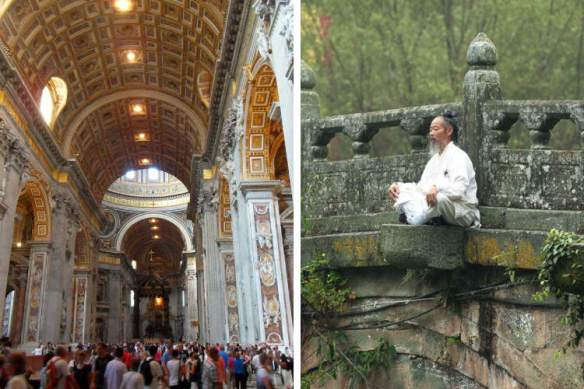
“Spirit can hardly be found in noisy, crowded churches and temples. Even where the teachings of the past sages have been established they have been spoiled by the insensitive trend of the times.

The spirit of the world’s religions died long ago and left most temples and churches merely empty shells.

These places continue as superficial social conventions and can only supply their devotees with shallow activities, psychological games of shadow playing, and hypnosis, all of which have absolutely nothing to do with spiritual reality.

This is the faith of today’s world, and most of their achievements are not the true answer.” ~ Taoist Master Hua Ching Ni

What then, is spiritual reality? And what does it look like in a world governed by fear, distracted by materialism, and kept in conflict by egotism? It’s really quite straightforward, says Master Ni, who refers to it as the “plain, simple truth of your life,’ which is best understood as the profoundly important concept of inner peace.

“The first spiritual goal of Taoism is the restoration and realization of one’s own well-balanced being, and then one’s spiritual evolution.

The highest goal of life is to combine oneself with the spiritual energy of the universe. There is one way to eliminate all wonder, bewilderment and confusion and that is to have inner peace.

The primary method or principle for personal cultivation is to keep peace within oneself and maintain normalcy in one’s environment; thus you can dwell with the spiritual energy and the spiritual energy dwells within you.” ~ Taoist Master Hua Ching Ni

Comparing the teachings of ordinary religions to true personal spiritual cultivation, Master Ni notes that undeveloped human beings follow and devote themselves to belief systems, deities and spiritual figureheads. In contrast, individuals seeking genuine spiritual evolution understand these systems for what they are: illusions and traps.

“People mistake religious emotionalism and hypnosis for spiritual reality.

Often in history religious emotion has been exalted as truth itself. This gave birth to all kinds of religious prejudice and persecution. Religious mobs have carried out the mischief caused by the hot-blooded in the forceful image of a spiritual sovereign. This has not the slightest connection with spiritual reality. It is the manifestation of the impure, heavy, bloody energy of undeveloped human beings before having completed their spiritual evolution.

Many people are fooled by their own ignorance or that of others. And in their ignorance they fool others too. People like this have no hope of reaching the spiritual realm. They will have no chance to touch the real spiritual life. So, before you commit yourself to any religion, you should develop the mental ability to discern what is religious emotion and what is the spiritual truth. One is the right way to follow, and the other is only a psychological pitfall and trap. This is very important for a seeker of truth on the spiritual path.” ~ Taoist Master Hua Ching Ni

Generating this type of spiritual emotionalism has become a profitable art form. Take note of the costumes worn by Catholic Cardinals and deference to the Pope in his symbolic Mitre hat. Islamic fundamentalists and ISIS do the same when they emote fear and terror by parading captives in front of religious soldiers clad in all black robes with faces covered, armed with rifles and sabres. Using symbolic imagery as tools of dominance and control, as Master Ni points out, has absolutely nothing to do with true spiritual reality.

What would the world look like if individuals first placed their own spiritual development ahead of their desire to change the world in accordance with their beliefs about spirituality and feelings of religious emotionalism? What if individuals were instead offered a plan of genuine spiritual cultivation, a path that led to actual inner peace?

“The spiritual process itself is a process of the evolution of the human spirit.” ~ Taoist Master Hua Ching Ni

What If the Christ Child Had Been Born in the American Police State?

By John W. Whitehead

Source: The Rutherford Institute

“When the song of the angels is stilled, when the star in the sky is gone, when the kings and princes are home, when the shepherds are back with their flocks, the work of Christmas begins: to find the lost, to heal the broken, to feed the hungry, to release the prisoner, to rebuild the nations, to bring peace among the people, to make music in the heart.” ― Howard Thurman

The Christmas story of a baby born in a manger is a familiar one.

The Roman Empire, a police state in its own right, had ordered that a census be conducted. Joseph and his pregnant wife Mary traveled to the little town of Bethlehem so that they could be counted. There being no room for the couple at any of the inns, they stayed in a stable (a barn), where Mary gave birth to a baby boy, Jesus. Warned that the government planned to kill the baby, Jesus’ family fled with him to Egypt until it was safe to return to their native land.

Yet what if Jesus had been born 2,000 years later?

What if, instead of being born into the Roman police state, Jesus had been born at this moment in time? What kind of reception would Jesus and his family be given? Would we recognize the Christ child’s humanity, let alone his divinity? Would we treat him any differently than he was treated by the Roman Empire? If his family were forced to flee violence in their native country and sought refuge and asylum within our borders, what sanctuary would we offer them?

A singular number of churches across the country have asked those very questions in recent years, and their conclusions were depicted with unnerving accuracy by nativity scenes in which Jesus and his family are separated, segregated and caged in individual chain-link pens, topped by barbed wire fencing.

Those nativity scenes were a pointed attempt to remind the modern world that the narrative about the birth of Jesus is one that speaks on multiple fronts to a world that has allowed the life, teachings and crucifixion of Jesus to be drowned out by partisan politics, secularism, materialism and war, all driven by a manipulative shadow government called the Deep State.

The modern-day church has largely shied away from applying Jesus’ teachings to modern problems such as war, poverty, immigration, etc., but thankfully there have been individuals throughout history who ask themselves and the world: what would Jesus do?

What would Jesus—the baby born in Bethlehem who grew into an itinerant preacher and revolutionary activist, who not only died challenging the police state of his day (namely, the Roman Empire) but spent his adult life speaking truth to power, challenging the status quo of his day, and pushing back against the abuses of the Roman Empire—do about the injustices of our  modern age?

Dietrich Bonhoeffer asked himself what Jesus would have done about the horrors perpetrated by Hitler and his assassins. The answer: Bonhoeffer was executed by Hitler for attempting to undermine the tyranny at the heart of Nazi Germany.

Aleksandr Solzhenitsyn asked himself what Jesus would have done about the soul-destroying gulags and labor camps of the Soviet Union. The answer: Solzhenitsyn found his voice and used it to speak out about government oppression and brutality.

Martin Luther King Jr. asked himself what Jesus would have done about America’s warmongering. The answer: declaring “my conscience leaves me no other choice,” King risked widespread condemnation when he publicly opposed the Vietnam War on moral and economic grounds.

Even now, despite the popularity of the phrase “What Would Jesus Do?” (WWJD) in Christian circles, there remains a disconnect in the modern church between the teachings of Christ and the suffering of what Jesus in Matthew 25 refers to as the “least of these.”

Yet this is not a theological gray area: Jesus was unequivocal about his views on many things, not the least of which was charity, compassion, war, tyranny and love.

After all, Jesus—the revered preacher, teacher, radical and prophet—was born into a police state not unlike the growing menace of the American police state. When he grew up, he had powerful, profound things to say, things that would change how we view people, alter government policies and change the world. “Blessed are the merciful,” “Blessed are the peacemakers,” and “Love your enemies” are just a few examples of his most profound and revolutionary teachings.

When confronted by those in authority, Jesus did not shy away from speaking truth to power. Indeed, his teachings undermined the political and religious establishment of his day. It cost him his life. He was eventually crucified as a warning to others not to challenge the powers-that-be.

Can you imagine what Jesus’ life would have been like if, instead of being born into the Roman police state, he had been born and raised in the American police state?

Consider the following if you will.

Had Jesus been born in the era of the America police state, rather than traveling to Bethlehem for a census, Jesus’ parents would have been mailed a 28-page American Community Survey, a mandatory government questionnaire documenting their habits, household inhabitants, work schedule, how many toilets are in your home, etc. The penalty for not responding to this invasive survey can go as high as $5,000.

Instead of being born in a manger, Jesus might have been born at home. Rather than wise men and shepherds bringing gifts, however, the baby’s parents might have been forced to ward off visits from state social workers intent on prosecuting them for the home birth. One couple in Washington had all three of their children removed after social services objected to the two youngest being birthed in an unassisted home delivery.

Had Jesus been born in a hospital, his blood and DNA would have been taken without his parents’ knowledge or consent and entered into a government biobank. While most states require newborn screening, a growing number are holding onto that genetic material long-term for research, analysis and purposes yet to be disclosed.

Then again, had Jesus’ parents been undocumented immigrants, they and the newborn baby might have been shuffled to a profit-driven, private prison for illegals where they first would have been separated from each other, the children detained in make-shift cages, and the parents eventually turned into cheap, forced laborers for corporations such as Starbucks, Microsoft, Walmart, and Victoria’s Secret. There’s quite a lot of money to be made from imprisoning immigrants, especially when taxpayers are footing the bill.

From the time he was old enough to attend school, Jesus would have been drilled in lessons of compliance and obedience to government authorities, while learning little about his own rights. Had he been daring enough to speak out against injustice while still in school, he might have found himself tasered or beaten by a school resource officer, or at the very least suspended under a school zero tolerance policy that punishes minor infractions as harshly as more serious offenses.

Had Jesus disappeared for a few hours let alone days as a 12-year-old, his parents would have been handcuffed, arrested and jailed for parental negligence. Parents across the country have been arrested for far less “offenses” such as allowing their children to walk to the park unaccompanied and play in their front yard alone.

Rather than disappearing from the history books from his early teenaged years to adulthood, Jesus’ movements and personal data—including his biometrics—would have been documented, tracked, monitored and filed by governmental agencies and corporations such as Google and Microsoft. Incredibly, 95 percent of school districts share their student records with outside companies that are contracted to manage data, which they then use to market products to us.

From the moment Jesus made contact with an “extremist” such as John the Baptist, he would have been flagged for surveillance because of his association with a prominent activist, peaceful or otherwise. Since 9/11, the FBI has actively carried out surveillance and intelligence-gathering operations on a broad range of activist groups, from animal rights groups to poverty relief, anti-war groups and other such “extremist” organizations.

Jesus’ anti-government views would certainly have resulted in him being labeled a domestic extremist. Law enforcement agencies are being trained to recognize signs of anti-government extremism during interactions with potential extremists who share a “belief in the approaching collapse of government and the economy.”

While traveling from community to community, Jesus might have been reported to government officials as “suspicious” under the Department of Homeland Security’s “See Something, Say Something” programs. Many states, including New York, are providing individuals with phone apps that allow them to take photos of suspicious activity and report them to their state Intelligence Center, where they are reviewed and forwarded to law-enforcement agencies.

Rather than being permitted to live as an itinerant preacher, Jesus might have found himself threatened with arrest for daring to live off the grid or sleeping outside. In fact, the number of cities that have resorted to criminalizing homelessness by enacting bans on camping, sleeping in vehicles, loitering and begging in public has doubled.

Viewed by the government as a dissident and a potential threat to its power, Jesus might have had government spies planted among his followers to monitor his activities, report on his movements, and entrap him into breaking the law. Such Judases today—called informants—often receive hefty paychecks from the government for their treachery.

Had Jesus used the internet to spread his radical message of peace and love, he might have found his blog posts infiltrated by government spies attempting to undermine his integrity, discredit him or plant incriminating information online about him. At the very least, he would have had his website hacked and his email monitored.

Had Jesus attempted to feed large crowds of people, he would have been threatened with arrest for violating various ordinances prohibiting the distribution of food without a permit. Florida officials arrested a 90-year-old man for feeding the homeless on a public beach.

Had Jesus spoken publicly about his 40 days in the desert and his conversations with the devil, he might have been labeled mentally ill and detained in a psych ward against his will for a mandatory involuntary psychiatric hold with no access to family or friends. One Virginia man was arrested, strip searched, handcuffed to a table, diagnosed as having “mental health issues,” and locked up for five days in a mental health facility against his will apparently because of his slurred speech and unsteady gait.

Without a doubt, had Jesus attempted to overturn tables in a Jewish temple and rage against the materialism of religious institutions, he would have been charged with a hate crime. Currently, 45 states and the federal government have hate crime laws on the books.

Had anyone reported Jesus to the police as being potentially dangerous, he might have found himself confronted—and killed—by police officers for whom any perceived act of non-compliance (a twitch, a question, a frown) can result in them shooting first and asking questions later.

Rather than having armed guards capture Jesus in a public place, government officials would have ordered that a SWAT team carry out a raid on Jesus and his followers, complete with flash-bang grenades and military equipment. There are upwards of 80,000 such SWAT team raids carried out every year, many on unsuspecting Americans who have no defense against such government invaders, even when such raids are done in error.

Instead of being detained by Roman guards, Jesus might have been made to “disappear” into a secret government detention center where he would have been interrogated, tortured and subjected to all manner of abuses. Chicago police have “disappeared” more than 7,000 people into a secret, off-the-books interrogation warehouse at Homan Square.

Charged with treason and labeled a domestic terrorist, Jesus might have been sentenced to a life-term in a private prison where he would have been forced to provide slave labor for corporations or put to death by way of the electric chair or a lethal mixture of drugs.

Indeed, as I show in my book Battlefield America: The War on the American People, given the nature of government then and now, it is painfully evident that whether Jesus had been born in our modern age or his own, he still would have died at the hands of a police state.

Thus, as we draw near to Christmas with its celebrations and gift-giving, we would do well to remember that what happened on that starry night in Bethlehem is only part of the story. That baby in the manger grew up to be a man who did not turn away from evil but instead spoke out against it, and we must do no less.

Generation Numb: How Losing My Phone Exposed Me to the Pain of My Peers

This terrible void of which everyone stays pleasantly unobservant is the unofficial sickness of Gen Z.

By Ben Scheer

Source: ScheerPost

I hadn’t planned to give up my smartphone. After all, I was starting my sophomore year of college and I had not met a single adult who lives without one and definitely no other 19-year-old. If you haven’t noticed, it is part of the culture. A few weeks into the semester, I forgot my phone (a Google Pixel 2, for all you phone nerds) in the backseat of an Uber on my way back from shopping off campus. This would lead to an opening to consider a break from the phone and everything that comes with it.

I remember feeling frustrated at myself for being so absentminded and immediately rushed to track it down, anxiously calling the driver from a friend’s phone. While I listened to the open ringing on the line I began to think about this one technology’s central role in my life.

That gateway to other worlds.

Over the next few days I continued to hope my phone would come back to me and also thought further into its role in my relationships. I felt how hindering it was in communicating with the people I love.

How it had required me to be always ready to pluck it from my pocket, pull my focus and as a result, never be truly present. I saw in that reflection the possibility for healthier relationships, less dependent on constant digital connection.

More free, less reliant.

Sure, there were a thousand things that would be made more challenging and tedious, but it would be worth it if I could be more present for my own life.

Days later, after I had given up hope of seeing it again, I used a friend’s phone to call my dad to tell him.

“I will get you another one, what kind do you want?” was the first thing he said.

“Actually I think I’m good,” I responded, to his surprise. “I can write you and my mom by email. If we want to talk, I can call you from my computer.”

Quickly, I started to feel the change. My mood and habits became clearer; I felt happier, more grounded, less looming anxiety, feeling more alone and with myself, more conscious of my space and those in it.

Being alone led to more opportunities for reflection and boredom. I felt calmer, and my walking and pace of day actually slowed down. It is hard to describe how it changed the patterns in my brain but I could feel it readjusting, as it does if you spend a week in the woods or on a beach. One thing I felt was that my days were longer and more connected from one moment to the next.

I also became more aware of the moods and feelings of others around me and was suddenly terrified to see how dependent my peers were on all their screens, and, looking back just a bit, how consumed I, too, had been.

Something else bubbled up from my unconscious: My expectations of college differed from what I was seeing. Between talking to older relatives and seeing college life on TV and in the movies, I was expecting a . . . BIT MORE JOY! Young souls, free minds, positive energy, community. I was seeking some bright spark in the people around me, yet all too often what I saw was dull, void, distractible, unthinking, unfeeling people enveloped in the world of their screens instead of being in community and conversing with the people around them.

Yes, that is harsh. It is also what I see.

So much lost human potential.

I want something or someone to blame, but maybe what I should really be blaming is myself for expecting something else. The truth is, though, I feel right in blaming the phones.

It has been over a year since I gave up my smartphone, but I remember vividly when looking at my phone for hours a day seemed normal to me. I was content to stare at the screen for hours, doing the same thing: Watching mildly entertaining videos or mashing game buttons, swiping on Tinder, scrolling on IG, surfing memes and YouTube videos. In many ways, it’s a drug too good to give up, seemingly a harmless drug, but no. We have opened Pandora’s box of marvels and there is no way to close it now.

We are continually wanting what we do not yet have, an innate motivation amplified and rerouted by capitalism’s hyperdrive marketing engines. A good fix for this constant yearning, or any discomfort is to drown it out with distractions. Feeling an uncontrollable emotion? Existential itch? Low-grade anxiety? No problem: Try scrolling on the social of your choice for a bit, trust me, it takes the edge off.

Trauma or poverty, pain or loneliness, all manner of worry, we have a cure! Or at least the emotional response can be staved off long enough for you to find the next thing to click.

This terrible void of which  everyone stays pleasantly unobservant is a part of me as well, the unofficial sickness of my generation. (COVID-19 will be the official one, memorialized in our virtual yearbooks.) This hole, this pit, that is created from not knowing one’s self, not trusting one’s self, or not allowing feelings. So distracted that these insecurities that we act on every day are a mystery. That you cannot see how fundamentally OK everything actually is because you have music constantly in your ear and a fear that, in silence, your own thoughts would be too scary. The sickening thought that your true feelings for someone were no more than an act of comfort-seeking desperation and that “love” is a lifesaver from yourself.

I can’t blame anyone though. The distractions surround us, they surround the people we are with. The collective unfeeling is so great, so vast, it cracked me open, actually made me cry often once I allowed myself to experience it. I felt like I was losing my footing in the world in which I had grown up. Disconnected from my past and unsure of where we were going.

(Side note: If you haven’t yet watched The Social Dilemma, go do that, it’s worth it.)

Walking into a small college class to see no one looking at each other or chatting, the blank vacant stares. The soft glow. It felt … confusing? Why were so many interesting young people ignoring one another? What was a classroom like before these tools were available and allowed everywhere? Why were the screens so celebrated?

Then my confusion grew, and from it rage and pain. These emotions danced together, fueled me and crushed me. I saw, for the first time, the real power that the phones held. Yes, a power we had given them, but a power nonetheless. The power to keep people who were 500 miles apart tethered to one another, or keep people sitting right next to each other brutally apart.

Who can I blame? It is just the world I have been born into, and the technology- and profit-driven changes are coming faster every year. We live in the future with brain equivalents in our pockets and a web that contains all of our collective knowledge but reveals the worst of what we are and so little of the love we contain and of which we are capable.

Is the internet a good idea? Are phones good for humans? These are not questions we have answered or even barely thought to ask in the mainstream of our culture. Of course they are, what else could they be? Progress! Faster communication! More knowledge! More speed! More fun! We will all be more efficient and entertained, and from that we will live better lives.

NO! Stop, slow down. Please. These gadgets, these everywhere-anytime screens, are ruining the minds of the people who have been mesmerized since they were only little children.

To clarify: not ruining, in that people are made stupid (although it definitely does not help develop our attention span), but rather ruining our emotional capacity and spiritual selves. And these limits fetter us as we are already so strained by the pain we are able to see through our little windows; we don’t have a moment to feel, to feel our own pain, or that of our friends.

Or, for that matter, the pain of the world, or the impact of our constant consumption, or where all this STUFF comes from and where it ends up, or the pain of our history and centuries of exploitation of other humans and nature from which all this wealth originally was derived.

Being human is objectively great. We can use language and words to describe how we feel. We can feel the sun on our face and take in the taste of a thousand foods, dance to every song. Feel great pain and great happiness. Yet, all the time I see this discomfort, unrest and fear in my most distracted friends. It is coming from the disconnection from what they are feeling, a disconnection from being.

This is the worst theft of modern-day, first-world life: the theft of being present.

The phones and distractions and speed create this disconnection from the simple fact that you are actually OK, better then OK — you are alive and can feel and that is a gift to cherish.

Worse than the days of sadness are the days of not feeling anything. Some people are depressed not because anything is wrong but because they are numb to their feelings, too distracted and avoidant to feel them; avoidant, and scared of what might happen if they let themselves feel.

Try this: Really study those you love, let their face become new to you, again, and become fascinated in the way they move. Feel the wonder of being with another human.

After more than a year without a smartphone, I am more hopeful than I was in those first few months. Not to say that everything is all right, far from it. Here in the United States our technology has allowed for multiple realities to coexist alongside one another and I don’t see a clear path out of that problem. Distraction and narrow self-interest prevent us from seeing and grappling with the apocalyptic future climate change can bring in a much shorter time frame than even most globally aware people are willing to accept.

However, I do know that change is a constant and I am healed by looking past my own lifetime and by all the simple beauties of life and living. In the end, these technologies do NOT define us. We can work together to change how we coexist.


Postscript: For those who are interested in also letting go of your smartphone, I would recommend downgrading to a flip-phone or phone of a similar level. I now walk around the world with a thick, red brick through which I can communicate with my work and family in case of emergencies.