The Fall of the American Empire

By W.J. Astore

Source: Bracing Views

Why do empires fall?  Sometimes, it’s easy to identify a cause.  Whether led by the Kaiser or by Hitler, Germany’s Second and Third Empires were destroyed by world wars.  Germany’s ambition was simply too great, its militarism too dominant, its policies too harsh to win long-term converts, its leaders too blinded by the pursuit of power, its enemies too many to conquer or otherwise neutralize.

Other imperial falls are more complex.  What caused Rome’s fall?  (Leaving aside the eastern part of the empire, which persisted far longer as the Byzantine Empire.)  Barbarians and their invasions, say some.  The enervating message and spirit of Christianity, said the historian Edward Gibbon.  Rome’s own corruption and tyranny, say others.  Even lead in Roman water pipes has been suggested as a contributing cause to Rome’s decline and fall.  Taking a longer view, some point to the rise of Islam in the 7th century and its rapid expansion into previously Roman territories as the event that administered the final coup de grâce to a dying empire.

America’s empire, it is clear, is now in decline, and a key reason is imperial overstretch as manifested by endless wars and overspending on the military (with literally trillions of dollars being thrown away on fruitless wars).  An especially fine summary is Alfred McCoy’s article at TomDispatch.com.  As McCoy notes:

In effect, the president and his team, distracted by visions of shimmering ships and shiny planes (with their predictable staggering future cost overruns), are ready to ditch the basics of global dominion: the relentless scientific research that has long been the cutting edge of U.S. military supremacy.  And by expanding the Pentagon while slashing the State Department, Trump is also destabilizing that delicate duality of U.S. power by skewing foreign policy ever more toward costly military solutions (that have proved anything but actual solutions) …

In just one extraordinary year, Trump has destabilized the delicate duality that has long been the foundation for U.S. foreign policy: favoring war over diplomacy, the Pentagon over the State Department, and narrow national interest over international leadership. But in a globalizing world interconnected by trade, the Internet, and the rapid proliferation of nuclear-armed missiles, walls won’t work. There can be no Fortress America.

In this passage, McCoy stresses the damage being done by the Trump administration.  But Trump is just the culmination of certain trends, e.g. favoring the Pentagon over the State Department is nothing new, as I wrote about here in 2010.  And America has been in love with shimmering ships and shiny planes for generations, with several administrations supporting the F-35 jet fighter, a program that may end up costing as much as $1.4 trillion.  Plenty of money for weapons that kill; not so much for medicines that cure: that’s imperial America in a nutshell.

I would stress that America’s strength overseas was (and is) always based on its strength at home in areas such as science, education, infrastructure, medicine, manufacturing, and exports.  But what we’ve witnessed over the last 40 years is an immense and wasteful “investment” in wars and weapons even as our country itself has hollowed out. Science is now marked by the denial of facts (such as global warming). Education is all about students as consumers, with an overall decline in standards and performance. Infrastructure is crumbling. Medicine is too expensive and America’s overall health and life expectancy are both in decline. Manufacturing and exports have withered (except for the production and export of weapons, naturally).

As a result of all this, America is running a national debt of roughly 20 trillion dollars.  The future is being sacrificed for the present, a tragic reality reflected in the latest Republican tax cut, which benefits the richest Americans the most, along with big corporations, and which will likely add another trillion to the national debt.

In short, America’s foreign decline is mirrored (and driven) by its domestic decline as reflected by its choices.  Looking at the USA today, you get the sense it’s the best of times for the richest few, and the worst of times for so many Americans struggling with health care debt, student loan debt, and the uncertainty of low-wage jobs that could be outsourced at any moment.  At the same time, the American political scene is driven by fear: of immigrants, of a nuclear war with North Korea, of Russian meddling (real or imagined), of growing Chinese power, and of the perpetually-hyped threat of terrorist attacks on “the Homeland.”

Empires can fall very quickly, as the “thousand-year” Third Reich did, or they can fall ever so slowly, as the Roman Empire did.  But fall they do.  What is in the cards for the United States?


The most perilous time in world history got worse

By Stephen Lendman

Source: Intrepid Report

Events ongoing should terrify everyone—things likely heading for greater war than already.

Most Americans, Brits, and others in NATO countries are unaware of the danger posed by hardline Western extremists in charge of policymaking—notably in Washington, London and Israel, the Jewish state an alliance Mediterranean Dialogue member.

Businessman Trump was co-opted to be a warrior president—neocon generals in charge of geopolitical policies, their agenda hardened by Mike Pompeo replacing Rex Tillerson at State, along with torturer-in-chief Gina Haspel appointed new CIA director.

An unholy alliance of US extremist policymakers allied with likeminded ones in partner countries risks war winds reaching gale force, a terrifying prospect if confrontation with Russia, Iran or North Korea occurs—the possibility increased by recent events.

Earlier this week, US Defense Secretary Mattis and UN envoy Haley threatened Russia and Damascus.

Russia vowed to retaliate against US attacks on Syrian forces in East Ghouta or elsewhere endangering its personnel in the country.

Anti-Russia hysteria in Britain over the Sergey Skripal poisoning affair, most certainly Moscow had nothing to do with, soured bilateral relations more than already.

In response to British PM Theresa May demanding swift Russian answers to questions posed about the incident, Russian Foreign Ministry spokeswoman (speaking for her government) replied sharply saying, “One does not give 24 hours notice to a nuclear power,” adding the “Skripal poisoning was not an incident but a colossal international provocation,” addin, not a “single international legal mechanism [exists] to probe the Skripal case.”

Russia’s embassy in London said “Moscow will not respond to London’s ultimatum until it receives samples of the chemical substance to which the UK investigators are referring.”

“Britain must comply with the Chemical Weapons Convention which stipulates joint investigation into the incident, for which Moscow is ready.”

“Without that, there can be no sense in any statements from London. The incident appears to be yet another crooked attempt by the UK authorities to discredit Russia.”

“Any threat to take ‘punitive’ measures against Russia will meet with a response. The British side should be aware of that.”

“Not only is Russia groundlessly and provocatively accused of the Salisbury incident, but apparently, plans are being developed in the UK to strike Russia with cyber weapons.”

“Judging by the statements of the prime minister, such a decision can be taken at tomorrow’s meeting of the National Security Council.”

Given the gravity of the situation, the above comments by Russian diplomats were uncharacteristically strong.

Sergey Lavrov warned Washington that “[i]f a new [US] strike . . . takes place [against Syrian forces], the consequences will be very serious,” adding, “I simply don’t have any normal terms left to describe all this.”

What’s coming remains to be seen. Hostile rhetoric from US and UK officials, along with hawkish extremists Pompeo in charge at State and Haspel appointed new CIA chief likely signal more war, not less.

What’s ongoing assures no possibility of improving dismal bilateral relations with Russia, China, Iran and other sovereign independent countries.

Talks with North Korea could either be scuttled or confrontational if they take place.

Given very disturbing ongoing events, the perilous state of world conditions reached a new low.

Be scared about what may follow—be very scared!


Stephen Lendman lives in Chicago. He can be reached at lendmanstephen@sbcglobal.net. His new book as editor and contributor is titled “Flashpoint in Ukraine: How the US Drive for Hegemony Risks WW III.” Listen to cutting-edge discussions with distinguished guests on the Progressive Radio News Hour on the Progressive Radio Network.

8 Signs of a Mind Infected by Political Malware

By Jordan Bates

Source: High Existence

Your mind is similar to a computer.

Your brain is the hardware, your worldview the software.

The operating system you’re running is heavily influenced by your culture, upbringing, education, and many other factors.

Arguably, a well-functioning mind is a mind that can update its operating system.

As new information comes in, a healthy mind will revise its previous conclusions about the world to account for the new data.

The smartest people in the world do this: They’re constantly reading, tinkering, experimenting, and in the process updating their understanding of the world.

After all, the more accurate your models are, the better decisions you’ll make, and the more success you’ll have.

This holds true in virtually every area of life. As the renowned economist John Maynard Keynes put it:

“When my information changes, I alter my conclusions. What do you do, sir?”

Dogma as Malware

Armed with this understanding, we can see that an unhealthy mind is a mind that does not or cannot update itself.

Instead of expanding and revising its models to reflect new information, it will warp and misshape the data to force-fit its existing models.

This problem is captured nicely by a favorite folk saying of the brilliant billionaire investor, Charlie Munger:

“To the man with only a hammer, every problem looks like a nail.”

What causes a mind to misfire in this way?

In a word: dogma: Absolute belief of any kind.

When the mind is convinced that something is incontrovertibly true, it ceases to update its views on that area of reality.

Any dogmatic ideology, then, can be seen as a kind of malware, or virus, attempting to infiltrate our mental computers.

Dogmatic ideologies—religious, political, or otherwise—are essentially trying to convince your mind to freeze into a certain shape and remain that way for the rest of your life.

As previously discussed, to allow one’s mind to freeze is generally disastrous, as a mind incapable of updating itself will tend to adapt very poorly to a complex world.

Unfortunately, certainty feels comfortable to us. It makes us feel like we’re in control, like we’ve got it all figured out. As a result, many minds are frozen by dogmatic malware.

This is an unfortunate state of affairs, as we humans can’t really afford to be non-adaptive at this point in history. We’re facing dire challenges, and we need our collective intelligence and decision-making to be sharp as possible.

8 Symptoms of Political Malware

One way to avoid getting mind-pwnd by dogmatic malware is to learn to recognize the warning signs.

If you can notice other people’s malfunctioning operating systems, you’re much more likely to be able to debug your own.

To hopefully help you do this, I’m going to outline eight telltale symptoms of a brain that’s been compromised by dogmatic political malware.

Political malware is far from the only form of dogma-malware lurking in the world today, but it’s sufficiently common that it should be a useful case to focus on and learn to recognize. And, naturally, many of these points can be extended to other domains.

Here are eight common symptoms of a brain-computer infected by political malware:

1. Inability to explain the arguments or evidence that led to current conclusions.

High-functioning minds don’t just believe things because they feel good or because someone told them to. They require evidence and well-reasoned arguments to support their positions.

If a person is unable to explain the evidence and/or arguments that convinced them of a particular political conclusion, it’s highly likely that they hold that belief simply because their political tribe does.

2. Never says, “I don’t have an opinion on this because I haven’t done enough research and thinking on it.”

Dogmatic, non-adaptive minds tend to have an opinion on everything. Even if they haven’t thought about a given issue for themselves, they just default to whatever opinion is popular with their tribe.

Healthy minds, by contrast, are extremely humble. They realize the world is ridiculously complex and that it’s actually impossible to have an informed opinion on everything. They are honest about what they don’t know, and they realize they should be cautious about forming opinions because humans are so good at deluding themselves and jumping to premature conclusions.

As the genius physicist Richard Feynman put it:

“The first principle is that you must not fool yourself — and you are the easiest person to fool.”

3. Treats affiliation like a badge of honor.

Whatever they happen to be—Republican or Democrat, radical or centrist, libertarian or fascist, conservative or liberal—you know it. Because they advertise it.

They’re proud to be a member of their particular team. But when a person is really proud to be part of something that requires them to hold certain beliefs, what are the chances that they’re going to be able to update those beliefs as they encounter new information? Slim to none. Sharp minds value truth over team and tend not to have strong political affiliations.

4. Views don’t change over time.

Ask a dogmatic person their thoughts on a certain political issue, then ask them again in five years. You’ll almost surely get the same answer. No added nuance, no “Well, I thought about this more and my take is a little bit different now.” Just the same old scripts, repeated ad nauseam.

5. Quickly becomes hostile in political conversations.

The thing about joining a political tribe and thus making your politics a really deep, important part of your identity is that it becomes extremely difficult to have a calm conversation about ideas. 

When you challenge a dogmatic political mind, you’re not just challenging their ideas. You’re challenging their tribe, their identity: the cornerstone of their sense of security in this universe. Naturally, this often doesn’t go over so well.

Healthy minds, by contrast, are interested in the truth, or the best solution, rather than preserving their sense of tribal pride. Therefore they can entertain multiple positions on a single issue without having their feathers ruffled. For them ideas are just ideasand they want to find as many good ideas as possible, let them do battle, and determine which are the best.

6. Absolute faith in the correctness of their own views.

There’s a reason Jordan Greenhall uses the terms “Blue Church” and “Red Religion” to describe the two major political monoliths vying for power in the West.

He’s not the first person to notice that for many people, politics has become a form of religion. With the secularization of the West in recent history, it’s not a surprise that people’s religious drives have been diverted into another dogmatic domain.

Adaptive minds, by contrast, expect to be wrong. The idea that they’ve somehow reached the Final Truth of reality seems ludicrous.

“You should take the approach that you’re wrong. Your goal is to be less wrong.”

― Elon Musk

7. Displays an “If you disagree with me, you must be my enemy” mentality.

For highly dogmatic minds, any disagreement is interpreted as an act of war. If you disagree with them, or even offer an alternate possibility, you must not be on their team, and if you’re not on their team, you must be on an opposing team—an enemy.

This black-and-white thinking is made all the worse when a country has just two major political parties, as in the case of the United States. In a well-functioning bipartisan system, the two parties should at least be able to cooperate, compromise, and realize everyone is ultimately seeking to improve the country, despite disagreeing about how best to do that. Unfortunately, in the profoundly divisive and polarized US political climate of 2018, bipartisan cooperation and understanding has become impossible for many people. This is a grim omen of things to come.

Adaptive minds realize that disagreement is healthy, and that talking through disagreements presents an opportunity to learn and refine one’s views. They furthermore understand that black-and-white thinking fails to account for the complexity of the world. They see that it is unwise to rigidly categorize someone as an enemy or as a member of a certain tribe based on a couple of their positions, considering there are potentially infinite positions one could take on any given issue.

8. All viewpoints are identical to those of a single political camp.

If you can guess a person’s positions on climate change, social welfare, immigration, and gun control, based on their position on some unrelated issue like abortion, you can be fairly certain that they’ve inherited tribal dogmas, rather than forming their own conclusions.

The appeal of subscribing to a dogmatic ideology is that there is an answer for everything. You just repeat the views that are popular with your tribe, and you never have to go to the trouble of analyzing individual issues for yourself.

Active minds, by contrast, hold complex, nuanced, unpredictable views, because they analyze each issue independently. They seek out the best arguments and evidence supporting different positions on the issue, and they form their own conclusions. Or often they’re agnostic on certain issues, because they’ve confronted the true complexity and don’t feel confident enough to favor one compelling view over another.

Conclusion: Activate Your Mind

A healthy mind is a mind that updates itself based on new arguments and evidence.

Cultivating this form of mental health will serve you well in all areas of life. It’s also arguably something that we need more people to do, if we hope to continue to flourish as a species and help other earthly species to flourish.

Humanity currently finds itself in the midst of unprecedented global changes. In such complex and unpredictable times, we surely need to be adaptable and open to good ideas, wherever they may come from. We are gaining the technological power of gods, but without the wisdom and care of gods to accompany this power, we are likely to wield it in disastrous ways.

Gaining the wisdom and care of gods begins with each of us: with our individual decisions to activate our minds—to actively pursue greater knowledge, wisdom, and understanding.

Hopefully this post has offered you some mind-activating inspiration and direction. The need for individuals to take their education and cognitive empowerment into their own hands extends far beyond politics. The degree to which we are collectively successful in this endeavor may well determine whether we create a utopia or an apocalypse in the coming decades and centuries.

All of this is to say that, your mind matters. Take good care of it. Best of luck.

The Singular Pursuit of Comrade Bezos

By Malcolm Harris

Source: Medium

It was explicitly and deliberately a ratchet, designed to effect a one-way passage from scarcity to plenty by way of stepping up output each year, every year, year after year. Nothing else mattered: not profit, not the rate of industrial accidents, not the effect of the factories on the land or the air. The planned economy measured its success in terms of the amount of physical things it produced.

— Francis Spufford, Red Plenty

But isn’t a business’s goal to turn a profit? Not at Amazon, at least in the traditional sense. Jeff Bezos knows that operating cash flow gives the company the money it needs to invest in all the things that keep it ahead of its competitors, and recover from flops like the Fire Phone. Up and to the right.

— Recode, “Amazon’s Epic 20-Year Run as a Public Company, Explained in Five Charts


From a financial point of view, Amazon doesn’t behave much like a successful 21st-century company. Amazon has not bought back its own stock since 2012. Amazon has never offered its shareholders a dividend. Unlike its peers Google, Apple, and Facebook, Amazon does not hoard cash. It has only recently started to record small, predictable profits. Instead, whenever it has resources, Amazon invests in capacity, which results in growth at a ridiculous clip. When the company found itself with $13.8 billion lying around, it bought a grocery chain for $13.7 billion. As the Recode story referenced above summarizes in one of the graphs: “It took Amazon 18 years as a public company to catch Walmart in market cap, but only two more years to double it.” More than a profit-seeking corporation, Amazon is behaving like a planned economy.

If there is one story on Americans who grew up after the fall of the Berlin Wall know about planned economies, I’d wager it’s the one about Boris Yeltsin in a Texas supermarket.

In 1989, recently elected to the Supreme Soviet, Yeltsin came to America, in part to see Johnson Space Center in Houston. On an unscheduled jaunt, the Soviet delegation visited a local supermarket. Photos from the Houston Chronicle capture the day: Yeltsin, overcome by a display of Jell-O Pudding Pops; Yeltsin inspecting the onions; Yeltsin staring down a full display of shiny produce like a line of enemy soldiers. Planning could never master the countless variables that capitalism calculated using the tireless machine of self-interest. According to the story, the overflowing shelves filled Yeltsin with despair for the Soviet system, turned him into an economic reformer, and spelled the end for state socialism as a global force. We’re taught this lesson in public schools, along with Animal Farm: Planned economies do not work.

It’s almost 30 years later, but if Comrade Yeltsin had visited today’s most-advanced American grocery stores, he might not have felt so bad. Journalist Hayley Peterson summarized her findings in the title of her investigative piece, “‘Seeing Someone Cry at Work Is Becoming Normal’: Employees Say Whole Foods Is Using ‘Scorecards’ to Punish Them.” The scorecard in question measures compliance with the (Amazon subsidiary) Whole Foods OTS, or “on-the-shelf” inventory management. OTS is exhaustive, replacing a previously decentralized system with inch-by-inch centralized standards. Those standards include delivering food from trucks straight to the shelves, skipping the expense of stockrooms. This has resulted in produce displays that couldn’t bring down North Korea. Has Bezos stumbled into the problems with planning?

Although OTS was in play before Amazon purchased Whole Foods last August, stories about enforcement to tears fit with the Bezos ethos and reputation. Amazon is famous for pursuing growth and large-scale efficiencies, even when workers find the experiments torturous and when they don’t make a lot of sense to customers, either. If you receive a tiny item in a giant Amazon box, don’t worry. Your order is just one small piece in an efficiency jigsaw that’s too big and fast for any individual human to comprehend. If we view Amazon as a planned economy rather than just another market player, it all starts to make more sense: We’ll thank Jeff later, when the plan works. And indeed, with our dollars, we have.

In fact, to think of Amazon as a “market player” is a mischaracterization. The world’s biggest store doesn’t use suggested retail pricing; it sets its own. Book authors (to use a personal example) receive a distinctly lower royalty for Amazon sales because the site has the power to demand lower prices from publishers, who in turn pass on the tighter margins to writers. But for consumers, it works! Not only are books significantly cheaper on Amazon, the site also features a giant stock that can be shipped to you within two days, for free with Amazon Prime citizensh…er, membership. All 10 or so bookstores I frequented as a high school and college student have closed, yet our access to books has improved — at least as far as we seem to be able to measure. It’s hard to expect consumers to feel bad enough about that to change our behavior.


Although they attempt to grow in a single direction, planned economies always destroy as well as build. In the 1930s, the Soviet Union compelled the collectivization of kulaks, or prosperous peasants. Small farms were incorporated into a larger collective agricultural system. Depending on who you ask, dekulakization was literal genocide, comparable to the Holocaust, and/or it catapulted what had been a continent-sized expanse of peasants into a modern superpower. Amazon’s decimation of small businesses (bookstores in particular) is a similar sort of collectivization, purging small proprietors or driving them onto Amazon platforms. The process is decentralized and executed by the market rather than the state, but don’t get confused: Whether or not Bezos is banging on his desk, demanding the extermination of independent booksellers — though he probably is — these are top-down decisions to eliminate particular ways of life.

Now, with the purchase of Whole Foods, Bezos and Co. seem likely to apply the same pattern to food. Responding to reports that Amazon will begin offering free two-hour Whole Foods delivery for Prime customers, BuzzFeed’s Tom Gara tweeted, “Stuff like this suggests Amazon is going to remove every cent of profit from the grocery industry.” Free two-hour grocery delivery is ludicrously convenient, perhaps the most convenient thing Amazon has come up with yet. And why should we consumers pay for huge dividends to Kroger shareholders? Fuck ’em; if Bezos has the discipline to stick to the growth plan instead of stuffing shareholder pockets every quarter, then let him eat their lunch. Despite a business model based on eliminating competition, Amazon has avoided attention from antitrust authorities because prices are down. If consumers are better off, who cares if it’s a monopoly? American antitrust law doesn’t exist to protect kulaks, whether they’re selling books or groceries.

Amazon has succeeded in large part because of the company’s uncommon drive to invest in growth. And today, not only are other companies slow to spend, so are governments. Austerity politics and decades of privatization put Amazon in a place to take over state functions. If localities can’t or won’t invest in jobs, then Bezos can get them to forgo tax dollars (and dignity) to host HQ2. There’s no reason governments couldn’t offer on-demand cloud computing services as a public utility, but instead the feds pay Amazon Web Services to host their sites. And if the government outsources health care for its population to insurers who insist on making profits, well, stay tuned. There’s no near-term natural end to Amazon’s growth, and by next year the company’s annual revenue should surpass the GDP of Vietnam. I don’t see any reason why Amazon won’t start building its own cities in the near future.

America never had to find out whether capitalism could compete with the Soviets plus 21st-century technology. Regardless, the idea that market competition can better set prices than algorithms and planning is now passé. Our economists used to scoff at the Soviets’ market-distorting subsidies; now Uber subsidizes every ride. Compared to the capitalists who are making their money by stripping the copper wiring from the American economy, the Bezos plan is efficient. So, with the exception of small business owners and managers, why wouldn’t we want to turn an increasing amount of our life-world over to Amazon? I have little doubt the company could, from a consumer perspective, improve upon the current public-private mess that is Obamacare, for example. Between the patchwork quilt of public- and private-sector scammers that run America today and “up and to the right,” life in the Amazon with Lex Luthor doesn’t look so bad. At least he has a plan, unlike some people.

From the perspective of the average consumer, it’s hard to beat Amazon. The single-minded focus on efficiency and growth has worked, and delivery convenience is perhaps the one area of American life that has kept up with our past expectations for the future. However, we do not make the passage from cradle to grave as mere average consumers. Take a look at package delivery, for example: Amazon’s latest disruptive announcement is “Shipping with Amazon,” a challenge to the USPS, from which Amazon has been conniving preferential rates. As a government agency bound to serve everyone, the Postal Service has had to accept all sorts of inefficiencies, like free delivery for rural customers or subsidized media distribution to realize freedom of the press. Amazon, on the other hand, is a private company that doesn’t really have to do anything it doesn’t want to do. In aggregate, as average consumers, we should be cheering. Maybe we are. But as members of a national community, I hope we stop to ask if efficiency is all we want from our delivery infrastructure. Lowering costs as far as possible sounds good until you remember that one of those costs is labor. One of those costs is us.

Earlier this month, Amazon was awarded two patents for a wristband system that would track the movement of warehouse employees’ hands in real time. It’s easy to see how this is a gain in efficiency: If the company can optimize employee movements, everything can be done faster and cheaper. It’s also easy to see how, for those workers, this is a significant step down the path into a dystopian hellworld. Amazon is a notoriously brutal, draining place to work, even at the executive levels. The fear used to be that if Amazon could elbow out all its competitors with low prices, it would then jack them up, Martin Shkreli style. That’s not what happened. Instead, Amazon and other monopsonists have used their power to drive wages and the labor share of production down. If you follow the Bezos strategy all the way, it doesn’t end in fully automated luxury communism or even Wall-E. It ends in The Matrix, with workers swaddled in a pod of perfect convenience and perfect exploitation. Central planning in its capitalist form turns people into another cost to be reduced as low as possible.

Just because a plan is efficient doesn’t mean it’s good. Postal Service employees are unionized; they have higher wages, paths for advancement, job stability, negotiated grievance procedures, health benefits, vacation time, etc. Amazon delivery drivers are not and do not. That difference counts as efficiency when we measure by price, and that is, to my mind, a very good argument for not handing the world over to the king of efficiency. The question that remains is whether we have already been too far reduced, whether after being treated as consumers and costs, we might still have it in us to be more, because that’s what it will take to wrench society away from Bezos and from the people who have made him look like a reasonable alternative.

“An Enthusiastic Corporate Citizen”: David Cronenberg and the Dawn of Neoliberalism

(Editor’s note: In commemoration of director David Cronenberg’s 75th birthday we present this compelling and socially relevant analysis of his filmography.)

By Michael Grasso

Source: We Are the Mutants

The cinematic corpus of David Cronenberg is probably best known for its expertly uncanny use of body horror, but looming almost as large in the writer-director’s various universes is the presence of faceless, all-powerful organizations. Like his rough contemporary Thomas Pynchon and the conspiracies that litter Pynchon’s early works—V. (1963), The Crying of Lot 49 (1966), and Gravity’s Rainbow (1973)—Cronenberg’s shadowy organizations offer fodder for paranoid conspiracy. These conspiracies operate under the cloak of beneficent academic institutes and, in his later work, corporations. The transition from institutes to corporations occurred during Cronenberg’s late ’70s and early ’80s output, specifically the trio of films The Brood (1979), Scanners (1981), and Videodrome (1983).

It is no coincidence that, at this particular time, international finance and prevailing political winds helped put the corporation in society’s driver’s seat. In Adam Curtis’s recent documentary film HyperNormalisation (2016), he notes how the default of the city of New York in 1975 opened the door for private investment and the finance industry to get their hands on municipal governance on a large scale for the first time, and how this creaked open the door for the Thatcher-Reagan privatization wave in the ’80s. These last few “hinge” years of the 1970s offered the last chance for a real alternative to the coming neoliberal revolution. Soon, all alternatives for governance in the name of the public good were destroyed. Corporatism tightened its grip on the Western polity.

Cronenberg’s early eerie organizations—the “Canadian Academy of Erotic Enquiry” from Stereo (1969) and the panoply of gruesome academic and cosmetic conspiracies in his Crimes of the Future (1970)—eventually yielded to corporations like Scanners‘ ConSec and Videodrome‘s Spectacular Optical. In these early works, Cronenberg’s mysterious organizations are headed by visionary (mad) geniuses. In 1975’s Shivers, experiments by a lone mad scientist infect an entire apartment building with parasites, which awaken dark impulses in the building’s residents and spread themselves through sexual violence. But as the decade went on, Cronenberg slowly backed away from utilizing the character of a singular scientific genius harboring a twisted vision of the future. Now, organizations sought to pull the strings from the shadows. The key transitional work in this chronology is the sometimes-underlooked The Brood from 1979.

In the film, Oliver Reed plays esteemed psychologist Dr. Hal Raglan, who has developed a method of exorcising deep-seated psychological issues using a technique called “psychoplasmics.” In intense one-on-one sessions reminiscent of psychodrama, Raglan is able to physically remove trauma from the human body in the form of ulcers, rashes, and, we eventually discover, cancer. In the ultimate reveal, it’s shown that Raglan has helped traumatized patient Nola Carveth (Samantha Eggar) to birth violent, deformed homunculi who go out into the world, psychically connected to her, in order to resolve her childhood abandonment issues and abuse with bloody murder. Raglan’s foundation, the Somafree Institute of Psychoplasmics (its name simultaneously evocative of Aldous Huxley’s perfect drug soma, and reminiscent of fringe psychological research like Wilhelm Reich’s orgone theory) inhabits a modernist chalet far outside the city of Toronto. Non-resident patients have to be bussed in. Raglan’s public reputation is that of an eccentric, but effective, therapist. At several points in the film we see the covers of Raglan’s presumably best-selling The Shape of Rage. (Curiously, a decade later, in 1990, a documentary titled Child of Rage would be released covering the controversial use of “attachment therapy.”)

As depicted in the film, Somafree is not a corporation. But the thematic threads surrounding Raglan and his Institute are based on real-life trends in the 1970s. In its practices and in the person of Raglan, Somafree resembles psycho-intensive institutes like Esalen, self-improvement organizations like Lifespring, and personalities like Werner Erhard. Erhard’s est movement used primal abuse to ostensibly create psychological breakthroughs, helping the “patient” become more assertive, more powerful, less prone to obeying impulses caused by their early traumas. There is also the real-life analogue to the psychological method that Raglan employs: psychodrama. In the 1970s, new methods of conflict resolution pioneered in places like Esalen were beginning to seep into the mainstream of North American society. These methods soon spread into the corporate world as a purported means of defusing tensions at work and making an office more productive. The “encounter group” soon became a punchline, but the principles behind the Age of Aquarius’s more touchy-feely psychodynamic methods soon became part of the warp and weft of corporate culture in the ’80s and well beyond.

Nola’s estranged husband Frank interviews a former Raglan patient, Jan Hartog, in an attempt to discredit Somafree so Frank can regain custody of his daughter. This patient bears the scars of Raglan’s work on him: a lymphatic cancer sprouting from his neck (an eerie foreshadowing of the coming of another mysterious lymphatic disorder that would soon break out all over North America). Hartog plans to sue; not to achieve victory in a courtroom, but to destroy Raglan’s reputation. It doesn’t matter if they win, Hartog says, because “They’ll just remember the slogan. Psychoplasmics can cause cancer.” The 1970s was full of an increased awareness of the carcinogens that surrounded us in the late-industrial West—cigarettes, sweeteners, food dyes, and pesticides—thanks in large part to the nascent environmental and consumer rights movements, which faced off against corporations using  weapons of negative publicity.

By the time we get to Scanners in 1981, we are fully invested in a world of shadowy corporate overlords. A huge multinational security firm, ConSec, tries to shepherd psychics called “scanners,” ostensibly to help them control their powers, but also to utilize and exploit their paranormal abilities. Protagonist Cameron Vale (Steven Lack) is apprehended off the streets, where, due to his psychic pain, he’s living as a derelict. We learn that scanners don’t “fit in” with society. When Vale is given the inhibitive drug ephemerol by ConSec’s head of scanner research, Dr. Paul Ruth (Patrick McGoohan), he is able to get himself together and is even given a new proto-yuppie wardrobe and mission by ConSec: eliminate rogue scanner Darryl Revok (Michael Ironside). But as Vale accepts his mission and new identity, he finds himself enlisted in ConSec’s private war against renegade scanners. When he runs into an emerging cell of scanners who are forming a powerful “group mind” in a New Age-like encounter session, assassins controlled by Revok murder most of the cell. “Everywhere you go, somebody dies,” one of the hive mind tells Vale, who is complicit with ConSec’s need to exert corporate control over scanners, including the use of violence as part of the corporate mission. Meanwhile, ConSec itself is riddled with moles working with Revok. Indeed, a chemical and pharmaceutical company called “Biocarbon Amalgamate,” founded by Dr. Ruth but now infiltrated by Revok, manufactures ephemerol in massive quantities. Scanners recontexualizes the Cold War espionage “wilderness of mirrors” in terms of corporate espionage for a new age of corporate domination. (It’s no coincidence that Cronenberg cast McGoohan, one of the Cold War’s most famous fictional spies, in the role of Dr. Ruth.)

ConSec’s corporate mission is revealed in a board meeting when the new head of security says, “We’re in the business of international security. We deal in weaponry and private armories.” This head of security also tells Dr. Ruth, “Let us leave the development of dolphins and freaks as weapons of espionage to others.” To the new breed of ConSec executive, fringe ’70s research is a thing of the past, despite its obvious power and relevance. The future is in fighting proxy wars, ensuring private security for the wealthy, and providing mercenary security forces. ConSec in this way is like many other private security firms that first emerged in the 1970s and ’80s. Begun as an outgrowth of post-colonial British military adventurism, the private military company soon became a way for ex-military officers to assure themselves a handsome post-service sinecure in a new era where hot wars were a thing of the past. “Brushfire wars” would continue to ensue, ensuring these companies an expanding portfolio, both in the waning years of the Cold War and in the 1990s and beyond. In fact, it’s interesting to note that many of the real-world military’s supposed psychic assets themselves got into private security after the U.S. Army shut down fringe science projects like Project STARGATE. Art imitates life imitates art.

Videodrome expands Cronenberg’s conspiratorial corporate, military, and espionage worldview into the rapidly exploding world of the media in the early ’80s. Leaps forward in technology, all of which are explicitly called out in Videodrome, litter the film’s visual landscape. Cable television, satellite transmissions (and the attendant hacking thereof), video cassette recorders, the rise of video pornography, virtual reality, postmodern media theory, and violence in entertainment all play essential roles in the film. Max Renn’s (James Woods) tiny Civic TV/Channel 83 (itself based on groundbreaking independent Toronto television station CityTV) is trying to survive as best it can in a world of massive international media players. Ever seeking the latest hit that will tap into the public’s unending hunger for sex and violence, his on-staff “satellite pirate” Harlan delivers the mysterious Videodrome transmission. Harlan is later revealed to be working with the Videodrome conspiracy, having intentionally exposed Max to the signal. In a memorable speech, Harlan nails Max’s amoral desire to sell sex and violence to his viewers: “This cesspool you call a television station, and your people who wallow around in it, and your viewers who watch you do it; you’re rotting us away from the inside.” When Renn is deep into his Videodrome-triggered hallucinations, he is offered corporate “help” much as Cameron Vale was. This time, his “savior” is Barry Convex, a representative of Spectacular Optical. In his video message to Max, he, like the ConSec executive before him, lays out Spectacular Optical’s corporate mission:

I’d like to invite you into the world of Spectacular Optical, an enthusiastic global corporate citizen. We make inexpensive glasses for the Third World… and missile guidance systems for NATO. We also make Videodrome, Max.

The final form of the military-industrial-entertainment complex is laid bare. Videodrome’s intent is to harden and make psychotic a North American television audience who’ve “become soft,” as Harlan puts it. Renn’s hallucinations are recorded, he is literally “reprogrammed” to kill Civic TV’s board (thanks to the memorable hallucinatory image of Convex sticking a VHS tape into Renn’s gut). Renn is then reprogrammed to retaliate and assassinate Convex by the much more ’70s-cult Cathode Ray Mission of “media prophet” Brian O’Blivion, whose postmodern, expressly McLuhanesque view of television’s place in the world allowed Videodrome to come into existence in the first place: “I had a brain tumor and I had visions. I believe the visions caused the tumor and not the reverse… when they removed the tumor, it was called Videodrome.” It’s also worth noting that O’Blivion tells us that Videodrome made him its first victim; postmodern criticism of the medium of television is no match for its violent, cancerous growth.

The deregulation of media in the U.S. in the Reagan years is common knowledge; rules around children’s television were especially eviscerated, which allowed for an explosion in violent, warlike cartoons based on popular toy lines, training a new generation for a lifetime of endless war. Combined with the aforementioned explosion of video technology, the laissez-faire environment shepherded by Reagan’s FCC allowed a new breed of cable television magnates to get rich and created a television and media landscape with a relatively friction-free relationship to government. By the time the first Gulf War broke out in 1991, war provided the cable news networks with surefire ratings and cable news provided the propaganda platform for the war effort, a mutually beneficial (and Cronenberg-esque) symbiosis that’s continued to metastasize through multiple subsequent wars in the Middle East. The world of Videodrome, the one Harlan evokes where America will no longer be soft in a world full of tough hombres, has finally come to fruition thanks in part to all of our enmeshment in the video arena—the video drome.

After Videodrome—in The Fly (1986), Dead Ringers (1988), and Crash (1996)—Cronenberg focuses less on sinister organizations and more on monomaniacal researchers, doctors, and fetishists who pursue their individual idiosyncratic agendas through the director’s trademark twisting mindscapes (and bodyscapes). With the exception of eXistenZ (1999), Cronenberg’s meditation on computer technology and gaming released amidst the first dot-com bubble, and his Occupy-influenced adaptation of Don DeLillo’s 2003 novel Cosmopolis (2012), he has retreated from a more overt suspicion of corporations and shadowy conspiracies. His warning about these invisible masters pulling the strings of society came during the time period when something could have been done about corporate hegemony. But now, the conspiracy operates in the open. We are now all of us the dumb, trusting Cronenberg protagonist, lulled into a false sense of security by a series of “enthusiastic corporate citizens.” Long live the new flesh.

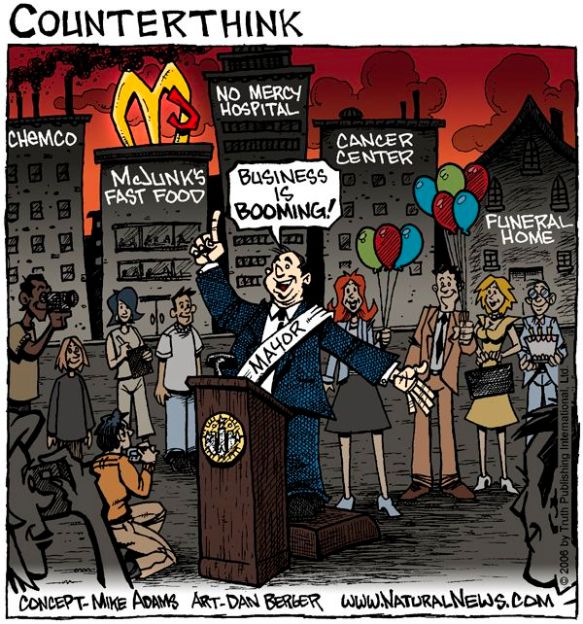
The political logic of the junk food revolution

By Jonathan Cook

Source: TruePublica

Here is an article on food whose political implications are really worth considering. We already know that people in western societies, particularly the US and UK, are eating far too much junk food, and that this leads to an epidemic of obesity, heart disease and cancer.

But the latest research not only reveals the extent that “ultra-processed” foods have come to dominate our diets in Europe – now comprising more than half of what Britons eat, for example – but raises the question of what effects the consumption of this much junk food will have on our behaviours.

The nutritionists here are reluctant to offer even well-informed speculation, which always seems to be the case with publicly funded scientists until things have moved beyond a critical point. Think of smoking and climate change: we usually learn much later that the corporations’ own pet-scientists had done the research decades earlier proving or predicting exactly what was coming.

But there are hints from the nutritionists to the Guardian of what might be going on:

“People are missing out not only on vitamins and minerals but also bioactive compounds found in natural foods such as phytoestrogens and fibre.

And then you get salt and starch and sugar and fat and all these additives. We are consuming every day an amount of new substances that are these flavours and colours and emulsifiers and we don’t have any idea as to what will be the problem of these items,” [Professor Carlos Monteiro from the University of Sao Paulo in Brazil, who led the research team] said. …

Other cumulative effects of eating these industrially-made substances are not yet known. “The honest answer is we don’t know what is going on,” said Monteiro.’

Here is an educated guess, based in part on experience and in part on the economic and political logic of our current junk food revolution. (Those of us who eat these industrial substances rarely enough that they do not dominate our diets still have a sense of what happens to us on the occasions we do.)

These lab-created, nutritionally empty substances that our bodies have not evolved to digest not only make us physically sick, but emotionally and mentally sick too: addicted, depressed, lazy, sluggish, docile and anxious.

In fact, a mess of emotions that transforms us into the perfect consumers, buying more of this cheap, harmful “food”. That boosts both the profits of food and other corporations and the electoral fortunes of crowd-pleasing, money-grubbing, vacuous politicians who wish to serve those corporations.

That is how an advanced capitalist system – premised on a psychopathic drive by the strongest to maximise profits by exploiting the weakest – will naturally evolve. It needs to make us as dependent, as passive and docile, as possible.

America’s Enemies, Who’s On the List?

Prospects and Perspectives

By Prof. James Petras

Source: Global Research

For almost 2 decades, the US pursued a list of ‘enemy countries’ to confront, attack, weaken and overthrow. 

This imperial quest to overthrow ‘enemy countries’ operated at various levels of intensity, depending on two considerations:  the level of priority and the degree of vulnerability for a ‘regime change’ operation.

The criteria for determining an ‘enemy country’ and its place on the list of priority targets in the US quest for greater global dominance, as well as its vulnerability to a ‘successfully’ regime change will be the focus of this essay.

We will conclude by discussing the realistic perspectives of future imperial options.

Prioritizing US Adversaries

Imperial strategists consider military, economic and political criteria in identifying high priority adversaries.

The following are high on the US ‘enemy list’:

1) Russia, because of its military power, is a nuclear counterweight to US global domination.  It has a huge, well-equipped armed force with a European, Asian and Middle East presence.  Its global oil and gas resources shield it from US economic blackmail and its growing geo-political alliances limit US expansion.

2) China, because of its global economic power and the growing scope of its trade, investment and technological networks.  China’s growing defensive military capability, particularly with regard to protecting its interests in the South China Sea serve to counter US domination in Asia.

3) North Korea, because of its nuclear and ballistic missile capability, its fierce independent foreign policies and its strategic geo-political location, is seen as a threat to the US military bases in Asia and Washington’s regional allies and proxies.

4) Venezuela, because of its oil resources and socio-political policies, challenge the US centered neo-liberal model in Latin America.

5) Iran, because of its oil resources, political independence and geo-political alliances in the Middle East, challenge US, Israeli and Saudi Arabia domination of the region and present an independent alternative.

6) Syria, because of its strategic position in the Middle East, its secular nationalist ruling party and its alliances with Iran, Palestine, Iraq and Russia, is a counterweight to US-Israeli plans to balkanize the Middle East into warring ethno-tribal states.

US  Middle-level Adversaries :

1)  Cuba, because of its independent foreign policies and its alternative socio-economic system stands in contrast to the US-centered neo-liberal regimes in the Caribbean, Central and South America.

2) Lebanon, because of its strategic location on the Mediterranean and the coalition government’s power sharing arrangement with the political party, Hezbollah, which is increasingly influential in Lebanese civil society in part because of its militia’s proven capacity to protect Lebanese national sovereignty by expelling the invading Israeli army and helping to defeat the ISIS/al Queda mercenaries in neighboring Syria.

3) Yemen, because of its independent, nationalist Houthi-led movement opposed to the Saudi-imposed puppet government as well as its relations with Iran.

Low Level Adversaries

1) Bolivia, because of its independent foreign policy, support for the Chavista government in Venezuela and advocacy of a mixed economy;  mining wealth and  defense of indigenous people’s territorial claims.

2) Nicaragua, because of its independent foreign policy and criticism of US aggression toward Cuba and Venezuela.

US hostility to high priority adversaries is expressed through economic sanctions military encirclement, provocations and intense propaganda wars toward North Korea, Russia, Venezuela, Iran and Syria.

Because of China’s powerful global market linkages, the US has applied few sanctions.  Instead, the US relies on military encirclement, separatist provocations and intense hostile propaganda when dealing with China.

Priority Adversaries, Low Vulnerability and Unreal Expectations

With the exception of Venezuela, Washington’s ‘high priority targets’ have limited strategic vulnerabilities. Venezuela is the most vulnerable because of its high dependence on oil revenues with its major refineries located in the US, and its high levels of indebtedness, verging on default.   In addition, there are the domestic opposition groups, all acting as US clients and Caracas’ growing isolation within Latin America due to orchestrated hostility by important US clients, Argentina, Brazil, Colombia and Mexico.

Iran is far less vulnerable: It is a strong strategic regional military power linked to neighboring countries and similar religious-nationalist movements.  Despite its dependence on oil exports, Iran has developed alternative markets, like China, free from US blackmail and is relatively safe from US or EU initiated creditor attacks.

North Korea, despite the crippling economic sanctions imposed on its regime and civilian population, has ‘the bomb’ as a deterrent to a US military attack and has shown no reluctance to defend itself.  Unlike Venezuela, neither Iran nor North Korea face significant internal attacks from US-funded or armed domestic opposition.

Russia has full military capacity – nuclear weapons, ICBM and a huge, well-trained armed force – to deter any direct US military threat.  Moscow is politically vulnerable to US-backed propaganda, opposition political parties and Western-funded NGO’s.  Russian oligarch-billionaires, linked to London and Wall Street, exercise some pressure against independent economic initiatives.

To a limited degree, US sanctions exploited Russia’s earlier dependence on Western markets, butsince the imposition of draconian sanctions by the Obama regime, Moscow has effectively counteredWashington’s offensive by diversifying its markets to Asia and strengthening domestic self-reliance in its agriculture, industry and high technology.

China has a world-class economy and is on course to become the world’s economic leader.  Feeble threats to ‘sanction’ China have merely exposed Washington’s weakness rather intimidating Beijing.  China has countered US military provocations and threats by expanding its economic market power, increasing its strategic military capacity and shedding dependence on the dollar.

Washington’s high priority targets are not vulnerable to frontal attack: They retain or are increasing their domestic cohesion and economic networks, while upgrading their military capacity to impose completely unacceptable costs on the US for any direct assault.

As a result, the US leaders are forced to rely on incremental, peripheral and proxy attacks with limited results against its high priority adversaries.

Washington will tighten sanctions on North Korea and Venezuela, with dubious prospects of success in the former and a possible pyrrhic victory in the case of Caracas. Iran and Russia can easily overcome proxy interventions.  US allies, like Saudi Arabia and Israel, can badger, propagandize and rail the Persians, but their fears that an out-and-out war against Iran, could quickly destroy Riyadh and Tel Aviv forces them to work in tandem to induce the corrupt US political establishment to push for war over the objections of a war-weary US military and population. Saudi and Israelis can bomb and starve the populations of Yemen and Gaza, which lack any capacity to reply in kind, but Teheran is another matter.

The politicians and propagandists in Washington can blather about Russia’s interference in the US’s corrupt electoral theater and scuttle moves to improve diplomatic ties, but they cannot counter Russia’s growing influence in the Middle East and its expanding trade with Asia, especially China.

In summary, at the global level, the US ‘priority’ targets are unattainable and invulnerable.  In the midst of the on-going inter-elite dogfight within the US, it may be too much to hope for the emergence of any rational policymakers in Washington who could rethink strategic priorities and calibrate policies of mutual accommodation to fit in with global realities.

Medium and Low Priorities, Vulnerabilities and Expectations

Washington can intervene and perhaps inflict severe damage on middle and low priority countries.  However, there are several drawbacks to a full-scale attack.

Yemen, Cuba, Lebanon, Bolivia and Syria are not nations capable of shaping global political and economic alignments.  The most the US can secure in these vulnerable countries are destructive regime changes with massive loss of life, infrastructure and millions of desperate refugees . . . but at great political cost, with prolonged instability and with severe economic losses.

Yemen

The US can push for a total Saudi Royal victory over the starving, cholera-stricken people of Yemen.  But who benefits?  Saudi Arabia is in the midst of a palace upheaval and has no ability to exercise hegemony, despite hundreds of billions of  dollars of US/NATO arms, trainers and bases.  Colonial occupations are costly and yield few, if any, economic benefits, especially from a poor, geographically isolated devastated nation like Yemen.

Cuba

Cuba has a powerful highly professional military backed by a million-member militia.  They are capable of prolonged resistance and can count on international support.  A US invasion of Cuba would require a prolonged occupation and heavy losses.  Decades of economic sanctions haven’t worked and their re-imposition by Trump have not affected the key tourist growth sectors.

President Trump’s ‘symbolic hostility’ does not cut any ice with the major US agro-business groups, which saw Cuba as a market. Over half of the so-called ‘overseas Cubans’ now oppose direct US intervention.

US-funded NGOs can provide some marginal propaganda points but they cannot reverse popular support for Cuba’s mixed ‘socialized’ economy, its excellent public education and health care and its independent foreign policy.

Lebanon

A joint US-Saudi economic blockade and Israeli bombs can destabilize Lebanon.  However, a full-scale prolonged Israeli invasion will cost Jewish lives and foment domestic unrest.  Hezbollah has missiles to counter Israeli bombs.  The Saudi economic blockade will radicalize Lebanese nationalists, especially among the Shia and the Christian populations.  The Washington’s ‘invasion’ of Libya, which did not lose a single US soldier, demonstrates that destructive invasions result in long-term, continent-wide chaos.

A US-Israeli-Saudi war would totally destroy Lebanon but it will destabilize the region and exacerbate conflicts in neighboring countries – Syria, Iran and possibly Iraq.  And Europe will be flooded with millions more desperate refugees.

Syria

The US-Saudi proxy war in Syria suffered serious defeats and the loss of political assets.  Russia gained influence, bases and allies.  Syria retained its sovereignty and forged a battle-hardened national armed force.  Washington can sanction Syria, grab some bases in a few phony ‘Kurdish enclaves’ but it will not advance beyond a stalemate and will be widely viewed as an occupying invader.

Syria is vulnerable and continues to be a middle-range target on the US enemy list but it offers few prospects of advancing US imperial power, beyond some limited ties with an unstable Kurd enclave, susceptible to internecine warfare, and risking major Turkish retaliation.

Bolivia and Nicaragua

Bolivia and Nicaragua are minor irritants on the US enemy list. US regional policymakers recognize that neither country exercises global or even regional power.  Moreover, both regimes rejected radical politics in practice and co-exist with powerful and influential local oligarchs and international MNC’s linked to the US.

Their foreign policy critiques, which are mostly for domestic consumption, are neutralized by the near total US influence in the OAS and the major neo-liberal regimes in Latin America.  It appears that the US will accommodate these marginalized rhetorical adversaries rather than risk provoking any revival of radical nationalist or socialist mass movements erupting in La Paz or Managua.

Conclusion

A brief examination of Washington’s ‘list of enemies’ reveals that the limited chances of success even among vulnerable targets.  Clearly, in this evolving world power configuration, US money and markets will not alter the power equation.

US allies, like Saudi Arabia, spend enormous amounts of money attacking a devastated nation, but they destroy markets while losing wars.  Powerful adversaries, like China, Russia and Iran, are not vulnerable and offer the Pentagon few prospects of military conquest in the foreseeable future.

Sanctions, or economic wars have failed to subdue adversaries in North Korea, Russia, Cuba and Iran.  The ‘enemy list’ has cost the US prestige, money and markets – a very peculiar imperialist balance sheet.  Russia now exceeds the US in wheat production and exports.  Gone are the days when US agro-exports dominated world trade including trade with Moscow.

Enemy lists are easy to compose, but effective policies are difficult to implement against rivals with dynamic economies and powerful military preparedness.

The US would regain some of its credibility if it operated within the contexts of global realities and pursued a win-win agenda instead of remaining a consistent loser in a zero-sum game.

Rational leaders could negotiate reciprocal trade agreements with China, which would develop high tech, finance and agro-commercial ties with manufacturers and services.  Rational leaders could develop joint Middle East economic and peace agreements, recognizing the reality of a Russian-Iranian-Lebanese Hezbollah and Syrian alliance.

As it stands, Washington’s ‘enemy list’ continues to be composed and imposed by its own irrational leaders, pro-Israel maniacs and Russophobes in the Democratic Party – with no acknowledgement of current realities.

For Americans, the list of domestic enemies is long and well known, what we lack is a civilian political leadership to replace these serial mis-leaders.

On Track for Extinction: Can Humanity Survive?

By Robert J. Burrowes

Anyone reading the scientific literature (or the progressive news outlets that truthfully report this literature) knows that homo sapiens sapiens is on the fast track to extinction, most likely some time between 2025 and 2040.

For a taste of the evidence in this regard focusing on the climate, see ‘Climate Collapse and Near Term Human Extinction’, ‘What They Won’t Tell You About Climate Catastrophe’, ‘Release of Arctic Methane “May Be Apocalyptic,” Study Warns’ and ‘7,000 underground [methane] gas bubbles poised to “explode” in Arctic’.

Unfortunately, of course, the climate is not the only imminent threat to human survival. With an insane leadership in the White House in the United States – see ‘Resisting Donald Trump’s Violence Strategically’ – we are faced with the prospect of nuclear war. And even if the climate and nuclear threats to our survival are removed, there is still a substantial range of environmental threats – including rainforest destruction, the ongoing dumping of Fukushima radiation into the Pacific Ocean, extensive contamination from military violence… – that need to be addressed too, given the synergistic impacts of these multiple and interrelated threats.

Can these extinction-threatening problems be effectively addressed?

Well the reality is that most (but not all) of them can be tackled effectively if we are courageous enough to make powerful personal and organizational decisions and then implement them. But we are not even close to doing that yet. And time is obviously running out fast.

Given the evidence, scientific and otherwise, documenting the cause and nature of many of these problems and what is required to fix them, why aren’t these strategies to address the problems implemented?

At the political and economic level, it is usually explained structurally – for example, as an outcome of capitalism, patriarchy and/or the states-system – or, more simply, as an outcome of the powerful vested interests that control governments and the corporate imperative to make profits despite exacerbating the current perilous state of the Earth’s biosphere and its many exploited populations (human and otherwise) by doing so.

But the reality is that these political and economic explanations mask the deeper psychological drivers that generate and maintain these dysfunctional structures and behaviours.

Let me explain why and how this happens using the climate catastrophe to illustrate the process.

While scientific concern about the increase in carbon dioxide in the Earth’s atmosphere had been raised more than a century ago – see ‘The Discovery of Global Warming’ – it wasn’t until the 1980s that this concern started to gain significant traction in public awareness. And despite ongoing agitation by some scientists as well as climate and environment groups, corporate-funded climate deniers were able to stall widespread recognition of, and the start of serious official action on, the climate catastrophe for more than two more decades.

However, as the truth of the climate catastrophe was finally being accepted by most people and the climate deniers were finally forced into full-scale retreat on the issue of whether or not the climate catastrophe was, in fact, so serious that it threatened human extinction, the climate deniers implemented their back-up strategy: they used their corporate media to persuade people that action wasn’t necessary ‘until the end of the [21st] century’ and to exaggerate the argument about the ‘acceptable’ increase above the pre-industrial norm – 2 degrees? 3 degrees? 1.5 degrees? – to obscure the truth that 0.5 degrees was, in fact, the climate science consensus back in 2007.

But, you might ask: ‘Why would anyone prefer to ignore the evidence, given the extinction-threatening nature of this problem?’

Or, to put the question more fully: ‘Why would anyone – whether an “ordinary” worker, academic, lawyer, doctor, businessperson, corporate executive, government leader or anyone else – prefer to live in delusion and believe the mainstream narrative about “the end of the century” (or 1.5 degrees) rather than simply consider the evidence and respond powerfully to it?’

And what is so unattractive about the truth that so many people run from it rather than embrace it?

Obviously, these questions go to the heart of the human (psychological) condition so let me explain why most humans now live in a delusional state whether in relation to the climate, environment issues generally, the ongoing wars and other military violence, the highly exploitative global economy or anything else.

People do not choose to live in delusion nor do they choose their delusion consciously. A delusion is generated by a person’s unconscious mind; that is, the part of their own mind of which the individual is normally unaware. So why does a person’s unconscious mind generate a delusion? What is the purpose of it?

A person’s unconscious mind generates a delusion when the individual is simply too terrified to contemplate and grapple with reality. Instead, the person unconsciously generates a delusion and then lives in accord with that delusion for the (obvious) reason that the delusion does not frighten them.

This unconscious delusional state is the fundamental outcome of the socialization, which I call ‘terrorization’, of the typical child during their childhood.

Endlessly and violently coerced (by a variety of threatened and actual punishments) to obey the will of parents, teachers and religious figures in denial of their own self-will, while simultaneously denied the opportunity to feel the fear, anger, sadness and other feelings that this violence causes, the child has no choice but to suppress their awareness of how they feel and the reality that caused these feelings. As a result, this leaves virtually all children feeling terrified, full of self-hatred and powerless. For brief explanations of how this happens, see ‘Understanding Self-Hatred in World Affairs’ and ‘Why Are Most Human Beings So Powerless?’

However, and this point is important, each of these feelings is extraordinarily unpleasant to feel consciously and the child never gets the listening they need to focus on feeling them. See ‘Nisteling: The Art of Deep Listening’.

As a result, these feelings are suppressed below conscious awareness and this fear, self-hatred and powerlessness become the primary but unconscious psychological drivers of their behaviour and, significantly, results in them participating mindlessly in the widespread ‘socially acceptable’ delusions generated by elites and endlessly promulgated through elite channels such as education systems, the corporate media and entertainment industries.

Hence, as a result of being terrorized during childhood, delusion is the most common state of human individuals, irrespective of their role in society. For a full explanation of why this happens, see ‘Why Violence?’ and ‘Fearless Psychology and Fearful Psychology: Principles and Practice’.

And, as one part of their delusional state, most people must engage in the denial of reality whenever reality (unconsciously) frightens them (or threatens to bring their unconscious self-hatred or powerlessness into their awareness). See ‘The Psychology of Denial’. This, of course, means that they are frightened to take action in response to reality but also deny it is even necessary.

So what can we do about all of this? Well, as always, I would tackle the problem at various levels.

If you are one of those rare people who prefers to research the evidence and to act intelligently and powerfully in response to the truth that emerges from this evidence, I encourage you to do so. One option you have if you find the evidence of near-term human extinction compelling in light of the lacklustre official responses so far, is to join those participating in ‘The Flame Tree Project to Save Life on Earth’.

Obviously, tokenism on your part – such as rejecting plastic bags or collecting rubbish from public places – is not enough in the face of the profound changes needed.

Of course, if you are self-aware enough to know that you are inclined to avoid unpleasant realities and to take the action that this requires, then perhaps you could tackle this problem at its source by ‘Putting Feelings First’.

If you want intelligent, compassionate and powerful children who do not grow up living in delusion and denial, consider making ‘My Promise to Children’.

If you want to campaign on the climate, war, rainforest destruction or any other issue that brings us closer to extinction, consider developing a comprehensive nonviolent strategy to do so. See Nonviolent Campaign Strategy.

And if you want to participate in the worldwide effort to end violence in all of its manifestations, you are welcome to consider signing the online pledge of ‘The People’s Charter to Create a Nonviolent World’.

In summary, the primary threat faced by humanity is not the synergistic multitude of complex social, political, economic and technological forces that are precipitating our rush to extinction.

The fundamental threat to our survival is our psychological incapacity (particularly because of our fear, self-hatred and powerlessness) to perceive reality and respond powerfully to it by formulating and implementing appropriate social, political, economic and technological measures that address our multifaceted crisis systematically.

Unless we include addressing this dysfunctional individual and collective psychological state in our strategy to avert human extinction, we will ultimately fail and extinction will indeed be our fate.


Biodata: Robert J. Burrowes has a lifetime commitment to understanding and ending human violence. He has done extensive research since 1966 in an effort to understand why human beings are violent and has been a nonviolent activist since 1981. He is the author of ‘Why Violence?’ His email address is flametree@riseup.net and his website is here.

Robert J. Burrowes
P.O. Box 68
Daylesford, Victoria 3460
Australia

Email: flametree@riseup.net

Websites:
Nonviolence Charter
Flame Tree Project to Save Life on Earth
‘Why Violence?’
Feelings First
Nonviolent Campaign Strategy
Nonviolent Defense/Liberation Strategy
Anita: Songs of Nonviolence
Robert Burrowes
Global Nonviolence Network