An Unreal Existence

By Richard Fernandez

Source: The Burning Platform

At the end of the 20th century people believed in the truth. While they had several truths, — liberalism, conservativism, classic Communism of the kind once espoused by Che Guevara and in places a naive form of apocalyptic Islam — at least each believed the world’s problems could be solved if their truth should triumph over the rest.

The clash of civilizations since September 11, 2001 has left every culture wounded and guilty in its own way. Western civilization, dominant through the modern era appears to be destroying itself in self-hatred, literally choosing extinction. “In 2015, all European Union countries had a sub-replacement fertility rate.” With the replacement fertility at 2.33, the average for the EU was 1.58. At the same time Islam was tearing itself apart in a global civil war while the United States was riven by discord.

No one seems to have the answers any more. Technological warfare only seems to increase entropy rather than reduce it. Yemen, Libya, Afghanistan are stories of one set of villains replacing another. So many Black Swans have appeared that they are no longer novelties. The old status quo faces the possibility that Brexit, Trump, Catalonia and the North Korean nuclear breakout far from being exceptions to the rule are harbingers of things to come.

What seems to have changed is our mental furniture though we don’t quite understand how it happened. Globalization has allowed drastic mutations that biologist Ernst Mayr notes often originates “in a relatively small and isolated population” to propagate very rapidly into a new normal. The new normal in Europe is depopulation, don’t ask how because the periphery can now become the center with surprising speed. The New York Times report that “major liberal donors, posing an insurgent challenge to some of the left’s most venerable institutions — and the Democratic Party itself” are no longer funding politicians like Hillary but the Resistance itself should come as no surprise.

“We’re in a disruptive period, and when we get through it, the progressive infrastructure landscape may look different,” said Gara LaMarche, president of the Democracy Alliance, a club of wealthy liberals who donate at least $200,000 a year to recommended groups.

The new variability is overwhelming the old political elite. As the World Wars and the Black Death demonstrated upheaval can produce wild mood swings in a populace. “The tremendous emotional shock [of the Black Death] … created a state of … depression and sometimes even panic” which turned people to fanaticism as others sought scapegoats for their troubles or lost themselves in a debauchery made famous by Poe’s Masque of the Red Death and the wild abandon of Weimar.

The underlying disruption is creating a similar volatility today. Currently we are obsessed with 71 genders but a nuclear or biological disaster can can flip decades of political correctness and deference to technology into their opposite. Considering all the freedoms and privacy the West has already given up to preserve the status quo the mantra “we can’t let it change us” is mockingly ironic. It is change, not changelessness which is characteristic of the present.

Perhaps the world is living through history’s first information epidemic and like the medievals who fell to unseen pathogens we can scarcely understand the catastrophe befalling us. Many are at a loss to explain entropy and anomie on a scale never seen before. But we cannot respond effectively to chaos without realizing the threat is not merely physical but an information corruption challenge.

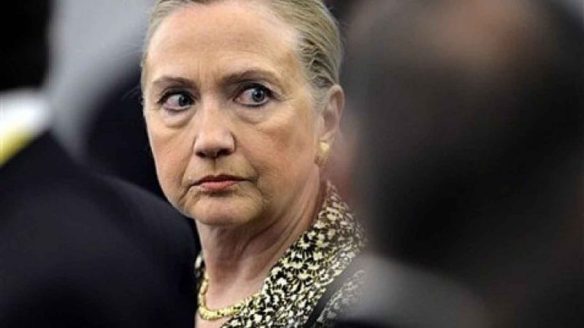
At least Hillary’s call for more censorship on social media shows the old establishment is belatedly waking up to the informational nature of the threat without fully understanding it. “This is a new kind of Cold War — and it is just getting started,” Clinton said in a speech at Stanford University, using the language of 1945 to describe 2017.  Clinton seems to regard the machinery of manipulation per se as acceptable as long as it does not fall into the wrong hands and is probably counting on it to restore order.  She fails to see that manipulation itself — the Narrative — is the root problem and that the Narrative is likely to master her rather than the other way round.

Human sanity was long anchored in reality. Religions might have been flawed but they usually tried to explain things in the light of contemporary knowledge. Common people spent the greater part of their day in contact with society and family in a smartphone-free world that seems to be lost forever. They were innoculated against much craziness. That world had a self-centering property that is now missing.

Today we have live in an environment where whole populations are immersed in an ocean of deliberate lies. People can believe anything — and often do. The Narrative is malware corroding our sense of humanity and reality. Instead of increasing privacy so data miners cannot engage in the targeted lying which makes “fake news” so effective we decrease it the better to help the manipulators. We’ve reached the point where having real human networks instead of social ones is slightly suspicious. “Fear the man,” we are told when pondering Steven Paddock, “with no digital footprint.”

Perhaps humanity was better off with rival truths rather than rival lies. In retrospect the status quo got bitten by its own creation in 2016 after Putin wrested a surprising chunk of the Narrative from the Gatekeepers. But the politicians far from learning their lesson want the handlers to take a firmer grip on the snake instead of defanging it. It will bite them again and more venomously next time.

The CIA Flips Off America

Photo credit: Adapted by WhoWhatWhy from sarang / Wikimedia and CIA / Wikimedia.

Open Letter from JFK Assassination Expert Dan Hardway

By Dan Hardway

Source: WhoWhatWhy.org

A 1964 CIA memo spells out clearly how James Jesus Angleton, the agency’s famous counterintelligence chief, wanted to deal with inquiries from the Warren Commission:

Jim would prefer to wait out the Commission.1

History seems to be repeating itself. The events of the past two weeks have shown that the CIA is still running a disinformation campaign against anyone who questions the “lone-nut” theory that, according to historian David Robarge, constitutes the agency’s “best truth.”

I recently published an article about the delay in releasing records under the 1992 JFK Records Collections Act. In that article I explained the CIA’s play to discredit those who question the agency’s lone-nut theory,2 and suggested that Robarge, its historian, has told us what to look for in the documents that are still being withheld.3

In that article I suggested we should look for information regarding covert operations against Cuba that would, according to Robarge, “circumstantially implicate CIA in conspiracy theories.”4 While I doubt the existence of a “smoking gun,” the circumstantial evidence we might look for in the delayed files could show a correlation between Lee Harvey Oswald’s activities in New Orleans and Mexico City in the late summer and fall of 1963 and CIA covert operations against Cuba being run by George Joannides and David Atlee Phillips involving anti-Castro groups such as the Directorio Revolucionario Estudiantil (DRE).5

I specifically suggested that we look to files on those operations. Some of these files are in the JFK records that are scheduled for release.

On October 26, 1992, Congress passed S. 3006, with only one amendment and very little, if any, opposition. The Senate bill, introduced by Sen. John Glenn (D-OH), was signed the same day by President George H.W. Bush and became Public Law 102-526, (“JFK Records Act”). Among other things the JFK Records Act provided for the collection, preservation and eventual release of all records related to the 1963 assassination of President John F. Kennedy, with minimal exceptions.

It mandates, in clear and unambiguous language, “[e]ach assassination record shall be publicly disclosed in full, and available in the Collection no later than the date that is 25 years after the date of enactment of this Act.” The Act allows an exemption to this mandatory requirement only if the president “certifies” that the release of each withheld document “is made necessary by an identifiable harm to” either 1) military defense; 2) intelligence operations; 3) law enforcement; or 4) the conduct of foreign relations and “the identifiable harm is of such gravity that it outweighs the public interest in disclosure.”6

On November 3, NARA released some of the files that I have been waiting on. The Excel spreadsheet listing the released files include four files referenced to David Atlee Phillips and one file referenced to the DRE.7 Of the files referencing Phillips, three are of an unspecified nature and one is listed as his Office of Personnel (OP) file. The DRE file is listed as “CIA file on DRE AMSPELL operations.”

AMSPELL is a CIA cryptonym for DRE, the anti-Castro Cuban group that was run by George Joannides in 1963, that had the encounter with Oswald in New Orleans in 1963, and published the first conspiracy theory blaming Castro in their CIA-financed newspaper in Miami on November 23, 1963. For such an active group, the file that was released is a very thin 87 pages of which 61 are expurgated in full.

Of the remaining 26 pages, many are largely expurgated. The Phillips files are even worse. The three files of unspecified type may be some of his operational files. These files are even more highly expurgated than the AMSPELL file. Taking the 73-pages long file RIF 104-10177-10135 as an example, a full 48 pages are completely redacted and NOTHING that was released in the file has any substantive info. For all intents and purposes, it remains withheld in full.

The file that is listed as David Atlee Phillips’s OP file is not as heavily redacted as the other three Phillips files, although many of the documents — mainly personnel forms — it contains have been cleansed of any significant data. That, however, is not the end of the story on this file.

The file starts with a few items of post-retirement correspondence between Phillips and the CIA in 1975 and then proceeds chronologically backwards from his retirement in 1975. I have not yet been able to go through the 358-page file to carefully study all the documents, but I have gone through it well enough to note that all his fitness reports between 1956 and 1965 are missing — not redacted, just simply not there.

Indeed, so far as I have been able to find, there is no record whatsoever of a document in the file dated between 1961 and 1965 — not redacted, just simply not there.

There has been no explanation, let alone a presidential certification, that the massive redactions in these “released in full” documents meet any of the mandatory exemptions that allow withholding. No identifiable harm is specified. No rationale is given as to why the secrets protected outweigh the public interest in disclosure.

These files are not in compliance with the law no matter what the mainstream media says.

They are an in-your-face flipped bird to the American public. They basically tell us that the CIA is saying that it doesn’t have to comply with the law of the land and that it will not tell us its secrets and that there is nothing we can do about it.

I’ve been here before. It was in a small room in CIA Headquarters in late 1978. I had been fighting to see a file generated by the CIA debriefing of its hired mafioso Johnny Roselli. Scott Breckinridge and George Joannides, CIA liaisons with the HSCA, had just handed me a highly redacted file that violated the HSCA/CIA Memorandum of Understanding mandating unexpurgated access by HSCA to CIA files.

They stood by, grinning, as they watched my reaction upon opening the file to find it largely expurgated. They were grinning so hard because they knew they had waited out the HSCA and there was nothing I could do about it. The Angleton strategy still worked. It is still working today.

This release not only demonstrates that the Angleton strategy is still being applied; it also illustrates the point I have been making about what they are covering up. There may well be nothing we can do about it. It appears our lawmakers are spineless in the face of the intelligence community. Joseph Burkholder Smith, a retired CIA officer, told me and fellow investigator Gaeton Fonzi in 1978, “You represent Congress. What the f*** is that to the CIA? You’ll be gone in two years and the CIA will still be there.”

To paraphrase that to fit the situation in which we now find ourselves: “You are the people that Congress supposedly represents. What’s that to the CIA? You’ll forget about it in a few weeks or so.”

But I won’t. I wrote a letter to my senator, West Virginia Democrat Joe Manchin, on November 3 before I saw the travesty that was the day’s release of JFK documents by NARA. Probably a futile gesture, but one I had to take anyway. Here’s part of what I told him:

On October 26, 2017, as I am sure you are aware, President Donald Trump, at the request of the Central Intelligence Agency and other intelligence community members, disregarded the clear provisions of the law and postponed release of ninety percent of the remaining withheld documents in the JFK Records Collection for an additional six months. In doing this, the President made no findings, issued no orders and certified nothing, merely issuing a statement through the press office saying that all documents will be released “with redactions only in the rarest of circumstances” by April 26, 2018.

The President’s action was not only without authority in law, it was also taken in patent violation of the clear, unambiguous and mandatory terms of a law that your institution passed. …

The real problem that this presents is that it is showing to the nation that the intelligence agencies of our nation are not subject to the laws of the nation. They are effectively above the law. At their request, or pressure, the President of the United States will violate the clear mandates of enacted legislation. And, to date, the reaction of our elected representatives in Congress seems to reinforce the fact that no one is willing to stand up to such blatant disregard of the clear provisions of the duly enacted laws of the nation. I understand that it is the executive branch that is charged with the enforcement of the laws your branch enacts and, in this case, it is the executive branch that is violating the law so there can be little realistic expectation of enforcement from them. But this is the heart of the problem and why it is incumbent upon the Congress to act. At a minimum there should be oversight hearings. At a minimum the Congress should not be seen to willingly acquiesce in executive contempt for the Legislative branch of government and the law of the land.

This action on the part of the intelligence community, the National Archives, and the Executive is only the latest in a long string of actions that disregard the provisions of the JFK Records Act that also subvert and cover up the information related to the assassination of our 35th president. Those other actions are beyond the present scope of this letter, but are things about which I would be glad to speak with you if you have any interest, so I will not go into them here.

To my knowledge there has been no coverage or explanation of why the intelligence community has requested this delay of the President. It was made in secret. What reason have they given for the delay? What kind of pressure have they brought to bear? How can they force a president to so blatantly disregard the law? If they can do this in regard to disclosure of fifty-year-old records, in what else can they exercise a like secret influence that corrupts the laws of the nation? What affect does the existence and use of such secret power have on our democracy? If these things — not just the documents but the method of influence — remain always secret, then how can a citizenry be sufficiently informed so as to exercise their franchise to any real purpose? How can we have faith in our democracy, let alone our government, if this kind of practice is allowed to continue unchallenged? These are the questions that I would like to have answered. But, to make it easier for you, I note you are in a unique position in regard to these issues due to your membership on the Senate Select Committee on Intelligence. Are you at least going to call and press for public hearings on any of these issues? Or are you going to join the vast majority of our representatives and once again cower before the intelligence agencies? Will you stand up for your constituents’ right to participate in their government on an informed basis? Will you stand for holding our government to a standard of open honesty before its citizens and against allowing the real affairs of state to be conducted in secret and in disregard of the laws enacted by the people’s representatives?8

The questions I asked Manchin in that letter are even more pressing today. I don’t know if he’ll even answer, let alone do anything. Maybe, like Sen. Chuck Grassley (R-IA), he’ll send out an apparently frustrated tweet. Or maybe, like the mainstream press, he’ll tout the release of the documents, hoping no one will look to see what a travesty the “release” is because of the massive redactions. At this point all I can do is try to tell the truth about this whole state of affairs.

I also encourage you to not take this insult to your intelligence and ability to govern yourselves without reaction. Do something. If nothing else, circulate this article to everyone you know. Refuse to accept the cancer of secrecy that destroys our liberty and ability to govern ourselves. Get involved. Get informed. Stay informed. Read and follow http://2017jfk.org/home/ and http://jfkfacts.org/. Read WhoWhatWhy.

Join the AARC at http://aarclibrary.org/aarc-membership/. Join CAPA at http://capa-us.org/membership/. If those who exercise the power in this country have such blatant contempt for the law, then the time for serious peaceful civil disobedience may be upon us. Get the word out. Don’t be silent any longer. This is not an issue of the left or the right. Do something. Say something. And don’t stop until you are heard.

Endnotes

.


1. Raymond Rocca to Richard Helms, Memo Re Response to Rankin, 5 Mar 1964, NARA Record No.  1993.06.24.14:59:13:840170, available at https://www.maryferrell.org/showDoc.html?docId=98075#relPageId=1&tab=page


2. David Robarge, “DCI John McCone and the Assassination of President John F. Kennedy,” Studies in Intelligence, (Vol. 57, No. 3, 09/2013), Approved for Release and declassified, 09/29/2014, at page 20.  Available at http://nsarchive.gwu.edu/NSAEBB/NSAEBB493/docs/intell_ebb_026.PDF. Robarge wrote: “The DCI was complicit in keeping incendiary and diversionary issues off the commission’s agenda and focusing it on what the Agency believed at the time was the ‘best truth’: that Lee Harvey Oswald, for as yet undetermined motives, had acted alone in killing John Kennedy.” For my commentary on the CIA’s “best truth”, see Thank You, Phil Shenon available at https://realhillbillyviews.blogspot.com/2015/10/. Note that the “best truth” was conditioned by “at the time” leaving open the real possibility that alternative cover stories may have to be brought to play in the event that time undermined what the Agency considered to be the best truth for them.


3. Dan Hardway, What Were They Hiding and What Should We Look For, 30 Oct 2017, available at https://realhillbillyviews.blogspot.com/2017/10/what-were-they-hiding-and-what-should_30.html


4. Robarge, n. 2 above, at p. 9.


5. This is addressed in more detail at JFKFacts, Exclusive: JFK investigator on how CIA stonewalled Congress, http://jfkfacts.org/hardway-declaration-cia-stonewalled-jfkinvestigation/; Declaration of Dan L. Hardway, Morley v. CIA, CA # 03-02545-RJL, D.C.D.C. 11 May 2016, Docket No. 156.


6. 44 U.S.C. § 2107 note  § 5(g)(2)(D). Emphasis added.


7. https://www.archives.gov/research/jfk/2017-release, RIF Nos. 104-10176-10121, 104-10177-10135, 104-10177-10134, 104-10194-10026, and 104-10170-10121.


8. See here for the full letter.

Democratic Party crisis explodes in wake of Brazile revelations

By Patrick Martin

Source: WSWS.org

The political crisis in the Democratic Party, brought to the surface with the publication Thursday of excerpts of a campaign memoir by the former interim chairman of the Democratic National Committee (DNC), Donna Brazile, erupted into mutual denunciations over the weekend.

Brazile made public an unprecedented agreement between the DNC (under previous chair Debbie Wasserman Schultz) and the Hillary Clinton presidential campaign that involved Clinton paying off the DNC’s debts and providing it a monthly subsidy in return for gaining control over the appointment of DNC officials and the right of approval over key operational decisions.

The deal was concluded in August 2015, six months before the first votes were to be cast in caucuses or primaries, when the DNC was required by its own rules to remain neutral in the contest between Clinton, Vermont Senator Bernie Sanders and several other candidates for the Democratic presidential nomination.

A further revelation from Brazile’s book was made public Saturday: she acknowledged discussions among leading Democrats in September 2016, after Hillary Clinton had collapsed at a ceremony in New York City marking the 15th anniversary of the 9/11 attacks, over whether Clinton should be replaced as the presidential candidate because of health concerns. Brazile writes that she herself considered Vice President Joe Biden as the logical replacement, but did not make the proposal.

Within hours of this report, 100 former Clinton campaign aides, headed by campaign chairman John Podesta and campaign manager Robby Mook, put their signatures on an open letter denouncing Brazile’s criticism of the Clinton campaign.

The “Open Letter From Hillary For America 2016 Team” makes use of the same Russia-baiting technique employed by the Democrats in their political conflict with the Trump White House, but this time directed against a former top Democrat. In assailing Brazile, the first paragraph of the open letter declares: “It is particularly troubling and puzzling that she would seemingly buy into false Russian-fueled propaganda, spread by both the Russians and our opponent, about our candidate’s health.”

The health questions about Clinton were fueled, however, not by Moscow, but by video broadcast over American cable television networks showing the candidate being lifted into a vehicle by aides and Secret Service agents, in visible distress. The characteristic duplicity of top campaign officials, who initially sought to conceal the incident, added to the ensuing furor.

Even more revealing is what is missing from the Clinton camp’s “Open Letter”: there is no reference whatsoever to the main revelation stemming from Brazile’s book—the secret joint fundraising agreement between the Clinton campaign and the DNC, six months before the first caucus in Iowa, giving Clinton effective control of the party apparatus. The Clinton aides do not dispute that this backroom deal occurred and make no attempt to justify it.

On Sunday morning, Brazile appeared on the ABC News program “This Week with George Stephanopoulos.” The host, himself a former top political aide in the White House of Bill Clinton, provided a platform for Brazile to repeat her exposure of the collusion between the Clinton campaign and the DNC and discuss the “Open Letter” from the former Clinton campaign officials.

She bitterly denounced the Clinton camp, both for its treatment of the DNC while she was in charge, and for their ferocious response to her new book. “George, for those who are telling me to shut up, they told Hillary that a couple of months ago,” Brazile declared. “You know what I tell them? Go to hell! I’m going to tell my story.”

Brazile also touched on a topic of intense but largely behind-the-scenes discussion in official Washington: the July 2016 murder of Seth Rich, a low-level IT staffer at the DNC, who was shot to death in what police called a failed robbery attempt. The Trump White House and ultra-right media allies, including Alex Jones of InfoWars and Sean Hannity of Fox News, have portrayed Rich, rather than Russian hackers, as the likely source for the DNC emails obtained by WikiLeaks, and his killing as a retaliatory “hit” ordered by the Clinton campaign.

Brazile reportedly suggests in her book—which will not be available to the public until Tuesday—that Rich’s death, warnings from the Obama administration about Russian hacking and repeated online threats from Trump supporters had made her extremely concerned about security issues, to the point where she had her home swept for bugs and installed multiple security devices. In her interview Sunday with Stephanopoulos, she spoke of her fears for her own personal safety. Her mention of Seth Rich, entirely unsolicited, seemed a veiled warning to the Clinton camp that more revelations about 2016 campaign skullduggery could be forthcoming.

Current DNC Chair Tom Perez was interviewed Sunday on “Meet the Press” on NBC and directly rejected the two main issues raised by Brazile. He maintained, “The charge that Hillary Clinton was somewhere incapacitated is quite frankly ludicrous,” although he did not attribute that concern to Russian propaganda.

He went on to argue that Clinton won the Democratic primary contest by four million votes, and the DNC was not in control of those elections, which are run by the state governments, while noting that the caucuses, which are controlled by the party apparatus, were mostly won by Sanders, not Clinton. Perez would concede only that “the DNC fell short during critical moments of the primary,” in terms of openly favoring Clinton over Sanders.

Significantly, neither Sanders nor any of his top aides or supporters made an appearance on any of the Sunday television talk shows. Sanders issued a statement on Brazile’s revelations suggesting that the conduct of the 2016 campaign was a diversion from the effort to mobilize opposition to the Trump administration.

The fact is that Brazile informed Sanders of the joint fundraising agreement and the takeover of the DNC by Clinton more than a year ago, and he has chosen to say nothing about it. This is part of his effort to prop up the Democratic Party and prevent the millions of working people and youth who supported his campaign from drawing the political conclusion that it is necessary to break with the Democrats in order to conduct any genuine struggle against the billionaires who dominate the US political system.

The conflict within the Democratic Party has erupted under conditions where the Republican Party is bordering on civil war, with several Republican senators denouncing Trump as a threat to American democracy—and then announcing they would retire from office rather than oppose him—and a vicious conflict developing between the party establishment and the fascist-minded elements around Trump, spearheaded by his former chief political aide and campaign manager, Stephen Bannon, now returned to his position as chief executive of the ultra-right Breitbart News.

In recent days, it has been reported that in an upcoming book titled The Last Republicans, the author cites interviews with George H. W. Bush and his son George W. Bush in which the two last Republican presidents before Trump denounce the current occupant of the White House and reveal that they refused to vote for him in 2016. In response, Trump tweeted an attack on his Republican presidential critics.

The ABC “This Week” program on which Brazile was interviewed began with the presentation of a new Washington Post/ABC News poll showing public support for Trump falling to its low point for the year, only 37 percent, with 59 percent opposing. Trump’s showing was the worst for any first-year president since modern polling began. Other polls have shown public support for the Republican-controlled Congress hitting new lows as well.

The vast majority of working people are increasingly alienated from the two-party political system in the United States, correctly regarding both the Democrats and the Republicans as tools of the super-rich and looking for an alternative. The central political question is the building of a political movement of the working class that will fight the capitalist system as a whole and advance a program to defend jobs, living standards and democratic rights, and oppose imperialist war.

Washington D.C. is Swarming With Unaccountable Parasites

By Michael Krieger

Source: Liberty Blitzkrieg

In theory, Americans should be proud of their national capital and all the important work that gets done there. In theory.

In reality, our nation’s capital is an utter cesspool of self-serving, unethical and unaccountable parasites. We all know it and, even worse, it’s probably a hundred times more grotesque than we can imagine. A distressingly high number of people attracted to this swamp don’t go there to do good public work or help the American people. They go in order to enrich themselves at our expense.

A particularly degenerate strain of D.C. cretin is the lobbyist. These people swarm into Washington to influence the purse-strings of the U.S. government and funnel as much American treasure as possible in the direction of their clients, including Wall Street oligarchs, defense contractors and barbaric foreign monarchies like Saudi Arabia. We’re told that Washington D.C. exists specifically to protect and benefit the American public, yet the average citizen is the one constituency which has virtually no actual representation there. Helping the vulnerable doesn’t pay very well.

Over the past couple of days, I’ve be reading political stories describing the “beltway buzz” in the aftermath of the Paul Manafort and Rick Gates indictments. I’ve found these articles quite instructive. The common theme is that hordes of the shady crooks who operate in D.C., and add absolutely zero value to society, are panicking that their gravy train of legalized corruption may be coming to an end.

To see what I mean, let’s examine two recently published articles. First from Politico:

Washington lobbyists who represent foreign powers have taken comfort for decades in the fact that the Justice Department rarely goes after them for potentially breaking the law. That all changed on Monday.

The two-tier justice system works quite nicely for D.C. crooks.

The news of Tony Podesta’s resignation from his namesake firm and indictment of Paul Manafort and Rick Gates sent K Street scrambling, as lobbyists rushed to make sure they’re in compliance with the rules. The developments also renewed calls for Congress to pass legislation beefing up the Justice Department’s enforcement of the law, which lawmakers in both parties have derided for lacking teeth.

“Firms are going to be even more careful than they have been in the past in the foreign lobbying arena,” said Trent Lott, the former Senate majority leader who’s now a lobbyist at Squire Patton Boggs, where his foreign clients have included Saudi Arabia and Turkey.

Prosecutions of violations of the Foreign Agents Registration Act — which requires lobbyists who represent foreign governments, political parties and other groups seeking to influence American foreign policy to register with the Justice Department — are rare. And it’s not clear whether the Justice Department will follow special counsel Robert Mueller’s lead and start cracking down on foreign lobbying violations.

The DOJ unit dedicated to enforcing FARA is small, and has focused in the past on prodding lobbyists to comply with the law voluntarily, rather than going after them by pressing criminal charges. Mueller’s willingness to indict Manafort and Gates instead of just hounding them to file has struck fear into lobbyists that they could be next.

If you’re a D.C. power player, you get asked politely to follow the law. Must be nice.

“It used to be [that the Justice Department would work with you to become compliant,” said another foreign lobbyist, who also spoke on condition of anonymity. “Now there’s a fear that they’ll just prosecute you.”

Oh, the horror. They might “just prosecute you” like a common peasant.

But the bar for criminal prosecution is high. Under the law, prosecutors can go after lobbyists only for willful violation of the law — a tough standard to prove.

“Policy makers are here to serve the interests of the American people, so we need to know when someone is pushing the priorities of a foreign interest,” Grassley said in a statement. “Unfortunately, we’ve seen time and again how lobbyists of foreign principals skirt existing disclosure laws to conceal their clients’ identities and agendas.”

But Lott said he wouldn’t hold his breath waiting for Congress to pass the legislation, especially with President Donald Trump still pushing to move a tax reform bill by the end of the year.

“There’s not much of anything happening right now in Congress, to be perfectly frank,” Lott said.

Of course not. Criminals run the place and they’re not going to prosecute themselves.

Now let’s turn to a few nuggets from a similarly themed BuzzFeed piece:

WASHINGTON – The threat of serving hard time for failing to disclose foreign lobbying work is rattling Washington’s multi-billion dollar influence industry following Monday’s 12-count indictment against Donald Trump’s former campaign chairman Paul Manafort and his deputy, Rick Gates.

And although the charges have largely been seen as a blow to the White House, Monday’s actions by special prosecutor Robert Mueller also sent shivers down the spines of Washington’s lobbyists, both Democrats and Repulicans.

“It’s a swampy place, and the swampy stink knows no partisan allegiance,” said one senior Democratic congressional aide.

A September 2016 report by the Justice Department’s inspector general identified a series of problems with how DOJ had handled FARA cases in the past. There was disagreement within the department about what types of cases should be prosecuted, the inspector general’s office found, and the FBI felt DOJ attorneys were slow in reviewing FARA cases and reluctant to sign off on criminal charges. The report also found that the FBI and local federal prosecutors reported feeling frustrated at being overruled by attorneys from the National Security Division about cases that they believed were worth pursuing.

Hold on a minute, what the heck is the “National Security Division” and why is it preventing rank and file FBI agents from prosecuting criminal lobbyists?

So that’s how the law works for D.C. lobbyists. Let’s now examine what happens if you’re a protester who happened to be in the wrong place at the wrong time during Donald’s Trump inauguration.

What follows are some very disturbing excerpts from a must read article published in The NationThe Prosecution of Inauguration-Day Protesters Is a Threat to Dissent:

Late next month, the first mass trial will be held for some of the roughly 200 people facing years—or even decades—in prison after being arrested during an anti-capitalist, anti-fascist protest that took place on the day of Donald Trump’s inauguration. The “J20” cases, as they are known, offer a glimpse at the treatment of dissent in this country, and the story they tell is one of overreach and criminalization. Defense lawyers have described the government’s approach as “unprecedented,” its indictments as “littered with fatal irremediable defects.” Sam Menefee-Libey of the DC Legal Posse, a group of activists who provide support to the defendants, was more blunt, criticizing the cases as “blatant political prosecutions” designed to “chill resistance.”

The story of the J20 protesters should frighten anyone concerned about the future of both free assembly and dissent in the United States. The charges—which include felony rioting, inciting or urging others to riot, conspiracy to riot, and property destruction—all stem from the same mass arrest, during which police indiscriminately swept up protesters, journalists, and legal observers. What makes the charges all the more troubling is that prosecutors then failed to allege that the bulk of defendants did anything specifically unlawful; rather, merely being at the protest was a crime.

A case in point: The prosecution charged all of the defendants (at one point numbering 214) with breaking the same windows. Prosecutors, of course, know that 200 people cannot break the same windows. But the logic of the case dictates that the defendants’ mere presence at a protest during which property damage occurred makes them guilty…

Few people dispute that property destruction took place during the march. Some individuals smashed windows, including those of a Bank of America branch and a limousine; prosecutors allege that there was more than $100,000 in property damage and that six police officers received minor injuries. Where things get thorny is that many of the people who have been charged did not commit property damage or violence but have been deemed guilty by their mere presence at the protest.

The problems began during the arrests themselves—arrests deemed so troubling that the ACLU has brought a lawsuit against the Metropolitan Police Department (MPD) accusing its members of using excessive force, making unconstitutional arrests, and more.

Among the controversial practices police engaged in that day, lawyers and observers say, was a tactic called “kettling.” Kettling is a form of indiscriminate mass arrest, wherein police block off a given area and arrest everyone within it. To be lawful, an arrest requires probable cause based on individual suspicion. Yet, inevitably, this heavy-handed tactic often sweeps up other protesters and bystanders whose only offense was their physical proximity to the alleged crime. Indeed, a report on the inauguration by the DC Office of Police Complaints noted that “it seems that proximity to the area where property damage occurred was a primary factor” in the arrests.

The mass arrests gave birth to the next government overreach, mass “felony riot” charges against those arrested. Felony rioting carries a penalty of up to 10 years in prison and a $25,000 fine, and applies when the alleged riot results in more than $5,000 in property damage. This is opposed to misdemeanor rioting, which can get you only 180 days in jail.

Attorneys who have long represented protesters in DC report never having encountered mass felony charges stemming from a protest before. Not the least of the reasons is that it’s difficult to produce enough evidence to sustain felony charges against dozens—or in this case, some 200—people. Yet, rather than backing down, prosecutors expanded the case by filing additional charges, and, in April, a grand jury returned a superseding indictment that added inciting or urging to riot and conspiracy to riot to the list of crimes. These new charges brought the number of felony counts up from one to eight and the amount of time defendants could face from 10 years to more than 70 years in prison.

The government’s overarching theory, then, seems to be one of guilt by association. Or that, as Assistant US Attorney Jennifer Kerkhoff asserted during a hearing about dismissing the charges, it is “the group that is the danger, the group that is criminal.” Thus one need not have committed an act of vandalism as an individual; just being present at the protest makes one guilty. (The DoJ declined to comment for this story, as the cases are currently pending.)

Among those swept up in this overbroad approach was a group of at least seven journalists who were covering the J20 protests. While prosecutors ultimately dismissed the felony rioting charges against the bulk of the journalists nearly as quickly as they were filed, two journalists remain in the crosshairs: Aaron Cantú, then a freelancer who has published with The Nation and The Intercept, and Alexei Wood, who livestreamed the event. In April a grand jury brought a superseding indictment of eight felony charges against both reporters along with the other defendants. They face as many as 70 years in prison, possibly more.

The indictment against Cantú deploys the same guilt-by-association approach that mars the entire case. Per prosecutors, Cantú moved in proximity to the march—something that would be necessary in order for him to do his job as a journalist. But prosecutors have additional evidence against Cantú: He wore the color black.

Blade Runner And The Synthetic Panopticon

Truth Is Always An Open Question

By James Curcio

Source: Modern Mythology

This Is Only A Model

We are living in alternate realities. In one reality people see Trump’s incessant lying, and no one in power seeming to doing anything to stop it. Others see him as battling the deep state. Some see Brexit as a blind idiot kamikaze mission, while others see it as fighting back the evils of globalism. These are not equivalent claims, but they are both claims, narratives that claim to represent the way things are, and that’s what I’d like to examine here.

“All things are subject to interpretation, whichever interpretation prevails is a function of power and not truth.” — Nietzsche

Note that this aphorism doesn’t say “there is no truth,” nor does it question whether we all ultimately inhabit a single reality, only that whichever interpretation of the truth prevails is a function of power. Truth relies on an accurate or corresponding representation of reality. In this sense, we can talk of them singularly. But we only have our narratives and experiences with which to evaluate what that is.

And what is power? That demands at least an article in itself, but a popular 1984 quote lays the heart of what it’s purpose is: more of itself.

We know what no one ever seizes power with the intention of relinquishing it. Power is not a means; it is an end. One does not establish a dictatorship in order to safeguard a revolution; one makes the revolution in order to establish the dictatorship. The object of persecution is persecution. The object of torture is torture. The object of power is power.

This interpretation of social dynamics doesn’t contest the legitimacy of the scientific method, iteratively approaching closer approximations of truth (a model) distilled from reality, through experimentation. In fact, this premise was presented by Stephen Hawking and Leonard Mlodinow in their 2010 book, The Grand Design.

Model-dependent realism is a view of scientific inquiry that focuses on the role of scientific models of phenomena. It claims reality should be interpreted based upon these models, and where several models overlap in describing a particular subject, multiple, equally valid, realities exist. It claims that it is meaningless to talk about the “true reality” of a model as we can never be absolutely certain of anything. The only meaningful thing is the usefulness of the model.

However, social dynamics aren’t exactly like physics, either. Not being able to recognize the difference between the ideal (an appeal for rationality, consistent methodology, and balance), vs. how people actually engage with interpreting it is a serious problem. And got to catch up. Fast.

In other words, the appeal for truth — whether CNN’s recent “this is an apple” advertisement, or Fox New’s old “fair and balanced” — itself enters into the marketplace of ideas. Or perhaps a more apt metaphor is a battlefield, especially when we consider the amount of capital, technology and labor that states, corporations, and billionaires can throw at furthering their personal agendas.

Cognitive biases, innate responses like tribalism, the myopia of fear, etc. are all being leveraged via media, all around us, all the time. This includes all forms of media, since it’s all digital narrative building of a collective sort. Myth making, even. That’s the real point, and it seems to be drowned out across the spectrum. We’re all too familiar now with the ideas of dis/information wars, but all of them are fundamentally a contest over who gets to define the narrative. If we recognize that this is fundamentally about power, do we also recognize that it operates on dynamics that have absolutely nothing to do with our dearly held moral values?

An assumption some may draw from this is that vested interests have distorted reality; therefore there is no reality. However, that obviously isn’t quite right, either. What obscures clear thinking on this is that reality essentially has two meanings: the “state of things as they are”, which makes no assurances of what that state is, and the question of if things exist at all. The first poses an epistemological framework, the latter, an ontological one.

The former we might consider the social-linguistic definition. That shouldn’t be conflated with the absolute existence of a thing. No, it can only speak to the identity and meaning that we apply to what we’re given.


The Hierarchy of Reality

This may seem like a tangent, but consider the Turing test:

The Turing test, developed by Alan Turing in 1950, is a test of a machine’s ability to exhibit intelligent behavior equivalent to, or indistinguishable from, that of a human. Turing proposed that a human evaluator would judge natural language conversations between a human and a machine designed to generate human-like responses. … If the evaluator cannot reliably tell the machine from the human, the machine is said to have passed the test.

In other words, the appearance of sentience is all we ever get. An AI that behaves as if conscious is, from the outside, precisely the same as a conscious agent. If we appear to be having a conversation, then so we are. But does that prove we’re real in some definitive sense? No. Again, we are being presented with the social-linguistic layer of reality, that speaks to perceptions.

The relevance here to society is to be found within Blade Runner, which of course takes a great deal of inspiration in its core mythos from the problems posed by the Turing test. The world presented there is a hierarchy of power based on perceived degree of reality.

There is, within this, the implications of Benthamite Utilitarianism, and Foucault’s later elaboration on those ideas: that we may consider the world based on externalities that are socially determined rather than based on our internal experience. This seems in some sense precisely the opposite of “lived experience,” which seeks to situate our internal experience as the center of our concerns.

This directly enters into Blade Runner 2049, for instance, Joi, who seems the lowest on the hierarchy of reality, is seen as a pure surface, and all but K seem to question whether she has any lived experience at all. Mariette observes to K, “Oh I see, you don’t like real girls,” and later to Joi, “I‘ve been inside you. Not so much there as you think.”

Of course, this question is always open, one must always be judged “sufficiently real.”

Another example of this dilemma can be found in a current medical crisis. As many Americans know, we have something of an opiate epidemic in the United States. Although there is no end of debate over why this is the case, for doctors concerned about liability and patients concerned about being in pain for the rest of their lives, much of the politics boils away.

The problem comes down to the nature of pain itself. We may exhibit external signs of pain, but some patients will present with those more or less, for various cultural, personal, and even biological reasons. So the appearance of pain or lack of it is little use, when trying to determine whether a patient is “drug seeking.” Even if we test the biological response of different patients who are experiencing pain, we find that it is very difficult to tell. This is especially true with those who experience chronic pain. For instance, blood pressure often rises when you’re in pain, but higher blood pressure isn’t proof, and one must also ask what the baseline is. All of this calls to mind the lie-detector style tests used in the first Blade Runner movie to assess the reality of the subject, from the outside in.

Patient reporting was seen as the golden standard for pain level diagnosis during the years that doctors were ostensibly over-prescribing. But this too is no better than asking a Replicant whether they’re “real” or not. What we’re left with is a dependence on trust of people’s own stories about their lived experience, but of course, people can also lie. It comes down to a matter of faith and trust, and those are commonly in short supply.

This outside-in valuation is also the basis for what has recently come to be called — with some contention — neoliberal capitalism.

… it [Utilitarianism] presupposes a very concrete theory of nature as well as human nature: an understanding of human beings not as unique, irreplaceable beings — as neighbors, friends, or members of a community oriented toward justice and fairness — but rather as nameless, faceless, calculating, hedonistic, atomistic units. Alongside of this it understands nature and the natural world of plants, animals, trees, oceans and mountains not as intrinsic goods in themselves, but merely as ‘things’ that have only human use-value.

This gives us a clue to understanding why utilitarianism is so attractive to a modern bureaucratized, consumerist culture that is prepared to uphold profit maximization over human health, environmental safety, clean water and nutritious food. In other words, utilitarianism is widely embraced precisely because it replaces the living, breathing, emotional and experiencing human being with the human as pleasure or profit maximizing machine; it prizes the quick technical fix over the difficult task of understanding the human condition; it valorizes thoughtless calculation over thoughtful ethical discernment and practical wisdom. — CounterPunch

So Blade Runner presents an acceleration of the myths many of us already apply to the world around us, one which is deeply suspicious of our ability to find singular truth, or maybe more aptly, to avoid inflicting our power fantasies, needs and fears upon one another, forever.


The Authority of Authorship

When we engage with narratives online, in the press, in the media, we need to remain constantly aware that it is presenting a view of the world, and it is a view which in many ways is likely to be self-serving. There is, at the same time, an invisible architecture at work underneath the ways the world is re-presented to us, and this composes one of the fundamental anxieties that Baudrillard presented in Simulacra and Simulation. We cannot always discern even our own motives, or the reasons why we feel that one thing is more true than another when truly sufficient evidence has not been provided. Because interpretations of truth are malleable. And there has never been a mass-surveillance, mass-behavioral and linguistic analysis machine like the Internet.

It is easy for us to apply this sort of cynicism towards our presumptive ideological enemies, but will always remain more difficult to apply that same consideration to narratives that immediately go, “ah, this seems true!” Again, truth is always a claim, which must be proven — and never finally.

All authority that seeks to stop this process and say “put no others before me” are plays at power. Even within our own minds and hearts this is true.

We mustn’t forget that.

What Did Hillary Clinton Know?

By Robert Parry

Source: Consortium News

The revelation that Hillary Clinton’s campaign and the Democratic National Committee helped pay for the notorious “Steele Dossier” of hearsay claims about Donald Trump’s relations with Russia is not surprising but is noteworthy given how long the mystery about the funding was allowed to linger.

Another mild surprise is that the Clinton campaign would have had a direct hand in the financing rather than maintaining an arm’s length relationship to the dossier by having some “friend of the campaign” make the payments and giving Clinton more deniability.

Instead, the campaign appears to have relied on its lawyer, Marc E. Elias of Perkins Coie, and a confidentiality agreement to provide some insulation between Clinton and the dossier’s startling claims which presumably helped inform Clinton’s charge in the final presidential debate that Trump was Russian President Vladimir Putin’s “puppet.” Indeed, how much Clinton personally knew about the dossier and its financing remains an intriguing question for investigators.

Ultimately, the facts about who commissioned the dossier were forced out by a congressional Republican subpoena seeking the bank records of Fusion GPS, the opposition research firm that hired former British intelligence operative Christopher Steele to compile the opposition research, known as “oppo,” against Trump.

As part of the legal wrangling over that subpoena, the Clinton/DNC law firm, Perkins Coie, wrote a letter releasing Fusion GPS from its confidentiality agreement.

After that letter, The Washington Post reported on Tuesday night that the Clinton campaign and the DNC had helped fund the Steele effort with attorney Elias retaining Fusion GPS in April 2016 and with Fusion GPS then hiring Steele.

The Post reported that “people familiar with the matter” disclosed that outline of the arrangement but still would not divulge how much the Clinton campaign and the DNC paid to Fusion GPS. One source told me that the total amount came to about $1 million.

‘Trash for Cash’

An irony about Hillary Clinton’s role in funding allegations about Trump’s connection to the Russians, including claims that he cavorted with prostitutes in a five-star Moscow hotel while Russian intelligence operatives secretly filmed him, is that the Clinton camp bristled when Bill Clinton was the subject of Republican “oppo” that surfaced salacious charges against him. The Clintons dismissed such accusations as “cash for trash.”

Nevertheless, just as conspiratorial accusations about the Clintons gave rise to the Whitewater investigation and a rash of other alleged “scandals,” which bedeviled Bill Clinton’s presidency, the Steele Dossier provided a map that investigators have followed for the ongoing Russia-gate investigation into President Trump.

Much like those Clinton allegations, Steele’s accusations have had a dubious track record for accuracy, with U.S. government investigators unable to corroborate some key claims but, I’m told, believing that some are true nonetheless.

In the 1990s, even though the core allegations of wrongdoing about the Clintons and their Whitewater land deal collapsed, the drawn-out investigation eventually unearthed Bill Clinton’s sexual relationship with White House intern Monica Lewinsky and led to his impeachment in the House although he was acquitted in a Senate trial.

Some Democrats have openly hoped for the impeachment of President Trump, too, and they have hitched many of those hopes to the Russia-gate bandwagon.

There is also no doubt about the significance of the Steele Dossier in spurring the Russia-gate scandal forward.

When Rep. Adam Schiff, the ranking Democratic member of the House Intelligence Committee, offered what amounted to a prosecutor’s opening statement in March, his seamless 15-minute narrative of the Trump campaign’s alleged collaboration with Russia followed the trail blazed by Steele, who had worked for Britain’s MI-6 in Russia and tapped into ex-colleagues and unnamed sources inside Russia, including supposedly leadership figures in the Kremlin.

Steele’s Methods

Since Steele could not reenter Russia himself, he based his reports on multiple hearsay from these anonymous Russians who claim to have heard some information from their government contacts before passing it on to Steele’s associates who then gave it to Steele who compiled this mix of rumors and alleged inside dope into “raw” intelligence reports.

Besides the anonymous sourcing and the sources’ financial incentives to dig up dirt, Steele’s reports had other problems, including the inability of FBI investigators to confirm key elements, such as the claim that several years ago Russian intelligence operatives secretly videotaped Trump having prostitutes urinate on him while he lay in the same bed at Moscow’s Ritz-Carlton used by President Obama and First Lady Michelle Obama.

That tantalizing tidbit was included in Steele’s opening report to his new clients, dated June 20, 2016. Apparently, it proved irresistible in whetting the appetite of Clinton insiders. Also in that first report were the basic outlines of Russia-gate.

But Steele’s June report also reflected the telephone-tag aspects of these allegations: “Speaking to a trusted compatriot in June 2016 sources A and B, a senior Russian Foreign Ministry figure and a former top level Russian intelligence officer still active inside the Kremlin respectively, the Russian authorities had been cultivating and supporting US Republican presidential candidate, Donald TRUMP for a least 5 years.

“Source B asserted that the TRUMP operation was both supported and directed by Russian President Vladimir PUTIN. Its aim was to sow discord and disunity both within the US itself, but more especially within the Transatlantic alliance which was viewed as inimical to Russia’s interests. … In terms of specifics, Source A confided that the Kremlin had been feeding TRUMP and his team valuable intelligence on his opponents, including Democratic presidential candidate Hillary CLINTON, for several years. …

“The Kremlin’s cultivation operation on TRUMP also had comprised offering him various lucrative real estate development business deals in Russia, especially in relation to the ongoing 2018 World Cup soccer tournament. However, so far, for reasons unknown, TRUMP had not taken up any of these.”

Besides the anonymous and hearsay quality of the allegations, there are obvious logical problems, especially the point that five years before the 2016 campaign, virtually no one would have thought that Trump had any chance of becoming President of the United States.

There also may have been a more mundane reason why Trump’s hotel deal fell through. A source familiar with those negotiations told me that Trump had hoped to get a half interest in the $2 billion project but that Russian-Israeli investor Mikhail Fridman, a founder of Russia’s Alfa Bank, balked because Trump was unwilling to commit a significant investment beyond the branding value of the Trump name.

Yet, one would assume that if the supposedly all-powerful Putin wanted to give a $1 billion or so payoff to his golden boy, Donald Trump, whom Putin anticipated would become President in five years, the deal would have happened, but it didn’t.

Despite the dubious quality of Steele’s second- and third-hand information, the June 2016 report appears to have impressed Team Clinton. And once the bait was taken, Steele continued to produce his conspiracy-laden reports, totaling at least 17 through Dec. 13, 2016.

Framing the Investigation

The reports not only captivated the Clinton political operatives but influenced the assessments of President Obama’s appointees in the U.S. intelligence community regarding alleged Russian “meddling” in the presidential election.

Still, a careful analysis of Steele’s reports would have discovered not only apparent factual inaccuracies, such as putting Trump lawyer Michael Cohen at a meeting with a Russian official in Prague (when Cohen says he’s never been to Prague), but also the sort of broad conspiracy-mongering that the mainstream U.S. news media usually loves to ridicule.

For instance, Steele’s reports pin a range of U.S. political attitudes on Russian manipulation rather than the notion that Americans can reach reasonable conclusions on their own. In one report dated Sept. 14, 2016, Steele claimed that an unnamed senior official in Putin’s Presidential Administration (or PA) explained how Putin used the alleged Russian influence operation to generate opposition to Obama’s Pacific trade deals.

Steele wrote that Putin’s intention was “pushing candidate CLINTON away from President OBAMA’s policies. The best example of this was that both candidates [Clinton and Trump] now openly opposed the draft trade agreements, TPP and TTIP, which were assessed by Moscow as detrimental to Russian interests.”

In other words, the Russians supposedly intervened in the U.S. presidential campaign to turn the leading candidates against Obama’s trade deals. But how credible is that? Are we to believe that American politicians – running the gamut from Senators Bernie Sanders and Elizabeth Warren through former Secretary of State Hillary Clinton to President Donald Trump – have all been tricked by the Kremlin to oppose those controversial trade deals, which are also broadly unpopular with the American people who are sick and tired of trade agreements that cost them jobs?

Of course, the disclosure that the Clinton campaign and the DNC help pay for Steele’s opposition research doesn’t necessarily discredit the information, but it does suggest a possible financial incentive for Steele and his collaborators to sex-up the reports to keep Clinton’s camp coming back for more.


Investigative reporter Robert Parry broke many of the Iran-Contra stories for The Associated Press and Newsweek in the 1980s. You can buy his latest book, America’s Stolen Narrative, either in print here or as an e-book (from Amazonand barnesandnoble.com).

Are We Living Haunted Lives?

By Kingsley L. Dennis

Source: Waking Times

‘Fear has many eyes
And can see things underground’
~Cervantes, Don Quixote

The world as we know it has gone from being flat to round; from being the center of the universe to the center of the solar system; from being animistic and supernatural to raw in tooth and claw; from being particle-atomic to wavy-quantum. And now we are disappearing into the digital domains of virtual-augmented spaces and false information, bombarded with the spectacle and the image. And somewhere in the midst of all this is the human soul, still largely wrapped and unopened. If there’s a crime here then it is that we’ve allowed ourselves to become haunted – to live haunted lives that lack significance and meaning.

The ‘objects’ or values that we have attempted to live by, or that we pursue, – such as power, truth, understanding, dreams, work, love, and the rest – have all seemingly vanished into some warped, elusive reality where the presence of these things no longer tangibly exist. However, the doubt, uncertainty, and pain of their absence – or ‘fake presence’ – are indeed real enough to affect us deeply. We seek the already disappeared and stalk their substitutes.

We are now close to the stage where we end up just acting out our fantasies upon the phantasmal theatre of our lives and thinking it is reality. This theatre, or screen, of fantasies and the fantastical is like the cave wall in Plato’s allegory where the flickering shadows that move across are taken to be the real. In an updating of Plato’s famous allegory we no longer have shadows projected upon the cave wall; they are now projected upon the green screens that form the back-drop for computer-generated imagery (CGI) that adorn our movies, television programs, and video games.

Whole societies, notably in the technologically-advanced western world, are arranging for our lives to be enacted amidst a scenery backdrop of events and issues artificially projected for us as CGI onto a fake canvas. Within this encroaching visual world, full of misinformation that influences our worldview, we are made to believe in a different kind of reality. It is a reality that is uncertain and insecure, and that requires for us to hold deep obedience to our state institutions to protect us. And within this projection of reality, meanings are provided for us as ready-made meals. In other words, full of too much salt, saturated fats, and laziness.

These socially manufactured meanings are provided as a substitute for the genuine lack. Of these choices offered we often take our pick, as consumers in a marketplace. It may be career, wealth, fame, achievement, or a combination of these and more. Yet the manufactured consent in our sense of meaning, no matter how thoroughly pursued and potentially obtained, is still not genuine. And like the ready-made meal, it soon leaves us with a continued hunger. The illusion of meaning is a vital illusion, yet it still remains an illusion. We may say then that the world we have come to know is a great spectacle of illusion and play; of movement, distraction, simulation, and excess. Yet rather than critically confronting the illusions and distractions we are cleverly persuaded to indulge in them.

The world we share now is also shared with our collective doubts, fears, anger, and frustrations. And these new emotions upon the global stage are blurring our picture of the world and its future. Whilst there are many of us who are excited and genuinely inspired by this increased complexity and diversity there has been a cultural backlash, in the western nations especially, to cover this up with a sheen of simplicity through generic news, bland reporting, and excruciatingly trivial entertainment. This clash of the complex with the simple is creating an odd reality where things just don’t feel right anymore.

We are participants on a ride through the flippant and the flimsy, the significant and the necessary, as we are expected to find our foothold – our human soul – in a world seemingly on the verge of insanity. In such a world, Disneyland may seem to some as the greatest of sanctuaries; whilst to rest of us it stands as a superficial sign of our times.

Most of us do not have the capacity to verify the truth claims of the mainstream media and yet we are more than willing it accept the veracity of their claims. We suspend our own disbelief by trusting in others, especially when it comes to authority and experts. In other words, we have been conditioned to respect the positions of authority and ‘the expert,’ often without critical thought.

And this is the context which frames the telling of his-story and also our-stories. The singer-songwriter Lou Reed once sang, ‘Don’t believe anything you hear and only half of what you see.’ Documentary film-maker Adam Curtis discusses this phenomenon of how the mainstream media projects a simplified, fake reality in his film HyperNormalization (2016). The term hypernormaliztion was taken from an account of life in the Soviet Union during the twenty years before it collapsed. In this account everyone knew the system was failing but they couldn’t envision any alternative and so everyone is resigned to maintaining the pretence of a functioning society. Over time this delusion is accepted as real, an effect termed as hypernormalization. In other words, when the fake is finally accepted as the real then we are living in a hypernormalized state. Does this sound familiar?

The question is – does Reality ever take place?

Our bodies of authority, our mainstream media channels, and our centers of learning – that is, a majority of our significant institutions – have turned, or are in the process of turning, into advertising gimmicks. They peddle publicity and propaganda as endless programs stuck on a loop. They serve to produce the appearance of reality; yet they fail to represent a sense of reality. And this fundamental difference has produced a feeling of living haunted lives. We wander as ghosts in liminal zones, hungry for meaning.

In this sense of loss we no longer seem to know, or distinguish, between oppositions. Almost all of our value systems are based on relative terms – good, bad, my history, your history, etc. Often, the values we take to be ‘our values’ were inculcated in us depending upon which culture we happened to be born into. It is true there are some values more universally shared – such as thou shalt not kill – but the majority of them are culturally relative. Take for instance, sex before marriage – good or bad? Same-sex partnerships? Freedom of religious speech? Eating pork? Eating rats? Democrats or Republicans? Labour or Conservative? Which is good and which is bad? In the case of political parties it is neither – they are false oppositions. More than that, they are also distractions. When you’re arguing (sorry, debating) over political parties you are not observing the system behind them that created this false lack of choice in the first place. False oppositions plague our haunted hinterland. We don’t see this if we are the aimless ghosts, or the walking dead. It’s not pleasant – it’s eerie. And we are in eerie times.

Modernity in its current form is haunted by a sense of loss; of not knowing where it is heading. There are a great many aspects of our age that are in disruption and dislocation. All forms of stability are in question; old and incumbent patterns and models are in dispute; and too many people are experiencing moods of despair and anguish. It is as if our human civilization has come loose from its moorings and is now adrift upon the waters of uncertainty, insignificance, and the loss of meaning.

And so it seems that our civilization is careering dangerously close to some kind of blind spot where we no longer can tell what is true or false anymore. Truth is replaced by a fake substitute and the false becomes a parody of the truth. They are the haunted spaces where the mist drifts by. It’s like a Zen joke. It’s the same as a voice whispering in the darkness saying there is no such thing as a voice whispering in the darkness. They couldn’t have written a better riddle if they had tried.

So what went wrong? Where did it all go? What is it, in fact?

A profound sense of unease has crept into many of us, and also into our social systems, our cultures, our art, our news, and into the very collective soul of humanity. It is an eeriness; an uncertain disquiet – almost an unsettling foreboding. Something has come loose, and we’re not sure what it is. Further still, most of us are fairly certain that those institutions supposedly ‘looking after our best interests’, or running the show – whether they be governmental bodies, financial elites, or shadowy organizations and cabals – are not really in control or are sure either. It feels as if something is amiss, and we just can’t quite put our finger on it. Welcome to our haunted modernity.

We have disarray over a consensus concerning climate chaos, stock market panics and economic crashes, offshore tax evasions and leaked documents, political scandals, pandemic threats and contested vaccines, state and terrorist violence, congenital anxiety and existential fear – a whole cauldron of terror, dread, disquiet, nervousness, angst, and what-the-hell-is-going-on collective confusion is bubbling both under and over in many of our societies.

We have been infiltrated with a virus and it is infecting not only our bodies but our very minds. It’s a pure mind-bending virus and it’s playing havoc with our insecurities and indulging in our sense of lostness. The Spanish have a phrase for this state – “de perdidos al río” – and it roughly translates as from lost to the river. It may not make complete literal sense in English but that’s just it; you can get the sense of it and its vagueness is exactly where we are – from lost to the river!

In such ‘haunted lives’ we can easily become accustomed to metaphysical anguish as just another pain. It is like a pulled muscle or a sprained ankle; something unpleasant and yet we continue to move around with it. In the end we learn how to direct and project this metaphysical anguish onto other things – we choose intoxicating entertainment, sports, and other cultural pastimes and diversions. Angst just becomes a factor that appears to come as a default setting with our species. There is the danger that we become accepting of the ghostly flimsiness to life, which ends up being hypernormalized so that the sense of absence of something real becomes the new reality. There is the dangerous potential here for a state of indifference to emerge and seep into our cultures, which then becomes an ennui-creep into the world until…oh, well, what does it matter anyway?

During these years of disarray and turbulence it is essential that we create meaning for ourselves, otherwise the ‘distant algorithmic’ universe that runs the life around us will create a deep sense of alienation. In a world of scrambled code and big data, transcendence will seem another chimera not within grasp or even real. Or, at worse, the very notion of transcendence will seem the delirium of unstable minds – for those people not able to ‘get real’ with the world of Now.

In this instance, transcendence will appear as a form of spiritual autism. And yet the notion of going beyond ourselves, of developing our capacities for higher perception, are the saving grace inherent within our human species. We are incomplete, and this haunts us, and yet it should also give us meaning and a higher aim in life in knowing that there is further to go. In knowing that there are tools within us for creating, shaping, and cultivating these finer faculties. In being haunted we are also being reminded of what is lacking and this urge should compel us to find a solution within ourselves. We are in fact being ‘haunted into remembrance.’

However, for many of us a haunted modernity offers us a conditioned life where there is little or no space for transcendence. In such social and cultural hauntings there are no navigable locations. We have stepped into an unsouling from the wilderness. We are compelled to walk on.

The conspiracy to censor the Internet

By Andre Damon and Joseph Kishore

Source: WSWS.org

The political representatives of the American ruling class are engaged in a conspiracy to suppress free speech. Under the guise of combating “trolls” and “fake news” supposedly controlled by Russia, the most basic constitutional rights enumerated in the First Amendment are under direct attack.

The leading political force in this campaign is the Democratic Party, working in collaboration with sections of the Republican Party, the mass media and the military-intelligence establishment.

The Trump administration is threatening nuclear war against North Korea, escalating the assault on health care, demanding new tax cuts for the rich, waging war on immigrant workers, and eviscerating corporate and environmental regulations. This reactionary agenda is not, however, the focus of the Democratic Party. It is concentrating instead on increasingly hysterical claims that Russia is “sowing divisions” within the United States.

In the media, one report follows another, each more ludicrous than the last. The claim that Russia shifted the US election by means of $100,000 in advertisements on Facebook and Twitter has been followed by breathless reports of the Putin government’s manipulation of other forms of communication.

An “exclusive” report from CNN last week proclaimed that one organization, “Don’t Shoot Us,” which it alleges without substantiation is connected to Russia, sought to “exploit racial tensions and sow discord” on Instagram, Twitter, YouTube, Tumblr and even Pokémon Go, a reality game played on cell phones.

Another report from CNN on Monday asserted that a Russian “troll factory” was involved in posting comments critical of Hillary Clinton as “part of President Vladimir Putin’s campaign to influence the 2016 election.” All of the negative commentary in news media and other publications directed at Clinton, it implied, were the product of Russian agents or people duped by Russian agents.

As during the period of Cold War McCarthyism, the absurdity of the charges goes unchallenged. They are picked up and repeated by other media outlets and by politicians to demonstrate just how far-reaching the actions of the nefarious “foreign enemy” really are.

While one aim has been to continue and escalate an anti-Russia foreign policy, the more basic purpose is emerging ever more clearly: to criminalize political dissent within the United States.

The most direct expression to date of this conspiracy against free speech was given by the anticommunist ideologue Anne Applebaum in a column published Monday in the Washington Post, “If Russia can create fake ‘Black Lives Matter’ accounts, who will next?”

Her answer: the American people. “I can imagine multiple groups, many of them proudly American, who might well want to manipulate a range of fake accounts during a riot or disaster to increase anxiety or fear,” she writes. She warns that “political groups—on the left, the right, you name it—will quickly figure out” how to use social media to spread “disinformation” and “demoralization.”

Applebaum rails against all those who seek to hide their identity online. “There is a better case than ever against anonymity, at least against anonymity in the public forums of social media and comment sections,” she writes. She continues: “The right to free speech is something that is granted to humans, not bits of computer code.” Her target, however, is not “bots” operating “fake accounts,” but anyone who seeks, fearing state repression or unjust punishment by his or her employer, to make an anonymous statement online. And that is only the opening shot in a drive to silence political dissent.

Applebaum is closely connected to the highest echelons of the capitalist state. She is a member of key foreign policy think tanks and sits on the board of directors of the CIA-linked National Endowment for Democracy. Married to the former foreign minister of Poland, she is a ferocious war hawk. Following the Russian annexation of Crimea, she authored a column in the Washington Post in which she called for “total war” against nuclear-armed Russia. She embodies the connection between militarism and political repression.

The implications of Applebaum’s arguments are made clear in an extraordinary article published on the front page of Tuesday’s New York Times, “As US Confronts Internet’s Disruptions, China Feels Vindicated,” which takes a favorable view of China’s aggressive censorship of the Internet and implies that the United States is moving toward just such a regime.

“For years, the United States and others saw” China’s “heavy-handed censorship as a sign of political vulnerability and a barrier to China’s economic development,” the Times writes. “But as countries in the West discuss potential Internet restrictions and wring their hands over fake news, hacking and foreign meddling, some in China see a powerful affirmation of the country’s vision for the internet.”

The article goes on to assert that while “few would argue that China’s Internet control serves as a model for democratic societies… At the same time, China anticipated many of the questions now flummoxing governments from the United States to Germany to Indonesia.”

Glaringly absent from the Times article, Applebaum’s commentary and all of the endless demands for a crackdown on social media is any reference to democratic rights, free speech or the First Amendment.

The First Amendment, which asserts that “Congress shall make no law… abridging the freedom of speech,” is the broadest amendment in the US Constitution. Contrary to Applebaum, there is no caveat exempting anonymous speech from Constitutional protection. It is a historical fact that leaders of the American Revolution and drafters of the Constitution wrote articles under pseudonyms to avoid repression by the British authorities.

The Constitution does not give the government or powerful corporations the right to proclaim what is “fake” and what is not, what is a “conspiracy theory” and what is “authoritative.” The same arguments now being employed to crack down on social media could just as well have been used to suppress books and mass circulation newspapers that emerged with the development of the printing press.

The drive toward Internet censorship in the United States is already far advanced. Since Google announced plans to bury “alternative viewpoints” in search results earlier this year, leading left-wing sites have seen their search traffic plunge by more than 50 percent. The World Socialist Web Site’s search traffic from Google has fallen by 75 percent.

Facebook, Twitter and other social media platforms have introduced similar measures. The campaign being whipped up over Russian online activity will be used to justify even more far-reaching measures.

This is taking place as universities implement policies to give police the authority to vet campus events. There are ongoing efforts to abolish “net neutrality” so as to give giant corporations the ability to regulate Internet traffic. The intelligence agencies have demanded the ability to circumvent encryption after having been exposed for illegally monitoring the phone communications and Internet activity of the entire population.

In one “democratic” country after another governments are turning to police-state forms of rule, from France, with its permanent state of emergency, to Germany, which last month shut down a subsidiary of the left-wing political site Indymedia, to Spain, with its violent crackdown on the separatist referendum in Catalonia and arrest of separatist leaders.

The destruction of democratic rights is the political response of the corporate and financial aristocracy to the growth of working class discontent bound up with record levels of social inequality. It is intimately linked to preparations for a major escalation of imperialist violence around the world. The greatest concern of the ruling elite is the emergence of an independent movement of the working class, and the state is taking actions to prevent it.