Neoliberalism Is Changing Our World Without Our Even Noticing

neo_liberalism_devolution_via_permanentculturenow.com_

Wendy Brown charts the ‘stealth revolution’ that’s transforming every aspect of society — and now has democracy in its sights.

By Hans Rollmann

Source: PopMatters

‘Neoliberalism’ is a much confused and maligned term these days. Progressive activists deploy it derisively as a general sort of derogatory label; learned professors write articles on the topic without really saying anything more penetrating. It’s as over-used an idiom as globalization (or as capitalism and socialism were 70 years ago). Even Anti-Flag take up the subject in their 2012 track “The Neoliberal Anthem”: “Strap in and watch the world decay!” they proclaim. Blunt, but not inaccurate.

Yet for all its confounded usages, what exactly does it signify?

In a 2013 review essay in the Los Angeles Review of Books that is more useful – if less straightforward – than Anti-Flag, Michael W. Clune described neoliberalism as “an economic doctrine that favors privatization, deregulation, and unfettered free markets over public institutions and government.” (”What Was Neoliberalism?”, 26 February 2013)

But it’s much more than that. Now, in Undoing the Demos: Neoliberalism’s Stealth Revolution, political theorist Wendy Brown contributes a truly useful text on an over-wrought topic, and one which focuses not only on the economic manifestations of neoliberalism, but on its broader effects on our political and social thinking. “Neoliberalism is a distinctive mode of reason, of the production of subjects, a ‘conduct of conduct,’ and a ‘scheme of valuation,’” she writes. It’s a mode of thinking, and the manner in which it emerges can be infinitely varied. We must be alert to neoliberalism’s “inconstancy and plasticity”, she warns, and its ability to reconfigure itself in new guises. Neoliberalism “takes diverse shapes and spawns diverse content and normative details, even different idioms. It is globally ubiquitous, yet disunified and nonidentical with itself in space and over time.” It’s a slippery beast, in other words – hard to define and even harder to see when it’s happening.

Brown’s work is an important and vital contribution at this time insofar as it takes aim at the beating heart of neoliberalism: its insinuation in the very institutions and identities which were hitherto used to limit its spread; institutions which, it was once hoped, would sustain deeper and more profound values implicit to democratic society and human sociality.

Brown is less interested than other scholars in the grim economics of neoliberalism: what she focuses on is its implicit threat to democracy. She opens her book by charting the emergence and contestation between ‘homo politicus’ and ‘homo oeconomicus’; between the human who uses politics to shape their world, and the human who is driven by self-interest and sees the world as always already shaped by economics. French philosopher Michel Foucault discussed this dichotomy in his 1978-79 College de France lectures on the Birth of Biopolitics, and Brown analyzes what Foucault saw – and failed to see – about this early emergence of neoliberal rationality.

In a superb if lamentably short section on gender she also discusses the question: “Does homo economicus have a gender? Does human capital? Is there a femina domestica invisibly striating or supplementing these figures…?” Her point is that “liberalism’s old gender problem is intensified by neoliberalism”, or that neoliberalism impacts women with particular vehemence.

Having discussed Foucault’s early charting of neoliberal political rationality, and expanded on his ideas in light of neoliberalism’s trajectory in the past 30 years, Brown analyzes some modern examples of neoliberalism’s diverse expressions. She looks at how it has insinuated itself in governance – in the notion of building consensus, rather than appreciating contestation; in the depoliticization of government; in the valorization of benchmarking and best practices. All of these deliver destructive blows against democratic political will, against the notion that humans can determine their own destiny and ought to shape their own reality. Instead of making their own decisions, governments appoint ‘external consultants’ to tell them what they should be doing; instead of inventing new ideas and ways of doing things, governments survey ‘best practices’ and see what everyone else is doing. It represents, in many ways, the triumph of mediocrity.

Neoliberal rationality infects law and legal reason, as well. Brown offers an in-depth analysis of the Citizens United case, which protected the right of corporations and the wealthy to dominate democratic elections in the US with their overwhelming power of capital. She also offers one of the best and most thorough analyses of how neoliberal rationality is destroying higher education: the post-WWII dream of an educated and equal society has been twisted into an economistic view, which holds that universities exist only to enhance capital; and that the purpose of an education is not to become better able to contribute to the broader political community, but rather to enhance one’s own ability to generate further capital.

Brown’s book is theoretical yet accessible; it’s an important and vital interjection which reveals and casts bare the neoliberal rationality that increasingly governs our world.

Dismantling Neoliberal Rationality

There’s an implicit warning in Brown’s text, which she addresses briefly but is worth some additional reflection. Audre Lorde famously cautioned against using the master’s tools to dismantle the master’s house, and increasingly this is precisely the direction in which efforts to limit the ravages of neoliberal thinking have turned, using economistic arguments in an effort to preserve institutions and principles that are premised on other-than-economistic values. Some examples serve to illustrate this.

In the ‘80s and ‘90s, public-private partnerships (P3’s) emerged as a neoliberal strategy transferring control and responsibility for public infrastructure – roads, bridges, hospitals, schools – into private hands. The basic argument held that the private sector, not beholden to political interests but rather to principles of efficiency and maximization of cost and utility, would prove more efficient custodians of public infrastructure. This neoliberal argument piggybacked nicely onto the drive to lower taxes. In an environment where lower taxes resulted in reduced state budgets, maximizing cost and efficiency would ensure public dollars stretched as far as possible.

This argument was received sympathetically by a public which had been worked up (by conservative pundits and politicians) into a collective sense of outrage over personal tax obligations and a sense of diminishing consumer power. It struck an affective chord, even though it was not based on any solid research. Yet P3’s became a dominant and accepted approach to building and maintaining public infrastructure and services.

In the past decade, efforts to fight back against public-private partnerships have achieved some limited success and have taken as their point of departure the fact that these partnerships are in fact not very efficient or effective. The private sector, it turns out, is often even more inefficient and ineffective than the public sector, given that it is driven by values such as greed and profit as opposed to public accountability. Analyses of several P3 projects have revealed massive cost over-runs, invariably subsidized by taxpayers to a cost far in excess of what it would have cost the state to produce the infrastructure on its own. (”The Problem with Public-Private Partnerships”, by Toby Sanger and Corina Crawley, CCPA, 1 April 2009) Contractual stipulations often guarantee corporate profits at public expense, requiring the state to assume all the risk, using public funds to rescue projects when private partners fail or walk away, and in some cases even using public funds to top-up corporate profits that fail to meet agreed-upon projections. (”Ontario Auditor breaks new ground with review of public private partnerships methodology”, by Keith Reynolds, Policy Note, 5 January 2015)

All this is true, and revealing the truly ineffective and inefficient nature of P3s has been critical to turning them back in many cases. However, there’s a problem with this. These campaigns against P3s adopt the same economistic principles as were used to promote the notion of P3s in the first place: namely, that efficiency, cost maximization and capital enhancement ought to be the driving principles of the demos, or public state. The implicit argument is that P3s are wrong not because they transfer public ownership into private hands, but because they do so inefficiently and at the expense of the taxpayer. Granted, there is often a reference to P3s being ‘unaccountable’ to the public, but this is rarely interrogated or explored as deeply as it should be. In fact, it ought to lie at the core of public resistance to P3s. Public-private partnerships are wrong simply because the state ought never to allow public goods to fall under private control, even if it might save more money. Economization ought never to hold sway over the values, principles and political power of the public.

Similarly, neoliberal logic has infected other efforts to fight back against neoliberal initiatives. Labour unions – a common target of neoliberalism—are increasingly defended on the basis that they benefit the economy (through ensuring consistent and safe workplace practices as well as strong wages to bolster consumer spending in the community), rather than on the simpler basis that workers deserve the right to control their working conditions. Efforts to reduce tuition fees for out-of-province/state or international students are often predicated on the notion that their economic contribution to the local economy exceeds the value of their fiscal contribution to the university through tuition fees. Nowhere – or rarely – is the argument presented that post-secondary ought to be a public good and universal right in and of itself.

The danger, in other words, is that efforts to resist neoliberalism are increasingly being expressed in such a way that they serve to entrench and legitimize neoliberal values – economization, efficiency, capital enhancement—rather than questioning or challenging the desirability and social and political consequences of those values in the first place.

Brown acknowledges the urgency of the problem. It’s quite possible, she observes, for neoliberal economic policy to be paused or reversed but for “the deleterious effects of neoliberal reason on democracy” to survive, undermining the potential for substantive, entrenched change. Without tackling neoliberal reason, neoliberal economics and governance will inevitably emerge again. It is the ongoing sense of surrender to the inevitability of economics; of the bottom line; of finance as key determiner of what is politically possible, that dooms the political potential of democracy. Although only emerging at the end of the book, this is one of the key lessons it offers: that efforts to resist or reverse the ravages of neoliberal economics are fatally flawed when “NGOs, nonprofits, schools, neighborhood organizations, and even social movements that understand themselves as opposing neoliberal economic policies may nonetheless be organized by neoliberal rationality.”

Fascism’s Forbidden Face

Brown comes close to a forbidden truth in closing. She notes, with great delicacy and hesitation, the similarities between neoliberal rationality and fascism. “This is not to say that neoliberalism is fascism or that we live in fascist times,” comes the inevitable caveat. But what if it is an emerging form of fascism?

One of the troubling trends that’s emerged in recent decades and needs to be challenged more forcefully is the notion that it’s intellectually taboo, inaccurate or excessive to call something ‘fascist’, or to draw analogies to fascist states like Nazi Germany. An example of this taboo is ‘Godwin’s Law’ – the notion that referring to Hitler (or by extension, fascism broadly) destroys the credibility of your argument. It’s a trendy term, but intellectually dangerous. The fact is, fascism was – and is – very real, and the notion that no one should talk about fascism as seriously emerging in the present day is very much a product of our neoliberal era.

In fact we do need to talk about it. The skepticism with which the term ‘fascism’ is treated; the dismissal of arguments which make reference to Nazis, all collaborate in erasing and masking the very real resemblances that exist between historical fascism and contemporary forms of governance like neoliberalism. In its demand for self-sacrifice to the heartless whole – a demand iterated, for instance, in the sacrifice of millions of homeowners and mortgage defaulters in order to save the banks during the subprime mortgage crisis – neoliberal rationality resembles the demand for citizen self-sacrifice that characterized fascism.

George Orwell (in his remarkable book review of Adolf Hitler’s Mein Kampf) warned against underrating the emotional appeal of fascism. While socialism and even capitalism offered a vision of the good life – fewer working-hours, health and education, leisure and pleasure – people appear inevitably lured by the attraction of struggle and self-sacrifice. “Whereas Socialism, and even capitalism in a more grudging way, have said to people ‘I offer you a good time,’ Hitler has said to them ‘I offer you struggle, danger and death,’ and as a result a whole nation flings itself at his feet,” he wrote. The same could easily be said of neoliberalism: people have a remarkable knack of voting for economic tough-guys who promise to make life harder on individuals and communities in order to ‘save the economy’, whatever that’s supposed to mean.

Brown’s book is essential reading not only for academics but for anyone concerned with our collective political future, and with the defense of democratic politics. Her book ends on a grim note: “Despair” is the title of its final section. Brown has eloquently elucidated the problem, and made a profound contribution to understanding the complex nature of neoliberal rationality and its threat to democracy.

So what is the solution? Brown doesn’t have one, but notes there is no alternative but to keep struggling to find an alternative. We have reached a state of “civilizational despair”, she writes; modernism is dead and with it the hope and belief that we can create a better world. How do we counter this despair, and re-inject hope and alternatives into the world? Such a task “is incalculably difficult, bears no immediate reward, and carries no guarantee of success. Yet what, apart from this work, could afford the slightest hope for a just, sustainable, and habitable future?”


Hans Rollmann is a writer and editor based in Eastern Canada. He’s a columnist, writer and opinions editor with the online news magazine TheIndependent.ca as well as editor of Landwash, a journal of literary and creative arts published out of Newfoundland and Labrador. His work has appeared in a range of other publications both print and online, from Briarpatch Magazine to Feral Feminisms. In addition to a background in radio-broadcasting, union organizing and archaeology, he’s currently completing a PhD in Gender, Feminist & Women’s Studies in Toronto. He can be reached by email at hansnf@gmail.com or @hansnf on Twitter.


Sumerian Economics

sumerian-king-list

By Peter Lamborn Wilson

Source: Reality Sandwich

Public secret: everyone knows but no one speaks. Another kind of public secret: the fact is published but no one pays attention.

A cuneiform tablet called The Sumerian King List states that “kingship first descended from heaven in the city of Eridu,” in the south of Sumer. Mesopotamians believed Eridu the oldest city in the world, and modern archaeology confirms the myth. Eridu was founded about 5000 BC and disappeared under the sand around the time of Christ.

Eridu’s god Ea or Enki (a kind of Neptune and Hermes combined) had a ziggurat where fish were sacrificed. He owned the ME, the fifty-one principles of Civilization. The first king, named “Staghorn,” probably ruled as Enki’s high priest. After some centuries came the Flood, and kingship had to descend from heaven again, this time in Uruk and Ur. Gilgamesh now appears on the list. The flood actually occurred; Sir Leonard Wooley saw the thick layer of silt at Ur between two inhabited strata.

Bishop Ushher once calculated according to the Bible that the world was created on October 19th 4004 BC at 9 o’clock in the morning. This makes no Darwinian sense, but provides a good date for the founding of the Sumerian state, which certainly created a new world. Abraham came from Ur of the Chaldees; Genesis owes much to the Enuma Elish (Mesopotamian Creation Myth). Our only text is late Babylonian but obviously based in a lost Sumerian original. Marduk the wargod of Babylon has apparently been pasted over a series of earlier figures beginning with Enki.

Before the creation of the world as we know it a family of deities held sway. Chief among them at the time, Tiamat (a typical avatar of the universal Neolithic earth goddess) described by the text as a dragon or serpent, rules a brood of monsters and dallies with her “Consort” (high priest) Kingu, an effeminate Tammuz/Adonis prototype. The youngest gods are dissatisfied with her reign; they are “noisy,” and Tiamat (the text claims) wants to destroy them because their noise disturbs her slothful slumber. In truth the young gods are simply fed up with doing all the shitwork themselves because there are no “humans” yet. The gods want Progress. They elect Marduk their king and declare war on Tiamat.

A gruesome battle ensues. Marduk triumphs. He kills Tiamut and slices her body lengthwise in two. He separates the halves with a mighty ripping heave. One half becomes sky above, the other earth below.

Then he kills Kingu and chops his body up into gobs and gobbets. The gods mix the bloody mess with mud and mold little figurines. Thus humans are created as robots for the gods. The poem ends with a triumphalist paean to Marduk, the new king of heaven.

Clearly the Neolithic is over. City-god, war-god, metal-god, vs. country-goddess, lazy goddess, garden goddess. The creation of the world equals the creation of civilization, separation, hierarchy, masters and slaves, above and below. Ziggurat and pyramid symbolizes the new shape of life.

Combining Enuma elish and the King List we get an explosive secret document about the origin of civilization not as gradual evolution towards inevitable future, but as violent coup, conspiratorial overthrow of primordial rough-egalitarian Stone Age society by a crew of black magic cult cannibals. (Human sacrifice first appears in the archaeological record at Ur III. Similar grisly phenomena in the first few Egyptian dynasties.)

About 3100 writing was invented at Uruk. Apparently you can witness the moment in the strata: one layer no writing, next layer writing. Of course writing has a prehistory (like the State). From ancient times a system of accounting had grown up based on little clay counters in the shapes of commodities (hides, jars of oil, bars of metal, etc.) Also glyptic seals had been invented with images used heraldically to designate the seals’ owners. Counters and seals were pressed into slabs of wet clay and the records were held in Temple archives-probably records of debts owed to the Temple. (In the Neolithic Age the temples no doubt served as redistribution centers. In the Bronze Age they began to function as banks.)

As I picture the invention of real writing took place within a singly brilliant family of temple archivists over three or four generations, say a century. The counters were discarded and a reed stylus was used to impress signs in clay, based on the shapes of the old counters, and with further pictograms imitated from the seals. Numbering was easily compacted from rows of counters to number-signs. The real break-through came with the flash that certain pictographs could be used for their sound divorced from their meaning and recombined to “spell” other words (especially abstractions). Integrating the two systems proved cumbersome, but maybe the sly scribes considered this an advantage. Writing needed to be difficult because it was a mystery revealed by gods and a monopoly of the New Class of scribes. Aristocrats rarely learned to read and write — a matter for mere bureaucrats. But writing provided the key to state expansion by separating sound from meaning, speaker from hearer, and sight from other senses. Writing as separation both mirrors and reinforces separation as “written,” as fate. Action-at-a-distance (including distance of time) constitutes the magic of the state, the nervous system of control. Writing both is and represents the new “Creation” ideology. It wipes out the oral tradition of the Stone Age and erases the collective memory of a time before hierarchy. In the text we have always been slaves.

By combining image and word in single memes or hieroglyphs the scribes of Uruk (and a few years later the pre-dynastic scribes of Egypt) created a magical system. According to a late syncretistic Greco-Egyptian myth, when Hermes-Toth invents writing he boasts to his father Zeus that humans never need forget anything ever again. Zeus replies, “On the contrary my son, now they’ll forget everything.” Zeus discerned the occult purpose of the text, the forgetfulness of the oral/aural, the false memory of the text, indeed the lost text. He sensed a void where others saw only a plenum of information. But this void is the telos of writing.

Writing begins as a method of controlling debt owed to the Temple, debt as yet another form of absence. When full-blown economic texts appear a few strata later we find ourselves already immersed in a complex economic world based on debt, interest, compound interest, debt peonage as well as outright slavery, rents, leases, private and public forms of property, long distance trade, craft monopolies, police, and even a “money-lenders bazaar.” Not money as we understand it yet, but commodity currencies (usually barley and silver), often loaned for as much as 33 1/3rd % per year. The Jubilee or periodic forgiveness of debts (as known in the Bible) already existed in Sumer, which would have otherwise collapsed under the load of debt.

Sooner or later the bank (i.e. the temple) would solve this problem by obtaining the monopoly on money. By lending at interest ten or more times its actual assets, the modern bank simultaneously creates debt and the money to pay debt. Fiat, “let it be.” But even in Sumer the indebtedness of the king (the state) to the temple (the bank) had already begun.

The problem with commodity currencies is that no one can have a monopoly on cows or wheat. Their materiality limits them. A cow might calve, and barley might grow, but not at rates demanded by usury. Silver doesn’t grow at all.

So, the next brilliant move, by King Croesus of Lydia (Asia Minor, 7th century BC) was the invention of the coin, a refinement of money just as the Greek alphabet (also 7th cen.) was a refinement of writing. Originally a temple token or souvenir signifying one’s “due portion” of the communal sacrifice, a lump of metal impressed with a royal or temple seal (often a sacrificial animal such as the bull), the coin begins its career with mana, something super-natural, something more (or less) than the weight of the metal. Stage two, coins showing two faces, one with image, the other with writing. You can never see both at once, suggesting the metaphysical slipperiness of the object, but together they constitute a hieroglyph, a word/image expressed in metal as a single meme of value.

Coins might “really” be worth only their weight in metal but the temple says they’re worth more and the king is ready to enforce the decree. The object and its value are separated; the value floats free, the object circulates. Money works the way it works because of an absence not a presence. In fact money largely consists of absent wealth-debt — your debt to king and temple. Moreover, free of its anchor in the messy materiality of commodity currencies, money can now compound unto eternity, far beyond mere cows and jars of beer, beyond all worldly things, even unto heaven. “Money begets money,” Ben Franklin gloated. But money is dead. Coins are inanimate objects. Then money must be the sexuality of the dead.

The whole of Greco-Egypto-Sumerian economics compacts itself neatly into the hieroglyphic text of the Yankee dollar bill, the most popular publication in the history of History. The owl of Athena, one of the earliest coin images, perches microscopically on the face of the bill in the upper left corner of the upper right shield (you’ll need a magnifying glass), and the Pyramid of Cheops is topped with the all-seeing eye of Horus or the panopticonical eye of ideology. The Washington family coat of arms (stars and stripes) combined with imperial eagle and fasces of arrows, etc.; a portrait of Washington as Masonic Grand Master; and even an admission that the bill is nothing but tender for debt, public or private. Since 1971 the bill is not even “backed” by gold, and thus has become pure textuality.

Hieroglyph as magic focus of desire deflects psyche from object to representation. It “enchains” imagination and defines consciousness. In this sense money constitutes the great triumph of writing, its proof of magic power. Image wields power over desire but no control. Control is added when the image is semanticized (or “alienated”) by logos. The emblem (picture plus caption) gives desire or emotion an ideological frame and thus directs its force. Hieroglyph equals picture plus word, or picture as word (“rebus”), hence hieroglyph’s power and control over both conscious and unconscious — or in other words, its magic.

U.S. Wealth-Concentration: The Most-Accurate Current Estimates

un2

By Eric Zuesse

Source: Washington’s Blog

CURRENT REALITIES:

Wealthiest Tenth (10%) of Americans Own 75% of America; They Draw 40% of All U.S. Income.

Wealthiest Hundredth (1%) of Americans Own 43% of America; They Draw 20% of All U.S. Income.

Wealthiest Thousandth (0.1%) of Americans Own 22% of America; They Draw 8% of All U.S. Income.

Wealthiest Ten-Thousandth (0.01%) Own 11.2% of America; They Draw 5% of All U.S. Income.

Wealthiest 0.0025% (Forbes 400) Own 2.75% (of all trackable privately-held wealth, not including ‘non-profits’ that are controlled by them).

That last (2.75%) is this $2.29 trillion divided by this $83,296 billion (representing all of the privately owned wealth in the U.S.), in the final quarter of 2014.

Incidentally, the wealthiest tenth are worth over $1 million and draw incomes above $200,000; so: they’re all “millionaires” in common parlance; all of the “top 10%” are.

Following will be mirror-images of the above-cited breakdowns:

Poorest 90% of Americans Own 25% of America; They Draw 60% of All U.S. Income.

Poorest 99% of Americans Own 57% of America; They Draw 80% of All U.S. Income.

Poorest 99.9% of Americans Own 78% of America; They Draw 92% of All U.S. Income.

Poorest 99.99% of Americans Own Less Than 88.8% of America; They Draw Less Than 95% of All U.S. Income.

Poorer 50%: Comprehensive figures for the wealthier and poorer 50% of Americans haven’t been published as recently. However, for the year 2010, the wealthier 50% of Americans owned 98.9% of America, and the poorer 50% of Americans owned 1.1% of America. That was the year after the crash had supposedly ended in 2009. The last prior year in that same study was 2007, the economic peak, and it showed the wealthier half owning 97.5% of America, and the poorer half owning 2.5% of it. In other words: the losses from the Wall Street economic crash went overwhelmingly to the poorer half of the U.S. population (their wealth going down from 2.5% to only 1.1% of America’s total), because of the bailouts to Wall Street. Wall Street complains about “welfare programs,” as if it’s the poor who get bailed out; but those complaints are merely part of Wall Street’s — and their billionaires’ — scams that are targeted to sway fools. The figures show the exact opposite to be the actual truth. America is overwhelmingly a kleptocracy by the top against everybody else; not a “welfare state for the poor.” That’s just aristocrats’ scam, pumped by the economists they hire, and by the ‘news’ media which are controlled by aristocrats, and believed by suckers they fool.

HERE ARE THE TRENDS:

Right before the crash, in 2006 and 2007, the top 1% owned 33.8% of America; they drew 21.4% of all U.S. income.

A Congressional Research Service study, “An Analysis of the Distribution of Wealth Across Households, 1989-2010,” found that between the economic peak in 2007, and the end of the opening phase of the Wall Street bailouts in 2010, wealth-inequality in America soared, rising even faster than it had been rising during the George W. Bush years. As a consequence, whereas in 2007, the top 1% owned 33.8% of America, by 2010 this figure had risen to 34.5% — and the latest figure is 43%; so, this soaring is continuing (it wasn’t occurring only at the start of Obama’s Administration). What was bad under Bush has thus become lots worse under Obama, despite all of Obama’s rhetoric against wealth-inequality. And yet the Wall Street bailouts continue (under the guise of “QE”), as if the trickle-down policies of Obama and the Republicans had “ended” the “recession” for Americans generally, instead of only for the top 1% — which latter was the reality, and which reality makes a mockery of economists, who say that the “recession ended in 2009.” “Ended,” for whom? The policy is to bail out the megabanksters who made trillions from the MBS scams that brought the economy down — those people were bailed out when they were deep in the hole — while not bailing out their homeowners and cheated investors, who never recovered; statistics show they continue to suffer from those crimes. As a consequence, under Obama, wealth has risen only for the wealthiest of Americans.

However, incomes have been rising slightly for everyone else. For example, the “Bottom 99% Incomes Real Growth” during “2009-2014” was only 4.3% — less than 1% per year — while for the “Top 1%” it was 58% during that 5-year time-expanse. But that — bad as it is — is nonetheless an improvement, on income.

Throughout Obama’s first term, 2009-2012, the “Bottom 99% Incomes Real Growth” had been only 0.4% — less than 1% throughout that entire four-year period. The “Top 1%” received 95% of the “Incomes Real Growth” then. And yet, even though even the incomes of the bottom 99% of the U.S. population were stagnant throughout that four-year period ending in 2012 (all of Obama’s first term), economists still say that the “recession ended in 2009.” And the reality was even worse than this incomes-picture shows, because, in terms of wealth, which is even more important than income, there hasn’t yet  been a “recovery,” in the U.S., for the bottom 99% of Americans. What there has been, instead, is continuing scams, misinforming the public, about what’s actually happening, and what happened, and what caused it to happen. It’s just a racket.

THE DEEPER MEANING:

Under Presidents G.W. Bush and Barack Obama, economic inequality in America has been more extreme, for more years, than under any Presidents in all of the previous U.S. history. But, at least, Bush didn’t pretend to care about it. Obama does. He pretended to a concern for justice which he never really had; he was always merely faking liberalism. It was thus entirely true-to-form that President Obama had his Solicitor General present an argument to the U.S. Supreme Court that lying in politics is Constitutionally protected “free speech.”

But what, then, is really left of ‘democracy’ in the U.S.? After all, even before Obama, democracy in America was already dying, if not yet dead. And what meaningful democracy can even possibly exist in a nation where lying in politics is constitutionally protected ‘free speech,’ which no state may penalize, under any conditions? How may “the people” even conceivably rule in a republic where politicians can reasonably be expected to win only lying-contests, because not to lie in such a nation is not to be politically competitive there at all? Can democracy really consist of contests in deception? Is such a political race-to-the-bottom consistent with democracy?

Or, is it instead the case that such extreme wealth-disparities as exist in the U.S. are the natural result of decades of politics being (perhaps increasingly within recent times) little more than lying-contests? Is that the deeper truth, behind the deplorable figures here?

Is this extreme inequality the result of state-imposed reduction of ‘democracy’ to being basically contests in deceiving the public? Is that what it’s really all about — a racket, basically, against the public, for and on behalf of the aristocracy?

Is this extreme inequality the intended result, or is it merely the result of the stupidity of those who just happen to win high national office in the United States?

Do the farm animals just happen to end up as burger-meat? Or is that what they are there for? We know. Do they?

Inside the Belly of the Beast

banksy-dreams-cancelled-b223-colour-white-40366-55087_medium

The Manifold Crises Threatening Higher Education

By Vince Chernak and Henry A. Giroux

Source: Counterpunch

When Western University president Amit Chakma’s jaw-dropping income was posted recently on the Sunshine list, it put a spotlight on the inequities and conflicts that exist in the contemporary university between the administration and faculty, contract instructors and students. The corporatization of the university means the administrators are well off, while those responsible for actual education, doing the teaching, are struggling to survive.

But that may just be the tip of iceberg in this scandal. Prof. Henry Giroux, a renowned and formative thinker in critical pedagogy notes that the role of the university president has diminished into a fundraising machine and is just part of the disturbing decline in the university. “What we need to do is reimagine that the university is a place to think,” he says, “a place for peace, a place that has something to say about critical thought, about educating people to being engaged citizens. I think the public nature of the university is under siege.”

The McMaster University Professor for Scholarship in the Public Interest is the author of over 60 books, including the recent Zombie Politics and Culture in the Age of Casino Capitalism, Dangerous Thinking in the Age of the New Authoritarianism, Neoliberalism’s War on Higher Education, and The Violence of Organized Forgetting. Giroux discusses how we might retake agency in our universities and in the zombie culture at large.

Vince Chernak: Is it fair to say this situation of discord between administration and faculty is not unique to Western?

Henry A. Giroux: No, it’s a trend that’s highlighted both in the United States and the United Kingdom, but also increasingly true in Canada. What we basically see is a business model taking over the universities in which power is being concentrated more and more in the hands of administrators and faculty are basically becoming more powerless. I think the real issue here is as Noam Chomsky points out is what you have is a model in which labour costs are being reduced and what’s being increased at the same time is labour servility. I think this increasing casualization of faculty is horrendous in terms of its implications; not only are faculty powerless, their incomes are increasingly being reduced. Now, that’s not as bad in Canada as it is in the U.S. In the U.S. 70 percent of faculty are either part-time or non-tenure track. That’s horrendous. That basically is about the death of the university in my estimation as a critical institution.

So you have a neo-liberal model at work there and increasingly now under the Conservative government in the U.K. that really is destroying education as a public good. It’s no longer seen as a public good, it’s seen as a training centre for corporate interests.

VC: You’ve said 10 years ago that the university president has become a technocratic fund-raising machine. That wouldn’t have been the case a few decades ago?

HG: If you look at the university presidents of the ’60s and ’70s what you see are a number of people who are well known for producing big ideas. People who wrote books about the university, who saw it as a public good. Or at least were struggling with what it meant to maintain it as a public good in an economy that was increasingly coming into the power of financial interests. But I think what we increasingly see now is presidents being reduced to fund raisers. Of course fund raising is important but what you want to see is presidents who have some sense of vision, that can provide a model of what it means to talk about the university in ways that suggest it’s connected to public life, that address important social problems, that it’s a public good, a public trust. This is not what the Harper administration wants from universities, he wants to turn them basically into car factories. I think you have a lot of university presidents in Canada who are caught in the middle of that, who don’t buy that assessment. Certainly not the president of McMaster University. But at the same time I think the pressures are so overwhelming to instrumentalize the university, to turn it into a business culture and at the same time, produce a faculty that’s practically powerless is an ongoing problem that has to be addressed.

VC: It might be that the vociferous outrage here in London isn’t so much about Chakma bringing in a half-million or a million a year in salary, but that his job mostly entails just such fundraising and that he and the board of governors supporting him are out of touch with the real issues on campus. Before a non-confidence vote Chakma even admitted that. But when government support has been in decline, is that such a bad thing—to hire the guy who’s going to bring in revenues? What are the alternatives?

HG: The faculty have to mobilize, along with the students, like they did in the’60s and take the university back. The university is a site of struggle. I think those people who are most affected, the faculty and students, have got to find ways to link up with social movements outside of the university to be able to educate the public, mobilize, do everything they can to say, ‘Look, sorry, the model that we have now defining the university is a model that is not healthy for democracy, and it’s not healthy for students and faculty. Faculty are more than casual labour, students are more than customers and the university is more than simply a training centre for big business.’

We can’t become like Margaret Thatcher, we can’t fall into the argument that there’s no alternative. What we need to do is reimagine that the university is a place to think, a place for peace, a place that has something to say about critical thought, about educating people to being engaged citizens. I think the public nature of the university is under siege.

VC: Faculty and students are agitating to get the board of governors to see that they have lost sight of the purpose of the university. And while Chakma has said he will work diligently to understand the complaints, he recently declined a meeting with the faculty of Media and Information Studies because the faculty allowed media to observe. He’s in damage control mode and his advisors are clearly trying to protect “the brand.” It looks like administration isn’t just suppressing critical and creative thinking from the faculty, they’re almost at war with faculty.

HG: It’s sad to say that when the administrators shut down any possibility for dialogue, when administrations withdraw into cocoon-like gated communities in which they’re always on the defensive, I think that it’s probably not unreasonable to say that this is not just about an assault, this looks like a war strategy. It looks like power is functioning in such a way as to both stamp out dissent and at the same time concentrate itself in ways in which it’s not held accountable.

HG: You’ve noted the branding extends down to the student body: “the school looks like a mall.” The students are branded, and the curriculum is written by corporations. “Where are the public spaces for young people to learn a discourse that’s not commodified?” you ask. “To think about non-commodifiable values like trust, justice, honesty, integrity, caring for others, compassion. There’s no room for the imagination, for creativity.”

VC: That’s an enormously important issue. If the university is going to be a space that takes seriously what it means to educate young people to be critically engaged citizens it can’t construct the university around a set of structures and spaces and organizing principles that seem to suggest the opposite of that — that basically they’re just consumers. The reason that that’s so deadly is that when you instrumentalize and commodify the university like that and you just see students as clients who have to make choices for the marketplace, you’re really talking about the death of a formative culture that is essential for educating people to live in a real democracy. So the issue is not just that branding is becoming an organizing principle of the universities, the real issue is, at what cost? What price is paid for that? What kind of disservice do we do to students? For instance, I was reading today that between 2001 and 2013 the Koch Foundation provided $70 million to 400 campuses — they’re buying faculty, they’re buying courses — in some cases, some of these major corporations have suggested that they’ll give a donation but everyone in the freshman class has to read Atlas Shrugged. What happens when a university is so susceptible that corporate interests step in and decide who is going to be hired, what’s going to be taught? That’s truly the death of the university.

VC: One thing that’s come up under scrutiny through this Western scandal is the prioritizing of STEM (science, technology, engineering, medicine) faculty funding. I believe German post-secondary education may involve such a split between humanities and the technical or professional streams. Do we have an outmoded idea of the university, one that needs a fundamental restructuring?

HG: I think it’s outmoded, entirely. I’ll give you an example. People often talk about health faculties as simply being instrumentalized faculties, professional faculties that are really bogged down in doing practical things. If you look at health faculties today like at McMaster, they’re involved in community work, public services, interdisciplinary work…so I think that when administrators begin to separate these faculties out in ways in which they say things like, ‘Well, the humanities and liberal arts are concerned about things that are non-instrumental, non-functional, we need to diminish their power in the university… the real work is being done by professionals,’ I think that’s a joke and it’s a misrepresentation. The organizing principles in the liberal arts are so entrenched now in the professional faculties that you can’t separate them anymore. It doesn’t make any sense: nuclear scientists are obviously going to have to take in ethical considerations, right? Professional people don’t work in an ethical void. The liberal arts, people can’t simply live in gated communities and write in languages that nobody can understand. There’s going to be a melding, a bleeding into each other in these faculties in ways in which we say, okay, how do we merge questions of public values and professional skills.

But let me go back to your question. You’re right in the sense that increasingly what we see administrations doing are favouring STEM faculties as an excuse to diminish and eliminate the liberal arts and humanities. I’ll give you one example that is unbelievable. In the States you have a governor that’s instituted a policy in which he said that if you take a course that’s in the field of business, that has a direct application to the business world, we will lower your tuition. If you take courses in the liberal arts then you’re going to pay a higher tuition. Can you believe this?

VC: A lot of kids might be avoiding university these days for more practical trade school or college training that’ll lead to employment. Distinguish the value of education versus training.

HG: When I claim that education is simply a form of training I think that what I’m arguing is that you get people sort of educated to learn very specific skills in ways that completely remove from larger socio- political and economic conditions or questions or disciplines, so that people are learning how to be plumbers but they’re not learning about the nature of work and what it means to have meaningful work in a society. I think that when you place the emphasis on simply a kind of instrumental rationality and you refuse to deal with larger questions, conceptual questions about what it means to be well-rounded educationally and what it means to get a general education and what it means to be able to cross disciplines, what it means to learn how to govern and not simply be governed, I think something terrible happens and that distinction is very important. Education is not simply about an immediate fix, i.e., getting a job. Education is about preparing people for life, it’s about preparing people for the future. And I’ll tell you something else, even the rationale that education is training is not good because often the skills people get in five years, those skills are obsolete. Who wants a doctor who can’t think? I mean we don’t want to turn out Joseph Mengele. You want to have people who have some sense of compassion, who understand the world in terms of power relations, who understand that their work is always enmeshed in political relations and relations of power and never can escape from questions of ethical and social responsibility. When we cut that element of education out, I don’t know what you have. You basically have training schools. I don’t want to create mechanics, I want to create people who can think but also can fix your car.

VC: In his book, Shop Class as Soulcraft: an Inquiry into the Value of WorkMatthew Crawford notes that much of work today is mere training in following rote procedures, conceived by a systems engineer and perhaps better done by robots than humans. He argues that there can be more human excellence in working with your hands, in practical work that involves actual thinking and coming up with creative solutions.

HG: John Dewey said the same thing, he said in true experience people learn how to think. Multiple things happen when you have to solve problems and you put things together and you apply them to the real world. We do see a lot of that in the university but I think those economic, political and religious fundamentalists who really see the university as a threat… you know, look, the kind of discussion that we’re having in some ways has to have a historical context and I think that what we often forget is that in the ’60s something happened that blew the lid off the conservative mentality. All of a sudden the ’60s were an era of enormous turbulence, people were struggling over the meaning and the purpose of the university, they were arguing for more ethnic and racial representation, they wanted to broaden courses in what was available in terms of academic disciplines in ways that had something to do with the real world, and all of a sudden the university opened up in a way in which all kinds of people were now coming to the university, in the past they were excluded, ethnic groups, religious groups, minorities.

The right never got over this. I mean they never got over this. That’s why you have the Powell Memo of the 1970s saying that the right has to get together and do something about these cultural apparatuses including schools so that we indoctrinate people for capitalism, we don’t let this happen again. I think that much of what we see all over North America and increasingly in Europe is the legacy of that backlash. This is really a counter-revolution. When you talk about doubling up the salaries, all that, I get it, yeah it’s offensive morally and politically but there’s a larger issue here. When you put the context together what’s happening all over North America you have to say two things, you have to say, one, the university as a site for creating the formative cultures that make a democracy possible is a) under siege, that’s for sure. Democracy is dangerous, and the institutions that produce people who engage in it basically are dangerous. Secondly, neoliberalism as we know it is not just about the governing of the market, it’s about the governing of all social life.

VC: Let’s mention zombies for a bit: zombies are back in a big way in the cultural zeitgeist since at least the beginning of the recession in ’09. You referenced them in Zombie Politics and Culture in the Age of Casino Capitalism. I think originally George Romero cheekily used this metaphor for the numbed conspicuous consumer in the ‘60s and the age of the Cold War threat of nuclear annihilation. Tell us how the zombie is recast in your book in contemporary times.

HG: The zombies suggest two or three things. At one level, zombie becomes a metaphor for talking about the way in which life is being sucked out of a society by a financial elite who really represent the walking dead. They really have produced a death-saturated age, and in that sense the zombies, they’re unthinking, they’re unfeeling, they have no sense of the social and I think in that sense they’re reproducing both an enormous amount of misery and violence in the world and also against the planet itself. Secondly I talk about zombies in ways that suggest a kind of sleeplessness, people basically are so tied to simply surviving that in some ways they have no… time has become an utter deprivation rather than a luxury. They’re so focused on just simply staying alive as opposed to the ’50s and the ’60s when people talked about moving up, that they’ve become zombie-like in the kind of political comas that they find themselves in. They lose all sense of agency, at least a kind of agency that would be individual, collective and engaged towards addressing the world in which they live in. I think we don’t even need to use the word ‘zombie’, we can say this is a population marked by horrible precarity. I mean, we see it in students who are so burdened by debt now that their radical imagination has been eliminated. They’ve become zombies in a sense. They’ve become zombies as victims. And I think ‘zombies as victims’ because it becomes very difficult for them to think about anything else than simply paying back this debt and being able to survive. When you live in a world in which survival of the fittest is the only logic available to you, that’s a form of depoliticization.

VC: One could say we’re living in an age of mass psychopathy, madness. From the short-term thinking of governments, self-serving corporations and down to the wretched individual waiting to win the lottery, we seem to be in a very dark place culturally. Is this a terminal state of the human condition?

HG: No, no, no, it’s not terminal. I mean we see all kinds of movements that basically are fighting against this, and let me just say something about that, it’s an important question. I think first of all you can’t sort of universalize power as only a form of despair. Power is also a form of resistance and I think that what we see all over the world right now, we have seen movements fighting against this kind of neoliberal ‘juggernaut’, we see that with Podemos in Spain, Syriza in Greece, we see it with the Black Lives Matter movement, we see it all over the United States. I think young people are waking up. I’m actually more optimistic than I’ve been in a long time. I think the contradictions of neoliberal capitalism are now so severe, so unbelievable that nobody’s fooled anymore, it’s difficult to be fooled. You know when you don’t have food, you don’t have health care, you don’t have social provisions, people are chipping away at your life to make your life miserable, eliminating the conditions that would enable some sense of security, then it seems to me the space of politics opens up in a way like we haven’t seen before. Now, it doesn’t offer any guarantees, I mean, people could become Nazis, right? They could be like Golden Dawn in Greece, they could join right-wing movements. But I do think that space is opening up, that the alternative media is opening up, I think that a lot of youth movements are now all of a sudden mobilizing in ways to try addressing the most immediate problems they find themselves in, there’s an environmental movement. But the real issue here is not whether we have resistance. There’s resistance. It’s local, it’s invested, it’s serious, but it’s got to be unified. I think from the Occupy movement to the Quebec student movement, what we’ve seen is that these movements tend to fizzle out quickly. They need focus. There’s no long-term organization. The other side of this is that we don’t talk about power enough. There’s an enormous attempt to sort of talk about leaderless revolutions. I’ll be honest, I don’t know what that means. I don’t know what it means to claim that everybody is empowered, that we don’t need organizations to sort of address the issues that we find ourselves in. We’ve got to rethink something about horizontal power, to seize it in ways that suggest that power has to be seized. You have to fight for it. Do you really believe these ruling classes are going to sort of just step down? And that’s not a call for violence; that’s a call for non-violence. That’s a call for street actions, for mobilizations, people developing third parties, trying to imagine political systems outside of the traditional liberal notion of capitalism. Liberalism is dead. It’s dead. It’s simply a center-right movement now. It’s all about accommodation with Obama being the ultimate spectacle of that accommodation. And so the time does exist for reinventing the very meaning of politics and what that might mean.

VC: Do you think the digital revolution we’re going through is aiding that process?

HG: I think it has enormous potential, I really do. I think it has an enormous amount of potential. I think it has to be seized. I mean right now that revolution is in the hands of both the surveillance industry and people who in fact are wedded to privatization, putting everything up on the web, from if you wiped your baby today to when you went to the movies last night. I think that what people have to realize is that that site itself is not about entertainment, it’s not just about happiness, it’s not about instant pleasure, it’s also a site of struggle and that we know the cultural apparatuses that dominate neoliberal societies are really in the hands of financial elites. We need to educate a generation of young people who are not just cultural critics but are also cultural producers. They have to learn these technologies. They have to learn to create their own radio stations, they have to learn how to do alternative media, they have to learn how to open up alternative sites. I look at sites like TruthDig and TruthOut and Counterpunch. These sites are growing like you can’t imagine because there are very few sites that are offering up the kind of alternative languages and modes of understanding that young people really need. They need a new language. The alternative media offers enormous possibilities for that.

VC: You gave a talk at Fanshawe College last year, “A World Beyond Violence in Media.”

HG: What I was trying to say is that we need to really reclaim the radical imagination, we need to rethink the world in terms that don’t simply define it through exchange values, through privatization, commodification, deregulation. We need to invent new modes of solidarity, we need to reclaim public values, public trust, we need to reclaim a sense of the common good and we need to do it globally. We need a new understanding of politics, one that refuses to equate capitalism with democracy. I think that one of the great changes that marks the 21st century is that power is global and politics is local. The global elite, they’re not indebted to anybody, they don’t believe in political concessions anymore because they float. They’re not tied to nation states, and I think there’s an enormous need to really rethink democracy in global terms and not just simply local terms, that’s not going to work. And I think one of the greatest things we’re beginning to see is, if you look at the movements that are now developing against police brutality, I mean these kids are talking to people in Mexico, they’re talking to youth groups in France. What the internet has opened up is the possibility for creating global alliances and I think that that matters. The real crisis that we face is not simply about the crisis of economics, it’s about the crisis of ideas. The crisis of ideas does not match the crisis of economics. And I think that’s an educational and pedagogical issue. We need to make education central to politics. Central. And I don’t just simply mean that we need to recognize that education takes place outside of the schools, I think it means that we need to build those kind of sites, those kind of cultural apparatuses in which education is crucial in which it mobilizes people, it educates people, and it offers a sense of alternative and a space for agency that we haven’t seen before.

VC: You have a new book, Dangerous Thinking in the Age of the New Authoritarianism. There’s a quote, “There are no dangerous thoughts. Thinking itself is dangerous.”

HG: t comes from Hannah Arendt. One of the things that Arendt said that I love is, she said at the base of fascism was a kind of thoughtlessness. An inability to think. An inability to understand the world in terms that related different issues, that brought things together. I think what we have to recognize is, thinking is not simply a by-product of actions, it has to inform action, and thinking has to be central to how we talk about a whole range of things from education to a number of public spheres. Thinking is so crucial in that once you eliminate it or you place it under siege or you repress dissent, then what you do is you create the foundation for a kind of authoritarianism in which thinking is seen as dangerous. And I think we’re increasingly seeing that. I think that thinking is dangerous in many places, not only in the most authoritarian states like Iran and others that we can mention but increasingly in the West. When you have a Harper government that wants to censor what scientists are saying about climate change, who are criticizing it and saying it’s man-made, that’s thinking that’s dangerous. You have in the United States the head of the Senate committee on the environment who says that only God can change the environment — believe me, that’s not just an argument for religious fundamentalism, that’s an argument against critical thinking itself.

A Shorter Version of this interview appeared in the London Yodeller.

Vince Chernak writes for the London Yodeller. 

Henry A. Giroux currently holds the McMaster University Chair for Scholarship in the Public Interest in the English and Cultural Studies Department and a Distinguished Visiting Professorship at Ryerson University. His most recent books are America’s Education Deficit and the War on Youth (Monthly Review Press, 2013) and Neoliberalism’s War on Higher Education (Haymarket Press, 2014). His web site is www.henryagiroux.com.


Zero for 40 at Predicting Attacks: Why Do Media Still Take FBI Terror Warnings Seriously?

By Adam Johnson

Source: FAIR

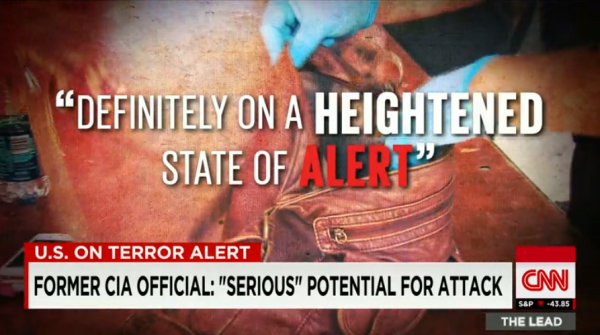
On Monday, several mainstream media outlets repeated the latest press release by the FBI that country was under a new “heightened terror alert” from “ISIL-inspired attacks” “leading up to the July 4th weekend.” One of the more sensational outlets, CNN, led with the breathless warning on several of its cable programs, complete with a special report by The Lead’s Jim Sciutto in primetime:

TerrorAlert

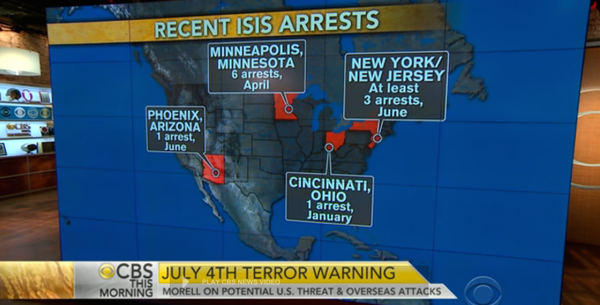
The threat was given extra credence when former CIA director—and consultant at DC PR firm Beacon Global Strategies—Michael Morell went on CBS This Morning (6/29/15) and scared the ever-living bejesus out of everyone by saying he “wouldn’t be surprised if we were sitting [in the studio] next week discussing an attack on the US.” The first piece of evidence Morell used to justify his apocalyptic posture, the “50 ISIS arrests,” was accompanied by a scary map on the CBS jumbotron showing “ISIS arrests” all throughout the US:

RecentISISArrests

But one key detail is missing from this  graphic: None of these “ISIS arrests” involved any actual members of ISIS, only members of the FBI—and their network of informants—posing as such. (The one exception being the man arrested in Arizona, who, while having no contact with ISIS, was also not prompted by the FBI.) So even if one thinks the threat of “lone wolf” attacks is a serious one, it cannot be said these are really “ISIS arrests.”  Perhaps on some meta-level, it shows an increase of “radicalization,” but it’s impossible to distinguish between this and simply more aggressive sting operations by the FBI.

In any event, this nuance gets left out entirely. As I’ve previously shown, in the media’s rush to hype the threat, the fact of FBI-manufactured—or at least “assisted”—terror plots is left out as a complicating factor altogether, and the viewer is left thinking the FBI arrested 50 actual ISIS sleeper cells.

Nevertheless, the ominous FBI (or Department of Homeland Security) “terror warning” has become such a staple of the on-going, seemingly endless “war on terror” (d/b/a war on ISIS), we hardly even notice it anymore. Marked by a feedback loop of extremist propaganda, unverifiable claims about “online chatter” and fuzzy pronouncements issued by a neverending string of faceless Muslim bad guys, and given PR cover by FBI-contrived “terror plots,” the specter of the impending “attack” is part of a broader white noise of fear that never went away after 9/11. Indeed, the verbiage employed by the FBI in this latest warning —“we’re asking people to remain vigilant”—implies no actual change of the status quo, just an hysterical nudge to not let down our collective guard.

There’s only one problem: These warnings never actually come to fruition. Not rarely, or almost never, but—by all accounts—never. No attacks, no arrests, no suspects at large.

Here’s a selection of previous FBI and DHS “terror warnings” over the past 14 years, not a single one of which actually predicted or foiled a terror attack:

October 2001: “Potential use of chemical/biological and/or radiological/nuclear weapons

November 2001: California bridges

February 2002: “Hollywood studios”

May 2002: Statue of Liberty

June 2002: “Around the Fourth of July holiday”

July 2002: Stadiums

August 2002: “Landmarks”

October 2002: “AQ to attack Amtrak

November 2002:Spectacular Al Qaeda attacks

February 2003: “Apartments, hotels, sports arenas and amusement parks

May 2003: “Possibility of multiple attacks”

May 2004: “Attempt to affect the outcome” of presidential election

July 2004: “Military facilities and large gatherings” on July 4th

August 2004: VA hospitals

January 2005: Dirty bomb

March 2005: US/Mexican border

October 2005: NYC & Baltimore subways

March 2006: “Sporting events”

June 2007: Colleges

December 2007:Shopping malls in Chicago and LA”

November 2008: “Al Qaeda to attack transit during Thanksgiving

November 2010: Mass transit in New York City

October 2011: “Americans in Europe” facing “commando-style AQ attack”

February 2011: “Financial institutions”

May 2011: “Threats of retaliation”

June 2011: Al Qaeda “hit list”

July 2011: “Private jets of executives” involved in drone manufacturing

September 2011: “Small planes”

September 2011: “New York City or Washington around…10th anniversary of 9/11

September 2011: Airports

March 2012: “Terrorist hacking”

August 2012: Anarchists blowing up bridge during Tampa RNC

September 2012: “Islamic violence over movie

August 2013: “San Fransisco on high alert

November 2013: “cyber attacks”

April 2014: “College students abroad”

December 2014: ISIS targeting Mississippi River bridge

December 2014: ISIS “sabotaging US military personnel” over social media

April 2015: ISIS targeting “parts of California

May 2015: ISIS targeting “military bases

A casual search reveals the FBI and DHS are a pitiful 0 for 40 warning of terror attacks—some of which were specifically about 4th of July threats, none of which materialized in any way. This should not be considered a comprehensive list of all threat warnings transmitted by media; I tried to narrow the scope to warnings that were at least in some way specific.

The actual terror attacks carried out on US soil—the Times Square bomber, “Underwear bomber,” Boston bombing and Garland attacks—were accompanied by no such warnings. (Nor were the often deadlier terrorist attacks by right-wing white terrorists–but terrorism in this category is rarely if ever the subject of FBI warnings.)

So why, a rational person may ask, does the media keeps repeating them if they’re wrong 100 percent of the time?

The problem is three fold:

  1. The FBI has all the incentive in the world to issue warnings and no incentive whatsoever to not issue warnings. Issuing warnings has no downside, while not doing so is all downside.
  2. The FBI, like all agencies of the government, does not operate in a political vacuum. Emphasizing the “ISIS threat” at home necessarily helps prop up the broader war effort the FBI’s boss, the president of the United States, must sell to a war-weary public. The incentive is to therefore highlight the smallest threats. This was a feature that did not go unnoticed during the Bush years, but has since fallen out of fashion.
  3. It has no actual utility. What does it mean to be “more vigilant”? It’s a vague call to alertness that officials, aside from “beefing up security” by local police, never quite explain what it means. If the FBI wanted to tell local police departments to up their security of the 4th of July weekend, surely they could do so quietly, without the chair of the House Committee on Homeland Security having to go on all major networks talking over b-roll of ISIS in apocalyptic terms.

When I brought up these objections up to CNN’s Sciutto, his response was less than satisfying:

fair question, the point is about the wider threat, FBI encourages people to attend events but be vigilant.

Yes, I would prefer warnings only when attacks were imminent. Which, of course, they never are. Because if they were, the government would actually attempt to stop them, rather than running a three-day PR tour. CNN‘s Jake Tapper, to his credit, would raise my concerns to Michael Chertoff later that day:

View image on Twitter

Ex-DHS head pushes back against terror warning skeptics http://cnn.it/1LyERVV 


While the attempt to introduce some skepticism is very much appreciated, Tapper missed the fundamental problem altogether. Next time he has on a Chertoff or a McCaul discussing a vague government terror warning, I’d like him to ask this simple question: “Has the FBI ever successfully warned, or foreshadowed in anyway, a terror attack in the United States? Because so far the count is 0 for 40+, and I’m curious what makes this time different.”

Put the burden of proof on those who are attempting to scare us, march our men and women off to war, and line their private security firm’s pockets. Don’t demand “FBI warning skeptics” disprove those in power; make those in power justify their own consistently discredited “warnings.”

If journalists still insist on disseminating these vague “threats,” I ask this question: How many false positives would be required for you to eventually stop doing so? Seventy? Two hundred?

Because 14 years on, I’m curious when, if ever, this media trope will ever end.

h/t Kevin Gosztola, who caught a 4th of July warning from 2004 I missed.\


Adam Johnson is an associate editor at AlterNet and writes frequently for FAIR.org. You can follow him on Twitter at @adamjohnsonnyc.

No ‘Je Suis Charleston’?

Obama-sings-Amazing-Grace-poolvideo

The De-politicization of Black Oppression

By Ajamu Baraka

Source: Counterpunch

Where are the international marches of solidarity with African Americans? The statements from world leaders condemning the terrorist attack and calling on U.S. Authorities to crack down on the white nationalist terror networks developing in the U.S.? Where are the marches in white communities condemning racism and standing with black people? Why no ‘Je Suis Charleston’?

The fact that these questions are not being raised by most people speaks to the adroit way in which the propagandists of the U.S. state, with the corporate media in lockstep, successfully domesticated and depoliticized the murderous attack in Charleston, South Carolina.

First, President Obama, as the government’s chief propagandist, defined Dylann Roof, the white nationalist assailant, as a pathological, hateful loner who had easy access to guns. The words “terrorist” never crossed his lips or the lips of any other officials of the national government.

Then, the state and corporate media followed-up this framing with a fascinating slight-of-hand stunt: instead of focusing on the domestic security threat posed by violent, racist right-wing extremists groups in the country, the old trope of gun control – along with a new twist, removing the Confederate flag – became the new focus! The implication was that by removing the Confederate battle flag – a symbol of white supremacy and the defense of slavery – from public buildings (no one bothered to explain why, if this was the rationale for removing the Confederate flag, there would not be a discussion around the need to reject the national flag also), that would somehow move the country towards racial reconciliation, much like electing a black president was supposed to do.

The effectiveness of this propaganda effort paid off just a few days after the attack. The domestic and international press gave full coverage to the spate of “terrorist” attacks that took place in three different counties but missing from that coverage was any connection and mention of the terror attack in Charleston.

However, it was at the funeral of Rev Pinckney, the pastor of the Emanuel African Methodist Episcopal Church murdered by Dylann Roof, where the concluding act of the governments’ obscene efforts to co-opt and deflect the pain of the attack played to a world-wide audience. President Obama turned in one of his best performances of a life-time of performances for white supremacy. His eulogy was a masterful example of his special talent to embody an instrumentalist “blackness” while delivering up that blackness to the white supremacist, U.S. settler project. In his eulogy, he couched his narrative of “American exceptionalism” in the language of Christian religiosity that was indistinguishable from the proclamations of the religious right that sees the U.S. as a state bestowed with the grace of their God.

Obama sang ‘Amazing Grace’ and lulled into a stupefying silence black voices that should have demanded answers as to why the Charleston attack was not considered a terrorist attack, even though it fit the definition of domestic terrorism, or why the Obama Administration collaborated with suppressing the 2009 report from the Department of Homeland Security (DHS), which identified violent white supremacist groups as a threat to national security more lethal than the threat from Islamic ‘fundamentalists’.

Because of this threat and the depraved indifference to black life by the U.S. government, international attention and solidarity is critical for African Americans. Yet, by quickly deploying the Obama weapon – aligning the government with the victims of the attack but defining the attack as a domestic criminal act – the political space for international solidarity with the plight of African Americans was significantly reduced, at least in relationship to the Charleston attack.

There is another element of this story that compelled the Administration to get out in front of this issue. Obama needed to draw attention away from the fact that his Administration caved under the pressure from the “respectable” racist right-wingers in Congress who criticized the DHS report in 2009.

John Boehner, the leader of the House of Representatives, characterized the report as “Offensive and unacceptable.” According to Boehner, the Obama Administration should not be condemning “American citizens who disagree with the direction Washington Democrats are taking our nation.”

Instead of defending Secretary Napolitano and the report issued by her Department, or taking the opportunity provided by the report to educate the public on this internal threat, Obama threw Napolitano under the bus and the DHS pulled the report from its website. The unit responsible for monitoring white supremacist organizations and movements was dismantled, and the threat of white supremacist violence becoming the victim of Washington politics.

This is the mindset and the politics of this Administration and the political culture in the U.S., where the differential value placed on black life allows black life to be reduced to an instrumental calculation when considering issues of international public relations and domestic politics.

The result?

For all intents and purposes, the tragedy in Charleston is over, closed out on a song written by a captain on a slave ship in 1779 and sung over 200 years later by a black man still in the service of white supremacy.

Ajamu Baraka is interviewed in Episode 3 of CounterPunch Radio, available for free here.

Ajamu Baraka is a human rights activist, organizer and geo-political analyst. Baraka is an Associate Fellow at the Institute for Policy Studies (IPS) in Washington, D.C. and editor and contributing columnist for the Black Agenda Report. He is a contributor to “Killing Trayvons: An Anthology of American Violence” (Counterpunch Books, 2014). He can be reached at www.AjamuBaraka.com


Numbered Man – An Analysis of The Prisoner (1967)

index

An excellent analysis from Jay Dyer of one of the best television series created so far, imho.

The Consciousness Revolution

GrahamHancockReconnectWithSpirit

By Graham Hancock

Source: Reality Sandwich

The following is excerpted from The Divine Spark: Psychedelics, Consciousness, and the Birth of Civilization, edited by Graham Hancock (Disinformation Books, April 2015).

Consciousness is one of the great mysteries of science—perhaps the greatest mystery. We all know we have it, when we think, when we dream, when we savor tastes and aromas, when we hear a great symphony, when we fall in love, and it is surely the most intimate, the most sapient, the most personal part of ourselves. Yet no one can really claim to have understood and explained it completely. There’s no doubt it’s associated with the brain in some way, but the nature of that association is far from clear. In particular, how do these three pounds of material stuff inside our skulls allow us to have experiences?

Professor David Chalmers of the Australian National University has dubbed this the “hard problem” of consciousness, but many scientists, partic­ularly those (still in the majority) who are philosophically inclined to believe that all phenomena can be reduced to material interactions, deny that any problem exists. To them, it seems self-evident that physical processes within the stuff of the brain produce consciousness rather in the way that a genera­tor produces electricity—i.e., consciousness is an “epiphenomenon” of brain activity. And they see it as equally obvious that there cannot be such things as conscious survival of death or out-of-body experiences since both con­sciousness and experience are confined to the brain and must die when the brain dies.

Yet other scientists with equally impressive credentials are not so sure and are increasingly willing to consider a very different analogy—namely that the relationship of consciousness to the brain may be less like the rela­tionship of the generator to the electricity it produces and more like the relationship of the TV signal to the TV set. In that case, when the TV set is destroyed—dead—the signal still continues. Nothing in the present state of knowledge of neuroscience rules this revolutionary possibility out. True, if you damage certain areas of the brain, certain areas of consciousness are compromised, but this does not prove that those areas of the brain generate the relevant areas of consciousness. If you were to damage certain areas of your TV set, the picture would deteriorate or vanish but the TV signal would remain intact.

We are, in other words, confronted by at least as much mystery as fact around the subject of consciousness, and this being the case, we should remember that what seems obvious and self-evident to one generation may not seem at all obvious or self-evident to the next. For hundreds of years, it was obvious and self-evident to the greatest human minds that the Sun moved around the Earth—one need only look to the sky, they said, to see the truth of this proposition. Indeed, those who maintained the revolutionary view that the Earth moved around the Sun faced the Inquisition and death by burning at the stake. Yet as it turned out, the revolutionaries were right and orthodoxy was terribly, ridiculously wrong.

The same may well prove to be true with the mystery of consciousness. Yes, it does seem obvious and self-evident that the brain produces it (the generator analogy), but this is a deduction from incomplete data and cat­egorically not yet an established and irrefutable fact. New discoveries may force materialist science to rescind this theory in favor of something more like the TV analogy in which the brain comes to be understood as a trans­ceiver rather than as a generator of consciousness and in which conscious­ness is recognized as fundamentally “nonlocal” in nature—perhaps even as one of the basic driving forces of the universe. At the very least, we should withhold judgment on this “hard problem” until more evidence is in and view with suspicion those who hold dogmatic and ideological views about the nature of consciousness.

It’s at this point that the whole seemingly academic issue becomes intensely political and current because modern technological society ideal­izes and is monopolistically focused on only one state of consciousness—the alert, problem-solving state of consciousness that makes us efficient pro­ducers and consumers of material goods and services. At the same time, our society seeks to police and control a wide range of other “altered” states of consciousness on the basis of the unproven proposition that consciousness is generated by the brain.

I refer here to the so-called “war on drugs” which is really better under­stood as a war on consciousness and which maintains, supposedly in the interests of society, that we as adults do not have the right or maturity to make sovereign decisions about our own consciousness and about the states of consciousness we wish to explore and embrace. This extraordinary impo­sition on adult cognitive liberty is justified by the idea that our brain activity, disturbed by drugs, will adversely impact our behavior toward others. Yet anyone who pauses to think seriously for even a moment must realize that we already have adequate laws that govern adverse behavior toward others and that the real purpose of the “war on drugs” must therefore be to bear down on consciousness itself.

Confirmation that this is so came from the last British Labour govern­ment. It declared that its drug policy would be based on scientific evidence, yet in 2009 it sacked Professor David Nutt, chair of the Advisory Council on the Misuse of Drugs, for stating the simple statistical fact that cannabis is less dangerous (in terms of measured “harms”) than tobacco and alcohol and that ecstasy is less dangerous than horse riding. Clearly what was at play here were ideological issues of great importance to the powers that be. And this is an ideology that sticks stubbornly in place regardless of changes in the complexion of the government of the day. The present Conservative-Liberal coalition remains just as adamant in its enforcement of the so-called war on drugs as its Labour predecessor and continues, in the name of this “war,” to pour public money—our money—into large, armed, drug-enforcement bureaucracies which are entitled to break down our doors at dead of night, invade our homes, ruin our reputations, and put us behind bars.

All of this, we have been persuaded, is in our own interests. Yet if we as adults are not free to make sovereign decisions—right or wrong—about our own consciousness, that most intimate, that most sapient, that most personal part of ourselves, then in what useful sense can we be said to be free at all? And how are we to begin to take real and meaningful responsibility for all the other aspects of our lives when our governments seek to disenfranchise us from this most fundamental of all human rights and responsibilities?

In this connection, it is interesting to note that our society has no objec­tion to altering consciousness per se. On the contrary, many consciousness-altering drugs, such as Prozac, Seroxat, Ritalin, and alcohol are either mas­sively overprescribed or freely available today, and they make huge fortunes for their manufacturers but remain entirely legal despite causing obvious harms. Could this be because such legal drugs do not alter consciousness in ways that threaten the monopolistic dominance of the alert problem-solving state of consciousness, while a good number of illegal drugs, such as canna­bis, LSD, DMT, and psilocybin, do?

There is a revolution in the making here, and what is at stake transcends the case for cognitive liberty as an essential and inalienable adult human right. If it turns out that the brain is not a generator but a transceiver of consciousness, then we must consider some little-known scientific research that points to a seemingly outlandish possibility, namely that a particular category of illegal drugs, the hallucinogens such as LSD, DMT, and psilo­cybin, may alter the receiver wavelength of the brain and allow us to gain contact with intelligent nonmaterial entities, “light beings,” “spirits,” “machine elves” (as Terence McKenna called them)—perhaps even the inhabitants of other dimensions. This possibility is regarded as plain fact by shamans in hunter-gatherer societies who for thousands of years made use of visionary plants and fungi to enter and interact with what they construed as the “spirit world.” Intriguingly, it was also specifically envisaged by Dr. Rick Strass­man, professor of psychiatry at the University of New Mexico, following his groundbreaking research with human volunteers and DMT carried out in the 1990s—a project that produced findings with shattering implications for our understanding of the nature of reality. For further information on Strass­man’s revolutionary work, see his book DMT: The Spirit Molecule.