“Bringing Out the Dead” (1999) is the fourth collaboration between director Martin Scorsese and screenwriter Paul Schrader (and their most underrated). Based on a novel by Joe Connelly, the plot follows New York paramedic Frank Pierce (Nicolas Cage), who’s on the verge of a nervous breakdown as he struggles to save a steady stream of victims of a heroin plague in the early 90s. As could be expected, the film is full of grim and harrowing situations but is punctuated by darkly humorous moments as well. Given the current wave of opiate overdoses caused primarily by the drug war and big pharma, Bringing Out the Dead is unfortunately more topical than ever.
If you’ve never seen Rollerball, stop what you’re doing and dial up the DVD for this 1975 Science Fiction Movie classic. Set in the year 2024, this dystopia puts Bread and Circuses on a violent whirlwind that’s engineered to keep the world’s corporate overlords out of the crosshairs. As such, revolving door heroes are amply provided and give the population cause to question the saccharin surroundings they live in. That is until each warrior meets their predetermined end and complacency has no other choice but to comply. Great Science Fiction but real control is so much easier.
Nonetheless, the backdrop of this dark world takes place after the “Corporate Wars” have bankrupted the world’s nations. In the void left behind, the corporations employ and govern. This leaves the public free of concerning themselves with important decisions, which are better left to “the few” in this standout among dystopian movies.
The Privileged Few
They also enjoy the privilege – even at the expense of Jonathan E. (James Caan). In the hero class of distraction, E. lost his wife to an executive who wanted her for himself. Paid off to leave him, the accompanying villa in Rome was no match for the rugged, introspect of the world renowned figure.
In this, we are given the vehicle to dig into underbelly as we digest the glory of the game and all its bloodletting. Obviously discontented, Jonathan questions the tradeoff between the material preeminence his position affords and freedom. One of his hanger’s on who serves among the privilege Jonathan reaps doesn’t have such depth and toes the line the system forges like the mindless drone she is. “But comfort is freedom,” reasons Ella.
Enough of the citizenry bought off with nice things, the oversight does not even consider those who may reap much less, because this set up is sure to have losers on a far greater scale. This all sends E. off to determine how people have been so effectively siphoned off as sheep.
Information is Power
Expectedly, the information is scarce – or better yet – properly edited. Summaries of important works are readily available, and in case 24-7 of the game on telescreen gives way to inquiry, the overlords will reset any doubt in the comfort of your own easy chair. “What do you want books for?,” Jonathan’s teammate, Moon Pie asks “Look Johnny, if you wanna learn somethin’, just get a Corporate Teacher to come and teach it to ya’.
Jonathan defers and goes to Geneva to visit a computerized archive. The prospects are quickly eradicated as the librarian is little help, and the system even less. Leaving E at a loss, the willing agent reveals that “the whole of the 13th Century is gone.”
All still escapes Ella with Jonathan coming to a crossroad. “Why don’t you do what the executives want – especially since you’ll be paid handsomely,” she doesn’t get it.
Specifically, they want him to retire. His survival defies the preset odds and disturbs the complacency. Or in chilling John Houseman-speak, the game was created to demonstrate “the futility of individuality.”
Real Control is much Easier
Your mind is officially blown. But a simple look at voter turnout or the tune out that hundreds of TV stations afford us and control takes on the form of despondency. Most significantly, a two party system in which the same elites support both sides, and the important decisions gives the many the illusion of choice.
Even so with the two party gaming clearly at our disposal, we are still sold on the stark differences, and coalesce into our corners over less substantial issues. So while we all don’t like American jobs shipped overseas of elite born trade policy, hate money in politics, the never ending improprieties of the big banks and inefficient delivery of healthcare, we are unable to find crossover or a leader able to unite across party lines.
Instead, our only common place involves a shared sense that the other side is mired in stupidity. This even as we see enough smarts among them that they are also able to navigate survival against such a stacked deck. Blinded by the many fictional divides, who really needs to pick up spilled guts or dislodged eyeballs when the powerlessness our elites have created is so much easier to clean up.
All the News That’s Fit to Print
Of course, the chance to narrow the divides can be a function of the availability of information. In the Science Fiction of Rollerball, this is diminished by keeping information controlled by offering tidbits or official accounts. But secrets only give rise to the desire to seek out what you’re not supposed to know.
It’s far more efficient to let people think they have a free press, and now with the internet and cable news, sources that rise to the top are the ones providing fictitious entertainment in place of facts.
In addition, the unseen hand of Google elevating disinformation now rivals the wall between advertising and content, which doesn’t really exist, and has always acted as editors to protect the elite.
Of course, we do have our distractions, and the cult-like mass following of the NFL can’t help but be seen as a parallel to Rollerball. The circus though is subtle and smarter than 2024.
Whoever has the most Toys
Putting aside violence on the decline, a no one left standing approach has been replaced with parity where everyone has a chance to win. Far more effective for viewership, and the Sunday, Monday, Thursday cascade plays right into the American consumerism that one ups Rollerball’s ability to feign comfort for the masses. Or why give people stuff to keep them complacent when you can make them ever in pursuit of the next gadget that is sure to bring unending happiness.
As Brad Pitt says in Fight Club, “the things you own, they ending up owning you.” For example, when Apple outsources production to a Chinese factory where nets keep workers from jumping out the windows, stock options go a long way to allaying the guilt and getting you that Lexus you can’t do without.
But who knows, Rollerball might have emerged because people figured out how to beat the system, and the powerful went back to the basics that the Romans perfected. Maybe, we should be content, and let the elites have their ball so they go don’t go home and take it with them. You know, before they return with something worse, and we’re left rolling over dead instead of despondent.
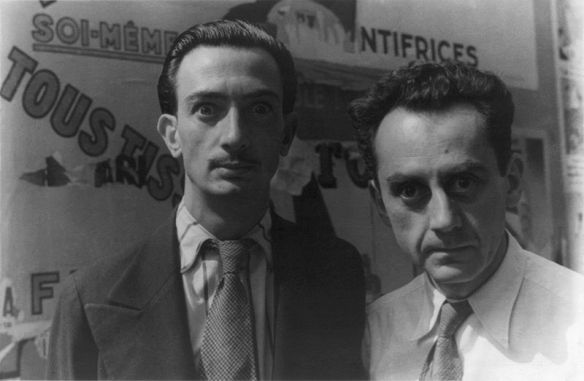
While studying at the University of Madrid in the late 1910s, a young Luis Buñuel befriended an even younger Salvador Dalí. The first fruit of their association, a short film called Un Chien Andalou, appeared a decade later, in 1929, and quickly achieved the international renown it still has today. Several elements had to fall into place to bring this cinematic dream — or cinematic nightmare, or, most accurately, something nebulously in-between — into reality. First, Buñuel gained experience in the medium by assistant-directing on major silent-era European films like Mauprat, La chute de la maison Usher, and La Sirène des Tropiques. Then, Buñuel dreamt of the simultaneous image of a cloud slicing through the moon and a razor slicing through an eye. Then, Dalí dreamt of a human hand covered in ants. With those two visuals in place, they proceeded to collaborate on the rest of the film, working under the principle that “no idea or image that might lend itself to a rational explanation of any kind would be accepted.”
We could discuss Un Chien Andalou‘s rationally inexplicable images, but wouldn’t that defeat the purpose? The moon, the eye, the hand, the ants, the cyclist in the nun’s habit — these nonsensical but enduring images must be seen, and you can do that free on YouTube. But at sixteen minutes, the movie will only whet your aesthetic appetite for Buñuel and Dalí’s particular flavor of flamboyantly nonsensical, grimly satirical imagery. Luckily, you can follow it up with 1930’s L’Age d’Or, which began as another Buñuel-Dalí joint venture until the two suddenly went their separate ways after writing the script. Buñuel took over, crafting a wryly savage five-part critique of the Roman Catholic Church. Buñuel and Dalí had prepared themselves for shock-induced physical violence at the premiere of Un Chien Andalou, only to find that the crowd had heartily approved. But L’Age d’Or drew enough fire for both pictures and then some, getting banned in France and eventually withdrawn from distribution until re-emerging in 1979. Now you can watch it whenever you like on the internet, suggesting that the controversy has evaporated — yet the images remain as surreal a way as any to begin your weekend. A restored version of the film can be viewed here.
“Momo” (1986) is an Italian/German fantasy film directed by Johannes Schaaf and based on the 1973 novel of the same name by Michael Ende (The Neverending Story). The plot explores the concept of time through the journey of Momo, a girl whose extraordinary personality puts her at odds with the Men in Grey, shady representatives of the Timesavings Bank who steal the time of all her neighbors in the village. Momo features the final performance of writer/director/actor John Huston.
The Future Doesn’t Need Us… Or So We’ve Been Told. With the rise of technology and the real-time pressures of an online, global economy, humans will have to be very clever – and very careful – not to be left behind by the future. From the perspective of those in charge, human labor is losing its value, and people are becoming a liability. This documentary reveals the real motivation behind the secretive effort to reduce the population and bring resource use into strict, centralized control. Could it be that the biggest threat we face isn’t just automation and robots destroying jobs, but the larger sense that humans could become obsolete altogether? *Please watch and share!* Link to film: http://amzn.to/2f69Ocr
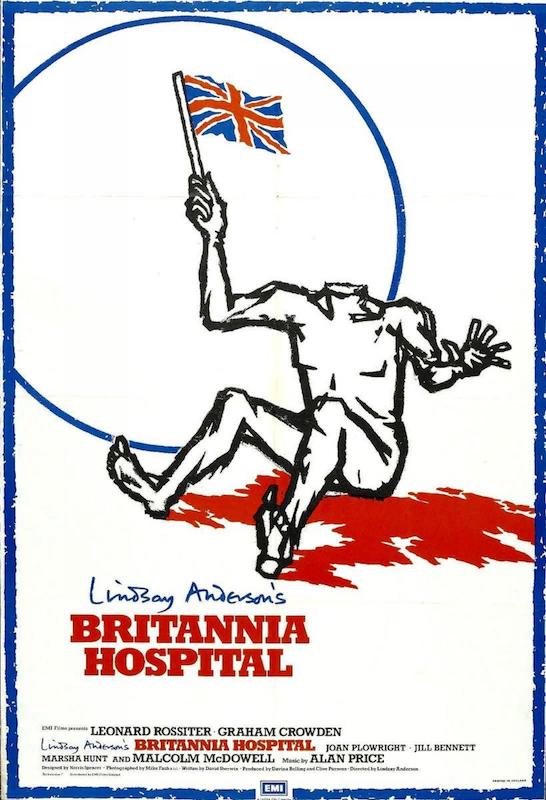
“Britannia Hospital” (1982) is the third installment of director Lindsay Anderson’s “Mick Travis Trilogy”. Like the other films in the series, it’s a dark comedy following a particularly eventful chapter in the life of Mick Travis (Malcolm McDowell) as he confronts various disturbing and absurd aspects of Britain and western society in general. In Britannia Hospital, Travis is a muckraking investigative journalist covertly filming a documentary on the prestigious Britannia Hospital as it faces a variety of challenges including the opening of a new wing, the arrival of the Queen Mother and other dignitaries, and protesters opposing an African dictator’s stay at the hospital as well as extravagant meals for VIP guests. As he gets further into his investigation Travis becomes embroiled in a secret transhumanist project directed by the head of the new wing. The Film’s central thesis is summed up by the following statement from Lindsay Anderson:
“The absurdities of human behaviour as we move into the Twenty-first Century are too extreme — and too dangerous — to permit us the luxury of sentimentalism or tears. But by looking at humanity objectively and without indulgence, we may hope to save it. Laughter can help.”
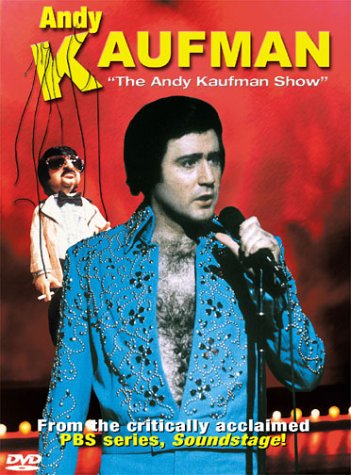
Holy moly! In 1983, just a year before his death of lung cancer—an event some people dispute ever happened—Andy Kaufman was given the bountiful gift of an hour of PBS programming time in the form of a segment of the music series Soundstage.
It’s a revelation.
Kaufman used his hour to create a mind-boggling critique of talk shows and the entertainment complex writ large. The show is presented out of phase: we see the inexplicable final, hysterical moments of the program, perhaps holding out the promise that we’ll find out what the fuck was going on at the very end. Kaufman sings an inane farewell song and credits roll—then the program starts up again.
One of the first things Kaufman does is ask the home viewer to go get a piece of cellophane from the kitchen—and then sits on the lip of the audience bleachers and waits 30 seconds in ballsy silence while that task is accomplished. (Just in case there are any stragglers, he then briefly jacks the volume and shouts at the home viewers to hurry up.)
You don’t need me to tell you all the gags in advance, but boy, they are beautiful. What’s sometimes forgotten about Kaufman is that for all of his daring experimentation, he was almost always very funny. Nobody had better mastery over the mirth that could be extracted from an awkward turn of phrase or an uncomfortable pause.
They gave him an installment of the PBS concert series Soundstage, for which he was invited to fill an hour as he saw fit and, since this was public television and no serious money was involved, he saw fit to contrive the most elliptical and surreal refraction of existential realities that he had ever attempted. He spent the better part of June working at the WTTW production facilities in Chicago, where the series was produced and where he plotted strategem as he went along, with George and Lynne Margulies and Elayne Boosler as his sounding board. He would begin the show at the end and start again near the middle and utilize ideas learned as a child from watching Winky-Dink and You, wherein viewers were instructed to put cellophane on the television screen and draw on it to help him out of jams. He would have himself arrested and thrown into television court (all with cartoon backdrop) and defend whatever broadcast transgressions he had so far commited on the program. He would have an interviewing desk that was now seven feet high (calling no attention to this) from which he would imperiously interview Elayne, wherein they (candidly, no, really) traversed what had gone wrong with their relationship—“Sometimes I would wake in the morning,” he told her, “and I’d think I’d like to tell you that we’re gonna break up. I’d say, Well, I gotta tell her tonight—we’re gonna break up!” The Clifton puppet would meanwhile stalk the desktop and serve as sidekick.
If you have any yen at all for the outer reaches of experimental comedy, this is a must-see.
Oh—since it’s Kaufman we’re talking about here, don’t take anything for granted. Make sure you watch the program to the very end.
“Summer Wars” (2009) is a sci-fi anime directed by Mamoru Hosoda (The Girl Who Leapt Through Time) and animated by Madhouse studio. The film’s plot follows Kenji Koiso, an eleventh-grade math prodigy who, while visiting his friend Natsuki’s great-grandmother, is falsely implicated in the hacking of a virtual world by a rogue AI called Love Machine. With the help of his community, Kenji must undo the damage and prevent the AI’s spread into the real world.





 After the Crash