Yes, Jesus Would Have Been Branded a Domestic Extremist Today

By John & Nisha Whitehead

Source: The Rutherford Institute

“When the song of the angels is stilled, when the star in the sky is gone, when the kings and princes are home, when the shepherds are back with their flocks, the work of Christmas begins: to find the lost, to heal the broken, to feed the hungry, to release the prisoner, to rebuild the nations, to bring peace among the people, to make music in the heart.”—Howard Thurman, theologian and civil rights activist

The Christmas story of a baby born in a manger is a familiar one.

The Roman Empire, a police state in its own right, had ordered that a census be conducted. Joseph and his pregnant wife Mary traveled to the little town of Bethlehem so that they could be counted. There being no room for the couple at any of the inns, they stayed in a stable (a barn), where Mary gave birth to a baby boy, Jesus. Warned that the government planned to kill the baby, Jesus’ family fled with him to Egypt until it was safe to return to their native land.

Yet what if Jesus had been born 2,000 years later.

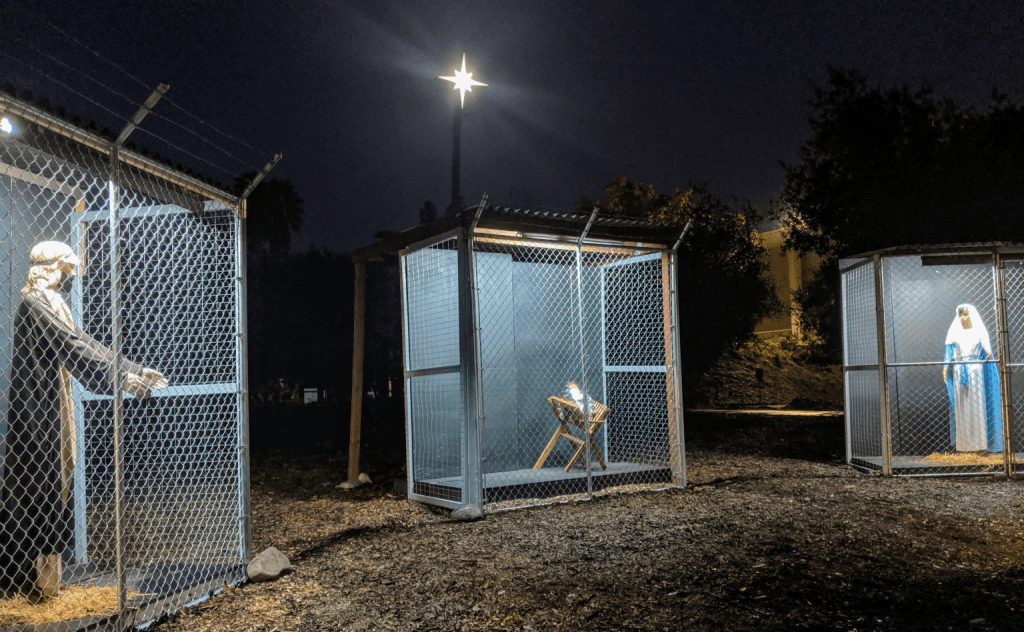
What if, instead of being born into the Roman police state, Jesus had been born at this moment in time? What kind of reception would Jesus and his family be given? Would we recognize the Christ child’s humanity, let alone his divinity? Would we treat him any differently than he was treated by the Roman Empire? If his family were forced to flee violence in their native country and sought refuge and asylum within our borders, what sanctuary would we offer them?A singular number of churches across the country have asked those very questions in recent years, and their conclusions were depicted with unnerving accuracy by nativity scenes in which Jesus and his family are separated, segregated and caged in individual chain-link pens, topped by barbed wire fencing.

Those nativity scenes were a pointed attempt to remind the modern world that the narrative about the birth of Jesus is one that speaks on multiple fronts to a world that has allowed the life, teachings and crucifixion of Jesus to be drowned out by partisan politics, secularism, materialism and war, all driven by a manipulative shadow government called the Deep State.

The modern-day church has largely shied away from applying Jesus’ teachings to modern problems such as war, poverty, immigration, etc., but thankfully there have been individuals throughout history who ask themselves and the world: what would Jesus do.

What would Jesus—the baby born in Bethlehem who grew into an itinerant preacher and revolutionary activist, who not only died challenging the police state of his day (namely, the Roman Empire) but spent his adult life speaking truth to power, challenging the status quo of his day, and pushing back against the abuses of the Roman Empire—do about the injustices of our  modern age.

Dietrich Bonhoeffer asked himself what Jesus would have done about the horrors perpetrated by Hitler and his assassins. The answer: Bonhoeffer was executed by Hitler for attempting to undermine the tyranny at the heart of Nazi Germany.

Aleksandr Solzhenitsyn asked himself what Jesus would have done about the soul-destroying gulags and labor camps of the Soviet Union. The answer: Solzhenitsyn found his voice and used it to speak out about government oppression and brutality.

Martin Luther King Jr. asked himself what Jesus would have done about America’s warmongering. The answer: declaring “my conscience leaves me no other choice,” King risked widespread condemnation as well as his life when he publicly opposed the Vietnam War on moral and economic grounds.

Even now, despite the popularity of the phrase “What Would Jesus Do?” (WWJD) in Christian circles, there remains a disconnect in the modern church between the teachings of Christ and the suffering of what Jesus in Matthew 25 refers to as the “least of these.

Yet this is not a theological gray area: Jesus was unequivocal about his views on many things, not the least of which was charity, compassion, war, tyranny and love.

After all, Jesus—the revered preacher, teacher, radical and prophet—was born into a police state not unlike the growing menace of the American police state. When he grew up, he had powerful, profound things to say, things that would change how we view people, alter government policies and change the world. “Blessed are the merciful,” “Blessed are the peacemakers,” and “Love your enemies” are just a few examples of his most profound and revolutionary teachings.

When confronted by those in authority, Jesus did not shy away from speaking truth to power. Indeed, his teachings undermined the political and religious establishment of his day. It cost him his life. He was eventually crucified as a warning to others not to challenge the powers-that-be.

Can you imagine what Jesus’ life would have been like if, instead of being born into the Roman police state, he had been born and raised in the American police state.

Consider the following if you will.

Had Jesus been born in the era of the America police state, rather than traveling to Bethlehem for a census, Jesus’ parents would have been mailed a 28-page American Community Survey, a mandatory government questionnaire documenting their habits, household inhabitants, work schedule, how many toilets are in your home, etc. The penalty for not responding to this invasive survey can go as high as $5,000.

Instead of being born in a manger, Jesus might have been born at home. Rather than wise men and shepherds bringing gifts, however, the baby’s parents might have been forced to ward off visits from state social workers intent on prosecuting them for the home birth. One couple in Washington had all three of their children removed after social services objected to the two youngest being birthed in an unassisted home delivery.

Had Jesus been born in a hospital, his blood and DNA would have been taken without his parents’ knowledge or consent and entered into a government biobank. While most states require newborn screening, a growing number are holding onto that genetic material long-term for research, analysis and purposes yet to be disclosed.

Then again, had Jesus’ parents been undocumented immigrants, they and the newborn baby might have been shuffled to a profit-driven, private prison for illegals where they first would have been separated from each other, the children detained in make-shift cages, and the parents eventually turned into cheap, forced laborers for corporations such as Starbucks, Microsoft, Walmart, and Victoria’s Secret. There’s quite a lot of money to be made from imprisoning immigrants, especially when taxpayers are footing the bill.

From the time he was old enough to attend school, Jesus would have been drilled in lessons of compliance and obedience to government authorities, while learning little about his own rights. Had he been daring enough to speak out against injustice while still in school, he might have found himself tasered or beaten by a school resource officer, or at the very least suspended under a school zero tolerance policy that punishes minor infractions as harshly as more serious offenses.

Had Jesus disappeared for a few hours let alone days as a 12-year-old, his parents would have been handcuffed, arrested and jailed for parental negligence. Parents across the country have been arrested for far less “offenses” such as allowing their children to walk to the park unaccompanied and play in their front yard alone.

Rather than disappearing from the history books from his early teenaged years to adulthood, Jesus’ movements and personal data—including his biometrics—would have been documented, tracked, monitored and filed by governmental agencies and corporations such as Google and Microsoft. Incredibly, 95 percent of school districts share their student records with outside companies that are contracted to manage data, which they then use to market products to us.

From the moment Jesus made contact with an “extremist” such as John the Baptist, he would have been flagged for surveillance because of his association with a prominent activist, peaceful or otherwise. Since 9/11, the FBI has actively carried out surveillance and intelligence-gathering operations on a broad range of activist groups, from animal rights groups to poverty relief, anti-war groups and other such “extremist” organizations.

Jesus’ anti-government views would certainly have resulted in him being labeled a domestic extremist. Law enforcement agencies are being trained to recognize signs of anti-government extremism during interactions with potential extremists who share a “belief in the approaching collapse of government and the economy.

While traveling from community to community, Jesus might have been reported to government officials as “suspicious” under the Department of Homeland Security’s “See Something, Say Something” programs. Many states, including New York, are providing individuals with phone apps that allow them to take photos of suspicious activity and report them to their state Intelligence Center, where they are reviewed and forwarded to law-enforcement agencies.

Rather than being permitted to live as an itinerant preacher, Jesus might have found himself threatened with arrest for daring to live off the grid or sleeping outside. In fact, the number of cities that have resorted to criminalizing homelessness by enacting bans on camping, sleeping in vehicles, loitering and begging in public has doubled.

Viewed by the government as a dissident and a potential threat to its power, Jesus might have had government spies planted among his followers to monitor his activities, report on his movements, and entrap him into breaking the law. Such Judases today—called informants—often receive hefty paychecks from the government for their treachery.

Had Jesus used the internet to spread his radical message of peace and love, he might have found his blog posts infiltrated by government spies attempting to undermine his integrity, discredit him or plant incriminating information online about him. At the very least, he would have had his website hacked and his email monitored.

Had Jesus attempted to feed large crowds of people, he would have been threatened with arrest for violating various ordinances prohibiting the distribution of food without a permit. Florida officials arrested a 90-year-old man for feeding the homeless on a public beach.

Had Jesus spoken publicly about his 40 days in the desert and his conversations with the devil, he might have been labeled mentally ill and detained in a psych ward against his will for a mandatory involuntary psychiatric hold with no access to family or friends. One Virginia man was arrested, strip searched, handcuffed to a table, diagnosed as having “mental health issues,” and locked up for five days in a mental health facility against his will apparently because of his slurred speech and unsteady gait.

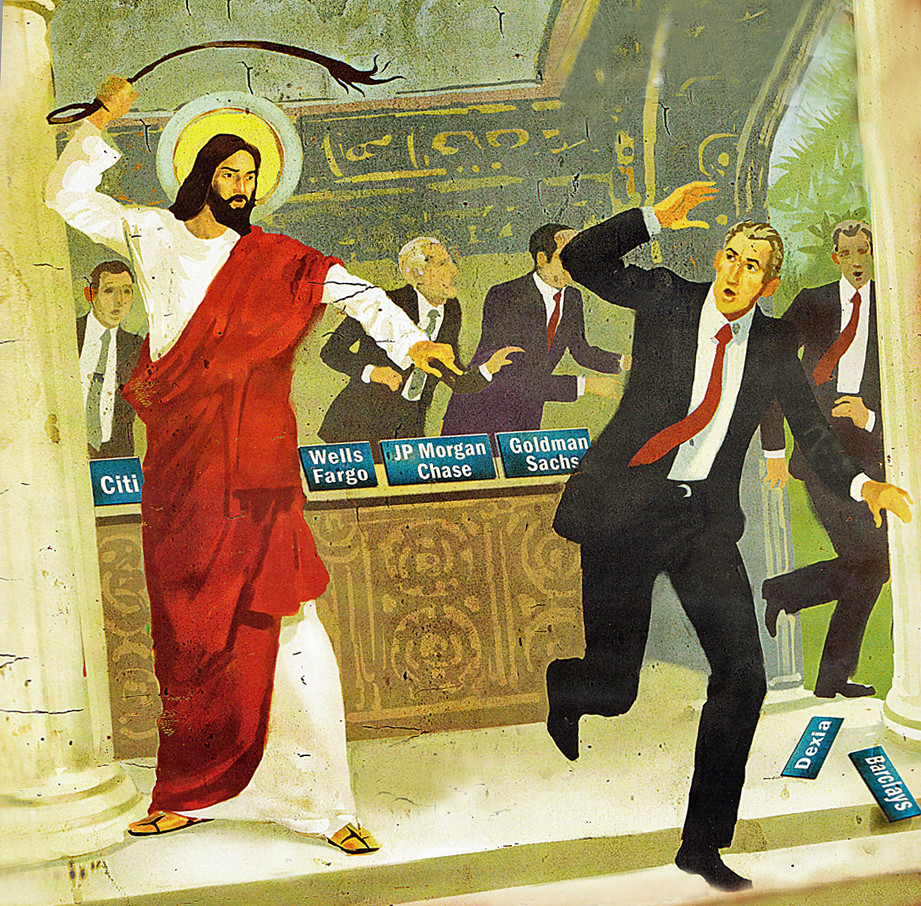
Without a doubt, had Jesus attempted to overturn tables in a Jewish temple and rage against the materialism of religious institutions, he would have been charged with a hate crime. More than 45 states and the federal government have hate crime laws on the books.

Had anyone reported Jesus to the police as being potentially dangerous, he might have found himself confronted—and killed—by police officers for whom any perceived act of non-compliance (a twitch, a question, a frown) can result in them shooting first and asking questions later.

Rather than having armed guards capture Jesus in a public place, government officials would have ordered that a SWAT team carry out a raid on Jesus and his followers, complete with flash-bang grenades and military equipment. There are upwards of 80,000 such SWAT team raids carried out every year, many on unsuspecting Americans who have no defense against such government invaders, even when such raids are done in error.

Instead of being detained by Roman guards, Jesus might have been made to “disappear” into a secret government detention center where he would have been interrogated, tortured and subjected to all manner of abuses. Chicago police have “disappeared” more than 7,000 people into a secret, off-the-books interrogation warehouse at Homan Square.

Charged with treason and labeled a domestic terrorist, Jesus might have been sentenced to a life-term in a private prison where he would have been forced to provide slave labor for corporations or put to death by way of the electric chair or a lethal mixture of drugs.

Indeed, as I make clear in my book Battlefield America: The War on the American People and in its fictional counterpart The Erik Blair Diaries, given the nature of government then and now, it is painfully evident that whether Jesus had been born in our modern age or his own, he still would have died at the hands of a police state.

Thus, as we draw near to Christmas with its celebration of miracles and promise of salvation, we would do well to remember that what happened in that manger on that starry night in Bethlehem is only the beginning of the story. That baby born in a police state grew up to be a man who did not turn away from the evils of his age but rather spoke out against it.

We must do no less.

Revolution, Awakening, And Leaving Abusive Relationships All Happen In Unexpected Ways

By Caitlin Johnstone

Source: CaitlinJohnstone.com

People don’t generally leave abusive relationships in egoically satisfying, Hollywood-friendly ways.

I point this out because those of us who are watching the people’s abusive relationship with predatory power structures and hoping for revolutionary change often tend to envision the status quo ending in an epic way that will make for a good story and let us feel good about ourselves and how right we were. And that just isn’t how these things tend to go.

One of the most shameful things about being in an abusive relationship is how much longer you’ll let it go on for than an outside observer would expect. How much brutality you’ll put up with and the ways you’ll justify it to yourself.

The shame of this can be soul-crushing. A friend once said, “The worst part wasn’t when he raped me, it was having to make him breakfast afterward.” The shamefulness of the abuse and degradation you’ll put up with because of where you’re at in your mind is why people don’t discuss this aspect more, which is why the loved ones of people in those relationships often have such a hard time understanding it. People don’t talk about it, so many don’t understand how common it is.

Generally when someone leaves an abusive relationship it’s not really because they were hit one too many times. It’s not because it got worse than it used to be. Sometimes it will be because the abuser started to assault the victim’s child, but even that will often happen in ways that are a lot more complicated and shameful than the victim acknowledges when telling the story later on.

Generally when someone leaves an abusive relationship it happens for the same reason flowers bloom: because it was time. Something just shifts, and suddenly you’re seeing things you weren’t seeing before. You start noticing patterns, noticing manipulations, noticing the malice in the abuser’s face that you’d previously compartmentalized away from seeing.

And then when you leave the reality of it doesn’t often make for a great Hollywood movie or Hallmark TV special. It doesn’t fit well into egoically gratifying stories. A process just kind of plays itself out, some things happen in ways you probably didn’t anticipate, and then one day you’re not waking up next to the same person anymore. You might try to tell heroic stories about it, or others might do that on your behalf, but really it just kind of happened when the happening was ripe.

Spiritual enlightenment often happens in the same way. Zen Buddhism is full of stories of sudden awakenings where a monk meditates for thirty years while remaining locked in delusion and then suddenly experiences satori after slipping and falling or hearing a teacher say something unexpected or whatever.

It happens when it’s time. A good teacher might offer some spiritual practices to help “lay the groundwork” for awakening, but one person can take those practices and never awaken while another can awaken very quickly. It’s not like building a house or learning a new language where you set to work and do certain things in a certain way and then eventually you have what you set out to obtain. Awakening doesn’t work that way. It’s not the product of personal will. It happens when it happens.

A pot of water can sit there on the stove for minutes without looking like much is happening. When people look at our current environment of murderous exploitative status quo systems and deeply propagandized populations they’ll often despair because it’s very much the same: it doesn’t look like much is happening.

But then the water begins to boil. But then the battered wife escapes to safety. But then the spiritual aspirant sees beyond the veil of illusion. But then the people rise up.

Humans are storytelling creatures; that’s why it’s possible to gain such a tremendous amount of power over us by controlling our stories. We are storytelling creatures whose primate brains weren’t evolved for the purpose of giving us any absolute understanding of ultimate reality, whose senses only take in a tiny fraction of our surroundings, whose minds don’t process what’s happening in the ways science tells us things are actually happening.

What do you get when you have a storytelling animal with a very limited capacity to perceive life as it really is? You get a lot of things happening in ways that the creature did not expect, because none of their mental stories told them to anticipate it happening in that way. And then probably telling a bunch of stories about what happened which don’t truly reflect reality.

If and when humanity does wake up from its propaganda-induced coma and push for the changes needed for us to evade extinction and create a healthy world together, it will happen in ways we’re not expecting. It will happen in ways that aren’t pleasing to the ego. It will happen in ways that don’t allow us to stand up and say “Aha! You see? I was right all along!” It will happen in ways that don’t form a compelling narrative.

And how could it? If humanity is to survive into the distant future we’re going to have to transcend the egoic mental habits which led us into this mess. We’re going to have to transcend our unhealthy relationship with mental narrative which made us so easy to manipulate and propagandize. We’re going to have to transcend our self-destructive patterning, which will necessarily have to come from an unpatterned, and therefore unexpected direction.

It will happen when it happens, in a way we couldn’t possibly have predicted it would happen.

So don’t despair if it looks like things aren’t headed toward change. The boiling water, the escaped abuse victim, and the deeply enlightened mind all looked the same at one point.

Don’t despair, and don’t fear the unknown. The unknown is the only direction humanity’s salvation can possibly come from.

Totalitarian Paranoia Run Amok: Pandemics, Lockdowns & Martial Law

By John W. Whitehead & Nisha Whitehead

Source: The Rutherford Institute

Totalitarian paranoia runs deep in American society, and it now inhabits the highest levels of government.”—Professor Henry Giroux

Once upon a time, there was a government so paranoid about its hold on power that it treated everyone and everything as a threat and a reason to expand its powers. Unfortunately, the citizens of this nation believed everything they were told by their government, and they suffered for it.

When terrorists attacked the country, and the government passed massive laws aimed at paving the way for a surveillance state, the people believed it was done merely to keep them safe. The few who disagreed were labeled traitors.

When the government waged costly preemptive wars on foreign countries, insisting it was necessary to protect the nation, the citizens believed it. And when the government brought the weapons and tactics of war home to use against the populace, claiming it was just a way to recycle old equipment, the people believed that too. The few who disagreed were labeled unpatriotic.

When the government spied on its own citizens, claiming they were looking for terrorists hiding among them, the people believed it. And when the government began tracking the citizenry’s movements, monitoring their spending, snooping on their social media, and surveying them about their habits—supposedly in an effort to make their lives more efficient—the people believed that, too. The few who disagreed were labeled paranoid.

When the government allowed private companies to take over the prison industry and agreed to keep the jails full, justifying it as a cost-saving measure, the people believed them. And when the government started arresting and jailing people for minor infractions, claiming the only way to keep communities safe was to be tough on crime, the people believed that too. The few who disagreed were labeled soft on crime.

When the government hired crisis actors to take part in disaster drills, never alerting the public to which “disasters” were staged, the people genuinely believed they were under attack. And when the government insisted it needed greater powers to prevent such attacks from happening again, the people believed that too. The few who disagreed were told to shut up or leave the country.

When the government started carrying out covert military drills around the country, insisting it was necessary to train the troops for foreign combat, most of the people believed them. The few who disagreed, fearing that perhaps all was not what it seemed, were shouted down as conspiracy theorists and quacks.

When government leaders locked down the nation, claiming it was the only way to prevent an unknown virus from sickening the populace, the people believed them and complied with the mandates and quarantines. The few who resisted or voiced skepticism about the government’s edicts were denounced as selfish and dangerous and silenced on social media.

When the government expanded its war on terrorism to include domestic terrorists, the people believed that only violent extremists would be targeted. Little did they know that anyone who criticizes the government can be considered an extremist.

By the time the government began using nationalized police and the military to routinely lockdown the nation, the citizenry had become so acclimated to such states of emergency that they barely even noticed the prison walls that had grown up around them.

Now every fable has a moral, and the moral of this story is to beware of anyone who urges you to ignore your better instincts and blindly trust that the government has your best interests at heart.

In other words, if it looks like trouble and it smells like trouble, you can bet there’s trouble afoot.

Unfortunately, the government has fully succeeded in recalibrating our general distaste for anything that smacks too overtly of tyranny.

After all, like the proverbial boiling frogs, the government has been gradually acclimating us to the specter of a police state for years now: Militarized police. Riot squads. Camouflage gear. Black uniforms. Armored vehicles. Mass arrests. Pepper spray. Tear gas. Batons. Strip searches. Surveillance cameras. Kevlar vests. Drones. Lethal weapons. Less-than-lethal weapons unleashed with deadly force. Rubber bullets. Water cannons. Stun grenades. Arrests of journalists. Crowd control tactics. Intimidation tactics. Brutality.

This is how you prepare a populace to accept a police state willingly, even gratefully.

You don’t scare them by making dramatic changes. Rather, you acclimate them slowly to their prison walls. Persuade the citizenry that their prison walls are merely intended to keep them safe and danger out. Desensitize them to violence, acclimate them to a military presence in their communities, and persuade them that only a militarized government can alter the seemingly hopeless trajectory of the nation.

It’s happening already.

The sight of police clad in body armor and gas masks, wielding semiautomatic rifles and escorting an armored vehicle through a crowded street, a scene likened to “a military patrol through a hostile city,” no longer causes alarm among the general populace.

We’ve allowed ourselves to be acclimated to the occasional lockdown of government buildings, military drills in small towns so that special operations forces can get “realistic military training” in “hostile” territory, and  Live Active Shooter Drill training exercises, carried out at schools, in shopping malls, and on public transit, which can and do fool law enforcement officials, students, teachers and bystanders into thinking it’s a real crisis.

Still, you can’t say we weren’t warned.

Back in 2008, an Army War College report revealed that “widespread civil violence inside the United States would force the defense establishment to reorient priorities in extremis to defend basic domestic order and human security.” The 44-page report went on to warn that potential causes for such civil unrest could include another terrorist attack, “unforeseen economic collapse, loss of functioning political and legal order, purposeful domestic resistance or insurgency, pervasive public health emergencies, and catastrophic natural and human disasters.”

In 2009, reports by the Department of Homeland Security surfaced that called on the government to subject right-wing and left-wing activists and military veterans to full-fledged, pre-crime surveillance.

Meanwhile, the government has been amassing an arsenal of military weapons, including hollow point bullets, for use domestically and equipping and training their “troops” for war. Even government agencies with largely administrative functions such as the Food and Drug Administration, Department of Veterans Affairs, and the Smithsonian have been acquiring body armor, riot helmets and shields, cannon launchers and police firearms and ammunition. In fact, there are now at least 120,000 armed federal agents carrying such weapons who possess the power to arrest.

Rounding out this profit-driven campaign to turn American citizens into enemy combatants (and America into a battlefield) is a technology sector that has been colluding with the government to create a Big Brother that is all-knowing, all-seeing and inescapable. It’s not just the drones, fusion centers, license plate readers, stingray devices and the NSA that you have to worry about. You’re also being tracked by the black boxes in your cars, your cell phone, smart devices in your home, grocery loyalty cards, social media accounts, credit cards, streaming services such as Netflix, Amazon, and e-book reader accounts.

And then there are the military drills that have been taking place on American soil in recent years.

In the latest “unconventional warfare exercise,” dubbed “Robin Sage,” special forces soldiers will battle seasoned “freedom fighters” in a “realistic” guerrilla war across two dozen North Carolina counties.

Robin Sage follows on the heels of other such military drills, including Jade Helm, which involved U.S. Army Special Operations Command, the Navy Seals, Air Force Special Operations, Marine Special Operations Command, Marine Expeditionary Units, the 82nd Airborne Division, and other interagency partners.

According to the government, these planned military exercises are supposed to test and practice unconventional warfare including, but not limited to, guerrilla warfare, subversion, sabotage, intelligence activities, and unconventional assisted recovery.

The training, known as Realistic Military Training (RMT) because it will be conducted outside of federal property, are carried out on both public and private land, with locations marked as “hostile territory,” permissive, uncertain (leaning friendly), or uncertain (leaning hostile).

This is psychological warfare at its most sophisticated.

Add these military exercises onto the list of other troubling developments that have taken place over the past 30 years or more, and suddenly, the overall picture seems that much more sinister: the expansion of the military industrial complex and its influence in Washington DC, the rampant surveillance, the corporate-funded elections and revolving door between lobbyists and elected officials, the militarized police, the loss of our freedoms, the injustice of the courts, the privatized prisons, the school lockdowns, the roadside strip searches, the military drills on domestic soil, the fusion centers and the simultaneous fusing of every branch of law enforcement (federal, state and local), the stockpiling of ammunition by various government agencies, the active shooter drills that are indistinguishable from actual crises, the economy flirting with near collapse, the growing social unrest, the socio-psychological experiments being carried out by government agencies, etc.

And then you have the government’s Machiavellian schemes for unleashing all manner of dangers on an unsuspecting populace, then demanding additional powers in order to protect “we the people” from the threats. Almost every national security threat that the government has claimed greater powers in order to fight—all the while undermining the liberties of the American citizenry—has been manufactured in one way or another by the government.

What we’ve seen play out before us is more than mere totalitarian paranoia run amok.

What has unfolded over the past few years has been a test to see how well “we the people” have assimilated the government’s lessons in compliance, fear and police state tactics; a test to see how quickly “we the people” will march in lockstep with the government’s dictates, no questions asked; and a test to see how little resistance “we the people” will offer up to the government’s power grabs when made in the name of national security.

Most critically of all, this has been a test to see whether the Constitution—and our commitment to the principles enshrined in the Bill of Rights—could survive a national crisis and true state of emergency.

We have failed the test abysmally.

We have also made it way too easy for a government that has been working hard to destabilize to lockdown the nation.

Mark my words, there’s trouble brewing.

Better yet, take a look at “Megacities: Urban Future, the Emerging Complexity,” a Pentagon training video created by the Army for U.S. Special Operations Command.

The training video is only five minutes long, but it says a lot about the government’s mindset, the way its views the citizenry, and the so-called “problems” that the government must be prepared to address in the near future through the use of martial law.

Even more troubling, however, is what this military video doesn’t say about the Constitution, about the rights of the citizenry, and about the dangers of locking down the nation and using the military to address political and social problems.

The training video anticipates that all hell will break loose by 2030—that’s barely eight short years away—but we’re already witnessing a breakdown of society on virtually every front.

The danger signs are screaming out a message

The government is anticipating trouble (read: civil unrest), which is code for anything that challenges the government’s authority, wealth and power.

According to the Pentagon training video created by the Army for U.S. Special Operations Command, the U.S. government is grooming its armed forces to solve future domestic political and social problems.

What they’re really talking about is martial law, packaged as a well-meaning and overriding concern for the nation’s security.

The chilling five-minute training video, obtained by The Intercept through a FOIA request and made available online, paints an ominous picture of the future—a future the military is preparing for—bedeviled by “criminal networks,” “substandard infrastructure,” “religious and ethnic tensions,” “impoverishment, slums,” “open landfills, over-burdened sewers,” a “growing mass of unemployed,” and an urban landscape in which the prosperous economic elite must be protected from the impoverishment of the have nots.

And then comes the kicker. Three-and-a-half minutes into the Pentagon’s dystopian vision of “a world of Robert Kaplan-esque urban hellscapes—brutal and anarchic supercities filled with gangs of youth-gone-wild, a restive underclass, criminal syndicates, and bands of malicious hackers,” the ominous voice of the narrator speaks of a need to “drain the swamps.”

The government wants to use the military to drain the swamps of futuristic urban American cities of “noncombatants and engage the remaining adversaries in high intensity conflict within.” And who are these noncombatants, a military term that refers to civilians who are not engaged in fighting? They are, according to the Pentagon, “adversaries.” They are “threats.”

They are the “enemy.”

They are people who don’t support the government, people who live in fast-growing urban communities, people who may be less well-off economically than the government and corporate elite, people who engage in protests, people who are unemployed, people who engage in crime (in keeping with the government’s fast-growing, overly broad definition of what constitutes a crime).

In other words, in the eyes of the U.S. military, noncombatants are American citizens a.k.a. domestic extremists a.k.a. enemy combatants who must be identified, targeted, detained, contained and, if necessary, eliminated.

In the future imagined by the Pentagon, any walls and prisons that are built will be used to protect the societal elite—the haves—from the have-nots.

If you haven’t figured it out already, we the people are the have-nots.

Suddenly, the events of recent years begin to make sense: the invasive surveillance, the extremism reports, the civil unrest, the protests, the shootings, the bombings, the military exercises and active shooter drills, the color-coded alerts and threat assessments, the fusion centers, the transformation of local police into extensions of the military, the distribution of military equipment and weapons to local police forces, the government databases containing the names of dissidents and potential troublemakers.

The government is systematically locking down the nation and shifting us into martial law.

This is how you prepare a populace to accept a police state willingly, even gratefully.

As Nazi Field Marshal Hermann Goering remarked during the Nuremberg trials:

It is always a simple matter to drag people along whether it is a democracy, or a fascist dictatorship, or a parliament, or a communist dictatorship. Voice or no voice, the people can always be brought to the bidding of the leaders. This is easy. All you have to do is tell them they are being attacked, and denounce the pacifists for lack of patriotism and exposing the country to danger. It works the same in every country.

It does indeed work the same in every country.

It’s time to wake up and stop being deceived by government propaganda.

Mind you, by “government,” I’m not referring to the highly partisan, two-party bureaucracy of the Republicans and Democrats.

As I make clear in my book Battlefield America: The War on the American People and in its fictional counterpart The Erik Blair Diaries, I’m referring to “government” with a capital “G,” the entrenched Deep State that is unaffected by elections, unaltered by populist movements, and has set itself beyond the reach of the law. I’m referring to the corporatized, militarized, entrenched bureaucracy that is fully operational and staffed by unelected officials who are, in essence, running the country and calling the shots in Washington DC, no matter who sits in the White House.

Be warned: in the future envisioned by the government, we will not be viewed as Republicans or Democrats. Rather, “we the people” will all be enemies of the state.

Corporate Media Largely Silent as Millions Protest Vaccine Mandates Worldwide

By Matt Agorist

Source: The Free Thought Project

When protests in the United States happen that help the establishment in some way, whether by stoking divide or pushing an establishment agenda, corporate media is all over them, bombarding us with news of packed streets. However, when massive crowds take to the streets to have their anti-establishment voices heard, it’s crickets on FOXSNBCNN.

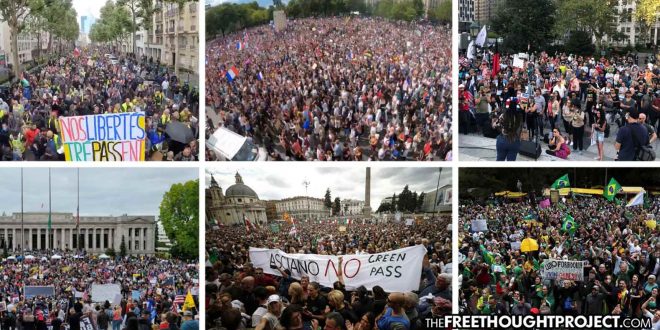
Such is the case recently as millions of people across the world have taken to the streets to protest the draconian laws which segregate society and deprive people of their freedoms over their choice in taking a vaccine they may not even need.

Such is the case recently as millions of people across the world have taken to the streets to protest the draconian laws which segregate society and deprive people of their freedoms over their choice in taking a vaccine they may not even need.

One place, in particular, that is currently seeing massive protests is Italy whose government just passed the strictest vaccine mandate in Europe. Starting on October 15, Italy begins enforcing the new workplace green pass requirement. If employees cannot show proof of vaccination, they will not be allowed to go to work nor will they be able to enter any public places like restaurants, theaters, gyms, etc.

If an Italian citizen misses five days of work by failing to comply with the new mandate, the government forces their employer to stop paying them. If employees are caught working without a green pass, the state will extort them to the tune of $2,100 per instance.

Naturally, moves like this have pissed a lot of people off. It is well known now that the antibodies from the covid vaccines fade over time, which is why Israel is now requiring boosters for all of their citizens. It is also well known that immunity from natural infection is far superior to the vaccine.

A person who had the jab back in January and likely has very few antibodies left is considered “green.” However, at the same time, a person who may have caught covid last month and recovered, thereby drastically reducing their ability to catch and spread the disease, is considered a threat and cannot go to work or public places. There is zero logic in these mandates, which prove one thing — they are about control — not your safety.

This is why people are in the streets across the country and all over Europe and Australia. Civil disobedience is their only option left as they are forced out of their jobs, denied entry into public places, and forbidden from travelling.

As the mainstream media refuses to question the idea behind mandating vaccinations, they have made their role clear in this tyranny as enablers. This should come as no surprise either given the money that pours into their coffers from the ones who stand to gain the most from vaccine mandates — big pharma.

As we are currently witnessing with their silence in regard to vaccine mandate protests, it is no secret that the pharmaceutical industry wields immense control over the government, big tech, and the media. It is their control which keeps this and any other negative press about their products from seeing the light of day. However, most people likely do not know the scope of this control.

As Mike Papantonio, attorney and host of the international television show America’s Lawyer, explains, with the exception of CBS, every major media outlet in the United States shares at least one board member with at least one pharmaceutical company. To put that into perspective: These board members wake up, go to a meeting at Merck or Pfizer, then they have their driver take them over to a meeting with NBC to decide what kind of programming that network is going to air.

We have even reported incidents in which reporters have been cut off by the network for mentioning the connection on air. In a clear example of how beholden mainstream media is to the pharmaceutical industries who manufacture and market these drugs, FOX News’ Sean Hannity was recorded in 2018, blatantly cutting off a reporter who dared mention Nikolas Cruz’s reported association with antidepressants.

In the report below, Papantonio explains how the billions of dollars big pharma gives to mainstream media outlets every year is used to keep them subservient and complicit in covering up the slew of deadly side effects from their products.

As we can see with the current censorship and narrative control in regard to those questioning the safety of the COVID-19 vaccines, big pharma wields massive control over the information you are allowed to talk about and consume. Once we zoom out and see the entire situation, it becomes exceedingly evident as to why Facebook, Twitter, YouTube, and the rest of Big Tech, have made it their mission to wipe out any and all content that questions the “official narrative.”

Glen Ford: A Remarkable Revolutionary

By Danny Haiphong

Source: Black Agenda Report

Glen Ford was a revolutionary in all that he did.

The year was 2011. I was full to the brim with anger toward the United States for the deleterious impact of racism on my life and the lives of those closest to me. I was equally furious with liberal elitism and the class-blind racial politics that privileged “diversity” over the substantive material issues most critical to oppressed people everywhere. I marched with Occupy Wall Street and engaged in the labor movement but still felt alone. I frequently asked myself: “Why are all sides of the so-called American Left unable to fight race and class simultaneously?”

I then came across Glen Ford’s work from a simple online search and recall a similar reaction to that of Ho Chi Minh after he was introduced to Vladimir Lenin’s “Theses on the Colonial Question,”

What emotion, enthusiasm, clear-sightedness and confidence it instilled into me! I was overjoyed to tears. Though sitting alone in my room, I shouted out aloud as if addressing large crowds: “Dear martyrs compatriots! This is what we need, this is the path to our liberation!”

Reading and listening to Glen Ford’s analysis of the Obama administration placed a bright spotlight on a historical moment of intense darkness. At present, there are still too few others who have been able to coherently place the Obama era in its proper context of the U.S.’s ongoing counterinsurgency warfare against Black liberation and self-determination. While much of the American left equated the rise of Obama with “progress,” Glen Ford repeatedly warned us that the Obama administration rendered U.S. imperialism and white supremacy a more effective, and therefore more dangerous, evil.

That’s what revolutionaries do. They warn us through careful explanation and analysis of how oppressive systems work. They prepare us to make history through revolution; to replace the old decrepit order with a new one. But revolutionaries do not just champion any social order. Glen Ford was quite clear that any social transformation of the United States must satisfy the needs of humanity, especially the most terrorized and exploited among us. Socialism and self-determination were not antithetical principles but rather interconnected aims wholly consistent with the struggle for Black liberation.  

Glen Ford’s work convinced me in rapid fashion of the necessity of Black revolutionary leadership in the long struggle to build a socialist project in the United States. His grasp of theory and history was matched by few others. His talent behind the microphone and written word brought his analysis to life. From 2011 to 2013, I followed Black Agenda Report regularly and held it to the sky as a necessary source for anyone claiming interest in “social justice.” Glen Ford’s work on the U.S. war against the African country of Libya, an invasion led by the first Black President of the United States, laid the foundations for my own anti-imperialist approach to both activism and journalism.

In 2013, I took a leap and submitted my first article to Glen Ford analyzing Barack Obama’s presidency as a corporate brand. My writing was raw. I was schooled poorly in grammar and had only begun reading regularly over the last year. Clarity was not yet a strength that I possessed. Not to worry. Glen’s brief responses to my submissions over the next several months provided a basic education into concise analytical writing, and I owe much of my development as both a writer and political analyst to him.

From 2014 to 2016, I met Glen Ford in the flesh only in brief encounters at The Left Forum. In 2017, I moved to New York City. Glen and I would eventually convene at Molly Wee’s in Manhattan on a periodic basis and speak for hours about the political situation in the U.S. and abroad. Glen Ford was a communist who shared his experiences in the Black Panther Party and the Communist Party without hesitation to trusted comrades. He loved to tell a good story.

But it wasn’t just for the fun of it. Glen had expectations. He didn’t need to say it bluntly for me to know that he hoped his stories would be incorporated in my own work in service of the people. Everything with Glen was for the people. This didn’t mean he didn’t enjoy a good time, however. A good time for Glen Ford was defined both by the company he kept and his passion for analyzing the world and those struggling for power within it. A drink didn’t hurt, either.

Glen Ford always addressed me as a fellow revolutionary, a comrade. This was one of the greatest personal gifts that I have ever received. In the beginning of our relationship, I was intimidated. I was aware from his bio in Black Agenda Report and his personal stories just how significant he was as a pioneer in Black journalism. Glen had once held deep relationships with not only James Brown but also political officials such as the late John Conyers. He could have become a Black media mogul and raked in millions through loyalty to the powerful.

Instead, Glen Ford died a revolutionary mentoring people like myself in the theory and practice of revolutionary struggle. Instead of lucrative gigs, Glen was creating a new language for oppressed people to understand and change the world. We can attribute to him the term “Black misleadership class” to describe Black leaders such as Al Sharpton who have gained comfortable careers from service to the white capitalist class. In 2015, Glen Ford led the way in principled critiques of the Black Lives Matter Network’s (BLM) relationship with the Democratic Party. He took great pride in knowing Black Agenda Report played a large part in BLM’s refusal to endorse the DNC in the 2016 election.

On numerous occasions, Glen Ford advised me on how to navigate difficult political problems. There were some on the so-called “Left” who took issue with my contribution to Black Agenda Report and my criticisms of the Black Lives Matter Network. Glen Ford smiled when I brought the issue to him. His advice? Tell the naysayers that the best of the Black liberation movement has always been inclusive to the interests and movements of all oppressed people. And he was clear with me, and to anyone who questioned, that Black Agenda Report would remain firmly under radical Black leadership no matter who contributed.

Glen Ford was a remarkable revolutionary who encouraged others to develop and hone their skills for the movement. His commitment to the Black Radical Tradition’s anti-imperialist and socialist politics blazed a path forward in a historical period of intense reaction and crisis. Roberto Sirvent and I did not have to think twice about asking Glen Ford to contribute the afterword to our book on American exceptionalism. Glen’s influence, especially his cutting style and fearless takedowns of the American empire, was so influential to the project that it was only natural for him to have the last word.

We must continue to keep Glen’s spirit and work alive. We must apply all of his lessons about elite chicanery, imperialism, and the dangers of the Democratic Party to our efforts to develop revolutionary leadership in the citadel of oppression. We cannot thank Glen Ford enough for all of the sacrifices he made for the cause of liberation. His work lives on not only in Black Agenda Report, but also in political organizations such as The Black Alliance for Peace, the Black is Back Coalition, and the United National Anti-War Coalition (UNAC) to name just a few.

Personally, I am one of the luckiest humans on this earth for the opportunity to learn from his contributions up close and personal. His mentorship was, and will always be, invaluable. In truth, however, anyone who followed or knew Glen Ford was mentored by him. He is one of the few among us who lived by Amilcar Cabral’s iconic words,

“Tell no lies, claim no easy victories!”

Rise in Power, Glen Ford!

Stand Up to Tyranny: How to Respond to the Evils of Our Age

By John W. Whitehead & Nisha Whitehead

Source: The Rutherford Institute

“The church must be reminded that it is not the master or the servant of the state, but rather the conscience of the state. It must be the guide and the critic of the state, and never its tool. If the church does not recapture its prophetic zeal, it will become an irrelevant social club without moral or spiritual authority.”—Martin Luther King Jr. (A Knock at Midnight, June 11, 1967)

In every age, we find ourselves wrestling with the question of how Jesus Christ—the itinerant preacher and revolutionary activist who died challenging the police state of his time, namely, the Roman Empire—would respond to the moral questions of our day.

For instance, would Jesus advocate, as so many evangelical Christian leaders have done in recent years, for congregants to “submit to your leaders and those in authority,” which in the American police state translates to complying, conforming, submitting, obeying orders, deferring to authority and generally doing whatever a government official tells you to do?

What would Jesus do? 

Study the life and teachings of Jesus, and you may be surprised at how relevant he is to our modern age.

A radical nonconformist who challenged authority at every turn, Jesus spent his adult life speaking truth to power, challenging the status quo of his day, pushing back against the abuses of the Roman Empire, and providing a blueprint for standing up to tyranny that would be followed by those, religious and otherwise, who came after him.

Those living through this present age of government lockdowns, immunity passports, militarized police, SWAT team raids, police shootings of unarmed citizens, roadside strip searches, invasive surveillance and the like might feel as if these events are unprecedented. However, the characteristics of a police state and its reasons for being are no different today than they were in Jesus’ lifetime: control, power and money.

Much like the American Empire today, the Roman Empire of Jesus’ day was characterized by secrecy, surveillance, a widespread police presence, a citizenry treated like suspects with little recourse against the police state, perpetual wars, a military empire, martial law, and political retribution against those who dared to challenge the power of the state.

A police state extends far beyond the actions of law enforcement.  In fact, a police state “is characterized by bureaucracy, secrecy, perpetual wars, a nation of suspects, militarization, surveillance, widespread police presence, and a citizenry with little recourse against police actions.”

Indeed, the police state in which Jesus lived (and died) and its striking similarities to modern-day America are beyond troubling.

Secrecy, surveillance and rule by the elite. As the chasm between the wealthy and poor grew wider in the Roman Empire, the ruling class and the wealthy class became synonymous, while the lower classes, increasingly deprived of their political freedoms, grew disinterested in the government and easily distracted by “bread and circuses.” Much like America today, with its lack of government transparency, overt domestic surveillance, and rule by the rich, the inner workings of the Roman Empire were shrouded in secrecy, while its leaders were constantly on the watch for any potential threats to its power. The resulting state-wide surveillance was primarily carried out by the military, which acted as investigators, enforcers, torturers, policemen, executioners and jailers. Today that role is fulfilled by the NSA, the FBI, the Department of Homeland Security and the increasingly militarized police forces across the country.

Widespread police presence. The Roman Empire used its military forces to maintain the “peace,” thereby establishing a police state that reached into all aspects of a citizen’s life. In this way, these military officers, used to address a broad range of routine problems and conflicts, enforced the will of the state. Today SWAT teams, comprised of local police and federal agents, are employed to carry out routine search warrants for minor crimes such as marijuana possession and credit card fraud.

Citizenry with little recourse against the police state. As the Roman Empire expanded, personal freedom and independence nearly vanished, as did any real sense of local governance and national consciousness. Similarly, in America today, citizens largely feel powerless, voiceless and unrepresented in the face of a power-hungry federal government. As states and localities are brought under direct control by federal agencies and regulations, a sense of learned helplessness grips the nation.

Perpetual wars and a military empire. Much like America today with its practice of policing the world, war and an over-arching militarist ethos provided the framework for the Roman Empire, which extended from the Italian peninsula to all over Southern, Western, and Eastern Europe, extending into North Africa and Western Asia as well. In addition to significant foreign threats, wars were waged against inchoate, unstructured and socially inferior foes.

Martial law. Eventually, Rome established a permanent military dictatorship that left the citizens at the mercy of an unreachable and oppressive totalitarian regime. In the absence of resources to establish civic police forces, the Romans relied increasingly on the military to intervene in all matters of conflict or upheaval in provinces, from small-scale scuffles to large-scale revolts. Not unlike police forces today, with their martial law training drills on American soil, militarized weapons and “shoot first, ask questions later” mindset, the Roman soldier had “the exercise of lethal force at his fingertips” with the potential of wreaking havoc on normal citizens’ lives.

A nation of suspects. Just as the American Empire looks upon its citizens as suspects to be tracked, surveilled and controlled, the Roman Empire looked upon all potential insubordinates, from the common thief to a full-fledged insurrectionist, as threats to its power. The insurrectionist was seen as directly challenging the Emperor.  A “bandit,” or revolutionist, was seen as capable of overturning the empire, was always considered guilty and deserving of the most savage penalties, including capital punishment. Bandits were usually punished publicly and cruelly as a means of deterring others from challenging the power of the state.  Jesus’ execution was one such public punishment.

Acts of civil disobedience by insurrectionists. Starting with his act of civil disobedience at the Jewish temple, the site of the administrative headquarters of the Sanhedrin, the supreme Jewish council, Jesus branded himself a political revolutionary. When Jesus “with the help of his disciples, blocks the entrance to the courtyard” and forbids “anyone carrying goods for sale or trade from entering the Temple,” he committed a blatantly criminal and seditious act, an act “that undoubtedly precipitated his arrest and execution.” Because the commercial events were sponsored by the religious hierarchy, which in turn was operated by consent of the Roman government, Jesus’ attack on the money chargers and traders can be seen as an attack on Rome itself, an unmistakable declaration of political and social independence from the Roman oppression.

Military-style arrests in the dead of night. Jesus’ arrest account testifies to the fact that the Romans perceived Him as a revolutionary. Eerily similar to today’s SWAT team raids, Jesus was arrested in the middle of the night, in secret, by a large, heavily armed fleet of soldiers.  Rather than merely asking for Jesus when they came to arrest him, his pursuers collaborated beforehand with Judas. Acting as a government informant, Judas concocted a kiss as a secret identification marker, hinting that a level of deception and trickery must be used to obtain this seemingly “dangerous revolutionist’s” cooperation. 

Torture and capital punishment. In Jesus’ day, religious preachers, self-proclaimed prophets and nonviolent protesters were not summarily arrested and executed. Indeed, the high priests and Roman governors normally allowed a protest, particularly a small-scale one, to run its course. However, government authorities were quick to dispose of leaders and movements that appeared to threaten the Roman Empire. The charges leveled against Jesus—that he was a threat to the stability of the nation, opposed paying Roman taxes and claimed to be the rightful King—were purely political, not religious. To the Romans, any one of these charges was enough to merit death by crucifixion, which was usually reserved for slaves, non-Romans, radicals, revolutionaries and the worst criminals.

Jesus was presented to Pontius Pilate “as a disturber of the political peace,” a leader of a rebellion, a political threat, and most gravely—a claimant to kingship, a “king of the revolutionary type.” After Jesus is formally condemned by Pilate, he is sentenced to death by crucifixion, “the Roman means of executing criminals convicted of high treason.”  The purpose of crucifixion was not so much to kill the criminal, as it was an immensely public statement intended to visually warn all those who would challenge the power of the Roman Empire. Hence, it was reserved solely for the most extreme political crimes: treason, rebellion, sedition, and banditry. After being ruthlessly whipped and mocked, Jesus was nailed to a cross.

As Professor Mark Lewis Taylor observed:

The cross within Roman politics and culture was a marker of shame, of being a criminal. If you were put to the cross, you were marked as shameful, as criminal, but especially as subversive. And there were thousands of people put to the cross. The cross was actually positioned at many crossroads, and, as New Testament scholar Paula Fredricksen has reminded us, it served as kind of a public service announcement that said, “Act like this person did, and this is how you will end up.”

Jesus—the revolutionary, the political dissident, and the nonviolent activist—lived and died in a police state. Any reflection on Jesus’ life and death within a police state must take into account several factors: Jesus spoke out strongly against such things as empires, controlling people, state violence and power politics. Jesus challenged the political and religious belief systems of his day. And worldly powers feared Jesus, not because he challenged them for control of thrones or government but because he undercut their claims of supremacy, and he dared to speak truth to power in a time when doing so could—and often did—cost a person his life.

Unfortunately, the radical Jesus, the political dissident who took aim at injustice and oppression, has been largely forgotten today, replaced by a congenial, smiling Jesus trotted out for religious holidays but otherwise rendered mute when it comes to matters of war, power and politics.

Yet for those who truly study the life and teachings of Jesus, the resounding theme is one of outright resistance to war, materialism and empire.

Ultimately, as I point out in my book Battlefield America: The War on the American People, this is the contradiction that must be resolved if the radical Jesus—the one who stood up to the Roman Empire and was crucified as a warning to others not to challenge the powers-that-be—is to be an example for our modern age.

After all, there is so much suffering and injustice in the world, and so much good that can be done by those who truly aspire to follow Jesus Christ’s example.

We must decide whether we will follow the path of least resistance—willing to turn a blind eye to what Martin Luther King Jr. referred to as the “evils of segregation and the crippling effects of discrimination, to the moral degeneracy of religious bigotry and the corroding effects of narrow sectarianism, to economic conditions that deprive men of work and food, and to the insanities of militarism and the self-defeating effects of physical violence”—or whether we will be transformed nonconformists “dedicated to justice, peace, and brotherhood.”

As King explained in a powerful sermon delivered in 1954, “This command not to conform comes … [from] Jesus Christ, the world’s most dedicated nonconformist, whose ethical nonconformity still challenges the conscience of mankind.”

Furthermore:

We need to recapture the gospel glow of the early Christians, who were nonconformists in the truest sense of the word and refused to shape their witness according to the mundane patterns of the world.  Willingly they sacrificed fame, fortune, and life itself in behalf of a cause they knew to be right.  Quantitatively small, they were qualitatively giants.  Their powerful gospel put an end to such barbaric evils as infanticide and bloody gladiatorial contests.  Finally, they captured the Roman Empire for Jesus Christ… The hope of a secure and livable world lies with disciplined nonconformists, who are dedicated to justice, peace, and brotherhood.  The trailblazers in human, academic, scientific, and religious freedom have always been nonconformists.  In any cause that concerns the progress of mankind, put your faith in the nonconformist!

…Honesty impels me to admit that transformed nonconformity, which is always costly and never altogether comfortable, may mean walking through the valley of the shadow of suffering, losing a job, or having a six-year-old daughter ask, “Daddy, why do you have to go to jail so much?”  But we are gravely mistaken to think that Christianity protects us from the pain and agony of mortal existence.  Christianity has always insisted that the cross we bear precedes the crown we wear.  To be a Christian, one must take up his cross, with all of its difficulties and agonizing and tragedy-packed content, and carry it until that very cross leaves its marks upon us and redeems us to that more excellent way that comes only through suffering.

In these days of worldwide confusion, there is a dire need for men and women who will courageously do battle for truth.  We must make a choice. Will we continue to march to the drumbeat of conformity and respectability, or will we, listening to the beat of a more distant drum, move to its echoing sounds?  Will we march only to the music of time, or will we, risking criticism and abuse, march to the soul saving music of eternity?

The Government’s War on Free Speech: Protest Laws Undermine the First Amendment

By John W. Whitehead & Nisha Whitehead

Source: The Rutherford Institute

“If freedom of speech is taken away, then dumb and silent we may be led, like sheep to the slaughter.”— George Washington

It’s a given that the government is corrupt, unaccountable, and has exceeded its authority.

So what can we do about it?

The first remedy involves speech (protest, assembly, speech, prayer, and publicity), and lots of it, in order to speak truth to power.

The First Amendment, which is the cornerstone of the Bill of Rights, affirms the right of “we the people” to pray freely about our grievances regarding the government. We can gather together peacefully to protest those grievances. We can publicize those grievances. And we can express our displeasure (peacefully) in word and deed.

Unfortunately, tyrants don’t like people who speak truth to power.

The American Police State has shown itself to be particularly intolerant of free speech activities that challenge its authority, stand up to its power grabs, and force it to operate according to the rules of the Constitution.

Cue the rise of protest laws, the police state’s go-to methods for muzzling discontent.

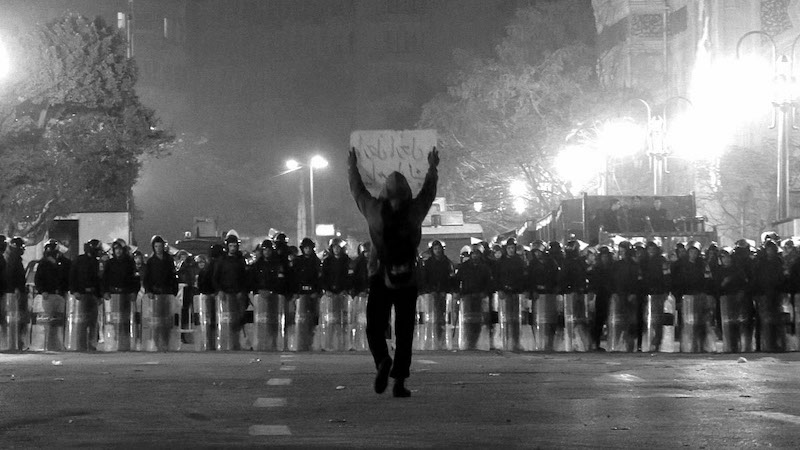
These protest laws, some of which appear to encourage violence against peaceful protesters by providing immunity to individuals who drive their car into protesters impeding traffic and use preemptive deadly force against protesters who might be involved in a riot, take intolerance for speech with which one might disagree to a whole new level.

Ever since the Capitol protests on Jan. 6, 2021, state legislatures have introduced a broad array of these laws aimed at criminalizing protest activities. Yet while the growing numbers of protest laws cropping up across the country are being marketed as necessary to protect private property, public roads or national security, they are a wolf in sheep’s clothing, a thinly disguised plot to discourage anyone from challenging government authority at the expense of our First Amendment rights.

It doesn’t matter what the source of that discontent might be (police brutality, election outcomes, COVID-19 mandates, the environment, etc.): protest laws, free speech zones, bubble zones, trespass zones, anti-bullying legislation, zero tolerance policies, hate crime laws, etc., aim to muzzle every last one of us.

However, as Human Rights Watch points out, these assaults on free speech are nothing new. “Various states have long-tried to curtail the right to protest. They do so by legislating wide definitions of what constitutes an ‘unlawful assembly’ or a ‘riot’ as well as increasing punishments. They also allow police to use catch-all public offenses, such as trespassing, obstructing traffic, or disrupting the peace, as a pretext for ordering dispersals, using force, and making arrests. Finally, they make it easier for corporations and others to bring lawsuits against protest organizers.

Make no mistake: while many of these laws claim to be in the interest of “public safety and limiting economic damage,” these legislative attempts to redefine and criminalize speech are a backdoor attempt to rewrite the Constitution and render the First Amendment’s robust safeguards null and void.

For instance, there are at least 205 proposed laws being considered in 45 states that would curtail the right to peacefully assemble and protest by expanding the definition of rioting, heightening penalties for existing offenses, or creating new crimes associated with assembly.

No matter how you package these laws, no matter how well-meaning they may sound, no matter how much you may disagree with the protesters or sympathize with the objects of the protest, these proposed laws are aimed at one thing only: discouraging dissent.

In Alabama, lawmakers are pushing to allow individuals to use deadly force near a riot. Kentucky, Missouri and New Hampshire are also considering similar stand your ground laws to justify the use of lethal force in relation to riots.

In Arizona, legislators want to classify protests involving seven or more people as felonies punishable by up to two years in jail. Under such a law, traditional, nonviolent forms of civil disobedience—sit-ins, boycotts and marches—would be illegal.

In Arkansas, peaceful protesters who engage in civil disobedience by occupying any government property after being told to leave could face six months in jail and a $1000 fine.

In Minnesota, where activists continue to protest the death of George Floyd, who was killed after police knelt on his neck for eight minutes, individuals who are found guilty of any kind of offense in connection with a peaceful protest could be denied a range of benefits, including food assistance, education loans and grants, and unemployment assistance.

Oregon lawmakers wanted to “require public community colleges and universities to expel any student convicted of participating in a violent riot.” In Illinois, students who twice infringe the rights of others to engage in expressive activities could be suspended for at least a year.

Proposed laws in at least 25 states, including Oklahoma, Mississippi, and Florida, would give drivers the green light to “accidentally” run over protesters who are preventing them from fleeing a riot. Washington wants to levy steeper penalties against protesters who “swarm” a vehicle, punishing them for a repeat offense with up to 40 years in prison and a $100,000 fine.

Responding to protests over the Keystone Pipeline, South Dakota enabled its governor and sheriffs to prohibit gatherings of 20 or more people on public land if the gathering might damage the land. At least 15 other states have also adopted or are considering legislation that would levy harsher penalties for environmental protests near oil and gas pipelines.

In Iowa, all it takes is for one person in a group of three of more people to use force or cause property damage, and the whole group can be punished with up to 5 years in prison and a $7,500 fine.

Obstruct access to critical infrastructure in Mississippi and you could be facing a $10,000 fine and a seven-year prison sentence.

North Carolina law would have made it a crime to heckle state officials. Under this law, shouting at a former governor would constitute a crime.

In Connecticut, you could be sentenced to five years behind bars and a $5,000 fine for disrupting the state legislature by making noise or using disturbing language.

Indiana lawmakers wanted to authorize police to use “any means necessary” to breakup mass gatherings that block traffic. Lawmakers have since focused their efforts on expanding the definition of a “riot” and punishing anyone who wears a mask to a peaceful protest, even a medical mask, with 2.5 years in prison and a $10,000 fine.

Georgia wants to ban all spontaneous, First Amendment-protected assemblies and deny anyone convicted of violating the ban from receiving state or local employment benefits.

Virginia wants to subject protesters who engage in an “unlawful assembly” after “having been lawfully warned to disperse” with up to a year of jail time and a fine of up to $2,500.

Missouri made it illegal for public employees to take part in strikes and picketing, only to have the law ruled unconstitutional in its entirety.

Oklahoma created a sliding scale for protesters whose actions impact or impede critical infrastructure (including a telephone pole). The penalties range from $1,000 and six months in a county jail to $100,000 and up to 10 years in prison. And if you’re part of an organization, that fine goes as high as $1,000,000.

Talk about intimidation tactics.

Ask yourself: if there are already laws on the books in all of the states that address criminal or illegal behavior such as blocking public roadways, trespassing on private property or vandalizing property—because such laws are already on the books—then why does the government need to pass laws criminalizing activities that are already outlawed?

What’s really going on here?

No matter what the politicians might say, the government doesn’t care about our rights, our welfare or our safety.

Every despotic measure used to control us and make us cower and comply with the government’s dictates has been packaged as being for our benefit, while in truth benefiting only those who stand to profit, financially or otherwise, from the government’s transformation of the citizenry into a criminal class.

In this way, the government conspires to corrode our core freedoms purportedly for our own good but really for its own benefit.

Remember, the USA Patriot Act didn’t make us safer. It simply turned American citizens into suspects and, in the process, gave rise to an entire industry—private and governmental—whose profit depends on its ability to undermine our Fourth Amendment rights.

In much the same way that the Patriot Act was used as a front to advance the surveillance state, allowing the government to establish a far-reaching domestic spying program that turned every American citizen into a criminal suspect, the government’s anti-extremism program criminalizes otherwise lawful, nonviolent activities such as peaceful protesting.

Clearly, freedom no longer means what it once did.

This holds true whether you’re talking about the right to criticize the government in word or deed, the right to be free from government surveillance, the right to not have your person or your property subjected to warrantless searches by government agents, the right to due process, the right to be safe from soldiers invading your home, the right to be innocent until proven guilty and every other right that once reinforced the founders’ belief that this would be “a government of the people, by the people and for the people.”

Not only do we no longer have dominion over our bodies, our families, our property and our lives, but the government continues to chip away at what few rights we still have to speak freely and think for ourselves.

Yet the unspoken freedom enshrined in the First Amendment is the right to think freely and openly debate issues without being muzzled or treated like a criminal.

In other words, if we no longer have the right to voice concerns about COVID-19 mandates, if we no longer have the right to tell a Census Worker to get off our property, if we no longer have the right to tell a police officer to get a search warrant before they dare to walk through our door, if we no longer have the right to stand in front of the Supreme Court wearing a protest sign or approach an elected representative to share our views, if we no longer have the right to protest unjust laws or government policies by voicing our opinions in public or on social media or before a legislative body—no matter how politically incorrect or socially unacceptable those views might be—then we do not have free speech.

What we have instead is regulated, controlled speech, and that’s what those who founded America called tyranny.

On paper, we may be technically free.

In reality, however, we are only as free as a government official may allow.

As the great George Carlin rightly observed: “Rights aren’t rights if someone can take them away. They’re privileges. That’s all we’ve ever had in this country, is a bill of temporary privileges. And if you read the news even badly, you know that every year the list gets shorter and shorter. Sooner or later, the people in this country are gonna realize the government … doesn’t care about you, or your children, or your rights, or your welfare or your safety… It’s interested in its own power. That’s the only thing. Keeping it and expanding it wherever possible.”

In other words, we only think we live in a constitutional republic, governed by just laws created for our benefit.

As I make clear in my book Battlefield America: The War on the American People, we live in a dictatorship disguised as a democracy where all that we own, all that we earn, all that we say and do—our very lives—depends on the benevolence of government agents and corporate shareholders for whom profit and power will always trump principle. And now the government is litigating and legislating its way into a new framework where the dictates of petty bureaucrats carry greater weight than the inalienable rights of the citizenry.

Remember: if the government can control speech, it can control thought and, in turn, it can control the minds of the citizenry.

Lee Camp: It’s Time for Major Wealth Redistribution — Yes, I Mean It.

No need to be all apologetic about it, either, since we would just be reclaiming the trillions taken by the billionaires.

By Lee Camp

Source: ScheerPost.org

It’s time for wealth redistribution. There, I said it.

I know it’s the third rail of politics, but I’m not running for a damn thing, which makes me free to speak the truth. (Well, I am running for president of my neighborhood elementary school’s PTA, but I’m pretty sure I’ll win easily since my campaign slogan is “Extend the school day to 20 hours because we don’t want to deal with those little monsters. You take ‘em!” . . . Well, I’ll win as long as they don’t find out I don’t have a child.)

Anyway, we desperately need wealth redistribution. And before anyone starts yelling something about Joseph Stalin, here’s the part that’s going to blow your mind — in the United States we’ve already had wealth redistribution for decades.

Fifty trillion dollars has been redistributed from the poorest Americans to the top one percent over the past several decades. That’s right, a new study shows the richest people in the world have stolen trillions from average Americans. To put this in easier to access terms — you know how mad you get when someone takes the last donut? Well, imagine that multiplied by 50 trillion. (Quick reminder: If you make $40,000 a year, it would take you 1.25 Billion years to make $50 trillion.)

The new study reveals, “…that the cumulative tab for our four-decade-long experiment in radical inequality has grown to over $47 trillion from 1975 through 2018. At a recent pace of about $2.5 trillion a year, that number we estimate crossed the $50 trillion mark by early 2020.”

And to be clear, this money has been stolen from nearly every American. Had income distribution and buying power remained the same as it was from the end of World War II to 1975, ” . . . the aggregate annual income of Americans earning below the 90th percentile would have been $2.5 trillion higher in the year 2018 alone. That is … enough to pay every single working American in the bottom nine deciles an additional $1,144 a month. Every month. Every single year.”

The richest people in America are pilfering over $1,100 from you personally and everyone you know every single month of every single year. Just imagine what each living soul in America could do with an extra $13,700 per year — how many people that would feed, how much less stressful their lives would be, how many fewer foreclosures there would be, and how many more people would get the healthcare they need. Yet every time the most modest tax increases are proposed on the richest Americans, or every time someone so much as mumbles about putting in a public jungle gym or putting in filters to take the metal chunks out of the water or fixing the holes in our bridges that are bigger than the ones in Maria Bartiromo’s head — every time someone brings up these common sense solutions, the elites of our society (who own the media outlets and the levers of the state and the law enforcement and the courts) start screaming from their wine-soaked ski resort orgy balconies, “That’s wealth redistribution! That’s class war!”

Meanwhile, most so-called “progressives” tip-toe around this subject, saying things like, “Well, we just want to slightly increase the taxes on the giant swimming pools filled with money of the wealthiest people. It would only impact people with billions of dollars, which is only a few individuals. We’re sorry. We’re so sorry to ask for this, Mr. Boss Man. Please forgive us.”

Enough of the pussy-footing. It’s time to demand true, full-on wealth redistribution. It’s time to say to the billionaires, “We’re taking your shit, and we’re giving it back to the society you stole it from. We’re taking your cars and your marble statues of your own ass and your boats that park inside your other boats and your emerald bathtubs filled with naked man servants and your inbred cross eyed ugly-ass dogs! . . . But you can keep your children. We don’t want those sociopaths in training. But other than that, we’re taking your stuff because this level of inequality is what most rational economists call ‘fucking nuts’.”

I will however give one caveat to make this go smoother. We only take back everything over $10 million. It’s estimated that there are about 1.4 million American households who have over $10 million. So that means what I’m proposing would impact less than one-half of one percent of Americans. The average American has never even met someone with over $10 million unless they shook Jim Carrey’s hand one time on a sidewalk in New York.

So we — the 99 percent — would take everything over $10 million from the people who have over $10 million. And we would give it out with the bottom 50 percent getting the vast majority of it. This means 99.5 percent of Americans would benefit from this redistribution of wealth. So, before you argue against this idea — Remember: you benefit. You would receive money. Because I promise there is no one with over $10 million reading this column right now, unless one banker accidentally clicked on this because it was next to the Wall Street Journal in his Twitter feed.

Do you need more numbers to hammer home the point? The billionaires in this country have increased their wealth by over $1.3 Trillion, an increase of 44 percent, just since the beginning of the pandemic.

One out of every three people in America have had trouble paying their bills during this pandemic.

Nearly 15 million people have lost their healthcare coverage just since the beginning of this pandemic.

And if you are the one person with over $10 million reading this, don’t give me that horse shit about, “I worked for that money. I earned that money.” No, no, no, no, you did not earn over $10 million. I know you didn’t because that’s impossible. It’s madness. It’s Gary Busey inside Charlie Sheen inside Ted Nugent. Taking the laws of physics into account, there is no way you worked a thousand times harder than a janitor or a sanitation worker or a nurse or a busboy or a fluffer or a fluffer’s second assistant fluffer intern. It’s physically impossible that you worked a thousand times harder than every “essential worker.” (Yes, fluffers are essential.)

What you did was merely take advantage of a system that is set up to exploit the vast majority of the society while most people don’t even realize what happened. That’s what you did because you’re a sociopath. Indeed, most of the Americans with over $10 million are sociopaths. They would kick a puppy down a flight of stairs into the teeth of a wool thresher if it meant they could make an extra $1,000. But I will acknowledge that not all of them are sociopaths. Some of them are relatively okay people working inside a breathtakingly corrupt system. So for the ones who are sociopaths, why should we feel bad for taking their wealth — over $10 million — and redistributing it? (They’re sociopaths after all. Lest we forget: they kick puppies.)

And then for the other ones, who are not sociopaths but still have over $10 million, they’re not going suffer because at the end of the day, they still have ten million goddamn dollars! It’s not like they’d suddenly be scraping by, clothing their children with cardboard boxes painted to look like shirts and bow ties.

So the next time someone says to you, “You can’t raise the taxes on the top 1% because that’s class war. It’s redistribution of wealth,” don’t respond the way most squishy liberals respond — “Ummm, ahhh, errr, no, uhhhh, I’m sorry.” Instead respond, “You’re damn right it is! I want redistribution of wealth. I want a nonviolent class war — because it has been done to the rest of us for the past 50 years at least. We have been exploited and abused, beaten down and defeated, kicked and slapped and scratched and drained and sucked dry and extracted and even burgled!” (Oh man, do I hate being burgled.)

Now is our time to fight back against this terrible machine that has allowed this unbelievable level of exploitation. Screw this system that allows some people to have enough money to end world hunger (literally Jeff Bezos could end world hunger many times over) and yet never do it, while other individuals sleep on a bench hoping no one steals their one box of cereal in the night. To put my conclusion into more sophisticated academic language — Fuck that.

This is an abusive relationship, and it’s time to get out.