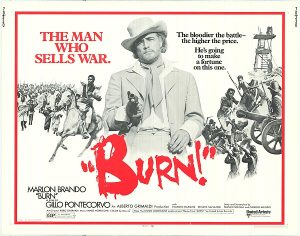
Saturday Matinee: Burn! (aka Queimada)

MPW-51451

“Burn!” (aka Queimada) (1969) is a film directed by Gillo Pontecorvo loosely based on a failed uprising in Guadalupe but also serves as an amalgamation of many incidents throughout the history of western exploitation of the global south. Marlon Brando stars as William Walker, a character named after the American filibuster but is a British agent in the film. He arrives in the fictional island of Queimada to foment a slave revolt against the Portuguese regime in order to install a government controlled by British plantation owners. A decade later, when an uprising occurs against the plantation-controlled regime, Walker is sent back to install an even more corporate-beholden government but things don’t go exactly as planned. Burn! features great performances from Marlon Brando and Evaristo Márquez in his debut role as a revolutionary leader. The film is also notable for its excellent direction by Pentecorvo (who previously directed The Battle of Algiers) and soundtrack by Ennio Morricone (best known for his music for films of Sergio Leone).

Insurrection and Utopia, Part 1: “We are Eating From a Trashcan; This Trashcan is Ideology.”

AsoskW4CMAAPEf9

By Dr. Bones

Source: Gods and Radicals

It all started innocently enough. A friend asked me a question on facebook:

“How can you advocate anarchic revolution when your political vision is so far in the minority?”

The underlying premise was a good one: In a country of 300+ million, how can you call for the upheaval of society, the breaking of societal and political bonds, when so few would readily identify as Anarchists/Socialists/Communists/Leftists/Anti-Capitalists/What-have-you? It’s a question often thrown at the Left and unfortunately many haven’t fully wrapped their heads around it.

In a way it’s a watermark. For an ideology or political vision to go from outright dismissal and laughter to being asked to provide real world examples of what would be done if it came to pass is a sign of growth; it is a signal, an omen, that the winds are beginning to blow in our favor and many want to know what might lie ahead. It’s one thing to talk about “from each according to their ability, to each according to their need” but it’s quite another to discuss how restaurants would be run democratically and without profit or what exactly people might “do” on a day to day level in a classless, stateless society.

Still, the question is not an easy one. We could argue that it is the one question that has always plagued and nagged the Left: “Well that’s all good and well, but how do you plan to achieve this? How does such a world become born?” Staunch Marxists rely on a religious belief in the inevitable procession of history, Syndicalists will rail about the need for increased unionization, firebrand Neo-Bolsheviks plot to simply take power and liquidate class enemies, while the newly minted faux-left “Democratic Socialists” will hem-and-haw about passing enough laws to magically change the balance of power.

All of these options present difficult problems. History has been shown to be anything but inevitable (every year since 1914 has been “Late Capitalism”), a worker-owned McDonalds is still a site of exploitation, nobody ever bothers to explain just where all these people ready to kill for the Revolution are to come from, and the ludicrous doctrine of the Sandernistas that the wealthy and powerful will simply submit to higher taxes and the rule of law is so preposterous it’s only response should be derisive laughter.

So, where are we? Where do we go from here? How are we to change the world?

I start first with a question: Whose world?

You Can’t Teach an Old Carrion-Eater New Tricks

Society, technology, language, and culture all bear the birth marks and forms of the ideological underpinnings of the system they emerged from. Marx notes:

The ideas of the ruling class are in every epoch the ruling ideas, i.e. the class which is the ruling material force of society, is at the same time its ruling intellectual force. The class which has the means of material production at its disposal, has control at the same time over the means of mental production, so that thereby, generally speaking, the ideas of those who lack the means of mental production are subject to it. The ruling ideas are nothing more than the ideal expression of the dominant material relationships, the dominant material relationships grasped as ideas; hence of the relationships which make the one class the ruling one, therefore, the ideas of its dominance.

The Ruling Class, whether Capitalist or State Socialist, informs and projects its will and vision onto the rest of society by the sheer nature of being the dominant force in that society. Of course we can see this politically, but Marx notes this extends also into ideas, culture, anything that could be identified as a byproduct of human interaction and thinking.

The iron steel resolve and blatant disregard of human life so typical of the fearsome Bolshevik Commissar was not so much traits born as traits cultivated; ideals taken within the individual and digested. These cultivated traits came directly from the ideological call for early revolutionary Bolsheviks to identify themselves as “hards,” to be tough, to be ruthless and uncompromising in their goals; when they took state power it become propagated on a cultural level. This meme, this political trait, spiraled out and became a creature, a position, a symbolic figure to be adored/feared all onto its own. It transcended its existence as a mere “idea” or feeling about how party members should behave.

Uber, the trendy internet-based taxi service, could have just as easily manifested into the world as a collectively owned, worker-managed co-op. The internet platform itself is not that revolutionary, the people and tools to create the business were there all along and yet….it did not. Instead Uber emerged and was formed through an ideological lens that made sense to the Ruling Class and by a CEO who’s practically a poster boy for modern capitalism:

“Let’s consider how Kalanick treated his Uber taxi drivers in New York. When he was trying to convince them to break the law to boost Uber’s footprint in the city, Kalanick offered yellow cab drivers free iPhones and promised to “take care of” any legal problems they encountered with the TLC. A few short months later, when the service was forced to close, those same drivers received a message to come to Uber HQ. Reports the Verge ‘Multiple drivers said Uber called them into headquarters, claiming they needed to come by in order to get paid and would get a cash bonus for showing up. When the cabbies came in, Uber surprised them by asking for the device back, informing them that taxi service was no longer available in New York.’”

This is how Uber is evolving, this is how the entire concept other companies will build off is evolving: through actions committed under the dictate and logic of a particular ideology. Taken as gospel or rejected as too harsh new companies will only differ themselves in shades from this first “business plan” and mold their own social and economic arrangements within this ideological parameter. Even the technologies, once thought to be “pure” of politics develop along political lines.

“In an even stronger sense, many technologies can be said to possess inherent political qualities, whereby a given technical system by itself requires or at least strongly encourages specific patterns of human relationships. Winner (1985, 29–37) suggests that a nuclear weapon by its very existence demands the introduction of a centralized, rigidly hierarchical chain of command to regulate who may come anywhere near it, under what conditions, and for what purposes. It would simply be insane to do otherwise. More mundanely, in the daily infrastructures of our large-scale economies — from railroads and oil refineries to cash crops and microchips — centralization and hierarchical management are vastly more efficient for operation, production, and maintenance. Thus the creation and maintenance of certain social conditions can happen in the technological system’s immediate operating environment as well as in society at large.”

What’s interesting is the feedback loop this creates: technology is warped and shaped by the society(and thus dominant ideology), while at the same time the society becomes molded by the technology.

“As technologies are being built and put into use, significant alterations in patterns of human activity and human institutions are already taking place … the construction of a technical system that involves human beings as operating parts brings a reconstruction of social roles and relationships. Often this is a result of the new system’s own operating requirements: it simply will not work unless human behavior changes to suit its form and process. Hence, the very act of using the kinds of machines, techniques and systems available to us generates patterns of activities and expectations that soon become “second nature.”…

Winner gives several examples of technologies employed with intention to dominate, including post-1848 Parisian thoroughfares built to disable urban guerrillas, pneumatic iron molders introduced to break skilled workers’ unions in Chicago, and a segregationist policy of low highway overpasses in 1950s Long Island, which deliberately made rich, white Jones Beach inaccessible by bus, effectively closing it off to the poor. In all these cases, although the design was politically intentional, we can see that the technical arrangements determine social results in a way that logically and temporally precedes their actual deployment. There are predictable social consequences to deploying a given technology or set of technologies.”

In effect we our trapped in a web: We exist in a world not only molded and shaped by a Hierarchical and Capitalist mentality, but the very tools we use including our social selves maintain and reinforce this artifice. The ideology molds the world which molds the people which molds the technology which molds the world which molds the people, etc, etc, etc. As Slajov Zizek points out even those who wish to rebel against the system seem doomed(as if by design?) to remain within it:

“If, today, one follows a direct call to act, this act will not be performed in an empty space — it will be an act WITHIN the hegemonic ideological coordinates: those who ‘really want to do something to help people’ get involved in (undoubtedly honorable) exploits like Medecins sans frontiere, Greenpeace, feminist and anti-racist campaigns, which are all not only tolerated, but even supported by the media, even if they seemingly enter the economic territory (say, denouncing and boycotting companies which do not respect ecological conditions or which use child labor) — they are tolerated and supported as long as they do not get too close to a certain limit. This kind of activity provides the perfect example of interpassivity: of doing things not to achieve something, but to PREVENT from something really happening, really changing.”

Even if State power is seized, if the old masters are cast out, the very throne itself acts like a cursed object and corrupts those that sought to destroy it. People who fought for the worker’s emancipation end up crushing strikes, Greens end up debating just how much depleted uranium to bury underground and how much to fire out of tanks, anti-austerity Leftists end up dispatching riot police to break up protests, the list goes on and on throughout history. The simple truth is you can take the most noble pauper and make him a king, and he may be a great king, but he must still maintain certain conditions(however unjust) by simply being king. The more he becomes attached to this position the more “pragmatism” takes over, excusing acts once thought unthinkable in the name keeping the current conditions going if only to “continue to do good things.” Hugo Chavez and Castro can speak all day of “people’s liberation” but the fact is people aren’t liberated if simply holding a different opinion is so threatening to your revolution they have to be jailed. And thus the throne lives on. While the Kings may change shape or party color the throne of the State and Capital continue to exist, continue to propagate exploitative and domineering cultural memes, social conditions, and technological apparatus.

But there is hope, even on the hinterlands of the oh-so-popular activism of today, in that seemingly bizarre behavior the State displays when people, protests, and organizations are met with overwhelming force.  Why can millions march up and down streets freely “as long as they do not get close to a certain limit” of behavior? What is this Hedge, this boundary we must cross? What is this line so jealously guarded?

Push it to the Limit

Remember the Cuban Missile crises? Where the big bad Soviet Union brought us within an inch to war, ready to point nuclear warheads stationed in Cuba right at us? And how it was only through tough diplomacy and American bravado that we got them to turn around? No? Good, because it didn’t happen like that at all. The Soviets, arming an ally after a recent American-backed invasion, made the deal, not us: Remove the missiles stationed in Turkey(a country that shared a border with the USSR) pointed at Moscow and they would do the same. Kennedy liked the deal and took it. This brought horror to the Military-Industrial establishment; they saw it as backing down to the Soviets. Remember that ideology bit? They didn’t see it as two individuals avoiding nuclear war; their ideological lens would not permit them to. They instead saw it in a hierarchical, dominating dialectic: we had been submissive towards another power. But the Soviets didn’t see it that way, and neither did much of the world, and therein lay the true danger: a new way of thinking, a shift in vision had been displayed and put into practice. And this would not stand.

Others have covered just how against the grain Kennedy went, and how often those who went against him howled for war. I leave the fact that one of those two combatants is dead under your feet for you to play with and ponder. I could mention that right when Nobel Laureate Martin Luther King started talking about “economic justice” and planned on occupying DC until the Vietnam war was ended he too ended up dead. Interestingly enough his family won a wrongful death suit(full court transcripts available) alleging the government killed him. But I’ll instead stick with “accepted” facts like the long history of COINTELPRO, an FBI program specializing in infiltrating, discrediting, and disrupting domestic political organizations. And this wasn’t a kids games either.

“Infiltration: Agents and informers did not merely spy on political activists. Their main purpose was to discredit and disrupt. Their very presence served to undermine trust and scare off potential supporters. The FBI and police exploited this fear to smear genuine activists as agents.

Psychological warfare: The FBI and police used myriad “dirty tricks” to undermine progressive movements. They planted false media stories and published bogus leaflets and other publications in the name of targeted groups. They forged correspondence, sent anonymous letters, and made anonymous telephone calls. They spread misinformation about meetings and events, set up pseudo movement groups run by government agents, and manipulated or strong-armed parents, employers, landlords, school officials and others to cause trouble for activists. They used bad-jacketing to create suspicion about targeted activists, sometimes with lethal consequences.

Legal harassment: The FBI and police abused the legal system to harass dissidents and make them appear to be criminals. Officers of the law gave perjured testimony and presented fabricated evidence as a pretext for false arrests and wrongful imprisonment. They discriminatorily enforced tax laws and other government regulations and used conspicuous surveillance, “investigative” interviews, and grand jury subpoenas in an effort to intimidate activists and silence their supporters.

Illegal force: The FBI conspired with local police departments to threaten dissidents; to conduct illegal break-ins in order to search dissident homes; and to commit vandalism, assaults, beatings and assassinations. The object was to frighten or eliminate dissidents and disrupt their movements….

The FBI also conspired with the police departments of many U.S. cities (San Diego, Los Angeles, San Francisco, Oakland, Philadelphia, Chicago) to encourage repeated raids on Black Panther homes—often with little or no evidence of violations of federal, state, or local laws—which resulted directly in the police killing many members of the Black Panther Party…In order to eliminate black militant leaders whom they considered dangerous, the FBI is believed to have worked with local police departments to target specific individuals, accuse them of crimes they did not commit, suppress exculpatory evidence and falsely incarcerate them.”

Anyone who thinks this has ended is sorely mistaken. Really, really mistaken.

“Participants were tasked to “identify those who were ‘problem-solvers’ and those who were ‘problem-causers,’ and the rest of the population whom would be the target of the information operations to move their Center of Gravity toward that set of viewpoints and values which was the ‘desired end-state’ of the military’s strategy.”

Let me translate that for you: “We are actively studying political movements, identifying people whom might actually change things and are using propaganda techniques to change the conversations they have as well as they views they hold to better suit the military’s domestic strategy.” Let that one sink in.

Truth be told we may never fully know how deep the rabbit hole goes. But there is a unifying factor here: the State clamps down hard whenever the ongoing narrative, the ideology itself is shown not to be the only one. They’re afraid of ideas, because these things are what sparks action. The greatest threat to the system isn’t just learning things aren’t what they appear to be, but beginning to imagine a world where things are different. If something is outside the “parameters of acceptance” for the dominant ideology it presupposes that there are limitations to the system; if there are limitations to the system it can become old, worn out, made useless, and ultimately replaced.

So the Ruling Class will violently defend it’s doctrines at all costs. Can we beat such an invincible enemy, an enemy whose literally shaped us all our lives?  How can we achieve that? Can we ever free ourselves and stop eating out of the trashcan of Capitalist Ideology?

Follow me down a rabbit hole of our own making, lets…article6


Dr. Bones is an 8 year practitioner of the Southern occult tradition known as Conjure, Rootwork, and Hoodoo. A skilled card reader and Spiritworker, Dr. Bones has undertaken all aspects of the work, both benevolent and malefic. Politically he holds the Anarchist line that “Individuality can only flourish where equality of access to the conditions of existence is the social reality. This equality of access is Communism.” He resides in the insane State of Florida with his loving wife, a herd of cats, and a house full of spirits.
He can be reached through facebook and at drbones@gmail.com

There is something extraordinary happening in the world

flux1-660x375

By Gustavo Tanaka

Source: Medium

A few months ago, I freed myself from society, I’ve released myself from attachments I had and fear that locked me to the system. And since then, I started seeing the world from a different perspective. The perspective that everything is changing and most of us have not even realized that.

Why is the world changing? In this post I’ll list the reasons that take me to believe this.

1 — No one can stand the employment model anymore.

Each one is reaching its own limit. People that work in big corporations can’t handle their jobs. The lack of purpose starts to knock the door of each one as a desperate scream coming from the heart.

People want to escape. They want to leave everything behind. Look how many people trying to become entrepreneurs, how many people going on sabbaticals, how many people depressed in their jobs, how many people in burnout.

2- The entrepreneurship model is also changing

A few years ago, with the explosion of the startups, thousands of entrepreneurs, ran to their garages to create their billion dollar ideas. The glory was to get funded by an investor. Investor’s money in hand was just like winning the World Cup.

But what happens after you get funded?

You become an employee again. You have people that are not aligned with your dream, that don’t give a damn to the purpose and everything turns into money. The financial return starts to be the main driver.

Many people are suffering with this. Brilliant startups start to fall because the model of chasing money never ends.

We need a new model of entrepreneurship.

And there is already many good people doing this.

3- The rise of collaboration

Many people have already realized that makes no sense to go alone. Many people awake to this crazy mentality of “going on your own”.

Stop, take a step back and think. Isn’t it an absurd, we, 7 billion people living in the same planet get so separated from each other? What sense does it make, you and the thousands (or millions) of people living in the same city turn your back to each other? Every time I think of that I get kind of depressed.

But fortunately, things are changing. All the movements of sharing and collaborative economy are pointing towards this direction. The rise of collaboration, sharing, helping, giving a hand, getting united.

It is beautiful. It brings tears to my eyes.

4- We are finally starting to understand what the internet is

Internet is an incredibly spectacular thing and only now, after so many years we are understanding it’s power. With internet, the world opens, the barriers fall, separation ends, union starts, collaboration explodes, help emerges.

Some nations made revolution with the internet, such as the Arab Spring. In Brazil we are just starting to use better this magnificent tool.

Internet is taking down mass control. There is no more television, no more few newspapers showing the news they want us to read. You can go after whatever you want, you relate to whoever you want. You can explore whatever you want, whenever you want.

With internet, the small starts to get a voice. The anonymous become known. The world gets united. And the system may fall.

5- The fall of exaggerated consumption

For many years, we have been manipulated, stimulated to consume as maniacs. To buy everything that was launched in the market. To have the newest car, the latest iphone, the best brands, lots of clothes, lots of shoes, lots of lots, lots of everything.

But many people have already understood that it makes no sense at all. Movements such as the lowsumerism, slow life, slow food, start to show us that we have organized ourselves in the most absurd possible way.

Each time less people using cars, less people buying a lot, each time more people trading clothes, donating, buying old things, sharing goods, sharing cars, apartments, offices.

We need nothing of what they told us we needed.

And this consciousness can break any corporation that depends on exaggerated consumption.

6- Healthy and organic eating

We were so crazy that we accepted eating any kind of garbage. It only needed to taste good, that was ok.

We were so disconnected, that the guys started to add poison in our food and we didn’t say anything.

But then some guys started to wake up and give strength to movements of healthy eating and organic consumption.

And this is going to be huge.

But what does it have to do with economy and work? Everything!

The production of food is the basis of our society. Food industry is one of the most important in the world. If consciousness changes, our eating habits also change, and consumption changes, and then the big corporations must follow these changes.

The small farmer is starting to have strength again. Also people who are planting their own food.

And that changes the whole economy.

7 — The awakening of spirituality

How many friends do you have that practice yoga? What about meditation?

How many used to do it 10 years ago?

Spirituality for many years was a thing of the esoteric people. Of those weird people from mysticism.

But fortunately, this is also changing. We got to the limit of our rationality. We could see that only with the rational mind we cannot understand everything that happens here. There is something more happening and I know you want to understand.

You want to understand how things work in here. How life operates, what happens after death, what is this energy thing that people talk so much, what is quantum physics, how can thoughts become things and create our reality, what are coincidences and synchronicities, why meditation works, how is it possible to cure with the hands and what about these alternative therapies that medicine does not approve, but work?

Companies are promoting meditation to their employees. Schools teaching meditation to kids.

8 — Unschooling movements

Who created this teaching model? Who chose the classes you have to take? Who chose the lessons we learn in history classes? Why didn’t they teach us the truth about other ancient civilizations?

Why should the kids obey rules? Why should they watch everything in silence? Why should they wear uniform?

Take a test to prove that you learned?

We created a model that forms followers of the system. That prepare people to be ordinary human beings.

But fortunately there are many people working to change that. Movements like unschooling, hackschooling, homeschooling.

Maybe you have never thought of this and you are chocked with the points I’m listing here.

But all these things are happening.

Silently, people are awakening and realizing how crazy it is to live in this society.

Look at all these movements and try to think everything is normal.

I don’t think it is.

There is something extraordinary happening.

— — — — — — — — — — — — — — — — — — — — — — — — — — — — —

Gustavo Tanaka — Brazilian author and entrepreneur, trying to create with my friends a new model, a new system and maybe helping to create a new economy.

Counterculture: The Rebel Commodity

Screen-Shot-2013-09-23-at-2.48.39-PM

By James Curcio

Source: Rebel News

Let’s talk about being a rebel.

Everyone seems to want to be one. But it’s not entirely clear what it means. Does it take camo- pants? A Che T-shirt? A guitar? Is it just doing the opposite of whatever your parents did? “Be an individual, a rebel, innovate,” so many advertisements whisper. They’d have us believe that True Revolutionaries think different. They use Apple, or drink Coke. We signal our dissent to one another with the music we listen to and the cars we drive.

There’s something very peculiar going on here, something elusive and deeply contentious.

In the 1997 book, Commodify Your Dissent, Thomas Frank laid out a thesis that may appear common sense to those that have watched or lived in the commodified subcultures of the 90s, 00s, and beyond. A New York Times review comments,

… business culture and the counterculture today are essentially one and the same thing. Corporations cleverly employ the slogans and imagery of rebellion to market their products, thereby (a) seizing a language that ever connotes “new” and “different,” two key words in marketing, and (b) coaxing the young effortlessly into the capitalist order, where they will be so content with the stylishly packaged and annually updated goods signifying nonconformity they’ll never so much as consider real dissent — dissent against what Frank sees as the concentrated economic power of the “Culture Trust,” those telecommunications and entertainment giants who, he believes, “fabricate the materials with which the world thinks.” To have suffered the calculated pseudo-transgressions of Madonna or Calvin Klein, to have winced at the Nike commercial in which the Beatles’ “Revolution” serves as a jingle, is to sense Frank is on to something. (After reading Frank, in fact, you’ll have a hard time using words like “revolution” or “rebel” ever again, at least without quotation marks.)

The urge to rebel fuels the same system they ostensibly oppose. Whether it’s in arms trade, or far less ominously, manners of dress and behavior, there are dollars to be made fighting “The Man.” And maybe making money isn’t always an altogether bad thing. But it is certainly a complication, especially for those espousing neo-Marxists ideals.

As Guy Debord observed, “revolutionary theory is now the enemy of all revolutionary ideology and knows it.” Rebel movements are a counterculture, regardless of what they call themselves.

Rebellion is Cool

We’ll begin with a quintessential icon of the branded, shiny counterculture. The Matrix. We’ve probably all seen it. Even as an example it’s a cliché, and that’s part of the point. Here’s a framed sketch of the first movie, for those that haven’t: when it first ran, it was a slick take on the alienation most suburban American youth feel, packaged within the context of the epistemological skepticism Descartes wrestled with in the 17th century. Taken out of the cubicle and into the underworld, we witness the protagonist “keeping it real” by eating mush, donning co-opted fetish fashion, and fighting an army of identical men in business suits in slow motion. The movie superimposes the oligarchic and imperialist powers-that-be atop Neo’s quest of adolescent self-mastery. A successful piece of marketing — you can be sure no one collecting profits or licensing deals let their misgivings about “the Man” keep them from paying the rent.

This is not to point an accusatory finger, but rather to show the essential dependence of the counterculture upon the mainstream, because counter-cultures are not self-sustaining, and every culture produces a counter-culture in its shadow, just as every self produces an other. Any counterculture. Punk, mod, beatnik, romantic, hippy, psychedelic, straight edge, or occult. Even the early adopters of Internet culture started a group of outsiders that shared a collective vision,

The computer enthusiasts who could only dream of an open, global network in 1990 would go on to staff the dot-coms of the next decade. The closed networks that once guarded forbidden knowledge quickly fell by the wayside, and curiosity about computers could no longer be imagined a crime.

Our cyberspace today has its share of problems, but it is no dystopia — and for that, we must acknowledge the key part played by the messy collision of table-top games, computer hacking, law enforcement overreach and cyberpunk science fiction in 1990.

This article explores the strange history of Peter Jackson games, TSR, and the FBI. But it wasn’t the only one. Shadow Run, another popular cyberpunk RPGs of the 1990s, presented one of the more seemingly-improbable of cyberpunk futures, where you could play a freelancing mutant scrambling to survive in an ecosystem of headless corporations connected through cyberspace. Sound familiar? The Matrix just represented the final translation of these and similar fringe narratives into the mainstream.

Future vision has some effect on future reality, both in the identities we imagine for ourselves and the technologies we choose to explore. They almost always have unexpected consequences. Now we carry the networked planet in our palms, granting near instant communication with anyone, anywhere and anytime, and your intended subject isn’t always the only one listening.

We shouldn’t be surprised by this feedback loop. Without laying the material, mythic, and social groundwork for a new society, counterculture cannot be a bridge; it almost invariably leads back to the mainstream, though not necessarily without first making its mark and pushing some new envelope.

This even presents something of a false dichotomy — that old models of business can’t themselves be co-opted by countercultural myths. Yesterday’s counterculture is today’s mainstream. What better way to understand the so-called revolution of iPads or social media?

Our cultural symbols and signifiers are never static. Psychedelic and straight edge can share the same rack in a store if the store owner can co-brand the fashions, and people can brand themselves “green” through their purchasing power without ever leaving those boxes or worrying about the big picture. AdBuster’s Buy Nothing Day still capitalizes on the “rebel dollar.”

Rebellion is cool.  “Cool” is what customers pay a premium for, along with the comfort of a world with easy definitions and pre-packaged cultural rebellions. This process itself isn’t new. The rebel or nonconformist is probably a constitutive feature of the American imagination: original colonies were religious non-conformist, the country was founded by rebellion, the frontier, the civil war, the swinging 20s, Jazz, James Dean, John Wayne, Elvis, the list goes on. The non-conformist imagination is as paradoxically and problematically American as cowboys and indians, apple pie and racism.

The territory between aesthetic, ideals, and social movement is blurry at best. But the most well-known expression of this trend in recent history is the now somewhat idealized 1960s, a clear view of which has been obscured through a haze of pot-smoke and partisan politics. Though this revolution certainly didn’t start in the 1960s, there we have one of the clearest instances of what good bed-fellows mass advertising and manufacturing make when branded under the zeitgeist of the counterculture.

When people bought those hip clothes to make a statement, whose pockets were they lining? It’s a revolving door of product tie-ins, and it all feeds on the needs of the individual, embodied in a sub-culture. The moment that psychedelic culture gained a certain momentum, Madison Avenue chewed it up and spit it back out in 7up ads. That interpretation of what it meant to be a hippie, a revolutionary, became an influence on the next generation. The rise of Rolling Stone magazine could also be seen as an example of this — a counterculture upstart turned mainstream institution.

While advertising and counterculture get along just fine, authenticity and profit often make strange bedfellows. But they aren’t necessarily diametric opposites, either. As movements gain momentum, they present a market, and markets are essentially agnostic when it comes to ideals.

There are many examples of how troubled that relationship can be. The Grunge movement in the 90s, before it was discovered, was just a bunch of poor ass kids playing broken ass instruments in the Pacific Northwest. This was the very reason it struck disenfranchised youth — the relationship between those acts and the aging record industry in many ways seemed to reflect the relationship of adolescent Gen Xers with their Boomer parents. They retained the desire to “drop out,” as Timothy Leary had preached to the previous counterculture generation of Laguna Beach and Haight Ashbury, but without the mystical optimism of “tuning in.” Hunter S Thompson maybe presaged this transition in the quotation from Fear and Loathing In Las Vegas that’s now rendered famous to the kids of 90s thanks to Terry Gilliam’s film adaptation,

We are all wired into a survival trip now. No more of the speed that fueled that 60’s. That was the fatal flaw in Tim Leary’s trip. He crashed around America selling “consciousness expansion” without ever giving a thought to the grim meat-hook realities that were lying in wait for all the people who took him seriously… All those pathetically eager acid freaks who thought they could buy Peace and Understanding for three bucks a hit. But their loss and failure is ours too. What Leary took down with him was the central illusion of a whole life-style that he helped create… a generation of permanent cripples, failed seekers, who never understood the essential old-mystic fallacy of the Acid Culture: the desperate assumption that somebody… or at least some force – is tending the light at the end of the tunnel.

I don’t think it’s a great stretch to imagine the suddenly-famous bands of the Grunge era as a part of this same legacy. Alice In Chains or Nirvana songs about dying drugged out and alone weren’t oracular prophecy, they were journal entry. And it became part of the allure, because it too was “authentic.” The greatest irony of all was that the tragic meltdowns and burn outs that followed on fame’s heels became part of the commodity. (Not that this vulture economy is new to tabloids).

Our narratives about authentic moments of aesthetic expression or innovation often depict them like volcanic eruptions: they build up and acquire force in subterranean and occluded environments, before erupting in a momentary and spectacular public display of creativity. It is telling that this quote from On The Road has become so popular, very likely cited in the papers and journals of more rebellion-minded American teens than any other from that book, “… The only people for me are the mad ones, the ones who are mad to live, mad to talk, mad to be saved, desirous of everything at the same time, the ones who never yawn or say a commonplace thing, but burn, burn, burn like fabulous yellow roman candles exploding like spiders across the stars.”

Hendrix, Joplin, Morrison, Cobain… the 27 Club is big. And quite a few more could be added if it was “the 20-something club.” Are the public self destructions of so many young, creative minds informed by this myth, or do they create it?

Maybe a bit of both. The Spectacle, in the sense Guy Debord uses it, disseminates its sensibilities, styles — a version of the truth. The particular moves ever toward the general, as facts gradually turn to legend and, eventually, myth. Mainstream appropriation is the process in which aesthetic movements affect broader society and culture. The ideals need a pulpit to reach the people, even if invariably it is fitted with guillotines for the early adopters once that message has been heard.

YOUR FATASS DIRTY DOLLAR

A message is a commodity, or it is obscure. Capitalism survives so well, in part, because it adapts to any message. If we instead think counterculture is an ideal that exists somehow apart from plebeian needs like making money, then countercultures will forever hobble itself. It doesn’t matter that these ideologies have little in common. It is the fashion or mystique that gets sold. Anti-corporate ideology sells as well as pro-. When all an ideology really boils down to is an easy to replicate aesthetic, how could they not?

Where do we draw the line between idealism and profit? The question is how individuals utilize or leverage the potential energy represented by that currency, and what ends it is applied to. Hard nosed books on business by the old guard, such as Drucker’s Management: Tasks, Responsibilities, Practices say exactly the same thing, in a less epigrammatic, Yoda-like way: profit is not a motive, it is a means. This much, at least, doesn’t change with the changing of the (sub)cultural tides. Within our present economic paradigm, without profit, nothing happens. Game over.

Those who position themselves as extreme radicals within the counterculture framework just  disenfranchise themselves through an act of inept transference, finding anything with a dollar sign on it questionable. To this view, anyone that’s made a red cent off of their work is somehow morally bankrupt. This mentality generally ends one way: howling after the piece of meat on the end of someone else’s string, working by day for a major corporation, covering their self-loathing at night in tattoos, and body-modifications they can hide. That is, unless they lock themselves in a cave or try to start an agrarian commune. None of this posturing is in any way necessary, since business rhetoric itself has long since co-opted the countercultural message. For instance, this passage from Commodify your Dissent,

Dropping Naked Lunch and picking up Thriving on Chaos, the groundbreaking 1987 management text by Tom Peters, the most popular business writer of the past decade, one finds more philosophical similarities than one would expect from two manifestos of, respectively, dissident culture and business culture. If anything, Peters’ celebration of disorder is, by virtue of its hard statistics, bleaker and more nightmarish than Burroughs’. For this popular lecturer on such once-blithe topics as competitiveness and pop psychology there is nothing, absolutely nothing, that is certain. His world is one in which the corporate wisdom of the past is meaningless, established customs are ridiculous, and “rules” are some sort of curse, a remnant of the foolish fifties that exist to be defied, not obeyed. We live in what Peters calls “A World Turned Upside Down,” in which whirl is king and, in order to survive, businesses must eventually embrace Peters’ universal solution: “Revolution!”

“To meet the demands of the fast-changing competitive scene,” he counsels, “we must simply learn to love change as much as we have hated it in the past.” He advises businessmen to become Robespierres of routine, to demand of their underlings, “‘What have you changed lately?’ ‘How fast are you changing?’ and ‘Are you pursuing bold enough change goals?’” “Revolution,” of course, means for Peters the same thing it did to Burroughs and Ginsberg, Presley and the Stones in their heyday: breaking rules, pissing off the suits, shocking the bean-counters: “Actively and publicly hail defiance of the rules, many of which you doubtless labored mightily to construct in the first place.”

Growth on its own is never a clear indicator that the underlying ideals of a movement will remain preserved. If history has shown anything, it is that successful movements spread until core message becomes an empty, parroted aesthetic, as with most musical scenes and their transition from content to fashion; or that core is otherwise so emphasized that the meaning within is lost through literalism, as we can see in the history of the world’s major religions. One version of early Christian Gnostic history — of “love thy neighbor,” “all is one,” and scurrilous rumors of agape orgies — were replaced by the Roman Orthodoxy and the authority provided through the ultimate union of State and Religion. The hippies traded in their sandals and beat up VWs for SUVs and overpriced Birkenstocks. The relationship between ideology and act is far to complicated to enter into here, but the counter-history of Communism when viewed against the backdrop of Marxist ideals is perhaps equally insightful.

Enantiodromia, the tendency of things to turn into their opposites, is as much social observation as psychological. It oftentimes seems that succeeding too well can be the greatest curse to befall a movement. When the pendulum swings far in one direction, it often turns into its opposite without having the common decency to wait to swing back the other way.

As we’ve seen, this was part of the supposed downfall of counterculture in capitalism: “suits” decided they could deconstruct an organic process and manufacture it. They could own it from the ground up.

But this isn’t necessarily so. The branding of Cirque Du Soleil points toward a third option — arts movements will be dissected in the jargon of marketing, and they must succeed on those grounds to be taken seriously or accomplish anything.

Burning Man isn’t suddenly opening its gates to the wealthy. Yacht Communism has been a part of that movement ever since it gained some mainstream appeal, likely before. Seen as an arts and cultural movement, it has been vastly successful. Seen as an example of how to create a true egalitarian society, it would be an utter failure. But that was never the point.

Two weeks at Burning Man might be fun, even transformative, but spend two years there and you’d find out what hell is like.

Revolution is On Doorstep in the US

poverty_line_america

By Valery Kulikov

President Obama just like any other US politician is particularly keen on criticizing human rights situations in other countries, while glorifying the ideals of “American-style democracy.” Moreover, these topics are not simply the prime topic of his speeches, but the basis for meddling in other countries’ affairs under the guise of “promoting democracy”. To carry out these operations the US has been heavily funding a countless number of NGOs and when those fail to stage a coup d’etat – usually a military intervention follows. This was the case in Iraq, Libya, Afghanistan, Syria and a number of other states.

The true value of money

index

Economics needs a revolution.

By David Orrell

Source: Adbusters

This sentiment has been expressed by people from the physicist turned hedge-fund manager Jean-Philippe Bouchaud (in a 2008 paper), to the Bank of England’s Andrew Haldane (in a 2014 foreword for Manchester’s student-run Post-Crash Economics), to activist groups such as Kick It Over. So what would such a revolution look like?

Perhaps the archetypal model for a scientific revolution is the quantum revolution that shocked the world at the turn of the last century. In the space of a few short years, almost everything that was known about the nature of matter was overturned. The Newtonian view of the world as a predictable machine crumbled with it.

Except, that is, in economics – which continues to base its models on quasi-Newtonian economic laws.

A peculiar feature of orthodox economics is that money is treated as an inert medium of exchange, with no special properties of its own. As a result, money is largely excluded from macroeconomic models, which is one reason the financial crisis of 2007/8 was not predicted (it involved money). In many respects, when viewed through the lens of quantum physics, money behaves a lot like matter – and acknowledging that behavior promises to do to economics what quanta did for physics.

The main insight of quantum physics is that matter is composed of entities which behave in some ways as waves and in other ways as particles. This novel insight countered the Newtonian view that billiard ball-like atoms behaved independently of each other. A beam of light, for example, is an electromagnetic wave but it is also a stream of particles known as photons. At a quantum level, matter is fundamentally dualistic: neither the particle nor the wave description is complete by itself.

The same can be said of money, which turns out to have quantum properties of its own. Money is strange stuff, when you think about it – but because it has been around for millennia we rarely do. Consider for example a U.S. dollar bill. On the one hand it represents a number – in this case the number one. On the other hand it is a physical thing which can be possessed, exchanged and above all valued (even lusted after, if there are enough of them). It therefore lives partly in the abstract world of numbers and mathematics and partly in the real world of things, people and value.

The same is true of any money object that we use for payment. Here “object” could refer either to a physical object – such as a coin – or a virtual object, such as 1.2107 bitcoin (BTC) sent from a phone. What makes such objects special is that they have a fixed, defined value in currency units.

While seeing money objects as things with a fixed monetary value might appear trivial, it turns out to have complex and contradictory properties that feed into the economy as a whole. In particular, they combine two aspects, abstract number and real world value, which are as different as waves and particles.

For example numbers are subject to mathematical laws – such as compound interest – and can grow without limits, while in the real world natural processes tend to be subject to bounds. In 1850 an American lawyer did the math and calculated that five English pennies invested at 5 percent compound interest since 0 AD would have accumulated to 32 billion spheres of pure gold, each equal in size to the Earth. This is a useful exercise for anyone who thinks that gross domestic product (GDP) can grow forever.

Numbers can be negative, as in debts, but (as the English physicist-turned-economist Frederick Soddy pointed out) there is no such thing as a negative number of objects. You might be underwater on your mortgage but you can’t own a negative house. Throughout history the frightening ability of negative debt to grow without bounds has been responsible for forcing people into economic slavery.

Numbers are hard and precise, like the particle aspect of matter. Real-world concepts such as value are diffuse and fuzzy, like the wave aspect of matter. By combining these two aspects in a single package, money objects are our contribution to the quantum universe.

The dualistic nature of money explains its frequently paradoxical behavior. In the early 2000s, cheap credit in the United States meant that even low-income people could afford their own homes. Some cashed in and sold their houses at the top of the market. For them the money was real – they could go to the bank and withdraw dollar bills. But when the credit crunch kicked in most of the new money disappeared into the ether, as if it had never existed. Money seemed to be both real and unreal at the same time – a sensation familiar to anyone who has studied quantum physics.

Just as quantum physics overturned Newtonian physics, so a reexamination of money promises to disrupt economics. The reason that critics are calling for fundamental change is that neoclassical economics has failed to provide answers to problems such as wealth inequality, financial crises and environmental degradation – which is unsurprising if it treats money as nothing more than an inert, Newtonian medium of exchange. The tendency of money to clump and accumulate with a small group of creditors, or for financial markets to be inherently unstable, or for GDP growth to be valued over the environment, becomes clearer when we acknowledge the vital, active role of money and the tension and discrepancy between numbers and the real world that drives it.

Of course, one should not underestimate the resistance of economists to adopting new ideas, however the worldwide student movement calling for change is unlikely to go away. Economics is primed for a quantum revolution of its own.

— David Orrell is a mathematician and author. His latest book, Truth or Beauty: Science and The Quest for Order, explores the role of aesthetics in science. He is currently working on a book about money.

Billionaire Fears The Poor RIsing Up Against The Rich

.

Source: Popular Resistance

A billionaire finally had a epiphany and told all his wealthy friends about it.

Johann Rupert is the filthy rich owner of Richemont, a luxury goods company that serves as parent company to jeweler Cartier. His net worth tops out at nearly $8 billion making him part of the 1% of wealthy people who are greedily taking control of most of the world’s wealth to the detriment of poor people and the middle class.

According to Oxfam, an organization that fights poverty, the richest one percent are on pace to control more global wealth than the rest of the 99 percent combined by 2016. And it doesn’t show any signs of stopping.

Unsurprisingly, most of the billionaires in the world live in the United States, where they hire armies of lobbyists to influence the passage of government policies that help them keep their vast wealth and keep it growing. Meanwhile, other nations, despite having a few billionaires, have more regulations designed to narrow the income inequality gap.

Nevertheless, the system that allows the rich to keep getting richer isn’t doing anything for the rest of humanity as most people around the world continue to struggle to make ends meet. While the wealthy continue to make more money, everyone else is making less, which is starting to cause social unrest and upheaval that worries Johann Rupert.

Rupert now fears that the greed of the 1 percent has gone too far, and the thought that one day the rest of the world will grab their pitchforks and torches makes sleeping more difficult for him.

How is society going to cope with structural unemployment and the envy, hatred and the social warfare? We are destroying the middle classes at this stage and it will affect us. It’s unfair. So that’s what keeps me awake at night.

Rupert revealed his terror at the Financial Times Business of Luxury Summit in Monaco, and frankly, he is right to fear this scenario.

There are 7 billion people in this world and only a few hundred grotesquely wealthy people. As people become more desperate to care for themselves and their struggling families in a world where rich people are making more money they don’t need off the backs of the working poor, it won’t be long before people get so fed up that they literally band together to bring down the greedy assholes who care more about owning the world than they do about everyone who lives in it.

That especially applies here in America as income inequality has cast millions of Americans into a never-ending cycle of poverty that becomes harder to escape year after year while the super-wealthy continually try to roll back policies such as minimum wage laws and other benefits in order to engineer a cheaper workforce through legislation. In other words, wealthy businessmen are treating the rest of the world as nothing more than slave labor put on this Earth to keep themselves rich.

Eventually, people will get sick and tired of the game that rich people are playing. They will rise up like Rupert fears and come for them. And then they will wish they had shared the wealth instead of hoarding it all for themselves.