If you feel like you are unsure of what is real and what is unreal then you are not alone. Our materialistic mode of life is accelerating and expanding so rapidly that it is saturating our modern cultures to the point of abstraction. Life in materially-privileged societies is increasingly shifting into a world of image and show. Many people today are living within their bubbles that are customized by all the digital conveniences tailored to individual needs. By being surrounded by conveniences that satisfy all our needs we are deliberately excluding so much else, including all of life’s serendipities.
Reality – whatever that is or was – has retreated behind a spectacle of make-believe that is playing at being the new, shimmering façade for the 21st century. One result of this is that things which once stood in opposition to one another are losing their meaning and becoming indistinguishable. That is, fixed identities that used to make life easy for us – us/them, friend/enemy, good/bad, and the rest – are now more like false realities. Life has shifted, or has been pushed, into a realm of invention that is being exploited ever more overtly by politicians, mainstream media, and their propaganda machinery. Out of this, a different sense of reality has emerged that succeeds in absorbing differences and contradictions and making them seem smooth rather than jagged. And the result is what I refer to as hyperreality.
The Hyperreality Pill
It is no longer the jagged pill we are forced to swallow, but the smooth pill we are willing to pop. And this smoothness is presented as succulent and easy to swallow. Our modern cultures want us to think that they are simple, smooth, and therefore require our willing obedience. As a consequence, many of us no longer know, or care in knowing, where the resistance is. And if we do feel the need to express resistance, we find ourselves at a loss of where it should be placed. The ‘smooth ideal’ is that society is managed so there can be no efficient resistance against it. This is what Herbert Marcuse once referred to as a ‘comfortable, smooth, reasonable, democratic unfreedom.’ The hyperreal evades any real contact. It is like being at the end of a phone call when waiting for the automated voice service. This evasive strategy of the hyperreal has succeeded in obscuring any site of resistance. It’s all so ‘real,’ and yet of course it is not.
The original notion of hyperreality (a term borrowed from semiotics and postmodern theory) is an inability of consciousness to distinguish reality from a simulation of reality, especially in technologically advanced societies. We are no longer faced with the threat of struggling with our shadows – we are now faced with the threat of our clones. This may be the radical illusion we are slipping into.
Yet the radical illusion of the world has been faced by all cultures. It has been described by mystics, symbolized by art, and struggled over by philosophers. The notion of illusion is not the main issue – rather, it is the medium through which it is conveyed. Or, more importantly, whether it is deliberately exaggerated and amplified. And how, by who – and why? Illusion is now perhaps our greatest industry, especially in western societies. Illusion is the consensus story we are told when growing up and which we all believe in. It’s the story that’s always been told because ‘that’s the way it’s always been.’ No wonder there is so much confusion, which is then fed by another great western industry – therapy.
Hyperreality plays a somewhat different game, with new rules and a different deck of cards. The paradox today is that those of us caught up in the game have no idea what the gameplay is. This is similar to a Jorge Luis Borges short story ‘The Lottery in Babylon’ where all activities in life are governed by the lottery; that is, by chance. And the lottery is run by ‘The Company,’ the rules of which not only are the rules of the game but become the rules of life. If that’s not confusing enough, then we need another hyperreality pill.
Please Sir, Can I Have Some More Hyperreality?
Hyperreality – the inability to distinguish the real from simulation – has become our new reality structure (perception set) and is constructed so that everyone believes in it and goes along with it. There is an underlying feeling that something is not quite right, yet our sense of reality often appears so extreme that it becomes ‘extra-plausible.’ It appears that strange walls of falsehood are being erected between the individual and what is real. The result is a distortion of how we see things. In other words, a perception distortion. To put it simply, hyperreality can be described as the normalization of delusion. When mass society adheres to a collective delusion we call it normal, or ‘reality,’ and if one person strays too far from this consensus thinking then we often label them as delusional, or unstable. It is as if we have been struck by on-coming car headlights and we are like dazed rabbits in the middle of the road. Better not sit around too long wagging our fluffy tails!
The hyperreal smoothes and soothes all contradictions. When once we thought we had ‘left’ politics and ‘right’ politics, these distinctions are now nullified. There is no more any ‘left’ or ‘right,’ only agendas that use varying means to acquire the same power. Any basis of truth has slipped into the sleek substitution – the simulation. Let me ask a question: Do we really think that the face of politics, for example, represents any vestige of truth? There is no more truth in politics than there is in someone wearing a laboratory coat in a television commercial trying to persuade us to buy a particular brand of detergent. There is persuasion and falsity that parades as an element of truth, yet it is a pure simulation. We have slipped into an age where the new ‘reality principle’ tells us that nothing is out of reach and that almost everything can be bought for a price. That is, the real is solid and exists as the flow of goods, services, desires, wants, pleasures, and an almost instant availability.
The question now is how far can the world go before yielding to a permanent state of hyperreality? Perhaps we are already in this state right now; after all, the hyperreal is contagious, like a chain reaction. In the hyperreal world the space of communications is condensed into the simultaneous now; marginal spaces on the periphery are now the hidden spaces where secrecy flows in offshore networks. Our networks of mobility and movement are fragmented into those that privilege some and exclude the many. Even the space above our heads is colonized by the satellites that spy on us. We have street views being watched and analyzed by Google. Our movement, speech, and text being spied on, processed, and interpreted by intelligent algorithms. We have injected a ‘smart-virus’ into the Earth in order to monitor all activity.
Our smooth digital flows allow – with precision and efficiency – for many aspects of our national and private economies to be shifted to the periphery where the secret networks operate. Only the hyperreal economies remain in the spotlight. There is now a global offshore world that moves in exclusive, mostly secretive networks. The phenomenon of offshoring has transformed peripheral and marginal places into central nodes. Offshored economies had mostly operated in the unseen shadows until the scandal of the Panama Papers in 2015. This massive leaking of documents led to political and celebrity scandals across the world, forcing many politicians to resign from their coveted positions. Presidents are now further pressed to release their tax returns to prove their legitimacy. Yet with the farce within the hyperreal, such players as US President Donald Trump can evade these processes with blatant deceptions. Offshored secrecy and surveillance are central to the functioning of contemporary societies.
Hyperreality is also about disappearance.
Please Sir, Can You Tell Me Where I Can Find Some Hyperreality?
Hyperreality is not only about speed and velocity; it is also about size – things are condensing into ever smaller spaces before disappearing altogether. Our urban habitats, information flows, financial transactions, have all shown increased density at the same time as velocity. Financial crashes today are more explosive because they affect so many more systems on a global level. They are dense in their complexity.
At the core of the condensed form what we once knew as the real begins to disappear. At the extremity of economics, the value of money disappears. At the extremity of warfare there is no real humanity, only insanity and immense sorrow, loss, and pain. At the extremity of sexuality there is no warmth only the pornography of lust and the commodity of desire. At the extremity of goodness there is the greed to do good. And even at the extremity of love there is no real love, but obsession and possession. Within these extremities we lose touch with anything that once came close to the real. We are in the slipstream of the hyperreal where the substitute replaces its former host. And the substitute is ‘always-on’ 24/7.
An ‘always-on’ hyperreal world also creates the illusion of mobility. Precisely because we can be connected throughout the world by the technologies in our pocket we are no longer required to move. We can be in the office while speaking with colleagues across the globe; or chatting with friends on another continent whilst remaining seated on our sofas. The contradiction here is that hypermobility creates its own sedentary life. This was explored in the sci-fi film Surrogates (2009) where people purchase remote-controlled humanoid robots to conduct their social life and affairs whilst the real person remains at home wired to their chair. Of course, everyone chooses a pretty or handsome humanoid to represent them (just like avatars in the online world) whilst their real bodies lie fat and underused in the unmoving chair.
We have yet little cultural experience to protect us from the invasion of simulation, artificiality, and the hyperreal. It has all happened too quickly for us and our senses have not fully adjusted. Some of us are struggling with aching bodies, restless sleep cycles, and tired eyes from all the screens in our lives. It is not motion sickness we are suffering from more and more but monitor sickness. One of the features of hyperreality is that communication occurs extremely rapidly, and we are bombarded with information almost constantly.
The hyperreal brings to the fore a convincing collection of disastrous non-events. Everything that is happening somehow gets reported, transmitted, and commented upon, creating an explosive babble of micro-impacts that dominate our superficial conversations. Then the next day they have disappeared into a black hole of amnesia and replaced by another twenty-four-hour dose of attention-topics. This hyperreal lifestyle creates a background noise; a seemingly endless low static buzz that infests our everyday spaces. It’s like the static we experience when changing radio channels, or when a digital television channel isn’t yet synchronized.
Many of us are living in a high-velocity, always-connected, post-historic world. For those people who are not yet attuned to this it is highly unpleasant. Things seemingly take place, but we are not quite sure. This is the dilemma. The hyperreal takes the wounded soul and Photoshops it into a caricature of its former self. It becomes glorified and falsely beautified into the less real, but with hyper-appeal. Events and issues are glossed over, making truths little more than quick sound-bites that flash before our eyes. Despite these absurdities we are still living in a world that is physically very real.
The Hyperreal in Overreaction and Overload
We ultra-react because we are continually under bombardment by a stream of information that keeps us in overload. We wish to know as much as possible about what is going on in our environment because this used to be an evolutionary survival strategy for our ancestors. Yet our distant ancestors didn’t have the Internet, smartphones, and a whole array of connected gadgets – they had clubs and hatchets. We’ve changed our rhythms, or rather our new technologically-pervasive environment has altered our rhythms, and we’ve not had sufficient time biologically, as well as psychologically, to adjust. We are waking up to a world in a new rhythm, with a new, faster speed and an altered resonance; and frankly for most of us it makes us feel as if we’re partially inebriated. The world is making our children respond to its hyperreal energy, and then subsequently we go about tranquilizing them. The rise of young schoolchildren in the modern world taking medications for ADHD (attention deficit hyperactivity disorder) is phenomenal. In such a world it becomes much harder to practice and maintain certain types of attention, such as contemplative, reflective, and introspective thought. We are accessing information, yet less so are we translating this information into rich, interior states or memories.
It is as if we are afraid to be bored. We may feel that being bored – or being boring – is a failure; that we have failed to make use of all the information and opportunities at our fingertips. Yet the brain is continually working hard to process all information and external impacts, and so we need to take time off to relax, recharge, and replenish. We need to retain our attentiveness instead of giving in to the lazy approach of digitally-offloading our attention. We cannot navigate our own path through life by GPS. At the same time, retaining attention should not require artificial, chemical inducers. Nor should it require copious amounts of fantasy masquerading as the real. Many highly developed cultures are already basking in the ‘Disneyfication’ effect where western commercial pursuits, practices, and values are promoted around the world as a panacea for all. Disneyfication gives us bigger, faster, and better entertainment that’s the same the world over – US mass culture values on the global stage. Disneyfication hides the ‘real’ places, yet paradoxically many people seem to prefer being in the imaginary. Perhaps its real function is to make us believe that the rest of society is imaginary and only that which resides within the walls of Disney is real. In the hyperreal the spectacle becomes the lived space of our social lives. Disney is colonizing our lives and that colonization becomes the new world map.
The Argentinean writer Jorge Luis Borges famously wrote of a great Empire that created a map that was so detailed it was as large as the Empire itself. The actual map grew and decayed as the Empire itself conquered or lost territory. When the Empire finally crumbled, all that remained was the map. This ‘imaginary map’ finally became the only remaining reality of the great Empire: a simulation of the once physical reality that has now been colonized by its own spectacle. This is where the Real loses its center and becomes origin-less.
The hyperreal too evades a sense of origin, which accounts for the rise in nostalgia, retro-revival, and people dressing up as superheroes. Star trek conventions, speaking Klingon, and entering a whole new universe meshes with the online worlds and their avatars. In the realm of the hyperreal the origin is origin-less, and real place is place-less. We are given new maps of celebration and celebrity that hide a commodity fetishism – yet where is the meaning? We crave for meaning.
The hyperreal incorporates everything within itself. There is no outer or inner within its realm. The only escape is a form of transcendence – a process or act of gnosis – that can see through the superficiality of the spectacle. This is the current dilemma – our systems are extending but not transcending themselves. Many of us are in this situation: we go for more of the same, only a little bit different. The answer lies in becoming beyond difference. Life has always been a sequence of events that we ascribe meaning too. When we experience this sequence in a reasonable enough form then we create our meanings. It is when this sequence of events and signs becomes asymmetrical, non-linear, or accelerated beyond our limits of standardized perception that we begin to lose our ability to ascribe significance to it. Hyperreality is the zone where this slippage occurs and meaning loses its anchorage. The result is that we feel we are being carried away from ourselves. We are being pulled into the flux and flow of this hyperreality and we lose sight of the ground. Not only the grounded-ness of place, but also our inner ground – that part of us which makes us feel human. It is the soulful part of us that we are losing.
In these hyperreal times we need to find a new balance and arrangement between things. Our old arrangements are shifting, and those things once in perceived stability and order are losing their moorings. We should remember that the ‘Real’ exists somewhere inside of us and keep this in mind as the world outside continues its head-long rush into a frenetic, whirlwind of chaotic events. In the end, we can only truly rely on our own good sense and intuition. As Václev Havel stated in one of his addresses, ‘Transcendence is the only real alternative to extinction.’
We must try to remain stable and as sane as possible as life accelerates into its own hyperreality. Otherwise we may not find our own center within the global maelstrom. The ride has only just begun.
While it is now very late in the life cycle of homo sapiens, with extinction now due to consign us to Earth’s fossil record – see ‘Will humans be extinct by 2026?’ – I would like to make a belated pitch for the importance of the human individual and why nurturing each individual’s uniqueness is so important even if it is now probably too late.
‘Why are you writing about this?’ you might ask, adding that many people accept that each one of us is unique, important and deserves the opportunities and support necessary to live a fulfilling life according to our own culture and choices. It is just the sexists, racists, bigots (religious and otherwise), upper class, governments, corporations, members of the global elite, and some other categories of people, as well as many organizations, particularly those that are violent, that do not.
Well, I wish that this was true. But I am troubled by the overwhelming evidence that suggests it is not. In fact, from my own observations and investigations, I see virtually no evidence that anyone really works to actively nurture the uniqueness of individual human beings. The whole purpose of socialization is to terrorize the child into surrendering their unique individuality so that they become like everyone else.
Of course, you might counter my claim by noting that socialization is necessary to make the child fit into their society but once they have done so, they can make certain choices of their own. This particularly applies once the individual is an adolescent or an adult when, for example, they can choose their own school subjects (from the range offered), their work (from the employment options available), decide for whom they will vote to govern them (from a narrow selection of individuals and political parties) if they live in a ‘democracy’ and, if they work hard enough at socially-approved employment and thereby accumulate enough wealth while living in a relatively wealthy industrial society, they can also choose the foods, clothing, housing, entertainment and travel options they will consume.
Needless to say, to children we do not even offer this parody of ‘freedom’ whether they live in an impoverished country where many of these opportunities are not available or even if they live in a wealthy industrialized one. Under the unending threat of violence (usually labeled ‘punishment’ to obscure from ourselves that we are using violence) by parents, teachers, religious figures and adults generally, children are coerced into doing what we believe is in their ‘best interests’ as we define them. We do not listen to children so that they can tell us what they need in order to travel their own unique life journey.
You might argue that children do not have this capacity to tell us what they need. But this is not my experience and I wonder if it is really yours. Most parents are ready to complain about the enormous effort (that is, violence) it takes ‘to train a child to do as they are told’; that is, to obey the orders of all adults in all contexts.
But because each adult, when they were a child, was terrorized into unconsciously accepting the importance of obedience, only the rarest individual ever reaches a point in life where they are able to consciously reflect on their own childhood and ask fundamental questions about it. Questions such as these: ‘Why do I believe that obedience is so important? And is it?’, ‘Is terrorizing a child into obedience really the best way to raise a child?’ and ‘What would happen if I listened to a child and let them guide me on the support they need to become their own unique Self?’
Tragically, it is that most hallowed of institutions – school – which I call ‘prison for children’ where much of the damage is done. Designed to terrorize children into obedience and conformity on the basis that ‘one size fits all’, school destroys the physical, sensory, intellectual and emotional capacities of children churning out individuals with near-zero capacity to feel anything profound, think creatively and behave powerfully with integrity.
That is, we take the uniquely gifted baby at the moment of birth and turn them into an individual who has multiple lifetime disabilities, physically, sensorily, intellectually and emotionally. For further information and a fuller explanation with links to background documentation, see ‘Do We Want School or Education?’
Of course, this suits governments and those corporations who want vast quantities of cheap labor to work as soldiers, in a factory or at one of the other dangerous and/or meaningless jobs that qualify as ‘employment’ in the modern economy. But before you conclude that it is only working class employment that is in this category, only the rarest of professionals, in any industry, has the capacity to feel deeply, think genuinely creatively (as distinct from within the narrow parameters of their profession) and to act powerfully with integrity. In short, those who work 8-5, five days (or more) a week, doing what others trained them to do at University or elsewhere, are simply being better rewarded for surrendering their soul as a child.
But, unfortunately, it is not school that does the most damage. All children within the childhood home experience extensive ‘invisible’ and ‘utterly invisible’ violence, and many experience ‘visible’ violence as well. These are comprehensively explained in ‘Why Violence?’ and ‘Fearless Psychology and Fearful Psychology: Principles and Practice’.
The inevitable outcome of this violence is that the child suppresses their awareness of the feelings that would have guided them to behave most functionally in each and every circumstance of their life (including about whether or not to attend school). Moreover, a consequence of suppressing their awareness of these feelings is that the child is left with an (unconscious) legacy of fear, self hatred and powerlessness, precisely because they have been terrorized into suppressing their own Self-will and obeying the will of another.
So by the time the child is forced to attend school – no free choices about this, you may have noted, with homeschooling (to an externally-imposed syllabus) only marginally less violent – they have already been terrorized into submission, doing what they have learned is least terrifying and, hopefully, also gains them approval by adults.
Thus, virtually all children are utterly powerless to perceive the world clearly, analyze it, make intelligent and moral choices about how to respond, and to then behave powerfully in doing so. And a decade, more or less, of school makes sure that only the rarest of individuals survives to achieve some version of their evolutionary potential, which required a nurturing, not terrifying, social environment.
In short, this person is not an individual with an unshakable sense of their own self-worth who, as a result, inherently values the worth of all others. They are simply a person who has been terrorized into conformity with a set of localized norms by the significant adults in their life.
At its worst, the outcome is an adult who is so devoid of a Self that they identify with other similarly and equally damaged individuals and then violently attack people in ‘legitimized victim groups’. See, for example, ‘What is Generation Identity?’ This individual might be a prominent political leader who wages war against other national groups that are ‘different’, it might be a corporate executive who exploits people in other parts of the world who are ‘different’ or it might be an ‘ordinary’ person who hurls abuse at someone in their neighborhood who is ‘different’.
But the most common outcome is those who are simply too scared and powerless to respond meaningfully to the violence in our world and particularly the extinction-threatening assault on Earth’s biosphere.
And so, at this point in human history, it is extraordinarily difficult to get the typical human being to focus their attention on reality (including military, economic and ecological reality), astutely observe the phenomena presented, analyze the evidence in relation to it, devise (or seek out) a thoughtful strategy to resolve any problem or conflict that has arisen without resorting to violence, and to then behave appropriately, powerfully and with integrity in response.
Hence, instead of nurturing emotionally and intellectually resourceful and resilient individuals who are engaged with the world and capable of identifying and grappling powerfully with problems and conflicts early so that they do not spiral out of control, we are now faced with a last-ditch fight to avert our own extinction with most people still living in the delusion that we have an ‘end of century’ timeframe. See ‘Human Extinction by 2026? A Last Ditch Strategy to Fight for Human Survival’. How intelligent is that?
So can we get out of this mess?
I don’t know and, frankly, I doubt it. But if you want to be part of the effort to try, consider making ‘My Promise to Children’, which particularly requires the capacity to listen deeply to children – see ‘Nisteling: The Art of Deep Listening’ – so that we start to nurture each child to become the extraordinarily powerful individual that is built into their genetic potential.
And we don’t have to settle for just improving how we relate to children. We can improve our own functionality and access our conscience and courage too. How? See ‘Putting Feelings First’.
If you are following the evidence in relation to the imminent extinction of human beings – see articles above – rather than the garbage published in the corporate media, and want to respond powerfully, consider joining those participating in ‘The Flame Tree Project to Save Life on Earth’.
So how important is the human individual? In the context of life on Earth at the current time, I simply respond with ‘What is more important?’
We can do nothing about our fate if we do not value, above all else, the human individual and their potential. Including our own. This potential is difficult to nurture; it is easily destroyed.
But, as Mohandas K. Gandhi once observed in one of his many memorable lines: ‘The individual is the one supreme consideration.’
And remember, if the challenge to honour the human individual and to act powerfully yourself (as vital parts of our strategy to avert human extinction) sounds daunting, Gandhi also noted that ‘Whatever you do may seem insignificant to you, but it is most important that you do it.’
In essence, the foundation of any strategy for human survival must be the powerful individual. It is this individual who will mobilize some of those around them simply by making their own life-enhancing behavioural choices consciously and courageously.
Biodata: Robert J. Burrowes has a lifetime commitment to understanding and ending human violence. He has done extensive research since 1966 in an effort to understand why human beings are violent and has been a nonviolent activist since 1981. He is the author of ‘Why Violence?’ http://tinyurl.com/whyviolence His email address is flametree@riseup.net and his website is here. http://robertjburrowes.wordpress.com
Robert J. Burrowes
P.O. Box 68
Daylesford, Victoria 3460
Australia
“I must create a system or be enslaved by another Man’s.” ~William Blake
Becoming free is creating your own virtuous system despite being outflanked by unvirtuous systems controlled by unvirtuous men. It is cultivating a healthy way of living despite the unhealthy ways of unhealthy men. It’s becoming so “absolutely free that your very existence is an act of rebellion” (Albert Camus). Then it’s building “a new model that makes the existing model obsolete” (Buckminster Fuller).
But first, we must ask ourselves what we are freeing ourselves for before asking ourselves what we are freeing ourselves from. The answer to that question, what are we freeing ourselves for, will be the foundation of our freedom, the cornerstone of our virtue, the building blocks of a healthier way of being human in the world.
Understand: we must be critical and highly skeptical of any “answer” that should arise from asking this most vital of questions. For if our “answer” is deemed invalid/unhealthy by the dictates of universal law (what’s healthy and what’s not), then it should be discarded as invalid/unhealthy for any humans who are attempting to be virtuous and healthy. Also, every “answer” should remain flexible and adaptable lest it become stagnant, rigid, dogmatic, tyrannical, or stuck in its ways.
A virtuous system follows the Golden Rule and the Nonaggression Principle:
“Beware of the good and the just! They like to crucify those who invent their own virtue for themselves.” ~Nietzsche
As human beings there is no way around the fact that we are social creatures. We need each other to survive in a hostile (entropic) universe. Therefore, the golden rule is paramount.
It is imperative that whatever we are freeing ourselves for does not overreach or impede the health and welfare of others. A truly virtuous system never forces its virtue onto others. The moment a so-called virtuous system forces its virtue or values onto others, it ceases to be virtuous. There’s no way around this absolute fact. Any attempt to “get around it” is a violation of the golden rule and therefore unvirtuous.
Likewise, it is vital that whatever we are freeing ourselves for does not violate the nonaggression principle (See caveat). A truly virtuous system is never directly violent. It is only ever violent in self-defense. The moment a so-called virtuous system becomes directly violent it ceases to be virtuous. The only moral exception to this fact is when violence is necessary to defend against direct violence –and, even then, only as a last resort. Any attempt to use violence to force others into compliance is a violation of the nonaggression principle and therefore unvirtuous.
Caveat: Being social animals in an environment with finite resources is highly complicated. To the extent that our virtuous system indirectly pollutes the environment it gets a pass for somewhat violating the nonaggression principle. The tragedy of the commons is a very real and sometimes unavoidable paradox. But, and here’s the rub, to the extent that our virtuous system directly pollutes the environment it is in direct violation of the nonaggression principle and therefore can no longer be considered virtuous.
A healthy system is sustainable, moral, and eco-conscious:
“A thing is right when it tends to preserve the integrity, stability, and beauty of the biotic community. It is wrong when it tends otherwise.” ~ Aldo Leopold
How do we know the current system (society) is unsustainable, immoral and even ecocidal, and thus unfit for healthy and virtuous people? It’s self-evident…
1.) Our society pollutes the air it needs to breathe.
2.) Our society pollutes the water it needs to drink.
3.) Our society pollutes the food it needs to eat.
4.) Our society creates unhealthy individuals it needs to evolve with.
Any system that forces its people to breathe polluted air, drink polluted water, eat polluted food and then continues to do all the things that causes that pollution is a profoundly sick society. Krishnamurti’s quote is a powerful reminder of this vital fact: “It’s no measure of health to be well-adjusted to a profoundly sick society.”
The solution is to create a system that is sustainable, moral, and eco-conscious; to create a healthy system that makes the unhealthy system obsolete.
The problem is that the unhealthy system overreaches. It overreaches with its pollution and it overreaches with its power. So almost any attempt at creating a healthier system will have to be covert and strategically defensive. Both in its attempt to create a healthy system and in its attempt to thwart the encroaching unhealthy system. It will have to be clandestine and stealthy on the one hand, and creative and daring on the other hand.
This will probably result in pockets of horizontal democracy on the group level: sustainable communes, ecovillages, and various types of anarchist groups. While on the individual level it will probably result in plenty of free-range humans, ninjaneers, eco-warriors, and various types of sustainable hermits.
The bottom line: Discovering a healthy and virtuous answer to the question ‘what are we freeing ourselves for?’ is no easy feat. It’s not for the faint of heart. It will take counterintuitive reasoning. It will require you to think outside of whatever box you’ve been conditioned to think inside of for most of your life. It will force you to unwash the brainwash. It will involve reprogramming your programming. It will demand that you question the profoundly sick society you were born into.
Most of all, it will require audacious courage in the face of comfortable cowardice. As Ralph Waldo Emerson said:
“A man is to carry himself in the presence of all opposition…I ought to go upright and vital and speak the rude truth in all ways…Your goodness must have some edge to it — else it is none.”
But, in the end, it will have been worth it. For you will have discovered moral virtue. You will have discovered provident health. You will have discovered authentic freedom. And your conscience will have finally been cleared.
Hallucination (huh-loo-suh–ney-shuh n) : a sensory experience of something that does not exist outside the mind, caused by various physical and mental disorders, or by reaction to certain toxic substances, and usually manifested as visual or auditory images.
Psychiatry has built an entire infrastructure around the definition of normal.
In my training, I learned clinical, diagnostic terms like “magical thinking” to pedantically dismiss any flourishes of wonderment, “delusions of reference” to coldly malign any experience of meaning or synchronicity, and even “grandiosity” if you might deign to think too much of yourself.
When human behavior is medicalized, the foundation of a shared belief system is set up. Some behaviors are unacceptable, some are not. And conforming to these expectations – even through force and involuntary submission, retention, and medication – is essential to reinforcing what is considered normal. Those who are not performing their expected part in the machinery of this system are deemed less or non-functional (the quantification of which, psychiatry assigns a numerical value based on the Global Assessment of Functioning metric scale). But what if it is, as Krishnamurti warned, “no measure of health to be well-adapted to a profoundly sick society”? What if being “functional” requires buying into an entire matrix of illusions, many of which require a total divorce from one’s own soul?
Mental Illness as an indicator of sensitivity
It’s my belief that those who are mentally ill are the canaries in this coal mine. Whose bodies, minds, and spirits are exquisitely sensitive to all that is off, amiss, misaligned, and divergent from truth. What if these illnesses are a special invitation to wake up, to embody, and to move through a dark night, a tight passage, shedding one more artificial skin, revealing a layer closer to an unfettered experience of being, of freedom, and of joy. A sometimes loud reminder to stop eating chemical food, stop participating in the poisoning of this planet, stop working just to work, and start making room for whatever it takes to awaken.
In this case, those hallucinating are those who still believe, despite all of the evidence to the contrary, that we are, as my favorite philosopher, Alan Watts says, flesh robots on a dead rock, spinning out in the middle of nowhere. That the natural world is an indifferent backdrop subject to random forces that we must shield ourselves from. Those who still believe, despite the grossly exposed limitations of the model, that Newtonian physics – linear cause and effect, what you get out is what you put in, push-pull hydraulics – reigns over subtler, nonlinear quantum processes. Quantum physics introduces all manner of uncomfortable concepts to those firmly fixated on the delusional belief that there is an objective, quantifiable, measurable reality of known variables that predictably govern a non-sentient universe.
What if this is a collectively held delusion? Those who have had mystical experiences know that it is but an illusion that our selfness is between our ears and behind our eyes, and that the natural world needs to be managed and controlled. We know that we emerge from the complexity of beingness on this planet and that there is no objective good and bad, and perhaps no objective anything at all.
Alan Watts, puts it this way:
I wonder what you mean when you use the word I.
I’ve been very interested in this problem for a long, long time. And I’ve come to the conclusion that what most civilized people mean by that word is a hallucination—that is to say a false sense of personal identity that is at complete variance with the facts of nature.
And as a result of having a false sense of identity, we act in a way that is inappropriate to our natural environment. And when that inappropriate way of action is magnified by a very powerful technology, we swiftly begin to see the results of a profound discord between man and nature.
As is well known, we are now in the process of destroying our environment as a result of an attempt to conquer it and master it. And we have not realized therefore that our environment is not something other than ourselves.
In assuming that it is, we have made a great mistake and are now paying the price for it.
Resolving the hallucinations of the dominant narrative
The thing is, that a hallucination that becomes aware of itself, dissolves, if it is, indeed a hallucination. In the case of the dominant belief system – the most collectively shared hallucination – this is called awakening and it has everything to do with generating an awareness of the story that we have been telling ourselves.
We have been telling ourselves that we control our lives – or we wouldn’t experience anxiety.
We have been telling ourselves that we are supposed to simply feel ok with what is happening on this planet – or we wouldn’t feel depressed.
We have been telling ourselves that the world is unsafe – or we wouldn’t feel paranoid.
We have been telling ourselves to stay in line, punch the clock, and behave – or we wouldn’t get manic.
So what if we simply turn the light on and wake up to the story and recognize it as such.
Here’s how to wake up and dissolve the illusion:
1. Feel better
Information, in and of itself, changes nothing. We have to experience the truth, viscerally, for our bodies, minds, and spirits to shift and open. In order to generate the conditions of a reunion with the natural world, and a felt sense of having emerged from it, it becomes critical to experience the environment as an inextricable part of oneself. This means that nature is rendered sacred again. The human organism is seen as a miracle before which your consciousness bows. In this light, the only proper comportment is to strip away chemicals and the participation in a chemical free lifestyle, eat whole organic food, and begin the process of healing from many years of desecration. It is my belief that these simple behaviors – being in nature, cleaning up your consumerism, your eating, and beginning to detox – not only result in feeling better but in feeling apart, feeling held, and feeling a deep sense of ok-ness that stands in sharp contrast to the feeling of discord generated by the modern lifestyle.
2. Know better
Once you feel better, you are ready to learn about why. This is a good time to explore the wisdom of our forefathers and mothers, of indigenous cultures, and of modern visionaries. If you’re attracted to science as a means of narrating our shared perceptions, then begin to enjoy a growing body of science that tells a totally different story about the natural world, healing, and the wonder of this planet. Continue to look at the places where you may still be asleep, delusional, or hallucinating!
Part of this process is claiming radical responsibility for your journey, your decisions, and your experience. If you can reclaim all of the energy you are putting towards blaming, resenting, hating, and otherwise feeling victimized, you will be amazed at the experience of empowerment that results. Deeper change, reflexive self-examination, and compassion towards others comes from this shift in perspective.
3. Do better
Once you feel better and you know better, then you are ready to live differently – to do better. But here’s the surprising news. There’s no pilgrimage required, no major planning or strategy, no big decisions. Doing better, in an awakened state, involves simply caring for yourself – kneeling at the altar of your body and getting clear enough to see the programs of fear and control when they creep back into your consciousness. Getting clear involves pausing, every day.
This is how you keep the “I” illusion at bay. You resist the temptation to do, fix, better yourself and your life circumstances endlessly. You let it be. You say yes, I accept. And you work with the flow. You give to others even when you feel most in need. In short, you burn your stories and you have faith. Watts says,
“To have faith is like when you trust yourself to the water. You don’t grab hold of the water when you swim, because if you do you will become stiff and tight in the water, and sink. You have to relax, and the attitude of faith is the very opposite of clinging, and holding on. In other words, a person who is fanatic in matters of religion, and clings to certain ideas about the nature of God and the universe becomes a person who has no faith at all. Instead they are holding tight. But the attitude of faith is to let go, and become open to truth, whatever it might turn out to be.”
Call it living in the Matrix, call it hallucinating, call it Biopolitic, or Maya, if you live life according to what mainstream media, government, and appointed authorities say is, there will come a time when you crack. Freak out. Or choose to opt out. Or when you simply leave the premises. You’ll be labeled with ADHD, Generalized Anxiety, Major Depression, Schizophrenia, or Bipolar Disorder. You will be told you are the sick one, that something is wrong with your inbuilt hardware. The figurative bone will be pointed at you and the collective will support your containment, restraint, and oppression to keep the infrastructure of the illusion intact.
But the mortar is cracking. Too many of us who have felt the truth that is spirituality. To be infused with spirit. To feel your own soul. To stop and inspire, breathe, and understand that without the entire ecosystem of beingness on this planet, you yourself are nothing. And once you have felt the fearlessness of this faith, you can never be controlled again, and you are finally free.
Transcript:
I wonder what you mean when you use the word I.
I’ve been very interested in this problem for a long, long time. And I’ve come to the conclusion that what most civilized people mean by that word is a hallucination—that is to say a false sense of personal identity that is at complete variance with the facts of nature.
And as a result of having a false sense of identity, we act in a way that is inappropriate to our natural environment. And when that inappropriate way of action is magnified by a very powerful technology, we swiftly begin to see the results of a profound discord between man and nature.
As is well known, we are now in the process of destroying our environment as a result of an attempt to conquer it and master it. And we have not realized therefore that our environment is not something other than ourselves.
In assuming that it is, we have made a great mistake and are now paying the price for it.
But most people would agree with the lines of the poet who said “I, a stranger and afraid. In a world I never made” because we have the strong sensation that our own being inside our skin is extremely different from the world outside our skin, that while there may be intelligence inside human skins, and while there may be values and loving feelings, outside the skin is a world of mechanical process which does not give a damn about any individual and which is basically unintelligent, being gyrations of blind force, and so far as the merely biological world is concerned, gyrations of libido, which is Freud’s word for “blind lust.”
It should be obvious that the human being goes with the rest of the universe even though we say in popular speech “I came into this world.”
Now, it is not true that you came into this world. You came out of it in the same way as a flower comes out of a plant or a fruit comes out of a tree. And as an apple tree apples, the solar system in which we live, and therefore the galaxy in which we live, and therefore the system of galaxies in which we live, that system peoples. And therefore, people are an expression of its energy and of its nature.
If people are intelligent—and I suppose we have to grant that if—then the energy which people express must also be intelligent because one does not gather figs from thistles and grapes from thorns. But it does not occur, you see, to the ordinary civilized person to regard himself or herself as an expression of the whole universe. It should be obvious that we cannot exist except in an environment of earth, air, water, and solar temperature, that all these things go with us and are as important to us, albeit outside our skins, as our internal organs, heart, stomach, brain, and so forth.
Now, if then we cannot describe the behavior of organisms without at the same time describing the behavior of their environments, we should realize that we have a new entity of description—not the individual organism alone, but what would now be called a field of behavior, which we must call rather clumsily the “organism environment.” You go with your environment in the same way as your head goes with the rest of your body. You do not find in nature faces arriving in the world sui generis; they go with a body.
But also, bodies do not arrive in a world which would be, for example, a plane, ball of scrubbed rock floating without an atmosphere far away from a star. That will not grow bodies. There is no soil for bodies. There is no complexity of environment which is body-producing.
So, bodies go with a very complicated natural environment. And if the head goes with the body, and the body goes with the environment, the body is as much an integral part of the environment as the head is part of the body.
It is deceptive of course because the human being is not rooted to the ground like a tree. A human being moves about and therefore can shift from one environment to another. But these shifts are superficial. The basic environment of the planet remains a constant. And if the human being leaves the planet, he has to take with him a canned version of the planetary environment.
Now, we are not really aware of this. Upon taking thought and due consideration, it does occur to us, yes, indeed, we do need that environment. But in the ordinary way, we don’t feel it, that is to say we don’t have a vivid sensation of belonging to our environment in the same way that we have a vivid sensation of being an ego inside a bag of skin located mostly in the skull about halfway between the ears and a little way behind the eyes. And it issues in these disastrous results of the ego which, according to 19th century common sense, feels that it is a fluke in nature, and that if it does not fight nature, it will not be able to maintain its status as intelligent fluke.
So, the geneticists are now saying, and many others are now saying, that man must take the course of his evolution into his own hands. He can no longer trust the wiggly, random, and unintelligible processes of nature to develop him any further, but he must interfere with his own intelligence, and through genetic alterations, breed the kind of people who will be viable for human society and that sort of thing.
Now, this I submit is a ghastly error because human intelligence has a very serious limitation. That limitation is that it is a scanning system of conscious attention which is linear—that is to say it examines the world in lines rather as he would pass the beam of a flashlight across a room (or a spotlight).
That’s why our education takes so long. It takes so long because we have to scan miles of lines of print. And we regard that, you see, as basic information.
Now, the universe does not come at us in lines. It comes at us in a multi-dimensional continuum in which everything is happening all together everywhere at once. And it comes at us much too quickly to be translated into lines of print or of other information however fast they may be scanned. And that is our limitation so far as the intellectual life and the scientific life is concerned.
The computer will greatly speed up linear scanning, but it’s still linear scanning. And so long as we are stuck with that form of wisdom, we cannot deal with more than a few variables at once.
Now, what do I mean by that? What is a variable? A variable is any one linear process. Let’s take music. When you play a Bach fugue, and there are four parts to it, you have four variables. You have four moving lines, and you can take care of that with two hands. An organist using two feet can put in two more variables and have six going. And you may realize, if you’ve ever tried to play the organ, that it’s quite difficult to make six independent motions go at once. The average person cannot do that without training. The average person cannot deal with more than three variables at once without using a pencil.
Now, when we study physics, we are dealing with processes in which there are millions of variables. This, however, we handle by statistics in the same way as insurance companies use actuarial tables to predict when most people will die. If the average age of death is 65, however, this prediction does not apply to any given individual. Any given individual will live through plus or minus 65 years. And the range of difference may be very wide indeed of course. But this is alright. The 65 guess is alright when you’re doing large-scale gambling. And that’s the way the physicists works in predicting the behavior of nuclear wavicles.
But the practical problems of human life deal with variables in the hundreds of thousands. Here, statistical methods are very poor. And thinking it out by linear consideration is impossible.
With that equipment then we are proposing to interfere with our genes. And with that equipment also, be it said, we are trying to solve our political, economic, and social problems. And naturally, everybody has the sense of total frustration. And the individual fears “Well, what on earth can I do?”
We do not seem to know a way of calling upon our brains because our brains can handle an enormous number of variables that are not accessible to the process of conscious attention. Your brain is now handling your total nervous system, to be more accurate, your blood chemistry, the secretions from your glands, the behavior of millions of cells. It is doing all that without thinking about it—that is to say without translating the processes it is handling into consciously reviewed words, symbols, or numbers.
Now, when I use the word “thinking,” I mean precisely that process, translating what is going on in nature into words, symbols or numbers—of course, both words and numbers are kinds of symbols.
Symbols bear the same relation to the real world that money bears to wealth. You cannot quench anybody’s thirst with the word “water,” just as you cannot eat a dollar bill and derive nutrition from it.
But using symbols and using conscious intelligence—scanning—has proved very useful to us. It has given us such technology as we have.
But at the same time, it has proved too much of a good thing. At the same time, we’ve become so fascinated with it that we confuse the world as it is with the world as it is thought about, talked about, and figured about—that is to say with the world as it is described. And the difference between these two is vast.
And when we are not aware of ourselves except in a symbolic way, we are not related to ourselves at all. We are like people eating menus instead of dinners. And that’s why we all feel psychologically frustrated.
So then we get back to the question of what do we mean by I?
Well, first of all, obviously, we mean our symbol of ourselves. Now, our ourselves in this case is the whole psychophysical organism, conscious and unconscious, plus its environment. That’s your real self.
Your real self, in other words, is the universe as centered on your organism. That’s you.
Let me just clarify that a little for one reason. What you do is also a doing of your environment. Your behavior is its behavior as much as its behavior is your behavior; it’s mutual. We could say it is transactional. You are not a puppet which your environment pushes around, nor is the environment a puppet which you push around. They go together, they act together.
In the same way, for example, if I have a wheel, one side of it going down is the same as the other side of it going up. When you handle the steering wheel of a car, are you pulling it or are you pushing it? No, you’re doing both, aren’t you? When you pull it down this side, you are pushing it up that side. It’s all one.
So, there’s a push-pull between organism and environment. We are only rarely aware of this as when in curious alterations of consciousness, which we call “mystical experience,” “cosmic consciousness,” an individual gets the feeling that everything that is happening is his own doing, or the opposite of that feeling that he isn’t doing anything, but that all his doings, his decisions, and so forth, are happenings of nature.
You can feel it either way. You can describe it in these two completely opposite ways, but you’re talking about the same experience. You’re talking about experiencing your own activity and the activity of nature as one single process. And you can describe it as if you were omnipotent like God or as if it were completely deterministic and you hardly existed at all.
But remember, both points of view are right. And we’ll see where that gets us.
But we don’t feel that, do we, ordinarily? What we feel instead is an identification of ourselves with our idea of ourselves, or I would rather say, with our “image” of ourselves. And that’s the person or the ego.
You play a role, you identify with that role. I play a role. It’s called Alan Watts. And I know very well that that’s a big act. I can play some other roles besides Alan Watts if necessary. But I find this one is better for making a living.
But I assure you, it’s a mask, and I don’t take it seriously. The idea of my being a kind of messiah or guru or savior of the world just breaks me up because I know me. It’s very difficult to be holy in the ordinary sense.
So, I know I’m not that. But most of us are taught to think that we are whom we are called. And when you’re a little child, and you begin to learn a role, and your parents and your peers approve of your being that, they know who you are. You’re predictable, so you can be controlled.
But when you act out of role, and you imitate some other child’s behavior, everybody points the finger and says, “You’re not being true to yourself.” “Johnny, that’s not you. That’s Peter.” And so you learn to stay Peter or to stay Johnny.
But of course, you’re not either… because this is just the image of you. It’s as much of you as you can get into your conscious attention which is precious little.
Your image of yourself contains no information about how you structure your nervous system. It contains no information about your blood chemistry. It contains almost no information about the subtle influences of society upon your behavior. It does not include the basic assumptions of your culture, which are all taken for granted and unconscious. You can’t find them out unless you study other cultures to see how their basic assumptions differ.
It includes all kinds of illusions that you’re completely unaware of as, for example, that time is real and that there is such a thing as a past which is pure hokum. But nevertheless, all these things are unconscious in us and they are not included in our image of ourselves, nor of course included in our image of ourselves. Is there any information about our inseparable relationships with the whole natural universe?
So, this is a very impoverished image. When you ask a person, “What did you do yesterday?” they’ll give you a historical account of a certain number of events in which they participated and a certain number of things which they saw, used, or were clobbered by. But realize at once that this history leaves out most of what happened.
I, in trying to describe what happens to me this evening, will never be able to describe it because there are so many people here that if I were to talk about everyone whom I’ve seen, what they were wearing, what color their hair was, what sort of expressions they had on their faces, I would have to talk through doomsday.
So, instead of this rich physical experience—which is very rich indeed—I have to attenuate it in memory in description to saying, “Oh, I met a lot of people in Philadelphia. There were men, and there were women. Lots of them were young, and some of them were old.” It’s a most utterly impoverished account of what went on.
So, therefore, in thinking of ourselves in this way, what I did yesterday, what I did the day before, in terms of this stringy, mangy account, all I have is a caricature of myself. And you know the caricaturist doesn’t draw you all in; he just put certain salient features whereby people will recognize you. It’s all a skeleton.
So, we are, as it were, conceiving ourselves as a bunch of skeletons. And they’ve got no flesh on them, just a bunch of bones. And no wonder we all feel inadequate!
We’re all looking for something—to the future to bring us the goodie that we know we ought to have. There’s a golden goodie at the end of the line somewhere. There’s a good time coming be it ever so far away, that one far-off divine event which all creation moves… we hope.
And therefore, we say of something that’s no good, it has no future. I would say it has no present, but everybody says it has no future.
Now, here we are, as it were, psychically starved and always therefore looking—seeking, seeking, seeking. And this confused seeking is going on everywhere. We don’t know what we want. Nobody knows what they want. We say, yes, we think of what we want in vague terms—pleasure, money, wealth, love, fulfillment, personal development. But we don’t know what we mean by all that.
If a person really sits down to figure out, write a long essay, 20 pages, on your idea of heaven, it’ll be a sorry production.
You could see it already in medieval art whether it be depictions of heaven and hell. Hell is always much better than heaven—although it’s uncomfortable. It’s a sadomasochistic orgy. Wowie! Hell is really rip-roaring. Whereas all the saints in heaven are sitting very, very smug and demure like they were in church.
And you’ll see also the multitudes of the saved. Instead of this writhing wormy thing, you can see all their heads which the artist has drawn to abbreviate them, just the tops of their heads in masses. They look like cobblestone street flattened out.
So, what has happened then is this, that our eye is an illusion. It’s an image. And it is no more our self than an idol is the godhead.
But we say, “It can’t be so because I feel I really exist. It isn’t just an idea in my head. It’s a feeling. I feel me!” Well, what is it that you feel when you feel I?
Well, what is it that you feel when you feel I, I’ll tell you.
What do you do when somebody says, “Pay attention”? What is the difference between looking at something and taking a hard look at it, or between hearing something and listening intently? What’s the difference? What’s the difference between waiting while something goes on and enduring it?
Why, the difference is this.
When you pay attention instead of just looking, you screw up your face. You frown and stare. That is a muscular activity around here. When you will, you grit your teeth or clench your fists. When you endure or control yourself, you pull yourself together physically, and therefore, you get uptight. You hold your breath. You do all kinds of muscular things to control the functioning of your nervous system. And none of them have the slightest effect on the proper operation of the nervous system.
If you stare at things, you will rather fuzz the image than see them clearly. If you listen intently by concentrating on muscles around the ears, you will be so much attending to muscles here that you won’t hear things properly. And you may get singing in the ears. If you tighten up with your body to pull yourself together, all you do is constrict yourself.
I remember in school, I sat next to a boy who had great difficulty in learning to read. And what they always say to children is, “Try! If you can’t do something, you must try!” So the boy tries. And what has he done? When he’s trying to get out words, he grunts and groans as if he were lifting weights. And the teacher is impressed. The boy is really trying and gives him a B for effort.
It has nothing to do with it.
Now, we all make this muscular straining with the thought that it’s achieving psychological results, the sort of psychological results it’s intended to achieve. Now all this amounts to is this. You’re taking off in a jet plane, you’re a mile down the runway. The thing isn’t up in the air yet, you get nervous, so you start pulling at your seatbelt. That’s what it is now.
Now, that is a chronic feeling. We have it in us all the time. And it corresponds to the word I. That’s what you feel when you say I. You feel that chronic tension. When an organ is working properly, you don’t feel it.
If you see your eye, you’ve got cataract. If you hear your ears, you’ve got singing in your ears. You’re getting in the way of hearing. When you are fully functioning, you are unaware of the organ.
When you’re thinking clearly, your brain isn’t getting in your way. Actually, of course, you are seeing your eyes in the sense that everything you see out in front of you is a condition in the optic nerves at the back of the skull. That’s where you’re aware of all this. But you’re not aware of the eye as the eye. I’m talking about the optical eye.
So, when we are aware of the ego I, we are aware of this chronic tension inside ourselves. And that’s not us. It’s a futile tension. So when we get the illusion, the image of ourselves, married to a futile tension, you’ve got an illusion married to a futility. And then, you wonder “why I can’t do anything, why I feel, in the face of all the problems of the world, impotent, and why I somehow cannot manage to transform I.”
Now, here we get to the real problem. We’re always telling each other that we should be different. I’m not going to tell you that tonight. Why not? Because I know you can’t be. I’m not going to. That may sound depressing, but I’ll show you it isn’t. It’s very heartening.
Everybody you see who is at all sensitive and awake to their own problems and human problems is trying to change themselves. We know we can’t change the world unless we change ourselves. If we’re all individually selfish, we’re going to be collectively selfish. If we don’t really love people, and only pretend to, somehow we’ve got to find a way to love. After all, it’s said in the Bible, “Thou shalt love the Lord, thy God, and your neighbor as yourself.” You must love. Yeah, we all agree. Sure! But we don’t.
In fact, one psychologist very smartly asked a patient, “With whom are you in love against?” And this particularly becomes appalling when we enter into the realm of higher things, by which I mean spiritual development.
Everybody these days is interested in spiritual development—and wisely because we want to change our consciousness. Many people are well aware that this egocentric consciousness is a hallucination. And that they presume it’s the function of religion to change it because that’s what the Zen Buddhists and yogis and all these people in the Orient are doing, they are changing their state of consciousness to get something called satori or mystical experience or nirvana or moksha or what-have-you.
And everybody around here is really enthused about that because you don’t get that in church. I mean, there has been Christian mystics, but the church has been very quiet about them.
In the average church, all you get is talk. There’s no meditation, no spiritual discipline. They tell God what to do interminably as if He didn’t know. And then, they tell the people what to do as if they could or even wanted to. And then, they sing religious nursery rhymes.
And then, to cap it all, the Roman Catholic Church, which did at least have an unintelligible service, which was real mysterious and suggested vast magic going on, they wouldn’t put the thing into bad English. They took away incense, and they took away… they became a bunch of Protestants. The thing was just terrible!
So now, all these Catholics are at loose ends. As Claire Boothe Luce put it—not to be a pun, but she said, “It’s no longer possible to practice contemplative prayer at mass” because you’re being advised, exhorted, edified all the time. That becomes a bore. Think of God listening to all those prayers. I mean, talking about grieving the Holy Spirit. It’s just awful! People have no consideration for God at all.
But in pursuing these spiritual disciplines—yoga and Zen and so forth, and also psychotherapy—there comes up a big difficulty. And the big difficulty is this: I want to find a method whereby I can change my consciousness, therefore to improve myself. But the self that needs to be improved is the one that is doing the improving. And so I’m rather stuck.
I find out the reason that I think I believe say in God is that I sure hope that, somehow, God will rescue me. In other words, I want to hang on to my own existence. I feel rather shaky about doing that for myself, but I just hope there’s a god who’ll take care of it. Or if I could be loving, I would have a better opinion of myself. I’d feel better about it. “I could face myself,” as people say, “if I were more loving.”
So, the unloving me, somehow, by some gimmickry, has to turn itself into a loving me. And this is just like trying to lift yourself off the ground with your own bootstraps. It can’t be done!
And that’s why religion, in practice, mainly produces hypocrisy and guilt because of the constant failure of these enterprises.
People go and study Zen. They come back and say, “Wow! Getting rid of your ego is a superhuman task.” I assure you, it’s going to be very, very difficult to get rid of your ego. You’re going to have to sit for a long time and you’re going to get the sorest legs. It’s hard work! All you wretched kids who think you’re getting rid of your ego or something or another, easy yoga, you don’t know what you’re in for.
When it really comes down to the nitty-gritty, you know, the biggest ego trip going is getting rid of your ego.
And the joke of it all is our ego doesn’t exist! There’s nothing to get rid of. It’s an illusion as I tried to explain. But you still want to ask how to stop the illusion. Well, who’s asking?
In the ordinary sense in which you use the word I, how can I stop identifying myself with the wrong me? But the answer is simply you can’t.
Now, the Christians put this in their way when they say that mystical experience is a gift of divine grace. Man, as such, cannot achieve this experience. It is a gift of God. And if God doesn’t give it to you, there’s no way of getting it. Now, that is solidly true. You can’t do anything about it because you don’t exist.
Well, you say, “That’s pretty depressing news.” But the whole point is it isn’t depressing news. It is the joyous news. There’s a Zen poem which puts it like this. Talking about it, it means the mystical experience, Satori, the realization that you are the eternal energy of the universe like Jesus did. It like this:
“You cannot catch hold of it, nor can you get rid of it. In not being able to get it, you get it! When you speak, it’s silent. When you’re silent, it speaks.”
Now, in not being able to get it, you get it, because this whole feeling, what Krishnamurti is trying to explain to people, for example, when he says, “Why do you ask for a method? There is no method. All methods are simply gimmicks for strengthening your ego.”
So, how do we not do that? He says, “You’re still asking for a method.” There is no method. If you really understand what your I is, you will see there is no method.
Is it just so sad? But it’s not. This is the gospel, the good news, because if you cannot achieve it, if you cannot transform yourself, that means that the main obstacle to mystical vision has collapsed. That was you.
What happens? You can’t do anything about it. You’re at your wit’s end. What would you do? Commit suicide. But supposing you just put that off for a little while, wait and see what happens.
You can’t control your thoughts, you can’t control your feelings because there is no controller. You are your thoughts and your feelings. They’re running along, running along, running along. Just sit and watch them. There they go!
You’re still breathing, aren’t you? Still growing your hair? Still seeing and hearing? Are you doing that? I mean is breathing something that you do? Do you see, I mean do you organize the operations of your eyes? You know exactly how to work those rods and cones in the retina? Do you do that? It’s a happening. It happens.
So, you couldn’t feel all this happening. Your breathing is happening. Your thinking is happening. Your feeling is happening—your hearing, your seeing. The clouds are happening across the sky. The sky is happening blue. The Sun is happening shining.
There it is, all that’s happening. And may I introduce to you… this is yourself.
This begins to be a vision of who you really are. And that’s the way you function. You function by happening, that is to say, by spontaneous occurrence.
And this is not a state of affairs that you should realize. I cannot possibly preach it to you because the minute you start thinking, “I should understand that,” this is the stupid notion again of “I should bring it about” when there is no you to bring it about. So that’s why I’m not preaching. You can only preach to egos. All I can do is to talk about what is. It amuses me to talk about what is because it’s wonderful. I love it. And therefore, I like to talk. If I get paid for it, then I make my living. And sensible people get paid for doing what they enjoy doing.
So, you see, the whole approach here is not to convert you, not to improve you, but for you to discover that if you really knew the way you are, things would be sane. But you see, you can’t do that. You can’t make that discovery because you’re in your own way, so long as you think “I’m I,” so long as that hallucination blocks it.
And the hallucination disappears only in the realization of its own futility, when at last you see you can’t do it. You cannot make yourself over. You cannot really control your own mind.
See, when we try to control the mind, a lot of yoga teachers try to get you to control your own mind mainly to prove to you that you can’t do it. There’s nothing, you know, a fool who persists in his folly will become wise. So what they do is they speed up the folly.
And so, you get concentrating. And you can have a certain amount of superficial and initial success by a process commonly called self-hypnosis. You can think you’re making progress, and a good teacher will let you go along that way for a while until he really throws you with one. Why are you concentrating?
See, Buddhism works this way. The Buddha said, “If you suffer, you suffer because you desire, and your desires are either unattainable. You’re always being disappointed or something. So cut out desire.” So, those disciples went away, and they stamped on desire, jumped on desire, cut the throat of desire, and threw out desire. But then they came back and Buddha said, “But you are still desiring not to desire.” Now they want to know how to get rid of that.
So when you see that that’s nonsense, there naturally comes over you a quietness. And seeing that you cannot control your mind, you realize there is no controller. What you took to be the thinker of thoughts is just one of the thoughts. What you took to be the feeler of the feelings, which was that chronic muscular strain, was just one of the feelings. What you took to be the experience of experience is just by the experience.
So, there isn’t any thinker of thoughts, feeler of feelings. We get into that bind because we have a grammatical rule that verbs have to have subjects. And the funny thing about that is that verbs are processes and subjects are nouns which is supposed to be things. How does a noun start a verb? How does a thing put a process into action? Obviously, it can’t.
But we always insist that there is this subject called the “knower.” And without a knower, there can’t be knowing. Well, that’s just a grammatical rule. It isn’t a rule of nature. In nature, there’s just knowing like you’re feeling it.
I have to say you are feeling it as if you were somehow different from the feeling. When I say, “I am feeling,” what I mean is there is feeling here. When I say you are feeling, I mean there is feeling there. I have to say even “there is feeling.” What a cumbersome language we have. Chinese is easier. You don’t have to put all that in. And you say things twice as fast in Chinese as you can in any other language.
Well, anyway, when you come to see that you can do nothing, that the play of thought, of feeling, et cetera, just goes on by itself as a happening, then you are in a state which we will call meditation. And slowly, without being pushed, your thoughts will come to silence—that is to say all the verbal symbolic chatter going on in the skull.
Don’t try and get rid of it because that will again produce the illusion that there’s a controller. It goes on, it goes on, it goes on. Finally, it gets tired of itself and bored and stops. And so then there’s a silence. And this is a deeper level of meditation.
And in that silence, you suddenly begin to see the world as it is. You don’t see any past. You don’t see any future. You don’t see any difference between yourself and the rest of it. That’s just an idea. You can’t put your hand on the difference between myself and you. You can’t blow it. You can’t bounce it. You can’t pull it. It’s just an idea. You can’t find any material body because material body is an idea; so is spiritual body. This is somebody’s philosophical notions.
So, reality isn’t material. That’s an idea. Reality isn’t spiritual. That’s an idea. Reality is {claps}.
So, we find, if I’ve got to put it back into words, that we live in an eternal now. You’ve got all the time in the world because you’ve got all the time there is which is now.
And you are this universe. You feel the strange feeling when—ideas don’t define the differences. You feel that other people’s doings are your doings. And that makes it very difficult to blame other people. If you’re not sophisticated theologically, you may of course run screaming in the streets and say that you’re God.
In a way, that’s what happened to Jesus because he wasn’t sophisticated theologically. He only had Old Testament biblical theology behind him. If he’d had Hindu theology, he could have put it more subtly. But it was only that rather primitive theology of the Old Testament. And that was a conception of God as a monarchical boss. And you can’t go around and say, “I’m the boss’ son.” If you’re going to say, “I’m God,” you must allow it for everyone else too.
But this was a heretical idea from the point of view of Hebrew theology. So what they did with Jesus was they pedestalized him. That means “kicked him upstairs,” so that he wouldn’t be able to influence anyone else. And only you may be God. That stopped the gospel cold right at the beginning. It couldn’t spread.
Well, anyway, this is therefore to say that the transformation of human consciousness through meditation is frustrated. So long as we think of it in terms of something that I, myself, can bring about by some kind of wangle, by some sort of gimmick.
Because you see, that leads to endless games of spiritual one-upmanship and of guru competitions. “My guru is more effective than your guru. My yoga is faster than your yoga. I’m more aware of myself than you are. I’m humbler than you are. I’m sorrier for my sins than you are. I love you more than you love me.” There is interminable goings-on about which people fight and wonder whether they are a little bit more evolved than somebody else and so on. All that can just fall away.
And then, we get this strange feeling that we have never had in our lives except occasionally by accident. Some people get a glimpse that we are no longer this poor little stranger and afraid in the world it never made, but that you are this universe and you are creating it at every month.
Because, you see, it starts now. It didn’t begin in the past. There was no past. So if the universe began in the past, when that happened, it was now, see? But it’s still now.
And the universe is still beginning now and it’s trailing off like the wake of a ship from now. When the wake of the ship fades out, so does the past. You can look back there to explain things, but the explanation disappears. You’ll never find it there. Things are not explained by the past. They’re explained by what happens now that creates the past. It begins here.
That’s the birth of responsibility because, otherwise, you can always look over your shoulder and say, “Well, I’m the way I am because my mother dropped me. And she dropped me because she was neurotic because her mother dropped her” and away we go back to Adam and Eve or to a disappearing monkey or something. We’ll never get at it.
But in this way, you’re faced with… you’re doing all this. And that’s an extraordinary thought.
So, cheer up! You can’t blame anyone else for the kind of world you’re in. And if you know, you’ll see that I, in the sense of the person, the front, the ego, it really doesn’t exist, then it won’t go to your head too badly if you wake up and discover that you’re God.
In 2015, psychotherapist Traci Ruble started a “community listening project” in San Francisco dubbed “Sidewalk Talk.” The project sends trained volunteers to meet strangers on the street and listen to them discuss their problems and concerns. In a promotional video, Ruble is shown with her fellow volunteers, asking people if they’d like to sit for a talk. “You want to be listened to? It feels good!” Sidewalk Talk has apparently caught on and is now in 29 cities across the country.
Are there large numbers of Americans so bereft of friends and confidants that they have only strangers in the street to confide in? There apparently are. New studies are showing that Americans are increasingly lonely, isolated, and unhappy. Unmoored from one another and from a (fading) sense of community. More and more of our fellow citizens are going through life alone. This has devastating consequences for individual health and portends a troubled future for the American experiment.
According to a recent Cigna study involving 20,000 adults, loneliness in America has reached “epidemic proportions.” “Most Americans,” the report states, “are now considered lonely.” When asked how often they feel like no one knows them well, 54 percent responded that they sometimes or always feel that way. Nearly half of respondents report feeling sometimes or always alone. The numbers are even more disturbing when broken down:
“We also see that roughly one in four respondents rarely/never feel as though there are people who really understand them (27%), that they belong to a group of friends (27%), can find companionship when they want it (24%), or again feel as though they have a lot in common with others (25%).” Only 53 percent of American have daily “meaningful in-person social interactions,” according to Cigna.
Loneliness and social isolation, both “actual and perceived,” have direct consequences on one’s health, according to a 2015 study published in the journal Perspectives on Psychological Science. The effects of loneliness on mortality are the equivalent of smoking 15 cigarettes a day, which makes prolonged loneliness a bigger individual health risk than obesity.
Loneliness is also connected, perhaps not surprisingly, to mental disorders. According to the National Institute of Mental Health , nearly one in five adults have a mental health condition. Mental health issues are now one of the fastest growing causes of long-term absences from work. More disturbing still is the connection between loneliness and suicide, which recently hit a 30-year high in America. Even the opioid crisis, a main contributor to the country’s declining life expectancy, has been connected to the loneliness epidemic. These deaths are increasingly classified by researchers and the media as “deaths of despair.”
The World Happiness Report 2017, compiled by a group of independent experts for the United Nations, recently delivered even more bad news for Americans. The introduction to the report (written by John F. Helliwell, Richard Layard, and Jeffrey Sachs) states “Happiness is increasingly considered the proper measure of social progress and the goal of public policy.”
The top countries on the list rank highly on six key factors, the report explains: “healthy years of life expectancy, social support (as measured by having someone to count on in times of trouble), trust (as measured by a perceived absence of corruption in government and business), perceived freedom to make life decisions, and generosity (as measured by recent donations).” Norway, Denmark, Iceland, and Switzerland are the happiest nations. The US, on the other hand, finished in 19th place. Rising levels of corruption and “declining social support” are listed among the primary reasons for America’s dismal placing.
While the phenomena of decreasing happiness and increasing loneliness are finally getting notice, much of the blame is often placed on recent developments in the country’s history, including the rise of neoliberalism (understandable) and the election of Donald Trump as president (equally understandable). However, historical roots and recent developments alike seem to constitute important elements of the country’s failure to develop a meaningful sense of community and attachment among its citizenry.
American culture is often described – rightly – as highly individualistic. Despite the Puritans and their quest for ” a city upon a hill,” as John Winthrop so memorably put it, the first immigrants to the New World often arrived seeking material, not spiritual, prosperity. “Even in the sixteenth century,” writes historian Leo Marx, “the American countryside was the object of something like a calculated real estate promotion.” This was a “business civilization,” as historian Morris Berman refers to it (something Calvin Coolidge echoed during the 1920s when he said, “The business of America is business”).
The peerless observer Alexis de Tocqueville saw this during his travels through the country in 1831. While de Tocqueville admired much of the American character, he understood the downside of the relentless individualism that permeated every aspect of social and cultural life: “They owe nothing to any man, they expect nothing from any man; they acquire the habits of always considering themselves as standing alone, and they apt to imagine that their whole destiny is in their hands.”
Americans proved to be relentless seekers; first moving beyond the Royal Proclamation line that the British issued to separate their colonies from Indian lands; and then, finally, fulfilling “Manifest Destiny” and closing the frontier in the 19th century. The existence of the frontier in American life nurtured a “dominant individualism,” according to historian Frederick Jackson Turner – one that failed to disappear with the frontier itself.
War, however, proved to be a force for increasing civic mindedness, and it provided a boon for voluntary associations – trends that no doubt helped combat the social isolation which certainly accompanied the settling of the country. According to historian Theda Skocpol, the five largest civic associations of the late 19th and early 20th centuries formed between 1864 and 1868.
Robert Putnam found similar evidence for an increase in civic mindedness among the generation shaped by World War II. In the seminal book Bowling Alone: The Collapse and Revival of American Community, Putnam calls the generation that fought the war the “long civic generation,” also known as the “Greatest Generation.” According to the Cigna study, they’re the generation least affected by the epidemic of loneliness. On the other hand, Generation Z (those born between 1995 and 2010) reported the highest levels of loneliness. The civic connectedness and civic mindedness of the Greatest Generation simply did not last. “The [generational] changes are probably part of a larger societal shift toward individual and material values and away from communal values,” Putnam writes in Bowling Alone.
There’s evidence to support his assertion. In Bowling Alone, Putnam cites a Roper study from 1972 that asked adults to identify essential elements of “the good life.” Approximately 38 percent chose “a lot of money,” but an equal percentage chose “a job that contributes to the welfare of society.” By 1996, the percentage of people who chose making a lot of money had risen to 63 percent. According to current research, 71 percent of millennials place a similar emphasis on making money.
But much like other Americans, outcomes for the wealthy compare poorly to those of their peers in other countries. For example, according to a 2007 study in the Journal of the American Psychological Association, the “richest, healthiest Americans” are as a sick as the poorest citizens in Britain. What’s the reason? The study’s author, Sir Michael Marmot of University College London Medical School, gives two reasons: Americans worker longer hours, are more stressed than their counterparts in other wealthy democracies, and Americans are apparently more likely to feel “friendless and isolated.”
This pervading sense of loneliness and disconnection, while felt particularly by the young, cuts across class, gender and race, according to Cigna. The rise of social media is sometimes blamed for an increase in feelings of loneliness and isolation, but its use did not figure as a major cause of loneliness in the study.
For much of the past century, some American artists and intellectuals have pointed fingers at the country’s culture – or what passes for culture – as being at the root of societal anomie. In 1950, playwright and novelist Thornton Wilder stated that a lack of a codification of ideals was making American life difficult to process. Americans, he said, were always on the move – a “very un-European” manner of life.
Famed sociologist Philip Slater delivered perhaps one of the most pointed critiques of American life in his 1970 book, The Pursuit of Loneliness. He declared the human desire for engagement, community, and yes, dependence, were frustrated at every turn by American life. “Americans have created a society in which they are automatic nobodies,” he writes, “since no one has any stable place or enduring connection.”
And it hasn’t only been liberals who have echoed such criticisms. Michael Hendrix writes in the National Review, “Americans conceive of themselves as individuals isolated from others in such a way that it becomes an imperative for them to form their own meaning for their own lives.” Clearly, many Americans aren’t forming a meaning for their own lives, at least not alone. The dismal statistics tell us as much. But as we have seen – with some exceptions – this is a problem as old as America itself. A country where individuals are adrift and leading lives without meaningful, connective and nourishing attachments is a country with a grim future indeed. And the problem is now accelerating, as levels of loneliness and disconnection rise among the millennials and Generation Z.
How will the country solve its most vexing problems when Americans are no longer capable of holding onto even the most elementary attachments to one another and their surrounding communities? We might find out, too late, that a society of atomized individuals is no society at all.
When technology can be produced that mimics diseases such as schizophrenia, or phenomena such as telepathy, how do we discern fact from fiction? When our memories are fallible, and when people can, over time with great repetition, replace true memories with false — where does this leave us?
One day when I was a child, I enthusiastically told my father that I could “talk, but in my head, where no one can hear me.” When my father replied that what I had described was called “thinking”, and that everyone does it, my heart dropped a bit. It seemed so interesting to me, and so banal to him. The world and my place in it were still mysteries to me, as for all children, and even the most mundane experiences seemed wondrous. I couldn’t blame him for what I saw as his lack of imagination.
I was a book worm and movie enthusiast, science-fiction and fantasy. A few years later, while watching Star Trek: TNG, I realized that mind control and telepathy were a re-occuring theme. There were so many examples of mind altering technology within the series that it reawakened this childhood curiosity, and a fear.
“What if people really could read my thoughts?” I wondered. What if people could control them?
I wasn’t exactly concerned. It was just a childish fancy, something that gets under our skin, but we have already developed the reality testing to maintain it as a hypothetical. A popular trope meant to freak us out. Right? Even before science fiction tried to make mind control tech seem plausible, we spun tales about thoughts and desires altered at a distance, or clandestinely acquired information garnered from supernatural sources. Our inner voice has been a source of anxiety for virtual eons, after all, if someone can control it, how can we trust it?
Just fiction, right? Well, yes and no.
This series will explore some of these connections…
I was mildly religious back in the day, a non-denominational flavor of generic Christian. I should have noticed the similarity between how I felt about fictional mind-control and telepathy, and how I felt about the idea of God watching every thought or move I made. That feeling of having no privacy, of having inner thoughts and opinions weighed out and measured, and judged. Or maybe even manipulated directly. Somehow, I never made a link between the idea of an omniscient deity reading all my thoughts and judging my eternal soul, and telepathy as found in science-fiction and fantasy.
At least, not as a child.
Now I understand the can of worms we are opening. As we will see through the rest of this series, through the fusion of global disinformation, technology that can beam voices into your mind by vibrating the tiny bones in your ear, and the ever-present hum of all ideologies vying for you to attribute those voices to their cause, we’re quickly approaching a semantic apocalypse. This sounds crazy, I know. That’s kind of the point. Imagine you’re hearing a voice in your head that is telling you to kill all the Jews, or that Obama is the Antichrist, and then you open Twitter to find the President is amplifying that paranoia. That’s a hell of force multiplier for mass insanity. Anyone who has watched the news recently should understand how deadly serious this epistemic crisis is.
Let’s begin with “the crazy.” Who hasn’t heard of people wearing “tin-foil hats”? Usually a pejorative allusion to someone who has bought into conspiracy theory, the first recorded idea of a telepathy-blocking device can actually be found in the strange non-fiction book Atomic Consciousness: An Explanation of Ghosts, Spiritualism, Witchcraft, Occult Phenomena and all Supernormal Manifestations written by self-proclaimed seer John Palfrey in 1909, under the name “James Bathurst”. He posited a hypothetical “insulative electrical contrivance encircling the head during thought” for use against “telepathic impactive impingement”.
The first allusion to a “foil-hat” specifically used to block telepathy comes from Julian Huxley, brother of Aldous Huxley, who wrote a short science-fiction story titled “The Tissue-Culture King” (1926), in which a hat made of foil is used to block others from reading the protagonist’s mind.
Philip K. Dick, a popular science fiction writer, was himself beset by strange visions that he assumed were some kind of transmission. Much of his fiction revolves around the dissociation, cognitive dissonance, and paranoia of psychosis, drug-induced or otherwise: forms of invasion, disruption of thought-privacy, and personal autonomy. And the day-to-day experience of living in the techno-authoritarian world we are coming to inhabit.
The tale of Dick’s experience is too long to go into here, and not the focus of the article, but if you’re interested you can find information about it online. There’s even a comic that details the reported experience. I’d like to focus in on a particular quote from Dick’s retelling of the experience. The quote is from a 1979 interview with author and journalist Charles Platt. Dick discusses his confusion about whether he thought the “transmissions” were a supernatural (“God”) or technological (“the Russians”) phenomena.
“On Thursdays and Saturdays I’d think it was God,” he told Platt. “On Tuesdays and Wednesdays, I’d think it was extraterrestrials. Some times I’d think it was the Soviet Union Academy of Sciences trying out their psychotronic microwave telepathic transmissions.”
The trope of mind-control or telepathy is not one of modern invention. We can find examples of telepathy, and the various kinds of abuses it would entail, in folklore and mythology spanning centuries.
Readers familiar with Buddhism, particularly Japanese Buddhism, might know the term “satori”, which translates roughly to “comprehension; understanding”. However, there is another “satori”, a folkloric yōkai, a class of spirits or demon. The satori “monster” was said to be able to read people’s minds, and would then speak their thoughts aloud faster than the thinker could think them.
Another example of mind-control can be found in European folklore about witches. The Malleus Malificarum, a 15th century book on witch-hunting written by German inquisitor Heinrich Kramer, lists several ways in which a devil or witch may “enter the Human Body and the Head without doing any Hurt” and “the Method by which Devils through the Operations of Witches sometimes actually possess men.”
“From this it is concluded that, since devils operates there where they are, therefore when they confuse the fancy and the inner perceptions they are existing in them. Again, although to enter the soul is possible only to God Who created it, yet devils can, with God’s permission, enter our bodies; and they an then make impressions on the inner faculties corresponding to the bodily organs. And by those impressions the organs are affected in proportion as the inner perceptions are affected in the way which has been shown: that the devil can draw out some image retained in a faculty corresponding to one of the senses; as he draws from the memory, which is in the back part of the head, an image of a horse, and locally moves that phantasm to the middle part of the head, where are the cells of imaginative power; and finally to the sense of reason, which is in the front of the head. And he causes such a sudden change and confusion, that such objects are necessarily thought to be actual things seen with the eyes.”
And of course, among countless other examples, there’s also the Abrahamic God with his alleged omniscience:
“12 For the word of God is alive and active. Sharper than any double-edged sword, it penetrates even to dividing soul and spirit, joints and marrow; it judges the thoughts and attitudes of the heart. 13 Nothing in all creation is hidden from God’s sight. Everything is uncovered and laid bare before the eyes of him to whom we must give account.” Hebrews 4:12–13 New International Version
So whether in science-fiction, religion, or folklore, we can see that humanity has had anxieties about autonomy and privacy of thought for some time. But whether or not you believe in supposed psychic powers and the like, there remains the matter of self-fulfilling prophecies. We find inspiration from fiction, and in the case of weapons and warfare, developing technology specifically to frighten and confuse the targets, in addition to dealing physical harm. This is one of the many ways that fiction is written into reality. Given the role of reality television in politics at this time, we can probably imagine many more.
Where did this begin? There were probably many points of modern origin. But the most well known was MKULTRA was the code name for a now well-known series of declassified CIA experiments involving the use of psychotropic drugs and various techniques to coerce confessions from suspects, and yes, attempted mind-control. More books and articles than I can count have been written on this topic, so I mention it only as a reference point. While the project was ultimately deemed a failure by heavily-involved Sidney Gottlieb (chemist and employee of the CIA at the time of MKULTRA), it provides an example of real-world attempts at harnessing the mythological power of mind-control, a failed experiment that resulted in real casualties.
On November 28, 1953, Frank Olson, a scientist and CIA employee, jumped from a building and killed himself. Years later, the government admitted to his family that he had been covertly given LSD by his supervisor within the CIA just before the suicide. Later, it was uncovered that the CIA was at the time dosing people without their consent to further their MKULTRA experiments. This has been well dramatized on the recent Netflix series Wormwood, but it is only one small piece of the CIA programs that grew out of the cold war conflict, such as Operation Midnight Climax, which by name alone is begging to be turned into another series.
Then there’s DARPA (Defense Advanced Research Projects Agency), an agency of the U.S. Department of Homeland Defense responsible for developing emerging technologies to be used by the U.S. Armed Forces. According to WIRED journalist Sharon Weinerberger’s 2007 article, DARPA is trying to develop what they call “hypersound”.
“The goal of the Sonic Projector program is to provide Special Forces with a method of surreptitious audio communication at distances over 1 km. Sonic Projector technology is based on the non-linear interaction of sound in air translating an ultrasonic signal into audible sound. The Sonic Projector will be designed to be a man-deployable system, using high power acoustic transducer technology and signal processing algorithms which result in no, or unintelligible, sound everywhere but at the intended target. The Sonic Projector system could be used to conceal communications for special operations forces and hostage rescue missions, and to disrupt enemy activities.” (Emphasis mine)
The Modern Mythology-adjacent publication Narrative Machines includes some of the details of how and why DARPA is interested in analyzing language and memes in particular.
The interests of organizations seeking to manipulate obviously spans scales and contexts, from global sentiment analysis and manipulation, persona management, and enhancing battlefield awareness. All of these technologies point toward the kind of world we will soon inhabit.
It isn’t only that people are looking for ways to implant thoughts, mind-control, or utilize what amounts to telepathy; we are also starting to realize just how unreliable our memories and perceptions are to begin with — how much of a narrative it is, and a fiction at that. What we consider a closed-off, private space — our minds — actually turns out to be more like a sponge. Porous, an open system with influx and efflux. Liable to fallibility, and exploitation.
There’s a term for when people assume everything they perceive and remember is accurate and accurately depicts the world: naive realism. Its counterpoint is indirect realism, also known as cognitive representationalism.
Indirect realism posits that we cannot have a direct perception of the world, instead we interpret our mental representations of the world. If you doubt cognitive representationalism, simply look at any of the number of “illusion” art pieces on the Internet. (Here are a few examples.)
If naive realism were entirely correct, then there would be no illusions. It’s pretty much that simple. Since there are illusions, we can assume naive realism is somewhat incorrect, even though it is both natural and intuitive for humans to be naive realists. This “intuition” has played a major part in events ranging from the Satanic Panic of the 90’s to reports of individuals under hypnosis “remembering” alien abductions.
Surprisingly, hypnosis has a history of working, though not as intended. A far cry from how it is depicted in fiction — spin the wheel, use the pendulum, get mind-controlled slaves, etc — hypnosis seems to be more applicable as a false-memory implantation technique, or a means of otherwise putting ourselves into a suggestible state.
According to Green, “There’s a cultural expectation that hypnosis will lead to more accurate and earlier memories, but that’s not true.’’
And: “The results suggest that warnings are helpful to some extent in discouraging pseudomemories” […] “Warnings did not prevent pseudomemories and did not reduce the confidence subjects had in those memories.’’ […] “Most research supports the claim that our memories typically begin around age 3 or 4, so it seems quite unlikely that these very early memories actually happened at the stated time. Many people believe that hypnosis can lead to earlier memories, although that has never been shown to be true. People’s expectations about what hypnosis can do will influence what they remember.’’
Elizabeth F. Loftus, a cognitive psychologist and expert on human memory, is known for her work on the “misinformation effect”. She gained notoriety because she suggested that people were capable of accidentally fabricating memories, and for advocating for people convicted of crimes based on eye-witness testimony when such testimony seemed to fall under false-memory syndrome. Her work has been considered both controversial and ground-breaking.
One troubling example is the wrongful conviction of Steve Titus. On October 12, 1980, a teenage girl was raped while hitchhiking. She provided various details on her assailant when she later called the police. The victim later picked Titus out a line-up (both her assailant and he had beards) and his car was the same color as the one the victim described. Titus did not have a three-piece suit (which was one of the details given to police) and his car had several differences to that of the car described by the victim.
Originally only saying that Titus “most resembled” the man who had raped her, the victim eventually declared she was certain it was Titus. This was what led Elizabeth Flotus to get involved in the case upon request, suspicious that this followed the “modus operandi” of false-memory syndrome.
Titus was then convicted of the rape and sent to prison. Eventually, police caught the actual perpetrator, a serial rapist named Edward Lee King, who later confessed to the rape of the hitchhiking teenager while in police custody.
The case of Steve Titus is considered, looking back, an abortion of justice, and wrongful imprisonment. Titus would go on to sue the police department involved in the investigation, but died of a heart attack before the case went to court. The police officer Titus accused of planting evidence — a similar brown folder to that which the victim described in her assailants car was found in Titus’s vehicle, but he denied ever seeing it — died six years later himself of a heart attack.
“Unhappily, Steve Titus is not the only person to be convicted based on somebody’s false memory. In one project in the United States, information has been gathered on 300 innocent people, 300 defendants who were convicted of crimes they didn’t do. They spent 10, 20, 30 years in prison for these crimes, and now DNA testing has proven that they are actually innocent. And when those cases have been analyzed, three quarters of them are due to faulty memory, faulty eyewitness memory.” Loftus said in a TED talk discussion on false-memory.
These various uncertainties about the privacy and ultimate agency of our thoughts are only one part of the epistemic crisis I’ve outlined. A broader view can be found in the unmooring effect of a consumer-tech society itself. Author and philosopher RS Bakker wrote a blog post in 2011 that is showing itself quite prescient, “What Is The Semantic Apocalypse?”, in which he wrote,
The result of this heterogeniety is a society lacking any universal meaning-based imperatives: all the ‘shoulds’ of a meaningful life are either individual or subcultural. As a result, the only universal imperatives that remain are those arising out of our shared biology: our fears and hungers. Thus, consumer society, the efficient organization of humans around the facts of their shared animality.
In biological terms, my fear is that the Semantic Apocalypse is about to happen. Despite the florid diversity of answers to the Question of Meaning, they tend to display a remarkable degree of structural convergence. This is what you would expect, given that we are neurologically wired for meaning, to look at the world in terms of intent, purpose, and propriety. Research in this last, the biology of morality, has found striking convergences in moral thought across what otherwise seem vast cultural chasms.
He continues,
The million dollar question is really one of what happens once that shared neurophysiology begins to fragment, and sharing imperatives becomes a matter of coincidence. It has to be madness, one that will creep upon us by technological degrees.
Why does it have to be madness? Because we define madness according what our brains normally do. Once we begin personalizing our brains, ‘normally do’ will become less and less meaningful. ‘Insanity’ will simply be what one tribe calls another, and from our antiquated perspective, it will all look like insanity.
James Curcio and I are currently exploring this premise (among other things) in the Fallen Cycle web-comic BLACKOUT. Beginning with the false memories and blank spaces of drug blackouts and half-remembered dreams, where we all agree on the extent of our uncertainty, this can so quickly be expanded to all our seemingly waking and sober states.
Sometimes, people acquire false memories on their own, to be sure. But they are just as likely to be goaded one way or the other, depending on their suggestibility, to remember things inquired about by a well-meaning therapist unconsciously guiding them towards a particular recollection. In fact, there is no reason to suspect that people don’t intentionally try to implant false memories and associations via suggestion into other people. That is, after all, the bread and butter of advertising and politics.
Gas-lighting is a popular topic (and activity) on the Internet. While it’s usage has changed somewhat with popular adoption, gas-lighting refers to a concentrated effort to use psychological manipulation to convince someone their sanity, memories, and perception are inaccurate even though in reality, they are accurate. This is only one of an incredibly large toolkit available for global psychic warfare. When amplified through the reach and precision of targeted social media and media echo chambers alone, the most basic school-yard psychological tactics can be devastatingly effective.
Humanity has concerned about the privacy of their minds for centuries, if not longer. We’re concerned that our minds, or our hearts, as mentioned in the Bible, will be laid bare in front of others (supernatural or mortal) to judge. Or even worse, that we may be invaded, made to do things against our wills, controlled. The scrutiny of the Palantir is only the most recent form of this anxiety.
This anxiety comes from a real place. Despite ideological, religious, or philosophical models that state the contrary, I believe we’ve always known on some level our minds are open-systems. This is indicated by anxieties about mind-control and telepathy spanning centuries, across cultures, found in many instances of folk-lore, religion, and mythology. That, no matter how much we might declare ourselves possessing metaphysical free-will, there is an intuitive understanding that we can be manipulated, that our wills can be forced or coerced without our even knowing. That freedom is fleeting when we can’t actually know ourselves. Being forced to confront our “open” minds leaves some of us aghast in cognitive dissonance, only to double down on faith in metaphysical free-will and total autonomy of thought.
Governments, corporations, in truth any group with suitable funding and desire, have taken these human anxieties, as old as humanity itself, and used them as a blueprint with which to forge a new generation of psycho-weaponry, to use on whomever they like.
Once you’ve weaponized insanity, you kick out the legs of people’s grasp on reality. Nobody is sure anymore whether they are ill or being attacked. Genuine insanity is getting reaffirmed, actualized, even actively funded, while the most sane and sober are paralyzed by self-doubt. The implications of a world with these sorts of technologies being used are far-reaching, and the damage it will do to people’s sense of security in the world, of their perceptions, is likely to cause unintended side-effects.
Much of our response to the development of these technologies will be long-overdue. Will they force us to face ourselves, our fallible minds, and those around us who utilize these cognitive exploits as weapons or means of control?
… Or will we just go off the deep end?
Consider a control situation: ten people in a lifeboat. two armed self-appointed leaders force the other eight to do the rowing while they dispose of the food and water, keeping most of it for themselves an doling out only enough to keep the other eight rowing. The two leaders now need to exercise control to maintain an advantageous position which they could not hold without it. Here the method of control is force — the possession of guns. Decontrol would be accomplished by overpowering the leaders and taking their guns. This effected, it would be advantageous to kill them at once. So once embarked on a policy of control, the leaders must continue the policy as a matter of self-preservation. Who, then, needs to control others but those who protect by such control a position of relative advantage? Why do they need to exercise control? Because they would soon lose this position and advantage and in many cases their lives as well, if they relinquished control. […]
Extending the lifeboat analogy to the Ship of State, few existing governments could withstand a sudden, all-out attack by all their underprivileged citizens, and such an attack might well occur if the intentions of certain existing governments were unequivocally apparent. Suppose the lifeboat leaders had built a barricade and could withstand a concerted attack and kill all eight of the rowers if necessary. They would then have to do the rowing themselves and neither would be safe from the other. Similarly, a modern government armed with heavy weapons and prepared for attack could wipe out ninety-five percent of its citizens. But who would do the work, and who would protect them from the soldiers and technicians needed to make and man the weapons? Successful control means achieving a balance and avoiding a showdown where all-out force would be necessary. This is achieved through various techniques of psychological control, also balanced. The techniques of both force and psychological control are constantly improved and refined, and yet worldwide dissent has never been so widespread or so dangerous to the present controllers. — “The Limits of Control,” William S. Burroughs.
This year Facebook filed two very interesting patents in the US. One was a patent for emotion recognition technology; which recognises human emotions through facial expressions and so can therefore assess what mood we are in at any given time-happy or anxious for example. This can be done either by a webcam or through a phone cam. The technology is relatively straight forward. Artificially intelligent driven algorithms analyses and then deciphers facial expressions, it then matches the duration and intensity of the expression with a corresponding emotion. Take contempt for example. Measured by a range of values from 0 to 100, an expression of contempt could be measured by a smirking smile, a furrowed brow and a wrinkled nose. An emotion can then be extrapolated from the data linking it to your dominant personality traits: openness, introverted, neurotic, say.
The accuracy of the match may not be perfect, its always good to be sceptical about what is being claimed, but as AI (Artificial Intelligence) learns exponentially and the technology gets much better; it is already much, much quicker than human intelligence.
Recently at Columbia University a competition was set up between human lawyers and their AI counterparts. Both read a series of non-disclosure agreements with loopholes in them. AI found 95% compared to 88% by humans. The human lawyers took 90 minutes to read them; AI took 22 seconds. More incredibly still, last year Google’s AlphaZero beat Stockfish 8 in chess. Stockfish 8 is an open-sourced chess engine with access to centuries of human chess experience. Yet AlphaZero taught itself using machine learning principles, free of human instruction, beating Stockfish 8 28 times and drawing 72 out of 100. It took AlphaZero four hours to independently teach itself chess. Four hours from blank slate to genius.
A common misconception about algorithms is that they can be easily controlled, rather they can learn, change and run themselves-a process known as deep “neural” learning. In other words, they run on self-improving feed back loops. Much of this is positive of course, unthought of solutions by humans to collective problems like climate change are more possible in the future. The social payoffs could be huge too. But what of the use of AI for other means more nefarious. What if, as Yuval Noah Hariri says, AI becomes just another tool to be used by elites to consolidate their power even further in the 21stcentury. History teaches us that it isn’t luddite to ask this question, nor is it merely indulging in catastrophic thinking about the future. Rapidly evolving technology ending up in the hands of just a few mega companies, unregulated and uncontrolled, should seriously concern us all.
Algorithms, as Jamie Bartlett the author of The People Vs Tech puts it, are “the keys to the magic kingdom” of understanding deep seated human psychology: they filter, predict, correlate, target & learn. They also manipulate. We would be naive in the extreme to think they already don’t, and even more naive to think the manipulation is done only by commercial entities. After all, it’s not as if there aren’t lots of online tribes, some manufactured and some not, to be manipulated into and out of political viewpoints, our fleeced of their money.
In 2017 Facebook said they could detect teenagers’ moods and emotions such as feeling nervous and insecure by their entries, a claim they denied later, adding we do not, “offer tools to target people based on their emotional state”. The internal report was written by two Australian executives-Andy Sinn and David Fernandez. The report according to The Guardian was written for a large bank and said that, “the company has a database of its young users – 1.9 million high schoolers, 1.5 million tertiary students and 3 million young workers”.
Going one better still, Affectiva, a Boston company, claims to be able to detect and decode complex emotional and cognitive data from your face, voice and physiological state using emotion recognition technology (ECT)-amassing 12 billion “emotion data points” across gender, age & ethnicity. Its founder has declared that Affectiva’s ECT can read your heart rate from a webcam without the you wearing any sensors, simply by using the reflection of your face which highlights blood flow-a reflection of your blood pressure. Next time you’re listening to Newstalk’s breakfast show, think of that.
Affectiva’s ultimate goal of course, when you get past all the feel-good optimistic guff about “social connectivity”, “awesome innovation”, and worst of all “empowering” is, to use their own words, to “enable media creators to optimize their content”. Profiting from decoding our emotional states in other words.
Maybe Facebook (and Google) would use this technology wisely for our benefit, then again maybe not. It isn’t such a stretch to imagine how it could be used unethically too. To microtarget customised ads and messages at us depending on our state of mind at given time, say, and allowing Cambridge Analytica to harvest the personal data of 87 million Facebook users to subvert democracy with Brexit & Trump. Facebook claims they weren’t aware of this though. Well, maybe, maybe not, and in spite of their protests in recent years they are still not especially transparent or accountable given their enormous cultural and social power in our lives. Curiouser and Curiouser you might think, and you’d be right.
The second Facebook patent is even more interesting, if that’s the right word, or dystopian if you prefer. Patented this June, published under the code US20180167677 (with the abstract title of Broadcast Content View Analysis Based on Ambient Audio Recording, application no: 15/376,515) illustrates a process by which secret messages- ‘ambient audio fingerprints’ in the jargon-embedded in TV ads, would trigger your smart technology (phone or TV) to record you while the ad was playing. Presumably to gauge your reaction to the product being advertised at you through, perhaps, voice biometrics (i.e. the identification and recognition of the pitch and tone of your voice).
As the patent explains in near impenetrable but just about understandable jargon this is done by first, detecting one or more broadcasting signals (the advertisement) of a content item. Second, ambient audio of the content item is recorded, and then the audio feature is extracted “from the recorded ambient audio to generate an ambient fingerprint” and finally, wait for it, “ the ambient audio fingerprint, time information of the recorded ambient audio, and an identifier of an individual associated with a client device (you and your phone or smart TV) recording the ambient audio” is sent, “to an online system for determining whether there was an impression of the content by the individual.” It goes on to say that “the impression of the identified content item by the identified individual” is logged in a “data store of the online system”.
It goes on to state that “content providers have a vested interest in knowing who have listened and/or viewed their content” and that the feature described in the patent are not exhaustive, and that “many additional features and advantages will be apparent to one of ordinary skill in the art…”.
It is already obvious we don’t know how much Facebook and other big tech platforms monitor us, neither do we know how much data they hold on us individually and collectively and, critically, who has access to that data and how they could use it.
If you can sell consumer goods by such manipulation why not whole ideologies, chipping away at our human agency one dystopian tech innovation at a time, paving the way for the morphing of late stage capitalism into authoritarian capitalism; one efficiency gain at a time.
If put into place such “innovations” are designed to monitor our emotional states for monetary gain. In essence, it is a type of online mood tracking where we are the digital lab rats. Facebook is already valued at half a trillion US dollars giving it huge economic and cultural power.
According to Private Eye magazine, Facebook’s legal team say the patent was filed “to prevent aggression from other companies”, and that “patents tend to focus on future-looking technology that is often speculative in nature and could be commercialised by other companies”. As Private Eye pointed out though, it’s not as if Facebook has been completely transparent about such secretive issues in the past or present. The fact that Facebook generates billions by manipulating our emotions is not a surprise us, their business model is based on it, but how they intend to do it in the future should surprise, and alert us. We are after all the product. Over 90% of their revenues comes from selling adverts. They have the market incentive.
How will all this play out in the future? It isn’t difficult to build a picture of a commercialised and rapacious big tech dystopia, the very opposite of the freedoms and civil liberties envisaged by the original pioneers of the internet, and the opposite of how they currently perceive themselves.
Verint, a leading multinational analytics & biometric corporation, with an office in Ireland, has been known to install and sell, “intrusive mass surveillance systems worldwide including to authoritarian governments”, according to Privacy International. Governments that routinely commit human rights abuses on their own citizens.
China, a world leader in surveillance capitalism, recently declared that by 2020 a national video surveillance network, Xueliang, will be fully operationable, Sharp Eyes in English-Kafka and Orwell must be smirking knowingly somewhere. The term sharp eyes harks back to the post war slogan in communist China of “The people have sharp eyes”, when neighbours were encouraged to spy and tell on other neighbours of counter revolutionary or defeatist gossip about the 1949 revolution.
Democracies too have built overarching systems of surveillance. Edward Snowden told us in 2013 that the NSA was given secret direct access to the servers of big tech companies (Facebook, YouTube, Google and others) to collect private communications. As Glenn Greenwald said, the NSA’s unofficial “motto of omniscience” is: Know it all, Collect it all, Process it all.
Jaron Lanier, pioneer of virtual reality technology and a tech renegade, and an apostate to some, recently called the likes of Facebook and Google “behaviour manipulation empires”. Their pervasive surveillance and subtle manipulation through “weaponised advertising” he argues debases democracy by polarising debate at a scale unthinkable even just five or ten years ago, and it’s not only advertising that can be weaponised. Facebook, Google, Twitter and Instagram all have “manipulation engines” (algorithms we know little about) running in the background Lanier says, designed specifically by thousands of psychological & “emotional engineers” (“choice architects” or “product philosophers” to use the inane corporate gobbledygook). Their job is to keep you addicted to what’s now known as the “attention economy”-and attention equals profit. A better description still might be the attention/anxiety economy. Twitter has for instance a 3 second time delay between the page loading and notification loading, Facebook something similar-and always red for urgent. They are known in psychology as intermittent variable rewards, negative reinforcement in this context which keep behaviour going by the hope of maybe being rewarded, with a like or a follower. This builds anticipation and releases feel good neurotransmitters, and taps into your need to belong, and to be heard-we’re intensely social creatures. The downside is the opposite of course,where we can be thrown into an emotional rollercoaster if the expected dopamine hit doesn’t come.
The goal is addiction into a consumption frenzy of socially approved validation. Big Tech’s social media universe is, as one reformed “choice architect” put it, “an attention seeking gravitational wormhole” that sucks you into their profit seeking universe. If you don’t think so, check how many times you look at your phone every day. The average person checks 150 times. Most of that is social media. We’re all in an attention arms race now.
There is a great German word: Zukunftsangst. It means translated, roughly, future-anxiety. Maybe it should be renamed Zuckerbergangst instead.
The Buddha was said to have predicted the day he would die. When that day approached, his followers, weeping, asked him to stay with them. “I’ve told you that life is about suffering,” he reminded them, “would you have me continue suffering?” With that, his followers let go and allowed their beloved teacher to die in peace.
A thousand years after the Buddha’s death, a monk known as Bodhidharma is said to have brought a version of the Buddha’s philosophy from India to China, where it became known as Ch-an. There is no scientific evidence that Bodhidharma ever existed, but I believe he did, the evidence being the existence of Ch-an, which spread to Korea as Sen, and later to Japan as Zen.
Bodhidharma emphasized the Buddhist opposition to what they call the three poisons—hatred, greed and delusion—defining in three words everything which holds mankind back from constructing a heaven on earth. Understanding this enables adherents to define the causes of suffering and address them.
The Buddha had set out as a young man to discover the cause of suffering, and how to end it. Decades of failed attempts did not deter him. He tried to bring about suffering on himself, but told followers this did not work. Finally, he discovered that intense meditation was the answer to that which he was seeking.
Buddhism is said to have a hundred-thousand sects, but Bodhidharma’s philosophy is one of “Northern School” Buddhism, or “Mahayana” Buddhism, and is about living one’s life to make a better world by opposing hatred, greed and delusion with the goal of ending the suffering of others.
The Buddha was said to have laughed when a follower asked him if he were a god or prophet come to teach them, admitting only that “I am awake.” His Mahayana followers believe he was an enlightened person, with no supernatural powers. The Buddha said that anyone may become so enlightened, primarily through deep meditation, in which one comes in contact with the inherent wisdom of the universe.
Within this philosophy of opposing hatred, greed and delusion to perfect one’s world, there is a teaching that all of us have a role to play should we become aware (the first spark of enlightenment). The belief is that if one meditates long enough, one will discover that role. There is no perfect purpose, nor one better than another, so one person realizes a need to feed the hungry, another furthering the cause of world peace—there are countless ways to relieve suffering in the world.
In this philosophy one recognizes that we are here to make a better world in some way, not to accumulate wealth, or power, or fame, which are seen as delusions by Buddhists.
And so it is that we live in a world where there are thousands of heroes who go unrecognized, driven by a need to make this world a better place. Many may be unaware that they are practicing this engaged form of Zen. They are in the shadows, away from the spotlight of mainstream media. Much of what they do is anathema to the teachings of the establishment.
War, for example, is glorified by the establishment’s mainstream media, because the powers behind mainstream media—its owners, board members and advertisers—make a lot of money from war (through their expanded financial portfolios), and wealth is all that concerns our ruling plutocrats. Guests invited on the cable news networks to discuss wars are often retired generals, many of them on the boards of “defense” companies which profit from war. One does not see peace activists giving the other side, only one side is allowed on all of the TV networks, the side promoting war, guiding the beliefs of the masses.
Watching cable news channels for months one is not likely to see a story about world hunger, a daily problem around the globe. The hungry do not buy products, so are of no interest to the TV “news” networks, existing as they do to profit from the sale of products.
There is a massive amount of work to do in easing suffering that lies outside of mainstream media’s viewpoint.
In my meditation classes I finish my basic course with a discussion about “engaged meditation,” said by many meditation masters of the East to be the highest form of meditation. One meditates on one’s chosen role, sometimes for months, until one discovers one’s chosen role in contributing toward making a better world—free of hatred, greed and delusion.
One student asked me if her work at a battered women’s shelter was a good choice. I replied, of course, if that is what you need to do. Another asked if working at an animal shelter was worthwhile, it seemed to her that it might somehow be a lesser cause than working to end human rights [abuses] or some of the other causes. I replied that of course it is a worthy cause—anything that eases suffering in the world.
We live in a laissez faire capitalist empire in which hatred, greed and delusion are emphasized as ideals. One is told by one’s TV news to hate the Russians, Chinese, Iranians, Venezuelans and North Koreans. One is told that to be successful, all that matters is that one acquires large sums of money at any cost to the public interest. One is told that one’s taxes should go to supporting a worldwide empire which serves the plutocrats against the interests of the masses.
The Buddha would have laughed at all of this, pointing out that following the messages of the mainstream press is delusional. Instead, he would tell you that you have a purpose, and you can find it by meditating deeply on what your role should be in making a better world. Imagine the world we could have if more people did this, united in making a civilization dedicated to ending suffering.


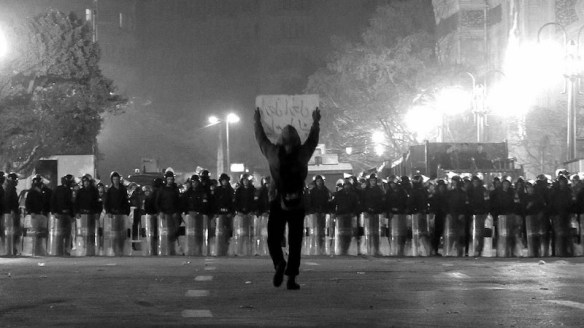


 After the Crash