A TAOIST MASTER EXPLAINS THE DIFFERENCE BETWEEN RELIGION AND INDIVIDUAL SPIRITUAL CULTIVATION

By Dylan Charles

Source: Waking Times

“The modern world needs true spiritual guidance and development.” ~ Taoist Master Hua Ching Ni

A spiritual war is upon us and the individual is challenged to maintain integrity in a sea of greed, egotism, terror and fear. With no clear path toward spiritual evolution, so many of us floundering and losing ourselves to addiction, despair and self-destruction.

When in the past ordinary religions might have served to offer a pathway toward spiritual awakening based upon the experiences of their ancient sages, today, the best they seem to offer is communal support. Far too often, though, modern religions are mired in greed, scandal, pedophilia and outright terrorism. Religions are failing to provide the help one needs to spiritually thrive in this insane world.

In a reading from the book 8,000 Years of Wisdom, Taoist Master Hua-Ching Ni talks about the state of religions today:

“Spirit can hardly be found in noisy, crowded churches and temples. Even where the teachings of the past sages have been established they have been spoiled by the insensitive trend of the times.

The spirit of the world’s religions died long ago and left most temples and churches merely empty shells.

These places continue as superficial social conventions and can only supply their devotees with shallow activities, psychological games of shadow playing, and hypnosis, all of which have absolutely nothing to do with spiritual reality.

This is the faith of today’s world, and most of their achievements are not the true answer.” ~ Taoist Master Hua Ching Ni

What then, is spiritual reality? And what does it look like in a world governed by fear, distracted by materialism, and kept in conflict by egotism? It’s really quite straightforward, says Master Ni, who refers to it as the “plain, simple truth of your life,’ which is best understood as the profoundly important concept of inner peace.

“The first spiritual goal of Taoism is the restoration and realization of one’s own well-balanced being, and then one’s spiritual evolution.

The highest goal of life is to combine oneself with the spiritual energy of the universe. There is one way to eliminate all wonder, bewilderment and confusion and that is to have inner peace.

The primary method or principle for personal cultivation is to keep peace within oneself and maintain normalcy in one’s environment; thus you can dwell with the spiritual energy and the spiritual energy dwells within you.” ~ Taoist Master Hua Ching Ni

Comparing the teachings of ordinary religions to true personal spiritual cultivation, Master Ni notes that undeveloped human beings follow and devote themselves to belief systems, deities and spiritual figureheads. In contrast, individuals seeking genuine spiritual evolution understand these systems for what they are: illusions and traps.

“People mistake religious emotionalism and hypnosis for spiritual reality.

Often in history religious emotion has been exalted as truth itself. This gave birth to all kinds of religious prejudice and persecution. Religious mobs have carried out the mischief caused by the hot-blooded in the forceful image of a spiritual sovereign. This has not the slightest connection with spiritual reality. It is the manifestation of the impure, heavy, bloody energy of undeveloped human beings before having completed their spiritual evolution.

Many people are fooled by their own ignorance or that of others. And in their ignorance they fool others too. People like this have no hope of reaching the spiritual realm. They will have no chance to touch the real spiritual life. So, before you commit yourself to any religion, you should develop the mental ability to discern what is religious emotion and what is the spiritual truth. One is the right way to follow, and the other is only a psychological pitfall and trap. This is very important for a seeker of truth on the spiritual path.” ~ Taoist Master Hua Ching Ni

Generating this type of spiritual emotionalism has become a profitable art form. Take note of the costumes worn by Catholic Cardinals and deference to the Pope in his symbolic Mitre hat. Islamic fundamentalists and ISIS do the same when they emote fear and terror by parading captives in front of religious soldiers clad in all black robes with faces covered, armed with rifles and sabres. Using symbolic imagery as tools of dominance and control, as Master Ni points out, has absolutely nothing to do with true spiritual reality.

What would the world look like if individuals first placed their own spiritual development ahead of their desire to change the world in accordance with their beliefs about spirituality and feelings of religious emotionalism? What if individuals were instead offered a plan of genuine spiritual cultivation, a path that led to actual inner peace?

“The spiritual process itself is a process of the evolution of the human spirit.” ~ Taoist Master Hua Ching Ni

Generation Numb: How Losing My Phone Exposed Me to the Pain of My Peers

This terrible void of which everyone stays pleasantly unobservant is the unofficial sickness of Gen Z.

By Ben Scheer

Source: ScheerPost

I hadn’t planned to give up my smartphone. After all, I was starting my sophomore year of college and I had not met a single adult who lives without one and definitely no other 19-year-old. If you haven’t noticed, it is part of the culture. A few weeks into the semester, I forgot my phone (a Google Pixel 2, for all you phone nerds) in the backseat of an Uber on my way back from shopping off campus. This would lead to an opening to consider a break from the phone and everything that comes with it.

I remember feeling frustrated at myself for being so absentminded and immediately rushed to track it down, anxiously calling the driver from a friend’s phone. While I listened to the open ringing on the line I began to think about this one technology’s central role in my life.

That gateway to other worlds.

Over the next few days I continued to hope my phone would come back to me and also thought further into its role in my relationships. I felt how hindering it was in communicating with the people I love.

How it had required me to be always ready to pluck it from my pocket, pull my focus and as a result, never be truly present. I saw in that reflection the possibility for healthier relationships, less dependent on constant digital connection.

More free, less reliant.

Sure, there were a thousand things that would be made more challenging and tedious, but it would be worth it if I could be more present for my own life.

Days later, after I had given up hope of seeing it again, I used a friend’s phone to call my dad to tell him.

“I will get you another one, what kind do you want?” was the first thing he said.

“Actually I think I’m good,” I responded, to his surprise. “I can write you and my mom by email. If we want to talk, I can call you from my computer.”

Quickly, I started to feel the change. My mood and habits became clearer; I felt happier, more grounded, less looming anxiety, feeling more alone and with myself, more conscious of my space and those in it.

Being alone led to more opportunities for reflection and boredom. I felt calmer, and my walking and pace of day actually slowed down. It is hard to describe how it changed the patterns in my brain but I could feel it readjusting, as it does if you spend a week in the woods or on a beach. One thing I felt was that my days were longer and more connected from one moment to the next.

I also became more aware of the moods and feelings of others around me and was suddenly terrified to see how dependent my peers were on all their screens, and, looking back just a bit, how consumed I, too, had been.

Something else bubbled up from my unconscious: My expectations of college differed from what I was seeing. Between talking to older relatives and seeing college life on TV and in the movies, I was expecting a . . . BIT MORE JOY! Young souls, free minds, positive energy, community. I was seeking some bright spark in the people around me, yet all too often what I saw was dull, void, distractible, unthinking, unfeeling people enveloped in the world of their screens instead of being in community and conversing with the people around them.

Yes, that is harsh. It is also what I see.

So much lost human potential.

I want something or someone to blame, but maybe what I should really be blaming is myself for expecting something else. The truth is, though, I feel right in blaming the phones.

It has been over a year since I gave up my smartphone, but I remember vividly when looking at my phone for hours a day seemed normal to me. I was content to stare at the screen for hours, doing the same thing: Watching mildly entertaining videos or mashing game buttons, swiping on Tinder, scrolling on IG, surfing memes and YouTube videos. In many ways, it’s a drug too good to give up, seemingly a harmless drug, but no. We have opened Pandora’s box of marvels and there is no way to close it now.

We are continually wanting what we do not yet have, an innate motivation amplified and rerouted by capitalism’s hyperdrive marketing engines. A good fix for this constant yearning, or any discomfort is to drown it out with distractions. Feeling an uncontrollable emotion? Existential itch? Low-grade anxiety? No problem: Try scrolling on the social of your choice for a bit, trust me, it takes the edge off.

Trauma or poverty, pain or loneliness, all manner of worry, we have a cure! Or at least the emotional response can be staved off long enough for you to find the next thing to click.

This terrible void of which  everyone stays pleasantly unobservant is a part of me as well, the unofficial sickness of my generation. (COVID-19 will be the official one, memorialized in our virtual yearbooks.) This hole, this pit, that is created from not knowing one’s self, not trusting one’s self, or not allowing feelings. So distracted that these insecurities that we act on every day are a mystery. That you cannot see how fundamentally OK everything actually is because you have music constantly in your ear and a fear that, in silence, your own thoughts would be too scary. The sickening thought that your true feelings for someone were no more than an act of comfort-seeking desperation and that “love” is a lifesaver from yourself.

I can’t blame anyone though. The distractions surround us, they surround the people we are with. The collective unfeeling is so great, so vast, it cracked me open, actually made me cry often once I allowed myself to experience it. I felt like I was losing my footing in the world in which I had grown up. Disconnected from my past and unsure of where we were going.

(Side note: If you haven’t yet watched The Social Dilemma, go do that, it’s worth it.)

Walking into a small college class to see no one looking at each other or chatting, the blank vacant stares. The soft glow. It felt … confusing? Why were so many interesting young people ignoring one another? What was a classroom like before these tools were available and allowed everywhere? Why were the screens so celebrated?

Then my confusion grew, and from it rage and pain. These emotions danced together, fueled me and crushed me. I saw, for the first time, the real power that the phones held. Yes, a power we had given them, but a power nonetheless. The power to keep people who were 500 miles apart tethered to one another, or keep people sitting right next to each other brutally apart.

Who can I blame? It is just the world I have been born into, and the technology- and profit-driven changes are coming faster every year. We live in the future with brain equivalents in our pockets and a web that contains all of our collective knowledge but reveals the worst of what we are and so little of the love we contain and of which we are capable.

Is the internet a good idea? Are phones good for humans? These are not questions we have answered or even barely thought to ask in the mainstream of our culture. Of course they are, what else could they be? Progress! Faster communication! More knowledge! More speed! More fun! We will all be more efficient and entertained, and from that we will live better lives.

NO! Stop, slow down. Please. These gadgets, these everywhere-anytime screens, are ruining the minds of the people who have been mesmerized since they were only little children.

To clarify: not ruining, in that people are made stupid (although it definitely does not help develop our attention span), but rather ruining our emotional capacity and spiritual selves. And these limits fetter us as we are already so strained by the pain we are able to see through our little windows; we don’t have a moment to feel, to feel our own pain, or that of our friends.

Or, for that matter, the pain of the world, or the impact of our constant consumption, or where all this STUFF comes from and where it ends up, or the pain of our history and centuries of exploitation of other humans and nature from which all this wealth originally was derived.

Being human is objectively great. We can use language and words to describe how we feel. We can feel the sun on our face and take in the taste of a thousand foods, dance to every song. Feel great pain and great happiness. Yet, all the time I see this discomfort, unrest and fear in my most distracted friends. It is coming from the disconnection from what they are feeling, a disconnection from being.

This is the worst theft of modern-day, first-world life: the theft of being present.

The phones and distractions and speed create this disconnection from the simple fact that you are actually OK, better then OK — you are alive and can feel and that is a gift to cherish.

Worse than the days of sadness are the days of not feeling anything. Some people are depressed not because anything is wrong but because they are numb to their feelings, too distracted and avoidant to feel them; avoidant, and scared of what might happen if they let themselves feel.

Try this: Really study those you love, let their face become new to you, again, and become fascinated in the way they move. Feel the wonder of being with another human.

After more than a year without a smartphone, I am more hopeful than I was in those first few months. Not to say that everything is all right, far from it. Here in the United States our technology has allowed for multiple realities to coexist alongside one another and I don’t see a clear path out of that problem. Distraction and narrow self-interest prevent us from seeing and grappling with the apocalyptic future climate change can bring in a much shorter time frame than even most globally aware people are willing to accept.

However, I do know that change is a constant and I am healed by looking past my own lifetime and by all the simple beauties of life and living. In the end, these technologies do NOT define us. We can work together to change how we coexist.


Postscript: For those who are interested in also letting go of your smartphone, I would recommend downgrading to a flip-phone or phone of a similar level. I now walk around the world with a thick, red brick through which I can communicate with my work and family in case of emergencies. 

Welcome To The Interregnum

Your unease has a name: Zozobra

By Chris Martensen

Source: Peak Prosperity

We’re between things.  It’s an uncomfortable place.

We are transitioning from an old story into a new one and that has folks feeling anxious.   By “we” I mean everyone on the planet.  If you find yourself with a deep sense of unease, yet unable to quite pin it down, you will find this article extremely helpful.

The old story of endless growth on a finite planet is winding down.  Whatever replaces it won’t be a continuation of the past.  Things are going to have to change, whether we like it or not.

Put more bluntly: the easy times are over, and a period of disruption has begun.

It may be many years or even decades before thing truly settle into a new equilibrium (of sorts – there really isn’t any such thing in this ever-changing universe).  The old will fall away even before the new has arrived. That process has already begun, hence the nervousness, anger, and fear.

My day job is serving as an information scout, an ambassador of the unknown, and because of that I’m acutely aware of the degree to which people are already worn down, burnt out, and unable to process any more.

Folks are so exhausted by the trials and tribulations dished up by the crazy-making machine fondly referred to as “2020,” that many are paralyzed.  Unable to take new actions because they are overwhelmed.

Yet, as I wrote recently, no choice IS a choice.  When so much is changing and so much is on the line, remaining frozen with anxiety is as much a determinant of your future prospects as taking swift action – each sets one down different paths promising different outcomes.

Truthfully, there is much that can be done that will contribute to a more resilient future for yourself and for the world.  But first we have to know where we are.  We have to sketch out the map as best we can, even if the edges remain blanks with little more than “there be monsters” scribed at the borders.

To orient properly, you must be aware of the idea that the Age of Growth is over.  We are now entering a Post-Growth era. Our task now is to settle into a very different existence – one with fewer ‘things’ and less ‘stuff’, but also offering more meaning and worthy challenges.

Like any good adventure, a little danger is involved.  But nothing quite so dangerous to your soul’s journey as wasting your life on trivial pursuits.

The Interregnum

The gap between reigns when the old king has died but the new successor has yet to be decided is called an interregnum.  It can also refer to the gap between first learning of something and then finally understanding its deeper significance:

in·ter·reg·num, noun

a period when normal government is suspended, especially between successive reigns or regimes.

– an interval or pause between two periods of office or other things. “the interregnum between the discovery of radioactivity and its detailed understanding”

I love this word because it perfectly matches our current state.

One feature of an interregnum, where power hangs in the balance, is that it’s a very uncertain time.  Anxiety rules the day because nobody knows how things might land.  It could be good for them personally, or very bad.  The old king was good.  His successor son is an already hated petty tyrant.  Perhaps a different, better successor will somehow manage to claim the throne instead…

This sort of uncertainty is a potent source of anxiety. Which is why an interregnum is the cradle of people’s most deep-seated fears.

The old king is gone.  Nobody knows who or what is in charge right now.  Is it humanity’s deep technological prowess or is it Mother Nature herself?

Does our destiny lie in our own hands or have the die already been cast and we’re simply awaiting to see how unfortunate of a roll it’s going to be?

Is there still time to sort out a decent solution to our many predicaments and problems, or have those moments already been wasted?

Nobody knows at this moment.  But the uncertainty is hanging thick.  Corrosive.  Emotional.  Explosive.

Welcome to the interregnum.  May the odds ever be in your favor.

Demoralization

Now while the above may sound depressing, as I’ve written before the better term is demoralizing, and there’s a very important distinction between the two terms.

Depression is a reaction to current circumstances. It can be treated with talk therapy to resolve an inner conflict, or temporary chemical rebalancing.

Demoralization, on the other hand, is what you experience when your cognitive map no longer aligns with the actual circumstances of life:

Rather than a depressive disorder, demoralization is a type of existential disorder associated with the breakdown of a person’s ‘cognitive map’. It is an overarching psycho-spiritual crisis in which victims feel generally disoriented and unable to locate meaning, purpose or sources of need fulfilment.

The world loses its credibility, and former beliefs and convictions dissolve into doubt, uncertainty and loss of direction.

Frustration, anger and bitterness are usual accompaniments, as well as an underlying sense of being part of a lost cause or losing battle. The label ‘existential depression’ is not appropriate since, unlike most forms of depression, demoralization is a realistic response to the circumstances impinging on the person’s life.

(Source)

Did you catch that? Demoralization is actually a realistic response under certain conditions.

Those conditions are manifesting themselves now. Which means that the waves of dispiriting statistics we’re seeing are not ‘bad’; they are telling us something important.

People are right to be deeply disturbed by the ways in which the main narrative of their culture no longer maps to reality.  Worse, the Endless Growth narrative is killing life on this planet and therefore harming each of us in ways both overt and subtle.

More and more people are detecting that, and that’s a good thing. Because that’s the necessary first step in crafting a new narrative and adopting a different model that hopefully serves us better.

We often say here at Peak Prosperity that if you’re feeling anxiety (or demoralization), it means that there’s a gap between what you know and what you’re doing.  Since you can’t unlearn something, your best course of action is to change your behavior.

To take action to better align what you know with what you do.

I totally get the frustration, anger and bitterness on display in politics all across the West right now, but these are almost universally misdirected at the wrong targets.  Whether by intent or accident, this is usually the case and heavily supported by a media system that actually promotes divisiveness over unity, and isolation over connection.

(Source – PeakProsperity – The End of Growth)

Bottom line: If you are demoralized there’s nothing wrong with you.  But there is definitely something wrong with the larger situation.

If you know someone who is demoralized, don’t try to ‘fix’ them by helping them fit back into their old lives better.  The problem isn’t with their ability to adapt.  The problem is they are already adapting to what is coming.  They’re ahead of the curve, not behind it.  They just see the new curve before you do.

With that critical framing for the word demoralization, we can now go a bit deeper.  But first, I want to introduce an important term relating to demoralization: Zozobra.  It describes a potent sensation one might experience during an interregnum, especially if demoralization is in play.

Zozobra

I came across this article very recently and have now read it a few times. It’s pitch perfect.

It neatly captures the context of demoralization.  By naming it we can begin to understand it, know its presence, and reduce its unconscious hold on us:

There’s a word for your overwhelming anxiety, and it’s “zozobra”

Nov 3rd, 2020

Ever had the feeling that you can’t make sense of what’s happening? One moment everything seems normal, then suddenly the frame shifts to reveal a world on fire, struggling with pandemic, recession, climate change, and political upheaval.

That’s “zozobra,” the peculiar form of anxiety that comes from being unable to settle into a single point of view, leaving you with questions like: Is it a lovely autumn day, or an alarming moment of converging historical catastrophes?

The word “zozobra” is an ordinary Spanish term for “anxiety” but with connotations that call to mind the wobbling of a ship about to capsize. The term emerged as a key concept among Mexican intellectuals in the early 20th century to describe the sense of having no stable ground and feeling out of place in the world.

This feeling of zozobra is commonly experienced by people who visit or immigrate to a foreign country: the rhythms of life, the way people interact, everything just seems “off” – unfamiliar, disorienting and vaguely alienating.

According to the philosopher Emilio Uranga (1921-1988), the telltale sign of zozobra is wobbling and toggling between perspectives, being unable to relax into a single framework to make sense of things. As Uranga describes it in his 1952 book “Analysis of Mexican Being”:

“Zozobra refers to a mode of being that incessantly oscillates between two possibilities, between two affects, without knowing which one of those to depend on … indiscriminately dismissing one extreme in favor of the other. In this to and fro the soul suffers, it feels torn and wounded.”

What makes zozobra so difficult to address is that its source is intangible. It is a soul-sickness not caused by any personal failing, nor by any of the particular events that we can point to.

Instead, it comes from cracks in the frameworks of meaning that we rely on to make sense of our world — the shared understanding of what is real and who is trustworthy, what risks we face and how to meet them, what basic decency requires of us and what ideals our nation aspires to.

(Source)

What ‘cracks in the framework of meaning’ could be more profound than facing the collapse of – well – everything?  Our many predicaments exist at all levels from top to bottom.  There’s no safe level on which to ride out the coming storm.  There’s nowhere to run.  There’s only right where you are.

When everything seems “off” – unfamiliar, disorienting and vaguely alienating, then you’re in some sort of foreign land.  You are out of bounds, off all of your known maps.  There’s no sense of place, nowhere to settle down. Zozobra.

When everything is wobbling and up for grabs, you wouldn’t be entirely human if you weren’t experiencing some sort of emotional unease.  AS with the adjustment reaction, an emotional arc is simply a part of the process.  Both unavoidable and necessary.

Those who navigate uncertainty best are those who process the quickest.  As always, having a good mental map, and the right terms, is helpful to that process.

Conclusion

If you are feeling nervous, angry or fearful – congratulations! – there’s nothing at all wrong with you.  In fact, your senses are operating normally, and your cognition is on the mark.  You are having an adjustment reaction, your cognitive map has a better grasp on reality than your culture, and zozobra is par for the course.

The most valuable part of naming and understanding these things is that they lose their ability to paralyze you with dread.

Our emotions are not “the truth”, but rather uncomfortable sensations that serve as an early warning system.  They are like a quantum processor able to parse through massively complex systems and situations way before our cortex can offer any guidance.

There’s also a comfort – a relief – that comes from understanding that our reactions are both perfectly normal and perfectly healthy.

There’s nothing that requires treatment. Nothing that requires medication. Nothing at all to be done about any of it.  Except knowing what it is, getting past whatever paralysis might exist as rapidly as possible, and then taking action.

Because you alone can’t alter the larger trends of ecological destruction, monetary printing, insane political responses, etc. and so forth, all that truly remains is for you to align your actions with what you know to be true.

And there’s so much to be done.  Soils need to be rebuilt.  Waste streams reformed into nutrient loops.  Energy efficiency to be built into the next generation of – everything.

The lists are as endless as they are exciting. And you can play a role, both at the individual level as well as contributing positively at the collective one.

Yes, there’s a “great reset” coming.  Whether it will be controlled and precise or a nature-driven chaotic mess remains to be seen.

But right now, you need to make a choice: You can either actively shape your future or wait to be shaped by it.

I’m all about controlling what I can and leaving the rest behind.  Maybe you are, too.

If so, then you’re part of our tribe here at Peak Prosperity.  We’re busying preparing for what is increasingly likely to consist of more macro chaos than control.

You know, to avoid being demoralized with an overwhelming sense of zozobra during this interregnum.

RUDOLF STEINER DESCRIBES THE HOSTILE SPIRITUAL BEINGS WHO FEED OFF YOUR FEAR AND ANXIETY

By Dylan Charles

Source: Waking Times

Anxiety, depression, and fear ravage so many today, but few pause to consider that in addition to the material influences in our lives, we may be also under the influence of beings which exist in dimensions outside of our ordinary perception.

But there is much more to reality than what we can see. feel, hear, taste and touch. In fact, an accounting of the matter that makes up the universe reveals that some 73% of it is made up of dark energy, and another 23% is made up of dark matter, neither of which can we see, nor understand. Furthermore, the human eye is only capable of seeing around .0035% of the entire spectrum of electromagnetic (EM) radiation. When we look into the heavens, 96% of it is invisible to us. Include in this the spiritual realms and there is an entire universe of possibilities which exists beyond our five senses.

Very few scientists today are willing to explore metaphysics to examine life beyond ordinary perception in order to make a connection between the seen and the unseen.

Rudolf Steiner, though, one of the most prolific and gifted scientists, philosophers, and esotericists of his time, devoted much of his work to the task of peering behind the veil, sharing his insight into the deeper nature of life and of the world beyond.

Regarding anxiety and depression, Steiner spoke of hostile beings in the spiritual world which influence and feed off of human emotion; a concept flatly rejected by most today. Yet this also analysis holds true for shamans and others who access the spiritual dimensions in order to alleviate mental suffering for their patients.

Many are familiar with the notion of energy vampires, or people who suck your energy and feed off your negative emotions. On the existence of similar entities which exist in other dimensions, Steiner wrote:

“There are beings in the spiritual realms for whom anxiety and fear emanating from human beings offer welcome food. When humans have no anxiety and fear, then these creatures starve. People not yet sufficiently convinced of this statement could understand it to be meant comparatively only. But for those who are familiar with this phenomenon, it is a reality. If fear and anxiety radiates from people and they break out in panic, then these creatures find welcome nutrition and they become more and more powerful. These beings are hostile towards humanity.

Everything that feeds on negative feelings, on anxiety, fear and superstition, despair or doubt, are in reality hostile forces in supersensible worlds, launching cruel attacks on human beings, while they are being fed. Therefore, it is above all necessary to begin with that the person who enters the spiritual world overcomes fear, feelings of helplessness, despair and anxiety. But these are exactly the feelings that belong to contemporary culture and materialism; because it estranges people from the spiritual world, it is especially suited to evoke hopelessness and fear of the unknown in people, thereby calling up the above mentioned hostile forces against them.” ~Rudolf Steiner

Negative emotions are food for inimical spirits. 

A concept such as this isn’t readily accepted into the everyday conversation steered by rigid skepticism and scientific materialism. The traditions of today have sought to expel ancient metaphysical wisdom and its practical application from our lives, and though scientific inquiry is exceptionally valuable, spiritual perception has always been a part of our experience.

“And yet, despite the cynical skepticism, all of the ancient mystery schools, true shamanic insights, and esoteric teachings (much of which have been suppressed and/or distorted over thousands of years for obvious reasons) have conveyed this truth for ‘the ones with eyes to see and ears to hear’, using their own language and symbolism, be it “The General Law” (Esoteric Christianity), Archons (Gnostics), “Lords of Destiny” (Hermeticism), Predator/Fliers – “The topic of all topics” (Shamanism, Castaneda), “The Evil Magician” (Gurdjieff), The Shaitans (Sufism), The Jinn (Arabian mythology), Wetiko (Native American Spirituality), Occult Hostile Forces (Sri Aurobindo & The Mother, The Integral Yoga), etc.” ~Bernhard Guenther

Dealings with extra-sensory or hyper-dimensional beings have long been a part of our history, and are directly accessible to any of us when proper practice and attention is given to the matter. I know this to be true from my experiences with plant medicine shamanism where it is entirely possible to enter into states of consciousness where entire cosmologies of life exist and are available to interact with.

Finding oneself in the rut of spiraling negative self-talk, depression, crippling anxiety, or uncontrollable, irrational fear, is a sign, as Steiner points out, of a disconnection from our true spiritual nature, exacerbated by beings who operate in the spiritual realms. This is why some consider disorders like this to be spiritual illnesses, and until the rift is healed with proper attention given to the development of spirit, the feelings tend to exacerbate and drive one further into distress.

“When humans have no anxiety and fear, then these creatures starve.” ~Rudolph Steiner

Why Do Most People Believe Propaganda and False Flag Attacks?

By Robert J. Burrowes

In his 1995 book The Demon-Haunted World Carl Sagan lamented as follows:

I have a foreboding of [a] time when… awesome technological powers are in the hands of a very few, and no one representing the public interest can even grasp the issues; when the people have lost the ability to set their own agendas or knowledgeably question those in authority; when, clutching our crystals and nervously consulting our horoscopes, our critical faculties in decline, unable to distinguish between what feels good and what’s true, we slide, almost without noticing, back into superstition and darkness.

The dumbing down… is most evident in the slow decay of substantive content in the enormously influential media… but especially a kind of celebration of ignorance…. The plain lesson is that study and learning – not just of science, but of anything – are avoidable, even undesirable.

We’ve arranged a global civilization in which most crucial elements… profoundly depend on science and technology. We have also arranged things so that almost no one understands science and technology. This is a prescription for disaster. We might get away with it for a while, but sooner or later this combustible mixture of ignorance and power is going to blow up in our faces. See The Demon-Haunted World: Science as a Candle in the Dark.

While it is 25 years since these words of Sagan’s were published a year before his death, one can only lament the ongoing decline of what might simply be labeled the capacity for critical thinking, whether in relation to society and politics, or the science and technology that so concerned Sagan.

At a time in human history when so much is at stake, why is it so difficult to engage most people in anything resembling a thoughtful investigation, consideration and analysis of what is taking place? Why is it that more people do not question what they are told, what they read and what they are shown? In short, why is it that most people do not seek out the evidence for themselves rather than simply believing what is presented to them?

In one sense, the answer to this question might seem simple. People are daily bombarded with ‘information’, in various guises, and a lifetime of submissively accepting what they are told leaves few with any inclination, or energy, to question anything. But let me offer a fuller explanation given the critical importance of this issue if we are to mobilize an effective response to the challenges confronting humanity.

So first: What is propaganda? A false flag attack? Why do most people simply believe what they are told without investigating, carefully, for themselves? And why are those who challenge the elite-driven narrative often labeled ‘conspiracy theorists’ or, depending on the issue, some other pejorative such as ‘peddling debunked science’, ‘anti-vaxxer’ or ‘anti-semitic’ for example?

What is Propaganda?

Propaganda is the deliberate and systematic effort, using a variety of means, to manipulate people into believing and behaving in accordance with something that is not true. For one comprehensive explanation of how this is done, see Trust Us, We’re Experts! How Industry Manipulates Science and Gambles with Your Future, a book which Robert F. Kennedy Jr. observes ‘shows how giant corporations employ sophisticated psychiatric techniques, unscrupulous public figures, junk science, tainted studies and clever PR mercenaries in a relentless effort to market products that routinely kill, maim, deform and poison consumers and our environment’. See ‘Trust Us, We’re Experts!: How Industry Manipulates Science and Gambles with Your Future’.

While some people argue that propaganda can be used for good, the fact is that something that is simply true should appeal to people anyway, even if it is unpleasant. This is because the truth is the only powerful place from which to start to address any circumstance, including unpleasant and difficult ones.

Propaganda is delivered by a variety of means. Aside from that issued, in various ways, by governments and corporations, propaganda is delivered by education systems as ‘knowledge’, by the corporate media as ‘news’ and by the entertainment industry as films, television programs, video games, music, literature and in other forms. But all propaganda is designed to instill and reinforce a limited set of fears, approved beliefs and endorsed behaviours so that the ‘individual’ responds submissively within the carefully managed system of elite political, social and economic control.

For example, education is designed to teach the individual a limited range of technical functions intended to help create, maintain but essentially serve the emerging technocratic tyranny (as it supersedes the existing version of industrial capitalism), make the individual a passive consumer and politically submissive, while ensuring that an intelligent mind capable of seeking out relevant evidence for themselves, critiquing society and responding powerfully does not develop. See ‘Do We Want School or Education?’

What is a False Flag Attack?

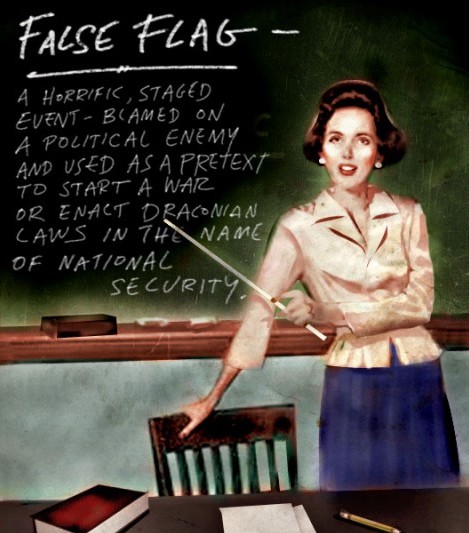
A false flag attack occurs when a government carries out a terror attack against its own population and then falsely blames an enemy to justify a political course of action, such as going to war against the country or countries it blames. While, again, those who question false flag attacks are often denounced by elite propagandists as ‘conspiracy theorists’, in fact the documentation of false flag attacks that have later been admitted is quite long. For one list, see ‘53 Admitted False Flag Attacks’. Of course, plenty of false flag attacks have not been admitted, even when the evidence is overwhelming, as in the case of 9/11 for example.

So Why Do Most People Believe Propaganda?

In an early book on propaganda written in 1928 by Sigmund Freud’s nephew, Edward Bernays, he opened with this paragraph:

The conscious and intelligent manipulation of the organized habits and opinions of the masses is an

important element in democratic society. Those who manipulate this unseen mechanism of society constitute an invisible government which is the true ruling power of our country. See Propaganda.

As Bernays makes clear from the outset, his preoccupation is the manipulation of people to do the bidding of others: clearly, a debased and cynical view of the human individual on which many of humanity’s less morally committed characters have capitalized since Bernays wrote the book.

For example, Joseph Goebbels, Nazi Minister of Propaganda from 1933 to 1945 and an avid reader of Bernays’ work, observed that ‘Propaganda works best when those who are being manipulated are confident they are acting on their own free will.’

But to understand why the approach of Bernays and his disciples such as Goebbels even works, we need to consider why it is that most people are so gullible in the first place. Why don’t more people ask deeper questions about what is taking place rather than simply accepting, without serious question, whatever is presented to them (whether by parents, teachers, religious figures, doctors, propagandists, marketing agents, governments or the corporate media)?

The fundamental problem is simply this: parents, teachers, religious figures and other significant adults in the child’s life require obedience. And obedience means that the child not only behaves as directed by the adult but also that the child believes what the adult believes. This latter point is easily overlooked but is actually the key issue. Why? Because a child who does not believe what the adult believes might think and behave in a way that scares the adult. And demanding obedience is essentially about eliminating beliefs (and their consequent behaviours) that would frighten the parent, teacher or other adult.

Parents require obedience virtually from the moment of birth, doing everything from comforting a child to stop them crying – see ‘Comforting a Baby is Violent’ – to punishing them for acting contrary to parental will once they start moving independently. Of course, once the child starts to think or believe differently, especially if this ‘difference’ is too far from a belief of the child’s parents, teachers or religious leaders (or a widely-accepted belief within their society), the child is quickly pulled back into line with some combination of inducements and/or violence. See ‘Punishment is Violent and Counterproductive’.

Despite legal conventions meaninglessly affirming versions of it – such as the Universal Declaration of Human Rights Article 18 declaring ‘Everyone has the right to freedom of thought…’ – the freedom to think for oneself is not a human right in any meaningful sense of the term and, even if it were, it would really only mean the freedom to think for oneself within certain clearly defined and narrow parameters. And only if you are an adult.

This is why, for example, a child who decides not to go to school does not emerge. Such a possibility would be frightening to virtually every parent, so no child is given that option, let alone allowed the opportunity to come up with, consider and act on that option for themself. Why? Because attendance at school, wherever it exists, is legally compulsory (meaning punishment will be inflicted for failure to comply), and only the rarest parent has the vaguest concept of freedom themselves, let alone the courage to defend their child’s freedom, including the freedom to choose how they spend the bulk of their time for the 8-13 years of ‘school age’.

Consequently, the freedom to think for oneself and act accordingly is strangled at a very young age and certainly by the time a child is compelled to attend a prison for children, also known as ‘school’. As a result the child’s concept of freedom, should they ever come across the notion, can only be a parody of the real thing. And the adult who emerges from this childhood is simply incapable of comprehending what freedom might mean for the obvious reason that to be meaningfully understood, freedom must be experienced.

Of course, is it not just parental authority and school that denies any child the experience of liberty. As Jean-Jacques Rousseau noted in his treatise The Social Contract in 1762, ‘Man is born free; and everywhere he is in chains’. Every institution in society is designed to circumscribe freedom, one way or another. It is just that a childhood spent living under the control of their parents and then teachers and religious figures leaves all children devoid of the experience of freedom and so any subsequent limits are not even noticed. In fact, they are expected and ‘taken for granted’.

So with parents, teachers and religious figures endlessly inflicting ‘visible’, ‘invisible’ and ‘utterly invisible’ violence on the child in the name of ‘socialization’ (which includes requiring obedience under threat of violence for non-compliance), the child progressively and rapidly loses several innate capacities, notably including a sense of their own Self-will, the capacities to think and feel for themselves, as well as conscience. See ‘Why Violence?’ and ‘Fearless Psychology and Fearful Psychology: Principles and Practice’. Anything that is too far from the dominant narrative simply becomes ‘unthinkable’ because the child’s innate capacity to perceive the truth is suppressed along with other mental capacities.

But soon it is not just parents, teachers and religious leaders that are the accepted ‘authority figures’ in the child’s life. No longer able to seriously question the imperatives of parents, teachers and religious figures because they have been terrorized out of doing so, the child has also unconsciously ‘learned’ that virtually any information with which they are presented must be true, even when the source is simply a government or corporate media outlet presenting elite propaganda. For the vast bulk of adult humans, the idea of questioning a dominant narrative does not even occur to them and it is certainly not something they can do with any intelligence, persistent research effort or courage.

So just as Hitler, ably supported by his Propaganda Minister Joseph Goebbels, was able to direct most Germans prior to and into World War II, it is quite straightforward for the global elite to be able to direct the bulk of the human population to believe, for example, that President John F. Kennedy was assassinated by the ‘lone gunman’ Lee Harvey Oswald, that the ‘Gulf of Tonkin incident’ justified the United States war on Vietnam, that a ‘virus’ labeled HIV caused a ‘disease’ labeled AIDS, that the three buildings 1,2 and 7 of the World Trade Center were destroyed by two aircraft flown by novice pilots into the top stories of the Twin Towers and justified the subsequently launched US ‘War on Terror’, that a ‘virus’ labeled SARS-Cov-2 exists and causes a ‘disease’ labeled Covid-19 that has justified the destruction of everything from a range of human rights to the global economy while accelerating four distinct paths to human extinction, that we live in a democracy in which each adult has a say in how they are governed, or even that ongoing effort is being made to bring a greater degree of shared prosperity to the people of the world.

For just a taste of the extensive evidence to debunk each of these propaganda-driven delusions, see these respective analyses of what the evidence actually demonstrates: On the Trail of the Assassins: One Man’s Quest to Solve the Murder of President Kennedy, the Pentagon PapersAIDS Inc.: Scandal of the CenturyArchitects & Engineers for 9/11 Truth‘Unmasking the Lies Around COVID-19: Facts vs Fiction of the Coronavirus Pandemic’‘The Elite’s COVID-19 Coup to Destroy Humanity that is also Fast-Tracking Four Paths to Human Extinction’‘America After the Election: A Few Hard Truths About the Things That Won’t Change’ and ‘The Federal Reserve Cartel: The Eight Families’.

In essence: my point is that is it is not the power of the propaganda, increasingly sophisticated though it has become, that makes people believe it, but a ‘socialization’ model designed to produce submissively obedient ‘individuals’ who gullibly interpret what is happening, and even their own ‘experience’, in terms of the information or scenario (that is, propaganda) with which they are presented. And because of the deeply-seated and unconscious fear of holding a divergent view, most people simply believe the widely-promulgated propaganda narrative with which they become familiar and, hence, comfortable. Moreover, those who challenge the elite-driven narrative frighten them, particularly when elite agents in government and the corporate media label them ‘conspiracy theorists’. For one explanation of why the term ‘conspiracy theorist’ emerged to denigrate those who challenge elite orthodoxy, see ‘In defence of conspiracy theories (and why the term is a misnomer)’.

And so this combination of dysfunctional parenting, education and religious exposure leaves the child devoid of their intuitive ‘truth register’ as well as the other mental faculties that would make them question explanations that obviously lack credibility while investigating and analyzing the evidence for themself. In fact, the idea of doing so never even occurs to them. Hence, a terrorized, gullible and easily manipulated individual enters adulthood. And, as the elite intends, galvanizing an effective response by such people to the truth hidden behind the propaganda is very difficult.

Resisting Propaganda

There is no point hoping that the global elite will discontinue their use of propaganda to shape the course of human events. This is largely because the global elite is insane. See ‘The Global Elite is Insane Revisited’. Moreover, attempts to curb the use of propaganda must inevitably run into the institutions and organizations that the elite controls. And while we can strategically resist these if we choose, the most powerful defence we have against elite propaganda is the human mind that can perceive and critique it. Hence, as a priority, I would profoundly alter our parenting model to achieve this outcome. See ‘My Promise to Children’.

If you are uncertain of your own capacity to critique propaganda, you can expand your capacity to do so by feeling the fear (to release it) that limits your mental faculties. See ‘Putting Feelings First’.

If you are interested in planning or participating in a strategy to achieve a peace, environmental or social justice outcome (particularly in relation to those issues that threaten human extinction), or to resist the elite coup currently taking place under cover of Covid-19, you can read sets of strategic goals for doing so in Campaign Strategic Aims or Coup Strategic Aims.

Moreover, if you wish to tackle the environmental threats to human existence while also strengthening your self-reliant capacity to resist the latest elite onslaught to take (much) greater control of your life, consider participating in ‘The Flame Tree Project to Save Life on Earth’. The greater your dependence on elite systems and processes of any kind, the less power you will have to resist as the noose tightens.

If you are interested in participating in the worldwide effort to resist elite and other violence, you are also welcome to sign the online pledge of ‘The People’s Charter to Create a Nonviolent World’.

More simply, if you like, you might consider committing to:

The Earth Pledge

Out of love for the Earth and all of its creatures, and my respect for their needs, from this day onwards I pledge that:

  1. I will listen deeply to children. See ‘Nisteling: The Art of Deep Listening’.
  2. I will not travel by plane
  3. I will not travel by car
  4. I will not eat meat and fish
  5. I will only eat organically/biodynamically grown food
  6. I will minimize the amount of fresh water I use, including by minimizing my ownership and use of electronic devices
  7. I will not own or use a mobile (cell) phone
  8. I will not buy rainforest timber
  9. I will not buy or use single-use plastic, such as bags, bottles, containers, cups and straws
  10. I will not use banks, superannuation (pension) funds or insurance companies that provide any service to corporations involved in fossil fuels, nuclear power and/or weapons
  11. I will not accept employment from, or invest in, any organization that supports or participates in the exploitation of fellow human beings or profits from killing and/or destruction of the biosphere
  12. I will not get news from the corporate media (mainstream newspapers, television, radio, Google, Facebook, Twitter…)
  13. I will make the effort to learn a skill, such as food gardening or sewing, that makes me more self-reliant
  14. I will gently encourage my family and friends to consider signing this pledge.

Conclusion

The world is complex: it is difficult to understand and requires enormous effort.

Propaganda is designed to give people information that is easy to understand (and sometimes frightening) while distracting them from the truth and offering a simple ‘choice’ (or command) designed to mobilize action in support of an elite-driven narrative.

For example, by telling people they are threatened by a virus, most will be scared into focusing their attention on the ‘virus’. They will pay no attention to the many more complex and dangerous things that are taking place under cover of the ‘virus’: a technocratic/transhumanist coup that is utterly transforming the very essence of human society, economy and even the human individual. See ‘Beware the Transhumanists: How “Being Human” is being Re-engineered by the Elite’s Covid-19 Coup’ and ‘Klaus Schwab and His Great Fascist Reset’.

Only a tiny proportion of the human population has even the vaguest idea of how the world actually works. But not even a tiny proportion of these people recognize that terrorizing children into obedience is the fundamental explanation of why the world works in the way that it does.

Unless we can mobilize greater recognition of our responsibility for giving the global elite the control over us that it has, and tackle this problem at its core – by fundamentally revising existing parenting and education models so that we produce powerful individuals – it will continue to be enormously difficult to mobilize sufficient strategic response to the challenges that confront humanity.

And while we are now fast-tracking four distinct paths to human extinction, there is an urgency about our predicament that accelerates daily.


Biodata: Robert J. Burrowes has a lifetime commitment to understanding and ending human violence. He has done extensive research since 1966 in an effort to understand why human beings are violent and has been a nonviolent activist since 1981. He is the author of ‘Why Violence?’ His email address is flametree@riseup.net and his website is here.

From Blue Shirts to Brown

By Alan Hamilton

Source: Off-Guardian

On at least 3 or 4 occasions in the past week we’ve had to smash the windows of people in cars and pull them out of there so they could provide their details – because they weren’t telling us where they were going; they weren’t adhering to the chief health officer’s guidelines, they weren’t providing their name and their address.”
Shane Patton, Victorian Chief Police Officer 04/08/2020

On Saturday 5th of September a national day of protest occurred in cities around Australia against the unnecessary and draconian lockdowns that have been occurring across the country and which are still occurring in Victoria. Similar protests have occurred in cities around the world, most especially in Europe.

These protests are a legitimate and rational response to despotic and often unconstitutional laws that unscientifically characterize every member of society as a bio-security risk to everyone else. They are also a protest against law enforcement bureaucracies that identify responsible, civic-minded citizens as criminals if they dare to question such laws or even worse, step out of their homes in defiance of the lockdown to register their dissent.

The Australian protests occurred peacefully and without incident in most places, including Brisbane where I participated. But it was not the case in Victoria where a State of Disaster has been declared due to the ‘extraordinarily high’ number of active Covid cases there.

On the eve of the nationwide protests, mainstream news reported on the harrowing state of affairs in Victoria which was suffering from hundreds of active cases but, as it turns out, had only 20 people in intensive care suffering from covid-related illnesses. This is in a state of 6.35 million people that has 58 metropolitan hospitals and 69 rural hospitals and District Health services.

Despite the ‘extraordinarily low’ incidence of people who were actually sick from Covid 19, the Victorian Premier decided that new case numbers (>100 per day) were just too high to tolerate anyone leaving their homes for any reason other than the four exemptions provided by the government.

What he neglected to mention when insisting on preserving his lockdown was that most new cases are occurring in the under-30 age bracket: a demographic that is almost always asymptomatic to SARS CoV-2 and which has more chance of dying in a motor vehicle accident than of Covid19.

Undeterred by inconvenient truths like this, the Premier announced he had to protect the public from the potentially catastrophic medical emergency that would doubtless result from masked people walking down St Kilda Road to the Cenotaph in a socially distanced manner, so he banned all participation in the national day of protest.

Just days earlier the Assistant Police Commissioner for the North West Metro Region, Luke Cornelius, warned everyone in Victoria against participating in the Saturday protests. He referred to people who planned to protest against lockdowns as “boof heads”, calling them an “anti-vax, anti-mask, tinfoil hat-wearing brigade who were batshit crazy”.

This oddly extreme language from one of the State’s most senior police officers is not accidental. It serves a specific purpose.

In order to get ordinary well-adjusted police officers – who may have joined the force out of a desire to be of public service – to brutalize a population whose only crime is that they object to being locked in their homes for 23 hrs a day for months on end, you need to demonize dissent. If your officers on the ground can identify in any way with the people they are being told to terrorize, they might not follow orders.

This is a perennial problem for martial leaders everywhere. It’s particularly problematic when the rules being enforced are arbitrary or unjust. Hence the need to malign.

As Saturday rolled around, the police were out in force across Victoria on horseback with cuffs, batons, tasers and guns ready to intimidate, arrest and fine anyone unfortunate enough to attract their attention within the vicinity of a protest in any town in the State – even those towns where not a single case of Covid-19 has been recorded.

And here we get to the crux of the SARS-CoV-2 scam. Sure, there’s a virus out there. It’s real and it certainly kills people but we know enough about it now to know that the draconian response taken by Premier Danial Andrews is scientifically indefensible. So why is he persisting with the lockdowns?

My personal opinion is that the global program of lockdowns is a mechanism for reorganizing societies around the world along the lines of the World Economic Forum’s ‘Great Reset” agenda and all that this entails. It seems Daniel Andrews is fully on board with this agenda. But make no mistake, its coming to your state and country next.

I believe that sustained lockdowns are a “Stanley Milgram-style” experiment designed to see just how far bureaucrats in authority will exceed the moral limits of their power and how much abuse the Australian public will tolerate before they push back.

As part of this experiment, the algorithms that once monitored every nuance of our social media interactions to make frighteningly accurate predictions about us have been extended to track and predict our off-line experience as well. It should come as no surprise that both the Azure and AWS cloud eco-systems have expanded by 50% since the beginning of the pandemic.

The purpose of all this surveillance is not to better understand us as potential marketing targets (the standard explanation) but rather to better control us as victims in a system of profound inequality. Such a system is already in place across much of the world and under the guise of a health pandemic, it is rapidly being expanded to developed countries as well.

So far as I can see the whole experiment is going spectacularly well for the globalists, billionaires, and authoritarians, and very poorly for free citizens everywhere: mostly due to the effectiveness of media propaganda in driving public passivity.

A SCIENTIFIC DICTATORSHIP

Many medical practitioners are aware that Victoria’s management of the SARS CoV-2 pandemic is based on highly selective medical advice which doesn’t stand up to serious scientific scrutiny.

Recently a group of doctors wrote an excellent letter to the Premier advocating an alternative response to disease management, noting that more than 41,000 people die every year in Victoria, roughly 10,000 each from cardiovascular disease and cancer, yet in 7 months of a supposed pandemic less than 600 Victorians have died of Covid-19: 90% of them over 65 years of age and most with multiple co-morbidities.

The problem with the doctor’s alternative advice is that it assumes the government is merely mistaken or misinformed in its policymaking and implementation. The idea that the exercise of political power in Victoria has become pathological never seems to occur to them – despite a wealth of evidence supporting such a notion.

When governments pass laws that are extreme or unjust or which by-pass constitutional constraints, it is rarely by accident. As doctors they ought to be the first to appreciate what a pathological exercise of power means to the cultural and institutional bonds that hold a society together:

  • As bio-security increasingly substitutes for health care, doctors will find that the personal confidences of their patients are no longer inviolate and that the Hippocratic obligations they once held so dear can be easily compromised by legal mandates to force-medicate people regardless of need or consequence.
  • When politicians rule by executive decree the police force morphs from a public service comprised of citizens in uniform to the enforcement arm of a political clique. When this happens, public trust in the police is lost and this loss of legitimacy results in a loss of respect. Eventually this loss of respect becomes mutual and the police start to despise the people they victimize and abuse the power they have. The opening quote being a perfect example.
  • Similarly with the military: when the exercise of our democratic rights is pathologized by those in power, our servicemen and women eventually find they’re being asked to apply, at home, the counter-insurgency training and urban warfare tactics they learned for battlefields abroad. This is something that has occurred since the time of Thucydides and it’s happening again.
  • Even the tools we use to make sense of the world, such as the scientific method, cease to function properly when our governments become toxic. Once everyone in a society has been force-vaccinated by government decree, it will become legally impossible to prove a link between mandated vaccines and any potential vaccine-related injury. Not because the manufacturers will have immunity from liability (they will), but because there will no longer be a non-vaccinated control group left against which randomized double-blind control studies can be conducted.

Not one of these developments is accidental. All of them are known, predictable outcomes of policy decisions being taken today. And these policy decisions rob everyone of their integrity; health workers, academics, the police and the military.

When those in power have a pathological relationship to the people they rule, you know you are on a road to perdition. We can see such a pathology evolving among our politicians most clearly in Victoria with its home invasions, curfews and lock downs but it is also evident in the overreach of governments around the country.

Western Australia’s recent dispute with mining magnate, Clive Palmer, over the State’s Covid border closure is a case in point. According to the WA Law Society the Government’s anti-Palmer legislation violates several of the fundamental legal principles that underpin the rule of law in a civilized society. Such overreach is also apparent in the ASIO Amendment Act 2020, introduced into Federal Parliament by Peter Dutton in May this year – right at the height of the Covid panic while most members were not even in Canberra.

This legislation is the latest in a succession of Bills that have been passed by our Federal government since 9/11 (85 and counting) which have vastly expanded the powers of law enforcement and security agencies in Australia while limiting public oversight. The legislation effectively criminalizes the free exercise of our basic democratic freedoms.

The Dutton amendment extends powers normally applied to terrorists, to any group or person engaged in any kind of civil disobedience or protest that could possibly result in ‘politically motivated violence’. That would include the anti-lock down protests that I participated in last week.

Among a raft of frightening provisions this bill allows police and intelligence agencies to track, apprehend and question children as young as 14 yrs of age as though they were terrorists. It suspends the rules of habeas corpus and allows the State to arbitrarily restrict a defendant’s access to legal representation.

This is the sort of legislation you’d expect to find in China or Saudi Arabia, not Australia.

The permanent changes to our society that are now in place in Australia following the SARS CoV-2 pandemic mean we qualify as proto-fascist State by any measure of political freedom. This thought is anathema to most Australians and would be vociferously denied by paid-off mainstream media pundits – but probably not constitutional lawyers – because the legislative reality is that we are now much closer to full-blooded fascism than we are to the liberal democracy that existed when I was born in 1963. And we are a very far cry from the nation our diggers returned to in 1945.

The only way we will arrest and/or reverse this trend is if we all take direct, non-violent, physical (not digital) action to exercise our civic and democratic rights at every opportunity we can. The time to speak up and stand up is now. It will be too late tomorrow.

The End of Reality?

By Edward Curtin

Source: Behind the Curtain

In 1888,  the year before he went insane, Friedrich Nietzsche wrote the following in Twilight of the Idols:

We have got rid of the real world: what world is left?  The apparent world perhaps? … But no!  Along with the real world we’ve done away with the apparent world as well.

So, if you feel you also may be going insane in the present climate of digital screen life, where real is unreal but realer than real, the apparent is cryptic, and up is down, true is false, and what you see you don’t, it has a history.  One hundred and thirty-two years ago, Nietzsche added that “something extraordinarily nasty and evil is about to make its debut.”  We know it did, and the bloody butcher’s bench known as the twentieth century was the result. Nihilism stepped onto center stage and has been the star of the show ever since, straight through to 2020.  Roberto Calasso puts it this way in Literature and the Gods:

Here we are, announces Nietzsche, and it would be hard not to hear a mocking ring in his voice.  We thought we were living in a world where the fog had lifted, a disenchanted, ascertainable, verifiable world.  And instead everything has gone back to being a ‘fable’ again.  How are we to get our bearings … This is the paralysis, the peculiar uncertainty of modern times, a paralysis that all since have experienced.

Obviously, we haven’t gotten our bearings.  We are far more adrift today on a stormy electronic sea where the analogical circle of life has been replaced by the digital, and “truths” like numbers click into place continuously to lead us in wrong, algorithm-controlled directions. The trap is almost closed.

Of course, Nietzsche did not have the Internet, but he lived at the dawn of the electric era, when space-time transformations were occurring at a rapid pace.  Inventions such as photography, the phonograph, the telephone, electricity, etc. were contracting space and time and a disembodied “reality” was being born.  With today’s Internet and digital screen life, the baby is full-grown and completely disembodied.  It does nothing but look at its image that is looking back into a lifeless void, whose lost gaze can’t figure out what it’s seeing.

Take, for example, the phonograph, invented by Thomas Edison in 1878.  If you could record a person’s voice, and if that person died, were you then listening to the voice of a living person or one who was dead?  If the person whose voice was recorded was alive and was miles away, you had also compressed earthly space. The phonograph suppressed absence, conjured ghosts, and seemed to overcome time and death as it captured the flow of time in sound.  It allowed a disembodied human voice to inhabit a machine, an early example of downloading.

“Two ruling ambitions in modern technology,” writes John Durham Peters in his wonderful book, Speaking into the Air, “appear in the phonograph: the creation of artificial life and the conjuring of the dead.”

Many people started to hear voices, and these people were not called deluded. Soon, with the arrival of cinema, they would see ghosts as well.  Today, speaking ghosts are everywhere, hiding in hand-held devices. It’s Halloween all year round as we are surrounded by electronic zombies in a screen culture.

This technological annihilation of space and time that was happening at a frenetic pace was the material background to Nietzsche’s thought.  His philosophical and epistemological analyses emerged from German intellectual life of his time as well, where theologians and philosophers were discovering that knowledge was relative and had to be understood in situ, i.e., within its historical and social place or context.

Without going into abstruse philosophical issues here, suffice it to say, Nietzsche was suggesting that not only was God dead because people killed him, but that knowledge was a fiction that changed over time and was a human construction.  All knowledge, not just science, had to be taken “as if” it were true.  This was a consoling mental trick but falsely reassuring, for most people could not accept this, since “knowledge” was a protection racket from pain and insanity. It still is. In other words, not only had people murdered God, but they had slain absolutes as well. This left them in the lurch, not knowing if what they knew and believed were really true, or sort of true – maybe, perhaps. The worm of uncertainty had entered modern thought through modern thought.

While the average person did not delve into these revolutionary ideas, they did, through the inventions that were entering their lives, and the news about Darwin, science, religion, etc., realize, however vaguely, that something very strange and dramatic was under way. Life was passing from substance to shadow because of human ingenuity.

It is similar to what so many feel today: that reality and truth are moving beyond their grasp as technological forces that they voluntarily embrace push everyday life towards some spectral denouement.  An inhuman, trans-human, on-line electronic life where everything is a parody of everything that preceded it, like an Andy Warhol copy of a copy of a Campbell’s soup can with a canned mocking laugh track that keeps repeating itself.  All this follows from the nineteenth century relativization of knowledge, or what at least was taken as such, for to say all knowledge is relative is an absolute statement.  That contradiction goes to the heart of our present dilemma.

This old feeling of lostness is perhaps best summarized in a few lines from Mathew Arnold’s 19th century poem, “Dover Beach”:

The Sea of Faith
Was once, too, at the full, and round earth’s shore
Lay like the folds of a bright girdle furled.
But now I only hear
Its melancholy, long, withdrawing roar,
Retreating, to the breath
Of the night-wind, down the vast edges drear
And naked shingles of the world.

But that was then.  Today, the Joker’s sardonic laughter would suffice.

***

I am sitting outside as I write, sipping a glass of wine before dinner.  Although New England fall weather is approaching, a nasty mosquito is buzzing around my head.  I hear it.  I am in killer mode since these bastards love to bite me.  This is real life.  If I went into the house and connected to the Internet on the computer screen – news, social media, anything – I would be entering another dimension.  Screen life, not real life. The society of the spectacle. No real mosquitoes, no wine, no trees swaying in the evening breeze.

In his novel, The Sun Also Rises, written between Nietzsche’s time and now, Ernest Hemingway, a man who surely lived in the physical world, writes of how Robert Cohn, the boxing champion from Princeton University, wants Jake Barnes, the book’s protagonist, to take a trip with him to South America.  As they sit and talk in Paris, Barnes says no, and tells Cohn, “All countries look just like the moving pictures.”

Whether Hemingway was being ironic or not, or simply visionary, I don’t know.  For in the 1920s, before passports and widespread tourism, there were many places you could only see if you traveled to them and they would never appear in moving pictures, while today there is almost no place that is not available to view beforehand on the internet or television.  So why go anywhere if you’ve already seen it all on a screen? Why travel to nowhere or to where you have already been?  Déjà vu all over again, as Yogi Berra put it and everyone laughed.  Now the laugh is on us.

***

This is neither an argument nor a story.  It’s real.  I am trying to get my bearings in a disorienting situation. Call it a compass, a weather-vane, a prayer.  You can call me Al or Ishmael.  Call me crazy.  Perhaps this writing is just an “as if.”

***

About fifteen years ago, I was teaching at a college where most communication was done via email.  I was, as they say, out of the loop since I didn’t do email. I was often asked why I didn’t, and I would repeatedly reply, like Melville’s Bartleby, because “I prefer not to.”  Finally, in order to keep my job, I succumbed and with the laptop computer they provided me, I went “on-line.”  There were 6,954.7 emails in my in-box from the past three years.  In those three years, I had performed all my duties scrupulously and hadn’t missed a beat.  Someone showed me how to delete the emails, which I did without reading any, but I had entered the labyrinth. I went electronic.  My reality changed. I am still searching for Ariadne’s thread.

***

But I am not yet a machine and refuse the invitation to become one.  It’s a very insistent invitation, almost an order.  Neil Postman (Oh such a rich surname!) sums it up well in Technopoly: The Surrender of Culture to Technology:

The fundamental metaphorical message of the computer, in short, is that we are machines – thinking machines, to be sure, but machines nonetheless.  It is for this reason that the computer is the quintessential, incomparable, near perfect machine for Technopoly.  It subordinates the claims of our nature, our biology, our emotions, our spirituality.  The computer claims sovereignty over the whole range of human experience, and supports its claim by showing that it ‘thinks’ better than we can…John McCarthy, the inventor of the term ‘artificial intelligence’…claims that ‘even machines as simple as thermostats can be said to have beliefs…What is significant about this response is that it has redefined the meaning of the word ‘belief’ … rejects the view that humans have internal states of mind that are the foundation of belief and argues instead that ‘belief’ means only what someone or something does … rejects the idea that the mind is a biological phenomenon … In other words, what we have here is a case of metaphor gone mad.

Postman wrote that in 1992, before the computer and the internet became ubiquitous and longer before on-line living had become de rigueur – before it was being shoved down our throats as it is today under the cover of COVID-19.

There is little doubt that we are being pushed to embrace what Klaus Schwab, the Executive Chairman of the World Economic Forum (WEF), calls COVID-19:The Great Reset, that involves a total acceptance of the electronic, on-line life.  On-line learning, on-line news, on-line everything – only an idiot (from Greek, idiotes, a private person who pays not attention to public affairs) would fail to see what is being promoted.  And who controls the electronic life and internet?  Not you, not I, but the powers that be, the intelligence agencies and the power elites. Goodbye  body, goodbye blood – “I don’t think we should ever shake hands ever again, to be honest with you,” said Dr. Anthony Fauci, the director of the National Institute of Allergy and Infectious Diseases (NIAID) in support of human estrangement.

Peter Koenig, one of the most astute investigators of this propaganda effort, puts it this way:

The panacea of the future will be crowned by the Pearl of the Fourth Industrialization – Artificial intelligence (AI). It will be made possible by a 5G electromagnetic field, allowing the Internet of Things (IoT). Schwab and Malleret [Schwab’s co-author] won’t say, beware, there is opposition. 5G could still be blocked. The 5G existence and further development is necessary for surveillance and control of humanity, by digitizing everything, including human identity and money.

It will be so simple, no more cash, just electronic, digital money – that is way beyond the control of the owner, the truthful earner of the money, as it can be accessed by the Global Government and withheld and / or used for pressuring misbehaving citizens into obeying the norms imposed from above. You don’t behave according to our norms, no money to buy food, shelter and health services, we let you starve. No more travel. No more attending public events. You’ll be put gradually in your own solitary confinement. The dictatorial and tyrannical global commandeering by digital control of everything is the essence of the 4th Age of Industrialization – highly promoted by the WEF’s Great Reset.

***

Like everything, of course, this push to place life under the aegis of cyberspace has a history, one that deifies the machine and attempts to convince people that they too are machines without existential freedom.  Thus the ongoing meme pumped out for the past three decades has been that we are controlled by our brains and that the brain is a computer and vice versa. Brain research has received massive government funding. Drugs have been offered as the solution to every human problem. So-called diseases and disorders have been created through the Diagnostic and Statistical Manual of  Mental Disorders (DSM) and matched to pharmaceutical drugs (or the revers) for scandalous profits. And the mind has been reduced to a figment of deluded  imaginations. People are machines; that’s the story, marvelous machines.  They have no freedom.

If one wishes an example of techno-fascism, there is one from the art world. Back in the 1920s and 1930s there was an art movement known as Futurism.  Its leader proponent was an Italian Fascist, friend of Mussolini, Filippo Tommaso Marinetti.  The futurists claimed that all life revolves around the machine, that the machine was god, that it was beyond human control and had to be obeyed.  They extolled war and speed and claimed that humans were no more significant than stones.  Patriotism, militarism, strength, method, and the kingdom of experts were their blueprint for a corporate fascist state.  The human eye and mind would be re-educated to automatically obey the machine’s dictates.

Now we have cyberspace, digital machines, and the internet, an exponential extension of the machine world of the 1930s and the rise of Mussolini, Fascism, and Hitler.  That this online world is being pushed as the new and future normal by trans-national elite forces should not be surprising.  If human communication becomes primarily digitally controlled on-line and on screens, those who control the machines will have achieved the most powerful means of mind control ever invented. That will be MKULTRA on a vast scale.  Surveillance will be complete.

Yes, there are places on the internet where truth is and will be told, such as this site where you are reading this; but as we can see from today’s growing censorship across the web, those power elites and intelligence forces who  control the companies that do their bidding will narrow the options for dissenting voices. Such censorship starts slowly, and then when one looks again, it is a fait accompli. The frog in the pan of slowly heating cold water never realizes it is being killed until it is too late. Free speech is now being strangled. Censorship is widespread.

The purpose of so much internet propaganda is to confuse, obsess, depress, and then repress the population. The overlords accomplish this by the “peculiar linking together of opposites – knowledge with ignorance, cynicism with fanaticism – [which] is one of the chief distinguishing marks of Oceanic society,” writes Orwell in Nineteen Eighty-Four.  “The official ideology abounds with contradictions even where there is no practical reason for them.”  One look into one’s life will suffice to see how the overlords have set people against each other.  It’s a classic tactic.  Divide and conquer. Trump vs. Biden, Democrats vs. Republicans, whites vs. blacks, liberals vs. conservatives. Pure mind games. Contradictions every day to create social disorientation.  Orwell describes Doublethink as follows:

Doublethink means the power of holding two contradictory beliefs in one’s mind simultaneously, and accepting both of them.  The Party intellectual knows in which direction his memories must be altered; he therefore knows he is playing tricks with reality; but by the exercise of doublethink he also satisfies himself that reality is not violated.  The process has to be conscious, or it would not be carried out with sufficient precision, but it also has to be unconscious, or it would bring with it a feeling of falsity and hence of guilt…To tell deliberate lies while genuinely believing them, to forget any fact that has become inconvenient, and then, when it becomes necessary again, to draw it back from oblivion for just as long as it is needed, to deny the existence of objective reality and all the while to take account of the reality which one denies – all this is indispensably necessary…If one is to rule, and to continue ruling, one must be able to dislocate the sense of reality. [author’s emphasis]

Nietzsche said that along with the real world we have done away with the apparent as well.  Digital online life has accomplished that.  It has allowed the rulers – through the media who are the magicians who serve them – to create counterfeit news and doctored videos at will, to present diametrically opposed points of view within the same paragraph, and to push breaking news items so fast that no one half-way sane could keep up with their magic shows. Nietzsche obviously didn’t foresee this technology, but he sensed the madness that the relativity of knowledge and the technology of his day would usher in.

***

The popular 1990s term “Information Superhighway,” meaning the internet and all digital telecommunications, was the perfect term to describe this lunacy. Get on that highway and go as fast as you can while trying to catch the meaning of all the information flashing past you as you speed to nowhere.  For not only does censorship, propaganda, disinformation, mixed messages, and contradictions line the road you are traveling, but contextless information overload is so heavy that even if you were stopped in a traffic jam, there is too much information to comprehend.  And if you think this Superhighway is a freeway, think again, for the cost is high. No one puts out their hand and asks you to pay up; but the more you travel down this road you’ll notice you are missing a bit of flesh here and some blood there.  And without a speed pass, you are considered road kill.

To make matters much worse, they say we need 5G to go much faster.

Paul Virilio, who has devoted himself to the study of speed (dromology), puts it this way in Open Sky:

The speed of the new optoelectronic and electroacoustic milieu becomes the final void (the void of the quick), a vacuum that no longer depends on the interval between places or things and so on the world’s very extension, but on the interface of an instantaneous transmission of remote appearances, on a geographic and geometric retention in which all volume, all relief vanishes.

***

And yet I don’t have a simple answer to the internet dilemma. You are reading it on-line and I am posting it there.  It is very convenient and quick. And yet…and yet….

Can we just walk away from it?  Maybe.  Perhaps like those few who, in Ursula K. Le Guin’s excruciating story, “The Ones Who Walk Away From Omelas,” we may decide the price for our conveniences and so-called happiness is too high and that there are hidden victims that this techno-scientific “progress” creates beneath its veneer of efficiency.  Others, us, our children, all children, who are reaching out not for speed and machines, but for the human touch that the on-line propagandists hope to destroy.  In Le Guin’s story, the price nearly all the citizens of Omelas are willing to pay for their happiness and comfort is the imprisonment of a single child.  Perhaps we should consider what we are doing to all the world’s children and their futures.

My friend Gary recently sent me this letter.  I believe it sums up what many people feel. There is a vast hunger for reality and truth. The analog life. How to live it – the question hangs in the air as the artificial intelligence/digital controllers try to reduce us to machines.

Although apparently it isn’t clear if Twain ever said this, it’s still a great quote:  (“If you don’t read the newspaper, you’re uninformed.  If you do, you’re misinformed.”)  To which “amen” is the only appropriate response.

I continue to daily stay abreast of events through the web, and these days much of what passed for “progressive media” simply regurgitates the covid madness as if it had been delivered on stone tablets – rather than by the same MSM that lie to us daily about literally ANYTHING of any importance.

There are days I wonder “why” I continue to bother to follow the unfolding madness as if it made some “difference.”  I could certainly play guitar more, and I might even get it together to write a few pieces on the nature of our collective madness, for which I have studiously assembled copious notes.  I really don’t need any more information or examples – I think I have things covered on that front.

Instead I find myself daily doing the little dance we’re all familiar with – uncomfortable with being “uninformed” – yet at almost every turn finding myself being routinely – “misinformed” – and so having to sift through the endless debris to have any chance at developing any coherent understanding of the world.

So yes, I totally get the draw of just saying to hell with the internet.  After years of shifting through the endless propaganda operations our generation has been subject too, I have no doubt you and I see through most the nonsense for what it is before we even have the proof in hand.  Once the rose-colored glasses of ‘American exceptionalism’ are off, one can almost sense and see through the lies in real time even as they are being uttered.

Reading Gary’s words reminded me of those of the Trappist monk Thomas Merton’s definition of the Unspeakable:

It is the void that contradicts everything that is spoken even before the words are said, the void that gets into the language of public and official declarations at the very moment when they are pronounced, and makes them ring dead with the hollowness of the abyss.  It is the void out of which Eichmann drew the punctilious exactitude of his obedience…

Yes, real time, real life – as we do our little dances.

Can we do our little dances and preserve reality?  I’m not sure.
Ireland: Thoughts on Wildness and Domestication

By Renzo Connors

Source: Anarchists Worldwide

“If I decide to break the chains of domestication, I can only do so because I feel the chains and suffer the effects of domestication on my own skin.” – Alfredo Bonanno

I

While out walking or cycling at night, foxes can always be seen roaming the housing estate. The glow of their eyes in darkness, appearing from dark alleyways suddenly visible under the street lights, they move around without a sound, hardly noticed. These lovely magnificent creatures are the embodiment of wildness. Leviathan towers all around but yet these wild beings live on freely from domestication. The foxes at times live off the scraps and waste that civilization throws away, but long after civilization crumbles these creatures will live on.

These wild beings will live on long after civilization kills itself because they are not dependent on civilization to provide the means of life. They remain wild and undomesticated, still equipped with the knowledge and skills to find food, build shelter, and survive independently for themselves.

The vast majority of humans on the other hand are totally domesticated and dependent on civilization and the vast majority would not be able to survive without shops and machines. Only a tiny percentage of humans that inhabit the earth still live wild, free, and living autonomously. The rest are imprisoned within the concrete and metal structures of techno-industrial society.

Domestication begins from birth, straight away an individual is given a birth certificate and social security number. These will be needed throughout life, to be recognised by whatever state an individual happens to be born into, to go to school, to work, to open a bank account and from there to get loans to buy shit, to get a passport, to register to vote, so the state knows who you are, what taxes you have paid or owe, your credit history: to be controlled and exploited. From birth, through childhood, into adulthood,an individual is moulded and taught how to behave, what is acceptable and what is not; through force and blackmail of collective and religious moralities created by the systems and institutions that make up civilization. The end result: a domesticated and a functional obedient citizen and wage slave.

Everything within the civilized culture is geared towards this. Education, children’s stories, TV shows, movies, books, games, and even songs are all exposure to the social norms and control of civilization. The soul purpose of the individual in civilization is to produce and reproduce the social structures, authoritarian institutions and daily subservience to civilized society. There is little room for escape from behind the computer screens and consumerism.

II

Tenalach
Irish – Used to describe a relationship one has with the land, air and water, a deep connection that one literally hears the Earth sing.

I’ve always felt an affinity and closeness with wild spaces. From childhood, playing in the fields and woodlands, fishing in the lake and swimming in the rivers that were close to the housing estate I grew up in. As a kid taking day trips to the Wicklow mountains seeing all the views, beauty of the trees and plants, rugged valleys, and at times what seems like inhospitable landscape of bog land and cliff drops.

Being in such spaces conjures up and stores feelings within me I wouldnt be able to adequately describe with words. Perhaps they could be described as something spiritual.

The landscape has been left scarred by civilization. Roads built long ago by the British colonists to flush out any hiding rebels, shells and ruins of buildings left over from the dawn of industrialism scattered across the landscape, electrical dams blocking up rivers, TV and radio transmitter masts, bog land robbed and left mutilated to feed industrial “progress”, forests cut down and replaced by animal agriculture and monocrop Sitka tree plantations poisoning the land, and the mass graves from pogroms and genocide of the religious and imperalist conquerers. There isn’t a place left on this island that civilization hasn’t left its mark.

******

In my early 20’s locked up in prison for taking part in the anti-imperialist struggle, I felt these feelings for the wild more intensely.

Not seeing any plants or trees, except the ones I could see from my cell window on the horizon. The urge to walk in grass and sand in my bare feet, wanting to roam in woodland to look up at the sky through the canopy.

For the years spent incarcerated I daydreamed about being in nature, being in the mountains, being by the sea.

After four years with eight months left I was granted temporary release for Christmas.

For the first time outside the concrete walls, iron bars and razor wire of prison there was only one thing I really wanted to do and that was to go to the ocean.

The beach was a short walk from where I was staying. To get there I’d first have to walk through a park. As I walked, even though it was winter there was still a lot of colour. A lot of the big tall trees in the park are evergreen trees so they still had their colour. Going through the park my head and eyes were darting around taking in the landscape, walking under the tall trees, their canopy blocking out the sky. It was an amazing feeling being hit in the face with so many different colours, different shades of green.

Sensory stimulation from the sounds of flowing water making its way down streams, birds chirping and singing, the wind blowing long grass and branches, colors of the landscape and the various shades of browns and greens of foliage was almost overwhelming to the senses.

When I reached the beach I walked for a little bit and then sat on a sand dune for about two hours looking out into the vast ocean of green, reflecting in my thoughts and finding some solace in my mind.

Are these feelings that rush around my mind and body urging me wildness, the inner primal anarchic instinct buried by years of domestication?

Or are they an individual desire and love within me for the wild?