The new mind control

mind_control

The internet has spawned subtle forms of influence that can flip elections and manipulate everything we say, think and do

By Robert Epstein

Source: Aeon Magazine

Over the past century, more than a few great writers have expressed concern about humanity’s future. In The Iron Heel (1908), the American writer Jack London pictured a world in which a handful of wealthy corporate titans – the ‘oligarchs’ – kept the masses at bay with a brutal combination of rewards and punishments. Much of humanity lived in virtual slavery, while the fortunate ones were bought off with decent wages that allowed them to live comfortably – but without any real control over their lives.

In We (1924), the brilliant Russian writer Yevgeny Zamyatin, anticipating the excesses of the emerging Soviet Union, envisioned a world in which people were kept in check through pervasive monitoring. The walls of their homes were made of clear glass, so everything they did could be observed. They were allowed to lower their shades an hour a day to have sex, but both the rendezvous time and the lover had to be registered first with the state.

In Brave New World (1932), the British author Aldous Huxley pictured a near-perfect society in which unhappiness and aggression had been engineered out of humanity through a combination of genetic engineering and psychological conditioning. And in the much darker novel 1984 (1949), Huxley’s compatriot George Orwell described a society in which thought itself was controlled; in Orwell’s world, children were taught to use a simplified form of English called Newspeak in order to assure that they could never express ideas that were dangerous to society.

These are all fictional tales, to be sure, and in each the leaders who held the power used conspicuous forms of control that at least a few people actively resisted and occasionally overcame. But in the non-fiction bestseller The Hidden Persuaders (1957) – recently released in a 50th-anniversary edition – the American journalist Vance Packard described a ‘strange and rather exotic’ type of influence that was rapidly emerging in the United States and that was, in a way, more threatening than the fictional types of control pictured in the novels. According to Packard, US corporate executives and politicians were beginning to use subtle and, in many cases, completely undetectable methods to change people’s thinking, emotions and behaviour based on insights from psychiatry and the social sciences.

Most of us have heard of at least one of these methods: subliminal stimulation, or what Packard called ‘subthreshold effects’ – the presentation of short messages that tell us what to do but that are flashed so briefly we aren’t aware we have seen them. In 1958, propelled by public concern about a theatre in New Jersey that had supposedly hidden messages in a movie to increase ice cream sales, the National Association of Broadcasters – the association that set standards for US television – amended its code to prohibit the use of subliminal messages in broadcasting. In 1974, the Federal Communications Commission opined that the use of such messages was ‘contrary to the public interest’. Legislation to prohibit subliminal messaging was also introduced in the US Congress but never enacted. Both the UK and Australia have strict laws prohibiting it.

Subliminal stimulation is probably still in wide use in the US – it’s hard to detect, after all, and no one is keeping track of it – but it’s probably not worth worrying about. Research suggests that it has only a small impact, and that it mainly influences people who are already motivated to follow its dictates; subliminal directives to drink affect people only if they’re already thirsty.

Packard had uncovered a much bigger problem, however – namely that powerful corporations were constantly looking for, and in many cases already applying, a wide variety of techniques for controlling people without their knowledge. He described a kind of cabal in which marketers worked closely with social scientists to determine, among other things, how to get people to buy things they didn’t need and how to condition young children to be good consumers – inclinations that were explicitly nurtured and trained in Huxley’s Brave New World. Guided by social science, marketers were quickly learning how to play upon people’s insecurities, frailties, unconscious fears, aggressive feelings and sexual desires to alter their thinking, emotions and behaviour without any awareness that they were being manipulated.

By the early 1950s, Packard said, politicians had got the message and were beginning to merchandise themselves using the same subtle forces being used to sell soap. Packard prefaced his chapter on politics with an unsettling quote from the British economist Kenneth Boulding: ‘A world of unseen dictatorship is conceivable, still using the forms of democratic government.’ Could this really happen, and, if so, how would it work?

The forces that Packard described have become more pervasive over the decades. The soothing music we all hear overhead in supermarkets causes us to walk more slowly and buy more food, whether we need it or not. Most of the vacuous thoughts and intense feelings our teenagers experience from morning till night are carefully orchestrated by highly skilled marketing professionals working in our fashion and entertainment industries. Politicians work with a wide range of consultants who test every aspect of what the politicians do in order to sway voters: clothing, intonations, facial expressions, makeup, hairstyles and speeches are all optimised, just like the packaging of a breakfast cereal.

Fortunately, all of these sources of influence operate competitively. Some of the persuaders want us to buy or believe one thing, others to buy or believe something else. It is the competitive nature of our society that keeps us, on balance, relatively free.

But what would happen if new sources of control began to emerge that had little or no competition? And what if new means of control were developed that were far more powerful – and far more invisible – than any that have existed in the past? And what if new types of control allowed a handful of people to exert enormous influence not just over the citizens of the US but over most of the people on Earth?

It might surprise you to hear this, but these things have already happened.

To understand how the new forms of mind control work, we need to start by looking at the search engine – one in particular: the biggest and best of them all, namely Google. The Google search engine is so good and so popular that the company’s name is now a commonly used verb in languages around the world. To ‘Google’ something is to look it up on the Google search engine, and that, in fact, is how most computer users worldwide get most of their information about just about everything these days. They Google it. Google has become the main gateway to virtually all knowledge, mainly because the search engine is so good at giving us exactly the information we are looking for, almost instantly and almost always in the first position of the list it shows us after we launch our search – the list of ‘search results’.

That ordered list is so good, in fact, that about 50 per cent of our clicks go to the top two items, and more than 90 per cent of our clicks go to the 10 items listed on the first page of results; few people look at other results pages, even though they often number in the thousands, which means they probably contain lots of good information. Google decides which of the billions of web pages it is going to include in our search results, and it also decides how to rank them. How it decides these things is a deep, dark secret – one of the best-kept secrets in the world, like the formula for Coca-Cola.

Because people are far more likely to read and click on higher-ranked items, companies now spend billions of dollars every year trying to trick Google’s search algorithm – the computer program that does the selecting and ranking – into boosting them another notch or two. Moving up a notch can mean the difference between success and failure for a business, and moving into the top slots can be the key to fat profits.

Late in 2012, I began to wonder whether highly ranked search results could be impacting more than consumer choices. Perhaps, I speculated, a top search result could have a small impact on people’s opinions about things. Early in 2013, with my associate Ronald E Robertson of the American Institute for Behavioral Research and Technology in Vista, California, I put this idea to a test by conducting an experiment in which 102 people from the San Diego area were randomly assigned to one of three groups. In one group, people saw search results that favoured one political candidate – that is, results that linked to web pages that made this candidate look better than his or her opponent. In a second group, people saw search rankings that favoured the opposing candidate, and in the third group – the control group – people saw a mix of rankings that favoured neither candidate. The same search results and web pages were used in each group; the only thing that differed for the three groups was the ordering of the search results.

To make our experiment realistic, we used real search results that linked to real web pages. We also used a real election – the 2010 election for the prime minister of Australia. We used a foreign election to make sure that our participants were ‘undecided’. Their lack of familiarity with the candidates assured this. Through advertisements, we also recruited an ethnically diverse group of registered voters over a wide age range in order to match key demographic characteristics of the US voting population.

All participants were first given brief descriptions of the candidates and then asked to rate them in various ways, as well as to indicate which candidate they would vote for; as you might expect, participants initially favoured neither candidate on any of the five measures we used, and the vote was evenly split in all three groups. Then the participants were given up to 15 minutes in which to conduct an online search using ‘Kadoodle’, our mock search engine, which gave them access to five pages of search results that linked to web pages. People could move freely between search results and web pages, just as we do when using Google. When participants completed their search, we asked them to rate the candidates again, and we also asked them again who they would vote for.

We predicted that the opinions and voting preferences of 2 or 3 per cent of the people in the two bias groups – the groups in which people were seeing rankings favouring one candidate – would shift toward that candidate. What we actually found was astonishing. The proportion of people favouring the search engine’s top-ranked candidate increased by 48.4 per cent, and all five of our measures shifted toward that candidate. What’s more, 75 per cent of the people in the bias groups seemed to have been completely unaware that they were viewing biased search rankings. In the control group, opinions did not shift significantly.

This seemed to be a major discovery. The shift we had produced, which we called the Search Engine Manipulation Effect (or SEME, pronounced ‘seem’), appeared to be one of the largest behavioural effects ever discovered. We did not immediately uncork the Champagne bottle, however. For one thing, we had tested only a small number of people, and they were all from the San Diego area.

Over the next year or so, we replicated our findings three more times, and the third time was with a sample of more than 2,000 people from all 50 US states. In that experiment, the shift in voting preferences was 37.1 per cent and even higher in some demographic groups – as high as 80 per cent, in fact.

We also learned in this series of experiments that by reducing the bias just slightly on the first page of search results – specifically, by including one search item that favoured the other candidate in the third or fourth position of the results – we could mask our manipulation so that few or even no people were aware that they were seeing biased rankings. We could still produce dramatic shifts in voting preferences, but we could do so invisibly.

Still no Champagne, though. Our results were strong and consistent, but our experiments all involved a foreign election – that 2010 election in Australia. Could voting preferences be shifted with real voters in the middle of a real campaign? We were skeptical. In real elections, people are bombarded with multiple sources of information, and they also know a lot about the candidates. It seemed unlikely that a single experience on a search engine would have much impact on their voting preferences.

To find out, in early 2014, we went to India just before voting began in the largest democratic election in the world – the Lok Sabha election for prime minister. The three main candidates were Rahul Gandhi, Arvind Kejriwal, and Narendra Modi. Making use of online subject pools and both online and print advertisements, we recruited 2,150 people from 27 of India’s 35 states and territories to participate in our experiment. To take part, they had to be registered voters who had not yet voted and who were still undecided about how they would vote.

Participants were randomly assigned to three search-engine groups, favouring, respectively, Gandhi, Kejriwal or Modi. As one might expect, familiarity levels with the candidates was high – between 7.7 and 8.5 on a scale of 10. We predicted that our manipulation would produce a very small effect, if any, but that’s not what we found. On average, we were able to shift the proportion of people favouring any given candidate by more than 20 per cent overall and more than 60 per cent in some demographic groups. Even more disturbing, 99.5 per cent of our participants showed no awareness that they were viewing biased search rankings – in other words, that they were being manipulated.

SEME’s near-invisibility is curious indeed. It means that when people – including you and me – are looking at biased search rankings, they look just fine. So if right now you Google ‘US presidential candidates’, the search results you see will probably look fairly random, even if they happen to favour one candidate. Even I have trouble detecting bias in search rankings that I know to be biased (because they were prepared by my staff). Yet our randomised, controlled experiments tell us over and over again that when higher-ranked items connect with web pages that favour one candidate, this has a dramatic impact on the opinions of undecided voters, in large part for the simple reason that people tend to click only on higher-ranked items. This is truly scary: like subliminal stimuli, SEME is a force you can’t see; but unlike subliminal stimuli, it has an enormous impact – like Casper the ghost pushing you down a flight of stairs.

We published a detailed report about our first five experiments on SEME in the prestigious Proceedings of the National Academy of Sciences (PNAS) in August 2015. We had indeed found something important, especially given Google’s dominance over search. Google has a near-monopoly on internet searches in the US, with 83 per cent of Americans specifying Google as the search engine they use most often, according to the Pew Research Center. So if Google favours one candidate in an election, its impact on undecided voters could easily decide the election’s outcome.

Keep in mind that we had had only one shot at our participants. What would be the impact of favouring one candidate in searches people are conducting over a period of weeks or months before an election? It would almost certainly be much larger than what we were seeing in our experiments.

Other types of influence during an election campaign are balanced by competing sources of influence – a wide variety of newspapers, radio shows and television networks, for example – but Google, for all intents and purposes, has no competition, and people trust its search results implicitly, assuming that the company’s mysterious search algorithm is entirely objective and unbiased. This high level of trust, combined with the lack of competition, puts Google in a unique position to impact elections. Even more disturbing, the search-ranking business is entirely unregulated, so Google could favour any candidate it likes without violating any laws. Some courts have even ruled that Google’s right to rank-order search results as it pleases is protected as a form of free speech.

Does the company ever favour particular candidates? In the 2012 US presidential election, Google and its top executives donated more than $800,000 to President Barack Obama and just $37,000 to his opponent, Mitt Romney. And in 2015, a team of researchers from the University of Maryland and elsewhere showed that Google’s search results routinely favoured Democratic candidates. Are Google’s search rankings really biased? An internal report issued by the US Federal Trade Commission in 2012 concluded that Google’s search rankings routinely put Google’s financial interests ahead of those of their competitors, and anti-trust actions currently under way against Google in both the European Union and India are based on similar findings.

In most countries, 90 per cent of online search is conducted on Google, which gives the company even more power to flip elections than it has in the US and, with internet penetration increasing rapidly worldwide, this power is growing. In our PNAS article, Robertson and I calculated that Google now has the power to flip upwards of 25 per cent of the national elections in the world with no one knowing this is occurring. In fact, we estimate that, with or without deliberate planning on the part of company executives, Google’s search rankings have been impacting elections for years, with growing impact each year. And because search rankings are ephemeral, they leave no paper trail, which gives the company complete deniability.

Power on this scale and with this level of invisibility is unprecedented in human history. But it turns out that our discovery about SEME was just the tip of a very large iceberg.

Recent reports suggest that the Democratic presidential candidate Hillary Clinton is making heavy use of social media to try to generate support – Twitter, Instagram, Pinterest, Snapchat and Facebook, for starters. At this writing, she has 5.4 million followers on Twitter, and her staff is tweeting several times an hour during waking hours. The Republican frontrunner, Donald Trump, has 5.9 million Twitter followers and is tweeting just as frequently.

Is social media as big a threat to democracy as search rankings appear to be? Not necessarily. When new technologies are used competitively, they present no threat. Even through the platforms are new, they are generally being used the same way as billboards and television commercials have been used for decades: you put a billboard on one side of the street; I put one on the other. I might have the money to erect more billboards than you, but the process is still competitive.

What happens, though, if such technologies are misused by the companies that own them? A study by Robert M Bond, now a political science professor at Ohio State University, and others published in Nature in 2012 described an ethically questionable experiment in which, on election day in 2010, Facebook sent ‘go out and vote’ reminders to more than 60 million of its users. The reminders caused about 340,000 people to vote who otherwise would not have. Writing in the New Republic in 2014, Jonathan Zittrain, professor of international law at Harvard University, pointed out that, given the massive amount of information it has collected about its users, Facebook could easily send such messages only to people who support one particular party or candidate, and that doing so could easily flip a close election – with no one knowing that this has occurred. And because advertisements, like search rankings, are ephemeral, manipulating an election in this way would leave no paper trail.

Are there laws prohibiting Facebook from sending out ads selectively to certain users? Absolutely not; in fact, targeted advertising is how Facebook makes its money. Is Facebook currently manipulating elections in this way? No one knows, but in my view it would be foolish and possibly even improper for Facebook not to do so. Some candidates are better for a company than others, and Facebook’s executives have a fiduciary responsibility to the company’s stockholders to promote the company’s interests.

The Bond study was largely ignored, but another Facebook experiment, published in 2014 in PNAS, prompted protests around the world. In this study, for a period of a week, 689,000 Facebook users were sent news feeds that contained either an excess of positive terms, an excess of negative terms, or neither. Those in the first group subsequently used slightly more positive terms in their communications, while those in the second group used slightly more negative terms in their communications. This was said to show that people’s ‘emotional states’ could be deliberately manipulated on a massive scale by a social media company, an idea that many people found disturbing. People were also upset that a large-scale experiment on emotion had been conducted without the explicit consent of any of the participants.

Facebook’s consumer profiles are undoubtedly massive, but they pale in comparison with those maintained by Google, which is collecting information about people 24/7, using more than 60 different observation platforms – the search engine, of course, but also Google Wallet, Google Maps, Google Adwords, Google Analytics, Chrome, Google Docs, Android, YouTube, and on and on. Gmail users are generally oblivious to the fact that Google stores and analyses every email they write, even the drafts they never send – as well as all the incoming email they receive from both Gmail and non-Gmail users.

According to Google’s privacy policy – to which one assents whenever one uses a Google product, even when one has not been informed that he or she is using a Google product – Google can share the information it collects about you with almost anyone, including government agencies. But never with you. Google’s privacy is sacrosanct; yours is nonexistent.

Could Google and ‘those we work with’ (language from the privacy policy) use the information they are amassing about you for nefarious purposes – to manipulate or coerce, for example? Could inaccurate information in people’s profiles (which people have no way to correct) limit their opportunities or ruin their reputations?

Certainly, if Google set about to fix an election, it could first dip into its massive database of personal information to identify just those voters who are undecided. Then it could, day after day, send customised rankings favouring one candidate to just those people. One advantage of this approach is that it would make Google’s manipulation extremely difficult for investigators to detect.

Extreme forms of monitoring, whether by the KGB in the Soviet Union, the Stasi in East Germany, or Big Brother in 1984, are essential elements of all tyrannies, and technology is making both monitoring and the consolidation of surveillance data easier than ever. By 2020, China will have put in place the most ambitious government monitoring system ever created – a single database called the Social Credit System, in which multiple ratings and records for all of its 1.3 billion citizens are recorded for easy access by officials and bureaucrats. At a glance, they will know whether someone has plagiarised schoolwork, was tardy in paying bills, urinated in public, or blogged inappropriately online.

As Edward Snowden’s revelations made clear, we are rapidly moving toward a world in which both governments and corporations – sometimes working together – are collecting massive amounts of data about every one of us every day, with few or no laws in place that restrict how those data can be used. When you combine the data collection with the desire to control or manipulate, the possibilities are endless, but perhaps the most frightening possibility is the one expressed in Boulding’s assertion that an ‘unseen dictatorship’ was possible ‘using the forms of democratic government’.

Since Robertson and I submitted our initial report on SEME to PNAS early in 2015, we have completed a sophisticated series of experiments that have greatly enhanced our understanding of this phenomenon, and other experiments will be completed in the coming months. We have a much better sense now of why SEME is so powerful and how, to some extent, it can be suppressed.

We have also learned something very disturbing – that search engines are influencing far more than what people buy and whom they vote for. We now have evidence suggesting that on virtually all issues where people are initially undecided, search rankings are impacting almost every decision that people make. They are having an impact on the opinions, beliefs, attitudes and behaviours of internet users worldwide – entirely without people’s knowledge that this is occurring. This is happening with or without deliberate intervention by company officials; even so-called ‘organic’ search processes regularly generate search results that favour one point of view, and that in turn has the potential to tip the opinions of millions of people who are undecided on an issue. In one of our recent experiments, biased search results shifted people’s opinions about the value of fracking by 33.9 per cent.

Perhaps even more disturbing is that the handful of people who do show awareness that they are viewing biased search rankings shift even further in the predicted direction; simply knowing that a list is biased doesn’t necessarily protect you from SEME’s power.

Remember what the search algorithm is doing: in response to your query, it is selecting a handful of webpages from among the billions that are available, and it is ordering those webpages using secret criteria. Seconds later, the decision you make or the opinion you form – about the best toothpaste to use, whether fracking is safe, where you should go on your next vacation, who would make the best president, or whether global warming is real – is determined by that short list you are shown, even though you have no idea how the list was generated.

Meanwhile, behind the scenes, a consolidation of search engines has been quietly taking place, so that more people are using the dominant search engine even when they think they are not. Because Google is the best search engine, and because crawling the rapidly expanding internet has become prohibitively expensive, more and more search engines are drawing their information from the leader rather than generating it themselves. The most recent deal, revealed in a Securities and Exchange Commission filing in October 2015, was between Google and Yahoo! Inc.

Looking ahead to the November 2016 US presidential election, I see clear signs that Google is backing Hillary Clinton. In April 2015, Clinton hired Stephanie Hannon away from Google to be her chief technology officer and, a few months ago, Eric Schmidt, chairman of the holding company that controls Google, set up a semi-secret company – The Groundwork – for the specific purpose of putting Clinton in office. The formation of The Groundwork prompted Julian Assange, founder of Wikileaks, to dub Google Clinton’s ‘secret weapon’ in her quest for the US presidency.

We now estimate that Hannon’s old friends have the power to drive between 2.6 and 10.4 million votes to Clinton on election day with no one knowing that this is occurring and without leaving a paper trail. They can also help her win the nomination, of course, by influencing undecided voters during the primaries. Swing voters have always been the key to winning elections, and there has never been a more powerful, efficient or inexpensive way to sway them than SEME.

We are living in a world in which a handful of high-tech companies, sometimes working hand-in-hand with governments, are not only monitoring much of our activity, but are also invisibly controlling more and more of what we think, feel, do and say. The technology that now surrounds us is not just a harmless toy; it has also made possible undetectable and untraceable manipulations of entire populations – manipulations that have no precedent in human history and that are currently well beyond the scope of existing regulations and laws. The new hidden persuaders are bigger, bolder and badder than anything Vance Packard ever envisioned. If we choose to ignore this, we do so at our peril.

Confirmed: “Draw Mohammed” Contest Attackers Were Managed by FBI

david-yerushalmi-pamela-geller-640x480

Anti-Muslim activists Pamela Geller and David Yerushalmi

UPDATE: Readers should backtrack to CNN’s 2015 coverage of the Garland, Texas shooting to see just how badly they are being deceived. As readers watch CNN’s video coverage and read the article, they must keep in mind that the FBI had been in contact with the suspects for years, and encouraged them to carry out the attack.

By Tony Cartalucci

Source: Land Destroyer

To some the 2015 shooting in Garland Texas at a “Draw Mohammed” contest organized by state-sponsored agitators seemed all too convenient.

The protest was meant to prove Muslims were irrational and violent, and amid the protest two armed men did indeed attack, both killed by police who were already on the scene.

The event was meant to reinforce the narrative that Islam is an irrational and dangerous ideology, that Muslims pose a danger to America and the West in general, and that both Islam and Muslims should be actively resisted culturally, politically, and militarily.

It was the culmination of years of agitation through networks maintained by Washington politicians and policymakers, particularly those who have – ironically – not only engineered America’s various and unending wars begun during the so-called “War on Terror,” but who have also armed and funded some of the most dangerous terrorist organizations on Earth via America’s Persian Gulf allies.

Now it is revealed that not only was the protest organized by politicians and organizations associated with Washington, but the shooting was as well.

The two suspects were being directed by undercover FBI agents, one of which reportedly told one of the shooters shortly before the attack to “tear up Texas.”

The Daily Beast in its article, “FBI Agent Apparently Egged on ‘Draw Muhammad’ Shooter,” would report that:

Days before an ISIS sympathizer attacked a cartoon contest in Garland, Texas, he received a text from an undercover FBI agent. 

“Tear up Texas,” the agent messaged Elton Simpson days before he opened fire at the Draw Muhammad event, according to an affidavit (pdf) filed in federal court Thursday.

The Daily Beast would also report:

That revelation comes amidst a national debate about the use of undercover officers and human sources in terrorism cases. Undercover sources are used in more than half of ISIS-related terror cases, according to statistics kept by the George Washington University Program on Extremism, and civil liberties advocates say some of those charged might not have escalated their behavior without those interventions.

This latest development regarding the 2015 incident reveals how the entire event and attack were organized by the state for the expressed purpose of creating fear, hysteria, and division within American society. It is very likely that similar attacks both in the United States and across Europe are also the work of concerted efforts by Western governments to manipulate public perception.

The toxic climate created by a phenomenon known as “Islamophobia” is helping the West justify an increased police state at home and wider wars abroad. It is also playing a role in helping to radicalize Muslims sorely needed to fill the ranks of the West’s militant fronts in nations like Syria where they are being used to target and overthrow governments obstructing American special interests.

Despite the rhetoric, there are approximately 1.6 billion Muslims on Earth today, meaning that if even 1% were truly as they are characterized by state-sponsored propaganda – as violent fanatics bent on global conquest – that would constitute an army of some 16 million strong – or in other words – an army larger than all of the military forces of the industrialized world combined.

In reality, the number of extremists is extremely low – a fraction of 1% of the total global Muslim population – and the vast majority of these extremists are indoctrinated by US-Saudi funded and facilitated “madrases,” trained, funded, and armed by US and its Persian Gulf allies, and “coincidentally” waging war on all of the West’s enemies – ranging from the now toppled government of Libya to the current governments of Syria and Iraq, as well as even Russia and China.

Those feeding into Islamophobia – then – are in fact aiding and abetting the cycle of violence, ignorance, and fear that keeps viable the West’s use of terrorism as a geopolitical tool both at home and abroad. It is particularly ironic that the “radical Islam” many Westerners are now paralyzed in fear over, is in fact a creation of the modern Western state, springing out of Washington-based policy papers, not the pages of the Qu’ran.

‘Stop Drinking the Kool-Aid, America: Political Fiction in an Age of Televised Lies’

20120527040549-stop-drinking-kool-aid

By John W. Whitehead

Source: A Government of Wolves

“We’ve got to face it. Politics have entered a new stage, the television stage. Instead of long-winded public debates, the people want capsule slogans—‘Time for a change’—‘The mess in Washington’—‘More bang for a buck’—punch lines and glamour.”— A Face in the Crowd (1957)

Politics is entertainment.

It is a heavily scripted, tightly choreographed, star-studded, ratings-driven, mass-marketed, costly exercise in how to sell a product—in this case, a presidential candidate—to dazzled consumers who will choose image over substance almost every time.

This year’s presidential election, much like every other election in recent years, is what historian Daniel Boorstin referred to as a “pseudo-event”: manufactured, contrived, confected and devoid of any intrinsic value save the value of being advertised. It is the end result of a culture that is moving away from substance toward sensationalism in an era of mass media.

As author Noam Chomsky rightly observed, “It is important to bear in mind that political campaigns are designed by the same people who sell toothpaste and cars.” In other words, we’re being sold a carefully crafted product by a monied elite who are masters in the art of making the public believe that they need exactly what is being sold to them, whether it’s the latest high-tech gadget, the hottest toy, or the most charismatic politician.

Tune into a political convention and you will find yourself being sucked into an alternate reality so glossy, star-studded, emotionally charged and entertaining as to make you forget that you live in a police state. The elaborate stage show, the costumes, the actors, the screenplay, the lighting, the music, the drama: all carefully calibrated to appeal to the public’s need for bread and circuses, diversion and entertainment, and pomp and circumstance.

Politics is a reality show, America’s favorite form of entertainment, dominated by money and profit, imagery and spin, hype and personality and guaranteed to ensure that nothing in the way of real truth reaches the populace.

After all, who cares about police shootings, drone killings, SWAT team raids, asset forfeiture schemes, private prisons, school-to-prison pipelines, overcriminalization, censorship or any of the other evils that plague our nation when you can listen to the croonings of Paul Simon, laugh along with Sarah Silverman, and get misty-eyed over the First Lady’s vision of progress in America.

But make no mistake: Americans only think they’re choosing the next president.

In truth, however, they’re engaging in the illusion of participation culminating in the reassurance ritual of voting. It’s just another Blue Pill, a manufactured reality conjured up by the matrix in order to keep the populace compliant and convinced that their vote counts and that they still have some influence over the political process.

Stop drinking the Kool-Aid, America.

The nation is drowning in debt, crippled by a slowing economy, overrun by militarized police, swarming with surveillance, besieged by endless wars and a military industrial complex intent on starting new ones, and riddled with corrupt politicians at every level of government. All the while, we’re arguing over which corporate puppet will be given the honor of stealing our money, invading our privacy, abusing our trust, undermining our freedoms, and shackling us with debt and misery for years to come.

Nothing taking place on Election Day will alleviate the suffering of the American people.

The government as we have come to know it—corrupt, bloated and controlled by big-money corporations, lobbyists and special interest groups—will remain unchanged. And “we the people”—overtaxed, overpoliced, overburdened by big government, underrepresented by those who should speak for us and blissfully ignorant of the prison walls closing in on us—will continue to trudge along a path of misery.

With roughly 22 lobbyists per Congressman, corporate greed will continue to call the shots in the nation’s capital, while our elected representatives will grow richer and the people poorer. And elections will continue to be driven by war chests and corporate benefactors rather than such values as honesty, integrity and public service. Just consider: it’s estimated that more than $5 billion will be spent on the elections this year, yet not a dime of that money will actually help the average American in their day-to-day struggles to just get by.

And the military industrial complex will continue to bleed us dry. Since 2001 Americans have spent $10.5 million every hour for numerous foreign military occupations, including in Iraq and Afghanistan. There’s also the $2.2 million spent every hour on maintaining the United States’ nuclear stockpile, and the $35,000 spent every hour to produce and maintain our collection of Tomahawk missiles. And then there’s the money the government exports to other countries to support their arsenals, at the cost of $1.61 million every hour for the American taxpayers.

Then again, when faced with the grim, seemingly hopeless reality of the American police state, it’s understandable why Americans might opt for escapism. “Humankind cannot bear too much reality,” T. S. Eliot once said. Perhaps that is one reason we are so drawn to the unreality of the American political experience: it is spectacle and fiction and farce all rolled up into one glossy dose of escapism.

Frankly, escapism or not, Americans should be mad as hell.

Many of our politicians live like kings. Chauffeured around in limousines, flying in private jets and eating gourmet meals, all paid for by the American taxpayer, they are far removed from those they represent. Such a luxurious lifestyle makes it difficult to identify with the “little guy”—the roofers, plumbers and blue-collar workers who live from paycheck to paycheck and keep the country running with their hard-earned dollars and the sweat of their brows.

Conveniently, politicians only seem to remember their constituents in the months leading up to an election, and yet “we the people” continue to take the abuse, the neglect, the corruption and the lies. We make excuses for the shoddy treatment, we cover up for them when they cheat on us, and we keep hoping that if we just stick with them long enough, eventually they’ll treat us right.

People get the government they deserve.

No matter who wins the presidential election come November, it’s a sure bet that the losers will be the American people.

As political science professor Gene Sharp notes in starker terms, “Dictators are not in the business of allowing elections that could remove them from their thrones.” As I make clear in my book Battlefield America: The War on the American People, the Establishment—the shadow government and its corporate partners that really run the show, pull the strings and dictate the policies, no matter who occupies the Oval Office—are not going to allow anyone to take office who will unravel their power structures. Those who have attempted to do so in the past have been effectively put out of commission.

So what is the solution to this blatant display of imperial elitism disguising itself as a populist exercise in representative government?

Stop playing the game. Stop supporting the system. Stop defending the insanity. Just stop.

Washington thrives on money, so stop giving them your money. Stop throwing your hard-earned dollars away on politicians and Super PACs who view you as nothing more than a means to an end. There are countless worthy grassroots organizations and nonprofits working in your community to address real needs like injustice, poverty, homelessness, etc. Support them and you’ll see change you really can believe in in your own backyard.

Politicians depend on votes, so stop giving them your vote unless they have a proven track record of listening to their constituents, abiding by their wishes and working hard to earn and keep their trust.

Stop buying into the lie that your vote matters. Your vote doesn’t elect a president. Despite the fact that there are 218 million eligible voters in this country (only half of whom actually vote), it is the electoral college, made up of 538 individuals handpicked by the candidates’ respective parties, that actually selects the next president. The only thing you’re accomplishing by taking part in the “reassurance ritual” of voting is sustaining the illusion that we have a democratic republic. What we have is a dictatorship, or as political scientists Martin Gilens and Benjamin Page more accurately term it, we are suffering from an “economic élite domination.”

A healthy, representative government is hard work. It takes a citizenry that is informed about the issues, educated about how the government operates, and willing to make the sacrifices necessary to stay involved, whether that means forgoing Monday night football in order to attend a city council meeting or risking arrest by picketing in front of a politician’s office.

It takes a citizenry willing to do more than grouse and complain. We must act—and act responsibly—keeping in mind that the duties of citizenship extend beyond the act of voting.

Most of all, it takes a citizenry that cares enough to get mad and get active. As Howard Beale declares in the 1976 film Network:

“I want you to get up right now, sit up, go to your windows, open them and stick your head out and yell, ‘I’m as mad as hell and I’m not going to take this anymore.’ Things have got to change. But first, you’ve gotta get mad!…You’ve got to say, ‘I’m as mad as hell, and I’m not going to take this anymore!’ Then we’ll figure out what to do about the depression and the inflation and the oil crisis. But first get up out of your chairs, open the window, stick your head out, and yell, and say it.”


Wikileaks Emails Bring New Attention to Hillary Victory Fund “Money Laundering” Charges

index

By Pam Martens and Russ Martens

Source: Wall Street on Parade

The problem with conspiracy theorists is that, quite frequently, the theorists lack adequate imagination. That seems to be the case when it comes to the Democratic National Committee’s behind-the-scenes machinations to muscle Hillary Clinton into the White House while plotting against her main challenger, Bernie Sanders. That conclusion stems from the trove of 20,000 DNC emails dumped into the public sphere by Wikileaks last Friday.

The leaked emails have cost Debbie Wasserman Schultz her job as Chair of the DNC but other top DNC officials captured in devious plots against Sanders in the email exchanges still have their jobs – or at least no official firings have been announced. This makes the conspiracies seem more like a DNC business model.

The DNC’s own charter demands that it treat all Democratic primary candidates fairly and impartially, but top DNC officials made a mockery of that mandate. In addition to conjuring up ways to smear Clinton challenger Bernie Sanders during the primary battles, the leaked emails show a coordinated effort to cover up what the Sanders camp called “money laundering” between the Hillary Victory Fund and the DNC.

Despite the fact that the Sanders campaign had no such active arrangement with the DNC, the DNC agreed to participate in the Hillary Victory Fund, a joint fundraising committee that sluiced money to both Hillary’s main candidate committee, Hillary for America, as well as into the DNC. To a much tinier degree, funds also went to dozens of separate State Democratic committees.

On May 2 of this year, the Sanders campaign released a statement charging Clinton with “looting funds meant for the state parties to skirt fundraising limits on her presidential campaign,” and exploiting “the rules in ways that let her high-dollar donors like Alice Walton of Wal-Mart fame and the actor George Clooney and his super-rich Hollywood friends skirt legal limits on campaign contributions.”

Despite Clinton’s promise to rein in tax dodges by hedge funds, Wall Street On Parade reported in April that major hedge fund titans were also big donors to the Hillary Victory Fund. We wrote at the time:

“Federal Election Commission records show that S. Donald Sussman, founder of hedge fund Paloma Partners, gave $343,400 to the Hillary Victory Fund while also donating $2.5 million to Priorities USA, the Super Pac supporting Hillary. Hedge Fund billionaire George Soros donated $343,400 to the Hillary Victory Fund while sluicing a whopping $7 million into Priorities USA to enhance Hillary’s efforts to move into the Oval Office.”

Today, reporters Ken Vogel and Isaac Arnsdorf of Politico have provided significant new details from the leaked emails to show how the DNC worked behind the scenes to control the media’s handling of revelations involving the Hillary Victory Fund.

Vogel was criticized by some media outlets when the Wikileaks emails revealed he had allowed a DNC official to review one of his articles critical of the joint fundraising operation prior to publication. Erik Wemple of the Washington Post has provided some necessary clarity to that issue here.

The Clinton camp and the DNC had attempted publicly to defend the joint fundraising operation as providing critical help to State Committees in order to help down-ticket candidates. But today, Vogel and Arnsdorf report the following:

“Between the creation of the victory fund in September and the end of last month, the fund had brought in $142 million, the lion’s share of which — 44 percent — has wound up in the coffers of the DNC ($24.4 million) and Hillary for America ($37.6 million), according to a POLITICO analysis of FEC filings. By comparison, the analysis found that the state parties have kept less than $800,000 of all the cash brought in by the committee — or only 0.56 percent.”

Vogel and Arnsdorf also detail how the DNC attempted to stonewall reporters on the topic, writing:

“The emails show the officials agreeing to withhold information from reporters about the Hillary Victory Fund’s allocation formula, working to align their stories about when — or if — the DNC had begun funding coordinated campaign committees with the states.”

The Politico reporters also note that Hillary Clinton’s campaign attorney, Marc Elias of law firm Perkins Coie, also appears in a Wikileaks email suggesting media strategy to the DNC:

“ ‘The DNC should push back DIRECTLY at Sanders and say that what he is saying is false and harmful to the Democratic party,’ Marc Elias, an attorney who advises the DNC and the Clinton campaign, wrote in an email to DNC officials. [DNC] CEO Amy Dacey responded ‘I do think there is too much of this narrative out there — I also worry since they are emailing to their list (which has overlap with ours!)’

“In another email, Miranda, the [DNC] communications director, suggested that the campaign tell other journalists seeking to follow POLITICO’s story that “Politico got it wrong.” But the rest of his email failed to indicate any errors in POLITICO’s story, nor did the DNC or the Clinton campaign seek a correction.”

Politico’s latest revelations build on the allegations in the class action lawsuit that has been filed against the DNC and Wasserman Schultz by Sanders’ supporters. One document submitted in that lawsuit came from a previous hack of the DNC server by an individual known as Guccifer 2.0. That document shows that even after Bernie Sanders had announced he was entering the race on April 30, 2015, the DNC was brainstorming on how it could advance Hillary Clinton to the top of the ticket. The memo is described as follows in the lawsuit:

“Among the documents released by Guccifer 2.0 on June 15th is a two-page Microsoft Word file with a ‘Confidential’ watermark that appears to be a memorandum written to the Democratic National Committee regarding ‘2016 GOP presidential candidates’ and dated May 26, 2015. A true and correct copy of this document (hereinafter, ‘DNC Memo’) is attached as Exhibit 1. The DNC Memo presents, ‘a suggested strategy for positioning and public messaging around the 2016 Republican presidential field.’ It states that, ‘Our goals in the coming months will be to frame the Republican field and the eventual nominee early and to provide a contrast between the GOP field and HRC.’ [HRC means Hillary Rodham Clinton.] The DNC Memo also advises that the DNC, ‘[u]se specific hits to muddy the waters around ethics, transparency and campaign finance attacks on HRC.’ In order to ‘muddy the waters’ around Clinton’s perceived vulnerabilities, the DNC Memo suggests ‘several different methods’ of attack including: (a) ‘[w]orking through the DNC’ to ‘utilize reporters’ and create stories in the media ‘with no fingerprints’; (b) ‘prep[ping]’ reporters for interviews with GOP candidates and having off-the-record conversations with them; (c) making use of social media attacks; and (d) using the DNC to ‘insert our messaging’ into Republican-favorable press.” [Read the full memorandum here.]

The response to all of this from Hillary Clinton has further enraged Sanders’ supporters. After the emails were leaked and written about in the media over the weekend, Hillary Clinton made Wasserman Schultz the honorary chairperson of her 50-state program and President Obama praised Wasserman Schultz in a statement that can only be described as bizarre, given the contents of the leaked emails. Obama said on Sunday:

“For the last eight years, Chairwoman Debbie Wasserman Schultz has had my back. This afternoon, I called her to let her know that I am grateful. Her leadership of the DNC has meant that we had someone who brought Democrats together not just for my re-election campaign, but for accomplishing the shared goals we have had for our country.”

Apparently, missing from those “shared goals” is allowing a fair primary process within the Democratic party or a challenge to the political machine that controls Washington.


Related Article: IRS Will Investigate Clinton Foundation ‘Pay-to-Play’ Corruption Accusations

Proving She Can Do Anything She Wants, Clinton Hires Disgraced DNC Chair for Own Campaign

1107afterforum1

By Clair Bernish

Source: The Free Thought Project

A spectacular implosion has beset the Democratic Party following the Wikileaks release of memos and emails proving, well, just about every accusation from independent media and Sanders supporters made throughout the past year — many of which had been mocked publicly as conspiracies by party insiders.

In the latest jaw-dropper over the nearly 20,000-document leak deserving of the title, DNC-Gate, already-loathed Democratic National Committee Chair Debbie Wasserman Schultz — shamed into resignation from decisive evidence of party collusion with corporate presstitutes against Sanders, among multiple other once-conspiracies — has been dutifully scooped up in an act of mordant hubris by none other than her teflon idol, Hillary Clinton.

“There’s simply no one better at taking the fight to the Republicans than Debbie,” Clinton pontificated on her loyal lackey, “which is why I am glad that she has agreed to serve as honorary chair of my campaign’s 50-state program to gain ground and elect Democrats Robby Mooin every part of the country, and will continue to serve as a surrogate for my campaign nationally, in Florida, and in other states.”

Yes, the former secretary of state did, in fact, say exactly what Sanders’ adherents, Republicans, and responsible journalists have been screaming about for months — Wasserman Schultz will continue to serve as a Clinton campaign proxy.

At least one thing is too patently obvious to warrant Clinton-esque deception.

As the daytime drama cum reality show now masquerading as the Democratic Party kicks off its convention in Philadelphia today, complete with tens of thousands of protesters of every stripe, Bernie Sanders issued a statement praising Wasserman Schultz’ scandal-tinged resignation.

“Debbie Wasserman Schultz has made the right decision for the future of the Democratic Party,” the Guardian quoted Sanders, adding party leaders must “always remain impartial in the presidential nominating process, something which did not occur in the 2016 race.”

Such moralizing, however, glistens only with a gilded glint given Sanders’ refusal to withdraw support for the establishment monarch, Hillary Clinton — in fact, the choice to remain loyal in the face of staggering coordination against his own campaign only lends credence to widely-held suspicions he’d been sheepdogging for Hillary for the duration. For Sanders to continue to plead fealty to the party whose insiders secretly denigrated his faith, derided his ardent supporters, and unscrupulously plotted his downfall either betrays his surreptitious role as longstanding Hillary shill, or denotes an ethically-void capitulation to the manufacturers of his demise.

Rendered effectively moot by both the DNC-Clinton alliance and his own lackluster lack of retort, Sanders’ affirmation of Wasserman Schultz’ rightful, humiliating self-removal from the helm merited little more than a footnote in the party’s bizarre damage-control scramble on the eve of its quadrennial main event.

In an apparent attempt to besmirch the legitimacy of the massive document drop — and distract from the telling contents — DNC officials proffered a ridiculous Russian red herring.

“Mrs. Clinton’s campaign manager, Robby Mook, argued on ABC’s ‘This Week’ that the emails were leaked ‘by the Russians for the purpose of helping Donald Trump’ citing ‘experts’ but offering no other evidence,” the New York Times reported. “Mr. Mook also suggested that the Russians might have good reason to support Mr. Trump: The Republican nominee indicated in an interview with The New York Times last week that he might not back NATO nations if they came under attack from Russia — unless he was first convinced that the countries had made sufficient contributions to the Atlantic alliance.”

Mook only slightly elaborated on this gelastic allegation for CNN, stating:

“What’s disturbing to us is that experts are telling us Russian state actors broke into the DNC, stole these emails, and other experts are now saying that the Russians are releasing these emails for the purpose of actually helping Donald Trump.”

He added, “I don’t think it’s coincidental that these emails are being released on the eve of our convention here” in Philadelphia.

Though Mook unsurprisingly failed to provide even a smidgen of evidence — much less names — to back up his claim, apparently the public should rest assured, because, he promised humorlessly:

“This isn’t my assertion. This is what experts are telling us.”

In echo-chamber support of this theoretical Russian plot — which the Trump camp and others have written off to absurd musings of an unraveling party — the Clinton campaign attested in a statement cited by the Guardian:

“This is further evidence the Russian government is trying to influence the outcome of the election.”

A similar accusation of Russian infiltration, dutifully parroted by corporate media in June, cited nameless, unverified DNC and U.S. ‘officials’ and anonymous ‘security experts’ claiming “Russian government hackers” penetrated the DNC’s network and, reported the Washington Post, had “so thoroughly compromised the DNC’s system that they were able to read all email and chat traffic.”

Of course, Russian officials wholly denied the claim, offering a far more sound explanation for the breach:

“Usually these kinds of leaks take place not because hackers broke in, but, as any professional will tell you, because someone simply forgot the password or set the simple password 123456,” mused President Putin’s top Internet advisor, German Kimeko, according to RIA Novosti state news agency cited by the Post. “Well, it’s always simpler to explain this away as the intrigues of enemies, rather than one’s own incompetence.”

Floundering under the weight of leaks revealing its slavish devotion to Clinton and inability to remain neutral while mendaciously claiming the contrary throughout the election season, the DNC might have effectively swindled a rift so broad as to be insurmountable.

As the convention gets underway, Sanders delegates and protesters might be sufficiently enraged to splinter from the Democratic Party so blatantly servile to its establishment darling against the conspicuous will of the people — with or without support from their populist hero, Bernie Sanders, himself.

Commodifying Dissent: Media, the Arts and the Hope in Cooperatives

Empire-USA-déclin

By Yoav Litvin

Source: CounterPunch

In the latest onslaught of apocalyptic news updates: The European Union is in crisis after the BREXIT vote, endless wars continue to ravage Africa and the Middle East causing millions of refugees to flee for their lives, ISIS strikes again, this time slaughtering over one hundred and fifty innocent Iraqis in Baghdad, and man-made climate change is wreaking havoc, fueling the third major mass extinction of species on Earth.

Meanwhile, back in the halls of empire the theatrics of the electoral process, together with the usual seasonal sports spectacles are mesmerizing and distracting the vast majority of the American public from the pressing issues threatening society. Despair and hatred mar our streets, nightclubs, schools, churches and movie theaters. Greed has overtaken empathy and a few powerful individuals have squashed the collective. Whole communities have been ravaged by neoliberal agendas that imprison and impoverish, all in the name of the almighty greenback.

But it is just another day at the office for the 1%. They own the Executive, Legislative and Judicial branches of government. As Chris Hedges frequently stresses: “We’ve undergone a corporate coup d’etat in slow motion. And it’s over. We’ve lost, and they’ve won.”

The vast majority of media sources, the watchdogs meant to protect democracy and the people’s interests at all costs, have succumbed to the rule of profit, aka “ratings”. They have become de factopropaganda outlets meant to manufacture consent and sell us on the faux virtues of consumerism and the American dream.

The corporate-owned mainstream media has been complicit on many levels. It is business as usual when a major outlet like MSNBC casually interrupts US Congresswoman Jane Harman speaking about NSA mass surveillance to feature the “breaking news” of teen pop star Justin Bieber’s DUI arrest. News networks carry on for hours with mind-numbing repetition about Donald Trump’s racist and misogynist antics, while all but completely ignoring a massive sit-in led by Democracy Spring, a movement that champions an end to the corruption of big money in our politics. Pundits whose job is to cry wolf endlessly discuss ISIS and the “threat of radical Islam”, but thorough analyses of the continued crimes of capitalism and imperialism are taboo, not to mention any productive discussions about systemic alternatives.

In this climate of corrupted news outlets, media that are independent of corporate funding are crucial in providing the people accurate information about systems of power and control.

But historically, the media has not been the only watchdog for the people and against powerful interest groups. Artists and other creatives have often used their works to voice progressive ideals that rebel against widely held conceptions of gender, race and class. As such, artists have been among the first voices of dissent to be targeted by totalitarian and fascist regimes. In the American capitalist culture, artists fall prey to a system that monetizes and commodifies all walks of life, including health care and education. Many artists willfully sell out, becoming court jesters who contribute their art to the needs of empire, i.e. as propaganda. Now studied as a degree at schools for higher education, the bulk of arts have become part of an “art market” – a multi-billion dollar industry that is more about a lifestyle and an investment, than it is about progressive messages or a passion for a new and interesting aesthetic. In the current cynical era when replicas sell for $100,000, there is little room for political art that expresses genuine and independent notions that challenge systemic conventions.

There are exceptions. Some artists refuse to corrupt themselves and their art by adhering to the whims of the “art market”. Notably, since the late sixties, there has been a movement of graffiti and street artists who have claimed public space from private owners. Born in the Washington Heights neighborhood in New York City (arguably) and now a global phenomenon, graffiti and street art often empower disenfranchised communities by serving as a voice of dissent, and providing free, uncensored messages regardless of commercial constraints.

The pathology behind the hijacking of media and the arts by the lords of capital runs deeper than the mere criminality of the 1%. It lies at the roots of one of the fundamental American values- individualism, where the achievements of the lone genius are sanctified, and those of the collective are ignored or even vilified. Individualism divides and conquers, providing the promise of immense spoils for victors, while always blaming failure on individual inadequacies, not systemic ones.

The cult of individualism has been so deeply ingrained in the American psyche that it has degenerated the biological human affinity to empathize rather than disregard, collaborate rather than dominate and has stifled the desire to give without the expectation of immediate return. Individualism has made cooperation a waste of time. But the fact of the matter is that humans have evolved as a social species and naturally yearn for and need connection, affirmation, love and stimulation to survive, thrive and create.

The crises humanity faces leave no choice but to decommodify dissent, abandon notions of individuality at the expense of others, topple hierarchies, and unite around democratic cooperatives that promote community, democracy and solidarity. Returning ownership of dissent to the public is a crucial step towards revolutionizing the workspaceen route toward a truly free and just democratic society.

Yoav Litvin is a Doctor of Psychology/ Behavioral Neuroscience.

LONDON CALLING! The DNC in England on ‘hols’

By Daniel Hopsicker

Source: MadCowNews

Primaries polished off, the Democratic National Committee has apparently decided to pop over to swinging London on holiday.  Because what’s happening right now in Great Britain explains how Bernie Sanders somehow “lost” the California Democratic primary to a candidate who couldn’t fill a high school auditorium there without trucking in busloads of middle-aged white women wearing boxy pantsuits and smug smiles.

What’s happening in London puts what happened in California in the context of globalization.

hols

Voting in the “Brisket” Referendum

They were voting on “Brisket,” the surprisingly highly-contested election about choosing the Best BBQ in the UK.

In the end, newspaper columnists were shocked by the voter’s bad taste. Members of the commentariat were said to be absolutely appalled, especially at a few sneers and dirty looks conflated into a rise in racist and anti-immigrant hate crimes, like the non-existent chairs that weren’t thrown after the Nevada Democratic convention.

Disinformation acknowledges no borders, knows no terrestrial bounds!

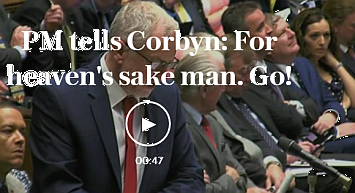
“The Brexit vote has precipitated the deepest political crisis in Britain in a generation. The nation is divided and the climate is lurching dangerously towards the far right. At this critical moment for the future of the country, the Blairites have opportunistically mounted an anti-Corbyn coup. They have been incubating this coup from day one despite Corbyn’s overwhelming mandate.”

Some guy Americans have never heard of—or if they’ve heard of him don’t know how to pronounce his name— named Jeremy Corbyn, head of the Labor Party (only they spell it “Labour,” like teen-aged girls spelling their names cute: “That Cyndy! She’s special!”

Dozens of Labour Members of Parliament (confusing, don’t they know “MP’” stands for Military Police?) want this Corbyn guy to resign.

It seems they never liked him from the get-go, and would have shrugged him off long before now, except he won a massive victory from the Party’s rank-and-file in an election.

And now he won’t go!

mod

I thought, OMG! He’s just like Bernie!

And that’s when everything began to make sense.

The ‘objective correlative’ 

Remember how just after the California primary everything looked very “Through the Looking Glass? Remember? Bernie Sanders drawing monster crowds all up and down California… and then going on to “defeat” in the Democratic Presidential primary?

Losing to a candidate who couldn’t fill a third-grade classroom without sprinkling the crowd with California Democratic officials?

hill

Sure ya do, mate.


“Mister Peabody Almost Goes to Washington”

We’ve all seen the movie. A candidate barnstorms across the state. Draws multitudes. Enthusiastic slogans chanted all around.

11

Election night is always the next scene in the montage. Basking in the approval of an excited crowd at a victory party roaring in celebration. The candidate waves for quiet (who are they kidding? Everyone knows they don’t mean it.)

But not this time. Not in California. Lucy picked up the football, took it home. It was DEFLATE-GATE  writ large.


Romeo wakes up, sees Juliet dead, tears all around. 

Many thought, “I must be dreamin’. This can’t be real.” Because there was no “objective correlative” to help bring sense to the experience. No recognizable human moment, as in “Romeo wakes up, sees Juliet dead, tears all around.”

bb

On Youtube, a baby struggles to stand; we all smile. Watch a toddler stumble across a room, swaying side to side like a drunk on a gambling cruise unexpectedly caught in high seas.

We silently urge the drooling little thing on. “Trust your tiny gyroscope, diapered one. In your forehead. Behind your Third Eye.”

There was no recognizable human moment in California, nor many of the other Democratic primaries.

Just a sinking feeling that—once again—we’ve been had.


Hey! That sinking feeling! Stay outta London 

But the jury’s still out on London.

“A massive show of support for Jeremy Corbyn has left the coup coalition of media pundits and disgruntled MPs with their jaws to the floor. With only 24 hours notice, over 10,000 people marched on parliament square to reinforce the Labour leader’s unprecedented democratic mandate.”

sup

Being Britain, things quickly got snarky.

gotime


We wish them well. They’re a plucky bunch. Some have even had their lips surgically removed, which must be a pretty painful procedure.

lip

Dallas Shootings: White Supremacists Succeeded in Provoking Black Extremism

(Editor’s note: Though at this time it’s still too early too tell whether the shooting was in fact an act of black extremism and/or a more complex situation intended to appear that way, the author’s central argument, that the social chaos created by such events benefit a select few, remains valid.)

By Eclinik Learning

Source: Covert Geopolitics

Considered to be one of the worst in US police history, five police officers were shot dead and scores wounded by snipers, presumably as a retaliation to the blatant killings of two black men this week in Louisiana and Minnesota.

Initial reports said that the three snipers were not part of those who joined the Black Lives Matter rally where the shootings occurred.

This event has just raised the confrontation between the white police and the black community to a new level.

The existence of a well-organized group of white supremacists that are occupying positions of power and within the armed services of the government is at the root of all these perennial deadly and racially loaded confrontations.

The graphic video of the murder cannot be subjected to wild speculations because it shows beyond doubt of a cold blooded murders by police officers who happens to be white.

These fanatics are not just hurting black people but they are those same extremists who were aiming their pepper spray to black and white kids alike during those massive Occupy Movement rallies, in close coordination with those same mindless talkingheads who are still running the mainstream media today.

Their aim is to provoke racial, political, and cultural conflict wherever possible. It would be a complete waste of our time to try and change their trajectory considering that these extremists completely believe in their own superiority just by the virtue of the color of their skin.

A more drastic action, like removing them all from power, should be done. These people don’t respond positively to vocal street protests.

As far as this recent event is concern, there is now a very high probability that a counter-retaliation will occur against the black people. But we don’t think that it could reach the level of a full blown racial confrontation considering that a sizable number of the Americans know exactly who the real enemy is.

Who has benefited from this drastic shift of the national attention?

This event undoubtedly and effectively shifted the national conversation away from the FBI’s absolution of one Hillary Clinton for her “extremely careless” handling of state secrets via her personal email server, which in itself was just a mere diversion of more heinous crimes that the Clinton couple have to cover-up all these years.

It would not surprise us a bit if something bad will happen on the other side of the Atlantic to stop the fallout from the Chilcot Report indicating that Tony Blair was lying about everything that has to do with the invasion of Iraq.

Aside from these obvious motivations of escaping executive accountability by covering lies with more lies, and by putting the people of the world constantly on the edge, the endless appetite for gun control and mass surveillance lies at the very foundation of all these unprovoked police shootings and false flag operations.

Only this time, those who survived for a while begun to shoot back. The only problem is that the wrong police may have been the casualties.

It is therefore a lot wiser for those would-be snipers to set their sight directly on the Eye of the Pyramid.


Related Video: