A Fed-Issued Digital Currency: The Mark of the Beast

A Fed-issued digital currency would be no more in our interests than the current dollar system.
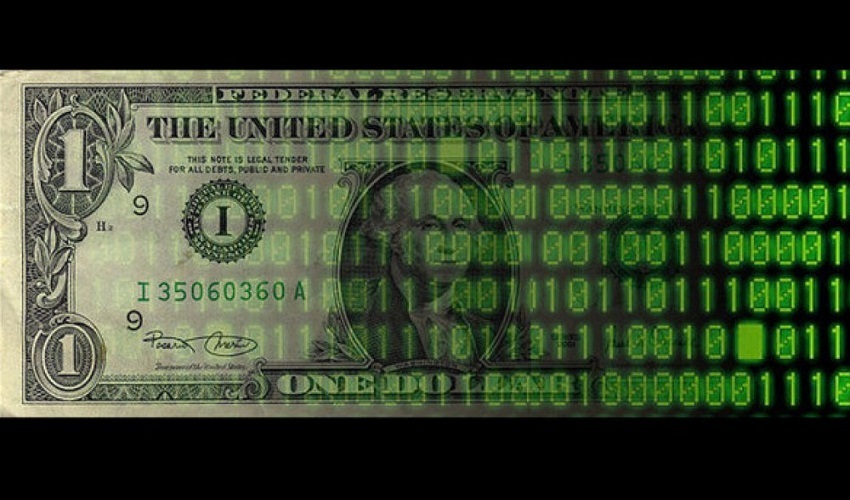
By Jeremy R. Hammond

Source: Jeremy R. Hammond Blog

China’s ‘Social Credit’ System

“And he causeth all, both small and great, rich and poor, free and bond, to receive a mark in their right hand, or in their foreheads: And that no man might buy or sell, save he that had the mark, or the name of the beast, or the number of his name.” — Revelation 13:16-17

In China, as you have likely heard, the government has been experimenting with a “social credit” system aimed at giving politicians even greater control over people’s behavior. China was, of course, also the country whose authoritarian “lockdown” response to the outbreak of SARS‑CoV‑2—the coronavirus that causes COVID‑19 and was likely engineered in a Chinese lab with US government funding—was pointed to as a model for the rest of the world to follow by the World Health Organization (WHO).

The WHO has since been aiming to acquire even more centralized global authority to issue diktats in the event of another pandemic, such as implementation of “lockdown” measures that might include travel restrictions, prevention of employment, and vaccine mandates or passport systems.

As of December 2020, around the time of the initial outbreak of the virus in Wuhan, China, social credit laws and regulations had been implemented in an estimated 80 percent of the country.

Naturally, the system is characterized by its proponents as a benevolent means to reward socially responsible people while denying privileges to unsavory and untrustworthy characters and businesses. But you and I both recognize the grave threat posed by politicians wielding this type of power and control over the population. It is an obvious threat to privacy and liberty.

The people of China regrettably but unsurprisingly appear to have welcomed this system, although the perception of public approval might be largely an artifact of people being afraid to publicly criticize the system lest their names be placed on one of the government’s “blacklists”.

As with any law or government policy, we should view it through the lens of how such power could be used as opposed to how politicians say they intend to use it.

A glimpse of how it could be used is the city of Rongcheng’s prohibition on “spreading harmful information”, violations of which could result in subtraction of points off residents’ social credit scores.

Such prohibitions must be seen in light of how governments are in the habit of interpreting “harmful information” as any information that does not align with the adopted political agenda. In the US during the COVID‑19 pandemic, there has been no greater purveyor of misinformation than the US government itself.

According to MIT Technology Review, the central government actually pressed the city to scale back the threat to individual liberty posed by its social credit system, such as enabling residents to opt-out. “The Chinese government did emphasize that all social-credit-related punishment has to adhere to existing laws,” the Review states, “but laws themselves can be unjust in the first place.”

The takeaway from that article is that “the social credit system does not (yet) exemplify abuse of advanced technologies like artificial intelligence”. But that’s no reason for the citizenry to consent to the implementation of systems that are conducive to extreme governmental abuses of authority.

A July 2019 article in Wired magazine related the example of Liu Hu, a journalist who was arrested, fined, and blacklisted, reportedly for writing about censorship and government corruption. He found himself on a “List of Dishonest Persons Subject to Enforcement by the Supreme People’s Court as ‘not qualified’ to buy a plane ticket, and banned from travelling some train lines, buying property, or taking out a loan.”

A more recent Newsweek article appropriately describes the system this way:

On an individual level, the government seeks to instill in the public an increased sense of morality to discourage everything from fraud and plagiarism to counterfeit goods and petty crime. But a system to make individual actions more transparent would necessitate the creation of tools to monitor all aspects of life. Social control, if not the original aim, could be an inevitable consequence, researchers say.

. . . While China’s vision of the system has yet to emerge as a dystopian tool for control driven by big data, there are real concerns about the way personal information is to be collected and processed to create social credit profiles, which could have lasting implications for individuals.

An untrustworthy government has no place dictating to its citizens what types of behaviors should be regarded as creating or breaking trust.

Human Rights Watch provides the example of lawyer Li Xioaolin, who was denied a plane ticket home while away on a work trip inside China because his name was on a blacklist of “untrustworthy” people in relation to a years-old court-related issue that he thought he had resolved.

According to Human Rights Watch, journalist Liu Hu was punished not for criticizing the government and exposing corruption but for having offered an apology that the government deemed “insincere” after losing a defamation case for publishing an article alleging that someone was an extortionist. Still, the organization notes, in both cases, “penalties were exacted in wildly arbitrary and unaccountable manners.” Additionally, “the courts failed to notify them, leaving them no chance to contest their treatment.”

According to the human rights organization, between 2013 and 2017, the Chinese government imposed more than seven million punishments to people for failing to carry out local court orders, which punishments have included publicly naming and shaming individuals and barring them from flights and trains.

After experiencing the totalitarianism of the disastrously harmful lockdown regimes and the accompanying efforts to coerce the population into accepting COVID‑19 vaccines and to censor truths countering the government’s incessant lies (I was permanently banned from LinkedIn, for example, for accurately reporting that the CDC’s claim that COVID‑19 vaccines provide greater protection against SARS‑CoV‑2 infection than natural immunity was a bald-faced lie), it should not be too difficult to imagine such a system being dangerously used to silence critics and punish dissenters so that whatever ruling regime can continue its crimes against humanity unobstructed.

The idea of a “social credit” score, of course, is inherently tied to the idea of central banking. In the US, the central bank is the Federal Reserve, a government-legislated private monopoly over the supply of currency. Increasingly, there is talk of a central bank digital currency, heightening concerns about the government having the means to exercise power over us and control our behavior.

“Project Hamilton”

As an example of how the Fed is exploring the idea of adopting a digital currency, the Massachusetts Institute of Technology (MIT) has teamed up with the Federal Reserve Bank of Boston under the appropriately named “Project Hamilton”.

Alexander Hamilton, of course, was instrumental in the adoption of central banking by the US government, famously at odds with Thomas Jefferson, who rightly opposed the idea and warned about the dangers inherent in such an institution. Jefferson appeared to hold the view that the means of exchange and interest rates ought to be determined by the market as opposed to being determined by fiat by a roomful of central planners.

Jefferson accurately foresaw how the government would use the central bank to pay for its spending as an alternative to raising taxes directly, and how the debt that would consequently be incurred by this uncontrolled spending would ultimately be borne by future generations.

In a letter to John Wayles Eppes in 1813, for example, Jefferson wrote:

I have said that the taxes should be continued by annual or biennial re-enactments; because a constant hold, by the nation, of the strings of the public purse, is a salutary restraint, from which an honest government ought not to wish, nor a corrupt one to be permitted, to be free. No tax should ever be yielded for longer than that of the Congress granting it, except when pledged for the reimbursement of a loan.

. . . Bank-paper must be suppressed, and the circulating medium must be restored to the nation to whom it belongs. . . . Treasury bills, bottomed on taxes, bearing, or not bearing interest, as may be found necessary, thrown into circulation, will take the place of so much gold & silver, which last, when crouded, will find an efflux into other countries, and thus keep the quantum of medium at its salutary level.

In a letter to John Taylor in 1816, Jefferson described central banking as rightly “reprobated” and as “a blot left in all our constitutions, which, if not covered, will end in their destruction”. He wrote, “And I sincerely believe with you, that banking establishments are more dangerous than standing armies; & that the principle of spending money to be paid by posterity, under the name of funding, is but swindling futurity on a large scale”.

Jefferson viewed the federal government as having no authority to institute a central banking system. As he wrote in 1791, “The incorporation of a bank, and the powers assumed by this bill, have not, in my opinion, been delegated to the United States, by the Constitution.”

The stated aim of Project Hamilton “is to investigate the technical feasibility of a general purpose central bank digital currency (CBDC) that could be used by an economy the size of the United States and to gain a hands-on understanding of a CBDC’s technical challenges, opportunities, risks, and tradeoffs.”

The project is part of MIT’s “Digital Currency Initiative”, which is aimed at bringing minds together “to conduct the research necessary to support the development of digital currency and blockchain technology.”

The aim of the collaboration with the Federal Reserve Bank of Boston has been “to develop a hypothetical CBDC.” MIT describes the possibility of a “central-bank-issued digital currency” as “a unique opportunity to address challenges in our existing payments system and design an economy that is more resilient, participatory, and open.”

We can reasonably assume that Thomas Jefferson, were he alive today, would disagree and view the idea as anathema to both a sound economy and a free society.

Noting that it was Alexander Hamilton “who laid the foundation for a U.S. central bank”, a project white paper published in February 2022 concluded that it is “critical” for research to continue for “achieving goals for a CBDC.” That is, it is not a question of whether the Fed should adopt a digital currency but how and when.

Biden’s Executive Order and Project Lithium

In January 2022, the Federal Reserve Board of Governors similarly published a paper titled “Money and Payments: The U.S. Dollar in the Age of Digital Transformation”, the aim of which was “to foster a broad and transparent public dialogue about CBDCs in general, and about the potential benefits and risks of a U.S. CBDC.”

Then in March 2022 President Joe Biden signed an “Executive Order on Ensuring Responsible Development of Digital Assets”, which declares the supposed need for the US government to “regulate” digital assets, including for the purpose of preventing circumvention of its sanctions regimes—in which context we might remember the US government’s criminal sanctions regime against Iraq in the 1990s and how Secretary of State Madeleine Albright insisted that the “price” of half-a-million dead Iraqi children was “worth it”.

The executive order, number 14067, describes how the government has an interest in maintaining the US dollar’s “central role” in “the global financial system”, which refers to the use of the dollar as a reserve currency. To that end, the order states, the Biden administration “places the highest urgency on research and development efforts into the potential design and deployment options of a United States CBDC.”

The White House is intent on determining what actions would be required to launch such a currency “if doing so is deemed to be in the national interest”. Of course, as the example of half a million excess childhood deaths in Iraq due to sanctions once again illustrates, determining just what is in the “national interest” is not a task that government policymakers seem particularly good at.

The lockdown measures, which utterly failed to project those at highest risk from COVID-19 while causing devastating harms globally, are another useful example of the ineptitude of policymakers when it comes to making decision that are in our best interests.

Following Biden’s executive order, in April 2022, the Depository Trust & Clearing Corporation (DTCC) announced “the development of the first prototype to explore how a CBDC might operate”. This endeavor was given the name “Project Lithium”, on which the DTCC is collaborating with The Digital Dollar Project (DDP), an organization that advocates US leadership “in advancing a CBDC” and encourages the executive branch of government “to support appropriate legislation” to authorize further research and development of such a currency.

The DDP published a white paper in May 2020 concluding that the US government “should, and must, take a leadership role in this new wave of digital innovation” and preserve the dollar’s role as “the world’s primary reserve currency” by working toward “the launch of a tokenized digital dollar”.

End the Fed!

Naturally, advocates of a central bank digital currency describe the aims of such a development as benign, just as the Federal Reserve system was originally established on the pretext that having a more centrally controlled economy would benefit all.

In truth, the Federal Reserve system serves the interests of the financially and political elite at the expense of the rest of us. Central banking itself, whatever the form of currency issued, is harmful to the economy because central banks essentially exist to effect a transfer of wealth upward. Schools of economic thought like Keynesianism and Modern Monetary Theory (MMT), which I like to refer to as “Keynesianism 2.0”, exist to justify the existence of central banks.

The Fed, a government-legislated private monopoly over the currency supply, enables the government to spend on whatever, including endless wars (euphemistically called “defense” spending), but the means of paying for it all, the creation of “money” out of thin air, results in upward wealth transfer. The elite classes who receive the newly created dollars first are able to spend it for purchasing assets prior to the resulting devaluation that manifests in the form of higher prices for goods and services.

Monetary inflation robs us of our purchasing power and so serves as a hidden tax. It also causes widespread malinvestment and major economic distortions like the housing bubble that burst in 2007 and precipitated the 2008 financial crisis, not to mention the current housing bubble and general asset inflation. (For more on that, see my book Ron Paul vs. Paul Krugman: Austrian vs. Keynesian Economics in the Financial Crisis.)

We are meant to believe we need centralized control over the currency supply for economic growth, but central banks instead serve to impede real economic growth in favor of enabling the government’s endlessly wasteful and harmful spending.

The chief appeal of a cryptocurrency like Bitcoin is that it is a decentralized medium of exchange that serves to compete with central-bank-issued currency and potentially enables people to opt-out of the exploitative dollar system. The idea of a “legal tender” digital currency in the hands of the bankers and politicians is anathema to the whole concept of a peer-to-peer electronic cash system.

One might argue that the replacement of print dollars with a centrally controlled cryptocurrency is just a natural evolution from the current system, in which exchange of actual cash is becoming less frequent and most transactions occur digitally anyway. We should keep up with the times and adapt to advancements in technology, the argument goes.

However, this overlooks the more fundamental issue that we should not have central banks in the first place. The way I see it, the movement towards replacing the US dollar with a Fed-issued cryptocurrency is far from benign. We have seen in the past few years just how far government policymakers are willing to go to exercise authoritarian control over us.

To illustrate, remember how businesses deemed “non-essential” were shut down by clueless bureaucrats under threat of punishment, and how coercive measures including mandates and travel restrictions were used to get people to accept COVID‑19 vaccinations?

With the World Economic Forum (WEF) having announced its “Great Reset” agenda, which ties directly into the global mass vaccination agenda, the advocates of greater centralized control over society do not deserve the benefit of our doubt about their intentions. It would be naïve to think that if the authoritarians in government had even greater means to penalize citizens for disobedience to the regime that they would not attempt to use it. It is safer to assume that if they can utilize a digital currency to control our behavior, they will.

It seems therefore imperative to oppose a centralized digital currency, but we also need to go further than that and oppose the existence of the Federal Reserve altogether. Whatever the form of currency, centralized economic planning is an abomination and anathema to the principle of a free market.

“And I heard another voice from heaven, saying, Come out of her, my people, that ye be not partakers of her sins, and that ye receive not of her plagues.” — Revelation 18:4

A Nanny State Idiocracy: When the Government Thinks It Knows Best

By John & Nisha Whitehead

Source: The Rutherford Institute

“Whether the mask is labeled fascism, democracy, or dictatorship of the proletariat, our great adversary remains the apparatus—the bureaucracy, the police, the military.”—Simone Weil, French philosopher

It’s hard to say whether we’re dealing with a kleptocracy (a government ruled by thieves), a kakistocracy (a government run by unprincipled career politicians, corporations and thieves that panders to the worst vices in our nature and has little regard for the rights of American citizens), or if we’ve gone straight to an idiocracy

For instance, an animal welfare bill introduced in the Florida state legislature would ban the sale of rabbits in March and April, prohibit cat owners from declawing their pets, make it illegal for dogs to stick their heads out of car windows, force owners to place dogs in a harness or in a pet seatbelt when traveling in a car, and require police to create a public list of convicted animal abusers.

A Massachusetts law prohibits drivers from letting their cars idle for more than five minutes on penalty of a $100 fine ($500 for repeat offenders), even in the winter. You can also be fined $20 or a month in jail for scaring pigeons.

This overbearing Nanny State despotism is what happens when government representatives (those elected and appointed to work for us) adopt the authoritarian notion that the government knows best and therefore must control, regulate and dictate almost everything about the citizenry’s public, private and professional lives.

The government’s bureaucratic attempts at muscle-flexing by way of overregulation and overcriminalization have reached such outrageous limits that federal and state governments now require on penalty of a fine that individuals apply for permission before they can grow exotic orchids, host elaborate dinner parties, gather friends in one’s home for Bible studies, give coffee to the homeless, let their kids manage a lemonade stand, keep chickens as pets, or braid someone’s hair, as ludicrous as that may seem.

Consider, for example, that businesses in California were ordered to designate an area of the children’s toy aisle “gender-neutral” or face a fine, whether or not the toys sold are traditionally marketed to girls or boys such as Barbies and Hot Wheels. California schools are prohibited from allowing students to access websites, novels or religious works that reflect negatively on gays. And while Californians are free to have sex with whomever they choose (because that’s none of the government’s business), removing a condom during sex without consent could make you liable for general, special and punitive damages.

It’s getting worse.

Almost every aspect of American life today—especially if it is work-related—is subject to this kind of heightened scrutiny and ham-fisted control, whether you’re talking about aspiring “bakers, braiders, casket makers, florists, veterinary masseuses, tour guides, taxi drivers, eyebrow threaders, teeth whiteners, and more.”

For instance, whereas 70 years ago, one out of every 20 U.S. jobs required a state license, today, almost 1 in 3 American occupations requires a license.

The problem of overregulation has become so bad that, as one analyst notes, “getting a license to style hair in Washington takes more instructional time than becoming an emergency medical technician or a firefighter.”

This is what happens when bureaucrats run the show, and the rule of law becomes little more than a cattle prod for forcing the citizenry to march in lockstep with the government.

Overregulation is just the other side of the coin to overcriminalization, that phenomenon in which everything is rendered illegal and everyone becomes a lawbreaker.

As policy analyst Michael Van Beek warns, the problem with overcriminalization is that there are so many laws at the federal, state and local levels—that we can’t possibly know them all.

“It’s also impossible to enforce all these laws. Instead, law enforcement officials must choose which ones are important and which are not. The result is that they pick the laws Americans really must follow, because they’re the ones deciding which laws really matter,” concludes Van Beek. “Federal, state and local regulations — rules created by unelected government bureaucrats — carry the same force of law and can turn you into a criminal if you violate any one of them… if we violate these rules, we could be prosecuted as criminals. No matter how antiquated or ridiculous, they still carry the full force of the law. By letting so many of these sit around, just waiting to be used against us, we increase the power of law enforcement, which has lots of options to charge people with legal and regulatory violations.”

This is the police state’s superpower: it has been vested with the authority to make our lives a bureaucratic hell.

That explains how a fisherman can be saddled with 20 years’ jail time for throwing fish that were too small back into the water. Or why police arrested a 90-year-old man for violating an ordinance that prohibits feeding the homeless in public unless portable toilets are also made available.

The laws can get downright silly. For instance, you could also find yourself passing time in a Florida slammer for such inane activities as singing in a public place while wearing a swimsuit, breaking more than three dishes per day, farting in a public place after 6 pm on a Thursday, and skateboarding without a license.

However, the consequences are all too serious for those whose lives become grist for the police state’s mill. A few years back, police raided barber shops in minority communities, resulting in barbers being handcuffed in front of customers, and their shops searched without warrants. All of this was purportedly done in an effort to make sure that the barbers’ licensing paperwork was up to snuff.

In this way, America has gone from being a beacon of freedom to a locked down nation. And “we the people,” sold on the idea that safety, security and material comforts are preferable to freedom, have allowed the government to pave over the Constitution in order to erect a concentration camp.

We labor today under the weight of countless tyrannies, large and small, carried out in the so-called name of the national good by an elite class of governmental and corporate officials who are largely insulated from the ill effects of their actions.

We increasingly find ourselves badgered, bullied and browbeaten into bearing the brunt of their arrogance, paying the price for their greed, suffering the backlash for their militarism, agonizing as a result of their inaction, feigning ignorance about their backroom dealings, overlooking their incompetence, turning a blind eye to their misdeeds, cowering from their heavy-handed tactics, and blindly hoping for change that never comes. 

The overt signs of the despotism exercised by the increasingly authoritarian regime that passes itself off as the United States government (and its corporate partners in crime) are all around us: censorship, criminalizing, shadow banning and de-platforming of individuals who express ideas that are politically incorrect or unpopular; warrantless surveillance of Americans’ movements and communications; SWAT team raids of Americans’ homes; shootings of unarmed citizens by police; harsh punishments meted out to schoolchildren in the name of zero tolerance; community-wide lockdowns and health mandates that strip Americans of their freedom of movement and bodily integrity; armed drones taking to the skies domestically; endless wars; out-of-control spending; militarized police; roadside strip searches; privatized prisons with a profit incentive for jailing Americans; fusion centers that spy on, collect and disseminate data on Americans’ private transactions; and militarized agencies with stockpiles of ammunition, to name some of the most appalling.

Yet as egregious as these incursions on our rights may be, it’s the endless, petty tyrannies—the heavy-handed, punitive-laden dictates inflicted by a self-righteous, Big-Brother-Knows-Best bureaucracy on an overtaxed, overregulated, and underrepresented populace—that illustrate so clearly the degree to which “we the people” are viewed as incapable of common sense, moral judgment, fairness, and intelligence, not to mention lacking a basic understanding of how to stay alive, raise a family, or be part of a functioning community.

In exchange for the promise of an end to global pandemics, lower taxes, lower crime rates, safe streets, safe schools, blight-free neighborhoods, and readily accessible technology, health care, water, food and power, we’ve opened the door to lockdowns, militarized police, government surveillance, asset forfeiture, school zero tolerance policies, license plate readers, red light cameras, SWAT team raids, health care mandates, overcriminalization, overregulation and government corruption.

In the end, such bargains always turn sour.

We relied on the government to help us safely navigate national emergencies (terrorism, natural disasters, global pandemics, etc.) only to find ourselves forced to relinquish our freedoms on the altar of national security, yet we’re no safer (or healthier) than before.

We asked our lawmakers to be tough on crime, and we’ve been saddled with an abundance of laws that criminalize almost every aspect of our lives. So far, we’re up to 4500 criminal laws and 300,000 criminal regulations that result in average Americans unknowingly engaging in criminal acts at least three times a day. For instance, the family of an 11-year-old girl was issued a $535 fine for violating the Federal Migratory Bird Act after the young girl rescued a baby woodpecker from predatory cats.

We wanted criminals taken off the streets, and we didn’t want to have to pay for their incarceration. What we’ve gotten is a nation that boasts the highest incarceration rate in the world, with more than 2.3 million people locked up, many of them doing time for relatively minor, nonviolent crimes, and a private prison industry fueling the drive for more inmates, who are forced to provide corporations with cheap labor.

A special report by CNBC breaks down the national numbers:

One out of 100 American adults is behind bars — while a stunning one out of 32 is on probation, parole or in prison. This reliance on mass incarceration has created a thriving prison economy. The states and the federal government spend about $74 billion a year on corrections, and nearly 800,000 people work in the industry.

We wanted law enforcement agencies to have the necessary resources to fight the nation’s wars on terror, crime and drugs. What we got instead were militarized police decked out with M-16 rifles, grenade launchers, silencers, battle tanks and hollow point bullets—gear designed for the battlefield, more than 80,000 SWAT team raids carried out every year (many for routine police tasks, resulting in losses of life and property), and profit-driven schemes that add to the government’s largesse such as asset forfeiture, where police seize property from “suspected criminals.”

According to the Washington Post, these funds have been used to buy guns, armored cars, electronic surveillance gear, “luxury vehicles, travel and a clown named Sparkles.” Police seminars advise officers to use their “department wish list when deciding which assets to seize” and, in particular, go after flat screen TVs, cash and nice cars.

In Florida, where police are no strangers to asset forfeiture, Florida police have been carrying out “reverse” sting operations, where they pose as drug dealers to lure buyers with promises of cheap cocaine, then bust them, and seize their cash and cars. Over the course of a year, police in one small Florida town seized close to $6 million using these entrapment schemes.

We fell for the government’s promise of safer roads, only to find ourselves caught in a tangle of profit-driven red light cameras, which ticket unsuspecting drivers in the so-called name of road safety while ostensibly fattening the coffers of local and state governments. Despite widespread public opposition, corruption and systemic malfunctions, these cameras—used in 24 states and Washington, DC—are particularly popular with municipalities, which look to them as an easy means of extra cash.

One small Florida town, population 8,000, generates a million dollars a year in fines from these cameras. Building on the profit-incentive schemes, the cameras’ manufacturers are also pushing speed cameras and school bus cameras, both of which result in heft fines for violators who speed or try to go around school buses.

As I make clear in my book Battlefield America: The War on the American People and in its fictional counterpart The Erik Blair Diaries, this is what happens when the American people get duped, deceived, double-crossed, cheated, lied to, swindled and conned into believing that the government and its army of bureaucrats—the people we appointed to safeguard our freedoms—actually have our best interests at heart.

The problem with these devil’s bargains is that there is always a catch, always a price to pay for whatever it is we valued so highly as to barter away our most precious possessions.

We’ve bartered away our right to self-governance, self-defense, privacy, autonomy and that most important right of all: the right to tell the government to “leave me the hell alone.”

The MSM Never Was Objective—and It Never Questioned Power, Either

By Iain Davis

Source: The Disillusioned Blogger

In his excellent exposé of the recent decision by the Knight-Cronkite News Lab (KCNL) to advocate journalism that goes beyond objectivity, and in light of the report from the Columbia Journalism Review (CJR) confirming that RussiaGate was fabricated nonsense, genuinely independent researcher, writer and filmmaker James Corbett made a number of very salient points.

As Corbett points out:

As a moment’s sober reflection will immediately reveal, the mouthpiece mockingbirds of the controlled establishment media have never been objective and they have no credibility to damage.

But there is far more to this particular psyop than merely covering up the inconvenient history of media. The new narrative, sold to us in this instance by both KCNL and the CJR, is laying the foundations for a transformation of the media landscape.

The establishment wants us to believe that our “trust” in journalism is a vital component of our democracy—and, moreover, that the state can determine which news media organisation is deserving of our “trust.”

In truth, if democratic principles really matter to us, it is essential that we never trust any “news reports” from any journalist or news provider. Democracy places a duty upon us to be fierce critical thinkers. We should never unquestioningly accept anything we are told.

Journalism Is Story Telling

Every mainstream media (MSM) and “alternative media” outlet presents narratives. They are in the business of telling stories, not simply presenting “objective” facts.

Good journalism expresses an opinion and then cites the evidence that informs it. Well written journalism does this within the engaging and intriguing narratives it weaves. But no journalism is free from the journalist’s own conformation bias, and the tenor of the story is often directed by the editorial policy and allegiances of the publisher.

Pulitzer Prize winner Seymour Hersh’s recent investigation, in which he exposes the likelihood that the US government was behind the destruction of the Nord Stream II pipeline, is only available via independent outlets and on his own Substack. Despite this apparently being a story of enormous magnitude, the MSM seems extremely reluctant to bring it to wider attention. You can read about it only in the so-called “alternative media.”

While some MSM outlets report the official denial of Hersh’s piece, none have lent it much credibility, and many have been quick to cast aspersions on Hersh himself. Yes, the old game of attacking the messenger while avoiding the content of the message.

It is fair to say, based on the Hersh article alone, that no one can really verify his revelations in specific regard to Nord Stream II. He presents no evidence other than anecdotal accounts from unnamed sources. But nowhere in the MSM does there appear to be any interest in pursuing the needed investigation that Hersh’s piece demands.

Thus, it remains a piece of fantastic journalism, most notably because the very specific references it makes to orders given and operations undertaken during the BALTOPS22 exercise can be investigated. Detailed questions can be asked of officials. The blanket denials of Hersh’s story and his precise allegations are nowhere near enough to discredit it.

Given all the circumstantial evidence that also points towards US and NATO aligned culpability, his journalism—a great story—adds real fuel to the fire. This is real investigative journalism. That the story he presents in part reflects his own perspective is irrelevant.

The MSM Was Never Objective

One of the MSM’s main criticisms of the so-called “alternative media” is that it can often be described as activist journalism. This allegation implies that the perspective of the alternative news journalist biases their reporting. But such a criticism is itself a deception, because all journalism reports from a perspective.

There are basic commercial reasons why objectivity doesn’t suit journalism. Consumers of “news” don’t want to simply know what the facts are. They also want a steer on the broader implications of those facts. If that reaffirms their existing world view, all the better for sales. We all want to believe we are right and not be constantly reminded that we are probably wrong.

This is why very few Guardian readers also read the Daily Telegraph or Sun readers the Mirror, even when the presented “facts” are essentially the same. We pay for the perspective we agree with, not simply an objective reporting of the facts.

It is science, not journalism, that strives to achieve absolute objectivity in its pursuit of empirical facts. But the problem with scientific objectivity, beyond its corruption, is that it tends to introduce immense complexity and can be extremely boring to read. It doesn’t lend itself well to stirring up emotions or selling media content.

Other than a few obsessive researchers and the scientists themselves, few of us actually want to read highly technical and sterile scientific papers. We rely upon the journals and the MSM to tell us what the science says, wrongly assuming that their reporting of it is “objective.”

Our faith in the MSM places us in a vulnerable position, especially when it comes to the reporting of hard facts, such as those supposedly revealed by science. If those same alleged “facts” then become the basis for justifying government policy and/or our own decisions, then we had better be damn sure that our belief in the veracity of the story is well-placed.

The evidence that the MSM doesn’t even report the facts accurately is overwhelming. The CJR has exposed RussiaGate as the politically motivated nonsense it was. But this rubbish was relentlessly spewed out on both sides of the Atlantic for more than a year—alongside the equally baseless Skripal yarn—by a majority of MSM outlets. The obvious propaganda was designed to illegitimately demonise the Russian government.

https://odysee.com/$/download/Skripal-Salisbury-Chemical-Weapons-Attack-2018/890ead50a0e7139bbcca98425260c767e938590e

The CJR report demonstrates that today’s Western MSM is a mass purveyor of mis- and disinformation. We are presently regaled with highly spurious Ukraine war propaganda. This is the culmination of the Russophobic Western MSM agenda that has been building for many years.

The scene has seemingly been set, and we have all been psychologically prepared for the current conflict. This makes it easier for us to imagine that the Russians are our enemy.

State propaganda partnerships with the MSM are nothing new. Three examples quickly come to mind:

— British military intelligence were feeding senior broadsheet correspondents “stories” for decades, long before the MSM made up tales about WMD in Iraq to convince the public to accept a fake casus belli for the Iraq War.

— The Church Committee formally exposed the “Operation Mockingbird” network in the US in 1975. The CIA had been manipulating the reporting of the US MSM for many years, feeding selected operative journalists intel that they then reported as “objective journalism.”

— The Mockingbird Operation PBSuccess employed public relations guru Edward Bernays to use the media to overthrow the Guatemalan government on behalf of the United Fruit Company in 1954.

While proven MSM disinformation operations and campaigns, such as these, have purportedly been assigned to the annals of history, disinfo activity is manifestly ongoing. If anything, state control of the MSM narrative for propaganda purposes has reached heights that even Bernays couldn’t have imagined.

State propaganda has been privatised. Governments channel taxpayers’ money to their global corporate partners, which in turn pay the MSM to produce the desired disinformation. During the pseudopandemic we saw whole teams of behavioural scientists at the World Health Organisation global governance level and in various nations states “use” the MSM to unethically deploy applied psychology and disinformation to tackle what the establishment and its MSM hypocritically called “the infodemic.”

When Spi-B—the team of behavioural change experts within the UK’s Scientific Advisory Group for Emergencies (SAGE)—recommended that the UK government should “use the media” to increase “the perceived level of personal threat” to convince British people that they were living through a pandemic, contrary to the evidence of their own eyes, the MSM dutifully obliged. They launched numerous corporate backed terror campaigns upon an unsuspecting public.

We are constantly told by the political class that “press freedom” is an essential part of our democracy. If the MSM really were a pluralistic and free media, it wouldn’t be possible to “use” it for propaganda. There would be too many dissenting articles by investigative MSM journalists to maintain a single, uniform narrative across all outlets simultaneously. But it isn’t a pluralistic and free media and never was, so it is entirely possible for the MSM to be co-opted. What does this say about our alleged democracy?

The so-called “infodemic,” identified by the World Health Organisation as being “just as dangerous” as an alleged global pandemic, included any and all information that questioned the diktats of our “democratic” policymakers. The MSM attacked all dissent—literally without question—on the behalf of governments and intergovernmental authorities and their corporate partners.

The infodemic, according to the establishment, was prompted by the public’s questions about government policy, about “science” as reported by the MSM, and about data that revealed statistical manipulation. The infodemic was also prompted by the MSM looking askance at sceptical scientific papers shared by people who dared question the reported “science” as well as at the millions of people who raised their voices in mass protests. These protests were either ignored by the MSM or the protestors views were distorted and their peaceful demonstrations labelled “extremist.”

There was nothing remotely “objective” about any of this mainstream “news coverage.” Rather, in total obedience to the state, the Western MSM attacked informed opinion, ridiculed all questions and demonised individuals who did not comply. Not because there was any justification for doing so, but because that is the role of the MSM. Objectivity is nowhere in sight, nor has it ever been.

The MSM Has Never Questioned Power

The Knight-Cronkite News Lab (KCNL) goal is to create a “set of standards for trustworthy news.” Indeed, maintaining the public’s “trust” is the overwhelming fixation of the MSM and its government partners. We are urged to place our faith in those who evidently lie to us and suppress facts all the time.

At one point the KCNL noted:

As early as the turbulent 1960s, some younger journalists, especially investigative reporters, began to question what objectivity really meant if it did not challenge power, privilege and inequality.

Similarly, the CJR report on RussiaGate states that “primary missions” of journalism include “informing the public and holding powerful interests accountable.”

We are told that “holding power to account,” or watchdog journalism, is the core principle of journalism. Yet nowhere in the International Federation of Journalists Charter of Ethics or in the UK National Union of Journalists Code of Conduct is there any mention of this alleged principle.

The American Press Association’s (APA) Principles of Journalism does say that journalism must serve as an independent monitor of power. But this “principle” speaks more about defending journalists’ alleged legal “rights” than it does about exposing any wrongdoing:

Journalism has an unusual capacity to serve as watchdog over those whose power and position most affect citizens. The Founders recognized this to be a rampart against despotism when they ensured an independent press; courts have affirmed it; citizens rely on it. As journalists, we have an obligation to protect this watchdog freedom by not demeaning it in frivolous use or exploiting it for commercial gain.

The APA’s watchdog principle is supposedly protected by the government and its courts. It is not a “right,” but rather a permit bestowed upon American journalists by the establishment. This permit can be rescinded. The extent to which journalists in the US can question “power” is based solely on the protection that legacy journalism receives from the institutions it allegedly questions.

Demeaning something as frivolous is precisely what the MSM does when it labels people as conspiracy theorists, as science deniers or as COVID deniers. These attacks are rarely, if ever, based upon any exploration of the evidence. In fact, the labelling system itself is used to omit, obscure or “deny” the evidence.

All the APA’s principles mean is that certain subjects and certain kinds of evidence, characterised as “frivolous,” must not be reported by its members. What is or is not considered “frivolous” is entirely subjective. Given journalism’s legislative “protections,” it seems pretty clear what will be considered “frivolous.” A high degree of subjectivity, not objectivity, is the full extent of the APA members’ ethical commitment to “watchdog” journalism.

We only need look at the history we’ve discussed to understand that the news media barely and rarely holds power to account. Instead, the MSM is more frequently an extension of state and corporate power and is used to control the people through disinformation, omission and misdirection rather than to inform them and question power of their behalf.

This is not to say that good MSM journalism doesn’t exist. But, on those few occasions when MSM journalists do expose state crimes, they pay a terrible price for doing so. Julian Assange is among the small band of journalists who have dared to question power. He currently languishes in a British high-security prison precisely because he did so.

The MSM doesn’t question power when it deceives the public about chemical weapon attacks on behalf of the state. It isn’t holding power to account with its refusal to investigate, or even report, evidence of malfeasance in office. Its ignoring of state crimes can in no way be considered “watchdog freedom.” And it certainly does not act as any kind of watchdog when it simply reports whatever it is ordered to report by a centrally controlled global propaganda network.

We Are the Problem and the Solution

Social media has been lambasted for corralling its users into self-affirming information silos. While this is somewhat concerning, it isn’t anything new. The technological capability of social media to control opinion is an added dimension, to be sure, but the MSM has been doing exactly the same thing for more than a century.

Unfortunately, the MSM is able to propagandise us with relative ease. It does this partly by exploiting our own misconceptions. While we all seem to agree that the Russian and Chinese MSM are state propaganda, we Westerners, for some unknown reason, apparently imagine that our own mainstream media isn’t.

There is, however, a caveat with regard to this apparent gullibility. Research statistics show that there is a remarkable lack of trust in the MSM in the West. Notably, in the US “trust” in the news is as low as 26%. The UK fares little better, at just 34%. “Trust” in the news is higher in Scandinavian countries.

We only need have brief conversations with friends and family to realise that the propaganda does, in fact, work. But what explains this disconnect between our lack of trust in the MSM with our continuing willingness to believe what it tells us?

The answer lies in the greatest achievement of the Western MSM and the parasite class it serves: They have convinced us that our media is free and is pluralistic—this despite it never being true.

Consequently, it seems that while we are wary of spin and propaganda, we refuse to contemplate the likelihood that the MSM is out-and-out lying to us. Perhaps that is because we perceive the MSM as basically serving the public interest—even if we admit to ourselves that it bends the truth a little. Our scepticism does not extend as far as disbelief.

We therefore remain unable to reconcile our credulous acceptance of MSM claims about itself with the reality that we are being misled en masse by that same institution. Cognitive dissonance—the uncomfortable psychological sensation we experience when we hold two or more contradictory thoughts at the same time—may account for our irreconcilable beliefs.

In other words, we are caught between not “trusting” the MSM, on the one hand, and, on the other, our inability to accept the fact that virtually nothing the MSM tells us is true. The implications of this dichotomy are beyond anything we want to contemplate. As a result, we still believe that “the news” is our window on the world.

If you think about it, the idea that all the important global events of the day can be condensed into a single “newspaper” or a 30-minute “evening news” broadcast is quite ridiculous. Even if it were composed of honest, unbiased reports, which it seldom is, “the news” cannot provide us with anything approaching a reasonable understanding of what is actually going on.

Therefore, if we genuinely want to know what’s happening, we have to actively seek information and critically evaluate it ourselves. As James Corbett wrote:

Granted, the realization that all media is constructed for us by someone with an interest in making us believe something is not a happy one for most people. Instead, it is a deeply unpopular realization, because it means we can’t just switch on the evening news, switch off our brain, and expect some totally neutral journalistic saviour to come along and hand us “the news” from on high.

Like it or not, it is our responsibility to think critically about all information, no matter who relays it. This responsibility applies equally to the stories we are fed by the “alternative media.” This article should be read critically! It is, after all, just information that’s being passed along to you.

The Knight-Cronkite News Lab suggests that journalists should give their “readers, viewers, listeners and users valuable information that helps them make better decisions and lead better lives.”

Here, the new breed of MSM journalists, no more nor less objective than their predecessors, has been given the task of reporting “the news” from a value-driven perspective. The aim is to change us by making us “better” people. So what are the values the new breed of journalists are being taught to advocate?

KCNL tell us:

There is broad consensus today about the reality of climate change and the threats that it poses. That may well inform how many resources a newsroom devotes to reporting on the issue as well as any point of view its stories reflect. The same might go for opposition to systemic racism, say, or support for LGBTQ rights. [. . .] One value we believe is worth stating out loud is support for democratic institutions, which are under attack on multiple fronts. Trustworthy news is essential to sustaining a healthy democracy.

Herein lies the problem. Every one of these “values” serves global political agendas and dovetails neatly with government policy and, perhaps most notably, with global governance policy. That is to say, the MSM’s new values are exactly the same as their old values. Their “new” objective, just like the old objective, is to advocate for power, not question it.

Contrary to the KCNL’s claims, democracy is not founded upon our acceptance of whatever we are told by government “institutions.” Rather, it is predicated upon our ability not just to question the state but to limit it. Thus, KCNL’s contention that a “healthy democracy” is one where “democratic institutions” assert sovereignty over us is entirely false.

To point out that these institutions have no authority over us whatsoever is not to attack “democracy.” On the contrary, doing so defends “democracy.” But you will never hear that from the MSM. The MSM’s continuing mission is to maintain the lies that ensure we never realise this “truth.”

It is ironic that the MSM attacks their alternative counterparts for advocacy journalism and yet the MSM’s own apparent solution to the trust issue that preoccupies it is to itself emulate advocacy journalism. The difference? The alternative media is far more likely to advocate the questioning of power, while the MSM looks set to continue advocating for power.

Seeing as how the concept of “news” is, in and of itself, absurd, the suggestion that news should be “trusted” simply adds another layer of misdirection to this new MSM advocacy journalism. So, if our “faith” in the stories we are told is part of the problem, a solution is self-evident. We should abandon any notion of “trust.” We should invest our efforts in being “better” critical thinkers.

The “alternative” media outlet UK Column sums up this point nicely. It asks:

Why should I trust the UK Column? Put simply, you shouldn’t. The question of whether or not to trust a news organisation is a false choice. Making such a choice is promoted by government, the old media, and two new organisation types: the fact checker and the trust provider.

It disenfranchises readers, viewers and listeners. It is based on the principle that if you trust the media organisation you are visiting, there is no need for you to check the information they present. So we ask you not to trust us. Instead, view everything published here with a critical eye. Where possible, primary source material is made available for everything we publish: check it; make up your own mind.

In his previously referenced article, James Corbett provides a list of questions we should all ask ourselves whenever we encounter information offered by any source. We don’t need government or any other “democratic institution” to control information for us, nor we do need to be told what to think about it. We just need to think critically and answer these simple questions to our own satisfaction:

  • Why is this media outlet showing us this report?
  • What interest do they have in making us think a particular way about the issue presented?
  • Can the information in the report be independently confirmed or triangulated from other sources?
  • Whose viewpoint is being shown, and how is that viewpoint portrayed? Whose viewpoint is being excluded? Why?
  • What language is being used to frame the issue?
  • What does the report make us believe about the world?
  • Are we in agreement with the report? Why or why not?

Ultimately, as ever, the choice is yours. You can gather information from any source you wish. If you want to know what the state wants you to believe and what behaviour it expects of you, then go to the MSM. If you want to explore broader criticism of government and its policies, then the more independent “alternative media” provides richer pickings.

Treat those two impostors just the same. There is honest, high-quality journalism in both. There is also propaganda to be found in both. Fortunately, if you answer James Corbett’s suggested questions, you’ll be able to spot the difference more often than not.

Don’t Bow Down to a Dictatorial Government. America Is a Prison Disguised as Paradise

By John & Nisha Whitehead

Source: The Rutherford Institute

“If all that Americans want is security, they can go to prison. They’ll have enough to eat, a bed and a roof over their heads. But if an American wants to preserve his dignity and his equality as a human being, he must not bow his neck to any dictatorial government.”— President Dwight D. Eisenhower

The government wants us to bow down to its dictates.

It wants us to buy into the fantasy that we are living the dream, when in fact, we are trapped in an endless nightmare of servitude and oppression.

Indeed, with every passing day, life in the American Police State increasingly resembles life in the dystopian television series The Prisoner.

First broadcast 55 years ago in the U.S., The Prisonerdescribed as “James Bond meets George Orwell filtered through Franz Kafka”—confronted societal themes that are still relevant today: the rise of a police state, the loss of freedom, round-the-clock surveillance, the corruption of government, totalitarianism, weaponization, group think, mass marketing, and the tendency of human beings to meekly accept their lot in life as prisoners in a prison of their own making.

Perhaps the best visual debate ever on individuality and freedom, The Prisoner centers around a British secret agent who abruptly resigns only to find himself imprisoned in a virtual prison disguised as a seaside paradise with parks and green fields, recreational activities and even a butler.

While luxurious, the Village’s inhabitants have no true freedom, they cannot leave the Village, they are under constant surveillance, all of their movements tracked by militarized drones, and stripped of their individuality so that they are identified only by numbers.

“I am not a number. I am a free man,” is the mantra chanted in each episode of The Prisoner, which was largely written and directed by Patrick McGoohan, who also played the title role of Number Six, the imprisoned government agent.

Throughout the series, Number Six is subjected to interrogation tactics, torture, hallucinogenic drugs, identity theft, mind control, dream manipulation, and various forms of social indoctrination and physical coercion in order to “persuade” him to comply, give up, give in and subjugate himself to the will of the powers-that-be.

Number Six refuses to comply.

In every episode, Number Six resists the Village’s indoctrination methods, struggles to maintain his own identity, and attempts to escape his captors. “I will not make any deals with you,” he pointedly remarks to Number Two, the Village administrator a.k.a. prison warden. “I’ve resigned. I will not be pushed, filed, stamped, indexed, debriefed or numbered. My life is my own.”

Yet no matter how far Number Six manages to get in his efforts to escape, it’s never far enough.

Watched by surveillance cameras and other devices, Number Six’s attempts to escape are continuously thwarted by ominous white balloon-like spheres known as “rovers.”

Still, he refuses to give up.

“Unlike me,” he says to his fellow prisoners, “many of you have accepted the situation of your imprisonment, and will die here like rotten cabbages.”

Number Six’s escapes become a surreal exercise in futility, each episode an unfunny, unsettling Groundhog’s Day that builds to the same frustrating denouement: there is no escape.

As journalist Scott Thill concludes for Wired, “Rebellion always comes at a price. During the acclaimed run of The Prisoner, Number Six is tortured, battered and even body-snatched: In the episode ‘Do Not Forsake Me Oh My Darling,’ his mind is transplanted to another man’s body. Number Six repeatedly escapes The Village only to be returned to it in the end, trapped like an animal, overcome by a restless energy he cannot expend, and betrayed by nearly everyone around him.”

The series is a chilling lesson about how difficult it is to gain one’s freedom in a society in which prison walls are disguised within the seemingly benevolent trappings of technological and scientific progress, national security and the need to guard against terrorists, pandemics, civil unrest, etc.

As Thill noted, “The Prisoner was an allegory of the individual, aiming to find peace and freedom in a dystopia masquerading as a utopia.”

The Prisoner’s Village is also an apt allegory for the American Police State, which is rapidly transitioning into a full-fledged Surveillance State: it gives the illusion of freedom while functioning all the while like a prison: controlled, watchful, inflexible, punitive, deadly and inescapable.

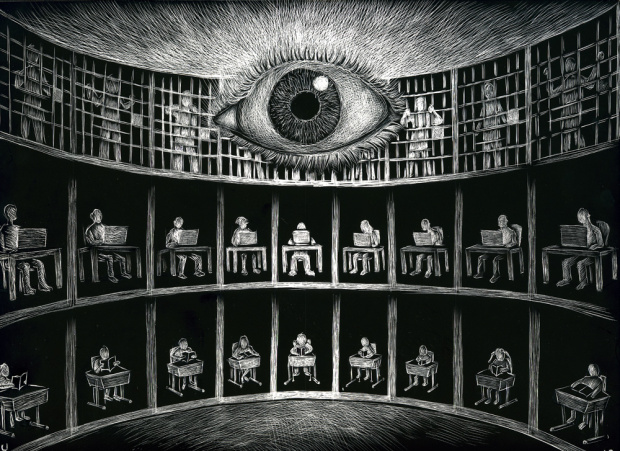
The American Surveillance State, much like The Prisoner’s Village, is a metaphorical panopticon, a circular prison in which the inmates are monitored by a single watchman situated in a central tower. Because the inmates cannot see the watchman, they are unable to tell whether or not they are being watched at any given time and must proceed under the assumption that they are always being watched.

Eighteenth century social theorist Jeremy Bentham envisioned the panopticon prison to be a cheaper and more effective means of “obtaining power of mind over mind, in a quantity hitherto without example.”

Bentham’s panopticon, in which the prisoners are used as a source of cheap, menial labor, has become a model for the modern surveillance state in which the populace is constantly being watched, controlled and managed by the powers-that-be while funding its existence.

Nowhere to run and nowhere to hide: this is the mantra of the architects of the Surveillance State and their corporate collaborators.

Government eyes are watching you.

They see your every move: what you read, how much you spend, where you go, with whom you interact, when you wake up in the morning, what you’re watching on television and reading on the internet.

Every move you make is being monitored, mined for data, crunched, and tabulated in order to amass a profile of who you are, what makes you tick, and how best to control you when and if it becomes necessary to bring you in line.

When the government sees all and knows all and has an abundance of laws to render even the most seemingly upstanding citizen a criminal and lawbreaker, then the old adage that you’ve got nothing to worry about if you’ve got nothing to hide no longer applies.

Apart from the obvious dangers posed by a government that feels justified and empowered to spy on its people and use its ever-expanding arsenal of weapons and technology to monitor and control them, we’re approaching a time in which we will be forced to choose between bowing down in obedience to the dictates of the government—i.e., the law, or whatever a government official deems the law to be—and maintaining our individuality, integrity and independence.

When people talk about privacy, they mistakenly assume it protects only that which is hidden behind a wall or under one’s clothing. The courts have fostered this misunderstanding with their constantly shifting delineation of what constitutes an “expectation of privacy.” And technology has furthered muddied the waters.

However, privacy is so much more than what you do or say behind locked doors. It is a way of living one’s life firm in the belief that you are the master of your life, and barring any immediate danger to another person (which is far different from the carefully crafted threats to national security the government uses to justify its actions), it’s no one’s business what you read, what you say, where you go, whom you spend your time with, and how you spend your money.

Unfortunately, George Orwell’s 1984—where “you had to live—did live, from habit that became instinct—in the assumption that every sound you made was overheard, and, except in darkness, every movement scrutinized”—has now become our reality.

We now find ourselves in the unenviable position of being monitored, managed, corralled and controlled by technologies that answer to government and corporate rulers.

Consider that on any given day, the average American going about his daily business will be monitored, surveilled, spied on and tracked in more than 20 different ways, by both government and corporate eyes and ears.

A byproduct of this new age in which we live, whether you’re walking through a store, driving your car, checking email, or talking to friends and family on the phone, you can be sure that some government agency is listening in and tracking your behavior.

This doesn’t even begin to touch on the corporate trackers that monitor your purchases, web browsing, Facebook posts and other activities taking place in the cyber sphere.

Stingray devices mounted on police cars to warrantlessly track cell phones, Doppler radar devices that can detect human breathing and movement within in a home, license plate readers that can record up to 1800 license plates per minutesidewalk and “public space” cameras coupled with facial recognition and behavior-sensing technology that lay the groundwork for police “pre-crime” programspolice body cameras that turn police officers into roving surveillance cameras, the internet of things: all of these technologies (and more) add up to a society in which there’s little room for indiscretions, imperfections, or acts of independence—especially not when the government can listen in on your phone calls, read your emails, monitor your driving habits, track your movements, scrutinize your purchases and peer through the walls of your home.

As French philosopher Michel Foucault concluded in his 1975 book Discipline and Punish, “Visibility is a trap.”

This is the electronic concentration camp—the panopticon prison—the Village—in which we are now caged.

It is a prison from which there will be no escape. Certainly not if the government and its corporate allies have anything to say about it.

As Glenn Greenwald notes:

“The way things are supposed to work is that we’re supposed to know virtually everything about what [government officials] do: that’s why they’re called public servants. They’re supposed to know virtually nothing about what we do: that’s why we’re called private individuals. This dynamic – the hallmark of a healthy and free society – has been radically reversed. Now, they know everything about what we do, and are constantly building systems to know more. Meanwhile, we know less and less about what they do, as they build walls of secrecy behind which they function. That’s the imbalance that needs to come to an end. No democracy can be healthy and functional if the most consequential acts of those who wield political power are completely unknown to those to whom they are supposed to be accountable.”

None of this will change, no matter which party controls Congress or the White House, because despite all of the work being done to help us buy into the fantasy that things will change if we just elect the right candidate, we’ll still be prisoners of the Village.

So how do you escape? For starters, resist the urge to conform to a group mind and the tyranny of mob-think as controlled by the Deep State.

Think for yourself. Be an individual.

As McGoohan commented in 1968, “At this moment individuals are being drained of their personalities and being brainwashed into slaves… As long as people feel something, that’s the great thing. It’s when they are walking around not thinking and not feeling, that’s tough. When you get a mob like that, you can turn them into the sort of gang that Hitler had.”

You want to be free? Remove the blindfold that blinds you to the Deep State’s con game, stop doping yourself with government propaganda, and break free of the political chokehold that has got you marching in lockstep with tyrants and dictators.

As I make clear in my book Battlefield America: The War on the American People and in its fictional counterpart The Erik Blair Diaries, until you come to terms with the fact that the government is the problem (no matter which party dominates), you’ll never stop being prisoners.

Distract, Divide and Conquer: The Painful Truth About the State of Our Union

By John & Nisha Whitehead

Source: The Rutherford Institute

Step away from the blinders that partisan politics uses to distract, divide and conquer, and you will find that we are drowning in a cesspool of problems that individually and collectively threaten our lives, liberties, prosperity and happiness.

These are not problems the politicians want to talk about, let alone address, yet we cannot afford to ignore them much longer.

Foreign interests are buying up our farmland and holding our national debt. As of 2021, foreign persons and entities owned 40.8 million acres of U.S. agricultural land, 47% of which was forestland, 29% in cropland, and 22% in pastureland. Foreign land holdings have increased by an average of 2.2 million acres per year since 2015. Foreign countries also own $7.4 trillion worth of U.S. national debt, with Japan and China ranked as our two largest foreign holders of our debt.

Corporate and governmental censorship have created digital dictators. While the “Twitter files” revealed the lengths to which the FBI has gone to monitor and censor social media content, the government has been colluding with the tech sector for some time now in order to silence its critics and target “dangerous” speech in the name of fighting so-called disinformation. The threat of being labelled “disinformation” is being used to undermine anyone who asks questions, challenges the status quo, and engages in critical thinking.

Middle- and lower-income Americans are barely keeping up. Rising costs of housing, food, gas and other necessities are presenting nearly insurmountable hurdles towards financial independence for the majority of households who are scrambling to make ends meet. Meanwhile, mounting layoffs in the tens of thousands are adding to the fiscal pain.

The government is attempting to weaponize mental health care. Increasingly, in communities across the nation, police are being empowered to forcibly detain individuals they believe might be mentally ill, even if they pose no danger to others. While these programs are ostensibly aimed at getting the homeless off the streets, when combined with the government’s ongoing efforts to predict who might pose a threat to public safety based on mental health sensor data (tracked by wearable data and monitored by government agencies such as HARPA), the specter of mental health round-ups begins to sound less far-fetched.

The military’s global occupation is spreading our resources thin and endangering us at home. America’s war spending and commitment to policing the rest of the world are bankrupting the nation and spreading our troops dangerously thin. In 2022 alone, the U.S. approved more than $50 billion in aid for Ukraine, half of which went towards military spending, with more on the way. The U.S. also maintains some 750 military bases in 80 countries around the world.

Deepfakes, AI and virtual reality are blurring the line between reality and a computer-generated illusion. Powered by AI software, deepfake audio and video move us into an age where it is almost impossible to discern what is real, especially as it relates to truth and disinformation. At the same time, the technology sector continues to use virtual reality to develop a digital universe—the metaverse—that is envisioned as being the next step in our evolutionary transformation from a human-driven society to a technological one.

Advances in technology are outstripping our ability to protect ourselves from its menacing side, both in times of rights, humanity and workforce. In the absence of constitutional protections in place to guard against encroachments on our rights in the electronic realm, we desperately need an Electronic Bill of Rights that protects “we the people” from predatory surveillance and data-mining business practices.

The courts have aligned themselves with the police state. In one ruling after another, the courts have used the doctrine of qualified immunity to shield police officers from accountability for misconduct, tacitly giving them a green light to act as judge, jury and executioner on the populace. All the while, police violence, the result of training that emphasizes brute force over constitutional restraints, continues to endanger the public.

The nation’s dependence on foreign imports has fueled a $1 trillion trade deficit. While analysts have pointed to the burgeoning trade deficit as a sign that the U.S. economy is growing, it underscores the extent to which very little is actually made in America anymore.

World governments, including the U.S., continue to use national crises such as COVID-19 to expand their emergency powers. None are willing to relinquish these powers when the crisis passes. According to the Brennan Center for Justice, the U.S. government still has 42 declared national emergencies in effect, allowing it to sidestep constitutional protocols that maintain a system of checks and balances. For instance, the emergency declared after the 9/11 has yet to be withdrawn.

The nation’s infrastructure is rapidly falling apart. Many of the country’s roads, bridges, airports, dams, levees and water systems are woefully outdated and in dire need of overhauling, and have fallen behind that of other developed countries in recent years. The American Society of Civil Engineers estimates that crumbling infrastructure costs every American household $3,300 in hidden costs a year due to lost time, increased fuel consumption while sitting in traffic jams, and extra car repairs due to poor road conditions.

The nation is about to hit a healthcare crisis. Despite the fact that the U.S. spends more on health care than any other high-income country, it has the worst health outcomes than its peer nations. Experts are also predicting a collapse in the U.S. health care system as the medical community deals with growing staff shortages and shuttered facilities.

These are just a small sampling of the many looming problems that threaten to overwhelm us in the near future.

Thus far, Americans seem inclined to just switch the channel, tune out what they don’t want to hear, and tune into their own personal echo chambers.

Yet as I make clear in my book Battlefield America: The War on the American People and in its fictional counterpart The Erik Blair Diaries, no amount of escapism can shield us from the harsh reality that the danger in our midst is posed by an entrenched government bureaucracy that has no regard for the Constitution, Congress, the courts or the citizenry.

360 Degree Surveillance: How Police Use Public-Private Partnerships to Spy on Americans

By John & Nisha Whitehead

Source: The Rutherford Institute

We live in a surveillance state founded on a partnership between government and the technology industry.”— Law Professor Avidan Y. Cover

In this age of ubiquitous surveillance, there are no private lives: everything is public.

Surveillance cameras mounted on utility poles, traffic lights, businesses, and homes. License plate readers. Ring doorbells. GPS devices. Dash cameras. Drones. Store security cameras. Geofencing and geotracking. FitBits. Alexa. Internet-connected devices.  

There are roughly one billion surveillance cameras worldwide and that number continues to grow, thanks to their wholehearted adoption by governments (especially law enforcement and military agencies), businesses, and individual consumers.

With every new surveillance device we welcome into our lives, the government gains yet another toehold into our private worlds.

Indeed, empowered by advances in surveillance technology and emboldened by rapidly expanding public-private partnerships between law enforcement, the Intelligence Community, and the private sector, police have become particularly adept at sidestepping the Fourth Amendment.

As law professor Avidan Y. Cover explains:

A key feature of the surveillance state is the cooperative relationship between the private sector and the government. The private sector’s role is vital to the surveillance both practically and legally. The private sector, of course, provides the infrastructure and tools for the surveillance… The private sector is also critical to the surveillance state’s legality. Under the third-party doctrine, the Fourth Amendment is not implicated when the government acquires information that people provide to corporations, because they voluntarily provide their information to another entity and assume the risk that the entity will disclose the information to the government. Therefore, people do not have a reasonable expectation of privacy in their calling data, or potentially even their emails. As a result, the government does not normally need a warrant to obtain information transmitted electronically. But the Fourth Amendment is not only a source of protection for individual privacy; it also limits government excess and abuse through challenges by the people. The third-party doctrine removes this vital and populist check on government overreach.

Critical to this end run around the Fourth Amendment’s prohibitions against unreasonable searches and seizures by government agents is a pass play that allows police to avoid public transparency requirements (open bids, public meetings, installation protocols) by having private companies and individuals do the upfront heavy lifting, leaving police to harvest the intel on the back end.

Stingray devices, facial recognition technology, body cameras, automated license plate readers, gunshot detection, predictive policing software, AI-enhanced video analytics, real-time crime centers, fusion centers: all of these technologies and surveillance programs rely on public-private partnerships that together create a sticky spiderweb from which there is no escape.

As the cost of these technologies becomes more affordable for the average consumer, an effort underwritten by the tech industry and encouraged by law enforcement agencies and local governing boards, which in turn benefit from access to surveillance they don’t need to include in their budgets, big cities, small towns, urban, suburban and rural communities alike are adding themselves to the surveillance state’s interconnected grid.

What this adds up to for government agencies (that is, FBI, NSA, DHS agents, etc., as well as local police) is a surveillance map that allows them to track someone’s movements over time and space, hopscotching from doorbell camera feeds and business security cameras to public cameras on utility poles, license plate readers, traffic cameras, drones, etc.

It has all but eliminated the notion of privacy and radically re-drawn the line of demarcation between our public and private selves.

Over the past 50 years, surveillance has brought about a series of revolutions in how governments govern and populations are policed to the detriment of us all. Cybersecurity expert Adam Scott Wandt has identified three such revolutions.

The first surveillance revolution came about as a result of government video cameras being installed in public areas. There were a reported 51 million surveillance cameras blanketing the United States in 2022. It’s estimated that Americans are caught on camera an average of 238 times every week (160 times per week while driving; 40 times per week at work; 24 times per week while out running errands and shopping; and 14 times per week through various other channels and activities). That doesn’t even touch on the coverage by surveillance drones, which remain a relatively covert part of police spying operations.

The second revolution occurred when law enforcement agencies started forging public-private partnerships with commercial establishments like banks and drug stores and parking lots in order to gain access to their live surveillance feeds. The use of automatic license plate readers (manufactured and distributed by the likes of Flock Safety), once deployed exclusively by police and now spreading to home owners associations and gated communities, extends the reach of the surveillance state that much further afield. It’s a win-win for police budgets and local legislatures when they can persuade businesses and residential communities to shoulder the costs of the equipment and share the footage, and they can conscript the citizenry to spy on each other through crowdsourced surveillance.

The third revolution was ushered in with the growing popularity of doorbell cameras such as Ring, Amazon’s video surveillance doorbell, and Google’s Nest Cam.

Amazon has been particularly aggressive in its pursuit of a relationship with police, enlisting them in its marketing efforts, and going so far as to hosting parties for police, providing free Ring doorbells and deep discounts, sharing “active camera” maps of Ring owners, allowing access to the Law Enforcement Neighborhood Portal, which enables police to directly contact owners for access to their footage, and coaching police on how to obtain footage without a warrant.

Ring currently partners with upwards of 2,161 law enforcement agencies and 455 fire departments, and that number grows exponentially every year. As Vice reports, “Ring has also heavily pursued city discount programs and private alliances with neighborhood watch groups. When cities provide free or discounted Ring cameras, they sometimes create camera registries, and police sometimes order people to aim Ring cameras at their neighbors, or only give cameras to people surveilled by neighborhood watches.”

In November 2022, San Francisco police gained access to the live footage of privately owned internet cameras as opposed to merely being able to access recorded footage. No longer do police even have to request permission of homeowners for such access: increasingly, corporations have given police access to footage as part of their so-called criminal investigations with or without court orders.

We would suggest a fourth revolutionary shift to be the use of facial recognition software and artificial intelligence-powered programs that can track people by their biometrics, clothing, behavior and car, thereby synthesizing the many strands of surveillance video footage into one cohesive narrative, which privacy advocates refer to as 360 degree surveillance.

Finally, Wandt sees autonomous cars equipped with cameras that record everything around them as yet another revolutionary expansion of surveillance to be tapped by police.

Yet in the present moment, it’s those public-private partnerships that signify a watershed moment in the transition from a police state to a surveillance state and sound a death knoll for our privacy rights. This fusion of government power and private power is also at the heart of the surveillance state’s growing stranglehold on the populace.

As always, these intrusions into our personal lives are justified in the name of national security and fighting crime. Yet while the price to be paid for having the government’s so-called protection is nothing less than our right to privacy, the guarantee of safety remains dubious, at best.

As a study on camera surveillance by researchers at City University of New York concluded, the presence of cameras were somewhat effective as a deterrent for crimes such as car burglaries and property theft, but they had no significant effect on violent crimes.

On the other hand, when you combine overcriminalization with wall-to-wall surveillance monitored by police in pursuit of crimes, the resulting suspect society inevitably gives way to a nation of criminals. In such a society, we are all guilty of some crime or other.

The predatory effect of these surveillance cameras has also yet to be fully addressed, but they are vulnerable to being hacked by third parties and abused by corporate and government employees.

After all, power corrupts. We’ve seen this abuse of power recur time and time again throughout history. For instance, as an in-depth investigative report by the Associated Press concludes, the very same mass surveillance technologies that were supposedly so necessary to fight the spread of COVID-19 are now being used to stifle dissent, persecute activists, harass marginalized communities, and link people’s health information to other surveillance and law enforcement tools. As the AP reports, federal officials have also been looking into how to add “‘identifiable patient data,’ such as mental health, substance use and behavioral health information from group homes, shelters, jails, detox facilities and schools,” to its surveillance toolkit.

These cameras—and the public-private eyes peering at us through them—are re-engineering a society structured around the aesthetic of fear and, in the process, empowering “people to not just watch their neighborhood, but to organize as watchers,” creating not just digital neighborhood watches but digital gated communities.

Finally, there is a repressive, suppressive effect to surveillance that not only acts as a potentially small deterrent on crime but serves to monitor and chill lawful First Amendment activity. As Matthew Feeney warns in the New York Times, “In the past, Communists, civil rights leaders, feminists, Quakers, folk singers, war protesters and others have been on the receiving end of law enforcement surveillance. No one knows who the next target will be.

No one knows, but it’s a pretty good bet that the surveillance state will be keeping a close watch on anyone seen as a threat to the government’s chokehold on power.

It’s George Orwell’s 1984 on a global scale.

As I make clear in my book Battlefield America: The War on the American People and in its fictional counterpart The Erik Blair Diaries, Orwell’s dystopian nightmare has become our looming reality.

Don’t Trust the Government with Your Privacy, Property or Your Freedoms

By John & Nisha Whitehead

Source: The Rutherford Institute

How do you trust a government that continuously sidesteps the Constitution and undermines our rights? You can’t.

When you consider all the ways “we the people” are being bullied, beaten, bamboozled, targeted, tracked, repressed, robbed, impoverished, imprisoned and killed by the government, one can only conclude that you shouldn’t trust the government with your privacy, your property, your life, or your freedoms.

Consider for yourself.

Don’t trust the government with your privacy, digital or otherwise. In the two decades since 9/11, the military-security industrial complex has operated under a permanent state of emergency that, in turn, has given rise to a digital prison that grows more confining and inescapable by the day. Wall-to wall surveillance, monitored by AI software and fed to a growing network of fusion centers, render the twin concepts of privacy and anonymity almost void. By conspiring with corporations, the Department of Homeland Security “fueled a massive influx of money into surveillance and policing in our cities, under a banner of emergency response and counterterrorism.” For instance, all across the country, police are installing Flock Safety license plate readers as part of a public-private partnership program between police and the surveillance industry. These cameras, which upload data in real time to fusion crime centers, signal a turning point in the transition from a police state to a police-driven surveillance state.

Don’t trust the government with your property. In yet another effort to legitimize warrantless searches, police are employing “hit-and-hold” tactics in which police enter a home, carry out an initial sweep of the property, handcuff the occupants, then wait for official search warrants to be secured and applied retroactively. In the meantime, police have managed to bypass the Fourth Amendment. The rationale, to prevent possible destruction of evidence, is the same one used to deadly effect with no-knock raids. If government agents can invade your home, break down your doors, kill your dog, damage your furnishings and terrorize your family, your property is no longer private and secure—it belongs to the government. Hard-working Americans are having their bank accounts, homes, cars electronics and cash seized by police under the assumption that they have allegedly been associated with some criminal scheme.

Don’t trust the government with your finances. The U.S. government—and that includes the current administration—is spending money it doesn’t have on programs it can’t afford, and “we the taxpayers” are being forced to foot the bill for the government’s fiscal insanity. The national debt is $31.3 trillion and growing, and we’re paying more than $300 billion in interest every year on that public debt, yet there seems to be no end in sight when it comes to the government’s fiscal insanity. According to Forbes, Congress has raised, extended or revised the definition of the debt limit 78 times since 1960 in order to allow the government to essentially fund its existence with a credit card.

Don’t trust the government with your health. For all intents and purposes, “we the people” have become lab rats in the government’s secret experiments, which include MKULTRA and the U.S. military’s secret race-based testing of mustard gas on more than 60,000 enlisted men. Indeed, you don’t have to dig very deep or go very back in the nation’s history to uncover numerous cases in which the government deliberately conducted secret experiments on an unsuspecting populace—citizens and noncitizens alike—making healthy people sick by spraying them with chemicals, injecting them with infectious diseases and exposing them to airborne toxins. Unfortunately, the public has become so easily distracted by the political spectacle out of Washington, DC, that they are altogether oblivious to the grisly experiments, barbaric behavior and inhumane conditions that have become synonymous with the U.S. government, which has meted out untold horrors against humans and animals alike.

Don’t trust the government with your life: At a time when growing numbers of unarmed people have been shot and killed for just standing a certain way, or moving a certain way, or holding something—anything—that police could misinterpret to be a gun, or igniting some trigger-centric fear in a police officer’s mind that has nothing to do with an actual threat to their safety, even the most benign encounters with police can have fatal consequences. The number of Americans killed by police continues to grow, with the majority of those killed as a result of police encounters having been suspected of a non-violent offense or no crime at all, or during a traffic violation. According a report by Mapping Police Violence, police killed more people in 2022 than any other year within the past decade. In 98% of those killings, police were not charged with a crime.

Don’t trust the government with your freedoms. For years now, the government has been playing a cat-and-mouse game with the American people, letting us enjoy just enough freedom to think we are free but not enough to actually allow us to live as a free people. Freedom no longer means what it once did. This holds true whether you’re talking about the right to criticize the government in word or deed, the right to be free from government surveillance, the right to not have your person or your property subjected to warrantless searches by government agents, the right to due process, the right to be safe from militarized police invading your home, the right to be innocent until proven guilty and every other right that once reinforced the founders’ belief that this would be “a government of the people, by the people and for the people.” On paper, we may be technically free, but in reality, we are only as free as a government official may allow.

Whatever else it may be—a danger, a menace, a threat—the U.S. government is certainly not looking out for our best interests, nor is it in any way a friend to freedom.

Remember the purpose of a good government is to protect the lives and liberties of its people.

Unfortunately, what we have been saddled with is, in almost every regard, the exact opposite of an institution dedicated to protecting the lives and liberties of its people.

As I make clear in my book Battlefield America: The War on the American People and in its fictional counterpart The Erik Blair Diaries, “we the people” should have learned early on that a government that repeatedly lies, cheats, steals, spies, kills, maims, enslaves, breaks the laws, overreaches its authority, and abuses its power at almost every turn can’t be trusted.

ABOUT JOHN W. WHITEHEAD

Constitutional attorney and author John W. Whitehead is founder and president of The Rutherford Institute. His most recent books are the best-selling Battlefield America: The War on the American People, the award-winning A Government of Wolves: The Emerging American Police State, and a debut dystopian fiction novel, The Erik Blair Diaries. Whitehead can be contacted at staff@rutherford.org. Nisha Whitehead is the Executive Director of The Rutherford Institute. Information about The Rutherford Institute is available at www.rutherford.org.

Why Orwell matters

His defence of freedom flies in the face of all that is woke and regressive today.

George Orwell aka Eric Blair (25 June 1903 – 21 January 1950)

By Bruno Waterfield

Source: Spike Online

Most people think that George Orwell was writing about, and against, totalitarianism – especially when they encounter him through the prism of his great dystopian novel, Nineteen Eighty-Four.

This view of Orwell is not wrong, but it can miss something. For Orwell was concerned above all about the particular threat posed by totalitarianism to words and language. He was concerned about the threat it posed to our ability to think and speak freely and truthfully. About the threat it posed to our freedom.

He saw, clearly and vividly, that to lose control of words is to lose control of meaning. That is what frightened him about the totalitarianism of Nazi Germany and Stalinist Russia – these regimes wanted to control the very linguistic substance of thought itself.

And that is why Orwell continues to speak to us so powerfully today. Because words, language and meaning are under threat once more.

Totalitarianism in Orwell’s time

The totalitarian regimes of Nazi Germany and Stalin’s Soviet Union represented something new and frightening for Orwell. Authoritarian dictatorships, in which power was wielded unaccountably and arbitrarily, had existed before, of course. But what made the totalitarian regimes of the 20th century different was the extent to which they demanded every individual’s complete subservience to the state. They sought to abolish the very basis of individual freedom and autonomy. They wanted to use dictatorial powers to socially engineer the human soul itself, changing and shaping how people think and behave.

Totalitarian regimes set about breaking up clubs, trade unions and other voluntary associations. They were effectively dismantling those areas of social and political life in which people were able to freely and spontaneously associate. The spaces, that is, in which local and national culture develops free of the state and officialdom. These cultural spaces were always tremendously important to Orwell. As he put it in his 1941 essay, ‘England Your England’: ‘All the culture that is most truly native centres round things which even when they are communal are not official – the pub, the football match, the back garden, the fireside and the “nice cup of tea”.’

Totalitarianism may have reached its horrifying zenith in Nazi Germany and Stalin’s USSR. But Orwell was worried about its effect in the West, too. He was concerned about the Sovietisation of Europe through the increasingly prominent and powerful Stalinist Communist Parties. He was also worried about what he saw as Britain’s leftwing ‘Europeanised intelligentsia’, which, like the Communist Parties of Western Europe, seemed to worship state power, particularly in the supranational form of the USSR. And he was concerned above all about the emergence of the totalitarian mindset, and the attempt to re-engineer the deep structures of mind and feeling that lie at the heart of autonomy and liberty.

Orwell could see this mindset flourishing among Britain’s intellectual elite, from the eugenics and top-down socialism of Fabians, like Sidney and Beatrice Webb and HG Wells, to the broader technocratic impulses of the intelligentsia in general. They wanted to remake people ‘for their own good’, or for the benefit of the race or state power. They therefore saw it as desirable to force people to conform to certain prescribed behaviours and attitudes. This threatened the everyday freedom of people who wanted, as Orwell put it, ‘the liberty to have a home of your own, to do what you like in your spare time, to choose your own amusements instead of having them chosen for you from above’.

In the aftermath of the Second World War, this new intellectual elite started to gain ascendancy. It was effectively a clerisy – a cultural and ruling elite defined by its academic achievements. It had been forged through higher education and academia rather than through traditional forms of privilege and wealth, such as public schools.

Orwell was naturally predisposed against this emergent clerisy. He may have attended Eton, but that’s where Orwell’s education stopped. He was not part of the clerisy’s world. He was not an academic writer, nor did he position himself as such. On the contrary, he saw himself as a popular writer, addressing a broad, non-university-educated audience.

Moreover, Orwell’s antipathy towards this new elite type was long-standing. He had bristled against the rigidity and pomposity of imperial officialdom as a minor colonial police official in Burma between 1922 and 1927. And he had always battled against the top-down socialist great and good, and much of academia, too, who were often very much hand in glove with the Stalinised left.

The hostility was mutual. Indeed, it accounts for the disdain that many academics and their fellow travellers continue to display towards Orwell today.

The importance of words

Nowadays we are all too familiar with this university-educated ruling caste, and its desire to control words and meaning. Just think, for example, of the way in which our cultural and educational elites have turned ‘fascism’ from a historically specific phenomenon into a pejorative that has lost all meaning, to be used to describe anything from Brexit to Boris Johnson’s Tory government – a process Orwell saw beginning with the Stalinist practice of calling Spanish democratic revolutionaries ‘Trotsky-fascists’ (which he documented in Homage to Catalonia (1938)).

Or think of the way in which our cultural and educational elites have transformed the very meanings of the words ‘man’ and ‘woman’, divesting them of any connection to biological reality. Orwell would not have been surprised by this development. In Nineteen Eighty-Four, he shows how the totalitarian state and its intellectuals will try to suppress real facts, and even natural laws, if they diverge from their worldview. Through exerting power over ideas, they seek to shape reality. ‘Power is in tearing human minds to pieces and putting them together in new shapes of your own choosing’, says O’Brien, the sinister party intellectual. ‘We control matter because we control the mind. Reality is inside the skull… You must get rid of these 19th-century ideas about the laws of nature.’

In Nineteen Eighty-Four, the totalitarian regime tries to subject history to similar manipulation. As anti-hero Winston Smith tells his lover, Julia:

‘Every record has been destroyed or falsified, every book has been rewritten, every picture has been repainted, every statue and street and building has been renamed, every date has been altered. And that process is continuing day by day and minute by minute. History has stopped. Nothing exists except an endless present in which the Party is always right.’

As Orwell wrote elsewhere, ‘the historian believes that the past cannot be altered and that a correct knowledge of history is valuable as a matter of course. From the totalitarian point of view history is something to be created rather than learned.’

This totalitarian approach to history is dominant today, from the New York Times’ 1619 Project to statue-toppling. History is something to be erased or conjured up or reshaped as a moral lesson for today. It is used to demonstrate the rectitude of the contemporary establishment.

But it is language that is central to Orwell’s analysis of this form of intellectual manipulation and thought-control. Take ‘Ingsoc’, the philosophy that the regime follows and enforces through the linguistic system of Newspeak. Newspeak is more than mere censorship. It is an attempt to make certain ideas – freedom, autonomy and so on – actually unthinkable or impossible. It is an attempt to eliminate the very possibility of dissent (or ‘thoughtcrime’).

As Syme, who is working on a Newspeak dictionary, tells Winston Smith:

‘The whole aim… is to narrow the range of thought. In the end we shall make thoughtcrime literally impossible, because there will be no words in which to express it. Every year fewer and fewer words, and the range of consciousness always a little smaller… Has it ever occurred to you, Winston, that by the year 2050, at the very latest, not a single human being will be alive who could understand such a conversation as we are having now?’

The parallels between Orwell’s nightmarish vision of totalitarianism and the totalitarian mindset of today, in which language is policed and controlled, should not be overstated. In the dystopia of Nineteen Eighty-Four, the project of eliminating freedom and dissent, as in Nazi Germany or Stalinist Russia, was backed up by a brutal, murderous secret police. There is little of that in our societies today – people are not forcibly silenced or disappeared.

However, they are cancelled, pushed out of their jobs, and sometimes even arrested by the police for what amounts to thoughtcrime. And many more people simply self-censor out of fear of saying the ‘wrong’ thing. Orwell’s concern that words could be erased or their meaning altered, and thought controlled, is not being realised in an openly dictatorial manner. No, it’s being achieved through a creeping cultural and intellectual conformism.

The intellectual turn against freedom

But then that was always Orwell’s worry – that intellectuals giving up on freedom would allow a Big Brother Britain to flourish. As he saw it in The Prevention of Literature (1946), the biggest danger to freedom of speech and thought came not from the threat of dictatorship (which was receding by then) but from intellectuals giving up on freedom, or worse, seeing it as an obstacle to the realisation of their worldview.

Interestingly, his concerns about an intellectual betrayal of freedom were reinforced by a 1944 meeting of the anti-censorship organisation, English PEN. Attending an event to mark the 300th anniversary of Milton’s Areopagitica, Milton’s famous 1644 speech making the case for the ‘Liberty of Unlicenc’d Printing’, Orwell noted that many of the left-wing intellectuals present were unwilling to criticise Soviet Russia or wartime censorship. Indeed, they had become profoundly indifferent or hostile to the question of political liberty and press freedom.

‘In England, the immediate enemies of truthfulness, and hence of freedom of thought, are the press lords, the film magnates, and the bureaucrats’, Orwell wrote, ‘but that on a long view the weakening of the desire for liberty among the intellectuals themselves is the most serious symptom of all’.

Orwell was concerned by the increasing popularity among influential left-wing intellectuals of ‘the much more tenable and dangerous proposition that freedom is undesirable and that intellectual honesty is a form of anti-social selfishness’. The exercise of freedom of speech and thought, the willingness to speak truth to power, was even then becoming seen as something to be frowned upon, a selfish, even elitist act.

An individual speaking freely and honestly, wrote Orwell, is ‘accused of either wanting to shut himself up in an ivory tower, or of making an exhibitionist display of his own personality, or of resisting the inevitable current of history in an attempt to cling to unjustified privilege’.

These are insights which have stood the test of time. Just think of the imprecations against those who challenge the consensus. They are dismissed as ‘contrarians’ and accused of selfishly upsetting people.

And worst of all, think of the way free speech is damned as the right of the privileged. This is possibly one of the greatest lies of our age. Free speech does not support privilege. We all have the capacity to speak, write, think and argue. We might not, as individuals or small groups, have the platforms of a press baron or the BBC. But it is only through our freedom to speak freely that we can challenge those with greater power.

Orwell’s legacy

Orwell is everywhere today. He is taught in schools and his ideas and phrases are part of our common culture. But his value and importance to us lies in his defence of freedom, especially the freedom to speak and write.

His outstanding 1946 essay, ‘Politics and the English Language’, can actually be read as a freedom manual. It is a guide on how to use words and language to fight back.

Of course, it is attacked today as an expression of privilege and of bigotry. Author and commentator Will Self cited ‘Politics and the English Language’ in a 2014 BBC Radio 4 show as proof that Orwell was an ‘authoritarian elitist’. He said: ‘Reading Orwell at his most lucid you can have the distinct impression he’s saying these things, in precisely this way, because he knows that you – and you alone – are exactly the sort of person who’s sufficiently intelligent to comprehend the very essence of what he’s trying to communicate. It’s this the mediocrity-loving English masses respond to – the talented dog-whistler calling them to chow down on a big bowl of conformity.’

Lionel Trilling, another writer and thinker, made a similar point to Self, but in a far more insightful, enlightening way. ‘[Orwell] liberates us’, he wrote in 1952:

‘He tells us that we can understand our political and social life merely by looking around us, he frees us from the need for the inside dope. He implies that our job is not to be intellectual, certainly not to be intellectual in this fashion or that, but merely to be intelligent according to our lights – he restores the old sense of the democracy of the mind, releasing us from the belief that the mind can work only in a technical, professional way and that it must work competitively. He has the effect of making us believe that we may become full members of the society of thinking men. That is why he is a figure for us.’

Orwell should be a figure for us, too – in our battle to restore the democracy of the mind and resist the totalitarian mindset of today. But this will require having the courage of our convictions and our words, as he so often did himself. As he put it in The Prevention of Literature, ‘To write in plain vigorous language one has to think fearlessly’. That Orwell did precisely that was a testament to his belief in the public just as much as his belief in himself. He sets an example and a challenge to us all.