IN THY BODY DO I DWELL (THE PHYSICAL CONSTRUCT AS HOST)

By Kingsley Dennis

Source: Waking Times

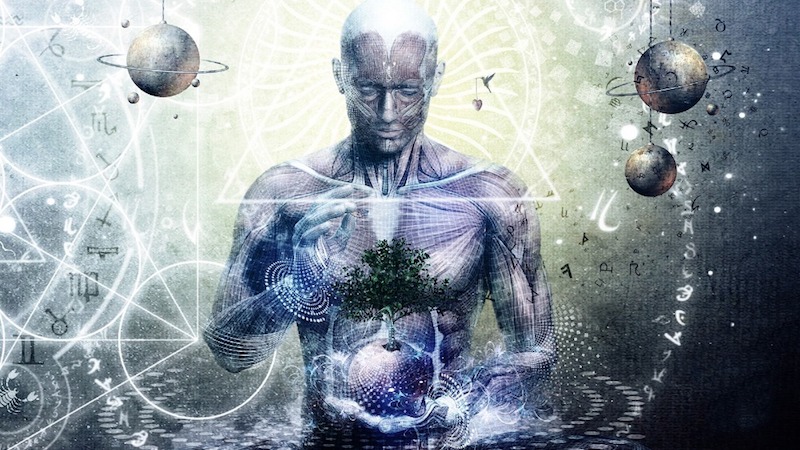
The body is coming back into sight as a site for experimentation and as a target for a type of quasi-transcendence. Within the inverted world of the lesser reality, the physical body has always been recognized as the vehicle through which life is experienced. In other words, it is our avatar whilst in this realm. As such, it has always been a site of contestation.

In some religious circles, the body is seen as a material distraction from the Divine and its influence was seen as needing to be repressed and subjugated (which may include certain physical deprivations, including self-harm). Various religio-spiritual perspectives have regarded the physical body as an obstacle, a barrier, to a sense of the sacred. The other extreme is that the body is regarded as the ideal vehicle for experiencing the sensual and sensuous – it is a vessel for indulgence and decadent experience. Still, there has been no consensus reached over how to regard the vehicle of the human physical body.

In my earlier book – Hijacking Reality – I noted how recent narratives are trying to place the human body as a site of weakness. That is, the body is open and vulnerable to disease and infection; it succumbs to aging and exhaustion; it disallows the human being from the full range of experiences. In this light, narratives of transhumanism are attempting to gain ground as a way of offering an alternative to the ‘weak body.’ These, as I had discussed, are attempts to drive the human experience deeper into materialism and a technocratic agenda for a digital-hybridization program within our societies.

The Inversion is steering ever forward into deeper and deeper realms of materialism. It is utilizing a narrative of quasi-transcendence through embedding deeper into the myth of technological salvation. The lines are not so much being drawn but being blurred. American writer Philip K. Dick, famous for his science fiction books that question the nature and validity of reality, spoke about the blurring of boundaries between body and environment in his 1972 speech “The Android and the Human” –

“Our environment, and I mean our man-made world of machines, artificial constructs, computers, electronic systems, interlinking homeostatic components—all of this is in fact beginning more and more to possess what the earnest psychologists fear the primitive sees in his environment: animation. In a very real sense our environment is becoming alive, or at least quasi-alive, and in ways specifically and fundamentally analogous to ourselves.1″

This quasi-aliveness of the environment that Dick speaks about is the animating stage where relations between the human body and the material world begin to blur (and merge). Much of Western spiritual-mystical practice is interpreted as a somatically-felt experience. The body is the instrument that receives and grounds the experience, whether it be in terms of the ‘great flash,’ ‘illuminating light,’ or the ‘bodily rush.’ The body is the human instrument for receiving, transforming, and sometimes transferring, energies. There are many ‘bodies’ in spiritual-mystic traditions, including the etheric, the astral, the ecstatic, the subtle, the higher, and others; the physical, material body is recognized as the densest of them all. Also, it is the ‘easy target’ since it resides fully within the material world and is open to social engineering and influence.

The body in history has always been a site of focus. It has helped define the experience of self/other and the outer/inner and has been regarded as the material vessel for the spiritual impulse. Perhaps for this reason, many societies around the world have, at one time or another, attempted to suppress the power and expression of the human body. It could be that the controlling agencies within the inverted world regard the balanced, correctly functioning human body as a portal for appropriately navigating the perceptive wavelengths of reality. Many of the mystical traditions placed a strong emphasis on the purification of the human body; on it being free from toxins and corruptive influences. In this way, the physical vessel was said to receive the ‘illuminations,’ or the ‘mercy’ of the sacred, divine impulse.

The body acts as an antenna for the nourishing inspirations/energies for the soul. What better way to block these illuminations than to corrupt the body’s purity through a polluting environment – socially, psychologically, and biologically. As such, the body has always been a site for the convergence of power and control. This body-power relationship has been a major theme in the work of French philosopher Michel Foucault. Foucault has deconstructed, in his critical history of modernity, how the body has been fought over as a site of power. The physical body is also regarded as a location of resistance against the establishment powers. It is a fixed place where an individual can be located, found, and held accountable. And now that our physical movements are continually tracked through the digital infosphere, there is even less chance to escape the eye of authoritative surveillance. If we cannot escape from our bodies then, it would appear, we are forever within the system.

The human body has always been accepted as a unit within the social matrix. This has also been expanded to define bodies in terms of social institutions: we have the body politic, the social body, the scientific body, the medical body, the body of an organization, etc. The once sacred site of the body, which was the vessel for somatic spiritual experiences, has been adopted, or co-opted, into a social construction of bodies that belong under control and subjugation of external authorities. In Gnostic terms, the body’s site of power has been referred to as those of the ‘sleepers’ and the ‘wakers.’ Sleepers are those whose inner self has yet to break through the layers of the body’s social conditioning.

The somatic spiritual experience has been seen as a threat to hierarchical societies because it exists beyond their bounds of power. This is one reason why ecstatic experiences, whether through spiritual or other means, have been suppressed, outlawed, and discredited by orthodox religions and mainstream institutions alike. Ecstatic experiences that can break down the thinking patterns and conditioning structures of the Inversion are alarming for institutions of socio-political power. How can you control, regulate, and discipline a body, energy, or experience that has no physical location? Such intangible forces, such as the power of baraka, are positively infectious and beyond bounds.[i] As cultural historian Morris Berman notes:

“The goal of the Church (any church) is to obtain a monopoly on this vibratory experience, to channel it into its own symbol system, when the truth is that the somatic response is not the exclusive property of any given religious leader or particular set of symbols. 2″

In recent times, there has been an increasing focus on what is termed the innate consciousness of the body, and which has been revealed through such techniques as muscle testing. It is innate because it is inborn (born in and of the body), and it is instinctual. Somatic consciousness then is another word for our intuitive intelligence. It is an intelligence that can be communicated through the body, and it is this which threatens those that seek to control the dreaming mind of humanity. However, the matrix of reality is not a clean-cut realm.

We exist in an anthropological environment where nature and culture cannot be neatly divided. The physical realm is a fusion of the real/imagined, and where subject/object is blurred. Yet now, this hybridity is being further enforced and coalesced through genetic engineering, implants, augmented reality, and the sciences of nanotechnology, biotechnology, and information technology (including artificial intelligence). The Inversion is attempting to gain our willing compliance through offering a form of transcendence that goes beyond the body and the bodily senses.

The Galactic Gaze

The dreaming mind has always been tempted and awed by the stars beyond. There is perhaps no living person who has not gazed up into the night firmament and wondered about the cosmos out there. And perhaps, there have been those persons who upon gazing up wondered whether they were not living within some kind of bubble. The dreamer’s world has often been depicted as a bubble reality, most notably by the Renaissance alchemists, as in this well-known engraving:

The Philosopher’s Stone lies outside of the realm of the Inversion; it can only be grasped by one who has exited from the dreamer’s reality bubble (or perceptual prison). For most people, the spiralling star tapestry of the cosmos is the first step of the beyond. Reason enough, then, for this to have become the new destination for the modern pioneers within the lesser reality.

The break from the body begins at an early age through social conditioning. To some extent, all individuals have to relinquish some of the contact they have with the innate intelligence of the body (including the body of the natural world) by being incorporated into the ‘social body.’ And as the social body becomes increasingly enmeshed within the digitized landscape, this alienation from the body will only likewise increase. Modern culture’s love affair with decadence, and the rise of sexualization and drug indulgence, all contribute to a desensitization of the body – even when the body is the medium of experience, such as in sexual experiences. As noted, this is a targeting of the ‘pure body’ so as to corrupt its potential for deciphering deeper layers within the Inversion. The body-medium for the life experience is also viewed by transhumanists as a hindrance upon the evolutionary journey toward an ‘immortal society’ that is destined for the stars.

This view is more keenly taken by mostly western and ‘elite’ types who have begun to feed themselves upon a modern cosmic-religious mythic consciousness. This is what Jasun Horsley refers to as a ‘Galactic religion,’ which seeks transcendence/ascension by leaving the planet and colonizing others. It is a ‘rich geek’ religion based on accelerating technologies and pushed by the major tech-titan companies. As Horsley notes, rather than ascension, it is the reverse: ‘It has to do with dissociation, the attempt of the traumatized psyche to split off from the body and float off into fantasy land, beyond the reach of reality and all the pain it entails. Bodies frozen on ice, souls lost in space, free, free from the terrible travails of the body.’3 In such contexts as these, and more, there is a trauma being experienced through the physical body. Trauma can be related to dysfunctional energy being trapped within the body, causing discomfort and disease. In an attempt to escape the body of the planet we are being forced to ‘techno-transcend’ the limitations of the biological human body.

To travel into the stars, we are told, requires us to upload our consciousness into machinic devices and/or ethereal cloudscapes. In a bid to escape the confines of a depleting ‘prison planet’ we are being asked to put our faith – and our consciousness – into a new techno-prison. Yet who shall be the new guards? This could entail the trauma of a new birth – re-enacting the prongs of the biological birth passage yet through entry into yet another realm of the Inversion. There seems to be no genuine exit of the dreaming mind through consciousness upload – only a leap into another programmable maze, yet this time perhaps with less benevolent programmers.

In the western psyche there appears to be an ongoing splintering between ‘inner space’ exploration and ‘outer space’ exploration. The techno-dream of space colonization is the new favoured trend whilst the inner space research of the psyche is promoted as a dangerous and trickster landscape. Outer space is the new undiscovered realm that offers hope against the twilight of the body (including the body of the earth). And yet such ‘Galactic pioneers’ seem driven less by a unified perception and more by forces arising within their splintered psyches that they have failed to integrate. These are the subconscious forces that grasp at survival, at any cost, and would willingly walk over the bodies of others to secure their own survival. Leaving the planetary body is only for the ‘lucky’ few, whilst the rest must remain grounded – or with their minds in cloudscape orbit. The trick of the Inversion is that there are endless doors to keep walking through, yet no exit to awaken out of. By walking out of one dreamworld into another we may think we are free, yet we remain imprisoned within the dream still. Or worse, we unknowingly become our very own prison guards.

No rockets will ever create enough thrust to take us where we truly need to go, for awakening from the gravity of the Inversion is an inner-space journey. It is the colonizing of the quiet kind – of ourselves. By striving to attain the orbital Overview Effect we are missing the real point, which is the ‘Inner view’ from within ourselves.

The Body as the Holy Host

The Inversion – our inverted world reality construct – is unsure what to make of the human physical body. Is it our saviour – our holy host? –  or a danger to our own progress and a threat to the agenda of others? As I have written previously,[ii] the narratives of a new biopower have brought to the fore a medical-political establishment within many of our societies worldwide. The biology of control is now a major player within the current realm of lived experience. There is now a noticeable rush to gain a political-corporate control over the access, use, and sovereignty of the human body. In a very real sense, it is the individual’s last line of physical defence. Each individual is a conscious entity (a spiritual essence) that is operating within this material realm through the vehicle of the physical body. As such, we are uniting with a biological partner. We are a merged being: as it is said, a union of flesh and spirit. Whilst the spirit – the essential being – is immortal, it has to abide in its physical incarnation by the biological limitations of the bodily host. Because of this crucial fact, external control agendas are determined to not only gain power over the outer aspects of the body (it’s freedoms, utility, mobility, etc.,) but also, via interventions, to have control over its internal functioning (DNA code, intra-communication, and more).

The human body functions upon many varied levels and acts as many things – including as a receiver, filter, and transmitter of energies and information. It is only the false, manipulated narrative that posits the human body as a ‘biohazard.’ By using this designation, external agencies of authority can seek to further contain and control the movement of the body as well as gaining internal access through chemical and pharmaceutical interventions. These possibilities were foreseen by many, not least by the social philosopher and author Aldous Huxley. Even as far back as the 1950s, Huxley envisaged the encroachment of scientism to gain increasing intervention into the human body:

Meanwhile pharmacology, biochemistry and neurology are on the march, and we can be quite certain that, in the course of the next few years, new and better chemical methods for increasing suggestibility and lowering psychological resistance will be discovered. Like everything else, these discoveries may be used well or badly. They may help the psychiatrist in his battle against mental illness, or they may help the dictator in his battle against freedom.4

And yet, this is still a viewpoint based on the material and physical sciences. It does not represent a deeper, spiritual perspective. This was to be provided by the Austrian philosopher and proponent of spiritual science, Rudolf Steiner. In talks given during September-October 1917, Steiner had the presence of vision to discuss the later potential interventions and influence over the human body. He said that: ‘Taking a “sound point of view,” people will invent a vaccine to influence the organism as early as possible, preferably as soon as it is born, so that this human body never even gets the idea that there is a soul and a spirit.’5

Clearly, this shows that the human physical body is a site of target in an attempt to curb or block reception of spiritual forces. Through what may appear to be a ‘sound point of view,’ a range of socio-cultural narratives will be created and propagated, according to Steiner, that will push an agenda of increased medical intervention. And these medically backed ideas have the aim ‘to find a vaccine that will drive all inclination towards spirituality out of people’s souls when they are still very young, and this will happen in a roundabout way through the living body.’6 Humanity has arrived at that time now, if we observe current events and their related consequences. We are now at a time within the 21st century where we are witnessing the transmutation of living beings – and bodies. The human being has arrived at a threshold previously unknown to it, and there are forces compelling the human to step over and through it. It is a threshold that will recode environments and bodies. The threshold is the point where a genetic deterritorialization process can begin, and from which we may witness the emergence of a new organism different from the current one. It is a threshold of recombination and recodification; a new assemblage that represents yet another phase within the Inversion. From here on, we are biologically vulnerable to an encroaching machinic impulse that, by its very nature, will morph bodily combinations into machinic connections.

Our bodies are reaching an exhaustion point. The crises we now face across the body of the earth is from a collapse of the individual, social, and psychological body. Already, the social mind is in trauma, and the body is showing this illness or dis-ease. The Inversion has made sure that the biological and psychological dimension has coalesced. The ripple of a bodily trauma is being felt across the planetary membrane as people are forced to unnaturally detach from the physical world around them. New physical arrangements of dislocation (lockdowns) and social avoidance are becoming established practices within our societies. These unnatural ordinances are creating cognitive and bodily dissonance. Bio-traumas have arisen that are affecting our sensibilities. New bodily phobias have been set in motion. This is the newly inverted threshold – a threshold of deterritorialization that has enforced a changing perception of the body. We are sensing alterations in human bodily awareness and receptivity. There is a deprivation too. The body is being pulled back from its natural organic terrain. It is being made to retreat from physical presence and away from the reassuring touch. It is as if the body is being reconfigured to devolve away from the sensual and into a new digitally articulated sensate. This bodily aliveness is being substituted by decomposition and the fear of decay and deterioration.

In the modern age, death has replaced sex as the modern taboo. The sanitized environment of the hospital has replaced the home as the place for passing away. The experience of death and dying has become detached from community life with the effect that emotion and closeness has been replaced by medical management. The dying body has become inverted into a thing of disgust and embarrassment. Death has now become something shameful – a forbidden process. Death is a modern scandal. Modern life has internalized the rejection of death, and we are coded to cringe at the thought of bodily deterioration. Death is a loser. To die is to lose, to fail. There is no room for failure within the deepening layers of machinic materialism and computational competition. Death can be replaced by tech-assisted immortality in the new ‘posthuman future.’ Alternatively, the body can be transcended through transhumanism so that death no longer haunts the halls of the physical flesh. These are the new imaginings in the realm of machinic desire. Humanity is on the threshold of venturing into an Inversion of codified imagination and upturned desires. Desire has overtaken pleasure, and it is the social sphere within the Inversion that creates and sustains this desirous torment and torture of the unattainable. And within the unattainable, greater forms of external control must be endorsed to compensate. For this reasoning, current forces have begun to establish new pathways of control over life processes. And this, by intent and not coincidence, aligns with the rise of the machinic impulse. The question that now needs to be asked is whether the machine impulse is evolutionary or devolutionary in terms of human life upon this planet.

References

Dick, Philip K. (1995) The Shifting Realities of Philip K. Dick: Selected Literary and Philosophical Writings (ed. Lawrence Sutin). New York: Vintage Books, p183

Berman, Morris (1990) Coming to Our Senses: Body and Spirit in the Hidden History of the West. New York: HarperCollins, 146.

Horsley, J. (2018). Prisoner of Infinity: UFOs, Social Engineering, and the Psychology of Fragmentation. London, Aeon Books, p189

Huxley, A. (1959). Brave New World Revisited. London, Chatto & Windus, p107-8

Steiner, Rudolf (2008) The Fall of the Spirits of Darkness. Forest Row: Rudolf Steiner Press, p85

Steiner, Rudolf (2008) The Fall of the Spirits of Darkness. Forest Row: Rudolf Steiner Press, p199-200

[i] Baraka, a prominent concept in Islamic mysticism, refers to a flow of grace and spiritual power that can be transmitted.

[ii] Hijacking Reality: The Reprogramming & Reorganization of Human Life
UNTANGLING THE QUANTUM ENTANGLEMENT

By Julian Rose

Source: Waking Times

The traditional gulf between science and metaphysics is undergoing a dramatic metamorphosis as the discovery of a ‘quantum entanglement’ between particles previously recognised as being miles apart, is further revealed.

In an experiment observed by scientists, when one of these particles spins around, its sister particle – although a long way off – also spins around. Responding as though never separated.

“Quantum entanglement is the phenomenon that occurs when a duet of particles are generated, interact, or share spatial proximity in such a way that the quantum state of each particle of the group cannot be described independently of the state of the others, including when the particles are separated by a large distance.” (Wikipedia)

The existence of such entanglement is both compelling and comprehensible, and I want to have a go at explaining why.

Let’s start by recognising that the Universe is ‘One’, all elements interconnecting with each other via invisible, energetic pulsating wavelengths.

The separation of particles that have previously been part of one mass, is only ‘separation’ on the classic physical plane, but not on the quantum plane.

Just because they no longer physically connect with each other, does not mean they are separated on the quantum level. They aren’t. They remain unified.

This is what in spiritual terminology is meant by ‘oneness’. This ‘oneness’ is vibrational. Such a state is experienced when one is attuned to essence: that which resonates ‘is-ness’ when undisturbed by external or internal mental intrusion. In this state there is no time, distance or resistance (gravity). No separation.

Although the speed of passage of a thought or energetic psychic exertion is often discussed within this context, it is not strictly relevant; because there is a simultaneity of connection occurring at well over the speed of light. At this level, the essence of the Universe is microscopically repeated in a dew drop and a sub atomic particle; all elements of existence remaining connected, therefore at one with the original manifestation. Mirrors of one originator, one source.

Viewed under a powerful microscope, the minutest of sub atomic particles are at one moment ‘specs’ and at another ‘waves’ according to Niels Bohr’s early quantum experiments. Even transforming again, into what Bohr described as a ‘dance’.

How these minute particles react depends equally upon the perspective and influence of the person engaged with them (the viewer) as with their independent existence as cosmic matter. They are simultaneously both mundane 3D and Universal God sparks.

It seems that once ‘together’ means always together in universal reality. The physical separation factor plays no part in altering this oneness.

At the most elemental levels, energy and matter are inseparable. Matter is congealed energy and takes on increasing levels of density according to its vibratory speed of resonance. The lower the speed the denser matter becomes and the more constricted becomes the movement of pure energy.

The Universe is both matter and ether. Particles or energetic expressions travelling outside of the constrictions of gravitational fields are not subject to resistance – being slowed down. Thus ‘God Speed’ is a powerful blessing for anyone wished it!

Classical science can only describe but not ‘experience’, intuitional higher consciousness which equates with ‘God Speed’. Intuitional consciousness places the experiencer within, not outside the quantum of existence.

Science looks in from ‘the outside’ but can, by intellectual effort and focussed concentration, recognise some of the component parts that make up the workings of cosmic consciousness, of Godliness; but falls short of ‘being’ (experiencing) what it describes.

Thus ‘quantum entanglement’ is not so mysterious. However, exploring it requires dynamic equilibrium between the two hemispheres of the brain, which accordingly reveals this entanglement to be a manifestation of the supreme interconnectivity of God consciousness.

It is the unseen glue, that along with stars, planets and other celestial objects, holds the Universe together. God consciousness resides in the heart and is openly available to all human beings. However, it sleeps within until awakened.

Huge efforts are being made to prevent humanity waking up and realising its power. Such is the paradoxical nature of existence that the struggle to overcome the dark suppressors of human evolution – both internal and external – creates the friction necessary to bring about the self-realisation of our deep spiritual powers that might otherwise remain dormant.

It also equips us with the power to defeat the dark imposters and set a new agenda for the future of life on earth.

Effort is required – nothing positive comes without effort. But the pleasure arising from a growing realisation of our quantum entanglement with our Creator far exceeds the limited and transient pleasures available to us in an unrealised, largely third density (3D) state, divorced from conscious contact with the source of our existence.

Embracing such ‘an entanglement’ will bring about a metamorphosis in human consciousness and an extraordinary new era of life on earth and beyond.

An era in which no distinction can be made between God and Man.

Navigating The Space Between Worlds

Mastering the art of being in the world, even when we know it’s filled with heavy challenges and chaos.

By Joe Martino

Source: The Pulse

Over the last few decades, many have written about our time as a space where humanity is between worlds. On one hand, we have our current way of life which is incredibly demanding on our minds and bodies, is rather toxic, and filled with conflict and destruction. On the other hand is a vision for a world that’s slower, more connected, more natural, and more loving.

As we navigate what appears to be the dying stages of the old paradigm, the intensity of what it is seems to increase. The qualities of the old system become louder, acting as an evolutionary pressure to push things along.

Many become inspired to explore ways to bring the ‘new world’ to the here and now via their actions.

How do I live without money?
How do I exit the toxicity of our current system?
How do I not participate anymore?

If we aren’t careful, these questions can create a framing of our current world that can make it very hard to live within.

If we deeply judge the need to work, to make money, to pay taxes etc, all of it can become a heavy thing to carry. We end up waking up every day dreading going to work, and having endless conversations, thoughts and emotions about how the bad guys are ruining life for us and we’re the victims in it all.

While there may be truth to some of the observations about our society, the framing of it in our minds is disempowering many of us, and it’s making our current moment dreadful. Further, it holds us back from living and being able to solve the problem.

So how do we work with this? How do we live in the space between worlds?

What Feels Natural To Us?

Indeed, our current societal design is not supportive of human beings thriving. In that sense, it has been poorly designed. We have such an easy time as a species doing this because our higher-order thinking allows us to override what is good for our biology. Simply put: it’s easy to ignore our needs using our thinking, especially when we become so identified with life cognitively.

I have 7 alpacas. The moment they need to poop, they just do it, no thinking, no “I’ll just finish this paragraph,” they just do it. They listen to their biology. Humans on the other hand don’t always listen. In some cases we don’t because we have social structures, social norms, and brains to hold this all together. But we also don’t because we’ve learned to ignore our body, feelings, and emotions in many ways.

While our higher-order thinking is beautiful in one sense, how do we know when it begins to work against us?

I often use an example with friends and clients of a bear. The bear (a mammal like us) was likely raised by an attached parent. It learned how to ‘bear’ and how to be in its environment from that parent in its natural environment. If that bear’s ecosystem was cut down or destroyed by humans, it wouldn’t stay for too long. It would know that concrete, a lack of forest, and a lack of fresh water aren’t good for it, and it would leave to find a suitable home. The bear is simply following its connection to its biology.

We as humans know we are doing this to animals and call it ‘displacing nature/animals.’ Interestingly, we tend to see ourselves ‘outside’ of nature, conveniently ignoring how we’re ‘displacing’ ourselves.

As mentioned, humans are resilient in that we can survive in different environments. We find ways to adjust, cope, and problem solve within environments that are not natural to us. Here I’m not just talking about physical environments but also emotional ones. We find ways to survive in abusive situations for example. We know we should leave, but sometimes we feel we can’t or don’t have the capacity to.

Further, there are difficult elements to our environments like not having access to clean food, clean water, and shelter without having to work very hard to get them.

Because of our amazing thinking brains, humans can do and create incredible things, but we can also become so cognitively and mentally identified that we override our basic biology so much so that we build systems that aren’t attuned to our own well-being.

Thus, humans are currently surviving, but we are in no way thriving. And we did this to ourselves via a disconnection from ourselves.

To be clear, it’s not that we shouldn’t have roads, technology, and societal systems, it’s that they should be designed with human and natural thrivability in mind. Instead, our world is designed with economic thrivability and elite power structures in mind. All at the expense of human wellness.

The tricky part is, that the more people see and experience this truth, the more we can become angered and upset by it. This is fair. A boundary feels crossed because we living now aren’t necessarily the ones who built it or are choosing it. “Why am I subjected to a system I don’t like nor support, yet feel like I can’t escape it?”

As I stated in my essay If No One Wants This, Why Are We Doing It? our way of life doesn’t feel natural to us deep down and it’s overwhelming the challenge is we can’t change it overnight. So what do we do to live within it without driving ourselves mad?

Exploring The Art of Existing Between Worlds

Over the last 15 years exploring alternative thinking and spiritual spaces, I have discovered that it’s common for people to want to fully “exit” the system. They don’t want to integrate, use money, or do anything within the system as they feel it’s “toxic.”

As mentioned, these feelings are somewhat valid, but how we choose to navigate them is everything. Here are a few key observations.

1. Having unprocessed anger, resentment, victimhood and judgment for the system is a recipe for disaster.

If we go to work each day, pay taxes, or drive on highways with the mindset and emotional drive that we are victims and stuck, we will certainly make our lives feel more challenging. Our mental, emotional, physical, and spiritual framing at that point is that of contraction and stuckness. And it’s often built on a nervous system foundation of survival.

Everything will feel much more difficult in this state. Now, this doesn’t mean we can’t observe the state of the world, understand it, and explore how to change it, all of that can be done without getting stuck in mental and emotional traps. But we have to be careful about the general state of mind and being we are taking into our daily lives. Without being aware of this, we give all of our power away to the system and allow it to dictate how we feel.

I’ve watched people panic and freak out about not eating organic apples, yet their mindset and relationship with themselves and the world is creating more toxicity in themselves than a non-organic apple.

When this mindset goes unchecked, our locus of control for our own well-being is outside of us, not inside. (Key note, I’m not suggesting that the system doesn’t have toxic effects on us, I’m saying that there is a space where we can exist within the system with greater wellness.)

Can we begin to see work, life, and what we currently have going as an opportunity? Can we change the lens through which we see it so it doesn’t add to greater dis-ease? Can we support ourselves, our nervous system, and our emotional well-being through practice that helps us build capacity and resilience?

2. Trying to exit completely is incredibly hard, and most end up just as unhappy.

I have found a lot of people trying everything in their power to avoid working and making money. Here I’m not referring to people who are not well or injured and can’t work, I’m talking about folks who can yet have such a degree of judgment toward the system that they avoid being within it.

Often this path leaves people stuck, uninspired, unable to experience much of the world, and unable to even afford fun projects at home. Life begins to become small, and these people rarely seem truly happy.

That said, intentional communities are an interesting path for some. Although they work and exist within the system in more ways than people think. Sure, a few places are fully off grid, but for the most part money, utilities, land purchases, property tax etc, are all part of the mix.

If you don’t have a lot of money, this path is very tough. People can of course move to countries where things are very cheap and start over, but even that is tough for most people as it’s still expensive and work still needs to be found to live well into the future.

1. Exploring capacity and resilience building to exist in our current world and help solve problems within it seems a fruitful path. This includes doing small things within the system to make life more natural.

To me, this is a path that is accessible to most people and provides a meaningful balance of making a difference and enjoying life. I may also be biased toward this as this is the path I’ve chosen and have taught throughout my work since 2009.

For example, I chose to start a company and embrace the world as it was in 2009. I built my business on a foundation of creating an amazing work environment for employees to work, rest, grow, and contribute to a ‘collective evolution.’ Over time, I was able to give back by hiring 14 people to come into this environment of serving something greater than our personal ambitions, yet those were taken care of too.

We did some amazing projects around the world with excess funds, and we helped establish an internet culture of wellness, consciousness and conscious media. If I had kept the system at a distance, those benefits would not have been shared.

Humans have lived for such a long time in unnatural ways, disconnected from ourselves, and not processing our emotions and traumas, our nervous systems hold that history. It is further being re-inforced by the reality that yes, there is toxicity still in our world. It is badly designed.

But still, regulation and capacity at a deep cellular level need to be restored for most of us. We need to clear out the messy stuff. Otherwise, we will take our pains into any revolutionary systems that pops up outside the system anyway. We see this a lot with intentional communities that collapse.

This means focusing on deeply restoring physiological safety, wellbeing, emotional fluidity and regulation is foundational to living well, and it can be done even in the existing system. Even though our system is tough, this path gives us much more energy, resilience and capacity to exist within the system and make as big a difference as possible while enjoying life.

This path is work. It acknowledged that it isn’t easy to feel great in our world due to the poor design, but that it’s still within our capacity if we focus on it.

This doesn’t mean we ignore the need to change or adjust our system. But this path gives us the greatest ability to do so as we will have built the capacity and deep empowerment to actually do it, vs. being feeling stuck, tired and victimized resisting the system so heavily.

Existing in a space between worlds means building individual and collective wellbeing, and creating change along the way. The more resilient we are, the more we can make money and use it as a tool to find ways to make our lives better, less reliant on the system, and healthier.

In that space of wellness, we can have meaningful conversations and learn to hold visions of a future world that isn’t built on hating and resenting the old. If I’m honest, almost all of the successful changes and projects I’ve seen out there have come from this space of being.

In summary, taking stock of whether our observations of the world have become deep disempowering judgements is a worthwhile reflection. Being ‘awake to corruption’ doesn’t have to come with lifelong resentment toward the system, where we comment online about ‘the bad guys’ ruining things for everyone. Or that somehow Biden, Trump, Trudeau etc. are the root of the problems. I hate to say it but, this gets us nowhere.

Questioning whether we are truly living our lives in a way that promotes emotional, physical, and spiritual well-being and expansiveness is important. Without this, our foundation is weak.

The path forward I’m suggesting is one of building enough strength, well-being, and energy to live with wellness in our current system, so we have energy left over to see clearly and act upon changing what is not natural to us. Good sensemaking of our current events goes alongside this, but as you’ll note from my previous work, good sensemaking is built on a healthy nervous system.

RAD, MAD & BAD: The Analog Rebellion of Craig Baldwin and Other Cinema

By Andy Prisbylla

Source: We Are The Mutants

In our current technocratic society, it’s incredibly rare to meet someone who is genuinely free. The erosion of the Consent Decrees of 1948—which allowed media conglomerates to own and control movie theaters—drastically altered the landscape of film and video production, further destabilizing an already unlevel playing field between corporate interests, content creators, and consumers. The trickle-down economics Reagan touted in his 1981 tax act proved only to favor the affluent, further alienating independent creators who were frozen out of a livelihood through economic blacklisting, a perpetual attack that continues to this day. Bill Clinton’s elimination of the fin-syn rules that required television networks to source 35% of their content from independent producers only helped to continue this trend into the new millennium, and soon the mainstream movie and TV-consuming public was offered a slate of hegemonic programming supplied by a monopoly rule. 

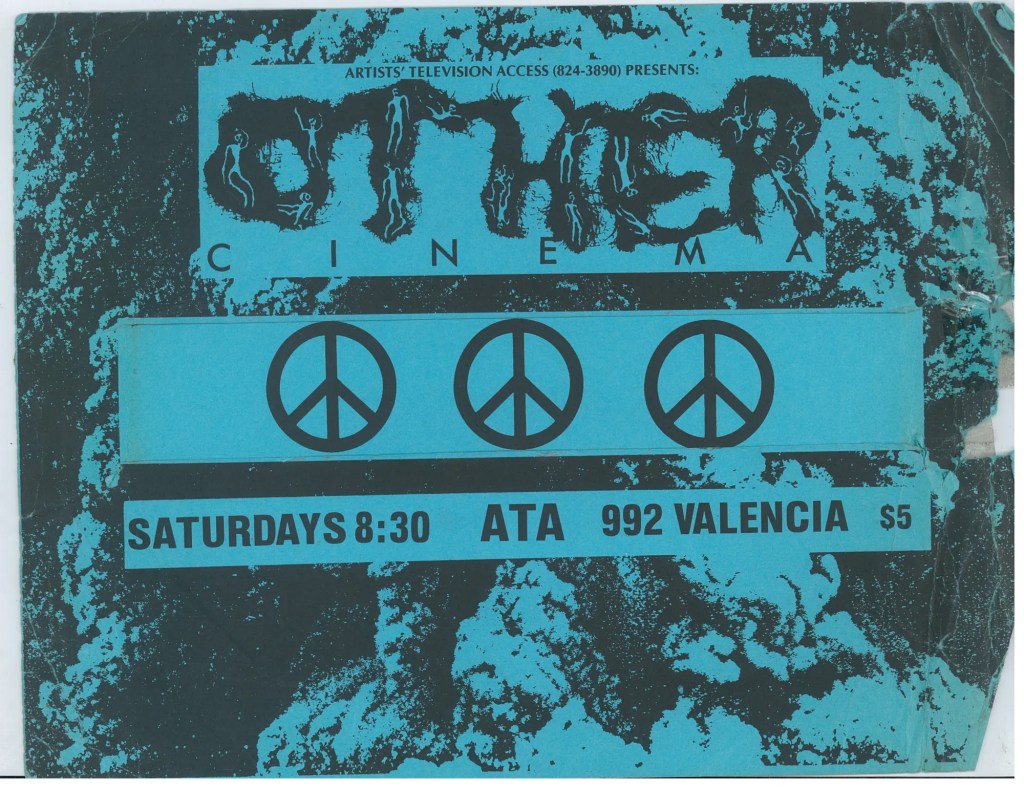
With traditional avenues of information exchange becoming more restricted, pockets of transgressive media resistance—inspired by the countercultural film and video collectives of the ‘60s and ‘70s—gained 501(c)(3) non-profit status in 1980s America. These artist-run community organizations championed alternative educational perspectives on media literacy and performance, such as Artists’ Television Access in the Mission District of San Francisco, California. Operating under the umbrella of this community space exists a cinematic collective with a subversive trajectory: a film screening series and analog archive curated from the margins of mainstream media and acceptable art practice. Under the stewardship of underground filmmaker and curator Craig Baldwin, Other Cinema stands as the vanguard of Baldwin’s personal artistic conviction—what he calls “cinema povera,” an anti-capitalist filmmaking creed where artists only use the materials at their disposal to create art. Combine this practice with an ethos of media archeology and mixed-media collage that predates our current remix culture activities and what’s generated is an exhibition calendar of the modern avant-garde—a thirty-six week screening schedule projecting experimental film and video to the masses. Every Saturday night, cartoons, B movies, and commercials hold equal ground with industrial, educational, documentary, personal essay, and public domain/orphan films, bringing together numerous artists and filmmakers from around the world under one cinematic ceiling for close to 40 years.

Specific details surrounding the origins of Other Cinema are hard to quantify, partially due to the vastly prolific yet oddly cryptic career of founder Craig Baldwin. Born into a self-admitted 1950s middle-class existence in the Sacramento suburb of Carmichael, California, Baldwin spent his teenage years nurturing a ravenous curiosity for subversive cultures and media. During high school, he was often at the local Towne Theater enjoying the latest midnight show of underground programming, absorbing the cinematic combustion of the ‘60s experimental scene led by filmmakers like George Kuchar and Bruce Conner, who as a teacher would later kick Baldwin out of his film class while attending San Francisco State University. In college Baldwin also indulged in subterranean films such as Peter Watkins’s 1966 pseudo-doc The War Game and exploitation flicks like Paul Bartel’s 1975 sci-fi dystopian romp Death Race 2000. Forming a fascination with film exhibition, Baldwin worked as a projectionist at several movie houses throughout the city, navigating the film worlds through an eclecticism of arthouse, exploitation, pornography, and political activism—including contributing programming and film services to El Salvador Film and Video Projects for the Salvadoran solidarity movement of northern California. His early activism with the artistic political action collective the Urban Rats saw him and his cohorts reclaim San Francisco’s urban landscape through adverse possession or “squatter’s rights,” which allowed Baldwin to experiment with expanded cinema performance, such as projecting film in abandoned buildings and other derelict dwellings. 

This direct approach towards genre and social action speaks to Baldwin’s personal opposition towards the status quo, an attitude that not only informs Other Cinema’s motion picture programming but also Baldwin’s own filmmaking forays. His early experiments with Super 8 film—such as the prototypical culture jam/situationist prank Stolen Movie—bled into his 16mm attacks on advertising, consumerism, and colonialism in Wild Gunman and RocketKitKongoKit before gaining maximum velocity with his Dexedrine-driven, countermyth conspiracy report Tribulation 99. Making up the pure found footage/collage aesthetic of his filmography until introducing live-action performance into the mix with his films !O No Coronado!Spectres of the Spectrum, and Mock Up on Mu, these early works draw heavily from Baldwin’s now massive archive of analog film. Housed beneath the Artists’ Television Access property, this subterranean scroll of marginalized media is continuously rescued from the bowels of civilization’s ever evolving technological burden and given new purpose. The shift from film in the 1970s to magnetic tape in the 1980s saw major institutions overhaul their audio/visual collections in favor of more economical video formats, sending reels of celluloid to the dumpsters and landfills. Much like the Dadaists of the early 20th century avant-garde, whose use of appropriation and photomontage expressed anti-bourgeois protest through their art, Baldwin and company salvaged these bastardized works from material obscurity and celebrated their ephemeral nature through collage and remix. These hybrid works of the late 20th century serve as precursor to many of our current 21st century new media innovations, resulting in the continued radicalization of modern artistic folklore, such as the mashups and supercuts of Everything Is Terrible! and the radical anti-authoritarian statements of the sister collective Soda Jerk

Baldwin and Other Cinema’s defense of the diminished and discarded extends not only to the physical media he interacts with but to the audience he exhibits for. Maintaining a dialectical attitude, Baldwin expresses both respect and disrespect towards film genre and classification by spinning one off the other and forming new categories. Each screening is meant to give equal weight to diverse voices and provoke participation amongst attendees—an ethos Baldwin codified with his underground screening series The RAD, The MAD & The BAD while programming film events for Artists’ Television Access during the organization’s formative years. A protean yet practical film genre grouping system sorted through three major categories stripped of pretense and soaked in punk rock colloquialism, each selection was designated its own time slot on Wednesdays and Saturdays with those represented creating a continuity across each section:

The RAD: showcasing political and social action films 

The MAD: mad genius or auteur cinema

The BAD: psychotronic themes of horror/sci-fi/exploitation

Defying the unspoken restraint behind many traditional classification systems that favor a false high-brow aesthetic to an honest low-brow sensibility, The RAD, The MAD & The BAD crossed the cultural demarcation line with an egalitarian stance towards genre representation, allowing for serious discussion about what constitutes a film’s importance and its commodification within society. More importantly, it displayed through example that poor production doesn’t always mean poor quality, and films created on the margins of capital contain a certain cultural influence and accessibility that corporate-backed productions can only hope to afford or inspire.

The authentic response audiences gave towards the weekly film schedule at Artists’ Television Access saw the prestigious San Francisco Cinematheque approach Baldwin to bring his street sensibility to their precocious crowd with Sub-Cinema, a RAD, MAD & BAD-inspired program that ran over the course of 1985. The creation of other pop-up programs like Anti-Films and Eyes of Hell inspired Baldwin to consolidate his film selections under his own programming umbrella, and soon the ethos that fueled The RAD, The MAD & The BAD manifested itself into the physical embodiment of Baldwin’s own psyche and practice with the foundation of Other Cinema. 

If the RAD, MAD & BAD helped bring acceptance to the concept of marginalization in film selection and exhibition during the 1980s, the programming behind Other Cinema built upon this provocation by introducing new alternative voices from the microcinema scene of the 1990s. One of the forefronts of this new cinematic experience, Other Cinema became a home for a subculture of film using and reusing old and new technologies to create future underground works, with filmmakers and exhibitors from across the country like Sam GreenMartha ColburnGreta SniderBill DanielOrgone Cinema3Ton Cinema, and “others” coalescing to this space like the children of Hamelin to the Pied Piper’s whimsical flute. Many of these groups and individuals appear in Baldwin’s upcoming career monograph Avant to Live!, a 500-page treatise detailing his cinematic trajectory in the media arts.

The decline of physical media coupled with our perpetual progression towards a digital state continues to divide us, with some championing the virtual realm and its democratization of new technologies and others questioning its effect on the human experience and how we interact with each other. The popularity of streaming services continues to challenge the economic longevity of physical media, forcing film formats into a wave of obsolescence. Despite this, Craig Baldwin and Other Cinema rise against the tide with an analog assault of expanded cinema every Saturday night. Filmmakers on the fringe and maverick media archeologists with an overwhelming responsibility to film history, yet hamstrung by a lack of resources, congregate at Other Cinema to embrace the struggle in an ever evolving motion picture renaissance. It’s a form of masochism one needs to make it on this side of the art world—the “masochism of the margins,” as Baldwin often says. It takes pain and sacrifice to live here, yet the psychic rewards far outweigh the material loss. 

Craig Baldwin: Avant to Live! is a collaborative project between San Francisco Cinematheque and INCITE: Journal of Experimental Media and was released on May 30, 2023.

Andy Prisbylla is an underground filmmaker and exhibitor from the rust belt apocalypse of Steel City, PA. His screening series SUBCINEMA showcases subterranean movies and art through digital programming and live pop-up events. Find out more through Letterboxd and Mastodon

If You’ve Just Started Paying Attention To US Foreign Policy

There are always, ALWAYS lies, obfuscations and manipulations involved in marketing a new war to the public, or in hiding its involvement in foreign wars from public attention.

By Caitlin Johnstone

Source: CaitlinJohnstone.com.au

If you’re among those who have only just begun paying attention to US foreign policy and western media bias in light of Israel’s destruction of Gaza and Biden’s act of war against Yemen, it’s important to understand that none of the depravity you’re seeing is new. The lies. The insane double standards. The murderousness. The western political/media class always does this.

Every war the US involves itself in is always facilitated by lies promulgated in one voice by the official government in Washington and by the “independent” “free” press (actually propaganda services) of the western world. They deceived the world about Ukraine. They deceived the world about Yemen. They deceived the world about Syria, Libya and Iraq. There are always, always lies, obfuscations and manipulations involved in marketing a new war to the public, or in hiding its involvement in foreign wars from public attention.

All of this manipulation and deceit is necessary to hide the fact that the US-centralized empire is the most tyrannical power structure on this planet. And make no mistake, it is an empire. Washington serves as the hub of an undeclared empire comprised of alliances, partnerships, assets, public deals and secret agreements which knit a large number of nations together into what functions as a single power structure with regard to international affairs.

Most of the beneficiaries of this power structure reside in the west, or global north, while the most exploited and abused victims of this power structure tend to reside in the east, or global south. There are all sorts of rules and regulations and narratives and justifications for why this all happens the way it happens, but if you mentally “mute” the soundtrack on the verbal overlay and just look at what’s actually happening, what you will see is the lion’s share of the world’s wealth and resources moving northward and westward from populations of a darker average skin tone toward populations of a paler average skin tone. Wherever that movement is hindered, diverted, threatened or inconvenienced, you will see western war machinery moving southward and eastward to get it back on the desired track.

Most major international conflicts can be understood as either direct or indirect efforts by the US empire to shore up planetary domination, which are often met with resistance by populations who wish to retain their sovereignty. Much of this conflict happens in the middle east because that’s where the world gets a lot of its oil from, with US-aligned nations like Israel and Saudi Arabia frequently serving as the frontline for hostilities with non-US-aligned nations like Iran and Syria as well as non-US-aligned forces like Hezbollah, Ansarallah and Hamas.

This struggle for US planetary hegemony is disguised by the western political/media class as something other than what it is, because you can’t allow the public in a democratic nation to understand clearly that their government is on the side of evil. They’ll frame it as a US-led international coalition to liberate a nation from a tyrannical dictator. As a humanitarian intervention to protect human rights. As support for Israel’s right to defend itself. As protection of freedom of navigation in the Red Sea. But what’s actually happening is the world’s most powerful and murderous power structure killing human beings in western Asia in order to secure control over a crucial resource.

You see this all over the world against nations which refuse to allow themselves to be absorbed into the US-centralized power structure like North Korea, Venezuela and Cuba, with China being by far the strongest of these and Russia a distant second. And you will notice that you have heard every nation I just mentioned cast in a very negative light by the western press over the years. This is not a coincidence. 

You don’t need to believe anything I’m saying on faith. If you just keep in mind what I said and start watching the patterns for yourself while seeking out the truth day by day, you will see it for yourself. You will see the same patterns emerging over and over again, year after year. Over and over again you will see the US and the states that are aligned with it acting with extreme aggression toward non-US-aligned powers in ways that benefit the US-centralized power structure, and you will see the western press deceiving the world about what’s happening. The next Official Bad Guy you see dominating western press coverage on international affairs will be a non-US-aligned power, and if you apply diligent research and critical thinking you will find that they are not presenting an accurate picture of what’s happening.

Just keep learning and studying the patterns with open curiosity and self-honesty, and the picture will inevitably become clear to you. And then you will clearly see who’s really driving the bulk of the violence and disorder in our world.

How to Navigate Our Low-Trust, Increasingly Dysfunctional Society and Economy

By Charles Hugh Smith

Source: Of Two Minds

Politicians and corporate managers have an enviable record of self-enrichment but very little to show in terms of putting the long-term interests of the citizenry above their own short-term gains.

This week’s focus is on self-reliance, a topic of increasing relevance than is more complex that it may seem.

Sociologists differentiate between high-trust and low-trust societies: in high-trust social orders, citizens tend to trust institutions and each other to conform to social norms, enabling strangers to trust a vast circle of transactions and socio-economic ties. Low-trust societies are plagued with distrust of authority and institutions and fear of getting taken advantage of by strangers, so the circles of trust are small, inhibiting social mobility and economic growth.

Economies and political systems can also be understood as high-trust or low-trust. If the political system excels at rewarding insiders and incumbents while leaving critical problems unsolved, citizens have little reason to trust the system.

The same is true of economies that greatly enrich insiders and incumbents at the expense of the citizenry via monopoly/cartel price-gouging, shrinkflation, degrading the quality of goods and services and the immiseration of standard services, forcing customers to “upgrade” from wretched to merely dismal.

Conventional pundits and economists are constantly whining that Americans “just don’t get it”: they tout our soaring per capita wealth, i.e. we’re getting richer, so everyone should be delighted, yet only 20% of the public are “satisfied with the way things are going.”

What the well-compensated pundits and economists are ignoring (or are paid to ignore) is the decay of the U.S. from a high-trust-functional to a low-trust-dysfunctional society and economy: Americans will still go out of their way to aid strangers, but their trust in institutions has plummeted to lows, as has their trust in the political-corporate elites’ leadership: politicians and corporate managers have an enviable record of self-enrichment but very little to show in terms of putting the long-term interests of the citizenry above their own short-term gains.

People understand the name of the game now is to spout all the expected optimistic PR of “innovation” and “serving the public” while maximizing their private gain at the expense of the nation. Offshoring America’s essential industrial supply chains wasn’t done to serve the nation; it was done to maximize profits, 90% of which flow to the top 10%. Pushing us into debt servitude is highly profitable, but it isn’t benefiting us or the nation.

Americans were told to trust long, hyper-globalized single-source supply chains as “efficient” (i.e. profitable) and trustworthy, yet they’ve discovered these supply chains are vulnerable and fragile. Americans were told that corporate monopolies were selling them “innovations” when in fact they were being sold highly addictive (and therefore highly profitable) goods and services.

Americans were told that their financial security was increasing even as the U.S. economy became increasingly dependent on hyper-financialized asset bubbles and central bank bailouts, the precise opposite of stability. Rather than producing more financial security for the bottom 80%, these “innovations” greatly expanded the gulf between the wealthy and the increasingly precarious bottom 80%.

Americans were told to trust that the hyper-centralization of political and financial power would benefit them, when the evidence is piling up that this hyper-centralization has increased the dysfunction of core institutions and the fragility of essential systems.

Doesn’t it ring hollow to glorify our soaring wealth while households declare bankruptcy due to medical bills, college students sign up for a lifetime of debt servitude to pay tuition and inflation has destroyed 20% of every wage earner’s paycheck just since January 2020? All that “soaring wealth” is asymmetrically distributed, but let’s not talk about that, let’s talk about statistics that mask that asymmetry.

What the well-compensated pundits and economists are paid to ignore is the concentration of the vast majority of all this new wealth and income in the top 10%. Soaring wealth only widens wealth inequality; it doesn’t benefit the nation, it weakens its foundations by accelerating the decay of trust in core institutions and systems.

What happens when high-trust decays to low-trust is the circle of reliable, trustworthy sources and people shrinks to the local, decentralized level. Rather than trust Big Ag, Big Fast-Food and supply chains of highly processed glop to feed us, we start turning to local sources of real food.

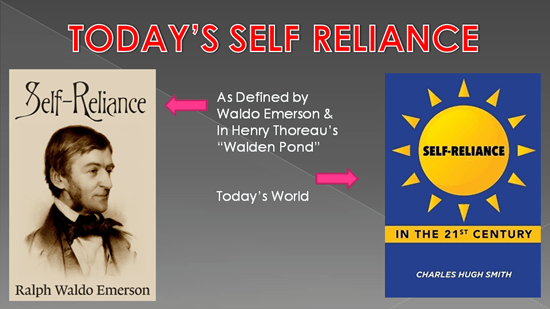
In the same way, we rediscover the value of thinking for ourselves rather than accepting self-serving memes-of-the-day. We rediscover the value of what Ralph Waldo Emerson wrote about in his 1841 essay Self-Reliance (free text, Project Gutenberg).

Emerson counsels us to “be our best selves,” and not to count property wealth above all else. (“They measure their esteem of each other by what each has, and not by what each is.”)

Emerson understood that the values of a society are the foundation of its economic order. A system lacking any principles and values other than greed and self-enrichment is a rotten structure doomed to collapse. It is not just the larger socio-economic order that needs a rock-solid value system; each individual must ground their choices and actions in a value system they have embraced on their own. (“Nothing can bring you peace but yourself. Nothing can bring you peace but the triumph of principles.”)

What Emerson is espousing is self-reliance, in thought, in values, and in economic and financial matters. In today’s world of crumbling hyper-globalization, self-reliance extends to the practical world of where our essential goods and services are coming from.

Gordon Long and I discuss these and many other aspects of Self-Reliance in the 21st Century in our wide-ranging podcast Self Reliance (45 min).

We discuss how the American economy has changed over the past 40 years, to the detriment of the nation’s values and the security of its citizenry, and what self-reliance means today– the topic of my book Self-Reliance in the 21st Century. (Read the first chapter for free.)

How can we best navigate our low-trust, increasingly dysfunctional society and economy? By strengthening our own self-reliance.

What Happened To The Truth Movement?

Over the years many aspects of the “truth movement” have devolved into an insufferable dumpster fire. But we can still salvage it.

By Benny Wills

Source: The Free Thought Project

From 2004 – 2016, I felt like I was a part of something special. I was participating in an “awakening.” The world was changing. Consciousness was shifting. The hidden hand was being exposed and all secrets were being revealed!

Right?

Or maybe it was wishful thinking.

9/11 happened. And for the next decade and a half, people all over the world began to question the events of that day. Then, major events in general. It was the beginning of an uprising. A revolution!

Right…?

Something else emerged during that time. Social media.

Social media has its upsides and downsides. Mostly upsides. But the downsides have serious ramifications. Specifically on communication.

Social media brings us together and tears us apart.

2001: A Truth Odyssey

By 2001, almost everyone was online and connected to the internet. But it was still in its infancy.

The iPhone didn’t exist. There was no YouTube, Facebook, Instagram, or Twitter. Even MySpace wasn’t around yet.

We had access to the internet, but we had no idea what we were in store for.

As the internet expanded, so did our ability to share information.

Alternative perspectives, counter-narratives, and “conspiracy theories” became more accessible. For the first time (possibly) in history, “official stories” were being challenged in real time. With evidence to support claims.

I was dubious about 9/11 as it was happening. Not because of the internet. Not because I was a conspiracy theorist. But because I hated George Bush. As a born and raised Democrat, I didn’t trust him. I was staunchly anti-war (and still am), and I knew America’s response to the attacks was going to be insane.

A few years later, someone shared a documentary with me called Loose Change. A film deconstructing the 9/11 narrative. My mind was blown, and it was off to the races.

Down, Down, Down The Rabbit Hole.

YouTube hit the scene in 2005. I used it strictly for conspiracy-related research.

Conspiracy content blew up online. A truth movement had begun. The masses were on the verge of waking up, well, en masse.

Right?!?!

Divide & Conquer

Fast forward to 2024. I have good news and bad news.

The good news is that more people are questioning things than ever. Distrust in anything mainstream is at an all time high.

The bad news:

Societal division is worse than it’s ever been. In my lifetime anyway. It’s hard to even call it division because division implies splitting into two halves.

This is a direct result of thumb-typed communication. (Generation Text.)

These days, most people prefer texting, emailing, or commenting over direct engagement. We yearn for human connection, but we’ve patterned ourselves to avoid it as much as possible. (I’m speaking generally, of course.)

Confronting someone is uncomfortable. But confrontation is a necessary part of human interaction. It’s a key component in solving conflict or avoiding it altogether. But since it can be terrifying, people today have the easy-out of typing instead of speaking.

Typed communication lacks empathy. It’s indirect. Impersonal. It’s both a barrier and a shield.

So people say things to each other online that they would never say out loud. They rip each other apart over the slightest differences of opinion. Many (especially YouTube commenters) hide behind avatars and pseudonyms to say whatever they want with no accountability.

Basically, everyone has free rein to be an asshole with zero repercussions.

Worst of all, no one is listening to each other anymore.

We haven’t just been divided; we’ve been fractalized into smithereens.

Awake Vs. Woke

The “awake” crowd is as insufferable as the “woke” one. Change my mind.

Mean-spirited mudslinging and public shaming are the online norm.

Checking the timeline on Facebook, for instance, is a disheartening experience.

It’s a daily mélange of proselytizing, bickering, and judging others. The sentiment is “my way or the highway.”

“I’m right, and you’re wrong. And not only are you wrong, you’re also a stupid idiot.”

Many on the alternative or “conspiracy” side of things have fallen into the same trap as the “sheep” they condemn.

Arrogant allegiance to ideas, beliefs, and opinions.

Critical Thinking

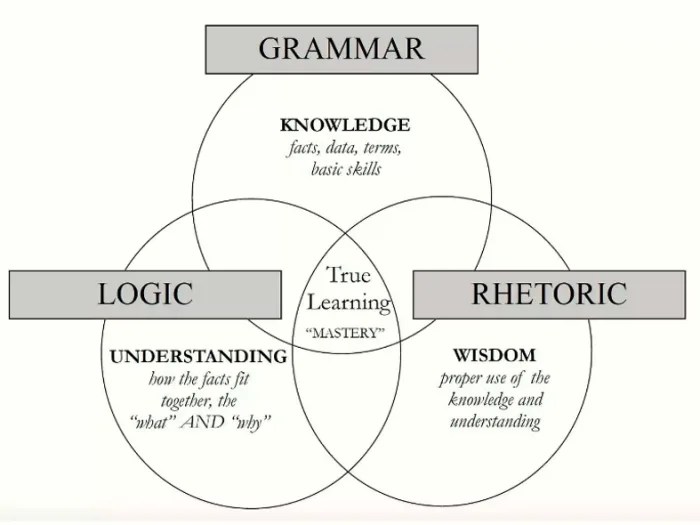
At the height of the truth movement in the 2010s, there was an emphasis on critical thinking. The Trivium was making a comeback.

Grammar, logic, and rhetoric

In that order. 

More often than not, online communication is rhetoric without grammar and logic to back it up.

Sweeping generalizations abound.

  • Accusations
  • Declarations
  • Proclamations
  • & Polarizing opinions disguised as facts

But opinions are not facts. (And you are not your opinions.)

“A great many people think they are thinking when they are merely rearranging their prejudices.” – William James

Social media algorithms are designed to keep you in a feedback loop.

A lot of people use their (typed) voice online to “speak the truth.” But they’re preaching to the choir in an echo chamber.

There’s camaraderie to be found in this. Which is good. But the likelihood of their rantings reaching those who (they feel) need to hear them is small.

The aggression that comes through many posts is ugly and derogatory.

Anger

Anger is a powerful emotion. But it’s like fire. It can warm your house or burn it down.

“Heat not a furnace for your foe so hot that it do singe yourself.” – William Shakespeare

Many people lean on anger to convey their conviction about a topic. They use it to stress the importance of something. But more often than not, it’s ineffective.

Anger is best utilized when it’s the seed preceding something more interesting.

In other words, anger alone is a weak emotion for personal expression.

When anger sparks an idea, and that idea is built upon with clarity and care, the expression of that idea has the power to shift someone’s perspective.

Many of my poems and JoyCamp videos came from an angry place. But anger is nowhere to be found in the final product.

Some think I’m too soft in my approach. Well, they’re welcome to think whatever they want. I’ve learned through trial and error that bluntly and angrily stating “the truth” is a fool’s errand. People don’t want to hear it, no matter how right or passionate you are.

Use anger like clay and sculpt it.

I tried anger in my 20s, and it got me nowhere. If anything, it only made situations worse. Speaking loudly and angrily puts more distance between your conversation partner and the point you want them to understand.

I’m committed to the truth and helping others discover it for themselves. Over the course of 15 years, I developed a nuanced approach to communication that actually works. One that I’ve taught to hundreds of people in my Parrhesia program (now called Free Your Speech).

If you didn’t pull the trigger on Parrhesia when I was offering it live, you can still purchase the course itself.

>>Free Your Speech: The Art of Communication

I’ve dropped the price to $149. It’s an election year. It’s probably worth your while.

Logic

It’s agonizing to witness your friends, family, and society at large fall into what you perceive as traps.

What’s painfully obvious to you is beyond absurd or ridiculous to them. And no matter how much you try to convince them otherwise, they double down on their commitment to the trap.

People are not logical. They’re emotional and motivated by fear, comfort, and ego.

“No one can possibly behave above his own level of understanding. Don’t expect people to do any better than they are compelled to do at their present level. Your problem is assuming that they should and could behave better. Understand this and annoyance disappears. As you gradually awaken you will feel the urge to share your discovery with others. Because you will find others in various stages of receptivity, remember this: Never give more than others can understand and appreciate in the moment. This is cosmic law. To try and give what others cannot receive is like tossing a ball against a brick wall—it bounces back to strike you. Jesus explained this law by saying that we should not cast our pearls before swine; that is, before those whose comprehension of truth makes them indifferent or hostile about it.” – François Fénelon

This is the cornerstone of my communication philosophy and approach.

The Real Awakening

There is no truth movement. There never was. There is only your journey to discovering what the truth is.

Pick your lane and choose your battles wisely.

Worry less about the world and other people’s opinions.

Concern yourself with what you’re capable of. Challenge your comfort zone. And focus your efforts on how you can help.

The most exciting rabbit hole is YOU.

Until next time.

Much love,

Benny

PS- Build Bridges

7 REASONS WHY DOUBT IS THE ORIGIN OF WISDOM

By Gary ‘Z’ McGee

Source: Waking Times

“Doubt is the origin of wisdom.” ~Rene Descartes

1.) Doubt transforms answers into questions:

“Doubt is essential. It is the vehicle that transports us from one certainty to another.” ~Eric Weiner

The right question is always more important than the right answer. Why? Because there is a higher probability of getting lost in answers. Also, there is a higher probability of discovering something beyond the “answers” by questioning them.

Answers are more likely to become golden idols. Questions are more likely to melt those golden idols into something more malleable, more open, and more adaptable to change.

As Ken Kesey said, “The need for mystery is greater than the need for an answer.”

Accepting answers without questioning them is a problem of certainty. You might think that you want to be certain, but certainty is almost always a hangup. The cure for certainty is curiosity. Don’t believe what you think; be curious about why you think it instead.

2.) Doubt teaches you how to recondition cultural conditioning:

“Only once he has endured the necessary doubt and despair within himself can the individual play an exemplary role in standing firm amidst the world’s pandemonium.” ~Stefan Zweig

Doubt makes you vulnerable, open, and honest with being a fallible creature. It forces you to confront the raw reality that we’re all just imperfect mammals vainly attempting to pigeonhole godhood into wormwood.

As Ernest Becker said, “The essence of normality is the refusal of reality.”

This is the comfortable burden forced upon you by Mother Culture. But you cannot afford to refuse reality. You must embrace it. Refuse the cultural illusion instead. Doubt the comfort zone.

Employ your mind as a mirror. Reflect the illusion. Receive but do not keep. Absorb but do not cling. Learn but do not dwell. Question but remember to never settle on an answer. Settling for an answer is giving up on your goal of knowing something that has never been known before. Never settle. Even if the answer seems convincing. Question it. Always question it. Especially if it is presented by culture as something you must believe in.

Asking difficult questions and challenging culture will always be more important than receiving simple answers and accepting culture.

3.) Doubt plants mind-opening seeds in the hard ground of blind belief:

“Trust those who seek the truth. Doubt those who find it.” ~Andre Gide

Doubt teaches you how to, as Aristotle advised, “entertain a thought without accepting it.”

Blind belief is the epitome of accepting a thought without entertaining it. Whether due to cultural conditioning, religious indoctrination, or political programming, blind belief leads to willful ignorance. And the only remedy for willful ignorance is doubt.

The willful ignorance inherent in blind belief is the bane of any Truth Quest. Doubt reprograms the Truth Quest. And once the Truth Quest is reprogrammed, you are liberated. You are free to always question, to always be open, to always be flexible, and to never again fall into the trap of blind belief.

As the Buddha said, “Doubt everything. Find your own light.”

Doubt keeps all things in perspective. And especially this: The Truth Quest must go on for the sake of Truth itself. Indeed. It is the hallmark of doubt to always keep the Truth Quest ahead of the “truth.”

4.) Doubt expands the self:

“If you would be a real seeker of truth, it is necessary that at least once in your life you doubt, as far as possible, all things.” ~Descartes

Doubt teaches clarity through iteration. The self is an endless ocean. The more you know yourself, the more you realize how much you don’t know. But a clarity comes from this. The waters are still endlessly deep, but you gain better visibility.

You realize that self-knowledge has no end. You realize that it’s not about coming to an identity, or ending up with a personality, or forming an opinion, or coming to a conclusion, or ending up with a belief. Not at all.

It’s about swimming into deeper clarity. You swim through identity, through personality, through opinion, through belief. You do so because the alternative is becoming stuck. The alternative is becoming fixed and conditioned, placated and trapped, bamboozled and brainwashed.

Doubt teaches you how to iterate through the self like a snake sheds its skin. Always moving forward. Always adapting. Always overcoming.

Growth, expansion, and greater clarity are always in the depths of a greater ocean. Swim!

5.) Doubt keeps you ahead of the curve:

“To be aware of limitations is already to be beyond them.” ~Georg Wilhelm Friedrich Hegel

Doubt teaches uncertainty and uncertainty teaches aplomb.

Aplomb drops a bomb in the bomb shelter of your certainty. It sees the way out of the trap of certainty from the inside out. It’s embracing the fact that doubt is a crashing wave, but rather than fight against it, you act with aplomb and surf it out.

Acting with aplomb is being proactive despite self-doubt. It’s honoring doubt, detaching from it, and then focusing on what makes you curious and inspired instead. Acting with aplomb takes nerve, nonchalance, and self-confidence. It’s realizing that the ends don’t have to justify the means.

So, the universe is fundamentally uncertain? So be it. Might as well join forces with it. Might as well take that uncertainty and transform it into astonishment and awe. Might as well stay ahead of the curve by not clinging to any aspect of the curve. Let the chips fall where they may.

Stepping into the unknown can be harrowing. Self-doubt is a given. Acting with aplomb is simply accepting it as a gift that keeps on giving you the power to consistently flatten the box, turn the tables, flip the script, and push the envelope of certainty that threatens to envelope you in one-dimensional thinking.

6.) Doubt transforms hubris into humor:

“Humor is not a mood but a way of looking at the world.” ~Ludwig Wittgenstein

There is nothing more powerful than a good sense of humor, not even power. In the throes of good humor, the entire universe is inside you, vibrating through you, howling at all moons, singing a language older than words, and most importantly reminding you that although you are but a speck in the cosmos you are also the entire cosmos within a speck.

When you’re in the throes of good humor, you are in tune with higher frequencies. You’re a fountainhead tapped into the higher order of disordered order. You’re a beacon of hope in a field of despair. You’re a beacon of darkness in the blinding light of cultural conditioning. You’re a devil-may-care cosmonaut in the whirlwind slipping all knots.

Cultivated humor is an inverted mirror that flips the universe. It puts seriousness and pettiness into perspective. It keeps humor ahead of hubris, laughter ahead of longing, Amor Fati ahead of Fate. It puts the ego on a leash.

As Camus said, “The greatness of man lies in his decision to be stronger than his condition.”

In order to build new knowledge, you must first be able to destroy untruth and stop taking yourself too seriously. Take a leap of courage out of belief and into faith. Be curious, not certain. Be creative, not convinced. Be eccentric, not conformist. Be humorous, not full of hubris.

Doubt! Free yourself to unlearn what you have been deceived into learning.

7.) Doubt teaches you the power of the Middle Way:

“The middle path does not go from here to there. It goes from there to here.” ~Jack Kornfield

Doubt keeps you in alignment with the Great Mystery; what some call God. The more aligned you are with this Mystery, the more disciplined your imagination will be. The more likely you will act with awe and transcendence rather than belief and closemindedness.

You can’t know the future. You can’t control how things will turn out. You can only control how you react to how things turn out. Even then, it’s not about control. It’s about being adaptable. It’s about being flexible and resilient. It’s about being prepared for the worst, even as you hope for the best. It’s about pulling your fragile past toward your antifragile future.

In that speck of hope is all the courage you’ll ever need. A dash of courage trumps an ocean of doubt. Use that courage like a sword. Or, even better, a scythe. Cut through the storm of the unknown. Shred the shroud of not knowing. Slice and dice the thickness of uncertainty. Not for the goal of invulnerability but for the transcendence of absolute vulnerability.

The Middle Way is where absolute vulnerability comes to fruition. The Middle Way is the sword of truth splitting all “truths”. The Middle Way is the scythe of justice breaking all “crowns”.

Cut with your soul. Meet the danger on the road to adventure. Greet Glory in the field. Confront the albatross on the path. Encounter the Minotaur in the labyrinth. Cut! Cut the obstacle until it becomes the path.

And if “God Himself” should stand in your way, cut that bastard down and become one with all things.