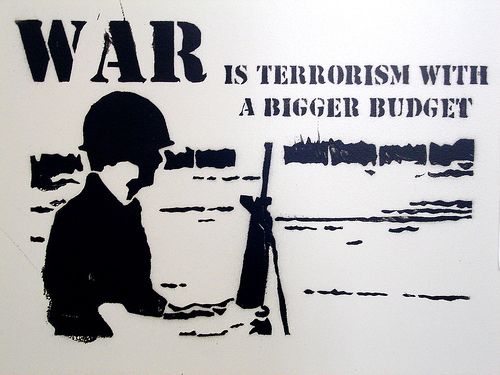
The Limits of American Destructiveness

By Dmitry Orlov

Source: Club Orlov

US foreign policy has always been directed at wrecking anything that wasn’t deemed sufficiently American and replacing it with something more acceptable—especially if that something allowed wealth to flow into the US from the outside. Compromises were reserved for the USSR, but even there the Americans constantly tried to cheat. For everyone else there was just submission, which was usually tactfully disguised as a positive—a seat at the big table which offered better chances for peace, prosperity and economic and social development.

Of course, it was a simple enough matter to pierce this veil of hypocritical politeness and to point out that the US, living far beyond its means, has only managed to survive by looting the rest of the world, but anyone who dared to do so would be ostracized, sanctioned, regime-changed, invaded and destroyed—whatever it took.

The US establishment has lavished its wrath on anyone who dared to oppose it ideologically, but it reserved its most extreme forms of malice for those who dared commit the cardinal sin of attempting to sell oil for anything other than US dollars. Iraq was destroyed for this very reason, then Libya. With Syria the juggernaut bogged down and stalled out; with Iran it is unlikely to ever get started.

Even the spineless European politicians are now forced to admit that US policies are designed to enrich certain American interests at the expense of their constituents; they understand by now that further denial would cause them further harm at the polls. Most insultingly to the American ego, US attempts at making Russia and China submit are being greeted with shrugs, titters and eye rolls. And now anybody who wants to can openly criticize the US and scheme behind its back.

How times have changed! US politicians and officials have abandoned all attempts at maintaining decorum and no longer disguise their rapacious, grasping ways. Instead of veiled threats, they now deploy big lies and fake threats. Focusing on the manufacture and dissemination of fakes, they have been attempting to use them to coerce obedience. There are the fake threats—Russian, Chinese, Iranian, North Korean, Cuban—that are used to call for discipline within NATO and for compliance with US unilateral sanctions.

There are also the fake (or false flag) events—a Boeing shot down over the Ukraine by “pro-Russian rebels”; the Skripal poisoning; fake chemical attacks in Syria preposterously blamed on the government; damaged oil tankers in UAE blamed on Iran. These fakes are being used as an an excuse to wreck everything—international security and trade agreements, the systems for insuring that these agreements are adhered to, and world trade.

Before the Americans would do their best to wreck anything that wasn’t theirs, then work to replace it with something that was theirs; but now they have nothing to offer as a replacement for what they are destroying. The only thing the US can offer China is Chinese victory in the trade war. China does not need the US, and this point is being rather loudly pounded home, not just by the Chinese government but by private companies and individuals as well.

First, there is a flood of countersanctions. In particular, a halt to the export of rare earth minerals will shut down electronics manufacturing and with it the entire US high tech sector. Then there are the bonuses to those who buy Huawei products and punishments for buying anything American, up to and including eating at McDonald’s. iPhones have been all but banned—not by the government but by peer pressure. Taking a trip to the US is now a firing offense. There is now a good chance that, caught up in this patriotic uplift, the Chinese are being prepared to make any sacrifice for the sake of outright victory in their trade war with the US.

But do the Americans still have the power to destroy? When Saddam Hussein decided to start selling oil for euros, the CIA organized a provocation that caused him to invade Kuweit as punishment for stealing Iraqi oil. This allowed the US to organize a gigantic expeditionary force with divisions from a large number of countries, including Syria and Egypt and pretty much all of NATO. After a decade of Hussein festering in place, a somewhat smaller coalition dealt him the coup de grâce, destroying Iraq in the process. The victims of the American invasion and occupation outnumber Saddam Hussein’s victims by orders of magnitude. Later, the same thing was done to Muammar Qaddafi, for similar reasons, and Libya is likely to remain as a ruin. There, some sort of minor coalition was cobbled together.

But now the US finds that it urgently needs to knock out Iran because otherwise it will be too late. It is time to form a new coalition and Mike Pompeo has started racing around Eurasia. First off, he offended the Germans by canceling his state visit with Angela Merkel on a moment’s notice and without offering a reason. Instead, he flew to Baghdad—a perfect location for launching an attack on Iran, except that the Iraqi response was a message of solidarity with Iran, willingness to mediate the US-Iranian dispute, and consideration of a ban on US troops on Iraqi soil.

And so Mike flew to Sochi, where he met with Russian foreign minister Sergei Lavrov and, briefly, with Putin. Most likely, Putin told him where he can stuff his war plans, and so Mike canceled his planned trip to Moscow, to avoid having Sergei Lavrov wipe his feet on him again. And so Mike flew on to Europe, where he got a quick “no” on Iran from EU foreign policy head Federica Mogherini and an outright refusal to meet from the foreign ministers of France, Germany and Great Britain. And so Mike flew back to Washington. You can’t tell anything by looking at his smirking fat mug, but I am sure that he was crying on the inside.

US actions around the world can now be compiled into two lists. The first list is of what the US has succeeded or may yet succeed in wrecking. The second list is of what the US wants to or has been trying to wreck but won’t be able to. There is no third list of what the US has managed to wreck and then make whole again. The challenge for the whole world is to move as many items as possible from the first list to the second list. There are many ways of going about doing this that do have a chance of working and one that doesn’t: negotiating with Americans. Because they lie and cheat and aren’t worth talking to.

Technotyranny: The Iron-Fisted Authoritarianism of the Surveillance State

By John W. Whitehead

Source: Activist Post

“There will come a time when it isn’t ‘They’re spying on me through my phone’ anymore. Eventually, it will be ‘My phone is spying on me.’” ― Philip K. Dick

Red pill or blue pill? You decide.

Twenty years after the Wachowskis’ iconic 1999 film, The Matrix, introduced us to a futuristic world in which humans exist in a computer-simulated non-reality powered by authoritarian machines—a world where the choice between existing in a denial-ridden virtual dream-state or facing up to the harsh, difficult realities of life comes down to a red pill or a blue pill—we stand at the precipice of a technologically-dominated matrix of our own making.

We are living the prequel to The Matrix with each passing day, falling further under the spell of technologically-driven virtual communities, virtual realities and virtual conveniences managed by artificially intelligent machines that are on a fast track to replacing us and eventually dominating every aspect of our lives.

Science fiction has become fact.

In The Matrixcomputer programmer Thomas Anderson a.k.a. hacker Neo is wakened from a virtual slumber by Morpheus, a freedom fighter seeking to liberate humanity from a lifelong hibernation state imposed by hyper-advanced artificial intelligence machines that rely on humans as an organic power source. With their minds plugged into a perfectly crafted virtual reality, few humans ever realize they are living in a dream world.

Neo is given a choice: to wake up and join the resistance, or remain asleep and serve as fodder for the powers-that-be. “You take the blue pill and the story ends. You wake in your bed and believe whatever you want to believe,” Morpheus says to Neo in The Matrix. “You take the red pill and you stay in Wonderland, and I show you how deep the rabbit hole goes.

Most people opt for the red pill.

In our case, the red pill—a one-way ticket to a life sentence in an electronic concentration camp—has been honey-coated to hide the bitter aftertaste, sold to us in the name of expediency and delivered by way of blazingly fast Internet, cell phone signals that never drop a call, thermostats that keep us at the perfect temperature without our having to raise a finger, and entertainment that can be simultaneously streamed to our TVs, tablets and cell phones.

Yet we are not merely in thrall with these technologies that were intended to make our lives easier. We have become enslaved by them.

Look around you. Everywhere you turn, people are so addicted to their internet-connected screen devices—smart phones, tablets, computers, televisions—that they can go for hours at a time submerged in a virtual world where human interaction is filtered through the medium of technology.

This is not freedom.

This is not even progress.

This is technological tyranny and iron-fisted control delivered by way of the surveillance state, corporate giants such as Google and Facebook, and government spy agencies such as the National Security Agency.

We are living in a virtual world carefully crafted to resemble a representative government, while in reality we are little more than slaves in thrall to an authoritarian regime, with its constant surveillance, manufactured media spectacles, secret courts, inverted justice, and violent repression of dissent.

So consumed are we with availing ourselves of all the latest technologies that we have spared barely a thought for the ramifications of our heedless, headlong stumble towards a world in which our abject reliance on internet-connected gadgets and gizmos is grooming us for a future in which freedom is an illusion.

It’s not just freedom that hangs in the balance. Humanity itself is on the line.

Indeed, while most people are busily taking selfies, Google has been busily partnering with the NSA, the Pentagon, and other governmental agencies to develop a new “human” species.

Essentially, Google—a neural network that approximates a global brain—is fusing with the human mind in a phenomenon that is called “singularity.” Google will know the answer to your question before you have asked it, said transhumanist scientist Ray Kurzweil. “It will have read every email you will ever have written, every document, every idle thought you’ve ever tapped into a search-engine box. It will know you better than your intimate partner does. Better, perhaps, than even yourself.”

But here’s the catch: the NSA and all other government agencies will also know you better than yourself. As William Binney, one of the highest-level whistleblowers to ever emerge from the NSA said, “The ultimate goal of the NSA is total population control.”

Cue the dawning of the Age of the Internet of Things, in which internet-connected “things” will monitor your home, your health and your habits in order to keep your pantry stocked, your utilities regulated and your life under control and relatively worry-free.

The key word here is control.

In the not-too-distant future, “just about every device you have — and even products like chairs, that you don’t normally expect to see technology in — will be connected and talking to each other.”

By 2020, there will be 152 million cars connected to the Internet and 100 million Internet-connected bulbs and lamps. By 2021, it is estimated there will be 240 million wearable devices such as smartwatches, keeping users connected it real time to their phones, emails, text messages and the Internet. By 2022, there will be 1.1 billion smart meters installed in homes, reporting real-time usage to utility companies and other interested parties.

This “connected” industry—estimated to add more than $14 trillion to the economy by 2020—is about to be the next big thing in terms of societal transformations, right up there with the Industrial Revolution, a watershed moment in technology and culture.

Between driverless cars that completely lacking a steering wheel, accelerator, or brake pedal and smart pills embedded with computer chips, sensors, cameras and robots, we are poised to outpace the imaginations of science fiction writers such as Philip K. Dick and Isaac Asimov. (By the way, there is no such thing as a driverless car. Someone or something will be driving, but it won’t be you.)

The aim of these internet-connected devices, as Nest proclaims, is to make “your house a more thoughtful and conscious home.” For example, your car can signal ahead that you’re on your way home, while Hue lights can flash on and off to get your attention if Nest Protect senses something’s wrong. Your coffeemaker, relying on data from fitness and sleep sensors, will brew a stronger pot of coffee for you if you’ve had a restless night.

Internet-connected techno gadgets as smart light bulbs can discourage burglars by making your house look occupied, smart thermostats will regulate the temperature of your home based on your activities, and smart doorbells will let you see who is at your front door without leaving the comfort of your couch.

Nest, Google’s $3 billion acquisition, has been at the forefront of the “connected” industry, with such technologically savvy conveniences as a smart lock that tells your thermostat who is home, what temperatures they like, and when your home is unoccupied; a home phone service system that interacts with your connected devices to “learn when you come and go” and alert you if your kids don’t come home; and a sleep system that will monitor when you fall asleep, when you wake up, and keep the house noises and temperature in a sleep-conducive state.

It’s not just our homes that are being reordered and reimagined in this connected age: it’s our workplaces, our health systems, our government and our very bodies that are being plugged into a matrix over which we have no real control.

Moreover, given the speed and trajectory at which these technologies are developing, it won’t be long before these devices are operating entirely independent of their human creators, which poses a whole new set of worries.

As technology expert Nicholas Carr notes, “As soon as you allow robots, or software programs, to act freely in the world, they’re going to run up against ethically fraught situations and face hard choices that can’t be resolved through statistical models. That will be true of self-driving cars, self-flying drones, and battlefield robots, just as it’s already true, on a lesser scale, with automated vacuum cleaners and lawnmowers.”

For instance, just as the robotic vacuum, Roomba, “makes no distinction between a dust bunny and an insect,” weaponized drones will be incapable of distinguishing between a fleeing criminal and someone merely jogging down a street.

For that matter, how do you defend yourself against a robotic cop—such as the Atlas android being developed by the Pentagon—that has been programmed to respond to any perceived threat with violence?

Unfortunately, in our race to the future, we have failed to consider what such dependence on technology might mean for our humanity, not to mention our freedoms.

Ingestible or implantable chips are a good example of how unprepared we are, morally and otherwise, to navigate this uncharted terrain. Hailed as revolutionary for their ability to access, analyze and manipulate your body from the inside, these smart pills can remind you to take your medication, search for cancer, and even send an alert to your doctor warning of an impending heart attack.

Sure, the technology could save lives, but is that all we need to know? Have we done our due diligence in dealing with the ramifications of giving the government and its cronies access to such intrusive programs? For example, asks reporter Ariana Eunjung Cha, “How will patients be assured that the technology won’t be used to compel them to take medications they don’t really want to take? Could what started as a voluntary experiment be turned into a compulsory government identification program that could erode civil liberties?

Let me put it another way.

If you were shocked by Edward Snowden’s revelations about how NSA agents have used surveillance to spy on Americans’ phone calls, emails and text messages, can you imagine what unscrupulous government agents could do with access to your internet-connected car, home and medications?

All of those internet-connected gadgets we just have to have (Forbes refers to them as “(data) pipelines to our intimate bodily processes”)—the smart watches that can monitor our blood pressure and the smart phones that let us pay for purchases with our fingerprints and iris scans—are setting us up for a brave new world where there is nowhere to run and nowhere to hide.

Imagine what a SWAT team could do with the ability to access, monitor and control your internet-connected home: locking you in, turning off the lights, activating alarms, etc.

Thus far, the public response to concerns about government surveillance has amounted to a collective shrug.

After all, who cares if the government can track your whereabouts on your GPS-enabled device so long as it helps you find the fastest route from Point A to Point B? Who cares if the NSA is listening in on your phone calls and downloading your emails so long as you can get your phone calls and emails on the go and get lightning fast Internet on the fly? Who cares if the government can monitor your activities in your home by tapping into your internet-connected devices—thermostat, water, lights—so long as you can control those things with the flick of a finger, whether you’re across the house or across the country?

It’s hard to truly appreciate the intangible menace of technology-enabled government surveillance in the face of the all-too-tangible menace of police shootings of unarmed citizens, SWAT team raids, and government violence and corruption.

However, both dangers are just as lethal to our freedoms if left unchecked.

Consider that on any given day, the average American going about his daily business is monitored, surveilled, spied on and tracked in virtually every way by both government and corporate eyes and ears.

Whether you’re walking through a store, driving your car, checking email, or talking to friends and family on the phone, you can be sure that some government agency, whether the NSA or some other entity, will be listening in and tracking your behavior.

This doesn’t even begin to touch on the corporate trackers that monitor your purchases, web browsing, Facebook posts and other activities taking place in the cyber sphere.

In other words, there is no form of digital communication that the government cannot and does not monitor: phone calls, emails, text messages, tweets, Facebook posts, internet video chats, etc., are all accessible, trackable and downloadable by federal agents.

The government and its corporate partners-in-crime have been bypassing the Fourth Amendment’s prohibitions for so long that this constitutional bulwark against warrantless searches and seizures has largely been rendered antiquated and irrelevant.

We are now in the final stage of the transition from a police state to a surveillance state.

Having already transformed local police into extensions of the military, the Department of Homeland Security, the Justice Department and the FBI are in the process of turning the nation’s police officers into techno-warriors, complete with iris scanners, body scanners, thermal imaging Doppler radar devices, facial recognition programs, license plate readers, cell phone Stingray devices and so much more.

Add in the fusion centers and real-time crime centers, city-wide surveillance networks, data clouds conveniently hosted overseas by Amazon and Microsoft, drones equipped with thermal imaging cameras, and biometric databases, and you’ve got the makings of a world in which “privacy” is reserved exclusively for government agencies.

In other words, the surveillance state that came into being with the 9/11 attacks is alive and well and kicking privacy to shreds in America. Having been persuaded to trade freedom for a phantom promise of security, Americans now find themselves imprisoned in a virtual cage of cameras, wiretaps, sensors and watchful government eyes.

Just about every branch of the government—from the Postal Service to the Treasury Department and every agency in between—now has its own surveillance sector, authorized to spy on the American people.

And of course that doesn’t even begin to touch on the complicity of the corporate sector, which buys and sells us from cradle to grave, until we have no more data left to mine. Indeed, Facebook, Amazon and Google are among the government’s closest competitors when it comes to carrying out surveillance on Americans, monitoring the content of your emails, tracking your purchases and exploiting your social media posts.

“Few consumers understand what data are being shared, with whom, or how the information is being used,” reports the Los Angeles Times. “Most Americans emit a stream of personal digital exhaust — what they search for, what they buy, who they communicate with, where they are — that is captured and exploited in a largely unregulated fashion.”

It’s not just what we say, where we go and what we buy that is being tracked.

We’re being surveilled right down to our genes, thanks to a potent combination of hardware, software and data collection that scans our biometrics—our faces, irises, voices, genetics, even our gait—runs them through computer programs that can break the data down into unique “identifiers,” and then offers them up to the government and its corporate allies for their respective uses.

For instance, imagine what the NSA could do (and is likely already doing) with voiceprint technology, which has been likened to a fingerprint. Described as “the next frontline in the battle against overweening public surveillance,” the collection of voiceprints is a booming industry for governments and businesses alike. As The Guardian reports, “voice biometrics could be used to pinpoint the location of individuals. There is already discussion about placing voice sensors in public spaces, and … multiple sensors could be triangulated to identify individuals and specify their location within very small areas.”

The NSA is merely one small part of a shadowy permanent government comprised of unelected bureaucrats who march in lockstep with profit-driven corporations that actually runs Washington, DC, and works to keep us under surveillance and, thus, under control. For example, Google openly works with the NSA, Amazon has built a massive $600 million intelligence database for CIA, and the telecommunications industry is making a fat profit by spying on us for the government.

In other words, Corporate America is making a hefty profit by aiding and abetting the government in its domestic surveillance efforts.

Control is the key here.

Total control over every aspect of our lives, right down to our inner thoughts, is the objective of any totalitarian regime.

George Orwell understood this. His masterpiece, 1984, portrays a global society of total control in which people are not allowed to have thoughts that in any way disagree with the corporate state. There is no personal freedom, and advanced technology has become the driving force behind a surveillance-driven society. Snitches and cameras are everywhere. And people are subject to the Thought Police, who deal with anyone guilty of thought crimes. The government, or “Party,” is headed by Big Brother, who appears on posters everywhere with the words: “Big Brother is watching you.”

Make no mistake: the Internet of Things is just Big Brother in a more appealing disguise.

Now there are still those who insist that they have nothing to hide from the surveillance state and nothing to fear from the police state because they have done nothing wrong. To those sanctimonious few, secure in their delusions, let this be a warning: the danger posed by the American police state applies equally to all of us, lawbreaker and law-abider alike.

In an age of too many laws, too many prisons, too many government spies, and too many corporations eager to make a fast buck at the expense of the American taxpayer, there is no safe place and no watertight alibi.

We are all guilty of some transgression or other.

Eventually, as I make clear in my book Battlefield America: The War on the American People, we will all be made to suffer the same consequences in the electronic concentration camp that surrounds us.

Bezos Reveals His Ugly Vision For The World He’s Trying To Rule

By Caitlin Johnstone

Source: CaitlinJohnstone.com

“Guess what the best planet is in this solar system?” asked Amazon CEO Jeff Bezos at a recent media event on his Blue Origin space program.

“It’s easy to know the answer to that question,” he continued. “We’ve sent robotic probes like this one to all of the planets in our solar system. Now, some of them have been fly-bys, but we’ve examined them all. Earth is the best planet. It is not close. This one is really good.”

Bezos then went on to discuss his plan to ship humans off of the best planet in the solar system and send them to live in floating cylinders in space.

Bezos claimed that the growing human population and growing energy consumption will force us to make a choice between “stasis and rationing” and “dynamism and growth”, and claimed that the latter item in his dichotomy is possible only by moving humans off the planet.

“If we’re out in the solar system, we can have a trillion humans in the solar system, which means we’d have a thousand Mozarts and a thousand Einsteins,” Bezos said. “This would be an incredible civilization. What would this future look like? Where would a trillion humans live? Well it’s very interesting, someone named Gerry O’Neill, a physics professor, looked at this question very carefully and he asked a very precise question that nobody had ever asked before, and it was, ‘Is a planetary surface the best place for humans to expand into the solar system?’ And he and his students set to work on answering that question, and they came to a very surprising–for them–counterintuitive answer: No.”

Bezos went on to describe how the limited surface areas, distance, and gravitational forces of the other planets in our solar system make settling on those planets impractical and cost-prohibitive, while constructing giant space cylinders closer to Earth which can hold a million people is far more practical. These cylinders would spin to replicate Earth’s gravitational pull with centrifugal force.

Here are some illustrations Bezos used in his presentation to show us what these “O’Neill colonies” might look like:

“These are really pleasant places to live,” Bezos said. “Some of these O’Neill colonies might choose to replicate Earth cities. They might pick historical cities and mimic them in some way. There’d be whole new types of architecture. These are ideal climates. These are short-sleeve environments. This is Maui on its best day, no rain, no storms, no earthquakes.”

No rain? No weather? Just big, spinning cylinders floating monotonously in space? A trillion divided by a million is one million, which means that the best idea the richest man in the world can come up with for the future of our species is to fill our solar system with a million of these floating homogenized space malls.

“If we build this vision, these O’Neill colonies, where does it take us? What does it mean for Earth?” Bezos asked. “Earth ends up zoned, residential, and light industry. It’ll be a beautiful place to live, it’ll be a beautiful place to visit, it’ll be a beautiful place to go to college, and to do some light industry. But heavy industry, polluting industry, all the things that are damaging our planet, those will be done off Earth. We get to have both. We get to keep this unique gem of a planet, which is completely irreplaceable–there is no Plan B. We have to save this planet. And we shouldn’t give up a future of our grandchildren’s grandchildren of dynamism and growth. We can have both.”

Now, if you look at the behavior of Jeff Bezos, who exploits his employees and destroys his competitors, and who some experts say is trying to take over the underlying infrastructure of our entire economy, you can feel reasonably confident that this man has no intention of leaving “this unique gem of a planet”, nor of having the heirs to his empire leave either. When you see this Pentagon advisory board member and CIA contractor planning to ship humans off the Earth’s surface so the planet can thrive, you may be certain that he’s talking about other humans. The unworthy ones. The ones who weren’t sociopathic enough to climb the capitalist ladder by stepping on the backs of everyone else.

And make no mistake, when Bezos talks about saving the planet for “our grandchildren’s grandchildren”, he’s not just talking about his heirs, he’s talking about himself. Bezos has invested large amounts of wealth in biotech aimed at reversing the aging process and cracking the secret of immortality.

This is the sort of guiding wisdom that is controlling the fate of our species, everyone. The world’s most ambitious plutocrat envisions a world in which, rather than evolving beyond our destructive tendencies and learning to live in collaboration with each other and our environment, we are simply shipped off into space so that he can stretch out and enjoy our beautiful planet. That’s his best idea.

Our plutocratic overlords aren’t just sociopaths. They’re morons.

Bezos’ incredibly shallow vision for humanity reminds me of something Julian Assange said at a 2017 London festival via video link about the way Silicon Valley plutocrats are trying to become immortal by finding a way to upload their brains onto computers.

“I know from our sources deep inside those Silicon Valley institutions, they genuinely believe that they are going to produce artificial intelligences that are so powerful, relatively soon, that people will have their brains digitized, uploaded on these artificial intelligences, and live forever in a simulation, therefore will have eternal life,” Assange said. “It’s a religion for atheists. They’ll have eternal life, and given that you’re in a simulation, why not program the simulation to have endless drug and sex orgy parties all around you. It’s like the 72 virgins, but it’s like the Silicon Valley equivalent.”

I mean, damn. First of all, how stupid do you have to be to overlook the fact that science has virtually no understanding of consciousness and doesn’t even really know what it is? Even if these idiots find a way to upload their neurological patternings onto some AI’s virtual simulation, it’s not like they’d be there to experience it. It would just be a bunch of data running in a computer somewhere, mimicking the personality of a dead person and experienced by no one. People who believe that all there is to them is their dopey mental patterns have not spent any time whatsoever exploring what they are, and have no idea what it is to be human. The fact that anyone would think they could become immortal by digitizing their churning, repetitive personality patterns is crazy, and the fact that they’d want to is even crazier.

People who think this way should shut up and learn about life, not rule the world in a plutocratic system where money translates directly to political influence. People who think that humans can be happily unplugged from the ecosystemic context in which they evolved, the ecosystemic context of which they are an inseparable part, and people who think they can become immortal by uploading their wanky personalities onto a computer should shut the fuck up, spend some time alone with themselves, maybe try some psilocybin mushrooms, and learn a bit about what it means to be human. They certainly shouldn’t be calling the shots.

Earth is our home. It’s what we’re made for. The earth went through a lot to give you life. Sparks had to catch, oceans had to freeze, billions of cells had to survive endless disease, all of these amazing things had to happen just right to give you life. You belong here. You are as much a creation of the earth as the air you breathe. You may feel like a singular organism but you’re actually as much a singular organism as one of the many billions of organisms that make up your body. You and earth are one. And because you evolved on earth, you are perfectly adapted to earth and it is perfectly adapted to you. It yearns for your breath as you yearn for its breeze on your face.

We absolutely have the ability to transcend our unhealthy tendencies as a species which, when you really look at them, are merely creations of a mind that feels alone and separate and like it is in a constant fight for its life. If we just put down our mental swords for a hot second and learned to channel our creativity into the thriving of our society and our ecosystem instead of into killing and out-competing one another then we will be okay. The way out of this is the way towards health. For example, once women have been given back even the most basic rights of sexual sovereignty such as birth control and access to terminations as they have in most western countries, birth rates fall below replication levels. Women’s own internal bodily wisdom makes the problem of overpopulation moot if given half a chance just to make decisions on behalf of her own body.

Another example. People lament the lack of jobs due to AI and automation but we actually desperately need people to do less. We need a whole lot of people doing nothing, not using the roads every morning and evening, not producing widgets that no one needs and creating advertising campaigns to brainwash people into buying them anyway, just to have them end up in the ocean or leaching heavy metals into the earth. Having a whole lot of people doing nothing for more of their week would take the strain off of our health systems as the single biggest factor in disease is stress. Studies show that stress also shrinks your brain and lessens your creativity and innovation too, so all the punitive-minded libertarians out there who are worried that we won’t progress as a species if we start sharing resources around to people who aren’t doing things that traditionally made money because we’ll be too relaxed can chill too. We don’t need to crack the whip to get people to make beautiful innovations. Humans are at their best when feeling playful and relaxed. Nearly all the technological advances of the past came from people who had a lot of leisure time due to their privileged status. Releasing humans from 9 to 5 slavery would be the fastest way to slow our resource consumption and take pressure off of all our systems and would have the added benefit of making us smarter, funnier, more creative and more innovative too.

And for that matter, having every idea and innovation be required to make money is also killing us. We need the ability to fund things that will not make profit. How many times have you been in a conversation and someone’s come up with an idea that will solve a major environmental, energy or health problem and no one’s got excited because it will never get off the ground because it will never make money? Fully disappearing a problem never made anyone any money. Healthy people, for example, never spend a dime at the doctors. The way out of this is detaching human innovation from money and allowing solutions to flourish without the imposition of also having to turn a profit.

These are merely three things I can think of that will dramatically improve our collective ability to reverse this extinction event and all we have to do is get saner, stop punishing each other, start sharing and start collaborating. The only issue we have as humans is that a handful of highly competitive, highly sociopathic and yet incredibly mediocre people have all the power to build our future for us with virtually no input from anyone else. Because all the power in the form of all the money has been allowed to pool into the hands of those most willing to do whatever it takes to get it, we have just a few ruthless yet surprisingly dumb individuals calling the shots on the future of all living beings. The competitive mindset that gave rise to Jeff Bezos is the exact opposite of the kind of collaborative, harmonious mindset we’ll need if we’re going to overcome the challenges we face on the horizon.


How GMO Seeds and Monsanto/Bayer’s “RoundUp” are Driving US Policy in Venezuela

Hugo Chavez and Luiz Inacio Lula da Silva visit a soy farm in El Tigre in Venezuela’s Anzoategui state, Oct. 30, 2009. Ariana Cubillos | AP

With Juan Guaidó’s parallel government attempting to take power with the backing of the U.S., it is telling that the top political donors of those in the U.S. most fervently pushing regime change in Venezuela have close ties to Monsanto and major financial stakes in Bayer.

By Whitney Webb

Source: MintPress News

As the political crisis in Venezuela has unfolded, much has been said about the Trump administration’s clear interest in the privatization and exploitation of Venezuela’s oil reserves, the largest in the world, by American oil giants like Chevron and ExxonMobil.

Yet the influence of another notorious American company, Monsanto — now a subsidiary of Bayer — has gone largely unmentioned.

While numerous other Latin American nations have become a “free for all” for the biotech company and its affiliates, Venezuela has been one of the few countries to fight Monsanto and other international agrochemical giants and win. However, since that victory — which was won under Chavista rule — the U.S.-backed Venezuelan opposition has been working to undo it.

Now, with Juan Guaidó’s parallel government attempting to take power with the backing of the U.S., it is telling that the top political donors of those in the U.S. most fervently pushing regime change in Venezuela have close ties to Monsanto and major financial stakes in Bayer.

In recent months, Monsanto’s most controversial and notorious product — the pesticide glyphosate, branded as Roundup, and linked to cancer in recent U.S. court rulings — has threatened Bayer’s financial future as never before, with a litany of new court cases barking at Bayer’s door. It appears that many of the forces in the U.S. now seeking to overthrow the Venezuelan government are hoping that a new Guaidó-led government will provide Bayer with a fresh, much-needed market for its agrochemicals and transgenic seeds, particularly those products that now face bans in countries all over the world, including once-defoliated and still-poisoned Vietnam.


U.S.-Backed Venezuelan opposition seeks to reverse Chavista seed law and GMO ban

In 2004, then-president of Venezuela, Hugo Chávez, surprised many when he announced the cancellation of Monsanto’s plans to plant 500,000 acres of Venezuelan agricultural land in genetically modified (GM) soybeans. The cancellation of Monsanto’s Venezuela contract led to what became an ad hoc ban on all GM seeds in the entire country, a move that was praised by local farmer groups and environmental activists. In contrast to anti-GM movements that have sprung up in other countries, Venezuela’s resistance to GM crops was based more on concerns about the country’s food sovereignty and protecting the livelihoods of farmers.

Although the ban has failed to keep GM products out of Venezuela — as Venezuela has long imported a majority of its food, much of it originating in countries that are among the world’s largest producers of genetically modified foods — one clear effect has been preventing companies like Monsanto and other major agrochemical and seed companies from gaining any significant foothold in the Venezuelan market.

In 2013, a new seed law was nearly passed that would have allowed GM seeds to be sold in Venezuela through a legal loophole. That law, which was authored by a member of the Chavista United Socialist Party of Venezuela (PSUV), was widely protested by farmers, indigenous activists, environmentalists, and eco-socialist groups, which led to the law’s transformation into what has been nicknamed the “People’s Seed Law.” That law, passed in 2015, went even farther than the original 2004 ban by banning not just GM seeds but several toxic agrochemicals, while also strengthening heirloom seed varieties through the creation of the National Seed Institute.

Soon after the new seed law was passed in 2015, the U.S.-backed Venezuelan opposition led by the Roundtable of Democratic Unity (MUD) — a group comprised of numerous U.S.-funded political parties, including Guaidó’s Popular Will — took control of the country’s National Assembly. Until Venezuela’s Supreme Court dissolved the assembly in 2017, the MUD-legislature attempted to repeal the seed law on several occasions. Those in favor of the repeal called the seed bill “anti-scientific” and damaging to the economy.

Despite the 2017 Supreme Court decision, the National Assembly has continued to meet, but the body holds no real power in the current Venezuelan government. However, if the current government is overthrown and Guaidó  — the “interim president” who is also president of the dissolved National Assembly — comes to power, it seems almost certain that the “People’s Seed Law” will be one of the first pieces of legislation on the chopping block.


The AEI axis

Some of the key figures and loudest voices supporting the efforts of the Trump administration to overthrow the Venezuelan government in the United States are well-connected to one particular think-tank, the American Enterprise Institute (AEI). For instance, John Bolton — now Trump’s national security advisor and a major player in the administration’s aggressive Venezuela policy — was a senior fellow at AEI until he became Trump’s top national security official. As national security adviser, Bolton advises the president on foreign policy and issues of national security while also advising both the Secretary of State and the Secretary of Defense. As of late, he has been pushing for military action in Venezuela, according to media reports.

Another key figure in Trump’s Venezuela policy — Elliott Abrams, the State Department’s Special Representative for Venezuela — has been regularly featured at AEI summits and as a guest on its panels and podcasts. According to Secretary of State Mike Pompeo, Abrams’ current role gives him the “responsibility for all things related to our efforts to restore democracy” in Venezuela. Other top figures in the administration, including Vice President Mike Pence and Secretary of State Mike Pompeo, were featured guests at the AEI’s “secretive” gathering in early March. As MintPress and other outlets have reported, Guaidó declared himself “interim president” of Venezuela at Pence’s behest. Pompeo is also intimately involved in directing Trump’s Venezuela policy as the president’s main adviser on foreign affairs.

Other connections to the Trump administration include Secretary of Education Betsy DeVos who was previously on AEI’s board of trustees.

AEI has long been a key part of the “neoconservative” establishment and employs well-known neoconservatives such as Fred Kagan — the architect of the Iraq “troop surge” — and Paul Wolfowitz, the architect of the Iraq War. Its connections to the George W. Bush administration were particularly notable and controversial, as more than 20 AEI employees were given top positions under Bush. Several of them, such as Bolton, have enjoyed new prominence in Trump’s administration.

Other key Bush officials joined the AEI soon after leaving their posts in the administration. One such was Roger Noriega, who was the U.S. representative to the Organization of American States (OAS) during the failed, U.S.-backed 2002 coup and went on to be assistant secretary of state for Western Hemisphere affairs from 2003 to 2005, where he was extremely influential in the administration’s policies towards Venezuela and Cuba.

Since leaving the Bush administration and promptly joining the AEI, Noriega has been instrumental in pushing claims that lack evidence but aim to paint Venezuela’s current President Nicolas Maduro-led government as a national security threat, such as claiming that Venezuela is helping Iran acquire nuclear weapons and hosts soldiers from Lebanon’s Hezbollah. He also lobbied Congress to support Venezuelan opposition leader Leopoldo López, Guaidó’s political mentor and leader of his political party, Popular Will.

Not only that, but Noreiga teamed up with Martin Rodil, a Venezuelan exile formerly employed by the IMF, and José Cardenas, who served in the Bush administration, to found Visión Américas, a private risk-assessment and lobbying firm that was hired to “support the efforts of the Honduran private sector to help consolidate the democratic transition in their country” after the U.S.-backed Honduran coup in 2009. In recent months, Noriega and his associates have been very focused on Venezuela, with Cardenas offering Trump public advice about how “to hasten Maduro’s exit,” while Rodil has publicly offered “to get you a deal” if you have dirt on Venezuela’s government.

While the AEI is best known for its hawkishness, it is also a promoter of big agricultural interests. Since 2000, It has hosted several conferences on the promise of “biotechnology” and genetically modified seeds and has heavily promoted the work of former Monsanto lobbyist Jon Entine, who was an AEI visiting fellow for several years. The AEI also has long-time connections to Dow Chemical.

The most likely reason for the AEI’s interest in promoting biotech, however, can be found in its links to Monsanto. In 2013, The Nation acquired a 2009 AEI document, obtained through a filing error and not intended for public disclosure, that revealed the think tank’s top donors. The form, known as the “schedule of contributors,” revealed that the AEI’s top two donors at the time were the Donors Capital Fund and billionaire Paul Singer.

The Donors Capital Fund, which remains a major contributor to the AEI, is linked to Monsanto interests through the vice chairman of its board, Kimberly O. Dennis, who is also currently a member of the AEI’s National Council. According to AEI, the National Council is composed of “business and community leaders from across the country who are committed to AEI’s success and serve as ambassadors for AEI, providing us with advice, insight, and guidance.”

Dennis is the long-time executive chairwoman of the Searle Freedom Trust, which was founded in 1988 by Daniel Searle after he oversaw the sale of his family pharmaceutical company — G.D. Searle and Company — to Monsanto in 1985 for $2.7 billion. The money Searle had made from that merger was used to fund the trust that now funds the AEI and other right-wing think tanks. Searle was also close to Donald Rumsfeld, who led G.D. Searle and Co. for years and was Secretary of Defense under Gerald Ford and George W. Bush. Searle was also a trustee of the Hudson Institute, which once employed Elliott Abrams.

After the family company — which gained notoriety for faking research about the safety of its sweetener, aspartame or NutraSweet — was sold to Monsanto, G.D. Searle executives close to Daniel Searle rose to prominence within the company. Robert Shapiro, who was G.D. Searle’s long-time attorney and head of its NutraSweet division, would go on to become Monsanto’s vice president, president and later CEO. Notably, Daniel Searle’s grandson, D. Gideon Searle, was an AEI trustee until relatively recently.


Why is a top to Marco Rubio increasing his stake in Bayer while others flee?

Yet, it is AEI’s top individual donor noted in the accidental “schedule of contributors” disclosure who is most telling about the private biotech interests guiding the Trump administration’s Venezuela policy. Paul Singer, the controversial billionaire hedge fund manager, has long been a major donor to neoconservative and Zionist causes — helping fund the Foreign Policy Initiative (FPI), the successor to the Project for a New American Century (PNAC); and the neoconservative and islamophobic Foundation for the Defense of Democracies (FDD), in addition to the AEI.

Singer is notably one of the top political donors to Senator Marco Rubio (R-FL) and has been intimately involved in the recent chaos in Venezuela. He has been called one of the architects of the administration’s current regime-change policy, and was the top donor to Rubio’s presidential campaign, as well as a key figure behind the controversial “dossier” on Donald Trump that was compiled by Fusion GPS. Indeed, Singer had been the first person to hire Fusion GPS to do “opposition research” on Trump. However, Singer has largely since evaded much scrutiny for his role in the dossier’s creation, likely because he became a key donor to Trump following his election win in 2016, giving $1 million to Trump’s inauguration fund.

Singer has a storied history in South America, though he has been relatively quiet about Venezuela. However, a long-time manager of Singer’s hedge fund, Jay Newman, recently told Bloomberg that a Guaidó-led government would recognize that foreign creditors “aren’t the enemy,” and hinted that Newman himself was weighing whether to join a growing “list of bond veterans [that have] already begun staking out positions, anticipating a $60 billion debt restructuring once the U.S.-backed Guaidó manages to oust President Nicolas Maduro and take control.” In addition, the Washington Free Beacon, which is largely funded by Singer, has been a vocal advocate for the Trump administration’s regime-change policy in Venezuela.

Beyond that, Singer’s Elliott Management Corporation gave Roger Noriega, the former assistant secretary of state for Western Hemisphere affairs under Bush, $60,000 in 2007 to lobby on the issue of sovereign debt and for “federal advocacy on behalf of U.S. investors in Latin America.” During the time Noriega was on Singer’s payroll, he wrote articles linking Argentina and Venezuela to Iran’s nonexistent nuclear program. At the time, Singer was aggressively pursuing the government of Argentina in an effort to obtain more money from the country’s prior default on its sovereign debt.

While Singer has been mum himself on Venezuela, he has been making business decisions that have raised eyebrows, such as significantly increasing his stake in Bayer. This move seems at odds with Bayer’s financial troubles, a direct result of the slew of court cases regarding the link between Monsanto’s glyphosate and cancer. The first ruling that signaled trouble for Monsanto and its new parent company Bayer took place last August, but Singer increased his stake in the company starting last December, even though it was already clear by then that Bayer’s financial troubles in relation to the glyphosate court cases were only beginning.

Since the year began, Bayer’s problems with the Monsanto merger have only worsened, with Bayer’s CEO recently stating that the lawsuits had “massively affected” the company’s stock prices and financial performance.


Forcing open a new market for RoundUp

Part of Singer’s interest in Bayer may relate to Venezuela, given that Juan Guaido’s “Plan País” to “rescue” the Venezuelan economy includes a focus on the country’s agricultural sector. Notably, prior to and under Chavismo, agricultural productivity and investment in the agricultural sector took a backseat to oil production, resulting in under 25 percent of Venezuelan land being used for agricultural purposes despite the fact that the nation has a wealth of arable land. The result has been that Venezuela needs to import much of its food from abroad, most of which originate in Colombia or the United States.

Under Chávez and his successor, Maduro, there has been a renewed focus on small-scale farming, food sovereignty and organic agriculture. However, if Maduro is ousted and Guaidó moves to implement his “Plan País,” the opposition’s coziness with foreign corporations, the interests of U.S. coup architects in Bayer/Monsanto, and the opposition’s past efforts to overturn the GM seed ban all suggest that a new market for Bayer/Monsanto products — particularly glyphosate — will open up.

South America has long been a key market for Monsanto and — as the company’s problems began to mount prior to the merger with Bayer — it became a lifeline for the company due to less stringent environmental and consumer regulations that many Western countries. In recent years, when South American governments have opened their countries to more “market-friendly” policies in their agricultural sectors, Monsanto has made millions.

For instance, when Brazil sought to expand biotechnology (i.e. GM seed) investment in 2012, Monsanto saw a 21% increase in its sales of GM corn seed alone, generating an additional $1 billion in profits for the company. A similar comeback scenario is needed more than every by Bayer/Monsanto, as Monsanto’s legal troubles saw the company’s profits plunge late last year.

With countries around the world now weighing glyphosate bans as a result of increased litigation over the chemical’s links to cancer, Bayer needs a new market for the chemical to avoid financial ruin. As Singer now has a significant stake in the company, he — along with the politicians and think tanks he funds — may see promise in the end of the anti-GM seed ban that a Guaidó-led government would bring.

Furthermore, given that Guaidó’s top adviser wants the Trump administration to have a direct role in governing Venezuela if Maduro is ousted, it seems likely that Singer would leverage his connections to keep Bayer/Monsanto afloat amid the growing controversy surrounding glyphosate. Such behavior on the part of Singer would hardly be surprising in light of the fact that international financial media have characterized him as a “ruthless opportunist” and “overly aggressive.”

Such an outcome would be in keeping with the increased profit margins for Monsanto and related companies that have followed its expansion into countries following U.S.-backed coups. For instance, after the U.S.-backed coup in Ukraine in 2014, the loans given to Ukraine by the International Monetary Fund and the World Bank forced the country to open up and expand the use of “biotechnology” and GM crops in its agricultural sector, and Monsanto, in particular, made millions as the prior government’s ban on GM seeds and their associated agrochemicals was reversed. If Maduro is ousted, a similar scenario is likely to play out in Venezuela, given that the Guaidó-led government made known its intention to borrow heavily from these institutions just days after Guaidó declared himself “interim president.”


Whitney Webb is a MintPress News journalist based in Chile. She has contributed to several independent media outlets including Global Research, EcoWatch, the Ron Paul Institute and 21st Century Wire, among others. She has made several radio and television appearances and is the 2019 winner of the Serena Shim Award for Uncompromised Integrity in Journalism.

Kieran Barr contributed to the research used in this report.

U.S. War Criminals, Conspiracy Theorists and the Mainstream Media vs. Julian Assange

By Timothy Alexander Guzman

Source: Silent Crow News

Julian Assange exposed U.S. war crimes, CIA spying capabilities, false flag cyber attacks and corruption within the Democratic Party and he’s the bad guy? Trump’s Justice department has decided to charge Julian Assange with “17 counts of violating the Espionage Act for his role in obtaining and publishing secret military and diplomatic documents in 2010, the Justice Department announced on Thursday, a novel case that raises profound First Amendment issues” according to The New York Times. The article ‘Assange Indicted Under Espionage Act, Raising First Amendment Issues’ does mention the fact that charging Assange under the Espionage Act sets the precedent to criminalize investigative journalism that is “related to obtaining, and in some cases publishing, state secrets to be criminal, the officials sought to minimize the implications for press freedoms.” However, The New York Times has become the judge and jury and says that Assange is a fugitive trying to avoid Sweden’s justice system for an alleged sexual assault charge and that he is a useful tool for the Russians in regards to interfering in U.S. elections:

The charges are the latest twist in a career in which Mr. Assange has morphed from a crusader for radical transparency to fugitive from a Swedish sexual assault investigation, to tool of Russia’s election interference, to criminal defendant in the United States.

Mr. Assange vaulted to global fame nearly a decade ago as a champion of openness about what governments secretly do. But with this indictment, he has become the target for a case that could open the door to criminalizing activities that are crucial to American investigative journalists who write about national security matters.

The case has nothing to do with Russia’s election interference in 2016, when Mr. Assange’s organization published Democratic emails stolen by Russia as part of its covert efforts to help elect President Trump. Instead, it focuses on Mr. Assange’s role in the leak of hundreds of thousands of State Department cables and military files by the former Army intelligence analyst Chelsea Manning

According to the head of the Justice Department’s National Security Division, John Demers, he said that “Some say that Assange is a journalist and that he should be immune from prosecution for these actions,” and that “The department takes seriously the role of journalists in our democracy and we thank you for it. It is not and has never been the department’s policy to target them for reporting.” But Mr. Assange, was “no journalist.”

Demers has accused Assange of collaborating with Chelsea Manning to steal classified information when he said that “No responsible actor, journalist or otherwise, would purposefully publish the names of individuals he or she knew to be confidential human sources in a war zone, exposing them to the gravest of dangers.”

The New York Times admits that they can be charged for doing what Wikileaks has done in the near future under the Espionage Act:

Notably, The New York Times, among many other news organizations, obtained precisely the same archives of documents from WikiLeaks, without authorization from the government — the act that most of the charges addressed. While The Times did take steps to withhold the names of informants in the subset of the files it published, it is not clear how that is legally different from publishing other classified information

Assange’s lawyer, Barry J. Pollack said that his client was charged for a crime, but according to Pollack, Assange is guilty “for encouraging sources to provide him truthful information and for publishing that information.” The New York Times also said that “the United States has asked Britain to extradite Mr. Assange, who is fighting the move, and the filing of the new charges clears the way for British courts to weigh whether it would be lawful to transfer custody of him to a place where he will face Espionage Act charges.” Britain will most likely extradite Assange to the U.S. since Britain is a close U.S. ally. The New York Times is sort of playing good cop, bad cop with the case of Julian Assange. They describe Assange as a fugitive who is avoiding Sweden’s sexual assault investigation to becoming a tool or a puppet for “Russia’s election interference” which is a joke, then they say that they can face the same charges as Wikileaks if they use the same tactics to obtain information. However, The New York Times and every other mainstream media outlet works for the U.S. government and are on the same page with the politicians as they shamefully and continuously discredit Assange. According to a report by FAIR (Fairness and Accuracy in Reporting) titled ‘Media Cheer Assange’s Arrest’ said that the media demonized Assange after his arrest:

A Washington Post editorial (4/11/19) claimed Assange was “no free-press hero” and insisted the arrest was “long overdue.” Likewise, the Wall Street Journal (4/11/19) demanded “accountability” for Assange, saying, “His targets always seem to be democratic institutions or governments.”

Other coverage was more condemnatory still. The View’s Meghan McCain (4/11/19) declared she hoped Assange “rots in hell.” Saturday Night Live’s Colin Jost (4/13/19) said it was “so satisfying to see an Internet troll get dragged out into the sunlight.” But it was perhaps the National Review (4/12/19) that expressed the most enthusiastic approval of Assange’s arrest, condemning him for his “anti-Americanism, his antisemitism and his raw personal corruption” and for harming the US with his “vile spite”

Trump and the CIA

The CIA is Trump’s wet dream, I know it sounds nasty but it was obvious from the start when Trump made his first visit as President of the United States to the CIA headquarters in Langley, Virginia and said “But I want to say that there is nobody that feels stronger about the intelligence community and the CIA than Donald Trump. There’s nobody.” Trump practically brown-nosed the CIA, and in doing so, the writing was on the wall to where the Trump-CIA relationship was going, that’s why Trump’s u-turn on Julian Assange’s arrest was not surprising and may I say, one of the most dishonest responses made by the president since the Obama and Bush years. Let’s remember during Trump’s campaign trail, it was reported that he mentioned Wikileaks more than 141 times until the day Assange was dragged out in handcuffs from the Ecuadorian embassy, and then Trump changed his tune when he was asked by the media about Assange’s arrest, and what was his response? “I know nothing about WikiLeaks.” Politicians from both sides of the aisle in Washington praised the arrest of Julian Assange especially Hillary Clinton who said Assange “has to answer for what he has done” according to The Guardian.

Trump’s entire administration wants Julian Assange and his Wikileaks organization to be permanently shut down including Trump’s advisor John Bolton who was exposed by Wikileaks when they released more than 800 files exposing his war crimes. Secretary of State and former CIA Director, Mike Pompeo is another war hawk neocon who wants Assange either dead or alive. Pompeo had called Julian Assange a “narcissist” who allegedly works hands in glove with Russia and that Assange depends on “the dirty work of others to make him famous.” During a speech at The Center for Strategic and International Studies(CSIS) back in 2017, Pompeo said that “It is time to call out WikiLeaks for what it really is: a non-state hostile intelligence service often abetted by state actors like Russia.” Pompeo said that the U.S. intelligence community (including the CIA) had already determined that Russia’s military intelligence service, the GRU used WikiLeaks to release hacked information from the DNC. But the reality is that the hacked emails came from a source who faced a serious risk according to Assange and that source was Seth Rich who was shot and killed in an affluent neighborhood in Washington, D.C. in the summer of 2016 in an apparent robbery that “failed” according to Seth Rich’s father, Joel during an interview with a local TV station KMTV. In 2016, Assange was interviewed on a Dutch television program Nieuwsuur, and said that they concerned about what happened to Seth Rich and were investigating the situation:

“We have to understand how high the stakes are in the US, and that our sources face serious risks. That’s why they come to us, so we can protect their anonymity. We are investigating what happened with Seth Rich. We think it is a concerning situation. There is not a conclusion yet; we are not willing to state a conclusion, but we are concerned about it. And more importantly, a variety of WikiLeaks sources are concerned when that kind of thing happens”

 Wikileaks offered a $20,000 reward for information leading to a conviction for the murder of Seth Rich.

Robert Mueller is a Conspiracy Theorist

The New York Times published an article based on the Mueller Report regarding the murder of Seth Rich ‘Seth Rich Was Not Source of Leaked D.N.C. Emails, Mueller Report Confirms’ claiming that Seth Rich was not the source of the Democratic National Committee’s (DNC) leaked emails proving that they were undermining the Bernie Sander’s campaign. The emails were first published by DCLeaks and then by WikiLeaks on July 22, 2016 right before the 2016 Democratic National Convention. According to The New York Times:

The special counsel’s report confirmed this week that Seth Rich, a young Democratic National Committee employee whose unsolved killing became grist for a right-wing conspiracy theory, was not the source of thousands of internal D.N.C. emails that WikiLeaks released during the 2016 presidential race, officially debunking a notion that had persisted without support for years

The report also said that “tucked amid hundreds of pages of the report’s main findings, the special counsel, Robert S. Mueller III, took aim at WikiLeaks and its founder, Julian Assange, for falsely implying that Mr. Rich was somehow involved in the dissemination of the emails, an act that aided President Trump’s campaign.” Mueller said that “WikiLeaks and Assange made several public statements apparently designed to obscure the source of the materials that WikiLeaks was releasing.” The report claims that WikiLeaks collaborated with the “true source of the leaked emails — Russian hackers — after Mr. Rich’s death.” The New York Times also said that “The theory linking Mr. Rich to the email leak took root in conservative circles and was cited by prominent conservatives like Newt Gingrich and right-wing commentators like Rush Limbaugh, Sean Hannity and Alex Jones of Infowars.” Mueller’s final statement regarding the murder of Seth Rich is just a diversion away from the truth and with Mueller’s help he can make it just go away, at least in the mainstream-media. The only people that can expose the truth regarding Seth Rich is Julian Assange and the Wikileaks organization. According to an nbcwashington.comarticle “The Mueller report says beginning in the summer of 2016 Julian Assange and WikiLeaks made statements about Rich falsely implying he leaked the stolen emails.” Last month, Vox.com published an article declaring that ‘The Seth Rich conspiracy theory needs to end now’ and falsely claimed that Assange knew that Seth Rich was not the source, because it was the Russians:

The report definitively disproved the notion that a Democratic National Committee staffer named Seth Rich was the source of leaked DNC documents later published by WikiLeaks, and that his July 2016 murder came as the result of his decision to leak those documents to WikiLeaks. This wasn’t true, although Trump associates like Jerome Corsi, Roger Stone, and countless others, have argued vehemently for years that it was. And WikiLeaks, and its founder Julian Assange, knew it

The Trump-Russia collusion hoax has been on air since Trump took office more than 2 years ago. MSNBC who was a cheerleader for the removal of Trump was humiliated after the Mueller Report revealed that Trump did not collude with Russia in the 2016 Presidential elections to defeat Hillary Clinton. Clinton lost the election because of Clinton, not Assange, the Russians or anyone else. Clinton was and still is despised by most people within the U.S. especially when she tried to undermine the other hypocrite, Bernie Sanders (who would be another puppet of the deep state if he were to win the 2020 U.S. elections)and she was exposed. Clinton and the DNC’s plan to undermine the Sander’s campaign was to secure her nomination. Wikileaks embarrassed the DNC and forced them to make an apology to Bernie Sanders and his supporters by saying “On behalf of everyone at the DNC, we want to offer a deep and sincere apology to Senator Sanders, his supporters, and the entire Democratic Party for the inexcusable remarks made over email” and that “These comments do not reflect the values of the DNC or our steadfast commitment to neutrality during the nominating process.” The Mueller report claims that the emails were allegedly stolen by hackers associated with Russian intelligence called Guccifer 2.0. In the summer of 2018, Robert Mueller indicted 12 Russian military intelligence agents called Fancy Bear who were allegedly responsible for the attack. Fancy Bear was supposedly behind Guccifer 2.0 who claimed they were responsible, but then again, it’s all a lie.

Vault 7: The CIA’s ‘Global Covert Hacking System’

One of the biggest news stories involving Wikileaks and the release of more than 8,761 documents under ‘Year Zero’, exposing the CIA and its global operations. It was the first part of a series of leaks that Wikileaks called ‘Vault 7’ a network that was inside the CIA’s Center for Cyber Intelligence based in Langley, Virginia that involves a “global covert hacking program,” including what Wikileaks describes as “weaponized exploits” used against such devices as “Apple’s iPhone, Google’s Android and Microsoft’s Windows and even Samsung TVs, which are turned into covert microphones.” The CIA bypassed encryption codes on messaging services such as WhatsApp and other phones devices. WikiLeaks said that government hackers can hack Android phones that basically collects “audio and message traffic before encryption is applied.” There are various parts of Vault 7 such as ‘Dark Matter’ that exposed the CIA’s hacking capabilities including Apple’s iPhones and Macs. Weeping Angel is another hacking tool that was developed by the CIA and the U.K.’s very own MI5 used to penetrate smart TVs to gather intelligence. Once the program is installed in smart T.V.s with a USB stick, it enabled those same televisions’ with built-in microphones and sometimes even video cameras to record while the television is turned off. Then the recorded data is either stored into the television’s memory or sent to the CIA through the internet. There are several other programs exposed under the ‘Year Zero’ global covert hacking program, but one other program stands out the most is what the CIA uses to conduct “false flag” cyber-attacks that has portrayed Russia in the past as the aggressor. Regarding the CIA’s Remote Devices Branch’s UMBRAGE group, which is a subdivision of the center’s Remote Development Branch (RDB), and according to Wikileaks’s source, the program “collects and maintains a substantial library of attack techniques” that were stolen from malware produced in other states including the Russian Federation. Wikileaks said the following:

With UMBRAGE and related projects the CIA cannot only increase its total number of attack types but also misdirect attribution by leaving behind the “fingerprints” of the groups that the attack techniques were stolen from. UMBRAGE components cover keyloggers, password collection, webcam capture, data destruction, persistence, privilege escalation, stealth, anti-virus (PSP) avoidance and survey techniques

Kim Dotcom commented on the Wikileaks revelations when he tweeted that the “CIA uses techniques to make cyber attacks look like they originated from enemy state. It turns DNC/Russia hack allegation by CIA into a JOKE.” Wired.com claimed that “Russian hacking deniers” were at an advantage in a 2017 article titled ‘WikiLeaks CIA Dump Gives Russian Hacking Deniers the Perfect Ammo’ and said that:

One nugget of particular interest to Trump supporters: a section titled “Umbrage” that details the CIA’s ability to impersonate cyber-attack techniques used by Russia and other nation states. In theory, that means the agency could have faked digital forensic fingerprints to make the Russians look guilty of hacking the Democratic National Committee

The CIA’s ability to hack smart TV’s, Smartphone’s and encrypted messaging applications and we must add to the fact that the CIA also has the capability to conduct cyber-attacks under the UMBRAGE group and make them appear it came from a foreign power is as Orwellian as one can get, it also carries very serious geopolitical implications. What is insane about the CIA’s UMBRAGE group is that according to Wikileaks, “With UMBRAGE and related projects the CIA cannot only increase its total number of attack types but also misdirect attribution by leaving behind the “fingerprints” of the groups that the attack techniques were stolen from.” In other words, the CIA could launch a malware attack that was originally developed by another country to intentionally “misdirect attribution” for the hack that would not be traced back to the CIA in any way. In 2017, CNN quoted the former CIA director James Woolsey as saying that “It’s often not foolproof to say who it is because it is possible and sometimes easy to hide your tracks,” he said. “There’s lots of tricks.” and he should know. “I think the Russians were in there, but it doesn’t mean other people weren’t, too,” Woolsey told CNN.

The CIA and the Persecution of Julian Assange 

When Julian Assange was arrested by British authorities, Wikileaks immediately released a statement on twitter mentioning the role of the CIA:

This man is a son, a father, a brother. He has won dozens of journalism awards. He’s been nominated for the Nobel Peace Prize every year since 2010. Powerful actors, including CIA, are engaged in a sophisticated effort to dehumanise, delegitimize and imprison him. #ProtectJulian

The arrest of Assange has sparked outrage and anger around the world. Assange is a hero to us all especially those in the alternative media. The mainstream-media, as we all know are based on conspiracy theories, fabrications and flat-out lies are celebrating the arrest of Assange. Perhaps, they are hoping to rebound after the ‘RussiaGate’ conspiracy theory hoax which backfired in their faces and since then, their viewership has completely collapsed.

Julian Assange will face a U.S. court if he is extradited. But rest assured, there will be those of us who will continue to speak out for Assange, and there will also be worldwide protests in coming months and years until Julian Assange is released from prison. There is hope because Assange has the truth on his side no matter what happens. If is imprisoned for life or god forbid executed at the behest of Washington and the CIA, Assange will become a Martyr. There will be many more people like Assange because the truth is like a virus to the establishment, and that’s why they want to destroy Wikileaks and the alternative media, but it’s too late, the truth is out and it will never be stopped. #ProtectJulian

1% Politics and the New Gilded Age

By Rajan Menon

Source: Intrepid Report

Despair about the state of our politics pervades the political spectrum, from left to right. One source of it, the narrative of fairness offered in basic civics textbooks — we all have an equal opportunity to succeed if we work hard and play by the rules; citizens can truly shape our politics — no longer rings true to most Americans. Recent surveys indicate that substantial numbers of them believe that the economy and political system are both rigged. They also think that money has an outsized influence on politics. Ninety percent of Democrats hold this view, but so do 80 percent of Republicans. And careful studies confirm what the public believes.

None of this should be surprising given the stark economic inequality that now marks our society. The richest 1 percent of American households currently account for 40 percent of the country’s wealth, more than the bottom 90 percent of families possess. Worse yet, the top 0.1 percent has cornered about 20percent of it, up from 7 percent in the mid-1970s. By contrast, the share of the bottom 90 percent has since then fallen from 35 percent to 25 percent. To put such figures in a personal light, in 2017, three men — Jeff Bezos, Warren Buffett, and Bill Gates — possessed more wealth ($248.5 billion) than the bottom 50 percent of Americans.

Over the last four decades, economic disparities in the U.S. increased substantially and are now greater than those in other wealthy democracies. The political consequence has been that a tiny minority of extremely wealthy Americans wields disproportionate influence, leaving so many others feeling disempowered.

What Money Sounds Like

Two recent headline-producing scandals highlight money’s power in society and politics.

The first involved super-affluent parents who used their wealth to get their manifestly unqualified children into highly selective colleges and universities that previously had reputations (whatever the reality) for weighing the merits of applicants above their parents’ wealth or influence.

The second concerned Texas Senator Ted Cruz’s reported failure to reveal, as election laws require, more than $1 million in low-interest loans that he received for his 2012 Senate campaign. (For that lapse, the Federal Election Commission (FEC) fined Senator Cruz a modest $35,000.) The funds came from Citibank and Goldman Sachs, the latter his wife’s longtime employer. News of those undisclosed loans, which also cast doubt on Cruz’s claim that he had funded his campaign in part by liquidating the couple’s assets, only added to the sense that favoritism now suffuses the politics of a country that once prided itself on being the world’s model democracy. (Journalists covering the story couldn’t resist pointing out that the senator had often lambasted Wall Street’s “crony capitalism” and excessive political influence.)

The Cruz controversy is just one reflection of the coming of 1 percent politics and 1 percent elections to America at a moment when the first billionaire has been ensconced in the Oval Office for more than two years, posing as a populist no less.

Since the Supreme Court’s 2010 ruling in Citizens United v. Federal Election Commission, money has poured into politics as never before. That’s because the Court ruled that no limits could be placed on corporate and union spending aimed at boosting or attacking candidates running for political office. Doing so, the justices determined in a 5-4 vote, would be tantamount to restricting individuals’ right to free speech, protected by the First Amendment. Then came the Court’s 2014 McCutcheon v. Federal Election Commission decision (again 5-4), which only increased money’s influence in politics by removing the aggregate limit on an individual’s contribution to candidates and to national party committees.

In an age when money drives politics, even ex-presidents are cashing in. Fifteen years after Bill Clinton departed the White House, he and Hillary had amassed a net worth of $75 million — a 6,150percent increase in their wealth. Barack and Michelle Obama’s similarly soared from $1.3 million in 2000 to $40 million last year — and they’re just warming up. Key sources of these staggering increases include sky-high speaking fees (often paid by large corporations), including $153 million for the Clintons between February 2001 and May 2016. George W. Bush also made tens of millions of dollars in this fashion and, in 2017, Obama received $400,000 for a single speech to a Wall Street firm.

No wonder average Americans believe that the political class is disconnected from their day-to-day lives and that ours is, in practice, a democracy of the rich in which money counts (and counts and counts).

Cash for College

Now let’s turn to what those two recent scandals tell us about the nexus between wealth and power in America.

First, the school scam. Parents have long hired pricey tutors to coach their children for the college admissions tests, sometimes paying them hundreds of dollars an hour, even $1,500 for 90 minutes of high-class prep. They’ve also long tapped their exclusive social and political connections to gin up razzle-dazzle internships to embellish those college applications. Anyone who has spent as much time in academia as I have knows that this sort of thing has been going on for a long time. So has the practice of“legacy admissions” — access to elite schools especially for the kids of alumni of substantial means who are, or might prove to be, donors. The same is true of privileged access to elite schools for the kids of mega-donors. Consider, for instance, that $2.5 million donation Charles Kushner made to Harvard in 1998, not long before his son Jared applied. Some of the folks who ran Jared’s high school noted that he wasn’t exactly a whiz-bang student or someone with sky-high SAT scores, but — surprise! — he was accepted anyway.

What’s new about the recent revelations is that they show the extent to which today’s deep-pocketed helicopter parents have gone into overdrive, using brazen schemes to corrupt the college admissions process yet more. One unnamed parent spent a cool $6.5 million to ensure the right college admitted his or her child. Others paid hefty amounts to get their kids’ college admissions test scores falsified or even hired proxies to take the tests for them. Famous actors and financial titans made huge payments to university sports coaches, who then lied to admissions officers, claiming that the young applicants were champions they had recruited in sports like water polo, crew, or tennis. (The kids may have known how to swim, row, or play tennis, but star athletes they were not.)

Of course, as figures on the growing economic inequality in this country since the 1970s indicate, the overwhelming majority of Americans lack the connections or the cash to stack the deck in such ways, even assuming they would do so. Hence, the public outrage, even though parents generally understand that not every aspirant can get into a top school — there aren’t enough spots — just as many know that their children’s future happiness and sense of fulfillment won’t depend on whether they attend a prestigious college or university.

Still, the unfairness and chicanery highlighted by the admissions scandal proved galling, the more so as the growing crew of fat cats corrupting the admissions process doubtless also preach the gospel of American meritocracy. Worse, most of their kids will undoubtedly present their fancy degrees as proof that quality wins out in our society, never mind that their starting blocks were placed so far ahead of the competition.

To add insult to injury, the same parents and children may even portray admissions policies designed to help students who lack wealth or come from underrepresented communities as violations of the principles of equal opportunity and fairness, democracy’s bedrock. In reality, students from low-income families, or even those of modest means, are startlingly less likely to be admitted to top private universities than those from households in the top 10 percent. In fact, applicants from families in the top 1 percent are now 77 times more likely than in the bottom 20 percent to land in an elite college, and 38 of those schools admit more kids from families in that top percentage than from the bottom 60 percent.

Buying Politics (and Politicians), American-Style

Now, let’s return to the political version of the same — the world in which Ted Cruz swims so comfortably. There, too, money talks, which means that those wealthy enough to gain access to, and the attention of, lawmakers have huge advantages over others. If you want political influence, whether as a person or a corporation, having the wealth needed to make big campaign contributions — to individuals or groups — and to hire top-drawer lobbyists makes a world of difference.

Official data on the distribution of family income in the United States show that the overwhelming majority of Americans can’t play that game, which remains the preserve of a tiny super-rich minority. In 2015, even with taxes and government-provided benefits included, households in the lowest 20 percent accounted for only about 5 percent of total income. Their average income — not counting taxes and government-provided assistance — was only $20,000. The share of the bottom 50 percent — families making $61,372 or less — dropped from 20 percent to 12 percent between 1978 and 2015.  By contrast, families in the top 1 percent earned nearly 50 percent of total income, averaging $215,000 a year — and that’s only income, not wealth. The super-rich have plenty of the latter, those in the bottom 20 percent next to none.

Before we proceed, a couple of caveats about money and political clout. Money doesn’t always prevail. Candidates with more campaign funds aren’t guaranteed victory, though the time politicians spend raising cash leaves no doubt that they believe it makes a striking difference. In addition, money in politics doesn’t operate the way simple bribery does. The use of it in pursuit of political influence works more subtly, and often — in the new era opened by the Supreme Court — without the slightest need to violate the law.

Still, in Donald Trump’s America, who would claim that money doesn’t talk? If nothing else, from inaugural events — for Trump’s inaugural $107 million was raised from a host of wealthy donors with no limits on individual payments, 30 of which totaled $1 million or more — to gala fundraisers, big donors get numerous opportunities to schmooze with those whose campaigns they’ve helped bankroll. Yes, there’s a limit — currently $5,600 — on how much any individual can officially give to a single election campaign, but the ultra-wealthy can simply put their money into organizations formed solely to influence elections as well as into various party committees.

Individuals, companies, and organizations can, for instance, give money to political action committees (PACs) and Super PACs. Though bound by rules, both entities still have lots of leeway. PACs face no monetary limits on their independent efforts to shape elections, though they can’t accept corporate or union money or take more than $5,000 from individuals. They can provide up to $5,000 to individual election campaigns and $15,000 per party committee, but there’s no limit on what they can contribute in the aggregate. Super PACs have far more running room. They can rake in unlimited amounts from a variety of sources (as long as they’re not foreign) and, like PACs, can spend limitless sums to shape elections, providing they don’t give money directly to candidates’ campaigns.

Then there are the dark money groups, which can receive financial contributions from any source, American or foreign. Though their primary purpose is to push policies, not individual campaigns, they can engage in election-related work, provided that no more than half their funds are devoted to it. Though barred from donating to individual campaigns, they can pour unlimited money into Super PACs and, unlike PACs and Super PACs, don’t have to disclose who gave them the money or how much. Between 2008 and 2018, dark money groups spent $1 billion to influence elections.

In 2018, 2,395 Super PACs were working their magic in this country. They raised $1.6 billion and spent nearly $809 million. Nearly 78 percent of the money they received came from 100 donors. They, in turn, belonged to the wealthiest 1 percent, who provided 95 percent of what those Super PACs took in.

As the 2018 congressional elections kicked off, the four wealthiest Super PACs alone had $113.4 million on hand to support candidates they favored, thanks in substantial measure to business world donors. In that election cycle, 31 individuals ponied up more than $5 million apiece, while contributions from the top four among them ranged from almost $40 million to $123 million.

The upshot: if you’re running for office and advocate policies disliked by wealthy individuals or by companies and organizations with lots of cash to drop into politics, you know from the get-go that you now have a problem.

Wealth also influences political outcomes through the lobbying industry. Here again, there are rules, but even so, vast numbers of lobbyists and eye-popping amounts of lobbying money now are at the heart of the American political system. In 2018 alone, the 50 biggest lobbying outfits, largely representing big companies, business associations, and banks, spent $540 million, and the grand total for lobbying that year alone was $3.4 billion.

Nearly 350 of those lobbyists were former legislators from Congress. Officials departing from senior positions in the executive branch have also found artful ways to circumvent presidential directives that prohibit them from working as lobbyists for a certain number of years.

Do unions and public interest groups also lobby? Sure, but there’s no contest between them and corporations. Lee Drutman of the New America think tank notes that, for every dollar the former spent in 2015, corporate donors spent $34. Unsurprisingly, only one of the top 20 spenders on lobbying last year was a union or a public-interest organization.

The sums spent by individual companies to gain political influence can be breathtaking. Take now-embattled Boeing. It devoted $15 million to lobbying in 2018 — and that’s not counting its campaign contributions, using various channels. Those added another $8.4 million in the last two-and-a-half years. Yet Boeing only placed 11th among the top 20 corporate spenders on lobbying last year. Leading the pack: the U.S. Chamber of Commerce at $94.8 million.

Defenders of the status quo will warn that substantially reducing money’s role in American politics is sure to threaten democracy and civil liberties by ceding undue power to the state and, horror of horrors, putting us on the road to “socialism,” the right wing’s bogeyman du jour. This is ludicrous. Other democracies have taken strong steps to prevent economic inequality from subverting their politics and haven’t become less free as a result. Even those democracies that don’t limit political contributions have adopted measures to curb the power of money, including bans on television ads (a huge expense for candidates in American elections: $3 billion in 2018 alone just for access to local stations), free airtime to allow competitors to disseminate their messages, and public funds to ease the financial burden of election campaigns. Compared to other democracies, the United States appears to be in a league of its own when it comes to money’s prominence in politics.

Those who favor continuing business as usual like to point out that federal “matching funds” exist to help presidential candidates not be steamrolled by competitors who’ve raised mounds of money. Those funds, however, do no such thing because they come with stringent limits on total spending. Candidates who accept matching funds for a general election cannot accept contributions from individuals. Moreover, matching funds are capped at $20 million, which is a joke considering that Barack Obama and Mitt Romney spent a combined $1.2 billion in individual contributions alone during the 2012 presidential election. (Super PACs spent another $350 million to help Romney and $100 million to back Obama.)

A New American Tradition?

Rising income inequalitywage stagnation, and slowing social mobility hurt ordinary Americans economically, even as they confer massive social and political advantages on the mega-rich — and not just when it comes to college admissions and politics either.

Even the Economist, a publication that can’t be charged with sympathy for left-wing ideas, warned recently of the threat economic inequality poses to the political agency of American citizens. The magazine cited studies showing that, despite everything you’ve heard about the power of small donations in recent political campaigns, 1 percent of the population actually provides a quarter of all the money spent on politics by individuals and 80 percent of what the two major political parties raise. Thanks to their wealth, a minuscule economic elite as well as big corporations now shape policies, notably on taxation and expenditure, to their advantage on an unprecedented scale. Polls show that an overwhelming majority of Americans support stricter laws to prevent wealth from hijacking politics and want the Citizens United ruling overturned. But then just how much does the voice of the majority matter? Judging from the many failed efforts to pass such laws, not much.

Understanding NATO, Ending War

By Robert J. Burrowes

On 4 April 2019, the North Atlantic Treaty Organization, better known as NATO, marked the 70th anniversary of its existence with a conference attended by the foreign ministers of member nations in Washington DC. This will be complemented by a meeting of the heads of state of member nations in London next December.

Coinciding with the anniversary event on 4 April, peace activists and concerned scholars in several countries conducted a variety of events to draw attention to, and further document, the many war crimes and other atrocities committed by NATO (sometimes by deploying its associate and crony terrorist armies – ISIS, Al Qaeda, Al Nusra – recruited and trained by the CIA and funded by Saudi Arabia, other Gulf countries and the US directly or through one or other of its many agencies: see ‘NATO – No Need – NATO-EXIT: The Florence Declaration’), the threat that NATO poses to global peace and security as an appendage of the US military, and to consider ways that NATO might be terminated.

These protests and related activities included several outlined in ‘No To NATO: Time To End Aggressive Militarism’ which also explains how NATO ‘provides a veneer of legality’ when ‘the US is unable to get the United Nations Security Council to approve military action’ and ‘Congress will not grant authority for US military action’ and despite the clearcut fact that NATO has no ‘international legal authority to go to war’, the grounds for which are clearly defined in the Charter of the United Nations and are limited to just two: authorization by the UN Security Council and a response in self-defense to a military attack.

The most significant gathering of concerned scholars was undoubtedly the ‘Exit NATO!’ conference in Florence, Italy, which culminated in the Florence Declaration calling for an end to NATO. See ‘The Florence Declaration: An International Front Calling for NATO-Exit’.

If NATO’s record of military destruction is so comprehensive – in the last 20 years virtually destroying Yugoslavia (balkanized into various successor states), Iraq and Libya, while inflicting enormous damage on many others, particularly Afghanistan and Syria – how did it come into existence and why does it exist now?

The Origin and Functions of NATO

Different authors offer a variety of reasons for the establishment of NATO. For example, Yves Engler argues that two of the factors driving the creation of NATO were ‘to blunt the European Left’ and ‘a desire to bolster colonial authority and bring the world under a US geopolitical umbrella’. See ‘On NATO’s 70th anniversary important to remember its anti-democratic roots’ and ‘Defense of European empires was original NATO goal’.

But few would disagree with Professor Jan Oberg’s brief statement on the origin of NATO: ‘Its raison d’etre… had always and unambiguously been the very existence of the Soviet Union… and its socialist/communist ideology.’ See ‘NATO at 70: An unlawful organisation with serious psychological problems’.

In other words, NATO was established as one response to the deep fear the United States government harbored in relation to the Soviet Union which, despite western propaganda to the contrary and at staggering cost to its population and industrial infrastructure, had led the defeat of Nazi Germany in World War II.

As Professor Michel Chossudovsky elaborates this point: The NATO ‘alliance’ of 29 member states (with Israel also a de facto member), most with US military bases, US military (and sometimes nuclear) weapons and significant or substantial deployments of US troops on their territory, was designed to sustain ‘the de facto “military occupation” of Western Europe’ and to confront the Soviet Union as the US administration orchestrated the Cold War to justify its imperial agenda – global domination guaranteed by massive US military expansion – in service of elite interests (including the profit maximization of the military industrial complex, its fossil fuel and banking corporations, and its media and information technology giants).

While NATO has the appearance of a multinational military alliance, the US controls NATO command structures with the Pentagon dominating NATO decision-making. NATO’s Supreme Allied Commander Europe (SACEUR) and Supreme Allied Commander Atlantic (SACLANT) are Americans appointed by Washington with the NATO Secretary General Jens Stoltenberg performing merely bureaucratic functions.

In light of the above, Chossudovsky observes: ‘Under the terms of the military alliance, NATO member states are harnessed into endorsing Washington’s imperial design of World conquest under the doctrine of collective security.’ Even worse, he argues, given the lies and fabrications that permeate US-NATO military doctrine, key decision-makers believe their own propaganda. ‘Immediately after the Cold War, a new nuclear doctrine was formulated, focused on the preemptive use of nuclear weapons, meaning a nuclear first strike as a means of self-defense.’ More recently: ‘Not only do they believe that tactical nuclear weapons are peace-making bombs, they are now putting forth the concept of a “Winnable Third World War”. Taking out China and Russia is on the drawing board of the Pentagon.’ See ‘NATO-Exit: Dismantle NATO, Close Down 800 US Military Bases, Prosecute the War Criminals’ and ‘NATO Spending Pushes Europe from Welfare to Warfare’.

So, given the ongoing military threats – with an expanding range of horrific weapons (including, to nominate just two, ‘more usable’ low yield nuclear weapons and technologies on ‘weather warfare’ offered by the military/nuclear corporate war planners) that threaten previously unimagined outcomes – and interventions by a US-led NATO, with Venezuela and now Iran the latest countries to be directly threatened – see ‘“Dangerous game”: US, Europe and the “betrayal” of Iran’ – as well as a gathering consensus among peace activists and scholars of the importance of stopping NATO (particularly given the many opportunities, beginning with aborting its origin, that have been missed already as explained by Professor Peter Kuznick: see ‘“Obscene” Bipartisan Applause for NATO in Congress’) how do we actually stop NATO?

While several authors, including those with articles cited above, offer ideas on what should be done about ending NATO, Chossudovsky offers the most comprehensive list of ideas in this regard well aware that stopping NATO is intimately connected to the struggle to end war and globalization. Chossudovsky’s ideas range from organizational suggestions such as integrating anti-war protest with the campaign against the gamut of neoliberal economic ‘reforms’ and the development of a broad based grassroots network independent of NGOs funded by Wall Street, objectives such as dismantling the propaganda apparatus which sustains the legitimacy of war and neoliberalism, challenging the corporate media (including by using alternative media outlets on the Internet), providing encouragement (including information about the illegality of their orders) for military personnel to refuse to fight (perhaps like the GI coffeehouse movement during the US war on Vietnam: see ‘The story of the GI coffeehouses’), working to close down weapons assembly plants and many other suggestions. See Towards a World War III Scenario: The Dangers of Nuclear War and ‘NATO-Exit: Dismantle NATO, Close Down 800 US Military Bases, Prosecute the War Criminals’.

Given my own deep interest in this subject of US/NATO wars and in developing and implementing a strategy that ends their war-making, let me elaborate Chossudovsky’s explanation of NATO’s function in the world today by introducing a book by Professor Peter Phillips.

In his book Giants: The Global Power Elite, Phillips observes that the power elite continually worries about rebellion by the ‘unruly exploited masses’ against their structure of concentrated wealth. This is why the US military empire has long played the role of defender of global capitalism. As a result, the United States has more than 800 military bases (with some scholars suggesting 1,000) in 70 countries and territories. In comparison, the United Kingdom, France, and Russia have about 30 foreign bases. In addition, US military forces are now deployed in 70 percent of the world’s nations with US Special Operations Command (SOCOM) having troops in 147 countries, an increase of 80 percent since 2010. These forces conduct counterterrorism strikes regularly, including drone assassinations and kill/capture raids.

‘The US military empire stands on hundreds of years of colonial exploitation and continues to support repressive, exploitative governments that cooperate with global capital’s imperial agenda. Governments that accept external capital investment, whereby a small segment of a country’s elite benefits, do so knowing that capital inevitably requires a return on investment that entails using up resources and people for economic gain. The whole system continues wealth concentration for elites and expanded wretched inequality for the masses….

‘Understanding permanent war as an economic relief valve for surplus capital is a vital part of comprehending capitalism in the world today. War provides investment opportunity for the Giants and TCC elites and a guaranteed return on capital. War also serves a repressive function of keeping the suffering masses of humanity afraid and compliant.’

As Phillips elaborates: This is why defense of global capital is the prime reason that NATO countries now account for 85 percent of the world’s military spending; the United States spends more on the military than the rest of the world combined.

In essence, ‘the Global Power Elite uses NATO and the US military empire for its worldwide security. This is part of an expanding strategy of US military domination around the world, whereby the US/ NATO military empire, advised by the power elite’s Atlantic Council, operates in service to the Transnational Corporate Class for the protection of international capital everywhere in the world’.

In short, ending NATO requires recognition of its fundamental role in preserving the US empire (at the expense of national sovereignty) and maintaining geopolitical control to defend the global elite’s capital interests – reflected in the capitalist agenda to endlessly expand economic growth – and particularly the profits the elite makes by inciting, supplying and justifying the massively profitable wars that the US/NATO conduct on its behalf.

So if you thought that wars were fought for reasons other than profit (like defense, a ‘just cause’ or ‘humanitarian’ motives) you have missed the essential function of US/NATO wars. And while these wars might be promoted by the corporate media as conflicts over geostrategic considerations (like ‘keeping open the Straits of Hormuz’), access to resources (‘war for oil’) or even markets (so that we can have US junk-food chains in every country on Earth), these explanations are all merely more palatable versions of the word ‘profit’ and are designed to obscure the truth.

And this raises another question worth pondering. Given that wars are the highly organized industrial-scale killing of fellow human beings (for profit) as well as the primary means of expanding the number of fellow human beings who are drawn into the global capitalist economy to be exploited (for profit) and the primary method used for destroying Earth’s climate and environment (for profit), you might wander if those who conduct wars are sane. Well, as even posing the question suggests, the global elite – which drives wars, the highly exploitative capitalist economy and destruction of the biosphere – is quite insane. And there is a brief explanation of this insanity and how it is caused in the article ‘The Global Elite is Insane Revisited’.

Stopping NATO

So if war is precipitated and now maintained perpetually by an insane elite that controls and utilizes the US and NATO military forces to secure profits by killing and exploiting fellow human beings while destroying the climate and environment, how can we stop it? Clearly, not without a sophisticated strategy that addresses each dimension of the conflict.

Hence, my own suggestion is that we do three things simultaneously:

  1. Invite participation in a comprehensive strategy to end war, of which NATO is a symptom
  2. Invite participation in one or another program to substantially reduce consumption to systematically reduce the vital driver of ‘wars for resources’ (which will also reduce the gross exploitation of fellow human beings and humanity’s adverse impact on the biosphere), and
  3. Invite participation in programs to increase human emotional functionality so that an increasing proportion of the human population is empowered to actively engage in struggles for peace, justice and sustainability and to perceive the propaganda of elites and their agents, including NATO functionaries and corporate media outlets, without being deceived by it.

There is a comprehensive strategy to end war explained on this website – Nonviolent Campaign Strategy – which includes identification of the two strategic aims and a basic list of 37 strategic goals to end war. See ‘Strategic Aims’.

There is a strategy for people to systematically reduce their consumption and increase their self-reliance mapped out in ‘The Flame Tree Project to Save Life on Earth’. But if you want a simpler 12-point list which still has strategic impact, see ‘The Earth Pledge’ included in ‘Why Activists Fail’. If you want to better understand why people over-consume, you can find out here: ‘Love Denied: The Psychology of Materialism, Violence and War’.

There is a process for improving your own emotional functionality (which will develop your conscience, courage and capacity to think strategically) described in the article ‘Putting Feelings First’. If you would like to assist children to grow up without emotional dysfunctionalities, consider making ‘My Promise to Children’. If you want to read the foundation behind these two suggestions, see Why Violence? and Fearless Psychology and Fearful Psychology: Principles and Practice.

Complementary to these suggestions, you might like to sign the online pledge of The Peoples Charter to Create a Nonviolent World which links people working to end violence in all contexts.

There is one question that remains unaddressed by the suggestions above: How do we mobilize sufficient people (both anti-war activists and others) and organizations (including anti-war groups and others) to participate in the effort to end elite-sponsored war, including its organizational structures such as NATO?

Given the notorious difficulty of mobilizing activists to act strategically in any context (a much more complex version of the basic problem of mobilizing people), my primary suggestion is that individuals within the anti-war movement invite other individuals and activist groups to choose and campaign on one or more of the strategic goals necessary to end war listed in ‘Strategic Aims’. While some activist groups are already working to achieve one or more of these strategic goals, we clearly need to engage more groups to work on the many other goals so that each of these goals is being addressed. War will not be ended otherwise.

One thing that a section of the climate movement does well is to research and report on those banks, superannuation funds and insurance companies that provide financial services, loans, investment capital and insurance cover to fossil fuel corporations and to then invite concerned people to sign standard letters sent to these organizations requesting them to cease their support of fossil fuels. The anti-war movement could usefully emulate this tactic (on a far wider scale than has existed previously) in relation to weapons corporations and to invite individuals and organizations everywhere to boycott banks, superannuation funds and insurance companies with any involvement in the weapons industry.

But this is just one simple tactic (involving no risk and little effort) on a small but important range of ‘targets’ in the anti-war struggle. Unfortunately, there are plenty more targets that need our attention and that will require more commitment than signing a letter given that, for example, essential funding for the weapons industry is supplied by government procurement programs using your taxes.

Similarly, we need individuals and groups working to mobilize people to substantially reduce their consumption, and individuals and groups working to mobilize people to prioritize their emotional well-being (the foundation of their courage to act conscientiously and strategically in resisting war, exploitation and destruction of the biosphere generally). If we do not undertake these complementary but essential programs, our efforts to end war will be endlessly undermined by our own fear and over-consumption.

Because, in the final analysis, it is our fearfully surrendered tax dollars and our dollars spent consuming the resources seized in wars that will ensure that elite-driven wars for profit by the US and NATO will be financially sustained, whatever words we utter and actions we take.

So our strategy must address this fear and over-consumption too if it is to have the sophistication and comprehensiveness necessary to shut down NATO and end war.


Biodata: Robert J. Burrowes has a lifetime commitment to understanding and ending human violence. He has done extensive research since 1966 in an effort to understand why human beings are violent and has been a nonviolent activist since 1981. He is the author of Why Violence? His email address is flametree@riseup.net and his website is here.

Bullet Points: How Forever War Will End

By

Source: Another Day in the Empire

Forget a popular movement to end the wars.

As George W. Bush said during his murder spree in Afghanistan and Iraq, the antiwar movement at that time (far larger than what we have today) was little more than a “focus group” ignored by the state (with the exception of sending out their operatives to spy on the movement and create disorder and factionalism).

Most Americans are numb to decades of expensive and debilitating wars. They prefer not to think about it. The corporate propaganda media provides plenty of fluff and chaff to distract them—spiked with hate screeds against the president—and the idea of a popular movement to end the wars is now nearly impossible.

Like former dirty trickster Karl Rove famously said, the American people really have no choice but to sit back and watch the creative destructionists “make history.” Any serious effort to mobilize an antiwar movement would be disrupted. The state has perfected the dark art of killing democratic action through subversion.

Economic Armageddon. It’s breathing down our necks, thanks to federal spending out of control for decades, at least half of it going to the “defense” department and associated death merchants.

“The United States recorded a government debt equivalent to 105.40 percent of the country’s Gross Domestic Product in 2017,” Trading Economics points out. “Government Debt to GDP in the United States averaged 61.70 percent from 1940 until 2017, reaching an all-time high of 118.90 percent in 1946 [after participating in the worst act of organized carnage in human history] and a record low of 31.70 percent in 1981.”

According to research conducted by William D. Harding and Mandy Smithberger, the “final annual tally for war, preparations for war, and the impact of war come to more than $1.25 trillion, more than double the Pentagon’s base budget [of the $750 billion Trump budget].”

Last year, the official tally for the national debt was $21,500 trillion. Some believe this is a lowball figure. John Williams of shadowstats.com has shown that with unfunded liabilities, the debt is actually closer to $222 trillion, a staggering number virtually unknown to the American people. Most don’t even realize the average public unfunded liability is $2 million per household (piled atop personal debt, which is at an all-time high).

Obviously, somewhere along the line, and I’d have to say soon, there will be a “reset,” an economic collapse and reordering of the game (on terms beneficial to the bankers). Empires typically fall when they become unsustainable.

Russia and China. Both nations have their own problems and are less than friendly to individual rights, although Russia is far better than totalitarian China. It is now obvious both are working to find an exit to the domination of Federal Reserve fiat funny money scheme that rules international economies and trade around the world. The US has weaponized this system by slapping sanctions on disfavored nations and those it has decided to invade and destroy (and with the current rhetoric from both sides of the one-sided war party, it is obvious the political class and its corporate directors are itching for a fight).

This is, of course, insane. I really do think the hubris—the indispensable nation, the exceptional nation—is so thick these fools can’t see how easily it would be to turn the world into a radioactive cauldron. On the other hand, I do believe, at least in regard to nuclear annihilation, somewhat saner heads will prevail.

News flash. If there is a non-nuclear (or limited nuclear) war with each or both (see the 2001 Sino-Russian Treaty of Friendship), it will not turn out good for the US, which has corrupted its defensive military capacity with a manufactured terror-asymmetrical posture.

This approach is effective in subversion operations to destabilize countries, particularly in the Middle East and South Asia. As we have seen since the end of the Second World War, the United States appears to be incapable of winning wars. This no mistake and primarily benefits Eisenhower’s military-industrial complex with a host of related new “national security” industries in addition to the war merchant stalwarts (Boeing, General Dynamics, General Electric, Lockheed-Martin, Raytheon, etc.), all feeding at the trough. Forever war is a forever profit stream for the ruling elite and its political class.

So, the conclusion is either economic collapse or defeat in a more or less conventional war will halt the trajectory the US is taking now as it is pulled along in a neocon spell with a president that has at best a sixth grade understanding of the world. Both probable outcomes are unthinkable.

Who knows. Maybe the American people will get off their duffs and demand the wars and provocations leading to war end. This was done in the 1960s and early 70s, primarily due to the Vietnam War protest that began in response to military servitude imposed on teenagers. The state ended a military draft, although it retained its “selective service” registration of potential future bullet-stoppers.

The moral aspect was secondary.