15 Questions That Are More Useful Than “What Presidential Candidate Should Americans Vote For?”

By Caitlin Johnstone

Source: CaitlinJohnstone.com

People keep asking me to weigh in on the US presidential race and its candidates, which is what always happens whenever there’s a US presidential race on because media saturation makes it so central in the minds of Americans it’s often the main issue they want to talk about, even if they’re fairly aware.

I really don’t have anything to say about who Americans should vote for, other to repeat what I’ve said already about the fact that you can’t vote your way out of a mess you never voted yourself into in the first place.

But what I can do instead is offer my American friends some questions to ask that would probably be much more helpful to them and their nation than the question “Which presidential candidate should we vote for?”

Here are 15 such questions:

1. Why does nothing change no matter who we vote for?

2. Why does US foreign policy always continue along the same trajectory regardless of the president’s party or platform?

3. What keeps our voting population split right down the middle into two political factions of equal size, with neither side ever gaining enough of a majority to democratically change society in any meaningful way?

4. Why does the stalemate described in #3 always seem to benefit the rich, the powerful, and the war-horny?

5. Why is it that the most consequential US government policies like plutocratic influence, privatization, globalization, ecocidal capitalism and nuclear brinkmanship are never on the ballot? Why do these things keep happening, against our interests, without our ever voting for them or electing anyone who campaigned on the pledge to enact them?

6. If our federal government’s behavior never changes no matter who we elect, could it be that there are other bodies involved in government policy-setting whom we did not elect, and who remain in positions of influence regardless of the comings and goings of our official elected government?

7. If the above is the case, then who is it? Who’s really calling the shots in this country?

8. Could it be that everything we’ve been told about our country, our government, our political processes and our world is untrue?

9. If so, what are the implications of the fact that our schools and our media have been feeding us lies since we were small?

10. What forces would be responsible for keeping all these lies flowing throughout our society? What might keep an ostensibly free press spinning more or less the same lies throughout the western world day after day, year after year, generation after generation?

11. Is it possible that our entire electoral system is a sham designed to give the public the illusion of control so that they’ll let oligarchs and empire managers run the country undisturbed?

12. If the electoral system is a sham, then how do we enact the changes we so desperately need?

13. Is it possible that there are other ways to effect change in the United States which don’t involve casting a pretend vote in a fake election?

14. Could it be that those other means of forcing change are precisely what the charade of casting pretend votes in fake elections is meant to divert us from?

15. Should we perhaps spend less energy bickering about who should get sworn into the White House a year and a half from now, and more energy examining other possible avenues toward advancing meaningful change?

Ukraine Stays with the West But Russia Is Winning and Has the Receipts

By Margaret Kimberley

Source: Black Agenda Report

A delegation of African leaders travelled to Ukraine and Russia to help broker peace. But the collective west insists on prolonging the conflict.

The war in Ukraine grinds on and the Ukrainian army is being destroyed by Russia with great loss of life. One would think that Ukraine would be grateful for any and all peace efforts, but it is being used as a proxy by the United States and its NATO allies, the collective west. The seeds of this catastrophe began long before Russia’s special military operation. The European Union and NATO nations brought anti-Russian right-wing forces to power in 2014 in a coup against the elected Ukrainian president. If not for them there would be no war at all.

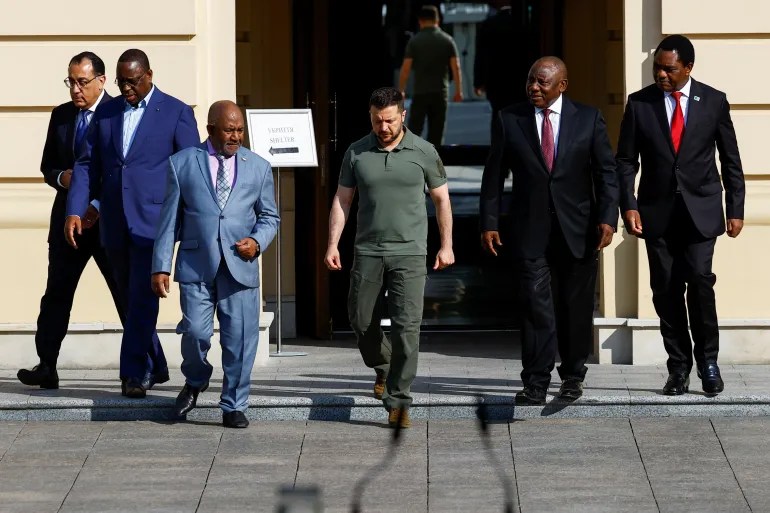
Their degree of culpability became clear recently when a delegation of African leaders traveled to Ukraine and Russia as part of a peacemaking initiative. The party included heads of state of Senegal, Egypt, Zambia, Comoros, Uganda, Republic of Congo, and South Africa. Comoros President Azali Assoumani is the current chair of the African Union. The group was greeted in Kiev by air raid sirens used to create the appearance that a Russian missile attack was underway. President Zelensky was barely polite, thanking South African president Cyril Ramaphosa and others for coming but letting them know that everything was Russia’s fault and that he had no interest whatsoever in peace talks. 

Not only is Ukraine a de facto U.S. colony which lives and dies by Washington’s whims, but it is also a deeply racist country. Much of its population is still attached to Nazi ideology and the politics of World War II collaborator Stephan Bandera. 

Nazi salutes, swastikas and other insignias are common there. So much so that the New York Times recently felt obliged to wonder in feigned innocence why these symbols are worn openly. The simple and obvious answer is that Ukraine is full of Nazis. Any likelihood that the same people would listen to Africans were indeed slim. 

Ukraine was joined in racial superiority theater by Poland. Media and security staff accompanying the presidents were delayed there and the delegation had to travel without them. When the manufactured drama was no longer needed the delegation arrived in St. Petersburg, Russia and met with president Vladimir Putin who had a surprise of his own. 

Putin listened politely to the 10-point plan and then interrupted with a surprise of his own. He not only reminded them the conflict began in 2014 but pointed out that Russia has been ready for peace ever since Turkey brokered negotiations with Ukraine in April 2022. Ukraine was on the verge of signing an agreement until its collective west friends, the US and UK in particular, scuttled the plan. 

The Treaty on Permanent Neutrality and Guarantees of Security of Ukraine offered security guarantees for Ukraine in exchange for a commitment to remain neutral, meaning that NATO membership would be off the table. Putin pointed out that as soon as Russian forces left Kiev the agreement was thrown into “the dustbin.” Just as in the case of the Minsk Agreements, the collective west offered treachery instead of peace.

The African leaders have their own self-interest which sent them to Russia. Their nations’ supplies of grain and fertilizer have been disrupted by the western sanctions and restrictions on trade with Russia. Earlier agreements on this trade have worked against Africans, as Putin pointed out, “These European neo-colonial powers, technically the US, have once again deceived the international community and the Africa countries in need: 31.7 million tonnes were exported and only three percent reached Africa’s needy countries. Is this not deception?”

It is all to the good that the international community works together to end this war, but the west is only interested in escalating and Ukraine pays the price. The collective west excels in creating propaganda and bullying its allies. The rest of the world is working to escape U.S. and NATO domination as Ukrainians die in large numbers.

Ukraine’s love of Nazi symbolism reveals why that country is content to turn its population into cannon fodder. Meanwhile western insistence on escalation brings the entire world to the brink. Yet there is still no honest discussion about how the war began, or how the Nordstream pipeline exploded. Russia is still painted as the villain and the people of this country go into another presidential election year in the dark.

Russia is not just winning on the battlefield. Nation after nation has declared an intention to use currencies other than the dollar for trade or to join the BRICS. But the collective west cannot accept defeat. The threat they represent to the world cannot be underestimated.

Traitor to the Constitution: The U.S. Government Is the Real Criminal

By John & Nisha Whitehead

Source: The Rutherford Institute

“The most dangerous man to any government is the man who is able to think things out for himself, without regard to the prevailing superstitions and taboos. Almost inevitably he comes to the conclusion that the government he lives under is dishonest, insane and intolerable.”—H.L. Mencken

And so it continues.

This entire fiasco—indicting Donald Trump for allegedly violating both the Espionage Act and obstructing justice by improperly handling classified records—is merely the latest in a never-ending series of distractions, distortions, and political theater aimed at diverting the public’s attention from the sinister advances of the American Deep State.

Don’t allow yourselves to be distracted, diverted or mesmerized by the cheap theater tricks.

This indictment spectacle is Shakespearean in its scope: full of sound and fury, signifying nothing.

Nothing is the key word here.

Despite the wall-to-wall media coverage, this is all just smoke and mirrors.

Mark my words: the government is as corrupt and self-serving as ever, dominated by two political factions that pretend to be at odds with each other all the while moving in lockstep to maintain the status quo.

If you really want to talk about who’s guilty of treason, set your sights higher: indict the government for overstepping its authority, abusing its power, disregarding the rule of law, and betraying the American people.

When we refer to the “rule of law,” that’s constitutional shorthand for the idea that everyone is treated the same under the law, everyone is held equally accountable to abiding by the law, and no one is given a free pass based on their politics, their connections, their wealth, their status or any other bright line test used to confer special treatment on the elite.

When the government and its agents no longer respect the rule of law—the Constitution—or believe that it applies to them, then the very contract on which this relationship is based becomes invalid.

This abuse of power has been going on for so long that it has become the norm, the Constitution be damned.

There are hundreds—make that thousands—of government bureaucrats who are getting away with murder (in many cases, literally) simply because the legislatures, courts and the citizenry can’t be bothered to make them play by the rules of the Constitution.

Unless something changes in the way we deal with these ongoing, egregious abuses of power, the predators of the police state will continue to wreak havoc on our freedoms, our communities, and our lives.

For too long now, the American people have played politics with their principles and turned a blind eye to all manner of wrongdoing when it was politically expedient, allowing the government to wreak havoc with their freedoms and act in violation of the rule of law.

“We the people” are paying the price for it now.

We are paying the price every day that we allow the government to continue to wage its war on the American People, a war that is being fought on many fronts: with bullets and tasers, with surveillance cameras and license readers, with intimidation and propaganda, with court rulings and legislation, with the collusion of every bureaucrat who dances to the tune of corporate handouts while on the government’s payroll, and most effectively of all, with the complicity of the American people, who continue to allow themselves to be easily manipulated by their politics, distracted by their pastimes, and acclimated to a world in which government corruption is the norm.

It’s the nature of the beast: power corrupts.

Worse, as 19th-century historian Lord Acton concluded, absolute power corrupts absolutely.

We’ve been losing our freedoms so incrementally for so long—sold to us in the name of national security and global peace, maintained by way of martial law disguised as law and order, and enforced by a standing army of militarized police and a political elite determined to maintain their powers at all costs—that it’s hard to pinpoint exactly when it all started going downhill, but we’re certainly on that downward trajectory now, and things are moving fast.

The republic has fallen.

The Deep State’s plot to take over America has succeeded.

The American system of representative government has been overthrown by a profit-driven, militaristic, corporate oligarchy bent on total control and global domination through the imposition of martial law here at home and by fomenting wars abroad.

Even now, we are being pushed and prodded towards a civil war, not because the American people are so divided but because that’s how corrupt governments control a populace (i.e., divide and conquer).

These are dangerous times.

These are indeed dangerous times but not because of violent crime or terrorism or illegal immigration.

No, the real danger that we face comes from none other than the U.S. government and the powers it has granted to its standing armies to rob, steal, cheat, harass, detain, brutalize, terrorize, torture and kill American citizens with immunity.

The danger “we the people” face comes from masked invaders on the government payroll who crash through our doors in the dark of night, shoot our dogs, and terrorize our families.

This danger comes from militarized henchmen on the government payroll who demand absolute obedience, instill abject fear, and shoot first and ask questions later.

This danger comes from greedy, power-hungry bureaucrats on the government payroll who have little to no understanding of their constitutional limits.

This danger comes from greedy politicians and corporations for whom profit trumps principle.

Consider, if you will, all of the dastardly, devious, diabolical, dangerous, debilitating, deceitful, dehumanizing, demonic, depraved, dishonorable, disillusioning, discriminatory, dictatorial schemes inflicted on “we the people” by a bureaucratic, totalitarian regime that has long since ceased to be “a government of the people, by the people and for the people.”

  • Americans have no protection against police abuse.
  • Americans are little more than pocketbooks to fund the police state.
  • Americans are no longer innocent until proven guilty.
  • Americans no longer have a right to private property.
  • Americans no longer have a say about what their children are exposed to in school.
  • Americans are powerless in the face of militarized police.
  • Americans no longer have a right to bodily integrity.
  • Americans no longer have a right to the expectation of privacy.
  • Americans can no longer rely on the courts to mete out justice.
  • Americans no longer have a representative government.

I haven’t even touched on the corporate state, the military industrial complex, SWAT team raids, invasive surveillance technology, zero tolerance policies in the schools, overcriminalization, or privatized prisons, to name just a few, but what I have touched on should be enough to show that the landscape of our freedoms has already changed dramatically from what it once was and will no doubt continue to deteriorate unless Americans can find a way to wrest back control of their government and reclaim their freedoms.

Indictments, impeachments and elections will not save us.

History may show that from this point forward, we will have left behind any semblance of constitutional government and entered into a totalitarian state where all citizens are suspects and security trumps freedom.

Even with its constantly shifting terrain, this topsy-turvy travesty of law and government has become America’s new normal.

From Clinton to Bush, then Obama to Trump and now Biden, it’s as if we’re caught in a time loop, forced to re-live the same thing over and over again: the same assaults on our freedoms, the same disregard for the rule of law, the same subservience to the Deep State, and the same corrupt, self-serving government that exists only to amass power, enrich its shareholders and ensure its continued domination.

There can be no denying that the world is indeed a dangerous place, but it’s the government that poses the gravest threat to our freedoms and way of life, and no amount of politicking, parsing or pandering will change that.

It is easy to be diverted, distracted and amused by political circuses and entertainment spectacles.

What is far more difficult to face up to is the reality of life in America, where “we the people” are at a distinct disadvantage in the face of the government elite’s power grabs, greed and firepower.

The Constitution doesn’t stand a chance against a federalized, globalized standing army protected by legislative, judicial and executive branches that are all on the same side.

As I make clear in my book Battlefield America: The War on the American People and in its fictional counterpart The Erik Blair Diaries, no matter what political views they subscribe to: suffice it to say, they are not on our side or the side of freedom.

That is the real betrayal.

What Happens When the Competent Opt Out?

By Charles Hugh Smith

Source: Of Two Minds

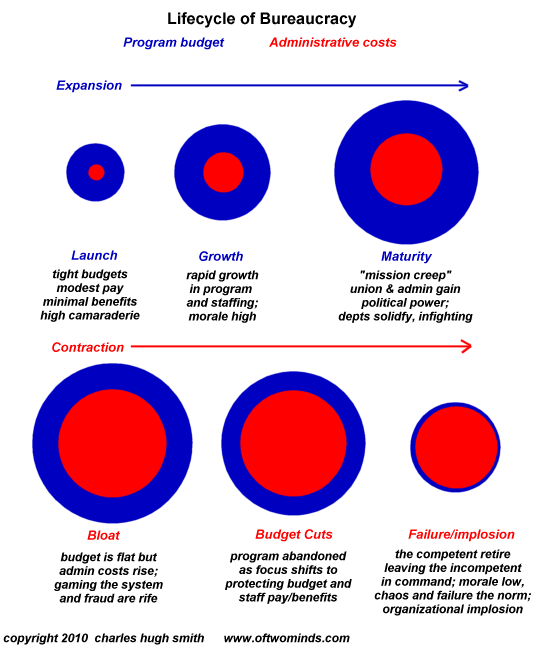
By this terminal stage, the competent have been driven out, quit or burned out.

What happens with the competent retire, burn out or opt out? It’s a question few bother to ask because the base assumption is that there is an essentially limitless pool of competent people who can be tapped or trained to replace those who retire, burn out or opt out, i.e. quit in favor of a lifestyle that doesn’t require much in the way of income or stress.

These assumptions are no longer valid. A great many essential services that are tightly bound to other essential services are cracking as the competent decide (or realize) they’re done with the rat-race.

The drivers of the Competent Opting Out are obvious yet difficult to quantify. Those retiring, burning out and opting out will deny they’re leaving for these reasons because it’s not politic to be so honest and direct. They will offer time-honored dodges such as “pursue other opportunities” or “family obligations.”

1. The steady increase in workloads, paperwork, compliance and make-work (i.e. work that has nothing to do with the institution’s actual purpose and mission) that lead to burnout. There is only so much we can accomplish, and if we’re burdened with ever-increasing demands for paperwork, compliance, useless meetings, training sessions, etc., then we no longer have the time or energy to perform our productive work.

I wrote a short book on my experience of Burnout. I believe it is increasingly common in jobs that demand responsibility and accountability yet don’t provide the tools and time to fulfill these demands. Once you’ve burned out, you cannot continue. That option no longer exists.

For others, the meager rewards simply aren’t worth the sacrifices required. The theme song playing in the background is the Johnny Paycheck classic Take this job and shove it.

Healthcare workloads, paperwork and compliance are one example of many. Failure to complete all the make-work can have dire consequences, so it becomes necessary to do less “real work” in order to complete all the work that has little or nothing to do with actual patient care. Alternatively, the workload expands to the point that it breaks the competent and they leave.

2. Loss of autonomy, control, belonging, rewards, accomplishment and fairness. Professor Christina Malasch pioneered research on the causes of burnout, which can be summarized as any work environment that reduces autonomy, control, belonging, rewards, accomplishment and fairness. Despite a near-infinite avalanche of corporate happy-talk (“we’re all family,”–oh, barf) this describes a great many work environments in the US: in a word, depersonalized. Everyone is a replaceable cog in a great impersonal machine optimized to maximize profits for shareholders.

3. The politicization of the work environment. Let’s begin by distinguishing between policies enforcing equal opportunity, pay, standards and accountability, policies required to fulfill the legal promises embedded in the nation’s social contract, and politicization, which demands allegiance and declarations of loyalty to political ideologies that have nothing to do with the work being done or the standards of accountability necessary to the operation of the complex institution or enterprise.

The problem with politicization is that it is 1) intrinsically inauthentic and 2) it substitutes the ideologically pure for the competent. Rigid, top-down hierarchies (including not just Communist regimes but corporations and institutions) demand expressions of fealty (the equivalent of loyalty oaths) and compliance to ideological demands (check the right boxes of party indoctrination, “self-criticism,” “struggle sessions,” etc.).

The correct verbiage and ideological enthusiasm become the basis of advancement rather than accountability to standards of competence. The competent are thus replaced with the politically savvy. Since competence is no longer being selected for, it’s replaced by what is being selected for, political compliance.

It doesn’t matter what flavor of ideological purity holds sway–conservative, progressive, communist or religious–all fatally erode competence by selecting for ideological compliance. Everyone knows the enthusiasm is inauthentic and only for show, but artifice and inauthenticity are perfectly adequate for the politicization taskmasters.

4. The competent must cover for the incompetent. As the competent tire of the artifice and make-work and quit, the remaining competent must work harder to keep everything glued together. Their commitment to high standards and accountability are their undoing, as the slack-masters and incompetent either don’t care (“I’m just here to qualify for my pension”) or they’ve mastered the processes of masking their incompetence, often by blaming the competent or the innocent for their own failings.

This additional workload crushes the remaining competent who then burn out and quit, go on disability or opt out, changing their lifestyle to get by on far less income, work, responsibility and far less exposure to the toxic work environments created by depersonalization, politicization and the elevation of the incompetent.

5. As the competent leadership leaves, the incompetent takes the reins, blind to their own incompetence. It all looked so easy when the competent were at the helm, but reality is a cruel taskmaster, and all the excuses that worked as an underling wear thin once the incompetent are in leadership roles.

By this terminal stage, the competent have been driven out, quit or burned out. There’s only slack-masters and incompetent left, and the toxic work environment has been institutionalized, so no competent individual will even bother applying, much less take a job doomed to burnout and failure.

This is why systems are breaking down before our eyes and why the breakdowns will spread with alarming rapidity due the tightly bound structure of complex systems.

America’s Addiction to War Comes with a 15 Trillion Dollar Price Tag

To surmount the debt crisis, America needs to stop feeding the Military-Industrial Complex, the most powerful lobby in Washington.

By Jeffrey D. Sachs

Source: Information Clearing House

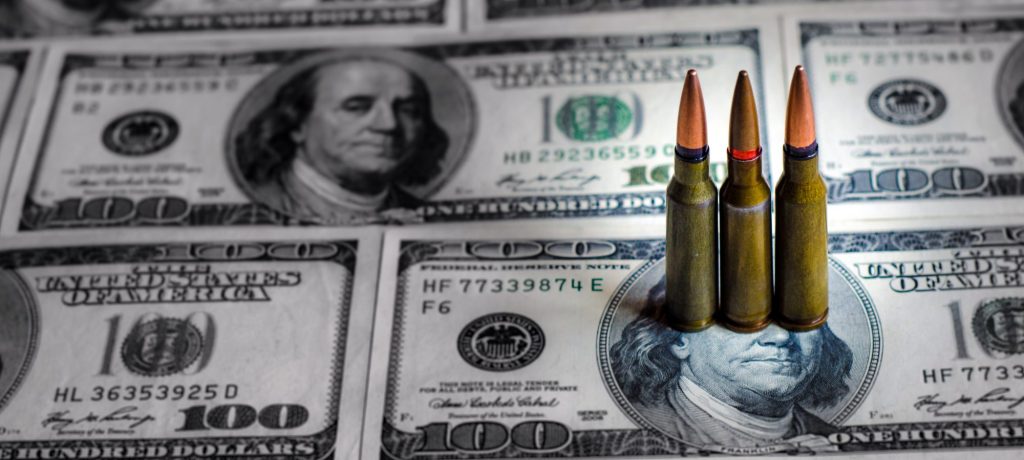
In the year 2000, the U.S. government debt was $3.5 trillion, equal to 35% of the Gross Domestic Product (GDP). By 2022, the debt was $24 trillion, equal to 95% of GDP. The U.S. debt is soaring, hence America’s current debt crisis. Yet both Republicans and Democrats are missing the solution: stopping America’s wars of choice and slashing military outlays.

Suppose the government’s debt had remained at a modest 35% of GDP, as in 2000. Today’s debt would be $9 billion, as opposed to $24 trillion. Why did the U.S. government incur the excess $15 trillion in debt?

The single biggest answer is the U.S. government’s addiction to war and military spending. According to the Watson Institute at Brown University, the cost of U.S. wars from fiscal year 2001 to fiscal year 2022 amounted to a whopping $8 trillion, more than half of the extra $15 trillion in debt. The other $7 trillion arose roughly equally from budget deficits caused by the 2008 financial crisis and the Covid-19 pandemic.

Facing down the military-industrial lobby is the vital first step to putting America’s fiscal house in order.

To surmount the debt crisis, America needs to stop feeding the Military-Industrial Complex (MIC), the most powerful lobby in Washington. As President Dwight D. Eisenhower famously warned on January 17, 1961, “In the councils of government, we must guard against the acquisition of unwarranted influence, whether sought or unsought, by the military-industrial complex. The potential for the disastrous rise of misplaced power exists and will persist.” Since 2000, the MIC led the U.S. into disastrous wars of choice in Afghanistan, Iraq, Syria, Libya, and now Ukraine.

The Military-Industrial Complex long ago adopted a winning political strategy by ensuring that the military budget reaches into every Congressional district. The Congressional Research Service recently reminded Congress that, “Defense spending touches every Member of Congress’s district through pay and benefits for military servicemembers and retirees, economic and environmental impact of installations, and procurement of weapons systems and parts from local industry, among other activities.” Only a brave member of Congress would vote against the military-industry lobby, yet bravery is certainly no hallmark of Congress.

America’s annual military spending is now around $900 billion, roughly 40% of the world’s total, and greater than the next 10 countries combined. U.S. military spending in 2022 was triple that of China. According to Congressional Budget Office, the military outlays for 2024-2033 will be a staggering $10.3 trillion on current baseline. A quarter or more of that could be avoided by ending America’s wars of choice, closing down many of America’s 800 or so military bases around the world, and negotiating new arms control agreements with China and Russia.

Yet instead of peace through diplomacy, and fiscal responsibility, the MIC regularly scares the American people with a comic-book style depictions of villains whom the U.S. must stop at all costs. The post-2000 list has included Afghanistan’s Taliban, Iraq’s Saddam Hussein, Syria’s Bashar al-Assad, Libya’s Moammar Qaddafi, Russia’s Vladimir Putin, and recently, China’s Xi Jinping. War, we are repeatedly told, is necessary for America’s survival.
 

A peace-oriented foreign policy would be opposed strenuously by the military-industrial lobby but not by the public. Significant public pluralities already want less, not more, U.S. involvement in other countries’ affairs, and less, not more, US troop deployments overseas. Regarding Ukraine, Americans overwhelmingly want a “minor role” (52%) rather than a “major role” (26%) in the conflict between Russia and Ukraine. This is why neither Biden nor any recent president has dared to ask Congress for any tax increase to pay for America’s wars. The public’s response would be a resounding “No!”

While America’s wars of choice have been awful for America, they have been far greater disasters for countries that America purports to be saving. As Henry Kissinger famously quipped, “To be an enemy of the United States can be dangerous, but to be a friend is fatal.” Afghanistan was America’s cause from 2001 to 2021, until the U.S. left it broken, bankrupt, and hungry. Ukraine is now in America’s embrace, with the same likely results: ongoing war, death, and destruction.

The military budget could be cut prudently and deeply if the U.S. replaced its wars of choice and arms races with real diplomacy and arms agreements. If presidents and members of congress had only heeded the warnings of top American diplomats such as William Burns, the U.S. Ambassador to Russia in 2008, and now CIA Director, the U.S. would have protected Ukraine’s security through diplomacy, agreeing with Russia that the U.S. would not expand NATO into Ukraine if Russia also kept its military out of Ukraine. Yet relentless NATO expansion is a favorite cause of the MIC; new NATO members are major customers of U.S. armaments.

The U.S. has also unilaterally abandoned key arms control agreements. In 2002, the U.S. unilaterally walked out of the Anti-Ballistic Missile Treaty. And rather than promote nuclear disarmament—as the U.S. and other nuclear powers are required to do under Article VI the Nuclear Non-Proliferation Treaty—the Military-Industrial Complex has sold Congress on plans to spend more than $600 billion by 2030 to “modernize” the U.S. nuclear arsenal.

Now the MIC is talking up the prospect of war with China over Taiwan. The drumbeats of war with China are stoking the military budget, yet war with China is easily avoidable if the U.S. adheres to the One-China policy that properly underpins U.S.-China relations. Such a war should be unthinkable. More than bankrupting the U.S., it could end the world.

Military spending is not the only budget challenge. Aging and rising healthcare costs add to the fiscal woes. According to the Congressional Budget Office, debt will reach 185 percent of GDP by 2052 if current policies remain unchanged. Healthcare costs should be capped while taxes on the rich should be raised. Yet facing down the military-industrial lobby is the vital first step to putting America’s fiscal house in order, needed to save the U.S., and possibly the world, from America’s perverse lobby-driven politics.

Bono Is Doing Illustrations For The Atlantic Now, Because Everything’s Fake And Stupid

By Caitlin Johnstone

Source: CaitlinJohnstone.com

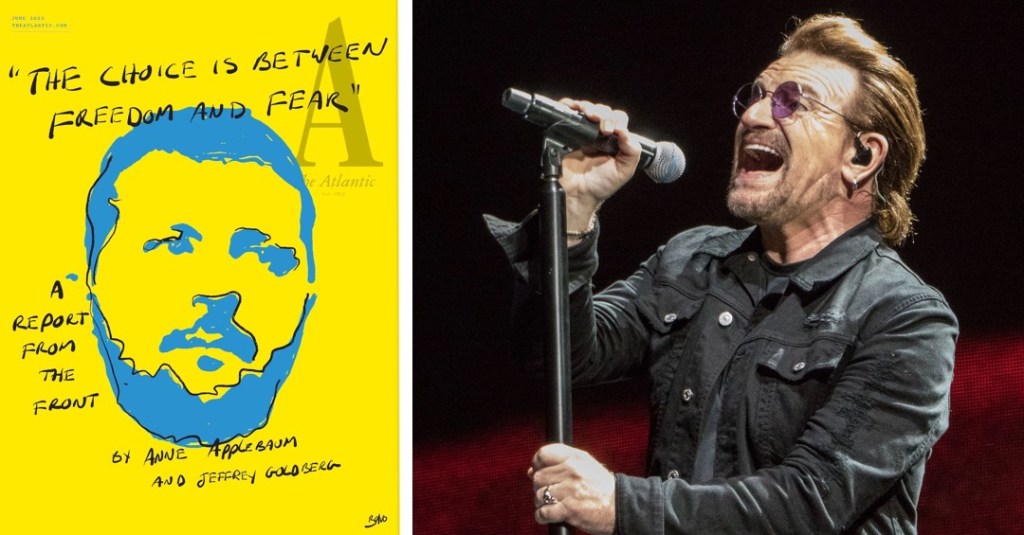
So U2 singer Bono is literally just doing illustrations for the imperialist propaganda rag The Atlantic now, because that’s the sort of thing that happens in a dystopian civilization during the death throes of a globe-spanning empire.

A Washington Post article titled “Bono likes to sketch Atlantic covers, so the magazine hired him” reports that “Bono is into Atlantic cover fanfic — so much so that he was invited to illustrate the magazine’s June cover featuring Ukrainian President Volodymyr Zelensky.” 

Bono’s latest contribution to the mountain of cringe-inducing Zelensky moments we’ve been seeing for the past year provides a cover image for an article by lifelong war propagandists Anne Applebaum and Jeffrey Goldberg. The article endorses a Ukrainian offensive to recapture Crimea, which experts largely agree would be the move most likely to trigger a nuclear war in this conflict.

Here’s a paragraph from Applebaum and Goldberg’s article, just to give you a taste of the infantile “Good Guys vs Bad Guys” framing that western liberals are being fed by mass media war propagandists these days:

“Sometimes, the war is described as a battle between autocracy and democracy, or between dictatorship and freedom. In truth, the differences between the two opponents are not merely ideological, but also sociological. Ukraine’s struggle against Russia pits a heterarchy against a hierarchy. An open, networked, flexible society—one that is both stronger at the grassroots level and more deeply integrated with Washington, Brussels, and Silicon Valley than anyone realized—is fighting a very large, very corrupt, top-down state. On one side, farmers defend their land and 20‑something engineers build eyes in the sky, using tools that would be familiar to 20‑something engineers anywhere else. On the other side, commanders send waves of poorly armed conscripts to be slaughtered—just as Stalin once sent shtrafbats, penal battalions, against the Nazis—under the leadership of a dictator obsessed with ancient bones. ‘The choice,’ Zelensky told us, ‘is between freedom and fear.’”

Many westerners felt their first stirrings of youthful rebellious passions while listening to U2 songs like “Sunday Bloody Sunday” and “Pride (In the Name of Love)”, but nowadays Bono’s voice is heard saying that he has “grown very fond” of war criminal George W Bush, praising capitalism at the World Economic Forum, teaming up with warmonger Lindsey Graham to promote US empire narratives about Syria, and  singing “Stand by Ukraine” in support of US empire narratives in a Kyiv subway. And just when it looks like he can’t become any more of a tool of the empire, he gets hired by one of the world’s worst militarist smut rags to draw a cover image of Zelensky.

Because that’s just how things go in a highly controlled society where mainstream culture is designed to serve the powerful. A society where the minds of the public are continually being shaped by mass-scale psychological manipulation to ensure that they keep thinking, speaking, working, consuming and voting in ways which serve the rich and powerful. Everything that gets elevated to the top of mainstream attention facilitates this agenda (or is at least harmless to it), and as soon as it becomes potentially threatening to this agenda it is either corrected or marginalized away from mainstream attention.

This dynamic can cause some truly jaw-dropping flotsam and jetsam to surface in the roilings of our cultural waters, like Simpsons characters waving Ukrainian flags, or an opera about a drone operator sponsored by General Dynamics.

Here’s Responsible Statecraft’s Connor Echols on that last one:

This fall, DC denizens will be treated to the world premiere of “Grounded,” an opera following an Air Force ace named Jess whose unexpected pregnancy forces her to leave behind her beloved F-16 and join the “chair force.”

Throughout the show, the “hot shot” pilot wrestles with the mental impact of firing rockets from a drone in Afghanistan from a trailer in Las Vegas. “As Jess tracks terrorists by day and rocks her daughter to sleep by night, the boundary between her worlds becomes dangerously permeable,” an ad tells us.

The production is brought to you by presenting sponsor General Dynamics, one of the world’s largest weapons companies (and, wouldn’t you know it, the maker of Jess’s favorite plane). Playwright George Brant wrote the libretto, which will be brought to life by mezzo-soprano Emily D’Angelo and Tony-winning composer Jeanine Tesori.

You’ll also see things like “humanitarian intervention” champion Samantha Power enthusiastically tweeting about the collaboration between the Sesame Street franchise and the CIA cutout USAID in Iraq:

You see things like this all the time under the shadow of the US empire, and individually they don’t look like much, but once you start noticing them you come to recognize them as symptoms of the profoundly diseased civilization that we are living in. One where our heart strings are pulled in the most obnoxious ways imaginable to get us to support capitalism, empire and oligarchy, where we are manipulated into espousing values systems which benefit powerful sociopaths under the cover of noble-sounding causes. Where we are trained like rats to support systems that are driving our species toward extinction because our rulers gave lip service to humanitarianism and waved a rainbow flag.

This is what dystopia looks like. Like a bunch of thought-controlled automatons mindlessly marching toward ecocide and omnicide to a beat played out by screens who tell them every day and in every way that there is no higher purpose than this. Like military industrial complex-funded feminist rock operas about drone operators and Cookie Monster helping Samantha Power psychologically colonize Iraqi children. Like Bono coming home from singing a heartfelt number about the assassination of Martin Luther King Jr to illustrate a cover for a war propaganda piece in The Atlantic.

It’s like they’re pouring concrete over our hearts. Sewing blindfolds over our souls. Numbing us, distracting us, sedating us, so that the local riff raff won’t interfere in the workings of the imperial machine. They’re killing off something beautiful and sacred in humanity, and they’re doing it to roll out some of the ugliest visions this planet has ever seen.

US Empire of Debt Headed for Collapse

By Pepe Escobar

Source: The Unz Review

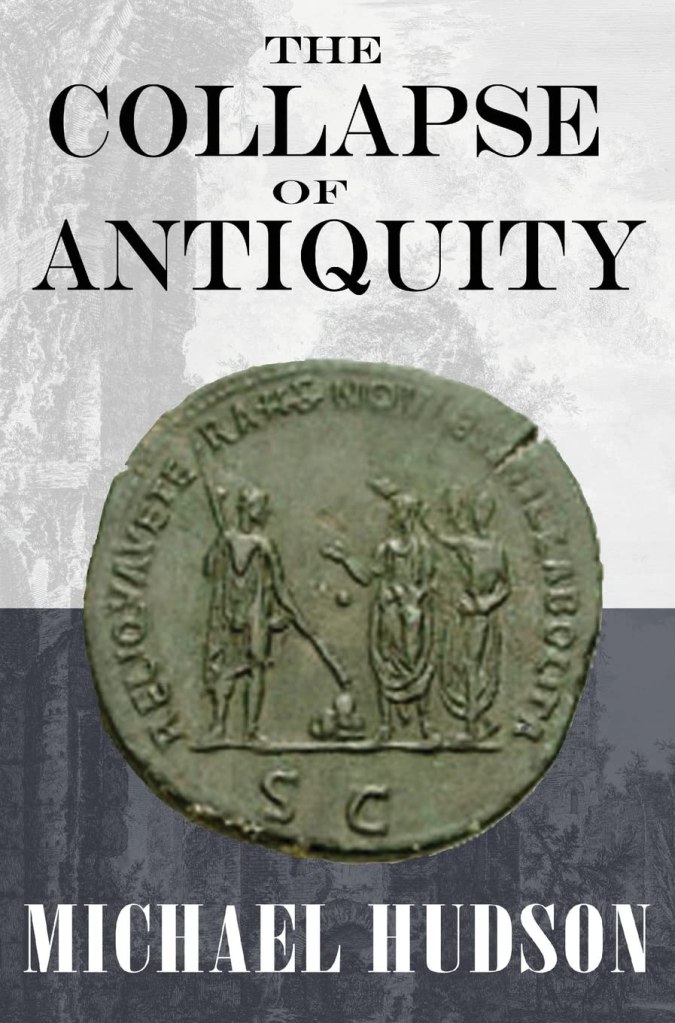
Prof. Michael Hudson’s new book, The Collapse of Antiquity: Greece and Rome as Civilization’s Oligarchic Turning Point is a seminal event in this Year of Living Dangerously when, to paraphrase Gramsci, the old geopolitical and geoeconomic order is dying and the new one is being born at breakneck speed.

Prof. Hudson’s main thesis is absolutely devastating: he sets out to prove that economic/financial practices in Ancient Greece and Rome – the pillars of Western Civilization – set the stage for what is happening today right in front of our eyes: an empire reduced to a rentier economy, collapsing from within.

And that brings us to the common denominator in every single Western financial system: it’s all about debt, inevitably growing by compound interest.

Ay, there’s the rub: before Greece and Rome, we had nearly 3,000 years of civilizations across West Asia doing exactly the opposite.

These kingdoms all knew about the importance of canceling debts. Otherwise their subjects would fall into bondage; lose their land to a bunch of foreclosing creditors; and these would usually try to overthrow the ruling power.

Aristotle succinctly framed it: “Under democracy, creditors begin to make loans and the debtors can’t pay and the creditors get more and more money, and they end up turning a democracy into an oligarchy, and then the oligarchy makes itself hereditary, and you have an aristocracy.”

Prof. Hudson sharply explains what happens when creditors take over and “reduce all the rest of the economy to bondage”: it’s what’s called today “austerity” or “debt deflation”.

So “what’s happening in the banking crisis today is that debts grow faster than the economy can pay. And so when the interest rates finally began to be raised by the Federal Reserve, this caused a crisis for the banks.”

Prof. Hudson also proposes an expanded formulation: “The emergence of financial and landholding oligarchies made debt peonage and bondage permanent, supported by a pro-creditor legal and social philosophy that distinguishes Western civilization from what went before. Today it would be called neoliberalism.”

Then he sets out to explain, in excruciating detail, how this state of affairs was solidified in Antiquity in the course of over 5 centuries. One can hear the contemporary echoes of “violent suppression of popular revolts” and “targeted assassination of leaders” seeking to cancel debts and “redistribute land to smallholders who have lost it to large landowners”.

The verdict is merciless: “What impoverished the population of the Roman Empire” bequeathed a “creditor-based body of legal principles to the modern world”.

Predatory oligarchies and “Oriental Despotism”

Prof Hudson develops a devastating critique of the “social darwinist philosophy of economic determinism”: a “self-congratulatory perspective” has led to “today’s institutions of individualism and security of credit and property contracts (favoring creditor claims over debtors, and landlord rights over those of tenants) being traced back to classical antiquity as “positive evolutionary developments, moving civilization away from ‘Oriental Despotism’”.

All that is a myth. Reality was a completely different story, with Rome’s extremely predatory oligarchies waging “five centuries of war to deprive populations of liberty, blocking popular opposition to harsh pro-creditor laws and the monopolization of the land into latifundia estates”.

So Rome in fact behaved very much like a “failed state”, with “generals, governors, tax collectors, moneylenders and carpet beggars” squeezing out silver and gold “in the form of military loot, tribute and usury from Asia Minor, Greece and Egypt.” And yet this Roman wasteland approach has been lavishly depicted in the modern West as bringing a French-style mission civilisatrice to the barbarians – while carrying the proverbial white man’s burden.

Prof. Hudson shows how Greek and Roman economies actually “ended in austerity and collapsed after having privatized credit and land in the hands of rentier oligarchies”. Does that ring a – contemporary – bell?

Arguably the central nexus of his argument is here:

“Rome’s law of contracts established the fundamental principle of Western legal philosophy giving creditor claims priority over the property of debtors – euphemized today as ‘security of property rights’. Public expenditure on social welfare was minimized – what today’s political ideology calls leaving matters to ‘the market’. It was a market that kept citizens of Rome and its Empire dependent for basic needs on wealthy patrons and moneylenders – and for bread and circuses, on the public dole and on games paid for by political candidates, who often themselves borrowed from wealthy oligarchs to finance their campaigns.”

Any similarity with the current system led by the Hegemon is not mere coincidence. Hudson: “These pro-rentier ideas, policies and principles are those that today’s Westernized world is following. That is what makes Roman history so relevant to today’s economies suffering similar economic and political strains.”

Prof. Hudson reminds us that Rome’s own historians – Livy, Sallust, Appian, Plutarch, Dionysius of Halicarnassus, among others – “emphasized the subjugation of citizens to debt bondage”. Even the Delphic Oracle in Greece, as well as poets and philosophers, warned against creditor greed. Socrates and the Stoics warned that “wealth addiction and its money-love was the major threat to social harmony and hence to society.”

And that brings us to how this criticism was completely expunged from Western historiography. “Very few classicists”, Hudson notes, follow Rome’s own historians describing how these debt struggles and land grabs were “mainly responsible for the Republic’s Decline and Fall.”

Hudson also reminds us that the barbarians were always at the gate of the Empire: Rome, in fact, was “weakened from within”, by “century after century of oligarchic excess.”

So this is the lesson we should all draw from Greece and Rome: creditor oligarchies “seek to monopolize income and land in predatory ways and bring prosperity and growth to a halt.” Plutarch was already into it: “The greed of creditors brings neither enjoyment nor profit to them, and ruins those whom they wrong. They do not till the fields which they take from their debtors, nor do they live in their houses after evicting them.”

Beware of pleonexia

It would be impossible to fully examine so many precious as jade offerings constantly enriching the main narrative. Here are just a few nuggets (And there will be more: Prof. Hudson told me, “I’m working on the sequel now, picking up with the Crusades.”)

Prof. Hudson reminds us how money matters, debt and interest came to the Aegean and Mediterranean from West Asia, by traders from Syria and the Levant, around 8th century B.C. But “with no tradition of debt cancellation and land redistribution to restrain personal wealth seeking, Greek and Italian chieftains, warlords and what some classicists have called mafiosi [ by the way, Northern European scholars, not Italians) imposed absentee land ownership over dependent labor.”

This economic polarization kept constantly worsening. Solon did cancel debts in Athens in the late 6th century – but there was no land redistribution. Athens’ monetary reserves came mainly from silver mines – which built the navy that defeated the Persians at Salamis. Pericles may have boosted democracy, but the eventful defeat facing Sparta in the Peloponnesian War (431-404 B.C.) opened the gates to a heavy debt-addicted oligarchy.

All of us who studied Plato and Aristotle in college may remember how they framed the whole problem in the context of pleonexia (“wealth addiction”) – which inevitably leads to predatory and “socially injurious” practices. In Plato’s Republic, Socrates proposes that only non-wealthy managers should be appointed to govern society – so they would not be hostages of hubris and greed.

The problem with Rome is that no written narratives survived. The standard stories were written only after the Republic had collapsed. The Second Punic War against Carthage (218-201 B.C.) is particularly intriguing, considering its contemporary Pentagon overtones: Prof. Hudson reminds us how military contractors engaged in large-scale fraud and fiercely blocked the Senate from prosecuting them.

Prof. Hudson shows how that “also became an occasion for endowing the wealthiest families with public land when the Rome state treated their ostensibly patriotic donations of jewelry and money to aid the war effort as retroactive public debts subject to repayment”.

After Rome defeated Carthage, the glitzy set wanted their money back. But the only asset left to the state was land in Campania, south of Rome. The wealthy families lobbied the Senate and gobbled up the whole lot.

With Caesar, that was the last chance for the working classes to get a fair deal. In the first half of the 1st century B.C. he did sponsor a bankruptcy law, writing down debts. But there was no widespread debt cancellation. Caesar being so moderate did not prevent the Senate oligarchs from whacking him, “fearing that he might use his popularity to ‘seek kingship’” and go for way more popular reforms.

After Octavian’s triumph and his designation by the Senate as Princeps and Augustus in 27 B.C., the Senate became just a ceremonial elite. Prof Hudson summarizes it in one sentence: “The Western Empire fell apart when there was no more land for the taking and no more monetary bullion to loot.” Once again, one should feel free to draw parallels with the current plight of the Hegemon.

Time to “uplift all labor”

In one of our immensely engaging email exchanges, Prof. Hudson remarked how he “immediately had a thought” on a parallel to 1848. I wrote in the Russian business paper Vedomosti: “After all, that turned out to be a limited bourgeois revolution. It was against the rentier landlord class and bankers – but was as yet a far cry from being pro-labor. The great revolutionary act of industrial capitalism was indeed to free economies from the feudal legacy of absentee landlordship and predatory banking — but it too fell back as the rentier classes made a comeback under finance capitalism.”

And that brings us to what he considers “the great test for today’s split”: “Whether it is merely for countries to free themselves from US/NATO control of their natural resources and infrastructure — which can be done by taxing natural-resource rent (thereby taxing away the capital flight by foreign investors who have privatized their natural resources). The great test will be whether countries in the new Global Majority will seek to uplift all labor, as China’s socialism is aiming to do.”

It’s no wonder “socialism with Chinese characteristics” spooks the Hegemon creditor oligarchy to the point they are even risking a Hot War. What’s certain is that the road to Sovereignty, across the Global South, will have to be revolutionary: “Independence from U.S. control is the Westphalian reforms of 1648 — the doctrine of non-interference in the affairs of other states. A rent tax is a key element of independence — the 1848 tax reforms. How soon will the modern 1917 take place?”

Let Plato and Aristotle weigh in: as soon as humanly possible.

Toxic Contagion – Funds, Food and Pharma

By Colin Todhunter

Source: Off-Guardian

In 2014, the organisation GRAIN revealed that small farms produce most of the world’s food in its report Hungry for land: small farmers feed the world with less than a quarter of all farmland.

The report Small-scale Farmers and Peasants Still Feed the World (ETC Group, 2022) confirmed this.

Small farmers produce up to 80% of the food in the non-industrialised countries. However, they are currently squeezed onto less than a quarter of the world’s farmland. The period 1974-2014 saw 140 million hectares – more than all the farmland in China – being taken over for soybean, oil palm, rapeseed and sugar cane plantations.

GRAIN noted that the concentration of fertile agricultural land in fewer and fewer hands is directly related to the increasing number of people going hungry every day. While industrial farms have enormous power, influence and resources, GRAIN’s data showed that small farms almost everywhere outperform big farms in terms of productivity.

In the same year, policy think tank the Oakland Institute released a report stating that the first years of the 21 century will be remembered for a global land rush of nearly unprecedented scale. An estimated 500 million acres, an area eight times the size of Britain, were reported bought or leased across the developing world between 2000 and 2011, often at the expense of local food security and land rights.

Institutional investors, including hedge funds, private equity, pension funds and university endowments, were eager to capitalise on global farmland as a new and highly desirable asset class.

This trend was not confined to buying up agricultural land in low-income countries. Oakland Institute’s Anuradha Mittal argued that there was a new rush for US farmland. One industry leader estimated that $10 billion in institutional capital was looking for access to this land in the US.

Although investors believed that there is roughly $1.8 trillion worth of farmland across the US, of this between $300 billion and $500 billion (2014 figures) is considered to be of “institutional quality” – a combination of factors relating to size, water access, soil quality and location that determine the investment appeal of a property.

In 2014, Mittal said that if action is not taken, then a perfect storm of global and national trends could converge to permanently shift farm ownership from family businesses to institutional investors and other consolidated corporate operations.

WHY THIS MATTERS

Peasant/smallholder agriculture prioritises food production for local and national markets as well as for farmers’ own families, whereas corporations take over fertile land and prioritise commodities or export crops for profit and markets far away that tend to cater for the needs of more affluent sections of the global population.

In 2013, a UN report stated that farming in rich and poor nations alike should shift from monocultures towards greater varieties of crops, reduced use of fertilisers and other inputs, increased support for small-scale farmers and more locally focused production and consumption of food. The report stated that monoculture and industrial farming methods were not providing sufficient affordable food where it is needed.

In September 2020, however, GRAIN showed an acceleration of the trend that it had warned of six years earlier: institutional investments via private equity funds being used to lease or buy up farms on the cheap and aggregate them into industrial-scale concerns. One of the firms spearheading this is the investment asset management firm BlackRock, which exists to put its funds to work to make money for its clients.

BlackRock holds shares in a number of the world’s largest food companies, including Nestlé, Coca-Cola, PepsiCo, Walmart, Danone and Kraft Heinz and also has significant shares in most of the top publicly traded food and agriculture firms: those which focus on providing inputs (seeds, chemicals, fertilisers) and farm equipment as well as agricultural trading companies, such as Deere, Bunge, ADM and Tyson (based on BlackRock’s own data from 2018).

Together, the world’s top five asset managers – BlackRock, Vanguard, State Street, Fidelity and Capital Group – own around 10–30% of the shares of the top firms in the agrifood sector.

The article Who is Driving the Destructive Industrial Agriculture Model? (2022) by Frederic Mousseau of the Oakland Institute showed that BlackRock and Vanguard are by far the biggest shareholders in eight of the largest pesticides and fertiliser companies: Yara, CF Industries Holdings K+S Aktiengesellschaft, Nutrien, The Mosaic Company, Corteva and Bayer.

These companies’ profits were projected to double, from US$19 billion in 2021 to $38 billion in 2022, and will continue to grow as long as the industrial agriculture production model on which they rely keeps expanding. Other major shareholders include investment firms, banks and pension funds from Europe and North America.

Through their capital injections, BlackRock et al fuel and make huge profits from a globalised food system that has been responsible for eradicating indigenous systems of production, expropriating seeds, land and knowledge, impoverishing, displacing or proletarianizing farmers and destroying rural communities and cultures. This has resulted in poor-quality food and illness, human rights abuses and ecological destruction.

SYSTEMIC COMPULSION

Post-1945, the Rockefeller Chase Manhattan bank with the World Bank helped roll out what has become the prevailing modern-day agrifood system under the guise of a supposedly ‘miraculous’ corporate-controlled, chemical-intensive Green Revolution (its much-heralded but seldom challenged ‘miracles’ of increased food production are nothing of the sort; for instance, see the What the Green Revolution Did for India and New Histories of the Green Revolution).

Ever since, the IMF, the World Bank and the WTO have helped consolidate an export-oriented industrial agriculture based on Green Revolution thinking and practices. A model that uses loan conditionalities to compel nations to ‘structurally adjust’ their economies and sacrifice food self-sufficiency.

Countries are placed on commodity crop production treadmills to earn foreign currency (US dollars) to buy oil and food on the global market (benefitting global commodity traders like Cargill, which helped write the WTO trade regime – the Agreement on Agriculture), entrenching the need to increase cash crop cultivation for exports.

Today, investment financing is helping to drive and further embed this system of corporate dependency worldwide. BlackRock is ideally positioned to create the political and legislative framework to maintain this system and increase the returns from its investments in the agrifood sector.

The firm has around $10 trillion in assets under its management and has, according to William Engdahl, positioned itself to effectively control the US Federal Reserve, many Wall Street mega-banks and the Biden administration: a number of former top people at BlackRock are in key government positions, shaping economic policy.

So, it is no surprise that we are seeing an intensification of the lop-sided battle being waged against local markets, local communities and indigenous systems of production for the benefit of global private equity and big agribusiness.

For example, while ordinary Ukrainians are currently defending their land, financial institutions are supporting the consolidation of farmland by rich individuals and Western financial interests. It is similar in India (see the article The Kisans Are Right: Their Land Is at Stake) where a land market is being prepared and global investors are no doubt poised to swoop.

In both countries, debt and loan conditionalities on the back of economic crises are helping to push such policies through. For instance, there has been a 30+ year plan to restructure India’s economy and agriculture. This stems from the country’s 1991 foreign exchange crisis, which was used to impose IMF-World Bank debt-related ‘structural adjustment’ conditionalities. The Mumbai-based Research Unit for Political Economy locates agricultural ‘reforms’ within a broader process of Western imperialism’s increasing capture of the Indian economy.

Yet ‘imperialism’ is a dirty word never to be used in ‘polite’ circles. Such a notion is to be brushed aside as ideological by the corporations that benefit from it. Instead, what we constantly hear from these conglomerates is that countries are choosing to embrace their entry and proprietary inputs into the domestic market as well as ‘neoliberal reforms’ because these are essential if we are to feed a growing global population. The reality is that these firms and their investors are attempting to deliver a knockout blow to smallholder farmers and local enterprises in places like India.

But the claim that these corporations, their inputs and their model of agriculture is vital for ensuring global food security is a proven falsehood. However, in an age of censorship and doublespeak, truth has become the lie and the lie is truth. Dispossession is growth, dependency is market integration, population displacement is land mobility, serving the needs of agrifood corporations is modern agriculture and the availability of adulterated, toxic food as part of a monoculture diet is feeding the world.

And when a ‘pandemic’ was announced and those who appeared to be dying in greater numbers were the elderly and people with obesity, diabetes and cardio-vascular disease, few were willing to point the finger at the food system and its powerful corporations,   practices and products that are responsible for the increasing prevalence of these conditions (see campaigner Rosemary Mason’s numerous papers documenting this on Academia.edu). Because this is the real public health crisis that has been building for decades.

But who cares? BlackRock, Vanguard and other institutional investors? Highly debatable because if we turn to the pharmaceuticals industry, we see similar patterns of ownership involving the same players.

A December 2020 paper on ownership of the major pharmaceuticals companies, by researchers Albert Banal-Estanol, Melissa Newham and Jo Seldeslachts, found the following (reported on the website of TRT World, a Turkish news media outlet):

Public companies are increasingly owned by a handful of large institutional investors, so we expected to see many ownership links between companies — what was more surprising was the magnitude of common ownership… We frequently find that more than 50 per cent of a company is owned by ‘common’ shareholders who also own stakes in rival pharma companies.”

The three largest shareholders of Pfizer, J&J and Merck are Vanguard, SSGA and BlackRock.

In 2019, the Centre for Research on Multinational Corporations reported that payouts to shareholders had increased by almost 400 per cent — from $30 billion in 2000 to $146 billion in 2018. Shareholders made $1.54 trillion in profits over that 18-year period.

So, for institutional investors, the link between poor food and bad health is good for profit. While investing in the food system rakes in enormous returns, you can perhaps double your gains if you invest in pharma too.

These findings predate the 2021 documentary Monopoly: An Overview of the Great Reset, which also shows that the stock of the world’s largest corporations are owned by the same institutional investors. ‘Competing’ brands, like Coke and Pepsi, are not really competitors, since their stock is owned by the same investment companies, investment funds, insurance companies and banks.

Smaller investors are owned by larger investors. Those are owned by even bigger investors. The visible top of this pyramid shows only Vanguard and Black Rock.

A 2017 Bloomberg report states that both these companies in the year 2028 together will have investments amounting to $20 trillion.

While individual corporations – like Pfizer and Monsanto/Bayer, for instance – should be (and at times have been) held to account for some of their many wrongdoings, their actions are symptomatic of a system that increasingly leads back to the boardrooms of the likes of BlackRock and Vanguard.

Prof Fabio Vighi of Cardiff University says:

Today, capitalist power can be summed up with the names of the three biggest investment funds in the world: BlackRock, Vanguard and State Street Global Advisor. These giants, sitting at the centre of a huge galaxy of financial entities, manage a mass of value close to half the global GDP, and are major shareholders in around 90% of listed companies.”

These firms help shape and fuel the dynamics of the economic system and the globalised food regime, ably assisted by the World Bank, the IMF, the WTO and other supranational institutions. A system that leverages debt, uses coercion and employs militarism to secure continued expansion.