Corporate Media Looks to Purveyors of State Violence Abroad to Condemn State Violence at Home

By Loretta Graceffo

Source: FAIR.org

Anti-racist protests have swept across the country over the past month, demanding justice for George Floyd, police accountability and the defunding of law enforcement.

In response to these uprisings, President Donald Trump publicly toyed with the idea of deploying active-duty military to American cities—a proposal that most corporate media, with a few glaring exceptions, have condemned as an abuse of power.

However, when we look at who media have called upon to denounce the Trump administration’s response, a revealing pattern emerges. Rather than providing a platform for protesters, who were met by heavily armed law enforcement toting chemical agents and flashbang grenades, media decided to turn to the enforcers of state violence abroad: the US national security apparatus. Several outlets asked current and former intelligence officials to weigh in on Trump’s response, utilizing their testimony to equate the crackdowns with those in other countries:

  • Washington Post (6/2/20): “CIA Veterans Who Monitored Crackdowns Abroad See Troubling Parallels in Trump’s Handling of Protests”
  • Independent (6/2/20): “I Asked Police, Veterans and a Former CIA Agent What They Think of Trump’s Response to the Protests. Even They Are Horrified.”
  • International Business Times (6/3/20): “George Floyd White House Protest: Donald Trump Acting Like Dictator During Racial Tensions, Intelligence and Defense Officials Warn.”

These articles are correct in pointing out that Trump’s militarized suppression of dissent at home has “troubling parallels” with authoritarian crackdowns abroad. The testimony of US state officials, especially former ones, can aid the public in taking cognizance of these parallels, given that they are responsible for enforcing similar crackdowns around the world. But because media present these sources uncritically and refuse to include vital context, they fail to examine our own empire, and ultimately make all the wrong connections.

Whitewashing war on dissent

In response to the Trump administration’s handling of the protests, the Post article includes a quote from Marc Polymeropoulos, who spent 26 years in the CIA:

“It reminded me of what I reported on for years in the Third World,” Polymeropoulos said on Twitter. Referring to the despotic leaders of Iraq, Syria and Libya, he said: “Saddam. Bashar. Qaddafi. They all did this.”

While it’s true that Trump’s response has been militant, these articles present this reaction as a disturbing departure from otherwise morally sound US leadership throughout history. Trump may be the first US president to tweet the words, “When the looting starts, the shootings starts,” but despite media’s historical amnesia, violent government crackdowns on anti-racist protests in the US have always been the norm, not the exception.

Take, for example, the FBI’s COINTELPRO program, which targeted thousands of activists through tactics like psychological warfare, blackmail and assasination. Or when the Philadelphia Police Department dropped a bomb on a residential neighborhood in order to disband a Black liberation group, killing nearly a dozen people and leaving hundreds of residents homeless. More recently, the FBI’s counterterrorism division has labeled “Black identity extremists” as a domestic terror threat, due to their “perceptions of police brutality against African Americans.”

By relying on CIA testimony, media shift the focus away from the tyranny in our own backyard in favor of pointing fingers at the “despotic leaders” of “the Third World”—never mind the fact that the US has no qualms with oppressive leadership in the Middle East when it aligns with our interests, as evidenced by our alliance with Saudi Arabia.

The articles by the Post and International Business Times both include a quote from Rep. Abigail Spanberger, who tweeted, in response to Trump’s crackdowns on protests: “As a former CIA officer, I know this playbook.” Her tweet goes on to compare his actions to those “undertaken by authoritarian regimes throughout the world.”

Of course Spanberger, as a former CIA official, knows this playbook—it’s one that the CIA practically wrote themselves. In 1973, it sponsored a coup that overthrew Chile’s democratically elected socialist government, installing the autocratic Augusto Pinochet, who rounded up, tortured and executed thousands of political dissidents. The CIA also opposed democratic forces in Zaire and backed the corrupt dictator Mobutu, whose decades-long regime regularly tortured and murdered its critics. And in the early 2010s, the Pentagon armed and trained Turkish mercenary forces, who went on to commit a litany of war crimes, including beheading Kurds in Northern Syria.

But the Post presents Spanberger’s intimate knowledge of this “playbook” as a result of her experience “monitoring democratic regression” and “societal unraveling” in the Global South. Another CIA analyst, Gail Helt, is described as “responsible for tracking developments in China and Southeast Asia.”

Nowhere in these articles is there any admission that the US national security apparatus does not just “track developments” abroad—it also plays a monumental role in shaping those developments, often using the same tactics of brutality and repression they claim to oppose.

Endless wars come home

By looking to state agents for moral authority and failing to provide any context that would impugn the CIA’s legitimacy, media espouses US imperialism by default, and reaffirms the chauvinistic belief that we have the right to impose our will on other countries by any means necessary.

The Post includes a quote from Brett McGurk, who helped institutionalize America’s bloody imperial occupation of Iraq, and pushed for the euphemistic “surge” which saw an additional 30 thousand US troops deployed to Iraq in 2007:

“The imagery of a head of state in a call with other governing officials saying, ‘Dominate the streets, dominate the battlespace’ — these are iconic images that will define America for some time,” said McGurk…. “It makes it much more difficult for us to distinguish ourselves from other countries we are trying to contest” or influence, he said.

But whether or not the US has ever had the credibility required to shape other countries’ policies—let alone present ourselves as a model of freedom and democracy—remains largely unexamined.

This is especially evident in the piece by Post, which claims that the Trump administration’s response characterized “US cities as a foreign war zone” and includes an anecdote about a US intelligence official “venturing into downtown Washington…as if taking measure of the street-level mood in a foreign country.”

The Independent describes “helicopters with US Army markings flying low over protesters,” a technique that one of the pilots they interviewed says is “for use against enemy insurgents overseas, not Americans protesting on the streets of Washington.”

In other words, when Defense Secretary Mark T. Esper urged governors to “dominate the battlespace” to end the unrest in cities, it was wrong only because he was talking about American cities.

The Independent article later includes a quote from ex–CIA officer Patrick Skinner, who has previously provided valuable insight into the ways that fascist maneuvers abroad inevitably make their way home. Skinner correctly condemns a dangerous “mentality among police that they are soldiers in a ‘war on crime.’”

If media had any real interest in exposing the reciprocity between urban policing at home and counterinsurgency abroad, as these articles supposedly propose, this would have been a good time for them to delve into the many ways in which the American carceral state and our endless wars in the Middle East are intrinsically connected.

Perhaps they could include that the tactic used to murder George Floyd—the knee on the neck—has also been used by the Israeli Defense Forces, who are bankrolled by the US and frequently provide training for American cops, including those in Minnesota.  (As many have pointed out, there are stark parallels between the police murder of George Floyd and the police murder of Iyad Halak, an unarmed, autistic Palestinian man whose killing has sparked protests in Jerusalem.)

Or media could mention other tactics that police, many of whom are military veterans, have picked up over years of continuous warfare: the use of torture to get confessions, stop- and-frisk searches targeting blacks and Latinos, and invasive surveillance techniques aimed at Muslim residents. Also relevant is the fact that, since the 1990s, the military has given police departments billions of dollars worth of surplus equipment—including tanks, grenade launchers and assault weapons—with a requirement that they make use of it within a year.

When done right, international analysis in times of domestic upheaval can shed light on the shared, global struggle for liberation against US occupation and militarism—a movement which spans from Minneapolis to Palestine.

But, as is inevitable when they uncritically look to the CIA for “expertise” on freedom and human rights, media come to an entirely different conclusion: It’s normal, necessary and perhaps even noble—after all, it is in the name of democracy—for our military tanks to line the streets of the Middle East. But when those same military tanks invade DC, New York or Minneapolis, they’ve gone too far.

Sidelining activists to uplift the state

This reliance on state agents to shape the narrative is also a staple of network Sunday morning political talk shows. In the two weeks after the police murder of George Floyd, FAIR analyzed every episode of ABC’s This WeekCBS’s Face the NationCNN’s State of the UnionFox News Sunday, and NBC’s Meet the Press. Across all networks, only one show featured an interview with someone affiliated with Black Lives Matter in its coverage of the protests. However, every network found time to interview current and former members of the US national security apparatus, resulting in 12 appearances altogether.

Among these guests was Chad Wolf, secretary of the Department of Homeland Security, who was asked to weigh in on the protests by ABC’s This Week (6/7/20) and Fox News Sunday (6/7/20). He spoke in support of Trump’s call to send active-duty troops to quell the uprisings—a predictable stance, given that, as one of the architects of the family separation policy, Wolf’s response to undocumented migration has been to take at least 4,000 children away from their parents and imprison them in cages. Despite this horrifying resume, NBC and Fox still saw it fit to give him a platform on national television to share his thoughts on state violence.

One of the guests featured on CNN’s State of the Union (5/31/20) was Robert O’Brien, the US National Security advisor, who has long defended the  indefensible—including Trump’s pardon of war criminals, and the assassination of Iranian military leader Qassem Solemani. Like Wolf, he denied the irrefutable fact that US law enforcement is intertwined with systematic racism—a declaration that was barely challenged by CNN’s Jake Tapper.

Only moments after defending Trump’s militaristic response to the uprisings, O’Brien favorably compared the US attitude towards the protests with other countries: “That’s the difference between us and our foreign adversaries. We’re going to allow people to protest.” Given that the US has arrested at least 10,000 protesters (AP6/4/20), this seems like a dubious distinction.

This is not to say there’s no value in interviewing former intelligence officials; some have provided valuable insight on the military/industrial complex, and many have provided critical information as whistleblowers.

Much more frequently, however, these interviews serve only to legitimize US authoritarianism abroad and whitewash state violence at home. As protesters take to the streets, facing tear gas, rubber bullets and arrest for demanding change, perhaps instead of uplifting the voices of state officials, media should hand the microphone to the people.

Elite television news rescued by COVID

By Jon Rappoport

Source: NoMoreFakeNews.com

Yet another consequence of the fake pandemic is the propping up of that doddering old fool, elite television news.

The COVID story doesn’t need Walter Cronkite. It only needs wall to wall. From 5AM to midnight, pandemic updates (mixed now with riot coverage), and the network ratings get well. The ratings jump out of the dumpster and rumble on the studio set and do cartwheels.

I’ve written a number of articles about network television news. Here are excerpts—


NEWS ABOUT THE NEWS.

The elite anchor is not a person filled with passion or curiosity. Therefore, the audience doesn’t have to be passionate or filled with curiosity, either.

The anchor is not a demanding voice on the air; therefore, the audience doesn’t have to be demanding.

The anchor isn’t hell-bent on uncovering the truth. For this he substitutes a false dignity. Therefore, the audience can surrender its need to wrestle with the truth and replace that with a false dignity of its own.

The anchor takes propriety to an extreme: it’s unmannerly to look below the surface of things. Therefore, the audience adopts those manners.

On air, the anchor is neutral, a castratus, a eunuch.

This is a time-honored ancient tradition. The eunuch, by his diminished condition, has the trust of the ruler. He guards the emperor’s inner sanctum. He acts as a buffer between his master and the people. He applies the royal seal to official documents.

Essentially, the television anchor is saying, “See, I’m ascetic in the service of truth. Why would I hamstring myself this way unless my mission is sincere objectivity?”

All expressed shades of emotion occur and are managed within that persona of the dependable court eunuch. The anchor who can move the closest to the line of being human without actually arriving there is the champion. In recent times, it was Brian Williams—until his “conflations” and “misremembrances” surfaced, and he was exiled to the wasteland of MSNBC.

The vibrating string between eunuch and human is the frequency that makes an anchor “great.” Think Cronkite, Chet Huntley, Edward R Murrow. Huntley was just a touch too masculine, so they teamed him up with David Brinkley, a medium-boiled egg. Brinkley supplied twinkles of comic relief.

The cable news networks don’t have anyone who qualifies as an elite anchor. Wolf Blitzer of CNN made his bones during the first Iraq war only because his name fit the bombing action so well. Brit Hume of FOX has more anchor authority than anyone now working in network television, but he’s semi-retired, content to play the role of contributor, because he knows the news is a scam on wheels.

There are other reasons for “voice-neutrality” of the anchor. Neutrality conveys a sense of science. “We did the experiment in the lab and this is how it turned out.”

Neutrality implies: we, the news division, don’t have to make money (a lie); we’re not like the cop shows; we’re on a higher plane; we’re performing a public service; we’re a responsible charity.


From the early days of television, there has been a parade of anchors/actors with know-how—intonation, edge of authority, parental feel, the ability to execute seamless blends from one piece of deception to the next:

John Daly, Douglas Edwards, Ed Murrow, Chet Huntley, David Brinkley, Harry Reasoner, Walter Cronkite, Dan Rather, and more recently, second-stringers—Brian Williams, Diane Sawyer, Scott Pelley.

They’re all gone.

Now we have Lester Holt, David Muir, and the newly appointed Norah O’Donnell. They couldn’t sell water in the desert.

Lester Holt is a cadaverous presence on-air, whose major journalistic achievement thus far is interrupting Donald Trump 41 times during a presidential debate; David Muir has the gravitas of a Sears underwear model; Norah O’Donnell, long-term, will have the energy needed to illuminate a miniature Xmas-tree light bulb.

The networks have no authoritative anchor-fathers waiting in the wings. They don’t breed them and bring them up through the minor leagues anymore.

Instead, armies of little Globalists, and ideologues who don’t realize they’re working for Globalists, have been infiltrating the news business. At best, they’re incompetent.

Thus, news-production techniques that enable an ongoing illusion of oceanic authority collapse like magnetic fields that have been suddenly switched off.

The selective mood lighting, the restful blue colors on the set, the inter-cutting of graphics and B-roll footage, the flawless shifts to reporters in far-flung places…it’s as if all these supporting features have suddenly been overcome by actors in a stage play who are abruptly stepping out of character. The spell is broken.

Elite mainstream news, in a fatuous attempt to save itself, is trying a democratic approach. Anchors are sharing more on-air minutes with gaggles of other reporters. But this is counter-productive in the extreme. The News has always meant one face and one authority and one voice and one tying-together of all broadcast elements. It’s as if, in a hypnotherapist’s office, the therapist decides to bring in colleagues to help render the patient into an alpha-state.

If by some miracle, the news bosses could raise Walter Cronkite, “the father of our country,” from the dead and put him back in the chair… but too many years have gone by; years of unaccomplished anchors. The horse is out of the barn, the cat is out of the bag.

This is why major news outlets have been appealing to social media/big tech for help, AKA censorship of independent voices.

One veteran news director told me several years ago, “We don’t have the stars [elite anchors] anymore. The star system is dead. You could comb all the local news outlets in America, and you wouldn’t find one face and voice who could really carry the freight. They’ve vanished. The up and coming people are lame. We’ve made them that way. It’s some cockeyed standard of equality we’ve internalized. And now we’re paying the price.”


The news is all about manipulating the context of stories. The thinner the context, the thinner the mind must become to accept it.

Imagine a rectangular solid. The news covers the top surface. Therefore, the viewer’s mind is trained to work in only two dimensions. Then it can’t fathom depth, and it certainly can’t appreciate the fact that the whole rectangular solid moves through time, the fourth dimension.

First, we have the studio image itself, the colors in foreground and background, the blend of restful and charged hues. The anchor and his/her smooth style.

Then we have the shifting of venue from the studio to reporters in the field, demonstrating the reach of coverage: the planet. As if this equals authenticity.

Actually, those reporters in the field rarely dig up information on location. A correspondent standing on a rooftop in Cairo could just as easily be positioned in a bathroom in a Las Vegas McDonald’s. His report would be identical.

The managing editor, usually the elite news anchor, chooses the stories to cover and has the final word on their sequence.

The anchor goes on the air: “Our top story tonight, more signs of gridlock today on Capitol Hill, as legislators walked out of a session on federal budget negotiations…”

The viewer fills in the context for the story: “Oh yes, the government. Gridlock is bad. Just like traffic on the I-5. We want the government to get something done, but they won’t.”

The anchor: “The Chinese government reports the new flu epidemic has spread to three provinces. Forty-two people have already died, and nearly a hundred are hospitalized…”

The viewer again supplies context, such as: “Flu. Dangerous. Epidemic. Get my flu shot.”

The anchor: “A new university study states that gun owners often stock up on weapons and ammunition…”

The viewer: “People with guns. Why do they need a dozen weapons? I don’t need a gun. The police have guns. Could I kill somebody if he broke into the house?”

The anchor: “Doctors at Yale University have made a discovery that could lead to new treatments in the battle against autism…”

Viewer: “Good. More research. Laboratory. The brain.”

If, at the end of the newscast, the viewer bothered to review the stories and his own reactions to them, he would realize he’d learned nothing. But reflection is not the game.

In fact, the flow of the news stories has washed over him and created very little except a sense of (false) continuity.

Therefore, every story on the news broadcast achieves the goal of keeping the context thin—night after night, year after year. The overall effect of this staging is: small viewer’s mind, small viewer’s understanding.

Next we come to words and pictures. More and more, news broadcasts are using the rudimentary film technique of a voice narrating what the viewer is seeing on the screen.

People are shouting and running and falling in a street. The anchor or a field reporter says: “The country is in turmoil. Parliament has suspended sessions for the third day in a row, as the government decides what to do about uprisings aimed at forcing democratic elections…”

Well, the voice must be right, because we’re seeing the pictures. If the voice said the riots were due to garbage-pickup cancellations, the viewer would believe that, too.

We see Building #7 of the WTC collapse. Must have been the result of a fire. The anchor tells us so. Words give meaning to pictures.

Staged news.

Since the dawn of time, untold billions of people have been urging a “television anchor” to “explain the pictures.”

The news gives them that precise solution, every night.

“Well, Mr. Jones,” the doctor says, as he pins X-rays to a screen in his office. “See this? Right here? We’ll need to start chemo immediately, and then we may have to remove most of your brain, and as a follow-up, take out one eye.”

Sure, why not? The patient saw the pictures and the anchor explained them.

Eventually, people get the idea and do it for themselves. They see things, they invent one-liners to explain them.

They’re their own anchors. They short-cut and undermine their own experience with vapid summaries of what it all means.

For “intelligent” viewers, there is a sober mainstream choice in America, a safety valve: PBS. That newscast tends to show more pictures from foreign lands.

“Yes, I watch PBS because they understand the planet is interconnected. It isn’t just about America. That’s good.”

Sure it’s good, if you want the same thin-context or false-context reports on events in other countries. Instead of the two minutes NBC might give you about momentous happenings in Syria, PBS will give you four minutes.

PBS experts seem kinder and gentler. “They’re nice and they’re more relaxed. I like that.”

Yes, the PBS experts are taking Valium, and they’re not drinking as much coffee as the CBS experts.


When network television news was created in the late 1940s, no one in charge knew how to do it. It was a new creature.

Sponsors? Yes. A studio with a desk and an anchor? Yes. A list of top stories? Yes. Important information for the public? Yes.

Of course, “important information” could have several definitions—and the CIA already had a few claws into news, so there would be boundaries and fake stories within those boundaries.

The producers knew the anchor was the main event; his voice, his manner, his face. He was the actor in a one-man show. But what should he project to the audience at home?

The first few anchors were dry sandpaper. John Cameron Swayze at NBC, and Douglas Edwards at CBS. But Swayze, also a quiz show host, broke out of the mold and imparted a bit of “cheery” to his broadcasts. A no-no. So he was eventually dumped.

In came a duo. Chet Huntley and David Brinkley. NBC co-anchors from 1956 to 1970. Chet was the heavy, with a somber baritone, and David was “twinkly,” as he was called by network insiders. He lightened the mood with a touch of sarcasm and an occasional grin. It worked. Ratings climbed. Television news as show biz started to take off. At the end of every broadcast, there was: “Good night, Chet.” “Good night, David.” The audience ate it up. They loved that tag.

However, rival CBS wasn’t standing still. They offloaded their anchor, Douglas Edwards, a bland egg, and brought in Walter Cronkite, who would go on to do 19 years in the chair (1962-1981). Walter was Chet Huntley with a difference. As he grew older, he emerged as a father, a favorite uncle, with an authoritative hills-and-valleys baritone that created instant trust. Magic. A news god was born.

Despite many efforts at the three major networks, no anchor over the past 40 years has been able to pull off the full Cronkite effect.

The closest recent competitor—until he was fired for lying and exiled to the waste dump at MSNBC—was Brian Williams. Williams artfully executed a reversal of tradition. He portrayed the youthful prodigy, a gradually maturing version of a newsboy who once bicycled along country roads, threw folded up papers on front porches, and knew all his customers by name. A good boy. A local boy. Your neighbor under the maple trees of an idyllic town. Cue the memories.

By the time Williams took over the helm at NBC, television news was decidedly a team operation. There were reporters in the field. The technology enabled the anchor to go live to these bit players, who tried to exude the impression they were actually running down leads and interviewing key sources on the spot—when in fact they could just as easily be doing their stand-ups from a hot dog cart outside 30 Rockefeller Plaza, the home studio of the network—because most of their information was really coming from inside that studio.

Nevertheless, the team was everything. The anchor was a manager, and his job was to impart an authentic feel to every look-in, from the White House to Paris to Berlin to Jerusalem to Beijing to a polar bear on an iceberg.

And local television news was blowing up to gargantuan proportions. Every city and town and village and hamlet seemed to have its own gaggle of hearty faces delivering vital info of interest to the citizenry. Branding and shaping this local phenomenon evolved into: FAMILY. Yes, that was the ticket. These bubbly, blown-dry, enthused, manic news and weather and sports hawks were really “part of the community.” Local News was no longer shoveled high and deep with an air of objectivity. “Aloof” was out. Share and care was in. What that had to do with actual news was anyone’s guess, but there it was. “Hi, we’re your team at KX6, and we feel what you feel and we live here with you and we know when the roads are icy and the wrecks pile up on the I-15 and the cops arrest someone for cocaine possession and when the charity bake sale is coming up to pay for [toxic] meds for seniors and when your cousin Judy passes away we mourn as you do…”

News for and by a fictional collective.

Disney news.

A caricature of a simulacrum of an imitation.

The discovery was: the viewing audience wanted news as a cartoon.

The problem is: this model deteriorates. The descending IQ of the news producers and anchors and reporters undergoes a grotesque revolution. Year by year, broadcasts make less sense. Even on the national scene, NBC hands its prime anchor spot to Lester Holt, who plays the old Addams Family living corpse, Lurch.

ABC, always looking for a new face, goes all in with David Muir, a Sears underwear-model type.

CBS counters with a youngish cipher, Jeff Glor, after ridding itself of Scott Pelley, who, true to his on-camera persona, might show up on The Young and the Restless as a lunatic surgeon doing operations without anesthetic.

The networks are losing it.

It’s a sight to behold.

Cable news is even worse. The longest surviving anchor is Wolf Blitzer at CNN. Wolf’s energy level tops out as a man in a tattered bathrobe, in his kitchen, chatting with his cousin while they play checkers.


When professionals broadcast one absurdity after another, they begin to see the effects are actually strengthening their own position of authority.

It’s a revelation. It’s also a continuation of the tradition of the Trickster archetype. For example, with just a few minor adjustments, Brian Williams can be seen as the sly Reynard the Fox…

From the viewpoint of elite television news, controlling the minds of its audience depends on what’s politely called “cognitive dissonance”:

As the anchor recites a news story, the viewer sees an obvious hole through which he could drive a truck.

The story makes no sense, yet it’s being presented as bland fact. The trusted anchor clearly has no problem with it.

What’s the viewer to do? He experiences a contradiction, a “dissonance.”

For example, this year’s flu vaccine. The US government has admitted the vaccine is geared to a flu virus that isn’t circulating in the population. Therefore, even by conventional standards, the vaccine is useless. But the kicker is, the CDC says people should take the vaccine anyway.

The anchor relays all this information—and never seriously questions the situation, never torpedoes the government for recommending the vaccine.

The average viewer feels a tug, a pulse of discomfort, a push-pull. The vaccine story is idiocy (side one), but the trusted anchor accepts it (side two).

Dissonance.

The top chiefs of news—and top propaganda operatives—anticipate cognitive dissonance. In a real sense, they want it to happen. They make it happen. Over and over.

Why?

Because it throws the viewer into a tailspin. And in that mental state, in his effort to resolve the contradiction, he will normally choose to…give in. Surrender. Believe in the anchor. It’s the easier path.

The viewer will even doubt his own perception. “I see no good reason for Building 7 to collapse, but the news doesn’t bring that up, so…it must be me.”

This is the power of the news. It presents absurdities and then moves right along, as if nothing has happened.

The introduction of contradiction, dissonance, and absurdity parading as ordinary reality is an intentional feature of brainwashing.

On the nightly news, the anchor reports that US government debt has risen by another three trillion dollars. He then cuts to a statement from a Federal Reserve spokesman: the new debt level isn’t a problem; in fact, it’s sound monetary policy; it strengthens the economy.

The viewer, caught up in this absurdity, tries to make sense of it, then gives up and passively accepts it. Brainwashing.

Smoothly transitioning from this story, the anchor relays information from the CDC: vaccination rates must achieve 90% in the population, in order to protect people from dangerous viruses. The viewer thinks, “Well, my daughter is already vaccinated, so if she comes into contact with a child who isn’t vaccinated, why would there be a problem? Why does 90% of the population have to be vaccinated to keep her safe? She’s already vaccinated.”

The viewer wrestles with this craziness for a moment, then gives in and accepts what the CDC and the anchor are saying. More passivity. More brainwashing.

The anchor moves right along to the next story: “The US is experiencing one of the coldest winters in history, further evidence of the effects of global warming, according to scientists at the United Nations.”

The viewer shakes his head, tries to deal with this dissonance, surrenders, and accepts what he is hearing. Deeper passivity is the result. Deeper brainwashing.

On and on it goes, day after day, month after month, year after year, on the news.

Contradiction, absurdity, dissonance; acceptance, surrender, passivity.

The same general formula is used in interrogations and formal mind control. It adds up to disorientation of the target.

Most disoriented people opt for the lowest- common-denominator solution: give in; accept the power of the person of authority.

Among the many supporters of conventional news is the education system. Most teachers never learn logic, and they don’t teach it. The result? Their students never gain the ability or the courage to reject the news and its dissonances.

What little these students gain from 12 or 16 years of schooling they eventually sacrifice on the altar of consensus reality—as broadcast every night on the screen before them.


Salvador Dali, surrealist, was one of the most reviled painters of the 20th century.

He disturbed Conventional Folk who just wanted to see an apple in a bowl on a table.

Dali’s apples and bowls were executed with a technical skill few artists could match—except the apples were coming out of a woman’s nose while she was ironing the back of a giraffe, who was on fire.

“It doesn’t go together! It doesn’t make sense! He’s Satan!”

Yet, these same Folk sit in front of the television screen every night and watch the entirely surreal network news. Elite anchors seamlessly and quickly move from blood running in the streets of a distant land to a hairdryer product-recall to an unseasonal hail storm in Michigan to a debate about public policy on pedophiles to genetically engineered mosquitoes in Florida to a possible breakthrough in storing computer simulations of human brains for later recapture to squirrels gathering nuts in New Jersey.

Nothing surreal about this??

When the elite anchor goes on air and digs in, he’s paid to be seamless. He could be transitioning from mass killings in East Asia to sub-standard air conditioners, and he makes the audience track through the absurd curve in the road.

The elite anchor should have a voice that soothes just a bit but brooks no resistance. It’s authoritative but not demanding.

Scott Pelley (CBS) was careful to watch himself on this count, because his tendency was to shove the message down the viewer’s throat like a surgeon making an incision with an icepick. Pelley was a high-IQ android who was training himself to be human.

Diane Sawyer wandered into sloppiness, like a housewife who’s still wearing her bathrobe at 4 in the afternoon. She exuded sympathetic syrup, as if she’d had a few cocktails for lunch. And she affected a pose of “caring too much.”

Brian Williams was head and shoulders above his two competitors. You had to look and listen hard to spot a speck of confusion in his delivery. He knew how to believe his act was real. He could also flick a little aw-shucks apple-pie at the viewer. Country boy who moved to the big city.

Segues, blends are absolutely vital. These are the transitions between one story and another. “Earlier today, in Boston.” “Meanwhile, in New York, the police are reporting.” “But on the Hill, the news was somewhat disappointing for supporters of the president.”

Doing excellent blends can earn an anchor millions of dollars. The audience doesn’t wobble or falter or make distinctions between what went before and what’s coming now. It’s all one script. It’s one winding weirdness of story every night.


And NOW, we have COVID, and we have riots. The current stories— the lies are egregious and relentless, the editorializing is cheesy. The omissions are Grand Canyons.

Surreal, cognitively dissonant, smoothly blended, outrageous:

The News Business. As Usual.

But with the junior varsity anchors, and their lack of skill, the networks need overwhelming stories to sell their act. They need COVID and riots. They have to have government manufacturing chaos and destruction and tighter control, in order to keep viewers coming back night after night.

You’ve got elite Globalists and elite government on one edge, and elite news on the other edge. They feed into each other. They bolster each other.

So why must they spend so much time censoring dissent?

Because freedom exists.

Because, no matter what, it always will.

And underestimating its power, time and time again, has proven to be a colossal mistake.

America Has Always Been a Dystopia

Too many of us just haven’t been paying attention

By Bryan Merchant

Source: OneZero

“Trump’s American dystopia has reached a new and ominous cliff,” warns a CNN opinion headline. “The last two and a half months in America have felt like the opening montage in a dystopian film about a nation come undone,” writes New York Times columnist Michele Goldberg, in describing the images of militarized police storming U.S. cities to put down protests in the days following George Floyd’s murder, which came on the heels of two months of pandemic, panic, and widespread economic collapse. A very popular post published elsewhere on Medium was titled, bluntly, “America is a Dystopia.”

There is a lot of dystopia talk getting tossed around right now, for reasons that probably seem obvious. Those images we’ve all spent hours staring at on Twitter and cable TV — the military vehicles patrolling suburban streets, the lines of tactical vested officers cordoned around the Lincoln Memorial, the scenes of tear gas blurring flames as masked protesters clash with armed police — match up reasonably well with the aesthetics and broad strokes of a genre that we’ve spent the last 10 years staring at on Netflix and the other channels on cable TV.

But this is not “Trump’s American dystopia.” It is the continued, if inflamed, dystopian state of play as it has laid for centuries. The montage of horrors did not begin only a few months ago or when a cohort of privileged observers suddenly became aghast at the SWAT howitzers and brutal policing tactics when they were seen on suburban streets.

Years of toothless and profitable pop culture dystopias have primed consumers to ignore race, helping to obscure the fact that the real dystopia arrived long ago.

If we wanted to get pithy about it, we might say that the 2010s were the dystopia decade, a period that saw both the rise of dystopia as a reliably profitable and uniform entertainment format in mass culture and what appeared to be the IRL manifestation of the images and tropes the genre broadcast by decade’s end. The Hunger Games rose to dominate box offices and spawned a follow-on flotilla of similarly shaped YA dystopian fare. Black Mirror mainstreamed a visual mode of bleak cynicism about technology, and critical darlings like Ex MachinaHer, and Mad Max: Fury Road made apocalypses brought about by artificial intelligence and climate change palatable for the intelligentsia. Meanwhile, Blade Runner, RoboCop, Starship Troopers, and Children of Men became frequent touchstones. Partly because they are good films that offered prescient cultural and political commentary, and partly because their visuals provide handy fodder for comparative screen-grabbing on social media while we’re watching high-tech police forces brutalize popular uprisings, climate change-fueled wildfires spread across cityscapes, and A.I. take on alarming new dimensions, like being racist.

As a result, comparing America to a dystopia has become something of a national pastime; a recurring op-ed framework, a subgenre of Twitter commentary — especially during crisis points and moments of mass upheaval.

But what are we actually talking about when we talk about “dystopia”? Gesturing towards a vague constellation of injustices set to the color palette of a “gritty” summer blockbuster and declaring it dystopian won’t cut it — for dystopia to be useful as a cautionary tool for avoiding bad futures, we need to understand exactly what the ingredients setting a society on the road to ruin are. As it stands, much of the modern dystopian discourse seems content to position dystopia as something that is bad, with an air of futurity. To quote Daniel Mallory Ortberg’s famous mocking of Black Mirror: “What if phones, but too much.” What if high-tech cops, what if sea level rise, etc.

“The adjective dystopian implies fearful futures where chaos and ruin prevail,” writes Gregory Claeys, a historian and professor at Royal Holloway, University of London, and author of Dystopia: A Natural History. Though in a historical and literary sense, he says, dystopia most commonly describes “a regime defined by extreme coercion, inequality, imprisonment, and slavery.”

Because its most popular touchstones are science fiction, modern dystopia discourse tends to fixate on profit- or warfare-accelerating technologies — digital surveillance, facial recognition, automation software, drones, technologized weapons — and their capacity to serve the wealthy and powerful in a time of ecological collapse, health crises, and/or widening inequality. Our current moment fits the bill. The coronavirus, mass unemployment, and police brutality against a racial justice uprising are unfolding to the backdrop of SpaceX rocket launches and tech billionaires like Amazon’s Jeff Bezos rapidly expanding their wealth.

When I noted on Twitter that the SpaceX launch was sending astronauts on a for-profit trip into space as a surge of protests swept the country, it struck a chord. Many responded by comparing the events to Elysium, the 2013 Neill Blomkamp film about a future where the poor toil and swelter on Earth while the wealthy live in luxury in a space station that orbits above the Terran rabble.

Others pointed to the great Gil Scott Heron song, “Whitey’s On the Moon.” The musician and poet released it in 1970, one year after the NASA moon landing, which was itself one year after Dr. Martin Luther King, Jr.’s assassination provoked a mass nationwide uprising, perhaps the last at a scale comparable to the one we’re seeing today.

Some of the lyrics:

A rat done bit my sister Nell.

(with Whitey on the moon)

Her face and arms began to swell.

(and Whitey’s on the moon)

I can’t pay no doctor bill.

(but Whitey’s on the moon)

Ten years from now I’ll be payin’ still.

(while Whitey’s on the moon)

That song was recorded a half-century ago, yet the plight remains the same. It was the same in 1993, when Octavia Butler, in her own magisterial dystopia, Parable of the Sower, set in a mostly Black community in Southern California in the apocalyptic 2020s, described the news of the death of a Mars explorer as eliciting the following reaction: “People here in the neighborhood are saying she had no business going to Mars, anyway. All that money wasted on another crazy space trip when so many people here on earth can’t afford water, food, or shelter.”

Billionaires can afford to send payloads into orbit, to explore space for science and for profit, but we cannot afford to provide health care to the poor or even basic racial equality. That’s what too many of us are missing when we talk about dystopia.

As comparatively radical as a dystopia like Elysium (or, say, Snowpiercer) is — in terms of summer blockbusters, anyway — its critique is limited to class. It glosses over race. It’s Matt Damon versus Sharlto Copley and Jodi Foster and the other white orbital techno-authoritarians. Take a scan through any of the most popular dystopian cinema products of the last decade or so, and you’ll find the same thing; matters of race are omitted almost entirely from the big screen eschatologies. Not only are the genre’s prime exports — Hunger Games, Divergent, Blade Runner, Elysium, RoboCop, the list goes on — written and directed by white people, the protagonists, actors, and even antagonists are nearly uniformly white. And despite many of these being imagined, written, and made in a nation whose founding arrangement was the most dystopian system conceivable, race is never even a component of the conversation in mainstream dystopian cinema, much less what the uprisings are predicated upon. Even the Handmaid’s Tale, which exploded in the wake of Trump’s misogyny-lined ascendency to the presidency, relegates any matter of racial politics deep into the background.

Angelica Jade Bastién points all this out in “Why Don’t Dystopias Know How to Talk About Race?”, where she explains how this in effect allows white viewers to cosplay as the oppressed, without actually interrogating in any meaningful way what oppression might actually entail or who gets oppressed and why.

“Race is relegated to inspiration, coloring the towering cityscapes of these worlds, while the white characters toil under the hardships that Brown and Black people experience acutely in real life,” Bastién writes. “In this way, dystopias become less fascinating thought experiments or vital warnings than escapades in which white people can take on the constraints of what it means to be the other.”

And in so doing, these popular dystopias appropriate the other’s struggles while conveniently ignoring the actual roots of said struggle. I do still think there’s utility in dystopias and trying to heed their warnings, but only if we recognize what’s being warned against, and only, especially, if we manage to understand that many of the looming “dystopias” perceived by more affluent entertainment consumers have been the realities of plenty of communities who have faced deep inequalities, technologized surveillance, and state oppression for generations already.

There’s a tweet that’s gone viral a number of times over the dystopian decade, each time in slightly different variation. Its most recent iteration came just this January, before the pandemic and the uprising came to dominate dystopia discourse:

https://twitter.com/ElleOnWords/status/1218693768339251200

White dystopia fanboys like me, pundits, columnists, and social media users need to get this through our skulls. To invert a notorious quote attributed to William Gibson, the dystopia has always been here; it just hasn’t been evenly distributed.

The “dystopia” lens too often fixes conditions like those — heavily policed communities, invasive surveillance, state oppression — in the future, and it glosses over the realities of the present and the long histories of oppression of Black communities and bodies, plenty of which was technologically abetted. The writer Anthony Walton noted in a 1999 Atlantic piece, “Technology Versus African Americans,” that from “the caravel to the cotton gin, technological innovation has made things worse for Blacks.” Western technologies, he writes, formed the infrastructure that gave rise to Black slavery:

Arab and African slave traders exchanged their human chattels for textiles, metals, and firearms, all products of Western technological wizardry, and those same slavers used guns, vastly superior to African weapons of the time, in wars of conquest against those tribes whose members they wished to capture… The slave wars and trade were only the first of many encounters with Western technology to prove disastrous for people of African descent. In the United States, as in South America and the Caribbean, the slaves were themselves the technology that allowed Europeans to master the wilderness.

What better fits Claeys description of dystopia — “a regime defined by extreme coercion, inequality, imprisonment, and slavery” — than actual chattel slavery? America was founded as a dystopia.

Yet for white and affluent consumers, the constant generation of novel and fantastic apocalyptic scenarios serves to extend the horizon for the arrival of the hellish conditions contained in dystopia — if oppression is a nebulous but ever-approaching threat, it’s perpetually obscured, lifted away into a sub-fictional ether. It needs not be interrogated, not now, anyway. Which is how power prefers it.

That’s the other thing about dystopia: In many of its guises, it’s a plainly conservative enterprise. The most influential dystopia of the 21st century, I would argue, is not 1984, but Atlas Shrugged, which alone is responsible for a generation of greed-is-good Republican policymaking. The 600,000-page book, which I have (regrettably) read, positions a handful of great white men and women as the only thing keeping society together and inveighs against the millions of working-class “moochers” with a barely veiled racist subtext. (Its author was also openly racist.) Many dystopias are less flagrant but similarly conservative: They highlight the fear that we might all end up like the poor unwashed masses if we are not careful to uphold the social order, not the fear that the poor might never be liberated. And that, in fact, includes the ur-dystopia.

“Visions of the apocalypse are at least as old as 1000 B.C.,” according to the dystopian historian Claeys. “The triumph of chaos over order defined the Egyptian ‘Prophecies of Neferti’ foretold the complete breakdown of society.” In it, the “great no longer rule the land,’ the ‘slaves will be exalted.’” The first dystopia, in other words, was a cautionary tale for the haves against sliding into the world of the have-nots. It’s hard not to shake that vibe from a lot of the Twitter commentariat, pointing at the protests from afar, going “man it’s so dystopian” and moving on to whatever the central animating conflict is in their own personal heroic narratives.

There are still useful deployments of dystopian language — it can certainly be effective shorthand for “this is fucked in a new way, pay attention.” A good example is this series of viral tweets that chronicle a day of peaceful protest where demonstrators were in turn greeted with the creepy electrified visage of Gov. Andrew Cuomo on a towering billboard, beaming down the newly instated curfew. A couple hours later, many protesters would be beaten.

And dystopias can still jolt the politically uninvolved to wake up — this podcaster even pointed to Elysium as an entry point into radical politics. But the surfeit of commentary that amounts to “wow, this is like Blade Runner send tweet” needs an upgrade. White viewers like me need to rethink and reevaluate what it means to watch and read popular dystopian fiction, how those products are shaping our perspectives and critiques of the futures and what they’re missing. And many more Black voices clearly need to be added to the mainstream canon and the broader discussion — there’s tons of great Black dystopian fiction; Dhalgren by Samuel Delany, Who Fears Death by Nnedi Okorafor, Zone One by Colson Whitehead, pretty much anything by Ishmael Reed. Who Fears Death is in development for a TV series, which is a start, but these voices need to be better foregrounded and made central to modern dystopia discourse.

A lack of diversity has been a problem in science fiction since the genre’s inception, and it persists. When I went to the Nebulas, a high-profile sci-fi awards conference last year, attendees were overwhelmingly white. The fact that Octavia Butler’s magisterial Parable of the Sower — a dystopia that actually and skillfully manages to interrogate climate change, total economic collapse, privatization, and racist oppression — is somehow not a film or a limited series yet is as scathing an indictment of Hollywood’s insistence on whitewashing dystopias as anything. The book absolutely rips.

This is not to disparage anyone who feels like they’re living in a certain kind of almost-future hell. The number of people who genuinely experience the world as an impending or current dystopia is almost certainly rising in tandem with trends of still-increasing inequality. A decade of jobless recovery ended in 2019 with the highest levels of income inequality in 50 years, and record numbers of people of all backgrounds, even whites, are sliding into poverty and despair, and our encounters with climate change, technological surveillance, conservatism’s hard drift toward authoritarianism, and all of the above being increasingly mediated through digital devices. Our current socioeconomic system is now ideally structured to be a dystopian protagonist generator. It is rewarding elites with unprecedented wealth and luxury, equipping the agents of the state with increasingly advanced weapons and technology, exacerbating ecological collapse, and positioning us all to experience the devastation alone, blinking into a screen, hoping for tiny units of validation from a pithy comment or two about the state of the morass on social media. It is us versus [gestures wildly] all of that, out there.

Which makes it all the more imperative that white fans, pundits, and observers stop ignoring what it has historically meant to experience actual dystopian conditions. It means acknowledging and working to improve the material conditions for those who are surviving the current iteration, and not glibly waving off dystopia as some always-approaching, faceless Empire without zeroing in on the nation’s institutional prejudices, its targets for violence, its specific hatreds. It means we have to stop LARPing in appropriated fictions. It means understanding that this has always been a dystopia — and that those who have always resisted it are at the center of the story.

Americans Have Already Skipped Payments On More Than 100 Million Loans, And Job Losses Continue To Escalate

By Michael Snyder

Source: Economic Collapse Blog

Those that have been hoping for some sort of a “V-shaped recovery” have had their hopes completely dashed.  U.S. workers continue to lose jobs at a staggering rate, and economic activity continues to remain at deeply suppressed levels all over the nation.  Of course this wasn’t supposed to happen now that states have been “reopening” their economies.  We were told that things would soon be getting back to normal and that the economic numbers would rebound dramatically.  But that is not happening.  In fact, the number of Americans that filed new claims for unemployment benefits last week was much higher than expected

Weekly jobless claims stayed above 1 million for the 13th consecutive week as the coronavirus pandemic continued to hammer the U.S. economy.

First-time claims totaled 1.5 million last week, higher than the 1.3 million that economists surveyed by Dow Jones had been expecting. The government report’s total was 58,000 lower than the previous week’s 1.566 million, which was revised up by 24,000.

To put this in perspective, let me once again remind my readers that prior to this year the all-time record for a single week was just 695,000.  So even though more than 44 million Americans had already filed initial claims for unemployment benefits before this latest report, there were still enough new people losing jobs to more than double that old record from 1982.

That is just astounding.  We were told that the economy would be regaining huge amounts of jobs by now, but instead job losses remain at a catastrophic level that is unlike anything that we have ever seen before in all of U.S. history.

With the addition of this latest number, a grand total of nearly 46 million Americans have now filed initial claims for unemployment benefits since the COVID-19 pandemic began.

If you can read that statement and still believe that the U.S. economy is not imploding, I would like to know what you are smoking, because it must be pretty powerful.

Some of the things that we are seeing happen around the country right now are absolutely nuts.  For example, earlier this week in Kentucky it was being reported that people were waiting in line for up to 8 hours to talk with a state official face to face about their unprocessed unemployment claims…

This wasn’t supposed to happen.

By now, the U.S. economy was supposed to be roaring back to life and we were supposed to be entering a new golden age of American prosperity.

Unfortunately, the truth is that more bad economic news is hitting us on a continual basis, and that isn’t going to change any time soon.

Over the past few days, we have learned that Hilton is laying off 22 percent of its corporate staff, and AT&T has announced that it will be eliminating 3,400 jobs and closing 250 stores…

The wireless carrier AT&T is cutting 3,400 jobs and shutting down 250 stores over the next few weeks, according to a statement from the Communications Workers of America, a union representing AT&T workers.

The AT&T Mobility and Cricket Wireless retail closures will affect 1,300 jobs, while the other layoffs are said to be affecting technical and clerical workers.

Needless to say, all of these job losses are having a tremendous ripple effect throughout the economy.

Without paychecks coming in, a lot of Americans are having a really tough time paying their bills, and the Wall Street Journal is reporting that payments have already been skipped on more than 100 million loans…

Americans have skipped payments on more than 100 million student loans, auto loans and other forms of debt since the coronavirus hit the U.S., the latest sign of the toll the pandemic is taking on people’s finances.

The number of accounts that enrolled in deferment, forbearance or some other type of relief since March 1 and remain in such a state rose to 106 million at the end of May, triple the number at the end of April, according to credit-reporting firm TransUnion.

Wow.

To me, that is an almost unimaginable number, and it has become clear that a tremendous amount of pain is ahead for the financial institutions that are holding these loans.

A lot of people out there are going to keep hoping that there will be some sort of an economic rebound, but the cold, hard reality of the matter is that fear of COVID-19 is going to keep a large segment of the population from resuming normal economic activities for the foreseeable future.  And it certainly doesn’t help that the number of confirmed cases in the U.S. has been steadily rising over the past couple of weeks and that the mainstream media has been endlessly warning that a “second wave” is coming.

If you doubt what I am saying, just look at what is happening to the restaurant industry.  We had started to see a small bit of improvement in the numbers, but now fear of a “second wave” has caused restaurant traffic to start cratering again

After three months of slow but consistent improvement in restaurant dining data in the US and across the globe, in its latest update on “the state of the restaurant industry”, OpenTable today reported the biggest drop in seated restaurant diners (from online, phone and walk-in reservations) since the depth of the global shutdown in March.

As shown in the OpenTable graphic below, on Sunday, June 14, restaurant traffic suddenly tumbled, sliding from a -66.5% y/y decline as of June 13 to -78.8% globally.

This was mostly due to a sharp drop in US restaurant diners, which plunged by 13% – from -65% to -78% – the biggest one day drop since the start of the shutdown in the US, and the second biggest one day drop on record.

Business travel is another area where we are seeing signs of big trouble ahead.  The following comes from Yves Smith

Business travel is not coming back any time soon. People are getting accustomed to Zoom. And word may also get out that domestic flying is much worse than it used to be, which will be a deterrent to those who might be so bold as to want to get on a plane. That is a fundamental blow to airlines, airport vendors, hotels, restaurants, and convention centers. Hotel occupancy in April was 24.5% which if anything seems high based on my personal datapoints. The pricings I see say that hotel operators are not expecting much if any improvement through the summer.

Like many of you, I wish that economic conditions would go back to the way they used to be, but that simply is not going to happen.

Yes, we will see economic numbers go up and down over the coming months, but a return to “the good times” is not in the cards.

And what hardly anyone realizes is that this is just the beginning of our problems, and I am working on a new project right now which will explain why this is true in great detail.

So stay tuned, because things are about to get really, really “interesting”.

The financialization of the end of the world

By Kurt Cobb

Source: resilience

For those who are fans of cartoons from The New Yorker magazine and consistent readers of this blog, you might be able to guess my two favorite cartoons. In the first one, a man in a coat and tie stands at a podium and tells his unseen audience the following: “And so, while the end-of-the-world scenario will be rife with unimaginable horrors, we believe that the pre-end period will be filled with unprecedented opportunities for profit.”

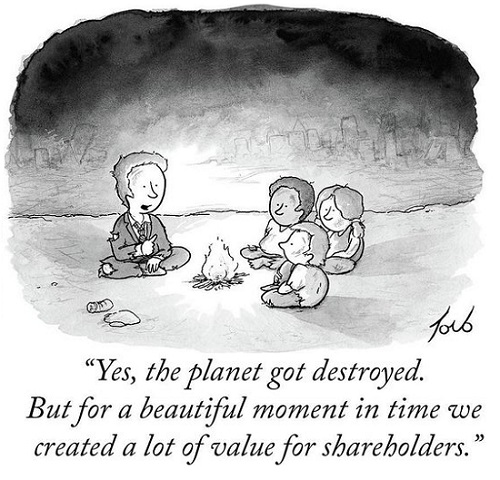
In the second, a man in a tattered suit sits cross-legged near a campfire with three children listening to him intently as he says this: “Yes, the planet got destroyed. But for a beautiful moment in time we created a lot of value for shareholders.”

Now, in the you-can’t-make-this-stuff-up category, financial writer Paul Farrell used the caption from the first cartoon in a 2015 piece for MarketWatch entitled: “Your No. 1 end-of-the-world investing strategy.” The subheading is: “How to pick stocks for the near term when long-term trends say collapse is near.” The subhead actually seems like it might be another caption from a New Yorker cartoon (or possibly one from The Onion). Why exactly would you invest in stocks—as opposed to seeds of food crops and sturdy garden implements—”when long-term trends say collapse is near”? But I’ll put that down to bad headline writing.

In Farrell’s defense, he frequently used his column in MarketWatch to warn his readers of the coming collapse of modern civilization if we don’t change our ways. He was obliged to give investment advice, of course, because that’s what the column was for.

Few other investment gurus are as intellectually honest as Farrell. Among prominent investment managers, only Jeremy Grantham comes close to understanding the scope of the challenges we face. Grantham wrote a piece in 2013 called “The Race of Our Lives” that outlines the myriad challenges humans face. He starts with a discussion of the fall of civilizations. (He updated his views in 2018.)

One would think that the coronavirus pandemic would allow for some sober reflection among those in the financial community as the pandemic-induced crash of the economy and the markets has called into question the stability of practically all the arrangements of modern civilization. Instead, the focus is on how stock markets could be back at or near all-times highs at the beginning of what is arguably the next Great Depression.

The New Yorker cartoons linked above appropriately characterize the madness that grips late-stage civilizations as their pillars begin to fall. Instead of attempting to adapt to new realities, every attempt is made to maintain the current fragile system. The trillions of dollars pumped into the world financial system by central banks and governments in the wake of the pandemic have done little except stoke renewed financial bubbles in practically all financial markets (and thereby bailed out the mostly wealthy owners of financial assets).

The disconnect is hard to miss. The latest reading of the U.S. Federal Reserve Bank of Atlanta’s GDPNow indicator, which is frequently updated as new data becomes available, now predicts that U.S. GDP will contract by 45.5 percent in the current quarter. (The number is annualized and seasonally adjusted.)

Even so the NASDAQ Composite Index hit a new all-time high earlier this month just three months after the recent trough reached during the crash. The S&P 500 is now very close to a new all-time high. Neither development makes sense in the middle of the worst economic downturn since the Great Depression. For comparison, it took more than two years for the NASDAQ Composite from the bottom in 2009 during the Great Financial Crisis to regain its 2007 highs. It took the S&P 500 more than four years.

Of course, the financialization of everything continues. Vaccine makers are in line for government funds. Naturally, it takes money to develop a vaccine. But drug makers aren’t in the business of keeping people healthy. They are in the business of making money. In the United States at least they are helped by the fact that they aren’t liable if their vaccine kills or injuries someone. And, executives in one money-losing pharmaceutical firm cashed in stock right after their company goosed the shares significantly higher with a very preliminary announcement about the company’s coronavirus vaccine research.

When it comes to real estate, it used to be that people bought it for income and as a store of value. Now firms buy real estate mostly with borrowed money and try to make gains mostly through property price appreciation. Often the real estate loans are packaged into securities that are sold and resold as part of the giant Wall Street and worldwide financial casino.

One of the surest signs of the financialization of everything and the growing disconnect of finance from reality is the credit default swap (CDS). The CDS is essentially insurance for loans and bonds. The buyer pays the seller a premium every month. If the instrument insured defaults, the seller provides a predetermined payment to reimburse the CDS buyer. Now here’s the weird thing: An investor doesn’t even have to own the loan or bond to insure it. It’s like me taking out an insurance policy on your home against fire when I have no ownership or interest in the home. In fact, I have every incentive to make sure your house burns down. Do you see any problem with that?

For normal insurance, the buyer must have an insurable interest. Typically, this means the buyer must actually own the thing he or she is insuring. The CDS, on the other hand, is an ideal instrument for those who want to bring on a financial end-of-the-world scenario. The buyers have every reason to want the economy to go down the drain as their payments may be 10 or even 20 times their initial investment.

Many wealthy people fear and even believe an end-of-the-world scenario is possible or probable. Some think they can hold up in luxury bunkers until the dust clears. But what if, when the dust clears, their wealth is gone and the financial world they used to inhabit has vanished.

Perhaps they will sit around campfires telling their grandchildren about the old days when finance was king and the real economy of goods and services was just a place where rubes got their daily bread—while, of course, simultaneously providing an outsized portion to the rich.

Globalists Reveal That The “Great Economic Reset” Is Coming In 2021

By Brandon Smith

Source: Alt-Market.com

For those not familiar with the phrase “global economic reset”, it is one that has been used ever increasingly by elitists in the central banking world for several years. I first heard it referenced by Christine Lagarde, the head of the IMF at the time, in 2014. The reset is often mentioned in the same breath as ideas like “the New Multilateralism” or “the Multipolar World Order” or “the New World Order”. All of these phrases mean essentially the same thing.

The reset is promoted as a solution to the ongoing economic crisis which was triggered in 2008. This same financial crash is still with us today, but now, after a decade of central bank money printing and debt creation, the bubble is even bigger than it was before. As always, the central bank “cure” is far worse than the disease, and the renewed crash we face today is far more deadly than what would have happened in 2008 if we had simply taken our medicine and refused to prop up weak parts of the economy artificially.

Many alternative economists often wrongly attribute the Fed’s habit of making things worse to “hubris” or “ignorance”. They think the Fed actually wants to save the financial system or “protect the golden goose”, but this is not reality. The truth is, the Fed is not a bumbling maintenance man, the Fed is a saboteur, a suicide bomber that is willing to destroy even itself as an institution in order to explode the US economy and clear the path for a new globally centralized one world system. Hence, the “Global Reset”.

In 2015 in my article ‘The Global Economic Reset Has Begun’, I stated:

The global reset is not a “response” to the process of collapse we are trapped in today. No, the global reset as implemented by central banks and the BIS/IMF is the cause of the collapse. The collapse is a tool, a flamethrower burning a great hole in the forest to make way for the foundations of the globalist Ziggurat to be built….economic disaster serves the interests of elitists.”

Now in 2020 we see the globalist plan coming to fruition, with the elites revealing what appears to be their intent to launch their reset in 2021. The World Economic Forum officially announced the Great Reset initiative as part of their Covid Action Platform last week, and a summit is scheduled in January 2021 to discuss their plans more openly with the world and the mainstream media.

The WEF also posted a rather bizarre video on the Reset, which consists of a series of images of the world falling apart (and images of factories releasing harmless carbon emission into the air which I suppose is meant to scare us with notions of global warming). The destruction is then “reset” at the push of a button, with everything reversing back to a pristine human-less world of nature and the words “Join Us”.

The reset, according to discussions by the IMF, is basically the next stage in the formation of a one-world economic system and potential global government. This seems to fall in line with the solutions offered during the Event 201 pandemic simulation; a simulation of a coronavirus pandemic that was held by the Bill And Melinda Gates Foundation and the World Economic Forum only two months before the REAL THING happened at the beginning of 2020. Event 201 suggested that one of the top solutions to a pandemic would be the institution of a centralized global economic body that could handle the financial response to the coronavirus.

Is it not convenient that the events of the real coronavirus pandemic fall exactly in line with the Event 201 simulation, as well as directly in line with the global reset plans of the IMF and the World Economic Forum? As they say, let no crisis go to waste, or, as is the motto of the globalists “Order Out Of Chaos”.

With civil unrest about to become a way of life for many parts of the world including the US, and the pandemic set for a resurgence of infections after the “reopening”, creating a rationale for a second wave of lockdowns probably in July, the economy as we know it is being destroyed. The last vestiges of the system, hanging by a thin thread after the crash of 2008, are now being cut.

The goal is rather obvious – Terrify the population with poverty, internal conflicts and a broken supply chain until they lobby the establishment for help.  Then, offer the “solution” of medical tyranny, immunity passports, martial law, a global economic system based on a cashless digital society in which privacy in trade is erased, and then slowly but surely form a faceless “multilateral” global government which answers to no one and does whatever it pleases.

I remember back in 2014 when Christine Lagarde first began talking about the reset. That same year she also made a very strange speech to the National Press Club in which she started rambling gleefully about numerology and the “magic number 7”. Many within the club laughed, as there was apparently an inside joke that the rest of us were not privy to. Well, I would point out that the World Economic Forum meeting on the global reset in 2021 will be held exactly 7 years after Lagarde gave that speech. Just another interesting coincidence I suppose…

The new world order, the global reset, is a long running scheme to centralize power, but in a way that is meant to be sustained for centuries to come. The elites know that it is not enough to achieve global governance by force alone; such an attempt would only lead to resistance and eternal rebellion. No, what the elites want is for the public to ASK, even beg for global governance. If the public is tricked into demanding it as a way to save them from the horrors of global chaos, then they are far less likely to rebel against it later. Problem – reaction – solution.

The pandemic is not going away anytime soon. Everyone should expect that state governments and the federal government will call for renewed lockdowns. With these new lockdowns, the US economy in particular will be finished. With 40 million people losing their jobs during the last lockdowns, many states only partially reopened, and only 13% to 18% of small businesses receiving bailout loans to survive, the next two months are going to be a devastating wake-up call.

The real solution will be for people to form more self reliant communities free of the mainstream economy. The real solution should be decentralization and independence, not centralization and slavery. The globalists will seek to interfere with any effort to break from the program. That said, they can do very little if millions of people enact localization efforts at the same time. If people aren’t reliant on the system, then they cannot be controlled by the system.

The real test will come with the final collapse of the existing economy. When stagflation spikes even harder than it is right now and prices of necessities double or triple yet again, and joblessness skyrockets even further, how many people will clamor for the globalist solution and how many will build their own systems? How many will be bowing in submission and how many will be ready to fight back. It is a question I still don’t have an answer to even after 14 years of analysis on the issue.

What I suspect is that many people will fight back. Not as many as we might hope for, but enough to defend the cause of liberty. Maybe this is overly optimistic, but I believe the globalists are destined to lose this war in the long run.

Another Bank Bailout Under Cover of a Virus

By Ellen Brown

Source: Web of Debt

Insolvent Wall Street banks have been quietly bailed out again. Banks made risk-free by the government should be public utilities.  

When the Dodd Frank Act was passed in 2010, President Obama triumphantly declared, “No more bailouts!” But what the Act actually said was that the next time the banks failed, they would be subject to “bail ins” – the funds of their creditors, including their large depositors, would be tapped to cover their bad loans.

Then bail-ins were tried in Europe. The results were disastrous.

Many economists in the US and Europe argued that the next time the banks failed, they should be nationalized – taken over by the government as public utilities. But that opportunity was lost when, in September 2019 and again in March 2020, Wall Street banks were quietly bailed out from a liquidity crisis in the repo market that could otherwise have bankrupted them. There was no bail-in of private funds, no heated congressional debate, and no public vote. It was all done unilaterally by unelected bureaucrats at the Federal Reserve.

“The justification of private profit,” said President Franklin Roosevelt in a 1938 address, “is private risk.” Banking has now been made virtually risk-free, backed by the full faith and credit of the United States and its people. The American people are therefore entitled to share in the benefits and the profits. Banking needs to be made a public utility.

The Risky Business of Borrowing Short to Lend Long

Individual banks can go bankrupt from too many bad loans, but the crises that can trigger system-wide collapse are “liquidity crises.” Banks “borrow short to lend long.” They borrow from their depositors to make long-term loans or investments while promising the depositors that they can come for their money “on demand.” To pull off this sleight of hand, when the depositors and the borrowers want the money at the same time, the banks have to borrow from somewhere else. If they can’t find lenders on short notice, or if the price of borrowing suddenly becomes prohibitive, the result is a “liquidity crisis.”

Before 1933, when the government stepped in with FDIC deposit insurance, bank panics and bank runs were common. When people suspected a bank was in trouble, they would all rush to withdraw their funds at once, exposing the fact that the banks did not have the money they purported to have. During the Great Depression, more than one-third of all private US banks were closed due to bank runs.

But President Franklin D. Roosevelt, who took office in 1933, was skeptical about insuring bank deposits. He warned, “We do not wish to make the United States Government liable for the mistakes and errors of individual banks, and put a premium on unsound banking in the future.” The government had a viable public alternative, a US postal banking system established in 1911. Postal banks became especially popular during the Depression, because they were backed by the US government. But Roosevelt was pressured into signing the 1933 Banking Act, creating the Federal Deposit Insurance Corporation that insured private banks with public funds.

Congress, however, was unwilling to insure more than $5,000 per depositor (about $100,000 today), a sum raised temporarily in 2008 and permanently in 2010 to $250,000. That meant large institutional investors (pension funds, mutual funds, hedge funds, sovereign wealth funds) had nowhere to park the millions of dollars they held between investments. They wanted a place to put their funds that was secure, provided them with some interest, and was liquid like a traditional deposit account, allowing quick withdrawal. They wanted the same “ironclad moneyback guarantee” provided by FDIC deposit insurance, with the ability to get their money back on demand.

It was largely in response to that need that the private repo market evolved. Repo trades, although technically “sales and repurchases” of collateral, are in effect secured short-term loans, usually repayable the next day or in two weeks. Repo replaces the security of deposit insurance with the security of highly liquid collateral, typically Treasury debt or mortgage-backed securities. Although the repo market evolved chiefly to satisfy the needs of the large institutional investors that were its chief lenders, it also served the interests of the banks, since it allowed them to get around the capital requirements imposed by regulators on the conventional banking system. Borrowing from the repo market became so popular that by 2008, it provided half the credit in the country. By 2020, this massive market had a turnover of $1 trillion a day.

Before 2008, banks also borrowed from each other in the fed funds market, allowing the Fed to manipulate interest rates by controlling the fed funds rate. But after 2008, banks were afraid to lend to each other for fear the borrowing banks might be insolvent and might not pay the loans back. Instead the lenders turned to the repo market, where loans were supposedly secured with collateral. The problem was that the collateral could be “rehypothecated,” or used for several loans at once; and by September 2019, the borrower side of the repo market had been taken over by hedge funds, which were notorious for risky rehypothecation. Many large institutional lenders therefore pulled out, driving the cost of borrowing at one point from 2% to 10%.

Rather than letting the banks fail and forcing a bail-in of private creditors’ funds, the Fed quietly stepped in and saved the banks by becoming the “repo lender of last resort.” But the liquidity crunch did not abate, and by March the Fed was making $1 trillion per day available in overnight loans. The central bank was backstopping the whole repo market, including the hedge funds, an untenable situation.

In March 2020, under cover of a national crisis, the Fed therefore flung the doors open to its discount window, where only banks could borrow. Previously, banks were reluctant to apply there because the interest was at a penalty rate and carried a stigma, signaling that the bank must be in distress. But that concern was eliminated when the Fed announced in a March 15 press release that the interest rate had been dropped to 0.25% (virtually zero). The reserve requirement was also eliminated, the capital requirement was relaxed, and all banks in good standing were offered loans of up to 90 days, “renewable on a daily basis.” The loans could be continually rolled over. And while the alleged intent was “to help meet demands for credit from households and businesses at this time,” no strings were attached to this interest-free money. There was no obligation to lend to small businesses, reduce credit card rates, or write down underwater mortgages.

The Fed’s scheme worked, and demand for repo loans plummeted. Even J.P. Morgan Chase, the largest bank in the country, has acknowledged borrowing at the Fed’s discount window for super cheap loans. But the windfall to Wall Street has not been shared with the public. In Canada, some of the biggest banks slashed their credit card interest rates in half, from 21 percent to 11 percent, to help relieve borrowers during the COVID-19 crisis. But US banks have felt no such compunction. US credit card rates dropped in April only by half a percentage point, to 20.15%. The giant Wall Street banks continue to favor their largest clients, doling out CARES Act benefits to them first, emptying the trough before many smaller businesses could drink there.

In 1969, Prime Minister Indira Gandhi nationalized 14 of India’s largest banks, not because they were bankrupt (the usual justification today) but to ensure that credit would be allocated according to planned priorities, including getting banks into rural areas and making cheap financing available to Indian farmers.  Congress could do the same today, but the odds are it won’t. As Sen. Dick Durbin said in 2009, “the banks … are still the most powerful lobby on Capitol Hill. And they frankly own the place.”

Time for the States to Step In

State and local governments could make cheap credit available to their communities, but today they too are second class citizens when it comes to borrowing. Unlike the banks, which can borrow virtually interest-free with no strings attached, states can sell their bonds to the Fed only at market rates of 3% or 4% or more plus a penalty. Why are elected local governments, which are required to serve the public, penalized for shortfalls in their budgets caused by a mandatory shutdown, when private banks that serve private stockholders are not?

States can borrow from the federal unemployment trust fund, as California just did for $348 million, but these loans too must be paid back with interest, and they must be used to cover soaring claims for state unemployment benefits. States remain desperately short of funds to repair holes in their budgets from lost revenues and increased costs due to the shutdown.

States are excellent credit risks – far better than banks would be without the life-support of the federal government. States have a tax base, they aren’t going anywhere, they are legally required to pay their bills, and they are forbidden to file for bankruptcy. Banks are considered better credit risks than states only because their deposits are insured by the federal government and they are gifted with routine bailouts from the Fed, without which they would have collapsed decades ago.

State and local governments with a mandate to serve the public interest deserve to be treated as well as private Wall Street banks that have repeatedly been found guilty of frauds on the public. How can states get parity with the banks? If Congress won’t address that need, states can borrow interest-free at the Fed’s discount window by forming their own publicly-owned banks. For more on that possibility, see my earlier article here.

As Buckminster Fuller said, “You never change things by fighting the existing reality. To change something, create a new model that makes the old model obsolete.” Post-COVID-19, the world will need to explore new models; and publicly-owned banks should be high on the list.

The Military Must be De-Funded Along with the Police

By Dan Kovalik

Source: CounterPuch

As Vijay Prashad explains in his book, Red Star Over The Third World, domestic fascism in the West has reflected the West’s pre-existing colonial practices abroad. Citing Martinique communist Aimé Césaire, Prashad explains: “What had come to define fascism inside Europe through the experience of the Nazis – the jackboots and the gas chambers – were familiar already in the colonies. . . . [F]ascism was a political form of bourgeois rule in times when democracy threatened capitalism; colonialism, on the other hand, was naked power justified by racism to seize resources from people who were not willing to hand them over. Their form was different but their manners were identical.”

As Prashad and Césaire teach us, the fascist tactics used by our Western governments in the Global South will inevitably be brought home to be used against us. In the case of the US, these tactics have surely been introduced here, and we are now seeing this clearly as our police, sometimes backed by the military itself, are battling protestors in the streets in the same manner that a military force does as a foreign occupying power. Indeed, as a number of commentators have pointed out, the very tactic which killed George Floyd – the knee on the neck – was imported by the Israeli Defense Forces (themselves bankrolled by the US) who use this tactic against the Palestinian people in the Occupied Territories and who are now training US police units, including the Minneapolis police force, to use it as well.

Moreover, the police are using not only the cruel military tactics used to oppress people abroad, they are also using the military’s very equipment to do so.

Democratic President Bill Clinton opened the door wide for this police militarization in the 1990s with the National Defense Authorization Act which created a program, the 1033 program, through which police departments are given surplus military equipment. As recently explained by Michael Shank in an article in The New York Review of Books, entitled “How Police Became Paramilitaries,” pursuant to this program, “local law enforcement began to adopt the type of military equipment more frequently used in a war zone: everything from armored personnel carriers and tanks, with 360-degree rotating machine gun turrets, to grenade launchers, drones, assault weapons, and more. Today, billions of dollars’ worth of military equipment—most used, some new—has been transferred to civilian police departments.”

And, once the police receive this equipment, they must use it. As Shank explains, the 1033 program “requires that law enforcement agencies make use of such equipment within a year of acquisition, effectively mandating that police put it into practice in the public space.”  In other words, the police are actually required to turn the military’s high-tech guns against their own people.

The militarization of the police, moreover, can be seen as a by-product of the US’s over-reliance on the use of military force and war to solve all of its problems, to the near exclusion of all other alternatives. Indeed, the US has given up on trying to lead the world through economic and technological prowess, or through moral suasion. Instead, our leaders have decided that brute military force alone will allow the US to dominate the planet, and our nation’s coffers are being looted to the tune of over $1 trillion a year to do so. The result is the starving of our educational system, our social safety net and our nation’s vital infrastructure. This, of course, then leads to mass deprivation and despair which then leads to mass unrest. And, just as it deals with the rest of the world, our rulers have decided to deal with the unrest at home, not by solving the social ills plaguing this nation, or by fixing a few bridges or dams, but by beating us down with military-style violence.

Military force, indeed, has become the only instrument in our government’s toolbox, as quite starkly illustrated recently by the White House’s decision to give our valuable medical workers military flyovers costing $60,000 an hour instead of providing these workers with the protective equipment they have been desperately demanding. As with all things, our government has money and resources for instruments of violence, but none for human needs. This is literally killing us, just as surely as it is killing hundreds of thousands of people – nearly all people of color, not coincidentally – in foreign lands. The fight against police brutality and racism must therefore be linked to the fight to de-fund our military and to the broader fight to de-militarize our very society and culture.