OCTOPUS PROMIS: The Rise Of Thought Crime Technology — We’re Living In Orwell’s 1984

By Aaron Kesel

Source: Activist Post

I don’t know if you have been paying attention or not, but a lot of police organizations across the U.S. have been using what are known as “heat lists” or pre-crime databases for years. What is a “heat list,” you may ask?

Well, “heat lists” are basically databases compiled by algorithms of people that police suspect may commit a crime. Yes, you read that right a person who “may” commit a crime. How these lists are generated and what factors determine an individual “may commit a crime” is unknown. A recent article by Tampa Bay Times highlights how this program in Florida terrorized and monitored residents of Pasco County and how the Pasco County Sheriff Department’s program operates.

According to the Times, the Sheriff’s office generates lists of people it considers likely to break the law, based on arrest histories, unspecified intelligence, and arbitrary decisions by police analysts. Then it sends deputies to find and interrogate anyone whose name appears, often without probable cause, a search warrant, or evidence of a specific crime.

This program according to the Times has been operating since at least 2011. The program introduces a social credit system. It gives people scores based on their criminal records. People get points each time they’re arrested, even when the charges are dropped, and they even get points for just being a suspect of a crime.

The deputies then make frequent – potentially even daily – visits to those with higher scores in the heavily flawed pre-criminal system.

Activists and journalists sued the Chicago Police Department in 2017 for failing to disclose how these programs operate, as Activist Post reported.

Chicago wasn’t the only major police department exposed using predictive crime algorithms. The Los Angeles Police Department was also caught one year later in 2018 by activists from the Stop LA Spying Coalition, as Activist Post reported.

This heat list idea in local law enforcement actually originated in Miami then was rolled out in Chicago. However, Activist Post may have missed other cities that gained less media attention; and as this writer will discuss shortly, the idea comes from a federal database.

A paper released last year by MIT entitled “Technical Flaws of Pretrial Risk Assessments Raise Grave Concerns” has been signed by some of the highest level university experts in the field of A.I. and law who warn about the “technical flaws” of these pre-crime based systems, Activist Post reported.

Fortunately for us, as Nicholas West noted, the pushback has already started in several cities, and a few police departments have dropped their programs after becoming aware of the inaccuracies. In 2018, for example, New Orleans suspended its 6-year running pre-crime program after its secret predictive policing software was exposed.

The scariest part of all this is that the New Orleans and LA police departments were actually both linked to Palantir Technologies, which directly works with the CIA and is suspected of being the current fork of PROMIS Main Core software. PROMIS pre-dates all of these local police heat lists, with algorithms that put suspected “domestic terrorists” into their own round-up lists, created at first by Oliver North for President Ronald Reagan and Vice President George H.W. Bush under FEMA’s Readiness Exercise — 1984 (REX-1984.)

The use of Palantir’s pre-crime algorithm software posits that other police departments may be utilizing the same software for their own pre-crime programs. Palantir is also the same company working with the U.S. Immigration and Customs Enforcement agency on its own lists to catch illegal immigrants, as Activist Post and investigative journalist Barrett Brown originally reported.

You may remember Palantir from journalist Barrett Brown, Anonymous’ hack of HBGary, or accusations that the company provided the technology that enables NSA’s mass surveillance PRISM which is the successor to PROMIS. Palantir’s software in many ways is similar to the Prosecutor’s Management Information System (PROMIS) stolen software Main Core and may be the next evolution in that code, which allegedly predated PRISM. In 2008, Salon.com published details about a top-secret government database that might have been at the heart of the Bush administration’s domestic spying operations. The database known as “Main Core” reportedly collected and stored vast amounts of personal and financial data about millions of Americans in the event of an emergency like Martial Law.

PROMIS was forked into many reported use-cases for the U.S. government, including an intelligence application on board nuclear submarines of the United States and Great Britain, and the use by both the U.S. government and certain allied governments for inventory tracking of nuclear materials and long-range ballistic missiles. But the most bizarre and frightening use was to keep track of dissident Americans under Main Core.

Trump’s administration has now expanded that effort for local police and federal officials with a national security watchlist that includes Americans who have no connection to terrorism. The new TOC (Transnational Organized Crime) watchlist, was authorized through a classified Attorney General order and launched in 2017, as Activist Post reported.

The TOC database allows the government to track and monitor Americans without a warrant, even when there is no evidence they’re breaking the law. Also, anyone who is considered to be an “authority”  – be it police to state and federal agencies, and even some allied foreign governments – can nominate any single person to the list.

The Main Core database isn’t just a rumor or conspiracy theory; PROMIS software was used by Iran-Contra fall guy then-National Security Council, Lt. Col. Oliver North to create the dissidents list for Rex-84 that would later evolve to Main Core. North used PROMIS software in 1982 in the Department of Justice, and at the White House, to compile a list of American dissidents to invoke if the government ever needed to do so under Ronald Reagan’s Continuity of Government (COG) program as a liaison to FEMA.

In 1993, Wired described North’s use of PROMIS in compiling the Main Core database:

Using PROMIS, sources point out, North could have drawn up lists of anyone ever arrested for a political protest, for example, or anyone who had ever refused to pay their taxes. Compared to PROMIS, Richard Nixon’s enemies list or Sen. Joe McCarthy’s blacklist look downright crude.

This Main Core database of individuals was given to a handful of individuals, meaning most government officials had no knowledge of the program ever existing. The database was passed off from administration to administration through National Security channels, according to sources.

This writer wrote extensively on Main Core and PROMIS in an investigation on the cover-up of stolen Inslaw software and murders of journalists Danny Casolaro and Anson NG Yonc, CIA intelligence operative Ian Spiro and NSA employee Alan Standorf. See: “Octopus PROMIS: The Conspiracy Against INSLAW Software, And The Murders To Cover Up A Scandal Bigger Than Watergate.”

The TOC list includes — “Insider threats,” which is relevant to leakers like Chelsea Manning and Edward Snowden, and journalists leaking these secrets like Julian Assange. In fact, last February, FBI Director Wray told the House Judiciary Committee that the Bureau had expanded initiatives “to focus on insider threats partnering with TCO [transnational criminal organization] actors.” This is a statement that is being re-echoed from 2017, when Wray stated a similar comment mentioning TCOs during a House meeting.

While presidents change, the leadership under them inside agencies only sees a shift by the replacing of the heads of the agencies. However, policies and stigmas inside stick with those in the intelligence community. In fact, Trump’s government, U.S. National Counterintelligence, and Security Center (NCSC) stressed in its latest report that hacktivists “Anonymous” and “public disclosure organizations” like WikiLeaks pose a “significant threat” similar to that of the Islamic State and Al-Qaeda terrorists, as well as Russia, Iran, and China.

Obama’s DHS didn’t hesitate to call those who believe in conspiracy theories potential right-wing terrorists, stating that the following points might make someone a terrorist in a study by the University of Maryland, which was funded in part by the Department of Homeland Security.

  • Americans who “are fiercely nationalistic, as opposed to universal and international in orientation”
  • Americans considering themselves “anti-global”
  • Americans who are “suspicious of centralized federal authority”
  • Americans who are “reverent of individual liberty (especially their right to own guns and be free of taxes)”
  • Americans exhibiting a belief in “conspiracy theories that involve grave threat to national sovereignty and/or personal liberty and a belief that one’s personal and/or national way of life is under attack”

Palantir was founded with early investment from the CIA and heavily used by the military, and Palantir is a subcontracting company in its own right. The company has even been featured in the Senate’s grilling of Facebook, when Washington State Senator Maria Cantwell asked CEO Mark Zuckerberg, “Do you know who Palantir is?” due to Peter Thiel sitting on Facebook’s board.

Palantir’s Gotham software allows Fusion Center police to track citizens beyond social media and online web accounts with people record searches, vehicle record searches, a Histogram tool, a Map tool, and an Object Explorer tool.

According to DHS, “Fusion centers operate as state and major urban area focal points for the receipt, analysis, gathering, and sharing of threat-related information between federal; state, local, tribal, territorial (SLTT); and private sector partners” like Palantir. Further, Fusion Centers are locally owned and operated, arms of the “intelligence community,” i.e. the 17 intelligence agencies coordinated by the National Counterterrorism Center (NCTC). However, sometimes the buildings are staffed by trained NSA personnel like what happened in Mexico City, according to a 2010 Defense Department (DOD) memorandum.

This is only the beginning of the fight, and it’s going to be a long battle drawn out to prevent the use of this technology, not just here in the U.S. but worldwide as well. There’s no telling how long these projects have been active, and trusting police to honestly tell us is like trusting the wolf guarding the henhouse. For more articles on artificial intelligence predicting criminals, see Uri Gal’s hilarious and honestly titled article: “Predictive Algorithms Are No Better At Telling The Future Than A Crystal Ball.”
The 2020 Election Bamboozle: We Are All Victims of the Deep State’s Con Game

By John W. Whitehead

Source: The Rutherford Institute

“We’re run by the Pentagon, we’re run by Madison Avenue, we’re run by television, and as long as we accept those things and don’t revolt we’ll have to go along with the stream to the eventual avalanche…. As long as we go out and buy stuff, we’re at their mercy… We all live in a little Village. Your Village may be different from other people’s Villages, but we are all prisoners.”— Patrick McGoohan

This is not an election.

This is a con game, a scam, a grift, a hustle, a bunko, a swindle, a flimflam, a gaffle, and a bamboozle.

In this carefully choreographed scheme to strip the American citizenry of our power and our rights, “we the people” are nothing more than marks, suckers, stooges, mugs, rubes, or gulls.

We are victims of the Deep State’s confidence game.

Every confidence game has six essential stages: 1) the foundation to lay the groundwork for the illusion; 2) the approach whereby the victim is contacted; 3) the build-up to make the victim feel like they’ve got a vested interest in the outcome; 4) the corroboration (aided by third-party conspirators) to legitimize that the scammers are, in fact, on the up-and-up; 5) the pay-off, in which the victim gets to experience some small early “wins”; and 6) the “hurrah”— a sudden manufactured crisis or change of events that creates a sense of urgency.  

In this particular con game, every candidate dangled before us as some form of political savior—including Donald Trump and Joe Biden—is part of a long-running, elaborate scam intended to persuade us that, despite all appearances to the contrary, we live in a constitutional republic.

In this way, the voters are the dupes, the candidates are the shills, and as usual, it’s the Deep State rigging the outcome.

Terrorist attacks, pandemics, civil unrest: these are all manipulated crises that add to the sense of urgency and help us feel invested in the outcome of the various elections, but it doesn’t change much in the long term.

No matter who wins this election, we’ll all still be prisoners of the Deep State.

We just haven’t learned to recognize our prison walls as such.

It’s like that old British television series The Prisoner, which takes place in a mysterious, self-contained, cosmopolitan, seemingly idyllic retirement community known only as The Village.

Perhaps the best visual debate ever on individuality and freedom, The Prisoner (17 episodes in all) centers around a British secret agent who abruptly resigns only to find himself imprisoned, monitored by militarized drones, and interrogated in The Village, a beautiful resort with parks and green fields, recreational activities and even a butler.

While luxurious, the Village is a virtual prison disguised as a seaside paradise: its inhabitants have no true freedom, they cannot leave the Village, they are under constant surveillance, all of their movements tracked. Residents of the Village are stripped of their individuality and identified only by numbers.

First broadcast in Great Britain 50-some years ago, The Prisoner dystopian television series —described as “James Bond meets George Orwell filtered through Franz Kafka”—confronted societal themes that are still relevant today: the rise of a police state, the loss of freedom, round-the-clock surveillance, the corruption of government, totalitarianism, weaponization, group think, mass marketing, and the tendency of human beings to meekly accept their lot in life as prisoners in a prison of their own making.

The series’ protagonist, played by Patrick McGoohan is Number Six.

Number Two, the Village administrator, acts as an agent for the unseen and all-powerful Number One, whose identity is not revealed until the final episode.

“I am not a number. I am a free man,” was the mantra chanted on each episode of The Prisoner, which was largely written and directed by Patrick McGoohan, who also played the title role.

In the opening episode (“The Arrival”), Number Six meets Number Two, who explains to him that he is in The Village because information stored “inside” his head has made him too valuable to be allowed to roam free “outside.”

Throughout the series, Number Six is subjected to interrogation tactics, torture, hallucinogenic drugs, identity theft, mind control, dream manipulation, and various forms of social indoctrination and physical coercion in order to “persuade” him to comply, give up, give in and subjugate himself to the will of the powers-that-be.

Number Six refuses to comply.

In every episode, Number Six resists the Village’s indoctrination methods, struggles to maintain his own identity, and attempts to escape his captors. “I will not make any deals with you,” he pointedly remarks to Number Two. “I’ve resigned. I will not be pushed, filed, stamped, indexed, debriefed or numbered. My life is my own.”

Yet no matter how far Number Six manages to get in his efforts to escape, it’s never far enough.

Watched by surveillance cameras and other devices, Number Six’s attempts to escape are continuously thwarted by ominous white balloon-like spheres known as “rovers.” Still, he refuses to give up. “Unlike me,” he says to his fellow prisoners, “many of you have accepted the situation of your imprisonment, and will die here like rotten cabbages.”

Number Six’s escapes become a surreal exercise in futility, each episode an unfunny, unsettling Groundhog’s Day that builds to the same frustrating denouement: there is no escape.

As journalist Scott Thill concludes for Wired, “Rebellion always comes at a price. During the acclaimed run of The Prisoner, Number Six is tortured, battered and even body-snatched: In the episode ‘Do Not Forsake Me Oh My Darling,’ his mind is transplanted to another man’s body. Number Six repeatedly escapes The Village only to be returned to it in the end, trapped like an animal, overcome by a restless energy he cannot expend, and betrayed by nearly everyone around him.”

The series is a chilling lesson about how difficult it is to gain one’s freedom in a society in which prison walls are disguised within the seemingly benevolent trappings of technological and scientific progress, national security and the need to guard against terrorists, pandemics, civil unrest, etc.

As Thill noted, “The Prisoner was an allegory of the individual, aiming to find peace and freedom in a dystopia masquerading as a utopia.”

The Prisoner’s Village is also an apt allegory for the American Police State: it gives the illusion of freedom while functioning all the while like a prison: controlled, watchful, inflexible, punitive, deadly and inescapable.

The American Police State, much like The Prisoner’s Village, is a metaphorical panopticon, a circular prison in which the inmates are monitored by a single watchman situated in a central tower. Because the inmates cannot see the watchman, they are unable to tell whether or not they are being watched at any given time and must proceed under the assumption that they are always being watched.

Eighteenth century social theorist Jeremy Bentham envisioned the panopticon prison to be a cheaper and more effective means of “obtaining power of mind over mind, in a quantity hitherto without example.”

Bentham’s panopticon, in which the prisoners are used as a source of cheap, menial labor, has become a model for the modern surveillance state in which the populace is constantly being watched, controlled and managed by the powers-that-be while funding its existence.

Nowhere to run and nowhere to hide: this is the new mantra of the architects of the Deep State and their corporate collaborators (Facebook, Amazon, Netflix, Google, Instagram, etc.).

Government eyes are watching you.

They see your every move: what you read, how much you spend, where you go, with whom you interact, when you wake up in the morning, what you’re watching on television and reading on the internet.

Every move you make is being monitored, mined for data, crunched, and tabulated in order to amass a profile of who you are, what makes you tick, and how best to control you when and if it becomes necessary to bring you in line.

When the government sees all and knows all and has an abundance of laws to render even the most seemingly upstanding citizen a criminal and lawbreaker, then the old adage that you’ve got nothing to worry about if you’ve got nothing to hide no longer applies.

Apart from the obvious dangers posed by a government that feels justified and empowered to spy on its people and use its ever-expanding arsenal of weapons and technology to monitor and control them, we’re approaching a time in which we will be forced to choose between obeying the dictates of the government—i.e., the law, or whatever a government official deems the law to be—and maintaining our individuality, integrity and independence.

When people talk about privacy, they mistakenly assume it protects only that which is hidden behind a wall or under one’s clothing. The courts have fostered this misunderstanding with their constantly shifting delineation of what constitutes an “expectation of privacy.” And technology has furthered muddied the waters.

However, privacy is so much more than what you do or say behind locked doors. It is a way of living one’s life firm in the belief that you are the master of your life, and barring any immediate danger to another person (which is far different from the carefully crafted threats to national security the government uses to justify its actions), it’s no one’s business what you read, what you say, where you go, whom you spend your time with, and how you spend your money.

Unfortunately, George Orwell’s 1984—where “you had to live—did live, from habit that became instinct—in the assumption that every sound you made was overheard, and, except in darkness, every movement scrutinized”—has now become our reality.

We now find ourselves in the unenviable position of being monitored, managed, corralled and controlled by technologies that answer to government and corporate rulers.

Consider that on any given day, the average American going about his daily business will be monitored, surveilled, spied on and tracked in more than 20 different ways, by both government and corporate eyes and ears.

A byproduct of this new age in which we live, whether you’re walking through a store, driving your car, checking email, or talking to friends and family on the phone, you can be sure that some government agency, whether the NSA or some other entity, is listening in and tracking your behavior.

This doesn’t even begin to touch on the corporate trackers that monitor your purchases, web browsing, Facebook posts and other activities taking place in the cyber sphere.

Stingray devices mounted on police cars to warrantlessly track cell phones, Doppler radar devices that can detect human breathing and movement within in a home, license plate readers that can record up to 1800 license plates per minutesidewalk and “public space” cameras coupled with facial recognition and behavior-sensing technology that lay the groundwork for police “pre-crime” programspolice body cameras that turn police officers into roving surveillance cameras, the internet of things: all of these technologies (and more) add up to a society in which there’s little room for indiscretions, imperfections, or acts of independence—especially not when the government can listen in on your phone calls, read your emails, monitor your driving habits, track your movements, scrutinize your purchases and peer through the walls of your home.

As French philosopher Michel Foucault concluded in his 1975 book Discipline and Punish, “Visibility is a trap.”

This is the electronic concentration camp—the panopticon prison—the Village—in which we are now caged.

It is a prison from which there will be no escape. Certainly not if the government and its corporate allies have anything to say about it.

As Glenn Greenwald notes:

“The way things are supposed to work is that we’re supposed to know virtually everything about what [government officials] do: that’s why they’re called public servants. They’re supposed to know virtually nothing about what we do: that’s why we’re called private individuals. This dynamic – the hallmark of a healthy and free society – has been radically reversed. Now, they know everything about what we do, and are constantly building systems to know more. Meanwhile, we know less and less about what they do, as they build walls of secrecy behind which they function. That’s the imbalance that needs to come to an end. No democracy can be healthy and functional if the most consequential acts of those who wield political power are completely unknown to those to whom they are supposed to be accountable.”

None of this will change, no matter who wins this upcoming presidential election.

And that’s the hustle, you see: because despite all of the work being done to help us buy into the fantasy that things will change if we just elect the right candidate, the day after a new president is sworn in, we’ll still find ourselves prisoners of the Village.

This should come as no surprise to those who haven’t been taking the escapist blue pill, who haven’t fallen for the Deep State’s phony rhetoric, who haven’t been lured in by the promise of a political savior: we never stopped being prisoners.

So how do you escape? For starters, resist the urge to conform to a group mind and the tyranny of mob-think as controlled by the Deep State.

Think for yourself. Be an individual. As McGoohan commented in 1968, “At this moment individuals are being drained of their personalities and being brainwashed into slaves… As long as people feel something, that’s the great thing. It’s when they are walking around not thinking and not feeling, that’s tough. When you get a mob like that, you can turn them into the sort of gang that Hitler had.”

You want to be free? Remove the blindfold that blinds you to the Deep State’s con game, stop doping yourself with government propaganda, and break free of the political chokehold that has got you marching in lockstep with tyrants and dictators.

As I make clear in my book Battlefield America: The War on the American People, until you come to terms with the fact that the government is the problem (no matter which party dominates), you’ll never be free.

Why We’re Doomed: Our Delusional Faith in Incremental Change

By Charles Hugh Smith

Source: Of Two Minds

Better not to risk any radical evolution that might fail, and so failure is thus assured.

When times are good, modest reforms are all that’s needed to maintain the ship’s course. By “good times,” I mean eras of rising prosperity which generate bigger budgets, profits, tax revenues, paychecks, etc., eras characterized by high levels of stability and predictability.

Since stability has been the norm for 75 years, institutions and conventional thinking have both been optimized for incremental change. This is an analog of natural selection in Nature: when the organism’s environment is stable, there’s little pressure to favor random mutations, as these can be risky.

Why risk big changes when everything’s working fine as is?

Absent any big changes in their environment, organisms’ genetic programming remains stable. Unlike natural selection’s process of generating random mutations and testing their efficacy and advantages over the existing programming, human organizations quickly habituate to stable eras by institutionalizing incremental changes as the only available process for reform / change.

Radical reforms are not just frowned on as 1) unneccesary and 2) needlessly risky, there is no institutionalized process to propose, test and adopt radical changes because there is no need for such a process.

Nature has such a process: punctuated equilibirium. When faced with a rapidly changing environment, organisms face intense evolutionary pressure to adapt or die. Mutations which confer a significant advantage in the new environment become part of the species’ genetic programming as those with the adaptation bear offspring who carry the advantageous adaptation. Those without the advantageous adaptation die and those with the adaptation thrive and multiply.

Once the environment stabilizes in “the new normal,” the evolutionary pressure lets up and the species returns to the stability of relatively few changes in its genetic programming.

Organisms which have lost the ability to adapt to rapid change die off once they encounter instability. Species that constantly face instability and rapid change will selectively favor genetic traits which optimize rapid evolution.

Nature tends to retain a basement closet full of fast-evolution tricks just in case the organism faces novel challenges.

Alas, human organizations and conventional thinking have no such closet of fast-evolution tricks. Rather, human organizations and conventional thinking marshal formidable forces to suppress anything which threatens the status quo, because why risk upsetting the feeding trough unless it’s absolutely necessary?

Therein lies the fatal problem: radical adaptation is never absolutely necessary in human organizations and conventional thinking until it’s too late–and even then, the leadership and conventional thinking will fatalistically accept oblivion rather than opt for a risky strategy of testing every mutation and fast-tracking whatever has promise, even though the odds of failure are high since 1) the challenge is novel and therefore unpredictable and 2) most mutations will fail to provide the radical advantages needed to meet the challenge.

In other words, what’s absolutely necessary to human organizations and conventional thinking is the suppression of potentially dangerous novel ideas because the worst-case scenario is that the novel ideas upset the feeding trough all the insiders have come to depend on.

Unfortunately for human organizations and conventional thinking, novel challenges demand precisely what they’re incapable of: risky rapid evolution. The risks will never seem worth it because some insiders might lose their spot at the feeding trough.

Since this loss is viewed as catastrophic by those at risk, they will fight with everything they have to stymie any radical reforms. Ironically, their resistance to rapid evolution only guarantees the demise of the entire organization / status quo, including the spot at the trough they were so eager to defend at all costs.

As the crisis deepens, the default setting in organizations and conventional thinking is that incremental changes and reforms will be enough, because they’ve been enough for four generations. I call this entirely natural default setting the delusional faith in incremental change because this faith isn’t guided by history or the logic of causality; it’s simply convenient and easy.

Nobody gets fired or demoted for agreeing to do more of what’s failed spectacularly.

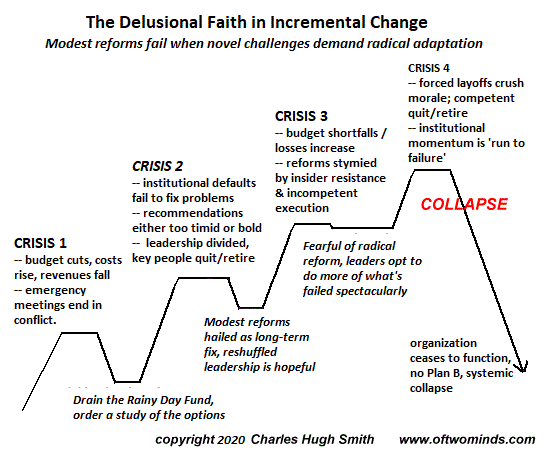
I’ve prepared a chart of the delusional faith in incremental change showing how each new crisis is met by incremental institutionalized defaults that are completely inadequate to the novel challenges that have arisen. The blindness to the need for radical adaption has been institutionalized as well: this is what worked in the past, so it will work nowWhy risk everything when we have procedures that have worked well?

Each stage of the crisis draws whatever conventional response causes the least pain. First, the “rainy day fund” is drained to keep everyone at the feeding trough. Studies of options are funded, and so on.

The recommendations are either too timid and clearly inadequate or they’re too bold and risky. So incremental policy and budget tweaks are adopted as acceptable institutional defaults.

But rifts open in the leadership as the farsighted few demand rapid, radical adaptations and the conventional risk-averse crowd digs in their heels. The farsighted few are pushed out or quit / retire, eliminating the only people who had the ability and experience to actually pull off a radical change of course.

A reshuffling of leadership evokes hope that the modest reforms will work magic. Alas, incremental tweaks only work in eras of stability. They fail miserably in unstable eras of rapidly-evolving challenges.

As everything runs to failure, the only acceptable path is to do more of what’s failed spectacularly, a default to low-risk incrementalism that only accelerates the final inevitable collapse.

The delusional faith in incremental change guarantees systemic failure. Better not to risk any radical evolution that might fail, and so failure is thus assured.

This is why our status quo is doomed:

Not News But A Juicy Collection Of Narratives – How The New York Times Failed Its Readers

By Moon of Alabama

The New York Times star reporter Rukmini Callimachi had been widely criticized for her exaggerated reporting about the Islamic State and terrorism. But her editors kept supporting and promoting her stories. That finally ended when Canada recently indicted one Shehroze Chaudhry, also known as Abu Huzaifa, for falsely claiming to have been an ISIS member. Chaudhry had made up his blood dripping stories. He had never been with ISIS and had never been to Syria or Iraq.

But the unverified stories of Abu Huzaifa al-Kanadi had been the central element of the NYT’s ten part Caliphate podcast by Rukmini Callimachi.

The failure of her reporting finally was so evident that the NYT had to allow its media columnist Ben Smith to write about the issue. Remarkably his reporting was published in the Business section of the paper.

An Arrest in Canada Casts a Shadow on a New York Times Star, and The Times

It is a pretty devastating report about the support Callimachi got from her editors even as an ever growing number of her collogues criticized her over-sensationalized reporting. The root cause of the problem is the way in which the Times, as well as other news media, try to change from news providers to narrative creators:

The crisis now surrounding the podcast is as much about The Times as it is about Ms. Callimachi. She is, in many ways, the new model of a New York Times reporter. She combines the old school bravado of the parachuting, big foot reporter of the past, with a more modern savvy for surfing Twitter’s narrative waves and spotting the sorts of stories that will explode on the internet.

Ms. Callimachi’s approach and her stories won her the support of some of the most powerful figures at The Times: early on, from Joe Kahn, who was foreign editor when Ms. Callimachi arrived and is now managing editor and viewed internally as the likely successor to the executive editor, Dean Baquet; and later, an assistant managing editor, Sam Dolnick, who oversees the paper’s successful audio team and is a member of the family that controls The Times.

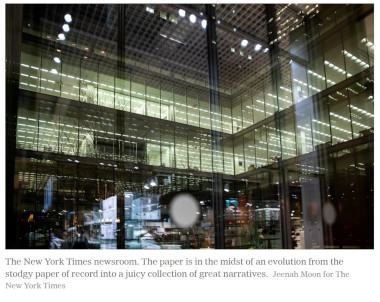
Ms. Callimachi’s approach to storytelling aligned with a more profound shift underway at The Times. The paper is in the midst of an evolution from the stodgy paper of record into a juicy collection of great narratives, on the web and streaming services. And Ms. Callimachi’s success has been due, in part, to her ability to turn distant conflicts in Africa and the Middle East into irresistibly accessible stories.

The highlighted sentence is the essence of the piece. It was even repeated in the caption of a picture accompanying it.

The striving for ‘juicy narratives’ is the biggest mistake of current news media. Their attempt to copy the success of Hollywood dramas by creating narratives has destroyed their credibility. It has put incentives on the wrong aspect of a reporter’s work. Instead of requiring well checked facts the editors are now asking for confirmations of preconceived tales:

What is clear is that The Times should have been alert to the possibility that, in its signature audio documentary, it was listening too hard for the story it wanted to hear — “rooting for the story,” as The Post’s Erik Wemple put it on Friday.

Callimachi is far from the only one guilty of creating fake news to fulfill her editors demand of narratives. The four year long coverage of ‘Russiagate’, the fairytale collection of made up connections between Donald Trump and Russia, was full of such. The editorial push towards narratives is rooted in the desire to create clickbait and to generate a social media echo around the reporting. That may be profitable in the short term but it is also a guarantee for a long term failure.

False of hyped narratives will over time get debunked. People then lose trust in the media that provided them with the fake news. That again will cause a long term loss of readership.

A similar case of falling for ‘narratives’ happened to German magazine Der Spiegel. Its star author Claas Relotius wrote fake stories on a large scale. Whether he wrote about Trump voters in Arizona or about a little girl in Syria, Relotius invented the witnesses to the ‘news’ he provided. He made up ‘facts’ and described himself visiting places he had never been to. For years there had been warnings that many of the detail Relotius provided were wrong. But his editors promoted him because the slick ‘narratives’ he delivered were exactly what they wanted. Der Spiegel, a once universally trusted source of news, is now joked about as ‘the former news magazine’.

The media trend towards providing narratives instead of verified facts also increases the danger of falling for manipulation. Governments as well as political marketing campaigns love to provide ready made tales. It is easier and cheaper for media to pick these up and repeat them instead of digging into the facts and their logic. We thus get false tales about chemical weapon use in Syria and a Skripal poisoning ‘narrative’ that does not stand up to the slightest scrutiny.

Can we please have real news? Just the new facts, with no ‘narrative’ or moral tales attached to them? Facts that are verified and described in the context of the issue they relate to? Do they fit the logic of already known ones? Do they make sense? How may they influence further developments?

To provide the above can easily fill a reporter’s day of work. It is usually enough material to write an 800 words report. Its sufficient for the reader to create his own narrative from it.

Dear news media. Please go back to providing real news. If you do so you will eventually regain my trust. That will be, in the long run, a much more valuable asset than the social media chatter you are currently trying to generate.

Battlefield Social Media: The West’s Growing Censorship

Censorship in the West flourishes as tech giants turn social media back into traditional programmed media. 

By Gunnar Ulson

Source: Land Destroyer

The United States, United Kingdom and the European Union are fond of passing judgement on nations around the globe regarding “free speech.”

While it is increasingly clear to a growing number of people that this “concern” is disingenuous and aimed at merely defending agitators funded and directed by Western special interests in these targeted nations, the West still likes to fashion itself as a sort of champion of free speech.

Yet back home the Internet has been taken over by social media and tech giants like Google, Facebook and Twitter.

Their platforms clearly serve as online public squares where everything is discussed and even election campaigns play out. Yet these companies have, over the years, begun to eliminate voices of dissent against a notion known as “consensus.”

If you are speaking out against “consensus” you are in real danger of disappearing from these platforms. Some of these platforms, like Google-owned YouTube, serve as the livelihood to people who have for years built up their audiences, produced hundreds of videos and when their accounts are deleted for speaking out against the “consensus,” they have their livelihoods destroyed.

In the wake of these incremental “purges” is a chilling effect with content creators self-censoring or even withdrawing entirely from Western social media.

It is the sort of very real censorship the West has crusaded against in fiction around the globe for decades. 

Concensus or Else 

A more recent example is Google’s decision to ban ad revenue for those going against the Coronavirus Disease 2019 (COVID-19) “consensus.”

CNBC in their story “Google will ban ads from running on stories spreading debunked coronavirus conspiracy theories,” would claim:

Google next month will ban publishers from using its ad platform to show advertisements next to content that promotes conspiracy theories about Covid-19. It will also ban ads that promote those theories. In cases where a particular site publishes a certain threshold of material that violates these policies, it will ban the entire site from using its ad platforms.

Those “conspiracy theories” might include questioning the official death rates of COVID-19. Yet even the British government itself has been recently forced to investigate its statistics regarding death rates, vindicating the very sort of people who would have been either forced into silence or forced to give up ad revenue.

The London Guardian in its article, “Matt Hancock orders urgent review of PHE Covid-19 death figures,” would admit:

The UK health secretary, Matt Hancock, is ordering an urgent review of the daily Covid-19 death statistics produced by Public Health England, after it emerged that they may include recovered former sufferers who could have died of other causes.

False reporting over deaths to hype COVID-19, induce greater public panic and pave the way for billions in government handouts to pharmaceutical giants is at the very core of many of these so-called “conspiracy theories” Google seeks to silence through its campaign of financial coercion.

Imagine if this chilling effect was achieved sooner. Would the British government have even bothered investigating its faulty statistics if there weren’t people suspicious of them?

The chilling effect this has over openly discussing something as serious as COVID-19 considering its socioeconomic impact is truly alarming and much more so because it is happening in the so-called “free world” overseen by its self-appointed arbitrators in the US, UK and EU.

A similar campaign was carried out to purge Google, Twitter and Facebook of anyone allegedly connected with “Russia” who also so happened to be anti-war and anti-NATO for waging those wars.

Entire lists are compiled by Western government-funded organizations which are then submitted to these tech giants for purging. The Western media writes accompanying articles announcing, justifying and spinning the purges… but also sending a warning to those left about what is and isn’t going to be tolerated on these platforms.

Social Media Transforming Back into Programmed Media 

Content creators are faced with two decisions; to either self-censor themselves to protect their work, their audiences and their livelihood, or to accept the possibility they will eventually be “purged” (censored) and need to rebuild their audiences from scratch on platforms with far fewer potential readers, viewers and patrons.

Social media, of course, is no longer social media in this sort of environment, but more akin to the sort of programmed media giant Western special interests built their power on over the course of the 20th and early 21st century.

Private Public Squares? 

Of course the defense is that Google, Facebook and Twitter are “private companies”and can do as they please with their platforms. In reality, these companies work in tandem with Western governments whether it is fomenting political destabilization abroad or creating “concensus” at home.

The notion that censorship is “ok” because the US, UK and EU governments launder it through private companies ignores the close relationship these companies have with the government and how their platforms have been transformed into defacto public squares and critical channels of public communication and participation.

The West’s growing overt censorship leaves it with a choice; to either accept that it is in reality as guilty of censorship and manipulating the public as it has claimed its opponents are, or continue pretending it isn’t but at the continued cost of its legitimacy upon the global stage.

There is a very good reason the West is in decline around the globe and why its attempts to leverage notions like “human rights” and “free speech” against nations like China or Russia are increasingly impotent. That reason can be found, at least in part, among the growing number of purge lists, censorship campaigns and calls for “consensus” across Western social media.

Finally, the increasingly overt nature of censorship and controlled narratives promoted by tech giants like Google, Facebook and Twitter should have them facing restrictions and bans around the globe. Why should any nation host a “public square” where discourse is entirely controlled by interests oceans away? Why shouldn’t a local alternative be created instead where the revenue is kept locally and if narratives are to be controlled, controlled in a way that best suits people locally?

It is ironic that, China for example, is condemned for not allowing Google, Facebook and Twitter to operate freely within their information space because it is a violation of “free speech,” even as Google, Facebook and Twitter cudgel free speech on their own respective platforms.

How much longer will the world tolerate these double standards? How long until individuals, organizations and even entire nations begin creating alternatives to Google, Facebook and Twitter to at the very least balance out the lopsided power and influence they have collectively accrued and abused? 

The Election Has Already Been Hijacked and the Winner Decided: ‘We the People’ Lose

By John W. Whitehead

Source: The Rutherford Institute

“Free election of masters does not abolish the masters or the slaves.” ― Herbert Marcuse

Republicans and Democrats alike fear that the other party will attempt to hijack this election.

President Trump is convinced that mail-in ballots are a scam except in Florida, where it’s safe to vote by mail because of its “great Republican governor.”

The FBI is worried about foreign hackers continuing to target and exploit vulnerabilities in the nation’s electoral system, sowing distrust about the parties, the process and the outcome.

I, on the other hand, am not overly worried: after all, the voting booths have already been hijacked by a political elite comprised of Republicans and Democrats who are determined to retain power at all costs.

The outcome is a foregone conclusion: the Deep State will win and “we the people” will lose.

The damage has already been done.

The Department of Homeland Security (DHS), which has been tasked with helping to “secure” the elections and protect the nation against cyberattacks, is not exactly an agency known for its adherence to freedom principles.

After all, this is the agency largely responsible for turning the American republic into a police state. Since its creation, the DHS has ushered in the domestic use of surveillance drones, expanded the reach of fusion centers, stockpiled an alarming amount of ammunition (including hollow point bullets), urged Americans to become snitches through a “see something, say something” campaign, overseen the fumbling antics of TSA agents everywhere, militarized the nation’s police, spied on activists and veterans, distributed license plate readers and cell phone trackers to law enforcement agencies, contracted to build detention camps, carried out military drills and lockdowns in American cities, conducted virtual strip searches of airline passengers, established Constitution-free border zones, funded city-wide surveillance cameras, and undermined the Fourth Amendment at every turn.

So, no, I’m not losing a night’s sleep over the thought that this election might by any more rigged than it already is.

And I’m not holding my breath in the hopes that the winner of this year’s popularity contest will save us from government surveillance, weaponized drones, militarized police, endless wars, SWAT team raids, asset forfeiture schemes, overcriminalization, profit-driven private prisons, graft and corruption, or any of the other evils that masquerade as official government business these days.

You see, after years of trying to wake Americans up to the reality that there is no political savior who will save us from the police state, I’ve come to realize that Americans want to engage in the reassurance ritual of voting.

They want to believe the fantasy that politics matter.

They want to be persuaded that there’s a difference between the Republicans and Democrats (there’s not).

Some will swear that Donald Trump has been an improvement on Barack Obama (he is not).

Others are convinced that Joe Biden’s values are different from Donald Trump’s (with both of them, money talks).

Most of all, voters want to buy into the fantasy that when they elect a president, they’re getting someone who truly represents the citizenry rather than the Deep State (in fact, in the oligarchy that is the American police state, an elite group of wealthy donors is calling the shots in cooperation with a political elite).

The sad truth is that it doesn’t matter who wins the White House, because they all work for the same boss: Corporate America. Understanding this, many corporations hedge their bets on who will win the White House by splitting their donations between Democratic and Republican candidates.

Politics is a game, a joke, a hustle, a con, a distraction, a spectacle, a sport, and for many devout Americans, a religion. It is a political illusion aimed at persuading the citizenry that we are free, that our vote counts, and that we actually have some control over the government when in fact, we are prisoners of a Corporate Elite.

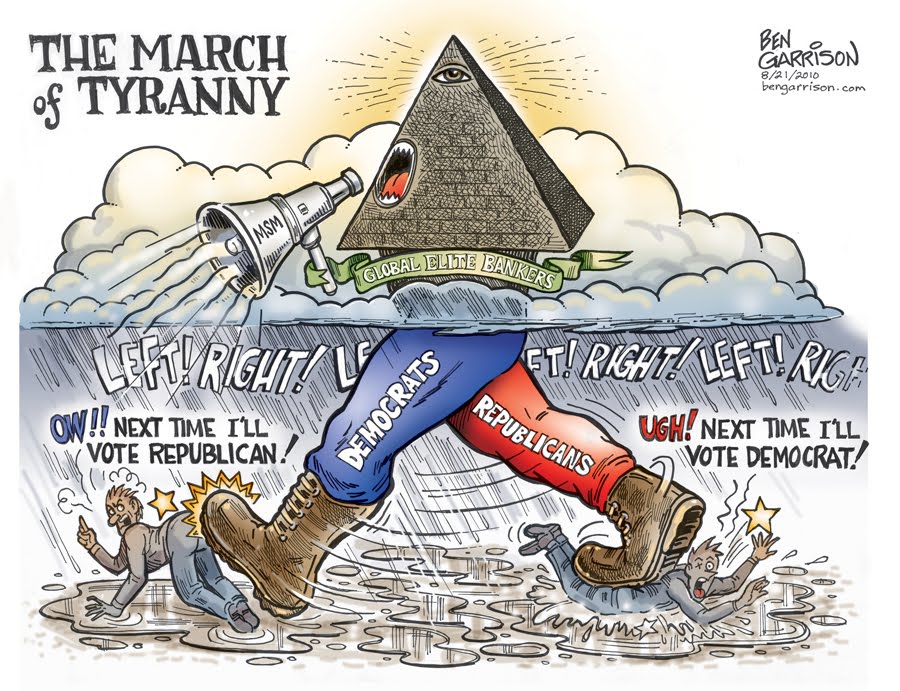
In other words, it’s a sophisticated ruse aimed at keeping us divided and fighting over two parties whose priorities, more often than not, are exactly the same so that we don’t join forces and do what the Declaration of Independence suggests, which is to throw the whole lot out and start over.

It’s no secret that both parties support endless war, engage in out-of-control spending, ignore the citizenry’s basic rights, have no respect for the rule of law, are bought and paid for by Big Business, care most about their own power, and have a long record of expanding government and shrinking liberty. Most of all, both parties enjoy an intimate, incestuous history with each other and with the moneyed elite that rule this country.

Despite the jabs the candidates volley at each other for the benefit of the cameras, they’re a relatively chummy bunch away from the spotlight. Moreover, despite Congress’ so-called political gridlock, our elected officials seem to have no trouble finding common ground when it’s time to collectively kowtow to the megacorporations, lobbyists, defense contractors and other special interest groups to whom they have pledged their true allegiance.

So don’t be fooled by the smear campaigns and name-calling or drawn into their divide-and-conquer politics of hate. They’re just useful tactics that have been proven to engage voters and increase voter turnout while keeping the citizenry at each other’s throats.

It’s all a grand illusion.

It used to be that the cogs, wheels and gear shifts in the government machinery worked to keep the republic running smoothly. However, without our fully realizing it, the mechanism has changed. Its purpose is no longer to keep our republic running smoothly. To the contrary, this particular contraption’s purpose is to keep the Deep State in power. Its various parts are already a corrupt part of the whole.

Just consider how insidious, incestuous and beholden to the corporate elite the various “parts” of the mechanism have become.

Congress. Perhaps the most notorious offenders and most obvious culprits in the creation of the corporate-state, Congress has proven itself to be both inept and avaricious, oblivious champions of an authoritarian system that is systematically dismantling their constituents’ fundamental rights. Long before they’re elected, Congressmen are trained to dance to the tune of their wealthy benefactors, so much so that they spend two-thirds of their time in office raising money. As Reuters reports, “For many lawmakers, the daily routine in Washington involves fundraising as much as legislating. The culture of nonstop political campaigning shapes the rhythms of daily life in Congress, as well as the landscape around the Capitol. It also means that lawmakers often spend more time listening to the concerns of the wealthy than anyone else.”

The President. What Americans want in a president and what they need are two very different things. The making of a popular president is an exercise in branding, marketing and creating alternate realities for the consumer—a.k.a., the citizenry—that allows them to buy into a fantasy about life in America that is utterly divorced from our increasingly grim reality. Take President Trump, for instance, who got elected by promising to drain the swamp in Washington DC. Instead of putting an end to the corruption, however, Trump has paved the way for lobbyists, corporations, the military industrial complex, and the rest of the Deep State (also referred to as “The 7th Floor Group”) to feast on the carcass of the dying American republic. The lesson: to be a successful president, it doesn’t matter whether you keep your campaign promises, sell the American people to the highest bidder, or march in lockstep with the Corporate State as long as you keep telling people what they most want to hear.

The Supreme Court. The U.S. Supreme Court—once the last refuge of justice, the one governmental body really capable of rolling back the slowly emerging tyranny enveloping America—has instead become the champion of the American police state, absolving government and corporate officials of their crimes while relentlessly punishing the average American for exercising his or her rights. Like the rest of the government, the Court has routinely prioritized profit, security, and convenience over the basic rights of the citizenry. Indeed, law professor Erwin Chemerinsky makes a compelling case that the Supreme Court, whose “justices have overwhelmingly come from positions of privilege,” almost unerringly throughout its history sides with the wealthy, the privileged, and the powerful.

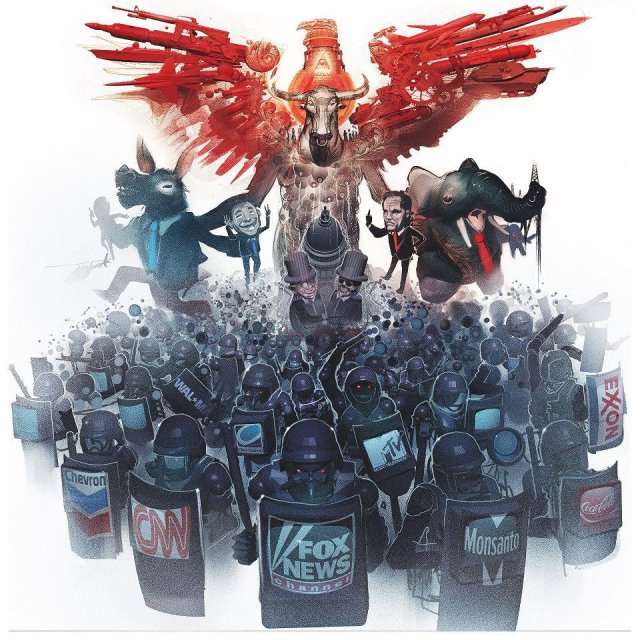
The Media. Of course, this triumvirate of total control would be completely ineffective without a propaganda machine provided by the world’s largest corporations. Besides shoveling drivel down our throats at every possible moment, the so-called news agencies which are supposed to act as bulwarks against government propaganda have instead become the mouthpieces of the state. The pundits which pollute our airwaves are at best court jesters and at worst propagandists for the false reality created by the American government. When you have internet and media giants such as Google, NBC Universal, News Corporation, Turner Broadcasting, Thomson Reuters, Comcast, Time Warner, Viacom, Public Radio International and The Washington Post Company donating to political candidates, you no longer have an independent media—what we used to refer to as the “fourth estate”—that can be trusted to hold the government accountable.

The American People. “We the people” now belong to a permanent underclass in America. It doesn’t matter what you call us—chattel, slaves, worker bees, it’s all the same—what matters is that we are expected to march in lockstep with and submit to the will of the state in all matters, public and private. Unfortunately, through our complicity in matters large and small, we have allowed an out-of-control corporate-state apparatus to take over every element of American society.

We’re playing against a stacked deck.

The game is rigged, and “we the people” keep getting dealt the same losing hand. The people dealing the cards—the politicians, the corporations, the judges, the prosecutors, the police, the bureaucrats, the military, the media, etc.—have only one prevailing concern, and that is to maintain their power and control over the citizenry, while milking us of our money and possessions.

It really doesn’t matter what you call them—Republicans, Democrats, the 1%, the elite, the controllers, the masterminds, the shadow government, the police state, the surveillance state, the military industrial complex—so long as you understand that while they are dealing the cards, the deck will always be stacked in their favor.

As I make clear in my book, Battlefield America: The War on the American People, our failure to remain informed about what is taking place in our government, to know and exercise our rights, to vocally protest, to demand accountability on the part of our government representatives, and at a minimum to care about the plight of our fellow Americans has been our downfall.

Now we find ourselves once again caught up in the spectacle of another presidential election, and once again the majority of Americans are acting as if this election will make a difference and bring about change. As if the new boss will be different from the old boss.

When in doubt, just remember what the astute commentator George Carlin had to say about the matter:

The politicians are put there to give you the idea that you have freedom of choice. You don’t. You have no choice. You have owners. They own you. They own everything. They own all the important land. They own and control the corporations. They’ve long since bought and paid for the Senate, the Congress, the state houses, the city halls. They got the judges in their back pockets and they own all the big media companies, so they control just about all of the news and information you get to hear. They got you by the balls. They spend billions of dollars every year lobbying. Lobbying to get what they want. Well, we know what they want. They want more for themselves and less for everybody else, but I’ll tell you what they don’t want. They don’t want a population of citizens capable of critical thinking. They don’t want well-informed, well-educated people capable of critical thinking. They’re not interested in that. That doesn’t help them. That’s against their interests. They want obedient workers. Obedient workers, people who are just smart enough to run the machines and do the paperwork…. It’s a big club and you ain’t in it. You and I are not in the big club. …The table is tilted, folks. The game is rigged and nobody seems to notice…. Nobody seems to care. That’s what the owners count on…. It’s called the American Dream, ’cause you have to be asleep to believe it.

‘$2.5 TRILLION THEFT’ – STUDY SHOWS RICHEST 1% OF AMERICANS HAVE TAKEN $50 TRILLION FROM BOTTOM 90% IN RECENT DECADES


The median U.S. worker salary would be around twice as high today if wages kept pace with economic output since World War II, new research revealed.

By Brett Wilkins

Source: Common Dreams

New research published Monday found that the top 1% of U.S. income earners have taken $50 trillion from the bottom 90% over the past several decades, and that the median worker salary would be around twice as high today as it was in 1945 if pay had kept pace with economic output over that period.

The study’s authors, Carter C. Price and Kathryn Edwards of the RAND Corporation, examined income distribution and economic growth in the United States from 1945 to the present. The researchers found stark differences between income distribution from 1945 to 1974 and 1975 to 2018.

According to the study—which was funded by the Seattle-based Fair Work Center—the median salary of a full-time U.S. worker is currently about $50,000. Adjusted for inflation using the consumer price index, workers at or below the current median income now earn less than half of what they would have if incomes had kept pace with economic growth. This means that if salaries had kept pace with economic output, the median worker pay would be between $92,000 and $102,000 today, depending on how inflation is calculated.

Had the more equitable distribution of the roughly 30-year postwar period continued apace, the total annual income of the bottom 90% of American workers would have been $2.5 trillion higher in 2018, or an amount equal to about 12% of GDP.  In other words, the upward redistribution of income has enriched the 1% by some $47 trillion—which would now be more than $50 trillion—at the expense of American workers.

David Rolf, a Seattle labor organizer, president of the Fair Work Center, and founder of Service Employees International Union (SEIU) Local 775, is more blunt. He calls this “the $2.5 trillion theft.”

“From the standpoint of people who have worked hard and played by the rules and yet are participating far less in economic growth than Americans did a generation ago, whether you call it ‘reverse distribution’ or ‘theft,’ it demands to be called something,” Rolf, who helped lead the fight for a $15 hourly minimum wage in Seattle and beyond, told Fast Company.

Remarkably, the study found that workers at all income levels would be better off today if income kept pace with output. Full-time, prime-age workers in the 25th percentile, for example, would be earning $61,000 instead of $33,000. Workers in the 75th percentile, who in 2018 earned $81,000, would be making $126,000. Even 90th-percentile workers, who earn $133,000, would be making $168,000 under the more equitable distribution.

On the other hand, had the economic pie been divided more equitably, the income of the top 1% would fall from around $1.2 million to a still-affluent $549,000.

“We were shocked by the numbers,” said Nick Hanauer, a venture capitalist and self-described “zillionaire” who, along with Rolf, came up with the idea for the study. “It explains almost everything,” Hanauer told Fast Company. “It explains why people are so pissed off. It explains why they are so economically precarious.”

Sen. Bernie Sanders (I-Vt.), who made correcting economic inequality a pillar of both of his presidential bids, lamented the “h-u-g-e redistribution of income in America” in a Monday tweet.

The researchers’ findings, which come amid a deadly coronavirus/Covid-19 pandemic, shine light on the injustice of an economy—by far the wealthiest in the history of civilization—in which essential workers struggle mightily, and often in vain, to survive while the richest people grow ever richer at their expense.

According to Americans for Tax Fairness, the total wealth of U.S. billionaires increased by $792 billion, or 27%, during the first five months of the Covid-19 pandemic. During this period, Amazon CEO Jeff Bezos, the world’s wealthiest person, has become the world’s first multi-centibillionaire, with a net worth now surpassing $200 billion. Meanwhile, his employees struggle to make ends meet, and Amazon workers who speak out against poor pay and hazardous working conditions during the pandemic have been fired and derided by company executives.

Compared to other most-developed nations, the U.S. has done a relatively poor job of taking care of its people during the pandemic. In addition to the U.S. being the only developed nation without universal healthcare, its workers have received less in direct payments and government support than people in many comparable countries.

The gap between the richest and poorest U.S. households is now wider than it has ever been in the past 50 years, according to the most recently available data from the U.S. Census Bureau. The pandemic has only exacerbated the situation, as around half of lower-income American households have reported a job or wage loss due to Covid-19.

Internationally, the U.S. ranks 39th out of over 150 nations in income inequality, according to Gini coefficient data compiled by the CIA, placing it roughly on par with nations like Peru and Cameroon. Among Organization for Economic Cooperation and Development (OECD) nations, the U.S. has the seventh-highest level of income inequality.

The U.S. has the highest poverty rate among the world’s most-developed nations, and the fourth-highest poverty rate among OECD nations after South Africa, Costa Rica, and Romania. According to UNICEF, the U.S. also has the second-highest rate of childhood poverty in the developed world behind Romania, with more than one in five U.S. children—and over one in four Latinx children, and nearly one in three Black and Native American children—living in poverty.

This year, more than 54 million Americans, or roughly one in every six people—including 18 million children—may experience food insecurity, according to the nonprofit group Feeding America.

New Pentagon-Google Partnership Suggests AI Will Soon Be Used to Diagnose Covid-19

Google recently teamed up with the Pentagon as part of the new, AI-driven “Predictive Health” program. Though only focused on “predictive cancer diagnoses” for now, Google and the military have apparent plans to expand the AI model for automating and predicting Covid-19 diagnoses.

By Whitney Webb

Source: Unlimited Hangout

At the beginning of September, Google Cloud announced that it had won a project from the Pentagon’s relatively new Defense Innovation Unit (DIU) to “prototype an AI-enabled digital pathology solution at select DoD [Department of Defense] facilities.” This prototype, per a Google Cloud press release, combines “augmented reality telescopes” with “AI-enabled” cancer detection tools that will allegedly improve the accuracy of “predictive cancer diagnoses.” It is the second DIU contract Google has won this year, with the first being related to combatting “cyber threats.”

The initial implementation of this Pentagon-funded, Google-created “digital pathology solution” will take place “at select Defense Health Agency (DHA) treatment facilities and Veterans Affairs hospitals in the United States,” and the program includes “future plans to expand across the broader U.S. Military Health System,” according to Google.

The initiative is part of a larger DIU-led program called “Predictive Health” that is also partnered with the joint AI effort of the US military and US intelligence community, the Joint Artificial Intelligence Center, and JAIC’s “Warfighter Health” initiative. The JAIC, which is currently led by a former Silicon Valley executive, is providing much of the funding for Predictive Health, while its related “Warfighter Health” initiative more broadly seeks “to field AI solutions that are aimed at transforming military health care.”

In addition to its stated goal of improving the accuracy of cancer diagnoses, the implementation of this Google-DIU AI-driven medical diagnosis tool aims to show “frontline health practitioners” that such tools “can improve the lives” of US troops, according to Google executives. As Mike Daniels, vice president of Global Public Sector at Google Cloud, noted in a statement, Google is “partnering with DIU to provide our machine learning and artificial intelligence technology to help frontline healthcare practitioners learn about capabilities that can improve the lives of our military men and women and their families.” Google also stated that the use of their tool at military health facilities would also “lower overall healthcare costs.”

The Google-DIU effort to outsource human doctor decision-making to a tailor-made artificial intelligence algorithm is, for now, only focused on the diagnosis of cancers. However, last Thursday, less than two weeks after winning the DIU contract, Google announced that it was donating $8.5 million to several organizations to advance the development and use of AI  “for monitoring and forecasting” Covid-19. That money is part of a larger $100 million donation from Google for financing “solutions” to Covid-19 that was announced in May.

Further evidence that Google soon plans to offer AI-driven “predictive diagnoses” for Covid-19 came in August, when Google Cloud partnered with Harvard’s Global Health Institute to provide “Covid-19 Public Forecasts,” which “provide a projection of Covid-19 cases, deaths, and other metrics over the next 14 days for US counties and states.” The announcement of the Google-Harvard collaboration coincided with an announcement from the National Institutes of Health (NIH) would begin “harness[ing] AI for COVID-19 diagnosis, treatment, and monitoring.”

Notably, other tech companies that have produced “predictive diagnosis” AI models for Covid-19 also began first by offering AI-created “forecasts” of “likely” Covid-19 outbreaks. For instance, the Israeli intelligence–linked Diagnostic Robotics initially offered AI-driven predictive “forecasts” of cities and districts to guide lockdown policy in Israel and the US state of Rhode Island before then teaming up with the US-based company Salesforce to develop a platform that uses AI to “predict” which individuals are likely to be diagnosed with Covid-19 and then uses AI to monitor and even “treat” those individuals.

Furthermore, in partnership with researchers at Mount Sinai healthcare centers in New York, tech giant Microsoft has already aided the development of an AI algorithm that “rapidly diagnoses” Covid-19. Mount Sinai’s AI model, supported by a recent grant from Microsoft’s “AI for Health” initiative, “was as accurate as an experienced radiologist in diagnosing the disease,” according to one of the lead researchers behind the model’s development. While its development was aided by Microsoft, the core of the Mount Sinai AI model is TensorFlow, which was developed by Google and is Google AI’s second-generation system for machine learning.

In addition, both Google and Microsoft are part of a Europe-based effort aimed at “automating diagnoses” for Covid-19 via an AI algorithm that analyzes CT scans, which is similar in several ways to the Mount Sinai AI model. Thus, it seems highly likely that Google’s efforts to offer AI-powered “predictive diagnoses” will soon expand to include tools that use algorithms to diagnose Covid-19, not just cancer.

The Merging of the Pentagon, the CIA, and Silicon Valley

Established in 2015, the Defense Innovation Unit of the Department of Defense officially exists to transfer “leading-edge commercial capabilities to the military faster and more cost-effectively than traditional defense acquisition methods” and to accelerate “the adoption of commercial technology throughout the military and [grow] the national security innovation base.” As the DIU makes clear on its website, the “national security innovation base” it seeks to “grow” consists of private tech companies, namely those based in Silicon Valley, that provide “advanced commercial solutions” to “national security challenges.” This, of course, includes the tech companies that already double as contractors for the national security state, such as Google, Microsoft, and Amazon, among numerous others.

The DIU boasts offices in Silicon Valley, Boston, Austin, and at the Pentagon itself and is largely led, not by career military men, but by former Silicon Valley executives. For instance, its current director—Michael Brown—is the former CEO of cybersecurity giant Symantec and, prior to that, led the Quantum corporation. In another example, the leader of the DIU’s artificial intelligence portfolio is Jeff Klugman, a former top executive at TiVo, the Quantum corporation, and Hewlett-Packard.

A year after the DIU was created, it was followed by the Defense Innovation Board (DIB), which is composed of “leaders from across the national security innovation base” and provides recommendations that “have been used to inform DoD leadership strategy and action, as well as congressional legislation.” Like the DIU, Silicon Valley is well represented on the DIB, as its members include former Google CEO Eric Schmidt and LinkedIn founder Reid Hoffman as well as top executives from Google, Microsoft, and Facebook.

Notably, just months before the DIU-led Predictive Health program was launched, the DIB noted in March 2020 that the Pentagon “owns the largest repository of disease- and cancer-related medical data in the world,” asserting further that “if the entire repository were leveraged to its fullest potential, it would advance diagnosis and treatment for thousands of illnesses, saving lives across DoD and the global population.” The DIB then specifically suggested that “artificial intelligence and machine learning models may help pathologists sort through this massive dataset more quickly and effectively to provide better care for patients in and out of the military,” adding that these troves of medical data should be used “to support DoD reform and modernization efforts in the field of AI/ML [Artificial Intelligence / Machine Learning].”

In other words, the Silicon Valley–dominated DIB called for what is now the Predictive Health program just months before the Silicon Valley–dominated DIU formally announced it. Also noteworthy is that Google—whose former CEO, current vice president, and several other Google-tied researchers and businessmen serve on the DIB—is the very company that won the DIU contract to have its AI models serve as the foundation for the Predictive Health program. This, of course, means that Google’s AI models will benefit immensely from the Pentagon’s “unique” and massive medical datasets, which the DIB previously stated was something that the Pentagon “must treat . . . as a strategic asset.”

It is also important to point out the considerable overlap between the Pentagon’s Defense Innovation Board and the National Security Commission on Artificial Intelligence. The NSCAI is chaired by Eric Schmidt (also on the DIB) and includes representatives from Google, Microsoft, Facebook, and Amazon as well as the current and former leaders of the CIA’s In-Q-Tel.

The official purpose of the NSCAI is “to consider the methods and means necessary to advance the development of artificial intelligence, machine learning, and associated technologies to comprehensively address the national security and defense needs of the United States.” As I previously reported for The Last American Vagabond, the vice-chair of NSCAI, Robert Work—former Deputy Secretary of Defense and senior fellow at the hawkish Center for a New American Security (CNAS)described the commission’s purpose as determining “how the U.S. national security apparatus should approach artificial intelligence, including a focus on how the government can work with industry to compete with China’s ‘civil-military fusion’ concept [my emphasis].”

For this reason, the NSCAI unites the US intelligence community and the military, which is already collaborating on AI initiatives via the Joint Artificial Intelligence Center and Silicon Valley companies. Notably, many of those Silicon Valley companies—like Google, for instance—are not only contractors to US intelligence, the military, or both but were initially created with funding from the CIA’s In-Q-Tel, which also has a considerable presence on the NSCAI. Thus, while the line between Silicon Valley and the US national-security state has always been murky, now that line is essentially nonexistent as entities like the NSCAI, DIB, and DIU, among several others, clearly show. Whereas China, as Robert Work noted, has the “civil-military fusion” model at its disposal, the NSCAI and the US government respond to that model by further fusing the US technology industry with the national-security state.

It is also certainly interesting that, just like the DIB, the NSCAI called for what would become the DIU’s Predictive Health program a few months before it was formally announced. In a NSCAI paper from June 2020 titled “The Role of AI Technology in Pandemic Response and Preparedness: Recommended Investments and Initiatives,” the commission recommends investments and initiatives aimed at using AI for diagnosing illnesses, including Covid-19. This seems to suggest that the Silicon Valley–led but Pentagon-housed DIU is the body that actually creates the government-industry partnerships and initiatives that are first planned out by the DIB and the NSCAI.

It’s All About the Data

While Google has stated that one of their main goals in participating in the Predictive Health program is showing health-care practitioners how AI can “improve lives,” the DIU was decidedly more direct regarding their intent in implementing this “predictive diagnosis” program. For instance, an article on the Google-DIU pilot program at DefenseOne, citing military officials, notes that the “enormous amount of healthcare data, unique to the Department of Defense, also presents a rare opportunity for the Department to train new machine learning tools.” It then adds that “there are 9.6 million beneficiaries in the Defense Health System, which means a lot of data to improve the accuracy of [AI] models.”

DIU’s chief medical officer, Niels Olsen, who created the Predictive Health program, recently stated that massive quantities of data planned to be obtained by the program and used for developing improved AI algorithms was a critical component of the project. In a Pentagon press release, Olsen stated that “the more data a tool has available to it, the more effective it is. That’s kind of what makes DOD unique. We have a larger pool of information [i. e., medical data] to draw from, so that you can select more diverse cases.”

Thus, the implementation of the Predictive Health program is expected to amass troves upon troves of medical data that offer both the DIU and its partners in Silicon Valley the “rare opportunity” for training new, improved AI models that can then be marketed commercially. This may explain part of the interest in partnering this initiative with the Defense Health Agency (DHA), which “owns the largest repository of disease- and cancer-related medical data in the world” through its management of the Joint Pathology Center, which was noted by the DIB in its March 2020 publication. In addition, as previously mentioned, Google will now be able to access that trove of sensitive data to refine its AI “health-focused” algorithms, thanks to it having won the DIU contract earlier this month.

Notably, the relatively new Predictive Health program builds on past DIU initiatives, such as an AI algorithm that predicts illnesses “48 hours before symptoms show.” That algorithm was developed by the Defense Threat Reduction Agency, the DIU, and the health IT company Royal Phillips. The Phillips team that developed that algorithm is now “refin[ing] the model at military hospitals and clinics managed by the Veterans Affairs Department.” According to the DTRA’s Edward Argenta, the focus of the program is to eventually use the AI algorithm to analyze data from devices that remotely monitor individual health, specifically “a wearable device that might sit on your body—like a watch-based one or a chest strap one.”

While various “innovation-focused” agencies at the Pentagon have been busy developing their own algorithms after harvesting mass amounts of medical data from military members and their families, a web of intelligence-linked tech companies, including those represented on the DIB and NSCAI, have gained access to the jackpot of medical data through partnering with the “Covid-19 Healthcare Coalition.”

According to its website, the Covid-19 Healthcare Coalition was established as “a coordinated public-interest, private-sector response to the Covid-19 pandemic, convening healthcare organizations, technology firms, nonprofits, academia, and startups.” The coalition, which was launched by the intelligence and defense contractor MITREalso includes tech giants like Google, Microsoft, Palantir, Salesforce, and Amazon and allows its member organizations to “collaborate, collect, analyze, visualize, and share data and insights.” With access to the data from partnered health-care institutions, such as the Mayo Clinic and the Cedars-Sinai Health System, these tech companies are “helping” the coalition “unlock large-scale analytics for Covid-19.” Institutions tied to the US government, and the NSCAI in particular, such as the CIA’s In-Q-Tel, are also members of the Covid-19 Healthcare Coalition.

Notably, the recent advances in US-based efforts to “predict” or “automate” Covid-19 diagnoses are all tied to this very coalition. Indeed, all of the companies and institutions mentioned thus far in this report have engaged in developing these tools, as Diagnostic Robotics, Salesforce, Google, Microsoft, Amazon, and Mount Sinai Medical Center are all coalition members.

Google, in the press release regarding its recent partnership with the DIU, noted that the prototype of the AI model set to make “predictive cancer diagnoses” had been “developed from [unspecified] public and private datasets,” making it possible—if not likely—that the private datasets were obtained through Google’s membership in this massive, yet relatively unknown, coalition of health-care institutions, tech companies, and US intelligence–linked entities like MITRE and In-Q-Tel.

This apparent obsession with medical data may explain the dramatic uptick in hacks of hospitals in the United States, which have been considerable in recent months and have largely targeted patient data. It is worth pointing out that the increase in these attacks seeking patient data coincides with the DIB-NSCAI policy recommendations regarding training AI algorithms on troves of medical data for automated and predictive diagnoses, among other applications.

Notably, the “solutions” offered to many of the health-care institutions that have been hacked have come from government-promoted yet opaque groups that are deeply tied to US and allied intelligence agencies as well as Silicon Valley. These “volunteer groups,” such as “the CTI League” and “the Cyber Alliance to Defend Our Healthcare,” offer their services for free but, notably, gain access to the patient data they are tasked with guarding. Are such groups, given their deep ties to Silicon Valley and intelligence agencies, helping acquire even more data to satisfy the Silicon Valley and national-security state’s endless hunger for more and more data?