Meet BlackRock, the New Great Vampire Squid

By Ellen Brown

Source: Web of Debt

BlackRock is a global financial giant with customers in 100 countries and its tentacles in major asset classes all over the world; and it now manages the spigots to trillions of bailout dollars from the Federal Reserve. The fate of a large portion of the country’s corporations has been put in the hands of a megalithic private entity with the private capitalist mandate to make as much money as possible for its owners and investors; and that is what it has proceeded to do.

To most people, if they are familiar with it at all, BlackRock is an asset manager that helps pension funds and retirees manage their savings through “passive” investments that track the stock market. But working behind the scenes, it is much more than that. BlackRock has been called “the most powerful institution in the financial system,” “the most powerful company in the world” and the “secret power.” It is the world’s largest asset manager and “shadow bank,” larger than the world’s largest bank (which is in China), with over $7 trillion in assets under direct management  and another $20 trillion managed through its Aladdin risk-monitoring software. BlackRock has also been called “the fourth branch of government” and “almost a shadow government”, but no part of it actually belongs to the government. Despite its size and global power, BlackRock is not even regulated as a “Systemically Important Financial Institution” under the Dodd-Frank Act, thanks to pressure from its CEO Larry Fink, who has long had “cozy” relationships with government officials.

BlackRock’s strategic importance and political weight were evident when four BlackRock executives, led by former Swiss National Bank head Philipp Hildebrand, presented a proposal at the annual meeting of central bankers in Jackson Hole, Wyoming, in August 2019 for an economic reset that was actually put into effect in March 2020. Acknowledging that central bankers were running out of ammunition for controlling the money supply and the economy, the BlackRock group argued that it was time for the central bank to abandon its long-vaunted independence and join monetary policy (the usual province of the central bank) with fiscal policy (the usual province of the legislature). They proposed that the central bank maintain a “Standing Emergency Fiscal Facility” that would be activated when interest rate manipulation was no longer working to avoid deflation. The Facility would be deployed by an “independent expert” appointed by the central bank.

The COVID-19 crisis presented the perfect opportunity to execute this proposal in the US, with BlackRock itself appointed to administer it. In March 2020, it was awarded a no-bid contract under the Coronavirus Aid, Relief, and Economic Security Act (CARES Act) to deploy a $454 billion slush fund established by the Treasury in partnership with the Federal Reserve. This fund in turn could be leveraged to provide over $4 trillion in Federal Reserve credit. While the public was distracted with protests, riots and lockdowns, BlackRock suddenly emerged from the shadows to become the “fourth branch of government,” managing the controls to the central bank’s print-on-demand fiat money. How did that happen and what are the implications?

Rising from the Shadows

BlackRock was founded in 1988 in partnership with the Blackstone Group, a multinational private equity management firm that would become notorious after the 2008-09 banking crisis for snatching up foreclosed homes at firesale prices and renting them at inflated prices. BlackRock first grew its balance sheet in the 1990s and 2000s by promoting the mortgage-backed securities (MBS) that brought down the economy in 2008. Knowing the MBS business from the inside, it was then put in charge of the Federal Reserve’s “Maiden Lane” facilities. Called “special purpose vehicles,” these were used to buy “toxic” assets (largely unmarketable MBS) from Bear Stearns and American Insurance Group (AIG), something the Fed was not legally allowed to do itself.

BlackRock really made its fortunes, however, in “exchange traded funds” (ETFs). It gained trillions in investable assets after it acquired the iShares series of ETFs in a takeover of Barclays Global Investors in 2009. By 2020, the wildly successful iShares series included over 800 funds and $1.9 trillion in assets under management.

Exchange traded funds are bought and sold like shares but operate as index-tracking funds, passively following specific indices such as the S&P 500, the benchmark index of America’s largest corporations and the index in which most people invest. Today the fast-growing ETF sector controls nearly half of all investments in US stocks, and it is highly concentrated. The sector is dominated by just three giant American asset managers – BlackRock, Vanguard and State Street, the “Big Three” – with BlackRock the clear global leader. By 2017, the Big Three together had become the largest shareholder in almost 90% of S&P 500 firms, including Apple, Microsoft, ExxonMobil, General Electric and Coca-Cola. BlackRock also owns major interests in nearly every mega-bank and in major media.

In March 2020, based on its expertise with the Maiden Lane facilities and its sophisticated Aladdin risk-monitoring software, BlackRock got the job of dispensing Federal Reserve funds through eleven “special purpose vehicles” authorized under the CARES Act. Like the Maiden Lane facilities, these vehicles were designed to allow the Fed, which is legally limited to purchasing safe federally-guaranteed assets, to finance the purchase of riskier assets in the market.

Blackrock Bails Itself Out

The national lockdown left states, cities and local businesses in desperate need of federal government aid. But according to David Dayen in The American Prospect, as of May 30 (the Fed’s last monthly report), the only purchases made under the Fed’s new BlackRock-administered SPVs were ETFs, mainly owned by BlackRock itself. Between May 14 and May 20, about $1.58 billion in ETFs were bought through the Secondary Market Corporate Credit Facility (SMCCF), of which $746 million or about 47% came from BlackRock ETFs. The Fed continued to buy more ETFs after May 20, and investors piled in behind, resulting in huge inflows into BlackRock’s corporate bond ETFs.

In fact, these ETFs needed a bailout; and BlackRock used its very favorable position with the government to get one. The complicated mechanisms and risks underlying ETFs are explained in an April 3 article by business law professor Ryan Clements, who begins his post:

Exchange-Traded Funds (ETFs) are at the heart of the COVID-19 financial crisisOver forty percent of the trading volume during the mid-March selloff was in ETFs ….

The ETFs were trading well below the value of their underlying bonds, which were dropping like a rock. Some ETFs were failing altogether. The problem was something critics had long warned of: while ETFs are very liquid, trading on demand like stocks, the assets that make up their portfolios are not. When the market drops and investors flee, the ETFs can have trouble coming up with the funds to settle up without trading at a deep discount; and that is what was happening in March.

According to a May 3 article in The National, “The sector was ultimately saved by the US Federal Reserve’s pledge on March 23 to buy investment-grade credit and certain ETFs. This provided the liquidity needed to rescue bonds that had been floundering in a market with no buyers.”

Prof. Clements states that if the Fed had not stepped in, “a ‘doom loop’ could have materialized where continued selling pressure in the ETF market exacerbated a fire-sale in the underlying [bonds], and again vice-versa, in a procyclical pile-on with devastating consequences.” He observes:

There’s an unsettling form of market alchemy that takes place when illiquid, over-the-counter bonds are transformed into instantly liquid ETFs. ETF “liquidity transformation” is now being supported by the government, just like liquidity transformation in mortgage backed securities and shadow banking was supported in 2008.

Working for Whom?

BlackRock got a bailout with no debate in Congress, no “penalty” interest rate of the sort imposed on states and cities borrowing in the Fed’s Municipal Liquidity Facility, no complicated paperwork or waiting in line for scarce Small Business Administration loans, no strings attached. It just quietly bailed itself out.

It might be argued that this bailout was good and necessary, since the market was saved from a disastrous “doom loop,” and so were the pension funds and the savings of millions of investors. Although BlackRock has a controlling interest in all the major corporations in the S&P 500, it professes not to “own” the funds. It just acts as a kind of “custodian” for its investors — or so it claims. But BlackRock and the other Big 3 ETFs vote the corporations’ shares; so from the point of view of management, they are the owners. And as observed in a 2017 article from the University of Amsterdam titled “These Three Firms Own Corporate America,” they vote 90% of the time in favor of management. That means they tend to vote against shareholder initiatives, against labor, and against the public interest. BlackRock is not actually working for us, although we the American people have now become its largest client base.

In a 2018 review titled “Blackrock – The Company That Owns the World”, a multinational research group called Investigate Europe concluded that BlackRock “undermines competition through owning shares in competing companies, blurs boundaries between private capital and government affairs by working closely with regulators, and advocates for privatization of pension schemes in order to channel savings capital into its own funds.”

Daniela Gabor, Professor of Macroeconomics at the University of Western England in Bristol, concluded after following a number of regulatory debates in Brussels that it was no longer the banks that wielded the financial power; it was the asset managers. She said:

We are often told that a manager is there to invest our money for our old age. But it’s much more than that. In my opinion, BlackRock reflects the renunciation of the welfare state. Its rise in power goes hand-in-hand with ongoing structural changes; in finance, but also in the nature of the social contract that unites the citizen and the state.

That these structural changes are planned and deliberate is evident in BlackRock’s August 2019 white paper laying out an economic reset that has now been implemented with BlackRock at the helm.

Public policy is made today in ways that favor the stock market, which is considered the barometer of the economy, although it has little to do with the strength of the real, productive economy. Giant pension and other investment funds largely control the stock market, and the asset managers control the funds. That effectively puts BlackRock, the largest and most influential asset manager, in the driver’s seat in controlling the economy.

As Peter Ewart notes in a May 14 article on BlackRock titled “Foxes in the Henhouse,” today the economic system “is not classical capitalism but rather state monopoly capitalism, where giant enterprises are regularly backstopped with public funds and the boundaries between the state and the financial oligarchy are virtually non-existent.”

If the corporate oligarchs are too big and strategically important to be broken up under the antitrust laws, rather than bailing them out they should be nationalized and put directly into the service of the public. At the very least, BlackRock should be regulated as a too-big-to-fail Systemically Important Financial Institution. Better yet would be to regulate it as a public utility. No private, unelected entity should have the power over the economy that BlackRock has, without a legally enforceable fiduciary duty to wield it in the public interest.
Trust No One

By Michael Krieger

Source: Liberty Blitzkrieg

The title of today’s post is not meant to be taken literally. I trust plenty of people. I trust friends who’ve demonstrated their trustworthiness over the years. I trust my family. Having people in my life I love and trust makes everything far more meaningful and pleasant. I hope people reading this likewise have a circle of trust they’ve built over the years.

On the other hand, you should never trust anyone or anything that hasn’t given you good reason to do so, and if someone or something gives you good reason not to trust them, you should never forget that. The more power a person or institution has in society, the less trustworthy they tend to be. I don’t say this because it’s fun to be cynical, I say this because my life experience has demonstrated its accuracy.

In the 21st century alone, I’ve been given good reason to distrust all sorts of things around me, including the U.S. government (all governments really), intelligence agencies, politicians, mass media, Wall Street and Silicon Valley, to name a few. These power centers make up “society” as we know it in 2020, which is really just massive concentrations of lawless financial and political power obfuscating rampant criminality behind the cover of various ostensibly venerable institutions. What’s most remarkable is how many people still maintain trust in so many of these provably untrustworthy organizations and industries, which speaks to the power of propaganda as well as the comfort of denial.

That said, the ground is clearly beginning to shift on this front. As more and more people recognize that the system’s designed to work against them, increased numbers will reject conventional wisdom and search for an alternative framework. Unfortunately, this next step can be equally treacherous and it’s important not to jump from the frying pan into the fire.

This is where social media comes into play. It offers an endless array of opinions and analysis that you don’t get from mass media, but it’s also filled with bad actors, professional propagandists and con artists. At this point, everyone knows that social media is the new information battleground, so every character or institution with malicious intent is aggressively playing in this arena and often with boatloads of money. The charlatans at MSNBC will have you believe it’s just the Russians or Chinese, but every government and every single special interest on the planet is now involved. They’re all on social media in one form or another, trying to push you in a specific direction that’s usually not in your best interests.

It took me a while, but I’ve finally recognized how unthoughtful and treacherous social media is whenever some big news event hits. Important arguments quickly lose all nuance and devolve into binary talking points and agendas. People split into teams in a way that feels very much akin to the traditional, and now largely discredited, red/blue political theater. For covid-19, it felt like half of Twitter thought it was an extinction-level event, while the other half was convinced the whole thing was a hoax. In the aftermath of George Floyd, you were either cheering on the civil unrest, or wanted to send in the military. Increasingly, if you aren’t in one of two manufactured camps on any issue you’ll be shouted down and ostracized.  That’s not the kind of discussion I’m here for.

As someone who’s found great value in Twitter over the years, I’ve become far more careful in how I use it and where to direct my attention and energy. It reminds me of Mos Eisley in Star Wars, a wretched hive of scum and villainy, but simultaneously a place you can connect with Han Solo and get a spaceship.

As we move forward, it’s going to feel like the world’s ending, and in some ways it will be. No the world isn’t literally ending, but a specific kind of world is ending, and it’ll be extremely difficult for many people to tell the difference as it’s happening. This will likely lead to many more episodes of mass insanity as professional manipulators take advantage of millions upon millions of disoriented people. Priority number one should be to stand guard at the gate of your mind during this time so as not to become a victim.

The best thing you can do from here on out is use your time and energy as productively as possible. We’re going to need builders, creators and inventors more than ever before, because we’re past the point of putting this thing back together. We’ll need to recreate, reimagine and rebuild, and all of this must spring from a point of consciousness in order to bring forth something that is both better and sustainable. Become more beautiful and resilient as others become ugly and unhinged. Focus on what’s within your capacity to control and always remember to resist the crazy.

The financialization of the end of the world

By Kurt Cobb

Source: resilience

For those who are fans of cartoons from The New Yorker magazine and consistent readers of this blog, you might be able to guess my two favorite cartoons. In the first one, a man in a coat and tie stands at a podium and tells his unseen audience the following: “And so, while the end-of-the-world scenario will be rife with unimaginable horrors, we believe that the pre-end period will be filled with unprecedented opportunities for profit.”

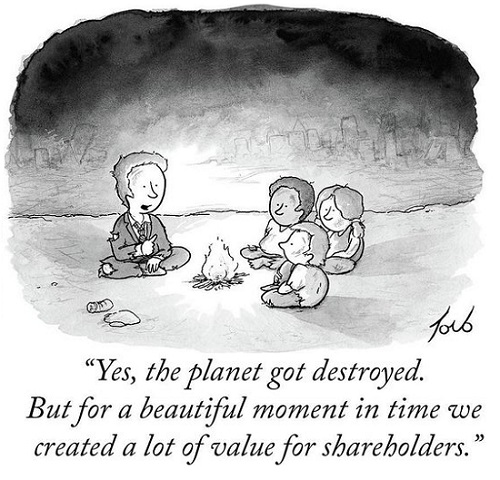
In the second, a man in a tattered suit sits cross-legged near a campfire with three children listening to him intently as he says this: “Yes, the planet got destroyed. But for a beautiful moment in time we created a lot of value for shareholders.”

Now, in the you-can’t-make-this-stuff-up category, financial writer Paul Farrell used the caption from the first cartoon in a 2015 piece for MarketWatch entitled: “Your No. 1 end-of-the-world investing strategy.” The subheading is: “How to pick stocks for the near term when long-term trends say collapse is near.” The subhead actually seems like it might be another caption from a New Yorker cartoon (or possibly one from The Onion). Why exactly would you invest in stocks—as opposed to seeds of food crops and sturdy garden implements—”when long-term trends say collapse is near”? But I’ll put that down to bad headline writing.

In Farrell’s defense, he frequently used his column in MarketWatch to warn his readers of the coming collapse of modern civilization if we don’t change our ways. He was obliged to give investment advice, of course, because that’s what the column was for.

Few other investment gurus are as intellectually honest as Farrell. Among prominent investment managers, only Jeremy Grantham comes close to understanding the scope of the challenges we face. Grantham wrote a piece in 2013 called “The Race of Our Lives” that outlines the myriad challenges humans face. He starts with a discussion of the fall of civilizations. (He updated his views in 2018.)

One would think that the coronavirus pandemic would allow for some sober reflection among those in the financial community as the pandemic-induced crash of the economy and the markets has called into question the stability of practically all the arrangements of modern civilization. Instead, the focus is on how stock markets could be back at or near all-times highs at the beginning of what is arguably the next Great Depression.

The New Yorker cartoons linked above appropriately characterize the madness that grips late-stage civilizations as their pillars begin to fall. Instead of attempting to adapt to new realities, every attempt is made to maintain the current fragile system. The trillions of dollars pumped into the world financial system by central banks and governments in the wake of the pandemic have done little except stoke renewed financial bubbles in practically all financial markets (and thereby bailed out the mostly wealthy owners of financial assets).

The disconnect is hard to miss. The latest reading of the U.S. Federal Reserve Bank of Atlanta’s GDPNow indicator, which is frequently updated as new data becomes available, now predicts that U.S. GDP will contract by 45.5 percent in the current quarter. (The number is annualized and seasonally adjusted.)

Even so the NASDAQ Composite Index hit a new all-time high earlier this month just three months after the recent trough reached during the crash. The S&P 500 is now very close to a new all-time high. Neither development makes sense in the middle of the worst economic downturn since the Great Depression. For comparison, it took more than two years for the NASDAQ Composite from the bottom in 2009 during the Great Financial Crisis to regain its 2007 highs. It took the S&P 500 more than four years.

Of course, the financialization of everything continues. Vaccine makers are in line for government funds. Naturally, it takes money to develop a vaccine. But drug makers aren’t in the business of keeping people healthy. They are in the business of making money. In the United States at least they are helped by the fact that they aren’t liable if their vaccine kills or injuries someone. And, executives in one money-losing pharmaceutical firm cashed in stock right after their company goosed the shares significantly higher with a very preliminary announcement about the company’s coronavirus vaccine research.

When it comes to real estate, it used to be that people bought it for income and as a store of value. Now firms buy real estate mostly with borrowed money and try to make gains mostly through property price appreciation. Often the real estate loans are packaged into securities that are sold and resold as part of the giant Wall Street and worldwide financial casino.

One of the surest signs of the financialization of everything and the growing disconnect of finance from reality is the credit default swap (CDS). The CDS is essentially insurance for loans and bonds. The buyer pays the seller a premium every month. If the instrument insured defaults, the seller provides a predetermined payment to reimburse the CDS buyer. Now here’s the weird thing: An investor doesn’t even have to own the loan or bond to insure it. It’s like me taking out an insurance policy on your home against fire when I have no ownership or interest in the home. In fact, I have every incentive to make sure your house burns down. Do you see any problem with that?

For normal insurance, the buyer must have an insurable interest. Typically, this means the buyer must actually own the thing he or she is insuring. The CDS, on the other hand, is an ideal instrument for those who want to bring on a financial end-of-the-world scenario. The buyers have every reason to want the economy to go down the drain as their payments may be 10 or even 20 times their initial investment.

Many wealthy people fear and even believe an end-of-the-world scenario is possible or probable. Some think they can hold up in luxury bunkers until the dust clears. But what if, when the dust clears, their wealth is gone and the financial world they used to inhabit has vanished.

Perhaps they will sit around campfires telling their grandchildren about the old days when finance was king and the real economy of goods and services was just a place where rubes got their daily bread—while, of course, simultaneously providing an outsized portion to the rich.

Globalists Reveal That The “Great Economic Reset” Is Coming In 2021

By Brandon Smith

Source: Alt-Market.com

For those not familiar with the phrase “global economic reset”, it is one that has been used ever increasingly by elitists in the central banking world for several years. I first heard it referenced by Christine Lagarde, the head of the IMF at the time, in 2014. The reset is often mentioned in the same breath as ideas like “the New Multilateralism” or “the Multipolar World Order” or “the New World Order”. All of these phrases mean essentially the same thing.

The reset is promoted as a solution to the ongoing economic crisis which was triggered in 2008. This same financial crash is still with us today, but now, after a decade of central bank money printing and debt creation, the bubble is even bigger than it was before. As always, the central bank “cure” is far worse than the disease, and the renewed crash we face today is far more deadly than what would have happened in 2008 if we had simply taken our medicine and refused to prop up weak parts of the economy artificially.

Many alternative economists often wrongly attribute the Fed’s habit of making things worse to “hubris” or “ignorance”. They think the Fed actually wants to save the financial system or “protect the golden goose”, but this is not reality. The truth is, the Fed is not a bumbling maintenance man, the Fed is a saboteur, a suicide bomber that is willing to destroy even itself as an institution in order to explode the US economy and clear the path for a new globally centralized one world system. Hence, the “Global Reset”.

In 2015 in my article ‘The Global Economic Reset Has Begun’, I stated:

The global reset is not a “response” to the process of collapse we are trapped in today. No, the global reset as implemented by central banks and the BIS/IMF is the cause of the collapse. The collapse is a tool, a flamethrower burning a great hole in the forest to make way for the foundations of the globalist Ziggurat to be built….economic disaster serves the interests of elitists.”

Now in 2020 we see the globalist plan coming to fruition, with the elites revealing what appears to be their intent to launch their reset in 2021. The World Economic Forum officially announced the Great Reset initiative as part of their Covid Action Platform last week, and a summit is scheduled in January 2021 to discuss their plans more openly with the world and the mainstream media.

The WEF also posted a rather bizarre video on the Reset, which consists of a series of images of the world falling apart (and images of factories releasing harmless carbon emission into the air which I suppose is meant to scare us with notions of global warming). The destruction is then “reset” at the push of a button, with everything reversing back to a pristine human-less world of nature and the words “Join Us”.

The reset, according to discussions by the IMF, is basically the next stage in the formation of a one-world economic system and potential global government. This seems to fall in line with the solutions offered during the Event 201 pandemic simulation; a simulation of a coronavirus pandemic that was held by the Bill And Melinda Gates Foundation and the World Economic Forum only two months before the REAL THING happened at the beginning of 2020. Event 201 suggested that one of the top solutions to a pandemic would be the institution of a centralized global economic body that could handle the financial response to the coronavirus.

Is it not convenient that the events of the real coronavirus pandemic fall exactly in line with the Event 201 simulation, as well as directly in line with the global reset plans of the IMF and the World Economic Forum? As they say, let no crisis go to waste, or, as is the motto of the globalists “Order Out Of Chaos”.

With civil unrest about to become a way of life for many parts of the world including the US, and the pandemic set for a resurgence of infections after the “reopening”, creating a rationale for a second wave of lockdowns probably in July, the economy as we know it is being destroyed. The last vestiges of the system, hanging by a thin thread after the crash of 2008, are now being cut.

The goal is rather obvious – Terrify the population with poverty, internal conflicts and a broken supply chain until they lobby the establishment for help.  Then, offer the “solution” of medical tyranny, immunity passports, martial law, a global economic system based on a cashless digital society in which privacy in trade is erased, and then slowly but surely form a faceless “multilateral” global government which answers to no one and does whatever it pleases.

I remember back in 2014 when Christine Lagarde first began talking about the reset. That same year she also made a very strange speech to the National Press Club in which she started rambling gleefully about numerology and the “magic number 7”. Many within the club laughed, as there was apparently an inside joke that the rest of us were not privy to. Well, I would point out that the World Economic Forum meeting on the global reset in 2021 will be held exactly 7 years after Lagarde gave that speech. Just another interesting coincidence I suppose…

The new world order, the global reset, is a long running scheme to centralize power, but in a way that is meant to be sustained for centuries to come. The elites know that it is not enough to achieve global governance by force alone; such an attempt would only lead to resistance and eternal rebellion. No, what the elites want is for the public to ASK, even beg for global governance. If the public is tricked into demanding it as a way to save them from the horrors of global chaos, then they are far less likely to rebel against it later. Problem – reaction – solution.

The pandemic is not going away anytime soon. Everyone should expect that state governments and the federal government will call for renewed lockdowns. With these new lockdowns, the US economy in particular will be finished. With 40 million people losing their jobs during the last lockdowns, many states only partially reopened, and only 13% to 18% of small businesses receiving bailout loans to survive, the next two months are going to be a devastating wake-up call.

The real solution will be for people to form more self reliant communities free of the mainstream economy. The real solution should be decentralization and independence, not centralization and slavery. The globalists will seek to interfere with any effort to break from the program. That said, they can do very little if millions of people enact localization efforts at the same time. If people aren’t reliant on the system, then they cannot be controlled by the system.

The real test will come with the final collapse of the existing economy. When stagflation spikes even harder than it is right now and prices of necessities double or triple yet again, and joblessness skyrockets even further, how many people will clamor for the globalist solution and how many will build their own systems? How many will be bowing in submission and how many will be ready to fight back. It is a question I still don’t have an answer to even after 14 years of analysis on the issue.

What I suspect is that many people will fight back. Not as many as we might hope for, but enough to defend the cause of liberty. Maybe this is overly optimistic, but I believe the globalists are destined to lose this war in the long run.

Facebook using “fact-checkers” to censor dissent on Covid19

Familiar tactics of obfuscation and weasel-words deployed to block access to articles

By Off-Guardian.org

Facebook has flagged our article “It’s all bullshit”: 3 links sinking the Covid narrative” as ‘false information’, based on nothing but a single ‘fact check’ website, which does not even claim the information is ‘false’, but merely quibbles over terminologies to justify claiming the information is ‘misleading.’

This is what you see today if you try to access that article on Facebook:

And if you click on the ‘see why’ button you get taken here, to the website of Health Feedback, an “independent fact-checker”.

Of course, they’re not independent – they’re actually funded by Facebook. They are also funded by the “Credibility Coalition”, an NGO focused on “common standards for information credibility”.

The Credibility Coalition are also funded by Facebook. And twitter. And google. And a whole host of unsavoury sounding NGOs.

So, with the idea that “health feedback” are anywhere close to “independent” firmly debunked, let’s see what they have to say.

Firstly, it’s important to note what is actually being “fact-checked” here.

It is not that the three documents were leaked. It is not the accuracy of the quotes used. It is not the statistics cited. In fact, not a single factual claim is being called “false”.

In short, Facebook is well aware that 90% of the article is perfectly provably true.

In fact, it’s not our article they’re allegedly fact-checking, it’s another article in the publication NewsPunch, which relies on one of the same sources we do.

The “fact-check” is entirely devoted to just one of three leaks we describe – the report from German Interior Ministry employee – and even then focuses solely on its provenance rather than its content. In essence, what is being “fact-checked” is not the report itself, but where it came from.

Nowhere in this ‘rebuttal’ does it claim the ‘German Ministry employee’ was lying or making provably false statements. Neither does it challenge the credentials, competence or honesty of the “independent scientists” who co-authored the report.

Instead, it uses diversionary language claiming the document’s main author, Stephan Kohn, was simply sharing his “private opinion” and was not authorised to speak for the government.

The author of the document is Stephan Kohn, a politologist and employee of Germany’s Interior Ministry in the KM 4 department for the Protection of Critical Infrastructures. However, Kohn’s analysis was not requested by the Interior Ministry, as the article claims. On 10 May, Germany’s Interior Ministry issued a press release stating that the employee had disseminated his “private opinion on the corona crisis management” and that the “elaboration was carried out outside the area of responsibility as well as without assignment and authorization”.

This approach should be hauntingly familiar to anyone who has been following the OPCW whistleblower story. Where expert witnesses contradicting the official narrative on Douma were claimed to merely be “disgruntled ex-employees” who were in Syria of their own accord and “never part of the fact-finding mission”.

All these claims have since been shown to be lies.

In addition to these irrelevant obfuscations, the article uses weasel words to construct a flimsy counter-argument:

According to EuroMOMO, the number of excess deaths coinciding with the COVID-19 pandemic was twice the number that occurred during the unusually deadly flu seasons of 2017, 2018, and 2019 (Figure 1).

Note that they only back three years in time, and not all the way to 2000 or 1998, both of which had very similar excess death numbers.

Note also they say “coinciding with”, and not “caused by”. This allows them to cite all the excess deaths in Europe, despite statistics showing that huge numbers of the excess deaths were due to other causes – including the lockdown limiting access to healthcare and increasing poverty.

They are using excess deaths caused by the lockdown, to argue against the accuracy of a report warning that the lockdown will cause excess deaths.

It is going full Orwell. And it is utterly disgusting.

This article simply does not offer any justification for dismissing our article reporting Kohn’s words as ‘false information’. The information is NOT demonstrably false, it is merely contentious, in that the data is open to multiple interpretations.

In fact, the article admits that itself – only able to label the claim as “misleading” or “unsupported”. Nowhere do they use the word “disinformation” or “misinformation” or “false information”. Not once.

And yet that is the label facebook has stuck on it.

Facebook is not suppressing this article because it contains false information at all, it is censoring it because it offers an interpretation of facts that does not support the current mainstream dogma.

This is censorship, pure and simple.

Another Bank Bailout Under Cover of a Virus

By Ellen Brown

Source: Web of Debt

Insolvent Wall Street banks have been quietly bailed out again. Banks made risk-free by the government should be public utilities.  

When the Dodd Frank Act was passed in 2010, President Obama triumphantly declared, “No more bailouts!” But what the Act actually said was that the next time the banks failed, they would be subject to “bail ins” – the funds of their creditors, including their large depositors, would be tapped to cover their bad loans.

Then bail-ins were tried in Europe. The results were disastrous.

Many economists in the US and Europe argued that the next time the banks failed, they should be nationalized – taken over by the government as public utilities. But that opportunity was lost when, in September 2019 and again in March 2020, Wall Street banks were quietly bailed out from a liquidity crisis in the repo market that could otherwise have bankrupted them. There was no bail-in of private funds, no heated congressional debate, and no public vote. It was all done unilaterally by unelected bureaucrats at the Federal Reserve.

“The justification of private profit,” said President Franklin Roosevelt in a 1938 address, “is private risk.” Banking has now been made virtually risk-free, backed by the full faith and credit of the United States and its people. The American people are therefore entitled to share in the benefits and the profits. Banking needs to be made a public utility.

The Risky Business of Borrowing Short to Lend Long

Individual banks can go bankrupt from too many bad loans, but the crises that can trigger system-wide collapse are “liquidity crises.” Banks “borrow short to lend long.” They borrow from their depositors to make long-term loans or investments while promising the depositors that they can come for their money “on demand.” To pull off this sleight of hand, when the depositors and the borrowers want the money at the same time, the banks have to borrow from somewhere else. If they can’t find lenders on short notice, or if the price of borrowing suddenly becomes prohibitive, the result is a “liquidity crisis.”

Before 1933, when the government stepped in with FDIC deposit insurance, bank panics and bank runs were common. When people suspected a bank was in trouble, they would all rush to withdraw their funds at once, exposing the fact that the banks did not have the money they purported to have. During the Great Depression, more than one-third of all private US banks were closed due to bank runs.

But President Franklin D. Roosevelt, who took office in 1933, was skeptical about insuring bank deposits. He warned, “We do not wish to make the United States Government liable for the mistakes and errors of individual banks, and put a premium on unsound banking in the future.” The government had a viable public alternative, a US postal banking system established in 1911. Postal banks became especially popular during the Depression, because they were backed by the US government. But Roosevelt was pressured into signing the 1933 Banking Act, creating the Federal Deposit Insurance Corporation that insured private banks with public funds.

Congress, however, was unwilling to insure more than $5,000 per depositor (about $100,000 today), a sum raised temporarily in 2008 and permanently in 2010 to $250,000. That meant large institutional investors (pension funds, mutual funds, hedge funds, sovereign wealth funds) had nowhere to park the millions of dollars they held between investments. They wanted a place to put their funds that was secure, provided them with some interest, and was liquid like a traditional deposit account, allowing quick withdrawal. They wanted the same “ironclad moneyback guarantee” provided by FDIC deposit insurance, with the ability to get their money back on demand.

It was largely in response to that need that the private repo market evolved. Repo trades, although technically “sales and repurchases” of collateral, are in effect secured short-term loans, usually repayable the next day or in two weeks. Repo replaces the security of deposit insurance with the security of highly liquid collateral, typically Treasury debt or mortgage-backed securities. Although the repo market evolved chiefly to satisfy the needs of the large institutional investors that were its chief lenders, it also served the interests of the banks, since it allowed them to get around the capital requirements imposed by regulators on the conventional banking system. Borrowing from the repo market became so popular that by 2008, it provided half the credit in the country. By 2020, this massive market had a turnover of $1 trillion a day.

Before 2008, banks also borrowed from each other in the fed funds market, allowing the Fed to manipulate interest rates by controlling the fed funds rate. But after 2008, banks were afraid to lend to each other for fear the borrowing banks might be insolvent and might not pay the loans back. Instead the lenders turned to the repo market, where loans were supposedly secured with collateral. The problem was that the collateral could be “rehypothecated,” or used for several loans at once; and by September 2019, the borrower side of the repo market had been taken over by hedge funds, which were notorious for risky rehypothecation. Many large institutional lenders therefore pulled out, driving the cost of borrowing at one point from 2% to 10%.

Rather than letting the banks fail and forcing a bail-in of private creditors’ funds, the Fed quietly stepped in and saved the banks by becoming the “repo lender of last resort.” But the liquidity crunch did not abate, and by March the Fed was making $1 trillion per day available in overnight loans. The central bank was backstopping the whole repo market, including the hedge funds, an untenable situation.

In March 2020, under cover of a national crisis, the Fed therefore flung the doors open to its discount window, where only banks could borrow. Previously, banks were reluctant to apply there because the interest was at a penalty rate and carried a stigma, signaling that the bank must be in distress. But that concern was eliminated when the Fed announced in a March 15 press release that the interest rate had been dropped to 0.25% (virtually zero). The reserve requirement was also eliminated, the capital requirement was relaxed, and all banks in good standing were offered loans of up to 90 days, “renewable on a daily basis.” The loans could be continually rolled over. And while the alleged intent was “to help meet demands for credit from households and businesses at this time,” no strings were attached to this interest-free money. There was no obligation to lend to small businesses, reduce credit card rates, or write down underwater mortgages.

The Fed’s scheme worked, and demand for repo loans plummeted. Even J.P. Morgan Chase, the largest bank in the country, has acknowledged borrowing at the Fed’s discount window for super cheap loans. But the windfall to Wall Street has not been shared with the public. In Canada, some of the biggest banks slashed their credit card interest rates in half, from 21 percent to 11 percent, to help relieve borrowers during the COVID-19 crisis. But US banks have felt no such compunction. US credit card rates dropped in April only by half a percentage point, to 20.15%. The giant Wall Street banks continue to favor their largest clients, doling out CARES Act benefits to them first, emptying the trough before many smaller businesses could drink there.

In 1969, Prime Minister Indira Gandhi nationalized 14 of India’s largest banks, not because they were bankrupt (the usual justification today) but to ensure that credit would be allocated according to planned priorities, including getting banks into rural areas and making cheap financing available to Indian farmers.  Congress could do the same today, but the odds are it won’t. As Sen. Dick Durbin said in 2009, “the banks … are still the most powerful lobby on Capitol Hill. And they frankly own the place.”

Time for the States to Step In

State and local governments could make cheap credit available to their communities, but today they too are second class citizens when it comes to borrowing. Unlike the banks, which can borrow virtually interest-free with no strings attached, states can sell their bonds to the Fed only at market rates of 3% or 4% or more plus a penalty. Why are elected local governments, which are required to serve the public, penalized for shortfalls in their budgets caused by a mandatory shutdown, when private banks that serve private stockholders are not?

States can borrow from the federal unemployment trust fund, as California just did for $348 million, but these loans too must be paid back with interest, and they must be used to cover soaring claims for state unemployment benefits. States remain desperately short of funds to repair holes in their budgets from lost revenues and increased costs due to the shutdown.

States are excellent credit risks – far better than banks would be without the life-support of the federal government. States have a tax base, they aren’t going anywhere, they are legally required to pay their bills, and they are forbidden to file for bankruptcy. Banks are considered better credit risks than states only because their deposits are insured by the federal government and they are gifted with routine bailouts from the Fed, without which they would have collapsed decades ago.

State and local governments with a mandate to serve the public interest deserve to be treated as well as private Wall Street banks that have repeatedly been found guilty of frauds on the public. How can states get parity with the banks? If Congress won’t address that need, states can borrow interest-free at the Fed’s discount window by forming their own publicly-owned banks. For more on that possibility, see my earlier article here.

As Buckminster Fuller said, “You never change things by fighting the existing reality. To change something, create a new model that makes the old model obsolete.” Post-COVID-19, the world will need to explore new models; and publicly-owned banks should be high on the list.

To America, Black Lives Only Sometimes Matter

By Tony Cartalucci

Source: Land Destroyer

There is no doubt that colonialism and racism sit at the root of America’s domestic problems. The push to dominate others abroad is directly linked to the belief that those who are different at home should also be dominated.

There are still Americans alive today that remember segregation laws that denied black Americans their basic rights and dignity. Before that, there was outright slavery.

Even today, racism is still institutionalized. It also permeates American culture, laying just beneath a superficial layer of tolerance and equality.

This is not just about white people who remain racist against blacks and other minorities – a product of America’s terminally ill culture – it is also about fundamental racism that still very much sits at the heart of American foreign and domestic policy – against not only blacks, but virtually every race on the planet from Africans to Asians to even Slavs.

The US is a nation that encourages its people to hate entire groups of people abroad to help justify otherwise unjust wars. Arabs, Chinese people, Russians – are all vilified with bigotry and hatred sanctioned by mainstream American culture. It isn’t hard to see why in a nation like this, hatred for other groups is easily justified in the minds of racists and the unjust.

Not Just Police in America – Racism is a Key Feature of US Foreign Policy 

It was under US President Barack Obama that the US decimated the North African nation of Libya, deposing Libyan leader Muammar Gaddafi – a champion of African dignity and progress and the champion of tens of thousands of blacks from all over Africa who travelled to Libya to find work and a better life – work and a better life Gaddafi provided them until he was brutally murdered and his government replaced by heavily armed, racist terrorists backed by the US and its European allies.

US-backed militants in Libya would hunt down Libya’s black population, killing them, torturing them, and even enslaving them in open air slave markets – a spectacle one might have believed was unthinkable in the 21st century – but something made possible by America, its foreign policy, and its deeply rooted racism and sense of supremacy – despite having a “black” president at the time.

President Obama is hardly the only one to blame – he simply picked up where others left off – and his successor, US President Donald Trump is simply next in line to carry forward systemic US injustice worldwide. The fact that President Obama was black made no difference and simply helps illustrate how while superficial milestones are waved in America’s face – the fundamental rot of injustice, racism, and supremacist thinking persists.

When a nation is able to justify denying one group of people their dignity, worth, and rights as human beings it is a slippery slope that easily leads to other groups likewise being stripped of their humanity and abused.

If Black Lives Matter – They Must Always Matter, Everywhere, All the Time 

Any case of police brutality is tragic and needs to be addressed -a problem in its own right. If officers killed George Floyd because he was black, it represents an additional problem that must also be addressed.

If Americans genuinely believe black lives matter – then they need to commit to fighting injustice against them, and all other victims of American racism and supremacy. If they speak up only when it is popular and “trending” it’s as good as not speaking up at all.

If they are silent when America is mass murdering blacks overseas, killing brown people across the planet, or attempting to normalize racism against Asians – Chinese people in particular – they are complicit in the very sort of deeply rooted, institutionalized racism that underpins US foreign policy and the globe-spanning industrialized injustice it represents – and the very sort of racism that manifests itself as injustice against blacks at home.

America needs genuine opposition to racism. Not opportunistic posturing.

US politicians like Alexandria Ocasio-Cortez pose as dedicated to racial equality and fighting racism – yet she regularly finds herself in support of US military aggression abroad which exclusively targets nations populated by black, brown, and Asian people.

Her most recent display of supreme hypocrisy was her support of US meddling in Hong Kong – an extension of the British Empire’s seizure from and subjugation of this Chinese territory.

The British Empire – of course – also pursued its foreign policy based entirely on the belief that white Westerners were superior to all others and that it was their right – even duty – to impose British “civilization” upon “heathen” races – China was no exception to this belief.

Alexandria Ocasio-Cortez may or may not appreciate that her support for US meddling in Hong Kong helps continue this disgraceful tradition and agenda – believing instead that supporting “democracy” in Hong Kong is not simply the same brand of Anglo-American racism merely repackaged for more sensitive global audiences. But she is supporting racism, supremacy, and hegemony all the same.

Black lives will never matter as long as “Black Lives Matter” remains a hollow political slogan shouted by interests easily able to ignore or even support injustice purveyed by the US against others abroad – including blacks.

Deeply rooted racism in the US is just one of many symptoms of an overall desire for hegemony and the notions of racial, political, and cultural supremacy that underpin it. Until this is addressed, racism will continue, with only the most superficial and unsustainable efforts made to stop it.

As long as America believes it is better than all others abroad – able to justify exploitation, coercion, and even military aggression to assert itself and pursue its “interests” – racism and injustice will persist at home. The same corporate-financier interests driving US injustice abroad see the US population – white and black – as merely another market segment to use and abuse – to divide and conquer – to put under itself for its own benefit.

Black lives matter, whether they are being strangled by a racist white cop in America or being bombed by US warplanes in Libya. Once Americans can unite in both understanding and opposing this across-the-board racism and injustice, something might actually be done about it besides kicking the can down the road for a few more months until the next video of police abuse emerges online.

America will not heal its domestic hatred and divisions if it remains built entirely on projecting and profiting from hatred and division abroad. It was no coincidence that legendary champions for equality like Martin Luther King Jr. were both opposed to racism and injustice at home and ceaselessly opposed  to American aggression and hegemony abroad. The two are linked by the common thread of fundamental injustice. Until they are both exposed and smashed completely, they will both continue.

The System Is Rigged: Qualified Immunity Is How the Police State Stays in Power

By John W. Whitehead

Source: Mint Press News

The system is rigged, the government is corrupt, and “we the people” continue to waste our strength by fighting each other rather than standing against the tyrant in our midst.

Because the system is rigged, because the government is corrupt, and because “we the people” remain polarized and divided, the police state will keep winning and “we the people” will keep losing.

Because the system is rigged and the U.S. Supreme Court—the so-called “people’s court”—has exchanged its appointed role as a gatekeeper of justice for its new role as maintainer of the status quo, there will be little if no consequences for the cops who brutalize and no justice for the victims of police brutality.

Because the system is rigged, there will be no consequences for police who destroyed a private home by bombarding it with tear gas grenades during a SWAT team raid gone awry, or for the cop who mistakenly shot a 10-year-old boy after aiming for and missing the non-threatening family dog, or for the arresting officer who sicced a police dog on a suspect who had already surrendered.

This is how unarmed Americans keep dying at the hands of militarized police.

By refusing to accept any of the eight or so qualified immunity cases before it this term that strove to hold police accountable for official misconduct, the Supreme Court delivered a chilling reminder that in the American police state, ‘we the people’ are at the mercy of law enforcement officers who have almost absolute discretion to decide who is a threat, what constitutes resistance, and how harshly they can deal with the citizens they were appointed to ‘serve and protect.”

This is how qualified immunity keeps the police state in power.

Lawyers tend to offer a lot of complicated, convoluted explanations for the doctrine of qualified immunity, which was intended to insulate government officials from frivolous lawsuits, but the real purpose of qualified immunity is to rig the system, ensuring that abusive agents of the government almost always win and the victims of government abuse almost always lose.

How else do you explain a doctrine that requires victims of police violence to prove that their abusers knew their behavior was illegal because it had been deemed so in a nearly identical case at some prior time: it’s a setup for failure.

Do you know how many different ways a cop can kill, maim, torture and abuse someone without being held liable?

The cops know: in large part due to training classes that drill them on the art of sidestepping the Fourth Amendment, which protects us from being bullied, badgered, beaten, broken and spied on by government agents.

This is how “we the people” keep losing.

Although the U.S. Supreme Court recognized in Harlow v. Fitzgerald (1982) that suing government officials for monetary damages is “the only realistic avenue” of holding them accountable for abusing their offices and violating the Constitution, it has ostensibly given the police and other government agents a green light to shoot first and ask questions later, as well as to probe, poke, pinch, taser, search, seize, strip and generally manhandle anyone they see fit in almost any circumstance, all with the general blessing of the courts.

Whether it’s police officers breaking through people’s front doors and shooting them dead in their homes or strip searching motorists on the side of the road, these instances of abuse are continually validated by a judicial system that kowtows to virtually every police demand, no matter how unjust, no matter how in opposition to the Constitution.

Make no mistake about it: this is what constitutes “law and order” in the American police state.

These are the hallmarks of a police state: where police officers, no longer mere servants of the people entrusted with keeping the peace, are part of an elite ruling class dependent on keeping the masses corralled, under control, and treated like suspects and enemies rather than citizens.

Unfortunately, we’ve been traveling this dangerous road for a long time now.

A review of critical court rulings over the past several decades, including rulings affirming qualified immunity protections for government agents by the U.S. Supreme Court, reveals a startling and steady trend towards pro-police state rulings by an institution concerned more with establishing order, protecting the ruling class, and insulating government agents from charges of wrongdoing than with upholding the rights enshrined in the Constitution.

Indeed, as Reuters reports, qualified immunity “has become a nearly failsafe tool to let police brutality go unpunished and deny victims their constitutional rights.” Worse, as Reuters concluded, “the Supreme Court has built qualified immunity into an often insurmountable police defense by intervening in cases mostly to favor the police.”

The system is rigged.

Police can claim qualified immunity for warrantless searches. In Anderson v. Creighton, the Supreme Court ruled that FBI and state law enforcement agents were entitled to qualified immunity protections after they were sued for raiding a private home without a warrant and holding family members at gunpoint, all in a search for a suspected bank robber who was not in the house.

Police can claim qualified immunity for warrantless arrests based on mere suspicion. In Hunter v. Bryant, the Court ruled that police acted reasonably in arresting James Bryant without a warrant in order to protect the president. Bryant had allegedly written a letter that referenced a third-party plot to assassinate President Ronald Reagan, but police had no proof that he intended to harm Reagan beyond a mere suspicion. The charges against Bryant were eventually dropped.

Police can claim qualified immunity for using excessive force against protesters. In Saucier v. Katz, the Court ruled in favor of federal law enforcement agents who forcefully tackled a protester as he attempted to unfurl a banner at Vice President Gore’s political rally. The Court reasoned that the officers acted reasonably given the urgency of protecting the vice president.

Police can claim qualified immunity for shooting a fleeing suspect in the back. In Brosseau v. Haugen, the Court dismissed a lawsuit against a police officer who shot Kenneth Haugen in the back as he entered his car in order to flee from police. The Court ruled that in light of existing case law, the cop’s conduct fell in the “hazy border between excessive and acceptable force” and so she did not violate clearly established law.

Police can claim qualified immunity for shooting a mentally impaired person. In City of San Francisco v. Sheehan, the Court ruled in favor of police who repeatedly shot Teresa Sheehan during the course of a mental health welfare check. The Court ruled that it was not unreasonable for police to pepper spray and shoot Sheehan multiple times after entering her room without a warrant and encountering her holding a knife.

Police officers can use lethal force in car chases without fear of lawsuits. In Plumhoff v. Rickard, the U.S. Supreme Court declared that police officers who used deadly force to terminate a car chase were immune from a lawsuit. The officers were accused of needlessly resorting to deadly force by shooting multiple times at a man and his passenger in a stopped car, killing both individuals.

Police can stop, arrest and search citizens without reasonable suspicion or probable cause. In a 5-3 ruling in Utah v. Strieff, the U.S. Supreme Court effectively gave police the go-ahead to embark on a fishing expedition of one’s person and property, rendering Americans completely vulnerable to the whims of any cop on the beat.

Police officers can stop cars based on “anonymous” tips or for “suspicious” behavior such as having a reclined car seat or driving too carefully. In a 5-4 ruling in Navarette v. California, the U.S. Supreme Court declared that police officers, under the guise of “reasonable suspicion,” can stop cars and question drivers based solely on anonymous tips, no matter how dubious, and whether or not they themselves witnessed any troubling behavior. Then in State v. Howard, the Kansas Supreme Court declared that motorists who recline their car seats are guilty of suspicious behavior and can be subject to warrantless searches by police. That ruling, coupled with other court rulings upholding warrantless searches and seizures by police renders one’s car a Constitution-free zone.

Americans have no protection against mandatory breathalyzer tests at a police checkpoint, although mandatory blood draws violate the Fourth Amendment (Birchfield v. North Dakota). Police can also conduct sobriety and “information-seeking” checkpoints (Illinois v. Lidster and Mich. Dep’t of State Police v. Sitz).

Police can forcibly take your DNA, whether or not you’ve been convicted of a crime. In Maryland v. King, a divided U.S. Supreme Court determined that a person arrested for a crime who is supposed to be presumed innocent until proven guilty must submit to forcible extraction of their DNA. Once again the Court sided with the guardians of the police state over the defenders of individual liberty in determining that DNA samples may be extracted from people arrested for “serious” offenses. The end result of the ruling paves the way for a nationwide dragnet of suspects targeted via DNA sampling.

Police can use the “fear for my life” rationale as an excuse for shooting unarmed individuals. Upon arriving on the scene of a nighttime traffic accident, an Alabama police officer shot a driver exiting his car, mistakenly believing the wallet in his hand to be a gun. A report by the Justice Department found that half of the unarmed people shot by one police department over a seven-year span were “shot because the officer saw something (like a cellphone) or some action (like a person pulling at the waist of their pants) and misidentified it as a threat.”

Police have free reign to use drug-sniffing dogs as “search warrants on leashes.” In Florida v. Harris, a unanimous U.S. Supreme Court determined that police officers may use highly unreliable drug-sniffing dogs to conduct warrantless searches of cars during routine traffic stops. The ruling turns man’s best friend into an extension of the police state, provided the use of a K-9 unit takes place within a reasonable amount of time (Rodriguez v. United States).

Not only are police largely protected by qualified immunity, but police dogs are also off the hook for wrongdoing. The Fourth Circuit Court of Appeals ruled in favor of a police officer who allowed a police dog to maul a homeless man innocent of any wrongdoing.

Police can subject Americans to strip searches, no matter the “offense.” A divided U.S. Supreme Court actually prioritized making life easier for overworked jail officials over the basic right of Americans to be free from debasing strip searches. In its 5-4 ruling in Florence v. Burlington, the Court declared that any person who is arrested and processed at a jail house, regardless of the severity of his or her offense (i.e., they can be guilty of nothing more than a minor traffic offense), can be subjected to a strip search by police or jail officials, which involves exposing the genitals and the buttocks. This “license to probe” is now being extended to roadside stops, as police officers throughout the country have begun performing roadside strip searches—some involving anal and vaginal probes—without any evidence of wrongdoing and without a warrant.

Police can break into homes without a warrant, even if it’s the wrong home. In an 8-1 ruling in Kentucky v. King, the U.S. Supreme Court placed their trust in the discretion of police officers, rather than in the dictates of the Constitution, when they gave police greater leeway to break into homes or apartments without a warrant. Despite the fact that the police in question ended up pursuing the wrong suspect, invaded the wrong apartment and violated just about every tenet that stands between us and a police state, the Court sanctioned the warrantless raid, leaving Americans with little real protection in the face of all manner of abuses by police.

Police can use knock-and-talk tactics as a means of sidestepping the Fourth Amendment. Aggressive “knock and talk” practices have become thinly veiled, warrantless exercises by which citizens are coerced and intimidated into “talking” with heavily armed police who “knock” on their doors in the middle of the night. Andrew Scott didn’t even get a chance to say no to such a heavy-handed request before he was gunned down by police who pounded aggressively on the wrong door at 1:30 a.m., failed to identify themselves as police, and then repeatedly shot and killed the man when he answered the door while holding a gun in self-defense.

Police can carry out no-knock raids if they believe announcing themselves would be dangerous. Police can perform a “no-knock” raid as long as they have a reasonable suspicion that knocking and announcing their presence, under the particular circumstances, would be dangerous or futile or give occupants a chance to destroy evidence of a crime (Richards v. Wisconsin). Legal ownership of a firearm is also enough to justify a no-knock raid by police (Quinn v. Texas). For instance, a Texas man had his home subject to a no-knock, SWAT-team style forceful entry and raid based solely on the suspicion that there were legally-owned firearms in his household. The homeowner was actually shot by police through his closed bedroom door.

Police can recklessly open fire on anyone that might be “armed.” Philando Castile was shot and killed during a routine traffic stop allegedly over a broken tail light merely for telling police he had a conceal-and-carry permit. That’s all it took for police to shoot Castile four times in the presence of his girlfriend and her 4-year-old daughter. A unanimous Supreme Court declared in County of Los Angeles vs. Mendez that police should not be held liable for recklessly firing 15 times into a shack where a homeless couple had been sleeping because the grabbed his BB gun in defense, fearing they were being attacked.

Police can destroy a home during a SWAT raid, even if the owner gives their consent to enter and search it. In West v. Winfield, the Supreme Court provided cover to police after they smashed the windows of Shaniz West’s home, punched holes in her walls and ceilings, and bombed the house with so much tear gas that it was uninhabitable for two months. All of this despite the fact that the suspect they were pursuing was not in the house and West, the homeowner, agreed to allow police to search the home to confirm that.

Police can suffocate someone, deliberately or inadvertently, in the process of subduing them. “I can’t breathe” has become a rallying cry following the deaths of Eric Garner and George Floyd, both of whom died after being placed in a chokehold by police. Dozens more have died in similar circumstances at the hands of police who have faced little repercussions for these deaths.

As I make clear in my book Battlefield America: The War on the American People, we are dealing with a nationwide epidemic of court-sanctioned police violence carried out with impunity against individuals posing little or no real threat.

So what’s the answer to reforming a system that is clearly self-serving and corrupt?

Abolishing the police is not the answer: that will inevitably lead to outright anarchy, which will give the police state and those law-and-order zealots all the incentive it needs to declare martial law.

Looting and violence are not the answer: As Martin Luther King Jr. recognized, “A riot merely intensifies the fears of the white community while relieving the guilt.” Using the looting and riots as justification for supporting police brutality is also not the answer:  As King recognized, “It is not enough … to condemn riots… without, at the same time, condemning the contingent, intolerable conditions that exist in our society. These conditions are the things that cause individuals to feel that they have no other alternative than to engage in violent rebellions to get attention. And I must say tonight that a riot is the language of the unheard. And what is it America has failed to hear? It has failed to hear that the plight of the negro poor has worsened over the last twelve or fifteen years. It has failed to hear that the promises of freedom and justice have not been met. And it has failed to hear that large segments of white society are more concerned about tranquility and the status quo than about justice and humanity.”

Police reform is necessary and unavoidable if we are to have any hope of living in an America in which freedom means something more than the right to stay alive, but how we reform the system is just as important as getting it done.

We don’t need to wait for nine members of a ruling aristocracy who primarily come from privileged backgrounds and who have a vested interest in maintaining the status quo to fix what’s broken in America.

Nor do we need to wait for 535 highly paid politicians to do something about these injustices only when it suits their political ambitions

And we certainly don’t need to wait for a president with a taste for totalitarian tactics to throw a few crumbs our way.

This is as much a local problem as it is a national one.

Be fair. Be nonviolent. Be relentless in your pursuit of justice for all.

Let’s get it done.