Twelve Tips For Making Sense Of The World

By Caitlin Johnstone

Source: CaitlinJohnstone.com

In an environment that is saturated with mass media propaganda, it can be hard to figure out which way’s up, let alone get an accurate read on what’s going on in the world. Here are a few tips I’ve learned which have given me a lot of clarity in seeing through the haze of spin and confusion. Taken separately they don’t tell you a lot, but taken together they paint a very useful picture of the world and why it is the way it is.

1. It’s always ultimately about acquiring power.

In the quest to understand why governments move in such irrational ways, why expensive, senseless wars are fought while homeless people die of exposure on the streets, why millionaires and billionaires get richer and richer while everyone else struggles to pay rent, why we destroy the ecosystem we depend on for our survival, why one elected official tends to advance more or less the same harmful policies and agendas as his or her predecessor, people often come up with explanations which don’t really hold water.

The most common of these is probably the notion that all of these problems are due to the malignant influence of one of two mainstream political parties, and if the other party could just get in control of the situation all the problems would go away. Other explanations include the belief that humans are just intrinsically awful, blaming minorities like Jews or immigrants, blaming racism and white supremacy, or going all the way down wild and twisted rabbit holes into theories about reptilian secret societies and baby-eating pedophile cabals. But really all of mankind’s irrational behavior can be explained by the basic human impulse to amass power and influence over one’s fellow humans, combined with the fact that sociopaths tend to rise to positions of power.

Our evolutionary ancestors were pack animals, and the ability to rise in social standing in one’s pack determined crucial matters like whether one got first or last dibs on food or got to reproduce. This impulse to rise in our pack is hardwired deeply into our evolutionary heritage, but when left unchecked due to a lack of empathy, and when expanded into the globe-spanning 7.6 billion human pack we now find ourselves in due to ease of transportation and communication, it can lead to individuals who will keep amassing more and more power until they wield immense influence over entire clusters of nations.

2. Money rewards sociopathy.

The willingness to do anything to get ahead, to claw your way to the top, to betray whomever you need to, to throw anyone under the bus, to step on anyone to pass them in the rat race, will be rewarded in our current system. Being willing to underpay employees, cheat the legal system, and influence legislators will be rewarded exponentially more. People with a sense of empathy are often unwilling to do such things, whereas sociopaths and psychopaths are. About four percent of the population are sociopaths, and about one percent are psychopaths, with some five to fifteen percent falling somewhere along the borderline. The less empathy you have, the further you are willing to go, and the further up the ladder you can climb.

3. Wealth kills empathy.

If that weren’t bad enough, studies have shown that controlling large amounts of wealth actually destroys one’s sense of compassion for one’s fellow man. When you are able to use wealth to obtain everything from security to loyalty to personal relationships, you no longer have to be tuned in to the brain’s empathy center the rest of humanity depends on to get an accurate reading on what’s going on with the people we’re surrounded by. Most people need to be constantly feeling around their families, coworkers, employers, friends and acquaintances in order to ensure their own safety, social standing and security, whereas a wealthy person can simply purchase those things. Being born into wealth or having it for a long time can prevent that sense of empathy from being as strong as it is in the rest of the population.

4. Money is power.

2014 Princeton study showed that ordinary Americans have essentially zero influence over their nation’s policy and behavior regardless of how they vote, while wealthy Americans have a great deal of influence. This is because the ability to use corporate lobbying and campaign donations effectively amounts to the legalized bribery of elected officials, which means that money translates directly into political power. This creates a ruling class which is naturally incentivized to use their influence to increase their own wealth while decreasing everyone else’s, because since power is relative, the less money everyone else has the more power the ruling class has.

This is why billionaires keep hoarding more and more wealth while using legalized bribery to stifle economic justice legislation. It isn’t because they want to be able to buy thousands of luxury cars or dozens of private jets; they can only use one at a time the same as everyone else. They hoard wealth to keep the rest of the population from having it. Because money equals power, spreading wealth around would be tantamount to making everyone king, and because power is relative, making everyone king would mean that no one is king.

Rulers, historically, do not give up power easily, and this elite wealthy class is no exception. Hence all their aggressive attempts to suppress any movement against the status quo from the unwashed masses.

5. This same ruling class controls the media.

It’s common knowledge that most media is controlled by plutocrats, whether it’s the old money plutocrats who control the legacy media or the new money Silicon Valley plutocrats who control much of the new media. Media control is an essential component of rule; this has always been the case, since the days when kings would order dissident books burned and bishops would torture dissident orators to death. This is why the first thing a new plutocrat does as soon as rising to a certain level of wealth is start buying up media influence, like Jeff Bezos did when he bought the Washington Post in 2013. Bezos bought WaPo not because he is a stupid businessman who thought newspapers were about to make a lucrative resurgence, but because he is a brilliant businessman who knows that the status quo he is building his empire upon requires a propaganda firm that the public will trust and believe.

6. People are always manipulating each other.

Cultivating an acute awareness of when you are being manipulated, and considering whether someone might have a motive to do so, is an essential component to making sense of the world.

It is very rare to encounter someone who won’t try to manipulate you in any way. Generally people you’ll encounter in your life will try to influence the way you perceive them and your relationship to them, they’ll try to pull you in in some ways and push you out in others, try to hook you up to their personal agendas and goals and shape you in a way that fits with their shape. There’s nothing inherently malevolent in such behavior, it’s just what people do and what they always have done. Again, humans are social creatures, and we do what we can to increase our standing within our social circles.

The big problem is when skillful manipulators find their way into positions of large-scale influence like government or media. Unfortunately, these are the types who tend to get elevated into such positions, because they can manipulate their way in, and generally they do so for reasons of personal ambition rather than altruism. These skillful manipulators form an essential echelon of the ruling class’ loyal servants, and are the minds behind the pro-establishment narratives you’ll suddenly see circulated from think tanks to media platforms to the establishment lackeys on Capitol Hill.

7. Society is made of narrative.

Most of human experience is filtered through our mental stories about it, from our sense of self, to our ideas about who we are, to our beliefs about how we’re supposed to behave in society, to what money is and how it works, to where power exists and who we’re supposed to obey. All of these things are purely conceptual constructs which only exist in the realm of thought; a “dollar” exists to the extent that we’ve all agreed to pretend it’s a real thing and that it has a certain amount of purchasing power. At any time we could collectively decide to change the rules about how power functions or what money is and how it operates, and then instantly the rule of the elite class would be over without anyone firing a shot. It really would be that simple.

That’s how powerful a force narrative is, which is why the ruling plutocrats fight so hard to keep us from seizing control of it. This is why whistleblowers and outlets like WikiLeaks are aggressively and constantly smeared and demonized in the corporate media; if they can create suspicion of truth-tellers then they can keep them from being trusted, and thus keep them from being believed. This tool has been used to minimize the impact of everything from on the ground reports of what’s happening in Syria to leak drops from Edward Snowden; if you can create enough suspicion of someone it doesn’t matter if they’re speaking 100 percent truth; nobody will believe them, and thus the dominant narrative will remain the same.

Maintaining an awareness that there is always an unending battle to control the narrative and manipulate it to advance plutocratic interests is an essential part of understanding the world.

8. The lines between nations are imaginary.

Those lines drawn on the map between countries are pure narrative as well; they’re only as real as the collective public agrees to pretend they are. The ruling elites know this and exploit this. They don’t think in terms of nations and governments, they think in terms of individuals and groups of individuals.

Key strategic region in the Middle East? No need to take over the whole country, just flood it with extremist groups who are loyal to your agendas and control its oil fields. Primo naval real estate in the southern hemisphere? No need to annex it and plant your country’s flag there, just secure enough influence over the important moving parts using corporate contracts, trade agreements, military/intelligence treaties and secret deals and you can use it however you want.

This is why I am dismissive of arguments that “Israel controls America” or “America controls Europe”. There is no “Israel” or “America”; they’re made-up ideas which rulers once upon a time treated as real, but in the modern days of nationless plutocracy they no longer do. There are individuals, there are corporations, there are government agencies, there are factions and groups, and these are what the ruling elites deal with. Governmental structures are only tools which are used by the ruling elites for the purpose of manipulation, control, and military violence, and they only do so insofar as it is useful. The idea of real nations and governments is a cutesy fairy tale sold to the masses so they won’t see the manipulations.

9. Powerful forces are naturally incentivized to collaborate with each other toward mutual interests.

You can be a low-grade millionaire and still live like a relatively normal civilian, but once you start obtaining giant amounts of wealth control you need to start collaborating with existing power structures or they’ll snuff you out to prevent you from rocking their boat, because again, money equals power. This is why Jeff Bezos contracts with the CIA and sits on a Pentagon advisory board, and it’s why Facebook and Google collaborate extensively with government agencies; they never would have been allowed to grow to their size if they had not. Plutocratic dynasties which have been in place since long before Amazon, Facebook and Google figured this out many generations ago, and have agreed to push forward in a direction of mutual interest that doesn’t upset the status quo that their wealth is built upon.

This is extremely true of the west, where an effective empire has been created by a complex transnational alliance of mostly western plutocrats, but it is true outside of that empire as well; there are power alliances to be found everywhere that there is power.

10. There is an immense amount of wealth that can be grabbed in the chaos of war and conflict.

In the same way that existing power structures are naturally incentivized to quash any emerging power which would upset their status quo, alliances of power structures push to crush non-aligned power structures the world over. Whenever you see the tight western alliances and their media propaganda arms attacking the interests of Russia, China, Syria, Iran, Venezuela etc., you are seeing an alliance of power structures working to disrupt the interests of another alliance of power structures in order to absorb their assets.

The chaotic, Wild West environments that these conflicts create allow for an amount of underhanded looting and pillaging that you could never get away with in your own country, in the exact same way the colonialists and conquistadors of old could never have gotten away with brazenly grabbing gold, land and slaves from their fellow Europeans in Madrid or Rome but were given no legal trouble in the new world. The colonialists and conquistadors pushed into the Americas, Africa and Asia on the pretense of spreading Christianity and civilization; modern day conquerers push into non-aligned power structures on the pretense of spreading freedom and democracy in precisely the same way.

This chaos doesn’t require direct military conflict to be profitable; the uncritical enmity against Russia that the western plutocratic alliance has manufactured with its media control has allowed them to be blamed for everything from incriminating WikiLeaks documents to a corporate raid by Ukrainian oligarchs without any questions asked. Anyone who has ever had to deal personally with a sociopath knows how much they love to exploit the gray areas that chaotic situations give them, and geopolitical conflicts create those situations in spades.

11. The neocons are always wrong.

This one’s really easy. If you ever want to be on the right side of history for a foreign policy debate, look at what Bush-era PNAC neocons like John Bolton and Bill Kristol are saying about it, and take the opposite position. Neocon thought leaders have been loudly and catastrophically wrong about everything since the turn of the century, from Afghanistan to Iraq to Libya to Syria, and they’re not about to start being right now.

12. The push towards truth always starts with yourself.

You can’t out-manipulate seasoned manipulators. The main error most people make when trying to deal with a sociopath is to try and manipulate them back. Don’t even try. They have years of experience on you because they literally have done nothing else. While you were laughing and crying and worrying and connecting and relating to people, they were working out how to play humans like Garry Kasparov worked out how to play chess. And when you have literal teams of sociopaths collaborating together to amass power, you my dear child, do not have a chance. Don’t play their game. You will lose.

The only way to win this is to set your compass resolutely to “true.” Always be honest with yourself. Find all the different ways that you are manipulating others and see them and acknowledge them. Find your tribal allegiances and your desire to be right, and tip your hat to their existence. The more self-aware we are, the less levers we have to be manipulated by. If you are blindly partisan or loyal to a particular faction, that makes you gullible to propaganda because your wishful thinking and your desire to be right come into play. Get honest with yourself about who you are and what you want, and you will start to become an un-playable piece on the board.

If we can’t beat these bastards with truth, we don’t deserve to win.

Harvest of Greed – the Merger of Bayer and Monsanto

By Dr. Mercola

Source: Waking Times

The featured documentary, “Harvest of Greed,” investigates a number of the many issues brought about by the merger of Monsanto and Bayer AG. The merger was initially announced in May 2016, when Monsanto accepted Bayer’s $66 billion takeover offer — the largest all-cash buyout on record.1,2,3

The U.S. Department of Justice (DOJ) approved the merger in April this year,following the European Union’s (EU) approval in March. As a condition of the DOJ’s approval, Bayer will sell some of its assets to BASF — its German competitor — before the finalization of the merger.

This includes its soybean, cottonseed and glufosinate weed killer businesses, which overlap with Monsanto’s and were antitrust sticking points. Combined, Bayer and Monsanto used to control nearly 60 percent of the American cottonseed market. Monsanto also owns the rights to 80 percent of corn and 90 percent of soybeans grown in the U.S.5 The EU also demanded Bayer eliminate about $7.4 billion-worth of its various firms “to ensure fair competition.”6

Mega-Entity Now Controls Large Portion of Global Seed Supply

This new entity is now the largest seed and pesticide company in the world, controlling more than 25 percent of the global seed and pesticide supply. In all, just three companies now dominate the global seed and pesticide market.7 (In addition to the Bayer-Monsanto merger, the DOJ has also given the Dow-DuPont merger the green light, and the Federal Trade Commission recently approved ChemChina’s acquisition of Syngenta.)

The Bayer-Monsanto merger generated deep concerns right from the start, and anti-competition regulators were urged to investigate the takeover. Bernie Sanders went on record saying the takeover poses “a threat to all Americans” and needed to be blocked.8 He also urged the DOJ to “reopen its investigation of Monsanto’s monopoly over the seed and chemical market.” Farmers have also expressed concern over what the merger might do to prices, as less competition inevitably tends to lead to price hikes.

As just one example, the price of a bag of seed corn has risen from $80 to $300 over the past decade alone — a price hike attributed to the consolidation of seed companies and reduced competition. The merger of Bayer and Monsanto is predicted to make matters worse. Farmers also worry that consolidation will result in lower quality products by reducing incentive for innovation. Organic farmers have their concerns as well. As noted by Food and Power:9

“For Kristina Hubbard, director of advocacy and communications for the Organic Seed Alliance, the merger presents a particular threat to organic farmers. She notes that the National Organic Program’s regulations on organic seeds generally dictate that growers must use organic seeds to grow their crops. But there is an exception granted for non-organic seed when ‘an equivalent organically produced variety is not commercially available.’

Acceptable non-organic seeds are generally owned by the giant seed companies. ‘That exemption is important because currently the supply [of organic seeds] isn’t sufficient to meet the diverse and regional needs of all organic farmers,’ she says. With continued consolidation in the seed industry, she says farmers that rely on those non-organic seed options may find themselves faced with even fewer options as the merged companies cut down on research and development.”

Bayer-Monsanto Merger Unlikely to Benefit Anyone but Its Shareholders

Bayer AG’s CEO, Werner Baumann, has stated that “it is not our plan or our ambition or our intent to prevent farmers from having choice.”10 But the history of Monsanto and Bayer both suggest it would be naïve to believe him. As noted by Mark Connelly, an agriculture analyst at the investment group CLSA Americas, “These companies want to make more money, they want to raise prices. No company in this industry needs these deals in order to innovate.”11

Indeed, there can be little doubt that the Bayer-Monsanto merger will give the subsequent entity even more power to bully farmers into paying more and pressuring and manipulating governments into accepting the unacceptable risks posed by genetically engineered (GE) crops and mounting use of ever more toxic pesticides.

One example of Monsanto’s strong-arm tactics included in the film is that of India, where more than 300,000 farmers have committed suicide due to farm-related debt. When the government attempted to regulate the price of seed — the main cause leading to these debts — Monsanto sued the Indian government.

Between 1997 and 2014, Monsanto also sued 147 farmers for “improperly reusing patented seeds.”12 They never lost a single case, even in cases where organic fields were contaminated or cross-pollinated with unwanted GE seeds.

Billions Against Bayer

In response to the announcement of the merger in 2016, the Organic Consumers Association (OCA) launched a boycott against Bayer. The “Billions Against Bayer” campaign is essentially a continuation of the successful “Millions Against Monsanto” campaign. Following the DOJ’s April approval of the merger, OCA renewed its call for consumers around the world to join the boycott. You can follow the campaign and get the latest news updates on Facebook.13 As noted in a September 2016 press release:14

“Two of the world’s most foul corporate criminals will be one. Monsanto will pack up its headquarters and head overseas. The much-maligned Monsanto name will be retired. But a corporate criminal by any other name — or size — is still a corporate criminal.

This merger only heightens the urgency, and strengthens our resolve, to hunt down the corporations that are poisoning everything in sight. We will follow them to the ends of the earth, if need be. We will expose their crimes. We will end the toxic tyranny. We will become the Billions Against Bayer. And we will need your help …

Even many Bayer employees are leery of the merger. While both companies have checkered pasts, Bayer has managed to escape the brunt of the kind of criticism, if not hatred, leveled at Monsanto over the years.

According to the featured documentary, Bayer claims the merger has widespread support among its staff, yet when Bayer employees were approached under the promise of anonymity, the general consensus was one of dismay at inheriting Monsanto’s tarnished reputation. Such fears are likely to come true sooner rather than later. Activists in Argentina, for example, promise Monsanto’s ill reputation cannot be washed clean but will now transfer over to Bayer.

Glyphosate — A Toxic Legacy

Both Bayer and Monsanto insist that glyphosate, the active ingredient in Monsanto’s weed killer Roundup and other herbicide formulations, is “a very safe product when used properly.” In the video, Bayer CEO Werner Baumann stresses that more than 3,000 studies support the chemical’s safety. Yet numerous studies have reached the converse conclusion, showing it poses toxic risks to soil, animals and humans.

“The things you hear in the public debate are ultimately based on misinformation about the risks of this product,” Baumann says. “So, we think glyphosate, even if it does belong to our company, is a good product, and its license should be renewed.”

At the end of 2017, the EU did indeed renew its approval of glyphosate for the next five years,15 but the process was not without its critics, such as Martin Häusling, member of the Green Party and the European Parliament, who noted that many of the studies exonerating glyphosate were funded by Monsanto itself, while independent research keeps finding problems.

Indeed, scientists have discovered it not only may be carcinogenic,16 but may also affect your body’s ability to produce fully functioning proteins, inhibit the shikimate pathway (found in gut bacteria) and interfere with the function of cytochrome P450 enzymes (required for activation of vitamin D and the creation of nitric oxide and cholesterol sulfate).

Glyphosate also chelates important minerals, disrupts sulfate synthesis and transport, interferes with the synthesis of aromatic amino acids and methionine, resulting in folate and neurotransmitter shortages, disrupts your microbiome by acting as an antibiotic, impairs methylation pathways, and inhibits pituitary release of thyroid stimulating hormone, which can lead to hypothyroidism.

Recent Government Tests Show Roundup Is More Toxic Than Glyphosate in Isolation

Most recently, toxicology testing17 by the U.S. National Toxicology Program (NTP) concluded the Roundup formula is actually far more toxic than glyphosate alone.18 The NTP testing was done by request from the U.S. Environmental Protection Agency (EPA) following the International Agency for Research on Cancer (IARC) reclassification of glyphosate as a Class 2A probable carcinogen three years ago.19

At the time, the IARC noted concerns about glyphosate formulations possibly having increased toxicity due to synergistic interactions. As it turns out, that’s exactly what the NTP testing found. According to the NTP’s summary of the results, glyphosate formulations “significantly altered” the viability of human cells by disrupting the functionality of cell membranes.

Mike DeVito, acting chief of the NTP Laboratory commented on the results saying, “We see the formulations are much more toxic. The formulations were killing the cells. The glyphosate really didn’t do it.”

Internal documents from Monsanto, obtained through previous Freedom of Information Act (FOIA) requests, reveal Monsanto’s own employees have not been convinced the product is harmless either. For example, in a 2002 email, Monsanto executive William Heydens said, “Glyphosate is OK but the formulated product … does the damage.”20

Monsanto Charged With Crimes Against Humanity

October 16, 2016 (on World Food Day), Monsanto was put on trial for “crimes against nature and humanity” at a tribunal in The Hague, Netherlands. The steering committee21 included Vandana Shiva, Corinne Lepage (former environment minister of France), Giles-Eric Séralini (toxicologist researching toxicities of GMOs and glyphosate), and Olivier De Schutter (former U.N. Special Rapporteur on the Right to Food), among others. The legal opinion on the evidence presented at the tribunal was delivered April 18, 2017. As reported by Corporate Europe Observatory:22 “The tribunal concluded that:

  • Monsanto has violated human rights to food, health, a healthy environment and the freedom indispensable for independent scientific research
  • ‘Ecocide’ should be recognized as a crime in international law
  • Human rights and environmental laws are undermined by corporate-friendly trade and investment regulation”

When asked if Bayer will continue Monsanto’s underhanded business practices, Baumann said the new entity will be managed “according to our standards,” adding that “Bayer stands for transparency, reliability and a different style of debate.”

Monsanto — A Destroyer of the Natural World

In addition to GE seeds and its flagship product, Roundup, Monsanto has also been a leading producer of Agent Orange, PCBs, DDT, recombinant bovine growth hormone and aspartame — the history of which is summarized in “The Complete History of Monsanto, ‘The World’s Most Evil Corporation,’”23 originally published by Waking Times in 2014.24

Monsanto also made its mark on history by participating in the Manhattan Project to build the first atomic bomb, thereby becoming a “war horse” ally to the United States government — an alliance that still holds today. As noted in “The Complete History,” article:

“To add insult to world injury, Monsanto and their partners in crime Archer Daniels Midland, Sodexo and Tyson Foods write and sponsor The Food Safety Modernization Act of 2009: HR 875.25 This ‘act’ gives the corporate factory farms a virtual monopoly to police and control all foods grown anywhere, including one’s own backyard, and provides harsh penalties and jail sentences for those who do not use chemicals and fertilizers. President Obama … gave his approval.

With this Act, Monsanto claims that only GM [genetically modified] foods are safe and organic or homegrown foods potentially spread disease, therefore must be regulated out of existence for the safety of the world … As further revelations have broken open regarding this evil giant’s true intentions, Monsanto crafted the ridiculous HR 933 Continuing Resolution,26aka Monsanto Protection Act, which Obama robo-signed into law as well.

This law states that no matter how harmful Monsanto’s GMO crops are and no matter how much devastation they wreak upon the country, U.S. federal courts cannot stop them from continuing to plant them anywhere they choose. Yes, Obama signed a provision that makes Monsanto above any laws and makes them more powerful than the government itself.”

Bayer Also Has a Long, Dark, Destructive History of Genocide

Despite having a far “cleaner” public reputation than Monsanto, Bayer is really just more of the same. Founded in Germany in 1863 by Friedrich Bayer and Johann Wescott, it too has a long, sordid history of creating poisons and mass destruction.27 During World War II, Bayer (then I.G. Farben) produced Zyklon B gas, used in the Nazi gas chambers to eradicate 11 million people whose only crime was to be born a Jew.

According to Alliance for Human Research Protection, the company was also “intimately involved with the human experimental atrocities committed by Mengele at Auschwitz.”28 In one case, Bayer purchased 150 healthy female prisoners from the camp commander of Auschwitz for use as test subjects for a new sleep drug. All the test subjects died, and another order for prisoners was placed.

While some of its board members ended up being arrested and tried for their crimes against humanity, others escaped and helped create the Federal Reserve.29 If you think the passing of time might have made this corporate entity kinder, safer and gentler, think again.

In 2003, it was revealed Bayer sold blood-clotting medicine tainted with the HIV virus to Asian, Latin American and Europe in the mid-1980s.30 The drug, Factor VIII concentrate, was worth millions of dollars, and the company continued to sell the tainted drug for a year after the contamination was discovered. In Hong Kong and Taiwan alone, more than 100 hemophiliacs contracted HIV and died after using the medicine.

Bayer’s drug Trasylol — used to control bleeding during surgery — was also eventually found to be responsible for at least 1,000 deaths each month for the 14 years it was on the market.31 In 2006, documents proved Bayer hid evidence showing unfavorable results from the drug in order to continue selling it.  Lawsuits have also been filed against Bayer for the untimely death of 190 young women taking their birth control pill Yaz, which raises your risk of blood clots by 300 percent.

Bayer Unlikely to Shift Public Perception of GMOs and Toxic Agriculture

Between 2006 and 2007, Bayer was also responsible for contaminating U.S. rice imports with three unapproved varieties of GE rice under development by Bayer CropScience. Bayer also makes neonicotinoid pesticides, suspected of being responsible for mass die-offs of bees around the world, thereby threatening the global food supply, and made the plastic chemical bisphenol-A, now known to have a dangerous impact on the human endocrine system.

In short, Bayer’s history is just as dark and unethical as Monsanto’s, if not more, and some have rightfully referred to the merger of these two destructive behemoths as a “marriage made in hell.”32 While change is possible, it seems improbable that this new Bayer-Monsanto mega-entity will radically change, and based on their combined histories, the world better get ready for a monumental fight.

Biotech Companies Are Gaining Power by Taking Over the Government

Monsanto and their industry allies will not willingly surrender their stranglehold on the food supply. They must be resisted and rolled back at every turn. There is no doubt in my mind that GMOs and the chemical-intensive agricultural model of which they are part and parcel, pose a serious threat to the environment and our health. Yet, government agencies not only turn a blind eye to the damage they are inflicting on the planet, but actively work to further the interests of the biotech giants.

This is not surprising. It is well-known that there is a revolving door between regulatory agencies and private corporations. This has allowed companies such as Monsanto to manipulate science, defang regulations and even control the free press, all from their commanding position within the halls of government.

Consider for a moment that on paper, the U.S. may have the strictest safety regulations in the world governing new food additives, but has repeatedly allowed GMOs and their accompanying pesticides such as Roundup to circumvent these laws.

In fact, the only legal basis for allowing GE foods to be marketed in the U.S. is the FDA’s tenuous claim that these foods are inherently safe, a claim which is demonstrably false. Documents released as a result of a lawsuit against the FDA reveal that the agency’s own scientists warned their superiors about the detrimental risks of GE foods. But their warnings fell on deaf ears.

Don’t Be Duped by Industry Shills!

In a further effort to deceive the public, Monsanto and its cohorts spoon-feed scientists, academics and journalists a diet of questionable studies that depict them in a positive light. By hiring “third-party experts,” biotech companies are able to take information of dubious validity, and present it as independent and authoritative.

Industry front groups also abound. The Genetic Literacy Project and the American Council for Science and Health are both Monsanto-funded. Even WebMD, a website that is often presented as a trustworthy source of “independent and objective” health information, is heavily reliant on advertising dollars. It is no coincidence that they promote corporate-backed health strategies and products.

There’s No Better Time to Act Than NOW — Here’s What You Can Do

The biotech giants have deep pocketbooks and political influence, and are fighting to maintain their position of dominance. It is only because of educated consumers and groups like the Organic Consumers Association (OCA) that their failed GMO experiment is on the ropes. We thank all of the donors who helped OCA achieve their fundraising goal. I made a commitment to triple match all donations to OCA during awareness week. It is with great pleasure to present a check to this fantastic organization for $250,000.

At the end of the day, we must shatter Monsanto’s grip on the agricultural sector. There is no way to recall GMOs once they have been released into the environment. The stakes could not be higher. Will you continue supporting the corrupt, toxic and unsustainable food system that Monsanto and its industry allies are working so hard to protect?

For more and more people, the answer is no. Consumers are rejecting genetically engineered and pesticide laden foods. Another positive trend is that there has been strong growth in the global organic and grass fed sectors. This just proves one thing: We can make a difference if we steadily work toward the same goal.

One of the best things you can do is to buy your foods from a local farmer who runs a small business and uses diverse methods that promote regenerative agriculture. You can also join a community-supported agriculture (CSA) program, where you can buy a “share” of the vegetables produced by the farm, so that you get a regular supply of fresh food. I believe that joining a CSA is a powerful investment not only in your own health, but in that of your local community and economy as well.

In addition, you should also adopt preventive strategies that can help reduce the toxic chemical pollution that assaults your body. I recommend visiting these trustworthy sites for non-GMO food resources in your country as well:

Organic Food Directory (Australia) Eat Wild (Canada)
Organic Explorer (New Zealand) Eat Well Guide (United States and Canada)
Farm Match (United States) Local Harvest (United States)
Weston A. Price Foundation (United States) The Cornucopia Institute

Monsanto and its allies want you to think that they control everything, but they are on the wrong side of history. It’s you, the informed and empowered, who hold the future in your hands. Let’s all work together to topple the biotech industry’s house of cards. Remember — it all starts with shopping smart and making the best food purchases for you and your family.

Amazon, Microsoft and Google compete for Pentagon Cloud warfighter project

By Will Morrow

Source: WSWS.org

Amazon, Microsoft and Google are competing to secure a multi-billion-dollar Department of Defense contract to build and oversee the US military’s Cloud computing infrastructure, which will be used to control every aspect of the Pentagon’s global operations.

The Joint Enterprise Defense Infrastructure (JEDI) project will transfer the large number of separate data control centers currently being run by the Pentagon into a centralized Cloud network that will be administered by one of the technology giants. The contract is reported to be worth up to $10 billion over the next decade, potentially making it the Department of Defense’s single largest acquisition ever. The winning bidder is expected to be announced in September.

The company that secures the contract will be completely integrated into all of the US military’s fighting operations. According to Nextgov, Brigadier General David Krumm, the deputy director for requirements for the Joint Chiefs of Staff, described JEDI as a “global fabric” that will connect the headquarters with active combat forces, from an F-35 fighter jet pilot to a Pacific submarine captain to an Army platoon leader. “This is going to make a difference like few things have to get information to our warfighters,” Krumm said.

The Department of Defense hosted an industry conference on the project on March 7 in Arlington, Virginia, attended by technology companies, including representatives from Amazon and Microsoft. Krumm told the audience that JEDI would “change the way that this nation, its soldiers, its sailors, its Marines and its airmen fight and win our nation’s wars.”

The Cloud network will be required to hold data at all security classification levels, meaning security officials with top secret security clearances will be working at the facilities.

On May 16, Bloomberg Government published images of the advertisements produced by Amazon and Microsoft on electronic billboards in the Pentagon railway station about how their companies’ technology could support the military in battle.

Microsoft’s ad featured an image of a special operations soldier and the caption, “The cloud gets actionable insight while the action is still unfolding.” An Amazon Web Services ad included the statement, “Time to launch: months minutes,” to underscore that the cloud infrastructure will help coordinate missile launches.

The JEDI program was first announced in September 2017, a month after Trump’s Defence Secretary James Mattis carried out a tour of Silicon Valley boardrooms. Mattis met with Google’s Founder Sergey Brin and CEO Sundar Pichai, as well as executives at Facebook and Amazon, to discuss further integrating their technologies into the US armed forces.

The Defense One website reported on April 12 that “Brin in particular was eager to showcase how much Google was learning every day about AI and cloud implementation,” citing an anonymous senior Defense Department official. Mattis “returned to Washington, D.C., convinced that the US military had to move much of its data to a commercial cloud provider—not just to manage files, email, and paperwork but to push mission-critical information to front-line operators,” the article noted.

Significantly, the article notes that while Amazon and Microsoft have publicly expressed their desire to secure the contract, Google has “kept its own interest … out of the press. Company leaders have even hidden the pursuit from its own workers, according to Google employees Defense One reached.”

Google’s integration into the military’s operations has triggered widespread opposition among its employees. A letter published in April written to Google’s CEO Pichai and signed by more than 3,000 Google workers, demanded that the company cease its collaboration with the Pentagon.

The letter was a response to Google admitting in March that it is providing the military with artificial intelligence software that can be used to detect objects in video surveillance footage, under what is called Project Maven. This technology can be directly used to develop automatic targeting for the US drone murder operations in the Middle East and North Africa.

The Defense One article stated that “Maven is more than either Google or the Defense Department has admitted publicly, according to the senior defense official who called it a ‘pathfinder’ project, a starting point for future collaboration between the Pentagon and Google.”

Media reports indicate that the company most likely to secure the JEDI contract is Amazon. The company is considered to have an edge because it is already operating a Cloud network for the US intelligence agencies, under a $600 million contract reached in 2013.

Since September 2016, Amazon has been providing facial recognition technology called Rekognition to police forces and private intelligence contractors. Rekognition is able to process video footage from police body cameras, surveillance cameras and CCTV to “identify persons of interest against a collection of millions of faces in real-time, enabling timely and accurate crime prevention” (see: “Amazon providing facial recognition technology to police agencies for mass surveillance”).

The distinction between the technology corporations and the state has become almost entirely blurred as they become ever-more integrated into the military-intelligence apparatus. This takes place as Washington is working to outpace its major geostrategic rivals, above all China and Russia, in the arena of advanced warfare technology and artificial intelligence, in preparation for a catastrophic war that would inevitably involve the use of nuclear weapons.

As they integrate themselves into the American military build-up, the technology giants are collaborating in mass political censorship of left-wing and anti-war websites, above all the World Socialist Web Site, in order to suppress mass opposition to war. Since April 2017, Google has altered its search result algorithms in order to censor the WSWS and other left-wing and anti-war websites.


The author also recommends:

Google, drone murder and the military-intelligence-censorship complex
[19 May 2018]

Saturday Matinee: The Occupation of the American Mind

From OccupationMovie.org:

Israel’s ongoing military occupation of Palestinian territory and its repeated invasions of the Gaza strip have triggered a fierce backlash against Israeli policies virtually everywhere in the world — except the United States. The Occupation of the American Mind takes an eye-opening look at this critical exception, zeroing in on pro-Israel public relations efforts within the U.S. Narrated by Roger Waters and featuring leading observers of the Israeli–Palestinian conflict, the film explores how the Israeli government, the U.S. government, and the pro-Israel lobby have joined forces, often with very different motives, to shape American media coverage of the conflict in Israel’s favor. The Occupation of the American Mind provides a sweeping analysis of Israel’s decades-long battle for the hearts, minds, and tax dollars of the American people — a battle that has only intensified over the past few years in the face of widening international condemnation of Israel’s increasingly right-wing policies. (Running time: 85 mins)

If you are a member of a major library system you can watch the full film at Kanopy.

Still Waiting for Evidence of a Russian Hack

More than two years after the allegation of Russian hacking of the 2016 U.S. presidential election was first made, conclusive proof is still lacking and may never be produced, says Ray McGovern.

By Ray McGovern

Source: Consortium News

If you are wondering why so little is heard these days of accusations that Russia hacked into the U.S. election in 2016, it could be because those charges could not withstand close scrutiny. It could also be because special counsel Robert Mueller appears to have never bothered to investigate what was once the central alleged crime in Russia-gate as no one associated with WikiLeaks has ever been questioned by his team.

Veteran Intelligence Professionals for Sanity — including two “alumni” who were former National Security Agency technical directors — have long since concluded that Julian Assange did not acquire what he called the “emails related to Hillary Clinton” via a “hack” by the Russians or anyone else. They found, rather, that he got them from someone with physical access to Democratic National Committee computers who copied the material onto an external storage device — probably a thumb drive. In December 2016 VIPS explained this in some detail in an open Memorandum to President Barack Obama.

On January 18, 2017 President Obama admitted that the “conclusions” of U.S. intelligence regarding how the alleged Russian hacking got to WikiLeaks were “inconclusive.” Even the vapid FBI/CIA/NSA “Intelligence Community Assessment of Russian Activities and Intentions in Recent U.S. Elections” of January 6, 2017, which tried to blame Russian President Vladimir Putin for election interference, contained no direct evidence of Russian involvement.  That did not prevent the “handpicked” authors of that poor excuse for intelligence analysis from expressing “high confidence” that Russian intelligence “relayed material it acquired from the Democratic National Committee … to WikiLeaks.”  Handpicked analysts, of course, say what they are handpicked to say.

Never mind. The FBI/CIA/NSA “assessment” became bible truth for partisans like Rep. Adam Schiff (D-CA), ranking member of the House Intelligence Committee, who was among the first off the blocks to blame Russia for interfering to help Trump.  It simply could not have been that Hillary Clinton was quite capable of snatching defeat out of victory all by herself.  No, it had to have been the Russians.

Five days into the Trump presidency, I had a chance to challenge Schiff personally on the gaping disconnect between the Russians and WikiLeaks. Schiff still “can’t share the evidence” with me … or with anyone else, because it does not exist.

WikiLeaks

It was on June 12, 2016, just six weeks before the Democratic National Convention, that Assange announced the pending publication of “emails related to Hillary Clinton,” throwing the Clinton campaign into panic mode, since the emails would document strong bias in favor of Clinton and successful attempts to sabotage the campaign of Bernie Sanders.  When the emails were published on July 22, just three days before the convention began, the campaign decided to create what I call a Magnificent Diversion, drawing attention away from the substance of the emails by blaming Russia for their release.

Clinton’s PR chief Jennifer Palmieri later admitted that she golf-carted around to various media outlets at the convention with instructions “to get the press to focus on something even we found difficult to process: the prospect that Russia had not only hacked and stolen emails from the DNC, but that it had done so to help Donald Trump and hurt Hillary Clinton.”  The diversion worked like a charm.  Mainstream media kept shouting “The Russians did it,” and gave little, if any, play to the DNC skullduggery revealed in the emails themselves. And like Brer’ Fox, Bernie didn’t say nothin’.

Meanwhile, highly sophisticated technical experts, were hard at work fabricating “forensic facts” to “prove” the Russians did it.  Here’s how it played out:

June 12, 2016: Assange announces that WikiLeaks is about to publish “emails related to Hillary Clinton.”

June 14, 2016: DNC contractor CrowdStrike, (with a dubious professional record and multiple conflicts of interest) announces that malware has been found on the DNC server and claims there is evidence it was injected by Russians.

June 15, 2016: “Guccifer 2.0” affirms the DNC statement; claims responsibility for the “hack;” claims to be a WikiLeaks source; and posts a document that the forensics show was synthetically tainted with “Russian fingerprints.”

The June 12, 14, & 15 timing was hardly coincidence. Rather, it was the start of a pre-emptive move to associate Russia with anything WikiLeaks might have been about to publish and to “show” that it came from a Russian hack.

Enter Independent Investigators

A year ago independent cyber-investigators completed the kind of forensic work that, for reasons best known to then-FBI Director James Comey, neither he nor the “handpicked analysts” who wrote the Jan. 6, 2017 assessment bothered to do.  The independent investigators found verifiable evidence from metadata found in the record of an alleged Russian hack of July 5, 2016 showing that the “hack” that day of the DNC by Guccifer 2.0 was not a hack, by Russia or anyone else.

Rather it originated with a copy (onto an external storage device – a thumb drive, for example) by an insider — the same process used by the DNC insider/leaker before June 12, 2016 for an altogether different purpose. (Once the metadata was found and the “fluid dynamics” principle of physics applied, this was not difficult to disprove the validity of the claim that Russia was responsible.)

One of these independent investigators publishing under the name of The Forensicator on May 31 published new evidence that the Guccifer 2.0 persona uploaded a document from the West Coast of the United States, and not from Russia.

In our July 24, 2017 Memorandum to President Donald Trump we stated, “We do not know who or what the murky Guccifer 2.0 is. You may wish to ask the FBI.”

Our July 24 Memorandum continued: “Mr. President, the disclosure described below may be related. Even if it is not, it is something we think you should be made aware of in this general connection. On March 7, 2017, WikiLeaks began to publish a trove of original CIA documents that WikiLeaks labeled ‘Vault 7.’ WikiLeaks said it got the trove from a current or former CIA contractor and described it as comparable in scale and significance to the information Edward Snowden gave to reporters in 2013.

“No one has challenged the authenticity of the original documents of Vault 7, which disclosed a vast array of cyber warfare tools developed, probably with help from NSA, by CIA’s Engineering Development Group. That Group was part of the sprawling CIA Directorate of Digital Innovation – a growth industry established by John Brennan in 2015. [ (VIPS warned President Obama of some of the dangers of that basic CIA reorganization at the time.]

Marbled

“Scarcely imaginable digital tools – that can take control of your car and make it race over 100 mph, for example, or can enable remote spying through a TV – were described and duly reported in the New York Times and other media throughout March. But the Vault 7, part 3 release on March 31 that exposed the “Marble Framework” program apparently was judged too delicate to qualify as ‘news fit to print’ and was kept out of the Times at the time, and has never been mentioned since.

“The Washington Post’s Ellen Nakashima, it seems, ‘did not get the memo’ in time. Her March 31 article bore the catching (and accurate) headline: ‘WikiLeaks’ latest release of CIA cyber-tools could blow the cover on agency hacking operations.’

“The WikiLeaks release indicated that Marble was designed for flexible and easy-to-use ‘obfuscation,’ and that Marble source code includes a “de-obfuscator” to reverse CIA text obfuscation.

“More important, the CIA reportedly used Marble during 2016. In her Washington Post report, Nakashima left that out, but did include another significant point made by WikiLeaks; namely, that the obfuscation tool could be used to conduct a ‘forensic attribution double game’ or false-flag operation because it included test samples in Chinese, Russian, Korean, Arabic and Farsi.”

A few weeks later William Binney, a former NSA technical director, and I commented on Vault 7 Marble, and were able to get a shortened op-ed version published in The Baltimore Sun.

The CIA’s reaction to the WikiLeaks disclosure of the Marble Framework tool was neuralgic. Then Director Mike Pompeo lashed out two weeks later, calling Assange and his associates “demons,” and insisting; “It’s time to call out WikiLeaks for what it really is, a non-state hostile intelligence service, often abetted by state actors like Russia.”

Our July 24 Memorandum continued:  “Mr. President, we do not know if CIA’s Marble Framework, or tools like it, played some kind of role in the campaign to blame Russia for hacking the DNC. Nor do we know how candid the denizens of CIA’s Digital Innovation Directorate have been with you and with Director Pompeo. These are areas that might profit from early White House review.  [ President Trump then directed Pompeo to invite Binney, one of the authors of the July 24, 2017 VIPS Memorandum to the President, to discuss all this.  Binney and Pompeo spent an hour together at CIA Headquarters on October 24, 2017, during which Binney briefed Pompeo with his customary straightforwardness. ]

“We also do not know if you have discussed cyber issues in any detail with President Putin. In his interview with NBC’s Megyn Kelly he seemed quite willing – perhaps even eager – to address issues related to the kind of cyber tools revealed in the Vault 7 disclosures, if only to indicate he has been briefed on them. Putin pointed out that today’s technology enables hacking to be ‘masked and camouflaged to an extent that no one can understand the origin’ [of the hack] … And, vice versa, it is possible to set up any entity or any individual that everyone will think that they are the exact source of that attack.

“‘Hackers may be anywhere,’ he said. ‘There may be hackers, by the way, in the United States who very craftily and professionally passed the buck to Russia. Can’t you imagine such a scenario? … I can.’

New attention has been drawn to these issues after I discussed them in a widely published 16-minute interview last Friday.

In view of the highly politicized environment surrounding these issues, I believe I must append here the same notice that VIPS felt compelled to add to our key Memorandum of July 24, 2017:

“Full Disclosure: Over recent decades the ethos of our intelligence profession has eroded in the public mind to the point that agenda-free analysis is deemed well nigh impossible. Thus, we add this disclaimer, which applies to everything we in VIPS say and do: We have no political agenda; our sole purpose is to spread truth around and, when necessary, hold to account our former intelligence colleagues.

“We speak and write without fear or favor. Consequently, any resemblance between what we say and what presidents, politicians and pundits say is purely coincidental.” The fact we find it is necessary to include that reminder speaks volumes about these highly politicized times.

Convenient Tales About Riches Within Reach

By Sam Pizzigati

Source: OpEdNews.com

The world at large knew virtually nada about Sylvia Bloom for 96 years. Then she died in 2016. Now, just a little too late, Sylvia Bloom is getting her belated — yet richly deserved — 15 minutes of worldwide fame.

The New York Times has just published a heart-warming story of the caring, upright life Sylvia Bloom lived, and the remarkable — and hidden — fortune she quietly accumulated over the course of her 67-year career as a Manhattan legal secretary.

That fortune totaled, in the end, over $9 million. The bulk of that wealth, the Times account reveals, is going — per Bloom’s wishes — to help students from poor families advance their educations.

None of Bloom’s surviving relatives or law firm colleagues or fellow volunteers at the Henry Street Settlement, the social services agency set to get $6.24 million from her bequest, had any idea that their unassuming loved one and friend had saved anything remotely close to multiple millions.

Counting Pennies

Bloom lived frugally all her life in Brooklyn and commuted, by subway, to her job. The “high life” never interested her in the least. She led a simple existence. She counted her pennies. In the end, she put them all to good use.

Stories like Bloom’s have been popping up regularly over recent years. Leonard Gigowski, a Wisconsin shopkeeper, died three years ago at age 90, and left behind a “secret $13 million fortune” that’s currently funding scholarships. Grace Groner passed away in 2010 at age 100. She spent most of her life in a one-bedroom Illinois home, shopped at thrift stores, and left $9 million for her alma mater.

Convenient Tales

Our popular culture can’t seem to get enough of these life-affirming tales of modest multi-millionaire seniors. These stories make us feel good. They also, unfortunately, reinforce a message that our society’s richest — and their cheerleaders — find enormously convenient.

You don’t have to be money-hungry, commit vile acts or have remarkable talents to become wealthy, the tellers of all these stories of hidden millions suggest. You just have to be frugal; almost anybody, in other words, can become rich.

And if you don’t happen to become rich, the media coverage of these stories not so subtly hints, just look in the mirror for the reason why. You, too, could have resisted temptation and counted your pennies.

You, too, could have built a huge personal fortune. Shame on you. You chose not to.

The Millionaire Next Door

A couple of decades ago, two academic researchers — Thomas Stanley and William Danko — made themselves not insignificant personal fortunes by wrapping up that same theme in reams of statistics. Their 1996 book, The Millionaire Next Door, has so far sold over 4 million copies.

That thrifty fellow down the block with a six-year-old Ford, The Millionaire Next Door related, could well be worth millions. And those millions, the book stressed, all begin with frugality.

Conservative pundits have always loved this basic frugality-pays thesis. Stanley and Danko, the argument goes, have served up the ultimate secret to getting rich. “Hardly any” of the self-made rich the pair profiled in The Millionaire Next Door, as one commentator noted a few years ago, “had expensive tastes.” Instead, these millionaires avoided “new homes and expensive clothes” and “often invested 15 to 20 percent of their net income.”

Any of us could follow that lead, this analyst would add, so long as we understand “that building wealth takes discipline, sacrifice, and hard work.”

Reaping Rewards

But if “discipline, sacrifice, and hard work” build wealth, why do so many millions of disciplined, sacrificing, and hard-working Americans today have so little of it? Why is the “millionaire next door” — especially for our millennial generation — becoming a vanishing species?

Sylvia Bloom’s life offers some clues. Yes, Bloom lived frugally, sacrificed, and worked hard. But she also matured in a society — mid-20th century America — that endeavored to help disciplined, sacrificing, and hard-working people.

That help came in many different forms. Sylvia Bloom attended Hunter College, part of a system of free public higher education in New York City. She and her husband, a firefighter and later teacher, lived in a rent-controlled apartment. She commuted, for just a few dimes per day, on the world’s most extensive public transit system.

Sylvia Bloom’s young adult counterparts today? They confront a totally different reality. The sky-high costs of attending college have turned 21st-century young adults into life-long debtors. To find an affordable place to live, they squeeze into tiny apartments close to their jobs or plop themselves in distant exurbs, fighting traffic jams all the way to work — if not paying big bucks daily for scarce transit options.

Austerity Trumps Frugality

These millennials aren’t living the frugal life. They’re living the austere life — and not by choice. Our elected leaders have thrust this austerity upon them, with decades of public policies that have rewarded the rich with tax cuts at every turn and whittled away public services at every opportunity.

If Sylvia Bloom had been born a millennial, she’d be pinching pennies today to pay off her college debts. She’d be looking forward to years of hard work and sacrifice, with no hope of ever saving up enough to become a significant invester.

In her actual life, Sylvia Bloom had the good fortune to live her early adult years in a society much more caring than ours. She cared back — and chose to devote her own financial good fortune to helping others to the same support that so helped her.

Sylvia Bloom’s life does indeed offer up inspiration. Let’s not let our rich turn that life into a rationalization for their riches.

WikiLeaks and whistleblowers condemn new allegations against Julian Assange

By James Cogan

Source: WSWS.org

WikiLeaks has announced it will sue the British Guardian over the scurrilous allegations it made on May 15 that Julian Assange “hacked” the communication system of the Ecuadorian embassy in London where he has been confined since he sought political asylum in June 2012.

The only and obvious motive behind the unsubstantiated, “anonymous” allegations is to provide the Ecuadorian government with a pretext to renege on Assange’s asylum and force him out of the embassy. Upon doing so, he would be arrested by waiting British police for breaching bail conditions. Once in British custody, the WikiLeaks editor would face the prospect of extradition to the US to stand trial on charges of espionage, which could lead to his protracted imprisonment or, potentially, even his execution (see: “Conspiracy emerges to push Julian Assange into British and US hands”).

In a tweet issued shortly after the publication of the Guardian articles, WikiLeaks denounced the assertions as an “anonymous libel” made on behalf of the “current UK-US government onslaught against Mr Assange’s asylum—while he can’t respond. You’ve gone too far this time. We’re suing.”

Assange cannot respond because on March 28, more than seven weeks ago, the Ecuadorian government of President Lenín Moreno cut off all his communications with the outside world and has blocked him from even receiving visitors. Ample indications exist that Ecuador did so on the demand of Washington, as part of the price for improved relations with the US.

WikiLeaks ended its tweet with a link to the scathing review that Assange wrote of the Guardian-published 2014 book, The Snowden Files: The Inside Story of the World’s Most Wanted Man. The author of the book was Luke Harding, the same Guardian journalist who co-wrote the May 15 attack on Assange and WikiLeaks.

In the first sentence of his review, Assange described Harding’s work as a “hack job in the purest sense of the word” and more than substantiated that characterisation. He condemned the Guardian for having “caved to government pressure” over the publication of leaked material and for leaving Edward Snowden “in the lurch” when the NSA whistleblower fled to Hong Kong in June 2013. It was a representative of WikiLeaks who organised for Snowden to escape to Russia, where he was eventually granted political asylum.

Harding and the Guardian did not have credibility in 2014 and they do not today.

Beside WikiLeaks and the World Socialist Web Site, only a handful of other websites and individuals have stepped forward to denounce the Guardian for serving as the conduit for the anti-Assange vendetta of the US government and intelligence agencies. In the main, there is a complicit silence on the part of the pro-imperialist establishment media and no less pro-imperialist pseudo-left organisations.

Former British whistleblower Craig Murray, who has vocally defended Assange from the outset, wrote on his blog yesterday that the Guardian articles included “outright lies.” Murray exposed, for example, the false claim by the newspaper that Sweden was “unable to question Assange” over allegations he may have committed sexual offences in 2010. The reprehensible attempt to slander Assange as a “rapist” has been relentlessly used to try and undermine the immense international support for WikiLeaks and its editor.

In fact, Assange was questioned before he left Sweden for Britain and a prosecutor deemed he had no case to answer. A second prosecutor, however, reopened the case and pursued it aggressively, gaining an arrest warrant to force Assange to return to Sweden to answer “questions.” The warrant was issued under conditions in which US and allied governments were baying for Assange’s blood because WikiLeaks had published vast amounts of damning evidence of war crimes and intrigues that had been courageously leaked by then Private Bradley [now Chelsea] Manning.

Assange correctly refused to submit to the politically-motivated warrant and challenged it in the British courts. He sought asylum in June 2012 only when his legal avenues ran out to prevent his extradition to Sweden, and likely rendition on to the US.

When Swedish authorities finally agreed to Assange’s longstanding offer to answer any questions, from Britain, he was interviewed by prosecutors and police for two days in November 2016. In May 2017, Sweden completely dropped the case. After more than six years of persecution, Assange was never charged with any crime.

Craig Murray characterised the May 15 Guardian articles as a “new low… in a collaboration between long term MI6 mouthpiece Luke Harding and the CIA financed neo-con propagandists of Focus Ecuador”—the right-wing Spanish-language site which was also provided the “anonymous” information that Assange “hacked” the embassy.

Murray opined: “I would bet any money that these anonymous ‘sources’ are as always Harding’s mates in the British security services.”

The Intercept website featured today an interview conducted by Glenn Greenwald, its editor and former whistleblower, with previous Ecuadorian President Rafael Correa, whose administration granted Assange asylum in 2012.

Correa denounced his protégé and successor Lenín Moreno for cutting off Assange’s communications and visitors, labelling it as “basically torture and “a clear violation of his rights.” He declared the Ecuadorian government “is attacking Julian’s mental health.” He reviewed the closer relations between Moreno’s administration and Washington that had been developed immediately prior to the attack on Assange

Correa stated that the Guardian allegations that Assange hacked the embassy were “absurd” and that it had “presented no evidence for this, just an anonymous source.”

The ex-president stated that if Moreno allowed the WikiLeaks’ editor to be forced out of the London embassy without an iron-clad guarantee he would not be extradited to the US, it would be a “terrible betrayal, a violation of the rules of asylum and a breach of Ecuador’s responsibility to protect the safety and welfare of Julian Assange.”

The almost universal hostility towards Assange and indifference to his fate on the part of the establishment press and self-styled “left” is in stark contrast to mass popular sentiment. On Facebook, Twitter and other social media, every defence of Assange is being responded to with a stream of supportive comments, retweets and shares, and sharp and informed rebuttals of all those who attempt to attack Assange and WikiLeaks with pro-state propaganda and lies.

The social force that must be politically mobilised in defence of democratic rights is the international working class. It must be alerted and educated as to the tremendous dangers posed by the steadily escalating efforts to censor the Internet, suppress free speech and railroad whistleblowers and principled journalists like Julian Assange into prison or worse.


The author also recommends:

Ecuador hints it may hand over Julian Assange to Britain and the US
[12 May 2018]

Freedom for Julian Assange!
[11 January 2018]

How false flag operations are carried out today

By Philip M. Giraldi

Source: Intrepid Report

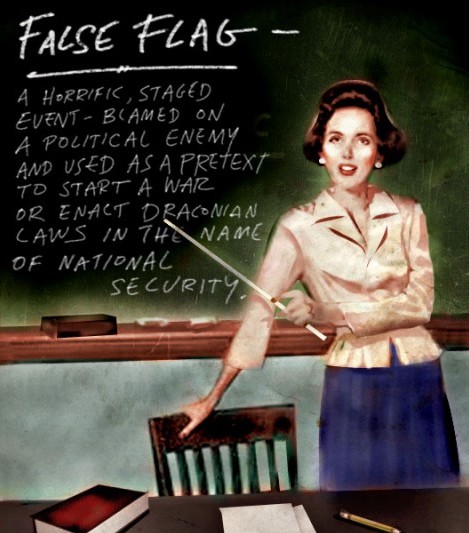
False Flag is a concept that goes back centuries. It was considered to be a legitimate ploy by the Greeks and Romans, where a military force would pretend to be friendly to get close to an enemy before dropping the pretense and raising its banners to reveal its own affiliation just before launching an attack. In the sea battles of the eighteenth century among Spain, France and Britain hoisting an enemy flag instead of one’s own to confuse the opponent was considered to be a legitimate ruse de guerre, but it was only “honorable” if one reverted to one’s own flag before engaging in combat.

Today’s false flag operations are generally carried out by intelligence agencies and non-government actors including terrorist groups, but they are only considered successful if the true attribution of an action remains secret. There is nothing honorable about them as their intention is to blame an innocent party for something that it did not do. There has been a lot of such activity lately and it was interesting to learn by way of a leak that the Central Intelligence Agency (CIA) has developed a capability to mimic the Internet fingerprints of other foreign intelligence services. That means that when the media is trumpeting news reports that the Russians or Chinese hacked into U.S. government websites or the sites of major corporations, it could actually have been the CIA carrying out the intrusion and making it look like it originated in Moscow or Beijing. Given that capability, there has been considerable speculation in the alternative media that it was actually the CIA that interfered in the 2016 national elections in the United States.

False flags can be involved in other sorts of activity as well. The past year’s two major alleged chemical attacks carried out against Syrian civilians that resulted in President Donald Trump and associates launching 160 cruise missiles are pretty clearly false flag operations carried out by the rebels and terrorist groups that controlled the affected areas at the time. The most recent reported attack on April 7 might not have occurred at all, according to doctors and other witnesses who were actually in Douma. Because the rebels succeeded in convincing much of the world that the Syrian government had carried out the attacks, one might consider their false flag efforts to have been extremely successful.

The remedy against false flag operations such as the recent one in Syria is, of course, to avoid taking the bait and instead waiting until a thorough and objective inspection of the evidence has taken place. The United States, Britain and France did not do that, preferring instead to respond to hysterical press reports by “doing something.” If the U.N. investigation of the alleged attack turns up nothing, a distinct possibility, it is unlikely that they will apologize for having committed a war crime.

The other major false flag that has recently surfaced is the poisoning of Sergei Skripal and his daughter Yulia in Salisbury, England, on March 4. Russia had no credible motive to carry out the attack and had, in fact, good reasons not to do so. The allegations made by British Prime Minister Theresa May about the claimed nerve agent being “very likely” Russian in origin have been debunked, in part through examination by the U.K.’s own chemical weapons lab. May, under attack even within her own party, needed a good story and a powerful enemy to solidify her own hold on power so false flagging something to Russia probably appeared to be just the ticket as Moscow would hardly be able to deny the “facts” being invented in London. Unfortunately, May proved wrong and the debate ignited over her actions, which included the expulsion of twenty-three Russian diplomats, has done her severe damage. Few now believe that Russia actually carried out the poisoning and there is a growing body of opinion suggesting that it was actually a false flag executed by the British government or even by the CIA.

The lesson that should be learned from Syria and Skripal is that if “an incident” looks like it has no obvious motive behind it, there is a high probability that it is a false flag. A bit of caution in assigning blame is appropriate given that the alternative would be a precipitate and likely disproportionate response that could easily escalate into a shooting war.