A Land Uncharted: the Persecution of Julian Assange

Drawing by Nathaniel St. Clair

By Kenn Orphan

Source: CounterPunch

“The freedom of the press is not safe. It’s over. And I think our republic is in its last days, because unauthorized disclosures of this kind are the lifeblood of a republic.”

– Daniel Ellsberg

The persecution and arrest of Julian Assange is the first and most definitive step toward full blown global fascism. The symbolism of a gravely ill journalist being manhandled by uniformed henchmen is the exact imagery it needed to send a chilling message to whistleblowers and the press. The assault and eventual dismantling of what remains of a free press has always been that first step, and it is what lies on the horizon barring mass dissent. For decades the mainstream media has acquiesced to the demands of the corporate world of high finance that now owns them outright and the military and surveillance state that informs their narrative. To be sure, many of them must be trembling at the events that unfolded in London.

That so many prominent American liberals are cheering this on is hardly surprising. History is replete with examples of how the privileged bourgeoisie are the first to capitulate to fascism. It happened in the 1930’s in Germany, Spain and Italy. It happened in the 1970’s in Argentina and Chile. It is happening now across the supposedly “democratic” western world. The animus they possess for Assange is not over his personal ethics, politics or affiliations, which are indeed open for criticism and debate. Like any human being, he is flawed. It is rooted in sore feelings over Wikileaks exposure of the machinations of the corrupt Democratic Party and their Wall Street favoured war hawk, Hillary Clinton. None of what Wikileaks revealed was untrue, but they blame the failure of their deeply flawed candidate on it nonetheless. They care little about the war crimes the platform helped expose through the courage of Chelsea Manning or the threat his persecution represents to press freedom itself.

That the fascist despot Trump has disavowed Wikileaks is hardly surprising either. After all, he may have used the leaks to his benefit, but the man who has relentlessly demonized the press will undoubtedly use this moment to his benefit again. Wikileaks as an organization isn’t perfect and, like any other media outlet, it is not beyond criticism. But nearly every major news outlet has used and published its material, without appreciation or gratitude, because it provided an unprecedented glimpse into the nefarious activities and guiding principles of the ruling elite. The veil had been finally lifted. But with the arrest of Julian Assange this makes all of those news outlets vulnerable to state or corporate repression and censure.

With the Trump administration chomping at the bit to launch a war against Iran and Venezuela, this must come as welcome news to them. After all, it was Wikileaks that exposed the war crimes of the Bush administration in Iraq, not the corporate media. So they can be assured little reporting, aside from a few courageous citizen journalists or those embedded with the troops who parrot Pentagon talking points, will be done to expose the Empire’s war crimes now.

Indeed, Trump has been given a green light with this one event to continue and expand the American Empire, moribund as it is, without reproach. And like a bloated corpse, it will undoubtedly infect and defile everything it touches. More brutal violations of the global south, more coups against democratically elected governments, and bolder acts of authoritarian cruelty at home. He has made no pretense of this. His minions, Pompeo and Bolton, are working tirelessly constructing the next war. And in the past several weeks he has purged his administration of monsters he deemed “too weak” when it comes to crackdowns against immigrants and asylum seekers. A classic tactic of all tyrants. He has anointed the rabid white supremacist, Stephen Miller, in this 21st century pogrom and has also toyed with the idea of making the military in charge of internment camps for migrants. Only a fool would not find such a thing chilling to the bone.

Indeed fascist leaders around the world, along with the military/surveillance establishment and their neoliberal enablers, are celebrating the silencing of Assange. After all, Wikileaks has represented a major thorn in their sides for a decade. From Netanyahu to Duterte to Bolsonaro to Modi and even Putin, all will be emboldened to expand their own attacks on press freedom. All of them will feel empowered to be even more unrestrained in their brutality.

We are on the eve of a sweeping, global, fascist tyranny. Thanks to the continued proliferation of nuclear arms, endless corporate and military assaults on the life sustaining biosphere, catastrophic climate change and the systematic dismantling of democracy, it is a land uncharted. Journalists, especially those who are independent of the corporate stranglehold, are being routinely and relentlessly persecuted and even murdered around the world. They are a bulwark against fascism we dare not lose. But the arrest of Assange is representative of a free press now under constant threat of annihilation. And it will without a doubt grow even more difficult for them to navigate through the mendacity of a ruthless ruling order that has become utterly unrestrained.

Kenn Orphan is an artist, sociologist, radical nature lover and weary, but committed activist. He can be reached at kennorphan.com.

Did the NY Times Violate Its Own Code of Ethics to Feature Child of Venezuelan Coup Plotter?

After the New York Times was slammed for obscuring comedian Joanna Hausmann’s family ties to the Guaido shadow regime, her coup-plotting father appeared online to defend her with a stream of insults.

By Anya Parampil

Source: The Grayzone

When the New York Times approached me seeking permission to use video I recorded of the Washington DC “Hands Off Venezuela” protest on March 16, I hoped that somebody at the paper was seeking to atone for the Gray Lady’s demonstrably one-sided coverage of the US coup attempt against the internationally recognized Maduro government. Maybe, just maybe, the editors had had a rare bout of self-reflection and decided to produce something that gave voice to the many Americans who rejected the Trump administration’s brazen regime change operation against Venezuela.

But on April 1, I woke up to learn that my footage had been used to demonize the protesters as useful idiots by a YouTube comedian born to one of the family dynasties of Venezuela’s opposition.

The comedian in question was Joanna Hausmann, and her appearance in the supposed newspaper of record was far from funny. How could the paper justify selecting Hausmann as an authoritative voice on the situation in Venezuela when she was so closely connected to central players in the Trump administration’s coup attempt? The answer is that it couldn’t, so it simply neglected to mention her glaring conflict of interest.

I took a deep dive into Hausmann’s family history in a March 10th article for MintPress, highlighting the role Joanna’s father, Ricardo Hausmann, played in the neoliberalization of Venezuela’s economy throughout the 1980s and ’90s as an academic and eventual member of the repressive Carlos Andrés Pérez administration.

The piece was inspired by Joanna Hausmann’s Youtube harangue, “What’s Happening in Venezuela.” Despite promising “a video dedicated to ‘just the facts,’” Hausmann failed to mention that her father was serving as a top advisor to Venezuelan opposition leader Juan Guaidó while she argued in support of his self-declared “presidency.”

Ricardo Hausmann’s function within the coup government crystalized shortly following the release of Joanna’s Youtube explainer, when Guaidó selected the Harvard professor to represent his shadow regime at the Inter-American Development Bank. The Times took no issue with the fact Hausmann’s family stood to benefit from the same coup she was urging viewers to support, and like Joanna herself, neglected to disclose this ostensibly relevant information.

The Times appeared to have underestimated the intelligence of its viewers, and was subsequently bombarded with criticism for its decision to obscure Hausmann’s background.

One reader who described himself as “a Venezuelan, [who agrees] with everything [Hausmann] has to say,” complained in the comments section of the Hausmann video that the omission amounted to “an ethical error,” arguing “it should be noted that her father has a lot to gain politically and professionally should regime change happen.” The comment forced a response from the segment’s executive producer, Adam Ellick, who claimed that, while the Times was “aware of her father’s biography before publication,” it opted not to acknowledge it because “Ms. Hausmann is an independent adult woman who has built a popular following on her own.”

Ellick’s response failed to satisfy the commenter, who emphasized that “the issue here isn’t one of independence, it’s one of shared outcomes.” According to Ellick’s logic, it would be journalistically ethical to ignore Ivanka Trump’s relation to the President on the basis she is “an independent adult woman” with a fashion line of her own. Does the Times actually think we are stupid?

The backlash against Joanna’s NYT debut grew so intense, it eventually compelled her father to respond to the controversy. Following the video’s release, I tweeted criticism of the paper for its failure to disclose that “Hausmann is the daughter of Guaidó advisor Ricardo Hausmann,” linking to my article which explained that he “was instrumental in neoliberalizing and destroying Venezuela’s economy in the 90s and wants to do it again.”

The factual statement apparently outraged Professor Hausmann, who charged that my “tweet surely deserves at least an honorary mention among the year’s most sexist comments,” adding, “since Joanna is my daughter, she is not entitled to her own opinion. She must be speaking on behalf of some male figure that tells her what to say. Seriously?”

Yes, seriously! Joanna does not appear to have her “own opinion” — she has precisely the same opinion as her father, who happens to be participating in the very coup for which she was advocating. Yet even if we accept the notion that Joanna formed opinions independent from her father’s influence, the Times still had an ethical obligation to disclose her family ties – especially considering that Professor Hausmann is not her only relative actively working to achieve regime change in Caracas.

Joanna’s mother, Ana Julia Jatar, has worked for the US-funded Súmate organization, which in 2004 tried and failed to oust President Hugo Chávez via popular referendum. As I reported for MintPress, Jatar hails from a political family herself.

Jatar’s father, Braulio Jatar Dotti, was once described by an independent Chilean news site “as having been ‘in charge of eliminating the leftist groups’ in Venezuela” in the 1960s, as the government sought to violently repress the armed Revolutionary Left Movement. Jatar Dotti even published a manual called, “Disabling the Extreme Left” in 1963. With her grandfather’s history in mind, it’s no wonder that Joanna now spends her time attacking the US left for organizing to oppose war on Venezuela. Apparently, the family that attacks the left and fails to overthrow governments together stays together.

While it is important to understand the full extent to which regime change and resentment of “the left” runs through Joanna Hausmann’s veins, her father’s participation in the current coup alone should have disqualified her to pose as a neutral voice on Venezuela. The Times’ decision to ignore her background is not only offensive to viewers, but may have also violated the paper’s own ethics code. According to that code, “staff members must be sensitive that perfectly proper political activity by their spouses, family or companions may nevertheless create conflicts of interest or the appearance of conflict.” The Hausmann scandal undeniably created such a scenario for the paper.

Joanna has largely kept quiet amid the deluge of criticism, and is quick to block those who question her. (She blocked me on Twitter after I noted her father’s prominent role in the Guaidó shadow regime.) Why a grown woman professing her total independence needed her father to come to her defense should be a mystery, as RT Español reporter Helena Villar observed.

One Twitter user named Vanessa Salas, who describes herself as “a personal friend” of Joanna, recommended that I “get to know” the comedian before making “unfounded statements.” Salas insistedthat her pal was “SMART, THOUGHTFUL, and FEARLESS.” Indeed, Joanna Hausmann was so fearless that she had to rely on her friends, family, and an army of trolls to deflect from her wanton journalistic malpractice.

Joanna did eventually muster up one non-answer to critics. When a Twitter user named @unnaband asked why she neglected to mention that her “father was personally appointed by the very opposition leader” she promoted in her video, the Youtube comedian hit back: “I am proud of my dad.”

He is surely proud of her too. And among the Times editors who presided over her ethically dubious video rant, there appears to be no shame.


Related Video:

Inventing the Future: The Collective Joy of Mark Fisher’s ‘k-punk’

By Michael Grasso

Source: We Are the Mutants

k-punk
By Mark Fisher
Foreword by Simon Reynolds, Edited by Darren Ambrose
Repeater Books, 2018

A little over two years ago, theorist and cultural critic Mark Fisher took his own life at the age of 48. I remember feeling numb at hearing the news; not out of sadness but more a sense of deja vu, of familiarity. I’d been through something similar already with David Foster Wallace’s suicide back in 2008; his Infinite Jest (1996) was one of the single most searing, searching moral indictments of the post-Cold War social and political order in the West, and a tremendously important work to me personally. Fisher toiled in very much the same fields in his writings. Both men had used their own struggles with depression (and in Wallace’s case, addiction) to fuel their insights into a world order that had run out of promise, of hope for the future. Wallace died two months before Barack Obama was elected, in the midst of the 2008 financial crisis; Fisher immediately after the election of Donald Trump. One American election offered (misplaced) hope, the other, a terminal kind of despair.

Over the past year or so I’ve also had the opportunity, while finishing my Master’s degree, to delve deeply into the work of cultural critic Walter Benjamin, who came to intellectual maturity in the Weimar Republic and found himself an exile with the rise of the Nazis in 1933. Like Wallace and Fisher, Benjamin used the cultural environment around him to help explain the world, to make sense of the turmoil that was roiling the once-orderly social order around him. Benjamin also killed himself, as he fled from the Nazi invasion of France in 1940 at the age of 48, just like Fisher. The parallels between all three men, to my mind, were uncanny. In the end, I feel the same thing got all three of these men: the encroaching feeling of dread at observing a world that had spun off its axis, beyond their ability to explain it.

I offer all this as a preface to my review of Mark Fisher’s collected online and unpublished writings, k-punk (Repeater Books, 2018), because I find myself thinking more often these days about the void of Fisher’s loss rather than the wealth of writings that he gave us while he was alive. And I feel like my despair essentially misunderstands what Mark Fisher was all about. The overwhelming feeling of most of the writings collected in k-punk is one of utter joy, whether it’s in celebrating a lost piece of media that Fisher wants us to know about, or his just and righteous delight in explaining exactly what late capitalism is doing to all of us.

A couple of years ago, my podcast partner Rob MacDougall and I had occasion to talk about the intellectual history of defining and preventing sexual harassment in the workplace for our podcast about WKRP in Cincinnati. And I’ll never forget the way he explained how clearly and uncompromisingly that defining a social problem can be the most important first step in combating it. He said, “Language is technology. Until you can name [something], you can’t get at it.” And I think that’s the legacy of Mark Fisher in a lot of ways. He gave us new terms—“pulp modernism,” “the precariat,” “hauntology,” “capitalist realism,” “acid communism”—that helped define not only our problems but our collective dreams for a better world. Like Benjamin before him, Fisher used his precise and profoundly moral observations of the world around him to give us a vocabulary to understand and express what is being done to us and how we can find our way out of it.

First things first: k-punk is a monster. Repeater Books has collected Fisher’s blog posts and unpublished writings in a massive 800-page tome. Given that the average length of one of these essays is about 3-4 pages, what you end up with is a bewilderingly encyclopedic collection of Fisher’s thoughts on seemingly everything. The conversion of once-hyperlink-laden web text to paper is sometimes jarring—the editor Darren Ambrose has done yeoman work in providing footnotes to mark where links to other bloggers and commenters once lay—but the reader almost never feels lost in figuring out what Fisher was trying to say. The foreword is by Fisher’s contemporary and friend, the music critic Simon Reynolds, whose seminal 2005 work on post-punk, Rip It Up and Start Again, is a favorite of mine. The same author’s 2011 Retromania: Pop Culture’s Addiction to Its Own Past was, like Fisher’s work, a major inspiration for my own Master’s capstone project on nostalgia and its use in museums. Reynolds’ foreword is not only a heartfelt and deeply touching tribute to Fisher’s life and work, it also illustrates well the cultural milieu in which both men worked in the early part of this century. Getting to know someone better by reading their blog everyday is a deeply familiar mode to me and many members of my generation, and here Reynolds nails the somewhat uncanny feeling of getting to be best friends with someone you’ve only hung out with a few times in person. Probably it will be less strange for the generations who come after us. I do admit stifling a chuckle as one of the first essays in this paperback collection is a “tag five friends” meme; seeing such an essentially “online” phenomenon in print, in an esteemed cultural critic’s essay collection no less, would probably be considered “weird” in the Fisherian “weird/eerie” schema: an intruder from Outside whose alien presence inflects its surroundings.

In his foreword, Reynolds dubs Fisher a member of a disappearing breed: “the music critic as prophet.” Both Reynolds and Fisher came of age in the golden era of British publications like the NME, which treated its readers with a modicum of sophistication and intellectual respect. British music critics in the 1980s were never afraid to throw in references to contemporary political philosophers and cultural critics from the world of academia, nor were they reluctant to blur the lines between artist and critic. Fisher himself offers tribute to one of these writer-artists in “Choose Your Weapons,” an essay focusing on NME writer and Art of Noise member/ZTT Records co-founder Paul Morley, as well as his fellow NME writer Ian Penman. Reynolds sees Fisher as the clear heir to this type of rock journalist; Fisher even had his own musical group in the early 1990s, D-Generation, which peppered press releases and music with references to cultural theory.

As mentioned above and in my earlier piece on him, Fisher was never afraid to unearth a piece of forgotten media from his childhood or adolescence for examination in the cold light of our present late capitalism. His mourning for the loss of risk-taking on the part of the gatekeepers at public broadcasters such as the BBC is well-known. (I highly recommend the essay “Precarity and Paternalism” in k-punk for Fisher’s breathtaking rhetorical link between the blandness of pop culture today and the burning down of the public sphere under neoliberalism.) But what k-punk puts forth clearly (and Reynolds makes clear in his foreword) is that Fisher was never solely a backwards-looking critic. In these essays you can see him fully engaged in the contemporary cultural scene in a way that can sometimes get lost in his reputation as “the hauntology guy.” I found Fisher’s recuperation of Donnie Darko director Richard Kelly’s odd little Twilight Zone riff from 2009, The Box, to be downright essential in explaining why I liked it so much but couldn’t articulate why at the time. Ironically, Fisher avers that it is a rare piece of American hauntology (an aesthetic I’ve been desperately trying to quantify here at We Are the Mutants), with Kelly exploring the legacy of his NASA employee dad during NASA’s own final years of glory as a public agency (the late ’70s era of the Viking and Voyager probes) before the ultimately doomed Shuttle program. As someone who only gave the k-punk blog a cursory look prior to Fisher’s death, being far more familiar with his published writings, reading Fisher on the Christopher Nolan Batman trilogy or on contemporary television series that I watched from the beginning, like Breaking Bad and The Americans, hit me in that same Fisherian-weird way.

Even though the essays in the k-punk collection are organized by content type—reviews of books, music, television/film, political writings, interviews—it’s easy to note Fisher’s evolution as a writer, with each content area organized chronologically within. Perhaps this is only my prejudice, but I notice in the early years of Fisher’s k-punk posts a distinct anxiety of influence with older writers and theoreticians, out of which he eventually matures. His early-’00s work centers writers and thinkers like J.G. Ballard, Franz Kafka, Dennis Potter, even Freud and Spinoza. Slavoj Žižek also looms very large, probably for no other reason than that he was (and still is) one of the only voices engaging intelligently with the political impact of the pop culture detritus of late capitalism. But it’s in this occasional early tension with Žižek that you start to see Fisher make his own conclusions, state his own thoughts. It’s not necessarily that Fisher ever makes an explicit break with Žižek; it’s just that you see him mentioned less and less and, finally, not at all.

It was in music that Fisher saw the greatest potential for social and cultural revolution. It’s become a thoroughly lazy trope among armchair cultural critics to keep quoting that bit from Plato’s Republic about how changing a society’s music will change the society, but Fisher actually convinces the reader of that idea, in a profoundly vital and contemporary context. For Fisher, mod, glam, and to a certain extent punk all offered the working classes a chance to grab the same aristocratic glamor and glory to which the bourgeoisie had always had access. (Reading Fisher on the unearthly magical “glamour” of pop stars gets me thinking about Kieron Gillen’s “gods come to earth as pop stars” comic The Wicked + the Divine; I’d be shocked if Gillen wasn’t a k-punk reader from way back.) I personally find Fisher far stronger on post-punk. His multi-part examination of The Fall and Mark E. Smith is downright essential; I thought often while reading how much I wish Fisher could have read Richard McKenna’s Sapphire And Steel-referencing encomium to Smith. A pure love of Green Gartside of Scritti Politti and his dance-floor theoretics, so beloved by that very same theory-soaked 1980s NME, shines through in several k-punk essays. Fisher’s multiple essays on the goth aesthetic (and adjunct aesthetic movements like steampunk) are insightful, even as he holds goth at a bit of a remove as compared to post-punk and dance music. His essays on the Cure, Nick Cave, and specifically Siouxsie Sioux’s visual aesthetic from early swastika-armband-wearing punk provocateur to glittering Klimt spectacle on A Kiss in the Dreamhouse are particularly good.

And it’s here in Fisher’s music writing that we see yet another evolution, this time in three phases roughly analogous to the Marxist-Fichtean dialectic. Fisher begins with an arguably essentialist, archetypal, borderline Paglian view of the aristocratic charisma inherent in pop music; moves to a canny and earnest recognition of the purely proletarian qualities of post-punk and dance music (and the paradoxically populist power of the “public information” aesthetic of hauntological music); and then shifts to an eventual synthesis of these very different conceptions of music-as-liberation.

That synthesis was to be the topic of his next book, Acid Communism, the preface for which is included at the end of k-punk: Fisher was going to look back at the origin point for neoliberalism in the 1970s and pinpoint exactly where the workers’ movement and the left had begun to lose the battle for power. Through a re-examination of the 1960s New Left under thinkers such as Herbert Marcuse, Fisher locates the real revolutionary promise and potential in the bewildering flowering of popular culture that occurred in the ’60s, as well as the profound societal change that this revolution in culture propelled. “Mass culture—and music culture in particular—was a terrain of struggle rather than a dominion of capital,” Fisher notes. The true conflict of workers’ leftism vs. neoliberalism, Fisher argued, happened nearly a decade before neoliberalism’s origin point, in the struggle between the liberal Cold War orthodoxies in the West and the profoundly psychedelic movement of the youth rebelling against these staid establishment cultural tendencies. In America, of course, this series of youth movements became inexorably intertwined with resistance to the Vietnam War, perhaps to its detriment. Fisher posits instead a youth movement that worked against the assumptions of Cold War-era society on a much more elemental level. He finds much more interesting the movements where the left chafed against the High Cold War hegemony of labor-leftism in the West and indeed the very idea of work, and sees glimmers of his “acid communism” in social milieus as disparate as Paris in 1968, the British miners’ strike (aided by students) in 1972, the GM strike in Lordstown Ohio in 1972, and Bologna in 1977. The essential question asked in all these times and places: what if the revolution happens and we are in thrall to just another set of labor bureaucrats? One might answer that this actually happened with the ascension of the Baby Boomers to places of authority in the supposedly kinder, gentler, more “diverse” digital capitalism we live with today.

Obviously, virtually every bit of cultural writing that Fisher published was viewed through the prism of a leftist politics, but in the Politics and Interviews sections of k-punk, we get those politics unfiltered through any particular piece of pop culture. Here is where you see Fisher at his most passionate, his most personal, his most vital. Most important, in my mind, is his relentless insistence that capitalism kills both body and soul. While a Marxist theory of alienation is certainly nothing new, Fisher’s own personal experiences with being a member of the “precariat,” dealing with the peculiar doublethink of the purported “freedom” of the gig economy, demonstrates how the market hands us all slavery in the guise of self-actualization. And here is where Fisher’s writing intersects with his profound personal interest in public health, specifically mental health. Digital technology allows the gig worker to be relentlessly surveilled and ruthlessly “reviewed”; the disappearance of the old forms of authority and hierarchy in the workplace are distributed among one’s fellow consumers to create a web of virtual bureaucracy that creates constant cognitive dissonance and the distinct feeling that one is truly never off the job. From the ancient dream of never working to the modern reality of constantly working: Fisher thus asks us over and over if it’s any wonder we are all anxious and depressed?

It’s glaringly obvious stuff to most of us living in 2019, but again: Fisher’s moral clarity shines through and illuminates the darker corners of a world to which we’ve all slowly acquiesced. And yes, Mark Fisher did suffer from severe depression himself. One of the editorial decisions that I disagree with most is the stated decision to not include Fisher’s more “pessimistic” work from earlier in his career. Here is k-punk‘s editor Ambrose on this decision:

A very small number of early k-punk posts, e.g. on antinatalism, are excluded by virtue of the fact that they seemed wildly out of step with Mark’s overall theoretical and political development, and because they seemed to reflect a temporary enthusiasm for a dogmatic theoretical misanthropy he repudiated in his later writing and life.

You still see glimpses of this pessimism and near-nihilism in a few of the essays; a startlingly good review of Mel Gibson’s The Passion of the Christ where Fisher sees its neo-Gnostic underpinnings, or a deep intrigue with the antinatalist works of horror writer and philosopher Thomas Ligotti (who would find unexpected mass popularity with Nic Pizzolatto’s use of Ligotti in the first season of True Detective). But speaking as someone who suffers with mental illness and profound depression, let me make clear: it is absolutely reasonable to expect someone even as optimistic and positive as Fisher to occasionally look at the world with abject despair. Moreover, I believe it is more than merely reasonable, it’s necessary. To dispute or deny that anyone with a modicum of political awareness would not be occasionally nihilistically fucking depressed with the world as it is today seems a massive mistake to me.

Immediately before presenting the unfinished introduction to Acid Communism, we’re presented with two of Fisher’s most famous essays: his polemic against the contemporary left’s tendency towards ideological puritanism, “Exiting the Vampire Castle,” and his personal memoir of living (and working) with depression, “Good For Nothing.” No two pieces in this book depict the central contradictions and tensions of Fisher’s ethics and philosophy more clearly. “Vampire Castle” is, in my personal opinion, one of Fisher’s greatest missteps and the one piece of his writing where I most see a distressing tendency towards a lack of empathy for his comrades. In the essay, Fisher excoriates a certain faction of the left and its tendency to center “identity politics.” He further posits that these identity-based politics are a way in which the mechanisms of late capitalist control attempt to neuter and split the political left, a profoundly “individualistic” movement rather than one that builds cross-cultural solidarity. Fisher states that humorless scolds participating in “call-out culture” are preventing the left from building true power. Every time I go back to this essay, I initially find myself seeing some some modicum of logic in Fisher’s arguments. But then I remember how much of the modern capitalism that Fisher despised is literally built on the backs of genocide, racism, slavery, colonialism. I remember all of capitalism’s own constant essentializing and dividing of the proletariat, purely on the basis of identity, a superstructure that has systematically disenfranchised entire peoples on this globe, and ultimately I react with, “This is the kind of take that only a white guy from Britain could make.” It’s tone-deaf, destructive, and has given fuel to the worst strains of white exceptionalism and disdain for so-called “idpol” on the left in the past few years. I would argue that nothing good and quite a bit that is bad has come from it.

In fact, I wish someone would’ve told Mark how harmful this piece was. I have a feeling all it would have taken is one person—a woman, a person of color, an indigenous person, someone queer—to explain to him that while there should obviously be solidarity on the left, there are profound issues of historical materialism here that stretch back centuries, unfinished work that needs a profound upheaval and seizure of power from below (and yes, to some degree the anger and fury and the positive social knock-on effects of a “call-out culture”) to even begin to deal with restoratively. I want to believe he’d understand. It can be true that the capitalist powers-that-be love watching the left devour their own over issues that might seem personalized and “individual” to a white British man, but it can also be true that the profound historical injustices inflicted on colonized peoples the world over need to be centered in any revolutionary left solidarity. Both can be true.

And then you have “Good For Nothing,” an essay that I can say confidently has saved my life, maybe several times, since I first read it a few years ago. It is overflowing with empathy: for those of us hedged in by our class identities and made to feel inferior, uneducated, unworthy, a cog in a machine that only views us for how useful we can be to an employer or to the economy. It is a crisp distillation of every piece of personal writing Fisher ever wrote about the dehumanizing and alienating collective psychological effects of neoliberalism. Most importantly, it is a clarion call for solidarity:

For some time now, one of the most successful tactics of the ruling class has been responsibilisation. Each individual member of the subordinate class is encouraged into feeling that their poverty, lack of opportunities, or unemployment, is their fault and their fault alone. Individuals will blame themselves rather than social structures, which in any case they have been induced into believing do not really exist (they are just excuses, called upon by the weak)…

Collective depression is the result of the ruling class project of resubordination. For some time now, we have increasingly accepted the idea that we are not the kind of people who can act. This isn’t a failure of will any more than an individual depressed person can “snap themselves out of it” by “pulling their socks up.” The rebuilding of class consciousness is a formidable task indeed, one that cannot be achieved by calling upon ready-made solutions—but, in spite of what our collective depression tells us, it can be done. Inventing new forms of political involvement, reviving institutions that have become decadent, converting privatised disaffection into politicised anger: all of this can happen, and when it does, who knows what is possible?

This call for collective action on a political, economic, psychological, and even spiritual level is the voice of Mark Fisher’s that I remember and hold close to my heart every day. In every one of us there is a person worthy of respect and dignity, regardless of how “useful” we might be to a boss or a manager; in all of us a person who deserves not to live a life of misery, a person worthy of joy and music and glamour. That’s the Mark Fisher who throbs under the surfaces of nearly every one of these 800 pages. k-punk is a fitting tribute to a thinker who showed us the wonder in our past and the promise in our future, if we but remembered each other and not merely ourselves.


Michael Grasso is a Senior Editor at We Are the Mutants. He is a Bostonian, a museum professional, and a podcaster. You can read his thoughts on museums and more on Twitter at @MuseumMichael.

The New Zealand Psyop

By Kurt Nimmo

Source: Another Day in the Empire\

Following the murder of fifty Muslims at a mosque in Christchurch New Zealand, the corporate media went into overdrive, describing the alleged shooter as a white supremacist Trump supporter.

This is clearly not the case. If we read a “manifesto” attributed to the accused shooter, Brenton Tarrant, we discover he followed the writing of Candace Owens, a “conservative” black woman, and predicts he will be set free like Nelson Mandela. 

Tarrant—if he is indeed the author of this professed manifesto—also criticized the leadership of President Trump and described himself as an “eco-fascist,” a socialist, a libertarian, an anarchist, and at the same time a follower of the Norwegian psychopath Anders Breivik, a self-described white nationalist. 

Despite these glaring incongruities, the agenda-driven corporate media has uniformly characterized the suspect as a white supremacist supporter of Donald Trump while either downplaying or ignoring the ideological contradictions and outright absurdity of Tarrant’s so-called manifesto. 

I believe this event is yet another psychological operation designed to 1) push anti-gun legislation (New Zealand wasted little time after the attack to call for confiscating the firearms of largely law-abiding individuals), 2) stoke and fan the flames of political division and portray “conservatives” as racist, misogynist, and fascist, and 3) conflate Trump (“Hitler”), the “Alt-Right,” and “conservatives” with “white nationalists” who are portrayed by an ideologically-driven media as the dangerous fellow travelers of psychotic murderers. 

The Southern Poverty Law Center set the tone while ignoring the massive contradictions that riddle the document, titled “The Great Replacement,” a title borrowed from the French writer Renaud Camus (“Le grand remplacement”). The book argues the French people and western civilization in Europe are being replaced by immigrants from the Middle East and North Africa. According to the left-leaning controlled information site Wikipedia, Camus is a conspiracy theorist.

“The type of racist rhetoric found in the manifesto is promoted heavily by Americans with large platforms like Rep. Steve King of Iowa and Tucker Carlson of Fox News,” writes Michael Edison Hayden on the SPLC “Hatewatch” web page. 

It should come as no surprise the SPLC would use the attack and a screed supposedly connected to Tarrant as ammunition to unfairly characterize Carlson and King as white supremacists and therefore legitimize (in the minds of progressives) the attacks on them, in particular the Antifa attack on Carlson’s family. 

I believe the shooting and others in the recent past are part of a psychological campaign first to identify and demonize critics of the establishment and then exclude them from political participation and possibly impose more draconian measures. 

In addition, this will give the state an excuse to place further restrictions on free speech and access to social media. Facebook, Twitter, YouTube, Instagram, etc., have initiated (at the behest of the state) a purge of their platforms based on a “progressive” political litmus test. 

Democrat Beto O’Rourke, a former member of the hacker group Cult of the Dead Cow, and who recently declared his intention to run for president, admitted there is no practical way to confiscate firearms owned by Americans, that number now totaling around 500,000,000 individual rifles and handguns. Instead, O’Rourke wants to circumvent the Bill of Rights and outlaw the sale of firearms, thus going the route New Zealand is now following. 

“In politics, nothing happens by accident. If it happens, you can bet it was planned that way,” quipped the master socialist politician, Franklin D. Roosevelt. 

I believe many of these mass shootings, especially those committed by supposed white supremacists and nationalists (many are controlled assets; e.g. Hal Turner), are part of a psychological operation designed to destabilize both America and Europe on a number of fronts. 

From borders and mass migration to economic austerity and the slow-motion erosion of the middle class and the export of industry and wealth by international banks and transnational corporations, we are witnessing a massive plan to usher in a unified global economy with its requirement for totalitarian governance.

For global elites working behind the scenes the ultimate goal is total, unquestioned control,  consolidation of wealth, and the impoverishment of humanity resulting ultimately in a serious reduction in world population. 

Before this can occur, however, the political and intellectual playing field must be cleansed of all dissent. The only dissent tolerated will be that of token groups and individuals keeping alive the illusion that we live in a democracy.

Survival of the Richest

All Are Equal, Except Those Who Aren’t

By Nomi Prins

Source: TomDispatch.com

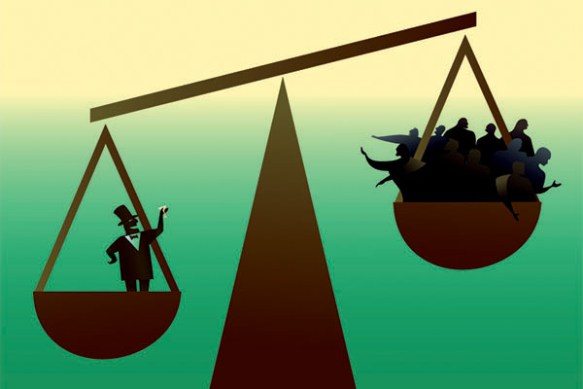
Like a gilded coating that makes the dullest things glitter, today’s thin veneer of political populism covers a grotesque underbelly of growing inequality that’s hiding in plain sight. And this phenomenon of ever more concentrated wealth and power has both Newtonian and Darwinian components to it.

In terms of Newton’s first law of motion: those in power will remain in power unless acted upon by an external force. Those who are wealthy will only gain in wealth as long as nothing deflects them from their present course. As for Darwin, in the world of financial evolution, those with wealth or power will do what’s in their best interest to protect that wealth, even if it’s in no one else’s interest at all.

In George Orwell’s iconic 1945 novel, Animal Farm, the pigs who gain control in a rebellion against a human farmer eventually impose a dictatorship on the other animals on the basis of a single commandment: “All animals are equal, but some animals are more equal than others.” In terms of the American republic, the modern equivalent would be: “All citizens are equal, but the wealthy are so much more equal than anyone else (and plan to remain that way).”

Certainly, inequality is the economic great wall between those with power and those without it.

As the animals of Orwell’s farm grew ever less equal, so in the present moment in a country that still claims equal opportunity for its citizens, one in which three Americans now have as much wealth as the bottom half of society (160 million people), you could certainly say that we live in an increasingly Orwellian society. Or perhaps an increasingly Twainian one.

After all, Mark Twain and Charles Dudley Warner wrote a classic 1873 novel that put an unforgettable label on their moment and could do the same for ours. The Gilded Age: A Tale of Today depicted the greed and political corruption of post-Civil War America. Its title caught the spirit of what proved to be a long moment when the uber-rich came to dominate Washington and the rest of America. It was a period saturated with robber barons, professional grifters, and incomprehensibly wealthy banking magnates. (Anything sound familiar?) The main difference between that last century’s gilded moment and this one was that those robber barons built tangible things like railroads. Today’s equivalent crew of the mega-wealthy build remarkably intangible things like tech and electronic platforms, while a grifter of a president opts for the only new infrastructure in sight, a great wall to nowhere.

In Twain’s epoch, the U.S. was emerging from the Civil War. Opportunists were rising from the ashes of the nation’s battered soul. Land speculation, government lobbying, and shady deals soon converged to create an unequal society of the first order (at least until now). Soon after their novel came out, a series of recessions ravaged the country, followed by a 1907 financial panic in New York City caused by a speculator-led copper-market scam.

From the late 1890s on, the most powerful banker on the planet, J.P. Morgan, was called upon multiple times to bail out a country on the economic edge. In 1907, Treasury Secretary George Cortelyou provided him with $25 million in bailout money at the request of President Theodore Roosevelt to stabilize Wall Street and calm frantic citizens trying to withdraw their deposits from banks around the country. And this Morgan did — by helping his friends and their companies, while skimming money off the top himself. As for the most troubled banks holding the savings of ordinary people? Well, they folded. (Shades of the 2007-2008 meltdown and bailout anyone?)

The leading bankers who had received that bounty from the government went on to cause the Crash of 1929. Not surprisingly, much speculation and fraud preceded it. In those years, the novelist F. Scott Fitzgerald caught the era’s spirit of grotesque inequality in The Great Gatsby when one of his characters comments: “Let me tell you about the very rich. They are different from you and me.” The same could certainly be said of today when it comes to the gaping maw between the have-nots and have-a-lots.

Income vs. Wealth

To fully grasp the nature of inequality in our twenty-first-century gilded age, it’s important to understand the difference between wealth and income and what kinds of inequality stem from each. Simply put, income is how much money you make in terms of paid work or any return on investments or assets (or other things you own that have the potential to change in value). Wealth is simply the gross accumulation of those very assets and any return or appreciation on them. The more wealth you have, the easier it is to have a higher annual income.

Let’s break that down. If you earn $31,000 a year, the median salary for an individual in the United States today, your income would be that amount minus associated taxes (including federal, state, social security, and Medicare ones). On average, that means you would be left with about $26,000 before other expenses kicked in.

If your wealth is $1,000,000, however, and you put that into a savings account paying 2.25% interest, you could receive about $22,500 and, after taxes, be left with about $19,000, for doing nothing whatsoever.

To put all this in perspective, the top 1% of Americans now take home, on average, more than 40 times the incomes of the bottom 90%. And if you head for the top 0.1%, those figures only radically worsen. That tiny crew takes home more than 198 times the income of the bottom 90% percent. They also possess as much wealth as the nation’s bottom 90%. “Wealth,” as Adam Smith so classically noted almost two-and-a-half-centuries ago in The Wealth of Nations, “is power,” an adage that seldom, sadly, seems outdated.

A Case Study: Wealth, Inequality, and the Federal Reserve

Obviously, if you inherit wealth in this country, you’re instantly ahead of the game. In America, a third to nearly a half of all wealth is inherited rather than self-made. According to a New York Times investigation, for instance, President Donald Trump, from birth, received an estimated $413 million (in today’s dollars, that is) from his dear old dad and another $140 million (in today’s dollars) in loans. Not a bad way for a “businessman” to begin building the empire (of bankruptcies) that became the platform for a presidential campaign that oozed into actually running the country. Trump did it, in other words, the old-fashioned way — through inheritance.

In his megalomaniacal zeal to declare a national emergency at the southern border, that gilded millionaire-turned-billionaire-turned-president provides but one of many examples of a long record of abusing power. Unfortunately, in this country, few people consider record inequality (which is still growing) as another kind of abuse of power, another kind of great wall, in this case keeping not Central Americans but most U.S. citizens out.

The Federal Reserve, the country’s central bank that dictates the cost of money and that sustained Wall Street in the wake of the financial crisis of 2007-2008 (and since), has finally pointed out that such extreme levels of inequality are bad news for the rest of the country. As Fed Chairman Jerome Powell said at a town hall in Washington in early February, “We want prosperity to be widely shared. We need policies to make that happen.” Sadly, the Fed has largely contributed to increasing the systemic inequality now engrained in the financial and, by extension, political system. In a recent research paper, the Fed did, at least, underscore the consequences of inequality to the economy, showing that “income inequality can generate low aggregate demand, deflation pressure, excessive credit growth, and financial instability.”

In the wake of the global economic meltdown, however, the Fed took it upon itself to reduce the cost of money for big banks by chopping interest rates to zero (before eventually raising them to 2.5%) and buying $4.5 trillion in Treasury and mortgage bonds to lower it further. All this so that banks could ostensibly lend money more easily to Main Street and stimulate the economy. As Senator Bernie Sanders noted though, “The Federal Reserve provided more than $16 trillion in total financial assistance to some of the largest financial institutions and corporations in the United States and throughout the world… a clear case of socialism for the rich and rugged, you’re-on-your-own individualism for everyone else.”

The economy has been treading water ever since (especially compared to the stock market). Annual gross domestic product growth has not surpassed 3%in any year since the financial crisis, even as the level of the stock market tripled, grotesquely increasing the country’s inequality gap. None of this should have been surprising, since much of the excess money went straight to big banks, rich investors, and speculators.  They then used it to invest in the stock and bond markets, but not in things that would matter to all the Americans outside that great wall of wealth.

The question is: Why are inequality and a flawed economic system mutually reinforcing? As a starting point, those able to invest in a stock market buoyed by the Fed’s policies only increased their wealth exponentially. In contrast, those relying on the economy to sustain them via wages and other income got shafted. Most people aren’t, of course, invested in the stock market, or really in anything. They can’t afford to be. It’s important to remember that nearly 80% of the population lives paycheck to paycheck.

The net result: an acute post-financial-crisis increase in wealth inequality — on top of the income inequality that was global but especially true in the United States. The crew in the top 1% that doesn’t rely on salaries to increase their wealth prospered fabulously. They, after all, now own more than half of all national wealth invested in stocks and mutual funds, so a soaring stock market disproportionately helps them. It’s also why the Federal Reserve subsidy policies to Wall Street banks have only added to the extreme wealth of those extreme few.

The Ramifications of Inequality

The list of negatives resulting from such inequality is long indeed. As a start, the only thing the majority of Americans possess a greater proportion of than that top 1% is a mountain of debt.

The bottom 90% are the lucky owners of about three-quarters of the country’s household debt. Mortgages, auto loans, student loans, and credit-card debt are cumulatively at a record-high $13.5 trillion.

And that’s just to start down a slippery slope. As Inequality.org reports, wealth and income inequality impact “everything from life expectancy to infant mortality and obesity.” High economic inequality and poor health, for instance, go hand and hand, or put another way, inequality compromises the overall health of the country. According to academic findings, income inequality is, in the most literal sense, making Americans sick. As one study put it, “Diseased and impoverished economic infrastructures [help] lead to diseased or impoverished or unbalanced bodies or minds.”

Then there’s Social Security, established in 1935 as a federal supplement for those in need who have also paid into the system through a tax on their wages. Today, all workers contribute 6.2% of their annual earnings and employers pay the other 6.2% (up to a cap of $132,900) into the Social Security system. Those making far more than that, specifically millionaires and billionaires, don’t have to pay a dime more on a proportional basis. In practice, that means about 94% of American workers and their employers paid the full 12.4% of their annual earnings toward Social Security, while the other 6% paid an often significantly smaller fraction of their earnings.

According to his own claims about his 2016 income, for instance, President Trump “contributed a mere 0.002 percent of his income to Social Security in 2016.” That means it would take nearly 22,000 additional workers earning the median U.S. salary to make up for what he doesn’t have to pay. And the greater the income inequality in this country, the more money those who make less have to put into the Social Security system on a proportional basis. In recent years, a staggering $1.4 trillion could have gone into that system, if there were no arbitrary payroll cap favoring the wealthy.

Inequality: A Dilemma With Global Implications

America is great at minting millionaires. It has the highest concentration of them, globally speaking, at 41%. (Another 24% of that millionaires’ club can be found in Europe.) And the top 1% of U.S. citizens earn 40 times the national average and own about 38.6% of the country’s total wealth. The highest figure in any other developed country is “only” 28%.

However, while the U.S. boasts of epic levels of inequality, it’s also a global trend. Consider this: the world’s richest 1% own 45% of total wealth on this planet. In contrast, 64% of the population (with an average of $10,000 in wealth to their name) holds less than 2%. And to widen the inequality picture a bit more, the world’s richest 10%, those having at least $100,000 in assets, own 84% of total global wealth.

The billionaires’ club is where it’s really at, though. According to Oxfam, the richest 42 billionaires have a combined wealth equal to that of the poorest 50% of humanity. Rest assured, however, that in this gilded century there’s inequality even among billionaires. After all, the 10 richest among them possess $745 billion in total global wealth. The next 10 down the list possess a mere $451.5 billion, and why even bother tallying the next 10 when you get the picture?

Oxfam also recently reported that “the number of billionaires has almost doubled, with a new billionaire created every two days between 2017 and 2018. They have now more wealth than ever before while almost half of humanity have barely escaped extreme poverty, living on less than $5.50 a day.”

How Does It End?

In sum, the rich are only getting richer and it’s happening at a historic rate. Worse yet, over the past decade, there was an extra perk for the truly wealthy. They could bulk up on assets that had been devalued due to the financial crisis, while so many of their peers on the other side of that great wall of wealth were economically decimated by the 2007-2008 meltdown and have yet to fully recover.

What we’ve seen ever since is how money just keeps flowing upward through banks and massive speculation, while the economic lives of those not at the top of the financial food chain have largely remained stagnant or worse. The result is, of course, sweeping inequality of a kind that, in much of the last century, might have seemed inconceivable.

Eventually, we will all have to face the black cloud this throws over the entire economy. Real people in the real world, those not at the top, have experienced a decade of ever greater instability, while the inequality gap of this beyond-gilded age is sure to shape a truly messy world ahead. In other words, this can’t end well.


Nomi Prins, a former Wall Street executive, is a TomDispatch regular. Her latest book is Collusion: How Central Bankers Rigged the World (Nation Books). She is also the author of All the Presidents’ Bankers: The Hidden Alliances That Drive American Power and five other books. Special thanks go to researcher Craig Wilson for his superb work on this piece.

Government to Facebook Pipeline Reveals a Corrupt Mix of Social Media and the State

The next time someone tells you that “Facebook is a private company” ask them if they know about the dozens of government employees who fill its ranks.

By Matt Agorist

Source: The Free Thought Project

As the Free Thought Project has previously reported, the phrase “Facebook is a private company” is not accurate as they have formed a partnership with an insidious neoconservative “think tank” known as the Atlantic Council which is directly funded and made up of groups tied to the pharmaceutical industry, the military industrial complex, and even government itself. The Atlantic Council dictates to Facebook who is allowed on the platform and who is purged.

Because the Atlantic Council is funded in part by the United States government—and they are making decisions for Facebook—this negates the claim that the company is private. Since our six million followers and years of hard work were wiped off the platform during the October purge, TFTP has consistently reported on the Atlantic Council and their ties to the social media giant. This week, however, we’ve discovered something just as ominous—the government to Facebook pipeline and revolving door.

It is a telltale sign of a corrupt industry or company when they create a revolving door between themselves and the state. Just like Monsanto has former employees on the Supreme Court and Pharmaceutical industry insiders move back and fourth from the FDA to their companies, we found that Facebook is doing the same thing.

Below are just a few of corrupt connections we’ve discovered while digging through the list of current and former employees within Facebook.

Facebook’s Head of Cybersecurity Policy—aka, the man who doles out the ban hammer to anyone he wishes—is Nathaniel Gleicher. Before Gleicher was censoring people at Facebook, he prosecuted cybercrime at the U.S. Department of Justice, and served as Director for Cybersecurity Policy at the National Security Council (NSC) in the Obama White House.

While Facebook may have an interest in seeking out Gleicher’s expertise, this man is an outspoken advocate of tyranny.

After deleting the pages of hundreds of antiwar and pro-peace media and activist outlets in October, last month, Facebook made another giant move to silence. This time, they had no problem noting that they went after pages whose specific missions were “anti-corruption” or “protest” movements. And it was all headed up by Gleicher.

“Some of the Pages frequently posted about topics like anti-NATO sentiment, protest movements, and anti-corruption,” Gleicher wrote in a blog post. “We are constantly working to detect and stop this type of activity because we don’t want our services to be used to manipulate people.”

Seems totally legit, right?

The list goes on.

In 2017, as the Russian/Trump propaganda ramped up, Facebook hired Joel Benenson, a former top adviser to President Barack Obama and the chief strategist for Hillary Clinton’s failed 2016 presidential campaign, as a consultant.

While filling team Zuck with Obama and Clinton advisers, Facebook hired Aneesh Raman, a former Obama speechwriter who now heads up Facebook’s “economic impact programming.”

Highlighting the revolving door aspect of Facebook and the US government is Sarah Feinberg who left the Obama train in 2011 to join Facebook as the director of corporate and strategic communications. She then moved on after and went back to Obama in 2015 to act as the administrator of the Federal Railroad Administration (FRA).

David Recordon also highlights the revolving door between Facebook and the government. Recordon was the former Director of IT for Obama’s White House. He was also Engineering Director at Facebook prior to his role at the White House, and returned to the position after the 2016 election. He is currently Engineering Director for the Chan-Zuckerberg initiative.

Starting to see a pattern of political influence here? You should. But just in case you don’t, the list goes on.

Meredith Carden—who, you guessed, came from the Obama administration — joined the Facebook clan last year to be a part of Facebook’s “News Integrity Team.” Now, she’s battling fake news on the platform and as we’ve shown, there is a ridiculous amount of selective enforcement of these so-called “standards.”

In fact, there are dozens of former Obama staffers, advisers, and campaign associates who quite literally fill Facebook’s ranks. It is no wonder the platform has taken such a political shift over the past few years. David Ploufe, Josh W. Higgins, Lauryn Ogbechie, Danielle Cwirko-GodyckiSarah Pollack, Ben Forer, Bonnie Calvin, and Juliane Sun, are just some of the many Facebook execs hailing out of the Obama era White House.

But fret not right wingers, Facebook likes their neocons too.

Jamie Fly, who was a top adviser to neocon Florida Senator Marco Rubio and who started his career in US political circles as an adviser to the George W. Bush administration, actually took credit for the massive purge of peaceful antiwar pages that took place last October.

“They can invent stories that get repeated and spread through different sites. So we are just starting to push back. Just this last week Facebook began starting to take down sites. So this is just the beginning,” Fly said in December.

Fly backs up his words with the fact that he works with Facebook’s arm of the Atlantic Council to ensure those dangerous antiwar folks don’t keep pushing their propaganda of peace and community.

And yes, this list goes on.

Joel David Kaplan is Facebook’s vice president of global public policy. Prior to his major role within Facebook, Kaplan took the place of neocon extraordinaire Karl Rove as the White House Deputy Chief of Staff for George W. Bush. Before that, from 2001 to 2003 he was Special Assistant to the President for Policy within the White House Chief of Staff’s office. Then he served as Deputy Director of the Office of Management And Budget (OMB).

Myriah Jordan was a special policy assistant in the Bush White House, who was hired on as a policy manager for Facebook’s congressional relations team—aka, a lobbyist. Jordan has moved back and forth between the private sector and the US government multiple times over his career as he’s made millions greasing the skids of the state for his corrupt employers.

So there you have it. Facebook, who claims to be a private entity, is quite literally made up of and advised by dozens of members of government. We’re ready for a change, are you?

The Age of Tyrannical Surveillance: We’re Being Branded, Bought and Sold for Our Data

By John W. Whitehead

Source: The Rutherford Institute

“We know where you are. We know where you’ve been. We can more or less know what you’re thinking about… Your digital identity will live forever… because there’s no delete button.”—Former Google CEO Eric Schmidt

Uncle Sam wants you.

Correction: Big Brother wants you.

To be technically accurate, Big Brother—aided and abetted by his corporate partners in crime—wants your data.

That’s what we have been reduced to in the eyes of the government and Corporate America: data bits and economic units to be bought, bartered and sold to the highest bidder.

Those highest bidders include America’s political class and the politicians aspiring to get elected or re-elected. As the Los Angeles Times reports, “If you have been to a political rally, a town hall, or just fit a demographic a campaign is after, chances are good your movements are being tracked with unnerving accuracy by data vendors on the payroll of campaigns.”

Your phones, televisions and digital devices are selling you out to politicians who want your vote.

Have you shopped at Whole Foods? Tested out target practice at a gun range? Sipped coffee at Starbucks while surfing the web? Visited an abortion clinic? Watched FOX News or MSNBC? Played Candy Crush on your phone? Walked through a mall? Walked past a government building?

That’s all it takes for your data to be hoovered up, sold and used to target you.

This is the age of surveillance capitalism.

Incredibly, once you’ve been identified and tracked, data brokers can travel back in time, digitally speaking, to discover where you’ve been, who you’ve been with, what you’ve been doing, and what you’ve been reading, viewing, buying, etc.

Once you’ve been identified in this way, you can be tracked endlessly.

“Welcome to the new frontier of campaign tech — a loosely regulated world in which simply downloading a weather app or game, connecting to Wi-Fi at a coffee shop or powering up a home router can allow a data broker to monitor your movements with ease, then compile the location information and sell it to a political candidate who can use it to surround you with messages,” writes journalist Evan Halper.

No one is spared.

In this regard, we are all equals: equally suffering the indignity of having every shred of privacy stripped away and the most intimate details of one’s life turned into fodder for marketers and data profiteers.

This creepy new era of government/corporate spying—in which we’re being listened to, watched, tracked, followed, mapped, bought, sold and targeted—makes the NSA’s surveillance appear almost antiquated in comparison.

What’s worse, this for-profit surveillance capitalism scheme is made possible with our cooperation.

All those disclaimers you scroll though without reading them, the ones written in minute font, only to quickly click on the “Agree” button at the end so you can get to the next step—downloading software, opening up a social media account, adding a new app to your phone or computer—those signify your written consent to having your activities monitored, recorded and shared.

Think about it.

Every move you make is being monitored, mined for data, crunched, and tabulated in order to form a picture of who you are, what makes you tick, and how best to influence and/or control you.

On any given day, the average American going about his daily business will be monitored, surveilled, spied on and tracked in more than 20 different ways by both government and corporate eyes and ears. A byproduct of this new age in which we live, whether you’re walking through a store, driving your car, checking email, or talking to friends and family on the phone, you can be sure that some government agency is listening in and tracking your behavior.

With every smartphone we buy, every GPS device we install, every Twitter, Facebook, and Google account we open, every frequent buyer card we use for purchases—whether at the grocer’s, the yogurt shop, the airlines or the department store—and every credit and debit card we use to pay for our transactions, we’re helping Corporate America build a dossier for its government counterparts on who we know, what we think, how we spend our money, and how we spend our time.

The technology has advanced so far that marketers (political campaigns are among the worst offenders) can actually build “digital fences” around your homes, workplaces, friends and family’s homes and other places you visit in order to bombard you with specially crafted messages aimed at achieving a particular outcome.

If anyone else stalked us in this way—tailing us wherever we go, tapping into our calls, reading our correspondence, ferreting out our secrets, profiling and targeting us based on our interests and activities—we’d call the cops.

Unfortunately, the cops (equipped with Stingray devices and other Peeping Tom technologies) are also in on this particular scam.

It’s not just the surveillance and the buying and selling of your data that is worrisome.

The ramifications of a government—any government—having this much unregulated, unaccountable power to target, track, round up and detain its citizens is beyond chilling.

Imagine what a totalitarian regime such as Nazi Germany could have done with this kind of unadulterated power.

Imagine what the next police state to follow in Germany’s footsteps will do with this kind of power. Society is definitely rapidly moving in that direction.

We’ve made it so easy for the government to watch us.

Government eyes see your every move: what you read, how much you spend, where you go, with whom you interact, when you wake up in the morning, what you’re watching on television and reading on the internet.

Every move you make is being monitored, mined for data, crunched, and tabulated in order to form a picture of who you are, what makes you tick, and how best to control you when and if it becomes necessary to bring you in line.

If you’re an activist and you simply like or share this article on Facebook or retweet it on Twitter, you’re most likely flagging yourself as a potential renegade, revolutionary or anti-government extremist—a.k.a. terrorist.

Yet whether or not you like or share this particular article, simply by reading it or any other articles related to government wrongdoing, surveillance, police misconduct or civil liberties is enough to get you categorized as a particular kind of person with particular kinds of interests that reflect a particular kind of mindset that might just lead you to engage in a particular kinds of activities. The corporate state must watch and keep tabs on you if it is to keep you in line.

Chances are, as the Washington Post has reported, you have already been assigned a color-coded threat assessment score—green, yellow or red—so police are forewarned about your potential inclination to be a troublemaker depending on whether you’ve had a career in the military, posted a comment perceived as threatening on Facebook, suffer from a particular medical condition, or know someone who knows someone who might have committed a crime.

In other words, you might already be flagged as potentially anti-government in a government database somewhere—Main Core, for example—that identifies and tracks individuals (so they can be rounded up and detained in times of distress) who aren’t inclined to march in lockstep to the police state’s dictates.

The government has the know-how.

As The Intercept reported, the FBI, CIA, NSA and other government agencies are increasingly investing in and relying on corporate surveillance technologies that can mine constitutionally protected speech on social media platforms such as Facebook, Twitter and Instagram in order to identify potential extremists and predict who might engage in future acts of anti-government behavior.

It’s happening already in China.

Millions of Chinese individuals and businesses, blacklisted as “unworthy” based on social media credit scores that grade them based on whether they are “good” citizens, have now been banned from accessing financial markets, buying real estate or travelling by air or train. Among the activities that can get you labeled unworthy are taking reserved seats on trains or causing trouble in hospitals.

Get ready, because all signs point to China serving as the role model for our dystopian future.

When the government sees all and knows all and has an abundance of laws to render even the most seemingly upstanding citizen a criminal and lawbreaker, then the old adage that you’ve got nothing to worry about if you’ve got nothing to hide no longer applies.

Apart from the overt dangers posed by a government that feels justified and empowered to spy on its people and use its ever-expanding arsenal of weapons and technology to monitor and control them, there’s also the covert dangers associated with a government empowered to use these same technologies to influence behaviors en masse and control the populace.

In fact, it was President Obama who issued an executive order directing federal agencies to use “behavioral science” methods to minimize bureaucracy and influence the way people respond to government programs.

It’s a short hop, skip and a jump from a behavioral program that tries to influence how people respond to paperwork to a government program that tries to shape the public’s views about other, more consequential matters.

Add pre-crime programs into the mix with government agencies and corporations working in tandem to determine who is a potential danger and spin a sticky spider-web of threat assessments, behavioral sensing warnings, flagged “words,” and “suspicious” activity reports using automated eyes and ears, social media, behavior sensing software, and citizen spies, and you having the makings for a perfect dystopian nightmare.

This is the kind of oppressive pre-crime and pre-thought crime package foreshadowed by George Orwell, Aldous Huxley and Phillip K. Dick.

Remember, even the most well-intentioned government law or program can be—and has been—perverted, corrupted and used to advance illegitimate purposes once profit and power are added to the equation.

The war on terror, the war on drugs, the war on illegal immigration, asset forfeiture schemes, road safety schemes, school safety schemes, eminent domain: all of these programs started out as legitimate responses to pressing concerns and have since become weapons of compliance and control in the police state’s hands.

In the right (or wrong) hands, benevolent plans can easily be put to malevolent purposes.

Surveillance, digital stalking and the data mining of the American people—weapons of compliance and control in the government’s hands, especially when the government can listen in on your phone calls, monitor your driving habits, track your movements, scrutinize your purchases and peer through the walls of your home—add up to a society in which there’s little room for indiscretions, imperfections, or acts of independence.

This is the creepy, calculating yet diabolical genius of the American police state: the very technology we hailed as revolutionary and liberating has become our prison, jailer, probation officer, Big Brother and Father Knows Best all rolled into one.

It turns out that we are Soylent Green.

The 1973 film of the same name, starring Charlton Heston and Edward G. Robinson, is set in 2022 in an overpopulated, polluted, starving New York City whose inhabitants depend on synthetic foods manufactured by the Soylent Corporation for survival.

Heston plays a policeman investigating a murder, who discovers the grisly truth about the primary ingredient in the wafer, soylent green, which is the principal source of nourishment for a starved population. “It’s people. Soylent Green is made out of people,” declares Heston’s character. “They’re making our food out of people. Next thing they’ll be breeding us like cattle for food.”

Oh, how right he was.

Soylent Green is indeed people or, in our case, Soylent Green is our own personal data, repossessed, repackaged and used by corporations and the government to entrap us.

We, too, are being bred like cattle but not for food.

Rather, as I make clear in my book Battlefield America: The War on the American People, we’re being bred, branded, bought and sold for our data.

As the insidious partnership between the U.S. government and Corporate America grows more invasive and more subtle with every passing day, there’s virtually no way to opt out of these assaults on your digital privacy short of being a modern-day Luddite, completely disconnected from all technology.

Indeed, George Orwell’s description of the world of 1984 is as apt a description of today’s world as I’ve ever seen: “You had to live—did live, from habit that became instinct—in the assumption that every sound you made was overheard, and, except in darkness, every movement scrutinized.”

What we desperately lack and urgently need is an Electronic Bill of Rights that protects “we the people” from predatory surveillance and data-mining business practices.

Without constitutional protections in place to guard against encroachments on our rights in the electronic realm, it won’t be long before we find ourselves, much like Edward G. Robinson’s character in Soylent Green, looking back on the past with longing, back to an age where we could speak to whom we wanted, buy what we wanted, think what we wanted without those thoughts, words and activities being tracked, processed and stored by corporate giants such as Google, sold to government agencies such as the NSA and CIA, and used against us by militarized police with their army of futuristic technologies.

Saturday Matinee: I fight, therefore I am

I fight therefore I am (in french: Je lutte donc je suis) is a documentary film about social and political struggles in Greece and Spain which provides an overview of the struggles in Europe against austerity, capitalism and fascism. A musical journey celebrating Resistance from one end of the Mediterranean to the other. The title is made from the aphorism of the philosopher René Descartes Cogito Ergo Sum (I think therefore I am). Although it hasn’t been distributed by any mainstream company, it has enjoyed great success, and has been shown to numerous theaters, festivals, in France and in Europe.