Email Hacking Was ‘Pearl Harbor,’ Helsinki Presidency’s ‘New Low’: Welcome to the United States of Amnesia

By Jim Naureckas and Janine Jackson

Source: FAIR 

The media maelstrom around the Helsinki meeting between Donald Trump and Vladimir Putin obscures at least one point of view: that it’s possible to believe that Russia intervened in the 2016 election on behalf of Trump without thinking that this is remotely comparable to Pearl Harbor, as Politico (7/16/18) declared, or “the worst attack on America since 9/11,” as a Washington Postheadline (2/18/18) claimed earlier this year.

Not saying it doesn’t make it less true that both Russia and the United States frequently interfere in other countries’ elections—the US somewhat more frequently, according to a database of electoral interventions maintained by a political scientist at Carnegie Mellon. That’s a lot of Pearl Harbors.

In 1996, Time magazine published a cover story (7/15/96) headlined “Yanks to the Rescue: The Secret Story of How American Advisers Helped Yeltsin Win.” Russian President Boris Yeltsin, you may recall, embraced the idea pushed by Western advisors that what the Russian economy needed was “shock therapy,” a policy that resulted in the country losing about a third of its GDP. Yeltsin also created the model for the authoritarian post-Soviet Russia we have today, notably when he called out the military to shell the Russian parliament—just one of many examples that make clear that the difference between US and Russian electoral interference is not that “we” intervene on the side of democracy.

What justified concern there could be is undermined rather than served by airily ahistorical claims like that of a Washington Post op-ed by Garry Kasparov (7/17/18): “The Helsinki Summit Marks a New Low in the History of the US Presidency.” Suffice to say there are millions who disagree that Trump failing to acknowledge that he had Russian help in getting elected is worse than Bush Jr. invading Iraq, Reagan arming death squads in Central America, worse than Nixon bombing Cambodia, or Truman dropping atomic bombs on civilians, or FDR rounding up Japanese-Americans or, well,  worse than the deliberate separation of children from their families at the southern border. A conversation without that perspective is hardly worth having. Should we talk about electoral interference? Sure. But we don’t have to be led by media who are outraged at Moscow doing things that never bothered them when they were done by Washington—“It’s different cuz it’s us” is not really a moral principle—or whose concern about “foreign” interference in US elections is orders of magnitude greater than that around the interference represented by anti-black and anti-poor voter suppression, inaccessible polling places or partisan gerrymandering.

Unsouling From the Wilderness

By Kingsley L. Dennis

Source: Waking Times

“Crazy Horse dreamed and went into the world where there is nothing but the spirits of all things. That is the real world that is behind this one, and everything we see here is something like a shadow from that one.” ~Black Elk, Black Elk Speaks

“Modern man, I dutifully noted, is in search of a soul, and the age is an age of longing.” ~Theodore Roszak, Where the Wasteland Ends

Perhaps the reason some of us are feeling a sense of loss and longing is that we are, as Black Elk informs us, living in the shadow world. Our reality on this side may only be the fleeting ghosts of a place that is more real somewhere else. On this side we have broken our commitment to the earth and have unsouled ourselves from the wilderness. By the first century CE, the essayist Plutarch was asking, “Why is it that the gods are no longer speaking to us?”

For a long time now, we have been trying to create a new and different image of ourselves. It is an image where modern humanity is placed at the center of its own universe. We learn by observing, probing, experimenting, and finally dissecting and destroying the dynamic world we live within. From this, the modern mind started to develop a new reality for itself.

The collective reality in which we now reside does not take kindly to opposing perspectives. We have inherited an alienated consciousness that views the world as an outside entity – a world of objects that move in mechanical motion. This alienated consciousness has substituted the enchantment and mystery of living within a dynamic and animated world with a dream of the artificial, and ultimately the unreal. The modern landscape is now more scattered with administration than adventure. The central image of our modern age has been that of consumerism: the ability of the average person to buy the material goods they require in order to have a decent standard of living. A standard of living albeit promoted to us through our mainstream media and glamorous propaganda.

Only recently have some of us come to realize that consumerism has now become a contemporary form of crash therapy for unsatisfied people wanting to buy their way into happiness to escape from the very system they are simultaneously supporting. The easy acquisition of things has become more about trying to cover up anxiety as a substitute for contentment. Modern life, especially in the highly-developed West, is now rife with people parading their false selves in place of authenticity.

The modern history of the West has been about the removal of mystery, mind, and magic from the world around us. In the past there were realms of wilderness that existed outside of the social order, and each culture had these ‘wild zones’ where people danced with the little folk in the woods, undertook initiations in caves, circles, and hard-to-find corners. There were pagan rituals, crazy ecstasies, and unknown zones where primal energies were released. These were the places of wilderness, where dreamtime reigned, and clock-time was banned. And now these wild places are fewer and fewer as a new ‘reality order’ becomes the manifesto of the day. Now it is many of us who are feeling haunted. We have lost the presence of the ‘transcendent’ within our modern societies.

We must now recognize that something has happened – a break, a mutation, has occurred that has placed us in an ‘intermediate’ stage between eras. Modern life is being not so much rewritten as reconfigured. We are seeing odd things occurring in relation to time, speed, and distance. It’s as if right now the clock, and our sense of timing, is malfunctioning. This ahistorical period is out of time, until it resets itself. And here, the possibility of transcendence lingers like a phantasma.

We are in a time of carnivalesque distortion where ‘fast food’ is a parody of our normal food preparation and consumption; mediatized sport is a spectacle of its original form; and the music industry is one huge commercial carnival that mocks genuine creativity. In the pop music industry, the spectacle, the live show – the ‘carnival performance’ – is often more important than the actual merit of the song (even when the performer mimes, as they often do). We are in a different world right now – or at least a seemingly different reality.

In this new world of different relations, symbols, and meanings we have become unmoored from our harbors. We are talking about the fractal, the quantum, the molecular, the nano, the bots, artificial intelligence, and the singularity – yet we find we have no soulful connection with any of these terms or their significances. Perhaps we have entered a void-time.

The Sense of the Void

With human life having lost its reference to transcendence and the notion of the sacred, there is the ever-present danger that we may descend to a form of human morality that lacks any real meaning or higher principles. It is not hard to believe that a degree of inertia has crept into our modern societies. The result is that many of us may now be finding ourselves with a hollow space inside. This space becomes the perfect seedbed for the consuming desires, distractions, and attractions of modernity’s excesses. Within such an environment we wonder whether we may find ourselves waking up to a world where the dream is still dreaming itself and we can no longer distinguish what is real.

An age of the quantifiable has been ushered in and everyone, and everything, gets given a mark or a measurement. Ever since the industrial age brought in the points system – the marking scores – into mass education we’ve been carrying numbers around with us. Before then, students were known as apprentices and they spent time embedded in their discipline learning its skills. They either learnt great skills or they didn’t; now they get an 85, a 78, a 66, or a 45. Now all modern institutions think in numbers and our social status is quantified by such numbers, or grades, that allow us into other specialized zones – such as the members clubs, the elite institutions, or even into the ‘good credit’ rating books. The organic nature and capacity of a person has been stripped down to the quantifiable, and this measures the worth of an individual according to such grades. These associated numbers then follow the person around for the rest of their lives, influencing their careers, associations, and social freedoms. Society is now painting-by-numbers.

The mesmerizing void that is modern life tries to appease us with simulated pleasures. Through our unsouling from the greater transcendent wilderness we have become all too easily appeased by seeking inadequate answers to life’s meaning. By not seeking for the essential, we cannot hope to be anything other than temporary. Within the past century millions of people in developed parts of the world have distanced and divorced themselves from nature. We are negotiating how to adapt to a world structured within an increasingly artificial environment. The mutational shift is well underway, and new arrangements will need to be sought.

A potential lack of understanding can disconnect us from a world that is at the same time becoming increasingly connected. For thousands of years our ancestors lived alongside natural forces, learning from environmental cycles, and reading the world around them. This uncoupling from the wilderness is not only in favor of urban settings but eventually artificially constructed settings that will soon be made ‘smart.’ The profusion of what are called ‘mega-cities’ are set to implement ‘smart’ technologies which will be a combination of connected information and communication infrastructures.

A Moment of Reflection

We are, it is said, the most highly-developed and articulate species on planet Earth, and yet we live in a world of reflections. We are doomed never to be able to see directly our own faces. Our face, as well as our ‘true face’ as they say, is non-visible to us; and so we are guided by reflections and their appearances.

There is a short-story from Argentinean writer Jorge Luis Borges entitled ‘Fauna of Mirrors’ that tells of a time during the reign of the Yellow Emperor when the world of mirrors and the world of men were not, like today, cut off from one another.[i] Both kingdoms lived in harmony and each could come and go through the mirrors. Yet one night the mirror people invaded the earth and a mighty battle ensued until finally the magic arts of the Yellow Emperor prevailed. The mirror people were pushed back and imprisoned into their mirrors, and punished by being forced to repeat, as if in a dream, all the actions of the world of men. They were stripped of their power and their forms and reduced to mere reflections. A day will come, however, when the magic spell will be broken and little by little these reflections will awaken and will slowly differ from us. Then they will stop imitating the world of humans and eventually they will break through the glass once again to enter the earth.

They say that life imitates art far more than art imitates life. Upon reflection, every culture and society claim a portion of our private psyche as its own. With the narrowing of our sensibilities comes not only a much-diminished reality but also a contracted perspective whereby this condensed form of perception and visibility becomes as hyperreality to us. If it’s true that modern life has muffled the call of transcendental mystery, then it is equally true that it has made transcendence both a more needed and yet more difficult promise. The cry for the ‘death of the soul’ and the unsouling from the wilderness has helped to pave the slippery path toward a simplified hyperreality that is now stealing the show. Fasten seatbelts…

A Bardo Chat with: Aranyani, Hindu Goddess of the Forests 

Author (A): Hello Aranyani. Are you there?

Aranyani (Ai): (short pause) Hello…hello!

A: Hello Aranyani. How are you today?

Ai: Today? Why today? I don’t have days like you do.

A: Ah yes, sorry. I was thinking in my own terms of time. It’s a frequent trap!

Ai: That’s okay, we understand. Traps are there to break out of. I am good, thank you. I am well.

A: That is good to hear. I am glad to know you are well amidst all this disconnection going on right now.

Ai: Disconnection? I am gently strolling through my forests. There is no disconnection (another short pause). All is well here.

A: Sorry, I should have been more specific. I meant disconnection between us, humans, and the natural world. It seems that we’ve done a terrible job of respecting Nature and our environment.

Ai: Mmm, yes, that is so. I am not fond of strolling too near to your civilizations. But why do you call it a job? You see, already you show a wrong way to look at things. Your way of words shows how your mind thinks. Looking after the natural world, as you put it, is not a ‘job.’ It is a recognition of respect, or mutual interdependence, and of compassion and love.

A: Sorry again. I know that I use my words too loosely. It is the way we use phrases here.

Ai: Yes, I know how your species is. For one thing, you don’t listen at all very well. You consider yourselves as a separate species. My dear, nothing is separate. You see space between bodies and you label this as separation. You think and behave like children, and Nature is your forgiving mother.

A: I know, we’ve got a lot of things back-to-front. Would you care to explain more on this relationship?

Ai: (a soft sigh) Maybe a little. Everything communicates here, it always has. You don’t necessarily need a mouth or words or letters to communicate. It all communicates energetically, and you humans are also attuned to this. Every part was supposed to work together. You are strange in that you forgot how to properly listen. And now you build devices outside of yourselves to wrap around the earth – but you don’t need them. And there will be a time when you shall know this, and learn to communicate correctly, as you were always meant to – and not with your machine things. All of nature is alive, don’t you know that?

A: Yes, some of us do; but not enough, unfortunately.

Ai: You knew better before, a long time ago.

A: Yes, I have a feeling we did. Yet we now need to learn how to know in a different way.

Ai: Well….. (long pause)

A: Hello, are you there Aranyani?

Ai: Oh yes, sorry, I was dancing. I have a tune in my head. It’s been given to me from the trees.

A: Wonderful! I was saying that we need to learn how to know in a different way.

Ai: That’s not really how it is. Learning, knowing, and all these things – it’s all head stuff. You live too much in your heads. You always think you need to grab onto something – to know better, and the like. I would say you have to open up more, and to remember everything that was placed inside you. You are coming to a different place now…

A: Yes, thank you. And what do you mean by ‘coming to a different place’?

Ai: I mean you are not in your little tribal units anymore. You are now all over the earth. You grew and connected as you should, and now you are coming to a time when you can really be of help to the earth.

A: You mean as a global species?

Ai: (laughs) You and your fancy words. Yes, you are connecting more strongly with the body of Gaia now. Soon you will find your minds being changed for you. That should be fun!

A: Ah, and what do you mean by that?

Ai: (hums to herself) I don’t feel I should reveal too much just now. Not too many of you have realized that your minds are attuned to Gaia, your planet consciousness. Consciousness is not only those thoughts in your head, silly! (laughs). This is the true language, the natural language, and it is everywhere. This language flows through the trees, the plants, the animals, and through all of Gaia. There is a language that connects, and the humans are disconnected from this. Yes, that is the true disconnection. You talk about disconnect from Nature, but really it is disconnection from your shared language. You speak in tongues but only babble silly words.

A: Yes, true – we do babble a lot.

Ai: Babble, babble, yes you do! Like that story you tell yourselves. You call it the Tower of Babel, right?

A: Yes, that’s true. And it’s a perfect analogy. We tried to build a tower to our Creator and we ended up being divided in languages through our ignorance.

Ai: Yes, that’s it right there. You were disconnected through your ignorance.

A: Mm…yes (sighs)

Ai: Don’t worry, dear. You still have it all inside of you. Your connection to Origin and the universal language is still there. And you are not disconnected from us either. You are always with us, and you always have been.

A: Okay, sure. And thanks. But by being with you always are we not making the balance of Nature worse?

Ai: Oh, dear ones – it’s always about you, isn’t it!? Let me tell you that Nature is far more capable of taking care of herself than you are. Things change, yes. And you are making a mess and not clearing up your mess, like children. This is true too. Yet so many more things come to pass that are not in your hands – that is Nature. She is so far beyond your comprehension of her. You think of these separate things within Nature, like the trees and the forests, and the rivers. But you cannot yet see them as being all together as a wondrous Being. She is a Being far beyond your little minds. And she cares for you. Little children, wake up!

A: Yes, yes.

Ai: Be more joyful and love the things you have, and which surround you. The disconnection you speak of is less from Nature and more from yourselves (starts to sing)

A: That is so true – thank you.

Ai: I have to go now…byeee (voice fades into distance)

A: Yes, thank you Aranyani – bye!


About the Author

Kingsley L. Dennis is the author of The Phoenix Generation: A New Era of Connection, Compassion, and Consciousnessand The Sacred Revival: Magic, Mind & Meaning in a Technological Age, available at Amazon. Visit him on the web at http://www.kingsleydennis.com/.

References:

[i] See his short-story collection The Book of Imaginary Beings.

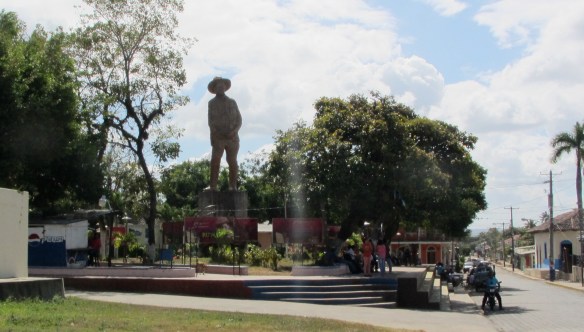
Nicaragua Defeats The Not-So-Soft Coup

Statue of national hero Augusto Sandino at the central park of his hometown, Niquinohomo.

By Stephen Sefton

Source: Popular Resistance

The author, Stephen Sefton, is a writer from the Tortilla Con Sal Collective in Nicaragua. Sefton was the guest on Clearing The FOG Radio this week where we discussed What’s Really Happening In Nicaragua. The show examined the groups behind the violent coup that is occurring, and according to the report below, failing in Nicaragua. It also examines some of the many false stories about what is going on in Nicaragua, e.g. that the coup is nonviolent, that it is student-led, that Ortega is in league with the capitalist class, that the US is not behind the coup attempt. Sefton describes how reality has been turned on its head and reports in the US corporate media and the Nicaraguan media which is controlled by oligarchs and funded by the US National Endowment for Democracy. We hope Sefton is right that the coup is being defeated in time for the July 19th celebration of the 39th anniversary of their historic 1979 defeat of the Somoza dictatorship. KZ and MF

July 19 will be a massive celebration of the coup’s defeat and a categorical vindication of President Daniel Ortega’s Sandinista government’s efforts for peace in Nicaragua.

On July 19, hundreds of thousands of people from across Nicaragua will converge on the capital Managua to celebrate the 39th anniversary of their historic 1979 defeat of the Somoza dictatorship. The event takes place as the authorities continue to liberate communities blockaded by roadblocks operated by armed opposition activists whose not-so-soft coup attempt against the Sandinista government, begun on April 18, has failed. Ever since April 21, when President Daniel Ortega called for a process of National Dialogue to peacefully resolve opposition demands, Nicaragua’s political opposition and their allies have worked to sabotage talks for a negotiated solution. They have regularly staged extremely violent provocations falsely seeking to portray the government as being wholly responsible for the crisis and demanding President Ortega’s resignation.

Early in July, the opposition reneged on an agreement to dismantle the roadblocks their armed supporters have used since late April to try to destroy the country’s economy and intimidate the general population. On July 9, the government declared it would no longer permit the opposition to abuse the population’s basic rights to peace and security, stating: “Faced with the daily suffering imposed on Nicaragua’s families, who since April 18 have suffered violence from terrorists who have murdered, tortured and kidnapped hundreds of citizens, the same terrorists that have burned and destroyed hundreds of families’ homes, public buildings, small- and medium-sized businesses, such that the state is bound to act in accordance with the law to guarantee the right of its citizens to live in peace, with security and respect for the human rights enshrined in our political constitution, in the charters of international organizations and in human rights conventions.”

Opposition Violence

Subsequently, Nicaragua’s national police have worked with local communities around the country to clear the opposition roadblocks. In Jinotepe, they set free hundreds of trucks and their drivers held hostage by opposition gangs for over a month. In many places, it has been possible to negotiate agreements to remove the roadblocks peacefully. Elsewhere, the process has involved violence and casualties provoked by very well-armed activists and associated paid criminals resisting the authorities’ efforts to restore freedom of movement. On July 13 in Managua, two opposition activists were killed during the clearance of blockades in and around the National Autonomous University.

Elsewhere, on July 12, opposition activists from roadblocks operated by Francisca Ramirez and Medardo Mairena’s anti-Canal movement infiltrated an opposition peace march in the town of Morrito, on the eastern shore of Lake Nicaragua, on the highway to the Rio San Juan. They attacked a police post and the local municipal office, murdering four police officers and a primary school teacher, wounding four municipal workers and kidnapping nine police officers. Subsequently, that evening the police officers were set free, six of them with injuries.

Tortured & Murdered

In Masaya, opposition activists tortured, murdered and burned police officer Gabriel Vado Ruiz and would have done the same to another police officer, Rodrigo Barrios Flores, had he not escaped from his captors after enduring two days of torture and abuse. Although the extreme violence of the armed opposition activists has been responsible directly and indirectly for almost all the loss of life and injuries during the crisis, international news media and human rights organizations continue to falsely blame the government for virtually all the deaths and people injured. Amnesty International and fellow coup apologists such as Bianca Jagger and SOS Nicaragua, along with their allies in corporate media such as the Guardian, Telegraph, Washington Post, New York Times, Al Jazeera, CNN,  BBC, all cover up very serious human rights violations by the opposition activists during the failed attempted coup against Nicaragua’s legitimate government.

However, abundant audiovisual and photographic material exists providing irrefutable evidence of systematic human rights violations practiced by Nicaragua’s political opposition. From the the start, on April 18, the armed opposition offensive has manipulated legitimate peaceful protest so as to give cover to a very deliberate campaign of violence and deceit, promoting a climate of fear and casting blame on the government so as to create a psychosis of hatred, polarizing Nicaraguan society. The campaign’s objective is to make impossible a negotiated solution to the crisis provoked by the political opposition. Over the weekend of July 13-15, events in Nicaragua showed how refined the techniques of psychological warfare have become.

Misrepresenting & Exaggerating

The political opposition have used social media to misrepresent and exaggerate events, create incidents that never happened and obliterate their own criminal terrorist attacks. For example, the crisis in Nicaragua began with a fake ‘student massacre’ that never took place. Now Nicaragua’s opposition have faked attacks on a church in Managua, exaggerated casualties during the clearance of opposition thugs from the national university and covered up their own deliberate murders of police in Morrito and Masaya, as well as their gratuitous attacks on peaceful Sandinista demonstrators. In the national university, the opposition gangs also set fire to a classroom module and destroyed a preschool facility on the university campus.

Right from the start of the crisis, the opposition have expertly staged phony scenes of students taking cover from gunfire and used those images to justify their own savage attacks, like those in which they burned down pro-government Nuevo Radio Ya and CARUNA, the rural cooperatives’ savings and loan institution. Photographs show opposition journalists and photographers filming opposition activists pretending to be attacked, but despite the obvious fakery, those false stories get published uncritically in international corporate and alternative media. Nicaragua provides a textbook case study bearing out the work of analysts such as Cuba’s Randy Falcon, who has emphasized how new technologies exponentially multiply the digital reproduction of longstanding conventional propaganda motifs.

Propaganda Ploys

In Nicaragua, the government has in several cases negotiated agreements to clear armed opposition roadblocks, only to find that the opposition refuse to honor the agreements. The extremist political opposition are desperate to keep up their violence so as to sabotage efforts at National Dialogue and project the false image of a repressive government without popular support. Large demonstrations across the country supporting the government’s efforts for peace show exactly the reverse is true. Majority national opinion in Nicaragua is well aware of the opposition’s propaganda ploys and false claims.

Within Nicaragua, the opposition hardly bother to conceal their invention and artifice because their false political theater is staged almost entirely to impress overseas opinion. Their sinister cynical theater aims to set the scene for the Organization of American States to change its previously moderate position on Nicaragua and give the U.S. government an institutional pretext on which to intensify sanctions against Nicaragua’s government and its people. Even so, despite probable opposition attempts to sabotage it, July 19 will be a massive celebration of the coup’s defeat and a categorical vindication of President Daniel Ortega’s Sandinista government’s efforts for peace in Nicaragua.

Climb Down From the Summit of Hostile Propaganda

Public reactions to an open letter from academics, journalists and politicians asking for co-existence with Russia show many Americans don’t buy the media’s bellicose spin, as Norman Solomon explains.

By Norman Solomon

Source: Consortium News

Throughout the day before the summit in Helsinki, the lead story on the New York Times home page stayed the same: “Just by Meeting With Trump, Putin Comes Out Ahead.” The Sunday headline was in harmony with the tone of U.S. news coverage overall. As for media commentary, the Washington Post was in the dominant groove as it editorialized that Russia’s President Vladimir Putin is “an implacably hostile foreign adversary.”

Contempt for diplomacy with Russia is now extreme. Mainline U.S. journalists and top Democrats often bait President Trump in zero-sum terms. No doubt Hillary Clinton thought she was sending out an applause line in her tweet Sunday night: “Question for President Trump as he meets Putin: Do you know which team you play for?”

A bellicose stance toward Russia has become so routine and widespread that we might not give it a second thought — and that makes it all the more hazardous. After President George W. Bush declared “You’re either with us or against us,” many Americans gradually realized what was wrong with a Manichean view of the world. Such an outlook is even more dangerous today.

Since early 2017, the U.S. mass media have laid it on thick with the rough political equivalent of a painting technique known as chiaroscuro — “the use of strong contrasts between light and dark, usually bold contrasts affecting a whole composition,” in the words of Wikipedia. The Russiagate frenzy is largely about punching up contrasts between the United States (angelic and victimized) and Russia (sinister and victimizer).

Countless stories with selective facts are being told that way. But other selectively fact-based stories could also be told to portray the United States as a sinister victimizer and Russia as an angelic victim. Those governments and their conformist media outlets are relentless in telling it either way. As the great journalist I.F. Stone observed long ago, “All governments lie, and nothing they say should be believed.” In other words: don’t trust, verify.

Often the biggest lies involve what remains unsaid. For instance, U.S. media rarely mention such key matters as the promise-breaking huge expansion of NATO to Russia’s borders since the fall of the Berlin Wall, or the brazen U.S. intervention in Russia’s pivotal 1996 presidential election, or the U.S. government’s 2002 withdrawal from the Anti-Ballistic Missile Treaty, or the more than 800 U.S. military bases overseas — in contrast to Russia’s nine.

An Open Letter for Sanity

For human survival on this planet, an overarching truth appears in an open letter published last week by The Nation magazine: “No political advantage, real or imagined, could possibly compensate for the consequences if even a fraction of U.S. and Russian arsenals were to be utilized in a thermonuclear exchange. The tacit pretense that the worsening of U.S.-Russian relations does not worsen the odds of survival for the next generations is profoundly false.”

The initial 26 signers of the open letter — “Common Ground: For Secure Elections and True National Security” — included Pentagon Papers whistleblower Daniel Ellsberg, writer and feminist organizer Gloria Steinem, former UN ambassador Gov. Bill Richardson, political analyst Noam Chomsky, former covert CIA operations officer Valerie Plame, activist leader Rev. Dr. William Barber II, filmmaker Michael Moore, former Nixon White House counsel John Dean, Russia scholar Stephen F. Cohen, former U.S. ambassador to the USSR Jack F. Matlock Jr., Pulitzer Prize-winning writers Alice Walker and Viet Thanh Nguyen, The Nation editor Katrina vanden Heuvel, former senator Adlai Stevenson III, and former longtime House Armed Services Committee member Patricia Schroeder. (I was also one of the initial signers.)

Since its release five days ago, the open letter has gained support from a petition already signed by 30,000 people. The petition campaign aims to amplify the call for protecting the digital infrastructure of the electoral process that is now “vulnerable to would-be hackers based anywhere” — and for taking “concrete steps… to ease tensions between the nuclear superpowers.”

We need a major shift in the U.S. approach toward Russia. Clearly the needed shift won’t be initiated by the Republican or Democratic leaders in Congress; it must come from Americans who make their voices heard. The lives — and even existence — of future generations are at stake in the relationship between Washington and Moscow.

Many of the petition’s grassroots signers have posted comments along with their names. Here are a few of my favorites:

*  From Nevada: “We all share the same planet! We better learn how to do it safely or face the consequences of blowing ourselves up!”

*  From New Mexico: “The earth will not survive a nuclear war. The weapons we have today are able to cause much more destruction than those of previous eras. We must find a way to common ground.”

*  From Massachusetts: “It is imperative that we take steps to protect the sanctity of our elections and to prevent nuclear war anywhere on the earth.”

*  From Kentucky: “Secure elections are a fundamental part of a democratic system. But this could become meaningless in the event of thermonuclear war.”

*  From California: “There is only madness and hubris in talk of belligerence toward others, especially when we have such dangerous weapons and human error has almost led to our annihilation already more than once in the past half-century.”

Yet a wide array of media outlets, notably the “Russiagate”-obsessed network MSNBC, keeps egging on progressives to climb toward peaks of anti-Russian jingoism. The line of march is often in virtual lockstep with GOP hyper-hawks like Senators John McCain and Lindsey Graham. The incessant drumbeat is in sync with what Martin Luther King Jr. called “the madness of militarism.”

Meanwhile, as Dr. King said, “We still have a choice today: nonviolent co-existence or violent co-annihilation.


Norman Solomon is the coordinator of the online activist group RootsAction.org and the executive director of the Institute for Public Accuracy. He is the author of a dozen books including “War Made Easy: How Presidents and Pundits Keep Spinning Us to Death.”

Transcending the Hegelian Dialectic and Duality Reality

By Rosanne Lindsay

Source: Waking Times

In our ego-driven, divide-and-conquer world, we live in a duality reality. This reality reflects a matrix of opposites: introvert/extrovert, beginning/end, living/dead, mind/matter, wave/particle, self/other, material/spiritual, on/off, right/left. This is merely a separation of the mind that always wants to compare. We are both and neither. Humanity is a part of Nature and Nature is a continuum. In Nature, there is no separation, no opposition, no self and other, no conflict, and no destruction, unless destruction is balanced with creation. Just as Nature is self-sustaining and self-healing, so are we.

The hierarchical, dual systems in which we find ourselves, from prisons to politics, are grounded in duality, promoting separation over unity, creating leaders and followers. The system is served well by the Hegelian Dialectic.

The Hegelian Dialectic originated with George Hegel, a nineteenth century school teacher, who argued that human nature is a series of conflicts and resolutions that eventually elevate humankind to a unified spiritual state. The process is based in three easy steps: Problem-Reaction-Solution. Create a problem. Foment a reaction (of anger or sympathy). Provide a solution.

Two hundred years later, whatever Hegel’s good intentions, the goal to achieve unity from conflict-resolution has remained unproven and unachievable. Under duality reality, economic chaos has produced increased taxation. Shortages of oil and food have reinforced monopolies. The threat of pandemics has led to vaccine mandates. The threat of terrorism has resulted in restrictions on individual freedoms. Conflict has only bred more conflict.

The obvious truth that refutes Hegel’s idea is that unity is not uniformity. Unity follows no leaders and leads no followers. Unity does not restrict, limit, or conform through education or through more regulations and mandates. Unity fails where players must choose to align with a tribe and plug into the implicit biases of tribal programming. The tribe – wearing the suits of political parties or the robes of religious sects – reinforces the divisions and the information that we already believe and want to hear.

Hegel’s goal for unity can never work because in duality reality we naturally choose competition over compassion. In our system of choosing sides we lose our individuality. We hope for peace and wonder why nothing ever changes. Those who believe they are on the side of peace accuse others of being on the side of war. Each group fights with weapons of words, never able to find peace, unity, or common ground because the very foundation of the system keeps people divided.

Duality Matrix

Each side feels threatened by the other in a struggle over control. The duality matrix creates winners and losers. The media reinforces the infighting that keeps both sides distracted while an imbalance of power is maintained – the few controlling the many. The many are promised protection and security against all their fears. However, no guarantees are granted. As a consequence, the many are left feeling vulnerable and powerless, embracing their servitude and begging for greater protections at the expense of their freedoms.

As a nation, we experience the fear of vulnerability every time we are faced with the consequences of an unexpected natural, or man-made disaster. We have become dependent on the guise of security in the form of the National Weather Service and the Federal Emergency Management Agency (FEMA), so much so, that when the information is incorrect and the system fails, we are left helpless, not knowing how to forage for food, build shelter, or fend for ourselves as our ancestors did. We are a technically advanced nation without a community and without a connection to the land on which we live.

We believe that in giving our allegiance to the State and Federal government that we are protected. However, the State, including local law enforcement has no duty to protect us. The Supreme Court revealed this truth in 1856 in South v. Maryland when it ruled, “Local law-enforcement had no duty to protect individuals but only a general duty to enforce the laws. The Supreme Court uses the Constitution to protect the State in its ruling in Bowers v. Devito:

“there is no constitutional right to be protected by the state against being murdered by criminals or madmen. The Constitution is a charter of negative liberties; it tells the state to let the people alone; it does not require the federal government or the state to provide services, even so elementary a service as maintaining law and order.”

In exchange for votes to uphold a dual system, people receive a false sense of security. However, our inherent rights do not come from the government, The Constitution, or The Bill of Rights, or any paper document. These are merely symbols. Inherent rights and freedoms are not dictated by regulations and statutes but by common sense and morals, as long as no harm or loss is caused. Inherent rights are higher, transcendent rights that are “unalienable.” These rights are God-given under the laws of nature, and can neither be granted nor withdrawn. As Thomas Jefferson wrote in the Declaration of Independence:

We hold these truths to be self-evident, that all men are created equal, that they are endowed by their Creator with certain unalienable rights, that among these are life, liberty, and the pursuit of happiness.

The Tenth Amendment to the United States Constitution reads in part:

The powers not delegated to the United States by the Constitution, nor prohibited by it to the States, are reserved to the States respectively, or to the people.

New Hampshire is the only state in the country to have an express, written right of revolution in the state constitution. The only concern is the non-negotiable prohibition against violence of any sort in the enforcement or manifestation of this right.

Text of Article 10: Right of Revolution:

Government being instituted for the common benefit, protection, and security, of the whole community, and not for the private interest or emolument of any one man, family, or class of men; therefore, whenever the ends of government are perverted, and public liberty manifestly endangered, and all other means of redress are ineffectual, the people may, and of right ought to reform the old, or establish a new government. The doctrine of nonresistance against arbitrary power, and oppression, is absurd, slavish, and destructive of the good and happiness of mankind.

Transcend Duality Reality

The division of opposites will continue to play out in reality until we recognize that all war and peace, introvert and extrovert, light and dark exists within us. To attack another is to attack one’s very nature. To judge another is to judge one’s self. In peaceful resistance, we can either opt out or withdraw consent from any system that would subvert unity and cooperation. Just saying NO can be a powerful stance.

Transcending duality reality comes down to creating new rules under Natural Law, that does away with the hierarchical systems of authority. It also requires real choice. Choosing not to participate in a system that doesn’t serve the greatest good is making an energy statement as powerful as choosing to participate. Choice determines outcome. Withdrawing consent is not apathy but the opposite of apathy. Being vulnerable is not the problem, but fear is. F.E.A.R. is False Evidence Appearing Real. Fear is merely a construct of the mind, but it serves to hold humanity in shackles. The power to transcend conflict, and come together, is found in choosing kindness as our tribe.

Are we ready?


Starving and Bombed Children of Yemen Seek Entrapment in Flooded Thai Cave

By Robert J. Burrowes

While the world watched and waited with bated breath for the outcome of the substantial global effort – involving over 100 cave divers from various countries, 1,000 members of the Thai Army and 10,000 others in various roles – to rescue a team of 12 young football players and their coach, who were trapped inside a flooded cave in Thailand for 17 days, 850,000 children were killed by human adults in other parts of the world, many of them simply starved to death in Yemen or other parts of Africa, Asia and Central/South America.

But other children were killed in ritual sacrifice, many children were killed after being sexually trafficked, raped and tortured, many were killed in wars (including in Yemen), many were killed while living under military occupation, many died as child soldiers or while working as slave laborers, and vast numbers of other children suffered violence in a myriad other forms ranging from violence (including sexual violation) inflicted in the family home to lives of poverty, homelessness and misery in wealthy industrialized countries or as refugees fleeing conflict zones. See ‘Humanity’s “Dirty Little Secret”: Starving, Enslaving, Raping, Torturing and Killing our Children’.

Why did the world’s corporate media highlight the flooded Thai cave story so graphically and why do so many ordinary people respond with such interest – meaning genuine emotional engagement – in this story? But not the others just mentioned?

And what does this tell us about human psychology and geopolitics?

Needless to say, a great deal.

During the Thai cave drama, major corporate media outlets, such as the Washington Post and the BBC, were routinely releasing ‘breaking news’ updates on the status of the rescue effort. At high points in the drama, reports on this issue were overshadowing major political and other stories of the day. At the same time, there were no ‘breaking news’ stories on any of the many myriad forms of violence against children, which were (and are still) killing 50,000 children each day.

So why the corporate media interest in this essentially local (Thai) story about a group of 12 children trapped in a cave? And why did it attract so much support, including foreign cave divers, engineers and medics as well as technology billionaire Elon Musk, who flew in to investigate rescue options and assist with the rescue effort. They and their equivalents are certainly not flying in to rescue children in a vast number of other contexts, including where the provision of simple, nourishing meals and clean water would do wonders.

Well, in essence, the story was a great one for the corporate media, simply because it reported on something of little consequence to those not immediately impacted and enabled the media to garner attention for itself and other (western) ‘heroes’ drawn into the story while engaging in its usual practice of distracting us from what really matters. And it was an easy story to sell simply because the media could use a wide range of safe emotional triggers to draw people into the dramatized story without simultaneously raising difficult questions about the (appalling) state of the world and responsibility for it.

In simple language: like sports events and other forms of entertainment, the cave rescue provided a safely contained time and space for people to feel emotionally engaged in (this case) a real-life drama (with feelings like fear and relief allowed an outlet) while carefully reinforcing their unconscious feeling of powerlessness to do anything about it and their acceptance of this. This is why it was so important that expert rescue efforts were highlighted: the key media message was that ‘there is nothing you can do’.

Of course, in this context, this was largely true. The problem is that the corporate media coverage wasn’t aimed at this context. It was aimed at all those other contexts which it wasn’t even discussing, let alone highlighting: the vast range of issues – including the many ongoing wars and endless military violence, the threat of nuclear war, the climate catastrophe and innumerable threats to our biosphere posed by such activities as rainforest destruction, the refugee crisis, military occupations, as well as the ongoing violence against children in so many contexts as touched on above – that need a great deal of our attention but for which the elite uses its corporate media to distract us and reinforce our sense of powerlessness.

Another aspect of the story was the way in which it highlighted the ‘accidental’ nature of the incident: no one was really responsible, even the hapless coach who was just trying to give his young players an interesting excursion and whom, according to reports, none of the parents blamed.

By focusing on the logistical details of the story (the distance into the cave, the narrowness of certain passages, rescue possibilities, equipment, the threat of monsoon rains…), without attributing blame, the media could reinforce its endless message that ‘no-one’ is responsible for the state of the world. Hence, no individual and no organization is responsible for doing anything either. Again, this message is designed to deepen a sense of powerlessness and to make people disinclined to act: to make them powerless observers rather than active participants in their own fate.

As an aside, of course, it should be noted that in those contexts where it serves elite interests to attribute blame, it certainly does so. Hence, elites might contrive to blame Muslims, Russians, Palestinians or the other latest target (depending on the context) for some problem. However, in these contexts, the story of ‘blame’ is framed to ensure that elites have maximum opportunity to act as they wish (often militarily) while (again) engendering a sense of powerlessness among the rest of us.

The tragedy of the Thai cave incident is that one man died and many boys spent 17 days in a situation in which they were no doubt terrified and suffering genuine physical privation. But elite media cynically used the event to distract us from vitally important issues, including ongoing grotesque violence against children in a large number of contexts, and to reinforce ‘The Delusion “I Am Not Responsible”’.

In short, while the 12 boys and their coach were rescued after 17 days trapped in a flooded cave in Thailand which required a sophisticated and expensive international effort, during the same period around the world, 850,000 children were killed by human adults. Even in Thailand during this 17-day period, apart from those children violated and killed as a result of sex trafficking and other violence, 119 children drowned (at the rate of seven each day). See ‘Swim Safe: Preventing Child Drowning’. Obviously, these children were ignored because there was no profit in reporting their plight and helping to mobilize an international effort to save them.

So what can we do?

Well, for a start, we can boycott the corporate media and certainly not spend any money on it. What little truth it contains is usually of even less value (and probably gets barely beyond a good sports report). Instead, invest any money you previously spent on the corporate media by supporting progressive news outlets. They might not have reported events in relation to the Thai cave rescue but they do report on the ongoing violence inflicted on children in more grotesque circumstances such as the war in Yemen. They will also report and analyze important global events from a truthful and life-enhancing perspective and will often offer strategies for your engaged involvement.

If you want to understand why most people are suckered by the corporate media, whose primary function is to distract and disempower us, you will get a clear sense from reading how adults distract and disempower children in the name of ‘socialization’. See ‘Why Violence?’ and ‘Fearless Psychology and Fearful Psychology: Principles and Practice’.

If you want to nurture children to be powerful agents of change who will have no trouble resisting attempts (whether by the corporate media or any other elite agent) to distract and disempower them, you are welcome to consider making ‘My Promise to Children’.

If you are easily conned yourself, you will vastly enhance your capacity to discriminate and focus on what matters by ‘Putting Feelings First’ which will, among other things, restore your conscience, intuition and ‘truth register’, vital mental functions suppressed in most people.

You are also welcome to consider participating in ‘The Flame Tree Project to Save Life on Earth’ which maps out a fifteen-year strategy for creating a peaceful, just and sustainable world community so that all children (and everyone else) has an ecologically viable planet on which to live.

And for the vast range of other manifestations of violence against children touched on above, you might consider using Gandhian nonviolent strategy in any context of particular concern to you. See Nonviolent Campaign Strategy or Nonviolent Defense/Liberation Strategy.

You might also consider signing the online pledge of ‘The People’s Charter to Create a Nonviolent World’ which explicitly identifies the role of the corporate media, among many other elite agencies, in promoting violence.

Am I pleased that the 12 children and their coach in Thailand were rescued? Of course I am. I just wish that an equivalent effort was being made to rescue each of the 50,000 children we will kill today, tomorrow, the next day and the day after that….


Biodata: Robert J. Burrowes has a lifetime commitment to understanding and ending human violence. He has done extensive research since 1966 in an effort to understand why human beings are violent and has been a nonviolent activist since 1981. He is the author of ‘Why Violence?’ His email address is flametree@riseup.net and his website is here.

Robert J. Burrowes
P.O. Box 68
Daylesford, Victoria 3460
Australia

Email: flametree@riseup.net

Websites:
Nonviolence Charter
Flame Tree Project to Save Life on Earth
‘Why Violence?’
Feelings First
Nonviolent Campaign Strategy
Nonviolent Defense/Liberation Strategy
Anita: Songs of Nonviolence
Robert Burrowes
Global Nonviolence Network

Life-giving Light and Those Who Would Snuff it Out

By John Andrews

Source: Dissident Voice

The concluding sentence of Roy Medvedev’s superb account of Russia during the Stalin years reads:

When the cult of Stalin’s personality was exposed [in the XXth and XXIInd Congresses in 1956 and 1961 respectively] a great step was made to recovery.1

It’s a vital point, similar to that made by the incredible truth and reconciliation commission event that followed the dismantling of apartheid in South Africa, and that point is this: before any society can really advance it must recognise and admit to itself the mistakes and crimes perpetrated by its own trusted leaders. Or, as Rosa Luxemburg once put it:

Self-criticism – ruthless, harsh self-criticism, which gets down to the root of things – that is the life-giving light and air of the proletarian movement.2

Yet self-criticism of our own governments is almost impossible. Infinitely more effective than state censorship – which can restrict criticism – is self-censorship, and that’s pretty much what we have: a society which is incapable of seriously challenging those in power, let alone calling them to account for any wrongdoing – not through any state-imposed censorship, but through creating a culture that’s utterly brainwashed into believing the perfection of their constitution and therefore refusing to even imagine its very considerable imperfections. Whilst we do not have the domestic death squads and concentration camps of Hitler’s Germany or Stalin’s Russia to enforce domestic obedience, we still have loyal populations that are almost as effectively programmed to believe the perfections of their state leaders and their institutions as many Germans and Russians were during the Hitler and Stalin years.

In Britain, for example, in 2015 when the leader of the Green Party Natalie Bennett was provocatively questioned about the Party’s well-known opposition to monarchy she remarked,

I can’t see that the Queen is ever going to be really poor, but I’m sure we can find a council house for her — we’re going to build lots more.

This obviously whimsical comment, although factually reasonable, provoked the following headline in The Independent: ‘We would evict Queen from Buckingham Palace and allocate her council house,’ say Greens

Similar sensationalist headlines led in almost every newspaper and TV news broadcast. Green Party membership, which had been surging until that moment, immediately fell off a cliff. I was a membership secretary for our local Green Party branch at the time and had been signing up new members at the rate of about two a week. New memberships not only stopped completely, but some who had just joined us immediately cancelled their memberships. And this from people who would see themselves as progressives. No need to guess how Tory voters, who comprise most voters, reacted to Bennett’s quip. Such is the level of brainwashing in a supposedly democratic country about the perfection of the British monarchy, and its unchallengeable position as unelected head of state.

But it’s not just Britain that has to endure a majority of brainwashed citizens. I remember seeing a TV documentary about the time of the illegal Iraq War in 2003. The programme was about heroic US marines bravely defending western freedom, by helping to kill defenseless Iraqi civilians. Some of the heroes were interviewed about the hard time they were having, and the one that will forever stick in my mind implied that no amount of personal suffering was too great for him. “I would slit my own throat for my president”, he said. So Iraqi civilians didn’t have much chance.

The marine’s remark reminded me of a quote in Medvedev’s book, showing the similarity between modern US citizens and the brainwashed Russians of Stalin’s day:

Just as [religious] believers attribute everything good to god and everything bad to the devil, so everything good was attributed to Stalin and everything bad to evil forces that Stalin himself was [supposedly] fighting. “Long live Stalin!” some officials shouted as they were taken to be shot.3

When, very occasionally, some of the major crimes of our great trusted leaders are brought to our attention, there is never any clamouring for justice, no national outrage that the public’s trust could be so cheaply squandered. Whilst some newspapers might print a subdued story or two, located somewhere towards the bottom of page thirty nine, and whilst national TV stations may record a few words tucked away deeply buried somewhere on their websites, in the sacred name of “balance”, the real gravity of the misdeeds of our trusted leaders are otherwise routinely ignored, and the revelations are quickly lost in the usual myriad of trivial distractions.

For example, when, after many years and thirteen million pounds of treasure, the Chilcot Report was eventually published, effectively providing sufficient evidence for Tony Blair and other establishment leaders to be indicted for war crimes, no such calls from our trusted leaders were heard – just a deafening silence, followed almost immediately by business as usual.   But those who dare to provide the evidence of our rulers’ misdeeds are quickly and viciously victimized – as any whistleblower could easily confirm; with the better-known of whom, such as Daniel Ellsberg, Mordechai Vanunu, Julian Assange, Chelsea Manning and Ed Snowden standing as fine examples of the terrible consequences of speaking the truth about power. This is how Rosa Luxemburg’s ruthless self-criticism is rendered impossible in our “free” societies where official censorship doesn’t exist, but where official “news” isn’t worth censoring.

One of the holiest cows of the establishment, the institution which, almost above any other, will not tolerate any form of criticism, are our so-called “defence” forces. The word “hero” has been re-defined to mean absolutely anyone wearing a military uniform. TV commercials encouraging young people to join the armed forces appear almost every night. TV programmes depicting the military as brave heroes resisting overwhelming odds in the sacred name of freedom and democracy appear almost every night. Every year people adorn themselves in little plastic poppies and stand in silence for two minutes on the 11th November, not so much to recall those who were needlessly slaughtered for the supposed “war to end all war”, but to serve as a subliminal recruitment aid. Criticising the armed forces is always strictly off limits.

The Annihilation of Raqqa

Yet a recent report by Amnesty International (AI), who investigated the devastating attack by western coalition forces on the Syrian city of Raqqa, is so damning that anyone who does not criticise those responsible is guilty by association of war crimes.4 They are in a similar position to those who silently stood by as their neighbours were carted-off to Nazi concentration camps. Although AI has a somewhat dubious reputation, earned mainly by its very tepid response to the multitude of horrors perpetrated over many years by the Zionist regime in Occupied Palestine, its latest report on Raqqa has some merit.

No one will ever know how many civilians perished in last year’s battle for Raqqa. However, estimates for the numbers of people living in the city prior to the war are given at around 220,000, whilst the number estimated to be living there earlier this year is around 61,000.  Some civilians managed to flee the city, but many did not, as they were prevented from doing so by IS. Amnesty summarised the terrible situation for civilians as follows:

The four-month military operation to oust the armed group calling itself Islamic State (IS) from Raqqa, the Syrian city which IS had declared its capital, killed hundreds of civilians, injured many more and destroyed much of the city. During the course of the operation, from June to October 2017, homes, private and public buildings and infrastructure were reduced to rubble or damaged beyond repair.

Residents were trapped, as fighting raged in Raqqa’s streets between IS militants and Kurdish-led Syrian Democratic Forces (SDF) fighters, and US-led Coalition’s air and artillery strikes rocked the city. With escape routes mined by IS and the group’s snipers shooting at those trying to flee, civilians fled from place to place within the city, desperately seeking refuge or escape. Some were killed in their homes; some in the very places where they had sought refuge, and others as they tried to flee.5

If Amnesty was referring to North Korea, say, or Iran, Russia, China, or the Syrian government, almost certainly its report would have been leading the western world’s news broadcasts. Outraged politicians and their tame propagandists in the mainstream media would have been demanding that “something should be done”. But those countries were not the subjects of the Amnesty report. It was referring instead to the biggest villains in the world — the US and British governments, joined on this occasion by France. Although other countries were implicated in this particular “coalition of the willing”, their roles were relatively minor. Consequently our politicians and their lackeys in the mainstream media seem hardly to have noticed AI’s report. Once again the truth is available, but has been conveniently self-censored by all the usual tricks of state.

Two investigators from AI spent two weeks in February 2018 visiting the ruins of Raqqa. They went to 42 different locations and interviewed 112 civilian residents. About half of the report focuses mainly on the personal stories of four families whose lives were devastated by the “liberation” of Raqqa from IS occupation by the combined efforts of western firepower, and ground-troops supplied by the Syrian Democratic Forces (SDF) – a mainly Kurdish militia.

Although the so-called global coalition:

boasts membership of 71 countries and four inter-governmental organisations; an eclectic alliance including nations as diverse as Panama and Poland, Australia and Afghanistan. Some Coalition members, Chad, for example, or Niger, are likely to have given support in name only. Others, particularly European states, were more deeply involved, although the exact extent of their actions is not always clear.6

Whilst most people are probably aware that US, British and French air forces bombed countless targets in Syria generally, and specifically here, in Raqqa, fewer people know about the involvement of western ground troops. But AI tells us:

[T]he US deployed some 2,000 of its own troops to north-eastern Syria, many of whom were engaged in direct combat operations, notably firing artillery into Raqqa from positions outside the city. In addition, a smaller number of special forces were operating close to front lines alongside SDF members. British and French special forces were also deployed to the area, but in much smaller numbers.

Among the US deployment were Army High Mobility Artillery Rocket Systems (HIMARS) with GPS-directed 227mm rockets, which could be fired from 300km away, as well as hundreds of Marines from the 11th Marine Expeditionary Unit (MEU) and the 24th MEU equipped with M777 howitzers, which they used to rain down 155mm artillery fire upon the city from a distance of up to 30km.6

AI concludes its summary of the involvement of “coalition” forces as follows:

The Coalition launched tens of thousands of strikes on Raqqa during the military campaign. Of these, more than 4,000 were air strikes, almost all of them carried out by US forces. British forces carried out some 215 air strikes, while the French military was responsible for some 50 air strikes with the overwhelming majority – more than 90% – carried out by US piloted aircraft and drones. No other members of the Coalition are known to have carried out air strikes in Raqqa. At the same time, US Marines launched tens of thousands artillery shells into and around Raqqa…

While Coalition forces operated mostly from positions several kilometres outside the city, a small number of special operation forces from Coalition member states – notably the US, UK and France – operated alongside the SDF close to front line position in/around the city, reportedly mostly in an advisory rather than combat role.

The SDF were partly responsible for locating targets for Coalition air and artillery strikes. It is not clear what percentage of the Coalition air and artillery strikes were carried out based on co-ordinates provided by the SDF – as opposed to strikes on targets identified by Coalition forces themselves through air surveillance or other means – and the extent to which Coalition forces verified targets identified by the SDF prior to launching strikes on those targets.7

Although Kurdish militia were reportedly too lightly-armed to be physically accountable for the destruction of Raqqa, their target identification function was clearly significant.

It has long been routine for the military’s propaganda machine to dismiss concerns about civilian casualties inside war zones, and the carnage wreaked on Raqqa was no exception. Furthermore, the military’s word is always accepted at face value.

[A]t the height of conflict in Raqqa, Lieutenant General Stephen Townsend wrote that ‘… there has never been a more precise air campaign in the history of armed conflict’.8

But the alleged accuracy of the ordnance used by the military is not the point. The point is that no matter how smart the smart bombs are, they’re still killing civilians – and that’s a war crime. An estimated 4,000 bombs were dropped on the defenceless civilians of Raqqa by “coalition” warplanes. Given that many of those are only accurate, on a good day, to within ten metres of their target, it’s very clear to see that these alone must have accounted for considerable civilian casualties. But they may not have been the main problem.

Sergeant Major John Wayne Troxell (senior enlisted adviser to the Chairman of the Joint Chiefs of Staff), suggests that the Coalition operation was far from precise: ‘In five months they fired 35,000 artillery rounds on ISIS targets… They fired more rounds in five months in Raqqa, Syria, than any other Marine artillery battalion, or any Marine or Army battalion, since the Vietnam War.’8

But legitimate ISIS targets must have been almost negligible, as IS had immersed themselves amongst the civilian population. Given also that most artillery shells are considerably less accurate than guided missiles, and can only be expected to strike within a hundred metres of their targets, and given that tens of thousands of these things rained down on the trapped and defenceless civilians of Raqqa, the claims by the military’s propagandists that they tried everything possible to minimise civilian casualties are obviously ludicrous.

There has never been a more precise air campaign in the history of armed conflict [than in Raqqa]
— Lieutenant General Stephen Townsend

Isis withdraws, undefeated, from Raqqa

Sometime in October some sort of deal was suddenly worked out which allowed Isis to simply pack up and leave Raqqa, in a convoy of trucks, together with most of their weaponry. According to a BBC report, the deal:

enabled many hundreds of IS fighters to escape from the city. At the time, neither the US and British-led coalition, nor the SDF, which it backs, wanted to admit their part.  Has the pact, which stood as Raqqa’s dirty secret, unleashed a threat to the outside world – one that has enabled militants to spread far and wide across Syria and beyond?

Great pains were taken to hide it from the world. But the BBC has spoken to dozens of people who were either on the convoy, or observed it, and to the men who negotiated the deal…

[T]he convoy was six to seven kilometres long. It included almost 50 trucks, 13 buses and more than 100 of the Islamic State group’s own vehicles. IS fighters, their faces covered, sat defiantly on top of some of the vehicles…

Freed from Raqqa, where they were surrounded, some of the [IS] group’s most-wanted members have now spread far and wide across Syria and beyond.

War crimes

The US-led “coalition” undoubtedly committed a vast number of war crimes in the “liberation” of Raqqa, and the considerably-referenced AI report summarises the particular breaches of law applicable:

(a) The Principle of Distinction

This requires parties to conflict to at all times, ‘distinguish between civilians and combatants’ and to ensure that ‘attacks may only be directed against combatants’ and ‘must not be directed against civilians’. Parties to conflict must also distinguish between ‘civilian objects’ and ‘military objectives’. Anyone who is not a member of the armed forces of a party to the conflict is a civilian, and the civilian population comprises all persons who are not combatants. Civilians are protected against attack unless and for such time as they take a direct part in hostilities. In cases of doubt, individuals should be presumed to be civilians and immune from direct attack. Making the civilian population, or individual civilians not taking a direct part in hostilities, the object of attack (direct attacks on civilians) is a war crime (My emphasis).9

It isn’t clear how hard the “coalition” tried to distinguish combatants from non-combatants, but in the four detailed case studies that Amnesty supplied – which were the tragic stories of just four families from a city of tens of thousands – it would appear they didn’t try very hard at all. One such piece of evidence was supplied by “Ammar”, who

told Amnesty International that on ‘the second or third day of Eid” [26-27 June 2017] an air strike killed 20-25 people, mainly civilians but some IS too, at a communal water point, around the corner from Abu Saif’s house.’10

So, clearly essential water supplies were either deliberately targeted by the “coalition”, or some “legitimate” target was so near that the likely presence of defenceless civilians was simply ignored.

(b)  Proportionality

The principle of proportionality, another fundamental tenet of IHL, also prohibits disproportionate attacks, which are those “which may be expected to cause incidental loss of civilian life, injury to civilians, damage to civilian objects, or a combination thereof, which would be excessive in relation to the concrete and direct military advantage anticipated”. Intentionally launching a disproportionate attack (that is, knowing that the attack will cause excessive incidental civilian loss, injury or damage) constitutes a war crime. The Commentary on the Additional Protocols makes clear that the fact that the proportionality calculus requires an anticipated “concrete and direct” military advantage indicates that such advantage must be “substantial and relatively close, and that advantages which are hardly perceptible and those which would only appear in the long term should be disregarded (my emphasis).11

Whilst it is undeniable that the head-chopping organ-eating occupiers of Raqqa were about as vile a group of psychopaths as it’s possible to get, and that their removal from Raqqa would no doubt be extremely difficult to accomplish, it’s deeply questionable that the total destruction of a civilian-occupied city could be considered proportional to the reign of terror it was supposed to terminate. The fact that IS were eventually cleared out of Raqqa, very much alive and well, shows that they were not committed kamikaze warriors and suggests that alternative methods for bringing to an end their repulsive occupation may have been possible.

(c) Precautions

In order for parties to an armed conflict to respect the principles of distinction and proportionality they must take precautions in attack. “Constant care must be taken to spare the civilian population, civilians and civilian objects”; “all feasible precautions” must be taken to avoid and minimise incidental loss of civilian life, injury to civilians and damage to civilian objects. The parties must choose means and methods of warfare with a view to avoiding or at least minimising to the maximum extent possible incidental loss of civilian life, injury to civilians and damage to civilian objects. As well as verifying the military nature of targets and assessing the proportionality of attacks, the parties must also take all feasible steps to call off attacks which appear wrongly directed or disproportionate. Parties must give effective advance warning of attacks which may affect the civilian population, unless circumstances do not permit. When a choice is possible between several military objectives for obtaining a similar military advantage, the parties must select the target the attack on which would be expected to pose the least danger to civilians and to civilian objects.

The limited information available on the precautions in attack taken by the Coalition suggests that they were not adequate or effective. The cases examined in detail indicate that there were serious shortcomings in verification that targets selected for attack were in fact military, with disastrous results for civilian life. Further, several attacks examined by Amnesty International suggest that the Coalition did not, at least in those instances, select weapons that would minimise harm to civilians. Also, the warnings that were given to civilians were not effective. They did not take into account the reality that civilians were blocked from leaving Raqqa, and did not include specific information (such as warning civilians to stay away from tall buildings).11

Amnesty claim that up to the point of publication of their report repeated approaches to “the coalition” for specific details regarding their attacks on Raqqa were either inadequately answered or had not been answered at all. Therefore questions relating to whether sufficient precautions were taken remain unanswered, and could imply breaches of international law.

(d) Joint and individual responsibility of coalition members

One of the attractions to “coalition” actions is the difficulty in attributing specific responsibility for possible crimes after the event, and Amnesty states:

It is concerned that this lack of clarity may enable individual Coalition members to evade responsibility for their actions. The UK Government, for example, maintained until May 2018 that it had not killed a single civilian in Syria or Iraq, despite carrying out thousands of air strikes across the two countries. On 2 May 2018 it admitted for the first time that one of its drone strikes had caused one civilian casualty in Syria in March 2018.11

However, there is very limited wriggle-room in attempting to evade responsibility by trying to divert attention to others. International Humanitarian Law (IHL):

Requires all states to ‘respect and ensure respect’ for its provisions under Common Article 1 of the Geneva Conventions. This includes both positive and negative obligations on states providing assistance to another state which is then used to commit a violation of international humanitarian law. The negative obligation is not to encourage, aid or assist in violations of IHL by parties to a conflict. The positive obligation includes the prevention of violations where there is a foreseeable risk they will be committed and prevention of further violations where they have already occurred.

The USA, UK, France, and other states involved in military operations as part of Operation Inherent Resolve therefore may be legally responsible for unlawful acts carried out by Coalition members.12

(e) Duty to investigate, prosecute and provide reparation

States have an obligation to investigate allegations of war crimes by their forces or nationals, or committed on their territory and, if there is sufficient admissible evidence, prosecute the suspects. They must also investigate other war crimes over which they have jurisdiction, including through universal jurisdiction, and, if appropriate, prosecute the suspects.12

Life-giving light – and those who would snuff it out

The Amnesty International report provides compelling evidence that, at the very least, there are legitimate questions to be answered regarding the attacks on Raqqa by the USA, Britain and France. And it must never be forgotten that the whole IS phenomenon is mostly a creation of the west, that without the deeply cynical plotting of the US, British and possibly French deep states, IS would likely never have come into existence. The words of French foreign minister Roland Dumas should be recalled:

I’m going to tell you something,” Dumas said on French station LCP. “I was in England two years before the violence in Syria on other business [in 2009]. I met with top British officials, who confessed to me that they were preparing something in Syria. This was in Britain not in America. Britain was organizing an invasion of rebels into Syria. They even asked me, although I was no longer minister for foreign affairs, if I would like to participate. Naturally, I refused, I said I’m French, that doesn’t interest me.

So Dumas may have said – but the French were involved in the destruction of Raqqa.

If similar probable war crimes had been carried out in some other country by Russia, say, or China, or Iran, or any other nation to which the west is routinely hostile, almost certainly outraged voices would be heard caterwauling in Westminster and Washington. Front pages of newspapers, together with TV and radio news programmes would be howling that “something must be done”. Yet in Westminster and Washington the silence is deafening. Not a single word of protest appears on the front pages of our newspapers, and our TV and radio stations appear to be looking the other way. Why? Because our “heroes” are personally involved, and personally responsible for the terror, and that is the terrible truth that cannot be admitted.

The cold hard fact is that far from being heroic, many people in the military are de facto war criminals. From at least as far back as the second world war, when defenceless civilians were bombed to death and incinerated in their homes in the pointless bombing of Hamburg, Dresden and Tokyo, for example, Hiroshima and Nagasaki, through the slaughter of countless defenceless civilians in later wars, in Korea, Vietnam, Cambodia and Laos to the more recent civilian killing fields of Iraq, Libya and now Syria, our so-called heroes have just as much innocents’ blood on their hands as any Nazi war criminal ever had.

With very few exceptions, the military seldom do anything heroic. The very last thing that senior officers want, the generals, admirals, air marshals and so on, is a peaceful world – for the very obvious reason that they would all be out of work, vastly overpaid work requiring very little real and useful effort, work that not only pays these people far more than they’re worth, but also, which is far worse, gives them far too much power in our societies. Consider, for example, the words of an unnamed general in a recent Observer interview that if Jeremy Corbyn – a lifelong pacifist – was to win a general election:

There would be a mutiny in the armed forces… unless he learnt to love NATO and the nuclear bomb.13

The cold hard fact is that these people, those who run our so-called “defence” forces are out of control. They are more interested in protecting their own careers than doing what they’re supposed to be doing, and which so many people mistakenly believe they are doing – protecting us. We are not made safer by the ruthless and illegal destruction of civilian cities such as Raqqa. The people that carry out these war crimes should be brought to account and charged like the common war criminals they really are, which is pretty much the same conclusion reached by Amnesty International:

Where there is admissible evidence that individual members of Coalition forces are responsible for war crimes, ensure they are prosecuted in a fair trial without recourse to the death penalty.14

We need complete, truthful information. And the truth should not depend on whom it is to serve.
— V.I. Ulyanov, (Let History Judge, Roy Medvedev, Preface.))

Self-criticism – ruthless, harsh self-criticism, which gets down to the root of things – that is the life-giving light and air of the proletarian movement.
— Rosa Luxemburg15

Sometimes I think we biologists may find ourselves coming into politics from our own angle. If things go on as they are going – We may have to treat the whole world as a mental hospital. The entire species is going mad; for what is madness but a complete want of mental adaptation to one’s circumstances? Sooner or later, young man, your generation will have to face up to that.…

I have an idea, Father, a half-formed idea,that before we can go on to a sane new order, there has to be a far more extensive clearing up of old institutions… The world needs some sort of scavenging, a burning up of the old infected clothes, before it can get on to a new phase. At present it is enormously encumbered… This is just a shadowy idea in my mind… Something like breaking down condemned, old houses. We can’t begin to get things in order until there has been this scavenging.

— HG Wells, The Holy Terror, Simon and Schuster, 1939.

  1. Let History Judge: The Origins and Consequences of Stalinism, Roy Medvedev, p. 566.
  2. Let History Judge: The Origins and Consequences of Stalinism, Roy Medvedev, Preface.
  3. Medvedev, p. 363.
  4. Amnesty International Report, p. 9.
  5. AI Report, p. 5.
  6. AI Report, p. 48.
  7. AI Report, p. 49.
  8. AI Report, p. 53.
  9. AI Report, p. 62.
  10. AI Report, p. 44.
  11. AI Report, p. 63.
  12. AI Report, p. 64.
  13. How the Establishment lost control, Chris Nineham, p. 93.
  14. AI Report, p. 67.
  15. Let History Judge, Roy Medvedev, Preface

Invisible Architecture III: The Psychogeography of Hyperspace

By Rococo Modem Basilisk

Source: Modern Mythology

Ordinarily, when we discuss psychogeography, we operate at the scale of a city: we discuss how people are drawn through a walkable space, at a speed in which they can be affected by each piece of passing scenery and make a detour to examine it. But, at the same time the Lettrists were wandering Paris and laying the groundwork for Disneyland in the micro-scale, at the macro-scale holes were being punched through the fabric of the United States in the form of highways.

Habitual migration patterns break the close association between culture and geography. There’s a psychogeographic wormhole between Fairfield County, CT and south Florida, and used to be one between there and upstate NY. If you live in Fairfield County (or certain parts of NYC) you’re liable to be culturally closer to some parts of south Florida than to many points in-between, not because of natural rock formations or bodies of water, but because highways have made it possible to pass through the middle without interacting with it.

Areas of transience — the hyperspace of psychogeography — are not ‘non-places’ with ‘non-culture’. They have a uniquely warped kind of culture, in the same way tourist-dependent places do. Some people spend large amounts of their lives there: long-haul truckers, jet-setting businessmen, touring bands or comedians or authors. The attempt at producing a consistent experience across geography produces an experience that can only exist in hyperspace.

Our own psychogeographic hyperspace is not as psychedelic as the one in Cordwainer Smith’s A Game of Rat and Dragon, but it is stranger, in a Ligottian way.

Why do they have ice machines? Why do they have pools? Why are airplanes and airports trapped in a perpetual 1963 idea of what luxury looks like? Path dependence has made the culture of our hyperspace deeply strange: there are low upper limits on quality of manufacture and high lower limits on quality of service, and the assumed transitory state of most inhabitants means bonds cannot be formed.

When new ideas are integrated here at all, they slot into existing structures — structures that don’t exist outside, in the world that is normal for most of us. Wifi passwords come with the keycard; a robot kiosk in front of the check-in desk prints tickets, as the clerk who formerly printed tickets watches.

These liminal spaces are only forgettable for people who have destinations. They’re also populated by residents, or commuters from geographically — nearby places, who fill the service jobs. What’s it like to have a diner with no regulars? This situation is capitalism-optimized. If you are a resident of psychogeographic hyperspace — nomadic or not — you are dog-fooding the experience that Rand thought was natural to man: separation of orbits, mediated by impersonal monetary transactions. It looks like endless beige hotels with broken ice machines.

What are the attributes of this Randian New Man who lives as hyperspace nomad? Sleep deprivation, boredom, and a dependence on stimulants. Gas stations in hyperspace cater to truckers, abnormally large DVD and pornography selections and every variety of pick-me-up not yet banned. Airports, whose nomads are of a higher caste and have less private space or scheduling freedom, focus more on overpriced convenience food, mediocre reading material, and headphones, and pillows. A Cinnabon could not survive outside of hyperspace, even if it grew up in the shallows of the shopping mall, but in this ecosystem, sheltered from competitors and provided with a steady stream of easy prey, it thrives.

The culture of hyperspace is not a psychogeography, except in a fairly minor sense: everywhere is the same, or tries to be. The few deviations, like Denver International Airport, are notable because deviation is so rare. There is an international internet radio station specifically for airports, and I have heard it play the same playlist in three states. (It never played Brian Eno.) However, like the hyperspace of fiction, it is a strange world that fills the gaps as we jump from one point to another without travelling in-between.

Transit systems are not the only holes in psychogeography. Communications systems also create them. Just as the prevalence of snowbirds and Adirondack cottages make it possible for small segments of northern New York and southern Florida to influence Manhattan finance and vice versa, arbitrary decisions or early-mover advantages gave Los Angeles cultural power over film, Cleveland cultural power over radio, and Atlanta cultural power over podcasting.

Communications technologies have their own hyperspace-cultures, although the geographic centralization of the big players has a larger impact on how they manifest than in the case of hotels. Twitter is the internet equivalent of a trucker-optimized gas station, and caters to journalists — the long-haul truckers of the information landscape. Facebook is the internet equivalent of a Holiday Inn: a premium-mediocre imitation of homeyness that is endearing in its complete failure to be convincing but ultimately irritating if you try to stay too long. (Facebook’s ice machine is always broken, and always loud.) The film industry is a bit like any airport: perpetually stuck in a cheap imitation of an imagined luxurious past, adapting poorly to the cosmopolitanism produced by globalization while profiting through its monopoly on the means of that globalization.

The culture of any hyperspace, because the means of association are limited to the Randian, will be corporate in its manifestation: customer service, marketing, selection, returns, free coupons as a means of apology. It differs from non-hyperspace because these are the only forms of communication truly available. This diner has no regulars with whom the waitress can be frank, only strangers perpetually passing through. It can get away with being shallow and having nothing under its surface, because only very rarely will someone stay long enough to peel it back.