
The Art of Doublespeak: Bellingcat and Mind Control

By Edward Curtin

Source: Behind the Curtain

In the 1920s, the influential American intellectual Walter Lippman argued that the average person was incapable of seeing or understanding the world clearly and needed to be guided by experts behind the social curtain.  In a number of books he laid out the theoretical foundations for the practical work of Edward Bernays, who developed “public relations” (aka propaganda) to carry out this task for the ruling elites.  Bernays had honed his skills while working as a propagandist for the United States during World War I, and after the war he set himself up as a public relations counselor in New York City.

There is a fascinating exchange at the beginning of Adam Curtis’s documentary, The Century of Self, where Bernays, then nearly 100 years old but still very sharp, reveals his manipulative mindset and that of so many of those who have followed in his wake.  He says the reason he couldn’t call his new business “propaganda” was because the Germans had given propaganda a “bad name,” and so he came up with the euphemism “public relations.”  He then adds that “if you could use it [i.e. propaganda] for war, you certainly could use it for peace.”  Of course, he never used PR for peace but just to manipulate public opinion (he helped engineer the CIA coup against the democratically elected Arbenz government in Guatemala in 1954 with fake news broadcasts).  He says “the Germans gave propaganda a bad name,” not Bernays and the United States with their vast campaign of lies, mainly aimed at the American people to get their support for going to a war they opposed (think weapons of mass destruction).  He sounds proud of his war propaganda work that resounded to his credit since it led to support for the “war to end all wars” and subsequently to a hit movie about WWI, Yankee Doodle Dandy, made in 1942 to promote another war, since the first one somehow didn’t achieve its lofty goal.

As Bernays has said in his book Propaganda,

The American motion picture is the greatest unconscious carrier of propaganda in the world today.

He was a propagandist to the end.  I suspect most viewers of the film are taken in by these softly spoken words of an old man sipping a glass of wine at a dinner table with a woman who is asking him questions. I have shown this film to hundreds of students and none has noticed his legerdemain.  It is an example of the sort of hocus-pocus I will be getting to shortly, the sly insertion into seemingly liberal or matter-of-fact commentary of statements that imply a different story.  The placement of convincing or confusing disingenuous ingredients into a truth sandwich – for Bernays knew that the bread of truth is essential to conceal untruth.

In the following years, Bernays, Lippman, and their ilk were joined by social “scientists,” psychologists, and sundry others intent on making a sham out of the idea of democracy by developing strategies and techniques for the engineering of social consensus consonant with the wishes of the ruling classes.  Their techniques of propaganda developed exponentially with the development of technology, the creation of the CIA, its infiltration of all the major media, and that agency’s courting of what the CIA official Cord Meyer called in the 1950s “the compatible left,” having already had the right in its pocket. Today most people are, as is said, “wired,” and they get their information from the electronic media that is mostly controlled by giant corporations in cahoots with government propagandists.  Ask yourself: Has the power of the oligarchic, permanent warfare state with its propaganda and spy networks increased or decreased over your lifetime. The answer is obvious: the average people that Lippman and Bernays trashed are losing and the ruling elites are winning.

This is not just because powerful propagandists are good at controlling so-called “average” people’s thinking, but, perhaps more importantly, because they are also adept – probably more so – at confusing or directing the thinking of those who consider themselves above average, those who still might read a book or two or have the concentration to read multiple articles that offer different perspectives on a topic.  This is what some call the professional and intellectual classes, perhaps 15-20 % of the population, most of whom are not the ruling elites but their employees and sometimes their mouthpieces.  It is this segment of the population that considers itself “informed,” but the information they imbibe is often sprinkled with bits of misdirection, both intentional and not, that beclouds their understanding of important public matters but leaves them with the false impression that they are in the know.

Recently I have noticed a group of interconnected examples of how this group of the population that exerts influence incommensurate with their numbers has contributed to the blurring of lines between fact and fiction. Within this group there are opinion makers who are often journalists, writers, and cultural producers of some sort or other, and then the larger number of the intellectual or schooled class who follow their opinions.  This second group then passes on their received opinions to those who look up to them.

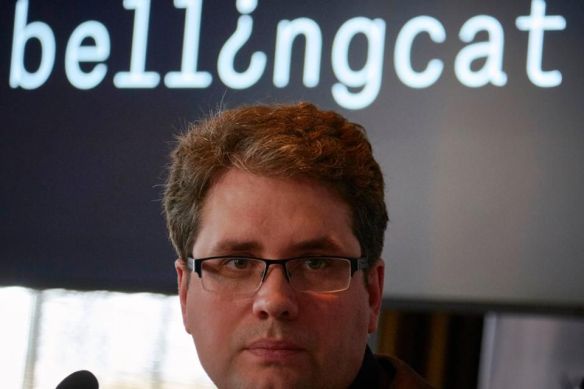
There is a notorious propaganda outfit called Bellingcat, started by an unemployed Englishman named Eliot Higgins, that has been funded by The Atlantic Council, a think-tank with deep ties to the U.S. government, NATO, war manufacturers, and their allies, and the National Endowment for Democracy (NED), another infamous U.S. front organization heavily involved in so-called color revolution regime change operations all around the world, that has just won the International Emmy Award for best documentary. The film with the Orwellian title, Bellingcat: Truth in a Post-Truth World, received its Emmy at a recent ceremony in New York City.  Bellingcat is an alleged group of amateur on-line researchers who have spent years shilling for the U.S. instigated war against the Syrian government, blaming the Douma chemical attack and others on the Assad government, and for the anti-Russian propaganda connected to, among other things, the Skripal poisoning case in England, and the downing of flight MH17 plane in Ukraine. It has been lauded by the corporate mainstream media in the west.  Its support for the equally fraudulent White Helmets (also funded by the US and the UK) in Syria has also been praised by the western corporate media while being dissected as propaganda by many excellent independent journalists such as Eva Bartlett, Vanessa Beeley, Catte Black, among others.  It’s had its work skewered by the likes of Seymour Hersh and MIT professor Theodore Postol, and its US government connections pointed out by many others, including Ben Norton and Max Blumenthal at The Gray Zone. And now we have the mainstream media’s wall of silence on the leaks from the Organization for the Prohibition on Chemical Weapons (OPCW) concerning the Douma chemical attack and the doctoring of their report that led to the illegal U.S. bombing of Syria in the spring of 2018.  Bellingcat was at the forefront of providing justification for such bombing, and now the journalists Peter Hitchens, Tareq Harrad (who recently resigned from Newsweek after accusing the publication of suppressing his revelations about the OPCW scandal) and others are fighting an uphill battle to get the truth out.

Yet Bellingcat: Truth in a Post-Truth World won the Emmy, fulfilling Bernays’ point about films being the greatest unconscious carriers of propaganda in the world today.

Who presented the Emmy Award to the film makers, but none other than the rebel journalist Chris Hedges.  Why he did so, I don’t know.  But that he did so clearly sends a message to those who follow his work and trust him that it’s okay to give a major cultural award to a propaganda outfit.  But then, perhaps he doesn’t consider Bellingcat to be that.

Nor, one presumes, does The Intercept, the billionaire Pierre Omidyar owned publication associated with Glen Greenwald and Jeremy Scahill, and also read by many progressive-minded people. The Intercept that earlier this year disbanded the small team that was tasked with reviewing and releasing more of the massive trove of documents they received from Edward Snowden six years ago, a minute number of which have ever been released or probably ever will be. As Whitney Webb pointed out, last year The Intercept  hosted a workshop for Bellingcat.  She wrote:

The Intercept, along with its parent company First Look Media, recently hosted a workshop for pro-war, Google-funded organization Bellingcat in New York. The workshop, which cost $2,500 per person to attend and lasted five days, aimed to instruct participants in how to perform investigations using “open source” tools — with Bellingcat’s past, controversial investigations for use as case studies…Thus, while The Intercept has long publicly promoted itself as an anti-interventionist and progressive media outlet, it is becoming clearer that – largely thanks to its ties to Omidyar – it is increasingly an organization that has more in common with Bellingcat, a group that launders NATO and U.S. propaganda and disguises it as “independent” and “investigative journalism.”

Then we have Jefferson Morley, the editor of The Deep State, former Washington Post journalist, and JFK assassination researcher, who has written a praiseworthy review of the Bellingcat film and who supports Bellingcat.  “In my experience, Bellingcat is credible,” he writes in an Alternet article, “Bellingcat documentary has the pace and plot of a thriller.”

Morley has also just written an article for Counterpunch“Why the Douma Chemical Attack Wasn’t a ‘Managed Massacre’” – in which he disputes the claim that the April 7, 2018 attack in the Damascus suburb was a false flag operation carried out by Assad’s opponents. “I do not see any evidence proving that Douma was a false flag incident,” he writes in this article that is written in a style that leaves one guessing as to what exactly he is saying.  It sounds convincing unless one concentrates, and then his double messages emerge.  Yet it is the kind of article that certain “sophisticated” left-wing readers might read and feel is insightful.  But then Morley, who has written considerably about the CIA, edits a website that advertises itself as “the thinking person’s portal to the world of secret government,” and recently had an exchange with former CIA Director John Brennan where “Brennan put a friendly finger on my chest,” said in February 2017, less than a month after Trump was sworn in as president, that:

With a docile Republican majority in Congress and a demoralized Democratic Party in opposition, the leaders of the Deep State are the most—perhaps the only—credible check in Washington on what Senator Bob Corker (R-Tenn.) calls Trump’s “wrecking ball presidency.”  

Is it any wonder that some people might be a bit confused?

“I know what you’re thinking about,” said Tweedledum; “but it isn’t so, nohow.”

“Contrariwise,” continued Tweedledee, “if it was so, it might be; and if it were so, it would be; but as it isn’t, it ain’t.  That’s logic.”

As a final case in point, there is a recent book by Stephen Kinzer, Poisoner in Chief: Sidney Gottlieb And The CIA Search For Mind Control, the story of the chemist known as Dr. Death who ran the CIA’s MK-ULTRA mind control project, using LSD, torture, electric shock therapy, hypnosis, etc.; developed sadistic methods of torture still used in black sites around the world; and invented various ingenious techniques for assassination, many of which were aimed at Fidel Castro.  Gottlieb was responsible for brutal prison and hospital experiments and untold death and suffering inflicted on all sorts of innocent people.  His work was depraved in the deepest sense; he worked with Nazis who experimented on Jews despite being Jewish himself.

Kinzer writes in depth about this man who considered himself a patriot and a spiritual person – a humane torturer and killer.  It is an eye-opening book for anyone who does not know about Gottlieb, who gave the CIA the essential tools they use in their “organized crime” activities around the world – in the words of Douglass Valentine, the author of The CIA as Organized Crime and The Phoenix Program. Kinzer’s book is good history on Gottlieb; however, he doesn’t venture into the present activities of the CIA and Gottlieb’s patriotic followers, who no doubt exist and go about their business in secret.

After recounting in detail the sordid history of Gottlieb’s secret work that is nauseating to read about, Kinzer leaves the reader with these strange words:

Gottlieb was not a sadist, but he might well have been…. Above all he was an instrument of history.  Understanding him is a deeply disturbing way of understanding ourselves.

What possibly could this mean?  Not a sadist?  An instrument of history?  Understanding ourselves?  These few sentences, dropped out of nowhere, pull the rug out from under what is generally an illuminating history and what seems like a moral indictment. This language is pure mystification.

Kinzer also concludes that because Gottlieb said so, the CIA failed in their efforts to develop methods of mind control and ended MK-ULTRA’s experiments long ago. Why would he believe the word of a man who personified the agency he worked for: a secret liar? He writes,

When Sydney Gottlieb brough MK-ULTRA to its end in the early 1960s, he told his CIA superiors that he had found no reliable way to wipe away memory, make people abandon their consciences, or commit crimes and then forget them.

As for those who might think otherwise, Kinzer suggests they have vivid imaginations and are caught up in conspiracy thinking: “This [convincing others that the CIA had developed methods of mind control when they hadn’t] is Sydney Gottlieb’s most unexpected legacy,” he asserts. He says this although Richard Helms, the CIA Director, destroyed all MK-Ultra records. He says that Allen Dulles, Gottlieb, and Helms themselves were caught up in a complete fantasy about mind control because they had seen too many movies and read too many books; mind control was impossible, a failure, a myth, he maintains. It is the stuff of popular culture, entertainment. In an interview with Chris Hedges, interestingly posted by Jefferson Morley at his website, The Deep State, Hedges agrees with Kinzer.  Gottlieb, Dulles, et al. were all deluded.  Mind control was impossible.  You couldn’t create a Manchurian Candidate; by implication, someone like Sirhan Sirhan could not have been programmed to be a fake Manchurian Candidate and to have no memory of what he did, as he claims.  He could not have been mind-controlled by the CIA to perform his part as the seeming assassin of Senator Robert Kennedy while the real killer shot RFK from behind. People who think like this should get real.

Furthermore, as is so common in books such as Kinzer’s, he repeats the canard that JFK and RFK knew about and pressured the CIA to assassinate Fidel Castro. This is demonstrably false, as shown by the Church Committee and the Assassinations Record Review Board, among many others. That Kinzer takes the word of notorious liars like Richard Helms and the top-level CIA operative Samuel Halpern is simple incredible, something that is hard to consider a mistake.  Slipped into a truth sandwich, it is devoured and passed on. But it is false. Bullshit meant to deceive.

But this is how these games are played. If you look carefully, you will see them widely.  Inform, enlighten, while throwing in doubletalk and untruths.  The small number of people who read such books and articles will come away knowing some history that has no current relevance and being misinformed on other history that does. They will then be in the know, ready to pass their “wisdom” on to those who care to listen. They will not think they are average.

But they will be mind controlled, and the killer cat will roam freely without a bell, ready to devour the unsuspecting mice.

How Facebook Has Become The Strategic Media Mouthpiece For The Global Elite

By Richard Enos

Source: Collective Evolution

It’s not clear whether Facebook was truly conceived by an innocent genius with noble intent, but one fact has become abundantly clear: Facebook is now a mouthpiece and tool for the proliferation of mainstream perception. This is specifically designed to enrich the global elite and continue to disenfranchise ordinary citizens and any attempts to bring important truths to light that would threaten the elite. And, of course, Mark Zuckerberg is now a ‘junior partner’ in this global elite.

The episode of the Jimmy Dore show found in the video below, which is worth watching to get the full context of the discussion, introduces whistleblower Vikram Kumar, a former promoter of third-party videos on Facebook. Dore brings interesting insights into Facebook’s latest strategies in terms of controlling the news commentary. He explains how Facebook is proliferating the establishment’s narrative while limiting and blocking alternative voices which, of course, Facebook characterizes as ‘Fake News’. Here, Kumar discusses Mark Zuckerberg’s testimony in Congress to this effect:

Back in 2017 there was that TechCrunch report that said that Facebook was taking measures to stop the spread of ‘Fake News’ by banning certain political accounts from promoting their videos on their newsfeed. So when I heard Mark Zuckerberg in 2018 telling Congress that he would be doing the same thing, I thought, what changed between 2017 and 2018? Are they taking new measures, are they re-taking the measures?  And it wasn’t until a week later that I realized that Variety Magazine reported that Facebook Watch, which is Facebook’s media platform, had reached a multi-million dollar deal with CNN, Fox News, ABC, and large media outlets.

The congressional testimony was the perfect opportunity for the political establishment, the media establishment, and the tech companies to form an alliance against small media outlets.


One of the biggest issues to remedy was the lack of viewership that traditional mainstream media was getting from young people, which is really the target market not only for advertisers but the social engineering wing of the global elite as well. Here’s how Kumar describes it:

As you know, young people, they don’t watch cable… the viewership of Fox News, CNN, and ABC are dying off, they’re getting older and older, and so what Facebook is, is access to young people, right, and so they viewed small anti-establishment media outlets such as yourself as an existential threat to their next generation of revenue.

Tech companies view media companies extremely valuably, you could go back to 1996, there was that merger between Microsoft, General Electric and NBC to create MSNBC.com. A lot of people don’t know that the ‘MS’ in MSNBC stands for Microsoft, and the reason why media companies and tech companies are so intertwined with each other is ’cause you can influence young people so much when you have the distribution network of something like Facebook, and with Facebook Watch, and their media platform, and their deal with CNN, Fox News, and ABC, they’re able to indoctrinate the next generation of young people. And so they want to take viewership away from shows like yours, and put those young people that haven’t been paying attention with cable news back into the pockets of companies like Fox News, ABC, and CNN.

Every media company wants some of that Facebook Watch dough. And so the companies that have coverage that Facebook doesn’t like are out of there, and new companies that have coverage that Facebook likes are back into the deal. And so Facebook is already taking steps to craft the political landscape in the framing that they find positively. And so you get that whole thing where Facebook shuts down over 800 political pages and accounts, and even legitimate political pages that expose things like police brutality… you’re already seeing a coordinated effort from the establishment media and tech companies to kind of craft the narrative for young people.

This is how that Variety Magazine article Kumar talked about characterizes the deal between Facebook and Mainstream Media:

After going through the fake-news wringer, Facebook is shelling out money on original news content. The strategy is partly aimed at driving up viewing on its Facebook Watch platform — but it also is supposed to demonstrate the social-media giant’s commitment to funding trustworthy journalism.

A corporate conglomerate now giving itself the authority to judge what is and isn’t trustworthy journalism. What could possibly go wrong?

Is Facebook Still Just A Tech Company?

The slippery slope that Facebook is trying to anchor itself to is as clear as the nose on Mark Zuckerberg’s face. He continues to want us to think about Facebook as a social media platform whose objective is still ‘to make the world more open and connected,’ yet at the same time he wants Facebook to become the prime arbiter of the ‘news that is fit to print,’ or in this case, to decide which sources of news will benefit and not benefit from Facebook’s tremendous reach. The same Variety article reinforces the idea that Facebook is trying to have things both ways, gaining the advantages of defining itself as a tech company, and not taking on the liabilities inherent in being a media company:

In the past, CEO Mark Zuckerberg has remarked that Facebook is a technology company — not a media company. Asked whether Facebook is now in fact a media company, given that it’s paying for a growing slate of content, Brown responded, “Having worked for big media companies, I don’t think Facebook is a media company. But are we responsible for the media on Facebook? Yes.”

The fact is that we have entered into somewhat uncharted territory in terms of what defines a media company since the rise of the Internet. We can only hope that we will collectively awaken to the fact that Facebook has clearly gone beyond being a platform that provides equal access to all voices and commentaries, and has given in to the temptation to control the flow and proliferation of information. As this Wired article starts off,

FACEBOOK STEADFASTLY RESISTS categorization as a traditional media company. Instead, CEO Mark Zuckerberg insists on calling the social network a technology platform—even though nearly half of all American adults get their news on Facebook. These old arguments no longer work, especially as Facebook starts making its own video content.

It is incumbent upon the awakening community to clearly grasp what is happening here and to act accordingly in terms of our future engagement with social media sites like Facebook. It is important to see how Bill Clinton’s Telecommunications Act of 1996, which allowed media cross-ownership that led to mergers between tech companies and media companies, was a seed that has already started to bear the fruit of an Orwellian dystopia, where the global elite are permitted to continue to proliferate mainstream propaganda and limit exposure to alternative views that are a threat to their agenda.

How Surveillance and Propaganda Work in ‘the Free World’

By Brian Cloughly

Source: Strategic Culture Foundation

A Bloomberg report of October 22 was concise and uncompromising in declaring Russia to be a surveillance state. Harking back to the good old days of the Cold War, as is increasingly the practice in much of the Western media, Bloomberg recounted that “The fourth of 10 basic rules Western spies followed when trying to infiltrate Russia’s capital during the Cold War — don’t look back because you’re never alone — is more apt than ever. Only these days it’s not just foreigners who are being tracked, but all 12.6 million Muscovites, too. Officials in Moscow have spent the last few years methodically assembling one of the most comprehensive video-surveillance operations in the world. The public-private network of as many as 200,000 cameras records 1.5 billion hours of footage a year that can be accessed by 16,000 government employees, intelligence officers and law-enforcement personnel.”

Terrifying, one might think. Straight out of Orwell’s 1984, that dystopian prediction of what the world could become, as noted in one description of how the face of the state’s symbolic leader, Big Brother, “gazes at you silently out of posters and billboards. His imposing presence establishes the sense of an all-seeing eye. The idea that he is always watching from the shadows imposes a kind of social order. You know not to speak out against The Party — because big brother is watching… The face always appears with the phrase Big Brother is watching you. As if you could forget.” Such is the terrifying Bloomberg picture of Moscow where there are supposedly 200,000 video cameras. You can’t blow your nose without it being seen. And wait for the next phase, in which Big Brother will hear you laugh.

In line with the Western approach, there is little mention of surveillance in other cities, but the website ‘Caught on Camera’ has analysed world-wide practices. It reports that there are some 25 million closed-circuit surveillance cameras world-wide and “the United Kingdom [with 4 million cameras] has more CCTV activity than any other European country, per capita… surprisingly, the Wandsworth borough in London in particular has more CCTV cameras than Boston, Dublin, Johannesburg and San Francisco put together. It is estimated there are 500,000 cameras dotted around London. The average person living in London will be recorded on camera 300 times in one day.”

The statistics obtained by Caught on Camera and comparitech differ markedly from those in the Bloomberg story which was retailed throughout the Western world by many news outlets, who increasingly refer to the West as “the Free World”. Comparitech records that as at August 2019 Moscow, with a population of 12.4 million, had 146,000 (not 200,000) cameras, while London’s 9 million citizens were being watched by 627,707 cameras. The picture (if one may use that word) is slightly slanted. To put it another way, London has 68 cameras for each 1,000 people, and the ratios elsewhere are enlightening: Shanghai 113 (China is in treble figures in three cities); Atlanta (Ga) 15; Chicago 13; Baghdad, Sydney and Dubai 12; Moscow and Berlin 11; and St Petersburg, Canberra and Washington DC tie at 5.

The slanting doesn’t stop there, because there are other ways of attacking Russia, spearheaded by such as the Washington Post, which highlighted the Bloomberg surveillance tale. The Post behaves like Big Brother focusing on Winston Smith, the hapless victim/hero of 1984 whose job it is “to rewrite the reports in newspapers of the past to conform with the present reality.” There is an eerie resonance in this, because the Post’s reportage on Russia verges on the obsessively censorious, while it avoids mention of anything remotely positive.

Understandably, the Post relies heavily on such sources as “Meduza, a Latvia-based online news outlet that covers the Kremlin” which reported that the Russian government “passed a law earlier this year that lets Vladimir Putin take all the country’s Internet traffic off the World Wide Web if he decrees that there’s an ‘emergency’.”

The fact that the intelligence services of the West have worked for a long time to devise strategies and tactics to destroy internet services in Russia and many other countries is neither here nor there, but it is important for Western propaganda purposes to condemn Russia for taking measures to counter the manoeuvres of the West’s cyberwar agencies. The Post emphasised that arrangements were made by various Russian ministries and agencies, including the Emergencies Ministry and the Federal Security Service which “is the successor to the KGB, where Putin was once an officer.”

The absurdity of that needlessly-injected personal point is amusing in a way, and serves to highlight the unending reiteration of detail intended to set the western public against Russia. Naturally, there is exclusion of information that could lead to audiences approving of Russia in any way.

The news site Axios states it aims to “deliver the cleanest, smartest, most efficient and trust-worthy experience for readers and advertisers alike” but when it comes to Russia it appears that there could be a bit of selectivity in that delivery. For example, in October the UK’s Guardian newspaper reported approvingly that according to the World Health Organisation (WHO), alcohol consumption in Russia “has dropped by 43% since 2003” and commented that the WHO had “put the decrease down to a series of measures brought in under the sport-loving president, Vladimir Putin, including restrictions on alcohol sales and the promotion of healthy lifestyles.” But Axios didn’t report it quite like that.

The Guardian also noted that “The last Soviet leader, Mikhail Gorbachev, led an anti-alcohol campaign with partial prohibition, which brought down consumption from the mid-1980s until 1990. But after the collapse of the Soviet Union, alcohol consumption exploded, continuing to rise until the start of the 2000s. Under Putin, Russia has introduced measures including a ban on shops selling any alcohol after 11 pm, increases in the minimum retail price of spirits and an advertising blackout.” The result has been “increased life expectancies in Russia, which reached a historic peak in 2018, at 78 years for women and 68 years for men. In the early 1990s, male life expectancy was just 57 years.”

This is an amazing societal development. In no other country has there been a comparable initiative that resulted in such a massive and positive shift in community habits.

The BBC was more coy than the Guardian about allocating approval for the remarkable success of the programme, and confined itself to reporting that the WHO “attributed the decline to a series of alcohol-control measures implemented by the state, and a push towards healthy lifestyles.” There was no reference to President Putin, and indeed the credit went elsewhere, because “alcohol-control measures introduced under former President Dmitry Medvedev included advertising restrictions, increased taxes on alcohol and a ban on alcohol sales between certain hours.”

Axios followed suit, and ‘Radio Free Europe’ didn’t mention Presidents Putin, Medvedev or Gorbachev, retailing simply that the “decline in consumption was due to “alcohol-control measures introduced at the beginning of the 2000s.” There were no reports of the achievement in US mainstream outlets or the UK’s resolutely right-wing anti-Russia media. (The Guardian doesn’t carry a Russian flag; it merely reports without xenophobic bias.)

The WHO Case Study provides an admirably detailed timeline of legislature and other developments concerning Russia’s successful drive against alcohol abuse, recording, for example, that in 2018 there was a “presidential decree on ‘National Purposes and Strategic Development Challenges of the Russian Federation until 2024’… including in the field of public health. The aim is to increase life expectancy to 78 years by 2024 and to 80 years by 2030, as well as the proportion of citizens leading a healthy lifestyle and systematically engaging in physical activities and sports.”

Don’t expect such an initiative to be praised or even mentioned by the Western media. Big Brother prefers to slant the cameras.

The Hidden Utopia: Hobo Graffiti and Sixties Paranoia in ‘The Crying of Lot 49’

By Pepe Tesoro

Source: We Are the Mutants

Thomas Pynchon’s 1966 novel The Crying of Lot 49 is usually regarded as one of the best testimonies of Cold War paranoia and early psychedelic ’60s culture. Even though it is a keen and pointed exploration of the growing anxieties over the exponential post-war rise of mass media and market capitalism, the central conspiracy revealed in the novel doesn’t reproduce itself through the then-new and fascinating forces of radio waves or cathode rays. Quite the opposite: the kernel of the conspiracy in Pynchon’s novel lays precisely in a clandestine communication network sent through old-fashioned, conventional mail. This network itself possesses roots that go back as far as medieval nobility feuds, its presence identified with something as ancient and basic as graffiti. Fredric Jameson attributed the true effectiveness of the novel to this anomalous feature. “[T]he force of Pynchon’s narrative,” he writes in The Geopolitical Aesthetic: Cinema and Space in the World System, “draws not on the advanced or futuristic technology of the contemporary media so much as from their endowment with an archaic past.”

It would seem that in order to perform an adequate exploration of the psychological and social and political disruptions of an era’s newest and most cutting-edge technological developments, sometimes it is required to take one or two steps back, as if the reflection over contemporary objects would be better served through the examination of old and already familiar realities. The long history and deep cultural footprint of retro-futuristic aesthetics in Pynchon’s fictional universe seems to point in somewhat the same direction. But this odd narrative movement doesn’t just go backwards; it also, quite interestingly, usually goes downwards. That’s the case of the The Crying of the Lot 49, where the occult conspiracy that our poor protagonist, Oedipa Maas, struggles to unveil, doesn’t just rely on the old means of the mail. Its members are imagined as marginalized individuals living in between the remnants and scraps of industrial machinery, as if the life of the vagabond would be the only true escape from the madness of modern civilization. These elusive individuals, as imagined by Oedipa, seem to be:

…squatters who stretched canvas for lean-tos behind smiling billboards along all the highways, or slept in junkyards in the stripped shells of wrecked Plymouths, or even, daring, spent the night up some pole in a lineman’s tent like caterpillars, swung among a web of telephone wires, living in the very copper rigging and secular miracle of communication, untroubled by the dumb voltages flickering their miles, the night long, in the thousands of unheard messages.

This supposed conspiracy of the homeless and the outcast, not subtly named W.A.S.T.E., is then imagined as a hidden net that mimics modern global communication networks, and even lives as close as it can to those hardware channels. And precisely because of that, it stays totally untouched by modernity and is invisible to its gaze. The particular mixture of secrecy, homelessness, and clandestine communication systems in Oedipa’s imagination was not new at the time, and can be traced back to the life and especially the works of one Leon Ray Livingston.

Livingston, born in 1872, was probably the most notorious American hobo. “Hobo“ is actually a rather particular term in American cultural history; it doesn’t merely designate an individual who lacks a stable location or place for living, but it instead indicates a quite idiosyncratic American social character, determined by the country’s own history of geographical expansion and industrialization. The hobo was a homeless man that crossed the entire continent, from city to city, throughout the growing railroad’s network, surfing the new, blossoming industrial landscapes a job at a time. Throughout the years, the hobo came to be recreated by the national cultural imagination as a romantic figure, a mystical outsider, a mysterious and almost invisible inhabitant of the modern world’s new industrial features, constantly at the edge of society, always trying to avoid unwelcome company and harassing authorities. That popular image was mostly the work of Livingston.

Livingston was not just a hobo; he was also a popular author. Under the pen name of “A-No1,” he published a series of books that fictionalized the hobo lifestyle and basically created from scratch the romantic and enigmatic portrait just described. But probably the most fascinating and persistent myth that emerged from the A-No1 books was the existence of a secret hobo code, presented in unnoticed and almost invisible chalk or charcoal graffiti. This code, composed of cryptic, seemingly ordinary and almost-childish hieroglyphs and symbols, was supposedly used by traveling hobos to transmit messages to their colleagues, such as “Dangerous town,” “Safe place to spend the night,” or “Here lives a nice lady.” It is known and well-documented (mostly through the work of filmmaker Bill Daniel) that the practice of signing the side of wagons and rail post with their personal monikers was and still is a spread practice for hobos and railroad workers in America. But with respect to a secret code that transmitted useful messages from hobo to hobo, there is not much evidence that it actually existed. After all, why would the hobo, a supposedly elusive and off-the-grid character, want to make public their own secret means of communication? It is not unfair to assume that the publication of the hobo code was probably nothing more than a ploy to fabricate and maintain that same legendary elusiveness.

Either way, thanks to Leon Ray Livingston’s works, the hobo’s supposed secret code became a common emblem of the intriguing and puzzling (and pretty much fantastic) mysteries of industrial civilization’s own underground realities. It seemed at the same time spooky and exhilarating to imagine that the unstoppable machine of progress was leaving behind, in its own dark residue, a striving secret society of outcasts and ostracized rebels living an almost chivalrous adventure, having happily exchanged social status and at times mental health to be free of the oppressive commands of power. I think it goes without saying how popular this common narrative has stayed throughout the years in science fiction and, more generally, in popular culture. The mystic figure of the marginalized can be tracked from the charming and magical homeless lady in Frank Capra’s A Pocketful of Miracles, to the cyberpunk Martian mutant separatists in Total Recall, to the Lo-Teks in Johnny Mnemonic and the Nebuchadnezzar crew in The Matrix series, just to name a few. These cyberpunk re-imaginations fall under the myth of the “hidden utopia”: the assumption that the hopes of resistance against the conspiracy of modern civilization lays in a counter-conspiracy of the outcasts, the unlikely sub-inhabitants of its most obscure and remote corners.

This is exactly what is deployed by Pynchon in The Crying of the Lot 49. Or, at least, this is how a borderline-paranoid protagonist tends to imagine a seemingly active but always evasive conspiracy, as if the myth of the hidden utopia could be also a borderline-paranoid fantasy of those made anxious and disoriented by postmodern subjectivity. It’s also possible to observe the echo of the hobo graffiti’s legend in Pynchon’s book, as the W.A.S.T.E. logo, a simply drawn muted cornet, suspiciously similar to the purported signs of the hobo code, appears to have been placed all over the most seemingly mundane corners of Oedipa’s reality, such as on the walls of a public bathroom or on the edge of a sidewalk.

But the recovery and use by Pynchon of these older cultural cues is not an idealization of the hidden problems of the homeless and the marginalized. After all, any social articulation outside the limits of the community itself can easily turn into a contradiction, a fantasy, a paradox not allowed by the predominant culture. If the whole world has been conquered by malignant forces and crooked interests, the possibility of a constructive, non-nihilistic escape from this system literally lays outside of this world. That’s why Pynchon, as Oedipa, finds himself at a dead end, accepting that, if W.A.S.T.E. and its obscure conspirators were to exist, its own definition would prohibit the final revelation of its actual existence. That’s good for Pynchon, who playfully explores the literary potential of such contradiction, but it ain’t so good for Oedipa, who is still and forever trapped in modern society, and seems destined to always live on the epistemic edge of paranoia, unable to determine if everything she experiences is a convoluted prank by her ex-lover, if she has gone definitively crazy, or if W.A.S.T.E. is, in fact, real.

In a dream-like episode in the middle of the novella, Oedipa encounters an old ex-anarchist friend, Jesús Arrabal, who, torn apart by the demise of the emancipatory narrative, has to admit to her the metaphysical impossibility, or at least almost supernatural essence, of any revolutionary promise: “You know what a miracle is. Not what Bakunin said. But another world’s intrusion into this one.” Alien invasion? Religious intervention? Not quite, but similarly unlikely: the possibility that, under the all-mighty and ubiquitous forces of the Machinery and the cannibalistic and expanding logic of Capital, there could have formed a secret alliance of those who have been cast out of society, those who inhabit the obscure nooks of the dirt and the piles of garbage, under the colossal figure of the ominous constructions and highways. Like parasites in the wires of modern communication systems, these posited liberatory beings have been exiled in a land “invisible yet congruent with the cheered land [Oedipa] lived in,” barely but firmly surviving out of the realm of the living, right next to where we stand, but nevertheless unnoticed by the naked eye.

US government drops case against Max Blumenthal after jailing journalist on false charges

As the mysterious disappearance of Secret Service records and complete absence of evidence supporting its case came to light, the US government dropped its bogus charges against journalist Max Blumenthal.

By Ben Norton

Source: Grayzone

The US government has dropped its bogus charge of “simple assault” against journalist Max Blumenthal, after having him arrested on a 5-month-old warrant and jailed for nearly two days.

The Grayzone has learned that Secret Service call logs recorded during the alleged incident were either not kept or destroyed. The mysteriously missing evidence included print documents and radio recordings that may have exposed collusion between Secret Service officers operating under the auspices of the US State Department and violent right-wing hooligans in an operation to besiege peace activists stationed inside Venezuela’s embassy in Washington, DC.

Blumenthal, who is the editor of The Grayzone, was arrested at his home on October 25 by a team of DC cops who had threatened to break down his door. He later learned that he was listed in his arrest warrant as “armed and dangerous,” a rare and completely unfounded designation that placed Blumenthal at risk of severe harm by the police.

The government’s case rested entirely on a false accusation by a right-wing Venezuelan opposition activist, Naylet Pacheco, that Blumenthal and Benjamin Rubinstein had assaulted her while they were delivering food to Venezuela’s embassy in Washington, DC in the early morning on May 8. (Rubinstein is the brother of journalist and Grayzone contributor Alexander Rubinstein, who was reporting from inside the embassy at the time.)

The Grayzone has reported extensively on the corruption of coup leader Juan Guaidó, whom Washington recognizes as “interim president” of Venezuela, as well as the scandals plaguing Guaidó’s “ambassador” to the United States, Carlos Vecchio.

Vecchio personally presided over the weeks-long siege of Venezuela’s embassy in Washington, DC, stage-managing efforts by a mob of rabid right-wing activists to prevent peace activists from receiving deliveries of food and sanitary supplies.

As The Grayzone reported, the Donald Trump administration has diverted USAID funding originally intended to assist Central American migrants to pay the salaries of Vecchio and his team in Washington.

The US Department of Justice dismissed its case against Blumenthal on December 6. On the same day, it also dropped charges against Rubinstein, who had been arrested on May 8, hours after the food delivery.

“I’m relieved the government has finally decided to drop these phony charges against me. But I’m also disgusted,” Max Blumenthal said, “because I should never have been hauled out of my house and thrown in jail for an obviously politically motivated, false allegation that the police failed to investigate.”

Disappeared Secret Service call logs ‘highly unusual’

Lawyers representing Blumenthal and Rubinstein placed multiple and highly specified discovery requests to the prosecutor for Secret Service call recordings and reports logged on May 8 at the location of the embassy food delivery. The US prosecutor was unable to satisfy the request, verbally confirming that if the documents had existed, they no longer did.

“This is highly unusual and highly notable, almost inexplicable in the ordinary course of operations that these records were not maintained and preserved,” said Carl Messineo, the counsel to Rubinstein and a co-founder of the Partnership for Civil Justice Fund. “Given the false nature of allegations and that they advanced a prosecution based on these it is really questionable that this information was not produced.”

Beyond the mysterious disappearance of the call logs, there was a complete dearth of evidence on the prosecution’s side.

William Moran, who served as Blumenthal’s attorney, wondered why law enforcement trusted Pacheco, an accuser with such clear credibility issues. “The local police advanced a fraudulent case against a journalist on the word of a complainant who told at least six different, increasingly exaggerated stories and made identical accusations that night about at least three other individuals,” he said.

One Venezuelan opposition member whose identity remains under a protective order provided testimony to police attempting to corroborate Pacheco’s claims about Blumenthal and Rubinstein. According to Moran, that person had been convicted for the impeachable offense of writing fraudulent checks.

“The DC police wholly failed to conduct a proper investigation before calling for the arrest and imprisonment of a dissident journalist that they labeled without any cause whatsoever as ‘armed and dangerous,’ placing him in mortal danger,” Moran stated.

A pattern of false assault allegations and police collusion

The arrest of Blumenthal was part of a wider pattern of political persecution of those who resisted the seizure of the Venezuelan embassy by a US-backed coup administration.

On November 13, police appeared at the home of Medea Benjamin to threaten her with arrest, after she too was falsely accused of assault. Benjamin, a co-founder and leader of the anti-war group CODEPINK, had been a prominent figure in the Venezuelan Embassy Protection Collective.

Benjamin was accused by members of the Venezuelan opposition of assaulting Representative Debbie Wasserman-Schultz, who had joined Carlos Vecchio for a press conference on Capitol Hill. The police eventually left without arresting Benjamin, because they did not have a warrant.

Video of the incident revealed that it was, in fact, Benjamin who was assaulted by Vecchio’s notoriously violent minions.

During the same press conference, a member of the Venezuelan opposition seized the phone of journalist Wyatt Reed. When Reed complained to a Secret Service officer on site, the officer brushed him off.

Diliana Bustillos, a Venezuelan opposition lobbyist who participated in a May 8 press conference falsely accusing peace activists of violence, threatened Reed after the incident, warning that he would “end up like [Max Blumenthal] and Ben [Rubinstein].”

Mara Verheyden-Hilliard, a civil liberties lawyer with the Partnership for Civil Justice Fund, was present throughout much of the embassy siege. She noticed clear collusion between the right-wing opposition mob outside and the Secret Service, who were operating at the time under the watch of the State Department.

“Throughout the siege of the peace activists at the Venezuelan embassy,” Verheyden-Hillard said, “it was apparent to those on the scene that there was what looked like a facilitated effort between the government and the mob besieging the embassy.”

Mainstream media silence, demonization by regime change activists

The Washington Post reported extensively on the siege of the Venezuelan embassy, presenting the situation largely from the opposition’s perspective. The paper’s correspondent, Marissa Lang, uncritically conveyed Pacheco’s false charges, writing that “she said she was pushed against a wall and kicked by several men, then spent hours at a hospital being treated.”

However, the Washington Post did not report on Blumenthal’s arrest and imprisonment five months later or any of his public comments about the high-profile incident.

Meanwhile, an assortment of malicious regime-change cheerleaders seized on Blumenthal’s arrest to defame him with false and now-discredited claims on social media:

  • Bellingcat founder Elliot Higgins promoted a Medium post by an anonymous author who has routinely smeared Blumenthal, which featured his arrest warrant and a video of the complainant’s false testimony. He then repeatedly criticized skeptics who expressed doubts about the completely unfounded allegations against Blumenthal. Higgins’ website Bellingcat is funded by the National Endowment for Democracy, a regime change arm of the US government, and the UK Foreign Office via the Zinc Network, among other entities.
  • Foreign Policy senior editor and anti-China hawk James Palmer declared without a scintilla of evidence that Blumenthal “assault[ed] people freely.”
  • Freelance journalist and longtime Syria regime-change activist Danny Gold claimed falsely and without proof that Blumenthal “kicked an old woman in the stomach.”
  • Idrees Ahmad, a Stirling University professor of journalism who has obsessively denigrated Blumenthal and even phoned him to threaten him against publishing a factual investigative report on the Syrian White Helmets, falsely accused Blumenthal of “manhandling an elderly woman.”
  • Istanbul-based TRT World contributor Wilson Dizard suggested that Blumenthal was guilty before being proven innocent, insisting that a Grayzone account of his arrest “does not actually provide an alternative version of events.”
  • Oz Katerji, the notorious regime change fanatic who was recently fired from the Daily Mail for denigrating its columnist Peter Hitchens on social media, declared that he would “probably buy the guys who shackled pro-Assad war crimes denier Max Blumenthal to the floor for assaulting a Venezuelan protester a beer or two.” Katerji later insisted without any basis that “there’s video evidence” to support the false charge against Blumenthal.
  • Dutch regime-change activist Thomas van Linge, who fancied himself a Syria expert before moving on to advocate for Western-backed right-wing opposition groups in Iran, Bolivia, Hong Kong, and beyond, denied that Blumenthal’s arrest was political and instead outrageously claimed he was “arrested for kicking a pregnant woman.” Even in the totally fabricated accusations against Blumenthal, no one ever claimed that the alleged victim, right-wing Venezuelan activist Naylet Pacheco, who is 58 years old, was pregnant. As of the publication of this article, van Linge still has not deleted this patently false, defamatory claim.
  • Neil Hauer, a self-described “freelance analyst” who has previously consulted for the European Union and US Marines, called journalist Jeet Heer a “moron” for publicly advocating for Blumenthal.
  • UK liberal interventionist Sunny Hundal also attacked Heer for defending Blumenthal, asserting that “given the person in question I think you should exercise some judgement before accepting his story at face value.”
  • The anonymous right-wing Reagan Battalion Twitter account falsely claimed that Blumenthal was “arrested for kicking a pregnant woman,” misrepresenting the identity of the complainant while not even bothering to frame the non-existent incident as an alleged assault. In a previous spasm of mendacity, the Reagan Battalion declared that Blumenthal “works for” foreign socialist governments and smeared him as “a puppet for every dictator around the globe.”
  • Liberal feminist Mona Eltahawy falsely smeared Blumenthal as a supposed abuser of women and a “piece of shit.”
  • Right-wing pro-Israel lobby group StopAntisemitism.org defamed Blumenthal, who is Jewish, as an “antisemite,” cheered his arrest, and falsely asserted he “assault[ed] a Venezuelan opposition figure.” This pro-Israel organization has also smeared left-wing Jewish activist Ariel Gold and Muslim American progressives Ilhan Omar, Rashida Tlaib, and Linda Sarsour as supposed “antisemites.”
  • Joshua Holland, a liberal contributor to The Nation, publicly lashed out at media critic Joe Emersberger and implied the false, totally unsubstantiated allegations could be true.
  • Joshua Frank, an editor of the former-muckraking website CounterPunch, downplayed the attack on Blumenthal, whitewashed the state repression, and called on people “to not blow this all out of proportion, as Max is likely to do for his own gain.” Frank, who has viciously maligned journalists and activists who opposed the international proxy war on Syria, also derided this present reporter, Ben Norton, with superficial ad hominem insults.
  • Sean Davis, a co-founder of the hard-right website The Federalist and a longtime conservative activist who has worked for numerous Republican politicians, spread the fake accusations. Davis’ website The Federalist has been widely criticized for blatant racism (it once had a tag devoted specifically to “black crime“), and it published an article defending far-right Alabama judge Roy Moore after he was accused of dating teenage girls as young as 14.

Asked about the wave of libelous attacks spurred by his arrest on false charges, Blumenthal commented, “The outpouring of support I’ve received from around the world has been more profound and meaningful than any of the smears from the usual suspects. But that does not mean that I will let this campaign of lies go unanswered. This whole episode began with a false, defamatory accusation, and I plan to take the necessary actions to see it ends with a sense of justice.


As The OPCW Is Accused Of False Reporting U.S. Propaganda Jumps To Its Help

Source: Moon of Alabama

An international organization published two false reports and got caught in the act. But as the false reports are in the U.S. interests a U.S. sponsored propaganda organization is send out to muddle the issue. As that effort comes under fire the New York Times jumps in to give the cover-up effort some extra help.

The Organisation for the Prohibition of Chemical Weapons (OPCW) manufactured a pretext for war by suppressing its own scientists’ research:

OPCW emails and documents were leaked and whistleblowers came forward to speak with journalists and international lawyers. Veteran journalist Jonathan Steele, who has spoken with the whistleblowers, wrote an excellent piece on the issues. In the Mail on Sunday columnist Peter Hitchens picked up the issue and moved it forward.

Under U.S. pressure the OPCW management modified or suppressed the findings of its own scientists to make it look as if the Syrian government had been responsible for the alleged chemical incident in April 2018 in Douma.

The public attention to the OPCW’s fakery lead to the questioning of other assertions the OPCW had previously made. With the OPCW under fire someone had to come to its help.

To save the propaganda value of the OPCW reports the U.S. financed Bellingcat propaganda organization jumped in to save the OPCW’s bacon. Bellingcat founder “suck my balls” Elliot Higgins claimed that the OPCW reports satisfied the concerns the OPCW scientist had voiced.

That assertion is now further propagated by a New York Times piece which, under the pretense of reporting about open source analysis, boosts Bellingcat and its defense of the OPCW:

The blogger Eliot Higgins made waves early in the decade by covering the war in Syria from a laptop in his apartment in Leicester, England, while caring for his infant daughter. In 2014, he founded Bellingcat, an open-source news outlet that has grown to include roughly a dozen staff members, with an office in The Hague. Mr. Higgins attributed his skill not to any special knowledge of international conflicts or digital data, but to the hours he had spent playing video games, which, he said, gave him the idea that any mystery can be cracked.

Bellingcat journalists have spread the word about their techniques in seminars attended by journalists and law-enforcement officials. Along with grants from groups like the Open Society Foundations, founded by George Soros, the seminars are a significant source of revenue for Bellingcat, a nonprofit organization.

It seems that the New York Times forgot to mention an important monetary source for Bellingcat. Here is a current screenshot of Bellingcat’s About page:

Porticus, Adessium, Pax for Peace and the Postcode Lottery are all Dutch organizations. Then there is the notorious Soros organization the New York Times mentioned. But why did the NYT forgot to tell its readers that Bellingcat is financed by the National Endowment for Democracy which itself is to nearly 100% funded by the U.S. government?

Could that be because the NED, which spends U.S.government money on more than 1.600 U.S. government paid Non-Government Organizations, is a Trojan horse, a cover for the CIA?

Spurred by Watergate – the Church committee of the Senate, the Pike committee of the House, and the Rockefeller Commission, created by the president, were all busy investigating the CIA. Seemingly every other day there was a new headline about the discovery of some awful thing, even criminal conduct, the CIA had been mixed up in for years.

What was done was to shift many of these awful things to a new organization, with a nice sounding name – The National Endowment for Democracy. The idea was that the NED would do somewhat overtly what the CIA had been doing covertly for decades, and thus, hopefully, eliminate the stigma associated with CIA covert activities.

“We should not have to do this kind of work covertly,” said Carl Gershman in 1986, while he was president of the Endowment. “It would be terrible for democratic groups around the world to be seen as subsidized by the C.I.A. We saw that in the 60’s, and that’s why it has been discontinued. We have not had the capability of doing this, and that’s why the endowment was created.”And Allen Weinstein, who helped draft the legislation establishing NED, declared in 1991: “A lot of what we do today was done covertly 25 years ago by the CIA.”

In effect, the CIA has been laundering money through NED.

The fact that the NED is doing the CIA’s work is likely the reason why the NYT puff piece about Bellingcat forgets to mention its payments and also why it jumps to Bellingcat’s and the OPCW’s help:

Some journalists and activists hostile to what they characterize as Bellingcat’s pro-Western narratives have criticized some of its coverage of the war in Syria.At issue is an April 7, 2018, attack on Douma, Syria. Bellingcat reported, based on an analysis of six open-source videos, that it was “highly likely” that Douma civilians had died because of chemical weapons. In March, the Organization for the Prohibition of Chemical Weapons reported that there were “reasonable grounds” to say that chemical weapons had been used in the attack.

Critics of Bellingcat have pointed to an email from an investigator with the organization, saying that it raised questions about the findings. WikiLeaks published the email on Nov. 23. In a response, Bellingcat defended its reporting, saying the final report on Douma from the Organization for the Prohibition of Chemical Weapons reflected the concerns of the investigator whose email was published by WikiLeaks.

By playing video games Elliot Higgins learned to identify chemical attacks in dubious video sequences published by terrorist affiliates. If true it is an admirable capability. Still his assertion that the OPCW report “reflected the concerns of the investigator” who criticized it is, as Caitlin Johnstone demonstrates, utterly false:

Bellingcat simply ignores this absolutely central aspect of the email, as well as the whistleblower’s point about the symptoms of victims not matching chlorine gas poisoning.

“In this case the confidence in the identity of chlorine or any choking agent is drawn into question precisely because of the inconsistency with the reported and observed symptoms,” the whistleblower writes in the email. “The inconsistency was not only noted by the [Fact Finding Mission] team but strongly noted by three toxicologists with expertise in exposure to [Chemical Weapons] agents.”

Bellingcat says nothing about these revelations in the email, and says nothing about the fact that the OPCW excluded them from both its Interim Report in July 2018 and its Final Report in March 2019, the latter of which actually asserted the exact opposite saying there was “reasonable grounds that the use of a toxic chemical as a weapon took place. This toxic chemical contained reactive chlorine. The toxic chemical was likely molecular chlorine.”

Bellingcat completely ignores all of these points, …

In its defense of the OPCW report Bellingcat wrote:

[A] comparison of the points raised in the letter against the final Douma report makes it amply clear that the OPCW not only addressed these points, but even changed the conclusion of an earlier report to reflect the concerns of said employee.

Mail on Sunday columnist Peter Hitchens did not concur with that paragraph:

Apart from the words ‘a’, and ‘the’, everything in the above paragraph is, to put it politely, mistaken. Bellingcat have been so anxious to trash the leak from the OPCW that they have (as many did when the attack was first released) rushed to judgment without waiting for the facts. More is known by the whistleblowers of the OPCW than has yet been released …

Caitlin and Peter should play more video games. I have read in the NYT that they are the true path to learning and to the factual assessment of alleged chemical attacks.

On April 7 2018 terrorists of the Jaish al Islam group ruled in Douma. They killed 40 civilians. The bodies were shown in videos along with chlorine gas canisters to pretend that the Syrian government had killed those people. The OPCW’s fact finding team analyzed the evidence and found that the canisters had not been dropped from the air but were manually placed. The symptoms the victims showed were inconsistent with a chlorine attack and chlorinated substances were only found in extremely low concentrations. There were absolutely no “reasonable grounds” to say that chemical weapons had been used in the attack.

But the OPCW management, under U.S. pressure and despite the protests by its own scientists, put out a report that said the opposite. As the manipulation came to light the U.S. funded Bellingcat made a perfunctory attempt to muddle the issue. Thus another propaganda organization, the New York Times, had to jump in to save Bellingcat and the false OPCW claims.

It is not going to help. There will soon be more evidence that the OPCW management published two false reports on Douma, and likely even more on other issues. There will be a public recognition that the OPCW has failed.

Establishment media’s mass deception

By Stephen Lendman

Source: Intrepid Report

On major geopolitical and other issues, mass deception overrides truth and full disclosure in establishment media print editions and daily broadcasts—wealth, power and privileged interests served over peace, equity and justice.

The NYT is Exhibit A. Its Friday edition featured Iran-bashing disinformation, saying the following: “Iran has used the continuing chaos in Iraq to build up a hidden arsenal of short-range ballistic missiles in Iraq [sic], part of a widening effort to try to intimidate the Middle East and assert its power [sic]”—citing unnamed US intelligence and Pentagon officials,” adding that the US built up “its military presence in the Middle East to counter emerging threats to American interests [sic], including attacks on oil tankers and facilities that intelligence officials have blamed on Iran [sic].”

Iranian missiles “pose a threat to American allies and partners in the region, including Israel and Saudi Arabia, and could endanger American troops…”

Fact: Iranian Foreign Ministry Spokesman Bahram Qassemi debunk phony claims about IRGC missiles in Iraq, saying that the accusations are “false, meaningless and ludicrous. What has been raised and published by some infamous cells and certain media about the transfer of Iranian missiles to Iraq is a nonsensical statement and sheer lie.”

They’re all about maliciously vilifying Iran to create a nonexistent threat, wanting its Iranian relations with neighboring countries undermined.

Iranian military advisors are in Iraq and Syria at the behest of their governments, Tehran’s Supreme National Security Council Secretary Ali Shamkhani earlier explained—adding that they’re there to help combat US-supported terrorism.

The US and its key allies are “the main creators and sponsors of takfiri terrorists,” he earlier stressed.

Fact: Iran was falsely blamed earlier for attacks on regional oil tankers and facilities it had nothing to do with—no evidence suggesting otherwise. The incidents were false flags staged to wrongfully blame Iran for what happened.

Fact: Iran threatens no other countries. Claims otherwise are bald-faced Big Lies, part of establishment media supported US propaganda.

Fact: The US and its imperial allies threaten humanity. Needing enemies to unjustifiably justify its imperial agenda, they’re invented because no real ones exist—none since WW II ended.

Fact: Iran’s nuclear program has no military component, never did in a nation abhorring these weapons, wanting them eliminated everywhere.

Fact: Iranian defense spending is solely for self-defense, its legal right under international law. It’s ruling authorities haven’t attacked another nation in centuries—what US-dominated NATO and Israel do repeatedly, their hostile actions supported by the Times and other establishment media.

Instead of reporting “all the news that’s fit to print,” Times’ editions feature managed news misinformation and disinformation.

Times and other establishment media columnists are what famed journalist George Seldes (1890 – 1995) called “prostitutes of the press.”

They’re propagandists, scam artists and charlatans—paid to lie, distort, misinform, and blame victims for US high crimes committed against them, while supporting monied interests over popular ones.

In his latest disinformation piece, Times columnist David Brooks “cheer[ed] (predatory) capitalism, now and forever,” adding, “I came to realize that capitalism is really good at doing the one thing socialism is really bad at: creating a learning process to help people figure stuff out… It has a competitive profit-driven process to motivate you to learn and innovate, every single day.”

Fact: Diogenes called education “the foundation of every state.” Horace Mann said: “The common [public] school (socialized education) is the greatest discovery ever made by man”—calling it the “great equalizer” that was “common” to all.

In 1862, the Morrill Act established land-grant public colleges and universities on a tuition-free basis.

For the next century, many US state and other public colleges and universities charged no or nominal tuition and other fees to attend—socialized higher education, affordable to millions that worked as intended.

Attending today entraps millions of students into debt bondage because of exorbitantly higher education costs—at a time when career opportunities are a shadow of what they were post-WW II

Fact: New Deal, Fair Deal, and Great Society program helped millions of Americans avoid poverty—social programs that worked, eroding and disappearing today.

FDR’s Great Depression social programs built or renovated 700,000 miles of roads, 7,800 bridges, 45,000 schools, 2,500 hospitals, 13,000 parks and playgrounds, 1,000 airfields, and other infrastructure projects—including much of Chicago’s lakefront.

Fact: The post-WW II (GI Bill) Servicemen’s Readjustment Act provided college or vocational education for 7.8 million returning vets.

Fact: Another 2.4 million got VA-backed low-interest, no down payment home loans at a time when their average cost was under $5,000—letting millions of families afford them.

Studies later showed the GI Bill was one of America’s soundest investments. It paid for itself seven times over. It also helped millions readjust successfully to civilian life.

The State University of New York (SUNY) system, the nation’s largest, was tuition-free until 1963. The University of California system had free tuition until the 1980s.

Today, SUNY tuition, room, board and fees are around $14,000 annually. At UCLA, it’s around $34,000 annually for state residents, at UC Berkeley over $36,000, for non-state residents about $63,000 annually.

Facilitating free or low-cost higher education and home ownership in the US post-WW II with VA-backed low-interest loans helped created post-war prosperity.

In the 1940s and 50s, strong unions and well-paid factory jobs elevated millions of Americans to middle-class status, what’s fast eroding today.

The economy then grew annually at around 3.5%. By 1960, blue-collar workers were the biggest buyers of many luxury goods and services, including homes and autos.

Socialism works as intended when unobstructed by foreign interference. Under Hugo Chavez, Venezuela was Latin America’s fastest growing economy.

The country prospered until devastated by US economic terrorism, harming the nation and its people.

According to the Times’ resident neocon Bret Stephens, “NATO is full of freeloaders [sic],” falsely adding the alliance is “how we defend the free world. Europe without American protection is a continental disaster waiting to happen.”

Fact: US-dominated NATO threatens world peace and humanity’s survival. After Soviet Russia dissolved in December 1991, NATO became an alliance for aggression, not deterrence, its current US-controlled mission.

As long as NATO exists, endless US-led wars will continue, world peace and stability remaining unattainable—the ominous threat of nuclear war by accident or design possible.

Social Media Censorship Reaches New Heights as Twitter Permanently Bans Dissent

Mnar Muhawesh speaks with journalist Daniel McAdams about being permanently banned from Twitter, social media censorship and more.

By Mnar Muhawesh

Source: Mint Press News

It’s an open secret. The deep state is working hand in hand with Silicon Valley social media giants like Twitter, Facebook and Google to control the flow of information. That includes suppressing, censoring and sometimes outright purging dissenting voices – all under the guise of fighting fake news and Russian propaganda.

Most recently, it was revealed that Twitter’s senior editorial executive for Europe, the Middle East and Africa is an active officer in the British Army’s 77th Brigade, a unit dedicated to online warfare and psychological operations.

In other words: he specializes in disseminating propaganda.

The news left many wondering how a member of the British Armed Forces secured such an influential job in the media.

The bombshell that one of the world’s most influential social networks is controlled in part by an active psychological warfare officer was not covered at all in the New York Times, CNN, CNBC, MSNBC or Fox News, who appear to have found the news unremarkable.

But for those paying attention and for those who have been following ’MintPress News’ extensive coverage of social media censorship, this revelation was merely another example of the increasing closeness between the deep state and the fourth estate.

Amazon owner, and world’s richest man, Jeff Bezos was paid $600 million by the CIA to develop software and media for the agency, that’s more than twice as much as Bezos bought the Washington Post for, and a move media critics warn spells the end of journalistic independence for the Post.

Meanwhile, Google has a very close relationship with the State Department, its former CEO Eric Schmidt’s book on technological imperialism was heartily endorsed by deep state warmongers like Henry Kissinger, Hillary Clinton and Tony Blair.

In their book titled, The New Digital Age: Reshaping the Future of People, Nations and Business, Eric Schmidt and fellow Google executive Jared Cohen wrote:

What Lockheed Martin was to the twentieth century…technology and cyber-security companies [like Google] will be to the twenty-first.”

Another social media giant partnering with the military-industrial complex is Facebook. The California-based company announced last year it was working closely with the neoconservative think tank, The Atlantic Council, which is largely funded by Saudi Arabia, Israel and weapons manufacturers to supposedly fight foreign “fake news.”

The Atlantic Council is a NATO offshoot and its board of directors reads like a rogue’s gallery of warmongers, including the notorious Henry Kissinger, Bush-era hawks like Condoleezza Rice, Colin Powell, James Baker, the former head of the Department of Homeland Security and author of the PATRIOT Act, Michael Chertoff, a number of former Army Generals including David Petraeus and Wesley Clark and former heads of the CIA Michael Hayden, Leon Panetta and Michael Morell.

39 percent of Americans, and similar numbers of people in other countries, get their news from Facebook, so when an organization like the Atlantic Council is controlling what the world sees in their Facebook news feeds, it can only be described as state censorship on a global level.

After working with the council, Facebook immediately began banning and removing accounts linked to media in official enemy states like Iran, Russia and Venezuela, ensuring the world would not be exposed to competing ideas and purging dissident voices under the guise of fighting “fake news” and “Russian bots.”

Meanwhile, the social media platform has been partnering with the U.S. and Israeli governments to silence Palestinian voices that show the reality of life under Israeli apartheid and occupation. The Israeli Justice Minister proudly revealed that Facebook complied with 95 percent of Israeli government requests to delete Palestinian pages. At the same time, Google deleted dozens of YouTube and blog accounts supposedly connected to the government of Iran.

In the last week alone, Twitter has purged several Palestinian news pages, including Quds News Network — without warning or explanation.

Electronic Intifada co-founder Ali Abunimah wrote, 

This alarming act of censorship is another indication of the complicity of major social media firms in Israel’s efforts to suppress news and information about its abuses of Palestinian rights.”

Alternative voices not welcome

The vast online purge of alternative voices has also been directed at internal “enemies.”

Publishers like Julian Assange and whistleblowers like Chelsea Manning are still being held in solitary confinement in conditions that international bodies and human rights groups call torture, for their crime of revealing the extent of the global surveillance network and the control over the media that Western governments have built.

As attempts to re-tighten the state and corporate grip over our means of communication increases, high-quality alternative media are being hit the hardest, as algorithm changes from the media monoliths have deranked, demoted, deleted and disincentivized outlets that question official narratives, leading to huge falls in traffic and revenue.

The message from social media giants is clear: independent and alternative voices are not welcome.

One causality in this propaganda war is Daniel McAdams, Executive Director of the Ron Paul Institute for Peace and Prosperity, a public advocacy group that argues that a non-interventionist foreign policy is crucial to securing a prosperous society at home. McAdams served as Senator Paul’s foreign affairs advisor between 2001 and 2012. Before that, he was a journalist and editor for the Budapest Sun and a human rights monitor across Eastern Europe.

McAdams, who spent much of his time on Twitter calling out the war machine supported by both parties, was recently permanently banned from the platform for so-called “hateful conduct.” His crime? Challenging Fox News anchor Sean Hannity over his hour-long segment claiming to be against the “deep state,” while simultaneously wearing a CIA lapel pin. In the exchange, McAdams called Hannity “retarded,” claiming he was becoming stupider every time he watched him.

Yes, despite that word and its derivatives having been used on Twitter over ten times in the previous minute, and often much more aggressively than McAdams used it – only McAdams fell victim to Twitter’s ban hammer. Something didn’t make sense about this ban. One only needs to read the replies under any of President Trump’s tweets to see far more hateful speech than what McAdams displayed to suspect foul play.

I spoke with McAdams about the ban and began by asking him if he accepts the premise of the ban, or if he believes something else was afoot.