On Ourselves in the Othernets

52-psychedelic-art-300x289

Though a month old, this piece by Chris Arkenberg of URBEINGRECORDED was one I found to be nonetheless thought provoking (I’ve added my own commentary in italics following the original paragraphs):

Ourselves in the Othernets

So dig: in about 20 years we went from knowing rather little about the world beyond what we directly experienced and what we gleaned through books and pictures and the occasional documentary or foreign movie, to having immediate on-demand insight into any facet of the globe you could imagine.

True, though I miss the sense of community and unique curation of some of the old physical media brick and mortar establishments.

And many you couldn’t imagine. The sheer amount of visibility into humanity is simply astonishing. And it’s this informational shift, this too-much-bloody-perspective that is really amplifying the change and disruption and anxiety through which we grapple with the unfolding narrative of our species.

I would argue that the disruption is amplified not just from too many perspectives, but from the cognitive dissonance caused by conflicting data and the struggle to discern which has a closer correlation to reality.

You see, humans are still basically tribal animals. We like what we know and we fear what we do not. Geography, bloodlines, race, and class are among the sociocultural elements that bind us when we share them and separate us from those who fall onto a different end of the spectrum. We cast the differences and the things we do not understand into the Other. The Other becomes the boogeyman, the shadow, the unknown that is presumed to be a threat (because it’s safest to first assume that things are threats and then let information persuade us otherwise).

Good description of unfortunate xenophobic and threat response tendencies that are all too easy for manipulative leaders to exploit.

This innate fear of the Other makes it easier to wage economics and wars on those folks over the mountain or beyond the sea. You can much more easily demonize or dehumanize people who have no discernible face, casting them into the Other without further regard. They’re different from us. They don’t like the things we do or worship the same gods. It’s our right as better, more civilized beings to have their oil/water/food/women/etc. In general, this made it easier to get down to business without the impediment of worrying about our impact on the savages. [Insert any relevant aside about colonialism or how the prosperity of the West has been built on the backs of cheap resources and labor in the Third World.]

At the same time, fear of the Other can blind us from seeing psychopaths and sociopaths who may look no different from ourselves. In fact, since they tend to be more adept at blending in, manipulating others, and seeking personal gain at expense of others, it’s no surprise many such people end up in positions of power.

And then the steady march of trade made it incrementally easier and easier to see bits of the Other. Radio emerged, then the telephone and television. But even those were mostly local or regional. Globalization reinforced shipping lanes and supply chains and people started engaging the overseas Other to figure out how Toyota managed to bust the asses of US automakers or how the Chinese could subsidize western luxury with cheaper manufacturing. And meanwhile, creeping along the copper lines, the internet was starting to form.

Depictions of the Other in media doesn’t necessarily help when society is exposed to predominantly negative images of certain groups. And early forms of globalization have been around at least since the colonial era previously mentioned and the global slave trade of the 17th century. It seems government and big business have always welcomed the Other…as cheap labor.

The early adopters really started to engage the web around 1993-1995. A few years later you could buy a cell phone that wasn’t the size of a brick but still a lot of folks who needed mobile connectivity just used a more affordable pager – a one-way ping that sent you running for a pay phone to respond. But by 2000 a lot of people were online and within another 5 years many of them had cell phones. Apple landed the smart phone revolutions and now, as of 2013, it’s not hyperbole to say that *most* people in the world have cell phones and sms. Many of them have internet access – at least enough to fill add hubs to regions still mostly lacking. And this penetration of digital eyes is especially high amongst the western nations so adept at justifying imperialism by demonizing and dehumanizing the Other. Ahem.

It’s amazing how fast these changes occurred. Penetration of “digital eyes” may be high among imperialist nations yet demonization of the Other continues largely thanks to corporate/government influence of mass media. Fortunately independent/foreign news and media offer a counterbalance to increasing audiences as corporate media declines.

Any analysis of the contemporary context we live in must therefore consider this fundamental reframing of such a core psychological construct. [IMHO.] The Other is collapsing into the known. We now see so much of the people, cultures, and races and interests and classes and… and basically the Other looks a lot like us, doesn’t it? Consider for a moment what it means for borders and national identity when our affinities are inherently borderless; when we make Facebook friends with people scattered all across the globe; when the streets of Bagdad (pre-post-Saddam) surprisingly looked a lot like the streets of Northridge or Minneapolis; and when the art and music and writings and media blend more and more across frictionless digital channels, reconfiguring to speak about the shared lives of humanity more than any isms or schisms. Well, call me a global-mind liberal tree-hugging old softy but it actually makes me feel better to see the barriers of culture and nationalism crumble a bit under the weight of the innate human need to connect and share and collaborate and remix. We’re still tribal, sure, and culture is valuable but the tribes are getting bigger and more distributed, and at the same time there are more and more niches in the Long Tail waking up to assert their *own* culture, however deep it may be in the sub-genre taxonomy.

From my perspective it’s a little simplistic to say the Other looks like us. In some cases they may, but the internet can also expose the extremes of different cultures and subcultures as well. It’s often a positive trend to be able to relate more with the Other, but it’s also important to acknowledge differences. And even though the Other may look like us, they may not think like us. Case in point are political/economic elites and the top 1%, who more people used to identify more with. Whether because they’re more corrupt than ever because of greater political/economic power or because of greater awareness of their harmful policies revealed mostly through the internet and independent media, they’re increasingly recognized as a new type of Other.

The impact of this shift and the crazy pace at which it’s happened has injected a tremendous amount of instability into the global system. And it’s all been carried along the sudden Cambrian explosion of computation and connectivity spreading into every nook and cranny it can find, wiring it all up and transforming the layers above. The sense of rapid change and the exponentiation of technological progress is probably not going to be a temporary or transitional event. It’s looking more likely that we’re steaming up a steep curve that’s elevating change from a passage to a condition. It’s the new normal within which we live our lives.

Can’t argue with that.

This is why I’m a bit sanguine on fears of NSA totalitarianism or rumors of grand conspiracies slowly wrapping us all up for the impending boot on our necks. I don’t believe in monoliths. There’s too much instability in the system for any one controller to reign it all in. Instead we live in a world of too many competitors – governments, transnationals, corporate multinationals, NGO’s, ideological blocks, cartels, super-empowered individuals. Even within organizations it’s all Game of Thrones and balkanized silos. They’re all vying for control but the outcome will not be any single winner. It will be a dynamic patchwork of power structures that, like any good ecosystem, will mostly keep each other in check. Mostly. Sometimes some of them align around a goal, other times they break apart and fragment.

This is where I do disagree. The scenario described would be an improvement over our current situation and may be where we end up eventually, but we’re not there yet. There might seem to be many conflicting factions but a closer examination reveals them to be different cards held by a relatively small number of players, and why wouldn’t these players cheat or conspire to retain their positions of power? A couple years ago a study from the Swiss Federal Institute of Technology in Zurich did a comprehensive analysis of 37 million companies, 43,060 transnational corporations and share ownerships linking them. They discovered that global corporate control has a dominant core of 147 firms with interlocking stakes. Together they control 40% of the wealth in the network. A total of 737 control 80% of it all.

The dystopic (realist?) balance to this sanguinity moves among the machines and the algorithmic mycelium wending its way through our networks and our devices and more and more of our lives. The opportunities for embedded governance when we all have a chip and an IP and a personal node on the net are indeed considerable. A geofenced life is a fenced life nevertheless, even if the prison is invisible. We humans may overcome our prejudices just in time to unite against the emerging Other of machine intelligence. There may yet be a Matrix scenario ahead of us though I suspect it won’t be possible for quite some time. Humans are fallible and, for now, we fallibly program the machines, lending de-rezed bits of our slippery minds to their cognitive computation. But what is the logic, the perspective, when the machines wise up and suddenly our dissent is regarded as a malfunctioning program throwing up a little flag on the network that can then be dispatched without ever requiring that humanly-fallible oversight? Perhaps then they just crawl into your mindtank and intermediate your pathetic shreds of freewill.

Among the emerging “True Other” I would include along with machine intelligence psychopathic government and corporate systems and the individuals who flourish within such systems.

But, you know, this is why we write programs to protect us. And why there are teenagers who are better at cracking things open than any would-be monolith will ever be at keeping them closed. This is the generational dance of evolution. The young are always one step ahead. It’s like a failsafe built-in to the species. Some inchoate balancer that makes sure nature maintains the upper hand lest we slip up and give it all away to fascists and imperialists and corporations and algorithms. And I suppose this is my faith, after all. That there is a failsafe. That we won’t let it all slip into ruin. Or at least, if we do, it will be the ruin of nature asserting its claim on us all, consuming civilization back into the womb of the Mother to be reconsidered and redrawn for the next momentous round of parthenogenesis. Maybe a little better and a little more suited to this world. Hopefully the music will be as good.

I must admit I have no idea how the future will turn out, but this proposed possibility is more hopeful than a number of likely outcomes.

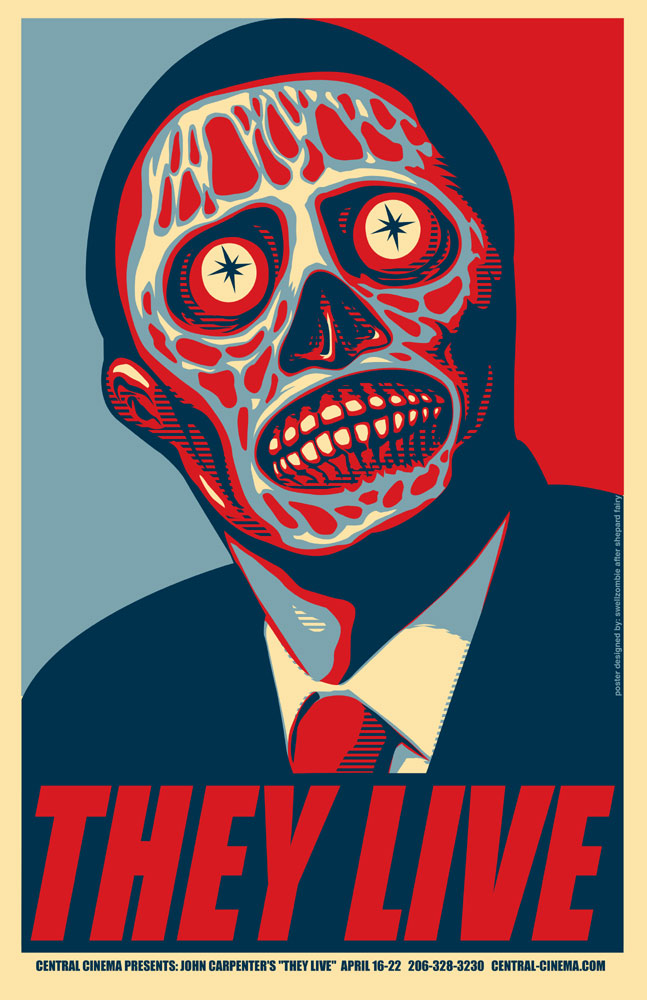
Life Imitates “They Live”

Obama-They-Live

Melissa Melton of Truthstream Media recently posted a story about former wrestler and actor Roddy Piper going public about his Libertarian and pro-Second Amendment beliefs via twitter. Quoting from the tweets:

They can’t have my Guns! Nobody! If you try and take my Gun, I’d be all out of Bubble Gum!

[…]I need to clean something up! When I say you take my gun I’m all out of gum….I’M NOT TRYING TO BE FUNNY!! It’s a FREEDOM STATEMENT!

[…]They Live is a documentary!!

For those who haven’t seen the film They Live, this is the famous “bubblegum scene” Piper is referencing:

They Live is a cult classic sci-fi/action buddy film based on the short story Eight O’Clock in the Morning by Ray Faraday Nelson (who happened to be one of Philip K. Dick’s closest friends). Roddy Piper plays Nada, a drifter searching for work during a recession who accidentally stumbles across an alien plot to take over the world by programming the masses to obey and consume using subliminal messages. Widely considered one of director John Carpenter’s best and smartest films, it was also part of a late 80s sub-genre of films containing as a subtext sharp critiques of U.S. government policies and the Reagan administration in particular. Other films include Wes Craven’s “The People Under the Stairs”, Paul Verhoeven’s “Robocop” and Dan O’Bannon’s “Return of the Living Dead”.

Just this past May, John Carpenter did a Q&A for a 25th anniversary screening of They Live as part of The Hero Complex Film Festival in Los Angeles. He had this to say about the film:

By the end of the ’70s there was a backlash against everything in the ’60s, and that’s what the ’80s were, and Ronald Reagan became president, and Reagonomics came in,” Carpenter told the sold-out theater at the Chinese 6 Theatres in Hollywood. “So a lot of the ideals that I grew up with were under assault, and something called a yuppie came into existence, and they just wanted money. And so by the late ’80s, I’d had enough, and I decided I had to make a statement, as stupid and banal as it is, but I made one, and that’s ‘They Live.’ … I just love that it was giving the finger to Reagan when nobody else would.

Read the full article here: http://herocomplex.latimes.com/movies/john-carpenter-they-live-was-about-giving-the-finger-to-reagan/#/0

Unfortunately, since the release of They Live, the state of the union has regressed to the point where the systemic criminality of the Reagan era seems mild and quaint in comparison. In certain ways, They Live does seem like a documentary because it contains images and ideas straight out of the headlines. Scenes of the protagonists’ tent city being bulldozed look exactly like the destruction of Occupy Movement encampments and forced closures of tent cities for the homeless across the country. Images of the aliens’ secret surveillance drones are prescient as well.

Melton’s Truthstream Media post also included this analysis of subliminal messages eerily reminiscent of They Live embedded in an old video clip used as nightly “sign-offs” for national television networks:

Read the full post here: http://truthstreammedia.com/?p=6717

Podcast News Updates

the-5th-horseman

There’s been another string of relevant news podcasts in the past few days so it’s time for another roundup post.

Last week Rob Kall of OpEdnews.cominterviewed Peter Ludlow a professor of linguistics and philosophy, on topics including systemic evil, whistleblowers and hacktivism:

https://itunes.apple.com/us/podcast/rob-kall-bottom-up-radio-show/id359765013

On Friday, Abby Martin of Breaking the Set did an excellent job deconstructing the corporatocracy on Coast to Coast AM with John Wells:

http://www.mediaroots.org/abby-martin-deconstructs-the-corporatocracy-on-coast-to-coast-am/

On Monday Nellie Bailey and Glen Ford of Black Agenda Report covered a wide range of important topics including an update on the corporate plan for Detroit (an American apartheid), the struggle to raise the minimum wage in Seattle, and Dave Swanson’s (of WarIsACrime.org) analysis of the multitude of lies in Obama’s recent UN speech : Listen to Black Agenda Radio on the Progressive Radio Network, with Glen Ford and Nellie Bailey – Week of 9/30/13.

From Traces of Reality there were two great consecutive shows. On 9/30 host Guillermo Jimenez interviewed Kevin Gallagher, director of Free Barrett Brown.  Brown is the journalist who faces a 105 year sentence, the bulk of which is related to charges associated with pasting a link in a chat room. On the 10/1 episode, Guillermo is joined by Vice President of The Future of Freedom Foundation, Sheldon Richman. They cover topics including the “government shutdown”, the national debt, taxation, private property, the “social contract,” and the fallacy of the “consent of the governed.”:

9/30

10/1

Why Does the Music Industry Keep “Underground Hip-Hop” Underground?

media-ownership

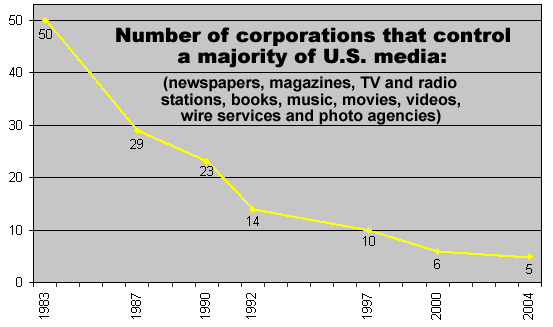
Timothy Alexander Guzman of Silent Crow News just posted an excellent analysis of the modern music industry (currently monopolized by a cartel of just a few dominant entertainment corporations) and their effect on society.

Highlights from the article:

The Corporate Music industry has had a monopoly on what youths from all around the world listen to. They have been controlling the thoughts and beliefs of our youths and even adults through their control of the music industry. The Music industry is a multi-billion dollar business. There are now “Big Three” record labels since 2012 that include Sony Music Entertainment, Warner Music Group and Universal Music Group that dominate the market. They control the artist and set what percentage of the sales receipts they keep as profits. They also keep the competition between the major record labels at a minimum since they are already a monopoly.

…There are many “underground Hip-Hop artists that are politically conscious-driven such as Common, Flobots, Dead Prez, Rebel Diaz and many others. Lowkey is another underground Hip-Hop artist, a former member of Poisonous Poets, lives in the UK and has traveled the world in support of Anti-war and human rights causes. He announced last year that he will leave the Music Industry to pursue his studies. Lowkey is a rapper that can easily be distinguished from main stream rappers. He has numerous albums produced independently that include Dear Listener, Soundtrack to the Struggle and Uncensored. One of his most popular songs is called ‘Obama Nation’. He has toured the world with several rappers including Talib Kweli and Lupe Fiasco. He is an influential part of the underground world of Hip-Hop music transforming how rap music can be used to inform and educate people not to turn them into consumers. Lowkey is one of several rappers who are at the forefront. The main stream media does not mention Lowkey, instead they continue to play Hip-Hop music from the likes of Kanye West, Jay-Z, Snopp Dog among many others. Their Music has no substance or positive meaning behind the lyrics. It is music that destroys the minds of urban youths. But according to the media whether based in the United States, Great Britain and Israel, all criticize Lowkey. The Jewish Chronicle Online describes in a 2011 article how Lowkey and other artists such as Elvis Costello can become a “Potential Nightmare” that can influence youths during an event organized by the Palestine Solidarity Campaign for the second anniversary of Operation Cast Lead and the Gaza conflict that killed thousands:

One expert studying anti-Israel activity described the increasing influence of performers such as Lowkey as a “potential nightmare,” and compared the impact of his backing for the campaign to the effect of artists such as Annie Lennox and Elvis Costello attacking the Jewish state.

…Many rappers in the West come from poor neighborhoods where crime, drugs and high incarceration rates affects their communities and do rap about “life in the ghetto”. But many rap about sex, drugs, prison and money. I have seen rap videos where they have numerous women on multi-million dollar yachts as Jay-Z’s video called ‘Big Pimpin’. According to Dr. Carolyn West, associate professor of psychology and the study of prevention of violence at the University of Washington said “What’s changed over time is the greater sexualization of hip-hop. Initially, it started off as a revolutionary form of music. Now, large corporations produce images that sell, and there is a blatant link between hip-hop and pornography” in a Pittsburg Post-Gazette article in 2008 called ‘Researcher cites negative influences of hip-hop.’ Rappers promote business agenda’s for the music industry where advertisements and propaganda prevail over young minds. Lowkey raps about real issues that affect life on earth. He wants his music to make a change in society. Why does the main stream media (MSM) and the Music industry criticize Lowkey? Why does the Jewish Chronicle Online call him and other musicians of consciousness a “Potential Nightmare?” Can Lowkey’s music inspire youth to seek change or the truth for that matter? Yes, the MSM and the music industry want to keep youths interested in issues that don’t matter. They want them to follow “Uninspiring rappers” who are about nothing. The majority of rappers are used by the major labels to sell propaganda. They use rappers to further demoralize people who have no idea what is happening in their communities and the world. Do music fans who follow main stream rappers know who Lowkey is? I doubt it. But I will bet that the state of Israel does. In 2009, Lowkey was detained in Israel, when he arrived in Tel Aviv’s airport for 9 hours.

Read the full article here: http://silentcrownews.com/wordpress/?p=2405

I highly recommend reading the entire post at Silent Crow News, which includes excerpts of interviews with Jay Woodson (organizer of NHHPC, National Hip Hop Political Convention), Lauryn Hill, Lowkey, and Cee-Lo Green.

Channel Surfing

A compilation of some of the best non-corporate alternative news clips from the past few days.

9/17 On Episode 237 of Breaking the Set,  Abby Martin and guests commemorate the second Occupy Wall Street anniversary.

9/18 At the WeAreChange channel, Luke Rudkowski interviews Everett Stern, a former employee of HSBC who blew the whistle on the company’s criminal schemes.

9/19 Ben Swann of Reality Check takes a look at three of the biggest current controversies surrounding Monsanto (one of the world’s most hated corporations).

9/19 Global Research TV’s James Corbett reports on inconsistencies and video manipulation that calls into question the official narrative of the Syrian chemical weapons attack.

9/19 Secular Talk gives a blistering critique of John McCain’s recent Pravda op-ed.

Joy Camp and WeAreChange.org introduce the iPhone 5nSa.

Post the Wrong Link, Get 105 Years in Jail

NSA-Seal--43798

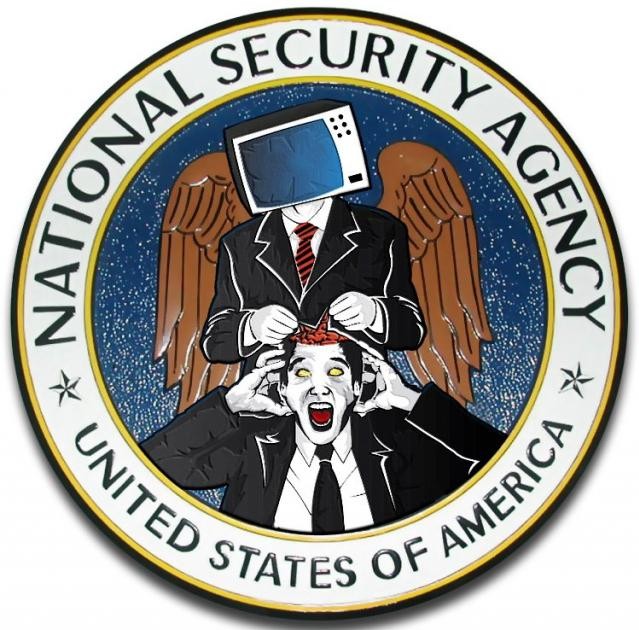
What kind of link does the government think warrants such punishment? Documents revealing the secrets-sharing relationship between government and private security companies, apparently. That was what Barrett Brown linked to, and was the root cause of his 105 year sentence. Brown is an author and activist journalist best known for his “spokesperson” role for the hacker collective “Anonymous”. He was also a close friend and associate of fellow journalist Michael Hastings, who was working on a story with Brown shortly before his death in a suspicious car explosion. In his last published article, Hastings wrote:

Transparency supporters, whistleblowers, and investigative reporters, especially those writers who have aggressively pursued the connections between the corporate defense industry and federal and local authorities involved in domestic surveillance, have been viciously attacked by the Obama administration and its allies in the FBI and DOJ.

…Barrett Brown, another investigative journalist who has written for Vanity Fair, among others [sic] publications, exposed the connections between the private contracting firm HB Gary (a government contracting firm that, incidentally, proposed a plan to spy on and ruin the reputation of the Guardian’s [Glenn] Greenwald) and who is currently sitting in a Texas prison on trumped up FBI charges regarding his legitimate reportorial inquiry into the political collective known sometimes as Anonymous.

…Perhaps more information will soon be forthcoming.

Christian Stork of WhoWhatWhy wrote a great piece on the connections between Michael Hastings, Barrett Brown, and Edward Snowden here: http://whowhatwhy.com/2013/08/07/connections-between-michael-hastings-edward-snowden-and-barrett-brown-the-war-with-the-security-state/

In 2010, Brown formed his own online collective called Project PM to investigate documents uncovered by Anonymous, Wikileaks and others. Among the documents they analyzed were ones involving the security company Stratfor Global Intelligence revealing close relationships between them, several other security contractors and several agencies of the government (including the NSA).

A recent article by Alfredo Lopez of OpEdNews.com covers the important details about the case and why it matters for all of us who believe in freedom of speech and freedom of information. The following excerpts outline why Barrett Brown’s case may also be of concern for everyone who uses the internet:

To make this personal, do you use links? Or, a less absurd question, are you sure the links you post don’t include criminal information? Today, there are an estimated 4500 federal criminal statutes and that means that, at some point in your life, you’ve probably violated federal law without knowing it. The same is true of the people who posted the material you are linking to. As ridiculous as it may seem, based on the Brown prosecution, you could be charged with a crime without having any involvement in it by linking to material posted by people who have no idea they committed a crime.

For example, here’s the link to the Stratfor files. While it indicates that these linked documents have now been cleansed of credit card information, I can’t be sure of that. Nor do I know that other information the government considers illegal (or may in the future) isn’t in there. I haven’t read all the documents. But based on what prosecutors are saying, if these files do contain information they eventually consider illegal, I could be charged with spreading it.

On the one hand, they attack privacy, which makes the Internet useful for us. Now they’re attacking links, the protocol that makes the Internet…well, the Internet. That’s something we can’t afford to lose

For those who might want to do something about this, there’s a website of people trying to organize a campaign in his support.

Read the entire article here: http://www.opednews.com/articles/When-Posting-a-Website-Lin-by-Alfredo-Lopez-Information_Internet_Internet_Internet-130918-548.html

At Traces of Reality Radio, host Guillermo Jimenez recently interviewed Christian Stork, author of the WhoWhatWhy article about the connections between Hastings, Brown and Snowden. They discuss Brown’s work and how he became a target of the FBI, how Project PM exposed HB Gary and Romas/COIN, the State Department and their use of “persona management software” and social media “sock puppets,” among other topics:

Show link: http://tracesofreality.com/2013/09/17/tor-radio-09172013-christian-stork-on-barrett-brown-project-pm-and-the-hidden-world-of-intelligence-contractors/