Colin Wilson’s “The Outsider”

51el43rwbvl-_sy344_bo1204203200_

(Editor’s note: We’re sharing this article today to commemorate the third anniversary of Colin Wilson’s passing.)

By Gary Lachman

Source: Reality Sandwich

This is an excerpt from my new book, Beyond the Robot: The Life and Work of Colin Wilson. Wilson rose to global fame sixty years ago, when his first book, The Outsider, became a bestseller overnight and sparked the nascent counter culture into a sudden blaze. It thrust the twenty-four year old Wilson into celebrity, and inaugurated the brief craze for the Angry Young Men, a kind of British buttoned-down version of the Beat Generation. Wilson had little in common with his other Angries, who were focused mainly on social issues. Wilson’s concern was the lack of spiritual tension in the modern world, and he quickly became known as Britain’s “homegrown existentialist,” rivaling Sartre, Camus and others on the existential scene with his analysis of the modern predicament. Wilson’s path to success was bumpy. In the years before The Outsider he had worked at dozens of menial jobs, always moving on when he got bored. He survived a suicide attempt, hitchhiked across England and France, hob nobbed with bohemians in London and Paris, and slept rough on Hampstead Heath while writing by day in the British Museum. He died in 2013 at the age of 82.

Wilson’s success was short-lived, and soon after celebrating him the press and the critics, ever fickle, brought him down, the boy genius now persona non grata. Wilson went on to write an enormous number of books, over a remarkable range of subjects, from criminality and sex to the paranormal and mystical experience, as well as many novels, such as Ritual in the Dark, about a modern-day Jack the Ripper, and The Mind Parasites, a phenomenological science fiction thriller about alien psychic vampires in the mind…

This section introduces Wilson’s character of the Outsider, a person who has a hunger for meaning and purpose that the modern world cannot provide, and who must discover the “secret life” within him or face death, madness, or quiet despair.

In The Outsider Wilson made his first attempt at analysing a character he felt was peculiar to our age, a person with a pressing hunger for meaning and spiritual purpose in a world seemingly bent on denying him these. In the past, during the Middle Ages, such an individual could have found a home in the church, which was then the heart of life, and which provided a place, monasteries, where he could work toward his salvation – work, that is, to awaken the spiritual life within him, to grasping his purpose with an unwavering seriousness. That purpose was to become something greater than himself, to work against the laziness and complacency that keeps him second-rate and allows him to be satisfied with being “only human.”

But today, in our modern society, geared toward comfort and security and motivated by purely material aims, there is no place for such a person, and his spiritual seriousness is a liability. His or her desire to be something more than a happy, well-fed animal, puts him at odds with the world around him. This type is driven by needs that the people he knows do not understand. For him the world that they complacently accept is false. He sees “too deep and too much” and his awareness of the illusions that satisfy others brings him to despair. He is not at home in the world, his permanent sense of self-dissatisfaction does not allow him to be. This dissatisfaction cannot be met by any changes to the social or economic system, as Marxists like the theatre critic Kenneth Tynan, one of the Angry Young men, believed. “The question of freedom,” Wilson writes, “is not a social problem.” Only by the long, difficult, personal struggle to self-realization can the Outsider realize his goal. That realization, or actualization, as the psychologist Abraham Maslow, one of Wilson’s earliest readers, called it, requires an “intensity of will” and is fostered by anything that arouses one’s “will to more life.”

This path is difficult. The Outsider at first feels himself a kind of misfit, a “lone nutter,” and his dissonance from the Insiders, those content with the world of the second-rate, leads to neurosis. There must be something wrong with him, he believes, and he may try to “fit in.” Usually he fails, and winds up occupying an uncomfortable middle realm. He cannot accept the world and its triviality, but he is not strong enough to escape from it completely or to impose his own seriousness upon it. This may lead to nothing more than a life of quiet desperation, or the Outsider may smoulder with resentment at the insects around him, and lash out indiscriminately – as Wilson’s explorations of the “criminal” Outsider will show, this can have deadly results. But if he is lucky, there are moments of vision, when a sense of power and meaning comes to him and he sees that he is not a misfit, and that the hunger and dissatisfaction that drives him, and which drove the mystics and saints of the past, are more real than the newspapers, television, and mediocrity he abhors.

It is a vision of “a higher form of reality than he has so far known,” a glimpse of what Wilson calls “the secret life,” that sense of total affirmation that he had experienced more than once by now. But then the vision fades. The Outsider is back on earth and is left wondering what the vision was about and why he must return to the dreary treadmill. The Outsider examines the possibility of restoring the vision, of so strengthening one’s grasp on one’s sense of purpose that it is not weakened or confused by the banality of “life.”

Wilson’s notebooks were full of observations of such figures, of Outsiders who were not able to survive their clashes with the world and who succumbed to illness, suicide or madness, who were not quite strong enough to impose their vision on their contemporaries. What went wrong? Why did giants like Nietzsche, Nijinsky, Van Gogh, T. E. Lawrence, and others fail? To say they failed is not, of course, to diminish their greatness. But Nietzsche and Nijinsky went insane, Van Gogh shot himself, and Lawrence went into a kind of spiritual suicide, burying himself as a private in the RAF at the height of his fame. Why did so many poets and writers of the nineteenth century end in a kind of self-destruction? Shelley, Keats, Poe, Hölderlin, Schubert, Hoffman, Schiller, Kleist, Rimbaud, Verlaine, Lautreamont – this list of nineteenth century geniuses who either died young, went mad, killed themselves or succumbed to alcohol or drug addiction could go on.

Why did it happen? Could it have been prevented? All were infused with the Romantic vision that burst upon western consciousness in the late eighteenth century, the insight that informed the music of Beethoven and the poetry of Blake. This was the sense, lost in the modern age, that human beings are really gods, or at least are meant to be, if only they could overcome their laziness and timidity. The Outsider is an exploration of the psychological and spiritual stresses that these and other men of genius faced in the search for their true selves. “The Outsider,” Wilson tells us, “ is not sure who he is. He has found an ‘I’, but it is not his true ‘I’. His main business is to find his way back to himself.”


‘Fake news stories’ eclipse ‘conspiracy theories’ in globalist/Sorosite lexicon

fakenews

By Wayne Madsen

Source: Intrepid Report

The corporate news media, allied with “media watchdog” groups, many financed with global billionaire troublemaker George Soros, have trotted out a new dog whistle to attack their opponents: “fake news stories.” The issue of “fake news stories” was even raised by outgoing President Barack Obama in a news conference in Berlin with German chancellor Angela Merkel. Both leaders cited “fake news stories” as something that threatens international stability.

Of course, there are an ample number of fake news stories that emanate from disreputable and discredited websites, many of them vanity sites intending to serve as “click bait” for the unsuspecting web surfer and even a few professional journalists taken in by alarmist headlines. A number of individuals have been duped by totally fake stories written by “Sorcha Faal,” a pseudonym for David Booth, allegedly a U.S. computer programmer and which may also be a pseudonym for another individual or group of individuals. Faal, Booth, or whatever his name is acts as a cyber version of an arsonist who releases fake stories attributed to Russian intelligence sources and then sits back to assess the impact of his prankster works. The fact that a number of Russian news organizations have re-published Faal/Booth fake articles as actual news leads some to believe that U.S. intelligence plays a role in the obvious disinformation operation. Faal/Booth has a number of competitors in the field of cyber-pranksterism.

However, the most prominent purveyors of fake news stories are the very corporate media entities that decry “fake news.” There are a number of examples of corporate media trafficking in fake news. The following are a few stark examples:

  • In 1981, Washington Post reporter Janet Cooke was awarded a Pulitzer Prize for a story about an 8-year old heroin addict named “Jimmy.” Washington, DC, Mayor Marion Barry was taken in by the story and launched a city-wide effort to search for “Jimmy” and provide him with treatment. Barry claimed “Jimmy” was real but, in fact, Cooke made up the entire story of “Jimmy’s World” and Barry lied about the supposed existence of the boy. Although Cooke’s story was totally fake, Post assistant managing editor Bob Woodward submitted it to the Pulitzer committee for an award for best feature writing. Woodward, who concocted the fictional “Deep Throat” source in his Watergate reporting for the Post, was never sanctioned for advancing a fake story for a supposed serious professional journalism honor. The Post can be attributed to two major “fake news stories”—”Jimmy” the heroin addict and “Deep Throat” the high-level Nixon administration source who was not FBI deputy director Mark Felt.
  • New York Times reporter Jayson Blair wrote a series of fake news stories for the so-called “paper of record.” The following are a few of his fake news headlines that appeared in the Times:


October 30, 2002—”US Sniper Case Seen as a Barrier to a Confession.”
February 10, 2003—”Peace and Answers Eluding Victims of the Sniper Attacks.”
March 3, 2003—”Making Sniper Suspect Talk Puts Detective in Spotlight.”
March 27, 2003—”Relatives of Missing Soldiers Dread Hearing Worse News.”
April 3, 2003—”Rescue in Iraq and a ‘Big Stir’ in West Virginia.”
April 7, 2003—”For One Pastor, the War Hits Home.”
April 19, 2003—””In Military Wards, Questions and Fears from the Wounded.”

Blair made up from whole cloth stories about the DC sniper and Iraq war veterans. In all, 36 of the 73 national stories penned by Blair were fake. However, a number of media outlets, including the Times, reported as fact fake stories about Saddam Hussein’s “weapons of mass destruction,” all of which were false. New York Times reporter Judith Miller reported as fact information from Iraqi exiled leader Ahmed Chalabi alleging that Iraq possessed mobile weapons laboratories. The information was false, as was other U.S. “intelligence” on Iraq that was fed Miller and other reporters that was all bogus, including stories on Saddam Hussein allegedly trying to procure yellow cake uranium from Niger.

  • In May 1998, Stephen Glass of The New Republic wrote an article titled “Hack Heaven” about a 15-year old hacker and a non-existent software firm called “Jukt Micronics.” It was later determined that 27 articles Glass wrote for The New Republic were fabrications.
  • USA Today reporter and Pulitzer nominee Jack Kelly allegedly fabricated a number of stories for the newspaper, including a 1999 story alleging that the Yugoslavian armed forces was ordered to ethnically cleanse an Albanian village in Kosovo.
  • The Dateline NBC story of November 17, 1992, titled “Waiting to Explode” and alleging that poor fuel tank design caused General Motors’ pick-up trucks to explode on impact was based on rigged tests and staged explosions.
  • NBC anchor Brian Williams was suspended after making several false claims about his prior reporting. He claimed to have been riding on board an Army Chinook helicopter that was forced to land in an Iraqi desert after it was hit by a rocket-propelled grenade. The story was false as was another in which Williams claimed to have flown into Baghdad with Navy SEAL Team 6. Williams also falsely claimed to have seen a man commit suicide in the New Orleans Superdome in the aftermath of hurricane Katrina. Williams also claimed to have personally witnessed the Berlin Wall coming down. He was not in Berlin until a day after the wall fell.
  • In 2013, CBS “60 Minutes” interviewed a U.S. security contractor who claimed he witnessed the attack on the U.S. compound in Benghazi, Libya on September 11, 2012. The contractor was not in Benghazi during the attack and the account was bogus.
  • Rolling Stone published a falsified story in 2014 about a University of Virginia gang rape victim named “Jackie” and school administrator Nicole Eramo. The magazine falsely claimed that Eramo covered up rape incidents at the university. A federal jury later found that Rolling Stone libeled Eramo.
  • Several news organizations falsely claimed that security guard Richard Jewell was the chief suspect in the July 27, 1996, bombing of Centennial Olympic Park in Atlanta. Jewell successfully sued CNN, The Atlanta Journal-Constitution (“FBI suspects ‘hero’ guard may have planted bomb”), NBC, and The New York Post for libel.
  • Fox News often featured a commentator named Wayne Simmons, described by the network as a former CIA “operative.” In fact, Simmons never worked for the CIA and he was a fraud. He was later sentenced to 33 months in prison for his fraudulent activities.

The corporate media is legitimized by a very phony “arbiter” of what and what does not constitute accurate news: the very problematic Snopes.com. Snopes traffics in as much fakery in its “debunking” of alternative media articles as does the corporate media in its national and international reporting.

It is clear that Obama, Merkel, the Soros operation, and others are attacking “fake news stories” in order to hide the real target for their invective rhetoric: the alternative media, which does not kow-tow to corporate executives, advertisers, and special interests ranging from Big Pharma to the Israeli Lobby. The alternative media provides the lifeblood for the First Amendment guarantee of freedom of the press. The corporate media is a bloated and deceitful artifice whose time is coming to an end.


Related Videos:

Libeled by the Washington Post in a ‘False News’ McCarthyite Attack on Alternative Media

america-under-communism

By Dave Lindorff

Source: This Can’t Be Happening

Is the Pentagon behind this massive hit on independent journalism?

Facebook and Google Ready to Kill Alternative Media for the Government

facebook-censorship

By Jake Anderson

Source: AntiMedia

This week three media goliaths — Facebook, Google, and Twitter, who collectively act as information gatekeepers for the Internet — announced they would begin implementing censorship practices against news sites they deem misleading.

Websites that publish “fake,” misleading, or even satirical news will now be subject to a sliding scale of infractions that will target ad revenue and social media algorithms. Without ad revenue from monetization platforms like Google Adsense, many of these sites would not be able to continue publishing, and without Facebook’s distribution platform, even sites with good organic reach could find their traffic severely crippled.

“Moving forward, we will restrict ad serving on pages that misrepresent, misstate, or conceal information about the publisher, the publisher’s content, or the primary purpose of the web property,” Google stated, following the lead of Mark Zuckerberg.

On a proprietary note, do these companies have the right to restrict users of their services who they deem to be in breach of contract? Yes. Is it understandable to want to exert some control over hacks who manipulate search engine and social media algorithms at the expense of a misinformed public? Yes. Does this exonerate the intellectual and cultural crime of using the specter of online ‘yellow journalism’ to deliver a crippling blow to the revenue streams of independent media…?

The move comes after Facebook and Google found themselves taking a lot of heat after the election. (Liberal) detractors went so far as to blame Facebook and Google for Trump’s win, claiming the constant online echo chamber of sensationalist news, unsubstantiated claims, and apocryphal headlines paved the way for Clinton’s electoral collapse.

The new restrictions will target a wide variety of websites: sites whose editorial content is deemed (by, Google, Facebook and Twitter’s board of directors, presumably?) false or misleading; sites that intend to invoke outrage with clickbait-y titles; and even sites that are purposely fake (such as the Onion’s sister site, Clickhole) for satirical purposes.

The websites on the new blacklist include Zero Hedge, The Free Thought Project, Collective Evolution, Disclose.TV, and dozens of others. The selections run the gamut from partisan propagandistic sites to alternative philosophy and healing resources. Unsurprisingly, alt-right darlings Infowars and Breitbart, both of which will soon wield vast power in the Trump administration, are targeted. In the case of Infowars, one might surmise the conservative Trumpland publication’s insistence that Hillary Clinton’s inner-circle practices satanic rituals had something to do with their inclusion on the list.

Some of the other sites on the list are surprising. Collective Evolution, as an example, may be considered by some to have New Age influences, but many of their articles practice sound journalistic ethics.

Why such a draconian response? Some analysts believe “fake news” had a role in flipping the results of the election away from what the mainstream media had predicted — away from their carefully groomed candidate. Their conscription of Google, Facebook, and Twitter (which may institute something called ‘mute’ filters) in order to exact revenge may cripple, if not destroy, an alternative media infrastructure that has grown into a formidable challenge to the traditional media establishment.

Because of how blatantly fascistic this move is, I struggle to respond to those who say, ‘Well, some of these sites are bad.’

Yes, some of them are, but that’s not the point. The point is that this is a Pandora’s Box scenario. Once we give the Corporate State the ability to curate online content via punitive measures, we’ve bestowed upon them the power to act as gatekeeper for a stunning amount of public knowledge. This is crony capitalism integrated into the very ethos of the fourth estate, using groupthink and the free market to drown out sites that don’t make the cut of acceptable. They will now be able to go through all news stories and delegate carte blanche which ones are “false” and must therefore be algorithmically and punitively castrated. They already used Russia as an excuse to not acknowledge Wikileaks impeccably researched leaks. What won’t they stoop to in order to conceal their future transgressions?

It will actually likely end up resembling aspects of the TPP (Trans-Pacific Partnership). In that (hopefully dead) trade agreement, corporate tribunals would have been given the power to overrule national laws that hurt their profits. Similarly, with the “fake news” control mechanism, the political-media-industrial complex will be able to determine which stories are damaging to their geopolitical and domestic narratives and then use Google, Facebook, and Twitter to suffocate any news articles that challenge these narratives. Half-truths and controversial op-eds will be cited as reasons for bans. Hacked information from Wikileaks cables could be cited as specious and without corroboration, or, more likely, Russian espionage (well, if Clinton were still around, at least).

There is another parallel, and it’s nothing less than 9/11 itself. After the terrorist attacks that tragically took the lives of over three thousand Americans, the government used the nation’s fear and collective trauma to ram through the Patriot Act, which created a matrix of laws that has been stripping us of our civil liberties for over 15 years. It appears the political establishment wants to use Clinton’s loss in a similar way: to bottle public anger over the election into the deliverable censorship of grassroots media. I’ve been claiming for months that the government’s next war would be on hackers and publishers of hacked material. It appears I may have been wrong (oops, I guess Google and Facebook ought to break our site over their knee). The next war could be on independent media, who the establishment rightfully believes is one of their biggest enemies at the moment. Who else can expose to everyday Americans that the government and their corporate goon-slaves are full of the worst kind of shit?

Let’s be clear: there are certainly sites on the list that publish bad journalism, sloppy journalism, or straight up lies. And sometimes it’s easy to find them. After all, Professor Melissa Zimdars (who contributed to the list) made the following astute point:

Odd domain names generally equal odd and rarely truthful news.”

But whether or not some sites practice questionable editorial standards is completely beside the point. By attacking the finances of alternative media sites who publish controversial but well-researched journalism, the government is blacklisting an entire movement. The precedent Google and Facebook will establish with this move will have incalculable ramifications on the future of alternative media and the Corporate State’s ability to censor any story they deem dangerous. This is nothing short of a two-step with fascism.

If they don’t want “misleading” news, they better kill the networks.

Let’s unpack this for a moment and pretend that truthful journalism is really what Google and Facebook are after. If that were the case, they would need to cut off the revenue streams of CNN, MSNBC, NBC, ABC, Fox, CBS, and all of the other mainstream news channels — you know, the same ones that collectively manipulated us into accepting the Iraq War and the subsequent regime change policies that have killed millions in the Middle East. And, see, that’s precisely the reason the mainstream media would never be held to these kinds of standards: they are a division of the State Department; they help manufacture consensus. You see, their “fake” news is important; the government’s fake news is real news.

Beyond just propagating blatantly misleading and fraudulent news (I’d be remiss if I didn’t mention that the link I just used, which catalogs instances of mainstream media perpetuating false news, is on the new official list of “fake” news), the networks have long been guilty of commission by omission — curating the news cycles so that stories on critical issues like Standing Rock, TPP and others get a fraction of the air time of, say, an airplane crash or Trump’s latest gaffe.

This is Trojan horse for the government

In the Deep State (which you won’t hear even a mention of on network news), the government operates as a series of revolving doors between private defense contractors, media conglomerates, the surveillance apparatus, and giant financial institutions. After the revelations of Snowden (source is another from the list of fake news – be wary!), it became clear that the government was spying on and data mining American citizens with impunity in ways far worse than even 1984 had imagined.

Caught with their pants down, the government stopped, right? No. In fact, they doubled down, except they did something smart: they farmed it out to corporations and created a new synergistic surveillance state. Without Silicon Valley, many of the NSA’s transgressions could have never come to pass. Similarly, the government will now outsource its censorship game to corporations. Ironically, it will be Google and Facebook, two companies that represent the 21st century Information Age, who will be holding the cuffs.

This is another example corporations pitch hitting for the government, and it sets a horrifying precedent.

What can you do?

1. Don’t listen to them. Trust independent media (while being extremely discerning) over corporate media.

2. Help in the effort to create alternative and underground internet and social media infrastructure. A huge part of this is holding independent media accountable to accurate reporting, confirming sources, and obtaining original documents. Alt. media doesn’t have the same financial resources available to them, but with the ubiquity of the Internet, there’s no excuse for sloppy reporting.

3. Support alternative media with donations and content sharing.

4. Boycott mainstream media.

5. Tell Google and Facebook you disagree with censorship.

6. Encrypt (always encrypt). This isn’t necessary for some journalists — but if you are breaking a big story you should be using anonymous web tools like Tor, a VPN, as well as using encryption to transmit and unlock messages. Take a look at the Twitter account of information activist Cory Doctorow. He lists a long string of numbers and letters. That is his public key, otherwise known as asymmetric cryptography, which allows him to communicate information privately and anonymously. In the future, it will be unthinkable for journalists to not protect themselves, their data, and their sources in this way.

Who Lost: A Biased Media, Pundits, Pollsters, Political Parties, Warmongers, the Corporatocracy, Pay-to-Play Grifters, Neoliberals

1596525_630x354

Editor’s Note: While the parties mentioned may have lost in the short run, it’s likely they’ll soon regroup for future assaults on humanity and the planet.

By Charles Hugh Smith

Source: Of Two Minds

Fake Progressives are perfectly fine with soaring inequality and corrupt governance, as long as everyone’s public utterances are politically correct.

Sometimes who lost is more important than who won. Let’s review who lost the election:

1. Let’s start with the Corporatocracy, which expected to once again wield unlimited influence by funding political campaigns with millions of dollars in contributions and speaking fees.

2. A biased mainstream media. My mom-in-law was watching CBS all night, so that’s what we watched. All the pundits/anchors spoke in the hushed tones of a funeral. For two hours, the only images of campaign workers shown were the sad faces of Clinton supporters; not one image of jubilant Trump supporters was broadcast until Trump gave his acceptance speech.

When one of the talking heads noted that Hillary never generated the enthusiasm of the Sanders or Trump campaigns, his comment was followed by a stony silence. That he had given voice to a self-evident truth was not welcome.

3. Mainstream punditry: they got it wrong from the start and remained close-minded and arrogant in their postured superiority.

The punditry applied a double standard to Trump and Hillary. Trump’s speeches and ethically questionable history were judged by moral standards, and he was declared unfit.

Hillary’s actions, on the other hand, were judged by strictly legalistic standards: well, you can’t indict her, so she’s fit for office.

Dear punditry: you can’t use double standards to promote your biases and retain any shred of credibility.

4. Pollsters. Having rigged the polls via over-sampling and under-sampling, they were laughably wrong. Here is a typical headline from election night, from the New York Times: Trump Takes Florida, Closing In on a Stunning Upset.

Only the pollsters and the MSM were stunned.

5. Political parties. As my friend G.F.B. observed, both parties ran 20th century campaigns in the 21st century. Both parties lost for this reason; both are hopelessly out of touch with a rapidly changing America.

Democrats upset with losing should look at their party’s system of Super-Delegates that squelched Bernie Sander’s bid.

6. Warmongers. Many Americans are sick and tired of interventionist, globalist warmongering. The only possible way they could register their opposition to warmongering was to vote for Trump.

7. Pay-to-Play Grifters. Let the investigations, indictments, prosecutions and convictions begin as soon as Trump is sworn in.

8. Neoliberals. Globalization boils down to freeing mobile capital to rove the globe for opportunities to strip-mine cheap resources, assets and labor and then move on, leaving ruined communities behind.

9. Bonus loser: Fake Progressives. Fake Progressives are perfectly fine with soaring inequality and corrupt governance, as long as everyone’s public utterances are politically correct. So the oppressor class is acceptable as long as they speak respectfully while stepping on your neck.

Real Progressives see jobs and community as solutions, not welfare and central planning. Real Progressives see the eradication of warmongering Imperial pretensions and corrupt pay-to-play grifting as the essential projects of liberty and democracy.

How Does Corporate Media Manufacture False Narratives?

aa-corporate-media-very-good-poster

By Nauman Sadiq

Source: RINF

What bothers me is not that we are unable to find the solution to our problems, what bothers me more is the fact that neoliberals are so utterly unaware of the real structural issues that their attempts to sort out the tangential issues will further exacerbate the main issues. Religious extremism, militancy and terrorism are not the cause but the effect of poverty, backwardness and disenfranchisement.

Empirically speaking, if we take all the other aggravating factors out: like poverty, backwardness, illiteracy, social injustice, disenfranchisement, conflict, instability, deliberate training and arming of certain militant groups by the regional and global players, and more importantly grievances against the duplicitous Western foreign policy, I don’t think that Islamic State, al-Qaeda and the likes would get the abundant supply of foot soldiers that they are getting now in the troubled regions of Middle East, North Africa and South Asia.

Moreover, I do concede that the rallying cry of “Jihad in the way of God” might have been one reason for the abundant supply of foot soldiers to the jihadists’ cause, but on an emotional level it is the self-serving and hypocritical Western interventionist policy in the energy-rich Middle East that adds fuel to the fire. When Muslims all over the Islamic countries see that their brothers-in-faith are dying in Palestine, Syria, Iraq, Libya, Yemen and Afghanistan, on an emotional level they feel outraged and seek vengeance and justice.

This emotional outrage, in my opinion, is a far more potent factor than the sterile rational argument of God’s supposed command to fight holy wars against the infidels. If we take all the other contributing factors, that I have mentioned in the second paragraph out of the equation, I don’t think that Muslims are some “exceptional” variety of human beings who are hell-bent on killing the heretics all over the world.

Notwithstanding, it’s very easy to distinguish between the victims of structural injustices and the beneficiaries of the existing neocolonial economic order all over the world. But instead of using words that can be interpreted subjectively I’ll let the figures do the talking. Pakistan’s total GDP is only $270 billion and with a population of 200 million it amounts to a per capita income of only $1400. While the US’ GDP is $18 trillion and per capita income is in excess of $50,000. Similarly the per capita income of most countries in the Western Europe is also around $40,000. That’s a difference of 40 to 50 TIMES between the incomes of Third World countries and the beneficiaries of neocolonialism, i.e. the Western powers.

Only the defense budget of the Pentagon is $600 billion, which is three times the size of Pakistan’s total GDP. A single multi-national corporation based in the Wall Street and other financial districts of the Western world owns assets in excess of $200 billion which is more than the total GDP of many developing economies. Examples of such business conglomerates are: Investment banks – JP Morgan, Goldman Sachs, Barclays, HSBC, BNP Paribas; Oil majors – Exxon Mobil, Chevron, BP, RDS, Total, Vitol; Manufacturers – Apple, Microsoft and Google.

On top of that, semi-legit wealth from all over the world flows into the Western commercial and investment banks: last year there was a report that the Russian oligarchs have deposited $800 billion in the Western banks, while the Chinese entrepreneurs have deposited $1.5 trillion in the Western financial institutions.

Moreover, in April this year the Saudi finance minister threatened that the Saudi kingdom would sell up to $750 billion in Treasury securities and other assets if Congress passed a bill that would allow the Saudi government to be held responsible for any role in the September 11, 2001 terror attacks. And $750 billion is only the Saudi investment in the US, if we add up Saudi investment in Western Europe, and the investments of UAE, Kuwait and Qatar in the Western economies, the sum total would amount to trillions of dollars of Gulf’s investment in the US and Western Europe.

The first and foremost priority of the Western powers is to save their Corporate Empire, and especially their financial institutions, from collapsing; everything else like eliminating terrorism, promoting democracy and “responsibility to protect” are merely arranged side shows to justify their interventionist foreign policy, especially in the energy-rich Middle East.

Additionally, the irony is that the neoliberal dupes of the mainstream media justify and validate the unfair practices of the neocolonial powers and hold the victims of structural injustices responsible for their misfortunes. If a Third World’s laborer has been forced to live on less than $5 a day and a corporate executive sits in the Wall Street on top of $18 trillion business empire, neoliberals are okay with this travesty.

However, we need to understand that how does a neoliberal mindset is structured? As we know that mass education programs and mass media engender mass ideologies. We like to believe that we are free to think, but we aren’t. Our narratives aren’t really “our” narratives. These narratives of injustice and inequality have been constructed for the public consumption by the corporate media, which is nothing more than the mouthpiece of the Western political establishments and the business interests.

Media is our eyes and ears through which we get all the inputs and it is also our brain through which we interpret raw data. If media keeps mum over some vital structural injustices and blows out of proportion some isolated incidents of injustice and violence, we are likely to forget all about the former and focus all of our energies on the tangential issues which the media portrays as the “real” ones.

Monopoly capitalism and the global neocolonial economic order are the real issues while Islamic radicalism and terrorism are the secondary issues and itself an adverse reaction to the former. That’s how the mainstream media constructs artificial narratives and dupes its audience into believing the absurd: during the Cold War it created the “Red Scare” and told us that communism is an existential threat to the free world and the Western way of life. We bought this narrative.

Then the West and its Saudi and Pakistani collaborators financed, trained and armed the Afghan so-called “freedom fighters” and used them as their proxies against the Soviets. After the collapse of the Soviet Union they declared the former “freedom fighters” to be terrorists and another existential threat to the “free world” and the Western way of life. We again bought this narrative.

And finally, during the Libyan and Syrian proxy wars the former terrorists once again became freedom fighters – albeit in a more nuanced manner, this time around the corporate media sells them as “moderate rebels.” And the lobotomized neoliberal audience of the mainstream media is once again willing to buy this narrative, how ironic?


Nauman Sadiq is an Islamabad-based attorney, columnist and geopolitical analyst focused on the politics of Af-Pak and MENA regions, neocolonialism and Petroimperialism.

WikiLeaks’ 10 Most Damning Clinton Emails that Prove Mainstream Media is Scripted and Controlled

d435thf

By Jay Syrmopoulos

Source: The Free Thought Project

Washington, D.C. – With information coming out of WikiLeaks at a fast and furious pace, it’s difficult for the average person to keep up with the many bombshell revelations being exposed.  This is happening so much that the most damning evidence is ending up as background noise in the 24-hour election news cycle without ever making it into the mainstream news.

On October 7th, 2016, WikiLeaks publish thousands of emails belonging to John Podesta’s private email archives. More emails have been released in the days that followed. Podesta is Hillary Clinton’s 2016 presidential campaign Chairman. He previously served as Chief of Staff to President Bill Clinton and Counselor to President Barack Obama.

The Podesta emails give insight into why there has been such little fanfare in the mainstream media regarding many of the most damning allegations against Clinton.

The fact that most of the newsworthy information contained in the emails is not being reported by the corporate media is indicative of the incestuous relationship between the mainstream media and the Clinton campaign – and is on full display in the Podesta emails.

While there are dozens of bombshell revelations contained within the emails –including transcripts of speeches to Wall St. banks that Clinton had refused to release, hidden policy positions, and evidence of collusion with brutal regimes – the most damning is the collusion and control of the U.S. media on display in the emails.

Essentially, the media has been weaponized as a means of controlling public opinion by propagandizing the American people. World renowned academic Noam Chomsky, in his book “Manufacturing Consent: The Political Economy of the Mass Media,” detailed how U.S. media frequently serve as an errand boy for U.S. corporate, military and imperial interests.

Chomsky forwarded the idea of what he called a “propaganda model.” Although the book was written in 1988, it speaks precisely to what is currently taking place and clearly revealed  in the Podesta emails.

“The media serve, and propagandize on behalf of, the powerful societal interests that control and finance them. The representatives of these interests have important agendas and principles that they want to advance, and they are well positioned to shape and constrain media policy.” -Chomsky

With knowledge of what is currently transpiring, here are the ten most damning Clinton emails regarding the media’s collusion with her presidential campaign, with hotlinks to the original WikiLeaks release.

1. Clinton Staff hosts private “off-the-record cocktail party” with 38 “influential” reporters, journalists, editors, and anchors (from 16 different mainstream media outlets including CNN, NBC, CBS, NYT, MSNBC, & more) with the stated goal of “framing the race.”

2. Donna Brazile (CNN contributor at the time, and current DNC Chairman now) leaked CNN town hall questions to Hillary Clinton’s staff prior to the debate.

3. Clinton campaign and the New York Times coordinating attack strategy against Trump.

4. Glen Thrush, POLITICO’s chief political correspondent and senior staff writer for POLITICO Magazine, sends John Podesta an article for his approval. Writes: “Please don’t share or tell anyone I did this. Tell me if I fucked up anything.”

5. Huffington Post contributor Frank Islam writes to John Podesta in an email titled “My blogs in the Huffington Post”, says “I am committed to make sure she is elected the next president.” “Please let me know if I can be of any service to you.”

6. Clinton staffer “Placing a story” with Politico / New York Times: “place a story with a friendly journalist” “we have a very good relationship with Maggie Haberman of Politico” “we should shape likely leaks in the best light for HRC.”

7. John Podesta receiving drafts of New York Times articles before they’re published.

Clinton staff “placing a story with a friendly at the AP (Matt Lee or Bradley Klapper).”

More media collusion: NYT and AP “helpful” to Clinton campaign.

8. Clinton staff colluding with New York Times and Wall Street Journal to paint Hillary’s economic policies in a “progressive” light.

9. CNBC panelist colluding with John Podesta on what to ask Trump when he calls in for an interview.

10. Clinton staff appearing to control the release times of Associated Press articles.

The reality revealed in these emails is one of media collusion with powerful interests, which only serve to keep the American people in the dark about what is actually transpiring. The exact opposite of transparency.

Please share this article to wake people up to the fact that their news is scripted by powerful entities as a means of influencing people’s perceptions!

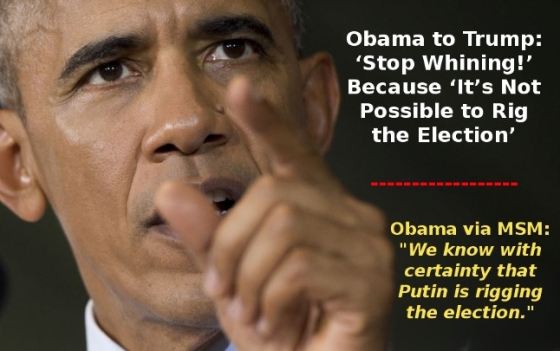
The Media Can’t Get Its Story Straight on Election Hacking

obamariggedelections

By Dan Engelke

Source: Who.What.Why.

In August, the corporate media was falling all over itself with breathless coverage on how Russia is interfering in the US election. Back then, stories citing experts suggested that voting machines were vulnerable to tampering that could change the outcome of the vote. A month later, something curious happened.

By September, government officials were doing all they could to tamp down those concerns, and the media duly reported their reassurances.

Should the public be comforted that election mischief will be homegrown?

The articles, usually citing active government officials, serve a dual purpose in reassuring the public: First, there is no way Russia can hack the election, despite cyber hacks in the Illinois and Arizona voter registration banks. Meanwhile, the message is also to insist Russian President Vladimir Putin is still giving orders to disrupt US cyberspace. This latter message culminated in the Obama administration publicly blaming the Russian government for trying to influence the election in early October.

Voter System vs Election System

The Washington Post began the trend on August 31 with the definitive headline “There’s Almost No Chance Our Elections Can Be Hacked by the Russians. Here’s why.”

The Post cites two major obstacles for potential (Russian) disruption of our election. One is the difference between the “voter system” and the “election system.” The voter system involves registered voter databases throughout the country, while the election system refers to voting machines and paper ballots.

According to executive director Merle King of the state-funded Center for Election Systems in Georgia, the public conflates these two issues about the election, and that leads to a lot of confusion.

The second hindrance for potential hackers is the decentralized voting process, the Post reported. A major positive for vote security, according to the Post, is that local jurisdictions set their own rules for how votes will be counted.

This claim is buttressed by a letter sent by state election officials to Florida voters which notes the public safeguards already in place for our voting process — including (1) layers of encryption for voting machines, (2) thumb drive backups of votes, (3) lack of internet connection to voting machines, and (4) a review of votes after an election.

The Los Angeles Times followed on September 8 with a report titled “Could Russian Hackers Mess with the US Election Results? It Wouldn’t Be Easy; Here’s Why.”

The Times also highlights the decentralized nature of the voting system as a safeguard against tampering. However, while the Post viewed the system as sophisticated, the Times saw the state-run and community-monitored systems as too cumbersome to be susceptible to any hacking.

Quoted again is Merle King, along with Connecticut Secretary of State Denise Merrill, and FBI Director James Comey. Pamela Smith of Verified Voting — an organization that highlights the susceptibility to election rigging — is also sourced to reassure readers that the upcoming election is safe, thanks to an uptick in paper ballot usage.

Russia’s Goal Not Hacking — But Scandal

On September 10, Washington, D.C.-based political newspaper The Hill worked the same dual agenda with “Hacking the Election is Nearly Impossible. But that’s not Russia’s Goal.”

Like the previous articles in the Washington Post and LA Times, The Hill presents the decentralized process of US elections as an impenetrable obstacle to Russian hacking. Bolstering the claims of election security in the piece are Florida’s Secretary of State Ken Detzner, Colorado’s Secretary of Wayne Williams, Pennsylvania Department of State spokesperson Wanda Murren, and Wisconsin’s Administrator of State Elections Division Michael Hass. The only non-governmental official quoted is Chris Porter, an administrator of strategic intelligence at cybersecurity firm FireEye Horizons.

Porter cited examples of Russian election tampering in the Ukraine and efforts to “create scandal,” despite their inability to hack the election.

The Chicago Tribune got its turn on September 14, quoting Assistant to the President for Homeland Security and Counterterrorism Lisa Monaco, who reiterated the safety of the election thanks to the decentralization of the voting process.

These assertions of election security and passive blame on Russia culminated in early October with the Obama administration publicly accusing “senior-most officials in Russia” of tampering with the election, despite their claimed inability to do so.

Taking a Screwdriver to the Election

Let’s go back to August to see why certain experts said that elections could indeed be tampered with.

Princeton professor Andrew Appel made headlines in August after hacking the Sequoia AVC Advantage electronic voting machine in seven minutes. Such machines are used in Louisiana, New Jersey, Virginia and Pennsylvania.

“[Appel] summoned a graduate student named Alex Halderman, who could pick the machine’s lock in seven seconds. Clutching a screwdriver, he deftly wedged out the four ROM chips — they weren’t soldered into the circuit board, as sense might dictate — making it simple to replace them with one of his own: A version of modified firmware that could throw off the machine’s results, subtly altering the tally of votes, never to betray a hint to the voter. The attack was concluded in minutes.”

Former government officials working in the cyber sphere have also warned of election tampering. Former White House counterterrorism czar Richard Clarke asserted: “Yes, It’s Possible to Hack the Election” on August 18.

“I have had three jobs that together [under Bill Clinton, George W. Bush, and Barack Obama] taught me at least one thing: If it’s a computer, it can be hacked.”

Special Interests and the Machines

Clarke sees the decentralized election system as the access point for potential tampering —rather than a potential safeguard. While there are safeguards, such as the voter tabulation through paper ballots, almost no state exclusively uses paper ballots. Instead, voting machines — even allowing votes from home — produce no paper ballot record and thus no way to ensure the “correct” vote was cast.

Furthermore, Clark argues paper ballot receipts from the voting machines are only used in the case of a recount — something today’s sophisticated hackers are aware of and would seek to avoid.

“My first reaction to all this government reassurance was ‘are you kidding me?’” Dr. Jonathan Simon of the Election Defense Alliance told WhoWhatWhy. “There is all this concern about outside hacking, but absolutely no talk of internal rigging.”

While Simon points out that there are many election safeguards, connections to special interests by those that control voting machines provides easy access to election rigging.

“Anyone who could stand to profit off certain policies — the Koch brothers, for example — have a better chance of rigging the election due to their connections to voting systems like Dominion, SES and their satellite companies,” Simon explained. “Russia, China, nor any terrorist group in the Middle East have a connection like that.”

Despite encryption and the lack of an Internet connection, Simon claims that there are other ways to change voting results.

“In a memory card, which is used in optical scanner-verified voting, three lines of code to flip votes one way or another can be entered into 7,000 or 8,000 lines of code virtually without detection. Multiple memory cards can be manipulated like this at the push of a button.”

Why Overlook Potential Domestic Hacking?

With articles by outside experts in August claiming the election could be hacked, followed in September with articles by government officials claiming it could not be — by Russia — it raises the question: why overlook domestic tampering?

“These are relatively unsophisticated and simple ways to rig the election,” Simon concluded.