Lost in the Theatre of Data, Dada, and Emotional Manipulation

By Edward Curtin

Source: OpEdNews.com

“It is not only information that they need — in this Age of Fact, information often dominates their attention and overwhelms their capacities to assimilate it”What they need, and what they feel they need, is a quality of mind that will help them to use information and to develop reason in order to achieve lucid summations of what is going on in the world and of what may be happening within themselves”what may be called the sociological imagination.”

— C. Wright Mills, The Sociological Imagination, 1959

“‘Our own death is indeed, unimaginable,’ Freud said in 1915, ‘and whenever we make the attempt to imagine it we can perceive that we really survive as spectators.’ It is thus the very habit of military situations that turn them theatrical. And it is their utter unthinkableness: it is impossible for a participant to believe that he is taking part in such murderous proceedings in his own character. The whole thing is too grossly farcical, perverse, cruel, and absurd to be credited as a form of ‘real life.’ Seeing warfare as theatre provides a psychic escape for the participant: with a sufficient sense of theatre, he can perform his duties without implicating his ‘real’ self and without impairing his innermost conviction that the world is still a rational place. Just before the attack on Loos, Major Pilditch testifies to ‘a queer new feeling these last few days, intensified last night. A sort of feeling of unreality as if I were acting on a stage”.'”

— Paul Fussell, The Great War and Modern Memory

“The society whose modernisation has reached the stage of integrated spectacle
is characterised by the combined effect of five principal factors: incessant technological renewal, integration of state and economy, generalised secrecy, unanswerable lies, and eternal present . . . .”

— Guy Debord, The Society of the Spectacle

“Hi-diddle-dee-dee

An actor’s life for me..

Hi-diddle-dee-dum

An actor’s life is fun”

— Walt Disney, “Pinocchio”

It was 100 years ago this November 11th when World War I ended. This “War to End All Wars,” resulted in the death of approximately 9 million soldiers and 9 million civilians. The brilliant leaders who waged this war — the crème de la crème — men who, in their own warped minds, possessed impeccable logic and rigorous reasoning, expected the war to be over in a few months. It lasted four years. Like their more current American counterparts before they launched the war against Iraq in 2003, they expected a “cakewalk” or a “slam-dunk” (the former term is racist and the latter a sports term, perfect unconscious verbiage for the slaughter of “lesser” humans). All these principals were data demented, they had lined up their little toy ducks in a row and expected a neat and logical outcome. Or so they said. The new weapons would make quick mincemeat of the enemy. Technology would expeditiously destroy to expeditiously save. Nothing has changed in one hundred years

Such instrumental logic and its positivistic data reductionism has now deeply infected the popular mind, as common sense has been destroyed by government and mass media propaganda so blatantly ridiculous that only a hypnotized person could believe it. But so many have been hypnotized and follow the repetitious and overwhelming streaming of each day’s markedly ad hoc “news,” following the Pied Piper to their doom via the wizardry of digital technology. Raptly attentive to the “politainment” that passes for journalism, they pin ball between alleged assertions of fact cobbled together with tendentious and faulty logic and theatrical displays of emotion meant to manipulate an audience of spectators in the national theatre of absurdity. It is all show and tell in which the audience is expected to react emotionally rather than think, with images and feelings having replaced concentrated reflection, and facts and evidence having disappeared like a coin from a magician’s hand.

This technological surround-sound theatre has reduced everything to play-acting, with audiences and their puppeteers playing reciprocal parts. Theodor Adorno analogizes thus:

“Real life is becoming indistinguishable from the movies. The sound film, far surpassing the theatre of illusion, leaves no room for imagination or reflection on the part of the audience, who is unable to respond within the structure of the film, yet deviate from its precise detail without losing the thread of the story; hence the film forces its victims to equate it directly with reality. The stunting of the mass-media consumer’s powers of imagination and spontaneity does not have to be traced back to any psychological mechanisms; he must ascribe the loss of those attributes to the objective nature of the products themselves, especially to the most characteristic of them, the sound film. They are so designed that quickness, powers of observation, and experience are undeniably needed to apprehend them at all; yet sustained thought is out of the question if the spectator is not to miss the relentless rush of facts.”

Meanwhile, the real business of murder, mayhem, and economic exploitation continues apace. As one “small” example of a fact relegated to oblivion by our mainstream media, in Gaza this past week, Israeli occupation forces killed Nasser Azim Musabeh (12), Mohammed Nayef Ai (14), Mohammed Ali Mohasmmed Anshasi, (18), Iyar Khalil Al-Sha’er (18), Mohasmmed Bassam Mohammed (24), Mohammed Walid Haniyeh (23), and Mohammed Ashraf Awawdeh (23). But such facts don’t matter since these dead young people were already reduced to invisible people not worthy of a mention.

Rather, pseudo-debates and pseudo-events are created by media and political magicians whose goal is to confuse the audience through information (data) and emotional overload into thinking that they are “freely” choosing what is always the same, to paraphrase Theodor Adorno. It is a conjurer’s act of mind manipulation in support of a repressive political and economic ideology built on false dichotomies. The political/media empire creates its own “reality” that the captivated audience takes as reality, as their emotions swing from outrage to laughter and their electronic clickers jump them from show to show, from CNN or Fox or the New York Times to Saturday Night Live in the land where there is no business but show business. “Amusing ourselves to death,” as Neal Postman so aptly put it. To which I would add: As we put others to death outside the show.

The other day I was in a library and was looking through a large book of World War I photographs from the Imperial War Museum that I found lying on a table. They were arranged chronologically from the start of the war in 1914 to its end in 1918. Fascinating photos, I thought. I went through the book page by page, examining the photos one by one, beginning with the assassination of Archduke Ferdinand by a young guy, on through the photos of stiff British war-hawk leaders in double-breasted suits, through photos of the trenches and the new weapons until I reached photos of the treaty to “end” it. By the conclusion, I felt exhausted and knew nothing new. Photos as data. Click, click, click: How many are enough? It was like spending an hour with the mainstream corporate media, and much of the alternative press. It was like a black and white movie in no motion. Same old, same old, as a young man I know often says when I ask him what’s new. Same old data via photographs. War is hell. Ditto. Bodies get blown to bits and decompose in mud. Ditto. Heads get separated from necks and blood pours forth. Ditto. War is hell. Ditto. Great leaders meet and end the carnage. Ditto.

Ditto Data Dada. I had to imagine the subsequent pages and years as these great leaders, so disgusted by war, prepared for the next one, and the one following, etc. Ditto, data, dada.

I understood then why the first famous Dadaist piece of art that emerged from absolute disgust with the data driven crazies who started and waged WW I was Marcel Duchamp’s 1917 “Fountain,” a porcelain urinal signed by R. Mutt, a message to tell the “great” leaders to piss off.

But Dadaist art, like all avant-garde art, gets quickly sucked into the maw of the entertainment complex, which is another name for the propaganda complex. As the word media means etymologically — magicians — these sorcerer’s have developed and use every bit of black magic to engineer the consent of the bewildered herd, to blend the words of two of America’s key propagandists from the past: Edward Bernays, Freud’s American nephew and President Woodrow Wilson’s master propagandist for WW I, and the famous journalist Walter Lippman. Bernays put it straight and succinctly:

It is impossible to overestimate the importance of engineering of consent. The engineering of consent is the very essence of the democratic process. It affects almost every aspect of our daily lives.

Last week I attended a production of the play Annie in a community theatre in a liberal town in the northeast. The show was sold out, and I was there because my lovely granddaughter was performing in the play, one whose story and music I was very familiar with. The show was delightful and the audience was enraptured by the performances and the wonderful music. If you are not familiar with the story, it is about an 11 year old orphan named Annie who, in 1933 when FDR has assumed the presidency, is in search of her biological parents. Together with other orphans in a NYC orphanage, she is treated miserably by a character named Miss Hannigan. By the play’s end, Annie is adopted by a wealthy man to presumably live happily ever after. At one point in the play, this wealthy man brings Annie to Washington D. C. to meet his friend, President Roosevelt. He says to FDR, Franklin, you need to do something and get my factories humming again. In this scene, Roosevelt and his cabinet, the wealthy man, and Annie sing the very upbeat song — “Tomorrow” — which Roosevelt loves since it offers hope in the dark time of the great depression. Everyone sings the stirring song, many in the audience silently singing along and the mood in the theater elevates. By the play’s end Annie is adopted by the wealthy man, whose name is Daddy Warbucks. This super-capitalist billionaire with a mansion on Fifth Avenue and a heart of gold has made his riches making weapons for WW I, though this is not spelled out in the show. I kept wondering what the audience of liberal-minded people were thinking, or if they were, about the strange fact the hero of the show was a man with a war-monger’s name whose factories had produced armaments that had created tens of thousands of war orphans and who was urging the liberal Roosevelt to get his munitions factories up and running again in 1933. I suspected they weren’t thinking about this at all and that the work of subtle propaganda was being magically induced at an unconscious level. For how could such a nice, caring guy, who adopts the cute Annie and who sings such tuneful songs, be a killer?

I guiltily thought: I shouldn’t be thinking such thoughts, as I also thought how can I not think them. Emotionally I felt one thing, and intellectually another. This was the classic double-bind.

Upon further reflection, I realized that this is how the finest propaganda works. It splits people in two and works subtly. Emotionally you are pulled one way, and intellectually another, if you are thinking at all. There are certain connections you are not supposed to make or verbalize, when to oppose the powerful sway of the media’s emotional appeals is considered a betrayal of your humanity and certain victims, such as a cute orphan or acceptable victims, even when that doesn’t follow logically.

But in the Magic Theatre that is American life, false choices are the essence of the show. Democrats vs. Republicans, Clinton vs. Bush, Bush vs. Obama, Obama vs. Trump, liberals vs. conservatives, and on and on endlessly. It’s Dada, my friends, all theater. The next election will change everything, right? “The sun’ll come out/Tomorrow, So ya gotta hang on/’Till tomorrow/ Come what may.”

Only when we leave the theatre can we see the real play. But that’s a bold act for which no Oscars, Tonys, or Emmys are handed out. And outside the theater’s warm embrace, it’s cold, and you feel like an orphan looking for a home, no matter how much blood-money purchased it. But don’t go in; it’s a trap.
 

Western Media Attacks Critics of the White Helmets

By Rick Sterling

Source: Dissident Voice

Introduction

The October 16 issue of NY Review of Books has an article by Janine di Giovani titled “Why Assad and Russia Target the White Helmets“. The article exemplifies how western media promotes the White Helmets uncritically and attacks those who challenge the myth.

Crude and Disingenuous Attack

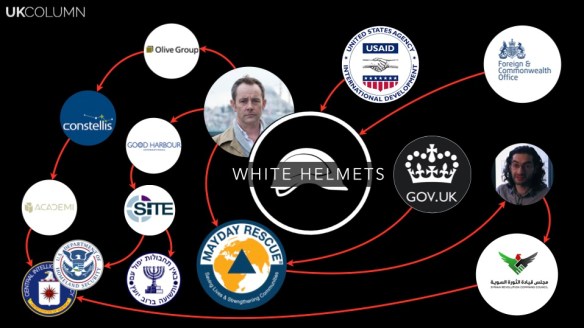
Giovani’s article attacks several journalists by name. She singles out Janine di Giovani and echoes the Guardian’s characterization of Beeley as the “high priestess of Syria propaganda”. She does this without challenging a single article or claim by the journalist. She might have acknowledged that Vanessa Beeley has some familiarity with the Middle East; she is the daughter of one of the foremost British Arabists and diplomats including British Ambassador to Egypt. Giovanni might have explored Beeley’s research in Syria that revealed the White Helmets founder (British military contractor James LeMesurier) assigned the name Syria Civil Defence despite the fact there is a real Syrian organization by that name that has existed since the 1950’s. For the past several years, Beeley has done many on-the-ground reports and investigations in Syria. None of these are challenged by Giovanni. Just days ago Beeley published a report on her visit to the White Helmets headquarters in Deraa.

Giovanni similarly dismisses another alternative journalist, Eva Bartlett. Again, Giovanni ignores the fact that Bartlett has substantial Middle East experience including having lived in Gaza for years. Instead of objectively evaluating the journalistic work of these independent journalists, Giovanni smears their work as “disinformation”. Presumably that is because their work is published at alternative sites such as 21st Century Wire and Russian media such as RT and Sputnik. Beeley and Bartlett surely would have been happy to have their reports published at the New York Review of Books, Newsweek or other mainstream outlets. But it’s evident that such reporting is not welcome there. Even Seymour Hersh had to go abroad to have his investigations on Syria published.

The New McCarthyism

Max Blumenthal is another journalist singled out by Giovanni. Blumenthal is the author of three books, including a New York Times bestseller and the highly acclaimed “Goliath: Life and Loathing in Greater Israel”. Giovanni describes his transition from “anti-Assad” to “pro-Assad” and suggests his change of perspective was due to Russian influence. She says, “Blumenthal went to Moscow on a junket to celebrate RT’s tenth anniversary. We don’t know what happened during that visit, but afterwards, Blumenthal’s views completely flipped.” Instead of examining the facts presented by Blumenthal in articles such as “Inside the Shadowy PR Firm that’s Lobyying for Regime Change in Syria“, Giovanni engages in fact-free McCarthyism. Blumenthal explained the transition in his thinking in a public interview. He also described the threats he experienced when he started to criticize the White Helmets and their public relations firm, but this is ignored by Giovanni.

Contrary to Giovanni’s assumptions, some western journalists and activists were exposing the White Helmets long before the story was publicized on Russian media. In spring 2015 the basic facts about the White Helmets including their origins, funding and role in the information war on Syria were exposed in my article “Seven Steps of Highly Effective Manipulators“. The article showed how the White Helmets were a key component in a campaign pushing for a “No Fly Zone” in Syria. It confirmed that the White Helmets is a political lobby force.

In spring 2016, Vanessa Beeley launched a petition “Do NOT give the Nobel Peace Prize to the White Helmets“. That petition garnered more support than a contrary petition urging the Nobel Prize committee to give the award to the White Helmets. Perhaps because of that, the petition was abruptly removed without explanation from the Change.org website. It was only at this time, with publicity around the heavily promoted nomination of the White Helmets for a Nobel Peace Prize that RT and other Russian media started to publicize and expose the White Helmets. That is one-and-a-half years after they were first exposed in western alternative media.

White Helmets and Chemical Weapons Accusations 

Giovanni ignores the investigations and conclusions of some of the most esteemed American journalists regarding the White Helmets and chemical weapons incidents in Syria.

The late Robert Parry published many articles exposing the White Helmets, for example “The White Helmets Controversy” and “Syria War Propaganda at the Oscars“. Parry wrote and published numerous investigations of the August 2013 chemical weapons attack and concluded the attacks were carried out by an opposition faction with the goal of pressuring the US to intervene militarily. Parry also challenged western conclusions regarding incidents such as April 4, 2017 at Khan Shaykhun. Giovanni breathlessly opens her article with this story while Parry revealed the impossibility of it being as described.

Buried deep inside a new U.N. report is evidence that could exonerate the Syrian government in the April 4 sarin atrocity and make President Trump look like an Al Qaeda dupe.

Legendary American journalist, Seymour Hersh, researched and refuted the assumptions of Giovanni and the media establishment regarding the August 2013 chemical weapons attacks near Damascus. Hersh’s investigation, titled “The Red Line and Rat Line“, provided evidence the atrocity was carried out by an armed opposition group with active support from Turkey. A Turkish member of parliament provided additional evidence. The fact that Hersh had to go across the Atlantic to have his investigation published suggests American not Russian disinformation and censorship.

In addition to ignoring the findings of widely esteemed journalists with proven track records, Giovanni plays loose with the truth. In her article she implies that a UN investigation blamed the Syrian government for the August 2013 attack. On the contrary, the head of the UN investigation team, Ake Sellstrom, said they did not determine who was responsible.

We do not have the evidence to say who did what ….The conflict in Syria is surrounded by a lot of rumors and a lot of propaganda, particularly when comes to the sensitive issue of chemical weapons.

First Responders or Western Funded Propagandists?

Giovanni says, “But the White Helmets’ financial backing is not the real reason why the pro-Assad camp is so bent on defaming them. Since 2015, the year the Russians began fighting in Syria, the White Helmets have been filming attacks on opposition-held areas with GoPro cameras affixed to their helmets.”

In reality, the ‘White Helmets” have a sophisticated media production and distribution operation. They have much more than GoPro cameras. In many of their movie segments one can see numerous people with video and still cameras. Sometimes the same incident will be shown with one segment with an Al Qaeda logo blending into the same scene with a White Helmets logo.

Giovanni claims “The Assad regime and the Russians are trying to neutralize the White Helmets because they are potential witnesses to war crimes.” However, the claims of White Helmet “witnesses” have little credibility. The White Helmet “volunteers” are paid three times as much as Syrian soldiers. They are trained, supplied and promoted by the same western states which have sought to regime change in Syria since 2011. An example of misleading and false claims by a White Helmets leader is exposed in Gareth Porter’s investigation titled “How a Syrian White Helmets Leader Played Western Media” . His conclusion could be directed to Giovanni and the NYReview of Books:

The uncritical reliance on claims by the White Helmets without any effort to investigate their credibility is yet another telling example of journalistic malpractice by media outlets with a long record of skewing coverage of conflicts toward an interventionist narrative.

When the militants (mostly Nusra/al Qaeda) were expelled from East Aleppo, civilians reported that the White Helmets were mostly concerned with saving their own and performing publicity stunts. For example, the photo of the little boy in east Aleppo looking dazed and confused in the back of a brand new White Helmet ambulance was essentially a White Helmet media stunt eagerly promoted in the West. It was later revealed the boy was not injured, he was grabbed without his parent’s consent. Eva Bartlett interviewed and photographed the father and family for her story “Mintpress Meets the Father of Iconic Aleppo Boy and says Media Lied About his Son“.

A Brilliant Marketing Success

The media and political impact of the White Helmets shows what money and marketing can do. An organization that was founded by a military contractor with funding from western governments was awarded the Rights Livelihood Award. The organization was seriously considered to receive the 2016 Nobel Peace Prize just three years after its formation.

The Netflix infomercial “The White Helmets” is an example of the propaganda. The scripted propaganda piece, where the producers did not set foot in Syria, won the Oscar award for best short documentary. It’s clear that lots of money and professional marketing can fool a lot of people. At $30 million per year, the White Helmets budget for one year is more than a decade of funding for the real Syrian Civil Defence which covers all of Syria not just pockets controlled by armed insurgents.

Unsurprisingly, it has been announced that White Helmets will receive the 2019 “Elie Wiesel” award from the heavily politicized and pro-Israel Holocaust Memorial Museum in Washington. This, plus the recent “rescue” of White Helmets by the Israeli government, is more proof of the true colors of the White Helmets. Vanessa Beeley’s recent interview with a White Helmet leader in Deraa revealed that ISIS and Nusra terrorists were part of the group “rescued” through Israel.

The Collapsing White Helmets Fraud

Giovanni is outraged that some journalists have successfully challenged and put a big dent in the White Helmets aura. She complains, “The damage the bloggers do is immense.”

Giovanni and western propagandists are upset because the myth is deflating. Increasing numbers of people – from a famous rock musician to a former UK Ambassador – see and acknowledge the reality.

As described in Blumenthal’s article, “How the White Helmets Tried to Recruit Roger Waters with Saudi Money“, rock legend Roger Waters says:

If we were to listen to the propaganda of the White Helmets and others, we would encourage our governments to start dropping bombs on people in Syria. This would be a mistake of monumental proportions…

Peter Ford, the former UK Ambassador to Syria, sums it up like this:

The White Helmets are jihadi auxiliaries… They are not, as claimed by themselves and by their supporters… simple rescuers. They are not volunteers. They are paid professionals of disinformation.

Giovanni claims her article is a “forensic take down of the Russian disinformation campaign to distort the truth in Syria.” In reality, Giovanni’s article is an example of western disinformation using subjective attacks on critics and evidence-free assertions aligned with the regime change goals of the West.

Has America Become a Dictatorship Disguised as a Democracy?


By John W. Whitehead

Source: The Rutherford Institute

“The poor and the underclass are growing. Racial justice and human rights are nonexistent. They have created a repressive society and we are their unwitting accomplices. Their intention to rule rests with the annihilation of consciousness. We have been lulled into a trance. They have made us indifferent to ourselves, to others. We are focused only on our own gain.”—They Live, John Carpenter

We’re living in two worlds, you and I.

There’s the world we see (or are made to see) and then there’s the one we sense (and occasionally catch a glimpse of), the latter of which is a far cry from the propaganda-driven reality manufactured by the government and its corporate sponsors, including the media.

Indeed, what most Americans perceive as life in America—privileged, progressive and free—is a far cry from reality, where economic inequality is growing, real agendas and real power are buried beneath layers of Orwellian doublespeak and corporate obfuscation, and “freedom,” such that it is, is meted out in small, legalistic doses by militarized police armed to the teeth.

All is not as it seems.

“You see them on the street. You watch them on TV. You might even vote for one this fall. You think they’re people just like you. You’re wrong. Dead wrong.”

This is the premise of John Carpenter’s film They Live, which was released 30 years ago in November 1988 and remains unnervingly, chillingly appropriate for our modern age.

Best known for his horror film Halloween, which assumes that there is a form of evil so dark that it can’t be killed, Carpenter’s larger body of work is infused with a strong anti-authoritarian, anti-establishment, laconic bent that speaks to the filmmaker’s concerns about the unraveling of our society, particularly our government.

Time and again, Carpenter portrays the government working against its own citizens, a populace out of touch with reality, technology run amok, and a future more horrific than any horror film.

In Escape from New York, Carpenter presents fascism as the future of America.

In The Thing, a remake of the 1951 sci-fi classic of the same name, Carpenter presupposes that increasingly we are all becoming dehumanized.

In Christine, the film adaptation of Stephen King’s novel about a demon-possessed car, technology exhibits a will and consciousness of its own and goes on a murderous rampage.

In In the Mouth of Madness, Carpenter notes that evil grows when people lose “the ability to know the difference between reality and fantasy.”

And then there is Carpenter’s They Live, in which two migrant workers discover that the world is not as it seems. In fact, the population is actually being controlled and exploited by aliens working in partnership with an oligarchic elite. All the while, the populace—blissfully unaware of the real agenda at work in their lives—has been lulled into complacency, indoctrinated into compliance, bombarded with media distractions, and hypnotized by subliminal messages beamed out of television and various electronic devices, billboards and the like.

It is only when homeless drifter John Nada (played to the hilt by the late Roddy Piper) discovers a pair of doctored sunglasses—Hoffman lenses—that Nada sees what lies beneath the elite’s fabricated reality: control and bondage.

When viewed through the lens of truth, the elite, who appear human until stripped of their disguises, are shown to be monsters who have enslaved the citizenry in order to prey on them.

Likewise, billboards blare out hidden, authoritative messages: a bikini-clad woman in one ad is actually ordering viewers to “MARRY AND REPRODUCE.” Magazine racks scream “CONSUME” and “OBEY.” A wad of dollar bills in a vendor’s hand proclaims, “THIS IS YOUR GOD.”

When viewed through Nada’s Hoffman lenses, some of the other hidden messages being drummed into the people’s subconscious include: NO INDEPENDENT THOUGHT, CONFORM, SUBMIT, STAY ASLEEP, BUY, WATCH TV, NO IMAGINATION, and DO NOT QUESTION AUTHORITY.

This indoctrination campaign engineered by the elite in They Live is painfully familiar to anyone who has studied the decline of American culture.

A citizenry that does not think for themselves, obeys without question, is submissive, does not challenge authority, does not think outside the box, and is content to sit back and be entertained is a citizenry that can be easily controlled.

In this way, the subtle message of They Live provides an apt analogy of our own distorted vision of life in the American police state, what philosopher Slavoj Žižek refers to as dictatorship in democracy, “the invisible order which sustains your apparent freedom.”

We’re being fed a series of carefully contrived fictions that bear no resemblance to reality.

The powers-that-be want us to feel threatened by forces beyond our control (terrorists, shootersbombers).

They want us afraid and dependent on the government and its militarized armies for our safety and well-being.

They want us distrustful of each other, divided by our prejudices, and at each other’s throats.

Most of all, they want us to continue to march in lockstep with their dictates.

Tune out the government’s attempts to distract, divert and befuddle us and tune into what’s really going on in this country, and you’ll run headlong into an unmistakable, unpalatable truth: the moneyed elite who rule us view us as expendable resources to be used, abused and discarded.

In fact, a study conducted by Princeton and Northwestern University concluded that the U.S. government does not represent the majority of American citizens. Instead, the study found that the government is ruled by the rich and powerful, or the so-called “economic elite.” Moreover, the researchers concluded that policies enacted by this governmental elite nearly always favor special interests and lobbying groups.

In other words, we are being ruled by an oligarchy disguised as a democracy, and arguably on our way towards fascism—a form of government where private corporate interests rule, money calls the shots, and the people are seen as mere subjects to be controlled.

Not only do you have to be rich—or beholden to the rich—to get elected these days, but getting elected is also a surefire way to get rich. As CBS News reports, “Once in office, members of Congress enjoy access to connections and information they can use to increase their wealth, in ways that are unparalleled in the private sector. And once politicians leave office, their connections allow them to profit even further.”

In denouncing this blatant corruption of America’s political system, former president Jimmy Carter blasted the process of getting elected—to the White House, governor’s mansion, Congress or state legislatures—as “unlimited political bribery… a subversion of our political system as a payoff to major contributors, who want and expect, and sometimes get, favors for themselves after the election is over.”

Rest assured that when and if fascism finally takes hold in America, the basic forms of government will remain: Fascism will appear to be friendly. The legislators will be in session. There will be elections, and the news media will continue to cover the entertainment and political trivia. Consent of the governed, however, will no longer apply. Actual control will have finally passed to the oligarchic elite controlling the government behind the scenes.

Sound familiar?

Clearly, we are now ruled by an oligarchic elite of governmental and corporate interests.

We have moved into “corporatism” (favored by Benito Mussolini), which is a halfway point on the road to full-blown fascism.

Corporatism is where the few moneyed interests—not elected by the citizenry—rule over the many. In this way, it is not a democracy or a republican form of government, which is what the American government was established to be. It is a top-down form of government and one which has a terrifying history typified by the developments that occurred in totalitarian regimes of the past: police states where everyone is watched and spied on, rounded up for minor infractions by government agents, placed under police control, and placed in detention (a.k.a. concentration) camps.

For the final hammer of fascism to fall, it will require the most crucial ingredient: the majority of the people will have to agree that it’s not only expedient but necessary.

But why would a people agree to such an oppressive regime?

The answer is the same in every age: fear.

Fear makes people stupid.

Fear is the method most often used by politicians to increase the power of government. And, as most social commentators recognize, an atmosphere of fear permeates modern America: fear of terrorism, fear of the police, fear of our neighbors and so on.

The propaganda of fear has been used quite effectively by those who want to gain control, and it is working on the American populace.

Despite the fact that we are 17,600 times more likely to die from heart disease than from a terrorist attack; 11,000 times more likely to die from an airplane accident than from a terrorist plot involving an airplane; 1,048 times more likely to die from a car accident than a terrorist attack, and 8 times more likely to be killed by a police officer than by a terrorist , we have handed over control of our lives to government officials who treat us as a means to an end—the source of money and power.

As the Bearded Man in They Live warns, “They are dismantling the sleeping middle class. More and more people are becoming poor. We are their cattle. We are being bred for slavery.”

In this regard, we’re not so different from the oppressed citizens in They Live.

From the moment we are born until we die, we are indoctrinated into believing that those who rule us do it for our own good. The truth is far different.

Despite the truth staring us in the face, we have allowed ourselves to become fearful, controlled, pacified zombies.

We live in a perpetual state of denial, insulated from the painful reality of the American police state by wall-to-wall entertainment news and screen devices.

Most everyone keeps their heads down these days while staring zombie-like into an electronic screen, even when they’re crossing the street. Families sit in restaurants with their heads down, separated by their screen devices and unaware of what’s going on around them. Young people especially seem dominated by the devices they hold in their hands, oblivious to the fact that they can simply push a button, turn the thing off and walk away.

Indeed, there is no larger group activity than that connected with those who watch screens—that is, television, lap tops, personal computers, cell phones and so on. In fact, a Nielsen study reports that American screen viewing is at an all-time high. For example, the average American watches approximately 151 hours of television per month.

The question, of course, is what effect does such screen consumption have on one’s mind?

Psychologically it is similar to drug addiction. Researchers found that “almost immediately after turning on the TV, subjects reported feeling more relaxed, and because this occurs so quickly and the tension returns so rapidly after the TV is turned off, people are conditioned to associate TV viewing with a lack of tension.” Research also shows that regardless of the programming, viewers’ brain waves slow down, thus transforming them into a more passive, nonresistant state.

Historically, television has been used by those in authority to quiet discontent and pacify disruptive people. “Faced with severe overcrowding and limited budgets for rehabilitation and counseling, more and more prison officials are using TV to keep inmates quiet,” according to Newsweek.

Given that the majority of what Americans watch on television is provided through channels controlled by six mega corporations, what we watch is now controlled by a corporate elite and, if that elite needs to foster a particular viewpoint or pacify its viewers, it can do so on a large scale.

If we’re watching, we’re not doing.

The powers-that-be understand this. As television journalist Edward R. Murrow warned in a 1958 speech:

We are currently wealthy, fat, comfortable and complacent. We have currently a built-in allergy to unpleasant or disturbing information. Our mass media reflect this. But unless we get up off our fat surpluses and recognize that television in the main is being used to distract, delude, amuse, and insulate us, then television and those who finance it, those who look at it, and those who work at it, may see a totally different picture too late.

This brings me back to They Live, in which the real zombies are not the aliens calling the shots but the populace who are content to remain controlled.

When all is said and done, the world of They Live is not so different from our own.

We, too, are focused only on our own pleasures, prejudices and gains. Our poor and underclasses are also growing. Racial injustice is growing. Human rights is nearly nonexistent. We too have been lulled into a trance, indifferent to others.

Oblivious to what lies ahead, we’ve been manipulated into believing that if we continue to consume, obey, and have faith, things will work out. But that’s never been true of emerging regimes. And by the time we feel the hammer coming down upon us, it will be too late.

So where does that leave us?

The characters who populate Carpenter’s films provide some insight.

Underneath their machismo, they still believe in the ideals of liberty and equal opportunity. Their beliefs place them in constant opposition with the law and the establishment, but they are nonetheless freedom fighters.

When, for example, John Nada destroys the alien hyno-transmitter in They Live, he restores hope by delivering America a wake-up call for freedom.

That’s the key right there: we need to wake up.

Stop allowing yourselves to be easily distracted by pointless political spectacles and pay attention to what’s really going on in the country.

The real battle for control of this nation is not being waged between Republicans and Democrats in the ballot box.

As I make clear in my book Battlefield America: The War on the American People, the real battle for control of this nation is taking place on roadsides, in police cars, on witness stands, over phone lines, in government offices, in corporate offices, in public school hallways and classrooms, in parks and city council meetings, and in towns and cities across this country.

The real battle between freedom and tyranny is taking place right in front of our eyes, if we would only open them.

All the trappings of the American police state are now in plain sight.

Wake up, America.

If they live (the tyrants, the oppressors, the invaders, the overlords), it is only because “we the people” sleep.

Digital Book Burners

By Kurt Nimmo

Source: Another Day in the Empire

Jamie Fly, a former high-ranking Bush era neocon, believes you shouldn’t have the right to post on social media.

“Fly went on to complain that ‘all you need is an email’ to set up a Facebook or Twitter account, lamenting the sites’ accessibility to members of the general public. He predicted a long struggle on a global scale to fix the situation, and pointed out that to do so would require constant vigilance,” write  Jeb Sprague and Max Blumenthal. 

This attitude shouldn’t come as a surprise. Neocons believe they are a special breed, the chosen few of an intellectual crème de la crème, and the rest of us are merely bread and circus spectators on the sidelines as they forge our collective history (and increasingly possible ruin). 

Fly is a research associate at the Council on Foreign Relations. He “served” in the National Security Council and the Defense Department during the Bush presidency. He also worked at the Claremont Institute and the American Enterprise Institute. Fly tutored presumptive presidential candidate Marco Rubio on foreign policy and he is the former director of the Foreign Policy Initiative, a staunch neocon advocacy group founded by arch neocons William Kristol, Robert Kagan, and Dan Senor. 

He is now a senior fellow and director of the Asia program at the German Marshall Fund, an organization funded by the US government and NATO. The German Marshall Fund organized the Alliance for Securing Democracy and its Hamilton 68 effort to destroy alternative media under the false (and largely debunked) claim it is a cutout for Russia and Vladimir Putin who are, we are reminded daily, dedicated to destroying democracy and taking down the exceptional and indispensable nation. 

Jamie Fly and his coconspirators Laura Rosenberger and J.M. Berger know the Russians aren’t responsible for thousands of alternate media websites and social media accounts. They know this phenomenon, which began with the birth of the World Wide Web in the mid-1990s, is homespun and has absolutely nothing to do with Russia. It is their mission to make sure the establishment is free to promulgate its lies and war propaganda without counterbalance and the interruption of truth. 

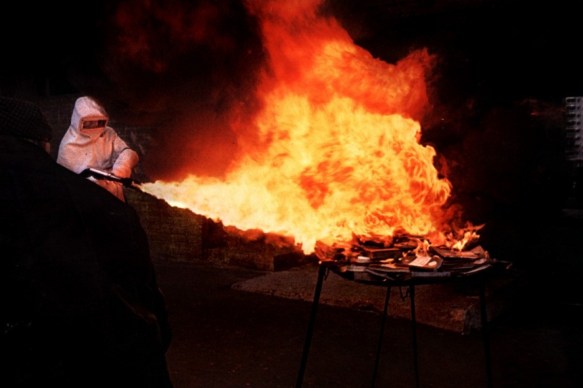
These folks are digital book burners on par with Nazis who burned books in Berlin on the Opernplatz in May of 1933. Like the Nazis, they want to silence those who counter the narrative. For the Nazis, the targets were communists, socialists, anarchists, and all who opposed fascism, while our new book burners—liquidators of heresy against the ruling elite—are focused on groups and individuals challenging the lies and half-truths of the state regardless of ideology.

For the elite, populism and nationalism represent a twin threat to the emerging globalist scheme of a one-world government and currency directed by a cadre of unelected bureaucrats and ideologues. 

Donald Trump portrayed himself as a patriot and nationalist—Make America Great Again—however after the election the same old crowd of CFR operatives, Goldman Sachs alumni, and hardcore neocons staffed his administration, thus making the realization of his campaign promises virtually impossible. 

The ruling elite, their functionaries and proxies have declared war on “alternative facts,” that is to say information contrary and even hostile to the narrative. While it is true the corporate media has lost some influence, it still projects a powerful influence on public opinion, especially in the current highly polarized political climate.

For instance, it is now assumed a Trump supporter send bombs to Democrats, and this has become a trending topic on social media. There is zero evidence a Trump supporter had anything to do with this incident, and yet the hashtag “MAGABomber” has gone viral on social media, demonstrating how easily it is to sell lies and fabrications to a polarized public. 

Fly and his digital book burning associates will not stop until the last vestiges of the alternative media are wiped out. This process is underway now with a number of popular alternative media websites losing significant traffic following removal from social media. 

As Mr. Fly says, this is only the beginning. They will not stop until the challenge is defeated and the digital information landscape is once again completely in control of the psychopaths at the top and their well-paid minions pushing the idiotic lie that Putin and the Russians are responsible. 

Facebook Censorship of Alternative Media “Just the Beginning,” Says Top Neocon Insider

At a Berlin security conference, hardline neocon Jamie Fly appeared to claim some credit for the recent coordinated purge of alternative media.

By Max Blumenthal and Jeb Sprague

Source: Gray Zone

This month, Facebook and Twitter deleted the accounts of hundreds of users, including many alternative media outlets maintained by American users. Among those wiped out in the coordinated purge were popular sites that scrutinized police brutality and U.S. interventionism like The Free Thought Project, Anti-Media, Cop Block and journalists like Rachel Blevins.

Facebook claimed that these sites had “broken our rules against spam and coordinated inauthentic behavior.” However, sites like The Free Thought Project were verified by Facebook and widely recognized as legitimate sources of news and opinion. John Vibes, an independent reporter who contributed to Free Thought, accused Facebook of “favoring mainstream sources and silencing alternative voices.”

In comments published here for the first time, a neoconservative Washington insider has apparently claimed a degree of credit for the recent purge and promised more takedowns in the near future.

“Russia, China, and other foreign states take advantage of our open political system,” remarked Jamie Fly, a senior fellow and director of the Asia program at the German Marshall Fund. “They can invent stories that get repeated and spread through different sites. So we are just starting to push back. Just this last week Facebook began starting to take down sites. So this is just the beginning.”

Fly went on to complain that “all you need is an email” to set up a Facebook or Twitter account, lamenting the sites’ accessibility to members of the general public. He predicted a long struggle on a global scale to fix the situation, and pointed out that to do so would require constant vigilance.

Fly made these stunning comments to Jeb Sprague, who is a visiting faculty in sociology at the University of California-Santa Barbara and co-author of this article. The two spoke during a lunch break at a conference on Asian security organized by the Stiftung Wissenschaft und Politik in Berlin, Germany.

In the tweet below, Fly is the third person from the left who appears seated at the table.

The remarks by Fly — “we are just starting to push back” — seemed to confirm the worst fears of the alternative online media community. If he was to be believed, the latest purge was motivated by politics, not spam prevention, and was driven by powerful interests hostile to dissident views, particularly where American state violence is concerned.

Rise of a neocon cadre

Jamie Fly is an influential foreign policy hardliner who has spent the last year lobbying for the censorship of “fringe views” on social media. Over the years, he has advocated for a military assault on Iran, a regime change war on Syria, and hiking military spending to unprecedented levels. He is the embodiment of a neoconservative cadre.

Like so many second generation neocons, Fly entered government by burrowing into mid-level positions in George W. Bush’s National Security Council and Department of Defense.

In 2009, he was appointed director of the Foreign Policy Initiative (FPI), a rebranded version of Bill Kristol’s Project for a New American Century, or PNAC. The latter outfit was an umbrella group of neoconservative activists that first made the case for an invasion of Iraq as part of a wider project of regime change in countries that resisted Washington’s sphere of influence.

By 2011, Fly was advancing the next phase in PNAC’s blueprint by clamoring for military strikes on Iran. “More diplomacy is not an adequate response,” he argued. A year later, Fly urged the US to “expand its list of targets beyond the [Iranian] nuclear program to key command and control elements of the Republican Guard and the intelligence ministry, and facilities associated with other key government officials.”

Fly soon found his way into the senate office of Marco Rubio, a neoconservative pet project, assuming a role as his top foreign policy advisor. Amongst other interventionist initiatives, Rubio has taken the lead in promoting harsh economic sanctions targeting Venezuela, even advocating for a U.S. military assault on the country. When Rubio’s 2016 presidential campaign floundered amid a mass revolt of the Republican Party’s middle American base against the party establishment, Fly was forced to cast about for new opportunities.

He found them in the paranoid atmosphere of Russiagate that formed soon after Donald Trump’s shock election victory.

PropOrNot sparks the alternative media panic

A journalistic insider’s account of the Hillary Clinton presidential campaign, Shattered, revealed that “in the days after the election, Hillary declined to take responsibility for her own loss.” Her top advisers were summoned the following day, according to the book, “to engineer the case that the election wasn’t entirely on the up-and-up … Already, Russian hacking was the centerpiece of the argument.”

Less than three weeks after Clinton’s defeat, the Washington Post’s Craig Timberg published a dubiously sourced report headlined, “Russian propaganda effort helped spread ‘fake news.’” The article hyped up a McCarthyite effort by a shadowy, anonymously run organization called PropOrNot to blacklist some 200 American media outlets as Russian “online propaganda.”

The alternative media outfits on the PropOrNot blacklist included some of those recently purged by Facebook and Twitter, such as The Free Thought Project and Anti-Media. Among the criteria PropOrNot identified as signs of Russian propaganda were, “Support for policies like Brexit, and the breakup of the EU and Eurozone” and, “Opposition to Ukrainian resistance to Russia and Syrian resistance to Assad.” PropOrNot called for “formal investigations by the U.S. government” into the outlets it had blacklisted.

According to Craig Timberg, the Washington Post correspondent who uncritically promoted the media suppression initiative, Propornot was established by “a nonpartisan collection of researchers with foreign policy, military and technology backgrounds.” Timberg quoted a figure associated with the George Washington University Center for Cyber and Homeland Security, Andrew Weisburd, and cited a report he wrote with his colleague, Clint Watts, on Russian meddling.

Timberg’s piece on was PropOrNot was promoted widely by former top Clinton staffers and celebrated by ex-Obama White House aide Dan Pfeiffer as “the biggest story in the world.” But after a wave of stinging criticism, including in the pages of the New Yorker, the article was amended with an editor’s note stating, “The [Washington] Post… does not itself vouch for the validity of PropOrNot’s findings regarding any individual media outlet.”

PropOrNot had been seemingly exposed as a McCarthyite sham, but the concept behind it — exposing online American media outlets as vehicles for Kremlin “active measures” — continued to flourish.

The birth of the Russian bot tracker

By August, a new, and seemingly related initiative appeared out of the blue, this time with backing from a bipartisan coalition of Democratic foreign policy hands and neocon Never Trumpers in Washington. Called the Alliance for Securing Democracy (ASD), the outfit aimed to expose how supposed Russian Twitter bots were infecting American political discourse with divisive narratives. It featured a daily “Hamilton 68” online dashboard that highlighted the supposed bot activity with easily digestible charts. Conveniently, the site avoided naming any of the digital Kremlin influence accounts it claimed to be tracking.

The initiative was immediately endorsed by John Podesta, the founder of the Democratic Party think tank, Center for American Progress, and former chief of staff of Hillary Clinton’s 2016 presidential campaign. Julia Ioffe, the Atlantic’s chief Russiagate correspondent, promoted the bot tracker as “a very cool tool.”

Unlike PropOrNot, the ASD was sponsored by one of the most respected think tanks in Washington, the German Marshall Fund, which had been founded in 1972 to nurture the special relationship between the US and what was then West Germany.

Though the German Marshall Fund did not name the donors that sponsored the initiative, it hosted a who’s who of bipartisan national security hardliners on the ASD’s advisory council, providing the endeavor with the patina of credibility. They ranged from neocon movement icon Bill Kristol to former Clinton foreign policy advisor Jake Sullivan to ex-CIA director Michael Morrell.

Jamie Fly, a German Marshall Fund fellow and Asia specialist, emerged as one of the most prolific promoters of the new Russian bot tracker in the media. Together with Laura Rosenberger, a former foreign policy aide to Hillary Clinton’s 2016 campaign, Fly appeared in a series of interviews and co-authored several op-eds emphasizing the need for a massive social media crackdown.

During a March 2018 interview on C-Span, Fly complained that “Russian accounts” were “trying to promote certain messages, amplify certain content, raise fringe views, pit Americans against each other, and we need to deal with this ongoing problem and find ways through the government, through tech companies, through broader society to tackle this issue.”

Yet few of the sites on PropOrNot’s blacklist, and none of the alternative sites that were erased in the recent Facebook purge that Fly and his colleagues take apparent credit for, were Russian accounts. Perhaps the only infraction they could have been accused of was publishing views that Fly and his cohorts saw as “fringe.”

What’s more, the ASD has been forced to admit that the mass of Twitter accounts it initially identified as “Russian bots” were not necessarily bots — and may not have been Russian either.

“I’m not convinced on this bot thing”

A November 2017 investigation by Max Blumenthal, a co-author of this article, found that the ASD’s Hamilton 68 dashboard was the creation of “a collection of cranks, counterterror retreads, online harassers and paranoiacs operating with support from some of the most prominent figures operating within the American national security apparatus.”

These figures included the same George Washington University Center for Cyber and Homeland Security fellows — Andrew Weisburd and Clint Watts — that were cited as experts in the Washington Post’s article promoting PropOrNot.

Weisburd, who has been described as one of the brains behind the Hamilton 68 dashboard, once maintained a one-man, anti-Palestinian web monitoring initiative that specialized in doxxing left-wing activists, Muslims and anyone he considered “anti-American.” More recently, he has taken to Twitter to spout off murderous and homophobic fantasies about Glenn Greenwald, the editor of the Intercept — a publication the ASD flagged without explanation as a vehicle for Russian influence operations.

Watts, for his part, has testified before Congress on several occasions to call on the government to “quell information rebellions” with censorious measures including “nutritional labels” for online media. He has received fawning publicity from corporate media and been rewarded with a contributor role for NBC on the basis of his supposed expertise in ferreting out Russian disinformation.

Clint Watts has urged Congress to “quell information rebellions”

However, under questioning during a public event by Grayzone contributor Ilias Stathatos, Watts admitted that substantial parts of his testimony were false, and refused to provide evidence to support some of his most colorful claims about malicious Russian bot activity.

In a separate interview with Buzzfeed, Watts appeared to completely disown the Hamilton 68 bot tracker as a legitimate tool. “I’m not convinced on this bot thing,” Watts confessed. He even called the narrative that he helped manufacture “overdone,” and admitted that the accounts Hamilton 68 tracked were not necessarily directed by Russian intelligence actors.

“We don’t even think they’re all commanded in Russia — at all. We think some of them are legitimately passionate people that are just really into promoting Russia,” Watts conceded.

But these stunning admissions did little to slow the momentum of the coming purge.

Enter the Atlantic Council

In his conversation with Sprague, the German Marshall Fund’s Fly stated that he was working with the Atlantic Council in the campaign to purge alternative media from social media platforms like Facebook.

The Atlantic Council is another Washington-based think tank that serves as a gathering point for neoconservatives and liberal interventionists pushing military aggression around the globe. It is funded by NATO and repressive, US-allied governments including Saudi Arabia, Bahrain and Turkey, as well as by Ukrainian oligarchs like Victor Pynchuk.

This May, Facebook announced a partnership with the Atlantic Council’s Digital Forensic Research Lab (DFRLab) to “identify, expose, and explain disinformation during elections around the world.”

The Atlantic Council’s DFRLab is notorious for its zealous conflation of legitimate online dissent with illicit Russian activity, embracing the same tactics as PropOrNot and the ASD.

Ben Nimmo, a DFRLab fellow who has built his reputation on flushing out online Kremlin influence networks, embarked on an embarrassing witch hunt this year that saw him misidentify several living, breathing individuals as Russian bots or Kremlin “influence accounts.” Nimmo’s victims included Mariam Susli, a well-known Syrian-Australian social media personality, the famed Ukrainian concert pianist Valentina Lisitsa, and a British pensioner named Ian Shilling.

In an interview with Sky News, Shilling delivered a memorable tirade against his accusers. “I have no Kremlin contacts whatsoever; I do not know any Russians, I have no contact with the Russian government or anything to do with them,” he exclaimed. “I am an ordinary British citizen who happens to do research on the current neocon wars which are going on in Syria at this very moment.”

With the latest Facebook and Twitter purges, ordinary citizens like Shilling are being targeted in the open, and without apology. The mass deletions of alternative media accounts illustrate how national security hardliners from the German Marshall Fund and Atlantic Council (and whoever was behind PropOrNot) have instrumentalized the manufactured panic around Russian interference to generate public support for a wider campaign of media censorship.

In his conversation in Berlin with Sprague, Fly noted with apparent approval that, “Trump is now pointing to Chinese interference in the 2018 election.” As the mantra of foreign interference expands to a new adversarial power, the clampdown on voices of dissent in online media is almost certain to intensify.

As Fly promised, “This is just the beginning.”

FACEBOOK’S PURGE OF POLITICAL PAGES FUELS DELUSION OF INSURGENT THREATS TO DEMOCRACY

By Kevin Gosztola

Source: ShadowProof

Facebook’s purge of more than 500 pages and 250 accounts ahead of midterm elections in the United States represents a massive trend to police social media activity in ways that put freedom of expression at risk.

This trend effectively discourages users from engaging in radical politics. It may be viewed as part of a counterinsurgency effort by a powerful social media company to assure a passive majority of Americans that they are properly guarding a widely used platform from alleged threats to democracy.

On October 11, Nathaniel Gleicher, Facebook’s head of cybersecurity policy, and Oscar Rodriguez, the company’s product manager, published a press release about the purge.

“We’re removing 559 pages and 251 accounts that have consistently broken our rules against spam and coordinated inauthentic behavior,” Gleicher and Rodriguez stated. “Many were using fake accounts or multiple accounts with the same names and posted massive amounts of content across a network of groups and pages to drive traffic to their websites.”

According to Gleicher and Rodriguez, these techniques were used by groups and pages to make content “appear more popular” than it truly was on Facebook.

Both suggested some of the pages and accounts were “ad farms” that misled users into believing they were “forums for legitimate political debate.”

Unfortunately, Facebook offered minimal transparency on the action. Administrators with removed pages or accounts were apparently given no specifics other than a notice that they were shut down.

Several of the pages and accounts removed were right-wing and known for boosting President Donald Trump and his administration’s agenda. There were also dozens of progressive or left-wing pages, which were taken down.

Anti-Media, an anti-establishment independent media site with two million followers, had its page removed. Carey Wedler, editor at Anti-Media, did not lose her personal Facebook page with over 100,000 followers, but almost simultaneously, Twitter sent a notice that Wedler’s account was suspended.

The Free Thought Project, Reverb Press, Press For Truth, and Rachel Blevins, an RT America correspondent, had their pages taken down.

Pages that document abuse by police were removed—Police the Police, Filming Cops, Cop Block, and Cop Logic. Both Police the Police and Filming Cops each had over a million followers.

“There are legitimate reasons that accounts and pages coordinate with each other—it’s the bedrock of fundraising campaigns and grassroots organizations,” Gleicher and Rodriguez stated. “But the difference is that these groups are upfront about who they are, and what they’re up to.”

Yet, none of the aforementioned pages, which have protested their removal, hid their missions from followers. They were very upfront about their political motives or agendas for social justice.

Gleicher and Rodriguez concluded, “As we get better at uncovering this kind of abuse, the people behind it—whether economically or politically motivated—will change their tactics to evade detection. It’s why we continue to invest heavily, including in better technology, to prevent this kind of misuse. Because people will only share on Facebook if they feel safe and trust the connections they make here.”

The last sentences of Facebook’s press release make it clear that the company took this action to protect their brand. They were concerned about how these pages or accounts were impacting the experience of more passive, or even apathetic, users.

Administrators also recognize that politicians on Capitol Hill are watching. As Senator Dianne Feinstein told executives during a recent Senate hearing, “You’ve created these platforms, and now they are being misused. And you have to be the ones to do something about it or we will.”

On October 17, Twitter also acknowledged pressure from upcoming midterm elections to guard against alleged “influence operations.” It released a dataset it said was linked to operations during the 2016 election.

“We will continue to proactively combat nefarious attempts to undermine the integrity of Twitter, while partnering with civil society, government, our industry peers, and researchers to improve our collective understanding of coordinated attempts to interfere in the public conversation,” the social media company pledged.”

No executives at any Silicon Valley tech corporation want the government to introduce regulations. With parts of the public, especially those in the liberal establishment clamoring for action, Facebook and other companies are taking steps to supposedly fix the problem.

Cracking Down On “Influence Campaigns”

Facebook’s mass removal of pages and accounts was the company’s most extensive crackdown on “influence campaigns” since it started policing its platform. Most U.S. media outlets described the offending pages and accounts as purveyors of “political spam.”

The New York Times reported on Facebook’s purge with an article that was headlined, “Facebook Tackles Rising Threat: Americans Aping Russian Schemes to Deceive.”

Ironically, this was misinformation. At no point did the Times demonstrate that the removed pages or accounts were inspired or influenced by “Russian schemes,” which may or may not have been employed during the 2016 presidential election.

What the Times did do is conflate Russia-based activity with the operation of these accounts because those users may have wielded similar tactics to extend their reach. This is as disingenuous as suggesting someone who relies on Internet privacy tools is using terrorist tactics because terrorists want to hide their location, too.

The push to impose more control over the exchange of information on Facebook stems from a widespread belief that the Russia-based Internet Research Agency conducted a campaign through more than 400 accounts and pages that relied on ads and false information to “create discord and harm” Hillary Clinton’s presidential campaign. The content was supposedly viewed by as many as 126 million Americans.

But in a paper on the 2016 presidential election by Thomas Ferguson, Paul Jorgensen, and Jie Chen from the Institute for New Economic Thinking, they show that this number is rather paltry. Americans saw at least 33 trillion posts in their news feeds between 2015 and 2017. Facebook even said a quarter of ads may have never been viewed by anyone.

The Senate intelligence committee reported minuscule ad numbers in key battleground states. In Wisconsin, $1,979 was spent. All but $54 were spent during the primary. Pennsylvania absorbed $823 and Michigan $300. “Unless Facebook discloses some vast new trove, the conclusion has to be that this was no full court press,” the report stated.

As the authors note, a few studies labeled sites as “Russian” or “Russian-influenced” simply because they have “politically distasteful” views that perhaps align with the agenda of Russia or run counter to U.S. foreign policy. This inappropriately counted non-mainstream or so-called fringe websites as part of an alleged Russian influence operation.

A far more extensive influence operation was likely perpetrated by networks highly capable of spreading right-wing messages in sophisticated manners.

“Our clearest and most significant observation is that the American political system has seen not a symmetrical polarization of the two sides of the political map, but rather the emergence of a discrete and relatively insular right-wing media ecosystem whose shape and communications practices differ sharply from the rest of the media ecosystem, ranging from the center-right to the left,” a Harvard study [PDF] on the 2016 election concluded.

The infiltrators sowing discord were aligned with Republicans and based in the United States. Like Ferguson, Jorgensen, and Chen contend, “By 2016, the Republican right had developed internet outreach and political advertising into a fine art and on a massive scale quite on its own.”

“Large numbers of conservative websites, including many that tolerated or actively encouraged white supremacy and contempt for immigrants, African-Americans, Hispanics, Jews, or the aspirations of women had been hard at work for years stoking up ‘tensions between groups already wary of one another.’ Breitbart and other organizations were in fact going global, opening offices abroad and establishing contacts with like-minded groups elsewhere.”

“Whatever the Russians were up to, they could hardly hope to add much value to the vast Made in America bombardment already underway. Nobody sows chaos like Breitbart or the Drudge Report, as the New York Times documented in one Idaho town,” the paper added.

Recognizing the influence of right-wing messaging networks during the 2016 election is critical. In fact, a list of removed pages posted by Western Journal suggests the vast majority of pages and accounts removed were right-wing. A minority were cop watch pages or libertarian pages against government abuses. An even smaller minority were liberal or Democratic pages.

Therefore, journalists are wrong to suggest there is some kind of balance between the left-wing and right-wing when it comes to spreading “fake news” or misinformation on social media platforms.

Part Of The Counterrevolution

It is difficult to discern whether police accountability or alternative media pages, which protested their removal, were targeted for the dissenting perspectives on their pages. What is more likely is that these pages were flagged by a Facebook algorithm.

“Bad content” to Facebook includes “false news,” “hate speech,” “spam,” “graphic violence,” “clickbait,” and “links to low quality web experiences (ad farms).” Given the company’s description of an “ad farm,” a page that linked to a website cluttered with ads, which were embedded to ensure server bills were paid, could be construed as an “ad farm.”

As Emma Llansó, the director of the Free Expression Project for the Center for Democracy and Technology, told the Guardian, there are a  “lot of people who fervently believe their political views and are trying to drive traffic to their posts and ideas. They’re probably also running ads on their sites to make money off doing so. The line between spammer activity with a financial motive and spammy-looking political advocacy is incredibly hard to draw.”

Facebook’s press release demonstrated indifference to the administrators of political pages, who use “backup” or fake accounts in order defend themselves from political opponents who may campaign to have their real accounts suspended.

Reverb’s page was verified by Facebook. As the Guardian reported, Reverb editor-in-chief Edward Lynn was never contacted by anyone with the company about any violations of standards.

Similarly, Brian Kolfage, who administered the Right Wing News page, which was shut down with three other pages, emailed back and forth with a Facebook executive. There were plans for a meeting so he could better understand how to comply with policies. The company chose not to work with Kolfage.

On October 17, Facebook deleted a video featuring journalist George Monbiot on the brutal colonial legacy of Christopher Columbus. It was up more than a week and had 900,000 views before it was taken down.

Again, the social media company was completely opaque in its decision. It may have been flagged as a result of graphic images in the video, but Facebook did not bother to offer an explanation.

Facebook announced a partnership in May with an influential think tank known as the Atlantic Council to help the company detect “emerging threats” and “disinformation campaigns.”  The organization formed after the North Atlantic Treaty was signed in 1949, and it is committed to maintaining America’s global dominance.

When Facebook removed 32 “suspicious pages” that were run by activists in August, it relied on the think tank’s Digital Forensic Research Lab to “point out similarities to fake Russian pages from 2016.” However, one of the pages removed was an event page for a counter-protest against a Unite the Right rally in Washington, D.C.

In Bernard Harcourt’s book, The Counterrevolution: How Our Government Went To War Against Its Own Citizens, he outlines his theory of the current paradigm citizens live under in the United States. Counterinsurgency has been systematically domesticated, even though there is “no real insurgency or active minority.”

“The Counterrevolution” creates this illusion of an “active minority.” When it comes to social media, the “active minority” is fringe political pages that are sowing discord by spreading “fake news” or misinformation. It is remarkable that part of the crackdown involved police accountability pages because law enforcement, which perpetuates this paradigm, benefits greatly from passive Americans believing cop watch pages on Facebook are “political spam.”

Or, more sinisterly, the pages and accounts are seen as employing tactics similar to Russian influence operations, which increases the fear of doing nothing to shut them down and justifies dramatic action—even if wholly innocent pages or users are censored.

Facebook may not be silencing dissenting perspectives deliberately, but in “The Counterrevolution,” it does not have to bother with restoring pages and accounts wrongfully taken down. Those pages and accounts are collateral damage. They were not specifically targeted. The social media company can claim it never intended to crack down on political speech and defend an action that is designed to give consumers and political elites the illusion that they are guarding the internet from perceived threats.

That is not to say there are no threats to democracy in the United States. A few weeks before Election Day, there are countless reports of voter suppression. But these threats do not manifest themselves in one’s news feed on Facebook. Rather, they come from Republican officials who use state apparatuses to make it harder for citizens to challenge their destructive and discriminatory agendas.

Why Is Russiagate Rumbling Into the 2018 Midterms?

By Alan Macleod

Source: FAIR

The November 6 midterms are fast approaching, yet much of the media is still looking back to the 2016 elections, and specifically the alleged Russian interference in them.

The New Yorker (10/1/18) published a 7,000-word article headlined “How Russia Helped Swing the Election for Trump.” Considering other explanations for Trump’s victory and Clinton’s loss, such as her tactical campaign errors, gerrymandering, vote suppression, racism and the actions of James Comey for only a paragraph, it quotes one expert claiming, “It stretches credulity to think the Russians didn’t” win it for him.

Meanwhile, the New York Times (9/20/18) released an intensive 10,000-word history and analysis of the Trump/Russia story, explaining to its readers that it was Putin’s “seething” ambivalence towards the West and his “nostalgia for Russia’s lost superpower status” that were the driving forces behind Russia’s nefarious actions.

There is also a great deal of fear about supposed hacking of the upcoming midterms. USA Today (10/9/18) warned, “As Russia and perhaps other foreign governments seek to undermine democratic elections, Congress and states need to get serious about defenses.” The PBS NewsHour (10/11/18) quoted one official who noted, “Given our experiences of 2016 and what we saw the Russians attempt to do across the nation’s election equipment, the election infrastructure, we certainly have a degree of concern of what their capability is.” Meanwhile, the Washington Post(9/26/18) writes, “While Russia is clearly trying to influence the 2018 elections, this time the United States is prepared and taking action to counter it.”

There is little concrete evidence offered in these reports; see Gareth Porter in Consortium News (10/10/18) for a dash of cold water on the New York Times’ narrative. Yet even the lack of evidence is an ominous sign for some. The Daily Beast (10/8/18) published an article headlined, “No Evidence That Russia Is Messing with Campaign 2018—Yet.” Despite that lack of evidence, the article asserted that the US should brace itself: “Russia has an arsenal of disruption capabilities… to sow havoc on election day,” it said, and “everyone is expecting the 2016 shock and awe” again.

The concern of the media over Russian actions has not resonated with the public more generally; a July Gallup poll reported that the number of Americans who considered Russia a top problem for the country was less than 1 percent. On the subject of the midterms and threats to their legitimacy, NPR (9/17/18) found that large majorities feel voter fraud or suppression to be a much greater danger to election integrity than foreign interference. Yet these concerns are not addressed nearly as thoroughly by the media. A search for “Russia” and “election” in the New York Timesdatabase generates 4,489 stories since the start of 2017, as compared to just 234 for “voter suppression” and “election,” 306 “gerrymandering” and “election” and 727 “racism” and “election.”

The question is not whether Russia, like other countries with extensive intelligence apparatuses, seeks to influence the elections of foreign nations. The question is why corporate media are concentrating on foreign interference, and not the other threats to democracy. In a previous article (FAIR.org7/27/18), I argued that the Democrats are using Russia to deflect anger and discontent away from their own failings. If Russia is to blame, there is no need for introspection, nor to address the deep race and class divides in the country that are addressed by surging political movements on the left, from Sanders to Black Lives Matter, and exploited by Trump and the alt-right. The focus on Russia as the sole reason for Trump’s victory allows establishment Democrats to continue as normal, without need for radical internal or policy change. As Clinton said, “America is already great.” To deflect pressure from the left, they can construct a narrative to explain why they lost to the most unpopular candidate ever.

For corporate media, the story of Russia covertly influencing the country promotes a climate where they can re-tighten their grip on the means of communication by accusing alternative media on both left and right of being Russian-sponsored “fake news.” As previously reported (FAIR.org, 8/22/18), under the guise of protecting readers, big media companies like Google, YouTube and Bing have changed their algorithms, resulting in devastating drops in traffic for reputable alternative media sites. Alternative media has been deleted, de-ranked, de-listed and de-monetized, effectively sidelining them. In response to ostensible Russian meddling, media giant Facebook announced last week (Washington Post10/11/18) it had shut down over 800 US accounts and pages for “inauthentic behavior,” a term even more nebulous than “fake news.” Included in the 800 were several police accountability watchdog groups and other alternative media, adding to its recent (temporary) deleting of TeleSUR English.

However, the best example of fake news and “inauthentic behavior” by media outlets in the modern age remains the manufacture of consent for the Afghanistan and Iraq invasions, with the crucial assistance of corporate outlets like the New York Times, Washington Post and NBC (FAIR.org11/1/01; 3/18/0310/23/17). Forty-five percent of Americans get their news from Facebook, but it seems doubtful the tech giant will remove accounts belonging to those publications.

While it is clear that Moscow has an interest in who the US elects and doesn’t elect, the media’s focus on Russiagate through the midterm elections has as much to do with its political utility as with the evidence. With President Trump accusing China of midterm interference (CNN8/26/18), it appears that both major parties have sown doubt into the process and have a pre-made excuse if they fail on November 6. Both sides undermining trust in the democratic process does not augur well for the future of US politics.

The US military’s vision for state censorship

By Andre Damon

Source: WSWS.org

In March, the United States Special Operations Command, the section of the Defense Department supervising the US Special Forces, held a conference on the theme of “Sovereignty in the Information Age.” The conference brought together Special Forces officers with domestic police forces, including officials from the New York Police Department, and representatives from technology companies such as Microsoft.

This meeting of top military, police and corporate representatives went unreported and unpublicized at the time. However, the Atlantic Council recently published a 21-page document summarizing the orientation of the proceedings. It is authored by John T. Watts, a former Australian Army officer and consultant to the US Department of Defense and Department of Homeland Security.

The Atlantic Council, a think tank with close ties to the highest levels of the state, has been a key partner in the social media companies’ censorship of left-wing views. Most notably, Facebook acted on a tip from the Atlantic Council when it shut down the official event page for an anti-fascist demonstration in Washington on the anniversary of last year’s neo-Nazi riot in Charlottesville.

Confident that none of the thousands of journalists in Washington will question, or even report, what he writes, Watts lays out, from the standpoint of the repressive apparatus of the state and the financial oligarchy it defends, why censorship is necessary.

The central theme of the report is “sovereignty,” or the state’s ability to impose its will upon the population. This “sovereignty,” Watts writes, faces “greater challenges now than it ever has in the past,” due to the confluence between growing political opposition to the state and the internet’s ability to quickly spread political dissent.

Watts cites the precedent of the invention of the printing press, which helped overthrow the feudal world order. In the Atlantic Council’s estimation, however, this was an overwhelmingly negative development, ushering in “decades, and arguably centuries, of conflict and disruption” and undermining the “sovereignty” of absolutist states. The “invention of the internet is similarly creating conflict and disruption,” Watts writes.

“Trust in Western society,” he warns, “is experiencing a crisis. The 2018 Edelman Trust Barometer has tracked this erosion, showing a 30 percent drop in trust in government over the last year in the United States.”

Watts notes that this collapse in support for the government cannot be explained merely by the rise of social media. This process began in the early 2000s, “at the dawn of the social media age but before it had become mainstream.” Left out are the major reasons for the collapse of popular support for government institutions: the stolen election of 2000, the Bush administration’s lies about weapons of mass destruction, unending war and the impact of the 2008 financial crisis.

However, while it is “hard to argue that the current loss of trust results solely from the emergence of social media,” Watts writes, there “can be little doubt that it acted as a critical amplifier of broader trends.”

He continues: “Technology has democratized the ability for sub-state groups and individuals to broadcast a narrative with limited resources and virtually unlimited scope.” By contrast, “In the past, the general public had limited sources of information, which were managed by professional gatekeepers.”

In other words, the rise of uncensored social media allowed small groups with ideas that correspond to those of the broader population to challenge the political narrative of vested interests on an equal footing, without the “professional gatekeepers” of the mainstream print and broadcast media, which publicizes only a pro-government narrative.

When “radical and extremist views” and “incorrect ideas” are “broadcast over social media, they can even influence the views of people who would not otherwise be sympathetic to that perspective,” Watts warns. “When forwarded by a close friend or relation, false information carries additional legitimacy; once accepted by an individual, this false information can be difficult to correct.”

People must be isolated, in other words, from the “incorrect” ideas of their friends and family, because such ideas are “difficult to correct” by the state once disseminated.

But how is this to be done? The growth of oppositional sentiment cannot be combatted with “facts” or the “truth,” because “facts themselves are not sufficient to combat disinformation.” The “truth” is “too complex, less interesting, and less meaningful to individuals.”

Nor can the growth of political opposition, for the time being, simply be solved by “eliminating” (i.e., killing or jailing) political dissidents, because this only lends legitimacy to the ideas of the victims. “Eliminating those individuals and organizations will not be sufficient to combat the narrative and may in fact help amplify it.” He adds, “This is also the case for censorship as those behind the narrative can use the attempt to repress the message as proof of its truth, importance, or authenticity.”

Enter the social media companies. The best mechanism for suppressing oppositional viewpoints and promoting pro-government narratives is the private sector, in particular “technology giants, including Facebook, Google, YouTube, and Twitter,” which can “determine what people see and do not see.”

Watts adds, “Fortunately, shifts in the policies of social media platforms such as Facebook have had significant impact on the type and quality of the content that is broadcast.”

The private sector, therefore, must do the dirty work of the government, because government propaganda is viewed with suspicion by the population. “Business and the private sector may not naturally understand the role they play in combating disinformation, but theirs is one of the most important…. In the West at least, they have been thrust into a central role due to the general public’s increased trust in them as institutions.”

But this is only the beginning. Online newspapers should “consider disabling commentary systems—the function of allowing the general public to leave comments beneath a particular media item,” while social media companies should “use a grading system akin to that used to rate the cleanliness of restaurants” to rate their users’ political statements.

Strong-arm tactics still have a role, of course. Citing the example of WikiLeaks editor Julian Assange, Watts declares that “governments need to create consequences” for spreading “disinformation” similar to those meted out for “state espionage” – which can carry the death penalty.

What Watts outlines in his document is a vision of a totalitarian social order, where the government, the media, and technology companies are united in suppressing oppositional viewpoints.

The most striking element of the document, however, is that it is not describing the future, but contemporary reality. Everything is in the present tense. The machinery of mass censorship has already been built.

The Atlantic Council report, based on high-level discussions within the military and state, is a confirmation of everything the World Socialist Web Site has said about the purpose of changes in the algorithms of internet and social media companies over the past year-and-a-half.

On August 25, 2017, the WSWS published an open letter to Google alleging that the company is “manipulating its Internet searches to restrict public awareness of and access to socialist, anti-war and left-wing websites.” It added, “Censorship on this scale is political blacklisting.”

Over the subsequent year, key details of the open letter have been indisputably confirmed. At congressional hearings and in other public statements, leading US technology companies have explained that they reduced the propagation of political views and statements targeted by US intelligence agencies, and did so in secret because they feared a public outcry. At the same time, they have explained the technical means by which they promoted pro-government, pro-war news outlets, such as the New York Times and Washington Post.

But the Atlantic Council document presents the most clear, direct and unvarnished explanation of the regime of state censorship.

The struggle against censorship is the spearhead of the defense of all democratic rights. The most urgent task is to unify the working class, which is engaged in a wave of social struggles all over the world, behind the struggle against censorship as a component of the fight for socialism.