Creating consensus on Ukraine

By Rick Staggenborg, MD

Source: OpEdNews.com

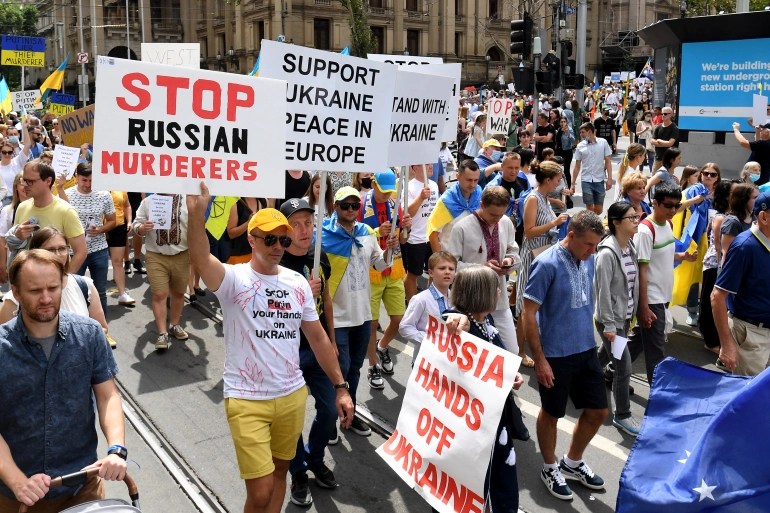
The antiwar community has fractured at a time when it most needs to speak with one voice to end the war in Ukraine. About all we can agree on is that the war is a terrible thing that needs to be stopped. Beyond that, reasonable people disagree about messaging, and unreasonable people demonize those who disagree. The result is that average Americans who don’t usually follow politics, let alone international affairs, form opinions based on emotional responses to what they hear in mainstream media rather than what may be most likely to promote peace. This is true despite the fact that most would say that peace is what they want.

The ability to influence American thinking through emotional appeals is what those with the power to manipulate the media count on to serve imperialism’s aims. If we can at least agree that how we frame our response is important, people who sincerely want to do something to end the war might be able to agree on what message would most effectively sway public opinion in a way that might influence our government to act in the interest of peace.

The most fundamental disagreement is over whether it’s necessary to call Russia out as solely or even primarily at fault for the war, or whether it is important to provide the context needed to understand the US role in creating the conditions that led it to decide that it had no choice but to respond to Ukrainian actions in Donbass with military force.

Given that our goal is to influence public opinion, it’s understandable that most peace groups have opted to follow the lead of politicians and mainstream commentators and preface every statement with a condemnation of Russia. After all, since they believe these accusations are justified, they fear being seen as supportive of Russia if they only focus on what the US has done that promotes war and what it hasn’t done that might have prevented it. Some peace groups go so far as to ignore clear US provocations as unimportant. Since it was Russia that invaded, they believe that their proper job is to wave Ukrainian flags and protest Russia’s actions, despite the reality that this will have no beneficial effect on the course of the war.

Other peace activists feel that either approach absolves the US of responsibility for creating conditions that led to the conflict. Believing the US actually initiated the conflict, they argue that dating its onset as February 24 is not only misleading, but false. They see the conflict as having started long before the Russian invasion and argue that knowing what choices Putin had is relevant to assigning blame.

The truth is that we don’t have to agree on who is at fault if we don’t make that an issue. As a psychotherapist with training in family therapy, I know from experience that focusing on who is responsible for a problem almost never leads to a satisfactory solution. And from a practical standpoint, placing sole blame on Russia is counterproductive not only because it splits the antiwar movement, but because to much of the public it provides a justification for an aggressive US response. Avoiding a conflict over whether Russia should be characterized as the sole aggressor is why many want to limit the message to demanding that the US
1) stop arming Ukraine, 2) declare it will never support Ukraine joining NATO, and 3) push Ukraine to negotiate without preconditions.

From a family therapy perspective, trying to keep the discussion focused on a solution would certainly be the approach to take if the US actually wanted to end the conflict. Unfortunately, that doesn’t seem to be the case. The effect of sending increasingly lethal weapons and imposing sanctions that primarily harm civilians is to prolong the war and increase casualties of both soldiers and civilians on both sides.

Recent reports indicate that the effort to help a depleted Ukrainian military drive Russia out of Donbass is futile. However, this approach is very profitable for a weapons industry that generously funds the elections of members of Congress willing to serve its interests, which is no doubt why any debate about how the US should proceed assumes that it will involve continuing a strategy that has proven to result in arming extremists when used in places like Iraq and Afghanistan. And yes, there are extremists with significant influence in Ukraine despite media denials.

Clearly, the focus on providing weapons has redirected the public’s attention from the question of how to end the war to how best to punish Russia, regardless of how US strategy affect Ukrainian civilians. This is not by accident, but by design. That’s why it is necessary to challenge the distortions, omissions and outright lies that are used to influence public opinion to conform with the goals of American imperialism. Unfortunately, the inability to agree on the facts is what has led to the stark divisions among those wanting to do something to make the war to end. That is we have to put aside our pride and listen to each other to understand why a minority firmly believes that the consensus opinion of the majority is based on misplaced trust in mainstream media.

Most Americans think they are informed if they read mainstream media and watch a variety of TV news sources. Antiwar activists know differently, because we know we have been lied into war repeatedly, at least from Vietnam through Syria. Unfortunately, like the general public, many peace proponents have no idea how information that challenges the government’s narrative is being systematically suppressed in unprecedented ways.

It’s always been true that truth is the first casualty of war. In today’s hybrid warfare, it is more critical than ever to control the information domain. The way news is presented by government officials and approved media frames the way most people think about US foreign policy. This is why the idea of sending ever more powerful weapons to prolong a military conflict that cannot be won is never challenged. While the ultimate outcome of Russia’s invasion cannot be predicted with certainty, the one thing we know for sure is that providing increasingly lethal weaponry will lead to more death on both sides and do nothing to promote stability in the region.

Of course, there is much more that could be said about the tremendous amount of disinformation in the mainstream media regarding Ukraine. While much of it is relevant to understanding the situation, it is far beyond the scope of this essay. I can only recommend that those who are inclined to believe what they read or hear in government-approved media look at any of the credible alternative sources that present evidence of critical facts that are being withheld from them.

A good way to find them is to look at the list of websites that Prop or Not, a shadowy group that claims to be the arbiter of “reliable sources,” claims should not be trusted. Interspersed among many dubious websites listed are some of the most informative sources of information contradicting the mainstream narrative. These are sites with authors that include prominent investigative journalists and veterans of the CIANSAState Departmenthigh ranking White House positions and military intelligence. They cite their sources, which gives their articles far more credibility than the mostly anonymous sources favored by the New York Times and Washington Post when reporting on many of the same stories.

I urge anyone interested in finding a common message to present to the public to read the statement released by the US Peace Council.
The Subtleties of Anti-Russia Leftist Rhetoric

By Edward Curtin

Source: Behind the Curtain

While the so-called liberal and conservative corporate mainstream media – all stenographers for the intelligence agencies – pour forth the most blatant propaganda about Russia and Ukraine that is so conspicuous that it is comedic if it weren’t so dangerous, the self-depicted cognoscenti also ingest subtler messages, often from the alternative media.

A woman I know and who knows my sociological analyses of propaganda contacted me to tell me there was an excellent article about the war in Ukraine at The Intercept, an on-line publication funded by billionaire Pierre Omidyar I have long considered a leading example of much deceptive reporting wherein truth is mixed with falsehoods to convey a “liberal” narrative that fundamentally supports the ruling elites while seeming to oppose them.  This, of course, is nothing new since it’s been the modus operandi of all corporate media in their own ideological and disingenuous ways, such as The New York Times, CBS, the Washington Post, the New York Daily News, Fox News, CNN, NBC, etc. for a very long time.

Nevertheless, out of respect for her judgment and knowing how deeply she feels for all suffering people, I read the article.  Written by Alice Speri, its title sounded ambiguous – “The Left in Europe Confronts NATO’s Resurgence After Russia’s Invasion of Ukraine” – until I saw the subtitle that begins with these words: “Russia’s brutal invasion complicates…”  But I read on.  By the fourth paragraph, it became clear where this article was going.  Speri writes that “In Ukraine, by contrast [with Iraq], it was Russia that had staged an illegal, unprovoked invasion, and U.S.-led support to Ukraine was understood by many as crucial to stave off even worse atrocities than those the Russian military had already committed.” [my emphasis]

While ostensibly about European anti-war and anti-NATO activists caught on the horns of a dilemma, the piece goes on to assert that although US/NATO was guilty of wrongful expansion over many years, Russia has been an aggressor in Ukraine and Georgia and is guilty of terrible war crimes, etc.

There is not a word about the U.S. engineered coup in 2014, the CIA and Pentagon backed mercenaries in Ukraine, or its support for the neo-Nazi Azov Battalion and Ukraine’s years of attacks on the Donbass where many thousands have been killed.  It is assumed these actions are not criminal or provocative.  And there is this:

The uncertain response of Europe’s peace activists is both a reflection of a brutal, unprovoked invasion that stunned the world and of an anti-war movement that has grown smaller and more marginalized over the years. The left in both Europe and the U.S. have struggled to respond to a wave of support for Ukraine that is at cross purposes with a decades long effort to untangle Europe from a U.S.-led military alliance. [my emphasis]

In other words, the article, couched in anti-war rhetoric, was anti-Russia propaganda.  When I told my friend my analysis, she refused to discuss it and got angry with me, as if I therefore were a proponent of war.  I have found this is a common response.

This got me thinking again about why people so often miss the untruths lying within articles that are in many parts truthful and accurate.  I notice this constantly.  They are like little seeds slipped in as if no one will notice; they work their magic nearly unconsciously.  Few do notice them, for they are often imperceptible.  But they have their effects and are cumulative and are far more powerful over time than blatant statements that will turn people off, especially those who think propaganda doesn’t work on them.  This is the power of successful propaganda, whether purposeful  or not.  It particularly works well on “intellectual” and highly schooled people.

For example, in a recent printed  interview, Noam Chomsky, after being introduced as a modern day Galileo, Newton, and Descartes rolled into one, talks about propaganda, its history, Edward Bernays, Walter Lippman, etc.  What he says is historically accurate and informative for anyone not knowing this history.  He speaks wisely of U.S. media propaganda concerning its unprovoked war against Iraq and he accurately calls the war in Ukraine “provoked.”  And then, concerning the war in Ukraine, he drops this startling statement:

I don’t think there are ‘significant lies’ in war reporting. The U.S. media are generally doing a highly creditable job in reporting Russian crimes in Ukraine. That’s valuable, just as it’s valuable that international investigations are underway in preparation for possible war crimes trials.

In the blink of an eye, Chomsky says something so incredibly untrue that unless one thinks of him as a modern day Galileo, which many do, it may pass as true and you will smoothly move on to the next paragraph.  Yet it is a statement so false as to be laughable.  The media propaganda concerning events in Ukraine has been so blatantly false and ridiculous that a careful reader will stop suddenly and think: Did he just say that?

So now Chomsky views the media, such as The New York Times and its ilk, that he has correctly castigated for propagandizing for the U.S. in Iraq and East Timor, to use two examples, is doing “a highly creditable job in reporting Russian crimes in Ukraine,” as if suddenly they were no longer spokespeople for the CIA and U.S. disinformation.  And he says this when we are in the midst of the greatest propaganda blitz since WW I, with its censorship, Disinformation Governance Board, de-platforming of dissidents, etc., that border on a parody of Orwell’s Nineteen Eighty-Four. 

Even slicker is his casual assertion that the media are doing a good job reporting Russia’s war crimes after he earlier has said this about propaganda:

So it continues. Particularly in the more free societies, where means of state violence have been constrained by popular activism, it is of great importance to devise methods of manufacturing consent, and to ensure that they are internalized, becoming as invisible as the air we breathe, particularly in articulate educated circles. Imposing war-myths is a regular feature of these enterprises.

This is simply masterful.  Explain what propaganda is at its best and how you oppose it and then drop a soupçon of it into your analysis.  And while he is at it, Chomsky makes sure to praise Chris Hedges, one of his followers, who has himself recently wrote an article – The Age of Self-Delusion – that also contains valid points appealing to those sick of wars, but which also contains the following words:

Putin’s revanchism is matched by our own.

The disorganization, ineptitude, and low morale of the Russian army conscripts, along with the repeated intelligence failures by the Russian high command, apparently convinced Russia would roll over Ukraine in a few days, exposes the lie that Russia is a global menace.

‘The Russian bear has effectively defanged itself,’ historian Andrew Bacevich writes.

But this is not a truth the war makers impart to the public. Russia must be inflated to become a global menace, despite nine weeks of humiliating military failures. [my emphasis]

Russia’s revanchism?  Where?  Revanchism?  What lost territory has the U.S. ever waged war to recover?  Iraq, Syria, Cuba, Vietnam, Yugoslavia, etc.?  The U.S.’s history is a history not of revanchism but of imperial conquest, of seizing or controlling territory, while Russia’s war in Ukraine is clearly an act of self-defense after years of U.S./NATO/Ukraine provocations and threats, which Hedges recognizes.  “Nine weeks of humiliating military failures”? – when they control a large section of eastern and southern Ukraine, including the Donbass.  But his false message is subtly woven, like Chomsky’s, into sentences that are true.

“But this is not a truth the war makers impart to the public.”  No, it is exactly what the media spokespeople for the war makers – i.e. The New York Times (Hedges former employer, which he never fails to mention and for whom he covered the Clinton administration’s savage destruction of Yugoslavia), CNNFox News, The Washington Post, the New York Post, etc. impart to the public every day for their masters.  Headlines that read how Russia, while allegedly committing daily war crimes, is failing in its war aims and that the mythic hero Zelensky is leading Ukrainians to victory.  Words to the effect that “The Russian bear has effectively defanged itself” presented as fact.

Yes, they do inflate the Russian monster myth, only to then puncture it with the myth of David defeating Goliath.

But being in the business of mind games (too much consistency leads to clarity and gives the game away), one can expect them to scramble their messages on an ongoing basis to serve the U.S. agenda in Ukraine and further NATO expansion in the undeclared war with Russia, for which the Ukrainian people will be sacrificed.

Orwell called it “doublethink”:

Doublethink lies at the very heart of Ingsoc, since the essential act of the Party is to use conscious deception while retaining the firmness of purpose that goes with complete honesty.To tell deliberate lies while genuinely believing in them, to forget any fact that has become inconvenient, and then, when it becomes necessary again, to draw it back from oblivion for just so long as it is needed, to deny the existence of objective reality and all the while to take account of the reality one denies – all this is indispensably necessary….with the lie always one step ahead of the truth.

Revealing while concealing and interjecting inoculating shots of untruths that will only get cursory attention from their readers, the writers mentioned here and others have great appeal for the left intelligentsia.  For people who basically worship those they have imbued with infallibility and genius, it is very hard to read all sentences carefully and smell a skunk.  The subterfuge is often very adroit and appeals to readers’ sense of outrage at what happened in the past – e.g. the George W. Bush administration’s lies about weapons of mass destruction in Iraq.

Chomsky, of course, is the leader of the pack, and his followers are legion, including Hedges.  For decades they have been either avoiding or supporting the official versions of the assassinations of JFK and RFK, the attacks of September 11, 2001 that led directly to the war on terror and so many wars of aggression,and the recent Covid-19 propaganda with its devastating lockdowns and crackdowns on civil liberties.  They are far from historical amnesiacs, of course, but obviously consider these foundational events of no importance, for otherwise they would have addressed them.  If you expect them to explain, you will be waiting a long time.

In a recent article – How the organized Left got Covid wrong, learned to love lockdowns and lost its mind: an autopsy – Christian Parenti writes this about Chomsky:

Almost the entire left intelligentsia has remained psychically stuck in March 2020. Its members have applauded the new biosecurity repression and calumniated as liars, grifters, and fascists any and all who dissented. Typically, they did so without even engaging evidence and while shirking public debate. Among the most visible in this has been Noam Chomsky, the self-described anarcho-syndicalist who called for the unvaccinated to “remove themselves from society,” and suggested that they should be allowed to go hungry if they refuse to submit.

Parenti’s critique of the left’s response (not just Chomsky’s and Hedges’) to Covid also applies to those foundational events mentioned above, which raises deeper questions about the CIA’s and NSA’s penetration  of the media in general, a subject beyond the scope of this analysis.

For those, like the liberal woman who referred me to The Intercept article, who would no doubt say of what I have written here: Why are you picking on leftists? my reply is quite simple.

The right-wing and the neocons are obvious in their pernicious agendas; nothing is really hidden; therefore they can and should be opposed. But many leftists serve two masters and are far subtler. Ostensibly on the side of regular people and opposed to imperialism and the predations of the elites at home and abroad, they are often tricksters of beguiling rhetoric that their followers miss. Rhetoric that indirectly fuels the wars they say they oppose.

Smelling skunks is not as obvious as it might seem.  Being nocturnal, they come forth when most are sleeping.

YouTube CEO at World Economic Forum: “There’ll always be work that we have to do” to censor “misinformation”

A commitment to constant censorship.

By Tom Parker

Source: Reclaim the Net

At the World Economic Forum Annual Meeting for 2022, an event where powerful CEOs and world leaders meet to “find solutions to the world’s most urgent challenges,” YouTube CEO Susan Wojcicki committed to persistent censorship of “misinformation” and praised YouTube’s existing censorship efforts.

Wojcicki made the comments after Alyson Shontell Lombardi, the Editor-in-Chief of Fortune Magazine, asked her whether YouTube’s efforts to censor misinformation will always be a “work in progress.”

“I think there’ll always be work that we have to do because there will always be incentives for people to be creating misinformation,” Wojcicki said. “The challenge will be to keep staying ahead of that and make sure that we are understanding what they are and the different ways that people may use to try to trick our systems and make sure that our systems are staying ahead of what’s necessary to make sure that we are managing that.”

Wojcicki continued by praising YouTube’s 5-6 year initiative of cracking down on content that’s deemed to be misinformation and said that users who look at YouTube search results or the homepage will see content from “authoritative sources” (mainstream media outlets that YouTube designates as authoritative) for “sensitive topics.”

Earlier in the conversation, Wojcicki said YouTube is “investing a huge amount to make sure that we’re fighting misinformation” and discussed the various ways YouTube is cracking down on misinformation. She pointed to YouTube introducing 10 COVID censorship policies, YouTube’s policy of not recommending “borderline content” which doesn’t break YouTube’s rules but is deemed to be “lower quality,” and YouTube’s policy of demonetizing content that’s deemed to be “propagating something that is generally understood as not accurate information.”

Wojcicki also talked about YouTube’s violative view rate (VVR) – a metric that shows how many views come from content that violates YouTube’s rules. The metric indicates how swiftly YouTube is censoring content. A low VVR signals that most of the content YouTube removes is being taken down before viewers have a chance to watch it.

Wojcicki noted that just 10-12 views of every 10,000 come from violative content and that this number has “come down significantly” over time.

“Our plan is to continue to work on it and make sure that we continue to reduce that,” Wojcicki added.

Wojcicki’s commitment to always crackdown on misinformation echoes her and the platform’s previous vows to censor misinformation. Days ago, Wojcicki promised to tackle “misinformation” to win over corporate cash. And earlier this year, she said: “Tackling misinformation and other harmful content is a top priority.”

YouTube has already deleted more than a million videos for “COVID misinformation,” plans to preemptively censor “new misinformation,” and has considered hiding the share button to prevent misinformation spread.

Related Videos

Pop Culture Has Become an Oligopoly

By Adam Mastroianni

Source: Experimental History

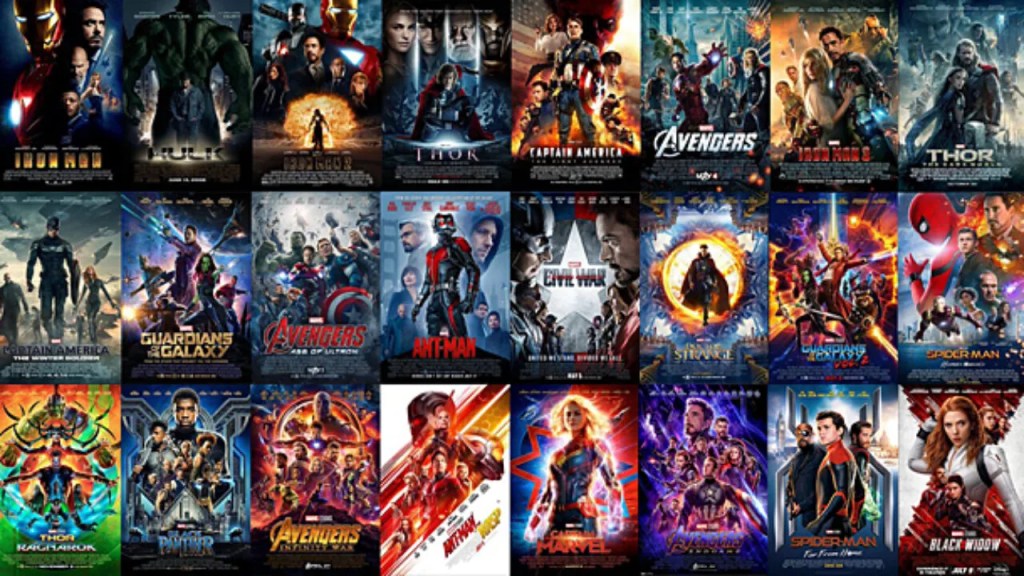
You may have noticed that every popular movie these days is a remake, reboot, sequel, spinoff, or cinematic universe expansion. In 2021, only one of the ten top-grossing films––the Ryan Reynolds vehicle Free Guy––was an original. There were only two originals in 2020’s top 10, and none at all in 2019.

People blame this trend on greedy movie studios or dumb moviegoers or competition from Netflix or humanity running out of ideas. Some say it’s a sign of the end of movies. Others claim there’s nothing new about this at all.

Some of these explanations are flat-out wrong; others may contain a nugget of truth. But all of them are incomplete, because this isn’t just happening in movies. In every corner of pop culture––movies, TV, music, books, and video games––a smaller and smaller cartel of superstars is claiming a larger and larger share of the market. What used to be winners-take-some has grown into winners-take-most and is now verging on winners-take-all. The (very silly) word for this oligopoly, like a monopoly but with a few players instead of just one.

I’m inherently skeptical of big claims about historical shifts. I recently published a paper showing that people overestimate how much public opinion has changed over the past 50 years, so naturally I’m on the lookout for similar biases here. But this shift is not an illusion. It’s big, it’s been going on for decades, and it’s happening everywhere you look. So let’s get to the bottom of it.

(Data and code available here.)

Movies 

At the top of the box office charts, original films have gone extinct. 

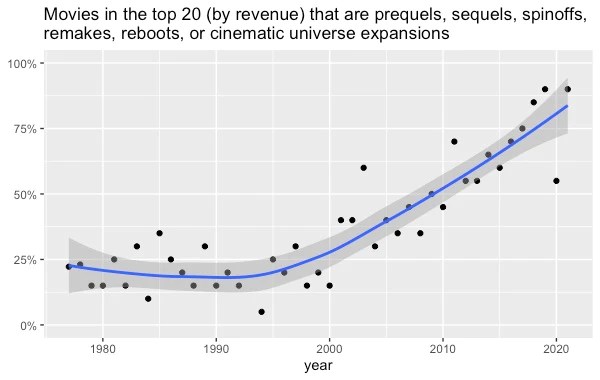
I looked at the 20 top-grossing movies going all the way back to 1977 (source), and I coded whether each was part of what film scholars call a “multiplicity”—sequels, prequels, franchises, spin-offs, cinematic universe expansions, etc. This required some judgment calls. Lots of movies are based on books and TV shows, but I only counted them as multiplicities if they were related to a previous movie. So 1990’s Teenage Mutant Ninja Turtles doesn’t get coded as a multiplicity, but 1991’s Teenage Mutant Ninja Turtles II: The Secret of the Ooze does, and so does the 2014 Teenage Mutant Ninja Turtles remake. I also probably missed a few multiplicities, especially in earlier decades, since sometimes it’s not obvious that a movie has some connection to an earlier movie.

Regardless, the shift is gigantic. Until the year 2000, about 25% of top-grossing movies were prequels, sequels, spinoffs, remakes, reboots, or cinematic universe expansions. Since 2010, it’s been over 50% ever year. In recent years, it’s been close to 100%.

Original movies just aren’t popular anymore, if they even get made in the first place.

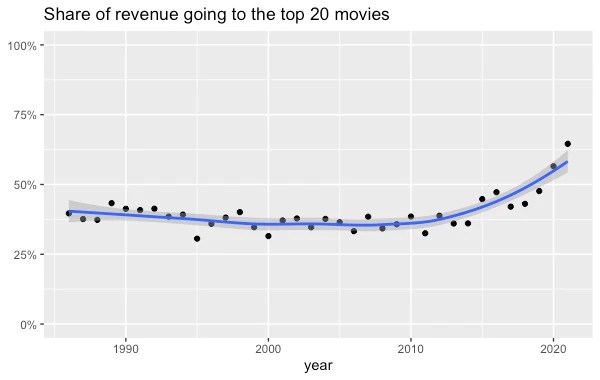
Top movies have also recently started taking a larger chunk of the market. I extracted the revenue of the top 20 movies and divided it by the total revenue of the top 200 movies, going all the way back to 1986 (source). The top 20 movies captured about 40% of all revenue until 2015, when they started gobbling up even more.

Television

Thanks to cable and streaming, there’s way more stuff on TV today than there was 50 years ago. So it would make sense if a few shows ruled the early decades of TV, and now new shows constantly displace each other at the top of the viewership charts.

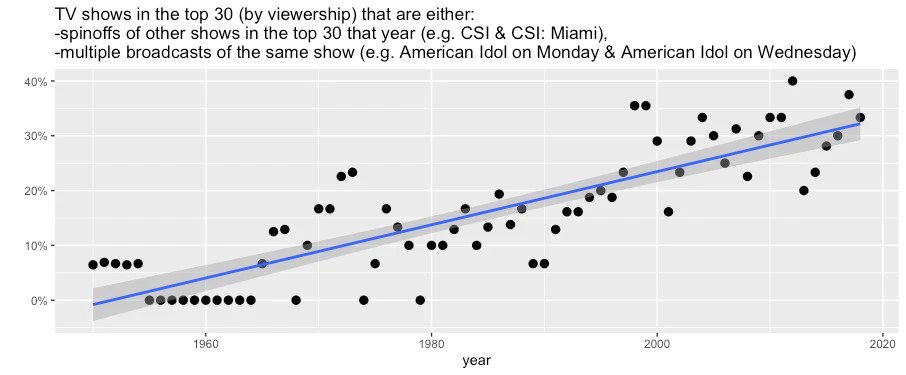
Instead, the opposite has happened. I pulled the top 30 most-viewed TV shows from 1950 to 2019 (source) and found that fewer and fewer franchises rule a larger and larger share of the airwaves. In fact, since 2000, about a third of the top 30 most-viewed shows are either spinoffs of other shows in the top 30 (e.g., CSI and CSI: Miami) or multiple broadcasts of the same show (e.g., American Idol on Monday and American Idol on Wednesday). 

Two caveats to this data. First, I’m probably slightly undercounting multiplicities from earlier decades, where the connections between shows might be harder for a modern viewer like me to understand––maybe one guy hosted multiple different shows, for example. And second, the Nielsen ratings I’m using only recently started accurately measuring viewership on streaming platforms. But even in 2019, only 14% of viewing time was spent on streaming, so this data isn’t missing much.

Music

It used to be that a few hitmakers ruled the charts––The Beatles, The Eagles, Michael Jackson––while today it’s a free-for-all, right?

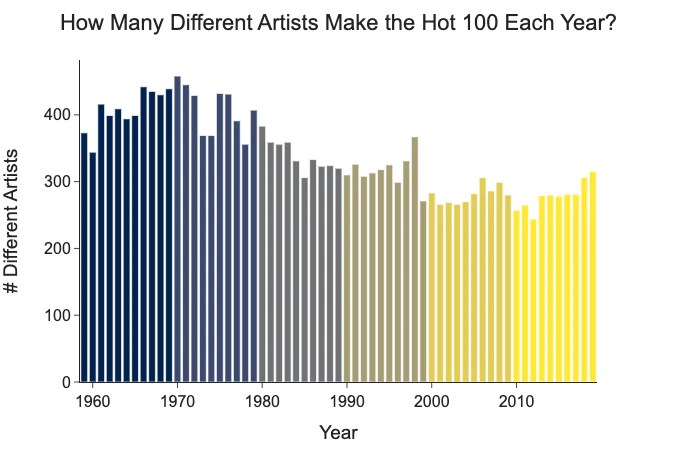
Nope. A data scientist named Azhad Syed has done the analysis, and he finds that the number of artists on the Billboard Hot 100 has been decreasing for decades.

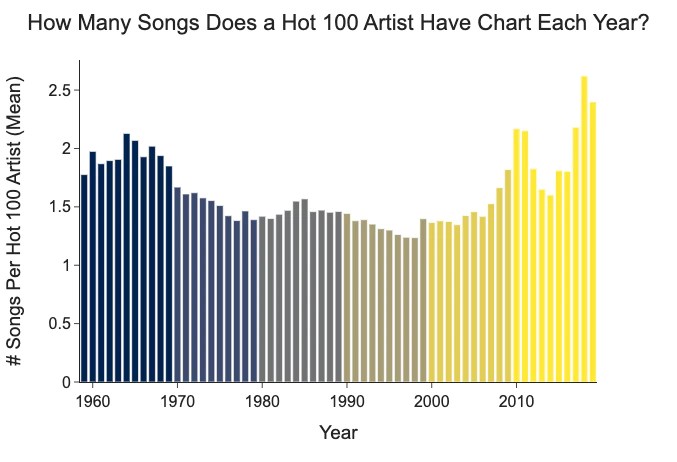
And since 2000, the number of hits per artist on the Hot 100 has been increasing. 

(Azhad says he’s looking for a job––you should hire him!)

A smaller group of artists tops the charts, and they produce more of the chart-toppers. Music, too, has become an oligopoly.

Books

Literature feels like a different world than movies, TV, and music, and yet the trend is the same.

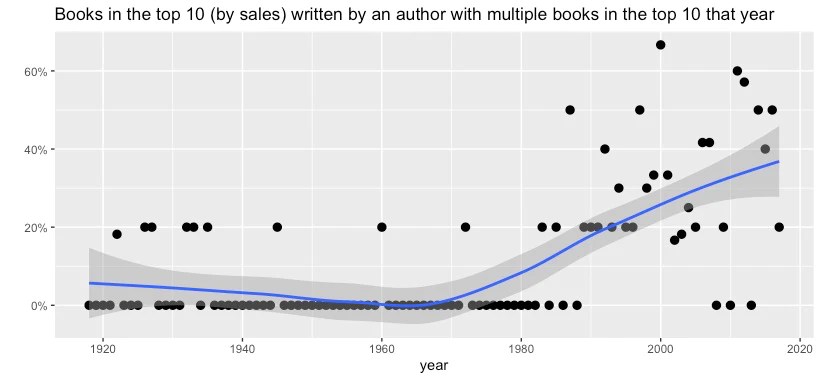
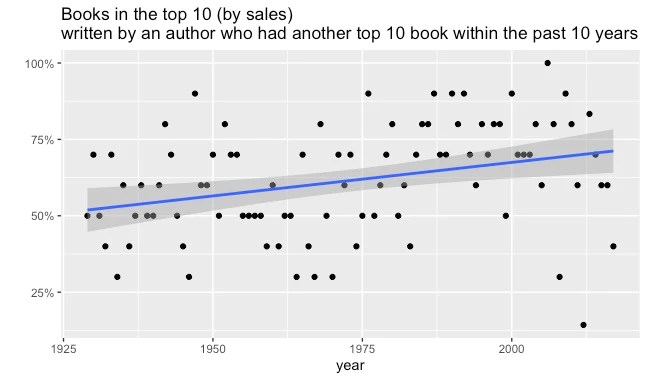
Using LiteraryHub’s list of the top 10 bestselling books for every year from 1919 to 2017, I found that the oligopoly has come to book publishing as well. There are a couple ways we can look at this. First, we can look at the percentage of repeat authors in the top 10––that is, the number of books in the top 10 that were written by an author with another book in the top 10.

It used to be pretty rare for one author to have multiple books in the top 10 in the same year. Since 1990, it’s happened almost every year. No author ever had three top 10 books in one year until Danielle Steel did it 1998. In 2011, John Grisham, Kathryn Stockett, and Stieg Larsson all had two chart-topping books each.

We can also look at the percentage of authors in the top 10 were already famous––say, they had a top 10 book within the past 10 years. That has increased over time, too. 

In the 1950s, a little over half of the authors in the top 10 had been there before. These days, it’s closer to 75%.

Video games

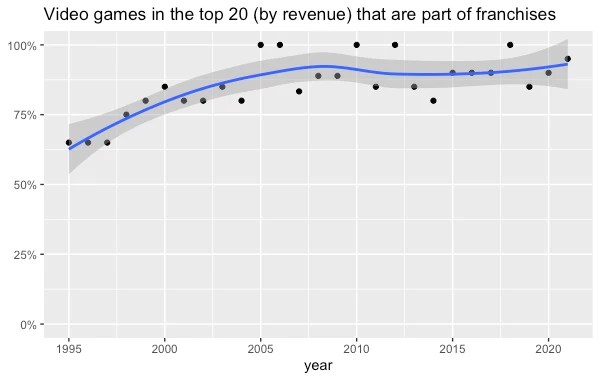
I tracked down the top 20 bestselling video games for each year from 1995 to 2021 (sources: 1234567) and coded whether each belongs to a preexisting video game franchise. (Some games, like Harry Potter and the Sorcerer’s Stone, belong to franchises outside of video games. For these, I coded the first installment as originals and any subsequent installments as franchise games.)

The oligopoly rules video games too:

In the late 1990s, 75% or less of bestselling video games were franchise installments. Since 2005, it’s been above 75% every year, and sometimes it’s 100%. At the top of the charts, it’s all Mario, Zelda, Call of Duty, and Grand Theft Auto.

Why is this happening?

Any explanation for the rise of the pop oligopoly has to answer two questions: why have producers started producing more of the same thing, and why are consumers consuming it? I think the answers to the first question are invasionconsolidation, and innovation. I think the answer to the second question is proliferation.

Invasion

Software and the internet have made it easier than ever to create and publish content. Most of the stuff that random amateurs make is crap and nobody looks at it, but a tiny proportion gets really successful. This might make media giants choose to produce and promote stuff that independent weirdos never could, like an Avengers movie. This can’t explain why oligopolization started decades ago––YouTube only launched in 2005, for example, and most Americans didn’t have broadband until 2007––but it might explain why it’s accelerated and stuck around.

Consolidation

Big things like to eat, defeat, and outcompete smaller things. So over time, big things should get bigger and small things should die off. Indeed, movie studiosmusic labelsTV stations, and publishers of books and video games have all consolidated. Maybe it’s inevitable that major producers of culture will suck up or destroy everybody else, leaving nothing but superstars and blockbusters. Indeed, maybe cultural oligopoly is merely a transition state before we reach cultural monopoly.

Innovation

You may think there’s nothing left to discover in art forms as old as literature and music, and that they simply iterate as fashions change. But it took humans thousands of years to figure out how to create the illusion of depth in paintings. Novelists used to think that sentences had to be long and complicated until Hemingway came along, wrote some snappy prose, and changed everything. Even very old art forms, then, may have secrets left to discover. Maybe the biggest players in culture discovered some innovations that won them a permanent, first-mover chunk of market share. I can think of a few:

  • In books: lightning-quick plots and chapter-ending cliffhangers. Nobody thinks The Da Vinci Code is high literature, but it’s a book that really really wants you to read it. And a lot of people did!
  • In music: sampling. Musicians seem to sample more often these days. Now we not only remake songs; we franchise them too.
  • In movies, TV, and video games: cinematic universes. Studios have finally figured out that once audiences fall in love with fictional worlds, they want to spend lots of time in them. Marvel, DC, and Star Wars are the most famous, but there are also smaller universe expansions like Better Call Saul and El Camino from Breaking Bad and The Many Saints of Newark from The Sopranos. Video game developers have understood this for even longer, which is why Mario does everything from playing tennis to driving go-karts to, you know, being a piece of paper.

Proliferation

Invasion, consolidation, and innovation can, I think, explain the pop oligopoly from the supply side. But all three require a willing audience. So why might people be more open to experiencing the same thing over and over again?

As options multiply, choosing gets harder. You can’t possibly evaluate everything, so you start relying on cues like “this movie has Tom Hanks in it” or “I liked Red Dead Redemption, so I’ll probably like Red Dead Redemption II,” which makes you less and less likely to pick something unfamiliar. 

Another way to think about it: more opportunities means higher opportunity costs, which could lead to lower risk tolerance. When the only way to watch a movie is to go pick one of the seven playing at your local AMC, you might take a chance on something new. But when you’ve got a million movies to pick from, picking a safe, familiar option seems more sensible than gambling on an original.

This could be happening across all of culture at once. Movies don’t just compete with other movies. They compete with every other way of spending your time, and those ways are both infinite and increasing. There are now 60,000 free books on Project Gutenberg, Spotify says it has 78 million songs and 4 million podcast episodes, and humanity uploads 500 hours of video to YouTube every minute. So uh, yeah, the Tom Hanks movie sounds good.

What do we do about it?

Some may think that the rise of the pop oligopoly means the decline of quality. But the oligopoly can still make art: Red Dead Redemption II is a terrific game, “Blinding Lights” is a great song, and Toy Story 4 is a pretty good movie. And when you look back at popular stuff from a generation ago, there was plenty of dreck. We’ve forgotten the pulpy Westerns and insipid romances that made the bestseller lists while books like The Great GatsbyBrave New World, and Animal Farm did not. American Idol is not so different from the televised talent shows of the 1950s. Popular culture has always been a mix of the brilliant and the banal, and nothing I’ve shown you suggests that the ratio has changed.

The problem isn’t that the mean has decreased. It’s that the variance has shrunk. Movies, TV, music, books, and video games should expand our consciousness, jumpstart our imaginations, and introduce us to new worlds and stories and feelings. They should alienate us sometimes, or make us mad, or make us think. But they can’t do any of that if they only feed us sequels and spinoffs. It’s like eating macaroni and cheese every single night forever: it may be comfortable, but eventually you’re going to get scurvy. 

We haven’t fully reckoned with what the cultural oligopoly might be doing to us. How much does it stunt our imaginations to play the same video games we were playing 30 years ago? What message does it send that one of the most popular songs in the 2010s was about how a 1970s rock star was really cool? How much does it dull our ambitions to watch 2021’s The Matrix: Resurrections, where the most interesting scene is just Neo watching the original Matrix from 1999? How inspiring is it to watch tiny variations on the same police procedurals and reality shows year after year? My parents grew up with the first Star Wars movie, which had the audacity to create an entire universe. My niece and nephews are growing up with the ninth Star Wars movie, which aspires to move merchandise. Subsisting entirely on cultural comfort food cannot make us thoughtful, creative, or courageous.

Fortunately, there’s a cure for our cultural anemia. While the top of the charts has been oligopolized, the bottom remains a vibrant anarchy. There are weird books and funky movies and bangers from across the sea. Two of the most interesting video games of the past decade put you in the role of an immigration officer and an insurance claims adjuster. Every strange thing, wonderful and terrible, is available to you, but they’ll die out if you don’t nourish them with your attention. Finding them takes some foraging and digging, and then you’ll have to stomach some very odd, unfamiliar flavors. That’s good. Learning to like unfamiliar things is one of the noblest human pursuits; it builds our empathy for unfamiliar people. And it kindles that delicate, precious fire inside us––without it, we might as well be algorithms. Humankind does not live on bread alone, nor can our spirits long survive on a diet of reruns.

On Censorship and Disinformation

By W.J. Astore

Source: Bracing Views

The best way to combat disinformation is with more and better information.  Censorship isn’t the answer.

The Biden administration has reached a different conclusion, creating a “Disinformation Governance Board” under the Department of Homeland Security. This “board” is headed by Nina Jankowicz, an unelected official and an apparent partisan hack. One example: she dismissed the infamous Hunter Biden laptop story as a “fairy tale” involving a “laptop repair shop”; it’s now been confirmed that Hunter’s laptop was real, and so too was that repair shop.

Democrats, of course, don’t have exclusive rights to censorship. Republicans always seem to be calling for books to be banned or education to be policed. But the real problem is much larger than partisan hackery and bickering. Efforts at censorship are all around us, couched as a way of protecting us from harmful lies and other forms of disinformation. Yet, as the comedian Jimmy Dore points out, the government isn’t that concerned about protecting you from lies; it is, however, deeply concerned with denying you access to certain truths, truths that undermine governmental authority and the dominant narrative.

As a retired U.S. military officer and as a historian, the most insidious lies and disinformation I’ve encountered have come from the government. Consider the lies revealed by Daniel Ellsberg and his leak of the Pentagon Papers. Consider the war crimes revealed by Chelsea Manning, aided by Julian Assange and Wikileaks. Consider the lies revealed in the recent Afghan War Papers. Consider the lies about the presence of WMD in Iraq, lies that were used to justify the disastrous Iraq War. The government, in short, is a center of lies and disinformation, which is precisely why we need an adversarial media, one that is willing to ferret out truth. Instead, we’re being offered a governmental Ministry of Truth in the form of a “Disinformation Governance Board.”

All things being equal, a democratic society thrives best when speech is as free as possible, trusting in the people to sort fact from fiction, and sound theories from blatant propaganda. And there’s the rub: trusting in the people. Because the government doesn’t trust us (remember Hillary Clinton’s comment about all those irredeemable deplorables), even as the government is often at pains to mislead and misinform us. As maverick journalist I.F. “Izzy” Stone said, all governments lie. It’s truly nonsensical, then, to allow the government to police what is true and what is “disinformation.”

But don’t we need some censorship in the name of safety or security or mental health or whatever? Sorry: censorship is rarely about safety, and it most certainly doesn’t serve the needs of the vulnerable. Instead, it serves the needs of the powerful, those who already possess the loudest megaphones in the public square.

But doesn’t someone like Donald Trump deserve to be censored because he spreads disinformation? Which is the bigger problem: Trump or censorship? I happen to think Trump is a divisive con man, but it was a bad precedent for Twitter to have banned him from tweeting. The bigger problem wasn’t Trump’s tweets but the media’s obsessive coverage of them in pursuit of ratings. The way to combat a blowhard like Trump is to ignore him, and to correct him when needed. To combat his lies with the truth. We don’t need a governmental Ministry of Truth to police the tweets of a former president. Not when the government is often the biggest liar.

The solution isn’t censorship but an active, engaged, and informed citizenry, assisted by a fourth estate, the press, that is truly independent and adversarial to power. But the weakening of education in America, combined with a fourth estate that is deeply compromised by the powerful and often in bed with the government, means that these democratic checks on power are less and less effective. Hence calls for quick yet dangerous “solutions” like censorship, where the censors (governmental boards, private corporations) are opaque and almost completely unaccountable to the people.

Unless your goal is to give the already powerful a monopoly on speech, censorship is not the answer.

A Weird, Stupid Dystopia

By Caitlin Johnstone

Source: CaitlinJohnstone.com

The last few days in the United States have seen a parade of wealthy freaks fellating each other’s egos and preening for the cameras in outlandish garb while ordinary Americans suffer more and more.

The weekend’s White House Correspondents’ Dinner saw a gaggle of media celebrities congregate to congratulate one another on what a great job they’ve been doing bravely telling the truth and holding the most powerful government on earth to account. The host, Trevor Noah of The Daily Show, gushed with enthusiasm about how much freedom the press have in America to say things the powerful don’t like.

“As we sit in this room tonight, people, I really hope you all remember what the real purpose of this evening is,” Noah said. “Yes, it’s fun. Yes, we dress nice. Yes, the people eat, they drink, we have fun. But the reason we’re here is to honor and celebrate the fourth estates and what you stand for — what you stand for — an additional check and balance that holds power to account and gives voice to those who otherwise wouldn’t have one.”

“And if you ever begin to doubt your responsibilities, if you ever begin to doubt how meaningful it is, look no further than what’s happening in Ukraine,” said Noah. “Look at what’s happening there. Journalists are risking and even losing their lives to show the world what’s really happening. You realize how amazing it is. In America, you have the right to seek the truth and speak the truth even if it makes people in power uncomfortable, even if it makes your viewers or your readers uncomfortable. You understand how amazing that is? I stood here tonight and I made fun of the president of the United States, and I’m going to be fine. I am going to be fine, right? Do you really understand what a blessing it is?”

Of course there are people who’ve said things that US presidents don’t like who are not in fact fine. Julian Assange continues to waste away in Belmarsh Prison as the US government continues its efforts to extradite him to he can become the first publisher ever tried under the Espionage Act. Edward Snowden, an American, remains in exile because one US president after another continues to refuse to pardon his heroic whistleblowing about the sinister surveillance practices of the US intelligence cartel. Daniel Hale, also an American, sits in prison for exposing the depravity of America’s monstrous drone program.

Trevor Noah did not mention these people, or the many others who’ve been persecuted, silenced, imprisoned and killed for saying things the powerful individuals who govern the US don’t approve of, because as a member of the mainstream media his job is not to inform but to propagandize.

Far from providing “an additional check and balance that holds power to account and gives voice to those who otherwise wouldn’t have one” as Noah claims, the people in his audience on Saturday night are tasked with manipulating public thought in facilitation of the interests of the powerful. The mainstream news media in America, and throughout all the so-called free democracies of the western world, are propaganda institutions whose first and foremost job is to manufacture consent for oligarchy and empire.

Which is why the President of the United States, when he took the podium that night, had nothing but friendly words for the mainstream press.

“What’s clear, and I mean this from the bottom of my heart, is that you, the free press, matter more than you ever did in the last century,” Biden said. “We’ve all seen the courage of Ukrainian people because of the courage of American reporters in this room, and your colleagues across the world who are on the ground taking their lives in their own hands.”

This past weekend also saw a friendly gathering of brave fourth estate truth warriors and political and government operatives of the US empire at a party hosted by the billionaire owner of the neocon war propaganda rag The Atlantic.

Politico reports:

David and Katherine Bradley and Laurene Powell Jobs hosted a dinner at the Bradleys’ home. SPOTTED: Secretary of State Antony Blinken and Cabinet Secretary Evan Ryan, Commerce Secretary Gina Raimondo, CIA Director Bill Burns, press secretary Jen Psaki, Deputy A.G. Lisa Monaco, Sen. Tina Smith (D-Minn.), FCC Chair Jessica Rosenworcel, Del. Stacey Plaskett (D-U.S. Virgin Islands), homeland security adviser Elizabeth Sherwood-Randall, Jeffrey Goldberg, Nick Thompson, Peter Lattman, Anne Applebaum, Russell Berman, Franklin Foer, David Frum, Elaine Godfrey, Adam Harris, Mark Leibovich, Jeff Dufour, Heather Kuldell, Kevin Baron, José Andrés, Enes Kanter, Mitch Landrieu, Dafna Linzer, Rachel Martin, Judy Woodruff, Jake Tapper, Wolf Blitzer, Jonathan Capehart, Katty Kay, Steve and Jean Case, John Dickerson and Jen Palmieri.

Yep, when you see a shady basketball player/empire propagandist fraternizing with the CIA Director while surrounded by media celebrities and government insiders at a party hosted by a media-owning plutocrat, you know you’re in a country where power is held to account. Right, Trevor?

The orgy of embarrassment was capped off by the 2022 Met Gala, a big weird dystopian parade of rich freaks dressed like Hunger Games aristocracy and laughing in the face of everyone who can’t afford to live.

An honest Met Gala dress would have a corset made from the bones of Yemeni children, draped with a cloth of stolen gold and lithium spun by the tiny hands of child slaves, with a full-length train that leached oil and blood wherever it went.

This while ordinary Americans struggle just to survive. While American women appear to be on the precipice of losing their reproductive sovereignty. While money is poured into a proxy war which threatens to escalate into a conflict that could easily end all life on earth.

This is your dying empire, America. This is your end-stage capitalism. This is your dystopia, in all its weird, phony, stupid glory.

It is horrifying. The longer you look at it, the creepier it gets.

Breathe it all in, folks.

We’re in for a hell of a ride.

Hedges: The Pimps of War

Whores of War, original illustration by Mr. Fish.

The coterie of neocons and liberal interventionists who orchestrated two decades of military fiascos in the Middle East and who have never been held to account are now stoking a suicidal war with Russia.

By Chris Hedges

Source: ScheerPost.com

The same cabal of warmongering pundits, foreign policy specialists and government officials, year after year, debacle after debacle, smugly dodge responsibility for the military fiascos they orchestrate. They are protean, shifting adroitly with the political winds, moving from the Republican Party to the Democratic Party and then back again, mutating from cold warriors to neocons to liberal interventionists. Pseudo intellectuals, they exude a cloying Ivy League snobbery as they sell perpetual fear, perpetual war, and a racist worldview, where the lesser breeds of the earth only understand violence. 

They are pimps of war, puppets of the Pentagon, a state within a state, and the defense contractors who lavishly fund their think tanks — Project for the New American Century, American Enterprise Institute, Foreign Policy Initiative, Institute for the Study of War, Atlantic Council and Brookings Institution. Like some mutant strain of an antibiotic-resistant bacteria, they cannot be vanquished. It does not matter how wrong they are, how absurd their theories, how many times they lie or denigrate other cultures and societies as uncivilized or how many murderous military interventions go bad. They are immovable props, the parasitic mandarins of power that are vomited up in the dying days of any empire, including ours, leaping from one self-defeating catastrophe to the next.

I spent  20 years as a foreign correspondent reporting on the suffering, misery, and murderous rampages these shills for war engineered and funded. My first encounter with them was in Central America. Elliot Abrams — convicted of providing misleading testimony to Congress on the Iran-Contra Affair and later  pardoned by President George H.W. Bush so he could return to government to sell us the Iraq War — and Robert Kagan, director of the State Department’s public diplomacy office for Latin America — were propagandists for the brutal military regimes in El Salvador and Guatemala, as well as the rapists and homicidal thugs that made up the rogue Contra forces fighting the Sandinista government in Nicaragua, which they illegally funded. Their job was to discredit our reporting.

They, and their coterie of fellow war lovers, went on to push for the expansion of NATO in Central and Eastern Europe after the fall of the Berlin Wall, violating an agreement not to extend NATO beyond the borders of a unified Germany and recklessly antagonizing Russia. They were and are cheerleaders for the apartheid state of Israel, justifying its war crimes against Palestinians and myopically conflating Israel’s interests with our own. They advocated for air strikes in Serbia, calling for the US to “take out” Slobodan Milosevic. They were the authors of the policy to invade Afghanistan, Iraq, Syria and Libya. Robert Kagan and William Kristol, with their typical cluelessness, wrote in April 2002 that “the road that leads to real security and peace” is “the road that runs through Baghdad.”

We saw how that worked out. That road led to the dissolution of Iraq, the destruction of its civilian infrastructure, including the obliteration of 18 of 20 electricity-generating plants and nearly all the water-pumping and sanitation systems during a 43-day period when 90,000 tons of bombs were rained down on the country, the rise of radical jihadist groups throughout the region, and failed states. The war in Iraq, along with the humiliating defeat in Afghanistan, shredded the illusion of US military and global hegemony. It also inflicted on Iraqis, who had nothing to do with the attacks of 9/11, the widespread killing of civilians, the torture and sexual humiliation of Iraqi prisoners, and the ascendancy of Iran as the preeminent power in the region. They continue to call for a war with Iran, with Fred Kagan stating that “there is nothing we can do short of attacking to force Iran to give up its nuclear weapons.” They pushed for the overthrow of President Nicholas Maduro, after trying to do the same to Hugo Chavez, in Venezuela. They have targeted Daniel Ortega, their old nemesis in Nicaragua.

They embrace a purblind nationalism that prohibits them from seeing the world from any perspective other than their own. They know nothing about the machinery of war, its consequences, or its inevitable blowback. They know nothing about the peoples and cultures they target for violent regeneration. They believe in their divine right to impose their “values” on others by force. Fiasco after fiasco. Now they are stoking a war with Russia.

“The nationalist is by definition an ignoramus,” Yugoslav writer Danilo Kiš observed. “Nationalism is the line of least resistance, the easy way. The nationalist is untroubled, he knows or thinks he knows what his values are, his, that’s to say national, that’s to say the values of the nation he belongs to, ethical and political; he is not interested in others, they are no concern of his, hell — it’s other people (other nations, another tribe). They don’t even need investigating. The nationalist sees other people in his own images — as nationalists.”

The Biden administration is filled with these ignoramuses, including Joe Biden. Victoria Nuland, the wife of Robert Kagan, serves as Biden’s undersecretary of state for political affairs. Antony Blinken is secretary of state. Jake Sullivan is national security advisor. They come from this cabal of moral and intellectual trolls that includes Kimberly Kagan, the wife of Fred Kagan, who founded The Institute for the Study of War, William Kristol, Max Boot, John Podhoretz, Gary Schmitt, Richard Perle, Douglas Feith, David Frum, and others. Many were once staunch Republicans or, like Nuland, served in Republican and Democratic administrations. Nuland was the principal deputy foreign policy adviser to Vice President Dick Cheney. 

They are united by the demand for larger and larger defense budgets and an ever expanding military. Julian Benda called these courtiers to power “the self-made barbarians of the intelligentsia.”

They once railed against liberal weakness and appeasement. But they swiftly migrated to the Democratic Party rather than support Donald Trump, who showed no desire to start a conflict with Russia and who called the invasion of Iraq a “big, fat mistake.” Besides, as they correctly pointed out, Hillary Clinton was a fellow neocon. And liberals wonder why nearly half the electorate, who revile these arrogant unelected power brokers, as they should, voted for Trump.

These ideologues did not see the corpses of their victims. I did. Including children. Every dead body I stood over in Guatemala, El Salvador, Nicaragua, Gaza, Iraq, Sudan, Yemen or Kosovo, month after month, year after year, exposed their moral bankruptcy, their intellectual dishonesty, and their sick bloodlust.  They did not serve in the military. Their children do not serve in the military. But they eagerly ship young American men and women off to fight and die for their self-delusional dreams of empire and American hegemony. Or, as in Ukraine, they provide hundreds of millions of dollars in weaponry and logistical support to sustain long and bloody proxy wars.

Historical time stopped for them with the end of World War II. The overthrow of democratically elected governments by the US during the Cold War in Indonesia, Guatemala, the Congo, Iran and Chile (where the CIA oversaw the assassination of the commander-in-chief of the army, General René Schneider, and President Salvador Allende), the Bay of Pigs, the atrocities and war crimes that defined the wars in Vietnam, Cambodia, and Laos, even the disasters they manufactured in the Middle East, have disappeared into the black hole of their collective historical amnesia. American global domination, they claim, is benign, a force for good, “benevolent hegemony.” The world, Charles Krauthammer insisted, welcomes “our power.” All enemies, from Saddam Hussein to Vladimir Putin, are the new Hitler. All US interventions are a fight for freedom that make the world a safer place. All refusals to bomb and occupy another country are a 1938 Munich moment, a pathetic retreat from confronting evil by the new Neville Chamberlain. We do have enemies abroad. But our most dangerous enemy is within.

The warmongers build a campaign against a country such as Iraq or Russia and then wait for a crisis — they call it the next Pearl Harbor — to justify the unjustifiable. In 1998, William Kristol and Robert Kagan, along with a dozen other prominent neoconservatives, wrote an open letter to President Bill Clinton denouncing his policy of containment of Iraq as a failure and demanding that he go to war to overthrow Saddam Hussein. To continue the “course of weakness and drift,” they warned, was to “put our interests and our future at risk.” Huge majorities in Congress, Republican and Democrat, rushed to pass the Iraq Liberation Act. Few Democrats or Republicans dared be seen as soft on national security. The act stated that the United States government would work to “remove the regime headed by Saddam Hussein” and authorized $99 million towards that goal, some of it being used to fund Ahmed Chalabi’s Iraqi National Congress that would become instrumental in disseminating the fabrications and lies used to justify the Iraq war during the administration of George W. Bush.

The attacks of 9/11 gave the war party its opening, first with Afghanistan, then Iraq. Krauthammer, who knows nothing about the Muslim world, wrote that “the way to tame the Arab street is not with appeasement and sweet sensitivity but with raw power and victory…The elementary truth that seems to elude the experts again and again…is that power is its own reward. Victory changes everything, psychologically above all. The psychology in the [Middle East] is now one of fear and deep respect for American power. Now is the time to use it.” Removing Saddam Hussein from power, Kristol crowed, would “transform the political landscape of the Middle East.”  

It did, of course, but not in ways that benefited the US.

They lust for apocalyptic global war. Fred Kagan, the brother of Robert, a military historian, wrote in 1999 that “America must be able to fight Iraq and North Korea, and also be able to fight genocide in the Balkans and elsewhere without compromising its ability to fight two major regional conflicts. And it must be able to contemplate war with China or Russia some considerable (but not infinite) time from now [author’s emphasis].”

They believe violence magically solves all disputes, even the Israeli-Palestinian morass. In a bizarre interview immediately after 9/11, Donald Kagan, the Yale classicist and rightwing ideologue who was the father of Robert and Fred, called, along with his son Fred, for the deployment of US troops in Gaza so we could “take the war to these people.” They have long demanded the stationing of NATO troops in Ukraine, with Robert Kagan saying that “we need to not worry that the problem is our encirclement rather than Russian ambitions.”  His wife, Victoria Nuland, was outed in a leaked phone conversation in 2014 with the US Ambassador to Ukraine, Geoffrey Pyatt, disparaging the EU and plotting to remove the lawfully elected President Viktor Yanukovych and install compliant Ukrainian politicians in power, most of whom did eventually take power. They lobbied for US troops to be sent to Syria to assist “moderate” rebels seeking to overthrow Basha al-Assad. Instead, the intervention spawned the Caliphate. The US ended up bombing the very forces they had armed, becoming Assad’s de facto air force.

The Russian invasion of Ukraine, like the attacks of 9/11, is a self-fulfilling prophecy. Putin, like everyone else they target, only understands force. We can, they assure us, militarily bend Russia to our will.

“It is true that acting firmly in 2008 or 2014 would have meant risking conflict,” Robert Kagan wrote in the latest issue of Foreign Affairs of Ukraine, lamenting our refusal to militarily confront Russia earlier. “But Washington is risking conflict now; Russia’s ambitions have created an inherently dangerous situation. It is better for the United States to risk confrontation with belligerent powers when they are in the early stages of ambition and expansion, not after they have already consolidated substantial gains. Russia may possess a fearful nuclear arsenal, but the risk of Moscow using it is not higher now than it would have been in 2008 or 2014, if the West had intervened then. And it has always been extraordinarily small: Putin was never going to obtain his objectives by destroying himself and his country, along with much of the rest of the world.”

In short, don’t worry about going to war with Russia, Putin won’t use the bomb.

I do not know if these people are stupid or cynical or both. They are lavishly funded by the war industry. They are never dropped from the networks for their repeated idiocy. They rotate in and out of power, parked in places like The Council on Foreign Relations or The Brookings Institution, before being called back into government. They are as welcome in the Obama or Biden White House as the Bush White House. The Cold War, for them, never ended. The world remains binary, us and them, good and evil. They are never held accountable. When one military intervention goes up in flames, they are ready to promote the next. These Dr. Strangeloves, if we don’t stop them, will terminate life as we know it on the planet.

Sit back and watch Europe commit suicide

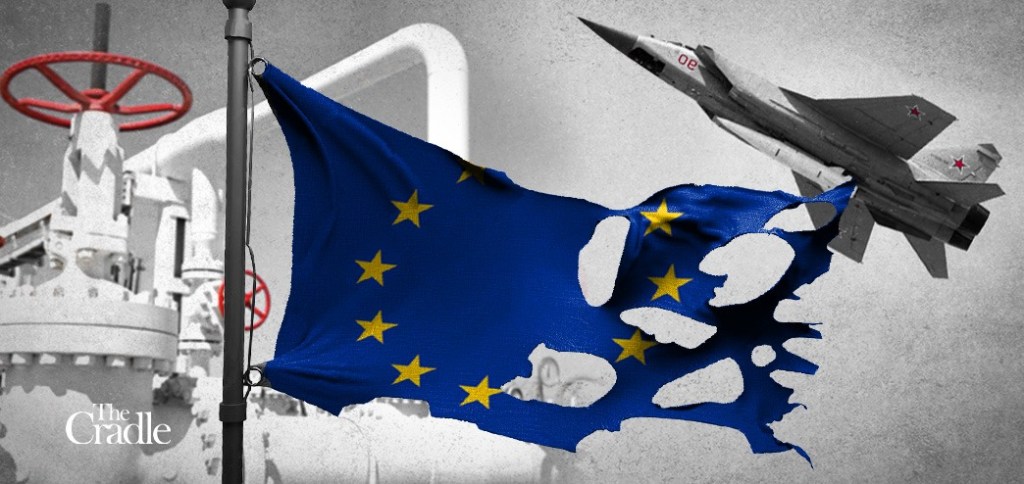
Washington’s competition with rising power Russia is so fierce, it is willing to sacrifice Europe.Photo Credit: The Cradle

If the US goal is to crush Russia’s economy with sanctions and isolation, why is Europe in an economic free fall instead?

By Pepe Escobar

Source: The Cradle

The stunning spectacle of the European Union (EU) committing slow motion hara-kiri is something for the ages. Like a cheap Kurosawa remake, the movie is actually about the US-detonated demolition of the EU, complete with the rerouting of some key Russian commodities exports to the US at the expense of Europeans.

It helps to have a 5th columnist actress strategically placed – in this case astonishingly incompetent European Commission head Ursula von der Lugen – with her vociferous announcement of a crushing new sanctions package: Russian ships banned from EU ports; road transportation companies from Russia and Belarus prohibited from entering the EU; no more coal imports (over 4.4 billion euros a year).

In practice, that translates into Washington shaking down its wealthiest western clients/puppets. Russia, of course, is too powerful to directly challenge militarily, and the US badly needs some of its key exports, especially minerals. So, the Americans will instead nudge the EU into imposing ever-increasing sanctions that will willfully collapse their national economies, while allowing the US to scoop everything up.

Cue to the coming catastrophic economic consequences felt by Europeans in their daily life (but not by the wealthiest five percent): inflation devouring salaries and savings; next winter energy bills packing a mean punch; products disappearing from supermarkets; holiday bookings almost frozen. France’s Le Petit Roi Emmanuel Macron – perhaps facing a nasty electoral surprise – has even announced: “food stamps like in WWII are possible.”

We have Germany facing the returning ghost of Weimar hyperinflation. BlackRock President Rob Kapito said, in Texas,“for the first time, this generation is going to go into a store and not be able to get what they want.” African farmers are unable to afford fertilizer at all this year, reducing agricultural production by an amount capable of feeding 100 million people.

Zoltan Poszar, former NY Fed and US Treasury guru, current Credit Suisse grand vizir, has been on a streak, stressing how commodity reserves – and, here, Russia is unrivaled – will be an essential feature of what he calls Bretton Woods III (although, what’s being designed by Russia, China, Iran and the Eurasia Economic Union is a post-Bretton Woods).

Poszar remarks that wars, historically, are won by those who have more food and energy supplies, in the past to power horses and soldiers; today to feed soldiers and fuel tanks and fighter jets. China, incidentally, has amassed large stocks of virtually everything.

Poszar notes how our current Bretton Woods II system has a deflationary impulse (globalization, open trade, just-in-time supply chains) while Bretton Woods 3 will provide an inflationary impulse (de-globalization, autarky, hoarding of raw materials) of supply chains and extra military spending to be able to protect what will remain of seaborne trade.

The implications are of course overwhelming. What’s implicit, ominously, is that this state of affairs may even lead to WWIII.

Rublegas or American LNG?

The Russian roundtable Valdai Club has conducted an essential expert discussion on what we at The Cradle have defined as  Rublegas – the real geoeconomic game-changer at the heart of the post-petrodollar era. Alexander Losev, a member of the Russian Council for Foreign and Defense Policy, offered the contours of the Big Picture. But it was up to Alexey Gromov, Chief Energy Director of the Institute of Energy and Finance, to come up with crucial nitty-gritty.

Russia, so far, was selling 155 billion cubic meters of gas to Europe each year. The EU rhetorically promises to get rid of it by 2027, and reduce supply by the end of 2022 by 100 billion cubic meters. Gromov asked “how,” and remarked, “any expert has no answer. Most of Russia’s natural gas is shipped over pipelines. This cannot simply be replaced by Liquified Natural Gas (LNG).”

The risible European answer has been “start saving,” as in “prepare to be worse off” and “reduce the temperature in households.” Gromov noted how, in Russia, “22 to 25 degrees in winter is the norm. Europe is promoting 16 degrees as ‘healthy’, and wearing sweaters at night.”

The EU won’t be able to get the gas it needs from Norway or Algeria (which is privileging domestic consumption). Azerbaijan would be able to provide at best 10 billion cubic meters a year, but “that will take 2 or 3 years” to happen.

Gromov stressed how “there’s no surplus in the market today for US and Qatar LNG,” and how prices for Asian customers are always higher. The bottom line is that “by the end of 2022, Europe won’t be able to significantly reduce” what it buys from Russia: “they might cut by 50 billion cubic meters, maximum.” And prices in the spot market will be higher – at least $1,300 per cubic meter.

An important development is that “Russia changed the logistical supply chains to Asia already.” That applies for gas and oil as well:  “You can impose sanctions if there’s a surplus in the market. Now there’s a shortage of at least 1.5 million barrels of oil a day. We’ll be sending our supplies to Asia – with a discount.” As it stands, Asia is already paying a premium, from 3 to 5 dollars more per barrel of oil.

On oil shipments, Gromov also commented on the key issue of insurance: “Insurance premiums are higher. Before Ukraine, it was all based on the Free on Board (FOB) system. Now buyers are saying ‘we don’t want to take the risk of taking your cargo to our ports.’ So they are applying the Cost, Insurance and Freight (CIF) system, where the seller has to insure and transport the cargo. That of course impacts revenues.”

An absolutely key issue for Russia is how to make the transition to China as its key gas customer. It’s all about the Power of Siberia 2, a new 2600-km pipeline originating in the Russian Bovanenkovo and Kharasavey gas fields in Yamal, in northwest Siberia – which will reach full capacity only in 2024. And, first, the interconnector through Mongolia must be built – “we need 3 years to build this pipeline” – so everything will be in place only around 2025.

On the Yamal pipeline, “most of the gas goes to Asia. If the Europeans don’t buy anymore we can redirect.” And then there’s the Arctic LNG 2 project – which is even larger than Yamal: “the first phase should be finished soon, it’s 80 percent ready.” An extra problem may be posed by the Russian “Unfriendlies” in Asia: Japan and South Korea. LNG infrastructure produced in Russia still depends on foreign technologies.

That’s what leads Gromov to note that, “the model of mobilization-based economy is not so good.” But that’s what Russia needs to deal with at least in the short to medium term.

The positives are that the new paradigm will allow “more cooperation within the BRICS (the emerging economies of Brazil, Russia, India, China and South Africa that have been meeting annually since 2009);” the expansion of the International North South Transportation Corridor (INSTC); and more interaction and integration with “Pakistan, India, Afghanistan and Iran.”

Only in terms of Iran and Russia, swaps in the Caspian Sea are already in the works, as Iran produces more than it needs, and is set to increase cooperation with Russia in the framework of their strengthened strategic partnership.

Hypersonic geoeconomics

It was up to Chinese energy expert Fu Chengyu to offer a concise explanation of why the EU drive of replacing Russian gas with American LNG is, well, a pipe dream. Essentially the US offer is “too limited and too costly.”

Fu Chengyu showed how a lengthy, tricky process depends on four contracts: between the gas developer and the LNG company; between the LNG company and the buyer company; between the LNG buyer and the cargo company (which builds vessels); and between the buyer and the end user.

“Each contract,” he pointed out, “takes a long time to finish. Without all these signed contracts, no party will invest – be it investment on infrastructure or gas field development.” So actual delivery of American LNG to Europe assumes all these interconnected resources are available – and moving like clockwork.

Fu Chengyu’s verdict is stark: this EU obsession on ditching Russian gas will provoke “an impact on global economic growth, and recession. They are pushing their own people – and the world. In the energy sector, we will all be harmed.”

It was quite enlightening to juxtapose the coming geoeconomic turbulence – the EU obsession in bypassing Russian gas and the onset of Rublegas – with the real reasons behind Operation Z in Ukraine, completely obscured by western media and analysts.

A US Deep State old pro, now retired, and quite familiar with the inner workings of the old OSS, the CIA precursor, all the way to the neocon dementia of today, provided some sobering insights:

“The whole Ukraine issue is over hypersonic missiles that can reach Moscow in less than four minutes. The US wants them there, in Poland, Romania, Baltic States, Sweden, Finland. This is in direct violation of the agreements in 1991 that NATO will not expand in Eastern Europe. The US does not have hypersonic missiles now but should – in a year or two. This is an existential threat to Russia. So they had to go into the Ukraine to stop this.  Next will be Poland and Romania where launchers have been built in Romania and are being built in Poland.”

From a completely different geopolitical perspective, what’s really telling is that his analysis happens to dovetail with Zoltan Poszar’s geoeconomics: “The US and NATO are totally belligerent. This presents a real danger to Russia. The idea that nuclear war is unthinkable is a myth. If you look at the firebombing of Tokyo against Hiroshima and Nagasaki, more people died in Tokyo than Hiroshima and Nagasaki. These cities were rebuilt. The radiation goes away and life can restart. The difference between firebombing and nuclear bombing is only efficiency. NATO provocations are so extreme, Russia had to place their nuclear missiles on standby alert. This is a gravely serious matter. But the US ignored it.”