The State of Our Nation: Still Divided, Enslaved & Locked Down

By John W. Whitehead & Nisha Whitehead

Source: The Rutherford Institute

A house divided against itself cannot stand. I believe this government cannot endure, permanently, half slave and half free. I do not expect the Union to be dissolved—I do not expect the house to fall—but I do expect it will cease to be divided. It will become all one thing or all the other.”—Abraham Lincoln

History has a funny way of circling back on itself.

The facts, figures, faces and technology may change from era to era, but the dangers remain the same.

This year is no different, whatever the politicians and talking heads may say to the contrary.

Sure, there’s a new guy in charge, but for the most part, we’re still recycling the same news stories that have kept us with one eye warily glued to the news for the past 100-odd years: War. Corruption. Brutality. Economic instability. Partisan politics. Militarism. Disease. Hunger. Greed. Violence. Poverty. Ignorance. Hatred.

The more things change, the more they stay the same.

Brush up on your history, and you’ll find that we’ve been stuck on repeat for some time now.

Take the United States of America in the year 2021, which is not so far different from the United States of America during the Civil Rights era, or the Cold War era, or even the Depression era.

Go far enough afield, and you’ll find aspects of our troubled history mirrored in the totalitarianism of Nazi Germany, in the fascism of Mussolini’s Italy, and further back in the militarism of the Roman Empire.

We’re like TV weatherman Phil Connors in Harold Ramis’ classic 1993 comedy Groundhog Day, forced to live the same day over and over again.

Here in the American police state, however, we continue to wake up, hoping each new day, new president and new year will somehow be different from what has come before.

Unfortunately, no matter how we change the narrative, change the characters, change the plot lines, we seem to keep ending up in the same place that we started: enslaved, divided and repeating the mistakes of the past.

You want to know about the true State of our Nation? Listen up.

The State of the Union: The state of our nation is politically polarized, controlled by forces beyond the purview of the average American, and rapidly moving the nation away from its freedom foundation. Over the past year, due in part to the COVID-19 pandemic, Americans have found themselves repeatedly subjected to egregious civil liberties violations, invasive surveillance, martial law, lockdowns, political correctness, erosions of free speech, strip searches, police shootings of unarmed citizens, government spying, the criminalization of lawful activities, warmongering, etc.

The predators of the police state have wreaked havoc on our freedoms, our communities, and our lives. The government does not listen to the citizenry, refuses to abide by the Constitution, and treats taxpayers as a source of funding and little else. Police officers shoot unarmed citizens and their household pets. Government agents—including local police—remain armed to the teeth and act like soldiers on a battlefield. Bloated government agencies continue to fleece taxpayers. Government technicians spy on our emails and phone calls. And government contractors make a killing by waging endless wars abroad.

Consequently, the state of our nation remains bureaucratic, debt-ridden, violent, militarized, fascist, lawless, invasive, corrupt, untrustworthy, mired in war, and unresponsive to the wishes and needs of the electorate.

The policies of the American police state continue unabated.

The Executive Branch: All of the imperial powers amassed by Donald Trump, Barack Obama and George W. Bush—to kill American citizens without due process, to detain suspects indefinitely, to strip Americans of their citizenship rights, to carry out mass surveillance on Americans without probable cause, to suspend laws during wartime, to disregard laws with which he might disagree, to conduct secret wars and convene secret courts, to sanction torture, to sidestep the legislatures and courts with executive orders and signing statements, to direct the military to operate beyond the reach of the law, to act as a dictator and a tyrant, above the law and beyond any real accountability—were inherited by Joe Biden.

Biden has these powers because every successive occupant of the Oval Office has been allowed to expand the reach and power of the presidency through the use of executive orders, decrees, memorandums, proclamations, national security directives and legislative signing statements that can be activated by any sitting president. Those of us who saw this eventuality coming have been warning for years about the growing danger of the Executive Branch with its presidential toolbox of terror that could be used—and abused—by future presidents. The groundwork, we warned, was being laid for a new kind of government where it won’t matter if you’re innocent or guilty, whether you’re a threat to the nation or even if you’re a citizen. What will matter is what the president—or whoever happens to be occupying the Oval Office at the time—thinks. And if he or she thinks you’re a threat to the nation and should be locked up, then you’ll be locked up with no access to the protections our Constitution provides. In effect, you will disappear.

Our warnings continue to go unheeded.

The Legislative Branch:  Congress may well be the most self-serving, semi-corrupt institution in America. Abuses of office runs the gamut from elected representatives neglecting their constituencies to engaging in self-serving practices, including the misuse of eminent domain, earmarking hundreds of millions of dollars in federal contracting in return for personal gain and campaign contributions, having inappropriate ties to lobbyist groups and incorrectly or incompletely disclosing financial information. Pork barrel spending, hastily passed legislation, partisan bickering, a skewed work ethic, graft and moral turpitude have all contributed to the public’s increasing dissatisfaction with congressional leadership. No wonder only 31 percent of Americans approve of the job Congress is doing.

The Judicial Branch: The Supreme Court was intended to be an institution established to intervene and protect the people against the government and its agents when they overstep their bounds. Yet through their deference to police power, preference for security over freedom, and evisceration of our most basic rights for the sake of order and expediency, the justices of the United States Supreme Court have become the guardians of the American police state in which we now live. As a result, sound judgment and justice have largely taken a back seat to legalism, statism and elitism, while preserving the rights of the people has been deprioritized and made to play second fiddle to both governmental and corporate interests. The courts have empowered the government to wreak havoc on our liberties. Protections for private property continue to be undermined. And Americans can no longer rely on the courts to mete out justice.

Shadow Government: Joe Biden inherited more than a bitterly divided nation teetering on the brink of financial catastrophe when he assumed office. He also inherited a shadow government, one that is fully operational and staffed by unelected officials who are, in essence, running the country. Referred to as the Deep State, this shadow government is comprised of unelected government bureaucrats, corporations, contractors, paper-pushers, and button-pushers who are actually calling the shots behind the scenes right now.

Law Enforcement: By and large the term “law enforcement” encompasses all agents within a militarized police state, including the military, local police, and the various agencies such as the Secret Service, FBI, CIA, NSA, etc. Having been given the green light to probe, poke, pinch, taser, search, seize, strip and generally manhandle anyone they see fit in almost any circumstance, all with the general blessing of the courts, America’s law enforcement officials, no longer mere servants of the people entrusted with keeping the peace but now extensions of the military, are part of an elite ruling class dependent on keeping the masses corralled, under control, and treated like suspects and enemies rather than citizens. As a result, police are becoming even more militarized and weaponized, and police shootings of unarmed individuals continue to increase.

A Suspect Surveillance Society: Every dystopian sci-fi film we’ve ever seen is suddenly converging into this present moment in a dangerous trifecta between science, technology and a government that wants to be all-seeing, all-knowing and all-powerful. By tapping into your phone lines and cell phone communications, the government knows what you say. By uploading all of your emails, opening your mail, and reading your Facebook posts and text messages, the government knows what you write. By monitoring your movements with the use of license plate readers, surveillance cameras and other tracking devices, the government knows where you go. By churning through all of the detritus of your life—what you read, where you go, what you say—the government can predict what you will do. By mapping the synapses in your brain, scientists—and in turn, the government—will soon know what you remember. And by accessing your DNA, the government will soon know everything else about you that they don’t already know: your family chart, your ancestry, what you look like, your health history, your inclination to follow orders or chart your own course, etc. Consequently, in the face of DNA evidence that places us at the scene of a crimebehavior sensing technology that interprets our body temperature and facial tics as suspicious, and government surveillance devices that cross-check our biometricslicense plates and DNA against a growing database of unsolved crimes and potential criminals, we are no longer “innocent until proven guilty.”

Military Empire: America’s endless global wars and burgeoning military empire—funded by taxpayer dollars—have depleted our resources, over-extended our military and increased our similarities to the Roman Empire and its eventual demise. Black budget spending has completely undermined any hope of fiscal transparency, with government contractors padding their pockets at the expense of taxpayers and the nation’s infrastructure—railroads, water pipelines, ports, dams, bridges, airports and roads—taking the hit. The U.S. now operates approximately 800 military bases in foreign countries around the globe at an annual cost of at least $156 billion. The consequences of financing a global military presence are dire. In fact, David Walker, former comptroller general of the U.S., believes there are “striking similarities” between America’s current situation and the factors that contributed to the fall of Rome, including “declining moral values and political civility at home, an over-confident and over-extended military in foreign lands and fiscal irresponsibility by the central government.”

I haven’t even touched on the corporate state, the military industrial complex, SWAT team raids, invasive surveillance technology, zero tolerance policies in the schools, overcriminalization, or privatized prisons, to name just a few. However, what I have touched on should be enough to show that the landscape of our freedoms has already changed dramatically from what it once was and will no doubt continue to deteriorate unless Americans can find a way to wrest back control of their government and reclaim their freedoms.

So how do we go about reclaiming our freedoms and reining in our runaway government?

Essentially, there are four camps of thought among the citizenry when it comes to holding the government accountable. Which camp you fall into says a lot about your view of government—or, at least, your view of whichever administration happens to be in power at the time.

In the first camp are those who trust the government to do the right thing, despite the government’s repeated failures in this department.

In the second camp are those who not only don’t trust the government but think the government is out to get them.

In the third camp are those who see government neither as an angel nor a devil, but merely as an entity that needs to be controlled, or as Thomas Jefferson phrased it, bound “down from mischief with the chains of the Constitution.”

Then there’s the fourth camp, comprised of individuals who pay little to no attention to the workings of government. Easily entertained, easily distracted, easily led, these are the ones who make the government’s job far easier than it should be.

It is easy to be diverted, distracted and amused by the antics of politicians, the pomp and circumstance of awards shows, athletic events, and entertainment news, and the feel-good evangelism that passes for religion today.

What is far more difficult to face up to is the reality of life in America, where unemployment, poverty, inequality, injustice and violence by government agents are increasingly norms.

The powers-that-be want us to remain divided, alienated from each other based on our politics, our bank accounts, our religion, our race and our value systems. Yet as George Orwell observed, “The real division is not between conservatives and revolutionaries but between authoritarians and libertarians.”

The only distinction that matters anymore is where you stand in the American police state.

In other words, you’re either part of the problem or part of the solution.

America is at a crossroads.

History may show that from this point forward, we will have left behind any semblance of constitutional government and entered into a militaristic state where all citizens are suspects and security trumps freedom.

Certainly, we have moved beyond the era of representative government and entered a new age: the age of authoritarianism. Even with its constantly shifting terrain, this topsy-turvy travesty of law and government has become America’s new normal.

As long as we continue to put our politics ahead of our principles—moral, legal and constitutional—“we the people” will lose.

And you know who will keep winning by playing on our prejudices, capitalizing on our fears, deepening our distrust of our fellow citizens, and dividing us into polarized, warring camps incapable of finding consensus on the one true menace that is an immediate threat to all of our freedoms? The government.

As I make clear in my book Battlefield America: The War on the American People and its fictional counterpart The Erik Blair Diaries, when we lose sight of the true purpose of government—to protect our rights—and fail to keep the government in its place as our servant, we allow the government to overstep its bounds and become a tyrant that rules by brute force.
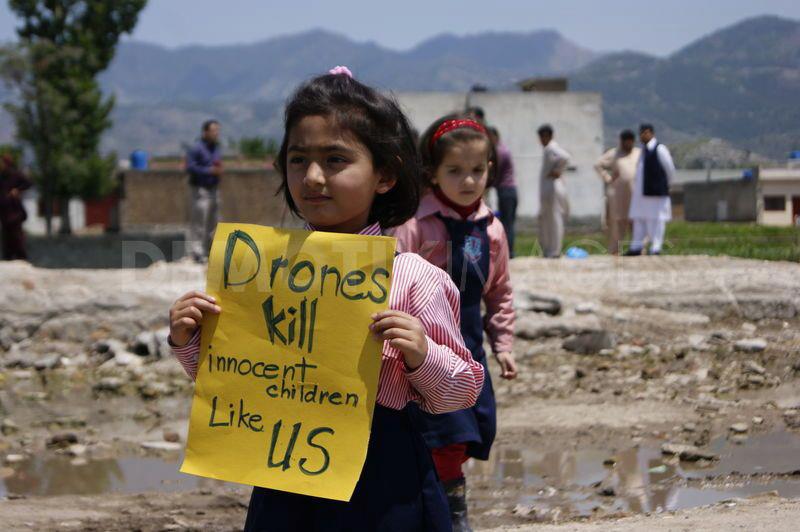
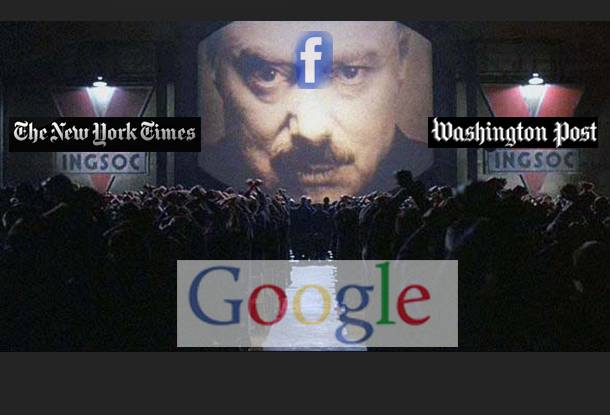
Drone warfare whistleblower sentenced to 45 months in prison for telling the American people the truth.

Drone warfare whistleblower sentenced to 45 months in prison for telling the American people the truth.

By Chris Hedges

Source: ScheerPost.com

Daniel Hale, a former intelligence analyst in the drone program for the Air Force who as a private contractor in 2013 leaked some 17 classified documents about drone strikes to the press, was sentenced today [7/27/21] to 45 months in prison.

The documents, published by The Intercept on October 15, 2015, exposed that between January 2012 and February 2013, US special operations airstrikes killed more than 200 people. Of those, only 35 were the intended targets. For one five-month period of the operation, according to the documents, nearly 90 percent of the people killed in airstrikes were not the intended targets. The civilian dead, usually innocent bystanders, were routinely classified as “enemies killed in action.”

The Justice Department coerced Hale, who was deployed to Afghanistan in 2012, on March 31 to plead guilty to one count of violating the Espionage Act, a law passed in 1917 designed to prosecute those who passed on state secrets to a hostile power, not those who expose to the public government lies and crimes. Hale admitted as part of the plea deal to “retention and transmission of national security information” and leaking 11 classified documents to a journalist. If he had refused the plea deal, he could have spent 50 years in prison. 

Hale, in a handwritten letter to Judge Liam O’Grady on July 18, explained why he leaked classified information, writing that the drone attacks and the war in Afghanistan “had little to do with preventing terror from coming into the United States and a lot more to do with protecting the profits of weapons manufacturers and so-called defense contractors.”

At the top of the ten-page letter Hale quoted US Navy Admiral Gene LaRocque, speaking to a reporter in 1995: “We now kill people without ever seeing them. Now you push a button thousands of miles away … Since it’s all done by remote control, there’s no remorse … and then we come home in triumph.”

“In my capacity as a signals intelligence analyst stationed at Bagram Airbase, I was made to track down the geographic location of handset cellphone devices believed to be in the possession of so-called enemy combatants,” Hale explained to the judge. “To accomplish this mission required access to a complex chain of globe-spanning satellites capable of maintaining an unbroken connection with remotely piloted aircraft, commonly referred to as drones. Once a steady connection is made and a targeted cell phone device is acquired, an imagery analyst in the U.S., in coordination with a drone pilot and camera operator, would take over using information I provided to surveil everything that occurred within the drone’s field of vision. This was done, most often, to document the day-to-day lives of suspected militants. Sometimes, under the right conditions, an attempt at capture would be made. Other times, a decision to strike and kill them where they stood would be weighed.”

He recalled the first time he witnessed a drone strike, a few days after he arrived in Afghanistan.

“Early that morning, before dawn, a group of men had gathered together in the mountain ranges of Patika province around a campfire carrying weapons and brewing tea,” he wrote. “That they carried weapons with them would not have been considered out of the ordinary in the place I grew up, much less within the virtually lawless tribal territories outside the control of the Afghan authorities. Except that among them was a suspected member of the Taliban, given away by the targeted cell phone device in his pocket. As for the remaining individuals, to be armed, of military age, and sitting in the presence of an alleged enemy combatant was enough evidence to place them under suspicion as well. Despite having peacefully assembled, posing no threat, the fate of the now tea drinking men had all but been fulfilled. I could only look on as I sat by and watched through a computer monitor when a sudden, terrifying flurry of hellfire missiles came crashing down, splattering, purple-colored crystal guts on the side of the morning mountain.”

This was his first experience with “scenes of graphic violence carried out from the cold comfort of a computer chair.” There would be many more.

“Not a day goes by that I don’t question the justification for my actions,” he wrote. “By the rules of engagement, it may have been permissible for me to have helped to kill those men — whose language I did not speak, customs I did not understand, and crimes I could not identify — in the gruesome manner that I did. Watch them die. But how could it be considered honorable of me to continuously have laid in wait for the next opportunity to kill unsuspecting persons, who, more often than not, are posing no danger to me or any other person at the time. Never mind honorable, how could it be that any thinking person continued to believe that it was necessary for the protection of the United States of America to be in Afghanistan and killing people, not one of whom present was responsible for the September 11th attacks on our nation. Notwithstanding, in 2012, a full year after the demise of Osama bin Laden in Pakistan, I was a part of killing misguided young men who were but mere children on the day of 9/11.” 

He and other service members were confronted with the privatization of war where “contract mercenaries outnumbered uniform wearing soldiers 2 to 1 and earned as much as 10 times their salary.”

“Meanwhile, it did not matter whether it was, as I had seen, an Afghan farmer blown in half, yet miraculously conscious and pointlessly trying to scoop his insides off the ground, or whether it was an American flag-draped coffin lowered into Arlington National Cemetery to the sound of a 21-gun salute,” he wrote. “Bang, bang, bang. Both served to justify the easy flow of capital at the cost of blood — theirs and ours. When I think about this, I am grief-stricken and ashamed of myself for the things I’ve done to support it.”

He described to the judge “the most harrowing day of my life” that took place a few months into his deployment “when a routine surveillance mission turned into disaster.” 

“For weeks we had been tracking the movements of a ring of car bomb manufacturers living around Jalalabad,” he wrote. “Car bombs directed at US bases had become an increasingly frequent and deadly problem that summer, so much effort was put into stopping them. It was a windy and clouded afternoon when one of the suspects had been discovered headed eastbound, driving at a high rate of speed. This alarmed my superiors who believe he might be attempting to escape across the border into Pakistan.”

Now, whenever I encounter an individual who thinks that drone warfare is justified and reliably keeps America safe, I remember that time and ask myself how could I possibly continue to believe that I am a good person, deserving of my life and the right to pursue happiness.

— Daniel Hale, of learning about children killed by indiscriminate US drone attacks he participated in.

“A drone strike was our only chance and already it began lining up to take the shot,” he continued. “But the less advanced predator drone found it difficult to see through clouds and compete against strong headwinds. The single payload MQ-1 failed to connect with its target, instead missing by a few meters. The vehicle, damaged, but still driveable, continued on ahead after narrowly avoiding destruction. Eventually, once the concern of another incoming missile subsided, the driver stopped, got out of the car, and checked himself as though he could not believe he was still alive. Out of the passenger side came a woman wearing an unmistakable burka. As astounding as it was to have just learned there had been a woman, possibly his wife, there with the man we intended to kill moments ago, I did not have the chance to see what happened next before the drone diverted its camera when she began frantically to pull out something from the back of the car.”

He learned a few days later from his commanding officer what next took place. 

“There indeed had been the suspect’s wife with him in the car,” he wrote. “And in the back were their two young daughters, ages 5 and 3 years old. A cadre of Afghan soldiers were sent to investigate where the car had stopped the following day. It was there they found them placed in the dumpster nearby. The eldest was found dead due to unspecified wounds caused by shrapnel that pierced her body. Her younger sister was alive but severely dehydrated. As my commanding officer relayed this information to us, she seemed to express disgust, not for the fact that we had errantly fired on a man and his family, having killed one of his daughters; but for the suspected bomb maker having ordered his wife to dump the bodies of their daughters in the trash, so that the two of them could more quickly escape across the border. Now, whenever I encounter an individual who thinks that drone warfare is justified and reliably keeps America safe, I remember that time and ask myself how could I possibly continue to believe that I am a good person, deserving of my life and the right to pursue happiness.”

“One year later, at a farewell gathering for those of us who would soon be leaving military service, I sat alone, transfixed by the television, while others reminisced together,” he continued. “On television was breaking news of the president giving his first public remarks about the policy surrounding the use of drone technology in warfare. His remarks were made to reassure the public of reports scrutinizing the death of civilians in drone strikes and the targeting of American citizens. The president said that a high standard of ‘near certainty’ needed to be met in order to ensure that no civilians were present. But from what I knew, of the instances where civilians plausibly could have been present, those killed were nearly always designated enemies killed in action unless proven otherwise. Nonetheless, I continued to heed his words as the president went on to explain how a drone could be used to eliminate someone who posed an ‘imminent threat’ to the United States. Using the analogy of taking out a sniper, with his sights set on an unassuming crowd of people, the president likened the use of drones to prevent a would-be terrorist from carrying out his evil plot. But, as I understood it to be, the unassuming crowd had been those who lived in fear and the terror of drones in their skies and the sniper in this scenario had been me. I came to believe that the policy of drone assassination was being used to mislead the public that it keeps us safe, and when I finally left the military, still processing what I’d been a part of, I began to speak out, believing my participation in the drone program to have been deeply wrong.”

Hale threw himself into anti-war activism when he left the military, speaking out about the indiscriminate killing of hundreds, perhaps thousands, of noncombatants, including children in drone strikes. He took part in a peace conference held in Washington, D.C. in November 2013. The Yemeni Fazil bin Ali Jaber spoke at the conference about the drone strike that killed his brother, Salem bin Ali Jaber, and their cousin Waleed. Waleed was a policeman. Salem was an Imam who was an outspoken critic of the armed attacks carried out by radical jihadists.

“One day in August 2012, local members of Al Qaeda traveling through Fazil’s village in a car spotted Salem in the shade, pulled up towards him, and beckoned him to come over and speak to them,” Hale wrote. “Not one to miss an opportunity to evangelize to the youth, Salem proceeded cautiously with Waleed by his side. Fazil and other villagers began looking on from afar. Farther still was an ever present reaper drone looking too.”

“As Fazil recounted what happened next, I felt myself transported back in time to where I had been on that day, 2012,” Hale told the judge. “Unbeknownst to Fazil and those of his village at the time was that they had not been the only watching Salem approach the jihadist in the car. From Afghanistan, I and everyone on duty paused their work to witness the carnage that was about to unfold. At the press of a button from thousands of miles away, two hellfire missiles screeched out of the sky, followed by two more. Showing no signs of remorse, I, and those around me, clapped and cheered triumphantly. In front of a speechless auditorium, Fazil wept.”

A week after the conference Hale was offered a job as a government contractor.  Desperate for money and steady employment, hoping to go to college, he took the job, which paid $ 80,000 a year.  But by then he was disgusted by the drone program.

“For a long time, I was uncomfortable with myself over the thought of taking advantage of my military background to land a cushy desk job,” he wrote. “During that time, I was still processing what I had been through, and I was starting to wonder if I was contributing again to the problem of money and war by accepting to return as a defense contractor. Worse was my growing apprehension that everyone around me was also taking part in a collective delusion and denial that was used to justify our exorbitant salaries, for comparatively easy labor. The thing I feared most at the time was the temptation not to question it.”

“Then it came to be that one day after work I stuck around to socialize with a pair of co-workers whose talented work I had come to greatly admire,” he wrote. “They made me feel welcomed, and I was happy to have earned their approval. But then, to my dismay, our brand-new friendship took an unexpectedly dark turn. They elected that we should take a moment and view together some archived footage of past drone strikes. Such bonding ceremonies around a computer to watch so-called “war porn” had not been new to me. I partook in them all the time while deployed to Afghanistan. But on that day, years after the fact, my new friends gaped and sneered, just as my old one’s had, at the sight of faceless men in the final moments of their lives. I sat by watching too; said nothing and felt my heart breaking into pieces.”

“Your Honor,” Hale wrote to the judge, “the truest truism that I’ve come to understand about the nature of war is that war is trauma. I believe that any person either called-upon or coerced to participate in war against their fellow man is promised to be exposed to some form of trauma. In that way, no soldier blessed to have returned home from war does so uninjured. The crux of PTSD is that it is a moral conundrum that afflicts invisible wounds on the psyche of a person made to burden the weight of experience after surviving a traumatic event. How PTSD manifests depends on the circumstances of the event. So how is the drone operator to process this? The victorious rifleman, unquestioningly remorseful, at least keeps his honor intact by having faced off against his enemy on the battlefield. The determined fighter pilot has the luxury of not having to witness the gruesome aftermath. But what possibly could I have done to cope with the undeniable cruelties that I perpetuated?”

“My conscience, once held at bay, came roaring back to life,” he wrote. “At first, I tried to ignore it. Wishing instead that someone, better placed than I, should come along to take this cup from me. But this too was folly. Left to decide whether to act, I only could do that which I ought to do before God and my own conscience. The answer came to me, that to stop the cycle of violence, I ought to sacrifice my own life and not that of another person. So, I contacted an investigative reporter, with whom I had had an established prior relationship, and told him that I had something the American people needed to know.”

Hale, who has admitted to being suicidal and depressed, said in the letter he, like many veterans, struggles with the crippling effects of post-traumatic stress disorder, aggravated by an impoverished and turbulent childhood.

“Depression is a constant,” he told the judge. “Though stress, particularly stress caused by war, can manifest itself at different times and in different ways. The tell-tale signs of a person afflicted by PTSD and depression can often be outwardly observed and are practically universally recognizable. Hard lines about the face and jaw. Eyes, once bright and wide, now deep-set, and fearful. And an inexplicably sudden loss of interest in things that used to spark joy. These are the noticeable changes in my demeanor marked by those who knew me before and after military service. To say that the period of my life spent serving in the United States Air Force had an impression on me would be an understatement. It is more accurate to say that it irreversibly transformed my identity as an American. Having forever altered the thread of my life’s story, weaved into the fabric of our nation’s history.”

George Orwell’s 1984 Has Become a Blueprint for Our Dystopian Reality

By John W. Whitehead & Nisha Whitehead

Source: The Rutherford Institute

“If you want a picture of the future, imagine a boot stamping on a human face—for ever.” George Orwell, 1984

Tread cautiously: the fiction of George Orwell (Jun. 25, 1903-Jan. 21, 1950) has become an operation manual for the omnipresent, modern-day surveillance state.

It’s been more than 70 years since Orwell—dying, beset by fever and bloody coughing fits, and driven to warn against the rise of a society in which rampant abuse of power and mass manipulation are the norm—depicted the ominous rise of ubiquitous technology, fascism and totalitarianism in 1984.

Who could have predicted that so many years after Orwell typed the final words to his dystopian novel, “He loved Big Brother,” we would come to love Big Brother.

“To the future or to the past, to a time when thought is free, when men are different from one another and do not live alone— to a time when truth exists and what is done cannot be undone: From the age of uniformity, from the age of solitude, from the age of Big Brother, from the age of doublethink — greetings!”—George Orwell

1984 portrays a global society of total control in which people are not allowed to have thoughts that in any way disagree with the corporate state. There is no personal freedom, and advanced technology has become the driving force behind a surveillance-driven society. Snitches and cameras are everywhere. People are subject to the Thought Police, who deal with anyone guilty of thought crimes. The government, or “Party,” is headed by Big Brother who appears on posters everywhere with the words: “Big Brother is watching you.”

We have arrived, way ahead of schedule, into the dystopian future dreamed up by not only Orwell but also such fiction writers as Aldous Huxley, Margaret Atwood and Philip K. Dick.

“If liberty means anything at all, it means the right to tell people what they do not want to hear.”―George Orwell

Much like Orwell’s Big Brother in 1984, the government and its corporate spies now watch our every move. Much like Huxley’s A Brave New World, we are churning out a society of watchers who “have their liberties taken away from them, but … rather enjoy it, because they [are] distracted from any desire to rebel by propaganda or brainwashing.” Much like Atwood’s The Handmaid’s Tale, the populace is now taught to “know their place and their duties, to understand that they have no real rights but will be protected up to a point if they conform, and to think so poorly of themselves that they will accept their assigned fate and not rebel or run away.”

And in keeping with Philip K. Dick’s darkly prophetic vision of a dystopian police state—which became the basis for Steven Spielberg’s futuristic thriller Minority Report—we are now trapped in a world in which the government is all-seeing, all-knowing and all-powerful, and if you dare to step out of line, dark-clad police SWAT teams and pre-crime units will crack a few skulls to bring the populace under control.

What once seemed futuristic no longer occupies the realm of science fiction.

Incredibly, as the various nascent technologies employed and shared by the government and corporations alike—facial recognition, iris scanners, massive databases, behavior prediction software, and so on—are incorporated into a complex, interwoven cyber network aimed at tracking our movements, predicting our thoughts and controlling our behavior, the dystopian visions of past writers is fast becoming our reality.

Our world is characterized by widespread surveillance, behavior prediction technologies, data mining, fusion centers, driverless cars, voice-controlled homes, facial recognition systems, cybugs and drones, and predictive policing (pre-crime) aimed at capturing would-be criminals before they can do any damage.

Surveillance cameras are everywhere. Government agents listen in on our telephone calls and read our emails. Political correctness—a philosophy that discourages diversity—has become a guiding principle of modern society.

“People sleep peaceably in their beds at night only because rough men stand ready to do violence on their behalf.”―George Orwell

The courts have shredded the Fourth Amendment’s protections against unreasonable searches and seizures. In fact, SWAT teams battering down doors without search warrants and FBI agents acting as a secret police that investigate dissenting citizens are common occurrences in contemporary America. And bodily privacy and integrity have been utterly eviscerated by a prevailing view that Americans have no rights over what happens to their bodies during an encounter with government officials, who are allowed to search, seize, strip, scan, spy on, probe, pat down, taser, and arrest any individual at any time and for the slightest provocation.

“The creatures outside looked from pig to man, and from man to pig, and from pig to man again; but already it was impossible to say which was which.”―George Orwell, Animal Farm

We are increasingly ruled by multi-corporations wedded to the police state.

What many fail to realize is that the government is not operating alone. It cannot. The government requires an accomplice. Thus, the increasingly complex security needs of the massive federal government, especially in the areas of defense, surveillance and data management, have been met within the corporate sector, which has shown itself to be a powerful ally that both depends on and feeds the growth of governmental overreach.

In fact, Big Tech wedded to Big Government has become Big Brother, and we are now ruled by the Corporate Elite whose tentacles have spread worldwide. The government now has at its disposal technological arsenals so sophisticated and invasive as to render any constitutional protections null and void. Spearheaded by the NSA, which has shown itself to care little to nothing for constitutional limits or privacy, the “security/industrial complex”—a marriage of government, military and corporate interests aimed at keeping Americans under constant surveillance—has come to dominate the government and our lives.

Money, power, control. There is no shortage of motives fueling the convergence of mega-corporations and government. But who is paying the price? The American people, of course.

Orwell understood what many Americans are still struggling to come to terms with: that there is no such thing as a government organized for the good of the people. Even the best intentions among those in government inevitably give way to the desire to maintain power and control over the citizenry at all costs.

“The further a society drifts from truth the more it will hate those who speak it.” ― George Orwell

Even our ability to speak and think freely is being regulated.

In totalitarian regimes—a.k.a. police states—where conformity and compliance are enforced at the end of a loaded gun, the government dictates what words can and cannot be used. In countries where the police state hides behind a benevolent mask and disguises itself as tolerance, the citizens censor themselves, policing their words and thoughts to conform to the dictates of the mass mind.

Dystopian literature shows what happens when the populace is transformed into mindless automatons.

In Ray Bradbury’s Fahrenheit 451, reading is banned and books are burned in order to suppress dissenting ideas, while televised entertainment is used to anesthetize the populace and render them easily pacified, distracted and controlled.

In Huxley’s Brave New World, serious literature, scientific thinking and experimentation are banned as subversive, while critical thinking is discouraged through the use of conditioning, social taboos and inferior education. Likewise, expressions of individuality, independence and morality are viewed as vulgar and abnormal.

In my debut novel The Erik Blair Diaries, the dystopian future that George Orwell predicted for 1984 has finally arrived, 100 years late and ten times as brutal. In this post-apocalyptic world where everyone marches to the beat of the same drummer and words like “freedom” are taboo, Erik Blair—Orwell’s descendant and unwitting heir to his legacy—isn’t volunteering to be anyone’s hero. Unfortunately, life doesn’t always go according to plan. To save all that he loves, Orwell will have to travel between his future self and the past.

And in Orwell’s 1984, Big Brother does away with all undesirable and unnecessary words and meanings, even going so far as to routinely rewrite history and punish “thoughtcrimes.” Orwell’s Big Brother relies on Newspeak to eliminate undesirable words, strip such words as remained of unorthodox meanings and make independent, non-government-approved thought altogether unnecessary.

Where we stand now is at the juncture of OldSpeak (where words have meanings, and ideas can be dangerous) and Newspeak (where only that which is “safe” and “accepted” by the majority is permitted). The power elite has made their intentions clear: they will pursue and prosecute any and all words, thoughts and expressions that challenge their authority.

This is the final link in the police state chain.

“Until they became conscious they will never rebel, and until after they have rebelled they cannot become conscious.”—George Orwell

Having been reduced to a cowering citizenry—mute in the face of elected officials who refuse to represent us, helpless in the face of police brutality, powerless in the face of militarized tactics and technology that treat us like enemy combatants on a battlefield, and naked in the face of government surveillance that sees and hears all—we have nowhere left to go.

We have, so to speak, gone from being a nation where privacy is king to one where nothing is safe from the prying eyes of government.

“Big Brother is Watching You.”―George Orwell

Wherever you go and whatever you do, you are now being watched, especially if you leave behind an electronic footprint. When you use your cell phone, you leave a record of when the call was placed, who you called, how long it lasted and even where you were at the time. When you use your ATM card, you leave a record of where and when you used the card. There is even a video camera at most locations equipped with facial recognition software. When you use a cell phone or drive a car enabled with GPS, you can be tracked by satellite. Such information is shared with government agents, including local police. And all of this once-private information about your consumer habits, your whereabouts and your activities is now being fed to the government.

The government has nearly inexhaustible resources when it comes to tracking our movements, from electronic wiretapping devices, traffic cameras and biometrics to radio-frequency identification cards, satellites and Internet surveillance.

In such a climate, everyone is a suspect. And you’re guilty until you can prove yourself innocent. To underscore this shift in how the government now views its citizens, the FBI uses its wide-ranging authority to investigate individuals or groups, regardless of whether they are suspected of criminal activity. 

“Nothing was your own except the few cubic centimetres inside your skull.” ― George Orwell

Here’s what a lot of people fail to understand, however: it’s not just what you say or do that is being monitored, but how you think that is being tracked and targeted. We’ve already seen this play out on the state and federal level with hate crime legislation that cracks down on so-called “hateful” thoughts and expression, encourages self-censoring and reduces free debate on various subject matter. 

Say hello to the new Thought Police.

Total Internet surveillance by the Corporate State, as omnipresent as God, is used by the government to predict and, more importantly, control the populace, and it’s not as far-fetched as you might think. For example, the NSA has been working on an artificial intelligence system designed to anticipate your every move. Aquaint (the acronym stands for Advanced QUestion Answering for INTelligence) has been designed to detect patterns and predict behavior.

No information is sacred or spared.

Everything from cell phone recordings and logs, to emails, to text messages, to personal information posted on social networking sites, to credit card statements, to library circulation records, to credit card histories, etc., is collected by the NSA and shared freely with its agents in crime: the CIA, FBI and DHS.

What we are witnessing, in the so-called name of security and efficiency, is the creation of a new class system comprised of the watched (average Americans such as you and me) and the watchers (government bureaucrats, technicians and private corporations).

Clearly, the age of privacy in America is at an end.

So where does that leave us?

We now find ourselves in the unenviable position of being monitored, managed and controlled by our technology, which answers not to us but to our government and corporate rulers. This is the fact-is-stranger-than-fiction lesson that is being pounded into us on a daily basis.

It won’t be long before we find ourselves looking back on the past with longing, back to an age where we could speak to whom we wanted, buy what we wanted, think what we wanted without those thoughts, words and activities being tracked, processed and stored by corporate giants such as Google, sold to government agencies such as the NSA and CIA, and used against us by militarized police with their army of futuristic technologies.

To be an individual today, to not conform, to have even a shred of privacy, and to live beyond the reach of the government’s roaming eyes and technological spies, one must not only be a rebel but rebel.

Even when you rebel and take your stand, there is rarely a happy ending awaiting you. You are rendered an outlaw. Just look at what happened to Julian Assange.

So how do you survive in the American surveillance state?

We’re running out of options.

Whether you’re dealing with fact or fiction, as I make clear in Battlefield America: The War on the American People and in my new novel The Erik Blair Diaries, we’ll soon have to choose between self-indulgence (the bread-and-circus distractions offered up by the news media, politicians, sports conglomerates, entertainment industry, etc.) and self-preservation in the form of renewed vigilance about threats to our freedoms and active engagement in self-governance.

One Nation Under Greed: The Profit Incentives Driving the American Police State

By By John W. Whitehead & Nisha Whitehead

Source: The Rutherford Institute

“When plunder becomes a way of life for a group of men in a society, over the course of time they create for themselves a legal system that authorizes it and a moral code that glorifies it.” ― Frédéric Bastiat, French economist

If there is an absolute maxim by which the American government seems to operate, it is that the taxpayer always gets ripped off.

Not only are Americans forced to “spend more on state, municipal, and federal taxes than the annual financial burdens of food, clothing, and housing combined,” but we’re also being played as easy marks by hustlers bearing the imprimatur of the government.

With every new tax, fine, fee and law adopted by our so-called representatives, the yoke around the neck of the average American seems to tighten just a little bit more.

Everywhere you go, everything you do, and every which way you look, we’re getting swindled, cheated, conned, robbed, raided, pickpocketed, mugged, deceived, defrauded, double-crossed and fleeced by governmental and corporate shareholders of the American police state out to make a profit at taxpayer expense.

The overt and costly signs of the despotism exercised by the increasingly authoritarian regime that passes itself off as the United States government are all around us: warrantless surveillance of Americans’ private phone and email conversations by the FBI, NSA, etc.; SWAT team raids of Americans’ homes; shootings of unarmed citizens by police; harsh punishments meted out to schoolchildren in the name of zero tolerance; drones taking to the skies domestically; endless wars; out-of-control spending; militarized police; roadside strip searches; privatized prisons with a profit incentive for jailing Americans; fusion centers that collect and disseminate data on Americans’ private transactions; and militarized agencies with stockpiles of ammunition, to name some of the most appalling.

Meanwhile, the three branches of government (Executive, Legislative and Judicial) and the agencies under their command—Defense, Commerce, Education, Homeland Security, Justice, Treasury, etc.—have switched their allegiance to the Corporate State with its unassailable pursuit of profit at all costs and by any means possible.

By the time you factor in the financial blowback from the COVID-19 pandemic with its politicized mandates, lockdowns, and payouts, it becomes quickly apparent that we are now ruled by a government consumed with squeezing every last penny out of the population and seemingly unconcerned if essential freedoms are trampled in the process.

As with most things, if you want to know the real motives behind any government program, follow the money trail.

When you dig down far enough, you quickly find that those who profit from Americans being surveilled, fined, scanned, searched, probed, tasered, arrested and imprisoned are none other than the police who arrest them, the courts which try them, the prisons which incarcerate them, and the corporations, which manufacture the weapons, equipment and prisons used by the American police state.

Examples of this legalized, profits-over-people, government-sanctioned extortion abound.

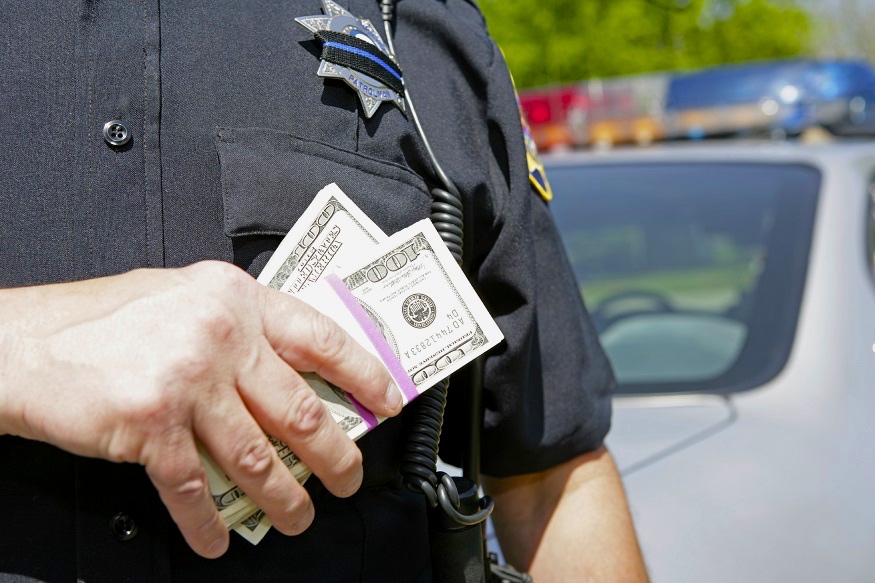
On the roads: Not satisfied with merely padding their budgets by issuing speeding tickets, police departments have turned to asset forfeiture and red light camera schemes as a means of growing their profits. Despite revelations of corruption, collusion and fraud, these money-making scams have been being inflicted on unsuspecting drivers by revenue-hungry municipalities. Now legislators are hoping to get in on the profit sharing by imposing a vehicle miles-traveled tax, which would charge drivers for each mile behind the wheel.

In the prisons: States now have quotas to meet for how many Americans go to jail. Increasing numbers of states have contracted to keep their prisons at 90% to 100% capacity. This profit-driven form of mass punishment has, in turn, given rise to a $70 billion private prison industry that relies on the complicity of state governments to keep the money flowing and their privately run prisons full, “regardless of whether crime was rising or falling.” As Mother Jones reports, “private prison companies have supported and helped write … laws that drive up prison populations. Their livelihoods depend on towns, cities, and states sending more people to prison and keeping them there.” Private prisons are also doling out harsher punishments for infractions by inmates in order to keep them locked up longer in order to “boost profits” at taxpayer expense. All the while, prisoners are being forced to provide cheap labor for private corporations. No wonder the United States has the largest prison population in the world.

In the schools: The security industrial complex with its tracking, spying, and identification devices has set its sights on the schools as “a vast, rich market”—a $20 billion market, no less—just waiting to be conquered. In fact, the public schools have become a microcosm of the total surveillance state which currently dominates America, adopting a host of surveillance technologies, including video cameras, finger and palm scanners, iris scanners, as well as RFID and GPS tracking devices, to keep constant watch over their student bodies. Likewise, the military industrial complex with its military weapons, metal detectors, and weapons of compliance such as tasers has succeeded in transforming the schools—at great taxpayer expense and personal profit—into quasi-prisons. Rounding things out are school truancy laws, which come disguised as well-meaning attempts to resolve attendance issues in the schools but in truth are nothing less than stealth maneuvers aimed at enriching school districts and court systems alike through excessive fines and jail sentences for “unauthorized” absences. Curiously, none of these efforts seem to have succeeded in making the schools any safer.

In the endless wars abroad: Fueled by the profit-driven military industrial complex, the government’s endless wars are wreaking havoc on our communities, our budget and our police forces. Having been co-opted by greedy defense contractors, corrupt politicians and incompetent government officials, America’s expanding military empire is bleeding the country dry at a rate of more than $32 million per hour. Future wars and military exercises waged around the globe are expected to push the total bill upwards of $12 trillion by 2053.  Talk about fiscally irresponsible: the U.S. government is spending money it doesn’t have on a military empire it can’t afford. War spending is bankrupting America.

In the form of militarized police: The Department of Homeland Security routinely hands out six-figure grants to enable local municipalities to purchase military-style vehicles, as well as a veritable war chest of weaponry, ranging from tactical vests, bomb-disarming robots, assault weapons and combat uniforms. This rise in military equipment purchases funded by the DHS has, according to analysts Andrew Becker and G.W. Schulz, “paralleled an apparent increase in local SWAT teams.” The end result? An explosive growth in the use of SWAT teams for otherwise routine police matters, an increased tendency on the part of police to shoot first and ask questions later, and an overall mindset within police forces that they are at war—and the citizenry are the enemy combatants. Over 80,000 SWAT team raids are conducted on American homes and businesses each year. Moreover, government-funded military-style training drills continue to take place in cities across the country.

In profit-driven schemes such as asset forfeiture: Under the guise of fighting the war on drugs, government agents (usually the police) have been given broad leeway to seize billions of dollars’ worth of private property (money, cars, TVs, etc.) they “suspect” may be connected to criminal activity. Then—and here’s the kicker—whether or not any crime is actually proven to have taken place, the government keeps the citizen’s property, often divvying it up with the local police who did the initial seizure. The police are actually being trained in seminars on how to seize the “goodies” that are on police departments’ wish lists. According to the New York Times, seized monies have been used by police to “pay for sports tickets, office parties, a home security system and a $90,000 sports car.”

Among government contractors: We have been saddled with a government that is outsourcing much of its work to high-paid contractors at great expense to the taxpayer and with no competition, little transparency and dubious savings. According to the Washington Post, “By some estimates, there are twice as many people doing government work under contract than there are government workers.” These open-ended contracts, worth hundreds of millions of dollars, “now account for anywhere between one quarter and one half of all federal service contracting.” Moreover, any attempt to reform the system is “bitterly opposed by federal employee unions, who take it as their mission to prevent good employees from being rewarded and bad employees from being fired.”

By the security industrial complex: We’re being spied on by a domestic army of government snitches, spies and techno-warriors. In the so-called name of “precrime,” this government of Peeping Toms is watching everything we do, reading everything we write, listening to everything we say, and monitoring everything we spend. Beware of what you say, what you read, what you write, where you go, and with whom you communicate, because it is all being recorded, stored, and catalogued, and will be used against you eventually, at a time and place of the government’s choosing. This far-reaching surveillance, carried out with the complicity of the Corporate State, has paved the way for an omnipresent, militarized fourth branch of government—the Surveillance State—that came into being without any electoral mandate or constitutional referendum. That doesn’t even touch on the government’s bold forays into biometric surveillance as a means of identifying and tracking the American people from birth to death.

By a government addicted to power: It’s a given that you can always count on the government to take advantage of a crisis, legitimate or manufactured. Emboldened by the citizenry’s inattention and willingness to tolerate its abuses, the government has weaponized one national crisis after another in order to expand its powers. The war on terror, the war on drugs, the war on illegal immigration, asset forfeiture schemes, road safety schemes, school safety schemes, eminent domain: all of these programs started out as legitimate responses to pressing concerns and have since become weapons of compliance and control in the police state’s hands. Now that the government has gotten a taste for flexing its police state powers by way of a bevy of COVID-19 lockdowns, mandates, restrictions, contact tracing programs, heightened surveillance, censorship, overcriminalization, etc., “we the people” may well find ourselves burdened with a Nanny State inclined to use its draconian pandemic powers to protect us from ourselves.

These injustices, petty tyrannies and overt acts of hostility are being carried out in the name of the national good—against the interests of individuals, society and ultimately our freedoms—by an elite class of government officials working in partnership with megacorporations that are largely insulated from the ill effects of their actions.

This perverse mixture of government authoritarianism and corporate profits has increased the reach of the state into our private lives while also adding a profit motive into the mix. And, as always, it’s we the people, we the taxpayers, we the gullible voters who keep getting taken for a ride by politicians eager to promise us the world on a plate.

This is a far cry from how a representative government is supposed to operate.

Indeed, it has been a long time since we could claim to be the masters of our own lives. Rather, we are now the subjects of a militarized, corporate empire in which the vast majority of the citizenry work their hands to the bone for the benefit of a privileged few

Adding injury to the ongoing insult of having our tax dollars misused and our so-called representatives bought and paid for by the moneyed elite, the government then turns around and uses the money we earn with our blood, sweat and tears to target, imprison and entrap us, in the form of militarized police, surveillance cameras, private prisons, license plate readers, drones, and cell phone tracking technology.

All of those nefarious deeds by government officials that you hear about every day: those are your tax dollars at work.

It’s your money that allows for government agents to spy on your emails, your phone calls, your text messages, and your movements. It’s your money that allows out-of-control police officers to burst into innocent people’s homes, or probe and strip search motorists on the side of the road. And it’s your money that leads to Americans across the country being prosecuted for innocuous activities such as growing vegetable gardens in their front yards or daring to speak their truth to their elected officials.

Just remember the next time you see a news story that makes your blood boil, whether it’s a police officer arresting someone for filming them in public, or a child being kicked out of school for attending a virtual class while playing with a toy gun, remember that it is your tax dollars that are paying for these injustices.

There was a time in our history when our forebears said “enough is enough” and stopped paying their taxes to what they considered an illegitimate government. They stood their ground and refused to support a system that was slowly choking out any attempts at self-governance, and which refused to be held accountable for its crimes against the people.

Their resistance sowed the seeds for the revolution that would follow.

Unfortunately, in the 200-plus years since we established our own government, we’ve let bankers, turncoats and number-crunching bureaucrats muddy the waters and pilfer the accounts to such an extent that we’re back where we started.

Once again, we’ve got a despotic regime with an imperial ruler doing as they please.

Once again, we’ve got a judicial system insisting we have no rights under a government which demands that the people march in lockstep with its dictates.

And once again, we’ve got to decide whether we’ll keep marching or break stride and make a turn toward freedom.

But what if we didn’t just pull out our pocketbooks and pony up to the federal government’s outrageous demands for more money?

What if we didn’t just dutifully line up to drop our hard-earned dollars into the collection bucket, no questions asked about how it will be spent?

What if, instead of quietly sending in our checks, hoping vainly for some meager return, we did a little calculating of our own and started deducting from our taxes those programs that we refuse to support?

As I make clear in my book Battlefield America: The War on the American People, if the government and its emissaries can just take from you what they want, when they want, and then use it however they want, you can’t claim to be anything more than a serf in a land they think of as theirs.

This is not freedom, America.

Assange prosecution relied on false testimony from a diagnosed sociopath and convicted pedophile

By Caitlin Johnstone

Source: Intrepid Report

The Icelandic newspaper Stundin reports that a key witness in the US prosecution of Julian Assange has admitted in an interview with the outlet that he fabricated critical accusations in the indictment against the WikiLeaks founder.

“A major witness in the United States’ Department of Justice case against Julian Assange has admitted to fabricating key accusations in the indictment against the Wikileaks founder,” Stundin reports. “The witness, who has a documented history with sociopathy and has received several convictions for sexual abuse of minors and wide-ranging financial fraud, made the admission in a newly published interview in Stundin where he also confessed to having continued his crime spree whilst working with the Department of Justice and FBI and receiving a promise of immunity from prosecution.”

BREAKING: Lead witness in US case against Julian Assange admits to fabricating evidence against him in exchange for a deal with the FBI #Assange https://t.co/kZxsTi62q0

— WikiLeaks (@wikileaks) June 26, 2021

This major witness would be Iceland’s Sigurdur “Sigi” Thordarson, a paid FBI informant who after his short-lived association with WikiLeaks has been found guilty of sexually abusing nine boys as well as embezzlement, fraud, and theft in his home country. A court-appointed psychologist has found him to be a sociopath.

“The court found that Sigurður is by all definitions a sociopath, suffering from a severe anti-social personality disorder. However, the court found that he did know the difference between right and wrong and could not be considered insane and could therefore stand trial,” Iceland Magazine reported in 2015 during Thordarson’s child abuse case.

This was all public knowledge when the US government was building its case to extradite Julian Assange to America and try him under the Patriot Act for journalistic activity which exposed US war crimes, a prosecution for which Assange is still locked up in Belmarsh Prison pending Washington’s appeal of a UK court’s denial of the extradition request. And now we know for a fact that the odious person whose testimony formed the basis for much of that prosecution was lying.

“US officials presented an updated version of an indictment against him to a Magistrate court in London last summer,” Stundin says. “The veracity of the information contained therein is now directly contradicted by the main witness, whose testimony it is based on.”

What this means is that the US decided to add more accusations to its previous indictment because charging a journalist for standard journalistic practices was too weak on its own, and now this decision has bitten them in the ass.

The article’s authors explain that contrary to the claims in that indictment, “Thordarson now admits to Stundin that Assange never asked him to hack or access phone recordings of MPs” and “further admits the claim, that Assange had instructed or asked him to access computers in order to find any such recordings, is false.”

Judge Baraitser: “he also asked [Thordarson] to hack into computers to obtain information including audio recordings of phone conversations between high-ranking officials, including members of the Parliament, of the government of “NATO country 1”.”
This is false, says Thordarson https://t.co/oDXLARJuGK

— Kristinn Hrafnsson (@khrafnsson) June 26, 2021

Thordarson’s testimony was cited extensively by British Magistrate Vanessa Baraitser when she was providing her ruling on the extradition request which is currently under appeal, and it looks pretty silly now that we know it was bogus. Her ruling repeats the prosecution’s claim that Assange “asked Teenager to hack into computers to obtain information including audio recordings of phone conversations between high-ranking officials, including members of the Parliament,” but Thordarson has now recanted this claim.

While the judgement on the extradition request reads, “It is alleged that Mr. Assange and Teenager failed a joint attempt to decrypt a file stolen from a ‘NATO country 1′ [ code for Iceland] bank”, Thordarson told Stundin that “this actually refers to a well publicised event in which an encrypted file was leaked from an Icelandic bank and assumed to contain information about defaulted loans provided by the Icelandic Landsbanki,” and that “Nothing supports the claim that this file was even ‘stolen’ per se, as it was assumed to have been distributed by whistleblowers from inside the failed bank.”

While the ruling repeats the claim that Assange “used the unauthorized access given to him by a source, to access a government website of NATO country-1 used to track police vehicles,” Thordarson told Stundin that “Assange never asked for any such access.”

It should be. https://t.co/PhTi8PIKLJ

— Glenn Greenwald (@ggreenwald) June 26, 2021

These revelations are entirely damning.

“This is the end of the case against Julian Assange,” tweeted NSA whistleblower Edward Snowden, adding, “If Biden continues to seek the extradition of a publisher under an indictment poisoned top-to-bottom with false testimony admitted by its own star witness, the damage to the United States’ reputation on press freedom would last for a generation. It’s unavoidable.”

“Now it’s time to have an international inquiry on how Sweden, UK, US, Ecuador and Australia have handled the Julian Assange case. My FOIA provides evidence nothing is normal in this case,” tweeted investigative journalist Stefania Maurizi.

It just says so much that the most powerful government in the world, with all its essentially limitless resources, needed to build its case against Assange on false testimony from a diagnosed sociopath and convicted child molester. That’s how strong their case was against a journalist whose only “crime” was telling the truth about the powerful.

This after we learned that Assange and his lawyers were spied on by the CIA, that he is being tortured, that his seven-year de facto imprisonment prior to his two-year stay in Belmarsh was arbitrary detention and unjust from the very beginning, and that the pretext for keeping him there was itself fallacious.

This is a farce. The fact that this man remains behind bars is an outrage.

The Culture of Vehicular Attacks

On the Murder of Deona Marie Erickson

By CrimethInc.

On June 13, a driver attacked a demonstration in Minneapolis, killing Deona Marie Erickson. This is the result of years of right-wing efforts to normalize—and even legalize—vehicular attacks. Now the corporate media has ceased to prioritize covering them, paving the way for more killings. In dialogue with our comrades at It’s Going Down and on the ground in Minneapolis, we have prepared the following reflections on the implications of this.


Shortly before midnight on June 13, while demonstrators gathered at Lake Street and Girard Avenue to protest the murder of Winston Smith by sheriff’s deputies and US Marshals, a man named Nicholas Kraus drove his SUV into the crowd at high speed, killing Deona Marie Erickson. One Black anti-fascist militant who was on the ground at the time of the attack reports that it was clear to those present that it was an intentional attack: “You heard his engine from three blocks away.”

According to Unicorn Riot,

“Deona Erickson’s car was parked on the side of the street in a way that would protect the people who were gathering. She was sitting down on the sidewalk about 15 feet from her car moments before the perpetrator smashed directly against her car at a very high speed. Witnesses say she was then hit by her car and sent flying. Street medics on the scene resuscitated her but she later died at the hospital.”

Deona Marie Erickson had two daughters. She worked as a program manager at a center for disabled adults. Today would have been her 32nd birthday. She gave her life to protect those who protest police murder.

Demonstrators detained the driver, Nicholas Kraus. Eyewitnesses dispute police allegations that he was “pulled from his car”; reportedly, police did not respond until after the attack, sending riot police to threaten the crowd before an ambulance could arrive. Under the circumstances, the demonstrators’ response was measured, to say the least.

https://twitter.com/aishaforward10/status/1404509174516625408


The Culture of Vehicular Attacks

Let’s put this attack in context.

Fox News and the Daily Caller circulated a video encouraging their viewers to carry out vehicular attacks against protesters months ahead of the fascist “Unite the Right” rally in Charlottesville at which a self-identified neo-Nazi did exactly that, killing Heather Heyer and injuring 35 people. Afterwards, leaked chats showed other neo-Nazis also planning to use vehicles to attack protesters.

In summer 2020, vehicular attacks surged in response to protests against the police murders of George Floyd, Breonna Taylor, and others. Over a dozen people were killed in these and other attacks on the movement.

https://twitter.com/IGD_News/status/1404699241570705408

Today, legislators around the United States are taking steps to criminalize protest activity, introducing a wide range of anti-protest bills. Foremost among them, Oklahoma and Florida lawmakers have passed laws guaranteeing civil and criminal immunity to drivers who hit demonstrators with vehicles, effectively granting vigilantes the right to crash cars into demonstrators. At the same time, Florida has introduced penalties of up to 15 years imprisonment for blocking traffic.

The message is clear enough. In short, lawmakers and police seek to crack down on pedestrians acting collectively to oppose state violence, while extending additional privileges to drivers who act individually to support state violence via their own attacks. The official institutions of the state have failed to leverage enough violence to suppress movements against police violence and white supremacy, so they are deputizing others to do so—a longstanding counterinsurgency strategy reflective of the colonial heritage of the United States.

On a fundamental level, the form of subjectivity that these lawmakers are promoting is what we might call a motorist subjectivity: consumerist, individualized, invested in the smooth functioning of the existing order, and regarding all other possibilities as threats. Structurally speaking, for the motorist, all other human beings—traffic as well as pedestrians—are obstacles, and the only imaginable journeys are dictated by the routes established by the state and the economy. The motorist wants to see the laws enforced on others, on the premise that it will reduce the ways that others might inconvenience him, but he doesn’t want the laws enforced on himself. Conceiving of our society as an entirely mapped world—the way that Google Maps does—in which all means of locomotion, all forms of agency, are individualized according to financial means, the motorist cannot imagine why people would assemble, off road or not, to challenge law enforcement itself.

As shocking as vehicular attacks are when they occur, they are an extension of the society in which they take place. They are anti-social, but they express and intensify the anti-social premises of our day-to-day relations with each other. Motorist versus pedestrian is a classic class opposition in a society in which transportation and mobility are fundamentally racialized. People who were raised on advertisements depicting jeeps off-roading across the suspiciously vacant landscape of the frontier only to find themselves sitting in bumper-to-bumper traffic on the freeway for an hour every day look around for someone to blame, and—as if by design—blame those with even less power than themselves. Road rage.

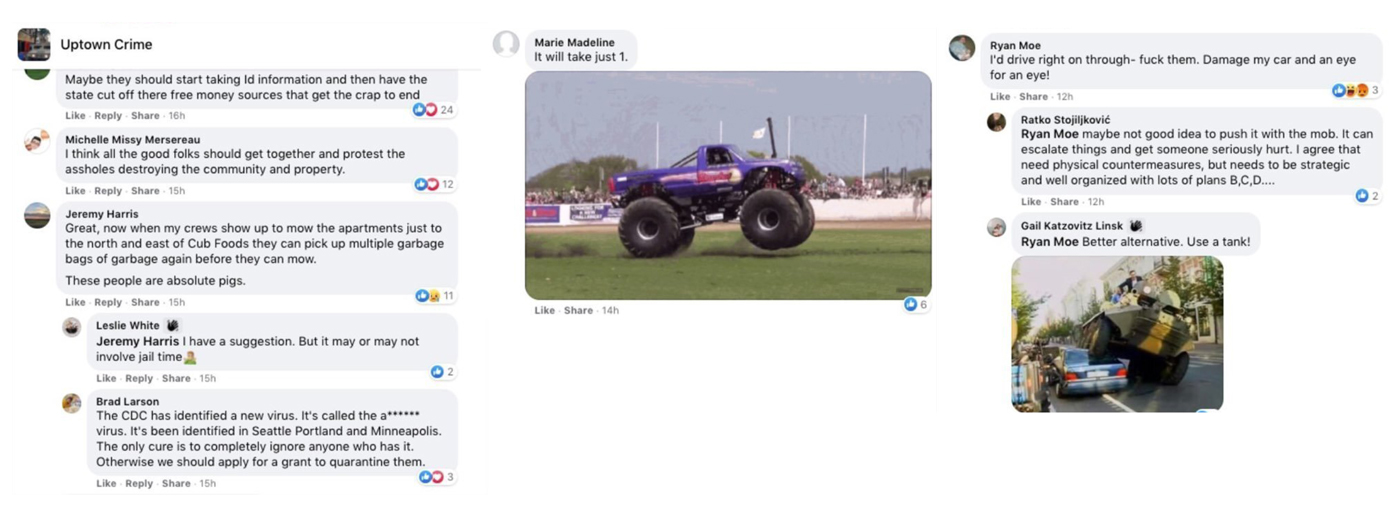
Right-wing online chatter in Minneapolis ahead of the attack that took Deona Marie Erickson’s life.

In this context, the chant “Whose streets? Our streets!” asserts another form of life, another way of relating to each other and conceiving of what our lives could be. Rather than framing vehicular attacks as aberrations from an otherwise peaceful social order—to be addressed, for example, by more policing—we have to understand them as one of the ugliest manifestations of a social structure that is fundamentally racist and anti-human, which can only be addressed via new forms of togetherness.

Honoring those whose lives have been taken by police and pro-police vigilantes is a first step towards this, and it is important that people have been doing this through shared presence in particular physical spaces. The internet—the information superhighway—tends to reinforce the motorist mentality of abstract competition and hostility. One of the most basic steps we can take towards creating a new social fabric on egalitarian terms is to encounter each other in person in ways that affirm the specificity of place.

This gives us more perspective on the ongoing efforts of city officials to evict the autonomous zone at the site where George Floyd was murdered, in order to open it up for “the free passage of traffic.” Rhetoric about “culture wars” is usually used to evoke a conflict between those on the fringe of the left and right, but here, we see centrist officials forcibly imposing a particular model for what our lives, relationships, and forms of grieving should be, even as they purport to be neutral.


Far-Right Murderers and Centrist Beneficiaries

Nicholas Kraus, a man with a history of domestic violence and abuse, is representative of the sort of dysfunctional, alienated men that far-right provocateurs aim to weaponize to carry out stochastic attacks on social movements.

This is effectively a watered-down version of the same strategy that ISIS has used in the Mideast in territories it does not control: taking advantage of the desperation, prejudice, and mental health issues of an entitled but disenfranchised population, the far right aims to disrupt popular mobilizations through consistent but deniable terror attacks. Their goal is to raise the risks of public organizing to such an extent that it becomes hard for movements to maintain momentum, in order to support state repression while opening up space for fascist groups to recruit and mobilize. In Turkey, this approach helped the despotic government of Recep Tayyip Erdoğan to crush what had been powerful social movements. The ultimate beneficiaries of this are not just far-right politicians, but also centrist capitalists who do not wish to see fundamental changes that could threaten their power.

Vigilante attacks are also advantageous for the city officials who would like to present themselves as “neutral” while suppressing the protest movements against the murders that the police they oversee regularly carry out. Vigilante attacks enable these officials to change the subject from the violence of the institutions they represent back to the question of how to “maintain order.”

“Some of these people with the megaphones, I guess their role is to get people riled up and get them in a space and march them around and educate them and tell them what their next big plans are and who they’re backing politics-wise and things like that.

“I like community, organic—no microphones, no megaphones, like right now. It’s about fifty people—but fifty people got Lake and Hennepin shut down right now, you know what I’m saying? We’re moving and grooving right now. As opposed to two or three hundred people holding signs, marching around, and then feeling accomplished, patting themselves on the back and then leaving—ain’t shit get shut down really. Police don’t even monitor the marches no more. No change will come from that.”

-Anonymous Black anti-fascist militant in Minneapolis, evening of June 15, 2021

But Who’s Paying Attention?

“You protested because it was trendy and ‘everyone was doing it.’ I protest because people are out here dying!”
-Deona Marie Erickson, June 10
In 2021, many liberals and progressives have left the streets, relying on the Biden administration to roll back the policies of the Trump administration. Consequently, the murder of Deona Marie Erickson has attracted considerably less attention than it might have just last year. This withdrawal from social struggles creates the conditions for more attacks like this to take place.
This reminds us of the situation before the murder of Heather Heyer made world news, when the far right carried out a series of murders around the United States without drawing the attention of corporate media. Corporate media outlets were only forced to cover the events in Charlottesville because it was not possible to sweep under the rug the fact that a thousand fascists had gathered in one place and killed a white woman. Because the events took news editors—though not anti-fascists—by surprise, they were not prepared to spin the story according to the preferences of their corporate backers; so for a week, fairly honest coverage of the threat represented by the far right suddenly appeared in a variety of news outlets. Subsequently, although this coverage was tempered by efforts to demonize anti-fascists, centrist media outlets continued to report on far-right attacks in order to associate them with the agenda of Donald Trump’s administration.
But now that centrists can’t leverage Deona Marie’s death against Trump, they are prepared to treat it as simply another sad facet of American life, to sweep it under the rug once more.
This coincides with widespread emotional numbness arising from several years of constant tragedies. The COVID-19 pandemic has already accustomed many people to thinking of human life as expendable. Last weekend saw multiple mass shootings across several states. Poverty has reached the highest levels since the beginning of the pandemic. These are the forces that drive desperate people to adopt far-right politics wherever there are no models for a collective pursuit of liberation, creating a feedback loop that will generate more and more tragedies.
“We keep us safe.” “We protect us.” These slogans spread far and wide in the course of the movements that burst onto the world stage in Ferguson, Missouri because it has become eminently apparent that no one else is going to protect us. Deona Marie died doing her best to keep her companions safe—to open up a space in which people can come to know each other on different terms, as part of a community premised on shared consideration for all human beings, not individualized capitalist competition. We should do the same, so that everyone like her, and like George Floyd, Breonna Taylor, and Winston Smith—might live. We should do the same, because the alternative means isolation, means eventually being treated as expendable ourselves.
“If the fascists would have run over Deona Marie and we would have not been holding space, not erected the barricades that the city just tried to tear down, then Deona Marie’s voice would be in vain. We’ve got to be out here. That fascist wins—that fascist who drove his car right here, he wins. ‘Oh, I got them off the street. They’re gone now. My fellow white supremacists can enjoy Lake Street now, because I got them fuckers off the street,’ you know what I’m saying?
“We’re out here stronger now. We have to be.”
-Anonymous Black anti-fascist militant in Minneapolis, June 15, 2021

https://twitter.com/TigerWorku/status/1404329351211016192

“Concerning Deona Marie”

From an internationalist anarchist woman in Rojava:
From half a world away, I hear about this sacrifice, this martyrdom. I use the words sacrifice and martyrdom and not the word “tragedy” because I am hearing about a woman comrade who chose to defend her community, and there are few things more beautiful and free in this world than that choice. She thought beyond herself, felt beyond her own personal safety, to defend those who struggled together side by side with her for freedom.
When a life is given and taken in struggle, it’s not an easy thing for those of us left to continue. It would dishonest for me to say this is not something heavy, but we do not have to let the weight of it become a burden—this weight can give us strength and power, and with it, we can continue her struggle.
Every martyr is another reason to continue, another example to hold ourselves up to. For every woman whose life they take, for every comrade, for every person who stands up to defend their community, whose light they try to extinguish, we can make sure that a hundred rise up in their place. The time when we could be separated on the basis of race, class and gender is coming to an end. When we sacrifice for each other in this way, as comrades, as people who share a freedom struggle, the methods of our enemies turn to dust.
This is the time for us to defend our communities like Deona did. Anything else, and we won’t have risen to her standard. Her choice to defend was a sacred act of love—let us all be led by it.
Revolutionary greetings, respect, and love from Rojava.

If the goal of those who seek to encourage vigilante attacks is to discourage movements based in direct action, this dovetails with the goals of city officials who seek to use the Non-Profit Industrial Complex to buy off a layer of activists to oppose and undermine effective strategies from within the movement. In that regard, one of the most important ways to prevent the attackers from achieving their goals is to preserve the horizontal, grassroots structure of movements against police, while continuing to emphasize systemic forms of white supremacist violence alongside vigilante attacks.

Saturday Matinee: Crude

Crude

Directed by Joe Berlinger

A dramatic documentary about the “Amazon Chernobyl” case where indigenous tribal groups are fighting the multinational corporation Chevron.

Film Review by Frederic and Mary Ann Brussat

Source: Spirituality & Practice

This attention-grabbing documentary directed by Joe Berlinger (Brother’s Keeper) centers on the dramatic story of a legal case that has dragged on for years: Aginda vs Chevron-Texaco. The plaintiffs are 30,000 individuals, including members of five indigenous tribes and colonial settlers in Ecuador who allege that over the course of its quest for oil, Texaco dumped over 18 billion gallons of toxic waste and formation water directly into streams, river, and jungle floor of the Amazon rainforest. In addition, the company is said to have spilled 18 million gallons of crude oil from pipelines, burned more than 235 billion cubic feet of natural gas into the atmosphere, and built nearly 1000 unlined toxic waste pits in the region — an area approximately the size of the state of Rhode Island. Berlinger manages to broaden the documentary out beyond what has been called the “Amazon Chernobyl case” to include material on global politics, celebrity causes, environmental activism, human rights advocacy, the role of the media in controversial trials, the power and wealth of multinational corporations, and the unconscionable treatment of rapidly-disappearing indigenous cultures.

At the center of this David vs Goliath struggle is Pablo Farjardo, the lead attorney for the Aguinda plaintiffs. He grew up in poverty in the Amazon region and attended college and law school under the sponsorship of the Catholic Church. In his first case, which has been running since November 1993, Farjardo is seen making his points during the judicial inspections of the affected regions, rallying support of indigenous tribes, and visiting with families who are suffering with cancer, skin conditions, and birth defects. In 2008, he received the Goldman Environmental Prize in San Francisco honoring his work along with Luis Yanza, President of the Amazon Defense Fund, who has been managing the day-by-day operations of the case. A large role has also been played by Steven Donziger, a New York-based attorney, who has provided invaluable strategy advice and seems to be very savvy about the importance of media coverage (the cover story about the case in Vanity Fair and the involvement of Trudie Styler, the co-founder of the Rainforest Foundation with her husband, the musician Sting).

The cause of Farjardo and associates is helped in 2007 when the new President of Ecuador, Rafael Correa, tours the toxic areas and lends his support. The case for Chevron in the documentary is presented by Ricardo Reis, the Managing Counsel for Chevron Latin America; Sara McMillan, Chevron’s Environmental Scientist who denies any connection between the company’s operations and the deaths and health issues of the indigenous tribes; and Adolfo Callejas and Diego Larrea, the two attorneys representing Chevron.

The proceedings reach a climactic point when the findings of Richard Cabrera, an independent expert, are released. He was appointed by the court to conduct a “global assessment” of the region, evaluating the plaintiffs’ claims and calculating the cost to repair any alleged damages. He found Chevron to be liable for up to $16 billion in damages (later amended to $27 billion) as compensation for health care, environmental remediation, reparations for loss of indigenous culture, cancer deaths, and the oil company’s “unjust enrichment” from its operations. Chevron has rejected the report calling it biased and unqualified. And so, the case continues and we recall that the Exxon Valdez judgment took nearly two decades to appeal.

Update:

Corporate Tyranny: How Chevron Conspired with US Courts to Destroy a Human Rights Lawyer

By Rania Khalek

Source: Breakthrough News

Human rights lawyer Steven Donziger has been thrust into an epic battle with one of the biggest oil companies in the world. He helped win a multi billion dollar lawsuit against the Oil Giant Chevron for polluting the Amazon in Ecuador and poisoning the indigenous community who lives there.

Ever since then Chevron has waged a relentless and global campaign to avoid accountability and to punish Doziger. In what reads like a Hollywood thriller, a US judge with ties to Chevron has conspired with the oil giant to destroy Donziger’s life. As a result of the case, he has been confined to his home on house arrest since 2019. And there’s a corporate media blackout!

Donziger spoke to Rania Khalek on Dispatches from house arrest in New York City, not too far from the New York Times, which has ignored the story.

Donate to Stephen Donziger’s legal defense fund here: https://www.donzigerdefense.com/

Total Tyranny: We’ll All Be Targeted Under the Government’s New Precrime Program

By John W. Whitehead

Source: The Rutherford Institute

“There is now the capacity to make tyranny total in America.”― James Bamford

It never fails.

Just as we get a glimmer of hope that maybe, just maybe, there might be a chance of crawling out of this totalitarian cesspool in which we’ve been mired, we get kicked down again.

In the same week that the U.S. Supreme Court unanimously declared that police cannot carry out warrantless home invasions in order to seize guns under the pretext of their “community caretaking” duties, the Biden Administration announced its plans for a “precrime” crime prevention agency.

Talk about taking one step forward and two steps back.

Precrime, straight out of the realm of dystopian science fiction movies such as Minority Report, aims to prevent crimes before they happen by combining widespread surveillance, behavior prediction technologies, data mining, precognitive technology, and neighborhood and family snitch programs to enable police to capture would-be criminals before they can do any damage.

This particular precrime division will fall under the Department of Homeland Security, the agency notorious for militarizing the police and SWAT teams; spying on activists, dissidents and veterans; stockpiling ammunition; distributing license plate readers; contracting to build detention camps; tracking cell-phones with Stingray devices; carrying out military drills and lockdowns in American cities; using the TSA as an advance guard; conducting virtual strip searches with full-body scanners; carrying out soft target checkpoints; directing government workers to spy on Americans; conducting widespread spying networks using fusion centers; carrying out Constitution-free border control searches; funding city-wide surveillance cameras; and utilizing drones and other spybots.

The intent, of course, is for the government to be all-seeing, all-knowing and all-powerful in its preemptive efforts to combat domestic extremism.

Where we run into trouble is when the government gets overzealous and over-ambitious and overreaches.

This is how you turn a nation of citizens into snitches and suspects.

In the blink of an eye, ordinary Americans will find themselves labeled domestic extremists for engaging in lawful behavior that triggers the government’s precrime sensors.

Of course, it’s an elaborate setup: we’ll all be targets.

In such a suspect society, the burden of proof is reversed so that guilt is assumed and innocence must be proven.

It’s the American police state’s take on the dystopian terrors foreshadowed by George Orwell, Aldous Huxley and Phillip K. Dick all rolled up into one oppressive pre-crime and pre-thought crime package.

What’s more, the technocrats who run the surveillance state don’t even have to break a sweat while monitoring what you say, what you read, what you write, where you go, how much you spend, whom you support, and with whom you communicate.

Computers now do the tedious work of trolling social media, the internet, text messages and phone calls for potentially anti-government remarks, all of which is carefully recorded, documented, and stored to be used against you someday at a time and place of the government’s choosing.

In this way, with the help of automated eyes and ears, a growing arsenal of high-tech software, hardware and techniques, government propaganda urging Americans to turn into spies and snitches, as well as social media and behavior sensing software, government agents are spinning a sticky spider-web of threat assessments, behavioral sensing warnings, flagged “words,” and “suspicious” activity reports aimed at snaring potential enemies of the state.

It works the same in any regime.

As Professor Robert Gellately notes in his book Backing Hitler about the police state tactics used in Nazi Germany: “There were relatively few secret police, and most were just processing the information coming in. I had found a shocking fact. It wasn’t the secret police who were doing this wide-scale surveillance and hiding on every street corner. It was the ordinary German people who were informing on their neighbors.”

Here’s the thing as the Germans themselves quickly discovered: you won’t have to do anything illegal or challenge the government’s authority in order to be flagged as a suspicious character, labeled an enemy of the state and locked up like a dangerous criminal.

In fact, all you will need to do is use certain trigger words, surf the internet, communicate using a cell phone, drive a car, stay at a hotel, purchase materials at a hardware store, take flying or boating lessons, appear suspicious to a neighbor, question government authority, or generally live in the United States.

The following activities are guaranteed to get you censored, surveilled, eventually placed on a government watch list, possibly detained and potentially killed.

Use harmless trigger words like cloud, pork and pirates: The Department of Homeland Security has an expansive list of keywords and phrases it uses to monitor social networking sites and online media for signs of terrorist or other threats. While you’ll definitely send up an alert for using phrases such as dirty bomb, Jihad and Agro terror, you’re just as likely to get flagged for surveillance if you reference the terms SWAT, lockdown, police, cloud, food poisoning, pork, flu, Subway, smart, delays, cancelled, la familia, pirates, hurricane, forest fire, storm, flood, help, ice, snow, worm, warning or social media.

Use a cell phone: Simply by using a cell phone, you make yourself an easy target for government agents—working closely with corporations—who can listen in on your phone calls, read your text messages and emails, and track your movements based on the data transferred from, received by, and stored in your cell phone. Mention any of the so-called “trigger” words in a conversation or text message, and you’ll get flagged for sure.

Drive a car: Unless you’ve got an old junkyard heap without any of the gadgets and gizmos that are so attractive to today’s car buyers (GPS, satellite radio, electrical everything, smart systems, etc.), driving a car today is like wearing a homing device: you’ll be tracked from the moment you open that car door thanks to black box recorders and vehicle-to-vehicle communications systems that can monitor your speed, direction, location, the number of miles traveled, and even your seatbelt use. Once you add satellites, GPS devices, license plate readers, and real-time traffic cameras to the mix, there’s nowhere you can go on our nation’s highways and byways that you can’t be followed. By the time you add self-driving cars into the futuristic mix, equipped with computers that know where you want to go before you do, privacy and autonomy will be little more than distant mirages in your rearview mirror.

Attend a political rally: Enacted in the wake of 9/11, the Patriot Act redefined terrorism so broadly that many non-terrorist political activities such as protest marches, demonstrations and civil disobedience were considered potential terrorist acts, thereby rendering anyone desiring to engage in protected First Amendment expressive activities as suspects of the surveillance state.

Express yourself on social media: The FBI, CIA, NSA and other government agencies are investing in and relying on corporate surveillance technologies that can mine constitutionally protected speech on social media platforms such as Facebook, Twitter and Instagram in order to identify potential extremists and predict who might engage in future acts of anti-government behavior. A decorated Marine, 26-year-old Brandon Raub was targeted by the Secret Service because of his Facebook posts, interrogated by government agents about his views on government corruption, arrested with no warning, labeled mentally ill for subscribing to so-called “conspiratorial” views about the government, detained against his will in a psych ward for having “dangerous” opinions, and isolated from his family, friends and attorneys.

Serve in the militaryOperation Vigilant Eagle, the brainchild of the Dept. of Homeland Security, calls for surveillance of military veterans returning from Iraq and Afghanistan, characterizing them as extremists and potential domestic terrorist threats because they may be “disgruntled, disillusioned or suffering from the psychological effects of war.” Police agencies are also using Beware, an “early warning” computer system that tips them off to a potential suspect’s inclination to be a troublemaker and assigns individuals a color-coded threat score—green, yellow or red—based on a variety of factors including one’s criminal records, military background, medical history and social media surveillance.

Disagree with a law enforcement official: A growing number of government programs are aimed at identifying, monitoring and locking up anyone considered potentially “dangerous” or mentally ill (according to government standards, of course). For instance, a homeless man in New York City who reportedly had a history of violence but no signs of mental illness was forcibly detained in a psych ward for a week after arguing with shelter police. Despite the fact that doctors cited no medical reason to commit him, the man was locked up in accordance with a $22 million program that monitors mentally ill people considered “potentially” violent. According to the Associated Press, “A judge finally ordered his release, ruling that the man’s commitment violated his civil rights and that bureaucrats had meddled in his medical treatment.”

Call in sick to work: In Virginia, a so-called police “welfare check” instigated by a 58-year-old man’s employer after he called in sick resulted in a two-hour, SWAT team-style raid on the man’s truck and a 72-hour mental health hold. During the standoff, a heavily armed police tactical team confronted Benjamin Burruss as he was leaving an area motel, surrounded his truck, deployed a “stinger” device behind the rear tires, launched a flash grenade, smashed the side window in order to drag him from the truck, handcuffed and searched him, and transported him to a local hospital for a psychiatric evaluation and mental health hold. All of this was done despite the fact that police acknowledged they had no legal basis nor probable cause for detaining Burruss, given that he had not threatened to harm anyone and was not mentally ill.

Limp or stutter: As a result of a nationwide push to certify a broad spectrum of government officials in mental health first-aid training (a 12-hour course comprised of PowerPoint presentations, videos, discussions, role playing and other interactive activities), more Americans are going to run the risk of being reported for having mental health issues by non-medical personnel. Mind you, once you get on such a government watch list—whether it’s a terrorist watch list, a mental health watch list, or a dissident watch list—there’s no clear-cut way to get off, whether or not you should actually be on there. For instance, one 37-year-old disabled man was arrested, diagnosed by police and an unlicensed mental health screener as having “mental health issues,” apparently because of his slurred speech and unsteady gait, and subsequently locked up for five days in a mental health facility against his will and with no access to family and friends. A subsequent hearing found that Gordon Goines, who suffers from a neurological condition similar to multiple sclerosis, has no mental illness and should not have been confined.

Appear confused or nervous, fidget, whistle or smell bad: According to the Transportation Security Administration’s 92-point secret behavior watch list for spotting terrorists, these are among some of the telling signs of suspicious behavior: fidgeting, whistling, bad body odor, yawning, clearing your throat, having a pale face from recently shaving your beard, covering your mouth with your hand when speaking and blinking your eyes fast. You can also be pulled aside for interrogation if you “have ‘unusual items,’ like almanacs and ‘numerous prepaid calling cards or cell phones.’” One critic of the program accurately referred to the program as a “license to harass.”

Allow yourself to be seen in public waving a toy gun or anything remotely resembling a gun, such as a water nozzle or a remote control or a walking cane, for instance: No longer is it unusual to hear about incidents in which police shoot unarmed individuals first and ask questions later. John Crawford was shot by police in an Ohio Wal-Mart for holding an air rifle sold in the store that he may have intended to buy. Thirteen-year-old Andy Lopez Cruz was shot 7 times in 10 seconds by a California police officer who mistook the boy’s toy gun for an assault rifle. Christopher Roupe, 17, was shot and killed after opening the door to a police officer. The officer, mistaking the Wii remote control in Roupe’s hand for a gun, shot him in the chest. Another police officer repeatedly shot 70-year-old Bobby Canipe during a traffic stop. The cop saw the man reaching for his cane and, believing the cane to be a rifle, opened fire.

Stare at a police officer: Miami-Dade police slammed the 14-year-old Tremaine McMillian to the ground, putting him in a chokehold and handcuffing him after he allegedly gave them “dehumanizing stares” and walked away from them, which the officers found unacceptable.

Appear to be pro-gun, pro-freedom or anti-government: You might be a domestic terrorist in the eyes of the FBI (and its network of snitches) if you: express libertarian philosophies (statements, bumper stickers); exhibit Second Amendment-oriented views (NRA or gun club membership); read survivalist literature, including apocalyptic fictional books; show signs of self-sufficiency (stockpiling food, ammo, hand tools, medical supplies); fear an economic collapse; buy gold and barter items; subscribe to religious views concerning the book of Revelation; voice fears about Big Brother or big government; expound about constitutional rights and civil liberties; or believe in a New World Order conspiracy. This is all part of a larger trend in American governance whereby dissent is criminalized and pathologized, and dissenters are censored, silenced or declared unfit for society. 

Attend a public school: Microcosms of the police state, America’s public schools contain almost every aspect of the militarized, intolerant, senseless, overcriminalized, legalistic, surveillance-riddled, totalitarian landscape that plagues those of us on the “outside.” From the moment a child enters one of the nation’s 98,000 public schools to the moment she graduates, she will be exposed to a steady diet of draconian zero tolerance policies that criminalize childish behavior, overreaching anti-bullying statutes that criminalize speech, school resource officers (police) tasked with disciplining and/or arresting so-called “disorderly” students, standardized testing that emphasizes rote answers over critical thinking, politically correct mindsets that teach young people to censor themselves and those around them, and extensive biometric and surveillance systems that, coupled with the rest, acclimate young people to a world in which they have no freedom of thought, speech or movement. Additionally, as part of the government’s so-called ongoing war on terror, the FBI—the nation’s de facto secret police force—has been recruiting students and teachers to spy on each other and report anyone who appears to have the potential to be “anti-government” or “extremist” as part of its “Don’t Be a Puppet” campaign.

Speak truth to power: Long before Chelsea Manning and Edward Snowden were being castigated for blowing the whistle on the government’s war crimes and the National Security Agency’s abuse of its surveillance powers, it was activists such as Martin Luther King Jr. and John Lennon who were being singled out for daring to speak truth to power. These men and others like them had their phone calls monitored and data files collected on their activities and associations. For a little while, at least, they became enemy number one in the eyes of the U.S. government.

Yet as I point out in my book Battlefield America: The War on the American People, you don’t even have to be a dissident to get flagged by the government for surveillance, censorship and detention.

All you really need to be is a citizen of the American police state.