“Economic Recovery” is Just Deceptive Statistics

images

Whenever there’s a cheerful jobs report propagated by corporate news, many of us know they’re lying (because it just doesn’t correspond to reality) though we might not know exactly how the numbers they use decieve us. At Counterpunch.org, Paul Craig Roberts dissects some of the figures cited by the Bureau of Labor Statistics as support for claims of an economic recovery. For example, their payroll jobs report says that the US economy created 203,000 jobs in November. Since it takes about 130,000 new jobs each month to keep up with population growth, the remaining 70,000 of the jobs would have only slightly reduced the unemployment rate yet it supposedly fell from 7.3 to 7.0 which is too much. It turns out the payroll survey counts a person holding two jobs as if it were two employed persons, while the unemployment rate is calculated from the household survey, which counts a person holding two or more jobs as one job. Though the two figures are often reported together, they actually have no connection.

Payroll numbers can be skewed by seasonal hiring and because the birth-death model used to estimate the numbers of unreported business shutdowns and startups often underestimate the former and overestimate the latter. The unemployment rate figures are innacurate because it leaves out people who have given up on looking for work. The greater the number of discouraged workers there are, the lower the rate of unemployment, according to the BLS.

So exactly where and what are the 203,000 new payroll jobs created in November? Paul Craig Roberts breaks down the figures as reported by the BLS and discovered that the majority are lowly-paid, part-time, nontradable (non exportable) domestic service jobs including:

…retail trade with 22,300 jobs, transportation and warehousing with 30,500 jobs, temporary help services with 16,400 jobs, ambulatory health care services with 26,300 jobs, home health care services with 11,800 jobs, and the old reliable waitresses and bartenders with 17,900 jobs.

This is the jobs profile of the American super economy. It is the profile of India 30 or 40 years ago.

PCR continues his analysis by citing the work of statistician John Williams (shadowstats.com), who found more misstated jobs that could be attributed to the government shutdown and reopening, the birth-death model, and concurrent-seasonal-adjustment errors. According to Williams, whose figures include long-term discouraged workers who cannot find a job, the US unemployment rate is actually 23.2%.

Of course there’s no recovery with a 23.2% unemployment rate, but to keep stocks and bonds at all-time record high levels, the Federal Reserve is printing $1,000 billion new dollars annually, potentially creating an economic bubble. Despite these issues, the BLS estimated a third quarter GDP growth of 3.6%. Paul Craig Roberts challenges this claim with the following figures:

US real median household income has declined from $56,189 in 2007 to $51,371 in 2012, a decline of $4,818 or 8.6%. http://www.deptofnumbers.com/income/us/

US real per capita income has declined from $29,554 in 2007 to $27,319 in 2012, a drop of $2,235 or 7.5%.

According to the Bureau of Labor Statistics, there are 1,277,000 fewer seasonally adjusted payroll jobs in November 2013 than in December 2007.

He concludes by asking:

How it is possible for the economy to have been in recovery since June 2009 (according to the National Bureau of Economic Research) and there are 1,277,000 fewer jobs today than existed six years ago prior to the recession?

How has real Gross Domestic Product recovered when jobs and real consumer incomes have not?

Thailand: Who are the Anti-Regime Protesters?

THAILAND-P__c891587_131127_467

By Tony Cartalucci for Land Destroyer Report

December 3, 2013
– After clashes with police in Bangkok and the taking of several government buildings, anti-regime protesters prepared for the next phase of their resistance – the protracted encampment of key governmental centers. Thousands of protesters are now permanently entrenched in an area winding for nearly a mile through the capital city. They have built up a city within a city at three main locations that are linked by the constant stream of protesters coming and going to and from the protest sites.


Image: It appears that the anti-regime protesters know exactly who they are dealing with. While it is easier in speeches and sound bites to describe Thaksin Shinawatra and his hereditary dictatorship as the central source of Thailand’s problems, it is well understood amongst protesters that a vast network of foreign-funded NGOs are propping up the Shinawatra regime. Freedom House, for instance, lists as a trustee Kenneth Adelman, who concurrently served as Thaksin’s lobbyist. Pro-regime news website Prachatai, is directly funded by US State Department NGOs such as the National Endowment for Democracy (NED)

….


But who are these protesters and what do they want? Are they, as the Western media portrays them, anti-democratic elitists who refuse to to concede power to awakened rural masses? Or are they dangerously informed, socially and politically aware groups that are actively opposing the designs of foreign corporate-financiers and the proxy regime they have put into power in Thailand?

Who are Thailand’s Anti-Regime Protesters?

Walking from one end of the protest to the other can become an all day affair. The sites are spaced out slightly, but occupy long stretches of road turned into permanent encampments complete with food, water, medical services, bathrooms, shower stalls, exhibition booths and support points, media centers, stages, and hawker stalls. There are thousands of permanently encamped protesters and thousands more who come and go – even at low points in the day.

The extensive infrastructure of these protest sites resemble a fair or an exhibition. While a single theme has brought them together, a large number of diverse groups have marshaled their resources to build the sprawling encampments. There of course is the main camp and stage set up by a group of political parties including the main opposition party, the Democrats, the People’s Democratic Reform Committee, and the Network of Students and People for Reform of Thailand.

The “Yellow Shirt”  People’s Alliance for Democracy (PAD) also maintains a camp, as does Santi Asoke, a group that practices the Thai-equivalent of organic farming, homesteading, and grassroots community development. 


Images: Labor unions have a strong showing in the anti-regime camps. While the Shinawatra regime has hijacked the color red for his mobs as well as the socialist rhetoric that goes with it, real labor unions flying the color red actually engage in the protection of workers’ rights. 
….


There are throughout the camps, smaller student groups from across Bangkok, and a large number of labor unions. Some of the bigger unions include those working for state enterprises, THAI Airways, and the country’s nationalized telecom company, CAT.

And despite the most vitriolic and perhaps even racist accusations leveled against the protesters is that they represent ethnic Chinese-Thais. While there certainly are a lot of Thais of Chinese descent at the rallies, mainly because they have called Bangkok their home for generations, still the vast majority of the protesters are ethnic Thais and include people drawn to the capital to find better lives from Thaksin Shinawatra’s northeast political stronghold.

What Do They Want? 

We are told by the Western media that this is a “people’s coup,” an attempt to overthrow democracy. In reality, and entirely unlike Thaksin’s red shirts who simplistically demand “democracy,”  the anti-regime protesters have a list of cogent demands.

1. No Amnesty – This refers to an amnesty bill designed by and for Thaksin Shinawatra to absolve himself of a decade of plundering, lying, and mass murder. While the government eventually backed off, it was only because massive street protests were mobilized. When the Constitution Court declared the bill unconstitutional, the ruling regime announced that it no longer recognized the authority of the court – even while using constitutionality to condemn the protests. Even though it is considered “dead,” Thaksin’s entire future depends on it eventually passing. Protesters feel the only way to truly kill this bill, is to remove entirely the regime attempting such an absurd abuse of power.

2. Rollback Article 190 – Article 190 of the Thai constitution requires that all treaties be approved by the parliament before they can be signed. In 2004, this mechanism had prevented Thaksin Shinawatra from unilaterally passing a US-Thai free trade agreement, and was one of many attempted circumventions of the law that led to his ouster in 2006. His nepotist-appointed sister Yingluck Shinawatra, has now managed to amend it making it possible for her to unilateral approve treaties (specifically unpopular FTA’s). Protesters would like to see this reversed.

3. The Re-Nationalization of Thailand’s Oil – Thailand’s oil giant, PTT, was privatized and sold off  to foreign multinationals under Thaksin Shinawatra in late 2001. Tremendous wealth has been siphoned out of Thailand and sent overseas, particularly to Chevron, one of the many sponsors on the US-ASEAN Business Council that directly supports the Shinawatra regime.

 
Image: Another issue protesters have is with the changing of article 190 which allows the regime to now unilaterally sign treaties without the parliament’s approval. This will be used specifically to pass through a series of extremely unpopular free trade agreements with the regime’s Western sponsors. 
….
 
4. Keep Thailand Anti-GMO, Anti-IP – The current Thai establishment resisting the regime has been stalwartly defending against GMO and “intellectual property” (IP) laws pushed on them by the United States, the UK, and the EU. In fact, one of the main points of attack by Thaksin Shinawatra’s Washington lobbyists, was attacking the military council that ousted Thaksin for ignoring US pharmaceutical patents while producing cheaper drugs for poor patients. Regarding GMO, Monsanto has been desperately trying to overrun Thailand’s food security but to no avail. Would it surprise readers to know that the US-ASEAN Business Council directly supporting Thaksin Shinawatra and his political machine also includes Monsanto?

It becomes abundantly clear why corporate media houses like the BBC, Reuters, AP, AFP, CNN, MSNBC, and Australia’s ABC have attacked the protesters as “anti-democratic,” “elitist,” and “violent.” They represent for them a population they cannot trick, manipulate, and have their way with. They would like to see it marginalized and removed from Thailand’s political landscape so they can grind Thailand into the ground like so many other nations across the developing world. Thailand’s anti-regime protesters are making their stand – those that support true freedom and progress should stand with them.

Drone camera footage of the protests:

War on the Poor Continues With Planned Pension Cuts in Detroit and Illinois

130614134247-detroit-protest-620xa

Yesterday Federal bankruptcy court judge Steven Rhodes ruled that Detroit is insolvent and eligible for a Chapter 9 debt restructuring. This gives the city the go-ahead to cut retirement benefits as part of its restructuring plan, despite pensions being explicitly protected by the state constitution.

Learn more about the situation in Detroit at Detroit Inquiry.

Judge Rhodes’s decision serves as a precedent for city and state governments across the country to carry out a similar policies. Just hours after the Detroit ruling, both chambers of the Illinois legislature also passed an unconstitutional pension reform bill that would steal money from the pension plans Illinois state workers paid for, reduce and suspend cost-of-living increases and limit their salaries.

Such acts of class warfare demonstrate how the government/corporate machine views the 99% as merely a source of wealth and cannon fodder. Once they find cheaper labor and more prosperous markets elsewhere and once soldiers return home after fighting their wars, we’re worth even less to them. Judging from their actions, the corporatocracy has no loyalty, trust and respect for us. Why should we give them any loyalty, trust and respect if it’s not reciprocated?

Detroit Bankruptcy Timeline:

2011

March 16: Michigan’s Public Act 4 emergency manager law goes into effect.

Nov. 16: Detroit Mayor Dave Bing says the city could run out of cash by April 2012 and have a potential shortfall of $45 million by the end of the fiscal year June 30.

Dec. 2: State Treasurer Andy Dillon orders a preliminary financial review of Detroit. The move sparks protests against Michigan Public Act 4, the emergency manager law that expanded EM powers.

Dec. 21: Dillon announces “probable financial stress” in Detroit and recommends Snyder send a team to review city finances.

2012

Jan. 10: Former State Treasurer Andy Dillon gives Mayor Dave Bing until the first week of February to submit a financial plan to avoid an emergency manager.

March 13: A 25-page proposed consent agreement is given to the City Council.

March 21: A state review team declares Detroit in a “severe financial emergency.”

March 23: The Michigan Court of Appeals reverses an Ingham County judge’s ruling that barred the state from entering a consent agreement with Detroit.

April 4: The City Council, 5-4, approves a consent agreement.

April 5: Gov. Rick Snyder and Bing sign the agreement.

June 15: A nine-member oversight board created under the consent agreement holds its first meeting.

Aug. 2: A proposed repeal of Public Act 4 is placed on the Nov. 6 ballot and the law immediately is suspended. Public Act 72, the prior 1990 law that grants fewer powers to emergency financial mangers, is reinstated.

Nov. 7: Public Act 4 is repealed in the general election.

Dec. 10: Detroit’s Financial Advisory Board calls for a 30-day review of the city’s finances under Public Act 72.

Dec. 14: A state review of Detroit finances finds “a serious financial problem.”

Dec. 27: Snyder signs a new emergency manager bill, Public Act 436, which is to take effect March 28.

2013

Jan. 3: An audit shows Detroit has a $327 million accumulated deficit as of June 30.

Feb. 19: A state team reviewing Detroit’s finances determines the city is in a financial emergency with “no satisfactory” plan to resolve it.

March 1: Snyder announces plans to bring an emergency manager to Detroit.

March 9: The council makes a formal request for an appeal hearing in Lansing.

March 12: Detroit officials fail to convince the state’s Emergency Loan Board that a satisfactory plan in place to address Detroit’s fiscal crisis without an emergency manager.

March 14: Snyder appoints Kevyn Orr as Detroit emergency manager. He takes office March 25 for the job, which pays $275,000 per year. State officials hope he can complete his job within 18 months.

March 26: Public Act 436 goes into effect and opponents file a lawsuit in U.S. District Court in Detroit, arguing the legislation deprives citizens of “constitutionally protected rights” and dilutes their vote.

May 13: Orr submits a preliminary financial and operating plan to the state Treasury Department, saying Detroit’s cash-flow crisis makes it “insolvent.”

June 14: Orr unveils to creditors his plans to restructure the city’s finances and avoid bankruptcy.

June 20: Orr holds closed-door meetings with union officials to discuss a restructuring proposal that includes health care and pension cuts and launches a probe of the city’s pension funds amid concerns about corruption, spending and management.

July 5: The city files a lawsuit against Syncora Guarantee Inc., in an attempt to recover $11 million a month in casino payments and taxes that Detroit claims are being improperly withheld by the insurance company.

July 15: Orr submits a quarterly financial report to the state saying the city’s financial condition “continues to be dire.”

July 17: The city’s two pension funds sue Snyder July 17 to block him from authorizing what would be the biggest municipal bankruptcy in U.S. history on claims it would violate retirees’ constitutional right to a pension.

July 18: Orr files a petition for municipal bankruptcy in U.S. District Court’s Eastern District in Detroit.

July 19: The case is assigned to U.S. Bankruptcy Judge Steven Rhodes.

July 24: Rhodes freezes all lawsuits against the city challenging the legality of Detroit’s bankruptcy filing.

Aug. 2: Rhodes creates a committee to represent city retirees.

Aug. 5: Orr announces he has contracted with Christie’s, the New York-based international auction house, to appraise the collection of the Detroit Institute of Arts.

Aug. 13: Chief U.S. District Judge Gerald Rosen is appointed to mediate disputes between the city and creditors.

Sept. 26: An audit commissioned by Orr reveals the city’s pension funds lost more than $125 million on real estate deals and gave questionable bonus payments to employees.

Oct. 9: Gov. Rick Snyder is questioned under oath about his decision to authorize the largest municipal bankruptcy in U.S. history. Snyder is the first sitting governor in modern Michigan history to face a sworn deposition.

Oct. 11: Orr announces the city has secured a $350 million loan agreement with Barclays to pay off a pension related-debt and finance city service improvements while Detroit is in bankruptcy.

Oct. 15: In a report to Dillon, Orr says the city’s financial condition remains dire but cash flow improved during the first quarter since the bankruptcy filing.

Oct. 25: Detroit’s eligibility trial begins before Judge Rhodes in Detroit’s federal courthouse.

Nov. 6: Judge Rhodes denies the NAACP’s request to pursue a lawsuit against Gov. Rick Snyder’s administration over the constitutionality of the emergency manager law.

Nov. 8: The city’s nine-day eligibility trial ends.

Nov. 8: Orr postpones a proposed health care initiative for retirees until Feb. 28 under an agreement with the city and retiree committee created through bankruptcy proceedings.

Nov. 13: A city union representing Detroit’s EMTs reaches a five-year, out-of-court contract agreement with Orr.

Nov. 25: Rhodes in a court filing announces he will decide Dec. 3 whether Detroit can proceed with its Chapter 9 bankruptcy filing.

Nov. 26: A group of creditors ask for an independent evaluation of the Detroit Institute of Arts collection.

Nov. 27: Judge Rhodes halts Detroit’s efforts to fix its broken streetlight system after discovering one of the city’s law firms involved in the bankruptcy case also represents the new Public Lighting Authority, a potential conflict of interest.

Nov. 27: A trial over Detroit’s plan to seek a $350 million bankruptcy loan is pushed back amid new objections by creditors. Judge Rhodes and attorneys representing the city and several creditors agreed in principle to delay the trial to Dec. 17-19.

Dec. 3: Rhodes delivers decision on bankruptcy eligibility.

(Timeline: Associated Press)

Origin of the Wal-Mart Workers’ Movement

walmart black friday strike

Wal-Mart’s unfair labor policies have been a concern of workers’ rights activists for decades but they managed to avoid a retail strike until last year. On October 4th 2012, 60 Wal-Mart employees struck in Los Angeles followed by strikes at 28 stores in 12 states five days later. Shortly after on October 10th, pressure was increased when more than 200 workers protested at Wal-Mart’s global headquarters in Bentonville, Arkansas, as executives met for its annual financial analyst meeting. More than 400 Wal-Mart strikers, mostly coordinated by Organization United For Respect at Wal-Mart (OUR Wal-mart) with support from the United Food and Commercial Workers Union, walked out on Black Friday, the day after Thanksgiving and traditionally Wal-Mart’s most profitable (and chaotic) day of the year.

Wal-Mart’s intimidation tactics have long suppressed employees’ attempts to organize but previous incidents reflecting growing collective outrage and urgency served as catalyst to make the wave of strikes inevitable. On June 4th 2012, eight Mexican guest workers at Wal-Mart supplier CJ’s Seafood went on strike and filed a complaint with the Labor Department and the Equal Opportunity Labor Commission. Plant managers had forced them to work 24 hour shifts with no overtime, locked employees inside the plant, threatened them with beatings and threatened violence against their families in Mexico. As a result of the strike, Wal-Mart was pressured into suspending CJ’s Seafood as a supplier.

In early September of 2012, around 30 temp workers at a warehouse storing goods for Wal-Mart went on strike without union backing. Conditions of the freight containers they worked in were becoming dangerously hot in the Summer. In addition, the underpaid workers had no access to clean water, were forced to use malfunctioning equipment, denied work breaks, and threatened by supervisors. The following week another 30 employees at a Wal-Mart distribution center in northeastern Illinois walked out after being retaliated against by supervisors for delivering a list of grievances to management. Their petition shared many of the same concerns listed by the strikers in California: dangerous working conditions, unsafe or insufficient equipment, lack of living wages, no overtime pay, benefits and job security, irregular schedules, work speed-ups and wage theft.

While exploitation and unjust treatment of workers are not unique to Wal-Mart and companies they subcontract to, the wild growth of the Wal-Mart empire can be largely attributed to their business model. Besides maintaining strict anti-union policies, by keeping tight control over their supply chain they force costs and responsibilities onto suppliers, squeezing their margins. Predictably, this results in the lowest paid laborers getting hit the hardest while the highest paid CEOs make obscenely inflated profits. According to Federal Reserve data analyzed by Sylvia Allegretto and Josn Bivens, between 2007 and 2010, while the average American family’s wealth decreased 38.8%, wealth of Wal-Mart heirs rose 22% to nearly $90 billion, equivalent to the wealth of 41.5 percent of American families combined. An article for the Progressive Change Campaign Committee by Zaid Jilani highlighted the fact that Wal-Mart CEO Mike Duke received compensation worth $18.1 million in 2011 while the average sales associate at the company was paid $8.81 an hour according to independent market research group IBIS World. Thus, Duke earned 1,167 times as much as his company’s average worker (average CEO-to-worker compensation ratio was 209.4-to-1 in 2011). A 2008 SweatFree Communities report brought to light horrendous working conditions at a Wal-Mart supplier in Bangladesh where sweatshop factory workers were forced to work up to 19-hour shifts, frequently subjected to verbal and physical abuse and paid as little as $20 a month.

Societal harm caused by Wal-Mart is hardly limited to poverty and sub-poverty wage employees, subcontractors, and their families. In 2010 Public Advocate for the City of New York Bill de Blasio and Hunter College Center for Community Planning and Development released “Wal-Mart’s Economic Footprint”, a comprehensive review of over fifty studies on Wal-Mart’s economic impact across the country. Among their findings:
-For every two low wage jobs Wal-Mart creates, three local jobs are eliminated.
-Wal-Mart stores have a strongly negative impact on a community’s existing retailers.
-Large chain stores such as Wal-Mart send most of their revenues out of communities.
-Wal-Mart has thousands of employees who qualify for Medicaid and other publicly subsidized care.
-Wal-Mart likely avoided paying $245 million in taxes 2008 by paying rent to itself and then deducting that rent from its taxable income.
-Wal-Mart has admitted a failure to pay $2.95 billion in taxes for fiscal year 2009.
-Wal-Mart’s average annual pay of $20,774 is below the Federal Poverty Level for a family of four.

Because Wal-Mart is now the largest food seller in the US, it has an outsized impact on our food system influencing which foods are made available, market prices of food and methods used by food producers. Continuing Wal-Mart’s trend of prioritizing profits over people, last year the company made a deal with Monsanto to sell unlabeled GM corn. This decision was made despite protests of 463,000 signatories of a petition from Food and Water Watch urging Wal-Mart not to carry the potentially harmful product.

The National Labor Relations Board recently decided that it will prosecute Wal-Mart for labor rights violations for firing and retaliating against striking workers and those who have been outspoken about working conditions at Wal-Mart. This case shows that actions over the past year and a half have had a significant impact. Nearly a year after the Tazreen factory fire in Bangladesh that killed at least 117 people, Wal-Mart has refused to contribute to a compensation program for survivors and families (55% of the factory’s production was for Wal-Mart contractors). Wal-Mart has also been in the media spotlight for promoting a holiday food drive for its own employees, many of whom are paid under $9 an hour.

To keep the pressure on Wal-Mart, many workers will be walking off the job again for this year’s Black Friday. Learn more about this year’s action and/or participate by visiting the ActionNetwork.org site.

Sources:

http://www.democracynow.org/2012/10/10/walmart_workers_in_12_states_stage#transcript

http://www.huffingtonpost.com/2012/09/17/warehouse-workers-strike-illinois_n_1891499.html

http://www.guardian.co.uk/business/2012/oct/18/walmart-supply-chain-agencies-accused-wage-theft

http://thinkprogress.org/economy/2012/07/17/534591/walmart-heirs-wealth-combined/

http://boldprogressives.org/why-they-strike-wal-marts-ceo-earns-1167-times-as-much-as-an-average-worker-at-the-company/

https://docs.google.com/file/d/0BwH0nSyYMDxtNzZlYTBkN2UtNDQyMS00MzhkLTlkZTctMGQ4NjQ5NGNlZTRj/preview?hl=en

http://advocate.nyc.gov/files/Walmart.pdf

http://www.commondreams.org/headline/2012/08/04-0

http://www.foodandwaterwatch.org/pressreleases/national-community-labor-and-food-leaders-explain-why-walmart-cant-fix-new-york-citys-food-system/

Judging from footage such as this compilation video of various Black Friday sales last year at Wal-Mart and other stores, many employees may also want to skip work that day for personal safety reasons:

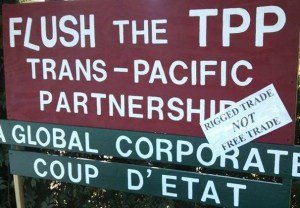
TPP: NAFTA on Steroids

TPP-protest-sign-from-Petrovich-lawn1-e1384352291139

by Stephen Lendman

The Trans-Pacific Partnership (TPP) is a trade deal from hell. It’s a stealth corporate coup d’etat.

It’s a giveaway to banksters. It’s a global neoliberal ripoff. It’s a business empowering Trojan horse. It’s a freedom and ecosystem destroying nightmare.

The Electronic Frontier Foundation (EFF) calls it “a secretive, multi-national trade agreement that threatens to extend restrictive intellectual property (IP) laws across the globe and rewrite international rules on its enforcement.”

More on TPP below. New York Times editors support it. Two decades ago, they endorsed NAFTA.


On January 1, 1994, its destructive life began. It’s anti-labor, anti-environment, anti-consumer and anti-democratic.

Corporate giants love it. Why not? They wrote it. Hundreds of pages of one-size-fits-all rules benefit them.

They override domestic laws. A race to the bottom followed. NAFTA was a disastrous experiment. In November 1993, New York editors headlined “The ‘Great Debate’ Over NAFTA,” saying:

“The laboriously constructed agreement to phase out trade barriers among the US, Mexico and Canada, which this page has strongly supported, is likely to have a positive, though small, impact on US living standards and provide a modest boost to the Mexican economy.”

“Some American jobs would be lost to cheaper Mexican labor, other jobs would be gained because American exports would increase as Mexico’s high tariffs gradually disappeared.”

“Economics aside, Nafta’s defeat would suggest that the US had abandoned its historical commitment to free trade and would thus discourage other Latin and South American countries thathave moved toward more market-oriented economies in the expectation of freer world trade.”So-called “free trade” is one-sided. It isn’t fair. NAFTA proponents promised tens of thousands of newly created US jobs.

Ordinary famers would export their way to wealth. Mexican living standards would rise. Economic opportunities would reduce regional immigration to America.

NAFTA’s promises never materialized. Reality proved polar opposite hype. A decade later, about a million US jobs were lost.

America’s Mexican trade deficit alone cost around 700,000 jobs by 2010.

Official government data show nearly five million US manufacturing disappeared since 1994.

NAFTA alone wasn’t responsible. It reflected broken promises, lost futures, and other trade deals from hell to follow. TPP stands out. It’s NAFTA on steroids.

Since 2008, multiple negotiating rounds were held. They continue secretly. Twelve nations are involved.

They include America, Australia, Brunei, Canada, Chile, Japan, Malaysia, Mexico, New Zealand, Peru, Singapore, and Vietnam. Others are invited to join.

At issue is agreeing on unrestricted trade in goods, services, rules of origin, trade remedies, sanitary and phytosanitary measures, technical barriers, government procurement and competition policies, and intellectual property (IP).

It’s about eliminating fundamental freedoms. It’s circumventing sovereign independent rights. Corporate power brokers want unchallenged control.

They want global rules and standards rewritten. They want supranational powers. They want them overriding national sovereignty. They want investor rights prioritized over public ones.

They already rule the world. Imagine giving them more power. Imagine no way to stop them.

Imagine a duplicitous president. Obama’s in lockstep with their wish list. He intends giving them everything they want.

Public Citizen is independent. It’s our voice. Its work entails “ensur(ing) that all citizens are represented in the halls of power.”

Its Global Trade Watch (GTW) monitors TPP developments. It calls it “a stealthy policy being pressed by corporate America. (It’s) a dream of the 1%.” It’ll:

• “offshore millions of American jobs,

• free the banksters from oversight,

• ban Buy America policies needed to create green (and many other) jobs (as well as) rebuild out economy,

• decrease access to medicine,

• flood the US with unsafe food and products,

• and empower corporations to attack our environment and health safeguards.”

Hyped benefits are fake. Reality is polar opposite what corporate shysters claim. Everything accruing from TPP benefits them. It does so by undermining what matters most to ordinary people.

Lori Wallach heads GTW. Ben Beachy is research director. Last June, they headlined their New York Times op-ed “Obama’s Covert Trade Deal.”

He’s committed to open government, he claims. His policies reflect otherwise. He’s negotiating TPP secretly.

It’s “the most significant international commercial agreement since the” World Trade Organization’s 1995 creation, said Wallach and Beachy.

Congress has exclusive “terms of trade” authority. Obama systematically refuses repeated congressional requests to release the entire draft agreement being negotiated.

He “denied requests from members to attend (sessions) as observers.” He “revers(ed) past practice” snubbing them.

He “rejected demands by outside groups” to release the draft text. George Bush never went that far.

Obama’s “wall of secrecy” had one exception. About “600 trade ‘advisors,’ dominated by representatives of big business,” got access to what Congress was denied.

TPP overrides American laws. It requires changing them. Otherwise trade sanctions on US exports can be imposed.

Wall Street loves TPP. It prohibits banning risky financial products. It lets banksters operate any way they want without oversight.

Congress has final say. Both houses will vote on TPP. Ahead of doing so, they’ll have access to its full text.

Why later? Why not now? Why not earlier? Why not without enough time for discussion and public debate?

Members won’t get enough time to examine TPP carefully. Maintaining secrecy as long as possible prevents public debate.

Obama wants TPP fast-tracked. He wants it approved by yearend. Until March, Ron Kirk was Obama’s trade representative.

He was remarkably candid. He said revealing TPP’s text would raise enormous opposition. Doing so might make adopting it impossible.

According to Wallach and Beachy:

“Whatever one thinks about ‘free trade,’ (TPP secrecy) represents a huge assault on the principles and practice of democratic governance.”

“That is untenable in the age of transparency, especially coming from an administration that is otherwise so quick to trumpet its commitment to open government.”

On October 30, a newly formed Friends of TPP caucus was formed. Four House co-chairman head it. They include Reps. David Reichert (R. WA), Charles Boustany (R. LA), Ron Kind (D. WI) and Gregory Meeks (D. NY).

They sound like earlier NAFTA supporters. They claim TPP is important for US jobs, exports and economic growth. They lied saying so.

Wallach commented separately. TPP is hugely hugely destructive, she said. It’s more than about trade. It’s a “corporate Trojan horse.” It has 29 chapters. Only five relate to trade.

The others “either handcuff our domestic governments, limit food safety, environmental standards, financial regulation, energy and climate policy, or establish new powers for corporations.”

They promote offshoring jobs to low-wage countries. They ban Buy America. Corporations can do whatever they please. Instead of investing domestically, they can use “our tax dollars” to operate abroad.

They can exploit national resources freely. They’ll have “rights for min(ed) (commodities), oil, gas” and others “without approval.”

TPP includes all sorts of “worrisome issues relating to Internet freedom.”

It provides a back door to earlier failed legislation. It resurrects SOPA, PIPA, ACTA and CISPA provisions. It tramples on fundamental freedoms and national sovereignty.

“Think about all the things that would be really hard to get into effect as a corporation in public, a lot of them rejected here and in the other 11 countries, and that is what’s bundled in to the TPP,” said Wallach.

“And every country would be required to change its laws domestically to meet these rules.”

“The binding provision is each country shall ensure the conformity of domestic laws, regulations and procedures.”

Negotiations are secret. Nothing is discussed publicly. Details leaked out. TPP includes hugely unpopular policies. It forces them on member countries.

It overrides domestic laws protecting people and ecosystems. It’s predatory capitalism at its worst writ large. Obama fully supports it. Lawmakers hadn’t seen it until last year.

They got access to a single chapter. Examining it is severely restricted. Their office is denied a copy. They alone can read it. Their staff is denied permission.

They can’t take detailed notes. They can’t publicly discuss what’s in it. Technical language makes it hard to understand what they read.

Congressional approval is likely. Lobby pressure is intense. “Everything is bought and sold,” said Wallach. “Honor is no exception.”

The reason there’s no deal so far “is because a lot of other countries are standing up to the worst of US corporate demands,” Wallach explained.

For how long remains to be seen. If TPP is adopted, public interest no longer will matter. The worst of all possible worlds will replace it. Corporate rights will supersede human ones. A global race to the bottom will intensify.

Signatory countries will be legally bound to support loss of personal freedoms. Sovereign laws won’t protect against poisoned food, water and air.

Ecosystems will be destroyed. Millions more jobs will shift from developed to under or less developed nations.

Corporate power will grow more exponentially. Fundamental human and civil rights may erode altogether. Not according to Times editors.

On November 5, they headlined “A Pacific Trade Deal.”

A dozen nations want a deal by yearend, they said. They want it to “help all of our economies and strengthen relations between the United States and several important Asian allies.”

It bears repeating. TPP is a trade deal from hell. It’s a stealth corporate coup d’etat. It’s a freedom and ecosystem destroying nightmare. Times editors didn’t explain.

They lied to readers. They betrayed them. They repeated their 1993 duplicity. Millions affected understand best.

An October 8 White House press release lied. It called TPP “a comprehensive, next-generation model for addressing both new and traditional trade and investment issues, supporting the creation and retention of jobs and promoting economic development in our countries.”

“The deepest and broadest possible liberalization of trade and investment will ensure the greatest benefits for countries’ large and small manufacturers, service providers, farmers, and ranchers, as well as workers, innovators, investors, and consumers.”

Times editors endorsed what they haven’t read. TPP provisions remain secret. Leaked information alone is known.

Times editors willingly accept Obama misinformation as fact. Twenty years ago, they got NAFTA wrong. Here they go again.

They’re mindless about secret negotiations. Public concerns don’t matter. Corporate interests alone count.

Subverting national sovereignty is OK. So is empowering transnational giants without oversight. They’ll be able sue countries for potentially undermining future profits.

Times editors support the worst of corporate excess. Doing so shows which side they’re on.

Fundamental freedoms aren’t important. Corporate rights drive The Times’ agenda. Its editors explained nothing about fast-track authority.

Max Baucus (D. MT) chairs the Senate Finance Committee. He supports fast-tracking. Doing so hands congressional authority to Obama.

Proper hearings are restricted. Debate is limited. Amendments can’t be introduced. The Senate can’t filibuster. Congress can only vote up or down.

It can happen virtually out of sight and mind. It can happen with scant media coverage. It can happen with none at all. It can become law with practically no public awareness.

Imagine corporate America getting coup d’etat authority with hardly anyone knowing what happened. Imagine the consequences if it does. Imagine today’s America becoming worse than ever.

Times editors stressed how Obama wants TPP to be “an example for the rest of the world to follow.”

Imagine one more than ever unfit to live in. Imagine a president promising change to believe in promoting it.

Imagine Times editors endorsing what demands condemnation. Imagine not explaining what readers most need to know.

Imagine substituting misinformation for truth and full disclosure. Imagine all the news they call fit to print not fit to read.

A Final Comment

On November 13, Public Citizen headlined “Leaked Documents Reveal Obama Administration Push for Internet Freedom Limits, Terms That Raise Drug Prices in Closed-Door Trade Talks.”

“US Demands in Trans-Pacific Partnership Agreement Text, Published Today by WikiLeaks, Contradict Obama Policy and Public Opinion at Home and Abroad.”

TPP’s leaked text reveals Obama demands limiting Internet freedom. He wants restricted access to lifesaving medicines.

He wants all TPP signatory countries bound the the same deplorable rules.

He lied claiming TPP reduces health care costs. It has nothing to do with advancing online freedom as he promised. It’s polar opposite on both counts.

According to Public Citizen:

“It is clear from the text obtained by WikiLeaks that the US government is isolated and has lost this debate.”

“Our partners don’t want to trade away their people’s health. Americans don’t want these measures either.”

Obama’s in the pocket of Big Pharma. He’s a Wall Street tool. He represents other corporate interests. He spurns popular ones. He lies claiming otherwise. He repeatedly avoids truth and full disclosure.

He lied about Obamacare. It’s an abomination. It’s a scam. It’s a scheme to enrich insurers and other healthcare giants.

TPP is a global scam. It’s an assault on fundamental freedoms.

Reports indicate around half the House members strongly oppose it. Others lean that way. According to Lori Wallach:

“This could be the end of TPP.”

“All these other countries are like, ‘Wait, you have no trade authority and nothing you’ve promised us means anything. Why would we give you our best deal?’ Why would you be making concessions to the emperor who has no clothes?”

It bears repeating. TPP is a trade bill from hell. It’s a stealth corporate coup d’ etat. Killing it is essential.

The alternative is losing fundamental freedoms. It’s destroying national sovereignty. It’s making healthcare less affordable. It’s undermining what ordinary people value most.

Stephen Lendman lives in Chicago.

He can be reached at lendmanstephen@sbcglobal.net.

His new book is titled “Banker Occupation: Waging Financial War on Humanity.”

http://www.claritypress.com/LendmanII.html

Visit his blog site at sjlendman.blogspot.com.

Listen to cutting-edge discussions with distinguished guests on the Progressive Radio News Hour on the Progressive Radio Network.

It airs Fridays at 10AM US Central time and Saturdays and Sundays at noon. All programs are archived for easy listening.

http://www.progressiveradionetwork.com/the-progressive-news-hour

 

Podcast News Updates

the-5th-horseman

There’s been another string of relevant news podcasts in the past few days so it’s time for another roundup post.

Last week Rob Kall of OpEdnews.cominterviewed Peter Ludlow a professor of linguistics and philosophy, on topics including systemic evil, whistleblowers and hacktivism:

https://itunes.apple.com/us/podcast/rob-kall-bottom-up-radio-show/id359765013

On Friday, Abby Martin of Breaking the Set did an excellent job deconstructing the corporatocracy on Coast to Coast AM with John Wells:

http://www.mediaroots.org/abby-martin-deconstructs-the-corporatocracy-on-coast-to-coast-am/

On Monday Nellie Bailey and Glen Ford of Black Agenda Report covered a wide range of important topics including an update on the corporate plan for Detroit (an American apartheid), the struggle to raise the minimum wage in Seattle, and Dave Swanson’s (of WarIsACrime.org) analysis of the multitude of lies in Obama’s recent UN speech : Listen to Black Agenda Radio on the Progressive Radio Network, with Glen Ford and Nellie Bailey – Week of 9/30/13.

From Traces of Reality there were two great consecutive shows. On 9/30 host Guillermo Jimenez interviewed Kevin Gallagher, director of Free Barrett Brown.  Brown is the journalist who faces a 105 year sentence, the bulk of which is related to charges associated with pasting a link in a chat room. On the 10/1 episode, Guillermo is joined by Vice President of The Future of Freedom Foundation, Sheldon Richman. They cover topics including the “government shutdown”, the national debt, taxation, private property, the “social contract,” and the fallacy of the “consent of the governed.”:

9/30

10/1

Bangladeshi Workers Fight for Living Wage

Photo: Reuters

Garment workers block a street during a demonstration in Gazipur, Bangladesh 9/23.  Photo: Reuters

Last Saturday, Garment Sramik Samannay Parishad, a federation of trade unions in garment sectors, organized a rally of over 50,000 workers to meet their different demands including raising minimum monthly salary to about $100. Bangladesh’s apparel industry, which supplies many Western brands such as Walmart, Gap and Macy’s, has been under a spotlight after several deadly work-related tragedies, including the collapse of a mega-factory on April 24th that killed more than 1,130 people.

The current minimum wage in Bangladesh is $38 a month, but factory owners and government have been in talks to increase it. When the Bangladesh Garment Manufacturers and Exporters Association (BGMEA) announced they would only agree to a $7.75 raise on Monday, demonstrations increased to an estimated 200,000 workers and spread to the major industrial hubs of the city. About 400 factories were shut down, some of them vandalized, vehicles were damaged and major roads barricaded. At least 60 people were injured in clashes with the police, who have fired tear gas and rubber bullets at the crowds.

As the mass demonstrations continue, the government has yet to publicly announce a decision on wages, but it has a vested interest in keeping them low since many ministers in Bangladesh’s parliament own factories. Besides boycotting stores and joining anti-sweatshop organizations, is there anything people in the West can do to support workers in Bangladesh and other countries used for cheap labor? One solution which has already been implemented in Switzerland and Egypt is a “maximum wage”. For example, Larry Hanley of the Amalgamated Transport Workers Union proposed a law that would limit an employer’s income to no more than 100 times the salary of their lowest-paid employee. Rather than putting a cap on earnings, it would maintain a fixed ratio between the executives at the top and employees at the bottom. Given that six Walmart heirs own more wealth than the bottom 40% of Americans ($102.7 billion), it seems a maximum wage for the U.S. is long overdue though admittedly unlikely given the current corrupt political system.

Sources:

http://rt.com/news/bangladesh-garment-protest-clashes-244/

http://america.aljazeera.com/articles/2013/9/23/tens-of-thousandsprotestlowwagesinbangladesh.html

http://english.peopledaily.com.cn/90777/8410310.html

http://www.yesmagazine.org/new-economy/should-there-be-a-maximum-wage

http://www.politifact.com/truth-o-meter/statements/2012/jul/31/bernie-s/sanders-says-walmart-heirs-own-more-wealth-bottom-/

American Apartheid Starts in Detroit

Power_outage_in_downtod55e1d2b-c272-479b-8a84-906566e6862b0000_20100710181343_320_240

A recent op-ed from Glen Ford, executive editor of Black Agenda Report, describes the situation in Detroit as the nexus of a new American apartheid in which inhabitants of largely Black urban centers are denied meaningful votes and ability to defend collective and individual property from the wealthy elite. In reaction to this alarming trend, on October 5 and 6, the International People’s Assembly will hold a conference, Against Banks and Against Austerity, in Detroit. Ford describes the goals of the conference in greater detail in this excerpt:

The International Peoples Assembly conference demands that the so-called debt to the banks be canceled – not just for Detroit, which supposedly owes Wall Street $22 billion, but for cities, school systems, states and countries around the world that have been purposely made into debt slaves for the rich. Workers pensions and jobs, and the vital services they provide to the community, must be guaranteed. This is a critical demand, since the emergency management regime in Pontiac, Michigan, has stripped the municipal workforce down to only 20 people for a city of 60,000. The unemployed must be put back to work repairing the damage inflicted on Detroit by the bankers’ foreclosure and disinvestment policies. Public education, which is rapidly being privatized, must be restored to the public sphere and fully funded.

Read the full article here: http://www.blackagendareport.com/content/detroit-nexus-new-american-apartheid

For those not familiar with the “emergency management regime” Ford referenced, it has been a topic of intense debate in Michigan for at least the past couple of years. The so-called emergency management legislation first introduced in 2011, was supposedly designed to help local government survive financial crises but also removed all powers from democratically elected officials and transferred governing power, including the power to make local laws, to appointed emergency managers (who are not required to obey local laws such as city charters or ordinances). Though the law was voted down by Michigan voters, a revised version was passed in December of 2012 during a lame duck session.

More details about Michigan’s “emergency manager” law here:

http://sugarlaw.org/projects/democracy-emergency/

http://www.huffingtonpost.com/david-alexander-bullock/detroit-elections_b_1442049.html

This past September 11th, citizens of Detroit experienced a harmful consequence of the emergency management powers when the city lost power during a heat wave that week. As described by Randa Morris at Addicting Info.:

In the city of Detroit, power outages left people stranded in elevators, trapped four hours in the blistering heat. Hundreds were evacuated from buildings in the downtown area, traffic lights did not function, public transportation was disabled and 1,400 sites across the city were without power. Wayne State University and other key buildings still remained closed, the following day. All of this after the city’s power supply supposedly failed.

…The problem is that the city’s power supply never failed.

On September 12th, 2013, Bill Nowling casually stated that the city’s power outages were intentional. Officials and citizens working in the city were given no warning before the electricity was cut off. Law enforcement officials working in the Hall of Justice had no time to prepare. Senior citizens and disabled citizens using elevators in the city’s downtown district had no way to know what was coming. The entire criminal justice system was shut down without notice. Wayne State University Campus was just one of many sites evacuated under emergency conditions. Traffic lights across the city stopped working. 1,400 public and private locations were left without power. And the entire thing was intentional, to “send a message” to the people of Detroit. Bill Nowling works in the office of Kevyn Orr, Detroit’s Emergency Manager.

Read the full story here: http://www.addictinginfo.org/2013/09/14/detroit-blackout/

So this unannounced power shutdown which endangered the health and safety of an entire city can be attributed to a single individual only accountable to Governor Rick Snyder, who appointed him as Emergency Manager in March. And what are Kevyn Orr’s credentials? He was the lead attorney who collected over a million dollars representing Chrysler during its bankruptcy proceedings in 2009. Private emails uncovered by labor activist Robert Davis indicate that Orr stood to make millions more in legal fees by facilitating Detroit’s bankruptcy which was filed on July 18, 2013. Orr has also been behind efforts to privatize Detroit’s energy grid according to this WSWS.org article by Khara Sikhan:

The Detroit Public Lighting Department (DPLD), has been systematically defunded for decades, and Democratic Mayor Dave Bing proposed to fully privatize the lighting department in 2012.

In mid-August, Kevyn Orr fired DPLD director Richard Tenney as part of his plan to restructure the city government. Orr announced in June that the city would sell off the public lighting grid to DTE Energy, in line with Bing’s proposal.

The drive to privatize the city’s lighting department, far from benefiting the city’s residents, would be only another means of extracting profit from the city.

Read the full article here: http://www.wsws.org/en/articles/2013/09/14/powe-s14.html?view=print