In A Corporatist System Of Government, Corporate Censorship Is State Censorship

By Caitlin Johnstone

Source: CaitlinJohnstone.com

Last year, representatives of Facebook, Twitter, and Google were instructed on the US Senate floor that it is their responsibility to “quell information rebellions” and adopt a “mission statement” expressing their commitment to “prevent the fomenting of discord.”

“Civil wars don’t start with gunshots, they start with words,” the representatives were told. “America’s war with itself has already begun. We all must act now on the social media battlefield to quell information rebellions that can quickly lead to violent confrontations and easily transform us into the Divided States of America.”

Yes, this really happened.

Today [8/7] Twitter has silenced three important anti-war voices on its platform: it has suspended Daniel McAdams, the executive director of the Ron Paul Institute, suspended Scott Horton of the Scott Horton Show, and completely removed the account of prominent Antiwar.com writer Peter Van Buren.

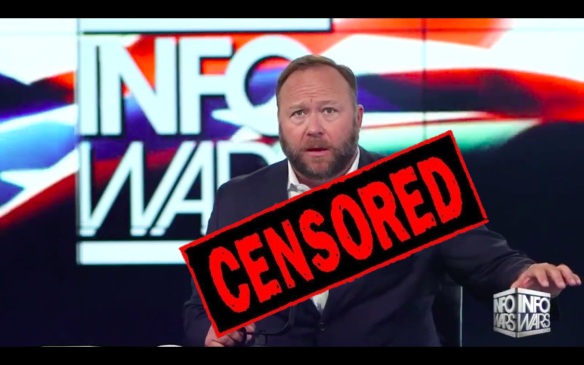
I’m about to talk about the censorship of Alex Jones and Infowars now, so let me get the “blah blah I don’t like Alex Jones” thing out of the way so that my social media notifications aren’t inundated with people saying “Caitlin didn’t say the ‘blah blah I don’t like Alex Jones’ thing!” I shouldn’t have to, because this isn’t actually about Alex Jones, but here it is:

I don’t like Alex Jones. He’s made millions saying the things disgruntled right-wingers want to hear instead of telling the truth; he throws in disinfo with his info, which is the same as lying all the time. He’s made countless false predictions and his sudden sycophantic support for a US president has helped lull the populist right into complacency when they should be holding Trump to his non-interventionist campaign pledges, making him even more worthless than he was prior to 2016.

But this isn’t about defending Alex Jones. He just happens to be the thinnest edge of the wedge.

As of this writing, Infowars has been censored from Facebook, Youtube (which is part of Google), Apple, Spotify, and now even Pinterest, all within hours of each other. This happens to have occurred at the same time Infowars was circulating a petition with tens of thousands of signatures calling on President Trump to pardon WikiLeaks editor-in-chief Julian Assange, who poses a much greater threat to establishment narratives than Alex Jones ever has. Assange’s mother also reports that this mass removal of Infowars’ audience occurred less than 48 hours after she was approached to do an interview by an Infowars producer.

In a corporatist system of government, wherein there is no meaningful separation between corporate power and state power, corporate censorship is state censorship. Because legalized bribery in the form of corporate lobbying and campaign donations has given wealthy Americans the ability to control the US government’s policy and behavior while ordinary Americans have no effective influence whatsoever, the US unquestionably has a corporatist system of government. Large, influential corporations are inseparable from the state, so their use of censorship is inseparable from state censorship.

This is especially true of the vast megacorporations of Silicon Valley, whose extensive ties to US intelligence agencies are well-documented. Once you’re assisting with the construction of the US military’s drone program, receiving grants from the CIA and NSA for mass surveillance, or having your site’s content regulated by NATO’s propaganda arm, you don’t get to pretend you’re a private, independent corporation that is separate from government power. It is possible in the current system to have a normal business worth a few million dollars, but if you want to get to billions of dollars in wealth control in a system where money translates directly to political power, you need to work with existing power structures like the CIA and the Pentagon, or else they’ll work with your competitors instead of you.

And yet every time I point to the dangers of a few Silicon Valley plutocrats controlling all new media political discourse with an iron fist, Democratic Party loyalists all turn into a bunch of hardline free market Ayn Rands. “It’s not censorship!” they exclaim. “It’s a private company and can do whatever it wants with its property!”

They do this because they know their mainstream, plutocrat-friendly “centrist” views will never be censored. Everyone else is on the chopping block, however. Leftist sites have already had their views slashed by a manipulation of Google’s algorithms, and it won’t be long before movements like BDS and Antifa and skeptics of the establishment Syria and Russia narratives can be made to face mass de-platforming on the same exact pretext as Infowars.

This is a setup. Hit the soft target so your oligarch-friendly censorship doesn’t look like what it is, then once you’ve manufactured consent, go on to shut down the rest of dissenting media bit by bit.

Don’t believe that’s the plan? Let’s ask sitting US Senator Chris Murphy:

“Infowars is the tip of a giant iceberg of hate and lies that uses sites like Facebook and YouTube to tear our nation apart,” Murphy tweeted in response to the news. “These companies must do more than take down one website. The survival of our democracy depends on it.”

That sure sounds an awful lot like the warnings issued to the Silicon Valley representatives on the Senate floor at the beginning of this article, no? This is headed somewhere dark.

We’re going to have to find a way to keep the oligarchs from having their cake and eating it too. Either (A) corporations are indeed private organizations separate from the government, in which case the people need to get money out of politics and government agencies out of Silicon Valley so they can start acting like it, and insist that their owners can’t be dragged out on to the Senate floor and instructed on what they can and can’t do with their business, or (B) these new media platforms get treated like the government agencies they function as, and the people get all the First Amendment protection that comes with it. Right now the social engineers are double-dipping in a way that will eventually give the alliance of corporate plutocrats and secretive government agencies the ability to fully control the public’s access to ideas and information.

If they accomplish that, it’s game over for humanity. Any hope of the public empowering itself over the will of a few sociopathic, ecocidal, omnicidal oligarchs will have been successfully quashed. We are playing for all the chips right now. We have to fight this. We have no choice.

Building a Cooperative Economy

By Oliver Sylvester-Bradley

Source: Resilience

In permaculture terms the economy sometimes feels like a segregated monoculture planted with terminator seeds, sprayed with patented pesticides on venture capital backed farms designed to maximise profits in an unsustainable market place full of thieves and cheats. No wonder people prefer to potter in their gardens and allotments – and try to forget the craziness of corporate capitalism!

But no matter how much we try to ignore the corporate machine it ploughs on regardless and at various points in all of our lives we are forced to interact with the unsustainable, greed-based economy whether we like it or not. We all need to travel, buy energy, we like presents and holidays and now we are buying more and more of these goods and services online, from people we do not know.

As local banks close in favour of apps, local taxis are driven out by Uber and the likes of Airbnb and other holiday and comparison websites offer us ‘guaranteed savings’ – the brave new world of digital platforms is being thrust upon us, whether we like it or not.

The dominant form of business in our economy has not changed, but the method of delivery has. Platform businesses which reach further and wider than conventional ‘bricks and mortar’ businesses, that are able to ‘scale up’ and attract customers in their millions are forcing out the smaller players, just like supermarkets killed the traditional garden market. Except these “platform monopolies” are taking things to a new level – often unbeknown to us they’re gathering our data and using sophisticated algorithms to work out how to sell us more things, that quite often we don’t need or want. They’re aggregating data and dissintermediating in ways that we never knew were possible. Uber is valued at over 60 billion dollars but does not own a single taxi…

From monoculture to platform co-ops

To someone practicing permaculture, there is something almost offensive about vast fields where businesses cultivate the same single crop and, in a similar way, the exponents of ‘peer to peer’ and ‘open source’ technologies get equally offended by monolithic platforms that dominate the digital landscape.

Peer to peer, (where individuals share content with other people, rather than relying on centralised servers) and open source software (which is free to use and adapt, without requiring a licence fee) are like the digital community’s own versions of permaculture. They provide a pathway to greater independence, autonomy, diversity and resilience than is offered by the dominant system.

David Holmgreen’s ideas about creating small scale, copyable, adaptable solutions which have the power to change the world by creating decentralised, diverse, and more resilient systems have huge parallels with open source, collaborative software projects, which are developing as a response to the monolithic, proprietary and profit driven enclosures that dominate today’s Internet.

The end goal of this work is to create ‘platform cooperatives’, as alternatives to the venture capital backed platforms. Platform cooperatives that are member owned and democratically controlled – allowing everyone that is affected by the business, be they customers, suppliers, workers or investors, a say in how the business is run and managed. Co-ops are an inherently different form of organisation than Limited or Public companies, which place community before profit, hence have entirely different principles than their corporate rivals. For this reason they are more resilient in downturns, more responsible to their communities and environments and more effective at delivering real (not just financial) value to everyone they interact with.

Platform co-ops provide a template for a new kind of economy built on trust, mutual aid and respect for nature and community. By placing ownership firmly in the hands of the people and applying democratic forms of governance they offer a legitimate alternative to the defacto form of business. There are several platform co-ops that already provide comparable, and often better services than their corporate rivals and with more support others will continue to develop.

On 26 and 27 July the OPEN 2018 conference at Conway Hall in London will showcase platform co-ops such as The Open Food Network – which is linking up local food producers and consumers through Europe, Resonate – the music streaming co-op, and SMart from Belgium which provides support for a network of thousands of freelancers throughout Europe. The beginnings of a viable, self-supporting and sustainable economy are stating to emerge and OPEN 2018, along with similar events in the US and across Europe, is bringing together the people with the ideas, the tech developers and the legal experts to help catalyse the transition.

Shared values and the network effect

There are so many similarities between permaculture’s philosophy and principles and the works of other progressive groups that hope to encourage a more sustainable, more resilient and equitable future. From Occupy to Open sourcePermaculture to Peer to Peer and Collaborative Technology to the Commons Transition groups there are clearly overlapping values.

David Bollier, writing on the Peer to Peer Foundation blog has suggested that “…permaculturists and commoners need to connect more and learn from each other…” and the idea that these communities are ultimately working towards the same objective seems especially important to recognise if we are to accelerate the development of a more sustainable world.

There is already an evolving “shared narrative” between these various, disparate initiatives, but it is often sidelined by our self-selecting filters which lead us back into the communities we know and trust. Collaboration and cooperation can be hard work and as groups get bigger they can become harder still but that’s no reason not to try. The fact that Wikipedia provides a better encyclopaedia for free in more languages than Britannica ever managed proves that online, open source collaboration can deliver greater value than proprietary, closed source systems.

The true value of a collaborative, open networks only really manifests when its members communicate, and work together, through connected systems. Sharing ideas, discussing problems and addressing challenges in larger networks creates positive feedback loops via the network effect – a term which describes how the value of something increases in proportion to the number of people using it (like a phone, or social media network) – something all the various ethical and progressive networks could benefit from enormously.

Parallels between collaborative, open source software development and permaculture principles:

1. Observe and interact

Progressive software projects often utilise ‘user focused’ design strategies to ensure they meet people’s needs. Taking time to understand how users interact with software systems via user experience testing groups and an ongoing, iterative design processes are recognised to deliver higher quality solutions which suit specific user needs.

2. Catch and store energy

Peer to peer networks don’t rely on centralised servers but instead make use of the latent capacity of other user’s machines. Imagine how much more efficient it would be than deploying huge server farms if our computers were not shut off at night, or left idle, when they could be providing valuable processing power for others. The Holochain project aims to make it simple and secure for anyone to join a truly peer to peer network and to share files and processing power in this way – and to even earn credits for hosting other people’s files and applications.

3. Obtain a yield

The Peer Production License provides a means by which open source developers can make the code they develop available for free and still benefit from it’s use. Sites like the Internet of Ownership, which contains a directory of cooperative platforms use the PPL to “permit reuse exclusively for non-commercial and worker-owned enterprises” thereby helping to grow the commons. The ultimate goal of the PPL is to enable mechanisms so commoners can support themselves and ensure their own social reproduction without resorting to capitalism.

4. Apply self-regulation and accept feedback

This principle is particularly integral to open source development since the concepts of ‘user focussed’ and ‘agile development’, ‘branching’ and ‘forking’ are all designed to ensure that software projects are self-regulating by listening to the users needs, driven by user feedback and that they are able to be adapted to changing needs.

5. Use and value renewable resources and services

Open source technology is inherently more renewable in the way it enables the reuse and repackaging of code for new purposes. Ethically minded hosts and developers such as Green Net power their servers with renewable energy.

6. Produce no waste

As above, open source code is often re-used and repurposed but progressive developers still have a lot to gain from better collaboration. There are often multiple teams working on identical problems and ideas and whilst this has benefits in terms of developing strength and resilience through diversity it also leads to waste, mainly in terms of time. At least the waste ‘product’ of web development is only digital and so old technology and code doesn’t littler the streets or pollute the environment as much as physical products can, especially if archives are stored on renewably powered servers.

7. Design from patterns to details

Genuine online collaboration has been slow to evolve, with the best examples being Linux (the open source operating system), Firefox, the open source web browser and Wikipedia, the open source encyclopaedia. It is only recently, with the rise of monolithic capitalist gardens such as Google and Facebook and Amazon that the hive mind of the internet is recognising the need to step back and redesign its systems according to new patterns. The push for “Net neutrality” and Tim Berners-Lee’s Solid project are examples of this in action as is the Holo project, a very exciting and truly peer to peer “community of passionate humans building a distributed cloud, owned and run by users like you and me.”

8. Integrate rather than segregate

The move from centralised to decentralised, to distributed and federated technology is a a key element of open source and collaborative technology design. The entire Peer to Peer philosophy is based on the recognition that the connections and relationships between nodes (people or computers) in a network is what gives it strength and value. Collaborative technologists still have a lot to gain from developing deeper and wider integrations, like we see in nature, and which permaculturists know so well.

9. Use small and slow solutions

Designing a computer system to be slow is not something you will normally (ever?) hear a programmer talk about but they often talk about small, in many guises. Small packages (of code), small apps, “minified” (meaning compressed) code and even small computers, like the Raspberry Pi are key features of collaborative technology which all aim for increased efficiency.

10. Use and value diversity

Diversity is intrinsic to open source and collaborative technology. The plurality and adaptability of open source solutions ensures a highly diverse ecosystem. Users are free to adapt open source code to their needs and the open nature of most open source projects values contributions from anyone, irrespective of race, gender, age or any other factor. It is true that the majority of contributors to open source projects are normally young, white and male but the reasons for that seem more to do with societal inequalities and stereotypes rather than any specific prejudices or practices.

11. Use edges and value the marginal

The explanation of this principle places most value on “the interface between things…” and this is a central component of web design. Web services have now realised the necessity of providing intuitive user interfaces, to allow users to navigate complex data and to investigate deeper informational relationships but, more interestingly the latest developments in linked open data enable users to interface with more specific, more granular and more timely data to provide increase value. The Internet Of Things will facilitate a massive increase in the number and type of products which can interact over the internet. Whilst it is not the norm, drawing diverse information from the edges and valuing the marginal is something the open internet can really facilitate.

12. Creatively use and response to change

Most open source, collaborative projects use some kind of agile development, which advocates adaptive planning, evolutionary development, early delivery, and continuous improvement, and encourages rapid and flexible response to change. Permaculture and open source see eye to eye on this principle which bodes very well for a growing, symbiotic relationship in our rapidly evolving world.

The Bizarre Facebook Path to Corporate Fascism

By Glen Ford

Source: Black Agenda Report

“The Facebook intervention is a qualitative escalation of the McCarthyite offensive.”

Facebook has assumed additional political police powers, disrupting a planned counter-demonstration against white supremacists, set for August 12th in Washington, on the grounds that it was initiated and inspired by “Russians” as part of a Kremlin campaign to “sow dissention” in the U.S. The Facebook intervention is a qualitative escalation of the McCarthyite offensive launched by the Democrat Party and elements of the national security state, and backed by most of the corporate media, initially to blame Hillary Clinton’s 2016 defeat on “collusion” between Wikileaks, “the Russians” and the Trump campaign to steal and publicize embarrassing Clinton campaign emails.

After failing to produce one shred of hard evidence to support their conspiracy theory, the anti-Russia hysteria mongers switched gears, focusing on the alleged purchase of about $100,000 in Facebook ads by the Internet Research Agency (IRA), a St. Petersburg-based Russian company, over a multi-year period. The problem was, most of the ads had no direct connection to the presidential contest, or were posted after the election was over, and many had no political content, at all. The messages were all over the place, politically, with the alleged Russian operatives posing as Christian activists, pro- and anti-immigration activists, and supporters of the Black Lives Matter Movement. Special prosecutor Robert Mueller was forced to flip the scriptindicting 13 Russians for promoting general “discord” and undermining “public confidence in democracy” in the United States – thus creating a political crime that has not previously been codified in the United States.

In doubling down on an unraveling conspiracy tale, the Mueller probe empowered itself to tar and feather all controversial speech that can be associated with utterances by “Russians,” even if the alleged “Russians” are, in fact, mimicking the normal speech of left- or right-wing Americans — a descent, not into Orwell’s world, but that of Kafka (Beyond the Law) and Heller (Catch-22).

Facebook this week announced that it had taken down 32 pages and accounts that had engaged in “coordinated and inauthentic behavior” in promoting the August 12 counter-demonstration against the same white supremacists that staged the fatal “Unite the Right” demonstrations in Charlottesville, Virginia, a year ago. Hundreds of anti-racists had indicated their intention to rally against “Unite the Right 2.0” under the banner of Shut It Down DC, which includes D.C. Antifascist Collective, Black Lives Matter D.C., Hoods4Justice, Resist This, and other local groups.

Facebook did not contend that these anti-racists’ behavior was “inauthentic,” but that the first ad for the event was purchased by a group calling itself “Resisters” that Facebook believes were behaving much like the Internet Research Agency. “At this point in our investigation, we do not have enough technical evidence to state definitively who is behind it,” said Nathaniel Gleicher, Facebook’s head of cybersecurity policy . “But we can say that these accounts engaged in some similar activity and have connected with known I.R.A accounts.”

Chelsea Manning, whose prison sentence for sending secret documents to Wikileaks was commuted by President Obama, said the counter-protest was “organic and authentic”and that activists had begun organizing several months ago. “Folks from D.C. and Charlottesville have been talking about this since at least February,” Manning told The New York Times.

“This was a legitimate Facebook event that was being organized by Washington, D.C. locals,” says Dylan Petrohilos, of Resist This. Petrohilos was one of the defendants in the Trump inauguration “riot” prosecutions. He protested Facebook’s disruption of legitimate free speech and assembly. “DC organizers had controlled the messaging on the no UTR fb page and now FB made it harder for grassroots people to organize,” he tweeted. The organizers insist the August 12 counter-demonstration — “No Unite the Right 2 – DC” — is still a go, as is the white supremacist rally.

Whoever was first to buy a Facebook ad — the suspected Russian “Resisters,” or Workers Against Racism, who told the Daily Beast they decided to host their own anti-“Unite the Right 2.0” event because they thought “Resisters” was an “inexperienced liberal organizer” – there was no doubt whatsoever that the white supremacists would be confronted by much larger numbers of counter-demonstrators, in Washington. Nobody in Russia needed to tell U.S. anti-racists to shut the white supremacists down, or vice versa. The Russians didn’t invent American white supremacy, or the native opposition to it. Even if Mueller, Facebook, the Democratic Party and the howling corporate media mob are to be believed, the “Russians” are simply mimicking U.S. political rhetoric and sloganeeriing – and weakly, at that. The Workers Against Racism thought the “Resisters” weren’t worth partnering with, but that the racist rally must be countered. The Shut It Down DC coalition didn’t need the “Resisters” to crystallize their thinking on white supremacism.

The Democratic Party and corporate media, speaking for most of the U.S. ruling class — and actually bullying one of its top oligarchs, Mark Zuckerberg — is on its own bizarre and twisted road to fascism. (Donald Trump’s proto-fascism is the old fashioned, all-American type that the white supremacists want to celebrate on August 12.) With former FBI Director Robert Mueller at the head of the pack, they have created a pseudo legal doctrine whereby “Russians” (or U.S. spooks pretending to be Russians) can be indicted for launching a #MeToo campaign of mimicry, echoing the rhetoric and memes indigenous to U.S. political struggles, while the genuine, “authentic” American political voices — the people who are being mimicked — are labeled co-conspirators in a foreign-based “plot,” and their rights to speech and assembly are trashed.

That’s truly crazy, but devilishly clever, too. If “Russian” mimics (or cloaked spooks) can reproduce the vocabulary and political program of U.S. dissent, then all of us actual U.S. lefties can be dismissed as “dupes of the Russians” or “co-conspirators” in the speech crimes of our mimics — for sounding like ourselves.


BAR executive editor Glen Ford can be contacted at Glen.Ford@BlackAgendaReport.com.

Technology giants hold censorship meeting with US intelligence agencies

By Will Morrow

Source: WSWS.org

The New York Times and Washington Post this week published reports of a private meeting last month between eight major technology and social media corporations and the US intelligence agencies, to discuss their censorship operations in the lead-up to the November 2018 mid-term elections.

The meeting was convened at Facebook’s Menlo Park, California, headquarters on May 23, and was attended by representatives from Amazon, Apple, Google, Microsoft, Snap, Twitter and Oath, which owns Yahoo and the telecommunications network Verizon, along with agents from the FBI and the Department of Homeland Security.

The Post described the meeting, organized at the request of Facebook, as a “new overture by the technology industry to develop closer ties to law enforcement.” Both articles were based on anonymous statements by individuals who attended. One attendee told the Post that the conversation was a “back-and-forth, with both sides talking about how they were thinking about the problem and how we were looking for opportunities to work together.”

The meeting is yet another testament to the increasing integration of the technology giants with the US military/intelligence apparatus. These companies, which provide a growing share of the technical infrastructure for the repressive apparatus of the state, increasingly see the censorship of left-wing, anti-war, and progressive viewpoints as an integral part of their business strategy.

Amazon, Microsoft and Google are competing to secure control over a $10 billion project to host the Pentagon’s Cloud infrastructure, a position that will literally mean hosting the communications between military units engaged in battle. Employees at the three companies have also written letters in recent months denouncing their provision of artificial intelligence technology to improve drone targeting (Google), facial recognition of civilians by police agencies (Amazon), and assisting in the operations of the Immigration and Customs Enforcement (Microsoft).

The Times and the Post are the main media voices for the campaign by the Democratic Party and intelligence agencies for Internet censorship, under the guise of opposing the spread of “misinformation” by the Russian government. This McCarthyite campaign is based on the totally unsubstantiated allegation that Russian “fake news” led to popular disillusionment with Hillary Clinton in the 2016 vote, and the subsequent election of Donald Trump. The newspapers’ synchronized reports therefore present last month’s meeting as aimed at preventing Russian interference in the mid-term elections.

But the real target of the censorship campaign is popular access to left-wing news sources not controlled by the corporate media, and the proliferation of oppositional social media content, such as videos of police killings, mass roundups of immigrants, military interventions, protests and exposures of corporate malfeasance and government criminality.

Since the beginning of the year, Facebook has rolled out a series of changes to its News Feed, including demoting political content in favor of so-called “personal moments,” and prioritizing content from so-called “trustworthy sources”—in reality pro-establishment propaganda outlets—including the Times and the Wall Street Journal. The social media giant has also changed its algorithms to reduce the spread of “viral videos,” which CEO Mark Zuckerberg declared are “not good for people’s well-being and society.”

Last Thursday, Facebook published an announcement by its Head of News Integrity Tessa Lyons, announcing a further expansion of these measures, including the introduction of “fact-checking” for videos and photos. The post also stated that Facebook is introducing “machine learning to help identify and demote foreign Pages that are likely to spread financially-motivated hoaxes to people in other countries.” These will work alongside Facebook’s army of “fact checkers”—i.e., censors—many of them former security and intelligence agents, who belong to the 20,000 people employed in its “security” and “moderation” department.

The “demotion” of what Facebook calls “false news” was codified in “community guidelines” published by the company in April. The guidelines state that because the suppression of “false news” is a “sensitive issue,” the company does not openly remove news stories, which would be easily detected by publishers and their followers, but does the same thing secretly: “significantly reduc[ing] its distribution by showing it lower on the News Feed.” (See: “Facebook codifies its censorship regime”)

Lyons repeated this line of argument in an interview with PBS’ Miles O’Brien on May 16. Admitting that “censoring and fully removing information unless it violates our community standards is not the expectation from our community,” Lyons explained that instead “we work to reduce the damage it can do” by restricting its proliferation. The Washington Post reported yesterday that while speaking at the International Fact Checkers Network conference last week, Lyons “told attendees that … [Facebook] will soon use machine learning to predict pages that are more likely to share misinformation.”

With the official ending of net neutrality this month, the financial oligarchy that controls both the search and social media monopolies and internet service providers has further tightened its grip over the freedom of expression on the internet, with ISPs given the prerogative to block and throttle internet content at will.

The expansion of internet censorship takes place amidst mounting pressure on whistleblower Julian Assange, the Wikileaks journalist who has been effectively imprisoned in the Ecuadorian embassy in London since 2012, where he was forced to take refuge to avoid being extradited to the US and charged for publishing evidence of US government crimes. The persecution of Assange for the “crime” of publishing the truth is aimed at intimidating whistleblowers and honest journalists all around the world.

Google , which attended last month’s meeting with the FBI and Department of Homeland Security, has altered its search engine algorithms to censor left-wing and anti-war websites, including the World Socialist Web Site, whose Google search traffic fell by three quarters in response to changes by the search engine in April 2017. There are indications that Google has recently intensified its censorship of the World Socialist Web Site, with search impressions falling by as much as one third over the past month.

In August 2017, the World Socialist Web Site published an open letter to Google demanding that it end its censorship of the internet, declaring, “Censorship on this scale is political blacklisting. The obvious intent of Google’s censorship algorithm is to block news that your company does not want reported and to suppress opinions with which you do not agree.”

We urge all readers of the World Socialist Web Site seeking to defend the freedom of expression online to contact us and join the struggle against internet censorship.

Amazon, Microsoft and Google compete for Pentagon Cloud warfighter project

By Will Morrow

Source: WSWS.org

Amazon, Microsoft and Google are competing to secure a multi-billion-dollar Department of Defense contract to build and oversee the US military’s Cloud computing infrastructure, which will be used to control every aspect of the Pentagon’s global operations.

The Joint Enterprise Defense Infrastructure (JEDI) project will transfer the large number of separate data control centers currently being run by the Pentagon into a centralized Cloud network that will be administered by one of the technology giants. The contract is reported to be worth up to $10 billion over the next decade, potentially making it the Department of Defense’s single largest acquisition ever. The winning bidder is expected to be announced in September.

The company that secures the contract will be completely integrated into all of the US military’s fighting operations. According to Nextgov, Brigadier General David Krumm, the deputy director for requirements for the Joint Chiefs of Staff, described JEDI as a “global fabric” that will connect the headquarters with active combat forces, from an F-35 fighter jet pilot to a Pacific submarine captain to an Army platoon leader. “This is going to make a difference like few things have to get information to our warfighters,” Krumm said.

The Department of Defense hosted an industry conference on the project on March 7 in Arlington, Virginia, attended by technology companies, including representatives from Amazon and Microsoft. Krumm told the audience that JEDI would “change the way that this nation, its soldiers, its sailors, its Marines and its airmen fight and win our nation’s wars.”

The Cloud network will be required to hold data at all security classification levels, meaning security officials with top secret security clearances will be working at the facilities.

On May 16, Bloomberg Government published images of the advertisements produced by Amazon and Microsoft on electronic billboards in the Pentagon railway station about how their companies’ technology could support the military in battle.

Microsoft’s ad featured an image of a special operations soldier and the caption, “The cloud gets actionable insight while the action is still unfolding.” An Amazon Web Services ad included the statement, “Time to launch: months minutes,” to underscore that the cloud infrastructure will help coordinate missile launches.

The JEDI program was first announced in September 2017, a month after Trump’s Defence Secretary James Mattis carried out a tour of Silicon Valley boardrooms. Mattis met with Google’s Founder Sergey Brin and CEO Sundar Pichai, as well as executives at Facebook and Amazon, to discuss further integrating their technologies into the US armed forces.

The Defense One website reported on April 12 that “Brin in particular was eager to showcase how much Google was learning every day about AI and cloud implementation,” citing an anonymous senior Defense Department official. Mattis “returned to Washington, D.C., convinced that the US military had to move much of its data to a commercial cloud provider—not just to manage files, email, and paperwork but to push mission-critical information to front-line operators,” the article noted.

Significantly, the article notes that while Amazon and Microsoft have publicly expressed their desire to secure the contract, Google has “kept its own interest … out of the press. Company leaders have even hidden the pursuit from its own workers, according to Google employees Defense One reached.”

Google’s integration into the military’s operations has triggered widespread opposition among its employees. A letter published in April written to Google’s CEO Pichai and signed by more than 3,000 Google workers, demanded that the company cease its collaboration with the Pentagon.

The letter was a response to Google admitting in March that it is providing the military with artificial intelligence software that can be used to detect objects in video surveillance footage, under what is called Project Maven. This technology can be directly used to develop automatic targeting for the US drone murder operations in the Middle East and North Africa.

The Defense One article stated that “Maven is more than either Google or the Defense Department has admitted publicly, according to the senior defense official who called it a ‘pathfinder’ project, a starting point for future collaboration between the Pentagon and Google.”

Media reports indicate that the company most likely to secure the JEDI contract is Amazon. The company is considered to have an edge because it is already operating a Cloud network for the US intelligence agencies, under a $600 million contract reached in 2013.

Since September 2016, Amazon has been providing facial recognition technology called Rekognition to police forces and private intelligence contractors. Rekognition is able to process video footage from police body cameras, surveillance cameras and CCTV to “identify persons of interest against a collection of millions of faces in real-time, enabling timely and accurate crime prevention” (see: “Amazon providing facial recognition technology to police agencies for mass surveillance”).

The distinction between the technology corporations and the state has become almost entirely blurred as they become ever-more integrated into the military-intelligence apparatus. This takes place as Washington is working to outpace its major geostrategic rivals, above all China and Russia, in the arena of advanced warfare technology and artificial intelligence, in preparation for a catastrophic war that would inevitably involve the use of nuclear weapons.

As they integrate themselves into the American military build-up, the technology giants are collaborating in mass political censorship of left-wing and anti-war websites, above all the World Socialist Web Site, in order to suppress mass opposition to war. Since April 2017, Google has altered its search result algorithms in order to censor the WSWS and other left-wing and anti-war websites.


The author also recommends:

Google, drone murder and the military-intelligence-censorship complex
[19 May 2018]

Social Media Behemoths Sweep Alternative News into the Memory Hole

By Kurt Nimmo

Source: Another Day in the Empire

The squabbling between self-identified progressives and conservatives continues as social media transforms itself into a news, information, and opinion gatekeeper.

All information that contradicts the establishment narrative will either be downgraded into obscurity or excluded outright on social media.

Take for instance ThinkProgress, the Soros-financed news website, a project of the Center for American Progress Action Fund welded to the infrastructure of the Democrat party. On May 2, it complained that a bias study at Facebook will be run by conservatives, that is to say establishment Republicans, notably former Arizona Congress critter Jon Kyl.

ThinkProgress believes there is no such thing as bias aimed at conservatives—it’s the liberals who are routinely downgraded at Facebook while so-called conservatives are free to post what progressives characterize as an evil and poisonous ideology.

According to Libby Watson at Splinter News, conservatives are involved in “grift,” flimflamming poor Mark Zuckerberg with untrue claims of bias against the likes of Breitbart News.

It’s all part of a never ending and hugely counterproductive “culture war” that has raged between the ostensible right and left going on thirty years now. Ms. Watson manages to squeeze identity politics into her screed.

“The conservative movement has done a remarkable job over the last half century to bellow and bully its way into having its most ridiculous and reality-divorced concerns taken seriously,” she writes. “It lies about and distorts everything: about tax cuts, about Benghazi and her emails, about immigration, about healthcare, about Diamond and Silk. The further Facebook descends down the path of letting that screaming white face of faux outrage dictate how they run their platform, the harder it’s going to be for them to get away from them.”

The progressive news website Common Dreams complains it has weathered “significant drops in traffic since Google and Facebook began changing algorithms and talking openly about their new attempts to control the kind of news content users see. According to internal data and Google Analytics, traffic to Common Dreams from Google searches fell by 34 percent after the powerful search giant unveiled its new search protocol in April 2017.”

Meanwhile, on the other side of the yawning divide, Brent Bozell, founder of the Media Research Center, rallied around 60 conservatives and fired off an open letter to the social media giants demanding transparency, clarity on the definition of hate speech, equality for conservatives, and respect for the First Amendment.

“Social media censorship and online restriction of conservatives and their organizations have reached a crisis level,” the open letter states. “Facebook CEO Mark Zuckerberg’s hearings on Capitol Hill only served to draw attention to how widespread this problem has become. Conservative leaders now have banded together to call for equal treatment on tech and social media.”

Both liberals and conservatives are missing the point.

Facebook and Google will continue and enlarge the effort to gatekeep information that does not jive with the establishment narrative, be it from the right or left.

The internet and web upended the establishment’s carefully constructed propaganda machine—the CIA’s “Mighty Wurlitzer” under its Operation Mockingbird beginning in the early 1950s—deeply embedded within corporate media.

Beginning with Friendster, MySpace, and like projects in the early 2000s and eventually morphing into the corporate behemoths Facebook, YouTube, and Twitter, social media platforms have extended the reach of alternative media, much to the displeasure of the establishment. Its preferred propaganda conduits have withered and this has seriously hampered its ability to control the narrative.

Both the right and left need to nurture their own social media platforms and drive traffic there.

Of course, this will not be as effective as plugging into the massive matrix of social connectivity provided by the corporate tech giants, but the alternative is to be marginalized and eventually swept into the memory hole as the context of “extremism” narrows and constricts expression, excluding all but the most token disagreement with the establishment narrative.

However, I’m not sure we’re up to it.

The elite has done a remarkable job of using the time tested divide and conquer concept, endlessly pitting the so-called right against the amorphously defined left and vice versa. Liberals and conservatives continue to fight over frivolous ideological points as the funny money asset-driven economy prepares to implode and the mission of infinity war expands to the point where it endangers life on planet Earth.

Corporate giant Unilever demands crackdown on oppositional Internet content

By Will Morrow

Source: WSWS.org

The drive to censor the Internet took another step this week with a public statement by Keith Weed, the chief marketing officer for the London-based multinational Unilever, threatening to withdraw advertising from social media platforms if they fail to suppress “toxic content.”

Weed reportedly told an annual leadership meeting of the Interactive Advertising Bureau in Palm Desert, California that the company “will not invest in platforms or environments” that “create divisions in society, and promote anger or hate.” He added, “We will prioritize investing only in responsible platforms that are committed to creating a positive impact in society.”

Excerpts of Weed’s remarks—the most explicit of their kind from a major corporate executive—were leaked to several media outlets, including the Wall Street Journal and the Guardian. They were immediately featured on NBC News and other major American news outlets on Sunday. The Journal’s report was accompanied by an interview with Weed.

The coordinated release was designed to escalate the propaganda offensive by the Democratic Party and US intelligence agencies, together with the corporate media, for Internet censorship. The fraudulent premise for this assault on freedom of speech, both in the US and across Europe, is the claim that political opposition and social tensions are the product not of poverty, inequality and policies of austerity and militarism, but of “fake news” spread by Russia through social media.

Weed’s statements preceded yesterday’s US Senate Select Committee on Intelligence hearing, which witnessed a series of hysterical denunciations of Russia by politicians and intelligence agents. The Democratic vice-chairman of the committee, Mark Warner of Virginia, declared that Russia “utilized our social media platforms to push and spread misinformation at an unprecedented scale.”

Facebook responded to Weed’s threats by declaring, “[W]e fully support Unilever’s commitments and are working closely with them.” The Journal stated that Unilever “has already held discussions” with Facebook, Google, Twitter, Snap and Amazon “to share ideas about what each can do to improve.”

Weed absurdly framed his demand for censorship, made on behalf of a multibillion-dollar global corporation, as the expression of popular anger over the supposed spread of “fake news.” He referred to research showing a decline in trust in social media and a “perceived lack of focus” in the form of “illegal, unethical and extremist behavior and material on” social media platforms. Speaking to the Wall Street Journal, he claimed to be articulating the concerns of consumers over “fake news” and “Russians influencing the US election.”

In reality, the intervention by Unilever—a consumer products behemoth with a market capitalization of $157 billion and annual revenues of $65 billion, more than the gross domestic product of many countries—only highlights the economic and political forces driving the censorship campaign: an alliance of the military/intelligence apparatus, giant technology firms and the corporate-financial oligarchy.

Unilever’s annual marketing outlays of nearly $9 billion place it in the top five companies in that category globally. It owns dozens of brands used by some 2.5 billion people around the world, including Dove soap, Rexona deodorant and food products Cornetto, Magnum and Lipton. Weed’s statements amount to a declaration that Unilever will use this economic power to filter what the world’s population can and cannot read online.

This is in line with a long and reactionary tradition. Large advertisers played a significant role in enforcing the McCarthyite witch hunt of socialist and left-wing figures in the US during the late 1940s and 1950s. General Motors, DuPont, Reynolds Tobacco and other major companies were backers of the notorious anticommunist periodical Counterattack, which published names of suspected communist sympathizers and forced the removal of targeted performers and critical content from programs they sponsored.

In one of many such cases, the blacklisted Jean Muir was dropped from the television show “The Aldrich Family” after General Foods, the program’s sponsor, told NBC it would not sponsor programs featuring “controversial persons.”

In another development, Susan Wojcicki, the CEO of YouTube (owned by Google’s parent company, Alphabet), told a Code Media conference in Los Angeles that Facebook “should get back to baby pictures and sharing.” The statement is a reference to Facebook’s announcement last month that it is deprioritizing news content on its News Feed in favor of “personal moments.” The change is one of a number of recent measures to prevent Facebook users from accessing news and analysis outside of officially sanctioned corporate outlets.

UK Home Secretary Amber Rudd on Tuesday released a government-developed application that uses machine-learning algorithms to automatically detect ISIS-related content in videos so that it can be censored.

The BBC wrote that the tool was seen by the government as a way to demonstrate that its “demand for a clampdown on extremist activity was not unreasonable.” Rudd stated, “The technology is there. There are tools out there that can do exactly what we’re asking for,” i.e., identifying and censoring video content. The new application will be provided free of charge to smaller video hosting companies, and the government will consider making its use legally mandatory.

The Washington Post, which along with the New York Times has been at the forefront of the censorship campaign, linked the UK government’s announcement to the intervention of Unilever, writing that it came “amid mounting pressure on social media companies to do more to remove extremist content from their platforms.”

Thought Police for the 21st Century

By Chris Hedges

Source: TruthDig

The abolition of net neutrality and the use of algorithms by Facebook, Google, YouTube and Twitter to divert readers and viewers from progressive, left-wing and anti-war sites, along with demonizing as foreign agents the journalists who expose the crimes of corporate capitalism and imperialism, have given the corporate state the power to destroy freedom of speech. Any state that accrues this kind of power will use it. And for that reason I traveled last week to Detroit to join David North, the chairperson of the international editorial board of the World Socialist Web Site, in a live-stream event calling for the formation of a broad front to block an escalating censorship while we still have a voice.

“The future of humanity is the struggle between humans that control machines and machines that control humans,” Julian Assange, the founder of WikiLeaks, said in a statement issued in support of the event. “Between the democratization of communication and usurpation of communication by artificial intelligence. While the Internet has brought about a revolution in people’s ability to educate themselves and others, the resulting democratic phenomena has shaken existing establishments to their core. Google, Facebook and their Chinese equivalents, who are socially, logistically and financially integrated with existing elites, have moved to re-establish discourse control. This is not simply a corrective action. Undetectable mass social influence powered by artificial intelligence is an existential threat to humanity. While still in its infancy, the trends are clear and of a geometric nature. The phenomena differs in traditional attempts to shape cultural and political phenomena by operating at scale, speed and increasingly at a subtlety that eclipses human capacities.”

In late April and early May the World Socialist Web Site, which identifies itself as a Trotskyite group that focuses on the crimes of capitalism, the plight of the working class and imperialism, began to see a steep decline in readership. The decline persisted into June. Search traffic to the World Socialist Web Site has been reduced by 75 percent overall. And the site is not alone. AlterNet’s search traffic is down 71 percent, Consortium News’ traffic is down 72 percent. And the situation appears to be growing worse.

The reductions coincided with the introduction of algorithms imposed by Google to fight “fake news.” Google said the algorithms are designed to elevate “more authoritative content” and marginalize “blatantly misleading, low quality, offensive or downright false information.” It soon became apparent, however, that in the name of combating “fake news,” Google, Facebook, YouTube and Twitter are censoring left-wing, progressive and anti-war sites. The 150 most popular search terms that brought readers to the World Socialist Web Site, including “socialism,” “Russian Revolution” and “inequality,” today elicit little or no traffic.

Monika Bickert, head of global policy management at Facebook, told the U.S. Senate Committee on Commerce, Science, and Transportation in a hearing Wednesday that Facebook employs a security team of 10,000—7,500 of whom “assess potentially violating content”—and that “by the end of 2018 we will more than double” it to over 20,000. Social media companies are intertwined with and often work for U.S. intelligence agencies. This army of censors is our Thought Police.

The group, Bickert said, includes “a dedicated counterterrorism team” of “former intelligence and law-enforcement officials and prosecutors who worked in the area of counterterrorism.” She testified that artificial intelligence automatically flags questionable content. Facebook, she said, does not “wait for these … bad actors to upload content to Facebook before placing it into our detection systems.” The “propaganda” that Facebook blocks, she said, “is content that we identify ourselves before anybody” else can see it. Facebook, she said, along with over a dozen other social media companies has created a blacklist of 50,000 “unique digital fingerprints” that can prevent content from being posted.

“We believe that a key part of combating extremism is preventing recruitment by disrupting the underlying ideologies that drive people to commit acts of violence,” she told the committee. “That’s why we support a variety of counterspeech efforts.”

“Counterspeech” is a word that could have been lifted from the pages of George Orwell’s dystopian novel “1984.”

Eric Schmidt, who is stepping down this month as the executive chairman of Google’s parent company, Alphabet, has acknowledged that Google is creating algorithms to “de-rank” Russian-based news websites RT and Sputnik from its Google News services, effectively blocking them. The U.S. Department of Justice forced RT America, on which I host a show, “On Contact,” that gives a voice to anti-imperialist and anti-capitalist voices, to register as a “foreign agent.” Google removed RT from its “preferred” channels on YouTube. Twitter has blocked the Russian news service agencies RT and Sputnik from advertising.

This censorship is global. The German government’s Network Enforcement Act fines social media companies for allegedly objectionable content. French President Emmanuel Macron has vowed to remove “fake news” from the internet. Facebook and Instagram erased the accounts of Ramzan Kadyrov, the dictator of the Chechen Republic, because he is on a U.S. sanctions list. Kadyrov is certainly repugnant, but this ban, as the American Civil Liberties Union points out, empowers the U.S. government to effectively censor content. Facebook, working with the Israeli government, has removed over 100 accounts of Palestinian activists. This is an ominous march to an Orwellian world of Thought Police, “Newspeak” and “thought-crime” or, as Facebook likes to call it, “de-ranking” and “counterspeech.”

The censorship, justified in the name of combating terrorism by blocking the content of extremist groups, is also designed to prevent a distressed public from accessing the language and ideas needed to understand corporate oppression, imperialism and socialism.

“Don’t you see that the whole aim of Newspeak is to narrow the range of thought?” Orwell wrote in “1984.” “In the end we shall make thought-crime literally impossible, because there will be no words in which to express it. Every concept that can ever be needed will be expressed by exactly one word, with its meaning rigidly defined and all its subsidiary meanings rubbed out and forgotten. … Every year fewer and fewer words, and the range of consciousness always a little smaller. …”

Corporate capitalism, and the ideology that justifies it—neoliberalism, the free market, globalization—no longer has any credibility. All of the utopian promises of globalization have been exposed as lies. Allowing banks and corporations to determine how we should order human society and govern ourselves did not spread global wealth, raise the living standards of workers or implant democracy across the globe. The ideology, preached in business schools and by pliant politicians, was a thin cover for the rapacious greed of the elites, elites who now control most of the world’s wealth.

The ruling elites know they are in trouble. The Republican and Democratic parties’ abject subservience to corporate power is transparent. The insurgencies in the two parties that saw Bernie Sanders nearly defeat the seemingly preordained Democratic nominee, Hillary Clinton, and the election of Donald Trump terrify the elites. The elites, by attacking critics and dissidents as foreign agents for Russia, are seeking to deflect attention from the cause of these insurgencies—massive social inequality. Critics of the corporate state and imperialism, already pushed to the margins, are now dangerous because the elites no longer have a viable counterargument. And so these dissidents must be silenced.

“What’s so specifically important about this is that in a period of growing political radicalization among young people, among workers, they start to look for oppositional information, they become interested in socialism, revolution, terms like ‘equality,’ those terms which previously would bring thousands of readers to the World Socialist Web Site, now were bringing no readers to the World Socialist Web Site,” North said. “In other words, they were setting up a quarantine between those who may be interested in our site and the WSWS. From being a bridge, Google was becoming a barrier, a guard preventing access to our site.”

The internet, with its ability to reach across international boundaries, is a potent tool for connecting workers across the earth who are fighting the same enemy—corporate capitalism. And control of the internet, the elites know, is vital to suppress information and consciousness.

“There is no national solution to the problems of American capitalism,” North said. “The effort of the United States is to overcome this through a policy of war. Because what, ultimately, is imperialism? The inability to solve the problems of the nation-state within national borders drives the policy of war and conquest. That is what is emerging. Under conditions of war, the threat of war, conditions of growing and immeasurable inequality, democracy cannot survive. The tendency now is the suppression of democracy. And just as there is no national solution for capitalism, there is no national solution for the working class.”

“War is not an expression of the strength of the system,” North said. “It is an expression of profound and deep crisis. Trotsky said in the Transitional Program: ‘The ruling elites toboggan with eyes closed toward catastrophe.’ In 1939, they went to war, as in 1914, aware of the potentially disastrous consequences. Certainly, in 1939, they knew what the consequences of war were: War brings revolution. But they could not see a way out. The global problems which exist can only be solved in one of two ways: the capitalist, imperialist solution is war and […] fascism. The working-class solution is socialist revolution. This is, I think, the alternative we’re confronted with. So, the question that has come up, in the broadest sense, [is] what is the answer to the problems we face? Building a revolutionary party.”

“There is going to be, and there is already unfolding, massive social struggles,” North said. “The question of social revolution is not utopian. It is a process that emerges objectively out of the contradictions of capitalism. I think the argument can be made—and I think we made this argument—that really, since 2008, we have been witnessing an acceleration of crisis. It has never been solved, and, indeed, the massive levels of social inequality are themselves not the expression of a healthy but [instead] a deeply diseased socioeconomic order. It is fueling, at every level, social opposition. Of course, the great problem, then, is overcoming the legacy of political confusion, produced, as a matter of fact, by the defeats and the betrayals of the 20th century: the betrayal of the Russian Revolution by Stalinism; the betrayals of the working class by social democracy; the subordination of the working class in the United States to the Democratic Party. These are the critical issues and lessons that have to be learned. The education of the working class in these issues, and the development of perspective, is the most critical point … the basic problem is not an absence of courage. It is not an absence of the desire to fight. It is an absence of understanding.”

“Socialist consciousness must be brought into the working class,” North said. “There is a working class. That working class is open now and receptive to revolutionary ideas. Our challenge is to create the conditions. The workers will not learn this in the universities. The Marxist movement, the Trotskyist movement, must provide the working class with the intellectual, cultural tools that it requires, so that it understands what must be done. It will provide the force, it will provide the determination, the emotional and passionate fuel of every revolutionary movement is present. But what it requires is understanding. And we will, and we are seeking to defend internet freedom because we want to make use of this medium, along with others, to create the conditions for this education and revival of revolutionary consciousness to take place.”