

America Has Always Been a Dystopia

Too many of us just haven’t been paying attention

By Bryan Merchant

Source: OneZero

“Trump’s American dystopia has reached a new and ominous cliff,” warns a CNN opinion headline. “The last two and a half months in America have felt like the opening montage in a dystopian film about a nation come undone,” writes New York Times columnist Michele Goldberg, in describing the images of militarized police storming U.S. cities to put down protests in the days following George Floyd’s murder, which came on the heels of two months of pandemic, panic, and widespread economic collapse. A very popular post published elsewhere on Medium was titled, bluntly, “America is a Dystopia.”

There is a lot of dystopia talk getting tossed around right now, for reasons that probably seem obvious. Those images we’ve all spent hours staring at on Twitter and cable TV — the military vehicles patrolling suburban streets, the lines of tactical vested officers cordoned around the Lincoln Memorial, the scenes of tear gas blurring flames as masked protesters clash with armed police — match up reasonably well with the aesthetics and broad strokes of a genre that we’ve spent the last 10 years staring at on Netflix and the other channels on cable TV.

But this is not “Trump’s American dystopia.” It is the continued, if inflamed, dystopian state of play as it has laid for centuries. The montage of horrors did not begin only a few months ago or when a cohort of privileged observers suddenly became aghast at the SWAT howitzers and brutal policing tactics when they were seen on suburban streets.

Years of toothless and profitable pop culture dystopias have primed consumers to ignore race, helping to obscure the fact that the real dystopia arrived long ago.

If we wanted to get pithy about it, we might say that the 2010s were the dystopia decade, a period that saw both the rise of dystopia as a reliably profitable and uniform entertainment format in mass culture and what appeared to be the IRL manifestation of the images and tropes the genre broadcast by decade’s end. The Hunger Games rose to dominate box offices and spawned a follow-on flotilla of similarly shaped YA dystopian fare. Black Mirror mainstreamed a visual mode of bleak cynicism about technology, and critical darlings like Ex MachinaHer, and Mad Max: Fury Road made apocalypses brought about by artificial intelligence and climate change palatable for the intelligentsia. Meanwhile, Blade Runner, RoboCop, Starship Troopers, and Children of Men became frequent touchstones. Partly because they are good films that offered prescient cultural and political commentary, and partly because their visuals provide handy fodder for comparative screen-grabbing on social media while we’re watching high-tech police forces brutalize popular uprisings, climate change-fueled wildfires spread across cityscapes, and A.I. take on alarming new dimensions, like being racist.

As a result, comparing America to a dystopia has become something of a national pastime; a recurring op-ed framework, a subgenre of Twitter commentary — especially during crisis points and moments of mass upheaval.

But what are we actually talking about when we talk about “dystopia”? Gesturing towards a vague constellation of injustices set to the color palette of a “gritty” summer blockbuster and declaring it dystopian won’t cut it — for dystopia to be useful as a cautionary tool for avoiding bad futures, we need to understand exactly what the ingredients setting a society on the road to ruin are. As it stands, much of the modern dystopian discourse seems content to position dystopia as something that is bad, with an air of futurity. To quote Daniel Mallory Ortberg’s famous mocking of Black Mirror: “What if phones, but too much.” What if high-tech cops, what if sea level rise, etc.

“The adjective dystopian implies fearful futures where chaos and ruin prevail,” writes Gregory Claeys, a historian and professor at Royal Holloway, University of London, and author of Dystopia: A Natural History. Though in a historical and literary sense, he says, dystopia most commonly describes “a regime defined by extreme coercion, inequality, imprisonment, and slavery.”

Because its most popular touchstones are science fiction, modern dystopia discourse tends to fixate on profit- or warfare-accelerating technologies — digital surveillance, facial recognition, automation software, drones, technologized weapons — and their capacity to serve the wealthy and powerful in a time of ecological collapse, health crises, and/or widening inequality. Our current moment fits the bill. The coronavirus, mass unemployment, and police brutality against a racial justice uprising are unfolding to the backdrop of SpaceX rocket launches and tech billionaires like Amazon’s Jeff Bezos rapidly expanding their wealth.

When I noted on Twitter that the SpaceX launch was sending astronauts on a for-profit trip into space as a surge of protests swept the country, it struck a chord. Many responded by comparing the events to Elysium, the 2013 Neill Blomkamp film about a future where the poor toil and swelter on Earth while the wealthy live in luxury in a space station that orbits above the Terran rabble.

Others pointed to the great Gil Scott Heron song, “Whitey’s On the Moon.” The musician and poet released it in 1970, one year after the NASA moon landing, which was itself one year after Dr. Martin Luther King, Jr.’s assassination provoked a mass nationwide uprising, perhaps the last at a scale comparable to the one we’re seeing today.

Some of the lyrics:

A rat done bit my sister Nell.

(with Whitey on the moon)

Her face and arms began to swell.

(and Whitey’s on the moon)

I can’t pay no doctor bill.

(but Whitey’s on the moon)

Ten years from now I’ll be payin’ still.

(while Whitey’s on the moon)

That song was recorded a half-century ago, yet the plight remains the same. It was the same in 1993, when Octavia Butler, in her own magisterial dystopia, Parable of the Sower, set in a mostly Black community in Southern California in the apocalyptic 2020s, described the news of the death of a Mars explorer as eliciting the following reaction: “People here in the neighborhood are saying she had no business going to Mars, anyway. All that money wasted on another crazy space trip when so many people here on earth can’t afford water, food, or shelter.”

Billionaires can afford to send payloads into orbit, to explore space for science and for profit, but we cannot afford to provide health care to the poor or even basic racial equality. That’s what too many of us are missing when we talk about dystopia.

As comparatively radical as a dystopia like Elysium (or, say, Snowpiercer) is — in terms of summer blockbusters, anyway — its critique is limited to class. It glosses over race. It’s Matt Damon versus Sharlto Copley and Jodi Foster and the other white orbital techno-authoritarians. Take a scan through any of the most popular dystopian cinema products of the last decade or so, and you’ll find the same thing; matters of race are omitted almost entirely from the big screen eschatologies. Not only are the genre’s prime exports — Hunger Games, Divergent, Blade Runner, Elysium, RoboCop, the list goes on — written and directed by white people, the protagonists, actors, and even antagonists are nearly uniformly white. And despite many of these being imagined, written, and made in a nation whose founding arrangement was the most dystopian system conceivable, race is never even a component of the conversation in mainstream dystopian cinema, much less what the uprisings are predicated upon. Even the Handmaid’s Tale, which exploded in the wake of Trump’s misogyny-lined ascendency to the presidency, relegates any matter of racial politics deep into the background.

Angelica Jade Bastién points all this out in “Why Don’t Dystopias Know How to Talk About Race?”, where she explains how this in effect allows white viewers to cosplay as the oppressed, without actually interrogating in any meaningful way what oppression might actually entail or who gets oppressed and why.

“Race is relegated to inspiration, coloring the towering cityscapes of these worlds, while the white characters toil under the hardships that Brown and Black people experience acutely in real life,” Bastién writes. “In this way, dystopias become less fascinating thought experiments or vital warnings than escapades in which white people can take on the constraints of what it means to be the other.”

And in so doing, these popular dystopias appropriate the other’s struggles while conveniently ignoring the actual roots of said struggle. I do still think there’s utility in dystopias and trying to heed their warnings, but only if we recognize what’s being warned against, and only, especially, if we manage to understand that many of the looming “dystopias” perceived by more affluent entertainment consumers have been the realities of plenty of communities who have faced deep inequalities, technologized surveillance, and state oppression for generations already.

There’s a tweet that’s gone viral a number of times over the dystopian decade, each time in slightly different variation. Its most recent iteration came just this January, before the pandemic and the uprising came to dominate dystopia discourse:

https://twitter.com/ElleOnWords/status/1218693768339251200

White dystopia fanboys like me, pundits, columnists, and social media users need to get this through our skulls. To invert a notorious quote attributed to William Gibson, the dystopia has always been here; it just hasn’t been evenly distributed.

The “dystopia” lens too often fixes conditions like those — heavily policed communities, invasive surveillance, state oppression — in the future, and it glosses over the realities of the present and the long histories of oppression of Black communities and bodies, plenty of which was technologically abetted. The writer Anthony Walton noted in a 1999 Atlantic piece, “Technology Versus African Americans,” that from “the caravel to the cotton gin, technological innovation has made things worse for Blacks.” Western technologies, he writes, formed the infrastructure that gave rise to Black slavery:

Arab and African slave traders exchanged their human chattels for textiles, metals, and firearms, all products of Western technological wizardry, and those same slavers used guns, vastly superior to African weapons of the time, in wars of conquest against those tribes whose members they wished to capture… The slave wars and trade were only the first of many encounters with Western technology to prove disastrous for people of African descent. In the United States, as in South America and the Caribbean, the slaves were themselves the technology that allowed Europeans to master the wilderness.

What better fits Claeys description of dystopia — “a regime defined by extreme coercion, inequality, imprisonment, and slavery” — than actual chattel slavery? America was founded as a dystopia.

Yet for white and affluent consumers, the constant generation of novel and fantastic apocalyptic scenarios serves to extend the horizon for the arrival of the hellish conditions contained in dystopia — if oppression is a nebulous but ever-approaching threat, it’s perpetually obscured, lifted away into a sub-fictional ether. It needs not be interrogated, not now, anyway. Which is how power prefers it.

That’s the other thing about dystopia: In many of its guises, it’s a plainly conservative enterprise. The most influential dystopia of the 21st century, I would argue, is not 1984, but Atlas Shrugged, which alone is responsible for a generation of greed-is-good Republican policymaking. The 600,000-page book, which I have (regrettably) read, positions a handful of great white men and women as the only thing keeping society together and inveighs against the millions of working-class “moochers” with a barely veiled racist subtext. (Its author was also openly racist.) Many dystopias are less flagrant but similarly conservative: They highlight the fear that we might all end up like the poor unwashed masses if we are not careful to uphold the social order, not the fear that the poor might never be liberated. And that, in fact, includes the ur-dystopia.

“Visions of the apocalypse are at least as old as 1000 B.C.,” according to the dystopian historian Claeys. “The triumph of chaos over order defined the Egyptian ‘Prophecies of Neferti’ foretold the complete breakdown of society.” In it, the “great no longer rule the land,’ the ‘slaves will be exalted.’” The first dystopia, in other words, was a cautionary tale for the haves against sliding into the world of the have-nots. It’s hard not to shake that vibe from a lot of the Twitter commentariat, pointing at the protests from afar, going “man it’s so dystopian” and moving on to whatever the central animating conflict is in their own personal heroic narratives.

There are still useful deployments of dystopian language — it can certainly be effective shorthand for “this is fucked in a new way, pay attention.” A good example is this series of viral tweets that chronicle a day of peaceful protest where demonstrators were in turn greeted with the creepy electrified visage of Gov. Andrew Cuomo on a towering billboard, beaming down the newly instated curfew. A couple hours later, many protesters would be beaten.

And dystopias can still jolt the politically uninvolved to wake up — this podcaster even pointed to Elysium as an entry point into radical politics. But the surfeit of commentary that amounts to “wow, this is like Blade Runner send tweet” needs an upgrade. White viewers like me need to rethink and reevaluate what it means to watch and read popular dystopian fiction, how those products are shaping our perspectives and critiques of the futures and what they’re missing. And many more Black voices clearly need to be added to the mainstream canon and the broader discussion — there’s tons of great Black dystopian fiction; Dhalgren by Samuel Delany, Who Fears Death by Nnedi Okorafor, Zone One by Colson Whitehead, pretty much anything by Ishmael Reed. Who Fears Death is in development for a TV series, which is a start, but these voices need to be better foregrounded and made central to modern dystopia discourse.

A lack of diversity has been a problem in science fiction since the genre’s inception, and it persists. When I went to the Nebulas, a high-profile sci-fi awards conference last year, attendees were overwhelmingly white. The fact that Octavia Butler’s magisterial Parable of the Sower — a dystopia that actually and skillfully manages to interrogate climate change, total economic collapse, privatization, and racist oppression — is somehow not a film or a limited series yet is as scathing an indictment of Hollywood’s insistence on whitewashing dystopias as anything. The book absolutely rips.

This is not to disparage anyone who feels like they’re living in a certain kind of almost-future hell. The number of people who genuinely experience the world as an impending or current dystopia is almost certainly rising in tandem with trends of still-increasing inequality. A decade of jobless recovery ended in 2019 with the highest levels of income inequality in 50 years, and record numbers of people of all backgrounds, even whites, are sliding into poverty and despair, and our encounters with climate change, technological surveillance, conservatism’s hard drift toward authoritarianism, and all of the above being increasingly mediated through digital devices. Our current socioeconomic system is now ideally structured to be a dystopian protagonist generator. It is rewarding elites with unprecedented wealth and luxury, equipping the agents of the state with increasingly advanced weapons and technology, exacerbating ecological collapse, and positioning us all to experience the devastation alone, blinking into a screen, hoping for tiny units of validation from a pithy comment or two about the state of the morass on social media. It is us versus [gestures wildly] all of that, out there.

Which makes it all the more imperative that white fans, pundits, and observers stop ignoring what it has historically meant to experience actual dystopian conditions. It means acknowledging and working to improve the material conditions for those who are surviving the current iteration, and not glibly waving off dystopia as some always-approaching, faceless Empire without zeroing in on the nation’s institutional prejudices, its targets for violence, its specific hatreds. It means we have to stop LARPing in appropriated fictions. It means understanding that this has always been a dystopia — and that those who have always resisted it are at the center of the story.
The financialization of the end of the world

By Kurt Cobb

Source: resilience

For those who are fans of cartoons from The New Yorker magazine and consistent readers of this blog, you might be able to guess my two favorite cartoons. In the first one, a man in a coat and tie stands at a podium and tells his unseen audience the following: “And so, while the end-of-the-world scenario will be rife with unimaginable horrors, we believe that the pre-end period will be filled with unprecedented opportunities for profit.”

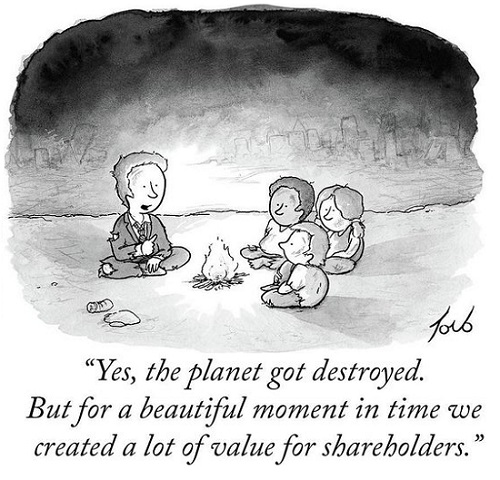
In the second, a man in a tattered suit sits cross-legged near a campfire with three children listening to him intently as he says this: “Yes, the planet got destroyed. But for a beautiful moment in time we created a lot of value for shareholders.”

Now, in the you-can’t-make-this-stuff-up category, financial writer Paul Farrell used the caption from the first cartoon in a 2015 piece for MarketWatch entitled: “Your No. 1 end-of-the-world investing strategy.” The subheading is: “How to pick stocks for the near term when long-term trends say collapse is near.” The subhead actually seems like it might be another caption from a New Yorker cartoon (or possibly one from The Onion). Why exactly would you invest in stocks—as opposed to seeds of food crops and sturdy garden implements—”when long-term trends say collapse is near”? But I’ll put that down to bad headline writing.

In Farrell’s defense, he frequently used his column in MarketWatch to warn his readers of the coming collapse of modern civilization if we don’t change our ways. He was obliged to give investment advice, of course, because that’s what the column was for.

Few other investment gurus are as intellectually honest as Farrell. Among prominent investment managers, only Jeremy Grantham comes close to understanding the scope of the challenges we face. Grantham wrote a piece in 2013 called “The Race of Our Lives” that outlines the myriad challenges humans face. He starts with a discussion of the fall of civilizations. (He updated his views in 2018.)

One would think that the coronavirus pandemic would allow for some sober reflection among those in the financial community as the pandemic-induced crash of the economy and the markets has called into question the stability of practically all the arrangements of modern civilization. Instead, the focus is on how stock markets could be back at or near all-times highs at the beginning of what is arguably the next Great Depression.

The New Yorker cartoons linked above appropriately characterize the madness that grips late-stage civilizations as their pillars begin to fall. Instead of attempting to adapt to new realities, every attempt is made to maintain the current fragile system. The trillions of dollars pumped into the world financial system by central banks and governments in the wake of the pandemic have done little except stoke renewed financial bubbles in practically all financial markets (and thereby bailed out the mostly wealthy owners of financial assets).

The disconnect is hard to miss. The latest reading of the U.S. Federal Reserve Bank of Atlanta’s GDPNow indicator, which is frequently updated as new data becomes available, now predicts that U.S. GDP will contract by 45.5 percent in the current quarter. (The number is annualized and seasonally adjusted.)

Even so the NASDAQ Composite Index hit a new all-time high earlier this month just three months after the recent trough reached during the crash. The S&P 500 is now very close to a new all-time high. Neither development makes sense in the middle of the worst economic downturn since the Great Depression. For comparison, it took more than two years for the NASDAQ Composite from the bottom in 2009 during the Great Financial Crisis to regain its 2007 highs. It took the S&P 500 more than four years.

Of course, the financialization of everything continues. Vaccine makers are in line for government funds. Naturally, it takes money to develop a vaccine. But drug makers aren’t in the business of keeping people healthy. They are in the business of making money. In the United States at least they are helped by the fact that they aren’t liable if their vaccine kills or injuries someone. And, executives in one money-losing pharmaceutical firm cashed in stock right after their company goosed the shares significantly higher with a very preliminary announcement about the company’s coronavirus vaccine research.

When it comes to real estate, it used to be that people bought it for income and as a store of value. Now firms buy real estate mostly with borrowed money and try to make gains mostly through property price appreciation. Often the real estate loans are packaged into securities that are sold and resold as part of the giant Wall Street and worldwide financial casino.

One of the surest signs of the financialization of everything and the growing disconnect of finance from reality is the credit default swap (CDS). The CDS is essentially insurance for loans and bonds. The buyer pays the seller a premium every month. If the instrument insured defaults, the seller provides a predetermined payment to reimburse the CDS buyer. Now here’s the weird thing: An investor doesn’t even have to own the loan or bond to insure it. It’s like me taking out an insurance policy on your home against fire when I have no ownership or interest in the home. In fact, I have every incentive to make sure your house burns down. Do you see any problem with that?

For normal insurance, the buyer must have an insurable interest. Typically, this means the buyer must actually own the thing he or she is insuring. The CDS, on the other hand, is an ideal instrument for those who want to bring on a financial end-of-the-world scenario. The buyers have every reason to want the economy to go down the drain as their payments may be 10 or even 20 times their initial investment.

Many wealthy people fear and even believe an end-of-the-world scenario is possible or probable. Some think they can hold up in luxury bunkers until the dust clears. But what if, when the dust clears, their wealth is gone and the financial world they used to inhabit has vanished.

Perhaps they will sit around campfires telling their grandchildren about the old days when finance was king and the real economy of goods and services was just a place where rubes got their daily bread—while, of course, simultaneously providing an outsized portion to the rich.

Globalists Reveal That The “Great Economic Reset” Is Coming In 2021

By Brandon Smith

Source: Alt-Market.com

For those not familiar with the phrase “global economic reset”, it is one that has been used ever increasingly by elitists in the central banking world for several years. I first heard it referenced by Christine Lagarde, the head of the IMF at the time, in 2014. The reset is often mentioned in the same breath as ideas like “the New Multilateralism” or “the Multipolar World Order” or “the New World Order”. All of these phrases mean essentially the same thing.

The reset is promoted as a solution to the ongoing economic crisis which was triggered in 2008. This same financial crash is still with us today, but now, after a decade of central bank money printing and debt creation, the bubble is even bigger than it was before. As always, the central bank “cure” is far worse than the disease, and the renewed crash we face today is far more deadly than what would have happened in 2008 if we had simply taken our medicine and refused to prop up weak parts of the economy artificially.

Many alternative economists often wrongly attribute the Fed’s habit of making things worse to “hubris” or “ignorance”. They think the Fed actually wants to save the financial system or “protect the golden goose”, but this is not reality. The truth is, the Fed is not a bumbling maintenance man, the Fed is a saboteur, a suicide bomber that is willing to destroy even itself as an institution in order to explode the US economy and clear the path for a new globally centralized one world system. Hence, the “Global Reset”.

In 2015 in my article ‘The Global Economic Reset Has Begun’, I stated:

The global reset is not a “response” to the process of collapse we are trapped in today. No, the global reset as implemented by central banks and the BIS/IMF is the cause of the collapse. The collapse is a tool, a flamethrower burning a great hole in the forest to make way for the foundations of the globalist Ziggurat to be built….economic disaster serves the interests of elitists.”

Now in 2020 we see the globalist plan coming to fruition, with the elites revealing what appears to be their intent to launch their reset in 2021. The World Economic Forum officially announced the Great Reset initiative as part of their Covid Action Platform last week, and a summit is scheduled in January 2021 to discuss their plans more openly with the world and the mainstream media.

The WEF also posted a rather bizarre video on the Reset, which consists of a series of images of the world falling apart (and images of factories releasing harmless carbon emission into the air which I suppose is meant to scare us with notions of global warming). The destruction is then “reset” at the push of a button, with everything reversing back to a pristine human-less world of nature and the words “Join Us”.

The reset, according to discussions by the IMF, is basically the next stage in the formation of a one-world economic system and potential global government. This seems to fall in line with the solutions offered during the Event 201 pandemic simulation; a simulation of a coronavirus pandemic that was held by the Bill And Melinda Gates Foundation and the World Economic Forum only two months before the REAL THING happened at the beginning of 2020. Event 201 suggested that one of the top solutions to a pandemic would be the institution of a centralized global economic body that could handle the financial response to the coronavirus.

Is it not convenient that the events of the real coronavirus pandemic fall exactly in line with the Event 201 simulation, as well as directly in line with the global reset plans of the IMF and the World Economic Forum? As they say, let no crisis go to waste, or, as is the motto of the globalists “Order Out Of Chaos”.

With civil unrest about to become a way of life for many parts of the world including the US, and the pandemic set for a resurgence of infections after the “reopening”, creating a rationale for a second wave of lockdowns probably in July, the economy as we know it is being destroyed. The last vestiges of the system, hanging by a thin thread after the crash of 2008, are now being cut.

The goal is rather obvious – Terrify the population with poverty, internal conflicts and a broken supply chain until they lobby the establishment for help.  Then, offer the “solution” of medical tyranny, immunity passports, martial law, a global economic system based on a cashless digital society in which privacy in trade is erased, and then slowly but surely form a faceless “multilateral” global government which answers to no one and does whatever it pleases.

I remember back in 2014 when Christine Lagarde first began talking about the reset. That same year she also made a very strange speech to the National Press Club in which she started rambling gleefully about numerology and the “magic number 7”. Many within the club laughed, as there was apparently an inside joke that the rest of us were not privy to. Well, I would point out that the World Economic Forum meeting on the global reset in 2021 will be held exactly 7 years after Lagarde gave that speech. Just another interesting coincidence I suppose…

The new world order, the global reset, is a long running scheme to centralize power, but in a way that is meant to be sustained for centuries to come. The elites know that it is not enough to achieve global governance by force alone; such an attempt would only lead to resistance and eternal rebellion. No, what the elites want is for the public to ASK, even beg for global governance. If the public is tricked into demanding it as a way to save them from the horrors of global chaos, then they are far less likely to rebel against it later. Problem – reaction – solution.

The pandemic is not going away anytime soon. Everyone should expect that state governments and the federal government will call for renewed lockdowns. With these new lockdowns, the US economy in particular will be finished. With 40 million people losing their jobs during the last lockdowns, many states only partially reopened, and only 13% to 18% of small businesses receiving bailout loans to survive, the next two months are going to be a devastating wake-up call.

The real solution will be for people to form more self reliant communities free of the mainstream economy. The real solution should be decentralization and independence, not centralization and slavery. The globalists will seek to interfere with any effort to break from the program. That said, they can do very little if millions of people enact localization efforts at the same time. If people aren’t reliant on the system, then they cannot be controlled by the system.

The real test will come with the final collapse of the existing economy. When stagflation spikes even harder than it is right now and prices of necessities double or triple yet again, and joblessness skyrockets even further, how many people will clamor for the globalist solution and how many will build their own systems? How many will be bowing in submission and how many will be ready to fight back. It is a question I still don’t have an answer to even after 14 years of analysis on the issue.

What I suspect is that many people will fight back. Not as many as we might hope for, but enough to defend the cause of liberty. Maybe this is overly optimistic, but I believe the globalists are destined to lose this war in the long run.

Another Bank Bailout Under Cover of a Virus

By Ellen Brown

Source: Web of Debt

Insolvent Wall Street banks have been quietly bailed out again. Banks made risk-free by the government should be public utilities.  

When the Dodd Frank Act was passed in 2010, President Obama triumphantly declared, “No more bailouts!” But what the Act actually said was that the next time the banks failed, they would be subject to “bail ins” – the funds of their creditors, including their large depositors, would be tapped to cover their bad loans.

Then bail-ins were tried in Europe. The results were disastrous.

Many economists in the US and Europe argued that the next time the banks failed, they should be nationalized – taken over by the government as public utilities. But that opportunity was lost when, in September 2019 and again in March 2020, Wall Street banks were quietly bailed out from a liquidity crisis in the repo market that could otherwise have bankrupted them. There was no bail-in of private funds, no heated congressional debate, and no public vote. It was all done unilaterally by unelected bureaucrats at the Federal Reserve.

“The justification of private profit,” said President Franklin Roosevelt in a 1938 address, “is private risk.” Banking has now been made virtually risk-free, backed by the full faith and credit of the United States and its people. The American people are therefore entitled to share in the benefits and the profits. Banking needs to be made a public utility.

The Risky Business of Borrowing Short to Lend Long

Individual banks can go bankrupt from too many bad loans, but the crises that can trigger system-wide collapse are “liquidity crises.” Banks “borrow short to lend long.” They borrow from their depositors to make long-term loans or investments while promising the depositors that they can come for their money “on demand.” To pull off this sleight of hand, when the depositors and the borrowers want the money at the same time, the banks have to borrow from somewhere else. If they can’t find lenders on short notice, or if the price of borrowing suddenly becomes prohibitive, the result is a “liquidity crisis.”

Before 1933, when the government stepped in with FDIC deposit insurance, bank panics and bank runs were common. When people suspected a bank was in trouble, they would all rush to withdraw their funds at once, exposing the fact that the banks did not have the money they purported to have. During the Great Depression, more than one-third of all private US banks were closed due to bank runs.

But President Franklin D. Roosevelt, who took office in 1933, was skeptical about insuring bank deposits. He warned, “We do not wish to make the United States Government liable for the mistakes and errors of individual banks, and put a premium on unsound banking in the future.” The government had a viable public alternative, a US postal banking system established in 1911. Postal banks became especially popular during the Depression, because they were backed by the US government. But Roosevelt was pressured into signing the 1933 Banking Act, creating the Federal Deposit Insurance Corporation that insured private banks with public funds.

Congress, however, was unwilling to insure more than $5,000 per depositor (about $100,000 today), a sum raised temporarily in 2008 and permanently in 2010 to $250,000. That meant large institutional investors (pension funds, mutual funds, hedge funds, sovereign wealth funds) had nowhere to park the millions of dollars they held between investments. They wanted a place to put their funds that was secure, provided them with some interest, and was liquid like a traditional deposit account, allowing quick withdrawal. They wanted the same “ironclad moneyback guarantee” provided by FDIC deposit insurance, with the ability to get their money back on demand.

It was largely in response to that need that the private repo market evolved. Repo trades, although technically “sales and repurchases” of collateral, are in effect secured short-term loans, usually repayable the next day or in two weeks. Repo replaces the security of deposit insurance with the security of highly liquid collateral, typically Treasury debt or mortgage-backed securities. Although the repo market evolved chiefly to satisfy the needs of the large institutional investors that were its chief lenders, it also served the interests of the banks, since it allowed them to get around the capital requirements imposed by regulators on the conventional banking system. Borrowing from the repo market became so popular that by 2008, it provided half the credit in the country. By 2020, this massive market had a turnover of $1 trillion a day.

Before 2008, banks also borrowed from each other in the fed funds market, allowing the Fed to manipulate interest rates by controlling the fed funds rate. But after 2008, banks were afraid to lend to each other for fear the borrowing banks might be insolvent and might not pay the loans back. Instead the lenders turned to the repo market, where loans were supposedly secured with collateral. The problem was that the collateral could be “rehypothecated,” or used for several loans at once; and by September 2019, the borrower side of the repo market had been taken over by hedge funds, which were notorious for risky rehypothecation. Many large institutional lenders therefore pulled out, driving the cost of borrowing at one point from 2% to 10%.

Rather than letting the banks fail and forcing a bail-in of private creditors’ funds, the Fed quietly stepped in and saved the banks by becoming the “repo lender of last resort.” But the liquidity crunch did not abate, and by March the Fed was making $1 trillion per day available in overnight loans. The central bank was backstopping the whole repo market, including the hedge funds, an untenable situation.

In March 2020, under cover of a national crisis, the Fed therefore flung the doors open to its discount window, where only banks could borrow. Previously, banks were reluctant to apply there because the interest was at a penalty rate and carried a stigma, signaling that the bank must be in distress. But that concern was eliminated when the Fed announced in a March 15 press release that the interest rate had been dropped to 0.25% (virtually zero). The reserve requirement was also eliminated, the capital requirement was relaxed, and all banks in good standing were offered loans of up to 90 days, “renewable on a daily basis.” The loans could be continually rolled over. And while the alleged intent was “to help meet demands for credit from households and businesses at this time,” no strings were attached to this interest-free money. There was no obligation to lend to small businesses, reduce credit card rates, or write down underwater mortgages.

The Fed’s scheme worked, and demand for repo loans plummeted. Even J.P. Morgan Chase, the largest bank in the country, has acknowledged borrowing at the Fed’s discount window for super cheap loans. But the windfall to Wall Street has not been shared with the public. In Canada, some of the biggest banks slashed their credit card interest rates in half, from 21 percent to 11 percent, to help relieve borrowers during the COVID-19 crisis. But US banks have felt no such compunction. US credit card rates dropped in April only by half a percentage point, to 20.15%. The giant Wall Street banks continue to favor their largest clients, doling out CARES Act benefits to them first, emptying the trough before many smaller businesses could drink there.

In 1969, Prime Minister Indira Gandhi nationalized 14 of India’s largest banks, not because they were bankrupt (the usual justification today) but to ensure that credit would be allocated according to planned priorities, including getting banks into rural areas and making cheap financing available to Indian farmers.  Congress could do the same today, but the odds are it won’t. As Sen. Dick Durbin said in 2009, “the banks … are still the most powerful lobby on Capitol Hill. And they frankly own the place.”

Time for the States to Step In

State and local governments could make cheap credit available to their communities, but today they too are second class citizens when it comes to borrowing. Unlike the banks, which can borrow virtually interest-free with no strings attached, states can sell their bonds to the Fed only at market rates of 3% or 4% or more plus a penalty. Why are elected local governments, which are required to serve the public, penalized for shortfalls in their budgets caused by a mandatory shutdown, when private banks that serve private stockholders are not?

States can borrow from the federal unemployment trust fund, as California just did for $348 million, but these loans too must be paid back with interest, and they must be used to cover soaring claims for state unemployment benefits. States remain desperately short of funds to repair holes in their budgets from lost revenues and increased costs due to the shutdown.

States are excellent credit risks – far better than banks would be without the life-support of the federal government. States have a tax base, they aren’t going anywhere, they are legally required to pay their bills, and they are forbidden to file for bankruptcy. Banks are considered better credit risks than states only because their deposits are insured by the federal government and they are gifted with routine bailouts from the Fed, without which they would have collapsed decades ago.

State and local governments with a mandate to serve the public interest deserve to be treated as well as private Wall Street banks that have repeatedly been found guilty of frauds on the public. How can states get parity with the banks? If Congress won’t address that need, states can borrow interest-free at the Fed’s discount window by forming their own publicly-owned banks. For more on that possibility, see my earlier article here.

As Buckminster Fuller said, “You never change things by fighting the existing reality. To change something, create a new model that makes the old model obsolete.” Post-COVID-19, the world will need to explore new models; and publicly-owned banks should be high on the list.

To America, Black Lives Only Sometimes Matter

By Tony Cartalucci

Source: Land Destroyer

There is no doubt that colonialism and racism sit at the root of America’s domestic problems. The push to dominate others abroad is directly linked to the belief that those who are different at home should also be dominated.

There are still Americans alive today that remember segregation laws that denied black Americans their basic rights and dignity. Before that, there was outright slavery.

Even today, racism is still institutionalized. It also permeates American culture, laying just beneath a superficial layer of tolerance and equality.

This is not just about white people who remain racist against blacks and other minorities – a product of America’s terminally ill culture – it is also about fundamental racism that still very much sits at the heart of American foreign and domestic policy – against not only blacks, but virtually every race on the planet from Africans to Asians to even Slavs.

The US is a nation that encourages its people to hate entire groups of people abroad to help justify otherwise unjust wars. Arabs, Chinese people, Russians – are all vilified with bigotry and hatred sanctioned by mainstream American culture. It isn’t hard to see why in a nation like this, hatred for other groups is easily justified in the minds of racists and the unjust.

Not Just Police in America – Racism is a Key Feature of US Foreign Policy 

It was under US President Barack Obama that the US decimated the North African nation of Libya, deposing Libyan leader Muammar Gaddafi – a champion of African dignity and progress and the champion of tens of thousands of blacks from all over Africa who travelled to Libya to find work and a better life – work and a better life Gaddafi provided them until he was brutally murdered and his government replaced by heavily armed, racist terrorists backed by the US and its European allies.

US-backed militants in Libya would hunt down Libya’s black population, killing them, torturing them, and even enslaving them in open air slave markets – a spectacle one might have believed was unthinkable in the 21st century – but something made possible by America, its foreign policy, and its deeply rooted racism and sense of supremacy – despite having a “black” president at the time.

President Obama is hardly the only one to blame – he simply picked up where others left off – and his successor, US President Donald Trump is simply next in line to carry forward systemic US injustice worldwide. The fact that President Obama was black made no difference and simply helps illustrate how while superficial milestones are waved in America’s face – the fundamental rot of injustice, racism, and supremacist thinking persists.

When a nation is able to justify denying one group of people their dignity, worth, and rights as human beings it is a slippery slope that easily leads to other groups likewise being stripped of their humanity and abused.

If Black Lives Matter – They Must Always Matter, Everywhere, All the Time 

Any case of police brutality is tragic and needs to be addressed -a problem in its own right. If officers killed George Floyd because he was black, it represents an additional problem that must also be addressed.

If Americans genuinely believe black lives matter – then they need to commit to fighting injustice against them, and all other victims of American racism and supremacy. If they speak up only when it is popular and “trending” it’s as good as not speaking up at all.

If they are silent when America is mass murdering blacks overseas, killing brown people across the planet, or attempting to normalize racism against Asians – Chinese people in particular – they are complicit in the very sort of deeply rooted, institutionalized racism that underpins US foreign policy and the globe-spanning industrialized injustice it represents – and the very sort of racism that manifests itself as injustice against blacks at home.

America needs genuine opposition to racism. Not opportunistic posturing.

US politicians like Alexandria Ocasio-Cortez pose as dedicated to racial equality and fighting racism – yet she regularly finds herself in support of US military aggression abroad which exclusively targets nations populated by black, brown, and Asian people.

Her most recent display of supreme hypocrisy was her support of US meddling in Hong Kong – an extension of the British Empire’s seizure from and subjugation of this Chinese territory.

The British Empire – of course – also pursued its foreign policy based entirely on the belief that white Westerners were superior to all others and that it was their right – even duty – to impose British “civilization” upon “heathen” races – China was no exception to this belief.

Alexandria Ocasio-Cortez may or may not appreciate that her support for US meddling in Hong Kong helps continue this disgraceful tradition and agenda – believing instead that supporting “democracy” in Hong Kong is not simply the same brand of Anglo-American racism merely repackaged for more sensitive global audiences. But she is supporting racism, supremacy, and hegemony all the same.

Black lives will never matter as long as “Black Lives Matter” remains a hollow political slogan shouted by interests easily able to ignore or even support injustice purveyed by the US against others abroad – including blacks.

Deeply rooted racism in the US is just one of many symptoms of an overall desire for hegemony and the notions of racial, political, and cultural supremacy that underpin it. Until this is addressed, racism will continue, with only the most superficial and unsustainable efforts made to stop it.

As long as America believes it is better than all others abroad – able to justify exploitation, coercion, and even military aggression to assert itself and pursue its “interests” – racism and injustice will persist at home. The same corporate-financier interests driving US injustice abroad see the US population – white and black – as merely another market segment to use and abuse – to divide and conquer – to put under itself for its own benefit.

Black lives matter, whether they are being strangled by a racist white cop in America or being bombed by US warplanes in Libya. Once Americans can unite in both understanding and opposing this across-the-board racism and injustice, something might actually be done about it besides kicking the can down the road for a few more months until the next video of police abuse emerges online.

America will not heal its domestic hatred and divisions if it remains built entirely on projecting and profiting from hatred and division abroad. It was no coincidence that legendary champions for equality like Martin Luther King Jr. were both opposed to racism and injustice at home and ceaselessly opposed  to American aggression and hegemony abroad. The two are linked by the common thread of fundamental injustice. Until they are both exposed and smashed completely, they will both continue.

Mass Distraction And Fake “V-Shaped” Recovery Provide Cover For The Fed Induced Crash

By Brandon Smith

Source: Alt-Market.com

This article, originally titled ‘The Fed Just Got Cover For The Collapse Of The US Economy’, was written by Brandon Smith and first published at Birch Gold Group

The scapegoating has already started. In almost every sector of the economy that is collapsing, the claim is that “everything was fine until the pandemic happened”. From tumbling web news platforms to small businesses to major corporations, the coronavirus outbreak and the national riots will become the excuse for failure. The establishment will try to rewrite history and many people will go along with it because the truth makes them look bad.

And what is the truth? The truth is that the U.S. economy – and in some ways, the global economy – was already collapsing. The system’s dependency on ultra-low interest rates and central bank stimulus created perhaps the largest debt bubble in history – the Everything Bubble. And that bubble began imploding at the end of 2018, triggered primarily by the Federal Reserve raising rates and dumping its balance sheet into economic weakness, just like it did at the start of the Great Depression. Fed Chair Jerome Powell knew what would happen if this policy was initiated; he even warned about it in the minutes of the October 2012 Federal Open Market Committee, and yet once he became the head of the central bank, he did it anyway.

For a year leading up to the pandemic, the Fed was struggling to maintain and suppress a repo market liquidity crisis. National debtcorporate debt and consumer debt were at all-time highs. Companies were desperate for new stimulus, and they were getting crumbs from the Fed, rather than the tens of trillions that they needed just to stay afloat. The central bank had sabotaged the economy, but they had to keep it in a state of living death until they had a perfect cover event for the collapse. The pandemic and inevitable civil unrest do the job nicely.

What many people do not understand is that the Fed does not care about the economy. In fact, every Fed action since its inception in 1913 has led to the downfall of the U.S. The Fed is not a maintenance man trying to stave off collapse; the Fed is a suicide bomber willing to destroy everything including itself in order to serve a greater ideology.

Total global centralization is the goal, and every new disaster is exploited to this end by the establishment. “Order out of chaos” is the motto of the global elites; in other words, in every crisis there is “opportunity”. This crisis has been no different. Suggested solutions have ranged from the creation of a cashless society operating on a digital currency system, to permanent lockdowns in the name of stopping “global warming”, to a surveillance state and medical tyranny utilizing 24/7 tracking of citizens in order to “stop the spread of the virus”. But how does the establishment plan to get people to go along with such freedom-crushing policies?

The pandemic by itself is not enough. The George Floyd riots may be a motivator, but they might fizzle out over time. The real catalyst, as I have said for many years now, will be an ongoing economic crash. This crash, engineered in 2008, has been a long time coming. Everything that is happening today is an extension of what happened over a decade ago. That said, the current phase was set in motion in 2018, as noted above.

The virus and the lockdowns solidified the crash, and while some people including Trump are calling for a V-shaped recovery, this is not going to happen.  Perhaps Trump is referring to stock markets artificially inflated by the Fed stimulus backstop?  Is anyone gullible enough to believe the stock market represents the real economy?  Because today’s jobs report from the BLS, despite all the hype, does not suggest V-shaped recovery to me.  The US lost 40 million jobs in the span of 6 weeks.  The BLS reports a gain of 2.5 million jobs in May as the country “reopened”.  So, we are still down nearly 38 million jobs in the past couple months yet the BLS stats are being called “stunning” and a “sign of recovery”?

The assumption being made here I think is that job gains will now be constant each month from now on.  I think not.  I think the jobs that were gained in May are the peak, and every jobs report after today will disappoint.  Here’s why…

The latest Fed models predict a GDP plunge of 52.8%, and the manner in which the Fed calculates GDP is actually rigged to the upside. It is difficult to predict the REAL fall in data, but we know it will likely be larger than 52%. Keep in mind that this crash is in the 2nd quarter, while the Fed pumped trillions into the system. What exactly did this money printing buy? Well, stock markets stabilized, but the rest of the economy didn’t, and stock market optimism isn’t going to last much longer either is there are renewed lockdowns.

The primary reason we now face a second Great Depression is because the small business sector has been destroyed. Small businesses are vital to the U.S. economy, representing around 50% of the job market. The closures resulted in around 40 million job losses in the past two months. Add that to the 95 million Americans that have been out of work but not counted by the BLS as unemployed – as well as the 11 million people that are counted – and you are looking at nearly 150 million working age people not generating an income.

The latest BLS jobs gains and the way they are being hyped by the media are suspicious to me.  It seems as if the establishment is trying to convince the public that the pandemic will have no affect on the economy and that their jobs will simply be waiting for them after every new shutdown (as long as they adhere to the rules and restriction set up by state and federal governments).

But it’s only going to get worse from here on…

The public doesn’t realize it yet, but many of the businesses that shut down over the past couple months are not coming back. Sure, a lot of them will try to reopen, and there will be a last gasp of activity during the next month or two, but the levels of debt attached to these ventures was already high before the pandemic hit. The recent small business bailouts seemed as if they were designed to give people false hope. According to figures out of JP Morgan, of the 300,000 clients that applied for the small business aid, only 18,000 actually received any. And, of that 18,000, many were larger corporation, not small businesses.

Business sectors most affected include retail and service, which crashed a record 16.4% overall in April. Food service lost approximately 30% of sales. Electronics and appliances lost 60%. Clothing plunged 78%. Auto sales fell 33% in May, and the expected rebound after the reopening has been disappointing.

The businesses most likely to die first are those that had large debt obligations before the lockdowns, as well as those that received no bailout money. Even though companies like General Electric, Verizon, IBM and Tesla all have massive debt issues, they may be kept alive by government bailouts, at least for a time. Small businesses, on the other hand, appear to be slated for destruction.

In particular, I suspect most restaurants besides major chains will go into bankruptcy. Boutique stores and clothing outlets will run out of money fast. Movie theater chains will collapse. Car rental outlets will collapse. Tourism businesses will close en masse and tourism towns will suffer profit losses despite the “reopening” in some states. Larger companies, like airlines, will continue to decline, and they will have to diversify into other areas, such as shipping, in order to survive. The auto industry is not coming back any time soon.

In the case of restaurants, the social distancing requirements reduce the number of customers that they can seat at any given time. Restaurants were already suffering major declines before the pandemic, and while take-out venues might have seen an uptick because of the lockdowns, this will not last as people begin to run out of cash and start cooking at home.

The same goes for small boutique stores, which rely on consumers with expendable cash flows. Such consumers no longer exist, and notions of “extra cash” will disappear along with waning government checks. As for tourism, I think there will be some travel, as lockdown restrictions are partially lifted. Many people in the cities will try to get away for a week or two just to escape and feel normal for a little while. However, I also think mainstream economists are underestimating the number of people who will refuse to travel because of concerns about coming in contact with the coronavirus. Just as retail refuses to rebound, so will tourism profits.

Air travel is unlikely to improve for the same reasons. Social distancing makes airplane flights a losing investment as passenger capacity is reduced. New car sales will remain stagnant because people are traveling less, and the used car market is being stocked with product as average people sell off vehicles to get extra cash to make ends meet.

All of these factors result in long-term job losses and debt defaults for small businesses as well as some larger companies. Which means much higher poverty rates and further dependency on government welfare programs.

The real test for the public will come when lockdowns return. I realize that there is a bit of denial in the population when it comes to this idea. I see many people operating on the assumption that the “reopening” is a long-term situation. I assure you, it is not. As I have noted in many previous articles, the establishment intends to use what I call “wave theory”, or a cycle of shutdowns and openings over the span of a year or longer. There WILL be new lockdowns, if not in the name of a resurgence in COVID infections, it will be in the name of stopping the national riots.

The response from the American people will be critical here. Will we support further lockdowns or martial law, even though the measures would harm us economically? Or will the public resist? Will the political left embrace a second lockdown in the face of further infection spikes? Will conservatives embrace lockdowns in the face of leftist protests and riots? Both sides of the political spectrum are being tempted with the use of a totalitarian government response in order to ensure their personal “safety”.

People must be made to understand the reality of our situation: the economy has already been undermined and this threat is far greater than either the virus or the riots. This is the danger that is being hidden by the pandemic and civil unrest distractions, and it is a threat that the government has no means or intention of saving us from. We must save ourselves, and doing that requires preparation and acceptance that the world is changed.

Four Reasons Civilization Won’t Decline: It Will Collapse

By Craig Collins

Source: CounterPunch

As modern civilization’s shelf life expires, more scholars have turned their attention to the decline and fall of civilizations past.  Their studies have generated rival explanations of why societies collapse and civilizations die.  Meanwhile, a lucrative market has emerged for post-apocalyptic novels, movies, TV shows, and video games for those who enjoy the vicarious thrill of dark, futuristic disaster and mayhem from the comfort of their cozy couch.  Of course, surviving the real thing will become a much different story.

The latent fear that civilization is living on borrowed time has also spawned a counter-market of “happily ever after” optimists who desperately cling to their belief in endless progress.  Popular Pollyannas, like cognitive psychologist Steven Pinker, provide this anxious crowd with soothing assurances that the titanic ship of progress is unsinkable.  Pinker’s publications have made him the high priest of progress.[1] While civilization circles the drain, his ardent audiences find comfort in lectures and books brimming with cherry-picked evidence to prove that life is better than ever, and will surely keep improving.  Yet, when questioned, Pinker himself admits, “It’s incorrect to extrapolate that the fact that we’ve made progress is a prediction that we’re guaranteed to make progress.”[2]

Pinker’s rosy statistics cleverly disguise the fatal flaw in his argument.  The progress of the past was built by sacrificing the future—and the future is upon us.  All the happy facts he cites about living standards, life expectancy, and economic growth are the product of an industrial civilization that has pillaged and polluted the planet to produce temporary progress for a growing middle class—and enormous profits and power for a tiny elite.

Not everyone who understands that progress has been purchased at the expense of the future thinks that civilization’s collapse will be abrupt and bitter.  Scholars of ancient societies, like Jared Diamond and John Michael Greer, accurately point out that abrupt collapse is a rare historical phenomenon.  In The Long Descent, Greer assures his readers that, “The same pattern repeats over and over again in history.  Gradual disintegration, not sudden catastrophic collapse, is the way civilizations end.”  Greer estimates that it takes, on average, about 250 years for civilizations to decline and fall, and he finds no reason why modern civilization shouldn’t follow this “usual timeline.”[3]

But Greer’s assumption is built on shaky ground because industrial civilization differs from all past civilizations in four crucial ways.  And every one of them may accelerate and intensify the coming collapse while increasing the difficulty of recovery.

Difference #1:  Unlike all previous civilizations, modern industrial civilization is powered by an exceptionally rich, NON-renewable, and irreplaceable energy source—fossil fuels.  This unique energy base predisposes industrial civilization to a short, meteoric lifespan of unprecedented boom and drastic bust.  Megacities, globalized production, industrial agriculture, and a human population approaching 8 billion are all historically exceptional—and unsustainable—without fossil fuels.  Today, the rich easily exploited oilfields and coalmines of the past are mostly depleted.  And, while there are energy alternatives, there are no realistic replacements that can deliver the abundant net energy fossil fuels once provided.[4]  Our complex, expansive, high-speed civilization owes its brief lifespan to this one-time, rapidly dwindling energy bonanza.

Difference #2:  Unlike past civilizations, the economy of industrial society is capitalist.  Production for profit is its prime directive and driving force.  The unprecedented surplus energy supplied by fossil fuels has generated exceptional growth and enormous profits over the past two centuries.  But in the coming decades, these historic windfalls of abundant energy, constant growth, and rising profits will vanish.

However, unless it is abolished, capitalism will not disappear when boom turns to bust.  Instead, energy-starved, growth-less capitalism will turn catabolic.  Catabolismrefers to the condition whereby a living thing devours itself.  As profitable sources of production dry up, capitalism will be compelled to turn a profit by consuming the social assets it once created.  By cannibalizing itself, the profit motive will exacerbate industrial society’s dramatic decline.

Catabolic capitalism will profit from scarcity, crisis, disaster, and conflict.  Warfare, resource hoarding, ecological disaster, and pandemic diseases will become the big profit makers.  Capital will flow toward lucrative ventures like cybercrime, predatory lending, and financial fraud; bribery, corruption, and racketeering; weapons, drugs, and human trafficking.  Once disintegration and destruction become the primary source of profit, catabolic capitalism will rampage down the road to ruin, gorging itself on one self-inflicted disaster after another.[5]

Difference #3:  Unlike past societies, industrial civilization isn’t Roman, Chinese, Egyptian, Aztec, or Mayan.  Modern civilization is HUMAN, PLANETARY, and ECOCIDAL.  Pre-industrial civilizations depleted their topsoil, felled their forests, and polluted their rivers.  But the harm was far more temporary and geographically limited. Once market incentives harnessed the colossal power of fossil fuels to exploit nature, the dire results were planetary.  Two centuries of fossil fuel combustion have saturated the biosphere with climate-altering carbon that will continue wreaking havoc for generations to come.  The damage to Earth’s living systems—the circulation and chemical composition of the atmosphere and the ocean; the stability of the hydrological and biogeochemical cycles; and the biodiversity of the entire planet—is essentially permanent.

Humans have become the most invasive species ever known.  Although we are a mere .01 percent of the planet’s biomass, our domesticated crops and livestock dominate life on Earth.  In terms of total biomass, 96 percent of all the mammals on Earth are livestock; only 4 percent are wild mammals.  Seventy percent of all birds are domesticated poultry, only 30 percent are wild.  About half the Earth’s wild animals are thought to have been lost in just the last 50 years.[6]  Scientists estimate that half of all remaining species will be extinct by the end of the century.[7] There are no more unspoiled ecosystems or new frontiers where people can escape the damage they’ve caused and recover from collapse.

Difference #4:  Human civilization’s collective capacity to confront its mounting crises is crippled by a fragmented political system of antagonistic nations ruled by corrupt elites who care more about power and wealth than people and the planet.  Humanity faces a perfect storm of converging global calamities.  Intersecting tribulations like climate chaos, rampant extinction, food and freshwater scarcity, poverty, extreme inequality, and the rise of global pandemics are rapidly eroding the foundations of modern life.

Yet, this fractious and fractured political system makes organizing and mounting a cooperative response nearly impossible.  And, the more catabolic industrial capitalism becomes, the greater the danger that hostile rulers will fan the flames of nationalism and go to war over scarce resources.  Of course, warfare is not new.  But modern warfare is so devastating, destructive, and toxic that little would remain in its aftermath.  This would be the final nail in civilization’s coffin.

Rising From the Ruins?

How people respond to the collapse of industrial civilization will determine how bad things get and what will replace it. The challenges are monumental.  They will force us to question our identities, our values, and our loyalties like no other experience in our history.  Who are we?  Are we, first and foremost, human beings struggling to raise our families, strengthen our communities, and coexist with the other inhabitants of Earth?  Or do our primary loyalties belong to our nation, our culture, our race, our ideology, or our religion?  Can we put the survival of our species and our planet first, or will we allow ourselves to become hopelessly divided along national, cultural, racial, religious, or party lines?

The eventual outcome of this great implosion is up for grabs.  Will we overcome denial and despair; kick our addiction to petroleum; and pull together to break the grip of corporate power over our lives?  Can we foster genuine democracy, harness renewable energy, reweave our communities, re-learn forgotten skills, and heal the wounds we’ve inflicted on the Earth?  Or will fear and prejudice drive us into hostile camps, fighting over the dwindling resources of a degraded planet?  The stakes could not be higher.

Notes.

[1] His books include: The Better Angels of Our Nature and Enlightenment Now: The Case for Reason, Science, Humanism, and Progress.

[2] King, Darryn. “Steven Pinker on the Past, Present, and Future of Optimism” (OneZero, Jan 10, 2019) https://onezero.medium.com/steven-pinker-on-the-past-present-and-future-of-optimism-f362398c604b

[3] Greer, John Michael.  The Long Descent (New Society Publishers, 2008): 29.

[4] Heinberg, Richard. The End Of Growth. (New Society, 2011): 117.

[5] For more on catabolic capitalism see: Collins, Craig. “Catabolism: Capitalism’s Frightening Future,”CounterPunch (Nov. 1, 2018). https://www.counterpunch.org/2018/11/01/catabolism-capitalisms-frightening-future/

[6] Carrington, Damian. “New Study: Humans Just 0.01% Of All Life But Have Destroyed 83% Of Wild Mammals,” The Guardian (May 21, 2018). https://www.theguardian.com/environment/2018/may/21/human-race-just-001-of-all-life-but-has-destroyed-over-80-of-wild-mammals-study

[7] Ceballos, Ehrlich, Barnosky, Garcia, Pringle & Palmer. “Accelerated Modern Human-Induced Species Losses: Entering The 6th Mass Extinction,” Science Advances. (June 19, 2015). http://advances.sciencemag.org/content/1/5/e1400253

We’re in the Thick of It Now – What Happens Next?

By Michael Krieger

Source: Liberty Blitzkrieg

It’s with an extremely heavy heart that I sit down to write today’s post. Although widespread civil unrest was easy to predict, it doesn’t make the situation any less sad and dangerous. We’re in the thick of it now, and how we respond will likely determine the direction of the country for decades to come.

If the combination of peaceful protesting, looting and violence witnessed across American cities over the past few days completely caught you off guard, you’re likely to come to the worst possible conclusion about what to do next. The knee-jerk response I’m already seeing from many is to crush the dissent by all means necessary, but that’s exactly how you give the imperial state and oligarchy more power. Power it will never relinquish.

The pressure cooker situation that erupted over the weekend has been building for five decades, but really accelerated over the past twenty years. After every crisis of the 21st century there’s been this “do whatever it takes mentality,” which resulted in more wealth and power for the national security state and oligarchy, and less resources, opportunities and civil liberties for the many. If anything, it’s surprising it took so long to get here, partly a testament to how skilled a salesman for the power structure Obama was.

The covid-19 pandemic, related societal lockdown and another round of in your face economic looting by Congress and the Federal Reserve merely served as an accelerant, and the only thing missing was some sort of catalyst combined with warmer weather. Now that the eruption has occurred, I hope cooler heads can prevail on all sides.

On the one hand, you can’t pillage the public so blatantly and consistently for decades while telling them voting will change things and not expect violence once people realize it doesn’t. On the other hand, street violence plays perfectly into the hands of those who would take the current moment and use it to advocate for a further loss of civil liberties, more internal militarization, and the emergence of an overt domestic police state that’s been itching to fully manifest since 9/11.

It’s my view we need to take the current moment and admit the unrest is a symptom of a deeply entrenched and corrupt bipartisan imperial oligarchy that cares only about its own wealth and power. If people of goodwill across the ideological spectrum don’t take a step back and point out who the real looters are, nothing’s going to improve and we’ll put another bandaid on a systemic cancer as we continue our longstanding march toward less freedom and more authoritarianism.

While we aren’t going to solve everything at once, something should be done as soon as possible to at least partially address current anger and frustration.

Clearly there’s a major problem when it comes to policing in America, particularly in poor inner-city communities. Let’s start by ending qualified immunity.

Qualified immunity, created by the Supreme Court in the 1970s, shields police and other government officials from liability in civil rights lawsuits when the illegality of their actions was not “clearly established” at the time of the offense.

Attorneys representing the families of Floyd, Ahmaud Arbery, and Breonna Taylor called for policing reforms—including rolling back qualified immunity—at a press conference today…

While it may seem like George Floyd’s right to not be choked to death by a police officer would be rather obvious, the fuzzy phrase “clearly established” has evolved over time to become a pedantic and unforgiving standard. Plaintiffs are often required to go fishing for cases that match their exact circumstances, lest their lawsuit get tossed. Last year, a 9th Circuit Court of Appeals panel granted qualified immunity to an officer who, without warning, shot a 15-year-old holding an airsoft gun. 

Ending qualified immunity may seem like a small thing, but it’s an important step toward adding some accountability to those in positions of power. As it stands, power at all levels in our society largely operates above the law. This applies to politicians, national security state operatives, CEOs, Wall Street, the police, and of course, Jeffrey Epstein. Those in positions to do the most damage to society are simultaneously most immune from the consequences of their actions. This is a core systemic problem in our country, so let’s take a small step and start with qualified immunity for police officers while the opportunity exists. From there we can turn our attention to the bigger fish.

I understand my message will likely fall on deaf ears, and I’m used to things not going the way I want them to. I have no idea where society will go from here, but I know we’re at a key inflection point in our nation’s history. We can begin to turn this thing around, or we can go totally off the deep end. Try to be as creative, constructive and conscious as possible during these trying times.