Is Sleepy Joe Biden Trying to Outdo Hitler and History?

By Phil Butler

Source: New Eastern Outlook

History is the most interesting subject for many reasons. Not the least of which is the fact it tends to repeat itself. And the fact that some are doomed by ignorance of this is an important lesson for today. Take German tanks, for instance. First, let’s rehash a little history about the steppes of Russia and Eastern Ukraine and unlearned lessons.

From the 5th of July 1943 until the 23rd of August 1943, the largest tank battle in history took place in what became known as the “Kursk Salient,” an area that stretched from the tiny town of Kirov on the Bolva River in the north, through Belgorod in Russia, Kharkiv, which Ukraine currently controls. The line reached deep into the Donbas region, the focal point of Ukraine’s Nazi hostilities since 2014.

Hitler’s Operation Zitadelle (“Citadel”) was carried out over a 700-mile-long front, where the best Germans tried to outgun and outmaneuver the advancing Soviet forces. It became the largest tank battle in history, pitting the most advanced weaponry Nazi Germany had against prepared and dug-in, superior Soviet resistance. The reader will find it interesting that the German high command chose Belgorod as one of the first key objectives.

Numerous parallels exist between the battle of Kursk and the current proxy war in Ukraine. First, I’d like to deal with tanks. In 1943, Germany manufactured what can be argued as the finest medium and heavy armor of World War II. Though not numerous at Kursk, the deadly Tiger played a big role. The all-new Panther and the giant Ferdinand tank destroyer were supposed to blast the Soviets off the battlefield.

Ironically, many of their burning hulks littered the countryside once the battle ended. The battle raged for months, with neither side gaining a clear advantage. The Soviets, not unlike their modern-day counterparts on the Russian lines, created massive defensive works to sap the German offensive until a counterattack would gain a decisive effect.

When I read the other day about almost all of the highly touted German Leopards sent to Zelensky having been destroyed, this seemed like Deja Vu as a student of history. An article in the Berliner Zeitung cited Alexander Sosnowski, who used data from pro-Ukraine media channels to determine that 41 Leopard-2s, 49 T72 tanks, 31 Bradlys, 7 German Marders, 23 howitzers, and 40 MRAP infantry fighting vehicles have already been turned to scrap by the Russians. In 1943, the great Nazi war machine faced similar despair.

But what other parallels can we draw? What is going to happen next? If you ask most experts, Europe is out of ammo, tanks, and guts. The Germans cannot even crank up and run half their remaining Leopard 2s for lack of repair, Paris is on fire, Germans are ready for any Chancellor but Scholz, Hungary seems about ready to leave the NATO alliance, the dollar may crumble toon, and even Americans grow weary of cheering a losing team.

We can understand how idiotic Joe Biden’s war on Russia will end if we recollect what happened after the Kursk failure. The Germans had been progressing in fighting through the defensive layers the Soviets had built. The northern front of the pincer bogged down, and the southern one was halted by bitter Soviet resistance. Hitler, who the legendary Heinz Guderian had warned against Operation Citadel, lost heart when decisive victory was not at hand and focused elsewhere. Meanwhile, the Soviets had gained momentum in the ground war and never relinquished it after Kursk.

As we know, once the Axis began its retreat from Kursk, the Soviets, and their allies from the West marched into the heart of Europe, taking Berlin and destroying the dream of Leibensraum, at least for the moment. Today, we find Germany’s best tanks strewn all over the battle lines in the regions reclaimed by Russia. Of course, they are not the Tigers or Panthers of legend. Four Tiger tanks held off tank brigades at Kursk. Now a lightweight drone seemed capable of knocking one out. The same seems true for NATO, a military alliance that has never shown it could beat its way out of a wet paper bag, let alone conquer Russia.

Whoever devised this genius plan to create Operation Barbarossa 2 is not even as clever as a drugged Hitler on his worst day. All that has happened is that the Russians are preparing again. Factories are shifting to creating T-14 Armata tanks instead of luxury Lada 4x4s. Far from the front, the Russians ramp up their military complex as before. For Westerners, we can only hope they do so for defensive rather than offensive operations. For certain, as the fires of discontent burning in Paris, there is nothing behind the Donetsk River to stop the Russians if they choose to widen their breathing space.

Funny, isn’t it, how history repeats itself and does so in the same places with the same idiotic mistakes being made?

House Passes $886 Billion National Defense Authorization Act

The bill narrowly passed in a vote of 219-210 due to a partisan divide over amendments included by Republicans

By Dave DeCamp

Source: AntiWar.com

The House on Friday passed its version 2024 National Defense Authorization Act in a vote of 219-210, which largely fell along partisan lines due to amendments added by Republicans relating to social policies in the military.

The Republican amendments covered abortion, transgender surgery, and diversity initiatives. Only four Democrats voted in favor of the bill, and four Republicans voted against it. The four Republicans who opposed the NDAA are Reps. Thomas Massie (KY), Eli Crane (AZ), Andy Biggs (AZ), and Ken Buck (CO).

The Senate still needs to pass its version of the NDAA, then the two chambers will negotiate the final version that will go to President Biden’s desk. The Republican amendments packed into the House version will set up a fight between the two chambers as Senate Majority Leader Chuck Schumer (D-NY) and other Democrats will reject them.

The 2024 NDAA is for a record $886 billion, the same amount President Biden requested. The debt ceiling deal reached between House Republicans in the White House did not limit military spending and put no caps on emergency supplemental funds, which is how the US has been spending on the war in Ukraine.

As the House was debating the NDAA, several amendments introduced by Republicans looking to rein in US support for Ukraine were voted down. One amendment sponsored by Rep. Warren Davidson (R-OH) would have required the Biden administration to develop a strategy for the war in Ukraine. It was rejected in a vote of 129-301, with only Republicans supporting it.

One amendment introduced by Rep. Marjorie Taylor Greene would have cut $300 million in military aid for Ukraine that’s packed into the NDAA, but it failed in a vote of 89-341. Rep. Matt Gaetz (R-FL) put forward an amendment to cut off all military assistance for Ukraine, which failed in a vote of 70-358. Only Republicans supported the two amendments.

Greene sponsored another amendment that would have prohibited the transfer of cluster munitions to Ukraine, although US cluster bombs have already arrived in the country. The effort failed in a vote of 147-276. It received support from 98 Republicans and 49 Democrats.

Why Propaganda Works

The primary reason people tend to remain committed to their propaganda-installed perspectives has a simple, well-documented explanation.

By Caitlin Johnstone

Source: Consortium News

It’s not really deniable that Western civilization is saturated with domestic propaganda geared toward manipulating the way the public thinks, acts, works, shops and votes.

Mass media employees have attested to the fact that they experience constant pressure to administer narratives which are favorable to the political status quo of the U.S. empire. The managers of empire have publicly acknowledged that they have a vested interest in manipulating public thought.

Casual naked-eye observation of the way the mass media reliably support every U.S. war, rally behind the U.S. foreign policy objective of the day and display overwhelming bias against empire-targeted governments makes it abundantly obvious that this is happening when viewed with any degree of critical thought.

To deny that these mass-scale manipulations have an effect would be as absurd as denying that advertising — a near trillion-dollar industry — has an effect.

It’s just an uncomfortable fact that as much as we like to think of ourselves as free-thinking sovereign agents immune to outside influence, human minds are very hackable. Manipulators understand this, and the science of modern propaganda which has been advancing for over a century understands this with acute lucidity.

By continually hammering our minds with simple, repeated messaging about the nature of the world we live in, propagandists are able to exploit glitches in human cognition like the illusory truth effect, which causes our minds to mistake the experience of having heard something before with the experience of having heard something that is true.

Our indoctrination into the mainstream imperial worldview begins when we are very young, largely because schooling is intertwined with the same power structures whose information interests are served by that worldview and because powerful plutocrats such as John D. Rockefeller actively inserted themselves into the formation of modern schooling systems.

Our worldview is formed when we are young in the interests of our rulers, and from there cognitive biases take over which protect and reinforce that worldview, typically preserving them in more or less the same form for the rest of our lives.

This is what makes it so hard to convince someone that their beliefs about an issue are falsehoods born of propaganda.

I see a lot of people blame this problem on the fact that critical thinking isn’t taught in schools and I’ve seen some strains of Marxist thought arguing that Westerners choose to espouse propaganda narratives because they know it advances their own class interests.

I’m sure both of these factor into the equation exist to some extent. But the primary reason people tend to remain committed to their propaganda-installed perspectives actually has a much simpler, well-documented explanation.

Modern psychology tells us that people don’t just tend to hold onto their propaganda-induced belief systems; people tend to hold onto any belief system.

 Belief perseverance, as the name suggests, describes the way people tend to cling to their beliefs even when presented with evidence disproving them. The theory goes that back when most humans lived in tribes that were often hostile to each other, our tribal cohesion and knowing who we can trust mattered more to our survival than taking the time to figure out what’s objectively true.

So now we’ve got these brains that tend to prioritize loyalty to our modern “tribes” like our nation, our religion, our ideological factions and our pet causes.

This tendency can take the form of motivated reasoning, where our emotional interests and “tribal” loyalties color the way we take in new information. It can also give rise to the backfire effect, where being confronted with evidence which conflicts with one’s worldview will not only fail to change their beliefs but actually strengthen them.

So the simple answer to why people cling to beliefs instilled by imperial propaganda is because that’s just how minds work. If you can consistently and forcefully indoctrinate someone from an early age and then give them a mainstream ideological “tribe” with which to identify in their indoctrination, the cognitive glitches in these newly-evolved brains of ours act as sentries protecting those implanted worldviews.

Which is exactly what modern propaganda, and our modern political systems, are set up to do.

I often see people expressing bewilderment about the way the smartest people they know subscribe to the most ridiculous propaganda narratives out there. This is why.  A smart person who has been effectively indoctrinated by propaganda will just be more clever than someone of average intelligence in defending their beliefs.

Some of the most foam-brained foreign policy think pieces you’ll ever read come from PhDs and Ivy League graduates, because all their intelligence gives them is the ability to make intelligent-sounding arguments for why it would be good and smart for the U.S. military to do something evil and stupid.

The Oatmeal has a great comic about this (which someone also made into a video if you prefer). Importantly, the author correctly notes that the mind’s tendency to forcefully protect its worldview does not mean it’s impossible for someone to change beliefs in light of new evidence, only that it is more difficult than accepting beliefs which confirm biases.

It takes some work, and it takes sincerity and self-honesty, but it can be done. Which is happy news for those of us who have an interest in convincing people to abandon their propaganda-constructed worldviews for reality-based ones.

Sometimes just being patient with someone, showing empathy, treating them how we’d like to be treated, and working to establish things in common to overcome the primitive psychology which screams we’re from a hostile tribe can accomplish a lot more than just laying out tons of objective facts disproving their believed narrative about Russia or China or their own government or what have you.

And above all we can just keep telling the truth, in as many fresh, engaging and creative ways as we can come up with. The more we do this, the more opportunities there are for someone to catch a glimmer of something beyond the veil of their propaganda-installed worldview and the cognitive biases which protect it.

The more such opportunities we create, the greater a chance the truth has of getting a word in edgewise.

Caitlin Johnstone’s work is entirely reader-supported, so if you enjoyed this piece please consider sharing it around, following her on FacebookTwitterSoundcloudYouTube, or throwing some money into her tip jar on Ko-fiPatreon or Paypal. If you want to read more you can buy her books. The best way to make sure you see the stuff she publishes is to subscribe to the mailing list at her website or on Substack, which will get you an email notification for everything she publishes.  For more info on who she is, where she stands and what she’s trying to do with her platform, click here. All works are co-authored with her American husband Tim Foley.

The Ultimate All-American Slush Fund

How A New Budget Loophole Could Send Pentagon Spending Soaring Even Higher

By Julia Gledhill and William D. Hartung

Source: TomDispatch

On June 3rd, President Joe Biden signed a bill into law that lifted the government’s debt ceiling and capped some categories of government spending. The big winner was — surprise, surprise! — the Pentagon.

Congress spared military-related programs any cuts while freezing all other categories of discretionary spending at the fiscal year 2023 level (except support for veterans). Indeed, lawmakers set the budget for the Pentagon and for other national security programs like nuclear-related work developing nuclear warheads at the Department of Energy at the level requested in the administration’s Fiscal Year 2024 budget proposal — a 3.3% increase in military spending to a whopping total of $886 billion. Consider that preferential treatment of the first order and, mind you, for the only government agency that’s failed to pass a single financial audit! 

Even so, that $886 billion hike in Pentagon and related spending is likely to prove just a floor, not a ceiling, on what will be allocated for “national defense” next year. An analysis of the deal by the Wall Street Journal found that spending on the Pentagon and veterans’ care — neither of which is frozen in the agreement — is likely to pass $1 trillion next year.

Compare that to the $637 billion left for the rest of the government’s discretionary budget. In other words, public health, environmental protection, housing, transportation, and almost everything else the government undertakes will have to make do with not even 45% of the federal government’s discretionary budget, less than what would be needed to keep up with inflation. (Forget addressing unmet needs in this country.)

And count on one thing: national security spending is likely to increase even more, thanks to a huge (if little-noticed) loophole in that budget deal, one that hawks in Congress are already salivating over how best to exploit. Yes, that loophole is easy to miss, given the bureaucratese used to explain it, but its potential impact on soaring military budgets couldn’t be clearer. In its analysis of the budget deal, the Congressional Budget Office noted that “funding designated as an emergency requirement or for overseas contingency operations would not be constrained” by anything the senators and House congressional representatives had agreed to.

As we should have learned from the 20 years of all-American wars in Afghanistan and Iraq, the term “overseas contingency” can be stretched to cover almost anything the Pentagon wants to spend your tax dollars on. In fact, there was even an “Overseas Contingency Operations” (OCO) account supposedly reserved for funding this country’s seemingly never-ending post-9/11 wars. And it certainly was used to fund them, but hundreds of billions of dollars of Pentagon projects that had nothing to do with the conflicts in Iraq or Afghanistan were funded that way as well. The critics of Pentagon overspending quickly dubbed it that department’s “slush fund.”

So, prepare yourself for “Slush Fund II” (coming soon to a theater near you). This time the vehicle for padding the Pentagon budget is likely to be the next military aid package for Ukraine, which will likely be put forward as an emergency bill later this year.  Expect that package to include not only aid to help Ukraine fend off Russia’s ongoing brutal invasion but tens of billions of dollars more to — yes, of course! — pump up the Pentagon’s already bloated budget.

Senator Lindsey Graham (R-SC) made just such a point in talking with reporters shortly after the debt-ceiling deal was passed by Congress. “There will be a day before too long,” he told them, “where we’ll have to deal with the Ukrainian situation. And that will create an opportunity for me and others to fill in the deficiencies that exist from this budget deal.”

Senate Majority Leader Chuck Schumer (D-NY) made a similar point in a statement on the Senate floor during the debate over that deal. “The debt ceiling deal,” he said, “does nothing to limit the Senate’s ability to appropriate emergency/supplemental funds to ensure our military capabilities are sufficient to deter China, Russia, and our other adversaries and respond to ongoing and growing national security threats.”

One potential (and surprising) snag in the future plans of those Pentagon budget boosters in both parties may be the position of House Speaker Kevin McCarthy (R-CA). He has, in fact, described efforts to increase Pentagon spending beyond the level set in the recent budget deal as “part of the problem.” For the moment at least, he openly opposes producing an emergency package to increase the Pentagon budget, saying:

“The last five audits the Department of Defense [have] failed. So there’s a lot of places for reform [where] we can have a lot of savings. We’ve plussed it up. This is the most money we’ve ever spent on defense — this is the most money anyone in the world has ever spent on defense. So I don’t think the first answer is to do a supplemental.”

The Massive Overfunding of the Pentagon

The Department of Defense is, of course, already massively overfunded. That $886 billion figure is among the highest ever — hundreds of billions of dollars more than at the peak of the Korean or Vietnam wars or during the most intensely combative years of the Cold War. It’s higher than the combined military budgets of the next 10 countries combined, most of whom are, in any case, U.S. allies. And it’s estimated to be three times what the Chinese military, the Pentagon’s “pacing threat,” receives annually. Consider it an irony that actually “keeping pace” with China would involve a massive cut in military spending, not an increase in the Pentagon’s bloated budget.

It also should go without saying that preparations to effectively defend the United States and its allies could be achieved for so much less than is currently lavished on the Pentagon.  A new approach could easily save significantly more than $100 billion in fiscal year 2024as proposed by Representatives Barbara Lee (D-CA) and Mark Pocan (D-WI) in the People Over Pentagon Act, the preeminent budget-cut proposal in Congress. An illustrative report released by the Congressional Budget Office (CBO) in late 2021 sketched out three scenarios, all involving a less interventionist, more restrained approach to defense that would include greater reliance on allies. Each option would reduce America’s 1.3-million-strong active military force (by up to one-fifth in one scenario). Total savings from the CBO’s proposed changes would, over a decade, be $1 trillion.

And a more comprehensive approach that shifted away from the current “cover the globe” strategy of being able to fight (though, as the history of this century shows, not always win) wars virtually anywhere on Earth on short notice — without allies, if necessary — could save hundreds of billions more over the next decade. Cutting bureaucracy and making other changes in defense policy could also yield yet more savings. To cite just two examples, reducing the Pentagon’s cohort of more than half-a-million private contract employees and scaling back its nuclear weapons “modernization” program would save significantly more than $300 billion extra over a decade.

But none of this is even remotely likely without concerted public pressure to, as a start, keep members of Congress from adding tens of billions of dollars in spending on parochial military projects that channel funding into their states or districts. And it would also mean pushing back against the propaganda of Pentagon contractors who claim they need ever more money to provide adequate tools to defend the country.

Contractors Crying Wolf

While demanding ever more of our tax dollars, the giant military-industrial corporations are spending all too much of their time simply stuffing the pockets of their shareholders rather than investing in the tools needed to actually defend this country. A recent Department of Defense report found that, from 2010-2019, such companies increased by 73% over the previous decade what they paid their shareholders. Meanwhile, their investment in research, development, and capital assets declined significantly. Still, such corporations claim that, without further Pentagon funding, they can’t afford to invest enough in their businesses to meet future national security challenges, which include ramping up weapons production to provide arms for Ukraine.

In reality, however, the financial data suggests that they simply chose to reward their shareholders over everything and everyone else, even as they experienced steadily improving profit margins and cash generation. In fact, the report pointed out that those companies “generate substantial amounts of cash beyond their needs for operations or capital investment.” So instead of investing further in their businesses, they choose to eat their “seed corn” by prioritizing short-term gains over long-term investments and by “investing” additional profits in their shareholders. And when you eat your seed corn, you have nothing left to plant next year.

Never fear, though, since Congress seems eternally prepared to bail them out. Their businesses, in fact, continue to thrive because Congress authorizes funding for the Pentagon to repeatedly grant them massive contracts, no matter their performance or lack of internal investment. No other industry could get away with such maximalist thinking.

Military contractors outperform similarly sized companies in non-defense industries in eight out of nine key financial metrics — including higher total returns to shareholders (a category where they leave much of the rest of the S&P 500 in the dust). They financially outshine their commercial counterparts for two obvious reasons: first, the government subsidizes so many of their costs; second, the weapons industry is so concentrated that its major firms have little or no competition.

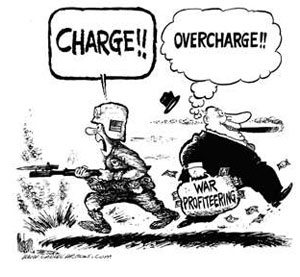
Adding insult to injury, contractors are overcharging the government for the basic weaponry they produce while they rake in cash to enrich their shareholders. In the past 15 years, the Pentagon’s internal watchdog has exposed price gouging by contractors ranging from Boeing and Lockheed Martin to lesser-known companies like TransDigm Group. In 2011, Boeing made about $13 million in excess profits by overcharging the Army for 18 spare parts used in Apache and Chinook helicopters. To put that in perspective, the Army paid $1,678.61 each for a tiny helicopter part that the Pentagon already had in stock at its own warehouse for only $7.71.

The Pentagon found Lockheed Martin and Boeing price gouging together in 2015. They overcharged the military by “hundreds of millions of dollars” for missiles. TransDigm similarly made $16 million by overcharging for spare parts between 2015 and 2017 and even more in the following two years, generating nearly $21 million in excess profits. If you can believe it, there is no legal requirement for such companies to refund the government if they’re exposed for price gouging.

Of course, there’s nothing new about such corporate price gouging, nor is it unique to the arms industry. But it’s especially egregious there, given how heavily the major military contractors depend on the government’s business. Lockheed Martin, the biggest of them, got a staggering 73% of its $66 billion in net sales from the government in 2022. Boeing, which does far more commercial business, still generated 40% of its revenue from the government that year. (Down from 51% in 2020.)

Despite their reliance on government contracts, companies like Boeing seem to be doubling down on practices that often lead to price gouging. According to Bloomberg News, between 2020 and 2021, Boeing refused to provide the Pentagon with certified cost and pricing data for nearly 11,000 spare parts on a single Air Force contract. Senator Elizabeth Warren (D-MA) and Representative John Garamendi (D-CA) have demanded that the Pentagon investigate since, without such information, the department will continue to be hard-pressed to ensure that it’s paying anything like a fair price, whatever its purchases.

Curbing the Special Interest Politics of “Defense”

Reining in rip-offs and corruption on the part of weapons contractors large and small could save the American taxpayer untold billions of dollars. And curbing special-interest politics on the part of the denizens of the military-industrial-congressional complex (MICC) could help open the way towards the development of a truly defensive global military strategy rather than the current interventionist approach that has embroiled the United States in the devastating and counterproductive wars of this century.

One modest step towards reining in the power of the arms lobby would be to revamp the campaign finance system by providing federal matching funds, thereby diluting the influential nature of the tens of millions in campaign contributions the arms industry makes every election cycle. In addition, prohibiting retiring top military officers from going to work for arms-making companies — or, at least, extending the cooling off period to at least four years before they can do so, as proposed by Senator Warren — would also help reduce the undue influence exerted by the MICC.

Last but not least, steps could be taken to prevent the military services from giving Congress their annual wish lists — officially known as “unfunded priorities lists” — of items they want added to the Pentagon budget. After all, those are but another tool allowing members of Congress to add billions more than what the Pentagon has even asked for to that department’s budget.

Whether such reforms alone, if adopted, would be enough to truly roll back excess Pentagon spending remains to be seen. Without them, however, count on one thing: the department’s budget will almost certainly continue to soar, undoubtedly reaching $1 trillion or more annually within just the next few years.  Americans can’t afford to let that happen.

How the Psychopaths Who Run the U.S. Government Think

By Eric Zuesse

Source: The Duran

On June 25th, the former Obama Secretary of State and current Biden climate czar John Kerry was interviewed by Darius Rochebin on the TF1 French TV network and Kerry accused Putin of aggression against Ukraine, he was pretending that the war in Ukraine hadn’t started with America’s coup in Ukraine in 2014 turning that country, which has the nearest border to The Kremlin, rabidly anti-Russian. Rochebin replied by comparing Russia’s 2022 invasion of Ukraine and America’s 2003 invasion of Iraq. He asked Kerry: wasn’t that an international war-crime, an aggressive invasion against Iraq, which was based on the lie that Iraq was hiding WMD, weapons of mass destruction? Kerry answered “No.” Rochebin asked Kerry why it wasn’t comparable to Bush’s invasion of Iraq. Kerry said that there was no comparison because whereas Putin is being charged by the ICC for a war crime of aggression, Bush never was. An accurate description of the discussion was provided by Russia’s RT, and here that is:

——

https://www.rt.com/news/578750-john-kerry-iraq-aggression-lie/

26 June 2023 17:29

US envoy admits Iraq invasion was based on lie

The 2003 war was not a crime because President George W. Bush was never charged, John Kerry has insisted

[The passage is starting at 9:30 in the video:

https://www.tf1info.fr/international/video-john-kerry-sur-lci-contre-le-rechauffement-climatique-il-faut-de-l-argent-2261616.html.%5D

The US-led invasion of Iraq was completely different to the current Ukraine conflict, Washington’s special envoy for climate change John Kerry has told French TV channel LCI.

He appeared on LCI’s Sunday evening show hosted by Darius Rochebin, who had previously interviewed him for a Swiss outlet in 2017. Rochebin tweeted a video segment of the interview, in which he confronted Kerry about the West accusing Russia of aggression regarding Ukraine. The French journalist noted that the 2003 invasion of Iraq was an actual war of aggression, based on the lie that Baghdad secretly possessed weapons of mass destruction.

“No,” Kerry replied. “Because there’s never even been, you know, a process of direct accusation of President [George W.] Bush himself.”

He added that there had been “abuses” in the course of that conflict, and that he “spoke out against them.” When Rochebin asked him directly whether the Iraq War had been a crime of aggression, Kerry repeatedly denied it.

“No, No, No. Well, you didn’t know it was a lie at the time. [That’s a lie because Bush certainly did know that it was a lie, at that time.] The evidence that was produced, people didn’t know that it was a lie,” the former diplomat said, before telling Rochebin that he doesn’t intend to “re-debate the Iraq War” at this point. 

Kerry also claimed he was opposed to the war at the time and thought it was the wrong thing to do. He actually voted in the Senate to authorize the invasion, however. When Rochebin pushed him on the apparent double standard, Kerry began speaking about “climate justice.”

The Bush administration accused Iraqi President Saddam Hussein of having chemical and biological weapons, as well as being somehow involved in the 9/11 terrorist attacks in New York and Washington. The ‘evidence’ for WMDs offered to the media and the UN Security Council turned out to be entirely fabricated, and no such weapons were ever found. Likewise, no connection between Baghdad and Al-Qaeda was ever established.

The 2003 invasion and the subsequent occupation of Iraq was carried out without UN approval, by what Bush called a ‘coalition of the willing’. The US, the UK, Australia and Poland provided troops for the attack, though Washington later claimed 44 more countries had offered some kind of support.

Kerry ran against Bush in 2004 but lost. He later served as secretary of state in the Barack Obama administration, and was appointed climate change ambassador by the current president, Joe Biden, in 2021.

——

Here was Rochebin’s tweeted video-clip of the discussion:

The tweeted responses to the discussion were largely regurgitations of U.S.-and-allied propaganda against Putin and against Russia. Very few tweets addressed the comparison of the 2003 invasion of Iraq and the 2022 invasion of Ukraine. Almost all of the tweeted replies were irrelevant to that issue — which had been the issue. Most of the tweets were non-responsive.

I have previously argued that the comparison is valid, and that the case that Bush is a war-criminal is far stronger than is the case that Putin is.

However, what is most remarkable here is the aristocratic Kerry’s unconcern with the substance of the matter — that Bush is at least as guilty as Putin is — and Kerry’s total and obsessive concern instead about whether Bush has been charged as having been a war-criminal. He thinks in labels, instead of realities. Bush has not been labelled “war-criminal.” It seems that all that concerns Kerry is what people think, and not what actually is.

His type of thinking is sometimes called “other-directed” as opposed to “inner-directed,” or else “conformist” instead of “autonomous” (or “independent”). It seems to lack a core, have no personality or character, because the only ‘conscience’ the person has is other people’s opinions, nothing inside the person — the person is actually a vacancy. That’s a classic psychopath: no conscience is present.

Is this a trait that is virtually universal among the people who run the U.S. Government? To judge by those twitter-responses, it appears to be a rather common trait, though perhaps not as universal as among the individuals who run the U.S. Government. In order to participate in the U.S. leadership, psychopathy seems to be the chief prerequisite. It’s the way to ignore reality.

A War Like No Other in Ukraine

By Peter Van Buren

Source: WeMeantWell.com

Joe Biden created for the U.S. a war like no other, one where others die and the U.S. simply sits back and pays the bills on a gargantuan scale. No attempts are made at diplomacy by the Americans, and the diplomatic efforts of others like the Chinese are dismissed as evil attempts to gain influence in the area (similar for Chinese diplomatic work in the Yemen war.) Biden is coming close to achieving 1984‘s goal of perpetual warfare while only putting a handful of American lives at risk. He has learned lessons from the Cold War, and already put them into play. Can we call it the Biden Doctrine yet?

Biden’s strategy is clear enough now after well more than a year of conflict; what he has been sending to Ukraine jumped from helmets and uniforms to F-16s in only 15 months and shows no signs of stopping. The problem is U.S. weapons are never enough for victory and always “just enough” to allow the battle to go on until then next round. If the Ukrainians think they are playing the U.S. for suckers for free arms they best check who is really paying for everything, in blood.

Putin is playing this game himself in a way, careful not to introduce anything too powerful, such as strategic bombers, and upset the balance and offer Biden the chance to intervene in the war directly (one can hear old man Biden on TV now, explaining American airstrikes are needed to prevent a genocide, the go-to excuse he learned at Obama’s knee.) That’s what the current escalation holds, airpower. Ukraine will find even with the promise of the F-16 it can’t acquire aircraft and train up pilots fast enough (minimum training time is 18-24 months), and next will be begging the U.S. to serve as its air force. As it is the planes are likely to be based out of Poland and Romania, suggesting NATO will pick up the high-skilled tasks of maintaining and repairing them. Left unclear is the NATO role in required aerial refueling to keep the planes over the battlefield. F-16s aside, a spin off bonus to all these weapons gifts is that the vast majority of transfers to date have been “presidential drawdowns.” This means the U.S. sends used or older weapons to Ukraine, after which the Pentagon can use the Congressionally-authorized funds to replenish their stocks by purchasing new arms. The irony that war machines once in Iraq are now on the ground in Ukraine can’t be missed.

The U.S. strategy seems based on creating a ghastly tie of sorts, two sides lined up across a field shooting at each other until one side called it quits for the day. Same as in 1865, same as in 1914, but the new factor is today those armies face off across those fields with 21st-century HIMARS artillery, machine guns, and other tools of killing far more effective than a musket. It is unsustainable, literally chewing up men, albeit not Americans. The question meanwhile of how many more Ukrainians have to die is answered privately by Joe Biden as “potentially all of them.” Anything else requires you to cynically believe Biden thinks he can simply purchase victory,

Up until now this has all been the Cold War playbook. Fighting to the last Afghan was a strategy perfected in Soviet-held Afghanistan in the 1980s. Yet what is different is the scale — since Russia invaded Ukraine, the United States sent over $37 billion worth of military aid to support Kiev’s war effort, the single largest arms transfer in U.S. history and one with no signs of stopping. A single F-16 costs up to $350 million a copy if bought with weapons, maintenance equipment, and spare parts kits.

Yet despite the similarities to Cold War Strategy 101, some lessons have been learned over the intervening years. One of America’s fail-points throughout the Cold War and the War on Terror was the use of puppet governments largely imposed or direly supported by American money and muscle. Because these governments lacked the support of the people (see Vietnam, Iraq, and Afghanistan) they were non-starters with the lifespan of fruit flies. Ukraine is different; the puppet government is the government, beholden to the U.S. for its very survival but more or less supported directly by the people for now.

The other lesson learned has to do with nation building, or rebuilding or reconstruction, whatever the vast post-war expenditures will be called in this conflict. No more straight-up governmental efforts as in Vietnam, Iraq, and Afghanistan. This time it will be all private enterprise. “It is obvious that American business can become the locomotive that will once again push forward global economic growth,” President Zelensky said, boasting that BlackRock, JP Morgan, and Goldman Sachs, and others “have already become part of our Ukrainian way.”

The NYT calls Ukraine “the world’s largest construction site” and predicts projects there in the multi-billions, as high in some estimates as $750 billion. It will be, says the Times, a “gold rush: the reconstruction of Ukraine once the war is over. Russia is stepping up its offensive heading into the second year of the war, but already the staggering rebuilding task is evident. Hundreds of thousands of homes, schools, hospitals and factories have been obliterated along with critical energy facilities and miles of roads, rail tracks and seaports. The profound human tragedy is unavoidably also a huge economic opportunity.” Earlier this year JP Morgan and Zelensky signed a memorandum of understanding stipulating Morgan would assist Ukraine in its reconstruction.

And maybe those large American companies have learned the lessons of Iraq and Afghanistan. Of the billions spent, much money was wasted on dead ends and much was siphoned off due to corruption. But success or failure, the contractors always got paid in our Wars of Terror. With that in mind, more than 300 companies from 22 countries signed up for a Rebuild Ukraine exhibition and conference in Warsaw. At the World Economic Forum in Davos, Switzerland, a standing-room-only crowd packed Ukraine House to discuss investment opportunities.

The eventual gold rush in rebuilding makes for an interesting addendum to the Biden strategy of fighting to the last Ukrainian. The more that is destroyed the more that needs to be rebuilt, and the potential for more money to pour into U.S. companies smart enough to wait by the trough for the killing to subside. But why wait? Drones operated by Danish companies have already mapped every bombed-out structure in the Mykolaiv Oblast region, with an eye toward using the data to help decide what reconstruction contracts should be issued.

So let’s put some lipstick on this pig of a strategy and call it the Biden Doctrine. Part I is to limit direct U.S. combat involvement while fanning the flames for others. Part II is to provide massive amounts of arms to enable a fight to the last local person. Part III is to transform the home government into a puppet instead of creating an unpopular one afresh. Part IV is to turn the reconstruction process into a profit center for American companies. How long the war lasts and how many die are cynically not part of the strategy. The off ramp in Ukraine, a diplomatic outcome that resets the map to pre-invasion 2022 levels, is clear enough to Washington. The Biden administration seems content, shamefully, not to call forcefully for diplomatic efforts but instead to bleed out the Russians as if this was Afghanistan 1980, albeit in the heart of Europe.

Julian Assange’s Imprisonment Is The Intellectual Imprisonment of Us All

By Eric Zuesse

Source: The Duran

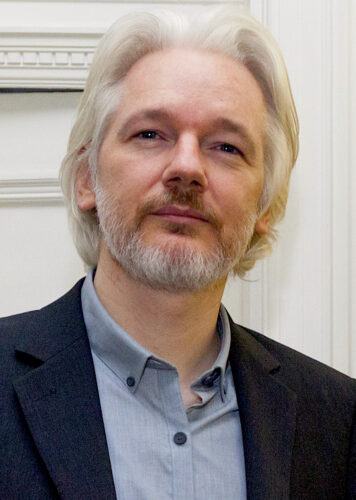
Julian Assange has been imprisoned since 2012 because he had provided, to whistleblowers who were in government and who saw and could supply to his WikiLeaks organization, items of evidence which indicated that their government was breaking its own laws, protection of their personal identity, which confidentiality they could then rely upon for their personal safety, to protect those whistleblowers against retaliation by their government. No regular ‘news’-medium could or would reliably do that, but Assange and his WikiLeaks organization could, and they always did. This is why governmental whistleblowers did go to them for this purpose.

The power that a government has to ‘classify’ documents is the power that it has to hide evidence from its public and so to rule its population as being their subjects instead of (authentically) their citizens: it is the ability to BE a dictatorship. (It might arguably be acceptable when a democracy is being invaded by a foreign country, but never — other than that — can there be governmental secrecy to protect itself unless the government is a dictatorship — NOT a democracy — in which case the Government is, itself, being the enemy of its own population.) Without such secrecy against the public, the government would be a democracy, because then the population would be voting in an authentically free information-environment where there exists uncensored information to the public, so that each individual can make one’s OWN individual judgments regarding what is true, and what is false. But, otherwise, a government is a dictatorship.

This power (classifying governmental information) is also a government’s power of legal impunity so that it can violate its own laws and know that the voting public will not know that it did. That routine power of classifying information is the intellectual imprisonment of the nation’s entire population.

Julian Assange is not a subject (‘citizen’) of the U.S. Government, nor is he a subject of the UK Government, nor is he a subject of the other two Governments (Sweden and Ecuador) that have participated in assisting America and Britain to place and keep him in varying forms of (now super-max) imprisonment for over a decade, but they have done it, during all of this time, and never yet has he been tried and convicted of anything other than his having jumped bail in 2012 on a phony rape charge that even its alleged victim admitted had been false; so, in effect, if not in reality, his very imprisonment is an example of those governments’ dictatorships — it has already been long-term imprisonment without trial. ONLY a dictatorship does that. Only a dictatorship can do that.

Assange is instead a subject of the Australian dictatorship, which has done nothing at all to assist him or to protest his being raped by ‘law’ in those foreign lands. The fact that there are not revolutions overthrowing and replacing the Governments in each one of the countries that has participated in this ‘legal’ rape of Assange is testimony to the effectiveness of the intellectual imprisonment of each one of those nations’ populations.

Assange has been in various forms of imprisonment by UK for the last ten years without his ever having been convicted of anything except that in 2012 he was sentenced to 50 weeks in prison for jumping bail (on sexual charges against him that even the alleged accuser denied were true). And yet he remains now in solitary confinement (“23 hours a day locked in their cells”) in a super-max British prison, because the U.S. Government won’t stop its demand that he be extradited to the U.S. (and killed here — imprisoned for up to 175 years — instead of in Britain). His only ‘crime’ was his publishing only truths, especially truths that cut to the core of exposing the U.S. regime’s constant lying. So, this blatant and illegal injustice against an international hero (virtually everywhere except in the United States) is today one prominent disproof of the U.S. and UK lies to the effect that they are democracies. On 26 September 2021, Yahoo News reported (based largely on reporting in Madrid’s El Pais on 5 January 2021) that the Trump Administration felt so embarrassed by some information that had been WikiLeaked, they drew up detailed plans to kidnap Assange at the Ecuadorian Embassy in London to “rendition” him for possible execution by America. The plans, including “meetings with authorities or approvals signed by the president,” were finally stopped at the National Security Council, as being too risky. “Discussions over kidnapping or killing Assange occurred ‘at the highest levels’ of the Trump administration”, even without any legal basis to try him in the United States. So: the Trump Administration then prepared an indictment against Assange (to legalize their extradition-request), and the indictment became unsealed or made public on the same day, 11 April 2019, when Ecuador’s Government allowed UK’s Government to drag Assange out into UK super-max solitary-confinement imprisonment, and this subsequently produced lie-based U.S. & UK tussles over how to prevent Assange from ever again being able to reach the public, either by continuing his solitary confinement, or else by, perhaps, poisoning him, or else convicting him of something and then executing him. On 4 January 2021, a British judge nixed Assange’s defense case: “I reject the defence submissions concerning staying extradition [to U.S.] as an abuse of the process of this court.” Earlier, her handling of Assange’s only ‘trial’, which was his extradition hearing, was a travesty, which would have been expected in Hitler’s courts, and which makes clear that UK’s courts can be just as bad as Nazi courts had been. However, the U.S. regime’s efforts to grab Assange continued on. Barack Obama, Donald Trump, Joe Biden, and the overwhelmingly compliant U.S. Congress, are all to blame for that dictatorial regime’s pursuit against that champion of truth-telling; and the same blame applies to the leadership in UK. On 10 December 2021, BBC bannered “Julian Assange can be extradited to the US, court rules”. Blatantly, both America and England lie in order to refer to themselves as being democracies. In fact, America has the world’s highest percentage of its residents in prisons. It’s the world’s #1 police-state. Is that because Americans are worse than the people in other countries, or is it instead because the thousand or so individuals who collectively control the nation’s Government are, themselves, especially psychopathic? Evidence will now be linked-to on that question: America has been scientifically examined more than any other country has, in regards to whether it is an aristocracy, or instead a democracy, and the clear and consistent finding is that it’s an aristocracy. And it clearly is that at the federal level. (Here is a video summarizing the best single study of that, and it finds America to be an aristocracy, because it’s controlled by the richest few). And Norway’s aristocracy had also been part of this scandal. It is an international scandal, and keeps getting worse.

On June 19th, Chris Hedges headlined “The Imminent Extradition of Julian Assange & the Death of Journalism” and documented that the alleged ‘assurances’ that the U.S. regime had provided to the UK regime on the basis of which the latter dictatorship would be transferring Assange to a super-max prison in the United States, had as many holes in it as a ton of Swiss cheese.

ONLY in barbaric dictatorships is any of this even possible, but here it is real.

Assange’s ‘trial’ will be the trial of ‘democracy’ in whatever nation it will be executed.

—————

Investigative historian Eric Zuesse’s new book, AMERICA’S EMPIRE OF EVIL: Hitler’s Posthumous Victory, and Why the Social Sciences Need to Change, is about how America took over the world after World War II in order to enslave it to U.S.-and-allied billionaires. Their cartels extract the world’s wealth by control of not only their ‘news’ media but the social ‘sciences’ — duping the public.

The patriotism of killing and being killed

Why are patriotism and war so intertwined in U.S. media and politics?

By Norman Solomon

Source: Nation of Change

The Fourth of July—the ultimate patriotic holiday—is approaching again. Politicians orate, American Flags proliferate and, even more than usual, many windows on the world are tinted red, white and blue. But an important question remains unasked: Why are patriotism and war so intertwined in U.S. media and politics?

The highest accolades often go to those who died for their country. But when a war is based on deception with horrific results, as became clear during the massive bloodshed in Vietnam, realism and cynicism are apt to undermine credulity. “War’s good business so give your son,” said a Jefferson Airplane song in 1967. “And I’d rather have my country die for me.”

Government leaders often assert that participating in war is the most laudable of patriotic services rendered. And even if the fighters don’t know what they’re fighting for, the pretense from leadership is that they do. When President Lyndon Johnson delivered a speech to U.S. troops at Cam Ranh Bay in South Vietnam, he proclaimed that “you know what you are doing, and you know why you are doing it—and you are doing it.”

Five decades later, long after sending U.S. troops to invade Panama in 1989 and fight the 1991 Gulf War, former President George H.W. Bush tweeted that he was “forever grateful not only to those patriots who made the ultimate sacrifice for our Nation—but also the Gold Star families whose heritage is imbued with their honor and heroism.” Such lofty rhetoric is routine.

Official flattery elevates the warriors and the war, no matter how terrible the consequences. In March 2010, making his first presidential visit to Afghanistan, Barack Obama told the assembled troops at Bagram Air Base that they “represent the virtues and the values that America so desperately needs right now: sacrifice and selflessness, honor and decency.”

From there, Obama went on to a theme of patriotic glory in death: “I’ve been humbled by your sacrifice in the solemn homecoming of flag-draped coffins at Dover, to the headstones in section 60 at Arlington, where the fallen from this war rest in peace alongside the fellow heroes of America’s story.” Implicit in such oratory is the assumption that “America’s story” is most heroic and patriotic on military battlefields.

A notable lack of civic imagination seems to assume that there is no higher calling for patriotism than to kill and be killed. It would be an extremely dubious notion even if U.S. wars from Vietnam to Afghanistan and Iraq had not been based on deception—underscoring just how destructive the conflation of patriotism and war can be.

From Vietnam to Iraq and beyond, the patriotism of U.S. troops—and their loved ones as well as the general public back home—has been exploited and manipulated by what outgoing President Dwight Eisenhower called the “military-industrial complex.” Whether illuminated by the Pentagon Papers in 1971 or the absence of the proclaimed Iraqi weapons of mass destruction three decades later, the falsehoods provided by the White House, State Department and Pentagon have been lethal forms of bait-and-switch.

Often lured by genuine love of country and eagerness to defend the United States of America, many young people have been drawn into oiling the gears of a war machine—vastly profitable for Pentagon contractors and vastly harmful to human beings trapped in warfare.

Yet, according to top officials in Washington and compliant media, fighting and dying in U.S. wars are the utmost proof of great patriotism.

We’re encouraged to closely associate America’s wars with American patriotism in large part because of elite interest in glorifying militarism as central to U.S. foreign policy. Given the destructiveness of that militarism, a strong argument can be made that true patriotism involves preventing and stopping wars instead of starting and continuing them.

If such patriotism can ever prevail, the Fourth of July will truly be a holiday to celebrate.