After the Crash

Dispatches From a Long Recovery (Est. 10/2024)

After the Crash

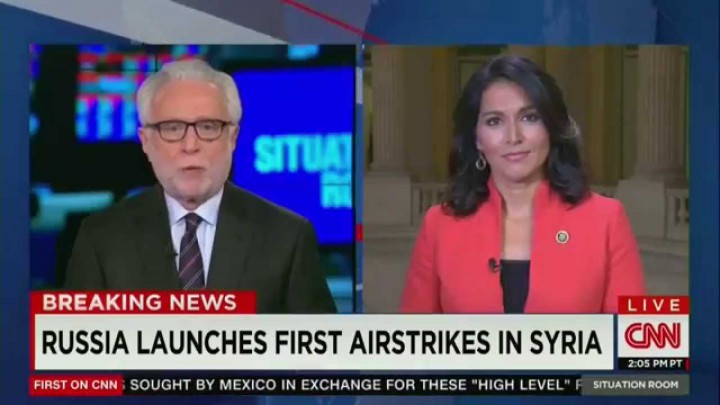
Headline News: US Congress Member Speaks the Truth on CNN

maxresdefault

In a time when politicians are expected to lie and corporate news networks more often than not self-censor (if/when covering actual news), it’s indeed a headline story when a member of congress speaks the truth on a corporate cable news program. Not surprisingly for those who’ve followed her career, the refreshingly honest words came from Rep. Tulsi Gabbard.

Gabbard was one of the first female combat veterans and became the youngest woman elected to a U.S. state office (as Representative for for Hawaii’s 42nd House District ) at age 21 in 2002. In 2004, Gabbard deployed with her Hawaii Army National Guard unit for a 12-month tour in Iraq where she served in a field medical unit as a specialist with a 29th Support Battalion medical company. Upon her return from Iraq in 2006 Gabbard served as a legislative aide for U.S. Senator Daniel Akaka in Washington, DC. During this time she attended the Accelerated Officer Candidate School at the Alabama Military Academy and finished as the distinguished honor graduate in March 2007  (a first for a woman in the Academy’s 50-year history). From 2011 and 2012 Gabbard served in the Honolulu City Council and in 2012 became the first American Samoan and Hindu member of the US Congress. On October 12, 2015 Captain Gabbard was promoted to Major at a ceremony at the National Memorial Cemetery of the Pacific, the same day she was disinvited by the DNC from the Democratic presidential debate for publicly stating she wanted to see more debates. Gabbard has been politically outspoken as a pro-choice and same-sex marriage supporter and has advocated for alternative energy, Native Hawaiian rights and a return of the Glass-Steagall Act. She has also opposed the use of drones to kill U.S. citizens.

As cynical as most of us should be about politics and government in this day and age, it’s promising when individuals who seem to have the honesty, intelligence and work ethic to be a true leader rise through the ranks. It’s especially hopeful for those who’d like to see more women in positions of power (other than Hillary, Palin, Fiorina, etc), regardless of whether improved leadership does anything significant to fix the current system.

Statements from Gabbard in the CNN segment that may startle those who habitually get news from corporate media include:

“The U.S. and the CIA are working to overthrow the Syrian government of Assad…

…while Russia, a long-time ally of Assad for decades now, is working to defend or uphold the Syrian government of Assad, and this puts us in a position of a possible direct head-to-head conflict with Russia as long as the U.S. and CIA continue down this path.”

(H/T: Truthstream Media)

The Role of Dystopian Fiction in a Dystopian World

images

By Luther Blissett and J. F. Sebastian of Arkesoul

A few years ago, Neal Stephenson wrote a widely-shared article called Innovation Starvation for the World Policy Institute. He began the piece lamenting our inability to fulfill the hopes and dreams of mid-20th century mainstream American society. Looking back at the majority of sci-fi visions of the era, it’s clear many thought we’d be living in a utopian golden age and exploring other planets by now. In reality, the speed of technological innovation has seemingly declined compared to the first half of the 20th century which saw the creation of cars, airplanes, electronic computers, etc. Stephenson also mentions the Deepwater Horizon oil spill and Fukushima disasters as examples of how we’ve collectively lost our ability to “execute on the big stuff”.

Stephenson’s explanation for this predicament is two-fold; outdated bureaucratic structures which discourage risk-taking and innovation, and the failure of cultural creatives to provide “big visions” which dispute the notion that we have all the technology we’ll ever need. While there’s much to be said about archaic, inefficient (and corrupt) bureaucracies, there’s also a compelling argument invoked over the cultural importance of storytelling and art and how best to utilize it. One of the solutions offered by Stephenson, in this regard, is Project Hieroglyph which he describes as “an effort to produce an anthology of new SF that will be in some ways a conscious throwback to the practical techno-optimism of the Golden Age.”

While Project Hieroglyph may be a noble endeavor, one could argue that it’s based on a flawed premise. The role of science fiction has never been just about supplying grand visions for a better future, but to make sense of the present. There seems to be an assumption that the optimistic Golden Age had a causal relationship with a perceived technological golden age when it may have simply been a reflection of it— just as dystopian sci-fi reflects and strongly resonates with the world today. Stephenson may be correct in his view that much SF today is written in a “generally darker, more skeptical and ambiguous tone”, but this more nuanced perspective does not necessarily signify the belief that “we have all the technology we’ll ever need”. Rather, it reflects decades of collective experience and knowledge of unforeseen and cumulative effects of technologies. Nor does such fiction focus only on destructive effects of technology, as large a component of the narrative it may be simply because it makes for better drama and the subtext is often intended as a critique rather than celebration. For example, the archetypal hacker protagonists of technocratic cyberpunk dystopias employ technology for more positive ends (though some question whether good SF, as in speculative fiction, needs to involve new technology at all).

A particularly positive function for dystopian sci-fi is its use as rhetorical shorthand. It’s increasingly common in public discourse on major issues of the day to invoke dystopian references. Disastrous social effects of peak oil or post-collapse are often characterized as Mad Max scenarios. Various negative aspects of genetic modification and pharmaceutical development conjure Brave New World. Anxiety over out-of-control AI and resultant devaluing of human life brings to mind films as varied as Blade Runner, The Matrix and Terminator films. The expanding police/surveillance state is reminiscent of 1984 and numerous classics which have followed in its footsteps including V for Vendetta and Brazil. General fears of duplicitous, psychopathic power elites and social manipulation have elevated They Live from relatively obscure b-movie to cult classic. The entry of the term “zombie apocalypse” into the popular lexicon may in part stem from fear (and uncomfortable recognition) of images of viral social disintegration and martial law-enforced containment efforts depicted throughout various media. The burgeoning omnipotence of multinational corporations and hackers in Mr. Robot may have been the stuff of cyberpunk dystopias such as Neuromancer and Max Headroom 30 years ago, yet, it still has much to contribute to the public discourse as contemporary drama. Such visions may not prevent (or have not prevented) the scenarios they warn us of but have provided a vocabulary and framework for understanding such problems, and who’s to say how much worse it could be had such cautionary memes never existed?

The prophetic nature of storytelling, inasmuch as it derives from the minds of authors, artists and commentators that coexist with tensions and contexts particular to their epochs, resonate with the oughts, ifs, and whats inherent to our daily lives. As it were, the cautionary element of narrative is a natural product of the human mind, and the premium of what involves sharing our mental reserves to the world. To creatively dwelve and concoct problems and solutions from experience, is an axiom analogous to that of the categorical imperative—purely, and in abstract terms of what rationality involves. Yet, often times, we find material that is in favor of cultural malaise; of all things pathological in our society, such as censorship, conformity, bureaucracy, authoritarianism, militarism, and capital marketing; things which underpin issues that, if left untouched, can engulf the real brilliance of our spirit.

Stephenson fails to see this point. SF, as any form of intelligent culture, denounces and opposes systems of oppression, and even shows us the how, when, and why—the frameworks, the makings of apparent utopias into dystopias. Dystopian storytelling can serve the efforts of downtrodden creators with utopian ideals as effectively as utopian stories can reframe a societal trajectory led by beneficiaries of real world dystopia (though it may be experienced as utopia for a privileged few). SF does not only conjure visions of better futures. They lend us vocabularies and syntaxes to understand, and impede the fallenness of a confused, and ever increasingly isolated humanity. They are languages that pervade our interiorities, and that allow the exterior to change.

At the core, SF is prophecy through reasoned extrapolation and artistic intuition. This is what SF stands for when properly aligned with the subjectivities of the oppressed, and not with the voices of oppression: true testaments of a space and a time; visions of the future that carefully partake in not committing the mistakes of the past; and tools for our personal and collective flourishing.

Skynet Ascendant

t2skynetbdcap1

By Cory Doctorow

Source: Locus Online

As I’ve written here before, science fiction is terrible at predicting the future, but it’s great at predicting the present. SF writers imagine all the futures they can, and these futures are processed by a huge, dynamic system consisting of editors, booksellers, and readers. The futures that attain popular and commercial success tell us what fears and aspirations for technology and society are bubbling in our collective imaginations.

When you read an era’s popular SF, you don’t learn much about the future, but you sure learn a lot about the past. Fright and hope are the inner and outer boundaries of our imagination, and the stories that appeal to either are the parameters of an era’s political reality.

Pay close attention to the impossibilities. When we find ourselves fascinated by faster than light travel, consciousness uploading, or the silly business from The Matrix of AIs using human beings as batteries, there’s something there that’s chiming with our lived experience of technology and social change.

Postwar SF featured mass-scale, state-level projects, a kind of science fictional New Deal. Americans and their imperial rivals built cities in space, hung skyhooks in orbit, even made Dyson Spheres that treated all the Solar System’s matter as the raw material for the a new, human-optimized megaplanet/space-station that would harvest every photon put out by our sun and put it to work for the human race.

Meanwhile, the people buying these books were living in an era of rapid economic growth, and even more importantly, the fruits of that economic growth were distributed to the middle class as well as to society’s richest. This was thanks to nearly unprecedented policies that protected tenants at the expense of landlords, workers at the expense of employers, and buy­ers at the expense of sellers. How those policies came to be enacted is a question of great interest today, even as most of them have been sunsetted by successive governments across the developed world.

Thomas Piketty’s data-driven economics bestseller Capital in the Twenty-First Century argues that the vast capital destruction of the two World Wars (and the chaos of the interwar years) weakened the grip of the wealthy on the governments of the world’s developed states. The arguments in favor of workplace safety laws, taxes on capital gains, and other policies that undermined the wealthy and benefited the middle class were not new. What was new was the political possibility of these ideas.

As developed nations’ middle classes grew, so did their material wealth, political influence, and expectations that governments would build am­bitious projects like interstate highways and massive civil engineering projects. These were politically popular – because lawmakers could use them to secure pork for their voters – and also lucrative for government contractors, making ‘‘Big Government’’ a rare point of agreement between the rich and middle-income earners.

(A note on poor people: Piketty’s data suggests that the share of the national wealth controlled by the bottom 50% has not changed much for several centuries – eras of prosperity are mostly about redistributing from the top 10-20% to the next 30-40%)

Piketty hypothesizes that the returns on investment are usually greater than the rate of growth in an economy. The best way to get rich is to start with a bunch of money that you turn over to professional managers to invest for you – all things being equal, this will make you richer than you could get by inventing something everyone uses and loves. For example, Piketty contrasts Bill Gates’s fortunes as the founder of Microsoft, once the most profitable company in the world, with Gates’s fortunes as an investor after his retirement from the business. Gates-the-founder made a lot less by creating one of the most successful and profitable products in history than he did when he gave up making stuff and started owning stuff for a living.

By the early 1980s, the share of wealth controlled by the top decile tipped over to the point where they could make their political will felt again – again, Piketty supports this with data showing that nations elect seriously investor-friendly/worker-unfriendly governments when investors gain control over a critical percentage of the national wealth. Leaders like Reagan, Thatcher, Pinochet, and Mulroney enacted legislative reforms that reversed the post-war trend, dis­mantling the rules that had given skilled workers an edge over their employers – and the investors the employers served.

The greed-is-good era was also the cyberpunk era of literary globalized corporate dystopias. Even though Neuromancer and Mirrorshades predated the anti-WTO protests by a decade and a half, they painted similar pictures. Educated, skilled people – people who comprised the mass of SF buyers – became a semi-disposable under­class in world where the hyperrich had literally ascended to the heavens, living in orbital luxury hotels and harvesting wealth from the bulk of humanity like whales straining krill.

Seen in this light, the vicious literary feuds between the cyberpunks and the old guard of space-colonizing stellar engineer writers can be seen as a struggle over our political imagination. If we crank the state’s dials all the way over the right, favoring the industrialist ‘‘job creators’’ to the exclusion of others, will we find our way to the stars by way of trickle-down, or will the overclass graft their way into a decadent New Old Rome, where reality TV and hedge fund raids consume the attention and work we once devoted to exploring our solar system?

Today, wealth disparity consumes the popular imagination and political debates. The front-running science fictional impossibility of the unequal age is rampant artificial intelligence. There were a lot of SF movies produced in the mid-eighties, but few retain the currency of the Termina­tor and its humanity-annihilating AI, Skynet. Everyone seems to thrum when that chord is plucked – even the NSA named one of its illegal mass surveillance programs SKYNET.

It’s been nearly 15 years since the Matrix movies debuted, but the Red Pill/Blue Pill business still gets a lot of play, and young adults who were small children when Neo fought the AIs know exactly what we mean when we talk about the Matrix.

Stephen Hawking, Elon Musk, and other luminaries have issued pan­icked warnings about the coming age of humanity-hating computerized overlords. We dote on the party tricks of modern AIs, sending half-admiring/half-dreading laurels to the Watson team when it manages to win at Jeopardy or randomwalk its way into a new recipe.

The fear of AIs is way out of proportion to their performance. The Big Data-trawling systems that are supposed to find terrorists or figure out what ads to show you have been a consistent flop. Facebook’s new growth model is sending a lot of Web traffic to businesses whose Facebook followers are increasing, waiting for them to shift their major commercial strategies over to Facebook marketing, then turning off the traffic and demanding recurr­ing payments to send it back – a far cry from using all the facts of your life to figure out that you’re about to buy a car before even you know it.

Google’s self-driving cars can only operate on roads that humans have mapped by hand, manually marking every piece of street-furniture. The NSA can’t point to a single terrorist plot that mass-surveillance has disrupted. Ad personalization sucks so hard you can hear it from orbit.

We don’t need artificial intelligences that think like us, after all. We have a lot of human cognition lying around, going spare – so much that we have to create listicles and other cognitive busy-work to absorb it. An AI that thinks like a human is a redundant vanity project – a thinking version of the ornithopter, a useless mechanical novelty that flies like a bird.

We need machines that don’t fly like birds. We need AI that thinks unlike humans. For example, we need AIs that can be vigilant for bomb-parts on airport X-rays. Humans literally can’t do this. If you spend all day looking for bomb-parts but finding water bottles, your brain will rewire your neurons to look for water bottles. You can’t get good at something you never do.

What does the fear of futuristic AI tell us about the parameters of our present-day fears and hopes?

I think it’s corporations.

We haven’t made Skynet, but we have made these autonomous, transhuman, transnational technolo­gies whose bodies are distributed throughout our physical and economic reality. The Internet of Things version of the razorblade business model (sell cheap handles, use them to lock people into buying expensive blades) means that the products we buy treat us as adversaries, checking to see if we’re breaking the business logic of their makers and self-destructing if they sense tampering.

Corporations run on a form of code – financial regulation and accounting practices – and the modern version of this code literally prohibits corporations from treating human beings with empathy. The principle of fiduciary duty to inves­tors means that where there is a chance to make an investor richer while making a worker or customer miserable, management is obliged to side with the investor, so long as the misery doesn’t backfire so much that it harms the investor’s quarterly return.

We humans are the inconvenient gut-flora of the corporation. They aren’t hostile to us. They aren’t sympathetic to us. Just as every human carries a hundred times more non-human cells in her gut than she has in the rest of her body, every corpora­tion is made up of many separate living creatures that it relies upon for its survival, but which are fundamentally interchangeable and disposable for its purposes. Just as you view stray gut-flora that attacks you as a pathogen and fight it off with anti­biotics, corporations attack their human adversaries with an impersonal viciousness that is all the more terrifying for its lack of any emotional heat.

The age of automation gave us stories like Chap­lan’s Modern Times, and the age of multinational hedge-fund capitalism made The Matrix into an enduring parable. We’ve gone from being cogs to being a reproductive agar within which new cor­porations can breed. As Mitt Romney reminded us, ‘‘Corporations are people.’’

Why Russia is Serious About Fighting Terrorism and the US Isn’t

obama_on_isis_10-1-2015_8-50-53_am

By Maram Susli

Source: New Eastern Outlook

Russia in the few days it has been of fighting terrorism in Syria has achieved far more than the US coalition. According to the New York Times, Russia’s fighter jets are conducting nearly as many strikes in a typical day as the American-led coalition has been carrying out each month this year, a number which includes strikes conducted in Iraq – not just Syria.

Whilst the US has been bombing ISIS for over a year, ISIS has only grown and gained more ground in Syria. A few months ago ISIS took over the ancient city of Palmyra in Syria, a UNESCO world heritage-listed site.

In spite of the fact that the US government acknowledged ISIS cannot be defeated without ground troops, they have refused to work with the Syrian military, the only force on the ground commanded by the only UN-recognized government in the country, and the only force capable and willing to fight ISIS.

On the other hand Russia is coordinating with the Syrian military on the ground, assisting Syrian troops in gaining ground against terrorism. The discrepancy shows a lack of honesty on the part of the US when it comes to its real agenda in Syria vs its proclaimed goal of fighting terrorism. The US is capable of more, the US military is the most powerful and technologically advanced force in the world. It is logical to conclude that they are willfully throwing the fight against terrorism in Syria and the reasons for that should be examined.

ISIS Serves US Geopolitical Interests, Threatens Russia’s

It has become clear that the US’s main objectives in Syria is not their expressed goal of ‘fighting ISIS’, but regime change, isolating Russian influence, the Balkanization and the creation of failed states. US presidential candidate and former Secretary of State Hillary Clinton herself stated that ‘removing Assad is the top priority”.

The US sees the Syrian state as one of the last spheres of Russian influence beyond the borders of the former Soviet Union, and a threat to its Israeli ally in the region. The presence of ISIS and other terrorists groups serves these interests. The US has a history of using terrorism to topple governments friendly to Russia. Al Qaeda itself was borne of the US objective to topple the Soviet friendly government of Afghanistan. The dismemberment of Russian-friendly Serbia and the creation of Kosovo was done via the same means.

More recently ISIS was a direct result of the US’s intervention in Iraq, and have only arrived in Libya and Syria in the wake of overt US-backed regime change efforts there. Although Libya and Iraq did not have relations with Russia as strong as Syria’s, Russia was still their main weapons supplier. It is therefore not surprising that since Russia entered the war in Syria, Saudi clerics and the Muslim Brotherhood – both US state assets – declared ‘jihad’ on Russia.

The former Defence Intelligence Agency (DIA) Chief Michael Flynn said in an interview that he believed the US had made a willful decision to allow ISIS to grow in Syria. A 2012 declassified DIA report, wrote if the US and its allies continued to destabilize Syria by arming extremist insurgents “there is the possibility of establishing a declared or undeclared Salafist principality in eastern Syria… and this is exactly what the supporting powers to the opposition want, in order to isolate the Syrian regime.”

The CIA had trained thousand of ‘rebels’, not to fight ISIS, but admittedly to fight the Assad government and Syrian military – showing once again that the real objective behind the US’ involvement is regime change. Media across the West has even admited this, including the Washington Post which would report:

…the CIA has since 2013 trained some 10,000 rebels to fight Assad’s forces. Those groups have made significant progress against strongholds of the Alawites, Assad’s sect.

Russia Has More to Gain by Truly Fighting Terrorism 

On the other hand Russia has clear geopolitical interests behind defending the Syrian state against terrorism. Syria has been an ally of Russia for decades, and it hosts Russia’s only Mediterranean naval base. Russian Foreign Minister Lavrov stated that Russia is entering Syria to prevent ‘another Libyan scenario,’ or in other words – to prevent it from turning into a failed state as the US had done to Libya.

Furthermore Russian interests in fighting terrorism are tied directly to Russia’s own national security. Russia has had problems in the past with terrorism within their own borders and in particular, Chechnya. Chechen fighters who have joined ISIS in Syria, have now threatened to take the fight to Moscow. Jabhat Al Nusra, Syria’s Al Qaeda faction, have also called for terror attacks in Russia. In an interview with 60 minutes, Russia’s President Vladimir Putin stated that it is better to fight terrorists in Syria than wait until they return to Russia.

Terrorism poses far greater risks to Russia’s national security than it does to the US. Not only is their proximity closer, but terrorists in Russia have the potential to cleave off part of the state and overrun entire Russian towns. This is not the case for the US, whose only risk to national security would be civilian deaths due to bombings, and that is not necessarily something that the US government would find a real ‘problem,’ and in fact, might even see as a possible opportunity.

The US Seeks Only to Contain ISIS

The US only wants to contain ISIS within Syria and Iraq’s borders indefinitely – not to defeat them. This was admitted to by a member of the current US government and party, Democratic Rep. Adam Smith to CNN who stated:

…we need to find partners that we can work with in Syria to help us contain ISIS. So it is a difficult problem to figure out the best strategy. I agree, they have safe haven there in parts of Syria and that will have to be part of the strategy for containing ISIS. 

Chairman of the U.S. House Intelligence Committee, Rep. Devin Nunes told CBS news:

 I think we are containing ISIS within the borders of Iraq and Syria. Outside of that we’re not doing much.

US President Barack Obama himself stated that he would like to like to:

…continue to shrink ISIL’s sphere of influence, its effectiveness, its financing, its military capabilities to the point where it is a manageable problem.

This suggests that President Obama wants to maintain ISIS sphere power to a contained manageable circle, like a diseases that is treated but never cured. Obama perhaps got his policies on the advice of the Brooking Institute think-tank, which stated:

Should we defeat ISIS? Rather than defeat, containing their activities within failed or near-failing states is the best option for the foreseeable future.

The US is Not Actually Bombing ISIS

The US bombing of ISIS has been mostly nominal, an exercise in perception management. Although the US Defense Intelligence Agency makes regular claims to have bombed specific targets, rarely is video evidence of the bombing strikes published. On the other hand the Russian military regularly releases video of most of the strikes on Russia Today. It was also leaked that the US had forbade its fighter jets from targeting a long list of ISIS training camps, which turn out thousands of fighters a month.

Award winning journalist Robert Fisk told the Australian program Lateline that the US could have bombed a convoy of ISIS militants who were taking over Palmyra, but instead allowed them to take over a Syrian military post as well as the ancient City which they have now begun to destroy. When the US has dropped bombs on ISIS run territory they have used the opportunity to primarily destroy Syria’s oil infrastructure. Likewise the US has largely avoided bombing ISIS and Al Qaeda targets in the Syrian district of North Hama in an attempt to prevent Syrian troops from gaining ground.Russia is now striking these targets long the benefactors of US-granted impunity.

The US Has ‘Forgotten’ its War with al Qaeda, Now Protects It

Perhaps the most ironic development of Russia’s involvement in Syria’s fight against terror, is the anger expressed by the US government and its media at Russia’s bombing of Al Qaeda (Jabhat Al Nusra) targets.

Former US National Security Adviser Zbigniew Brzezinski, the man largely responsible for the creation of Al Qaeda, expressed his frustration with the fact that Russia was targeting Al Qaeda as well as ISIS through his twitter account. Pro-NATO media has all but forgotten its war with Al Qaeda, and avoids any mention of its existence preferring to concentrate on ISIS instead. They have especially tried to avoid bringing to light the fact that Russia is bombing Al Qaeda in Syria where the US has largely avoided doing so including Homs, Hama, Idlib, and around Aleppo.

In the same CNN article which accuses Russia of not targeting ISIS but rather‘Syrian rebels”, two maps displayed from the Institute for the Study of War shows a very telling story. The first shows the areas in which Jabhat al Nusra controls or jointly controls with its allies – the so called moderate rebels receiving US-backing – but on a map showing locations of Russian strikes, Jabhat al Nusra territory can scarcely be seen, obstructed by highly concentrated Russian strikes – in other words – it is finally being wiped out of these areas.

The US is Continuing to Fund and Arm Terrorists

The map further illustrates how US-backed ‘moderate rebels’ working alongside Al Qaeda has become such common knowledge. In the past, commanders of rebel groups labeled ‘moderate’ by the US government have fought alongside ISIS, and reiterated their support of ISIS in satellite news interviews.

Recently “moderate rebels” from the so-called “Free Syrian Army” Division 16 joined Al Nusra in their attacks against the Kurdish city of Sheikh Maqsud in Aleppo. Pro-NATO media has even been reduced to calling the rebels ‘relatively moderate’. Relative to Al Qaeda and ISIS?

In any case, ‘moderate’ has always been a relative term, unlike the word secular which is the US run media dares not use to describe the US backed insurgency. Last week the US abandoned a Pentagon program to train rebels to fight ISIS, after all but five defected to Al Qaeda taking their weapons and training with them. Past attempts by the US to arm ‘vetted rebels’ has resulted in TOW anti-tank missiles ending up in the hands of Al Qaeda. But instead of admitting to the fact that ‘moderate rebels’ do not exist and ceasing the illegal armament of extremist insurgents, the US government has instead chosen to openly back “established rebel groups” who have close ties to Al Qaeda. The US is now sending yet another shipment of TOW missiles to these extremist groups through its ally Saudi Arabia.

Al Qaeda is not the only terrorist group the US has been accused of arming. This month, footage filmed by the Iraqi military of an oil refinery that had been captured by ISIS, shows US supply crates full of food and weapons having been delivered to Islamic State militants by parachute. In 2014, footage of another US supply drop to ISIS in Kobane Syria also emerged online. Only a few days ago the US airdropped 50 tons of ammunition into Hasake region of Syria, where there has been a lot of ISIS activity. Most of the weaponry used by ISIS is US made. In January this year, an Iraqi MP Majid al-Ghraoui publically accused the US of supplying ISIS with weapons through airdrops.

Iraq Trusts Russia More Than the US in a Real Fight Against Terrorism

The Iraqi government has become increasingly suspicious of the US’ lack of real commitment in fighting ISIS. On the other hand, Russian strikes have thus far been so effective against ISIS that the Iraqi government has asked Russia to take on a bigger role against ISIS than the US.

Russia has in turn signaled that it may start bombing ISIS in Iraq as well as Syria, with the permission of the Iraqi government. Unlike the US, Russia has not broken international law and has sought permission to enter Iraq and Syria from each respective state’s legitimate government.

With these actions Russia has called the US’ bluff on fighting ISIS, and is effectively forcing the US to do a better job of convincing the Iraqi government that it is truly fighting ISIS. If Russia does enter Iraqi airspace, it will more easily cross into Syrian airspace to provide supplies to the Syrian government, since the US has bullied many countries in the region to close their airspace to Russian aircraft. Furthermore, if Iraq asks Russia to enter, it is a scenario that would reverse any of the influence the US had gained in Iraq throughout its lengthy occupation of the country since 2003.

The US has been backed into a corner, and in doing so, has exposed itself and its allies as the source of terrorism, not champions truly fighting it. Terrorism has always been a means by which the US has sought to deconstruct Russian spheres of influences. Ironically over the last decade it has also simultaneously perpetuated the myth that it is actually fighting a war against terror. However as its allied states grow increasingly tired of this game, how long can the US continue to juggle this duplicity, before the entire deck of cards crumbles?

Maram Susli also known as “Syrian Girl,” is an activist-journalist and social commentator covering Syria and the wider topic of geopolitics. especially for the online magazineNew Eastern Outlook”.


Why America Will Never Hear the Entire Benghazi Story

ct-benghazi-hillary-clinton-20151022

By Larry Hancock

Source: WhoWhatWhy.org

The underlying story of Benghazi is one that cannot and will not be talked about in any open session of Congress. This means that Thursday’s hearing featuring former Secretary of State Hillary Clinton was nothing but an exercise in futility.

It is the story of a covert CIA operation that was operating from a separate facility in the Benghazi compound that was simply known as the “Annex.” Some two dozen CIA case officers, analysts, translators and special staff were a part of this operation and its security was provided by CIA Global Response Staff (GRS), who had entered the country under diplomatic cover.

The CIA’s mission included arms interdiction — attempting to stop the flow of Soviet-era weapons to Central Africa — and very possibly the organization of Libyan arms shipments to vetted insurgent groups on the ground in Syria.

There is also evidence that the mission was working in concert with military personnel from the Joint Special Operations Group Trans-Sahara. At the time of the attack, an unarmed American surveillance drone was in flight over the territory east of Benghazi and Trans-Sahara military personnel were stationed in the Libyan capital of Tripoli.

In contrast, the State Department’s special diplomatic mission facility, classified as “temporary,” was minimally staffed with a rotating series of State Department officers sent to and from Tripoli.

US Ambassador Christopher Stevens had not been in Benghazi for a year. When he arrived for a short stay in September 2012, only a single diplomatic officer was present there, and that officer rotated back to Tripoli upon the ambassador’s arrival. Stevens was accompanied by a communications officer and a handful of Diplomatic Service Security staff. The security personnel provided protection for the ambassador during his travels and meetings in the city. His presence was intended to be extremely low key, but it was exposed in the local media shortly after his arrival.

Fruitless, Meaningless, Pointless Questioning

Asking Clinton to justify maintaining the State Department temporary mission in the face of a worsening security situation is fruitless, given its actual function as a clandestine national security mission cover.

Questioning Clinton about that role would be as meaningless as questioning senior CIA personnel about operational information. Such missions cannot be publicly acknowledged or discussed, and revealing anything about them is strictly prohibited.

The same national security laws constraining State Department and CIA personnel also prevent lawmakers, other than those on select intelligence committees, from being briefed on such missions. And even those privileged individuals could not raise related questions in public — or even in closed sessions that include committee members or staff without the appropriate clearances.

In addition, querying Clinton about her involvement in the immediate response to the attacks is also pointless. The Secretary of State has no legal or operational role in a military response to a diplomatic facility attack. Only National Command Authority (president/secretary of defense) can order a foreign military intervention. The State Department does have Foreign Emergency Support Teams (FEST), composed of personnel from multiple agencies and maintained on alert to respond to crisis. But the FEST teams have no military elements and are dispatched only in the aftermath of a crisis, when the security situation allows. Following an attack their role is damage assessment and recovery.

Earlier investigations have already documented that President Obama ordered a military response immediately upon word reaching Washington. They showed as well that the AFRICOM commander responded to that order right away, directing deployment of the closest military quick reaction units — units which were on station in Spain, training in Eastern Europe, or back in the United States.

There were no armed American aircraft or naval units close enough to respond during the attack, those assets were in operation in Afghanistan, Iraq and around the Horn of Africa in Somalia and Yemen.

Maintaining a Covert Profile

As for the well-equipped paramilitary operatives at the CIA station, according to their own statements, they were initially held back by the CIA station chief — as they had been in other incidents. And the station chief was, in turn, acting under his directive to let local militia groups respond. That practice was intended to maintain the station’s covert profile. Unfortunately, it was not consistent with providing any real time defense for the State Department compound.

Given all of the above, it is clear why the hearing quickly turned into a game of “pin the tail on the donkey.” As Democrats have claimed all along — and some Republicans have recently admitted — the committee’s work is mostly about beating up a political adversary and not at all about advancing the security of American diplomats abroad.


Larry Hancock conducts investigative and historical research in the areas of intelligence and national security. He has studied Benghazi in regard to both its covert aspects and the issues it raises for diplomatic security. That work is published in Shadow Warfare, A History of America’s Undeclared Wars (Counterpoint, 2014) and his most recently published book, Surprise Attack, from Pearl Harbor to 9/11 to Benghazi (Counterpoint, Sept. 2015).

Financial Predators and Parasites Want to Live, Regardless of the Cost

Bankers-and-Tick1

By Charles Hugh Smith

Source: Of Two Minds

Reform is impossible in a system optimized for centralized power and financial predators and parasites.

The problem with optimizing private gain by any means available is you also optimize financial predators and parasites. The problem with optimizing a system for centralized power (i.e. the federal government and Federal Reserve) is that you also optimize regulatory capture, influence-peddling and the unholy marriage of wealth and power.

Optimization is a key principle of all technologies. Though the political class claims perfection is possible (with just a few more regulations and laws, heh), engineers understand every system is a series of trade-offs. If you want to optimize one output, everything else in the system is rendered secondary.

The master narrative of the status quo is that maximizing private gain by any means available is good because to get rich is glorious: the goal of getting rich motivates entrepreneurs to do wonderful things that benefit humanity while they amass vast fortunes.

This is the happy propaganda story, and we all know the few outliers who are endlessly trotted out to “prove” its truth: Steve Jobs, the Larrys (Ellison and Page) Bill Gates, et al. Nice, but the handful who fulfill the propaganda version of optimizing private gain by any means available only succeeded because there were no powerful vested interests in their way.

What our system actually optimizes is the assembly of vested interests that buy protection of their racket from the state. These vested interests include wealthy individuals, corporations, cartels and public unions.

Want to earn a 1,000% return on your investment? It’s very difficult to do so by producing a good or service. By any measure, the easiest, lowest-risk way to earn a 1,000% return on your investment is to buy political protection with lobbying and campaign contributions.

What we’ve done is optimize financial predation and parasitism. We’ve created enormous incentives for too big to fail/jail banks, financiers manipulating dark pools and high-frequency trading that add nothing to the real economy, public unions guaranteeing their members unbeatable pensions and benefits while taxpayers foot the bill, politicos who enter office with ambition and few financial means who leave office with great wealth, cartels that buy protection from competition from the centralized state and corporations that rewrite the tax code in their favor with campaign contributions.

Now that we’ve created vast menageries of insatiably greedy financial predators and parasites, we’ve created monsters who want to live regardless of the cost to the nation. Parasites prefer not to kill their host, but their ability to fine-tune the process of sucking as much money out of the system as possible without bringing it down is not as well-developed as their greed.

The Global Financial Meltdown of 2008 proved this. The financial parasites and their parasitic partners in the halls of federal power were blind to the risks of collapse their insatiable greed were generating; they continued sucking the maximum private gain out of the system until the moment it collapsed in a heap.

Predators don’t worry about maintaining the flock of sheep or the schools of little fish. They will dive into the swirling school of frantic fish and consume every last one. Financial predators are the same: financial predators will sell a subprime auto loan to every last debt-serf in the flock, until the ecosystem of prey collapses and there are no marks left for their cons.

This is why our system is well and truly doomed: we have optimized the system for vast menageries of insatiably greedy financial predators and parasites, and now that they exist and have gained power, they want to live and prosper regardless of the cost to the decimated prey and the nation. By optimizing centralized power, we have optimized the protection of financial predators and parasites by the all-powerful central state and bank.

Reform is impossible in a system optimized for centralized power and financial predators and parasites. The predators and parasites will gorge themselves until the system collapses.


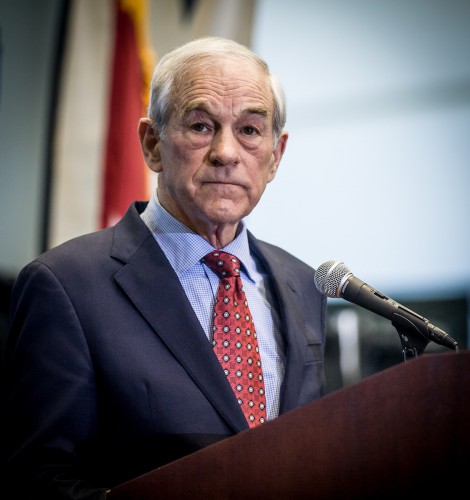
Politicians Exploit School Shooting While Ignoring Bombing Victims

Ron_Paul_0723

By Ron Paul

Source: Ron Paul Institute

Following the recent Oregon school shooting, many politicians rushed to the microphones to call for new gun control laws. President Obama even called on gun control supporters to “politicize” the shooting, while some members of Congress worked to establish a special commission on gun violence.

The reaction to the shooting stands in stark contrast to the reaction to the US military’s bombing of an Afghanistan hospital run by the international humanitarian (and Nobel Peace Prize winning) group Doctors Without Borders.

Our Nobel Peace Prize winning president did apologize to his fellow Nobel laureate for the bombing. However, President Obama has not “politicized” this tragedy by using it to justify ending military involvement in Afghanistan. No one in Congress is pushing for a special commission to examine the human costs of US militarism, and the mainstream media has largely ignored Doctors Without Borders’ accusation that the bombing constitutes a war crime.

The reason for the different reactions to these two events is that politicians prefer to focus on events they can “politicize” to increase government power. In contrast, politicians ignore incidents that raise uncomfortable questions about US foreign policy.

If the political and media elites were really interested in preventing future mass shootings, they would repeal the federal “gun-free” schools law, for example. By letting shooters know that their intended victims are defenseless, the gun-free schools law turns schoolchildren into easy targets.

Even some who oppose gun control are using the shooting to justify expanding federal power instead of trying to repeal unconstitutional laws. Some opponents of new gun control laws say Congress should expand the federal role in identifying, tracking, and treating those with “mental health problems.” This ignores the fact that many shooters were using psychotropic drugs prescribed by a mental health professional when they committed the horrible acts. Furthermore, creating a system to identify and track anyone with a “mental health problem” could deny respect for individuals’ Second Amendment and other rights because they perhaps once sought counseling for depression while going through a divorce or coping with a loved one’s passing.

While our political and media elites are eager to debate how much liberty people must sacrifice for safety, they are desperate to avoid debating the morality of our foreign policy. To admit that the US military sometimes commits immoral acts is to admit that the US government is not an unalloyed force for good. Even many proponents of our recent wars support using the US military for “humanitarian” purposes. Thus they are as reluctant as the neoconservatives to question the fundamental goodness of US foreign policy.

Anyone who raises constitutional or moral objections to the US use of drones, bombs, indefinite detention, and torture risks being attacked as anti-American and soft on terrorism. The smear of “terrorist apologist” is also hurled at those who dare suggest that it is our interventionist foreign policy, not a hatred of freedom, that causes people in other countries to dislike the United States. Which is a more logical explanation for why someone would resent America — a family member killed in a drone attack launched by the US military or rage over our abundance of liberty?

The disparate reactions to the Oregon school shooting and the Afghanistan hospital bombing shows the political class is unwilling and unable to acknowledge that the US government cannot run the world, run our lives, or run the economy. Clearly, politicians will never stop expanding government and give us back our lost liberties unless and until the people demand it.

The New American Order

natsec

1% Elections, The Privatization of the State, a Fourth Branch of Government, and the Demobilization of “We the People” 

By Tom Engelhardt

Source: TomDispatch.com

Have you ever undertaken some task you felt less than qualified for, but knew that someone needed to do? Consider this piece my version of that, and let me put what I do understand about it in a nutshell: based on developments in our post-9/11 world, we could be watching the birth of a new American political system and way of governing for which, as yet, we have no name.

And here’s what I find strange: the evidence of this, however inchoate, is all around us and yet it’s as if we can’t bear to take it in or make sense of it or even say that it might be so.

Let me make my case, however minimally, based on five areas in which at least the faint outlines of that new system seem to be emerging: political campaigns and elections; the privatization of Washington through the marriage of the corporation and the state; the de-legitimization of our traditional system of governance; the empowerment of the national security state as an untouchable fourth branch of government; and the demobilization of “we the people.”

Whatever this may add up to, it seems to be based, at least in part, on the increasing concentration of wealth and power in a new plutocratic class and in that ever-expanding national security state. Certainly, something out of the ordinary is underway, and yet its birth pangs, while widely reported, are generally categorized as aspects of an exceedingly familiar American system somewhat in disarray.

1. 1% Elections

Check out the news about the 2016 presidential election and you’ll quickly feel a sense of been-there, done-that. As a start, the two names most associated with it, Bush and Clinton, couldn’t be more familiar, highlighting as they do the curiously dynastic quality of recent presidential contests.  (If a Bush or Clinton should win in 2016 and again in 2020, a member of one of those families will have controlled the presidency for 28 of the last 36 years.)

Take, for instance, “Why 2016 Is Likely to Become a Close Race,” a recent piece Nate Cohn wrote for my hometown paper.  A noted election statistician, Cohn points out that, despite Hillary Clinton’s historically staggering lead in Democratic primary polls (and lack of serious challengers), she could lose the general election.  He bases this on what we know about her polling popularity from the Monica Lewinsky moment of the 1990s to the present.  Cohn assures readers that Hillary will not “be a Democratic Eisenhower, a popular, senior statesperson who cruises to an easy victory.”  It’s the sort of comparison that offers a certain implicit reassurance about the near future.  (No, Virginia, we haven’t left the world of politics in which former general and president Dwight D. Eisenhower can still be a touchstone.)

Cohn may be right when it comes to Hillary’s electability, but this is not Dwight D. Eisenhower’s or even Al Gore’s America. If you want a measure of that, consider this year’s primaries. I mean, of course, the 2015 ones. Once upon a time, the campaign season started with candidates flocking to Iowa and New Hampshire early in the election year to establish their bona fides among party voters. These days, however, those are already late primaries.

The early primaries, the ones that count, take place among a small group of millionaires and billionaires, a new caste flush with cash who will personally, or through complex networks of funders, pour multi-millions of dollars into the campaigns of candidates of their choice.  So the early primaries — this year mainly a Republican affair — are taking place in resort spots like Las Vegas, Rancho Mirage, California, and Sea Island, Georgia, as has been widely reported. These “contests” involve groveling politicians appearing at the beck and call of the rich and powerful, and so reflect our new 1% electoral system. (The main pro-Hillary super PAC, for instance, is aiming for a kitty of $500 million heading into 2016, while the Koch brothers network has already promised to drop almost $1 billion into the coming campaign season, doubling their efforts in the last presidential election year.)

Ever since the Supreme Court opened up the ultimate floodgates with its 2010 Citizens United decision, each subsequent election has seen record-breaking amounts of money donated and spent. The 2012 presidential campaign was the first $2 billion election; campaign 2016 is expected to hit the $5 billion mark without breaking a sweat.  By comparison, according to Burton Abrams and Russell Settle in their study, “The Effect of Broadcasting on Political Campaign Spending,” Republicans and Democrats spent just under $13 million combined in 1956 when Eisenhower won his second term.

In the meantime, it’s still true that the 2016 primaries will involve actual voters, as will the election that follows. The previous election season, the midterms of 2014, cost almost $4 billion, a record despite the number of small donors continuing to drop. It also represented the lowest midterm voter turnout since World War II. (See: demobilization of the public, below — and add in the demobilization of the Democrats as a real party, the breaking of organized labor, the fragmenting of the Republican Party, and the return of voter suppression laws visibly meant to limit the franchise.) It hardly matters just what the flood of new money does in such elections, when you can feel the weight of inequality bearing down on the whole process in a way that is pushing us somewhere new.

2. The Privatization of the State (or the U.S. as a Prospective Third-World Nation)

In the recent coverage of the Hillary Clinton email flap, you can find endless references to the Clintons of yore in wink-wink, you-know-how-they-are-style reporting; and yes, she did delete a lot of emails; and yes, it’s an election year coming and, as everyone points out, the Republicans are going to do their best to keep the email issue alive until hell freezes over, etc., etc.  Again, the coverage, while eyeball gluing, is in a you’ve-seen-it-all-before, you’ll-see-it-all-again-mode.

However, you haven’t seen it all before. The most striking aspect of this little brouhaha lies in what’s most obvious but least highlighted.  An American secretary of state chose to set up her own private, safeguarded email system for doing government work; that is, she chose to privatize her communications.  If this were Cairo, it might not warrant a second thought.  But it didn’t happen in some third-world state.  It was the act of a key official of the planet’s reigning (or thrashing) superpower, which — even if it wasn’t the first time such a thing had ever occurred — should be taken as a tiny symptom of something that couldn’t be larger or, in the long stretch of history, newer: the ongoing privatization of the American state, or at least the national security part of it.

Though the marriage of the state and the corporation has a pre-history, the full-scale arrival of the warrior corporation only occurred after 9/11.  Someday, that will undoubtedly be seen as a seminal moment in the formation of whatever may be coming in this country.  Only 13 years later, there is no part of the war state that has not experienced major forms of privatization.  The U.S. military could no longer go to war without its crony corporations doing KP and guard duty, delivering the mail, building the bases, and being involved in just about all of its activities, including training the militaries of foreign allies and even fighting.  Such warrior corporations are now involved in every aspect of the national security state, including torture, drone strikes, and — to the tune of hundreds of thousands of contract employees like Edward Snowden — intelligence gathering and spying.  You name it and, in these years, it’s been at least partly privatized.

All you have to do is read reporter James Risen’s recent book, Pay Any Price, on how the global war on terror was fought in Washington, and you know that privatization has brought something else with it: corruption, scams, and the gaming of the system for profits of a sort that might normally be associated with a typical third-world kleptocracy.  And all of this, a new world being born, was reflected in a tiny way in Hillary Clinton’s very personal decision about her emails.

Though it’s a subject I know so much less about, this kind of privatization (and the corruption that goes with it) is undoubtedly underway in the non-war-making, non-security-projecting part of the American state as well.

3. The De-legitimization of Congress and the Presidency

On a third front, American “confidence” in the three classic check-and-balance branches of government, as measured by polling outfits, continues to fall.  In 2014, Americans expressing a “great deal of confidence” in the Supreme Court hit a new low of 23%; in the presidency, it was 11%, and in Congress a bottom-scraping 5%.  (The military, on the other hand, registers at 50%.)  The figures for “hardly any confidence at all” are respectively 20%, 44%, and more than 50%.  All are in or near record-breaking territory for the last four decades.

It seems fair to say that in recent years Congress has been engaged in a process of delegitimizing itself.  Where that body once had the genuine power to declare war, for example, it is now “debating” in a desultory fashion an “authorization” for a war against the Islamic State in Syria, Iraq, and possibly elsewhere that has already been underway for eight months and whose course, it seems, will be essentially unaltered, whether Congress authorizes it or not.

What would President Harry Truman, who once famously ran a presidential campaign against a “do-nothing” Congress, have to say about a body that truly can do just about nothing?  Or rather, to give the Republican war hawks in that new Congress their due, not quite nothing.  They are proving capable of acting effectively to delegitimize the presidency as well.  House Majority Leader John Boehner’s invitation to Israeli Prime Minister Benjamin Netanyahu to undercut the president’s Iranian nuclear negotiations and the letter signed by 47 Republican senators and directed to the Iranian ayatollahs are striking examples of this.  They are visibly meant to tear down an “imperial presidency” that Republicans gloried in not so long ago.

The radical nature of that letter, not as an act of state but of its de-legitimization, was noted even in Iran, where fundamentalist Supreme Leader Ali Khamenei proclaimed it “a sign of a decline in political ethics and the destruction of the American establishment from within.” Here, however, the letter is either being covered as a singularly extreme one-off act (“treason!”) or, as Jon Stewart didon “The Daily Show,” as part of a repetitive tit-for-tat between Democrats and Republicans over who controls foreign policy.  It is, in fact, neither.  It represents part of a growing pattern in which Congress becomes an ever less effective body, except in its willingness to take on and potentially take out the presidency.

In the twenty-first century, all that “small government” Republicans and “big government” Democrats can agree on is offering essentially unconditional support to the military and the national security state.  The Republican Party — its various factions increasingly at each other’s throats almost as often as at those of the Democrats — seems reasonably united solely on issues of war-making and security.  As for the Democrats, an unpopular administration, facing constant attack by those who loath President Obama, has kept its footing in part by allying with and fusing with the national security state.  A president who came into office rejecting torture and promoting sunshine and transparency in government has, in the course of six-plus years, come to identify himself almost totally with the U.S. military, the CIA, the NSA, and the like.  While it has launched an unprecedented campaign against whistleblowers and leakers (as well as sunshine and transparency), the Obama White House has proved a powerful enabler of, but also remarkably dependent upon, that state-within-a-state, a strange fate for “the imperial presidency.”

4. The Rise of the National Security State as the Fourth Branch of Government

One “branch” of government is, however, visibly on the rise and rapidly gaining independence from just about any kind of oversight.  Its ability to enact its wishes with almost no opposition in Washington is a striking feature of our moment.  But while the symptoms of this process are regularly reported, the overall phenomenon — the creation of a de facto fourth branch of government — gets remarkably little attention.  In the war on terror era, the national security state has come into its own.  Its growth has been phenomenal.  Though it’s seldom pointed out, it should be considered remarkable that in this period we gained a second full-scale “defense department,” the Department of Homeland Security, and that it and the Pentagon have become even more entrenched, each surrounded by its own growing “complex” of private corporations, lobbyists, and allied politicians.  The militarization of the country has, in these years, proceeded apace.

Meanwhile, the duplication to be found in the U.S. Intelligence Community with its 17 major agencies and outfits is staggering.  Its growing ability to surveil and spy on a global scale, including on its own citizens, puts the totalitarian states of the twentieth century to shame.  That the various parts of the national security state can act in just about any fashion without fear of accountability in a court of law is by now too obvious to belabor.  As wealth has traveled upwards in American society in ways not seen since the first Gilded Age, so taxpayer dollars have migrated into the national security state in an almost plutocratic fashion.

New reports regularly surface about the further activities of parts of that state.  In recent weeks, for instance, we learned from Jeremy Scahill and Josh Begley of the Intercept that the CIA has spent years trying to break the encryption on Apple iPhones and iPads; it has, that is, been aggressively seeking to attack an all-American corporation (even if significant parts of its production process are actually in China).  Meanwhile, Devlin Barrett of the Wall Street Journal reported that the CIA, an agency barred from domestic spying operations of any sort, has been helping the U.S. Marshals Service (part of the Justice Department) create an airborne digital dragnet on American cell phones.  Planes flying out of five U.S. cities carry a form of technology that “mimics a cellphone tower.” This technology, developed and tested in distant American war zones and now brought to “the homeland,” is just part of the ongoing militarization of the country from its borders to its police forces.  And there’s hardly been a week since Edward Snowden first released crucial NSA documents in June 2013 when such “advances” haven’t been in the news.

News also regularly bubbles up about the further expansion, reorganization, and upgrading of parts of the intelligence world, the sorts of reports that have become the barely noticed background hum of our lives.  Recently, for instance, Director John Brennan announced a major reorganization of the CIA meant to break down the classic separation between spies and analysts at the Agency, while creating a new Directorate of Digital Innovation responsible for, among other things, cyberwarfare and cyberespionage.  At about the same time, according to the New York Times, the Center for Strategic Counterterrorism Communications, an obscure State Department agency, was given a new and expansive role in coordinating “all the existing attempts at countermessaging [against online propaganda by terror outfits like the Islamic State] by much larger federal departments, including the Pentagon, Homeland Security and intelligence agencies.”

This sort of thing is par for the course in an era in which the national security state has only grown stronger, endlessly elaborating, duplicating, and overlapping the various parts of its increasingly labyrinthine structure.  And keep in mind that, in a structure that has fought hard to keep what it’s doing cloaked in secrecy, there is so much more that we don’t know.  Still, we should know enough to realize that this ongoing process reflects something new in our American world (even if no one cares to notice).

5. The Demobilization of the American People

In The Age of Acquiescence, a new book about America’s two Gilded Ages, Steve Fraser asks why it was that, in the nineteenth century, another period of plutocratic excesses, concentration of wealth and inequality, buying of politicians, and attempts to demobilize the public, Americans took to the streets with such determination and in remarkable numbers over long periods of time to protest their treatment, and stayed there even when the brute power of the state was called out against them.  In our own moment, Fraser wonders, why has the silence of the public in the face of similar developments been so striking?

After all, a grim new American system is arising before our eyes.  Everything we once learned in the civics textbooks of our childhoods about how our government works now seems askew, while the growth of poverty, the flatlining of wages, the rise of the .01%, the collapse of labor, and the militarization of society are all evident.

The process of demobilizing the public certainly began with the military.  It was initially a response to the disruptive and rebellious draftees of the Vietnam-era.  In 1973, at the stroke of a presidential pen, the citizen’s army was declared no more, the raising of new recruits was turned over to advertising agencies (a preview of the privatization of the state to come), and the public was sent home, never again to meddle in military affairs.  Since 2001, that form of demobilization has been etched in stone and transformed into a way of life in the name of the “safety” and “security” of the public.

Since then, “we the people” have made ourselves felt in only three disparate ways: from the left in the Occupy movement, which, with its slogans about the 1% and the 99%, put the issue of growing economic inequality on the map of American consciousness; from the right, in the Tea Party movement, a complex expression of discontent backed and at least partially funded by right-wing operatives and billionaires, and aimed at the de-legitimization of the “nanny state”; and the recent round of post-Ferguson protests spurred at least in part by the militarization of the police in black and brown communities around the country.

The Birth of a New System

Otherwise, a moment of increasing extremity has also been a moment of — to use Fraser’s word — “acquiescence.”  Someday, we’ll assumedly understand far better how this all came to be.  In the meantime, let me be as clear as I can be about something that seems murky indeed: this period doesn’t represent a version, no matter how perverse or extreme, of politics as usual; nor is the 2016 campaign an election as usual; nor are we experiencing Washington as usual.  Put together our 1% elections, the privatization of our government, the de-legitimization of Congress and the presidency, as well as the empowerment of the national security state and the U.S. military, and add in the demobilization of the American public (in the name of protecting us from terrorism), and you have something like a new ballgame.

While significant planning has been involved in all of this, there may be no ruling pattern or design.  Much of it may be happening in a purely seat-of-the-pants fashion.  In response, there has been no urge to officially declare that something new is afoot, let alone convene a new constitutional convention.  Still, don’t for a second think that the American political system isn’t being rewritten on the run by interested parties in Congress, our present crop of billionaires, corporate interests, lobbyists, the Pentagon, and the officials of the national security state.

Out of the chaos of this prolonged moment and inside the shell of the old system, a new culture, a new kind of politics, a new kind of governance is being born right before our eyes. Call it what you want. But call it something. Stop pretending it’s not happening.

Tom Engelhardt is a co-founder of the American Empire Project and the author of The United States of Fear as well as a history of the Cold War, The End of Victory Culture. He is a fellow of the Nation Institute and runs TomDispatch.com. His latest book is Shadow Government: Surveillance, Secret Wars, and a Global Security State in a Single-Superpower World(Haymarket Books).

[Note: My special thanks go to my friend John Cobb, who talked me through this one.  Doing it would have been inconceivable without him.  Tom]

Follow TomDispatch on Twitter and join us on Facebook. Check out the newest Dispatch Book, Rebecca Solnit’s Men Explain Things to Me, and Tom Engelhardt’s latest book, Shadow Government: Surveillance, Secret Wars, and a Global Security State in a Single-Superpower World

Lara Trace Hentz

INDIAN COUNTRY NEWS

In Saner Thought

"It is the duty of every man, as far as his ability extends, to detect and expose delusion and error"..Thomas Paine

ZEDJournAI

Human in Algorithms

Rooster Crows

From the Roof Top

Aisle C

I See This

The Free

blog of the post capitalist transition.. Read or download the novel here + latest relevant posts

अध्ययन-अनुसन्धान(Essential Knowledge of the Overall Subject)

अध्ययन-अनुसन्धानको सार