The political logic of the junk food revolution

By Jonathan Cook

Source: TruePublica

Here is an article on food whose political implications are really worth considering. We already know that people in western societies, particularly the US and UK, are eating far too much junk food, and that this leads to an epidemic of obesity, heart disease and cancer.

But the latest research not only reveals the extent that “ultra-processed” foods have come to dominate our diets in Europe – now comprising more than half of what Britons eat, for example – but raises the question of what effects the consumption of this much junk food will have on our behaviours.

The nutritionists here are reluctant to offer even well-informed speculation, which always seems to be the case with publicly funded scientists until things have moved beyond a critical point. Think of smoking and climate change: we usually learn much later that the corporations’ own pet-scientists had done the research decades earlier proving or predicting exactly what was coming.

But there are hints from the nutritionists to the Guardian of what might be going on:

“People are missing out not only on vitamins and minerals but also bioactive compounds found in natural foods such as phytoestrogens and fibre.

And then you get salt and starch and sugar and fat and all these additives. We are consuming every day an amount of new substances that are these flavours and colours and emulsifiers and we don’t have any idea as to what will be the problem of these items,” [Professor Carlos Monteiro from the University of Sao Paulo in Brazil, who led the research team] said. …

Other cumulative effects of eating these industrially-made substances are not yet known. “The honest answer is we don’t know what is going on,” said Monteiro.’

Here is an educated guess, based in part on experience and in part on the economic and political logic of our current junk food revolution. (Those of us who eat these industrial substances rarely enough that they do not dominate our diets still have a sense of what happens to us on the occasions we do.)

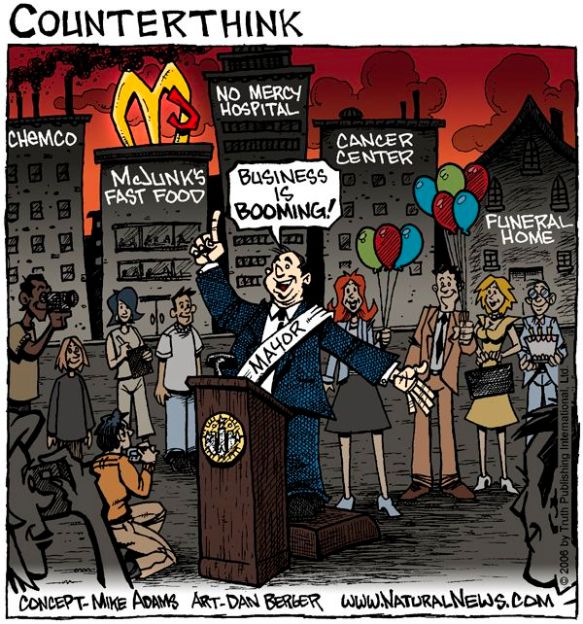
These lab-created, nutritionally empty substances that our bodies have not evolved to digest not only make us physically sick, but emotionally and mentally sick too: addicted, depressed, lazy, sluggish, docile and anxious.

In fact, a mess of emotions that transforms us into the perfect consumers, buying more of this cheap, harmful “food”. That boosts both the profits of food and other corporations and the electoral fortunes of crowd-pleasing, money-grubbing, vacuous politicians who wish to serve those corporations.

That is how an advanced capitalist system – premised on a psychopathic drive by the strongest to maximise profits by exploiting the weakest – will naturally evolve. It needs to make us as dependent, as passive and docile, as possible.

Junk Planet: Is Earth the Largest Garbage Dump in the Universe?

By Robert J. Burrowes

Is Earth the largest garbage dump in the Universe? I don’t know. But it’s a safe bet that Earth would be a contender were such a competition to be held. Let me explain why.

To start, just listing the types of rubbish generated by humans or the locations into which each of these is dumped is a staggering task beyond the scope of one article. Nevertheless, I will give you a reasonably comprehensive summary of the types of garbage being generated (focusing particularly on those that are less well known), the locations into which the garbage is being dumped and some indication of what is being done about it and what you can do too.

But before doing so, it is worth highlighting just why this is such a problem, prompting the United Nations Environment Programme to publish this recent report: ‘Towards a pollution-free planet’.

As noted by Baher Kamal in his commentary on this study: ‘Though some forms of pollution have been reduced as technologies and management strategies have advanced, approximately 19 million premature deaths are estimated to occur annually as a result of the way societies use natural resources and impact the environment to support production and consumption.’ See ‘Desperate Need to Halt “World’s Largest Killer” – Pollution’ and ‘Once Upon a Time a Planet… First part. Pollution, the world’s largest killer’.

And that is just the cost in human lives.

So what are the main types of pollution and where do they end up?


Atmospheric Pollution

The garbage, otherwise labelled ‘pollution’, that we dump into our atmosphere obviously includes the waste products from our burning of fossil fuels and our farming of animals. Primarily this means carbon dioxide, methane and nitrous oxide generated by driving motor vehicles and burning coal, oil and gas to generate electricity, and agriculture based on the exploitation of animals. This is having a devastating impact on Earth’s climate and environment with a vast array of manifestations adversely impacting all life on Earth. See, for example, ‘The World Is Burning’ and ‘The True Environmental Cost of Eating Meat’.

But these well-known pollutants are not the only garbage we dump into the atmosphere. Airline fuel pollutants from both civil and military aircraft have a shocking impact too, with significant adverse public health outcomes. Jet emissions, particularly the highly carcinogenic benzpyrene, can cause various cancers, lymphoma, leukemia, asthma, and birth defects. Jet emissions affect a 25 mile area around an airport; this means that adults, children, animals and plants are ‘crop dusted’ by toxic jet emissions for 12 miles from a runway end. ‘A typical commercial airport spews hundreds of tons of toxic pollutants into our atmosphere every day. These drift over heavily populated areas and settle onto water bodies and crops.’ Despite efforts to inform relevant authorities of the dangers in the USA, for example, they ‘continue to ignore the problem and allow aviation emissions to remain unregulated, uncontrolled and unreported’. See Aviation Justice. It is no better in other countries.

Another category of atmospheric pollutants of which you might not be aware is the particulate aerosol emitted into the atmosphere by the progressive wear of vehicle parts, especially synthetic rubber tyres, during their service life. Separately from this, however, there are also heavier pollutants from wearing vehicle tyres and parts, as well as from the wearing away of road surfaces, that accumulate temporarily on roads before being washed off into waterways where they accumulate.

While this substantial pollution and health problem has attracted little research attention, some researchers in a variety of countries have been investigating the problem.

In the USA as early as 1974, ‘tire industry scientists estimated that 600,000 metric tonnes of tire dust were released by tire wear in the U.S., or about 3 kilograms of dust released from each tire each year’. In 1994, careful measurement of air near roadways with moderate traffic ‘revealed the presence of 3800 to 6900 individual tire fragments in each cubic meter of air’ with more than 58.5% of them in the fully-breathable size range and shown to produce allergic reactions. See ‘Tire Dust’.

A study in Japan reported similar adverse environmental and health impacts. See ‘Dust Resulting from Tire Wear and the Risk of Health Hazards’.

Even worse, a study conducted in Moscow reported that the core pollutant of city air (up to 60% of hazardous matter) was the rubber of automobile tyres worn off and emitted as a small dust. The study found that the average car tyre discarded 1.6 kilograms of fine tyre dust as an aerosol during its service life while the tyre from a commercial vehicle discarded about 15 kilograms. Interestingly, passenger tyre dust emissions during the tyre’s service life significantly exceeded (by 6-7 times) emissions of particulate matters with vehicle exhaust gases. The research also determined that ‘tyre wear dust contains more than 140 different chemicals with different toxicity but the biggest threat to human health is poly-aromatic hydrocarbons and volatile carcinogens’. The study concluded that, in the European Union: ‘Despite tightening the requirements for vehicle tyres in terms of noise emission, wet grip and rolling resistance stipulated by the UN Regulation No. 117, the problem of reduction of tyre dust and its carcinogenic substance emissions due to tyre wear remains unaddressed.’ See ‘Particulate Matter Emissions by Tyres’.

As one toxicologist has concluded: ‘Tire rubber pollution is just one of many environmental problems in which the research is lagging far behind the damage we may have done.’ See ‘Road Rubber’.

Another pollution problem low on the public radar results from environmental modification techniques involving geoengineering particulates being secretly dumped into the atmosphere by the US military for more than half a century, based on research beginning in the 1940s. This geoengineering has been used to wage war on the climate, environment and ultimately ourselves. See, for example, ‘Engineered Climate Cataclysm: Hurricane Harvey’, ‘Planetary Weapons and Military Weather Modification: Chemtrails, Atmospheric Geoengineering and Environmental Warfare’, ‘Chemtrails: Aerosol and Electromagnetic Weapons in the Age of Nuclear War’ and ‘The Ultimate Weapon of Mass Destruction: “Owning the Weather” for Military Use’.

With ongoing official denials about the practice, it has fallen to the ongoing campaigning of committed groups such as GeoEngineering Watch to draw attention to and work to end this problem.

Despite the enormous and accelerating problems already being generated by the above atmospheric pollutants, it is worth pausing briefly to highlight the potentially catastrophic nature of the methane discharges now being released by the warming that has already taken place and is still taking place. A recent scientific study published by the prestigious journal Palaeoworld noted that ‘Global warming triggered by the massive release of carbon dioxide may be catastrophic, but the release of methane from hydrate may be apocalyptic.’ This refers to the methane stored in permafrost and shelf sediment. Warning of the staggering risk, the study highlights the fact that the most significant variable in the Permian Mass Extinction event, which occurred 250 million years ago and annihilated 90 percent of all the species on Earth, was methane hydrate. See Methane Hydrate: Killer cause of Earth’s greatest mass extinction’ and Release of Arctic Methane “May Be Apocalyptic,” Study Warns’.

How long have we got? Not long, with a recent Russian study identifying 7,000 underground [methane] gas bubbles poised to “explode” in Arctic’.

Is much being done about this atmospheric pollution including the ongoing apocalyptic release of methane? Well, there is considerable ‘push’ to switch to renewable (solar, wind, wave, geothermal) energy in some places and to produce electric cars in others. But these worthwhile initiatives aside, and if you ignore the mountain of tokenistic measures that are sometimes officially promised, the answer is ‘not really’ with many issues that critically impact this problem (including rainforest destruction, vehicle emissions, geoengineering, jet aircraft emissions and methane releases from animal agriculture) still being largely ignored.

If you want to make a difference on this biosphere-threatening issue of atmospheric pollution, you have three obvious choices to consider. Do not travel by air, do not travel by car and do not eat meat (and perhaps other animal products). This will no doubt require considerable commitment on your part. But without your commitment in these regards, there is no realistic hope of averting near-term human extinction. So your choices are critical.


Ocean Garbage

Many people will have heard of the problem of plastic rubbish being dumped into the ocean. Few people, however, have any idea of the vast scale of the problem, the virtual impossibility of cleaning it up and the monumental ongoing cost of it, whether measured in terms of (nonhuman) lives lost, ecological services or financially. And, unfortunately, plastic is not the worst pollutant we are dumping into the ocean but I will discuss it first.

In a major scientific study involving 24 expeditions conducted between 2007 and 2013, which was designed to estimate ‘the total number of plastic particles and their weight floating in the world’s oceans’ the team of scientists estimated that there was ‘a minimum of 5.25 trillion particles weighing 268,940 tons’. See ‘Plastic Pollution in the World’s Oceans: More than 5 Trillion Plastic Pieces Weighing over 250,000 Tons Afloat at Sea’ and ‘Full scale of plastic in the world’s oceans revealed for first time’.

Since then, of course, the problem has become progressively worse. See Plastic Garbage Patch Bigger Than Mexico Found in Pacific’ and ‘Plastic Chokes the Seas’.

‘Does it matter?’ you might ask. According to this report, it matters a great deal. See New UN report finds marine debris harming more than 800 species, costing countries millions’.

Can we remove the plastic to clean up the ocean? Not easily. The US National Oceanic and Atmospheric Adminstration has calculated that ‘if you tried to clean up less than one percent of the North Pacific Ocean it would take 67 ships one year’. See ‘The Great Pacific Garbage Patch’. Nevertheless, and despite the monumental nature of the problem – see ‘“Great Pacific garbage patch” far bigger than imagined, aerial survey shows’ – organizations like the Algalita Research Foundation, Ocean Cleanup and Positive Change for Marine Life have programs in place to investigate the nature and extent of the problem and remove some of the rubbish, while emphasizing that preventing plastic from entering the ocean is the key.

In addition, the UN Convention on Biological Diversity outlined a series of measures to tackle the problem in its 2016 report ‘Marine Debris Understanding, Preventing and Mitigating the Significant Adverse Impacts on Marine and Coastal Biodiversity’. In February 2017, the UN launched its Clean Seas Campaign inviting governments, corporations, NGOs and individuals to sign the pledge to reduce their plastic consumption. See #CleanSeas Campaign and ‘World Campaign to Clean Torrents of Plastic Dumped in the Oceans’.

Sadly, of course, it is not just plastic that is destroying the oceans. They absorb carbon dioxide as one manifestation of the climate catastrophe and, among other outcomes, this accelerates ocean acidification, adversely impacting coral reefs and the species that depend on these reefs.

In addition, a vast runoff of agricultural poisons, fossil fuels and other wastes is discharged into the ocean, adversely impacting life at all ocean depths – see Staggering level of toxic chemicals found in creatures at the bottom of the sea, scientists say’ – and generating ocean ‘dead zones’: regions that have too little oxygen to support marine organisms. See Our Planet Is Exploding With Marine “Dead Zones”’.

Since the Fukushima nuclear reactor disaster in 2011, and despite the ongoing official coverup, vast quantities of radioactive materials are being ongoingly discharged into the Pacific Ocean, irradiating everything within its path. See ‘Fukushima: A Nuclear War without a War: The Unspoken Crisis of Worldwide Nuclear Radiation’.

Finally, you may not be aware that there are up to 70 ‘still functional’ nuclear weapons as well as nine nuclear reactors lying on the ocean floor as a result of accidents involving nuclear warships and submarines. See ‘Naval Nuclear Accidents: The Secret Story’ and ‘A Nuclear Needle in a Haystack The Cold War’s Missing Atom Bombs’.

Virtually nothing is being done to stem the toxic discharges, contain the Fukushima radiation releases or find the nuclear weapons and nuclear reactors on the ocean floor.


Waterways and Groundwater Contamination

Many people would be familiar with the contaminants that find their way into Earth’s wetlands, rivers, creeks and lakes. Given corporate negligence, this includes all of the chemical poisons and heavy metals used in corporate farming and mining operations, as well as, in many cases around the world where rubbish removal is poorly organised, the sewage and all other forms of ‘domestic’ waste discharged from households. Contamination of the world’s creeks, rivers, lakes and wetlands is now so advanced that many are no longer able to fully support marine life. For brief summaries of the problem, see ‘Pollution in Our Waterways is Harming People and Animals – How Can You Stop This!’, ‘Wasting Our Waterways: Toxic Industrial Pollution and the Unfulfilled Promise of the Clean Water Act’ and ‘China’s new weapon against water pollution: its people’.

Beyond this, however, Earth’s groundwater supplies (located in many underground acquifers such as the Ogallala Aquifer in the United States) are also being progressively contaminated by gasoline, oil and chemicals from leaking storage tanks; bacteria, viruses and household chemicals from faulty septic systems; hazardous wastes from abandoned and uncontrolled hazardous waste sites (of which there are over 20,000 in the USA alone); leaks from landfill items such as car battery acid, paint and household cleaners; and the pesticides, herbicides and other poisons used on farms and home gardens. See ‘Groundwater contamination’.

However, while notably absent from the list above, these contaminants also include radioactive waste from nuclear tests – see ‘Groundwater drunk by BILLIONS of people may be contaminated by radioactive material spread across the world by nuclear testing in the 1950s’ – and the chemical contamination caused by hydraulic fracturing (fracking) in search of shale gas, for which about 750 chemicals and components, some extremely toxic and carcinogenic like lead and benzene, have been used. See ‘Fracking chemicals’.

There are local campaigns to clean up rivers, creeks, lakes and wetlands in many places around the world, focusing on the primary problems – ranging from campaigning to end poison runoffs from mines and farms to physically removing plastic and other trash – in that area. But a great deal more needs to be done and they could use your help.


Soil Contamination

Our unsustainable commercial farming and soil management practices are depleting the soil of nutrients and poisoning it with synthetic fertilisers, herbicides, pesticides and antibiotics (the latter contained in animal manure) at such a prodigious rate that even if there were no other adverse impacts on the soil, it will be unable to sustain farming within 60 years. See ‘Only 60 Years of Farming Left If Soil Degradation Continues’.

But not content to simply destroy the soil through farming, we also contaminate it with heavy metal wastes from industrial activity, as well as sewer mismanagement – see ‘“Black Soils” Excessive Use of Arsenic, Cadmium, Lead, Mercury…’ – the waste discharges from corporate mining – see, for example, ‘The $100bn gold mine and the West Papuans who say they are counting the cost’ – and the radioactive and many other toxic wastes from military violence, discussed below.

We also lose vast quantities of soil by extensive clearfelling of pristine forests to plant commercially valuable but ecologically inappropriate ‘garbage species’ (such as palm oil trees – see ‘The Great Palm Oil Scandal’ – soya beans – see ‘Soy Changes Map of Brazil, Set to Become World’s Leading Producer’ – and biofuel crops). This leaves the soil vulnerable to rainfall which carries it into local creeks and rivers and deposits it downstream or into the ocean.

Staggering though it may sound, we are losing tens of billions of tonnes of soil each year, much of it irreversibly.

Is anything being done? A little. In response to the decades-long push by some visionary individuals and community organizations to convert all farming to organic, biodynamic and/or permaculture principles, some impact is being made in some places to halt the damage caused by commercial farming. You can support these efforts by buying organically or biodynamically-certified food (that is, food that hasn’t been poisoned) or creating a permaculture garden in your own backyard. Any of these initiatives will also benefit your own health.

Of course, there is still a long way to go with the big agricultural corporations such as Monsanto more interested in profits than your health. See ‘Killing Us Softly – Glyphosate Herbicide or Genocide?’, Top 10 Poisons that are the legacy of Monsanto’ and Monsanto Has Knowingly Been Poisoning People for (at Least) 35 Years’.

One other noteworthy progressive change occurred in 2017 when the UN finally adopted the Minimata Convention, to curb mercury use. See ‘Landmark UN-backed treaty on mercury takes effect’ and ‘Minamata Convention, Curbing Mercury Use, is Now Legally Binding’.

As for the other issues mentioned above, there is nothing to celebrate with mining and logging corporations committed to their profits at the expense of the local environments of indigenous peoples all over the world and governments showing little effective interest in curbing this or taking more than token interest in cleaning up toxic military waste sites. As always, local indigenous and activist groups often work on these issues against enormous odds. See, for example, ‘Ecuador Endangered’.

Apart from supporting the work of the many activist groups that work on these issues, one thing that each of us can do is to put aside the food scraps left during meal preparation (or after our meal) and compost them. Food scraps and waste are an invaluable resource: nature composts this material to create soil and your simple arrangement to compost your food scraps will help to generate more of that invaluable soil we are losing.


Antibiotic Waste

One form of garbage we have been producing, ‘under the radar’, in vast quantities for decades is antiobiotic and antifungal drug residue. See ‘Environmental pollution with antimicrobial agents from bulk drug manufacturing industries… associated with dissemination of… pathogens’.

However, given that the bulk of this waste is secretly discharged untreated into waterways by the big pharmaceutical companies – see ‘Big Pharma fails to disclose antibiotic waste leaked from factories’ – the microbes are able to ‘build up resistance to the ingredients in the medicines that are supposed to kill them’ thus ‘fueling the creation of deadly superbugs’. Moreover, because the resistant microbes travel easily and have multiplied in huge numbers all over the world, they have created ‘a grave public health emergency that is already thought to kill hundreds of thousands of people a year.’

Are governments acting to end this practice? According to the recent and most comprehensive study of the problem ‘international regulators are allowing dirty drug production methods to continue unchecked’. See ‘Big Pharma’s pollution is creating deadly superbugs while the world looks the other way’.

Given the enormous power of the pharmaceutical industry, which effectively controls the medical industry in many countries, the most effective response we can make as individuals is to join the rush to natural health practitioners (such as practitioners of homeopathy, ostepathy, naturopathy, Ayurvedic medicine, herbal medicine and Chinese medicine) which do not prescribe pharmaceutical drugs. For further ideas, see ‘Defeating the Violence in Our Food and Medicine’.


Genetic Engineering and Gene Drives

Perhaps the most frightening pollutant that we now risk releasing into the environment goes beyond the genetic mutilation of organisms (GMOs) which has been widely practiced by some corporations, such as Monsanto, for several decades. See, for example, ‘GM Food Crops Illegally Growing in India: The Criminal Plan to Change the Genetic Core of the Nation’s Food System’.

Given that genetic engineering’s catastrophic outcomes are well documented – see, for example, ‘10 Reasons to Oppose Genetic Engineering’ – what are gene drives? ‘Imagine that by releasing a single fly into the wild you could genetically alter all the flies on the planet – causing them all to turn yellow, carry a toxin, or go extinct. This is the terrifyingly powerful premise behind gene drives: a new and controversial genetic engineering technology that can permanently alter an entire species by releasing one bioengineered individual.’

How effective are they? ‘Gene drives can entirely re-engineer ecosystems, create fast spreading extinctions, and intervene in living systems at a scale far beyond anything ever imagined.’ For example, if gene drives are engineered into a fast-reproducing species ‘they could alter their populations within short timeframes, from months to a few years, and rapidly cause extinction.’ This radical new technology, also called a ‘mutagenic chain reaction’, combines the extreme genetic engineering of synthetic biology and new gene editing techniques with the idea ‘that humans can and should use such powerful unlimited tools to control nature. Gene drives will change the fundamental relationship between humanity and the natural world forever.’

The implications for the environment, food security, peace, and even social stability are breathtaking, particularly given that existing ‘government regulations for the use of genetic engineering in agriculture have allowed widespread genetic contamination of the food supply and the environment.’ See ‘Reckless Driving: Gene drives and the end of nature’.

Consistent with their track records of sponsoring, promoting and using hi-tech atrocities against life, the recently released (27 October 2017) ‘Gene Drive Files’ reveal that the US military and individuals such as Bill Gates have been heavily involved in financing research, development and promotion of this grotesque technology. See ‘Military Revealed as Top Funder of Gene Drives; Gates Foundation paid $1.6 million to influence UN on gene drives’ and the ‘Gene Drive Files’.

‘Why would the US military be interested?’ you might ask. Well, imagine what could be done to an ‘enemy’ race with an extinction gene drive.

As always, while genuinely life-enhancing grassroots initiatives struggle for funding, any project that offers the prospect of huge profits – usually at enormous cost to life – gets all the funding it needs. If you haven’t realised yet that the global elite is insane, it might be worth pondering it now. See ‘The Global Elite is Insane’.

Is anything being done about these life-destroying technologies? A number of groups campaign against genetic engineering and SynBioWatch works to raise awareness of gene drives, to carefully explain the range of possible uses for them and to expose the extraordinary risks and dangers of the technology. You are welcome to participate in their efforts too.


Nanowaste

A nanoparticle is a microscopic particle whose size is measured in nanometers. One nanometer is one billionth of a meter. In simple English: Nanoparticles are extraordinarily tiny.

Nanoparticles are already being widely used including during the manufacture of cosmetics, pharmacology products, scratchproof eyeglasses, crack- resistant paints, anti-graffiti coatings for walls, transparent sunscreens, stain-repellent fabrics, self-cleaning windows and ceramic coatings for solar cells. ‘Nanoparticles can contribute to stronger, lighter, cleaner and “smarter” surfaces and systems.’ See ‘What are the uses of nanoparticles in consumer products?’

Some researchers are so enamored with nanoparticles that they cannot even conceal their own delusions. According to one recent report: ‘Researchers want to achieve a microscopic autonomous robot that measures no more than six nanometers across and can be controlled by remote. Swarms of these nanobots could clean your house, and since they’re invisible to the naked eye, their effects would appear to be magical. They could also swim easily and harmlessly through your bloodstream, which is what medical scientists find exciting.’ See ‘What are Nanoparticles?’

Unfortunately, however, nanoparticle contamination of medicines is already well documented. See ‘New Quality-Control Investigations on Vaccines: Micro- and Nanocontamination’.

Another report indicates that ‘Some nanomaterials may also induce cytotoxic or genotoxic responses’. See ‘Toxicity of particulate matter from incineration of nanowaste’. What does this mean? Well ‘cytotoxic’ means that something is toxic to the cells and ‘genotoxic’ describes the property of chemical agents that damage the genetic information within a cell, thus causing mutations which may lead to cancer.

Beyond the toxic problems with the nanoparticles themselves, those taking a wider view report the extraordinary difficulties of managing nanowaste. In fact, according to one recent report prepared for the UN: ‘Nanowaste is notoriously difficult to contain and monitor; due to its small size, it can spread in water systems or become airborne, causing harm to human health and the environment.’ Moreover ‘Nanotechnology is growing at an exponential rate, but it is clear that issues related to the disposal and recycling of nanowaste will grow at an even faster rate if left unchecked.’ See ‘Nanotechnology, Nanowaste and Their Effects on Ecosystems: A Need for Efficient Monitoring, Disposal and Recycling’.

Despite this apparent nonchanlance about the health impacts of nanowaste, one recent report reiterates that ‘Studies on the toxicity of nanoparticles… are abundant in the literature’. See ‘Toxicity of particulate matter from incineration of nanowaste’.

Moreover, in January, European Union agencies published three documents concerning government oversight of nanotechnology and new genetic engineering techniques. ‘Together, the documents put in doubt the scientific capacity and political will of the European Commission to provide any effective oversight of the consumer, agricultural and industrial products derived from these emerging technologies’. See ‘European Commission: Following the Trump Administration’s Retreat from Science-Based Regulation?’

So, as these recent reports makes clear, little is being done to monitor, measure or control these technologies or monitor, measure and control the harmful effects of discharging nanowaste.

Fortunately, with the usual absence of government interest in acting genuinely on our behalf, activist groups such as the Institute for Agriculture and Trade Policy and the Organic Consumers Association campaign against nanotechnology as part of their briefs. Needless to say, however, a lot more needs to be done.


Space Junk

Not content to dump our garbage in, on or under the Earth, we also dump our junk in Space too.

‘How do we do this?’ you may well ask. Quite simply, in fact. We routinely launch a variety of spacecraft into Space to either orbit the Earth (especially satellites designed to perform military functions such as spying, target identification and detection of missile launches but also satellites to perform some civilian functions such as weather monitoring, navigation and communication) or we send spacecraft into Space on exploratory missions (such as the Mars Exploration Rover Opportunity).

However, getting spacecraft into Space requires the expenditure of vast amounts of energy (which adds to pollution of the atmosphere) and the progressive discarding of rocket propulsion sections of the launch craft. Some of these fall back to Earth as junk but much of it ends up orbiting the Earth as junk. So what form does this junk take? It includes inactive satellites, the upper stages of launch vehicles, discarded bits left over from separation, frozen clouds of water and tiny flecks of paint. All orbiting high above Earth’s atmosphere. With Space junk now a significant problem, the impact of junk on satellites is regularly causing damage and generating even more junk.

Is it much of a problem? Yes, indeed. The problem is so big, in fact, that NASA in the USA keeps track of the bigger items, which travel at speeds of up to 17,500 mph, which is ‘fast enough for a relatively small piece of orbital debris to damage a satellite or a spacecraft’. How many pieces does it track? By 2013, it was tracking 500,000 pieces of space junk as they orbited the Earth. See ‘Space Debris and Human Spacecraft’. Of course, these items are big enough to track. But not all junk is that big.

In fact, a recent estimate indicates that the number of Space junk items could be in excess of 100 trillion. See ‘Space Junk: Tracking & Removing Orbital Debris’.

Is anything being done about Space junk? No government involved in Space is really interested: It’s too expensive for that to be seriously considered.

But given the ongoing government and military interest in weaponizing Space, as again reflected in the recent US ‘Nuclear Posture Review 2018’, which would add a particularly dangerous type of junk to Space, the Global Network Against Weapons and Nuclear Power in Space has been conducting an effective worldwide campaign since 1992 to mobilize resistance to weapons and nuclear power being deployed and used in Space.


Military Waste

The carnage and waste produced by preparation for and the conduct of military violence is so vast that it almost defies description and calculation. In its most basic sense, every single item produced to perform a military function – from part of a uniform to a weapon – is garbage: an item that has no functional purpose (unless you believe that killing people is functional). To barely touch on it here then, military violence generates a vast amount of pollution, which contaminates the atmosphere, oceans, all fresh water sources, and the soil with everything from the waste generated by producing military uniforms to the radioactive waste which contaminates environments indefinitely.

For just a taste of this pollution, see the Toxic Remnants of War Project, the film ‘Scarred Lands & Wounded Lives’, ‘U.S. Military World’s Largest Polluter – Hundreds of Bases Gravely Contaminated’, ‘Depleted Uranium and Radioactive Contamination in Iraq: An Overview’ and ‘The Long History of War’s Environmental Costs’.

Many individuals, groups and networks around the world campaign to end war. See, for example, War Resisters’ International, the International Peace Bureau and World Beyond War.

You can participate in these efforts.


Nuclear Waste

Partly related to military violence but also a product of using nuclear power, humans generate vast amounts of waste from exploitation of the nuclear fuel cycle. This ranges from the pollution generated by mining uranium to the radioactive waste generated by producing nuclear power or using a nuclear weapon. But it also includes the nuclear waste generated by accidents such as that at Chernobyl and Fukushima.

Again, for just a taste of the monumental nature of this problem, see Emergency Declared at Nuclear Waste Site in Washington State, ‘Disposing of Nuclear Waste is a Challenge for Humanity’ and ‘Three Years Since the Kitty Litter Disaster at Waste Isolation Pilot Plant’.

While the London Dumping Convention permanently bans the dumping of radioactive and industrial waste at sea (which means nothing in the face of the out-of-control discharges from Fukushima, of course) – see ‘1993 – Dumping of radioactive waste at sea gets banned’ – groups such as Friends of the Earth and Greenpeace continue to campaign against the nuclear industry (including radioactive waste dumping) and to promote renewable energy.

They would be happy to have your involvement.


Our Bodies

Some of the garbage that ends up being dumped is done via our bodies. Apart from the junk food produced at direct cost to the environment, the cost of these poisoned, processed and nutritionally depleted food-like substances also manifests as ill-health in our bodies and discharges of contaminated waste. Rather than eating food that is organically or biodynamically grown and healthily prepared, most of us eat processed food-like substances that are poisoned (that is, grown with large doses of synthetic fertilizers, herbicides and pesticides that also destroy the soil and kill vast numbers of insects – see ‘Death and Extinction of the Bees’ and ‘Insectageddon: farming is more catastrophic than climate breakdown’ – and then cook this food in rancid oils and perhaps even irradiate (microwave) it before eating. Although microwave ovens were outlawed in the Soviet Union in 1976, they remain legal elsewhere. See ‘The Hidden Hazards of Microwave Cooking’, ‘How Your Microwave Oven Damages Your Health In Multiple Ways’ and ‘Microwave Cooking is Killing People’.

Unfortunately, however, considerable official effort still goes into developing new ways to nuclearize (contaminate) our food – see ‘Seven examples of nuclear technology improving food and agriculture’ – despite long-established natural practices that are effective and have no damaging side effects or polluting outcomes.

But apart from poisoned, processed and unhealthily prepared food, we also inject our bodies with contaminated vaccines – see ‘New Quality-Control Investigations on Vaccines: Micro- and Nanocontamination’, ‘Dirty Vaccines: New Study Reveals Prevalence of Contaminants’ and ‘Aluminum, Autoimmunity, Autism and Alzheimer’s’ – consume medically-prescribed antibiotics (see section above) and other drugs – see ‘The Spoils of War: Afghanistan’s Multibillion Dollar Heroin Trade. Washington’s Hidden Agenda: Restore the Drug Trade’ – and leave the environment to deal with the contaminated waste generated by their production and the discharges from our body.

Many individuals and organizations all over the world work to draw attention to these and related issues, including the ‘death-dealing’ of doctors, but the onslaught of corporate media promotion and scare campaigns means that much of this effort is suppressed. Maintaining an unhealthy and medically-dependent human population is just too profitable.

If you want to genuinely care for your health and spare the environment the toxic junk dumped though your body, the ideas above in relation to growing and eating organic/biodynamic food and consulting natural health practitioners are a good place to start.


‘Ordinary’ Rubbish

For many people, of course, dealing with their daily garbage requires nothing more than putting it into a rubbish bin. But does this solve the problem?

Well, for a start, even recycled rubbish is not always recycled, and even when it is, the environmental cost is usually high.

In fact, the various costs of dealing with rubbish is now so severe that China, a long-time recipient of waste from various parts of the world, no longer wants it. See ‘China No Longer Wants Your Trash. Here’s Why That’s Potentially Disastrous’.

Of course there are also special events that encourage us to dump extra rubbish into the Earth’s biosphere. Ever thought about what happens following special celebrations like Christmas – see ‘The Environmental Christmas Hangover’ – or the waste discharged from cruise ships? See ‘16 Things Cruise Lines Never Tell You’.

Does all this pollution really matter? Well, as mentioned at the beginning, we pay an enormous cost for it both in terms of human life but in other ways too. See ‘The Lancet Commission on pollution and health’.


Junk information

One category of junk, which is easily overlooked and on which I will not elaborate, is the endless stream of junk information with which we are bombarded. Whether it is corporate ‘news’ (devoid of important news about our world and any truthful analysis of what is causing it) on television, the radio or in newspapers, letterbox advertising, telephone marketing or spam emails, our attention is endlessly distracted from what matters leaving most humans ill-informed and too disempowered to resist the onslaught that is destroying our world.


So what can we do about all of the junk identified above?

Well, unless you want to continue deluding yourself that some token measures taken by you, governments, international organizations (such as the United Nations) or industry are going to fix all of this, I encourage you to consider taking personal action that involves making a serious commitment.

This is because, at the most fundamental level, it is individuals who consume and then discharge the waste products of their consumption. And if you choose what you consume with greater care and consume less, no one is going to produce what you don’t buy or discharge the waste products of that production on your behalf.

Remember Gandhi? He was not just the great Indian independence leader. His personal possessions at his death numbered his few items of self-made clothing and his spectacles. We can’t all be like Gandhi but he can be a symbol to remind us that our possessions and our consumption are not the measure of our value. To ourselves or anyone else.

If the many itemized suggestions made above sound daunting, how does this option sound?

Do you think that you could reduce your consumption by 10% this year? And, ideally, do it in each of seven categories: water, household energy, vehicle fuel, paper, plastic, metals and meat? Could you do it progressively, reducing your consumption by 10% each year for 15 consecutive years? See ‘The Flame Tree Project to Save Life on Earth’.

I am well aware of the emotional void that makes many people use ‘shopping therapy’ to feel better or to otherwise consume, perhaps by traveling, to distract themselves. If you are in this category, then perhaps you could tackle this problem at its source by ‘Putting Feelings First’.

No consumer item or material event can ever fill the void in your Selfhood. But you can fill this void by traveling the journey to become the powerful individual that evolution gave you the potential to be. If you want to understand how you lost your Selfhood, see Why Violence?’ and Fearless Psychology and Fearful Psychology: Principles and Practice.

You might also help ensure that children do not acquire the consumption/pollution addiction by making ‘My Promise to Children’.

If you want to campaign against one of the issues threatening human survival discussed briefly above, consider planning a Nonviolent Campaign Strategy.

And if you wish to commit to resisting violence of all kinds, you can do so by signing the online pledge of The Peoples Charter to Create a Nonviolent World.

In the final analysis, each of us has a choice. We can contribute to the ongoing creation of Earth as the planet of junk. Or we can use our conscience, intelligence and determination to guide us in resisting the destruction of our world.


Biodata: Robert J. Burrowes has a lifetime commitment to understanding and ending human violence. He has done extensive research since 1966 in an effort to understand why human beings are violent and has been a nonviolent activist since 1981. He is the author of Why Violence? His email address is flametree@riseup.net and his website is here.


Robert J. Burrowes
P.O. Box 68
Daylesford, Victoria 3460
Australia

Email: flametree@riseup.net

Websites:
Nonviolence Charter
Flame Tree Project to Save Life on Earth
‘Why Violence?’
Feelings First
Nonviolent Campaign Strategy
Nonviolent Defense/Liberation Strategy
Anita: Songs of Nonviolence
Robert Burrowes
Global Nonviolence Network

Saturday Matinee: Ukraine on Fire – The Real Story

A Documentary You’ll Likely Never See

By James DiEugenio

Source: Consortium News

It is not very often that a documentary film can set a new paradigm about a recent event, let alone, one that is still in progress. But the new film Ukraine on Fire has the potential to do so – assuming that many people get to see it.

Usually, documentaries — even good ones — repackage familiar information in a different aesthetic form. If that form is skillfully done, then the information can move us in a different way than just reading about it.

A good example of this would be Peter Davis’s powerful documentary about U.S. involvement in Vietnam, Hearts and Minds. By 1974, most Americans understood just how bad the Vietnam War was, but through the combination of sounds and images, which could only have been done through film, that documentary created a sensation, which removed the last obstacles to America leaving Indochina.

Ukraine on Fire has the same potential and could make a contribution that even goes beyond what the Davis film did because there was very little new information in Hearts and Minds. Especially for American and Western European audiences, Ukraine on Fire could be revelatory in that it offers a historical explanation for the deep divisions within Ukraine and presents information about the current crisis that challenges the mainstream media’s paradigm, which blames the conflict almost exclusively on Russia.

Key people in the film’s production are director Igor Lopatonok, editor Alex Chavez, and writer Vanessa Dean, whose screenplay contains a large amount of historical as well as current material exploring how Ukraine became such a cauldron of violence and hate. Oliver Stone served as executive producer and conducted some high-profile interviews with Russian President Vladimir Putin and ousted Ukrainian President Viktor Yanukovych.

The film begins with gripping images of the violence that ripped through the capital city of Kiev during both the 2004 Orange Revolution and the 2014 removal of Yanukovich. It then travels back in time to provide a perspective that has been missing from mainstream versions of these events and even in many alternative media renditions.

A Longtime Pawn

Historically, Ukraine has been treated as a pawn since the late Seventeenth Century. In 1918, Ukraine was made a German protectorate by the Treaty of Brest Litovsk. Ukraine was also a part of the Molotov-Ribbentrop Pact of 1939 signed between Germany and Russia, but violated by Adolf Hitler when the Nazis invaded the Soviet Union in the summer of 1941.

The reaction of many in Ukraine to Hitler’s aggression was not the same as it was in the rest of the Soviet Union. Some Ukrainians welcomed the Nazis. The most significant Ukrainian nationalist group, Organization of Ukrainian Nationalists (OUN), had been established in 1929. Many of its members cooperated with the Nazis, some even enlisted in the Waffen SS and Ukrainian nationalists participated in the massacre of more than 33,000 Jews at Babi Yar ravine in Kiev in September 1941. According to scholar Pers Anders Rudling, the number of Ukrainian nationalists involved in the slaughter outnumbered the Germans by a factor of 4 to 1.

But it wasn’t just the Jews that the Ukrainian nationalists slaughtered. They also participated in massacres of Poles in the western Ukrainian region of Galicia from March 1943 until the end of 1944. Again, the main perpetrators were not Germans, but Ukrainians.

According to author Ryazard Szawlowksi, the Ukrainian nationalists first lulled the Poles into thinking they were their friends, then turned on them with a barbarity and ferocity that not even the Nazis could match, torturing their victims with saws and axes. The documentary places the number of dead at 36,750, but Szawlowski estimates it may be two or three times higher.

OUN members participated in these slaughters for the purpose of ethnic cleansing, wanting Ukraine to be preserved for what OUN regarded as native Ukrainians. They also expected Ukraine to be independent by the end of the war, free from both German and Russian domination. The two main leaders in OUN who participated in the Nazi collaboration were Stepan Bandera and Mykola Lebed. Bandera was a virulent anti-Semite, and Lebed was rabidly against the Poles, participating in their slaughter.

After the war, both Bandera and Lebed were protected by American intelligence, which spared them from the Nuremburg tribunals. The immediate antecedent of the CIA, Central Intelligence Group, wanted to use both men for information gathering and operations against the Soviet Union. England’s MI6 used Bandera even more than the CIA did, but the KGB eventually hunted down Bandera and assassinated him in Munich in 1959. Lebed was brought to America and addressed anti-communist Ukrainian organizations in the U.S. and Canada. The CIA protected him from immigration authorities who might otherwise have deported him as a war criminal.

The history of the Cold War was never too far in the background of Ukrainian politics, including within the diaspora that fled to the West after the Red Army defeated the Nazis and many of their Ukrainian collaborators emigrated to the United States and Canada. In the West, they formed a fierce anti-communist lobby that gained greater influence after Ronald Reagan was elected in 1980.

Important History

This history is an important part of Dean’s prologue to the main body of Ukraine on Fire and is essential for anyone trying to understand what has happened there since the collapse of the Soviet Union in 1991. For instance, the U.S.-backed candidate for president of Ukraine in 2004 — Viktor Yushchenko — decreed both Bandera and his military assistant Roman Shukhevych, who was also involved in atrocitites, were both named national heroes by Yushchenko.

Bandera, in particular, has become an icon for post-World War II Ukrainian nationalists. One of his followers was Dmytro Dontsov, who called for the birth of a “new man” who would mercilessly destroy Ukraine’s ethnic enemies.

Bandera’s movement was also kept alive by Yaroslav Stetsko, Bandera’s premier in exile. Stetsko fully endorsed Bandera’s anti-Semitism and also the Nazi attempt to exterminate the Jews of Europe. Stetsko, too, was used by the CIA during the Cold War and was honored by Yushchenko, who placed a plaque in his honor at the home where he died in Munich in 1986. Stetsko’s wife, Slava, returned to Ukraine in 1991 and ran for parliament in 2002 on the slate of Yushchenko’s Our Ukraine party.

Stetsko’s book, entitled Two Revolutions, has become the ideological cornerstone for the modern Ukrainian political party Svoboda, founded by Oleh Tyahnybok, who is pictured in the film calling Jews “kikes” in public, which is one reason the Simon Wiesenthal Center has ranked him as one of the most dangerous anti-Semites in the world.

Another follower of Bandera is Dymytro Yarosh, who reputedly leads the paramilitary arm of an even more powerful political organization in Ukraine called Right Sektor. Yarosh once said he controls a paramilitary force of about 7,000 men who were reportedly used in both the overthrow of Yanukovych in Kiev in February 2014 and the suppression of the rebellion in Odessa a few months later, which are both fully depicted in the film.

This historical prelude and its merging with the current civil war is eye-opening background that has been largely hidden by the mainstream Western media, which has downplayed or ignored the troubling links between these racist Ukrainian nationalists and the U.S.-backed political forces that vied for power after Ukraine became independent in 1991.

The Rise of a Violent Right

That same year, Tyahnybok formed Svoboda. Three years later, Yarosh founded Trident, an offshoot of Svoboda that eventually evolved into Right Sektor. In other words, the followers of Bandera and Lebed began organizing themselves immediately after the Soviet collapse.

In this time period, Ukraine had two Russian-oriented leaders who were elected in 1991 and 1994, Leonid Kravchuk, and Leonid Kuchma. But the hasty transition to a “free-market” economy didn’t go well for most Ukrainians or Russians as well-connected oligarchs seized much of the wealth and came to dominate the political process through massive corruption and purchase of news media outlets. However, for average citizens, living standards went down drastically, opening the door for the far-right parties and for foreign meddling.

In 2004, Viktor Yanukovych, whose political base was strongest among ethnic Russians in the east and south, won the presidential election by three percentage points over the U.S.-favored Viktor Yushchenko, whose base was asmostly in the country’s west where the Ukrainian nationalists are strongest.

Immediately, Yushchenko’s backers claimed fraud citing exit polls that had been organized by a group of eight Western nations and four non-governmental organizations or NGOs, including the Renaissance Foundation founded by billionaire financial speculator George Soros. Dick Morris, former President Bill Clinton’s political adviser, clandestinely met with Yushchenko’s team and advised them that the exit polls would not just help in accusations of fraud, but would bring protesters out into the streets. (Cambridge Review of International Affairs, Vol. 19, Number 1, p. 26)

Freedom House, another prominent NGO that receives substantial financing from the U.S.-government-funded National Endowment for Democracy (NED), provided training to young activists who then rallied protesters in what became known as the Orange Revolution, one of the so-called “color revolutions” that the West’s mainstream media fell in love with. It forced an election rerun that Yushchenko won.

But Yushchenko’s presidency failed to do much to improve the lot of the Ukrainian people and he grew increasingly unpopular. In 2010, Yushchenko failed to make it out of the first round of balloting and his rival Yanukovych was elected president in balloting that outside observers judged free and fair.

Big-Power Games

If this all had occurred due to indigenous factors within Ukraine, it could have been glossed over as a young nation going through some painful growing pains. But as the film points out, this was not the case. Ukraine continued to be a pawn in big-power games with many Western officials hoping to draw the country away from Russian influence and into the orbit of NATO and the European Union.

In one of the interviews in Ukraine on Fire, journalist and author Robert Parry explains how the National Endowment for Democracy and many subsidized political NGOs emerged in the 1980s to replace or supplement what the CIA had traditionally done in terms of influencing the direction of targeted countries.

During the investigations of the Church Committee in the 1970s, the CIA’s “political action” apparatus for removing foreign leaders was exposed. So, to disguise these efforts, CIA Director William Casey, Reagan’s White House and allies in Congress created the NED to finance an array of political and media NGOs.

As Parry noted in the documentary, many traditional NGOs do valuable work in helping impoverished and developing countries, but this activist/propaganda breed of NGOs promoted U.S. geopolitical objectives abroad – and NED funded scores of such projects inside Ukraine in the run-up to the 2014 crisis.

Ukraine on Fire goes into high gear when it chronicles the events that occurred in 2014, resulting in the violent overthrow of President Yanukovych and sparking the civil war that still rages. In the 2010 election, when Yushchenko couldn’t even tally in the double-digits, Yanukovych faced off against and defeated Yulia Tymoshenko, a wealthy oligarch who had served as Yushchenko’s prime minister.

After his election, Yanukovych repealed Bandera’s title as a national hero. However, because of festering economic problems, the new president began to search for an economic partner who could provide a large loan. He first negotiated with the European Union, but these negotiations bogged down due to the usual draconian demands made by the International Monetary Fund.

So, in November 2013, Yanukovych began to negotiate with Russian President Putin who offered more generous terms. But Yanukovych’s decision to delay the association agreement with the E.U. provoked street protests in Kiev especially from the people of western Ukraine.

As Ukraine on Fire points out, other unusual occurrences also occurred, including the emergence of three new TV channels – Spilno TV, Espreso TV, and Hromadske TV – going on the air between Nov. 21 and 24, with partial funding from the U.S. Embassy and George Soros.

Pro-E.U. protests in the Maidan square in central Kiev also grew more violent as ultra-nationalist street fighters from Lviv and other western areas began to pour in and engage in provocations, many of which were sponsored by Yarosh’s Right Sektor. The attacks escalated from torch marches similar to Nazi days to hurling Molotov cocktails at police to driving large tractors into police lines – all visually depicted in the film. As Yanukovich tells Stone, when this escalation happened, it made it impossible for him to negotiate with the Maidan crowd.

One of the film’s most interesting interviews is with Vitaliy Zakharchenko, who was Minister of the Interior at the time responsible for law enforcement and the conduct of the police. He traces the escalation of the attacks from Nov. 24 to 30, culminating with a clash between police and protesters over the transport of a giant Christmas tree into the Maidan. Zakharchenko said he now believes this confrontation was secretly approved by Serhiy Lyovochkin, a close friend of U.S. Ambassador Geoffrey Pyatt, as a pretext to escalate the violence.

At this point, the film addresses the direct involvement of U.S. politicians and diplomats. Throughout the crisis, American politicians visited Maidan, as both Republicans and Democrats, such as Senators John McCain, R-Arizona, and Chris Murphy, D-Connecticut. stirred up the crowds. Yanukovych also said he was in phone contact with Vice President Joe Biden, who he claims was misleading him about how to handle the crisis.

The film points out that the real center of American influence in the Kiev demonstrations was with Ambassador Pyatt and Assistant Secretary of State for European Affairs Victoria Nuland. As Parry points out, although Nuland was serving under President Obama, her allegiances were really with the neoconservative movement, most associated with the Republican Party.

Her husband is Robert Kagan, who worked as a State Department propagandist on the Central American wars in the 1980s and was the co-founder of the Project for the New American Century in the 1990s, the group that organized political and media pressure for the U.S. invasion of Iraq in 2003. Kagan also was McCain’s foreign policy adviser in the 2008 presidential election (although he threw his support behind Hillary Clinton in the 2016 race).

Adept Manipulators

As Parry explained, the neoconservatives have become quite adept at disguising their true aims and have powerful allies in the mainstream press. This combination has allowed them to push the foreign policy debate to such extremes that, when anyone objects, they can be branded a Putin or Yanukovych “apologist.”

Thus, Pyatt’s frequent meetings with the demonstrators in the embassy and Nuland’s handing out cookies to protesters in the Maidan were not criticized as American interference in a sovereign state, but were praised as “promoting democracy” abroad. However, as the Maidan crisis escalated, Ukrainian ultra-nationalists moved to the front, intensifying their attacks on police. Many of these extremists were disciples of Bandera and Lebed. By February 2014, they were armed with shotguns and rapid-fire handguns.

On Feb. 20, 2014, a mysterious sniper, apparently firing from a building controlled by the Right Sektor, shot both police and protesters, touching off a day of violence that left about 14 police and some 70 protesters dead.

With Kiev slipping out of control, Yanukovich was forced to negotiate with representatives from France, Poland and Germany. On Feb. 21, he agreed to schedule early elections and to accept reduced powers. At the urging of Vice President Biden, Yanukovych also pulled back the police.

But the agreement – though guaranteed by the European nations – was quickly negated by renewed attacks from the Right Sektor and its street fighters who seized government buildings. Russian intelligence services got word that an assassination plot was in the works against Yanukovych, who fled for his life.

On Feb. 24, Yanukovych asked permission to enter Russia for his safety and the Ukrainian parliament (or Rada), effectively under the control of the armed extremists, voted to remove Yanukovych from office in an unconstitutional manner because the courts were not involved and the vote to impeach him did not reach the mandatory threshold. Despite these irregularities, the U.S. and its European allies quickly recognized the new government as “legitimate.”

Calling a Coup a Coup

But the ouster of Yanukovych had all the earmarks of a coup. An intercepted phone call, apparently in early February, between Nuland and Pyatt revealed that they were directly involved in displacing Yanukovych and choosing his successor. The pair reviewed the field of candidates with Nuland favoring Arseniy Yatsenyuk, declaring “Yats is the guy” and discussing with Pyatt how to “glue this thing.” Pyatt wondered about how to “midwife this thing.” They sounded like Gilded Age millionaires in New York deciding who should become the next U.S. president. On Feb. 27, Yatsenyuk became Prime Minister of Ukraine.

Not everyone in Ukraine agreed with the new regime, however. Crimea, which had voted heavily for Yanukovych, decided to hold a referendum on whether to split from Ukraine and become a part of Russia. The results of the referendum were overwhelming. Some 96 percent of Crimeans voted to unite with Russia. Russian troops – previously stationed in Crimea under the Sevastopol naval base agreement – provided security against Right Sektor and other Ukrainian forces moving against the Crimean secession, but there was no evidence of Russian troops intimidating voters or controlling the elections. The Russian government then accepted the reunification with Crimea, which had historically been part of Russia dating back hundreds of years.

Two eastern provinces, Donetsk and Lugansk, also wanted to split off from Ukraine and also conducted a referendum in support of that move. But Putin would not agree to the request from the two provinces, which instead declared their own independence, a move that the new government in Kiev denounced as illegal. The Kiev regime also deemed the insurgents “terrorists” and launched an “anti-terrorism operation” to crush the resistance. Ultra-nationalist and even neo-Nazi militias, such as the Azov Battalion, took the lead in the bloody fighting.

Anti-coup demonstrations also broke out in the city of Odessa to the south. Ukrainian nationalist leader Andrei Parubiy went to Odessa, and two days later, on May 2, 2014, his street fighters attacked the demonstrators, driving them into the Trade Union building, which was then set on fire. Forty-two people were killed, some of whom jumped to their deaths.

‘Other Side of the Story’

If the film just got across this “other side of the story,” it would provide a valuable contribution since most of this information has been ignored or distorted by the West’s mainstream media, which simply blames the Ukraine crisis on Vladimir Putin. But in addition to the fine work by scenarist Vanessa Dean, the direction by Igor Lopatonok and the editing by Alexis Chavez are extraordinarily skillful and supple.

The 15-minute prologue, where the information about the Nazi collaboration by Bandera and Lebed is introduced, is an exceptional piece of filmmaking. It moves at a quick pace, utilizing rapid cutting and also split screens to depict photographs and statistics simultaneously. Lopatonok also uses interactive graphics throughout to transmit information in a visual and demonstrative manner.

Stone’s interviews with Putin and Yanukovych are also quite newsworthy, presenting a side of these demonized foreign leaders that has been absent in the propagandistic Western media.

Though about two hours long, the picture has a headlong tempo to it. If anything, it needed to slow down at points since such a large amount of information is being communicated. On the other hand, it’s a pleasure to watch a documentary that is so intelligently written, and yet so remarkably well made.

When the film ends, the enduring message is similar to those posed by the American interventions in Vietnam and Iraq. How could the State Department know so little about what it was about to unleash, given Ukraine’s deep historical divisions and the risk of an escalating conflict with nuclear-armed Russia?

In Vietnam, Americans knew little about the country’s decades-long struggle of the peasantry to be free from French and Japanese colonialism. Somehow, America was going to win their hearts and minds and create a Western-style “democracy” when many Vietnamese simply saw the extension of foreign imperialism.

In Iraq, President George W. Bush and his coterie of neocons was going to oust Saddam Hussein and create a Western-style democracy in the Middle East, except that Bush didn’t know the difference between Sunni and Shiite Moslems and how Iraq was likely to split over sectarian rivalries and screw up his expectations.

Similarly, the message of Ukraine on Fire is that short-sighted, ambitious and ideological officials – unchecked by their superiors – created something even worse than what existed. While high-level corruption persists today in Ukraine and may be even worse than before, the conditions of average Ukrainians have deteriorated.

And, the Ukraine conflict has reignited the Cold War by moving Western geopolitical forces onto Russia’s most sensitive frontier, which, as scholar Joshua Shifrinson has noted, violates a pledge made by Secretary of State James Baker in February 1990 as the Soviet Union peacefully accepted the collapse of its military influence in East Germany and eastern Europe. (Los Angeles Times, 5/30/ 2016)

This film also reminds us that what happened in Ukraine was a bipartisan effort. It was begun under George W. Bush and completed under Barack Obama. As Oliver Stone noted in the discussion that followed the film’s premiere in Los Angeles, the U.S. painfully needs some new leadership reminiscent of Franklin Roosevelt and John Kennedy, people who understand how America’s geopolitical ambitions must be tempered by on-the-ground realities and the broader needs of humanity to be freed from the dangers of all-out war.

James DiEugenio is a researcher and writer on the assassination of President John F. Kennedy and other mysteries of that era. His most recent book is Reclaiming Parkland.

First Do No Harm

By Emmy Bee

Source: Dissident Voice

Let me preface what I am about to say by stating that I have the utmost esteem for mainstream medicine’s skill in emergency situations — the do or die surgeries, the dispensing of powerful life-saving drugs necessary in that setting are second to none; and its mastery of cosmetic surgery in cases of deformities and the advances made in prosthetics are nothing less than spectacular. These are what make mainstream medicine great.

I would also like to add that I am not an expert of any kind. I hold no degrees or certifications, and neither do I represent, belong to, or work for any party, organization or corporation. I speak for myself, a sixty-two year old woman, and from my experiences with, and extensive research of, a topic I find fascinating, intriguing and bothersome — mainstream medicine and how the belief in its infallibility harms us in so many ways.

The pompous certainty of mainstream medicine’s powerful proponents — be they multi-billion dollar pharmaceutical companies, medical associations, disease-specific charities, government agencies, Madison Avenue selling the diseases and the pills, TV or magazines, the news media parroting its cash cow’s every claim — combined have most people, hook, line and sinker, believing in the impeccable record of mainstream medicine. No questions asked.

Here, I would like to throw out some alarming statistics — ones that can be easily found in a variety of journals from Forbes to JAMA to CounterPunch, etc.

The estimated annual mortality rate for adverse drug reactions to “correctly” prescribed drugs is the 5th leading cause of death in the U.S.1 Over the counter (OTC) cold medications are among the top twenty substances causing death in children.2 Used according to direction, NSAIDs (Non-Steroidal Anti-inflammatory Drugs) are responsible for more than 20,000 deaths every year.3 There are over 400,000 deaths each year from drug and medical errors and tens of thousands more deaths from unnecessary procedures.4 Add those together and mainstream medicine is the third leading cause of death in the U.S.

So, why is it that most people trust, without question, the omnipotence of mainstream medicine in the same way religious zealots believe in their chosen religion or atheists in theirs? When well over 200,000 people die in the U.S. each year from prescription drug use alone — not abuse, but use; when we spend more, per capita than any other nation on earth and yet our health indices and life expectancy are near the bottom of all other developed nations5 why is there no sense of outrage (except for price gouging!) or, at the very least, a sense that something is not right, that something is terribly wrong?

Yet, as has happened many times, should a doctor, a scientist, a researcher or a curious layperson question conventional medical creed the herald is quickly battered down with jeers of derision, and swiftly “discredited” and shunned by the medical community. The media then parrots what they are told and soon everyone is asking, “How dare they question science? Haven’t they heard of collateral damage? Every war (and they are constantly reminding us of the war we are fighting against diseases) has collateral damage”. Yet when a few people die from dirty spinach, improper use of some herbal product, or a handful of people (some even vaccinated) catch the measles (and live to tell about it!) panic overruns the media.

Does anyone remember or know of the ad campaigns telling us that “nine out of ten doctors smoke Camel cigarettes” or that DDT pesticide spray is “good for you!”? We may laugh now but what about the more recent debacles such as HRT (hormone replacement therapy), Vioxx, swine flu vaccines and GMOs — all of which received the seal of approval from industry scientists, government agencies and all were pushed by Madison Ave. — just like the cigarettes given to my father for heart disease and the DDT sprayed on everything in sight, including children.

The number of TV commercials for drugs, medical clinics, hospitals, and doctor-related reality TV shows is mind blowing. It is a constant barrage of “a pill for every ill” and “don’t forget to ask your doctor about it”, while people with vapid eyes move in slow motion through white rooms or a meadow filmed through gauze, while a voice, soft and soothing, tells you of the pill’s benefits and then the same voice, just as soft but at breakneck speed, spews a partial list of possible side effects and a series of unwanted symptoms, some of which sound, and are (such as death) worse than the “disease” itself.

And interspersed between the ad for an over-the-counter (OTC) medication that had not long ago been given “by prescription only” and another ad for the new six story billion dollar specialty clinic are yet more commercials inviting us to join in what has become a celebration of you fill in the blank disease. There’s a “walk” or a “run”, even a paddle! for this disease and a different colored “ribbon” for that disease. It is almost as if having a disease has become the new “in” thing — fashionable, admirable, heroic even.  Are we being groomed to embrace our diseases, while at the same time being told to give, give, give to find a “cure”? According to Dr. Robert Sharpe, author of The Cruel Deception, a book about animal testing in medical research,” . . . in our culture treating disease is enormously profitable, preventing it is not.”

We have been told we are living longer but the sad fact is that the trend has reversed and now for the first time in decades life expectancy has dropped in the U.S.6 Even more alarming is that, along with adults, the number of children with chronic diseases has risen sharply. Think about it. How many of us make it past seventy (hell, even sixty!) without some major medical catastrophe (or two) requiring surgery and/or special apparatuses to help us do what used to come naturally and/or prescribed no less than three or four drugs? And how many “new” (iatrogenic) diseases do we then acquire from taking those drugs or undergoing those procedures that require even more drugs and/or more procedures?

And just what is conventional medicine’s track record for curing disease — any disease — not palliation or suppression or masking (all of which suppress and weaken the immune system) — but curing?  Forty years ago I knew one woman with breast cancer while today I know dozens, all of who underwent tortuous procedures, surgeries and drugging, and yes, some of them died. And why is it that when people die after making use of conventional medicine — surgery, chemotherapy, drugs, etc. — there are no cries of foul against their choice of healthcare? Instead they are hailed as heroes who fought a courageous battle, but when someone dies after trying an alternative medicine the cries against their choice are nothing less than vitriolic, as if no one ever dies using mainstream medicine, when in actuality many thousands die each year from mishaps alone, never mind the many hundreds of thousands who die from the diseases that have remained rampant — heart disease, cancer and diabetes, etc.7

Despite unprecedented technical and scientific advances, mainstream medicine’s only answer to disease is to destroy—with toxic substances, ingested or injected, with life-threatening procedures and with the removal of diseased (and often times healthy) body parts.  Kill germs, fight cancer, destroy cells, kick (name a disease)’s ass, crush, terminate, rub out, blast; never build up, heal, cure. Are we, as a society, even capable of imagining alternatives to mainstream medicine? I once told an MD I knew that a friend’s kidney stone passed with relative ease after drinking a herbal tea prescribed by an Acupuncturist. “If there was something out there that can do that,” he told me, “we would know about it”.  Not with that attitude!

When contemplating all that led up to the economic debacle of 2008, I would venture to guess that most people would be leery now (if they weren’t already!) of any advise given by the banking industry and Wall Street concerning, let’s say, home loans. And the same wariness would prevail when listening to the oil or coal industries’ take on environmental issues, or the weapons makers’ spin on whether to go to war or sell arms, or the pesticide- producing conglomerates on the safety of their products. The conflict of interest in each case should be obvious because when one considers that the very ones who profit by limiting the field of allowable research, who selectively choose among research papers to discredit alternative theories or boost their own are the very ones who control the message, it becomes obvious that we are seeing conflict of interest on a massive scale.

And, what of the research done by pharmaceutical companies that tell us a certain drug, or procedure, or vaccine is safe and effective? Does it make you comfortable to know that President Obama’s pick for FDA (Food and Drug Administration) Commissioner, Robert Califf, had received research funds from twenty-five drug companies while director of Duke University clinical research department where a major research fraud scandal had erupted under his watch8 or that Julie Gerderding, former head of the CDC (Center for Disease Control) concealed and then destroyed evidence of a link between the MMR vaccine and autism in African-American boys9, and yet congress refuses to subpoena her and the whistleblower from the CDC and the media never mentions it, and that this same Julie Gerderding left the CDC to become the president of Merck’s vaccine division and then executive VP of Merck, the sole manufacturer of the MMR vaccine? These examples are just two of many that are not only about a colossal conflict of interest but also about a dangerous threat to true scientific discovery affecting millions of lives.

So, why is it that pharmaceutical companies (which, by the way, have more lobbyists than there are members of congress and the senate combined) and which have a woeful track record when it comes to conflict of interest in medical research, drug research and alternative medicine viability research, are given a pass, a green light, a pat on the back of confidence and, besides, are vehemently defended and vociferously cheered on? What marketing magic do they spin that makes people overlook their complicity in fraudulent research, their over-the-top demonizing of opposing viewpoints, and above all their abhorrent safety record?

Why can’t we question the effectiveness, the safety or the necessity of some vaccines without being rudely shouted down?  I wonder if those who shout the, “Shut up! They are safe!” mantra have ever taken the time to study the long history of infectious disease and the history of vaccine use? Do they know there are no long-term studies on the effects of vaccines, or that vaccinated people are not necessarily protected from the diseases they are vaccinated against, or that the pharmaceutical companies and the government agencies refuse to do a vaccinated vs. unvaccinated population study as to their overall health indices, that vaccines, unlike other drugs are not tested against a placebo but against another vaccine, or that childhood infectious diseases had been on a downward trend for many years (measles deaths had declined by almost 100 percent!) well before vaccines were introduced as had many of the other infectious diseases — running their course, improving as our sanitary conditions and treatment of the illness improved?  So, why not let them continue to decline until they naturally disappear? Why introduce crude disease substances and a mixture of lethal chemicals (of which no one knows or bothers to test their long-term effects) into our bodies in an attempt to eradicate diseases that seemed to be doing a fine job of doing just that naturally?

Could there be a connection between the plethora of “new” or increasing diseases and the crude drugs (including vaccines) we have been putting into our bodies for decades now? If we stop to think about it does it make sense to inject ourselves with hazardous material we know nothing about to prevent diseases like the measles, mumps and the flu and others that are now so simple to treat?

But we are told, ad nauseam, to, “Shut up and just get your shots! All your questions have already been answered!”  However, when you look behind the scenes of medical research and find the pharmaceutical companies paying the bills, writing the reports and working closely with government agencies, research colleges, medical journals and the media to get their message out, it should raise a red flag.

What is the great harm brought about by this absolutism of the proponents of mainstream medicine? There are many but two are outstanding. One is that freedom of choice in one’s healthcare decisions can and will be taken away — it has begun already and is picking up momentum. I do not use conventional medicine except in some emergency situations, but that doesn’t mean I wouldn’t fight for the right of others to choose to use it exclusively if they believe it to be their best or only option. Being comfortable with one’s healthcare choice is, I firmly believe, of utmost importance. Yet if it were up to many people I should not be allowed to choose the kind of healthcare I want for my family and me.

And secondly, that same vitriolic certainty and insular thinking is truly harmful to the very essence of scientific inquiry. Great discoveries could be ignored simply because of a refusal to look beyond what we are told is scientifically acceptable today, the realm of inquiry having been limited by the greed of those in power and their manipulation of the masses by way of the fear factor.

  1. To Err is Human: Building a Safer Healthcare System: Institute of Medicine, Committee on Quality of Health Care in America, 2000.
  2. 2009 annual report of the American Association of Poison Control Centers’ National Poison Data System (27th report).
  3. Healing the NSAID Nation, E. Goldman, 2012.
  4. Leah Binder, Stunning News on Preventable Deaths in Hospitals, September 23, 2013; see also: Gary Null, PhD; Carolyn Dean MD, ND; Martin Feldman, MD; Debora Rasio, MD; and Dorothy Smith, PhD. Death by Medicine, Integral Options Cafe, January 12, 2010.
  5. Numbeo. Health Care Index for Country 2016.
  6. Public Health, Life Expectany in the U.S. drops for First Time in Decades, Report Finds, Health News from NPR, December 8, 2016.
  7. The Marshall Protocol Knowledge Base, Autoimmunity Research Foundation.
  8. Martha Rosenberg, Obama’s Latest FDA Nominee: No Hidden Big Pharma Links, They are all in Plain Sight, Counterpunch, November 19, 2015.
  9. Sharyl Attkisson, CDC Scientist:  “We scheduled Meeting to Destroy Vaccine Autism Study Documents“, March 23, 2016.

Alex Schlegel on Imagination, the Brain and ‘the Mental Workspace’

By Rob Hopkins

Source: Resilience

What happens in the brain when we’re being imaginative?  Neuroscientists are moving away from the idea of what’s called ‘localisationism’ (the idea that each capacity of the brain is linked to a particular ‘area’ of the brain) towards the idea that what’s more important is to identify the networks that fire in order to enable particular activities or insights.  Alex Schlegel is a cognitive neuroscientist, which he describes as being about “trying to understand how the structure and function of the brain creates the mind and the consciousness we experience and everything that makes us human, like imagination”.

He recently co-published fascinating research entitled “Network structure and dynamics of the mental workspace” which appeared in Proceedings of the National Academy of Sciences, which identified what the authors called “the mental workspace”, the network that fires in the brain when we are being imaginative.  I spoke to Alex via Skype, and started by asking him to explain what the mental workspace is [here is the podcast of our full conversation, an edited transcript appears below].

This is maybe just a product of the historical moment we’re in with cognitive neuroscience researching, that most of neuroscience research, I think I would say even now, is still focused on finding where is the neuro correlate of some function?  Where does language happen?  Where does vision happen?  Where does memory happen?  Those kinds of things.

It was very easy to ask those questions when fRMI came around, because we could stick someone in the scanner and have them do one task, and do a control test, and then do the real test, and see what part of the brain lights up, in one case rather than the other.  Those very well controlled reductionist kinds of paradigms behind these very clean blobs where something happens in one case versus the other.  I think that led a lot to the story of one place in the brain for every function and we just have to map out those places.

But in reality, the brain is a complex system.  It works in a real world which is a complex environment, and in any kind of real behaviour that we engage in, the entire brain is going to be involved in one way or the other.  Especially when you start to get into these more complex abilities that are very hard to reduce to this highly controlled A versus B kind of thing.

To really understand the behaviour itself, like imagination, it’s not that surprising that it’s going to be a complex, multi-network kind of phenomenon. I think why we were able to show that is maybe primarily because the techniques are advancing in the field and we’re starting to figure out how to look at these behaviours in a more realistic way. One of the big limitations of cognitive neuroscience research right now, because of fMRI, because of the techniques we’ve had, is that we tend of think of behaviour as activating, or not activating the brain.

When we’re doing analyses of brain activity, we’re looking for areas that become more active than another. This is changing a lot in the last few years, but at least for the first fifteen, twenty years, that was one of the only ways we would look at brain activity. So it simplistically thinks of the brain as of some other organ where it’s either buzzing, or it’s not buzzing, or it’s buzzing, or it’s not buzzing, or if it buzzes, the language happens. But really the brain is a complex computational system.

It’s doing complex computations and information processing and that’s not something you’re really going to see if you’re just looking for, in a large area, increased versus decreased activity. When we start to be able to look at the brain more in terms of the information that is processing, and where we can see information, how we can see communication between different areas, then you can start to look at things like imagination, or mental workspace, in a more complex light.

So how does that idea sit alongside the ideas firstly of the ‘Default Network’, which is often linked to creativity and imagination as well, and also to the idea that the hippocampus is the area that is essential to a healthy, functioning imagination?  Do those three ideas just fit seamlessly together, or are they heading off in different directions?

I can give you my opinion, that’s not very well founded in any kind of data, but this is something that we’ve talked about a lot in the lab.  I have a suspicion that actually we had been thinking about how to test for a while.  So the Default Mode Network was first seen as this network that would become more active in between tasks.  So when we’re doing an fRMI experiment what we’ll usually do is you’ll have some period where you’re doing the task, and then there’s a period where you’re just resting, so you can get the baseline brain activity when you’re not doing anything.  And this was a surprising result, is that actually during rest periods, some areas of the brain become more active.  And, you know, “Oh wow, it’s a surprise, the person’s not just sitting there blankly doing nothing.”  The brain doesn’t just totally deactivate.  They’re doing other stuff during those blank periods where there’s no stimulus on the screen.

From my personal experience, what you do in those rest periods is you daydream.  Your mind wanders.  You think about what you’re going to do afterwards, or stuff that’s happened during the day.  There’s a lot of research since then to back that up.  It seems to be this kind of network that’s highly involved in daydreaming like behaviour, or social imagination, those kinds of things.

My opinion, or my suspicion, is that this is illustrating how our term ‘imagination’ really encompasses a lot of different things.  When you try to lump it under this one term, this one mega term, you’re going to be missing out on a lot of the complexity, or subtlety.  So what I suspect is going on is that there’s this more like daydreaming mode of control over your inner space, where you’re not really consciously, volitionally, directing yourself to have certain experiences.  There’s a default control network that’s more taking over the daydreaming.

When I daydream I’m not trying to think about anything, it’s just letting the thoughts come.  That’s maybe part of what imagination is, but a very important part of imagination is you trying to imagine things, trying to direct yourself, thinking, “Well, what is the relationship between these two things?  Or “how can I build community?””  Or something like that.  In that case you’re taking active volitional control over these systems.  So that would be my suspicion of what’s going on.

How the results we found would differ from default mode network is that in our study we would show people some stimulus (see below) and we would say, “Rotate this 90 degrees clockwise”, so they had this fairly difficult task that they had to do and it was effortful.  This more frontal parietal network probably took over then.  And you see that a lot in other studies.  Our frontal parietal, I think they sometimes call it like an Executive Attention Network, that directs when you’re consciously trying to engage in some tests, that takes over, and if you’re not doing anything, the default mode network takes over.

So they’re both different manifestations of the imagination?  Like an active and a more passive, less conscious version?  They’re two versions of the same thing, in a sense?

Yeah, I would think that.  It fits well with what I’ve seen.  There have been studies that show that they’re in some ways antagonistic or mutually inhibiting, the default mode network and this executive attention network…

It’s like oil or water, it’s one or the other?  Or Ying and Yang, as I’ve read in some papers?

Right, but a simple way of describing these that people often resort to is that the Executive Attention Network is designed for attention to the outside world, and the Default Mode Network is attention to the inner space.  Where I would disagree with that, or suggest that that’s not the case, is that I think a better way to classify it would be that executive attention is more of this volitionally driven attention, which is usually associated with attention to the outside world.  And default mode network is more – I don’t know how to describe it exactly, but it’s more of this daydreaming network.  But the point is that your executive volitional attention can be driven to the inner space just as much as it can be driven to the outside world.

Is the mental space network the same kind of network that would be firing in people as when they’re thinking about the future and trying to be imaginative about how the future could be?

Yeah, I would think so.  I think an important difference, or an important additional part that you might start to see if you’re thinking about imagining the future, is that practically most of the time when you’re imagining the future, you’re thinking about people, and social groups, and how to navigate those kinds of dynamics.

So I would guess that then you would get added into the mix all the social processing networks that we have.  That’s actually another thing that we’re thinking about how to look at, is that practically a big chunk of human cognition is spent thinking about your relationship with other people, and how to navigate that.  There’s a good argument to be made that that kind of complex processing space was one of the main drivers of us becoming who we are.  Because social cognition is some of the most complex cognition we do, trying to imagine what somebody’s thinking by looking at their facial expression, or imagine how do I resolve a conflict between these two people who are fighting.  Things like that.

We do have very specialised regions and networks in the brain that have evolved to do that kind of processing.  So yeah, it’s a very interesting question.  That how would these other mental workspace areas, at least that we looked at, that had nothing to do with it, you know, it’s like, “Here’s this abstract shape.  What does it look like if you flip it horizontally here”, things like that.  How would they interact with these socially evolved areas?  It’s a very interesting question.

A lot of the research that I’ve been looking at is about how when people are in states of trauma, or when people grow up in states of fear, that the hippocampus visibly shrinks and that cells are burnt out in the hippocampus, and that people become less able to imagine the future.  People get stuck in the present, and it’s one of the indicators, particularly with post-traumatic stress, is that inability to look forward, and inability to imagine a future.  Do you have any knowledge of, or any speculation about, what happens to the mental workspace when people are in states of trauma or when people are in states of fear?

Definitely no data, only speculation.  As with anything real and interesting involving humans, it’s going to be incredibly complex.  So it would be very difficult, and may be impossible to distil it down to simple understandable things that are happening in the brain, but what I would guess is that, in people that are in stressful situations, and experiencing trauma, you tend to focus – like you were hinting at – you tend to focus on present.  What’s there immediately?  How do I survive this day?

You don’t tend to think much about planning for the future.  Synthesising everything that’s happened to you in the past, you just react in the moment because you don’t know what the next moments are going to be like.  It’s no more cognitive load that you can deal with because of all the stress you have.  So I would guess that for one you’re not really synthesising or processing your experiences into something brought to bear on decisions in the future as much.

And you’re not exercising those muscles of planning far into the future.  So just like any other muscle in the body, if you don’t practice the skills, and you don’t use various parts of your brain, they’re going to atrophy.  They’re not going to develop in the way that they would if you did use them.  In that sense it seems perfectly understandable and not that surprising that these areas and these networks that we found associated with these kinds of activities of projecting oneself in the future, or imaging that things don’t exist, in people for whatever reason aren’t doing that kind of thing regularly in their lives, they’re not going to be developed as much as they would from people that were happy and healthy and imaginative.

The paper that Kyung Hee Kim published in 2010, ‘The Creativity Crisis’ suggested that we might be seeing a decline in our collective imagination.  Do you have any thoughts on why that might be, or what might be some of the processes at work here?

I could speculate a couple of things.  The first thing that pops to mind obviously is education.  How we think about the educational system, how we train children.  And I don’t know about 1990 in particular but definitely starting in 1999 when we became test-crazed, that would be a very obvious culprit.

One thing to think about with the Torrance test and pretty much all tests, these standardised tests of creativity that we use, is that one of the major components that determines the outcome on the test is this divergent thinking idea.  How many ideas can you come up with?  So this has, I think, fairly detrimentally become one of the working definitions we have in psychology research of creativity, is “how much?”  And not really focusing on quality so much, and just using how many ideas you can think of as a stand in for how creative someone is.

The Torrance Test is better because it does get into other dimensions as well, but still some of the major dimensions determining the score are fluency, when you’re doing these drawings, how many components are there in the drawing?  That kind of thing.  So for instance if there were educational trends starting in the 1990s and continuing to now that were leading people to try to converge rather than diverge – you know, “What’s the one right answer?” versus, “What are lots of possible answers?” – then that could definitely lead to these changes we’ve been seeing in the tests.

Even if that were the case though, is that really a problem? Obviously we want people to be able to think of lots of possibilities but if it’s just, for instance, people who have been brought up in an educational system where they’ve been taking standardised tests all the time, and they’re trying to figure out which of the four bubbles is the right one to fill in, then that could just be a habit they’ve developed that carries over to these tests.  I don’t know exactly.

Another idea that maybe would be related to this is we’re definitely much less idle than we were in the past.  I guess we lament all the time how overscheduled kids are.  They go from soccer practice to band practice to art class, to blah, blah, blah, blah, trying to fill up their resume for college or whatever.  So if somebody is just constantly buzzing, busy, not really just stopping and daydreaming, and throwing rocks in creeks or whatever, then that’s again, it’s a habit they’re not going to have developed and they’re not going to be able to use as well.

This idleness, or giving up control to the Default Mode Network maybe, if you will, letting those ideas come in, exploring possibilities, those are things that I think often come out of boredom. And if you’re never bored, you’re never really letting those processes happen.  So that would be another thing to think about.

So if somebody is less imaginative, is that because that when the mental workspace fires, it’s including less places, or that it’s joining them up less vigorously? I don’t have all the terminology.  It all fires, but it fires to less places?  Or it fires less strongly to all those different places?

I think it would be basically everything, to give you a terrible answer.  For instance, this is where we’re really getting at how imagination is a very, very complex process that we’re distilling to a single word, and it’s really thousands of parts to come together.

For instance, if you can imagine visual experiences more or less vividly, then that’s going to play a role.  Somebody who can have very vivid mental images of things is going to probably have an easier time recombining things than somebody who really struggles to form a visual image.  Or on the flip side, there’s a lot of circumstantial evidence that people tend to go to one end or another of being very visual people, and I consider myself on those…  When I think, I tend to think a lot in terms of visual representations.  So it’s very easy for me to do the kinds of tasks that I ask subjects to do, where you know, “Here’s this weird random shape, what would it look like if it was rotated 90 degrees?”

Some people have a really hard time doing that kind of stuff though.  They’ve very smart people, but they’re just terrible at mentally manipulating images.  But if you have them think about other things, like more verbal kinds of verbal logical representations, they’re really good at that.  So even trying to talk about the mental workspace network as one static network of areas in the brain is probably not true, or probably not accurate because different people will have different connections, or different parts of it will be more active than others.

When I’m trying to mentally imagine things, for some people like me, that might involve mental or visual images, and that’s the way I think about it, but for other people it might involve much more the language areas of the brain, exercising that language network in a more mental way.  And that might lead to strengths for some people versus others, and vice versa, depending on what kinds of tests you’re trying to do, or whether you’re a verbal person that’s being forced to try to do something visual, or vice versa.

So given that these networks are involved are these complex information processing systems, there’s any number of ways where they can differ or fail, or become strengthened or become atrophied.

One of the questions I’ve asked everybody that I’ve interviewed has been if you had been elected last year as the President on a platform of ‘Make America Imaginative Again’, if you had thought actually one of the most important things we need is to have young people have a society that really cherishes the imagination, an education system where people come out really fired up and passionate, what might be some of the things you would do in your first 100 days in office?

First 100 days?  Well I think the real solutions are things that are more like 20 year solutions.  So you can start at a 100 days I guess but you definitely won’t solve it in 100 days.  For me it all comes down to how we choose to educate people.  I come at this all from a perspective of the US education system, so one thing is that we don’t view a teacher as a profession really, in the same way that we do as a medical doctor, or a lawyer.

I would say we need the equivalent training and residencies and professional degrees for teachers that we would have with anything else that’s as important a profession as teaching is.  Obviously we shouldn’t be focused on tests in the way that we are.  If you teach tests, and you teach to the kind of competencies a child should achieve by fifth grade, you’re going to be ignoring all the things that are hard to measure, for one thing, like imagination, creativity, curiosity.  How do you evaluate whether a kid’s curious?  I don’t know.

One of the changes I would want to see is that we trust more that the outcomes that we want will come rather than need to see them happen, because if you need to see a result, then you’ll only focus the things that you can see.   And for a lot of what education really does, it’s very hard to measure it in any reliable way.  If your goal is create a society of people that are civically engaged, that are curious, that are creative, compassionate, that’s all stuff that you just have to set up a system to do that, and hope that the outcome you measure will be the society you create, basically.  So that it frees you to focus on those things, and not focus on maths skills, reading skills, that kind of thing.

So in the first 100 days, what do you do? I don’t know. One concrete thing you could do is try to reorganise the teacher training system to make it more professionally aligned.

Like they have in Finland, where teachers are basically trained to Masters level, and then there’s no testing in schools of teachers.  They are then just empowered to teach, and they have the most amount of play and the shortest school hours of any country in Europe, and they constantly gain the best results and the brightest students.

Maybe that would be the first thing we could do, just copy Scandinavia.

Fuck Happiness! Forget Feeling Good and Focus on Being Better

By Gary Z McGee

Source: The Mind Unleashed

“The difference between a good life and a bad life is how well you walk through the fire.” ~Carl Jung

Fuck positivity. Fuck feelings. Fuck trying to make yourself feel good all the time. Focus instead on becoming a better version of yourself. Focus on action. Better yet, be proactive. It’s less about feeling positive and more about positive action. Even then, it’s less about being great and more about being better. Indeed. There’s more happiness in a spoonful of hard-earned self-improvement than in an ocean-full of self-affirmations.

Positivity is the opposite of motivation:

“May your trails be crooked, winding, lonesome, dangerous, leading to the most amazing view. May your mountains rise into and above the clouds.” ~Edward Abbey

Here’s the thing: there’s nothing wrong with being happy. When you’re happy, be grateful. Soak it up. Absorb it. Balls to bones. Ovaries to marrow. But then let that shit go. Don’t remain in that state for too long or you’ll atrophy. You’ll stagnate. You’ll lose your focus. Other feelings and emotions have just as much to teach you (even more so, some might argue) as happiness does.

Everyone talks a big game about stretching their comfort zones, but when it really comes down to it most people remain in their comfortable, positive, warm, and happy comfort zones. We cling to them without even realizing it. We get so caught up in them that we lose sight of one of the most vital secrets of living finite lives in a seemingly infinite universe: take all things in moderation.

This includes, especially, positive emotions. Because positive emotions are more likely to hold you hostage than negative ones are. Whereas negative emotions are more likely to motivate you. I’m not saying be negative all the time. For negativity too should be taken in moderation. I’m saying use negative emotions to motivate you into positive action. Ask yourself: what’s more motivating “you’ve made it,” or “there’s no way you’ll make it.”

With “you’ve made it” there nothing more to do. There’s nowhere else to go. You’re done. You’re content. You’re comfort zone has reached its capacity. You’re stuck. You’ve succumbed to the Master’s Complex and forsaken Beginner’s Mind. With “there’s no way you’ll make it,”on the other hand, there’s a challenge. There’s an obstacle to overcome. There’s adventure to be had. You’re comfort zone has something to grow into and ultimately overcome. And then on to the next obstacle. As Shunryu Suzuki said, “In the beginner’s mind there are many possibilities, but in the expert’s there are few.”

Besides, when it really comes down to it, there is no such thing as “you’ve made it.” As long as you’re alive there is still more life to live. As Richard Bach said, “Here is a test to find whether your mission on earth is finished: If you’re alive, it isn’t.”

Forget feel-good platitudes, focus on “what can I learn from this?” instead:

“To those human beings who are of any concern to me I wish suffering, desolation, sickness, ill-treatment, indignities — I wish that they should not remain unfamiliar with profound self-contempt, the torture of self-mistrust, the wretchedness of the vanquished: I have no pity for them, because I wish them the only thing that can prove today whether one is worth anything or not —that one endures.” ~Friedrich Nietzsche

Ever heard the common cliché, “everything happens for a reason”? Well, fuck that shit! That’s just some sentimental placating bullshit people say to make them feel better about things happening.

Better to be honest with yourself. Better to get rid of the pacifying middleman with his pitiful reach-arounds and mawkish petting. Better to simply own up to the simple fact that shit happens. Good shit happens. Bad shit happens. Good shit happens to bad people. Bad shit happens to good people. Life is just one big shit show and some people get more shit than others.

Sometimes it really is just as simple as good/bad luck. Sometimes fate is out of our hands. And that’s okay. There’s more to being human than choice, there’s vicissitudes. There are unexpected changes that shit all over our choices. Things don’t happen for a reason. Things happen and then we give them a reason to ease our burden.

Which is fine if you wish to remain stuck in the safety of your comfort zone. But it’s disastrous if you wish to become a better, healthier version of yourself. Challenge all feel-good banalities with the self-empowering question: “What can I learn from this?” instead, and then watch as your comfort zone melts into your own progressive evolution.

Self-importance is a trap:

“Self-importance is a trap, because the moment we start to think that we actually matter is the moment when things start to go wrong. The truth is that you are supremely unimportant, and nothing matters. All of man’s striving is for nothing; all effort is wasted. To realize that everything is meaningless is tremendously liberating, since it then leaves us completely free to create our own lives and ignore the plans that others have for us.” ~Tom Hodgkinson

If self-importance is a trap, then self-improvement is the key to that trap. This is because the former is based on emotion and the latter is based on action. The former is lodged in positive emotion while the latter is engaged in positive action. Again, the action is the thing.

Feel-good emotions, positive affirmations, and idea’s like The Secret, only get you so far. They are akin to having a life jacket in turbulent water. Sure, your safe and secure from drowning. But without action, without swimming, that life jacket means fuck-all. If you don’t swim toward health and survival, you’re dead anyway. Appreciate the life jacket for what it is, but don’t just sit there glowing in your self-importance. Swim! Act! The positive act of swimming toward health, vitality, and survival, trumps the positive emotion of merely having a life jacket so that you don’t drown.

Same thing with happiness. It only gets you so far. Sometimes you just have to say fuck happiness. Fuck just floating here in a contented state. Fuck clinging to this safe and secure comfort zone that everyday constricts my becoming a better version of myself. This is the way comfort zones have been stretched since time immemorial. So swim! Courageously stretch your too-small comfort zone. Transform your life jacket into a life well lived.

The irony is that, in the long run, you’ll reap more happiness out of sowing a little painful and uncomfortable self-improvement than by remaining content in a state of “happy” and comfortable self-importance. And even if you don’t, at least you gave it a shot. At least you had the courage and the wherewithal to make your life better.

Transform negative emotions into positive action:

“Turn those negative emotions into action that will make you better instead of just feeling better about who you already are.” ~Elan Gale

It all comes down to this moment. Who are you right now? Sincerely ask yourself: do I want to improve myself or do I want to remain the same. There’s nothing inherently “wrong” with choosing either way. But there is something wrong with expecting self-improvement when you choose to remain the same. There is something wrong with expecting your comfort zone to miraculously stretch when you do absolutely nothing to encourage it to stretch. There issomething wrong with expecting your health to improve when you do fuck-all to help it improve.

This is where the rich minerals of negative emotion can be mined and harnessed to encourage the positive action needed to knock down the walls of reinforced positive emotions. If you honestly wish to remain the same, then, by all means, continue to bask in your contentedness and shower in your sentimental positive affirmations and armored happiness. There’s nobody to stop you. But if you really want to get down to brass tacks and utilize the positive action necessary to stretch your comfort zone and live life to the fullest, then tell yourself, “Fuck happiness (for now). It’s time to learn from my other emotions for a time.”

There is immense wisdom in sadness, anger, jealousy, and pain. Nearly all art was created by harnessing the vital power inherent in these sacred yet “negative” emotions. As Anais Nin surmised, “Great art was born of great terrors, great loneliness, great inhibitions, instabilities, and it always balances them.” And so it is also with the art of life. So it goes with attempting to bring balance and harmony to life. True happiness, Eudaimonia-type happiness, is more about transforming bad shit into fodder for good shit, than it is about relishing in mediocre shit and suppressing the bad shit.

Suppressing the bad shit just creates shitty demons that haunt us in our comfort zones anyway. Better not to create the demons in the first place. Or, if they’re already there (which they probably are), embrace them. Engage them. Go full-frontal, vulnerable beast-mode on them. Meet them on their turf, and then dare to transform them into your ally. Now that’stransforming demons into diamonds. That’s the epitome of transforming negative emotion into positive action.

So yeah, fuck happiness! Especially if it’s handicapping you from striving toward Eudaimonia. And especially-especially if you are using it as a sentimental placation or an excuse to remain stuck. A life well-lived cannot be lived inside a safe and secure, yet tiny and ignorant, comfort zone. No matter how happy you are there. It can only be lived by daring yourself to stretch it, again and again. Even if that means Pain, Sadness, and Grief have to drag you through the brambles. There’s adventure at hand. There are new horizons to stretch into. So fuck your positive emotions. Focus instead on transforming your negative emotions into positive action.

The Search for Meaning in Modern Life

By Kingsley L. Dennis

Source: Waking Times

Every good story about a search begins with a tale. So, here’s one; it’s a tale about a magician who gave a dinner for his neighbours.

There was once a Magician who built a house near a large and prosperous village. One day he invited all the people of the village to dinner. ‘Before we eat,’ he said, ‘we have some entertainments.’

Everyone was pleased, and the Magician provided a first-class conjuring show, with rabbits coming out of hats, flags appearing from nowhere, and one thing turning into another. The people were delighted. Then the Magician asked: ‘Would you like dinner now, or more entertainments?’

Everyone called for entertainments, for they had never seen anything like it before; at home there was food, but never such excitement as this. So, the Magician changed himself into a pigeon, then into a hawk, and finally into a dragon. The people went wild with excitement.

He asked them again, and they wanted more. And they got it. Then he asked them if they wanted to eat, and they said that they did. So the Magician made them feel that they were eating, diverting their attention with a number of tricks, through his magical powers.

The imaginary eating and entertainments went on all night. When it was dawn, some of the people said, ‘We must go to work.’ So the Magician made those people imagine that they went home, got ready for work, and actually did a day’s work

In short, whenever anyone said that he had to do something, the Magician made him think first that he was going to do it, then, that he had done it and finally that he had come back to the Magician’s house.

Finally, the Magician had woven such spells over the people of the village that they worked only for him while they thought that they were carrying on with their ordinary lives. Whenever they felt a little restless he made them think that they were back at dinner at his house, and this gave them pleasure and made them forget.

And what happened to the Magician and the people, in the end? Do you know, I cannot tell you, because he is still busily doing it, and the people are still largely under his spell.

Modern life is much like this tale – we live under a magician’s spell – and the magician is called Modernity. Modernity, especially as it emerged in western, industrialized cultures, created a system that put a spell on us. And this spell is principally promoted through our mainstream medias. Whether rationally, instinctively, or deep in our hearts, most of us know that something is not right about how human societies are managed. Human life is not yet in balance. And too many people still live in fear.

We are manipulated by our mainstream medias at unprecedented levels, and constantly fed with a controlled flow of information. This process is the old mind of humanity, still operating through control, censorship, and consumerism. In this way our contemporary societies are increasingly centered around emotion to a degree that allows people to be entertained as well as manipulated like never before. What we may be less aware of is that the human being is driven by an evolutionary energy that manifests through mental, emotional, and physical/sexual processes. This energy can be used to develop and drive us forward, or it can be hampered, blocked, and manipulated into slowing down our development. Mental, emotional, and physical/sexual energies are all necessary components of the social human being. If we take just a casual look at our mainstream media, entertainment, and social attractions/distractions we will readily see that these are the very areas which are targeted by the ‘culture of spectacle’ that is modern society.

Ancient religious-spiritual traditions have long talked about such ‘energy predators’ that are said to feed off from unstable human mental and emotional states. The early gnostic Christians referred to some of these as the Archons; various North American Indian tribes refer to Wetiko/Wendigo; Don Juan in the Carlos Castenada books refers to the Predators; and South American shamans have long talked of spirits that feed off from and fragment the vulnerable human inner state/soul.

We must wonder why it is that our modern cultures promote entertainments that manipulate and play upon excessively distorted images of mental and emotional anguish as well as exaggerated portrayals of sexuality. Furthermore, we are bombarded daily with images of death. In fact, a recent study into western media announced that the most repeated word in media is ‘death.’ Further, it revealed that in the first twelve years of a child’s life they would have been subjected to around 20,000 murders through television news and programs, films, online content, and video games. These forms of stimulation directly target a person’s mental, emotional, and physical states, which in turn hampers the operation of harmonious, developmental energies.

Modern life is increasingly a life addicted to high stimulation. Yet by its very nature it also creates anxiety. Many people are forced, or seduced, into lives that are continually stressful and busy. There is no room for the spaces, the intervals, of internal reflection. Yet similar to how music is not music without the intervals, so is life not a life without those internal spaces.

We spend our days trying to grasp at life, trying to understand it, often with ways that are not adequate. It is like trying to capture the ocean with a bucket. The ocean stands magnificently before us, and yet so many of us in modern societies are running around anxiously with empty buckets in our hands. We’ve been told that only full buckets are of any use – full buckets represent usefulness and progress.

Here is another story:

A man had two large pots, each hung on an end of a pole which he carried across his neck. One of the pots had a crack in it, and while the other pot was perfect and always delivered a full portion of water at the end of the long walk from the stream to his house, the cracked pot arrived only half full.

For a full two years this went on daily, with the man delivering only one and a half pots full of water to his house. Of course, the perfect pot was proud of its accomplishments, feeling accepted and appreciated. But the poor cracked pot was ashamed of its own imperfection, and miserable that it was able to accomplish only half of what it had been made to do. After two years of what it perceived to be a bitter failure, it spoke to the man one day by the stream.

“I am ashamed of myself, and I want to apologize to you.”

“Why?” asked the man. “What are you ashamed of?”

“I have been able, for these past two years, to deliver only half my load because this crack in my side causes water to leak out all the way back to your house. Because of my flaws, you have to do all of this work, and you don’t get full value from your efforts.” the pot said.

The man felt sorry for the old cracked pot, and in his compassion, he said, “As we return to my house, I want you to look at the beautiful flowers along the path. It will make you feel better.”

Indeed, as they went up the hill, the old cracked pot took notice of the sun warming the beautiful wild flowers on the side of the path, and this made it feel a little happier. But at the end of the path, it still felt bad because it had leaked out half its load, and so again the Pot apologized to the man for its failure.

The man said to the pot, “Did you notice that there were flowers only on your side of your path, but not on the other pot’s side? That’s because I have always known about your flaw, and I took advantage of it. I planted flower seeds on your side of the path, and every day while we walk back from the stream, you’ve been watering them. For two years I have been able to pick these beautiful flowers to take home to my wife. With you being just the way you are, you have given beauty and meaning to me every day.”

The way we are can give us beauty and meaning every day, and yet it seems we are living in a world of decreasing meaning. Our modern systems strive for perfection – for progress and efficiency – yet there is less and less happiness.

And the situation is worse in modern western cultures where so many people are seemingly dissatisfied even when they have acquired most things to keep them happy. Perhaps a society that provides superficial comfort produces conditions that do not develop people or cause them to turn an inward gaze or to question notions of their meaning and existence. It is important that other cultures do not follow this western model of superficial consumerism.

It is unfortunate that the meaning of life is often a meaningless question to so many people. Seeking the ‘unnamable’ might sound like madness to many people, and certainly there is little place for it in modern societies that prize themselves on progress. And yet a life that seeks meaning is its own adventure. The ‘unnamable’ does not need to be named – only recognized internally. The external world is not the only reality that exists for us.

The attitude of the modern-day person to the ‘world outside’ has largely been one of hostility – we have been conquering the external world for the most part of human history, instead of mastering our own inner nature. This hostile attitude ignores the reality that all life is interdependent and that our lives are a projection of our inner realities – that is, our fears, anxieties, and insecurities become projected into the world the same as our hopes, visions, and dreams. Whatever we project externally eventually becomes our sense of reality.

We all share a collective reality, despite our cultural differences. Although it alters depending upon where we were born and in which cultures we live, the methods each modern system uses are basically the same – we are provided with beliefs, cultural references, and norms and attitudes. The writer Doris Lessing referred to this as ‘The prisons we choose to live inside.’ And within these psychological prisons many people, as well as the institutions of the modern world, have rejected the wisdom of sages, mystics, philosophers, and even the voices of creative artists. They prefer instead the superficial trappings, entertainments, and technological distractions of the consumerist marketplace. Now, I wish to be clear here – I am not anti-technology. In fact, I am a great supporter of it; but not at the expense of the human vision. Despite the technological progress of the external world, there must always be a developed interior world to observe, reflect, and to question it. Without this, the exterior life is unleashed without values. Without an interior life to seek for significance, what gives meaning to our lives?

So, what is the ‘interior life’? There are no instruction sets for how to live a human life – and we live in a world where more and more people are at a loss to know either why they live or why they die. In life we must strive to examine the human condition.

Modernity has attempted to reinterpret the human condition – to see it as an external drive for progress – and this has resulted in a separation from our need to seek an essential inner self. This modern project has sought to divorce the human being from their imperative to find meaning in existence. The human project, if we wish to call it that, can never be ‘completed’ – it is an eternal quest to always be becoming. Here is a quote I would like to share:

‘When you have found yourself you can have knowledge. Until then you can only have opinions. Opinions are based on habit and what you conceive to be convenient to you. The study of the Interior Life requires self-encounter along the way. You have not met yourself yet. The only advantage of meeting others in the meantime is that one of them may present you to yourself. Before you do that, you will possibly imagine that you have met yourself many times. But the truth is that when you do meet yourself, you come into a permanent endowment and bequest of knowledge that is like no other experience on earth.’ ~TARIQAVI

What we are truly seeking for – and what the interior life can show us – is power over ourselves: not for power over others.

The world is in need of soulful healing, not power-seeking through corruption and manipulation. The world requires healed, integrated, and balanced people; for that which we lack in ourselves we shall always find lacking in the world outside. Also, there are many external forces in the world that are trying to make us live not according to our own sense but according to dominant social narratives. We are told that we must live according to certain social narratives that generally benefit those systems that have no interest in the human soul. And when we deny ourselves such essential nutrients we find that we have a discomfort within us. People are taking increasing amounts of antidepressants, or stimulants; as well as relaxants – we take drugs to bring us up and other drugs to take us down. We are open and vulnerable to the energies of discouragement. Here is a tale about the price of discouragement:

Once the word spread that the devil was pulling out of his business and was arranging to sell-off all his tools of the trade to the highest bidder. The night of the sale all the tools were arranged for the bidders to view. What a motley crew it was! There were sinister tools of hatred, jealousy, envy, malice, treachery, plus all the other elements of evil. Yet besides these there also was an instrument that seemed harmless, a wedge-shaped instrument that appeared worn out, shabby, and yet was priced so much higher than all others. Someone asked the devil what was the name of such a poor-looking instrument.

‘Discouragement,’ answered the Devil.

‘And why is the price so high for such a non-malicious sounding instrument? asked the bidder.

‘Because,’ spoke the Devil, ‘this instrument is more useful to me than any other. I can enter the consciousness of a human being when all other ways fail me and once inside through the discouragement of that person I can do whatever I please. The instrument is worn out because I use it almost everywhere and as very few people know about this I can continue to successfully achieve my goals.’

And as the price of discouragement was so very, very high even today it remains a tool in the property of the Devil.

The price of discouragement is a price too many people are paying – and it is a high price (as the devil knows!)

It is a common situation that we tell people at work we are happy when for much of the time we are not. We buy more and more items to feel happiness within ourselves or to buy happiness in others. People in modern cultures continue to accumulate goods and possessions whilst feeling empty within. Such consumerism empties our pockets and fails to fill our souls. And not only our physical lives become crowded with belongings but our psychological spaces too. We are crowded with those belongings that have accumulated as psychological attachments: the beliefs, ideologies, nationalisms, opinions, likes, dislikes, and all the rest. We are often cluttered in our minds by belonging to this and that and all the other things that we cling to or that cling to us. And this is where some of the disruptions are, and will continue to come from, because our belongings are now breaking apart. As our social, cultural, economic, and work lives go through change and transformation – as they are currently doing – then the clinging to old ‘belongings’ will only serve to cause greater confusion and disorientation. Already it seems as if we are living in a world that is displaying increasing outward signs of craziness and psychopathic tendencies. We must ensure that the world never has more critics than visionaries, or more complainers than positive doers. We must ensure that we do not lose sight of our frameworks for meaning.

Pre-modern societies, for example, lived within their own frameworks of meaning. Not all questions had their answers, yet mysteries and the mysterious at least had a home in which they could exist. We often live today within an atmosphere of meaningless questions and contradictory answers. The pursuit of meaning is being replaced by the pursuit of progress. Progress may alleviate some of our suffering and pains, yet it shall never compensate for the lack of fulfillment we feel inside, for this requires metaphysical or transcendental nourishment. Any notion of the spiritual, or the metaphysical, is often considered not essential to our daily life, and we are taught to dismiss it. Modernity’s task was thus seen as freeing us from the illusions of transcendence. And yet the desire, or the need, for some Absolute remains deep within us and can never be totally eradicated. Perhaps it is this contradiction that lies at the heart of our contemporary distress.

Modern life also tries to eradicate, or at least hide, all sense of enigma. Yet it is precisely these enigmas that make our lives rich in wonder and awe. To attempt to abolish them is an act of great ignorance and hubris. Unanswerable questions must be embraced and not rejected. Mystery and the mysterious must be allowed a space to thrive and enthrall us. It is this sense of mystery that keeps us curious, and curiosity is one of our driving, motivating forces.

Modern societies may well praise their sophisticated intellectual culture, yet it comes at the cost of having a deteriorated spiritual culture. That which belongs to the experience of the human soul is considered not only incommunicable, but rather dangerous to communicate. In the end, life’s mysteries are kept out of sight because they cannot be fully known and thus controlled. There is a spell upon us, and we are being distracted from the essential. Here is another tale:

A lion was captured and imprisoned in a reserve where, to his surprise, he found other lions that had been there for many years, some even their whole life having been born in captivity. The newcomer soon became familiar with the activities of the other lions, and observed how they were arranged in different groups.

One group was dedicated to socializing, another to show business, whilst yet another group was focused on preserving the customs, culture and history from the time the lions were free. There were church groups and others that had attracted the literary or artistic talent. There were also revolutionaries who devoted themselves to plot against their captors and against other revolutionary groups. Occasionally, a riot broke out and one group was removed or killed all the camp guards and so that they had to be replaced by another set of guards. However, the newcomer also noticed the presence of a lion that always seemed to be asleep. He did not belong to any group and was oblivious to them all. This lion appeared to arouse both admiration and hostility from the others. One day the newcomer approached this solitary lion and asked him which group he belonged to.

‘Do not join any group,’ said the lion. ‘Those poor ones deal with everything but the essential.’

‘And what is essential?’ asked the newcomer.

‘It is essential to study the nature of the fence’

A whole society can be distracted. There is a pertinent analogy here to how, in 256AD, the Persian army took Antioch from the Roman Empire. Many of the inhabitants were attending the roman theatre and were oblivious to the enemy archers who had climbed up behind them into the stands. The actors down below had seen the enemy archers and were desperately trying to warn them with hand signals…but the audience did not understand, thinking it part of the entertainment – until it was too late. They were amused up to the point of death. Perhaps we too, in the words of social critic Neil Postman, are ‘Amusing ourselves to Death.’

Understanding Our Place In The World

The only genuine freedom is to be found by turning within ourselves. The human being is naturally an imaginative and creative creature. Reality may be harsh and painful, yet it is also the realm of so much wonder and awe. We may live our lives playing in the mud, yet our minds can reach the stars. Our science can reach into the molecule as well as penetrate into the formation of the universe. Our mystics and sages can reach into the pulsating heart of the cosmos. The human being has an inner dimension that needs to be investigated and which, in turn, is timeless.

It is my view that the role of imagination – the interpenetration of the interior world – is crucial. It is what fuses together that which is above to that which is below. It is also a channel for intuition; and it is through intuition that we get closer to the essential. The inward gaze forever attempts to reveal the role of the human being, and what makes us human. It is about trying to understand our place in the world and our shifting views of the world. And right now, we find ourselves at a crucial point in human history.

Life on this planet is undergoing a great change. There is a revolution coming as people, especially the young people, develop their ways of communication, collaboration, and a new consciousness. We are seeing examples of empathy and compassion from young people around the world, as well as innovation, creativity, and inspired motivation. I have stated before that we are shifting into an epoch where new value sets will emerge as the dominant traits.

[1] And some of these values are already being expressed within our younger generations. I refer to these as the ‘C’ values of Connection – Communication – Collaboration – Consciousness – Compassion. Such changes will come into our lives, yet not overnight. It is not like flicking on a light switch. I expect it will be a process where much soul-searching and the questioning of our meanings and values will have to occur beforehand. However, it is not all about violence and thuggery, despite what our mainstream news may be showing us. There is a change emerging across the planet, and this change shall arise from within, through a new understanding of the human spirit, and of our place not only in our local cultures but also within a shared, planetary home. These are critical times of transition – and of momentous importance to us.It is important to recognize that we are undergoing a shift from localized cultures into a period of becoming planetary citizens. Nationalisms will need to become secondary, or put aside altogether, as we come closer together as a global species. And this significant transition is dissolving our securities, our belief systems, and our models of reality. Everything around us is beginning to shake – and so is the earth, literally. We can no longer remain within the old narratives. We are in need of new worldviews, both as individuals as well as within our communities and societies. What we now need is genuine and sincere far-reaching vision. And in our mainstream cultures we are also lacking hope and trust, especially in our socio-political systems. What is now essential is hope and trust in humanity, and in the richness and resilience of the human spirit. We are on the cusp of a different world coming into being, and at its centre shall be the human heart and soul. There can be no genuine, lasting future if it is based solely on the exterior life – it must be driven by the values that come from the interior of the human being.

To be prepared for the future world that is now emerging before us we must adapt our thinking and our consciousness to all possibilities. What we first need is a genuine change of mind:

God decided to come down to Earth for a quick look at how creation was coming along.

God approached Earth and happened to look at a big tree full of howling monkeys. As God looked down, one of the monkeys happened to look up and saw God.

The monkey became excited and started to shout: ‘I see God…..I see God!’

None of the other monkeys paid any attention. Some thought the monkey was crazy or perhaps just a religious fanatic. They went on about their daily lives of collecting food, taking care of their young, fighting with each other, etc., etc. Not getting any attention, our monkey decided to try to get attention from God, and said:

‘God, Almighty, You are the Beneficent, the Merciful, please help me!’

In an instant, the monkey was transformed into a man living in his own human community. Everything changed, except for one thing: the monkey’s mind. The monkey immediately realized that could be a problem.

‘Well, thank you God, but what about my mind?’

‘That,’ said God, ‘you will have to change yourself.’ 

As in this story, we have the human form. The next step is for us to assume the responsibility for the correct level of consciousness. It is as simple and as difficult as that.

We have to accept the responsibility for our own choices and actions; and also, how we choose to respond to events. Everything begins and ends with ourselves, and anything other than this is an excuse, no matter how plausible it may seem to us. As creative, imaginative beings we invent and innovate. At the same time, we are masters at inventing our own false stories and imaginings that self-deceive. In this regard we must choose carefully where we wish to put our attention, time, and efforts. After all, when we visit a beautiful garden do we choose to sit by the roses and savour their sweet smell, or to sit amidst the weeds that prick us? It is important to gift ourselves moments of joy, for joy is an infectious energy – and it shares easily too.

It is up to us to choose those moments, events, and circumstances to engrave upon our memories and heart. It is also about choosing what things to forget. Most of the things we encounter or accumulate we would be best to give up, or give away. We should only keep the few, thus ensuring the quality and integrity of those things we keep close to us. Here is another tale:

An Arabian legend tells of two friends who were travelling through the desert and at one point they fell into disagreement about the trip whereby one of the friends slaps the other across the face.

The friend who had been slapped said nothing, only wrote in the sand: ‘Today my best friend slapped me in the face.’

Both friends continued on their journey and eventually arrived at an oasis where there were baths to refresh themselves. The friend who had been slapped jumped into the large baths yet soon found himself starting to drown. The other friend immediately jumped in after him and saved him. After recovering the first man took a pen and wrote on a stone: ‘Today my best friend saved my life.’

Intrigued, the friend asked: ‘Why is it that after I hurt you, you wrote in the sand and now after saving you, you write on a stone?

Smiling, the other friend replied: ‘When a good friend offends us, we write in the sand where the wind of forgetfulness and forgiveness will be responsible for clearing it off; on the other hand, when something great happens to us, we burn it into stone in memory of the heart where no wind in the world can erase it.’

We build up and develop our own interior world by all the small things and moments we choose to engrave upon our heart, spirit, and soul. We can choose those things we wish to line our forward path with.

Choosing Our Path

We should not be afraid to talk about things of the spirit – to be present with spirit and to live with it in our everyday moments. As Bob Dylan says, those who are not busy being born are busy dying. We are representatives of the spirit, and so should seek to be present to this, without the urge for external showing-off. There is no need for acting weird or strange; to wear odd clothes or follow customs antagonistic to the culture in which we are living. We may think and feel differently, and have experiences that are beyond the accepted, normal ken. Yet to revert to odd external behavior only shows that we are unable to internalize and stabilize these experiences and energies. To all purposes, there is nothing wrong in appearing normal to the outside world. To engage with the spirit, we may have to first learn how to be still, without being bored. There are already enough active distractions in the world as it is – why add more?

It is a normal request to ask for ‘practical things.’ People want to find activities, acts, exercises, and rituals to help them along their own path of development. And the world offers many of these things, in varying degrees of genuineness, sincerity, and effectiveness. Yet sometimes being given an action to attend to belittles the process of the initial search. For me personally, I am unable to give specific remedies for the search for meaning, other than to say that a person must first experience what this longing, this need, feels like. We are catalysts for our own search for meaning, and each path is walked differently. To begin with, we must learn how to articulate this need. This will then begin the course of one’s life that will forever alter what comes after. We are compelled to trust our instincts, our intuition, and to take the appropriate response. We are not here in this life to live like ghosts amongst the phantasms of the world. We always have an internal choice, and this should not force us to surrender into the abyss of mass insanity. As the story goes,

There was once a wise and powerful king who ruled in a remote city of a far kingdom. And the king was feared for both his might and his love of wisdom. At the heart of the city was a well whose water was cool and crystalline, and all the inhabitants drank from this well, even the king and his courtiers, because there was no other well in the city. One night, while everyone was asleep, a witch entered the city and poured seven drops of a strange liquid into the well, and said:

‘From now on, anyone who drinks this water will go crazy.’

The next morning all the inhabitants drank the water from the well, except the king and his lord chamberlain, and very soon everyone went mad, as the witch had foretold. During that day, all people went through the narrow streets and public places whispering to each other:
‘The king is mad. Our king and his lord chamberlain have lost their reason. Naturally, we cannot be ruled by a mad king. We must dethrone him!’

That night, the king ordered a golden cup of water from the well to be brought to him. And when they brought the cup the king and his lord chamberlain drank heavily from it. Soon after that there was great rejoicing in that distant city of a far kingdom because the king and his lord chamberlain had regained their reason.

We must be fearless in committing to the inner path we have chosen, so long as we harm no other. The genuine inner path is a subtle one. At times it can seem as if nothing is happening – as if we are going nowhere. Perhaps the path itself is a search for no-place and no-where. And yet we can rest assured that the inner path is active in each moment, in all times. And the search for this can bring meaning to us as we engage with the modern world. Amidst the distractions and entertainments on offer it is possible to remain focused with our own internal meaningful enjoyment. And this inner joy brings with it its own sacred moments.

It will do us good to remember that life lies beyond reason, and is a sacred thing. And we should allow this sacred presence into our lives, with joy, respect, and even a little humour. After all, just a little bit of joy, respect, and humour can go a long, long way – and we have far to travel.


References:

[1] See The Phoenix Generation: A New Era of Connection, Compassion & Consciousness

The Stomach-churning Violence of Monsanto, Bayer and the Agrochemical Oligopoly

By Colin Todhunter

Source: RINF

As humans, we have evolved with the natural environment over millennia. We have learned what to eat and what not to eat, what to grow and how to grow it and our diets have developed accordingly. We have hunted, gathered, planted and harvested. Our overall survival as a species has been based on gradual, emerging relationships with the seasons, insects, soil, animals, trees and seeds. And out of these relationships, we have seen the development of communities whose rituals and bonds have a deep connection with food production and the natural environment.

However, over the last couple generations, agriculture and food production has changed more than it had done over previous millennia. These changes have involved massive social upheaval as communities and traditions have been uprooted and have entailed modifying what we eat, how we grow our food and what we apply to it. All of this has been driven by geopolitical concerns and powerful commercial interests with their proprietary chemicals and patented seeds. The process of neoliberal globalisation is accelerating the process as farmers are encouraged to produce for global supply chains dominated by transnational agribusiness.

Certain crops are now genetically engineered, the range of crops we grow has become less diverse, synthetic biocides have been poured on crops and soil and our bodies have been subjected to a chemical bombardment. We have arrived at a point where we have lost touch with our deep-rooted microbiological and social connection with nature and have developed an arrogance that has placed ‘man’ above the environment and all other species. One of the consequences is that we have paid an enormous price in terms of the consequent social, environmental and health-related devastation.

Despite the promise and potential of science, it has too often in modern society become a tool of vested interests, an ideology wrapped in the vestiges of authority and the ‘superstition’ that its corporate-appointed priesthood should not be challenged nor questioned. Instead of liberating humankind, it has now too often become a tool of deception in the hands of companies like Monsanto, Bayer and Syngenta which make up the oligopoly that controls what is an increasingly globalised system of modern food and agriculture.

These corporations have successfully instituted the notion that the mass application of biocides, monocropping and industrial agriculture are necessary and desirable. They are not. However, these companies have used their science and propaganda to project certainty in order to hide the fact that they have no real idea what their products and practices are doing to human health or the environment (and in cases when they do know, they do their best to cover it up or hide behind the notion of ‘commercial confidentiality‘).

Based on their limited, tainted studies and co-opted version of science, they say with certainty that, for example, genetically engineered food and glyphosate are ‘safe’. And when inconvenient truths do emerge, they will mobilise their massive lobbying resources to evade regulations, they will seek to hide the dangers of their products or they will set out to destroy scientists whose findings challenge their commercial bottom line.

Soil microbiologists are still trying to fully comprehend soil microbes and how they function as anintegrated network in relation to plants. The agrochemical sector has little idea of how their biocides have affected soils. It merely churns out public relations spin that their inputs are harmless for soil, plants and human health. Such claims are not based on proper, in-depth, long-term studies. They are based on a don’t look, don’t find approach or a manipulation of standards and procedures that ensure their products make it on to the commercial market and stay there. The devastating impacts on soil are increasingly clear to see.

And what are these biocides doing to us as humans? Numerous studies have linked the increase in pesticide us with spiralling rates of ill health. Kat Carrol of the National Health Federation is concerned about the impacts on human gut bacteria that play a big role in how organs function and our neurological health. The gut microbiome can contain up to six pounds of bacteria and is what Carroll calls ‘human soil’. She says that with their agrochemicals and food additives, powerful companies are attacking this ‘soil’ and with it the sanctity of the human body.

And her concerns seem valid. Many important neurotransmitters are located in the gut. Aside from affecting the functioning of major organs, these transmitters affect our moods and thinking. Feed gut bacteria a cocktail of biocides and is it any surprise that many diseases are increasing?

For instance, findings published in the journal ‘Translational Psychiatry’ provide strong evidence that gut bacteria can have a direct physical impact on the brain. Alterations in the composition of the gut microbiome have been implicated in a wide range of neurological and psychiatric conditions, including autism, chronic pain, depression, and Parkinson’s Disease.

Environmental campaigner Dr Rosemary Mason has written extensively on the impacts of agrochemicals (especially glyphosate) on humans, not least during child and adolescent development. In her numerous documents and papers, she cites a plethora of data and studies that link the use of agrochemicals with various diseases and ailments. She has also noted the impact of these chemicals on the human gut microbiome.

Writing in The Guardian, Mo Costandi discusses the importance of gut bacteria and their balance. In adolescence the brain undergoes a protracted period of heightened neural plasticity, during which large numbers of synapses are eliminated in the prefrontal cortex and a wave of ‘myelination’ sweeps across this part of the brain. These processes refine the circuitry in the prefrontal cortex and increase its connectivity to other brain regions. Myelination is also critical for normal, everyday functioning of the brain. Myelin increases a nerve fibre’s conduction velocity by up to a hundred times, and so when it breaks down, the consequences can be devastating.

Other recent work shows that gut microbes control the maturation and function of microglia, the immune cells that eliminate unwanted synapses in the brain; age-related changes to gut microbe composition might regulate myelination and synaptic pruning in adolescence and could, therefore, contribute to cognitive development. Upset those changes, and, As Mason argues, there are going to be serious implications for children and adolescents. Mason places glyphosate at the core of the ailments and disorders currently affecting young people in Wales and the UK in general.

Yet we are still being subjected to an unregulated cocktail of agrochemicals which end up interacting with each other in the gut. Regulatory agencies and governments appear to work hand in glove with the agrochemical sector.

Carol Van Strum has released documents indicating collusion between the manufacturers of dangerous chemicals and regulatory bodies. Evaggelos Vallianatos has highlighted the massive fraud surrounding the regulation of biocides and the wide scale corruption at laboratories that were supposed to test these chemicals for safety. Many of these substances were not subjected to what was deemed proper testing in the first place yet they remain on the market. Shiv Chopra has also highlighted how various dangerous products were allowed on the commercial market and into the food chain due to collusion between these companies and public officials.

Powerful transnational corporations are using humanity as their collective guinea pig. But those who question them or their corporate science are automatically labelled anti-science and accused of committing crimes against humanity because they are preventing their products from being commercialised ‘to help the poor or hungry’. Such attacks on critics by company mouthpieces who masquerade as public officials, independent scientists or independent journalists are mere spin. They are, moreover, based on the sheer hypocrisy that these companies (owned and controlled by elite interests) have humanity’s and the environment’s best interests at heart.

Many of these companies have historically profited from violence. Unfortunately, that character of persists. They directly profit on the back of militarism, whether as a result of the US-backed ‘regime change’ in Ukraine or the US invasion of Iraq. They also believe they can cajole (poison) nature by means of chemicals and bully governments and attack critics, while rolling out propaganda campaigns for public consumption.

Whether it involves neocolonialism and the destruction of indigenous practices and cultures under the guise of ‘development’, the impoverishment of farmers in India, the twisting and writing of national and international laws, the destruction of rural communities, the globalisation of bad food and illness, the deleterious impacts on health and soil, the hollowing out of public institutions and the range of human rights abuses we saw documented during The Monsanto Tribunal, what we are witnessing is structural violence in many forms.

Pesticides are in fact “a global human rights concern” and are in no way vital to ensuring food security. Ultimately, what we see is ignorance, arrogance and corruption masquerading as certainty and science.

“… when we wound the planet grievously by excavating its treasures – the gold, mineral and oil, destroy its ability to breathe by converting forests into urban wastelands, poison its waters with toxic wastes and exterminate other living organisms – we are in fact doing all this to our own bodies… all other species are to be enslaved or driven to extinction if need be in the interests of human ‘progress’… we are part of the same web of life –where every difference we construct artificially between ‘them’ and ‘us’ adds only one more brick to the tombstone of humankind itself.” – from ‘Micobes of the World Unite!’ By Satya Sager