Substack: Dead Man Walking

The crowning propaganda achievement of the next phase of authoritarian eradication of free speech is the theatrical takedown of Jack Teixeira.

By Kurt Nimmo

Source: Kurt Nimmo Substack

Substack’s days are numbered. The email newsletter platform is increasingly under attack, most recently by the ADL. The organization wrote on April 3 that Substack “continues to attract extremists and conspiracy theorists who routinely use the site to profit from spreading antisemitism, misinformation, disinformation and hate speech.”

The latest salvo by ADL against the First Amendment dovetails with a congressional push to further erode liberty with its draconian RESTRICT Act. There are a number of tweets that encapsulate the latest threat to liberty, but Substack no longer allows tweet embeds, thanks to an absurd ego-colliding tiff between Substack CEO Chris Best and Twitter boss, Elon Musk.

The RESTRICT Act is dressed up as a response to Tik Tok and China. Contrary to this propaganda, it will be used primarily to sanitize the internet and squash (and criminalize) all speech diverting from USG narratives.

“The Restrict Act Completes the Overthrow of the US Constitution,” writes Paul Craig Roberts. “The purpose is to silence all dissent from official explanations. Truth is criminalized. Propaganda and lies will reign supreme and unchallenged. The Matrix will be complete.”

Connor O’Keeffe writes for the Mises Institute,

With its vague language, the bill gives the government much leeway in defining what qualifies as illegal information. We’ve already seen government officials and their friends in media conflate antiestablishment arguments with foreign disinformation. They’ve even falsely labelled accurate news stories as foreign disinformation. It’s not hard to see these same people using the powers granted to them by the RESTRICT Act to criminalize certain dissenting views under the guise of counterintelligence.

The crowning propaganda achievement of the next phase of authoritarian control over free speech is the theatrical SWAT takedown of 21-year-old patsy Jack Teixeira, a low-level National Guard airman that, according to The Washington Post, somehow managed to get his hands on highly classified CIA and DOD documents. This is highly improbable, but then a blindsided American public is routinely fed improbable lies, exaggerations, and omissions by the USG and its corporate propaganda media.

CNN describes the event as a “carefully choreographed arrest,” and I’d agree with that assessment, although not as a result of the “Biden administration’s scramble” to contain sensitive leaks. The theatrical takedown of Mr. Teixeira is a propaganda event designed to bolster further eradication of dissent and grease the skids for the passage of RESTRICT.

The Washington Post has a documented history of working with the CIA to disseminate propaganda, so when we learn that the newspaper “wrote about the presence of problematic content on Substack, noting its use by spreaders of false information,” according to the ADL, we know for certain Substack will be brought to heel. (For more on the CIA’s takeover of the media, see The CIA and the Press: When the Washington Post Ran the CIA’s Propaganda Network, by Jeffrey St. Clair and Alexander Cockburn).

Add to this the Digital Services Act. It is “the EU’s latest incoming tech rulebook requiring them to stamp out illegal content on their platforms… including social media giants like Facebook, Instagram, TikTok and Twitter. These include quickly taking down flagged illegal content, including hate speech,” Politico reported last October. The corporate propaganda conduit conflated “hate speech” (that is, speech contrary to the narratives of the state) with “child pornography and terrorist videos.”

According to Slate, the Digital Services Act (DSA),

while written to protect EU residents, will almost certainly lead social media firms to change their moderation policies worldwide. Thus, with the DSA, the EU will effectively be doing what the First Amendment ostensibly prohibits our own government from doing: regulating the editorial judgments made by social media platforms on which Americans communicate with each other.

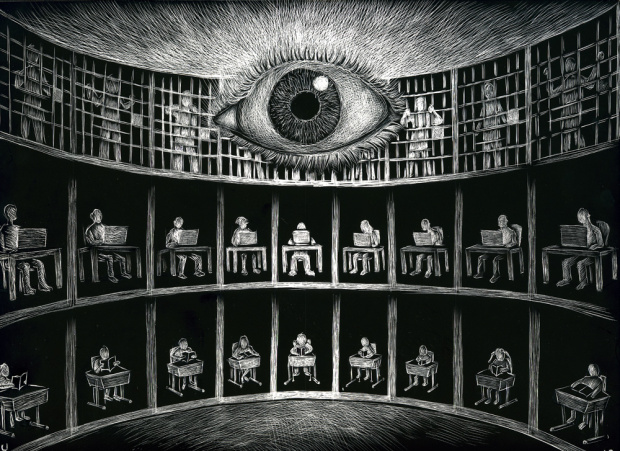
The jaws of the authoritarian vice are tightening. In the near future, the ability to express your opinion will be terminated if it runs counter to official government narratives. All avenues of expression are to be tightly monitored, moderated and censored at the behest of the state.

“The Biden administration is looking at expanding how it monitors social media sites and chatrooms after U.S. intelligence agencies failed to spot classified Pentagon documents circulating online for weeks,” NBC News reported on April 12. “The administration is now looking at expanding the universe of online sites that intelligence agencies and law enforcement authorities track.”

Undoubtedly, this will include Substack, one of the last remaining platforms where free speech is permissible without the heavy-handed interference of the state, and the narrowly focused and highly politicized censorship agenda of the ADL and other anti-First Amendment organizations.

Fox News Decision to settle Dominion lawsuit for more than three-quarters of a billion dollars makes no sense

By Paul Craig Roberts

Source: PaulCraigRoberts.org

Something fishy here.  

First, corporate executives don’t give away $787 million of shareholders’ money without a test of the claim in court.  The uncontested amount is so large that one wonders if Fox News itself paid it or whether this almost $800 million was a gift funneled through an uncontested lawsuit to fund Dominion by our ruling elites. Once elections are determined by how voting machines are programmed, the people are disenfranchised.

Second, it is not defamation to report the news.  Tucker Carlson reported the claims of experts.  That is news reporting.  Dominion’s defamation lawsuit should have been filed against the experts.  It wasn’t, because the experts had the evidence.

Third, Experts supplied evidence that the Dominion voting machines could be programmed to count votes differently from how the votes were cast; experts supplied evidence that the machines could be hacked; experts supplied evidence that the voting machines were connected to the Internet.  Fox News could have called these experts as expert witnesses. By agreeing to settle, Fox News refused the evidence its day in court.  Why?

A possible explanation is that Fox News, voluntarily or involuntarily, participated in an orchestration that established the precedent that reporting news different from the narrative, or news that is unfavorable to a person, company, or government institution, is defamation.  Think about what this means.  A prosecutor who charges a person with a crime has defamed the person.  Truth becomes unreportable. Investigative reporter Seymour Hersh could be charged for defamation, and for being a Russian agent, for reporting that the US government destroyed the Nord Stream pipeline. 

When we see the few truth-tellers who are the stars of their organizations jettisoned–Tucker Carlson from Fox News, Matt Taibbi from Rolling Stone, Glenn Greenwald from The Intercept, James O’Keefe from Project Veritas, President Trump charged under a non-existent law, and Wikileaks’ Julian Assange imprisoned for a decade without due process, we must face the fact that there is an organized conspiracy to suppress truth.  We are experiencing the completion of The Matrix in which expressed doubt or even unspoken suspicion of official narratives are criminal offenses.  

Truth-tellers receive almost nonexistent support.  The inescapable conclusion is that in the Western world truth has no future.

Tyranny is upon us.

The Loss Of Free Speech Was Predictable And Preventable

By Patrick Wood

Source: Technocracy News & Trends

As technology has disrupted key elements of society, Technocrats have taken advantage of the chaos to not only implement their own agenda but also to erect barriers to competition or resistance. If this had been recognized early enough, it could have been easily blocked. Now, the mere barriers have hardened into fortresses.⁃ TN Editor

The First Amendment is at a critical juncture. Recent congressional hearings on the Twitter Files brought the matter into full public view. Freedom of speech and of the press are hanging by a precarious thread. Do we want a future in which information flows freely, or one in which an information elite controls those flows “for our own good?” The choices we make over the next few years will determine which of those futures we get.

It’s tragic that we have let the problem reach this dangerous state. What heightens the tragedy, however, is that the war against America’s most cherished freedoms was predictable and preventable. If those of us who value freedom want to win, we’re going to need a strategy grounded in a clear understanding of what’s happening and why.

The Twitter Files story is shocking. Allegations that big tech and social media manipulate information have been around for as long as we’ve had tech and social media companies. Allegations of bias among the mainstream media are even older. In recent years, however, both the allegations and the supporting evidence have ratcheted upward to unprecedented levels.

When Elon Musk acquired Twitter, he opened his company’s internal archives to scrutiny. He assembled a team of journalists with a curious pedigree: registered Democrats with a distaste for Donald Trump and his supporters, whose track records skewed considerably left of center, and whose recent work has demonstrated deep concern about the politicization of journalism.

Musk gave them unfettered access. They found a deep, broad, and disturbing pattern of collaboration between big government and big tech designed to promote “official stories” on multiple issues, throttle competing theories and arguments, and sanction those who dared to question government propaganda.

When two of those journalists – Matt Taibbi and Michael Shellenberger – testified before Congress, their Democratic inquisitors sought to belittle their credentials, question their motives, and tar them as part of some Republican-funded, far-right conspiracy. The still-left-leaning journalists are trying to absorb their shock at the depths to which the formerly civil-libertarian left has fallen.

Far from shocking, however, that fall was predictable – and predicted. In 2001, amidst the public disgust with tech companies following the collapse of the dotcom bubble, I set out to make sense of life during the transition from the late industrial age to the early information age. I analyzed what I called the first four front-page stories of the information age: the dotcom bubble, the Microsoft antitrust trial, the rise of open-source software, and the Napster-driven wars over digital music. Contrary to popular opinion of the time, I believed that these stories were far from distinct. I saw them as four manifestations of a single underlying phenomenon. My goal was to understand that phenomenon.

I found it. It appeared most clearly in the digital music arena, but it ran through all four stories – and through much that has happened since. It appears just as clearly in today’s war on free speech. It involves an entirely predictable pattern of opportunity, action, and reaction.

The starting point is digitization and quantification. The Internet changed the economics of information. Throughout human history, information was scarce, hard to acquire, and expensive to process. Skilled professionals – spies, scholars, lawyers, accountants, clerics, doctors – could command a premium for their knowledge. When the Internet went public, anything that could be digitized and quantified suddenly flowed freely. Information was there for the asking. The premium shifted to filtering – the ability to discard unwanted information and arrange what remained.

Economic shifts generate massive opportunities for creative, entrepreneurial people and bring glorious benefits to millions of consumers. The Internet was no exception in this regard, and neither was the predictable backlash against it. Anything that benefits new businesses and empowers consumers is a warning shot across the bow of powerful incumbents who’d grown accustomed to serving those consumers in a predictable, profitable, manner.

In the music industry, anything that let individual consumers share digital music files reduced the revenues, profits, power, and control of record labels. Pre-digitization, these powerful incumbents determined what music got recorded and how it was packaged, distributed, presented, and priced. It was a comfortable business model that gave us the music industry “as we knew it.” The Internet undermined it entirely.

Powerful incumbents never fade quietly into the night when challenged. They fight, using whatever weapons they can muster. In our society, the most effective ways to undermine new technological and economic opportunities tend to lie in law, regulation, and public policy. The record labels fought – largely successfully – to apply and reinterpret existing laws and to change laws in ways favorable to their interests.

There’s the pattern: Technology creates opportunities. New businesses exploit those opportunities. Consumers benefit. Powerful incumbents fear their loss of control. Threatened incumbents seek allies in government. Government changes laws and regulations to protect incumbent interests. Media campaigns “educate” the public on the merits of the new policies. The new laws ensure that the next wave of technological change runs largely through the powerful incumbents, rather than against them.

By 2003, I had distilled this pattern, showed numerous ways that it had already unfolded, predicted that it would soon hit parts of our economy and our lives far more significant than the music industry, and suggested some ways that we might prepare ourselves for the coming battles.

It took another two years to get my analysis published. It went largely unnoticed. Twelve years later, then-Senator Ben Sasse described the ways that this pattern had forever disrupted the dynamics of employment. This, too, went largely unnoticed.

Today, we see that disruptive pattern threatening the most basic of our civil liberties. Its manifestation in the arenas of speech, propaganda, and censorship is clear. Consider how each step in the process I identified above has played out here:

Technology creates opportunities. The Internet opened entirely new vistas for the creation and exchange of ideas, information, theories, opinions, propaganda, and outright lies.

New businesses exploit those opportunities. The companies founded since 1995 that created and control the world’s most important conduits for information have joined the ranks of history’s most powerful entities.

Consumers benefit. The centrality of these communication systems to our lives (for better or for worse) proves that they confer real value.

Powerful incumbents fear their loss of control. The twin political shocks of 2016 – Brexit and Donald Trump – highlighted the extent to which official channels had lost control of the narrative. With the entirety of elite media, government, big business, and the intelligentsia aligned behind Remain and Hillary, the newly empowered masses understood – for the first time – that there were viable alternatives to the official story.

Threatened incumbents seek allies in government. A coalition of elite forces assembled quickly, laser-focused on stomping out the populist threat. Masses empowered to conduct their own analyses, draw their own conclusions, and share their opinions among themselves threatened the stability of the power structure “as we know it.”

Government changes laws and regulations to protect incumbent interests. Prior to Musk’s Twitter, the entirety of Silicon Valley committed itself to “protecting” the public from “disinformation,” roughly defined as anything that threatened to undermine an official, sanctioned narrative. Allies throughout the administrative state, Congress, and the Biden White House are working to embed those “protections” in law.

Media campaigns “educate” the public on the merits of the new policies. The same mainstream media that vilified Napster, Grokster, and Peer-to-Peer (P2P) file sharing is now working to turn public opinion against the evil purveyors of alleged “disinformation.”

Will the information age be an era of informed, empowered citizens – or an era of a dominant, information-controlling elite? Stay tuned. That’s the question we need to answer.

How Mainstream Media Becomes Controlled

Most people think of money and agenda, and that’s part of the picture, but there’s one incredibly common factor most don’t consider: access. Let’s explore Kim Iverson’s Dershowitz interview.

By Joe Martino

Source: The Pulse

In personal development, one can’t change something about themselves until they are first made aware of the pattern or problem they are experiencing. Once they know, steps can be taken to adjust, better themselves, or grow beyond the problem.

The same can be said for how our society functions. After all, we as individuals are a microcosm of our collective story.

In that sense, I am a strong believer that if we don’t have an understanding of how our world works, then we don’t stand a chance in making it a better place as we don’t know what problem we are solving.

The first step towards uncovering truth is being able to re-examine our positions and embrace uncertainty.

Propaganda Produces Narrative

In my previous piece on propaganda I talked about how governments distribute a “story” or “narrative” about current events to rally the public behind an idea. It’s through this propaganda that people believe something about how the world works, even if it’s not at all true.

Mainstream media is the mouthpiece that connects government to the people. It has incredible power in shaping public opinion, and governments and powerful people know this.

The is how the masses come to believe they live in a democracy, that government is doing their best to fight enemies. Or that government is keeping people safe through their authoritarian actions, and attempting to create wellness in society. Don’t question government or else you’re a conspiracy theorist.

This narrative is all told through mainstream media. Control mainstream media and you control the masses’ perception.

Controlling Mainstream Media

There are many ways in which mainstream media can be controlled. A common belief is that newsroom directors are constantly getting phone calls from government people telling them not to run certain stories.

This may be true for a small portion of MAJOR stories as we saw with the government program Project Mockingbird.

A 1991 a declassified document from the CIA archives shows the Central Intelligence Agency had a close relationship with mainstream media and academia.

The document states that the CIA task force “now has relationships with reporters from every major wire service, newspaper, news weekly, and television network in the nation,” and that “this has helped us turn some ‘intelligence failure’ stories into ‘intelligence success” stories,’ and has contributed to the accuracy of countless others.”

It admits the agency had “persuaded reporters to postpone, change, hold, or even scrap stories that could have adversely affected national security interests or jeopardized sources and methods.”

We learned through COVID that this sort of thing does still happen, especially with major stories. But for the most part this isn’t how media is controlled in my opinion.

One other common idea is that “all of the journalists at The New York Times or CBC know they are lying.” I don’t think this is true.

Most of these people fully believe in what they publish, and are more so regulated by a news culture and environment that is built around avoiding certain conclusions. They also tend to perform unbalanced investigation into certain subjects.

Part of how news culture is built, and what stops journalists from following their gut, is the fear of the loss of access.

What is Access?

Access is simple: a news outlet can gain access to certain individuals like politicians, powerful business people, or celebrities based on their reputation and knowledge that they won’t “cross the line” or surprise guests.

In this case “the line” is asking tough questions or holding people accountable. Cross the line, and word gets out that powerful people shouldn’t associate with those brands as readily.

Imagine during the Freedom Convoy if the CBC decided they were going to ask Justin Trudeau very tough questions about his abuse of power, lies, and hatred he was disseminating towards unvaccinated people.

You can bet that the CBC would be fearful Trudeau’s admin would give them less access to early stories, updates, interviews and so on if they don’t “play ball” with Trudeau.

If the CBC doesn’t play ball, they will be late on stories, their competition will get things first and the CBC would be playing catch up all the time. This is bad for business.

Access is directly tied to the profitability of many news organizations. Thus, it becomes a race to the bottom dynamic of kissing the ass of those in power and not upsetting them so you can compete amongst other news organizations to get access to stories and interviews first – or even at all.

A Prime Example

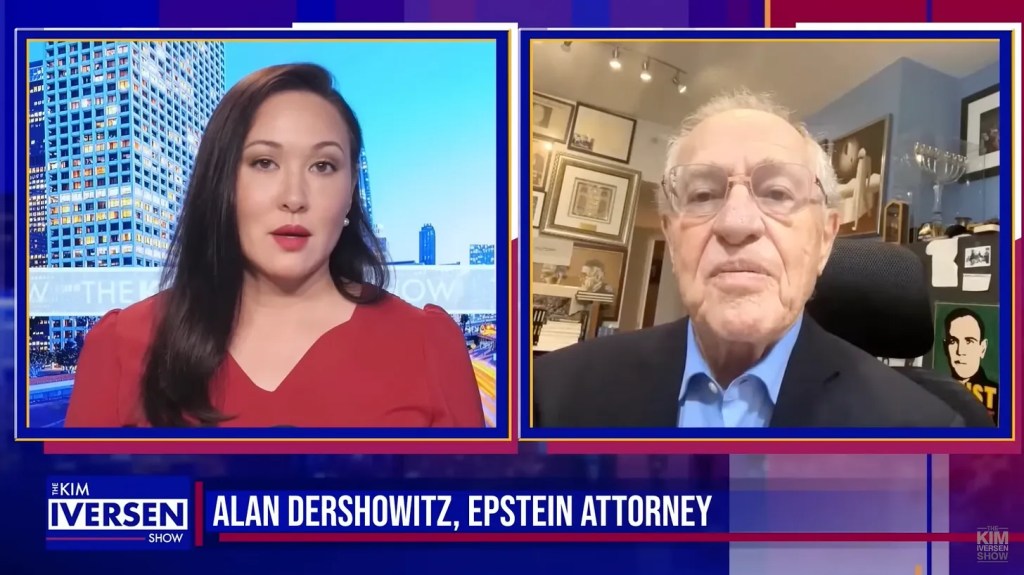
This concept is well demonstrated in a recent interview Kim Iverson conducted with Alan Dershowitz on her show. To note, Iverson’s program is independent, and not considered mainstream media.

Iverson interviewed Dershowitz about Trump’s looming arrest. During the interview, she also asked him about his ties to Epstein and whether or not Epstein had ties to Mossad.

Dershowitz went on to provide short, weak answers to the questions, but eventually became annoyed with Iverson questioning him about Epstein.

Dershowitz said:

“Are you used to having people come on your show to talk about one subject, and then sandbagging them on another subject without any warning? It’s nice to know you do that. I have nothing to hide, and I’m happy to talk about any of this, but I’m used to more ethical journalism.”

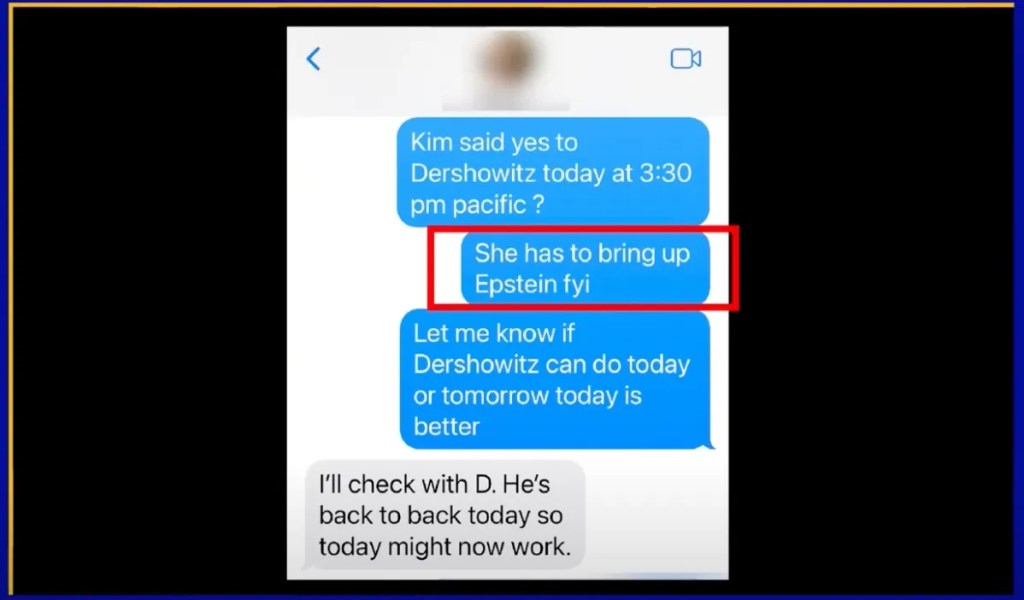
Iverson goes on to state that her team notified the people who booked Dershowitz onto the show that she would ask about Epstein.

Dershowitz said they never told him, and ended the interview by saying,

“[…] it’s the last time you’ll have me on your show, so take advantage of it.”

Iverson went on to provide proof that Dershowitz’s team was notified about upcoming Epstein questions.

Iverson asked Dershowitz tough questions that were significantly less “soft ball” than what he would get from mainstream media. He was also less prepared to tailor his answers perfectly because of an internal team mistake.

As a result, he won’t go on her show again. She lost access to him, and this message could spread throughout, causing her to lose access to others as well.

Simply put, the game is rigged. Play ball in the way powerful people want you to or you don’t get to play.

Put another way, ask tough questions that are “out of bounds” in authoritarian culture and you’ll stop getting interviews. Why then would someone ask tough questions?

But this instance also reveals something important: powerful people know the questions first before they appear on news shows. Does this make sense? Does this create the opportunity for true and honest answers?

Is real journalism even being done by mainstream outlets?

The Purpose of Media is Largely Lost, But Slowly Repairing

All of us who wonder why certain questions aren’t asked by mainstream journalists even when they are strikingly obvious, should consider the concept of access.

Every person listed on Epstein’s flight log could have been asked to explain themselves by The New York Times or Washington Post, but they weren’t. Because that’s not allowed.

However those organizations can forgo good journalistic practices to push COVID fear and propaganda all day long, because that will only gain them more access in the end.

Thus, mainstream media is controlled by the threat of losing access.

Does it make sense that a person should know all of the questions they are going to be asked before coming on a show? Does it make sense that they should be allowed to fully prepare those answers? Doesn’t that give a deep opportunity to deceive?

Why is this accepted as “ethical journalism” when in reality it can protect powerful people?

A Way Forward

This is why I believe we must point out the ways in which mainstream media has no incentive to tell the truth, and point out the ways in which mainstream journalism works.

We must also illustrate the ways in which the mainstream media is obviously wrong or misleading on certain subjects.

It is often too difficult to prove EXACTLY what is true, because that can be incredibly hard to know, but to critique the MSM in ways that reveal their deception can help people begin granting less legitimacy to MSM, and start embracing more uncertainty.

I do believe more and more people are seeing how corrupt mainstream media is, and perhaps we are getting closer to a tipping point. As a result, even The New York Times is trying to convince their audience they are ‘independent journalism.’

360 Degree Surveillance: How Police Use Public-Private Partnerships to Spy on Americans

By John & Nisha Whitehead

Source: The Rutherford Institute

We live in a surveillance state founded on a partnership between government and the technology industry.”— Law Professor Avidan Y. Cover

In this age of ubiquitous surveillance, there are no private lives: everything is public.

Surveillance cameras mounted on utility poles, traffic lights, businesses, and homes. License plate readers. Ring doorbells. GPS devices. Dash cameras. Drones. Store security cameras. Geofencing and geotracking. FitBits. Alexa. Internet-connected devices.  

There are roughly one billion surveillance cameras worldwide and that number continues to grow, thanks to their wholehearted adoption by governments (especially law enforcement and military agencies), businesses, and individual consumers.

With every new surveillance device we welcome into our lives, the government gains yet another toehold into our private worlds.

Indeed, empowered by advances in surveillance technology and emboldened by rapidly expanding public-private partnerships between law enforcement, the Intelligence Community, and the private sector, police have become particularly adept at sidestepping the Fourth Amendment.

As law professor Avidan Y. Cover explains:

A key feature of the surveillance state is the cooperative relationship between the private sector and the government. The private sector’s role is vital to the surveillance both practically and legally. The private sector, of course, provides the infrastructure and tools for the surveillance… The private sector is also critical to the surveillance state’s legality. Under the third-party doctrine, the Fourth Amendment is not implicated when the government acquires information that people provide to corporations, because they voluntarily provide their information to another entity and assume the risk that the entity will disclose the information to the government. Therefore, people do not have a reasonable expectation of privacy in their calling data, or potentially even their emails. As a result, the government does not normally need a warrant to obtain information transmitted electronically. But the Fourth Amendment is not only a source of protection for individual privacy; it also limits government excess and abuse through challenges by the people. The third-party doctrine removes this vital and populist check on government overreach.

Critical to this end run around the Fourth Amendment’s prohibitions against unreasonable searches and seizures by government agents is a pass play that allows police to avoid public transparency requirements (open bids, public meetings, installation protocols) by having private companies and individuals do the upfront heavy lifting, leaving police to harvest the intel on the back end.

Stingray devices, facial recognition technology, body cameras, automated license plate readers, gunshot detection, predictive policing software, AI-enhanced video analytics, real-time crime centers, fusion centers: all of these technologies and surveillance programs rely on public-private partnerships that together create a sticky spiderweb from which there is no escape.

As the cost of these technologies becomes more affordable for the average consumer, an effort underwritten by the tech industry and encouraged by law enforcement agencies and local governing boards, which in turn benefit from access to surveillance they don’t need to include in their budgets, big cities, small towns, urban, suburban and rural communities alike are adding themselves to the surveillance state’s interconnected grid.

What this adds up to for government agencies (that is, FBI, NSA, DHS agents, etc., as well as local police) is a surveillance map that allows them to track someone’s movements over time and space, hopscotching from doorbell camera feeds and business security cameras to public cameras on utility poles, license plate readers, traffic cameras, drones, etc.

It has all but eliminated the notion of privacy and radically re-drawn the line of demarcation between our public and private selves.

Over the past 50 years, surveillance has brought about a series of revolutions in how governments govern and populations are policed to the detriment of us all. Cybersecurity expert Adam Scott Wandt has identified three such revolutions.

The first surveillance revolution came about as a result of government video cameras being installed in public areas. There were a reported 51 million surveillance cameras blanketing the United States in 2022. It’s estimated that Americans are caught on camera an average of 238 times every week (160 times per week while driving; 40 times per week at work; 24 times per week while out running errands and shopping; and 14 times per week through various other channels and activities). That doesn’t even touch on the coverage by surveillance drones, which remain a relatively covert part of police spying operations.

The second revolution occurred when law enforcement agencies started forging public-private partnerships with commercial establishments like banks and drug stores and parking lots in order to gain access to their live surveillance feeds. The use of automatic license plate readers (manufactured and distributed by the likes of Flock Safety), once deployed exclusively by police and now spreading to home owners associations and gated communities, extends the reach of the surveillance state that much further afield. It’s a win-win for police budgets and local legislatures when they can persuade businesses and residential communities to shoulder the costs of the equipment and share the footage, and they can conscript the citizenry to spy on each other through crowdsourced surveillance.

The third revolution was ushered in with the growing popularity of doorbell cameras such as Ring, Amazon’s video surveillance doorbell, and Google’s Nest Cam.

Amazon has been particularly aggressive in its pursuit of a relationship with police, enlisting them in its marketing efforts, and going so far as to hosting parties for police, providing free Ring doorbells and deep discounts, sharing “active camera” maps of Ring owners, allowing access to the Law Enforcement Neighborhood Portal, which enables police to directly contact owners for access to their footage, and coaching police on how to obtain footage without a warrant.

Ring currently partners with upwards of 2,161 law enforcement agencies and 455 fire departments, and that number grows exponentially every year. As Vice reports, “Ring has also heavily pursued city discount programs and private alliances with neighborhood watch groups. When cities provide free or discounted Ring cameras, they sometimes create camera registries, and police sometimes order people to aim Ring cameras at their neighbors, or only give cameras to people surveilled by neighborhood watches.”

In November 2022, San Francisco police gained access to the live footage of privately owned internet cameras as opposed to merely being able to access recorded footage. No longer do police even have to request permission of homeowners for such access: increasingly, corporations have given police access to footage as part of their so-called criminal investigations with or without court orders.

We would suggest a fourth revolutionary shift to be the use of facial recognition software and artificial intelligence-powered programs that can track people by their biometrics, clothing, behavior and car, thereby synthesizing the many strands of surveillance video footage into one cohesive narrative, which privacy advocates refer to as 360 degree surveillance.

Finally, Wandt sees autonomous cars equipped with cameras that record everything around them as yet another revolutionary expansion of surveillance to be tapped by police.

Yet in the present moment, it’s those public-private partnerships that signify a watershed moment in the transition from a police state to a surveillance state and sound a death knoll for our privacy rights. This fusion of government power and private power is also at the heart of the surveillance state’s growing stranglehold on the populace.

As always, these intrusions into our personal lives are justified in the name of national security and fighting crime. Yet while the price to be paid for having the government’s so-called protection is nothing less than our right to privacy, the guarantee of safety remains dubious, at best.

As a study on camera surveillance by researchers at City University of New York concluded, the presence of cameras were somewhat effective as a deterrent for crimes such as car burglaries and property theft, but they had no significant effect on violent crimes.

On the other hand, when you combine overcriminalization with wall-to-wall surveillance monitored by police in pursuit of crimes, the resulting suspect society inevitably gives way to a nation of criminals. In such a society, we are all guilty of some crime or other.

The predatory effect of these surveillance cameras has also yet to be fully addressed, but they are vulnerable to being hacked by third parties and abused by corporate and government employees.

After all, power corrupts. We’ve seen this abuse of power recur time and time again throughout history. For instance, as an in-depth investigative report by the Associated Press concludes, the very same mass surveillance technologies that were supposedly so necessary to fight the spread of COVID-19 are now being used to stifle dissent, persecute activists, harass marginalized communities, and link people’s health information to other surveillance and law enforcement tools. As the AP reports, federal officials have also been looking into how to add “‘identifiable patient data,’ such as mental health, substance use and behavioral health information from group homes, shelters, jails, detox facilities and schools,” to its surveillance toolkit.

These cameras—and the public-private eyes peering at us through them—are re-engineering a society structured around the aesthetic of fear and, in the process, empowering “people to not just watch their neighborhood, but to organize as watchers,” creating not just digital neighborhood watches but digital gated communities.

Finally, there is a repressive, suppressive effect to surveillance that not only acts as a potentially small deterrent on crime but serves to monitor and chill lawful First Amendment activity. As Matthew Feeney warns in the New York Times, “In the past, Communists, civil rights leaders, feminists, Quakers, folk singers, war protesters and others have been on the receiving end of law enforcement surveillance. No one knows who the next target will be.

No one knows, but it’s a pretty good bet that the surveillance state will be keeping a close watch on anyone seen as a threat to the government’s chokehold on power.

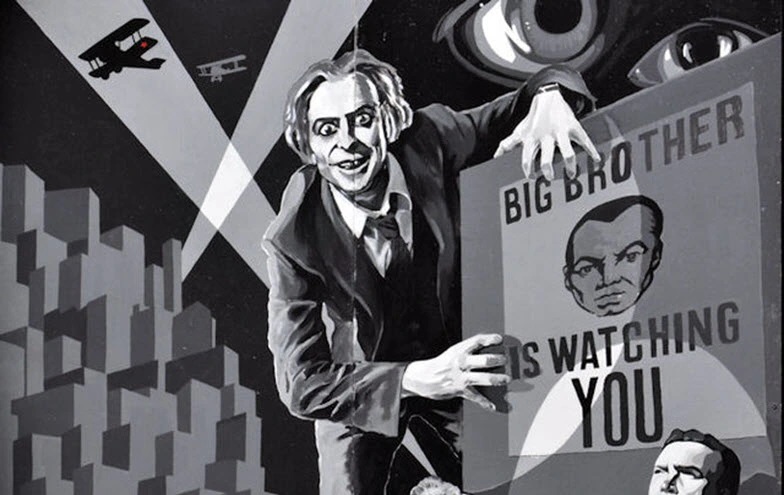
It’s George Orwell’s 1984 on a global scale.

As I make clear in my book Battlefield America: The War on the American People and in its fictional counterpart The Erik Blair Diaries, Orwell’s dystopian nightmare has become our looming reality.

The Twitter Files reveal influence of Russiagate disinformation

The suppression of the Hunter Biden laptop story shows how the Russian boogeyman is wielded to serve political goals and bury inconvenient facts.

(Jakub Porzycki/NurPhoto via Getty Images)

By Aaron Maté

Source: Aaron Maté Substack

Since 2016, US audiences have been flooded with claims that Russia has waged a “sweeping and systematic” interference campaign to influence them, and that Donald Trump and a bottomless cast of associates were somehow complicit.

No “scandal” in US history has yielded such a lengthy rap sheet of falsehoods, debunkings, and retractions. The Mueller investigation and parallel Congressional inquiries found no evidence for the all-consuming theories of a Trump-Kremlin conspiracy. Allegations of Russian government email hacking and social media operations are equally dubious, most notably on the foundational allegation that Russian intelligence stole Democratic Party emails and gave them to Wikileaks.

Even if we were to ignore the evidentiary gaps and accept each assertion about “Russian interference” at face value, the totality could in no way justify even a shred of the multi-year Russia-mania. With no shame and without end, prominent political and media voices have imbued Russian bots, memes, and hackers — real or imagined — with the power to “sow chaos” in US society, swing election results, and even become worthy of comparison to the attacks of Pearl Harbor and 9/11.

Given the Iraq WMD-esque preponderance of hyperbole and outright lies in the incessant claims of Russian subterfuge, it is reasonable to conclude that the US intelligence officials and political-media actors who have spread them are waging exactly what they accuse Russia of: a politically motivated disinformation campaign aimed at influencing the general public.

The newly disclosed Twitter Files — a cache of internal communications from the social media giant — offer new evidence of one of the Russiagate disinformation campaign’s core functions: protecting the rule of domestic elites, particularly in the Democratic Party.

In two consecutive presidential elections, the Russian boogeyman has been invoked to stigmatize and silence reporting on the Democratic candidate. It began in 2016, when journalists who reported on the stolen DNC emails’ revelations about Hillary Clinton’s Wall Street speeches or the DNC’s bias against Bernie Sanders were blamed for Trump’s victory and deemed to be unwitting Kremlin dupes promoting “disinformation” – in reality, factual material that embarrassed the pre-ordained winner.

Four years later, that same playbook was deployed for Clinton’s successor at the top of Democratic ticket, Joe Biden. In the weeks before the November 2020 election, Twitter and Facebook censored the New York Post’s reporting about the contents Hunter Biden’s laptop on the grounds that the computer material could be “Russian disinformation.” The Post’s stories detailed how Hunter Biden traded on his family name to secure lucrative business abroad, and raised questions about Joe Biden’s denials of any involvement.

The US media responded to the suppression of the laptop story with indifference or even approval. In one notable case, Glenn Greenwald resigned from the outlet that he co-founded, The Intercept, after its editors attempted to censor his coverage of the laptop controversy. Even stories that had long been public — such as the unqualified Hunter receiving an $80,000-per-month Burisma board seat just months after his father’s administration helped overthrow Ukraine’s government – were effectively off-limits.

There was never a shred of evidence that Russia was behind the laptop story, but that was of no consequence. Dutiful media editors, reporters, and pundits took their cues from a group of more than 50 former intelligence officials, who issued a statement declaring that the Hunter Biden laptop story “has all the classic earmarks of a Russian information operation.”

These intelligence veterans’ claim was in fact a classic Russiagate disinformation operation, as the Twitter files newly underscore.

If Government Officials Want To Prevent Rebellion They Should Stop Committing Treason

By Brandon Smith

Source: Alt-Market.us

I have been working within the liberty movement for almost 17 years now. In that time I’ve been involved in numerous organizations that all generally fought the same battle, or the same war – The war against encroaching centralization and authoritarianism. Each group and each institution has had different ideas about how to go about solving the problem of incremental tyranny.

Some of them focused on politics, others on preparedness, and still others on convincing police and military to stand on the side of freedom. Some of them had focused goals, some of them were scattered. Some had decent leadership, while the leadership in others was lacking (or self sabotaging). None of them, however, had malicious intent. None of them sought power over others, only to prevent power from being abused.

In some cases the effort became confrontational because that was the only option, as with Bundy Ranch. Liberty activists vowed never to allow another Waco or another Ruby Ridge in which federal agents violate the due process of targeted citizens, or outright murder them. And we should continue to hold to that promise. As we have seen time and time again, agencies like the FBI, ATF, CIA, etc are corrupt beyond all reckoning and there comes a point where the only solution to deal with a bully is to punch him in the teeth.

The Jan 6th event is also something that has been highly misrepresented on both sides – Leftists argue that it was an “insurrection” worse than anything seen since the Civil War in the name of installing Trump as a dictator. Many conservatives argue that it was a “honey pot” or “false flag” which was completely controlled by feds and informants. Neither claim is accurate.

Yes, there were obviously feds present at the event and yes, Capitol Police let protesters into the building as video evidence proves. But, the vast majority of people that showed up to the capitol that day were not feds. They were normal Americans seeking to air their grievances, as is their constitutional right. It is a mistake to pigeonhole very single major event as nothing more than a false flag; it’s lazy and it ignores the greater reality that many millions of people in the US are unhappy with the declining state of our nation.

As for those that claim it was an insurrection, they don’t know what an insurrection is.

Inconveniencing the government for a couple hours is not an insurrection. Protesting at the Capitol Building is not an insurrection. A real insurrection would be led by armed groups that would not leave the capitol voluntarily, and many people on both sides would die during such an action. As it stands, not a single person was killed by a Jan. 6th protester. Not one. This is not something that can be honestly said for the BLM protests which caused dozens of deaths and billions of dollars in property damage across the country.

If it had been BLM that day marching into the Capitol Building, the media would have nothing but applause and positive things to say. But because it was a show of conservative strength, they call it an insurrection and they seek to imprison the people involved. The media response to BLM vs their response to Jan 6th tells us one thing – The establishment wants to destroy conservatives and elevate leftist movements.

This debate, however, ignores the bigger question: Why is half the country angry? Why does half the country mistrust the government to the point that a potential civil war seems like the only viable option?

The establishment controlled media and the Biden Administration would argue that it is our fault. We are “conspiracy theorists” suffering from delusions of rising totalitarianism. We supposedly misinterpret everything we see as something more nefarious than what it is. We are dangerous because we are willing to lash out over changes that serve the greater good but disadvantage us in some way. Or, we are “white supremacists” and the evolving demographics of the country are triggering our inherent toxic ideology.

None of these claims are true. All of them are easily debunked propaganda, but they represent a narrative that is repeated ad nauseam on every mainstream outlet, on every social media website and by every leftist politician. There is no conspiracy theory, there is only conspiracy reality.

Almost every single “conspiracy claim” made by liberty groups over the past two decades has turned out to be true. There is indeed an authoritarian agenda at the core of our government today, and it has been gestating for many years. We saw this agenda enacted right out in the open during the pandemic lockdowns. the federal government and some state governments sought to erase nearly every protection outlined in the Bill of Rights, including free speech.

Most recently, we have seen the exposure of the Twitter Files by Elon Musk, which contain hard evidence of collusion (direct communications) between government agencies and Big Tech companies to silence the 1st Amendment rights of American citizens.

Multiple agencies have been exposed this year in a conspiracy with the old Twitter management (and undoubtedly all other large social media platforms) to censor and ban targeted individuals or groups that discuss information that is contrary to the establishment narrative. Whether it is info on Jan 6th, or info on the covid pandemic or vaccines, or info on Hunter Biden’s laptop, the FBI, DHS, the DNC, etc were all engaging in a joint effort to erase dissent and hide the facts according to internal documents and communications with Twitter staff.

The FBI in particular has even been caught PAYING Twitter staff millions of dollars to process their requests (censor people). This is proven TREASON, a violation of several elements of the Bill of Rights, and the FBI should be eliminated for it. Not reprimanded, but eliminated.

The FBI’s response to being caught was predictable. They state:

“The men and women of the FBI work every day to protect the American public. It is unfortunate that conspiracy theorists and others are feeding the American public misinformation with the sole purpose of attempting to discredit the agency.”

Translation: We are your “protectors”, therefore we can do whatever we want. Anyone that calls us out on our corrupt operations is crazy and a liar regardless of evidence. Discrediting the agency puts the public at risk. We are too big to fail.

The corporate media will come up with numerous spin devices to try to dilute the Twitter revelations, but they will fail. There is no way around it – The US government has been working with Big Tech companies to control free debate and silence citizens. The FBI has chosen a clear political side. They have gone to war against Americans that support constitutional liberty. This is illegal and if punishment is not dealt to the officials involved then eventually punishment will be enacted by members of the American public.

Conservative/libertarian rebellions usually do not happen without good reason. Conservatives prefer order rather than chaos. We prefer stability rather than crisis. We tend to want the system to work and serve the public as it is supposed to. It’s our strength as well as our weakness. Where others see a broken country, we see something that might be fixed.

We have no use for deconstructionists who see crisis and disaster as an opportunity.

That said, when it becomes clear that the system does not work, that it has been corrupted beyond redemption and that the establishment is openly instituting tyrannical policies, we aren’t going to stand by, we are going to act.

Some people claim this is “never” going to happen. Yet, tens of thousands of people showed up to face off with the feds at Bundy Ranch, half the states in the US stood against the covid mandates and thousands of people marched to the Capitol on Jan 6th. It’s only a matter of time.

I don’t think people realize how close we actually came to a kinetic civil war because of the covid mandates and the attempted vaccine passports. We were two seconds away from midnight. All I can say is, the moment someone tries to force me to take an untested Big Pharma product, I’ll put them six feet under. And, almost everyone I know feels the same way.

The big secret that’s not really secret is this: The establishment knows they are playing with fire. It’s why they backed off from the mandates. They know that their corrupt actions are fomenting civil unrest and that in some cases we have majority public support. They know that in the near future there is going to be a rebellion against them. They know this because they plan to continue chipping away at our freedoms until we snap; they just want to be able to control the outcome when we do.

The narratives we are hearing today about white supremacy, domestic terrorism, conspiracy theory and conservative rage are only about one thing: Gaslighting.

They poke and prod and stab at us, they attack us and degrade our freedoms subversively, and at the same time they paint us as the “insurrections”, the aggressors. They do this so that when we move to stop them from attacking us, the notion that we are the aggressors is already planted within the public consciousness.

This is 4th Generation warfare. It’s classic psy-ops. If you are the psychopath causing harm the best case scenario is to make your victims out to be the bad guys instead, so that when you get caught or your victims strike back you can claim to be a victim yourself.

Is this scheme going to work for establishment elites? No, not in the long term. No amount of gaslighting is going to save a psychopath when his victims come to pay him back. What the rest of the public thinks of you does not matter, only justice matters. That said, I want to reiterate the greater point here, which is that the actions of government agencies and the media suggest that the liberty movement is a legitimate threat to them.

We are far more prevalent than they care to admit. They want to paint us as fringe crazies and marginal bigots, while at the same time promoting the notion that we are capable of a national insurrection. They can’t have it both ways.

We are indeed a danger to them. Not to America, just to the despots that want to deconstruct it. What they don’t want the populace to know is that there is a very easy way to stop us – Simply stop committing treason and we will go away. Stop trying to erase our freedoms and we will back off quietly. Stop abusing governmental powers and you have nothing to fear from us.

Continue in these behaviors and policies, and yes, you should be afraid. Because once the reckoning begins, it will not stop until all elements of corruption are washed away.

Questioning The Official Story About Official Stories: A Role for Citizen Investigations

By Time Hayward

Source: Tim Hayward Blog

Official stories, according to the official story about them, are (nearly) always true. The ‘nearly’ gets mentioned just because, on rare occasions, an official story is acknowledged to have been wrong, as, for instance, with Iraq’s falsely alleged weapons of mass destruction in 2003. But that’s considered an exception to the rule, and to extrapolate from it to a more pervasive mistrust is to be foolish, ill-informed or even a dupe of hostile propaganda. In fact, diagnosing what is wrong with sceptics about official stories, and proposing ways of curing or otherwise dealing with them, are now becoming a growth industry in the media and academia. So we hear a lot about how dissenting from official narratives is to fall victim to ‘conspiracy theory’ or ‘disinformation’; and dissenters may be diagnosed as needing re-education or even psychological help. As for the dissent itself, this is increasingly subject to censure and censorship.

However, a major question is left unaddressed: What is it that’s supposed to make official stories so credible?

The assumption is that official stories are produced by people with relevant expert knowledge, so disputing them is a product of ignorance; and since experts have credentials, experience and the backing of competent institutions, rejecting their expertise is unwise or even delusional. Also assumed is that official stories are generally produced and disseminated in good faith.

But are those assumptions generally warranted? In probing their grounds we are brought to question whether the official meta-story, as we may call it, overstates reasons for automatically accepting official stories and underestimates the competence that members of the public can bring to independent inquiries.

Why Believe Official Stories?

No serious thinker would suggest that an official story should be believed just because it comes from officials. Indeed, use of the very expression ‘official story’, in practice, tends to imply that there is also some alternative story that does not have the backing of officials but might be more credible. We know, too, that many societies from various times and places have maintained order by invoking all manner of mythological stories, ideological stories, and blatantly discriminatory stories. Sometimes this has meant denying, suppressing or persecuting as heretics people engaged in rigorous intellectual questioning of officialdom.

A more plausible reason for believing official stories has been set out by the philosopher Neil Levy (2007). He points out that we all know most of the things we know in life because we have learned them from others: our direct personal experience of the world is extremely limited compared to the expanse of our general knowledge and the intricacies of our more specialist understandings. We rely on the testimony and good faith of others in almost everything we do, so just to live a normal life in society we trust a wide range of institutions and social arrangements. To doubt their general dependability would contradict the tacit assumptions that get us through life and would render inexplicable how even a tolerably well-ordered society could ever be possible.

The force of that consideration is strong, but not absolute – and how strong also depends on what kinds of communication we are referring to as official stories. It is strongest if one uses the term to refer to all public communications that emanate from an official source. In actual usage, however, that is not how the term ‘official story’ is normally understood. We don’t regard it as an ‘official story’ that to get a passport you need to submit an authenticated photograph of yourself; we don’t regard it as an ‘official story’ that in UK cars are to be driven on the left; and nor do we these days regard it as an ‘official story’ that smoking is bad for our health. By far the greater part of public pronouncements, like these, are simply taken to state how matters stand. When the distinctive term ‘official story’ occurs, it is typically in contexts where a public pronouncement has met with scepticism. So, for example, whereas we seldom nowadays hear the rationale for mandating wearing seatbelts in cars referred to as an ‘official story’, because there is no longer serious dissent, recent claims that the rationale for mandating mRNA injections against SARS-Cov2 was substantially comparable to that for seatbelts encountered resistance: the ‘official story’ about the benefits and safety of the mRNA injections has been subject to criticism from some sections of medical and scientific communities.

Of course, the mere fact of scepticism in some quarters does not mean that a given official story is necessarily mistaken, but it does highlight how an official story is not just an uncontroversial statement of how matters stand. It leads thoughtful people to look more closely at the nature of authority claimed for an official story.

Are There Experts in Expertise?

The authority claimed for official stories derives, as Levy explains, from the fact of being produced by ‘people socially acknowledged as the relevant experts on a topic’ (Levy 2022). Relevance here is understood in terms of knowledge and experience relating to the salient subject matter. However, certain people might officially be appointed as relevant experts, on other bases, such as known affinities with the organisation’s mission. So it is possible for designated experts to support an official story while a number of other people with materially relevant knowledge and experience take a quite different view.

Even among designated expert advisers, however, achieving an authoritative consensus on the kind of matter that official stories relate to is not straightforward. This is for reasons similar to those involved in giving policy advice (see e.g. Grundmann 2017). Insofar as an official story appeals to a scientific basis, it should be borne in mind that findings of science – a process of open, collaborative and progressive inquiry – have a provisional status, with all scientific statements being in principle corrigible. This means that a scientific adviser’s confidence can never be completely unconstrained or unhedged. Zeynep Panuk (2021) refers to a ‘paradox of scientific advice’ that arises from the difficulties of basing decisions on scientific knowledge that is almost always uncertain and subject to disagreement. Panuk cites experience of how overconfident scientists in advisory committees may suppress dissent so as to present a consensus view, only to find that its implementation had unfortunate or even disastrous consequences. Recent experiences of overconfident pronouncements on ‘The Science’ during the Covid pandemic have furnished further examples (Miller 2022Nelson 2022).

The kind of controversy for which an ‘official story’ comes into play will not normally reduce to some specialist detail of basic science, or even a collection of these, but will concern a situation involving many factors – including those pertaining to social organisation, human action and decision-making. Such situations are similar to those where policy advice is sought from scientific experts (SAPEA 2019 Ch. 2; Martin et al 2020). Official stories are seldom if ever straightforward statements of scientific opinion on a single well-defined scientific research question: they typically relate to situations where many interacting variables may not all be clearly disaggregable. There is in principle no necessary reason why an independent and unofficial grouping of investigators with materially relevant expertise might not be as well-suited to an inquiry as an official grouping. In fact, challenges to official stories can sometimes draw on impressive constellations of expertise.

Citizen Investigations

If the official meta-story may overestimate the dependability of designated expert advice, it may also underestimate the investigative competence of ordinary citizens. For challenges to official stories can be mustered not just by isolated individuals, caricatured as ‘doing their own research’ while ‘reading things on the internet,’ but by well-informed collaborative groups. These can be better able to track truths than independent individuals: ‘the superiority of the group over the individual does not require that one member has the right answer prior to deliberation: group deliberation may enable the aggregation of the genuine insights of several members and the rejection of the false hypotheses of some of the same individuals.’ (Levy 2019: 316)

Furthermore, if it is the case that ‘[g]roups of individuals who are strangers to one another are better at tracking truths than groups of individuals who have a shared history’ (Levy 2019: 318) then this is an advantage of groups comprising people who come together in cyberspace from all walks of life and may have little or no biographical information about those they connect with. Citizens doing their own research sometimes start their own Wikis, or form groups on Reddit, or informally deliberate via Twitter or Telegram. Sometimes they create investigative collectives offline.

It was from participating in chatrooms, for instance, that the now much-feted organisation Bellingcat originated: its founder, Eliot Higgins, a gamer-turned-investigative-citizen, would review copious amounts of war footage from his sofa in Leicester and discuss his observations in chatrooms. The work of his investigative collaborative has come to be ‘commended in the global media and by global agencies such as Amnesty International and Human Rights Watch.’ (Nguyen and Scifo 2018: 377) Impressed by the methods of ‘open source intelligence’ (D’Alessandra and Sutherland 2021), curators of official stories in the West – particularly those relating to geopolitical issues involving Russia – have bestowed accolades on Bellingcat, along with generous funding and encouragement.

So, there is precedent for treating citizens’ investigations as authoritative. Other groups of citizen investigators, that do not receive any funding, have mounted significant challenges to some of the West’s own official stories. Thus, directly countering Bellingcat, on occasion, is the Working Group on Syria, Propaganda and Media which has earned the confidence of whistleblowers rather than officials (OPCW 2020).

Aside from the benefits of collaboration, the reality of serious dissent in the digital sphere is that it can involve myriad critical individuals with significant independent claims to epistemic authority in their professional fields and who exhibit judicious awareness of both their own limitations and the value of others’ insights. For instance, challenging various official narratives are whistleblowers who include scientists, diplomats, intelligence officers, and various state or corporate employees. Challenges come too from professionals with relevant specialist expertise across fields like medicine, architecture, engineering, pharmaceuticals, and a gamut of others. Also worth highlighting are those journalists with previous careers in mainstream media organisations who found they could only maintain their professional integrity by becoming independent.[1] When a group of people independently deliberating together can include, for instance, a former head of a nation’s armed services, a UN weapons inspector, a senior diplomat, an intelligence officer, a world leading International Relations expert and a seasoned war correspondent, the insights they generate regarding situations relevant to foreign policy may well be no less sound than those informing the official story.[2] Indeed, in virtue of their freedom from institutional constraints, they may be more reliably informative for the public than the official story.

If serious challenges to official stories have become more prevalent in recent years, as they arguably have, this is likely due in good part to the sheer extent to which mainstream media have excluded the voices of experts who, maintaining their professional integrity and independence in the face of sometimes considerable hostility, have continued to articulate their challenges to official stories. Attentive members of the public notice this – just as they notice when the force of the state is brought to bear on those who bring to light its lies and malfeasance, and not only in high profile cases like Edward Snowden, Chelsea Manning, Katharine Gun or Julian Assange.

Part of the official meta-story currently is that the internet and social media are being flooded by targeted disinformation that is misleading and confusing people. However, from another perspective one might see that thanks to digital communications citizens can become aware of arguments developed by other experts which are suppressed by protectors of an ‘official story’. An example would be the authors of the Great Barrington Declaration (GBD) (2020), advocating an approach to dealing with the Covid situation characterized as ‘focused protection’ instead of the officially promoted lockdown approach. Lay persons may not be able to adjudicate first hand between recommendations from the GBD and the John Snow Memorandum (2020), which defended lockdown, but they can understand enough to know that the latter does not command an unproblematic consensus such as would be rational simply to defer to. Members of the public can assess the trustworthiness of expertise and official stories without a high level of technical knowledge, as science studies scholars have shown (Yearley 2005; Hess 2012).

People understand that if a view is suppressed rather than openly addressed and rebutted the reason might be that it cannot be rebutted. If an attentive public observes that dissent is simply treated as inadmissible, and especially if those formulating it are subject to smearing or censorship, then there is a corresponding diminution of public trust in the orthodox view.

Tension At The Heart of An Official Story

If the claim that the authority of an official story derives from an expert consensus can be questionable, something more certain is that an official story is asserted with the kind of authority that comes with power. People may defer to an official story not because they necessarily find it credible but out of a prudent concern to avoid the costs of dissidence. Those with power can also incentivise wider media of communication to stick to the narrative. This difference between epistemically earned authority and politically declared authority is a tension at the heart of official stories. Understanding it helps explain why we find a good many journalistic and scholarly studies of the supposed pathologies of dissident citizens and rather little reflection on the real nature of the authority of official stories.

Today we find a welter of studies of online ‘disinformation’ that trace webs of connection across cyberspace seeking to link influential dissenting accounts on social media with bots and trolls associated with malign actors. These communications are said to be engaged in strategically. That is, their aim is to persuade the public to accept a pre-established story rather than to allow people to determine, through open deliberations, what the most credible story is.

Yet this is exactly what the promulgators of official stories themselves do. Regardless of whether the content of a given official story is reliable or not, the form of an official story – in virtue of fulfilling its official function – is that of a strategic communication. Its communication, as official, is presented as a matter not for deliberation but for public acceptance. It is not submitted to public scrutiny with an implicit invitation for critical feedback. It is not up for discussion. It is communicated not to advance debate but to settle it.

This is the inherent tension in an official story: its assertion of epistemic authority depends on an implicit claim that it can be backed by processes of deliberative reasoning, but the pronouncement of an official story as a settled opinion curtails any such process.

What this means in practice has been illustrated, for instance, in the situation arising with the UK Government’s Covid response, which professedly aimed to ‘Follow The Science’ (Stevens 2020). This notion can only ever be ‘a misleading oversimplification’ of what it means to base policy on science (Abbasi 2020), and when UK government ministers claimed to be ‘guided by the science’, what they meant in practice was being guided by their scientists: ‘Ministers formed strong relationships with key scientific advisors, relied on evidence from their Scientific Advisory Group for Emergencies (SAGE), and ignored or excluded many other sources.’ (Cairney 2021) Thus a policy of public communications was decided on the basis of a selective interpretation of scientific findings. But more than this, instead of caution in the face of uncertainty, a policy of robustly promoting a particular view involved the use of psychological operations of a kind more normally associated with a war effort than with public health advice (Sidley 2021, 2022).

Unfortunately, as that example also showed, the defence of an official story against criticism can include counter-measures taken to smear and discredit dissenters. This is never an edifying approach, but is especially troubling when it involves discrediting serious critics who have their own credible claim to epistemic authority. This was illustrated in the case of the eminent scientists who signed the Great Barrington Declaration. They were widely vilified not only in the media but even by other academics, for pointing to certain established principles of epidemiology – including those developed over the two preceding decades of pandemic preparedness planning – that were being set aside and overridden by policy-makers on the basis of modellers’ projections in favour of a ‘zero-covid’ strategy (Ioannidis 2022). This vilification involved not only overt smearing but also something more insidious, namely, the pre-emptive dismissal of their views – notwithstanding their impeccable academic pedigree – as too far ‘beyond the pale’ to warrant serious consideration (HART 2022).

This situation showed that the other institutions of civil society, including the media and academia, which the official meta-story claims provide critical scrutiny, can in fact simply amplify official strategic communications. Thus the organisations that Levy recommends we rely on as guarantors of the authors of official stories can in reality see it as their responsibility to promote and defend the official story rather than question it. Public perceptions that this is the case are accompanied by a deficit of trust in the media and institutions more generally.

The official meta-story blames ‘conspiracy theorists’ and other critical questioners for this lack of trust. But perhaps that gets things the wrong way round.

Conclusion

Trust is something that has to be won, and, if betrayed, it can be lost. As the public’s trust in official stories diminishes, the official meta-story looks to blame this on ‘conspiracy theorists’ and other ‘disruptive influences’. Perhaps a more credible story about official stories would include serious reflection on how they might be made more transparently trustworthy.

Meanwhile, it is reasonable to suggest that each serious challenge to an official story should be assessed on its merits. This does not mean being swayed by extravagant contrarian hypotheses, since these should be treated with even more caution, and, when appropriate, summarily rejected. It does mean being duly aware of how the presumption in favour of official stories is necessarily defeasible. That is the case not just because any story may prove to be mistaken, even in all good faith, but also because we know that any organisation with politically-conferred authority is liable at times to come under political pressures that may, in certain circumstances, override scruples of honesty.

References

Abbasi, Kamran. 2020. ‘Covid-19: politicisation, “corruption,” and suppression of science’. BMJ; 371:m4425, 13 November: doi:10.1136/bmj.m4425   

Cairney, Paul. 2021. ‘The UK Government’s COVID-19 Policy: What Does “Guided by the Science” Mean in Practice?’ Frontiers in Political Science 315 March.https://www.frontiersin.org/articles/10.3389/fpos.2021.624068 DOI: 10.3389/fpos.2021.624068

D’Alessandra, Federica and Kirsty Sutherland. 2021. ‘The Promise and Challenges of New Actors and New Technologies in International Justice’. Journal of International Criminal Justice, 19(1): 9–34. https://doi.org/10.1093/jicj/mqab034

Great Barrington Declaration. 2020. https://gbdeclaration.org/

Grundmann, Reiner. 2017. ‘The Problem of Expertise in Knowledge Societies’. Minerva 55, 25–48 (2017). https://doi-org.ezproxy.is.ed.ac.uk/10.1007/s11024-016-9308-7

HART [Health Advisory and Recovery Team]. 2022. ‘The crushing of dissent throughout the covid era’, 8 October: https://www.hartgroup.org/the-crushing-of-dissent-throughout-the-covid-era/

Hess, David J. 2012. Science Studies: An Advanced Introduction. New York: NYU Press.

Ioannidis, John P. 2022. ‘Citation impact and social media visibility of Great Barrington and John Snow signatories for COVID-19 strategy.’ BMJ Open 2022;12:e052891. doi:10.1136/ bmjopen-2021-052891

John Snow Memorandum. 2020. https://www.johnsnowmemo.com/

Levy, Neil. 2007. ‘Radically Socialized Knowledge and Conspiracy Theories’, Episteme 4(2): 181-192.

Levy, Neil. 2019. ‘Due deference to denialism: explaining ordinary people’s rejection of established scientific findings’. Synthese 196: 313-327.

Levy, Neil. 2022. ‘Do Your Own Research!’ Synthese 200: 356. https://doi.org/10.1007/s11229-022-03793-w

Martin, Graham P., Esmée Hanna, Margaret McCartney and Robert Dingwall. 2020. ‘Science, society, and policy in the face of uncertainty: reflections on the debate around face coverings for the public during COVID-19’. Critical Public Health 30:5: 501-508, DOI: 10.1080/09581596.2020.1797997

Miller, Ian. 2022. Unmasked: The Global Failure of COVID Mask Mandates.

Nelson, Fraser. 2022. ‘The lockdown files: Rishi Sunak on what we weren’t told.’ The Spectator, 27 August: https://www.spectator.co.uk/article/the-lockdown-files-rishi-sunak-on-what-we-werent-told/

Nguyen, An and Salvatore Scifo. 2018. ‘Mapping the Citizen News Landscape: Blurring Boundaries, Promises, Perils, and Beyond.’ In Journalism, edited by Tim P. Vos. Berlin/Boston: De Gruyter.

OPCW [Organisation for the Prohibition of Chemical Weapons]. 2019. ‘Report Of The Fact-Finding Mission Regarding The Incident Of Alleged Use Of Toxic Chemicals As A Weapon In Douma, Syrian Arab Republic, On 7 April 2018.’ OPCW Technical Secretariat S/1731/2019: https://www.opcw.org/sites/default/files/documents/2019/03/s-1731-2019%28e%29.pdf

Panuk, Zeynep (2021) ‘COVID-19 and the Paradox of Scientific Advice.’ Perspectives on Politics 20(2): 562-576. DOI: https://doi.org/10.1017/S1537592721001201

SAPEA [Science Advice for Policy by European Academies]. 2019. Making sense of science for policy under conditions of complexity and uncertainty. Berlin: SAPEA. https://doi.org/10.26356/MASOS 

Sidley, Gary. 2021. ‘A Year of Fear.’ The Critic 23 March: https://thecritic.co.uk/a-year-of-fear/

Sidley, Gary. 2022. ‘Britain’s unethical Covid messaging must never be repeated.’ The Spectator 6 February: https://www.spectator.co.uk/article/britain-s-unethical-covid-messaging-must-never-be-repeated/

Stevens, Alex. 2020. ‘Governments cannot just ‘follow the science’ on COVID-19’. Nature Human Behaviour 4, 560: https://doi.org/10.1038/s41562-020-0894-x

Yearley, Steven. 2005. Making Sense of Science: Understanding the Social Study of Science. Thousand Oaks, CA: Sage.


[1] This is the case, for instance, with Jonathan Cook (formerly of The Guardian), Chris Hedges (formerly with the New Yorker), John Pilger (award-winning documentary film maker), and the late Robert Parry who founded the independent outlet Consortium News.

[2] This is to characterize part of the composition of the Berlin Group 21 that has produced the Statement of Concern relating to whistleblowers from the OPCW. See https://berlingroup21.org/ and associated press release: https://www.einnews.com/pr_news/538579944/leading-international-voices-call-on-opcw-and-its-scientific-advisors-to-allow-all-douma-investigators-to-be-heard