Saturday Matinee: Struggle

logo

From MentalRev Productions:

Struggle is a case study of the 2004 Presidential Election in Ohio, the deciding swing state which delivered the presidency once again to George W. Bush. Diligently researched by the key contributors to the film, Struggle is a bold film that challenges the legitimacy of that Presidential Election and brings the entire US electoral process into question.

This gripping documentary is filmed with a mix of expert testimony and first-hand accounts of voters whose votes were suppressed or manipulated, and community members who protested for election reform and justice in the State and National Capitals. This informative, engaging and tense film is told from a grass roots perspective, from the ground up, without the filters of mainstream media framing the dialogue. Filmed with a handheld style that reflects the intensity of the moment, this film identifies the practices of Individual and State entities to silence protest and manipulate elections in the United States.

This film was made without the resources of mainstream media or a highly funded political campaign. This is a grass roots film that speaks truth to power, with your help we will magnify that voice and demand free and fair elections for all Americans.

https://vimeo.com/50791629

15 News Stories from 2015 You Should Have Heard About But Probably Didn’t

Year_end_cropped_1_.560d8b1a89b8b

By Carey Wedler

Source: AntiMedia

In 2015, the iron fist of power clamped down on humanity, from warfare to terrorism (I repeat myself) to surveillance, police brutality, and corporate hegemony. The environment was repeatedly decimated, the health of citizens was constantly put at risk, and the justice system and media alike were perverted to serve the interests of the powers that be.

However, while 2015 was discouraging for more reasons than most of us can count, many of the year’s most underreported stories evidence not only a widespread pattern that explicitly reveals the nature of power, but pushback from human beings worldwide on a path toward a better world.

 1. CISA Pushed Through the Senate, Effectively Clamping Down on Internet Freedom: For years, Congress has attempted to legalize corporate and state control of the internet. First, in 2011, they attempted to pass PIPA and SOPA, companion bills slammed by internet and tech companies and ultimately defeated after overwhelming public outcry. Then they passed  CISPA — which the president had threatened to veto, having caught wind of the public’s opposition to heavy regulation of the internet (earlier this year, Obama reversed his position). However, corporate interests, like Hollywood’s studio monopoly, kept lawmakers’ tenacity afloat.

In October, Congress passed CISA, the Cybersecurity Information Sharing Act, but as the Electronic Freedom Foundation explained: “CISA is fundamentally flawed. The bill’s broad immunity clauses, vague definitions, and aggressive spying powers combine to make the bill a surveillance bill in disguise. Further, the bill does not address problems from the recent highly publicized computer data breaches that were caused by unencrypted files, poor computer architecture, un-updated servers, and employees (or contractors) clicking malware links.” Just before Christmas, Congress went even further, adding an amendment to the annual omnibus budget bill that strips CISA’s minimal privacy provisions even more. That budget bill was approved, though Representative Justin Amash of Michigan has vowed to introduce legislation to repeal the CISA provisions when Congress reconvenes.

But CISA wasn’t the only attack on citizens’ privacy this year. Though lawmakers touted the USA Freedom Act as a repeal of the mass surveillance state, in reality, it simply added a bureaucratic step to the process by which government agencies obtain private information. Further, a hack on Italian security firm, aptly called Hacker Tools, revealed that various agencies — including the DEA, NSA, Army, and FBI — possess software that enables them to, as Anti-Media reported, “view suspects’ photos, emails, listen to and record their conversations, and activate the cameras on their computers…” At the same time, the United Kingdom and France moved to tighten their already comprehensive surveillance States in the wake of multiple terrorist attacks. Though governments claim systematic surveillance is necessary to protect citizens — and Snowden’s leaks endangered that safety — the United States government has been unable to produce sufficient evidence the programs work. Instead, the documents the Department of Defense released this year as proof of the alleged endangerment were entirely redacted.

2. CIA Whistleblower Sent to Prison for Revealing Damning Information to a Journalist: While the government has no problem invading the privacy of its citizens, it offers swift backlash for those who attempt to violate its own clandestine operations. Jeffrey Sterling, a former CIA agent, had his first altercation with the CIA when he sued for racial discrimination in 2001. He was subsequently fired. Years later, the CIA filed espionage charges against him for speaking with New York Times journalist, James Risen. Sterling had revealed a botched CIA scheme, Operation Merlin, to infiltrate Iranian intelligence that ultimately worsened the situation, gave Iran a nuclear blueprint, and was deemed espionage, itself. Rather than acknowledge the woeful misstep, the CIA arrested him, charged him, and ultimately sentenced him to 42 months in prison. The trial was reportedly biased, but nevertheless, was severely underreported by the media. Sterling’s conviction reflects the ongoing war on whistleblowers, which Obama has successfully expanded during his presidency. Sterling joins the ranks of Edward Snowden, Chelsea (formerly Bradley) Manning, and others, including a whistleblower who worked for OSHA’s Whistleblower Protection Program and was fired for exposing dysfunction and incompetence within the ranks.

3. Press Freedom Continued to Deteriorate: An annual report from the World Press Freedom Index saw the United States slip 29 spots from last year, landing 49th out of 180 total. Investigative journalist Barrett Brown was sentenced to five years in prison for exposing the findings of hacker Jeremy Hammond. Brown was charged with obstructing justice, aiding and abetting, and separate charges of allegedly threatening the FBI in a rant. Hammond, who exposed severe violations of privacy on the part of Stratfor, a CIA contractor, was sentenced to ten years in prison. Brown’s experience was not an isolated incident. Journalists around the world, like several journalists who were killed while investigating ISIS in Turkey, faced increased danger. One small-town journalist in India was burned alive after exposing a corrupt politician.

4. Multiple Activists Arrested, Charged with Felonies for Educating Jurors About Their Rights: In an ongoing trend, otherwise peaceful, non-violent individuals were harassed by police and courts — not for exposing clandestine information, but for providing information to potential jurors about their rights in the courtroom. One Denver jury nullification activist, followed by another, was charged with multiple felonies for handing out pamphlets that explain a juror’s right to vote “not guilty” in a verdict, even if the defendant is clearly guilty. This right was established to allow jurors to vote with their conscience and question the morality of laws, from the 19th century’s Fugitive Slave Act to Prohibition, both of alcohol in the 1920s and of marijuana today. The Denver activists are awaiting trial, while more recently, a former pastor was charged with a felony for the same reason.

In other unjust convictions and failings of the “justice” system, an African-American man was sentenced to seven years in prison for barking at a police dog, a Kansas mother faces decades in prison for using marijuana to treat her debilitating Crohn’s disease, and a mentally ill man died in jail after being held for stealing five dollars worth of snacks from a convenience store. He was inexplicably awaiting transfer to a medical facility. Ross Ulbricht, founder of the dark web marketplace, the Silk Road, was sentenced to life in prison in spite of the fact that he committed no violent crimes — though the FBI attempted to paint a false picture that he did, albeit without filing formal charges. The prosecution was rife with corruption and scandal; two FBI agents involved in the case were charged with stealing Bitcoin during the investigation. In July, one admitted to stealing $700,000 worth of the digital currency.

5. Six-year-old Autistic Boy Killed by Police: 2015 established not only that the justice system remains broken, but the the enforcement class — police officers — continues to terrorize citizens. In one underreported case, a six-year-old boy was fatally caught in the crossfire of a police shootout against his father, who was unarmed. In another case, an African-American motorist was shot and killed by University of Cincinnati police over a missing front license plate. While high-profile cases of misconduct, including Freddie Gray and Sandra Bland, rightly dominated the news cycle, many more cases of police brutality received little attention. In fact, in 2015, it was revealed not only that the media-propagated “War on Cops” in America was a myth, but that American police kill exponentially more people in weeks than other countries’ police kill in years. On the bright side, many police officers did face charges — and even prosecution — in 2015, including one repeat rapist who cried upon being convicted of his crimes. The officers involved in the shooting of the six-year-old boy were also charged with murder.

6. Earth Enters Sixth Mass Extinction: 2015, like many years before, was disastrous for the environment. Researchers from Stanford University, University of California, Berkeley, and Princeton determined Earth is entering its sixth mass extinction, citing that species are disappearing at a rate 100 times faster than the normal rate between mass extinctions. Further, thanks, in part, to the widespread use of Monsanto’s glyphosate-based Roundup herbicide, populations of bees and Monarch butterflies dwindled — though, happily, the Monarchs appear to have bounced back. Polar bears also met continued endangerment.

The much-anticipated Paris Climate Conference yielded what many environmental activists deemed weak, if not fraudulent, solutions. Meanwhile, man-made environmental catastrophes endangered humans. In Flint, Michigan, lead levels in the water led to increased rates of contamination in children’s blood, prompting the mayor to declare a state of emergency. A massive methane gas leak in the San Fernando Valley, located just north of Los Angeles, has sickened residents and forced countless families to relocate. Authorities have been unable to stop the leak.

Thankfully, some measures to help the environment were taken, including creative solutions to stop animal poaching, the first flight of a solar-powered plane, the launch of a solar-powered airport in India, and Costa Rica’s successful effort to draw 99% of its energy from renewable sources.

7. Civilian Casualties in Western Wars Continue: Though ISIS and other terrorist groups were rightly condemned for killing civilians in 2015, the West pointed fingers while committing the same crimes. In fact, one U.N. report released in September found U.S. drone strikes have killed more civilians in Yemen than al-Qaeda. Another analysis released this year proved Obama’s drone wars have killed more people than were murdered during the Spanish Inquisition. Though the U.S. military’s bombing of a Doctors Without Borders (MSF) hospital received global attention and outrage, many other incidents went underreported. In May, one U.S. airstrike on Syria killed 52 civilians in one fell swoop. Additionally, U.S.-backed coalitions have bombed civilian populations, like in Yemen, where Saudi Arabia killed at least 500 children, not to mention thousands more adult civilians. In other egregious misdeeds, it was revealed that the U.S. military sanctions pedophilia in Afghanistan.

8. Insurrection at the Pentagon’s Defense Intelligence Agency Over Misleading Reports on ISIS: Over the summer, dissent grew within the ranks of the DIA, the Pentagon’s internal intelligence agency. In September, news broke that 50 intelligence analysts filed a report with the Department of Defense’s Inspector General to expose their superiors’ alleged manipulation of intelligence. The intention of the coverup was to downplay the threat of ISIS and the U.S.’s losing effort to fight it, all to maintain the Obama administration’s narrative the bombing campaigns have been successful.

Similar mishandlings of foreign affairs plagued 2015. It was revealed that the Pentagon had no idea what it did with $8.5 trillion, lost track of $500 million worth of weapons and equipment, and spent $43 million on a single gas station in Afghanistan. A DIA report released in June intimated the military was aware of the rising threat of ISIS, and not only allowed it, but welcomed it. The program to train moderate rebels in the fight cost half a billion dollars but yielded only four or five fighters. Further, multiple generals spoke out this year about the U.S. military’s role in creating ISIS. Additionally, news broke in 2015, that one ISIS recruiter had previously been trained by infamous Iraq War profiteer, Blackwater.

9. Activists Inch a Small Step Closer to Exposing the Actors Behind 9/11: Though few Americans heard about it, in August, a New York judge allowed a trial to move forward that could expose a potential government cover-up in the notorious terrorist attack. The ruling was tepid, allowing a 60 to 90 day window for the case to be dismissed or proceed. A later ruling hindered the effort, citing a reported lack of evidence; but activists have not stopped fighting for the release of 28 redacted pages from the 9/11 commission report that allegedly implicate Saudi Arabia (a majority of the hijackers on 9/11 were of Saudi origin).

Whatever the truth may be, 2015 witnessed growing doubts about the Saudi government, which beheaded more people than ISIS this year. It also sentenced a poet to beheading for writing poetry about his experience as a refugee from Palestine, sentenced a young man, Ali al-Nimr, to crucifixion for participating in anti-government protests, attempted to issue 350 lashings to a British man in possession of wine (though the U.K. intervened on his behalf, and that of al-Nimr; neither will be punished), and initiated a punishment of 1,000 lashings for a pro-democracy blogger, Raif Badawi.

10. The FDA Approved OxyContin for Use in Children: Though the approval of the powerful, addictive painkiller for use in 11-year-olds and younger children was unsurprising, the FDA’s justification was shocking. After lawmakers wrote a letter expressing concern to the FDA, the agency’s spokesperson, Eric Pahon, said the news was, in fact, not that serious because it was already standard practice. It’s important to stress that this approval was not intended to expand or otherwise change the pattern of use of extended-release opioids in pediatric patients,” Pahon said. “Doctors were already prescribing it to children, without the safety and efficacy data in hand with regard to the pediatric population.

However disturbing, the FDA’s decision comported with other events this year: President Obama appointed a pharmaceutical lobbyist Deputy Commissioner of medical and tobacco products, a study found swaths of heroin users graduate from prescription painkillers, and similarly, 75% of high school students who used heroin had previously abused pharmaceuticals.

In other stories regarding the misconduct of agencies tasked with keeping people safe, the FDA continued to allow meat companies to use a pharmaceutical additive banned in 150 countries, while whistleblowers at the USDA revealed several plants were producing pork filled with fingernails, hair, bile, and feces.

11. The Federal Government Finally Admitted Cannabis May Help Fight Brain Cancer: Though the government has long known about the medical benefits of cannabis — it holds patents on several medicinal qualities — the National Institute on Drug Abuse made waves this year when it published a document acknowledging the healing properties of cannabidiol, a non-psychoactive endocannabinoid. In particular, it noted “[e]vidence from one animal study suggests that extracts from whole-plant marijuana can shrink one of the most serious types of brain tumors.” Though more research is needed, the government’s admission was unexpected, albeit welcomed by many cannabis enthusiasts. Other studies this year revealed cannabis may help heal broken bones and is associated with lower rates of obesity.

Though many Americans still faced criminal prosecution for treating themselves and their children with cannabis, 2015 demonstrated the long-term trend of decriminalization and legalization will not be reversed. Nations around the world, from Ireland to Costa Rica to Canada laid groundwork to legalize marijuana to various degrees, while a majority of Americans now support legalization.

12. Nestle Paid $524 to Plunder the Public’s Water Resources: This year, Anti-Media reported on the insidious relationship between Nestle and the Forest Service in California. The investigation found not only that Nestle was using an expired permit to turn exponential profit on 27 million gallons of water, but that a former Forest Service official went on to consult for the company.

While corporate exploitation ran rampant in 2015, many countries around the world fought back. India banned one Nestle product for containing lead, while nations around the world banned Monsanto and GE products. Scotland, Denmark, and Bulgaria, among others, all moved to ban GE crops, while multiple lawsuits highlighted the serious potential health consequences of the widespread use of pesticides. Though corporate power remains all but monolithic, 2015 saw humans across the world rise up to resist it. Most recently (and comically), a proposed initiative in California is about to enter the next phase — signature gathering — to place it on the 2016 ballot. If placed on the ballot and passed, it will force California legislators to wear the logos of their top ten donors while they participate in legislative activities. The effort has drawn widespread praise and enthusiasm.

13. Establishment Caught Manipulating News to Fit Narratives: Following the death of Freddie Gray in Baltimore, contentious protests broke out, eventually resulting in limited rioting and looting. However, while the media attempted to paint protesters as aggressive, it failed to report officers’ systemic prohibition of their physical movement, to say nothing of the riot gear police showed up wearing. After being unable to move, a brick was thrown, but the media failed to reporting the instigation and discrimination law enforcement imposed that ultimately led the students and protesters to grow unruly.

In other manipulations, it was revealed that one Fox News contributor lied about his experience as a CIA agent; he had never been employed at the agency, and only obtained later national security jobs by lying about his CIA experience. Further, CBS edited out comments from Muslims, who discussed U.S. foreign policy as a driver of Islamic extremism during a televised focus group.

A study by fact checker, Politifact, revealed that all the major outlets surveyed — Fox News, CNN, and MSNBC— consistently report half-truths and lies. It is little wonder, then, that another survey found only 7% of Americans still harbor “a great deal of trust” in the mainstream media.

Still, it wasn’t just the media that lied. On multiple occasions, government agencies were caught attempting to distort facts. In March, news emerged that an IP address linked to the NYPD had attempted to edit the Wikipedia page on Eric Garner. Computers inside Britain’s parliament were linked to attempted edits on pages detailing sex scandals, among other transgressions. In a related story, the FBI reported it had foiled yet another terrorist plot, and once again, it was revealed the culprits were provided support from an informant working for the bureau.

14. TPP: In one of the most widely-contested pieces of legislation in recent memory, the Trans-Pacific Partnership moved forward, often in secret. The TPP has been condemned as a corporate power grab that ensures profit for pharmaceutical companies, among many other loathed industries. From clamping down on internet freedom to effectively sanctioning sex trafficking, TPP signals an ominous fate for the future of freedom.

15. Sharp Uptick in Islamophobia: Amid the carnage of the Paris terror attacks, the recent shooting in San Bernardino, and the surge in Syrian refugees seeking asylum in Western nations, attacks against Muslims skyrocketed in 2015. In the United States, Muslims have been attacked for praying in public, wearing traditional head scarves, and for simply being out in public. Sikhs have been caught in the crossfire for the crime of being brown and wearing cloth on their heads — and thus being confused with Muslims — while at least one Christian has been terrorized as a result of the unmitigated hate currently permeating modern society. Many European nations and U.S. states have rejected the influx of refugees from war-torn Syria.

Amid the increased hate against Muslims, however, has come an outpouring of love and tolerance. Muslim groups across the world have condemned terror attacks, raised money to help the families of victims, and promoted programs to discourage extremism. At the same time, citizens across Europe and throughout the United States have welcomed Syrian refugees with open arms.

2015 was a year of chaos, violence, hate, and an ongoing struggle of freedom versus oppression. In many ways, it was like the years, decades, and even centuries and millenia that came before. But amid the conflict and often discouraging headlines, humanity has continued to persevere, offering resistance to seemingly all-powerful forces and paving the way for, if nothing else, potential peace, freedom, and respect for human life.
Why the Darknet Matters

shutterstock_251313145-650

By Luther Blissett and J. F. Sebastian of Arkesoul

In February 2015 Ross Ulbricht was convicted of money laundering, computer hacking and conspiracy to traffic narcotics for his role (either with or as Dread Pirate Roberts) in creating and administrating the darknet market Silk Road. For this, U.S. District Judge Katherine Forrest sentenced Ulbricht to life in prison without possibility for parole. Why was Ulbricht treated more severely than most murderers and child molesters (not to mention wall street and state criminals who do far more societal harm than all others combined)? The only logical explanation is that they needed to make an example out of him not just for his actions but for what he represented. The draconian sentence sends a message that the government is doubling down on its destructive and wasteful war on drugs and is clearly threatened by agorists (ie. those advocating for a society of voluntary exchanges and counter-economics without violence or authority) who utilize the darknet to make their ideas manifest. To understand the scope of the threat this poses to governments one must understand what the darknet is.

The darknet is an anonymous overlay network accessed through special software, configurations and/or protocols. It was created in the 1970s to designate anonymous networks isolated from ARPANET (an early form of the internet) which, for security purposes, had addresses hidden from network lists and were unresponsive to pings or other inquiries. The World Wide Web content that exists on darknets (known as the dark web) can only be accessed through anonymous browsers such as the Freenet or TOR Browser Bundle. The darknet and dark web are part of the deep web, the content of the World Wide Web not discoverable by means of standard search engines.

Interest in and use of the darknet has grown dramatically since TOR was released to the public in 2003. Much like when the internet was new, the darknet is often slow, though it has more to do with the complex random rerouting necessary for anonymity than the hardware or infrastructure. And like the early internet, the darknet is widely viewed as the new “wild west”. The darknet does attract its share of fringe subcultures including cryptoanarchists, transhumanists, digital pirates, sexual fetishists, drug users and dealers of different types, etc., but the groups that have arguably been the most empowered by the technology are political dissidents such as whistleblowers and activists.

As governments and corporations gain increasing power over the physical realm through laws, economics, violence and surveillance, one of the few remaining options for anyone wanting to bring about systemic change without fear of retribution, is the darknet. The government would of course never openly admit their fear of such a threat, though it’s apparent that law enforcement and intelligence agencies (who behave as if they’re entitled to the right to monitor all activity) are threatened enough even by less overtly political darknet sites such as Silk Road. They may claim concern over drug gang violence and addiction justifies the crackdown, but if that were actually the case they would have ended the war on (some) drugs years ago when more than enough data was available proving harm reduction to be a more humane and effective strategy.

Of course violent and cruel behavior can be found on the darknet, just as it exists offline. One could argue such cases should be investigated in ways that don’t jeopardize the anonymity of all users. What about the safety of victims attempting to evade dangerous individuals and groups? Whistleblowers need anonymity as well if releasing information on crimes committed by people in power.

As law enforcement struggles to defeat darknet anonymity with new tools such as Memex (a data-trawling program), programmers innovate to make darknet sites more decentralized, private, secure, and user friendly. Improved user interface will draw more users to the darknet, especially as awareness of internet privacy and security issues increase. Government efforts to police and regulate the darknet will also increase further as aspects of the darknet become both more mainstream and fringe, the darknet marketplace expands exponentially and improved cryptocurrencies are developed to meet demand.

As is, the Darknet is a system that is continually evolving. And, inasmuch as it poses a threat and a risk to authority, there is friction between the two. On the one hand, there is the axiom for control and security, which often times conflates manipulation with exploitation. On the other, freedom and liberty of expression, which often times conflates a lack of cohesion with relativism.

Regarding the first side of the debate, it’s a natural product of strategic rationality to calculate safe scenarios as to ensure survival. Vertical hierarchies often times result in perverse agendas that funnel the interests of the few on the top. However, these exist to ensure safety for a particular collective. That is the very paradox of government: The criterion for peace, however illusory, is to make up a contract with the State and its people. “I give up certain rights in exchange of safety”. This is game theory: Predict the behavior of others so as to ensure safety. The government fulfills this need through law and order. Let’s minimise risk, and up control as well as safety, which produces a space to live and grow. In this model, the assumption is to always expect the worst, while paradoxically ensuring productivity through an illusory cohesion and identity. In a collective that is afraid of itself, everybody is “doing their part”, but as well miss out on having a say on the big issues. Government is a fail switch for everything absurd, illogical, and different. The infamous saying applies: “Fear what you don’t understand”.

On the other side of the debate, the inverse is suiting. Greater freedom involves having a voice. The trade off is becoming segregated as an outsider, because having an opinion comes with a price. Refusing to accept the “game rules” of “law and order”, is anathema to cohesion and identity. This philosophy is natural to fringe culture, because often times fringe culture is made up of victims of a system that doesn’t respond to the needs and demands of its people. That’s the problem: If everybody played by the rules, including those at the top, then the big illusion would make sense. There’d be intrinsic justice to the operational structures of society. That’s another paradox, power perverts when it should essentially allow and protect human flourishing and expression. That’s what we are taught, right? Civilization is supposed to be good. But it seems more and more evident that we haven’t yet learnt how to keep our governments at bay and working for the people. Because ideas fracture models by confronting power structures of domination and corruption, we essentially have a duty to be creative and protect what we rightfully are as a species. Ideas are revolutionary, because they add to the frame of possibilities and suggest ways in which the old modes of thinking are outdated. They pose a danger for the status quo, insofar as they fragment cultural psyches. They allow people to think. This is not what Government wants. Our freedom in exchange for safety. Censorship in exchange for control. Our voices in exchange for capital.

At odds, therefore, is the fear for different things versus the need for expression. The Darknet is an idea. It’s not perfect. It fails in many ways, particularly in allowing terrible transactions to happen. However, these are already there with or without the Darknet. If the government was smarter, it would learn to cooperate with the Darknet. It would stop trying to silence voices by hammering the stick. It would offer incentives for creativity and solutions. Yes, the Darknet might be a channel for people to do bad things. But it also allows for new and positive changes. Change is good. Change is evolution. We move forward as we learn. At some point, the Darknet will learn how to push the bad and to cohere the good. If we admonish the Darknet we also chastise our right to expression. We need to challenge our governments, and the Darknet meets that demand. One could argue there’s many pressing problems as important (if not more so) as electronic freedom, but few could have as much of an effect on the outcome of every other struggle. Government can’t silence our voices, it must adapt to them. The battle over the Darknet symbolizes a crossroads in history where decisions made now will have an increasingly large impact on our lives in the future. If freedom prevails, we have an opportunity to make a great idea function for an even greater and much more illuminating goal.


Some day, we could be a shining beacon of hope for the oppressed people of the world just as so many oppressed and violated souls have found refuge here already. Will it happen overnight? No. Will it happen in a lifetime? I don’t know. Is it worth fighting for until my last breath. Of course. Once you’ve seen what’s possible, how can you do otherwise? How can you plug yourself into the tax eating, life sucking, violent, sadistic, war mongering, oppressive machine ever again? How can you kneel when you’ve felt the power of your own legs? Felt them stretch and flex as you learn to walk and think as a free person? I would rather live my life in rags now than in golden chains. And now we can have both! Now it is profitable to throw off one’s chains, with amazing crypto technology reducing the risk of doing so dramatically. How many niches have yet to be filled in the world of anonymous online markets? The opportunity to prosper and take part in a revolution of epic proportions is at our fingertips!

I have no one to share my thoughts with in physical space. Security does not permit it, so thanks for listening. I hope my words can be an inspiration just as I am given so much by everyone here.
Dread Pirate Roberts  [3/20/2012]

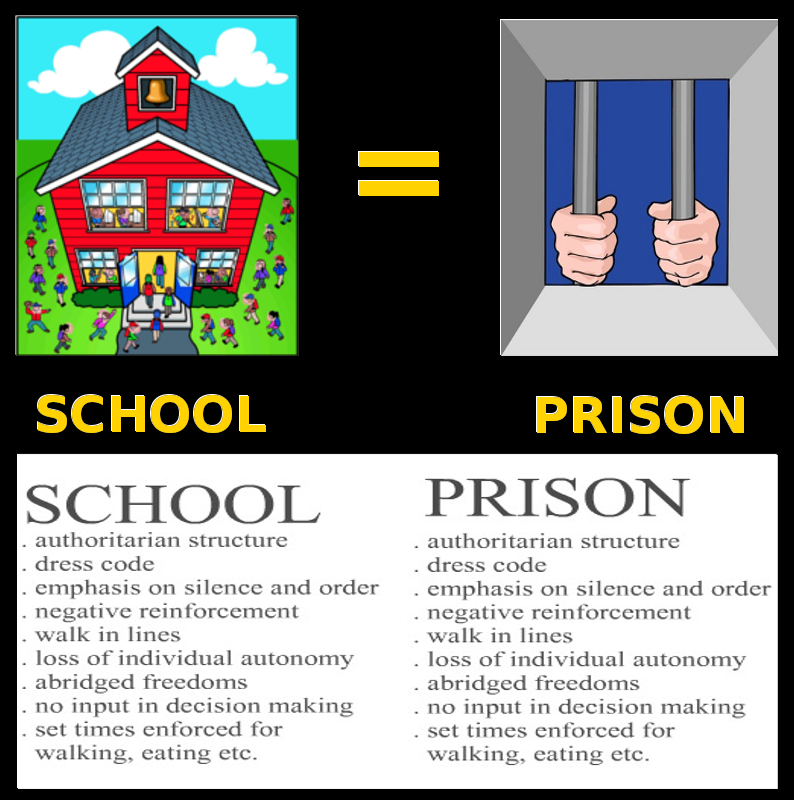
Public School Students Are the New Inmates in the American Police State

school_is_prison_by_twarrior-d4atw5g

By John W. Whitehead

Source: The Rutherford Institute

In the American police state, you’re either a prisoner (shackled, controlled, monitored, ordered about, limited in what you can do and say, your life not your own) or a prison bureaucrat (police officer, judge, jailer, spy, profiteer, etc.).

When you’re a child in the American police state, life is that much worse.

Microcosms of the police state, America’s public schools contain almost every aspect of the militarized, intolerant, senseless, overcriminalized, legalistic, surveillance-riddled, totalitarian landscape that plagues those of us on the “outside.”

From the moment a child enters one of the nation’s 98,000 public schools to the moment she graduates, she will be exposed to a steady diet of draconian zero tolerance policies that criminalize childish behavior, overreaching anti-bullying statutes that criminalize speech, school resource officers (police) tasked with disciplining and/or arresting so-called “disorderly” students, standardized testing that emphasizes rote answers over critical thinking, politically correct mindsets that teach young people to censor themselves and those around them, and extensive biometric and surveillance systems that, coupled with the rest, acclimate young people to a world in which they have no freedom of thought, speech or movement.

If your child is fortunate enough to survive his encounter with the public schools, you should count yourself fortunate.

Most students are not so lucky.

By the time the average young person in America finishes their public school education, nearly one out of every three of them will have been arrested.

More than 3 million students are suspended or expelled from schools every year, often for minor misbehavior, such as “disruptive behavior” or “insubordination.”

For instance, a Virginia sixth grader, the son of two school teachers and a member of the school’s gifted program, was suspended for a year after school officials found a leaf (likely a maple leaf) in his backpack that they suspected was marijuana. Despite the fact that the leaf in question was not marijuana (a fact that officials knew almost immediately), the 11-year-old was still kicked out of school, charged with marijuana possession in juvenile court, enrolled in an alternative school away from his friends, subjected to twice-daily searches for drugs, and forced to be evaluated for substance abuse problems.

Under similarly misguided school zero tolerance policies, students have been suspended for bringing to school household spices such as oregano, breath mints, birth control pills and powdered sugar. Look-alike weapons (toy guns—even Lego-sized ones, hand-drawn pictures of guns, pencils twirled in a “threatening” manner, imaginary bows and arrows, even fingers positioned like guns) can also get a student kicked out.

Acts of kindness, concern or basic manners can also result in suspensions. One 13-year-old was given detention for exposing the school to “liability” by sharing his lunch with a hungry friend. A third grader was suspended for shaving her head in sympathy for a friend who had lost her hair to chemotherapy. And then there was the high school senior who was suspended for saying “bless you” after a fellow classmate sneezed.

Unfortunately, these incidents are indicative of a nationwide phenomenon in which children are treated like suspects and criminals, especially within the public schools.

When you bring the police into the picture, after-school detention and visits to the principal’s office are transformed into punishments such as misdemeanor tickets, juvenile court, handcuffs, tasers and even prison terms.

More and more, police are “stepping in to deal with minor rulebreaking—sagging pants, disrespectful comments, brief physical skirmishes. What previously might have resulted in a detention or a visit to the principal’s office was replaced with excruciating pain and temporary blindness, often followed by a trip to the courthouse.”

Thanks to a combination of media hype, political pandering and financial incentives, the use of armed police officers to patrol school hallways has risen dramatically in the years since the Columbine school shooting.

Funded by government grants, these school resource officers have become de facto wardens in the elementary, middle and high schools, doling out their own brand of justice to the so-called “criminals” in their midst with the help of tasers, pepperspray, batons and brute force.

Now advocates for such harsh police tactics and weaponry will tell you that school safety should be our first priority lest we find ourselves with another Sandy Hook. What they will not tell you is that such shootings are rare. As one congressional report found, the schools are, generally speaking, safe places for children.

In their zeal to crack down on guns and lock down the schools, these cheerleaders for police state tactics in the schools might also fail to mention the lucrative, multi-million dollar deals being cut with military contractors such as Taser International to equip these school cops with tasers, tanks, rifles and $100,000 shooting detection systems.

Indeed, the transformation of hometown police departments into extensions of the military has been mirrored in the public schools, where school police have been gifted with high-powered M16 rifles, MRAP armored vehicles, grenade launchers, and other military gear. One Texas school district even boasts its own 12-member SWAT team.

As if it weren’t bad enough that the nation’s schools have come to resemble prisons—complete with surveillance cameras, metal detectors, drug-sniffing dogs, random locker searches and active shooter drills—the government is also contracting with private prisons to lock up young people for behavior that once would have merited a stern lecture. Nearly 40 percent of those young people who are arrested will serve time in a private prison, where the emphasis is on making profits for large megacorporations above all else.

Young people have become easy targets for the private prison industry. For instance, two Pennsylvania judges made headlines when it was revealed that they had been conspiring with two businessmen in a $2.6 million “kids for cash” scandal that resulted in more than 2500 children being found guilty and jailed in for-profit private prisons.

It has been said that America’s schools are the training ground for future generations. Yet as I point out in my book Battlefield America: The War on the American People, instead of raising up a generation of freedom fighters, however, we seem to be busy churning out newly minted citizens of the American police state who are being taught the hard way what it means to comply, fear and march in lockstep with the government’s dictates.

The lesson is this: you not only get what you pay for, but you reap what you sow.

If you want a nation of criminals, treat the citizenry like criminals.

If you want young people who grow up seeing themselves as prisoners, run the schools like prisons.

But if you want to raise up a generation of freedom fighters, who will actually operate with justice, fairness, accountability and equality towards each other and their government, then run the schools like freedom forums. Remove the metal detectors and surveillance cameras, re-assign the cops elsewhere, and start treating our nation’s young people like citizens of a republic and not inmates in a police state.


Kick Open the Doorway to Liberty: What Are We Waiting For?

0823e935c920bdf2c31447b67612bfc6

By John W. Whitehead

Source: The Rutherford Institute

“The greatness of America lies in the right to protest for right.”—Martin Luther King Jr.

Everything this nation once stood for is being turned on its head.

Free speech, religious expression, privacy, due process, bodily integrity, the sanctity of human life, the sovereignty of the family, individuality, the right to self-defense, protection against police abuses, representative government, private property, human rights—the very ideals that once made this nation great—have become casualties of a politically correct, misguided, materialistic, amoral, militaristic culture.

Indeed, I’m having a hard time reconciling the America I know and love with the America being depicted in the daily news headlines, where corruption, cronyism and abuse have taken precedence over the rights of the citizenry and the rule of law.

What kind of country do we live in where it’s acceptable for police to shoot unarmed citizens, for homeowners to be jailed for having overgrown lawns (a Texas homeowner was actually sentenced to 17 days in jail and fined $1700 for having an overgrown lawn), for kids to be tasered and pepper sprayed for acting like kids at school (many are left with health problems ranging from comas and asthma to cardiac arrest), and for local governments to rake in hefty profits under the guise of traffic safety (NPR reports that police departments across the country continue to require quotas for arrests and tickets, a practice that is illegal but in effect)?

Why should we Americans have to put up with the government listening in on our phone calls, spying on our emails, subjecting us to roadside strip searches, and generally holding our freedoms hostage in exchange for some phantom promises of security?

As I document in my new book Battlefield America: The War on the American People, it doesn’t matter where you live—big city or small town—it’s the same scenario being played out over and over again in which government agents ride roughshod over the rights of the citizenry.

In such an environment, it’s not just our Fourth Amendment rights—which protect us against police abuses—that are being trampled. It’s also our First Amendment rights to even voice concern over these practices that are being muzzled. Just consider some of the First Amendment battles that have taken place in recent years, and you too will find yourself wondering what country you’re living in:

  • Harold Hodge was arrested for standing silently in front of the U.S. Supreme Court building, holding a sign in protest of police tactics.
  • Marine Brandon Raub was arrested for criticizing the government on Facebook.
  • Pastor Michael Salman was arrested for holding Bible studies in his home.
  • Steven Howards was arrested for being too close to a government official when he voiced his disapproval of the war in Iraq.
  • Kenneth Webber was fired from his job as a schoolbus driver for displaying a Confederate flag on the truck he uses to drive from home to school and back.
  • Fred Marlow was arrested for filming a SWAT team raid that took place across from his apartment.

And then there were the three California high school public school students who were ordered to turn their American flag t-shirts inside out on May 5 (Cinco de Mayo) because school officials were afraid it might cause a disruption and/or offend Hispanic students. Incredibly, the U.S. Supreme Court actually sided with the school and the Ninth Circuit Court of Appeals, affirming that it might be disruptive for American students to wear the American flag to an American public school.

While there are all kinds of labels being put on so-called “unacceptable” speech today, from calling it politically incorrect and hate speech to offensive and dangerous speech, the real message being conveyed is that Americans don’t have a right to express themselves if what they are saying is unpopular, controversial or at odds with what the government determines to be acceptable.

Whether it’s through the use of so-called “free speech zones,” the requirement of speech permits, the policing of online forums, or a litany of laws and policies that criminalize expressive activities, what we’re seeing is the caging of free speech and the asphyxiation of the First Amendment.

Long before the menace of the police state, with its roadside strip searches, surveillance drones, and SWAT team raids, it was our First Amendment rights that were being battered by political correctness, hate crime legislation, the war on terror and every other thinly veiled rationale used to justify censoring our free speech rights.

By suppressing free speech, the government is contributing to a growing underclass of Americans who are being told that they can’t take part in American public life unless they “fit in.” Mind you, it won’t be long before anyone who believes in holding the government accountable to respecting our rights and abiding by the rule of law is labeled an “extremist” and is relegated to an underclass that doesn’t fit in and must be watched all the time.

It doesn’t matter how much money you make, what politics you subscribe to, or what God you worship: we are all potential suspects, terrorists and lawbreakers in the eyes of the government.

In other words, if and when this nation falls to tyranny, we will all suffer the same fate: we will fall together. However, if it is possible to avert such an outcome, it will rest in us remembering that we are also all descendants of those early American revolutionaries who pushed back against the abuses of the British government. These people were neither career politicians nor government bureaucrats. Instead, they were mechanics, merchants, artisans and the like—ordinary people groaning under the weight of Britain’s oppressive rule—who, having reached a breaking point, had decided that enough was enough.

The colonists’ treatment at the hands of the British was not much different from the abuses meted out to the American people today: they too were taxed on everything from food to labor without any real say in the matter, in addition to which they had their homes invaded by armed government agents, their property seized and searched, their families terrorized, their communications, associations and activities monitored, and their attempts to defend themselves and challenge the government’s abuses dismissed as belligerence, treachery, and sedition.

Unlike most Americans today, who remain ignorant of the government’s abuses, cheerfully distracted by the entertainment spectacles trotted out before them by a complicit media, readily persuaded that the government has their best interests at heart, and easily cowed by the slightest show of force, the colonists responded to the government’s abuses with outrage, activism and rebellion. They staged boycotts of British goods and organized public protests, mass meetings, parades, bonfires and other demonstrations, culminating with their most famous act of resistance, the Boston Tea Party.

On the night of December 16, 1773, a group of men dressed as Indians boarded three ships that were carrying tea. Cheered on by a crowd along the shore, they threw 342 chests of tea overboard in protest of a tax on the tea. Many American merchants were aghast at the wanton destruction of property. A town meeting in Bristol, Massachusetts, condemned the action. Ben Franklin even called on his native city to pay for the tea and apologize. But as historian Pauline Maier notes, the Boston Tea Party was a last resort for a group of people who had stated their peaceful demands but were rebuffed by the British: “The tea resistance constituted a model of justified forceful resistance upon traditional criteria.”

The rest, as they say, is history. Yet it’s a history we cannot afford to forget or allow to be rewritten.

The colonists suffered under the weight of countless tyrannies before they finally were emboldened to stand their ground. They attempted to reason with the British crown, to plea their cause, even to negotiate. It was only when these means proved futile that they resorted to outright resistance, civil disobedience and eventually rebellion.

More than 200 years later, we are once again suffering under a long train of abuses and usurpations. What Americans today must decide is how committed they are to the cause of freedom and how far they’re willing to go to restore what has been lost.

Nat Hentoff, one of my dearest friends and a formidable champion of the Constitution, has long advocated for the resurgence of grassroots activism. As Nat noted:

This resistance to arrant tyranny first became part of our heritage when Samuel Adams and the Sons of Liberty formed the original Committees of Correspondence, a unifying source of news of British tyranny throughout the colonies that became a precipitating cause of the American Revolution. Where are the Sons of Liberty, the Committees of Correspondence and the insistently courageous city councils now, when they are crucially needed to bring back the Bill of Rights that protect every American against government tyranny worse than King George III’s? Where are the citizens demanding that these doorways to liberty be opened … What are we waiting for?

What are we waiting for, indeed?

French comedian convicted of ‘supporting terror’

ENQUETE-JUIFS-HISTOIRE-CULTURE

By Ramin Mazaheri

Source: PressTV

Popular French humorist Dieudonné Mbala Mbala has been convicted and fined 30,000 euros for “supporting terrorism speech” in a decision which many say exemplifies the often discriminatory and two-tiered nature of France’s legal system. 

Following the recent terrorist attacks in France, Dieudonné, as he is widely known, posted on Facebook that “Je me sens Charlie Coulibaly” (I feel like Charlie Coulibaly), an apparent reworking of the global “Je suis Charlie” campaign. Coulibaly refers to Amedy Coulibaly, the terrorist responsible for four deaths at a Kosher supermarket in Paris.

The court rejected Dieudonné’s claim that he is a satirist in the same vein as Charlie Hebdo, the French weekly which has sparked worldwide protests on multiple occasions by publishing sacrilegious pictures of Prophet Mohammed.

Both Dieudonné and Charlie Hebdo defend their actions by saying they insult any and all religions, ethnicities and politicians, with plenty of evidence available on the Internet to support their claims.

While Charlie Hebdo has been exonerated for its previous cartoons of Prophet Mohammed, as well as for insulting  former French President Nicolas Sarkozy and the neo-fascist National Front Party, Dieudonné has been repeatedly fined for remarks deemed to incite racial hatred and anti-Semitism, both of which are explicitly banned by French law. Dieudonné and his entourage have been taken to court some 80 times in recent years, and just this week Dieudonné was convicted and forced to pay a fine of 4,000 euros for calling current Prime Minster Manuel Valls a “Mussolini with half Down’s Syndrome”.

Many claim that the lack of a law to ban Islamophobic speeches or the insulting of Islam reflects a state-sanctioned double-standard, and there is little political support apparent to create such laws. That has led to widespread complaints from France’s Muslim community, estimated at 5 to 10 percent of the overall population.

Where Dieudonné and Charlie Hebdo differ greatly is in their favored target: For more than a decade Charlie Hebdo has been openly anti-Palestinian and Islamophobic, while Dieudonné is openly anti-Zionist. Many also believe that Dieudonné satirizes France’s politicians much more forcefully, as Charlie Hebdo’s editors have increased their ties to the conservative UMP party in recent years.

This helps explain Dieudonné’s vast popularity among the youth, Muslim and immigrant communities, as reflected by the hundreds of Dieudonné supporters present at the Palais de Justice in Paris.

“Dieudonné is the same as Charlie Hebdo, except that Dieudonné attacks our society’s ‘untouchables’,” said Enzo Columba, 23, outside Dieudonné’s trial. “In France, you can attack the Blacks, the Arabs, the Muslims, but not the ‘untouchables’, and that’s why Dieudonné is treated differently by the media and the law,’” said Columba.

“He is so popular because he is like us: He is the son of immigrants, he grew up around Paris, and, like so many French youth, he is anti-Zionist,” added Columba.

France has not released updated arrest totals for “supporting terrorism speech” since January 20, when 117 arrests were acknowledged. People have been accused, tried, convicted and sentenced to multi-year prison terms in just 3 days, causing widespread accusations of “hysteria” and “witch-hunts”.

Among the convicted have been alcoholics, homeless people and the mentally ill. Critics contend that the wave of arrests is intended to have a “chilling effect” on all criticism of the government’s policies, as well as to intimidate the Muslim community.

“I’m here to support the liberty of expression, like we had in the past,” said Madame Lamarque, an interested citizen who also awaited the verdict outside the courtroom.

“I think we are losing this freedom, and I don’t understand why,” said Lamarque. “I do not think Dieudonné has been treated like other humorists.”

France made global news this week when an 8-year-old boy was interrogated for 30 minutes by police for allegedly making remarks supporting terrorism. Ahmed, whose last name has not been released, could not even explain what “terrorism” was, and his teachers and school principal have been sharply criticized for involving the police.

“The manner in which this was handled and became so overblown is totally unbelievable,” the head of the French Communist Party, Pierre Laurent, told Press TV.

“We cannot expose a child of 8 years to such a trauma,” said Laurent. “It’s the opposite of the mission of education: To care for and protect children, not to place them under the media’s glare and render them fodder for the public’s judgment.”

Ahmed is in the third grade in the southeastern city of Nice, an affluent region which is also a stronghold of the neo-fascist National Front party.

Related article: https://desultoryheroics.com/2014/01/14/comedian-dieudonne-censored-throughout-france/

Internationally Banned Tear Gas: For Domestic Use Only

19-ferguson-gas.w529.h352.2x

By Abby Martin

Source: Media Roots

As unrest erupts from Oakland to Egypt, there’s one weapon of war that has come to define the militarized police state: tear gas.

And while a St. Louis judge ruled recently that limits must be placed on the use of tear gas in Ferguson, he didn’t rule that tear gas should only be implemented as a last resort.

Around the country, contingents of peaceful protesters are being confronted by assemblies of heavily militarized police officers that regularly use chemical agents to disperse crowds. But usually the act of getting doused with chemicals is so infuriating that it only incites chaos.

People have a good reason to be afraid of tear gas, considering it’s a banned agent of war under the 1993 Chemical Weapons Convention. Here’s the catch – there’s a clause in the treaty that includes an exception for domestic use. Yes, it’s illegal for the US military to use tear gas against ISIS, but cool to use against American citizens.

The US ensured the exception, claiming it was afraid the convention may prohibit lethal injection. Because of this caveat for riot control, countries around the world regularly and irresponsibly use chemical agents against their own populations. In American cities like Ferguson, police deploy tear gas at the drop of a hat, often at cameramen and journalists.

Despite all of the apocalyptic imagery associated with the weapon, government officials maintain tear gas is perfectly safe, including Ferguson police chief Tom Jackson, who said ”There are complaints about the response from some people… but to me, nobody got hurt seriously, and I’m happy about that.”

He forgot to say yet, considering how Ferguson police are using tear gas canisters from the Cold War era and are so old, there’s a severe risk of shrapnel flying into crowds. Make no mistake, this “less than lethal” weapon can actually be quite deadly. Look no further than Palestine, where a man was killed from a tear gas canister hitting him at close range in 2011. Or in Egypt, when a policeman shot tear gas into a caravan holding  37 protesters, choking and killing them all.

Horrifyingly, tear gas also causes amputations and miscarriages. In Bahrain, Physicians for Human Rights reported that many pregnant women had miscarriages after exposure with the chemical agent. Officials assure there are no long term health effects, but that hasn’t been proven given the lack of long term studies. Sven-Eric Jordt, a leading expert in tear gas, says

“I frankly think that we don’t know much about the long-term effects, especially in civilian exposure…There’s very few follow-up studies. These are very active chemicals that can cause quite significant injury. I’m very concerned that, as use has increased, tear gas has been normalized. The attitude now is like, this is safe and we can use it as much as we want.”

And boy, do we. As the world’s leading military and arms supplier, the US is also the biggest producer of less than lethal weaponry. During Egypt’s revolution, while police gunned down protesters and made mass arrests, they liberally used tear gas that read “Made in the USA” (at a little place called Combined Systems International of Jamestown, Pennsylvania). According to VisionGain, the non-lethal weapons market has exploded over the last decade, and is worth a whopping 1.6 billion dollars this year.

Somehow the government has convinced the American people that using tear gas is perfectly harmless, despite stark evidence to the contrary. So, next time it tries to sell us another war because *this leader gasses his own people*, remember that claim isn’t so far from home.

Video News Roundup

5/7 RT interviews a survivor of the Odessa massacre who witnessed police complicity in the violence:

5/6 Mark Dice on the NSA and freedom of speech:

5/6 A NextNewsNetwork report on a test of the limits of religious freedom in Oklahoma:

5/5 Before Snowden there was NSA whistleblower Russ Tice, who has had suspiciously less corporate media coverage. Fortunately WeAreChange and other independent journalists are helping to get his message out:

5/5 GlobalResearchTV posted this PressTV report linking chaos in Ukraine to US policy:

5/5 Lee Camp on the military-industrial complex: