WSJ reports: Bank of North Dakota outperforms Wall Street

cache_4177911104

By Ellen Brown

Source: Intrepid Report

While 49 state treasuries were submerged in red ink after the 2008 financial crash, one state’s bank outperformed all others and actually launched an economy-shifting new industry. So reports the Wall Street Journal this week, discussing the Bank of North Dakota (BND) and its striking success in the midst of a national financial collapse led by the major banks.

Chester Dawson begins his November 16 article:

It is more profitable than Goldman Sachs Group Inc., has a better credit rating than J.P. Morgan Chase & Co. and hasn’t seen profit growth drop since 2003. Meet Bank of North Dakota, the U.S.’s lone state-owned bank, which has one branch, no automated teller machines and not a single investment banker.

He backs this up with comparative data on the BND’s performance:

[I]ts total assets have more than doubled, to $6.9 billion last year from $2.8 billion in 2007. By contrast, assets of the much bigger Bank of America Corp. have grown much more slowly, to $2.1 trillion from $1.7 trillion in that period.

. . . Return on equity, a measure of profitability, is 18.56%, about 70% higher than those at Goldman Sachs and J.P. Morgan. . . .

Standard & Poor’s Ratings Services last month reaffirmed its double-A-minus rating of the bank, whose deposits are guaranteed by the state of North Dakota. That is above the rating for both Goldman Sachs and J.P. Morgan and among U.S. financial institutions, second only to the Federal Home Loan Banks, rated double-A-plus.

Dawson goes on, however, to credit the BND’s remarkable performance to the Bakken oil boom. Giving his article the controversial title, “Shale Boom Helps North Dakota Bank Earn Returns Goldman Would Envy: U.S.’s Lone State-Owned Bank Is Beneficiary of Fracking,” he contends:

The reason for its success? As the sole repository of the state of North Dakota’s revenue, the bank has been one of the biggest beneficiaries of the boom in Bakken shale-oil production from hydraulic fracturing, or fracking. In fact, the bank played a crucial part in kick-starting the oil frenzy in the state in 2008 amid the financial crisis.

That is how the Wall Street-owned media routinely write off the exceptional record of this lone publicly-owned bank, crediting it to the success of the private oil industry. It would be more accurate to say that the bank made the boom.

Excess deposits do not explain the BND’s record profits

Dawson confirms that the BND played a crucial role in kickstarting the boom and the economy, at a time when other states were languishing in recession. It did this by lending for critical infrastructure (roads, housing, hospitals, hotels) when other states’ banks were curtailing local lending.

But while the state itself may have reaped increased taxes and fees from the oil boom, the BND got no more out of the deal than an increase in deposits, as Dawson also confirms. The BND is the sole repository of state revenues by law.

Having excess deposits can hardly be the reason the BND has outdistanced even JPMorganChase and Bank of America, which also have massive excess deposits and have not turned them into loans. Instead, they have invested their excess deposits in securities.

Interestingly, the BND has also followed this practice. According to Standard & Poor’s October 2014 credit report, it had a loan to deposit ratio in 2009 of 91%. This ratio dropped to 57.5% in 2014. The excess deposits have gone primarily into Treasuries, US government agency debt, and mortgage-backed securities. Thus the bank’s extraordinary profitability cannot be explained by an excess of deposits or an expanded loan portfolio.

Further eroding the Dawson explanation is that the oil boom did not actually hit North Dakota until 2010. Yet it was the sole state to have escaped the credit crisis by the spring of 2009, when every other state’s budget had already dipped into negative territory. Montana, the runner-up, was in the black by the end of 2009; but it dropped into the red in March of that year and had to implement a pay freeze on state employees.

According to Standard & Poor’s, the BND’s return on equity was up to 23.4% in 2009—substantially higher than in any of the years of the oil boom that began in 2010.

The real reasons for its stellar success

To what, then, are the remarkable achievements of this lone public bank attributable?

The answer is something the privately-owned major media have tried to sweep under the rug: the public banking model is simply more profitable and efficient than the private model. Profits, rather than being siphoned into offshore tax havens, are recycled back into the bank, the state and the community.

The BND’s costs are extremely low: no exorbitantly-paid executives; no bonuses, fees, or commissions; only only one branch office; very low borrowing costs; and no FDIC premiums (the state rather than the FDIC guarantees its deposits).

These are all features that set publicly-owned banks apart from privately-owned banks. Beyond that, they are safer for depositors, allow public infrastructure costs to be cut in half, and provide a non-criminal alternative to a Wall Street cartel caught in a laundry list of frauds.

Dawson describes some other unique aspects of the BND’s public banking model:

It traditionally extends credit, or invests directly, in areas other lenders shun, such as rural housing loans.

. . . [R]etail banking accounts for just 2%-3% of its business. The bank’s focus is providing loans to students and extending credit to companies in North Dakota, often in partnership with smaller community banks.

Bank of North Dakota also acts as a clearinghouse for interbank transactions in the state by settling checks and distributing coins and currency. . . .

The bank’s mission is promoting economic development, not competing with private banks. “We’re a state agency and profit maximization isn’t what drives us,” President Eric Hardmeyer said.

. . . It recently started offering mortgages to individuals in the most underserved corners of the state. But Mr. Hardmeyer dismisses any notion the bank could run into trouble with deadbeat borrowers. “We know our customers,” he said. “You’ve got to understand the conservative nature of this state. Nobody here is really interested in making subprime loans.”

The downsides of a boom

The bank’s mission to promote economic development could help explain why its return on equity has actually fallen since the oil boom hit in 2010. The mass invasion by private oil interests has put a severe strain on the state’s infrastructure, forcing it to muster its resources defensively to keep up; and the BND is in the thick of that battle.

In an August 2011 article titled, “North Dakota’s Oil Boom is a Blessing and a Curse,” Ryan Holeywell writes that virtually all major infrastructure in the boom cities and counties is strained or exhausted. To shore up its infrastructure needs, the state has committed hundreds of millions of dollars in revenue. Meanwhile, it is trying to promote industries other than oil and gas, such as companies involved with unmanned aircraft, manufacturing associated with wind energy equipment, and data centers; but the remoteness of the western part of the state, along with the high cost of labor, makes doing business there complicated and expensive.

Hydrofracking, which has been widely attacked as an environmental hazard, is not as bad in North Dakota as in other states, since the process takes place nearly two miles underground; but it still raises significant environmental concerns. In 2011, the state levied $3 million in fines against 20 oil companies for environmental violations. It also undertook a review of industry regulations and was in the process of doubling its oil field inspectors.

The greatest stresses from the oil industry, however, involve the shortage of housing and the damage to the county road system, which in many places consists of two-lane gravel and dirt roads. Drilling a new well requires more than 2,000 truck trips, and the heavy rigs are destroying the roads. Fixing them has been estimated to require an investment of more than $900 million over the next 20 years.

These are external costs imposed by the oil industry that the government has to pick up. All of it requires financing, and the BND is there to provide the credit lines.

Lighting a fire under legislators

What the Bank of North Dakota has done to sustain its state’s oil boom, a publicly-owned bank could do for other promising industries in other states. But Dawson observes that no other state has yet voted to take up the challenge, despite a plethora of bills introduced for the purpose. Legislators are slow to move on innovations, unless a fire is lit under them by a crisis or a mass popular movement.

We would be better off sparking a movement than waiting for a crisis. The compelling data in Dawson’s Wall Street Journal article, properly construed, could add fuel to the flames.

Ellen Brown is an attorney, founder of the Public Banking Institute, and author of twelve books, including the best-selling Web of Debt. In The Public Bank Solution, her latest book, she explores successful public banking models historically and globally. Her 200+ blog articles are at EllenBrown.com.


Podcast Roundup

12/2: On The Progressive Commentary Hour host Gary Null has an in-depth conversation with Peter Levenda on the Nazi legacy, its survival and influence in world events, and its continuation to this day:

Show link: http://s35.podbean.com/pb/1448aab68f3651499d84a256f2ad4c14/54820c63/data1/blogs18/371244/uploads/PCH_120214.mp3


12/3: Host KMO and partner Olga have a wide-ranging discussion with podcaster Duncan Crary, and entrepreneur Vic Christopher on localism, architecture and regenerating community among other topics on the C-Realm podcast:

Show link: http://www.c-realm.com/wp-content/uploads/443_Troy.mp3


12/3:  On the latest episode of Guns and Butter, host Bonnie Faulker interviews Judyth Vary Baker (an ex-girlfriend of Lee Harvey Oswald) on the connection between cancer causing bioweapons research and the JFK assassination:

Show link: http://archives.kpfa.org/data/20141203-Wed1300.mp3


12/4: Freeman and author Jamie Hanshaw discuss propagandistic and ritualistic aspects of the American Music Awards on The Free Zone:

Show link: http://freeman.theanomalieschannel.com/amas-american-mind-control-awards.mp3


12/5:  On the Corbett Report, Lionel of LionelMedia.com joins James Corbett for an epic discussion on fake stories in the media, manipulation of the historical record, the fake Syria sniper boy video, the Corbett/Lionel law, and the importance of self-correction.

http://www.corbettreport.com/mp3/2014-12-04%20Lionel.mp3


Miguel Conner and author Valarie Ziegler discuss the Gnostic subtext of Patrick McGoohan’s The Prisoner, one of the greatest television programs of the 60s:


Standard & Poor’s: Runaway Inequality Dampens GDP Growth, Leads to Boom/Bust Cycles and Discourages Trade, Investment and Hiring

income-inequality-yahoo

Source: Washington’s Blog

Inequality Also Dampens Social Mobility, Increases Political Pressure and Produces a Less Competitive Workforce

Standard & Poor’s released a report on inequality today, concluding:

Higher levels of income inequality increase political pressures, discouraging trade, investment, and hiring. Keynes first showed that income inequality can lead affluent households (Americans included) to increase savings and decrease consumption (1), while those with less means increase consumer borrowing to sustain consumption…until those options run out. When these imbalances can no longer be sustained, we see a boom/bust cycle such as the one that culminated in the Great Recession (2).

Aside from the extreme economic swings, such income imbalances tend to dampen social mobility and produce a less-educated workforce that can’t compete in a changing global economy. This diminishes future income prospects and potential long-term growth, becoming entrenched as political repercussions extend the problems.

Our review of the data, as well as a wealth of research on this matter, leads us to conclude that the current level of income inequality in the U.S. is dampening GDP growth, at a time when the world’s biggest economy is struggling to recover from the Great Recession and the government is in need of funds to support an aging population.

S&P joins many others in concluding that runaway inequality hurts the economy, including:

  • Former U.S. Secretary of Labor and UC Berkeley professor Robert Reich
  • Global economy and development division director at Brookings and former economy minister for Turkey, Kemal Dervi
  • Societe Generale investment strategist and former economist for the Bank of England, Albert Edwards
  • Michael Niemira, chief economist at the International Council of Shopping Centers
  • Former executive director of the Joint Economic Committee of Congress, senior policy analyst in the White House Office of Policy Development, and deputy assistant secretary for economic policy at the Treasury Department, Bruce Bartlett
  • Deputy Division Chief of the Modeling Unit in the Research Department of the IMF, Michael Kumhof

Even the father of free market economics – Adam Smith – didn’t believe that inequality should be a taboo subject.

Numerous investors and entrepreneurs agree that runaway inequality hurts the economy, including:

Indeed, extreme inequality helped cause the Great Depression, the current financial crisis … and the fall of the Roman Empire . And inequality in America today is twice as bad as in ancient Rome, worse than it was in Tsarist Russia, Gilded Age America, modern Egypt, Tunisia or Yemen, many banana republics in Latin America, and worse than experienced by slaves in 1774 colonial America. (More stunning facts.)

Bad government policy – which favors the fatcats at the expense of the average American – is largely responsible for our runaway inequality.

And yet the powers-that-be in Washington and Wall Street are accelerating the redistribution of wealth from the lower, middle and more modest members of the upper classes to the super-elite.

8 Facts About American Inequality

income-inequality-graphic

By Pierce Nahigyan

Source: Nation of Change

…that dream of a land in which life should be better and richer and fuller for everyone, with opportunity for each according to ability or achievement. It is a difficult dream for the European upper classes to interpret adequately, and too many of us ourselves have grown weary and mistrustful of it. It is not a dream of motor cars and high wages merely, but a dream of social order in which each man and each woman shall be able to attain to the fullest stature of which they are innately capable, and be recognized by others for what they are, regardless of the fortuitous circumstances of birth or position.”

– James Truslow Adams, The Epic of America (1931)

The American Dream has been defined many ways by writers of both poetic and prosaic bent, but its essentials tend to involve life, liberty and the pursuit of happiness (or property, depending on your source).

The Declaration of Independence, upon which an entire nation was radically brought into existence, asserts that not only are all men created equal but that this is a “self-evident” truth. The significance of this fact lies not in its semantics, which epistemologists would challenge, but in its utilization as a primary foundational creed. By this “unanimous Declaration of the thirteen united States of America,” a contract was agreed to, that their union would be founded on this principle. Furthermore, life, liberty and the pursuit of happiness are rights that governments are created to uphold. Thus, America was endowed with its dream at the moment of its conception: the freedom to succeed.  

The United States has promoted a self-congratulating exceptionalism for decades, waving its Declaration and Constitution in the faces of other sovereign nations as if the latter had never beheld such concepts. Our capital F “Freedom” sets us apart from the rest of the world, as the political rhetoric has repeated ad nauseam, no matter the freedoms enjoyed by democracies on every continent. And yet our basic freedom, the freedom to succeed, America’s contractual promise, has been shrinking for thirty years.

The freedom to succeed transcends economic systems but it is most potently expressed by capitalist gains. The ability to go “from rags to riches” is ingrained in this nation’s ethos and there is nothing intrinsically immoral about that goal. However, the current state of American inequality reveals a very real and expanding gap between the rich and poor that betrays the foundational endowment of this Union. When the freedom to succeed is denied every citizen, their equality is equally denied. 

The wealth and income inequalities in America do not require socialist reforms to fix, and capitalism is not the problem. The problem is that we have let inequality advance in this country so gradually that its obviousness is masked by its familiarity. Below I outline eight facts about inequality in America that every American should know. 

1) 400 Americans have more wealth than half of all Americans combined. To put that into context, as of 2013 there are an estimated 316,128,839 people living in the United States, according to the U.S. Census Bureau. Just 400 Americans have more money than over 158 million of their fellow citizens. Their net worth is over $2 trillion, which is approximate to the Gross Domestic Product of Russia. This ratio has been verified by Politifact and former Labor Secretary Robert Reich. One explanation for the vast discrepancy in wealth is the definition of “worth,” which includes everything a person or household owns. This means savings and property but also mortgages, bills and debt. Poorer households can owe so much in debt that they possess a negative net worth.

2) America has the second-highest level of income inequality, after Chile. The Organization for Economic Cooperation and Development studies thirty-four developed countries and ranks them both before and after taxes and government transfers take effect (government transfers include Social Security, income tax credit and unemployment insurance). Before taxes and government transfers, America ranks tenth in income inequality. After taxes and transfers, it ranks second. Whereas its developed peers reduce inequality through government programs, the United States’ government exacerbates it. 

3) The current state of inequality can be traced back to 1979. After the Stock Market Crash of 1929, the gap between the rich and the poor began to narrow. For fifty years, wages still differed greatly between the upper- and working-classes, but a robust middle-class took shape, as well as the opportunity for working-class individuals to ascend. In his book, “The Great Divergence,” journalist Timothy Noah traces today’s inequality to the beginning of the 1980s and the widening gap between the middle- and upper-classes. This gap was influenced by the following factors: the failure of American schools to prepare students for new technology; poor immigration policies that favor unskilled workers and drive down the price of already low-income labor; federally-mandated minimum wage that has failed to keep pace with inflation; and the decline of labor unions.

4) Non-union wages are also affected by the decline of unions. The Economic Policy Institute claims that 20% of the growth in the wage gap between high-school educated and college educated men can be attributed to deunionization. Between 1978 and 2011, union representation for blue-collar and high-school educated workers declined by more than half. This has also diminished the “union wage effect,” whereby the existence of unions (more than 40% of blue-collar workers were union members in ’78) was enough to boost wages in non-union jobs – in high school graduates by as much as 8.2%. Not only did unions protect lower- and middle-class workers from unfair wages, they also established norms and practices that were then adopted by non-union employers. Two prime examples are employee pensions and healthcare. Today about 13% of workers belong to unions, which has reduced their bargaining power and influence. 

5) There is less opportunity for intergenerational mobility. In December 2011, President Obama spoke at Osawatomie High School in Kansas. He was very clear about the prospects of the poor in today’s United States:

“[O]ver the last few decades, the rungs on the ladder of opportunity have grown farther and farther apart, and the middle class has shrunk. You know, a few years after World War II, a child who was born into poverty had a slightly better than 50-50 chance of becoming middle class as an adult. By 1980, that chance had fallen to around 40 percent. And if the trend of rising inequality over the last few decades continues, it’s estimated that a child born today will only have a one-in-three chance of making it to the middle class – 33 percent.”

As refreshing as that honesty is, Obama promised no fix beyond $1 trillion in spending cuts and a need to work toward an “innovation economy.” 

In a speech one month later, Obama’s Chairman of Economic Advisers, Alan Krueger, elaborated on the dire state of America’s shrinking middle-class. The contraction, he stated, could partially be attributed to “skill-biased technical change”: work activities that have become automated over time, reducing the need for unskilled labor and favoring those with analytical training. He also highlighted the 50 year decline in tax rates for the top 0.1%, increased competition from overseas workers, and a lack of educational equality for children. Poor children are denied the private tutors, college prep and business network of family and friends available to their wealthier peers, which locks them into the class they are born into.

6) Tax cuts to the wealthiest have not improved the economy or created more jobs. Krueger also revealed that the tax cuts of the 2000s for top earners did not improve the economy any better than they did in the 1990s (meanwhile, income growth was stronger for lower- and middle-class families in the 1990s than in the last forty years). Tax rates for the top income earners in America peaked in 1945 at 66.4 percent. Following decades of gradual reductions, they have since been cut in half. During the same time, the payroll tax has increased since the 1950s and individual income tax has bounced between 40-50% through the present day. Conversely, corporate tax declined from above 30% in the 1950s to under 10% in 2011. All of these tax cuts are made ostensibly to improve the economy and create jobs. However, the National Bureau of Economic Research has concluded that it is young companies, “regardless of their size,” that are the real job creators in America. Tax cuts to the wealthiest do not create jobs

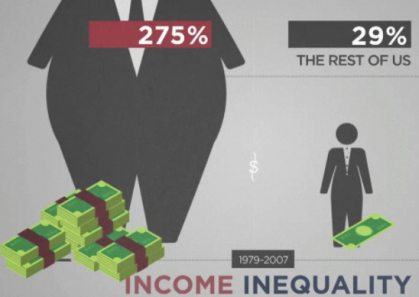
7) Incomes for the top 1% have increased (but the top 0.01% make even more). Between 1979 and 2007, the average incomes of the 1% increased 241%. Compare that to 19% growth for the middle fifth of America and 11% for the bottom fifth. Put another way, in 1980 the average American CEO earned forty-two times as much as his average worker. In 2001, he earned 531 times as much

Average income across the 1% is actually stratified into widely disparate echelons. Compare the $29,840 average income for the bottom 90% to the $161,139 of the top 10%. Compare the $1 million average income of the top 1% to the $2.8 million of the top 0.1%. Yet both still pale beside the $23 million average income of the top 0.01%. 

If those numbers seem a bit overwhelming, Politizane has created a video that illustrates this staggering inequality:

8) The majority of Congress does not feel your pain. Empowered by the Constitution to represent their constituents, United States Congress members are, for the first time in history, mostly millionaires. The 2012 financial disclosure information of the 534 current Congress men and women reveals that over half of them have a net worth of $1 million or more. After the past seven facts it is difficult to read this last one and believe that these 268 legislators have the best interests of the remaining 99% at heart. But if that is too presumptuous a leap, it is not too bold to say that wealthier donors, lobbyists and special interest groups enjoy greater access to these lawmakers than the average American. 

Life, and the Liberty to Go Hungry

Last week Congress failed to extend emergency benefits for unemployment, leaving 1.3 million people without federal aid. Congress is currently on a weeklong recess that will keep them from debating the issue until their return on January 27. The bill was too divisive for Republicans and Democrats to reach an agreement on, though unemployment is still above 7% nationally. 

Thankfully, the unemployed have their Congress working for them. And at $174,000 annual pay, those representatives are sure to return from vacation committed to fresh solutions. 

The pursuit of happiness is an ephemeral affair, but the freedom to succeed is not. It is something one possesses or lacks. It is the difference between enjoying a more prosperous life than one’s parents and believing there is no way out. A “self-evident” truth is one that is meaningful without proof, much akin to faith. If inequality continues to rise in America, the self-evident truths of its founding will be no more than words on an old piece of paper, its American Dream a tattered faith paid lip service by the deceitful and the blind.

How a Minimal Ebola Outbreak Will Devastate the U.S. Economy

By Dave Hodges

Source: Investment Watch

A World Bank analysis of the economic impact of Ebola on national economies suggests that only a minimal outbreak of the virus could very well devastate the United States and its economic interests.

Economic Consequences of the Perceived Threat of Ebola

There are two dominant theories related to the present Ebola crisis. One theory states that the media and certain government sponsored agencies such as the CDC, NIH and the FDA are hyping the Ebola crisis to promote the roll-out of mandatory vaccines. This notion promotes the belief that Ebola will not impact that many people but the fear being promoted will drive people to help people like Bill Gates make a fortune from the inevitable vaccines that  will follow this crisis. The theory certainly has merit.

The second theory postulates that Ebola will serve as a depopulation instrument AND the elite (e.g. Bill Gates) will make money on the demise of much of humanity through the implementation of mandatory vaccines, while Ebola rips through the population claiming millions of lives.

This second theory also proposes that the super-elite need not worry about succumbing to Ebola because of the fact that there are at least two vaccines and one vaccine, the 2006 human-tested Crucell vaccine, is being withheld from the public and is not being reported on in the media despite a paper trail pointing to its existence and possible efficacy as a treatment agent in the fight against Ebola. This fact has given rise to the possibility that the Crucell vaccine is effective, but the majority of the population will be receiving the hastily prepared and subsequently dangerous GSK vaccine. On the surface, this would seem like crazy thinking. However, it is actually very logical thinking because the Obama administration refuses to shut down air travel from West Africa or to shut down our porous border while trying to prevent the possibility of bioterrorism involving Ebola. Any prudent person would shut down the entry points of Ebola into the U.S. Therefore, we need to be asking what does the Obama administration know that the rest of us do not?

Which of the two theories is true? In terms of economic collapse, it does not matter which is true because either scenario will result in economic devastation.

The globalists are already warning the world about what lies ahead. On October 8, 2014, the World Bank warned about economic consequences of Ebola outbreaks on West African economies.

 “With Ebola’s potential to inflict massive economic costs on Guinea, Liberia, and Sierra Leone and the rest of their neighbors in West Africa, the international community must find ways to get past logistical roadblocks and bring in more doctors and trained medical staff, more hospital beds, and more health and development support to help stop Ebola in its tracks,” says Jim Yong Kim, the President of the World Bank Group.

In fact, the World Bank has published an economic analysis and a series of projections regarding the impacted Ebola countries in West Africa.
ebola-economics-in-africa

Ebola’s Critical Mass Impact On the U.S. Economy

What is the threshold of GDP loss that a country like the United States can endure before the wheels come off of the economy? In other words, how much of a percentage impact would Ebola have to have on the economy to devastate most businesses? Recently, the Washington Post published figures which set the historical average profit margin for a U.S. business at 4.6%. This means that if the spin-off effects of Ebola exceeds a 5% impact on the economy, the wheels will quickly come off the U.S. economy. Business failures will lead to a Stock Market collapse. Because the Glass-Steagall Act was repealed under Clinton, the Banks would be the next to fail  because they are recklessly tied to  underwriting and insuring many investment events in the Stock Market and individual savings and retirement accounts would disappear as well when the banks collapse.

Quickly, the country would fall into chaos. As widespread as the cascading economic collapse would become, no amount of martial law would contain the chaos.
Turn your attention to the World Bank chart, listed above, with regard to the projected economic impact on Liberia based upon low, medium and high projected effects  of an Ebola outbreak on their economy. Pay attention to the percentage of loss of their economic base listed in the above World Bank projections.


Ebola’s Impact on Liberia             Percentage of Impact

Low Impact From Ebola                          – 3.4%

Medium Impact From Ebola                   –  5.8%

High Impact From Ebola                         –  12.0%


Some are wondering why Liberia was chosen to illustrate the economic impact of Ebola and what this could potentially mean to the United States economy? Sierra Leone and Guinea have very primitive economies compared to Liberia, therefore, the impact of Ebola on their respective economies would be insignificant as a basis of comparison to the United States. To some extent, a Liberian comparison is invalid on its face because the Liberians do not have anything close to a 3,000 mile salad. In Liberia, there is virtually no “Just In Time” (JIT) delivery which forms the backbone of our service economy here in the United States. However, the Liberian numbers give us some idea of what we could expect in the U.S. when Ebola gains a foothold.

Since the economy of the United States is based upon JIT and our economic institutions are considerably more well-integrated and intertwined than they are in Liberia, what do you suppose would be the low, medium and high impact on the United States? Undeniably, the impact of Ebola as a factor of economic devastation would be catastrophically higher. The social consequences are devastatingly higher as well because a lower percentage of Americans are able to provide their own food supply as compared to Liberia. There are no numbers that I can point to with regard to the low, medium and high impact effect of Ebola on the U.S. economy except to say that any analysis would place the percentage of impact at a far higher rate than the World Bank projections listed for Liberia. It is safe to conclude that even a low impact effect of Ebola on the U.S. economy would exceed the 5% threshold.

When Going Out In Public Becomes Too Much of a Risk

As any politician, sociologist or policeman will tell you that the fabric that holds society together is voluntary conformity and trust. Most Americans obey most laws because we understand the importance of societal cooperation as opposed to the dangers of living in a state of anarchy. The other factor that binds society together is trust. One of the key elements of trust in America is that our citizens trust the fact that it is safe to go out in public. And going out in public is where much of America’s economic business is conducted (i.e. restaurants, movie theaters, shopping malls, football games, concerts, etc.).

Mike Adams, appearing as a guest on The Common Sense Show on October 6, 2014, captured this notion when he stated that when Americans lose trust in the belief that it is safe to be in crowds, the impact on our way of life, and especially on our economy, will be catastrophic.

To illustrate just how devastating the effects can be on the economy when people lose trust in the belief that it is safe to go out in public, let’s take a look at the immediate reaction from the citizens of Dallas when only one Ebola case, Thomas Duncan, surfaced in the city.

When it was announced that Thomas Duncan had contact with some Dallas school children, we saw the immediate impact as Dallas moms began to keep their children home from school. Officials in Louisiana refused to receive Thomas Duncan’s property. Subsequently, and according to the AP and Veolia North America, Duncan’s effects were  disposed of in drums taken from a Dallas apartment where Duncan became ill and were burned at the company’s incinerator in Port Arthur., TX.

It does not matter what I write or what someone broadcasts on their talk show about Ebola, once people perceive there is a threat, even a low-level threat posed by someone like Thomas Duncan, the people will panic. Rationality will not be part of the decision making process. Fear will take over.

How long would police, fire, EMT personnel, hospital personnel, people that service our water supplies and the doctors that service our infirm, stay on the job following an Ebola outbreak? An examination of this question, by using Hurricane Katrina, as a comparison, tells us that by the third day, virtually all essential  services would be seriously compromised because of personnel defections. In this scenario, how would chronically ill people receive their medications? How would people get emergency appendectomies or other emergency medical procedures?  There will be no “911, what’s your emergency”? The factors that bind society together will quickly unravel  as Ebola spreads even on a relatively low level of impact.

What can you do to prepare if the economy collapses because of the economic impact of Ebola?

9 Ominous Signals Coming From The Financial Markets That We Have Not Seen In Years

Meltdown-Secret-History-of-Global-Financial-Collapse

By Michael Snyder

Source: The Economic Collapse

Is the stock market about to crash?  Hopefully not, and there definitely have been quite a few “false alarms” over the past few years.  But without a doubt we have been living through one of the greatest financial bubbles in U.S. history, and the markets are absolutely primed for a full-blown crash.  That doesn’t mean that one will happen now, but we are starting to see some ominous things happen in the financial world that we have not seen happen in a very long time.  So many of the same patterns that we witnessed just prior to the bursting of the dotcom bubble and just prior to the 2008 financial crisis are repeating themselves again.  Hopefully we still have at least a little bit more time before stocks completely crash, because when this market does implode it is going to be a doozy.

The following are 9 ominous signals coming from the financial markets that we have not seen in years…

#1 By the time the markets closed on Monday, we had witnessed the biggest three day decline for U.S. stocks since 2011.

#2 On Monday, the S&P 500 moved below its 200 day moving average for the first time in about two years.  The last time this happened after such an extended streak of success, the S&P 500 ended up declining by a total of 22 percent.

#3 This week the put-call ratio actually moved higher than it was at any point during the collapse of Lehman Brothers in 2008.  This is an indication that there is a tremendous amount of fear on Wall Street right now.

#4 Everybody is watching the VIX at the moment.  According to the Economic Policy Journal, the VIX has now risen to the highest level that it has been since the heart of the European debt crisis.  This is another indicator that there is extraordinary fear on Wall Street…

US stock market volatility has jumped to the highest since the eurozone debt crisis, according to a closely watched index, the the CBOE Vix index of implied US share price volatility.

It jumped to 24.6 late on Monday and is up again this morning. On Thursday, it was as low as 15.

That’s a very strong move, but things have been much worse. At height of the recent financial crisis – the Vix index peaked at 80.1 in November 2008.

Could we get there again? Yeah.

#5 The price of oil is crashing.  This also happened in 2008 just before the financial crisis erupted.  At this point, the price of oil is now the lowest that it has been in more than two years.

#6 As Chris Kimble has pointed out, the chart for the Dow has formed a “Doji Star topping pattern”.  We also saw this happen in 2007.  Could this be an indication that we are on the verge of another stock market crash similar to what happened in 2008?

#7 Canadian stocks are actually doing even worse than U.S. stocks.  At this point, Canadian stocks have already dropped more than 10 percent from the peak of the market.

#8 European stocks have also had a very rough month.  For example, German stocks have already dropped about 10 percent since July, and there are growing concerns about the overall health of the German economy.

#9 The wealthy are hoarding cash and precious metals right now.  In fact, one British news report stated that sales of gold bars to wealthy customers are up 243 percent so far this year.

So what comes next?

Some experts are saying that this is the perfect time to buy stocks at value prices.  For example, USA Today published a story with the following headline on Tuesday: “Time to ‘buy’ the fear? One Wall Street pro says yes“.

Other experts, however, believe that this could represent a major turning point for the financial markets.

Just consider what Abigail Doolittle recently told CNBC

Technical strategist Abigail Doolittle is holding tight to her prediction of market doom ahead, asserting that a recent move in Wall Street’s fear gauge is signaling the way.

Doolittle, founder of Peak Theories Research, has made headlines lately suggesting a market correction worse than anyone thinks is ahead. The long-term possibility, she has said, is a 60 percent collapse for the S&P 500.

In early August, Doolittle was warning both of a looming “super spike” in the CBOE Volatility Index as well as a “death cross” in the 10-year Treasury note. The former referenced a sharp move higher in the “VIX,” while the latter used Wall Street lingo for an event that already occurred in which the fixed income benchmark saw its 50-day moving average cross below its 200-day trend line.

Both, she said, served as indicators for trouble ahead.

It’s Time for Some Anti-Science Fiction

nature-spaceships_00374723

Source: The Hipcrime Vocab

It’s Time for Some Anti-Science Fiction
Why must positive depictions of the future always be dependent upon some sort of new technology?

Neal Stephenson is a very successful and well-known science fiction writer. He’s also very upset that the pace of technological innovation has seemingly slowed down and we seem to be unable to come up with truly transformative  “big ideas” anymore. He believes this is the reason why we are so glum and pessimistic nowadays. Indeed, the science fiction genre, once identified with space exploration and utopias of post-scarcity and abundant leisure time, has come to be dominated by depictions of the future as a hellhole of extreme inequality, toxic environmental pollution, overcrowded cities, oppressive totalitarian governments, and overall political and social breakdown. Think of movies like The Hunger Games, Elysium, The Giver, and Snowpiercer.

This pessimism is destructive and corrosive, believes Stephenson. According to the BBC:

Acclaimed science-fiction writer Neal Stephenson saw this bleak trend in his own work, but didn’t give it much thought until he attended a conference on the future a couple years ago. At the time, Stephenson said that science fiction guides innovation because young readers later grow up to be scientists and engineers.

But fellow attendee Michael Crow, president of Arizona State University (ASU), “took a more sort of provocative stance, that science fiction actually needed to supply ideas that scientists and engineers could actually implement”, Stephenson says. “[He] basically told me that I needed to get off my duff and start writing science fiction in a more constructive and optimistic vein.”

“We want to create a more open, optimistic, ambitious and engaged conversation about the future,” project director Ed Finn says. According to his argument, negative visions of the future as perpetuated in pop culture are limiting people’s abilities to dream big or think outside the box. Science fiction, he says, should do more. “A good science fiction story can be very powerful,” Finn says. “It can inspire hundreds, thousands, millions of people to rally around something that they want to do.”

Basically, Stephenson wants to bring back the kind of science fiction that made us actually long for the future rather than dread it. Stephenson means to counter this techno-pessimism by inviting a number of well-known science fiction writers to come up with more positive, even utopian, visions of the future, where we once again come up with “big ideas” that inspire the scientists and engineers in their white labcoats. He apparently believes that it is the duty of science fiction authors to act as, in the words of one commentator, “the first draft of the future. ” Indeed, much of modern technology and space exploration was presaged by authors like H.G. Wells and Jules Verne. From the BBC article above, here are some of the positive future scenarios depicted in the book:

  •     Environmentalists fight to stop entrepreneurs from building the first extreme tourism destination hotel in Antarctica.
  •     People vie for citizenship on a near-zero-gravity moon of Mars, which has become a hub for innovation.
  •     Animal activists use drones to track elephant poachers.
  •     A crew crowd-funds a mission to the Moon to set up an autonomous 3D printing robot to create new building materials.
  •     A 20km tall tower spurs the US steel industry, sparks new methods of generating renewable energy and houses The First Bar in Space.

The whole idea behind Project Hieroglyph, as I understand it, is to depict more positive futures than the ones being depicted in current science fiction and media. That seems like a good idea. But my question is – why must these positive futures always involve more intensive application of technology? Why are we unable to envision a better future in any other way besides more technology, more machines, more inventions, more people, more economic growth, etc. Haven’t we already been down that road?

Or to put it another way, why must science fiction writers assume that more technological innovation will produce a better society when our modern society is the result of previous technological innovations, and is seen by many people as a dystopia (with many non-scientifically-minded people actually longing for a collapse of some sort)? Perhaps, to paraphrase former president Reagan, in the context of our current crisis, technology is not the solution to the problem, technology is the problem.

***

It’s worth pointing out that many of the increasingly dystopian elements of our present circumstances have been brought about by the application of technology.

Economists have pinpointed technology as a key driver of inequality thanks to the hollowing out of the middle class due to the automation of routine tasks that underpinned the  industrial/service economy leaving only high-end and low-end jobs remaining, as well as the “superstar effect” where a few well-paid superstars capture all the gains because technology allows them to everywhere at once. Fast supercomputers have allowed the rich to game the stock market casino where the average stock is now held for just fractions of a second, while global telecommunications has led to reassigning jobs anywhere in the world where the very cheapest workers can be found. America’s manufacturing  jobs are now done by Chinese workers and its service jobs by Indian workers half a world away even as the old Industrial heartland looks suspiciously like what is depicted in The Hunger Games. Rather than a world of abundant leisure, stressed out workers take their laptops to the beach, fearful of losing their jobs if they don’t, while millions have given up even looking for work anymore. A permanently underemployed underclass distracts itself with Netflix, smartphones and computer games, and takes expensive drugs promoted by pharmaceutical companies to deal with their depression.

Global supply chains, supertankers, the “warehouse and wheels,” and online shopping have hollowed out local main street economies and led to monopolies in every industry across the board. Small family farmers have been kicked off the land worldwide and replaced by gargantuan, fossil-fuel powered agricultural factories owned by agribusinesses churning out  bland processed food based around wheat, corn and soy causing soaring obesity rates worldwide and runaway population growth.

Banks have merged into just a handful of entities that are “too-big-to-fail” and send trillions around the world at the speed of light. Gains are privatized while loses and risk are socialized, and the public sphere is sold off to profiteers at fire sale prices. A small financial aristocracy controls the system and hamstrings the world with debt. Just eighty people control as much wealth as half of the planet’s population, and in the world’s biggest economy just three people gain as much income as half the workforce. There are now more prisoners in America than farmers.

A now global trans-national elite of owner-oligarchs criss-crosses the world in Gulfsteam jets and million-dollar yachts and  hides their money in offshore accounts beyond the reach of increasingly impotent national governments, while smaller local governments can’t keep potholes filled, streets plowed and streetlights on for ordinary citizens. Many of the world’s great cities have become “elite citadels” making it impossible for regular citizens to live there. This elite controls bond markets, funds political campaigns and owns and controls a monopolized media that normalizes this state of affairs using sophisticated propaganda tools enhanced by cutting-edge psychological research enabled by MRI scanners. The media is controlled by a small handful of corporations and panders to the lowest common demonstrator while keeping people in a constant state of fear and panic. Advertising preys on our insecurities and desire for status to make us buy more, enabled by abundant credit. The Internet, once the hope for a more democratic future, has ended up as shopping mall, entertainment delivery system and spying/tracking system rather than a force for democracy and revolution.

Security cameras peer at us from every streetcorner and store counter and shocking revelations about the power and reach of the national security state that are as fantastic as anything dreamed up by dystopian science fiction writers have become so commonplace that people hardly notice anymore. Anonymous people in gridded glass office towers read our every email, listen to our every phone call and track our every move using our cell phones. New technology promises “facial recognition” and “smart” technology promoted by corporations promises to track and permanently record literally every move you make.

Remote-control drones patrol the skies of global conflict zones and vaporize people half a world away without their pilots ever seeing their faces. High-tech fighter jets allow us to “cleanly” drop bombs without the messiness of a real war. Private mercenaries are a burgeoning industry and global arms sales continue to increase even in a stagnant global economy with arms companies often selling to both sides. By some accounts one in ten Americans is employed in some sort of “guard labor,” that is, keeping their fellow citizens in line. The number of failed states continues to increase in the Middle East and Africa and citizens in democracies are marching in the streets.

Not that there’s nothing for the national security state to fear after all – technology has enabled individual terrorists and non-state actors to produce devastating weapons capable of destroying economies and killing thousands as 9-11 demonstrated. A single “superempowered” individual can kill millions with a nuclear bomb the size of a suitcase or an engineered virus or other bioterrorism weapon. The latest concern is “cyberwarfare” which could destroy the technological infrastructure we are now utterly dependent upon and kill millions. “Non-state actors” can wreak as much havoc as armies thanks to modern technology, and there are a lot of disgruntled people out there.

And then there is the environmental devastation, of which climate change is the most overwhelming, but includes everything from burned down Amazonian rainforest, to polluted mangroves in Thailand, to collapased fish stocks, dissolving coral reefs and oceans full of jellyfish. Half the  world’s terrestrial biodiversity has been eliminated in the past fifty years and we’ve lost so much polar ice that earth’s gravity is measurably affected. In China, the world’s economic success story, the haze is so thick that people can’t see the tops of the skyscrapers they already have and there are “cancer villages.” The skies may be a bit clearer in America thanks to deindustrialization, but things like drought in the Southwest and increasinginly powerful hurricanes are reminders that no one is immune. Entire countries and major cities look to be submerged under rising oceans and the first climate refugees are already on the move from places like Africa and Southeast Asia leading to anti-immigrant backlash in developed countries.

This is not some future dystopia, by the way, this is where technology has us led right now. Today. Current headlines. Maybe the reason that dystopias are so popular is because that seems to be where technology had led us here in the first decade of the twenty-first century. I’m skeptical that Project Hieroglyph and it’s fostering of “big ideas” will do much to change that.

Thus my fundamental question is, given the above, why is it always assumed that the path to utopia goes through a widespread deployment of even more innovation and technology? Is it realistic to believe that colonies on Mars, drones, intelligent robots, skyscrapers and space elevators will solve any of this?

I’ve written before about the fact that the technology we already have in our possession today was expected to deliver a utopia by numerous writers and thinkers of the past. “The coming of the wireless era will make war impossible, because it will make war ridiculous,” declared Marconi in 1912. HG Wells, a committed socialist who lived during perhaps the greatest period of invention before or since (railroads, harnessing of electricity, radio communication, internal combustion engines, powered flight, antibiotics),  very frequently depicted utopian societies brought about through the applications of greater technology. Science fiction authors still seem to conceive utopias as being exclusively brought about by “technological progress.” But given hindsight, is that realistic anymore?

Maybe it’s time for some anti-science fiction.

***

The classic example of this is William Morris’ utopian novel News From Nowhere.

Morris was a key figure in the Arts and Crafts movement, which was a reaction to the factory-based mass production and subsequent deskilling of the workforce. People no longer collectively made the world of goods and buildings around them, rather they were now made by a small amount of people using deskilled, alienated labor in giant factories with the profits accruing to a tiny handful of capitalist owners. Morris wanted another way.

In Morris’ future London there are very little in the way of centralized institutions.  People work when they want to and do what they want to. Money is not used. Life is lived leisurely pace. Writing during the transformative changes of the Industrial Revolution, Morris’ London looks less like a World’s Fair and more like a lost bucolic pastoral London that had long since vanished under the smoke of factories. Technology plays a very small role yet people are much happier.

Morris’ work was written partially in response to a book entitled Looking Backward by Edward Bellamy, which was extraordinarily popular in the late nineteenth century, but almost forgotten today. Bellamy’s year 2000 utopia had the means of production brought under centralized control, with people serving time in an “industrial army” for twenty years and then retiring to a life of leisure and  material abundance brought about by production for use rather than capitalist profit.

Morris still felt that this subordinated workers to machines rather than depicting a society for the maximization of human well-being, including work. Here is Morris in a speech:

“Before I leave this matter of the surroundings of life, I wish to meet a possible objection. I have spoken of machinery being used freely for releasing people from the more mechanical and repulsive part of necessary labour; it is the allowing of machines to be our masters and not our servants that so injures the beauty of life nowadays. And, again, that leads me to my last claim, which is that the material surroundings of my life should be pleasant, generous, and beautiful; that I know is a large claim, but this I will say about it, that if it cannot be satisfied, if every civilised community cannot provide such surroundings for all its members, I do not want the world to go on.”

Morris’ book shows that utopias need not be high-tech. It also shows that real utopias are brought about by the underlying philosophy of a society and its corresponding social relations. It seems to me like Stephenson’s utopias are all predicated on the continuation of the philosophy and social relations of our current society – more growth, more technology, faster innovation, more debt, corporate control, trickle-down economics, private property, absentee ownership, anarchic markets, autonomous utility-maximizing consumers, etc. It is yoked to our ideas of “progress” as simply an application of more and faster technology.

By contrast, Morris’ utopia has the technological level we would  associate with a “dystopian” post collapse society, yet everyone seems a whole lot happier.

***

Now I don’t mean to suggest that any utopia should necessarily be a place where we have reverted to some sort pre-industrial level of technology. We don’t need to depict utopias as living like the Amish (although that would be an interesting avenue of exploration). I merely wish to point out that a future utopia need not be exclusively the domain of science fiction authors, and need not be predicated by some sort of new wonder technology or space exploration. For example, in an article entitled Is It Possible to Imagine Utopia Anymore? the author writes:

Recently, though, we may have finally hit Peak Dystopia…All of which suggests there might be an opening for a return to Utopian novels — if such a thing as “Utopian novels” actually existed anymore…In college, as part of a history class, I read Edward Bellamy’s Looking Backwards, a Utopian science-fiction novel published in 1888. The book — an enormous success in its time, nearly as big as Uncle Tom’s Cabin — is interesting now less as literature than as a historical document, and it’s certainly telling that, in the midst of the industrial revolution, a novel promising a future socialist landscape of increased equality and reduced labor so gripped the popular imagination. We might compare Bellamy’s book to current visions of Utopia if I could recall even a single Utopian novel or film from the past five years. Or ten years. Or 20. Wikipedia lists dozens of contemporary dystopian films and novels, yet the most recent entry in its rather sparse “List of Utopian Novels” is Island by Aldous Huxley, published in 1962*. The closest thing to a recent Utopian film I can think of is Spike Jonze’s Her, though that vision of the future — one in which human attachment to sentient computers might become something close to meaningful — hardly seems like a fate we should collectively strive for, but rather one we might all be resigned to placidly accept

Many serious contemporary authors have tackled dystopia: David Foster Wallace’s Infinite Jest, Gary Shteyngart’s Super Sad True Love Story, Cormac McCarthy’s The Road, and so on. But the closest thing we have to a contemporary Utopian novel is what we could call the retropia: books like Michael Chabon’s Telegraph Avenue (about a funky throwback Oakland record store) or Jonathan Lethem’s Fortress of Solitude (about 1970s Brooklyn) that fondly recall a bygone era, by way of illustrating what we’ve lost since —  “the lost glories of a vanished world,” as Chabon puts it. Lethem’s more recent Dissident Gardens is also concerned with utopia, but mostly in so far as it gently needles the revolutionaries of yesteryear.

Indeed, the closest things we have to utopias on TV today are shows like Mad Men which take place during the era when Star Trek was on TV rather than a utopia inspired by Star Trek itself. For many Americans, their version of utopia is not in the future but in the past – the 1950’s era of widespread prosperity, full employment, single-earner households, more leisure, guaranteed pensions, social mobility, inexpensive housing, wide open roads and spaces, and increasing living standards. As this article points out:

When I first heard about the project, my cynical heart responded skeptically. After all, much of the Golden Age science fiction Stephenson fondly remembers was written in an era when, for all its substantial problems, the U.S. enjoyed a greater degree of democratic consensus. Today, Congress can barely pass a budget, let alone agree on collective investments.

If someone asked me to depict a more positive future than the one we have, deploying more technology is just about the last thing I would do to bring it about. In fact, the future I would depict would almost certainly include less technology, or rather technology playing a smaller role in our lives. I would focus more on social relations that would make us be happy to be alive, where we eat good food, spend time doing what we want instead of what we’re forced to, and don’t have to be medicated just to make it through another day in our high-pressure classrooms and cubicles. I might even depict a future with no television inspired by Jerry Mander’s 1978 treatise Four Arguments for the Elimination of Television (hey, remember this is fiction after all!)

Rather it would depict different political, economic and social relations first, with new technology playing only a supporting, not a starring role. Organizing society around the needs of productive enterprise, growth and profits (and nothing else) is the reason, I believe, why we are feeling so depressed about the future that dystopias resonate more with a demoralized general public who rolls their collective eyes at the exhortations of science fiction writers with an agenda**. The problem of science fiction is it’s single-minded conflagration of technology with progress.

Personally my utopia would be something more like life on the Greek island of Ikaria*** according to this article from The New York Times (which reads an awful lot like News from Nowhere):

Seeking to learn more about the island’s reputation for long-lived residents, I called on Dr. Ilias Leriadis, one of Ikaria’s few physicians, in 2009. On an outdoor patio at his weekend house, he set a table with Kalamata olives, hummus, heavy Ikarian bread and wine. “People stay up late here,” Leriadis said. “We wake up late and always take naps. I don’t even open my office until 11 a.m. because no one comes before then.” He took a sip of his wine. “Have you noticed that no one wears a watch here? No clock is working correctly. When you invite someone to lunch, they might come at 10 a.m. or 6 p.m. We simply don’t care about the clock here.”

Pointing across the Aegean toward the neighboring island of Samos, he said: “Just 15 kilometers over there is a completely different world. There they are much more developed. There are high-rises and resorts and homes worth a million euros. In Samos, they care about money. Here, we don’t. For the many religious and cultural holidays, people pool their money and buy food and wine. If there is money left over, they give it to the poor. It’s not a ‘me’ place. It’s an ‘us’ place.”

Ikaria’s unusual past may explain its communal inclinations. The strong winds that buffet the island — mentioned in the “Iliad” — and the lack of natural harbors kept it outside the main shipping lanes for most of its history. This forced Ikaria to be self-sufficient. Then in the late 1940s, after the Greek Civil War, the government exiled thousands of Communists and radicals to the island. Nearly 40 percent of adults, many of them disillusioned with the high unemployment rate and the dwindling trickle of resources from Athens, still vote for the local Communist Party. About 75 percent of the population on Ikaria is under 65. The youngest adults, many of whom come home after college, often live in their parents’ home. They typically have to cobble together a living through small jobs and family support.

Leriadis also talked about local “mountain tea,” made from dried herbs endemic to the island, which is enjoyed as an end-of-the-day cocktail. He mentioned wild marjoram, sage (flaskomilia), a type of mint tea (fliskouni), rosemary and a drink made from boiling dandelion leaves and adding a little lemon. “People here think they’re drinking a comforting beverage, but they all double as medicine,” Leriadis said. Honey, too, is treated as a panacea. “They have types of honey here you won’t see anyplace else in the world,” he said. “They use it for everything from treating wounds to curing hangovers, or for treating influenza. Old people here will start their day with a spoonful of honey. They take it like medicine.”

Over the span of the next three days, I met some of Leriadis’s patients. In the area known as Raches, I met 20 people over 90 and one who claimed to be 104. I spoke to a 95-year-old man who still played the violin and a 98-year-old woman who ran a small hotel and played poker for money on the weekend.

On a trip the year before, I visited a slate-roofed house built into the slope at the top of a hill. I had come here after hearing of a couple who had been married for more than 75 years. Thanasis and Eirini Karimalis both came to the door, clapped their hands at the thrill of having a visitor and waved me in. They each stood maybe five feet tall. He wore a shapeless cotton shirt and a battered baseball cap, and she wore a housedress with her hair in a bun. Inside, there was a table, a medieval-looking fireplace heating a blackened pot, a nook of a closet that held one woolen suit coat, and fading black-and-white photographs of forebears on a soot-stained wall. The place was warm and cozy. “Sit down,” Eirini commanded. She hadn’t even asked my name or business but was already setting out teacups and a plate of cookies. Meanwhile, Thanasis scooted back and forth across the house with nervous energy, tidying up.

The couple were born in a nearby village, they told me. They married in their early 20s and raised five children on Thanasis’s pay as a lumberjack. Like that of almost all of Ikaria’s traditional folk, their daily routine unfolded much the way Leriadis had described it: Wake naturally, work in the garden, have a late lunch, take a nap. At sunset, they either visited neighbors or neighbors visited them. Their diet was also typical: a breakfast of goat’s milk, wine, sage tea or coffee, honey and bread. Lunch was almost always beans (lentils, garbanzos), potatoes, greens (fennel, dandelion or a spinachlike green called horta) and whatever seasonal vegetables their garden produced; dinner was bread and goat’s milk. At Christmas and Easter, they would slaughter the family pig and enjoy small portions of larded pork for the next several months.

During a tour of their property, Thanasis and Eirini introduced their pigs to me by name. Just after sunset, after we returned to their home to have some tea, another old couple walked in, carrying a glass amphora of homemade wine. The four nonagenarians cheek-kissed one another heartily and settled in around the table. They gossiped, drank wine and occasionally erupted into laughter.

No robot babysitters or mile-high skyscrapers required.

* No mention of Ernest Callenbach’s Ecotopia published in 1975?

** ASU is steeped in Department of Defense funding and DARPA (The Defense Research Projects Agency) was present at a conference about the book entitled “Can We Imagine Our Way to a Better Future?” held in Washington D.C. I’m guessing the event did not take place in the more run-down parts of the city. Cui Bono?

***Ironically, Icaria was used as the name of a utopian science fiction novel, Voyage to Icaria, and inspired an actual utopian community.

Ready Or Not… The unsustainable status quo is ending

images

By Chris Martenson

Source: Peak Prosperity

I have to confess, it’s getting more and more difficult to find ways of writing about everything going on in the world.

Not because there’s a shortage of things to write about — wars, propaganda, fraud, Ebola — but because most of the negative news and major world events we see around us are symptoms of the disease, not the disease itself.

There are only so many times you can describe the disease, before it all becomes repetitive for both the writer and the reader. It’s far more interesting to get to the root cause, because then real solutions offering real progress can be explored.

Equally troubling, in a world where the central banks have distorted, if not utterly flattened, the all important relationship between prices, risk, and reality, what good does it do to seek some sort of meaning in the new temporary arrangement of things?

When the price of money itself is distorted, then all prices are merely derivative works of that primary distortion. Some prices will be too high, some far too low, but none accurately determined by the intersection of true demand and supply.

If risk has been taken from where it belongs and instead shuffled onto central bank balance sheets, or allowed to be hidden by new and accommodating accounting tricks, has it really disappeared? In my world, risk is like energy: it can neither be created nor destroyed, only transformed or transferred.

If reality no longer has a place at the table — such as when policy makers act as if the all-too-temporary shale oil bonanza is now a new permanent constant — then the discussions happening around that table are only accidentally useful, if ever, and always delusional.

Through all of this, the big picture as described in the Crash Course grows ever more obviously clear: we are on an unsustainable course; economically, ecologically, and — most immediately worryingly  — in our use of energy.

So let’s start there, with a simple grounding in the facts.

By The Numbers

Humans now number 7.1 billion on the planet and that number is on track to rise to 8 or 9 billion by 2050. Already ‘energy per capita’ is stagnant across the world and has been for a few decades. If the human population indeed grows by 15-25% over the next three and a half decades, then net energy production will have to grow by the same amount simply to remain constant on a per capita basis.

But can it? Specifically, can the net energy we derive from oil grow by another 15% to 25% from here?

Consider that, according to the EIA, the US shale oil miracle will be thirty years in the rear-view mirror by 2050 (currently projected to peak in 2020). And beyond just shale, all of the currently-operating conventional oil reservoirs will be far past peak and well into their decline. That means that the energy-rich oil from the giant fields of yesteryear will have to be replaced by an even larger volume of new oil from the energetically weaker unconventional plays just to hold things steady.

To advance oil net energy on a per capita basis between now and 2050, we’ll have to fight all of the forces of depletion with one hand, and somehow generate even more energy output from energetically parsimonious unconventional sources such as shale and tar sands with the other hand.

These new finds…they just aren’t the same as the old ones. They are deeper, require more effort per well to get oil out, and return far less per well than those of yesteryear. Those are just the facts as we now know them to be.

In 2013, total worldwide oil discoveries were just 20 billion barrels. That’s against a backdrop of 32 billion barrels of oil production and consumption. Since 1984, consuming more oil than we’re discovering has been a yearly ritual. To use an analogy: it’s as if we’re spending from a trust fund at a faster rate than the interest and dividends are accruing. Eventually, you eat through the principal balance and then it’s game over.

Meanwhile, even as the total net energy we receive from oil slips and our consumption wildly surpasses discoveries, the collective debt of the developed economies has surpassed the $100 trillion mark — which is a colossal bet that the future economy will not only be larger than it is currently, but exponentially larger.

These debts are showing no signs of slowing down. Indeed, the world’s central banks are doing everything in their considerable monetary power to goose them higher, even if this means printing money out of thin air and buying the debt themselves.

Along with this, the demographics of most developed economies will be drawing upon badly-underfunded pension and entitlement accounts — most of which are literally nothing more substantial than empty political promises made many years ago.

These trends in oil, debt and demographics are stark facts all on their own. But when we tie these to the obvious ecological strains of meeting the needs of just the world’s current 7.1 billion, any adherence to the status quo seems worse than merely delusional.

Here’s just one example from the ecological sphere. All over the globe we see regions in which ancient groundwater, in the form of underground aquifers, is being tapped to meet the local demand.

Many of these reservoirs have natural recharge rates that are measured in thousands, or even tens of thousands, of years.

Virtually all of them are being over-pumped. The ground water is being removed at a far faster rate than it naturally replenishes.

This math is simple. Each time an aquifer is over-pumped, the length of time left for that aquifer to serve human needs diminishes. Easy, simple math. Very direct.

And yet, we see cultures all over the globe continuing to build populations and living centers – very expensive investments, both economically and energetically – that are dependent for their food and water on these same over-pumped aquifers.

In most cases, you can calculate with excellent precision when those aquifers will be entirely gone and how many millions of people will be drastically impacted.

And yet, in virtually every case, the local ‘plan’ (if that’s the correct word to use here) is to use the underground water to foster additional economic/population growth today without any clear idea of what to do later on.

The ‘plan’ such as it is, seems to be to let the people of the future deal with the consequences of today’s decisions.

So if human organizations all over the globe seem unable to grasp the urgent significance of drawing down their water supplies to the point that they someday run out, what are the odds we’ll successfully address the more complex and less direct impacts like slowly falling net energy from oil, or steadily rising levels of debt? Pretty low, in my estimation.

Conclusion

Look, it’s really this simple: Anything that can’t go on forever, won’t.  We know, financially speaking, that a great number of nations are utterly insolvent no matter how much the accounting is distorted. Said another way: there’s really no point in worrying about the combined $100 trillion shortfall in Social Security and Medicare, because it simply won’t be paid.

Why? It can’t, so it won’t. The promised entitlements dwarf our ability to fund them many times over. There’s really not much more to say there.

But the biggest predicament we face is that steadily-eroding net energy from oil, which will someday be married to steadily-falling output as well, can’t support billions more people and our steadily growing pile of debt.

Just as there’s no plan at all for what to do when the groundwater runs out besides ‘Let the folks in the future figure that one out,’ there’s no plan at all for reconciling the forced continuation of borrowing at a faster rate than the economy can (or likely will be able to) grow.

The phrase that comes to mind is ‘winging it.’

The wonder of it all is that people still turn to the same trusted sources for guidance and as a place to put their trust. For myself, I have absolutely no faith that the mix of DC career politicians and academic wonks in the Fed have any clue at all about such things as energy or ecological realities.  Their lens only concerns itself with money, and the only tradeoff concessions they make are between various forms of economic vs. political power.

If the captains supposed to be guiding this ship are using charts that ignore what lies beneath the waterline, then you can be sure that sooner or later the ship is going to strike something hard and founder.

I’m pretty sure the Fed’s (and ECB’s and BoJ’s and BoE’s) charts resemble those of medieval times, with “Here be dragons” scrawled in the margins next to a series of charts of falling stock prices and unwinding consumer debt.

So there we are. The globe is heading from 7.1 billion to 8 or 9 billion souls, during a period of time when literally every known oil find will be well past its peak. Perhaps additional shale finds will come along on other continents to smooth things out for a bit (which is not looking likely), but it’s well past time to square up to the notion that cheap oil is gone. And with it, our prospects for the robust and widespread prosperity of times past.