Saturday Matinee: The City of Lost Children

By Bill Gibron

Source: Pop Matters

Film has always been a visual medium. In the days before sound, the image was all we had. It told our story, established our characters, and accentuated the drama or comedy. Visual flair is as old as movies themselves, and yet so few directors today seem to rely on and relish in the imaginative or outrageous. Since the early ’60s, Hollywood and its filmmakers have de-evolved style in a vicious cycle real world recreation for the hyper-stylized universe of the big screen, exploiting small events to find the hidden theatrics. Instead of broad canvases of color or rich, dense imagery, we witness the mundane or maudlin. Even those epic dreamscapes woven by complex computers and deranged art designers usually have one foot firmly planted in the easy to recognize and rationalize. But not The City of Lost Children. It harkens back to a more old-fashioned pictographic mindset. In many significant and indirect ways, the wild world of Marc Caro and Jean-Pierre Jeunet is art come to life. As in their previous film together, 1991’s Delicatessen, it is a fairy tale presentation of pure unbridled, wonderfully wicked imagination. It’s the Brothers Grimm as envisioned by Salvador Dali and filmed by Fritz Lang.

This is a lost classic, a film not often discussed when visionary works of imaginative cinema are mentioned. Part of this may be due to its foreign film roots. Or perhaps, for many, the film is too dark, not your typical sweet Saturday morning matinee. There are very disturbing subtexts to City that do not exist in other flights of fancy. The children here are indeed lost, either captured and tormented by a character known as Krank, or forced into a life of juvenile crime by the manipulative twins who run an orphanage. We do not see mothers or fathers. There are no caregivers or guardians, nor do we see orphans or outcasts longing for them. This lack of unconditional love creates youths who are vastly more mature, discussing subjects like love and fear with ferocious intensity and sly maturity. The strongman known as One is the closest we have to any type of parental figure, and even he is not really the older, bigger brother. “No parents” does not equal “no worries” in City. This is also a film that wallows in the subtle beauty of the grotesque, amplifying ugliness to illustrate unbridled absurdity. From Jean Paul Gautier’s Marquis de Sade meets Moby Dick fashion statements to the walleyed, demon-like faces of the child-napping zealot Cyclops, the film takes the long lost look of the circus sideshow and melds it to a nightmarish world of technological and emotional freaks.

Jean-Pierre and Marc are obviously obsessed with the carnival. The entire color scheme seems lifted from a tattooed man’s body illustrations. Like Fellini’s La Strada, which sought to tell a simple tale of love and the human spirit within the unreal realm of the circus, the filmmakers use the fantastical festival setting as a means of expressing their themes. Within its pandemonium pallet are the purity of youth, the pain of age, the wickedness of greed, and the comfort of love. There are also religious philosophies at play, battles with God both figuratively and literally. Krank and his army of clones fight and argue amongst themselves, all in the hope that, one day, the Creator will return to right his genetic missteps. The twins lord over their orphan charges like devils at the seat of Satan’s cloven hoof, waiting for instruction and brimstone beatitudes. Even the Cyclops proclaim their undying faith by blinding themselves, hoping that God will see that through both their devotion and their evangelism how truly gifted with sight (both internal and external) they are. Just like the wistful notion of running off to join the traveling show, The City of Lost Children is a chance not taken, a place where the oppression of maturity, of the stark reality of mortality and responsibility turn adults into monsters, and children into commodities.

The viewer can see many divergent ideals and inspirations at work here. But the most interesting influence to wind its way throughout the entire film is American cartoonist and inventor Rube Goldberg. Goldberg’s ingenious drawings illustrated incredibly complicated and multi-stepped procedures to achieve the most basic of results. Several set pieces in the film apply his principles and influences, and there is a giddy joy when their cause and effect logic draws to its ultimate conclusion. One sequence, involving the animal kingdom and a call to arms, is as beautiful as it is ridiculously complex. Like all other special, unnerving aspects of this movie, from the twisted fable at the core of its narrative, to the subtle pronouncements on love and family, The City of Lost Children is indeed like one of Goldberg’s wildest inventions. It’s a film that hitches its humor to the stinger of a flea, rides it on the heads of circus strongmen, and brings its heartfelt conclusion to rest in the bubbling tank of a talking, sarcastic brain. Yet the movie never gets lost itself. There is a perverse logic in its over symbolic and stylized storytelling.

No discussion of City would be complete without a word or two about the film’s music and its wonderful performances. As he has done in so many other films for auteurs like David Lynch and Paul Schrader, Angelo Badalamenti creates the perfect score, adding the clarion call of the calliope and the lonesome moan of the strings to underscore the strangeness and the sadness. This is a town under fire from within (the gangs of mercenary urchins) and without (the abductions), and Badalamenti creates a theme and an aural presence for every ideal. Sonically, The City of Lost Children is a near seamless matching of music to moving image. As for the actors, Ron Perlman has always seemed like a stunt waiting to be cast. Usually unrecognizable in face altering or obliterating make-up, he normally essays roles as unreal as the location in this film. But interestingly enough, he is the very human core of the film, a strong, faithful muscleman whose basic needs match his simpleton intellect. His is a perfectly modulated, understated performance. Among the child actors, little Judith Vittet stands out as Miette, a child who carries an incredible amount of adult soul and beauty within her delicate, French bisque features. And as usual, Jeunet regular Dominique Pinon applies his elastic facial features to the creation of six distinct characters, all out of minimal dialogue and elegant pantomime.

A movie like The City of Lost Children doesn’t really want to show us where the secrets of youth are hidden. It buries its message of adulthood and its perils in elaborate sets and visually arresting images. It symbolizes the dead end of avarice, the importance of familial bonds, and the painful loss of innocence through dreams in wonderful, paint box strokes. But it still leaves us wondering if such a place actually exists. For some, the manufactured wonders of Disney World or Universal Studios theme parks offer a glimpse into the sacred village of eternal childhood. Still others find it in the magic of their offspring at play, in their riotous laughter. Many see it in the eyes of their son or daughter as they light up in loving response. And there are those who, no matter how hard they try or how long they look, will never find the City. It will pass them by, or they will look over or through it in pursuit of a more complicated, unimportant goal. Jean-Pierre Jeunet and Marc Caro have at least provided a roadmap to the mythological place in their film La Cité des Enfants Perdus. Just turn right at your dreams, be on the lookout for your heartstrings, and ride your imagination all the way to where the sea meets the sky.

https://vimeo.com/75469682

Saturday Matinee: The One Percent

This 80-minute documentary focuses on the growing “wealth gap” in America, as seen through the eyes of filmmaker Jamie Johnson, a 27-year-old heir to the Johnson & Johnson pharmaceutical fortune. Johnson, who cut his film teeth at NYU and made the Emmy®-nominated 2003 HBO documentary Born Rich, here sets his sights on exploring the political, moral and emotional rationale that enables a tiny percentage of Americans – the one percent – to control nearly half the wealth of the entire United States. The film Includes interviews with Nicole Buffett, Bill Gates Sr., Adnan Khashoggi, Milton Friedman, Robert Reich, Ralph Nader and other luminaries.

Saturday Matinee: Embrace of the Serpent

From Wikipedia:

Embrace of the Serpent (Spanish: El abrazo de la serpiente) is a 2015 internationally co-produced adventure drama film directed by Ciro Guerra, and written by Guerra and Jacques Toulemonde Vidal. Shot almost entirely in black and white, the film follows two journeys made thirty years apart by the indigenous shaman Karamakate in the Colombian Amazonian jungle, one with Theo, a German ethnographer, and the other with Evan, an American botanist, both of whom are searching for the rare plant yakruna. It was inspired by the travel diaries of Theodor Koch-Grunberg and Richard Evans Schultes, and dedicated to lost Amazonian cultures.

Embrace of the Serpent was premiered on 15 May 2015 during the Directors’ Fortnight section at the 2015 Cannes Film Festival, where it won the Art Cinema Award. The film was released in Colombia on 21 May 2015, and worldwide over the course of the following twelve months. It has received universal acclaim from critics, who praised the cinematography and the story’s impact of the destruction of the Amazon rainforest and way of life by white colonialism. It has won numerous awards, including the Alfred P. Sloan Prize at the 2016 Sundance Film Festival, the Grand Jury Prize for Best Picture at the 2017 Riviera International Film Festival, and seven awards at the 3rd Platino Awards to recognise the best Ibero-American films of 2015, including the Platino Award for Best Ibero-American Film. In 2016 the film was submitted as Colombia’s entry for the category of Best Foreign Language Film at the 88th Academy Awards and was included among the final five nominees, becoming the first Colombian film ever to receive a nomination for an Academy Award.

The film tells two stories thirty years apart, both featuring Karamakate, an Amazonian shaman and last survivor of his tribe. He travels with two scientists, firstly with the German Theo von Martius in 1909 and then with an American named Evan in 1940, to look for the rare yakruna, a sacred plant.[4]

Theo, an ethnographer from Tübingen who has already been residing in the Amazon for several years, is very sick and is travelling by canoe with his field notes and a westernised local named Manduca who he saved from enslavement on a rubber plantation. Karamakate prolongs his life, blasting white powder called “the sun’s semen” (possibly a hallucinogenic made from virola[5]) up his nose, but is reluctant to become involved with a westerner and refuses his money. Theo is searching for yakruna as the only cure for his disease and the three set off in the canoe to search for it.

Many years later an American botanist, Evan (Brionne Davis), paddles up to a much older Karamakate (Antonio Bolívar) who has apparently forgotten the customs of his own people. Evan says he is hoping to complete Theo’s quest and Karamakate does assist, again reluctantly, saying his knowledge is spent. Evan has a book of Theo’s final trek, which his aide had sent back to Europe, as he did not survive the jungle. The book includes an image of Karamakate, which he refers to as his chullachaqui, a native term for hollow spirit. Karamakate agrees to help him only when Evan describes himself as someone who has devoted himself to plants, although Evan’s real purpose is actually to secure disease-free rubber trees, since the United States’s supplies of rubber from South East Asia had dwindled due to the Japanese wartime advance.

Both expeditions feature a Spanish Catholic Mission by the side of an Amazon tributary, run in 1909 by a sadistic, lone Spanish priest who beats orphan boys for any “pagan” behaviour, and in 1940 by a delusional Brazilian figure who believes he is the Messiah. He only trusts the visitors when he believes they are the Biblical Magi, but Karamakate wins his respect when he heals his wife. By now the children of 1909 have grown into disturbed and violent acolytes.

In 1909, we are left with Theo, sick and having fled the Mission, arriving at a frontier post just about to be invaded by Colombian soldiers during the Amazon rubber boom, where the sacred yakruna is being abused by drunken men, and cultivated, against local traditions. Karamakate is furious and destroys it. In 1940, Karamakate does show Evan the origin of the plant in striking denuded dome-shaped mountains (Cerros de Mavecure), allegedly the home of yakruna. He reveals one yakruna flower that is on the last plant – he has destroyed all the others – and prepares it for Evan. The preparation being hallucinogenic, aids Evan in undergoing a superconscious experience. While most of the film is in black-and-white, a part of this experience is shown in colour to signify its intensity. The film ends with a transformed Evan remaining enamoured by a group of butterflies.

Watch the full film on Kanopy.

Saturday Matinee: Rakka

From Oats Studios

Rakka is the story of broken humanity following the invasion of a technologically superior alien species. Bleak, harrowing and unrelenting, the humans we meet must find enough courage to go on fighting.

Directed by Neill Blomkamp and starring Sigourney Weaver.

Cyberpunk is Dead

By John Semley

Source: The Baffler

“It was an embarrasser; what did I want? I hadn’t thought that far ahead. Me, caught without a program!”
—Bruce Bethke, “Cyberpunk” (1983)

Held annually in a downtown L.A. convention center so massive and glassy that it served as a futurist backdrop for the 1993 sci-fi action film Demolition Man and as an intergalactic “Federal Transport Hub” in Paul Verhoeven’s 1997 space-fascism satire Starship Troopers, the Electronic Entertainment Expo, a.k.a. “E3,” is the trade show of the future. Sort of.

With “electronic entertainment” now surpassing both music and movies (and, indeed the total earnings of music and movies combined), the future of entertainment, or at least entertainment revenue, is the future of video games. Yet it’s a future that’s backward-looking, its gaze locked in the rearview as the medium propels forward.

Highlights of E3’s 2019 installment included more details around a long-gestating remake of the popular PlayStation 1-era role-playing game Final Fantasy VII, a fifth entry in the demon-shooting franchise Doom, a mobile remake of jokey kids side-scroller Commander Keen, and playable adaptations of monster-budget movie franchises like Star Wars and The Avengers. But no title at E3 2019 garnered as much attention as Cyberpunk 2077, the unveiling of which was met with a level of slavish mania one might reserve for a stadium rock concert, or the ceremonial reveal of an efficacious new antibiotic.

An extended trailer premiere worked to whet appetites. Skyscrapers stretched upward, slashed horizontally with long windows of light and decked out with corporate branding for companies called “DATA INC.” and “softsys.” There were rotating wreaths of bright neon billboards advertising near-futuristic gizmos and gee-gaws, and, at the street level, sketchy no-tell motels and cars of the flying, non-flying, and self-piloting variety. In a grimy, high-security bunker, a man with a buzzcut, his face embedded with microchips, traded blows with another, slightly larger man with a buzzcut, whose fists were robotically augmented like the cyborg Special Forces brawler Jax from Mortal Kombat. The trailer smashed to its title, and to wild applause from congregated gamers and industry types.

Then, to a chug-a-lug riff provided by Swedish straight-edge punkers Refused (recording under the nom de guerre SAMURAI) that sounded like the sonic equivalent of a can of Monster energy drink, an enormous freight-style door lifted, revealing, through a haze of pumped-out fog, a vaguely familiar silhouette: a tall, lean-muscular stalk, scraggly hair cut just above the shoulders. Over the PA system, in smoothly undulating, bass-heavy movie trailer tones, a canned voice announced: “Please welcome . . . Keanu Reeves.” Applause. Pitchy screams. Hysterics in the front row prostrating themselves in Wayne’s World “we’re not worthy!” fashion. “I gotta talk to ya about something!” Reeves roared through the din. Dutifully reading from a teleprompter, he plugged Cyberpunk 2077’s customizable characters and its “vast open world with a branching storyline,” set in “a metropolis of the future where body modification has become an obsession.”

More than just stumping for Cyberpunk 2077, Reeves lent his voice and likeness to the game as a non-playable character (NPC) named “Johnny Silverhand,” who is described in the accompanying press materials as a “legendary rockerboy.” A relative newbie to the world of blockbuster Xbox One games, Reeves told the audience at E3 that Cyberpunk piqued his interest because he’s “always drawn to fascinating stories.” The comment is a bit rich—OK, yes, this is a trade show pitch, but still—considering that such near-futuristic, bodily augmented, neon-bathed dystopias are hardly new ground for Reeves. His appearance in Cyberpunk 2077 serves more to lend the game some genre cred, given Reeves’s starring roles in canonical sci-fi films such as Johnny Mnemonic (1995) and the considerably more fantastic Matrix trilogy (1999-2003)—now quadrilogy; with an anticipated fourth installment announced just recently. Like many of E3 2019’s other top-shelf titles, Cyberpunk 2077 looked forward by reflecting back, conjuring its tech-noir scenario from the nostalgic ephemera of cyberpunk futures past.

This was hardly lost among all the uproar and excitement. Author William Gibson, a doyenne of sci-fi’s so-called “cyberpunk” subgenre, offered his own withering appraisal of Cyberpunk 2077, tweeting that the game was little more than a cloned Grand Theft Auto, “skinned-over with generic 80s retro-future” upholstery. “[B]ut hey,” Gibson added, a bit glibly, “that’s just me.” One would imagine that, at least in the burrows of cyberpunk fandom, Gibson’s criticism carries considerable weight.

After all, the author’s 1984 novel Neuromancer is a core text in cyberpunk literature. Gibson also wrote the screenplay for Johnny Mnemonic, adapted from one of his own short stories, which likewise developed the aesthetic and thematic template for the cyberpunk genre: future dystopias in which corporations rule, computer implants (often called “wetware”) permit access to expansive virtual spaces that unfold before the user like a walk-in World Wide Web, scrappy gangs of social misfits unite to hack the bad guys’ mainframes, and samurai swords proliferate, along with Yakuza heavies, neon signs advertising noodle bars in Kanji, and other fetish objects imported from Japanese pop culture. Gibson dissing Cyberpunk 2077 is a bit like Elvis Presley clawing out of his grave to disparage the likeness of an aspiring Elvis impersonator.

Gibson’s snark speaks to a deeper malaise that has beset cyberpunk. A formerly lively genre that once offered a clear, if goofy, vision of the future, its structures of control, and the oppositional forces undermining those authoritarian edifices, it has now been clouded by a kind of self-mythologizing nostalgia. This problem was diagnosed as early as 1991 by novelist Lewis Shiner, himself an early cyberpunk-lit affiliate.

“What cyberpunk had going for it,” Shiner wrote in a New York Times op-ed titled “Confessions of an Ex-Cyberpunk, “was the idea that technology did not have to be intimidating. Readers in their teens and 20’s responded powerfully to it. They were tired of hearing how their home computers were tempting them into crime, how a few hackers would undermine Western civilization. They wanted fiction that could speak to the sense of joy and power that computers gave them.”

That sense of joy had been replaced, in Shiner’s estimation, by “power fantasies” (think only of The Matrix, in which Reeves’s moonlighting hacker becomes a reality-bending god), which offer “the same dead-end thrills we get from video games and blockbuster movies” (enter, in due time, the video games and blockbuster movies). Where early cyberpunk offerings rooted through the scrap heap of genre, history, and futurist prognostication to cobble together a genre that felt vital and original, its modern iterations have recourse only to the canon of cyberpunk itself, smashing together tropes, clichés, and old-hat ideas that, echoing Gibson’s complaint, feel pathetically unoriginal.

As Refused (in their pre-computer game rock band iteration) put it on the intro to their 1998 record The Shape of Punk to Come: “They told me that the classics never go out of style, but . . . they do, they do.”

Blade Ran

The word was minted by author Bruce Bethke, who titled a 1980 short story about teenage hackers “Cyberpunk.” But cyberpunk’s origins can be fruitfully traced back to 1968, when Philip K. Dick published Do Androids Dream of Electric Sheep?, a novel that updated the speculative fiction of Isaac Asimov’s Robot series for the psychedelic era. It’s ostensibly a tale about a bounty hunter named Rick Deckard chasing rogue androids in a post-apocalyptic San Francisco circa 1992. But like Dick’s better stories, it used its ready-made pulp sci-fi premise to flick at bigger questions about the nature of sentience and empathy, playing to a readership whose conceptions of consciousness were expanding.

Ridley Scott brought Dick’s story to the big screen with a loose 1982 film adaptation, Blade Runner, which cast Harrison Ford as Deckard and pushed its drizzly setting ahead to 2019. With its higher order questions about what it means to think, to feel, and to be free—and about who, or what, is entitled to such conditions—Blade Runner effectively set a cyberpunk template: the billboards, the neon, the high-collared jackets, the implants, the distinctly Japanese-influenced mise-en-scène extrapolated from Japan’s 1980s-era economic dominance. It is said that William Gibson saw Blade Runner in theaters while writing Neuromancer and suffered something of a crisis of conscience. “I was afraid to watch Blade Runner,” Gibson told The Paris Review in 2011. “I was right to be afraid, because even the first few minutes were better.” Yet Gibson deepened the framework established by Blade Runner with a crucial invention that would come to define cyberpunk as much as drizzle and dumpsters and sky-high billboards. He added another dimension—literally.

Henry Case, Gibson establishes early on, “lived for the bodiless exultation of cyberspace.” As delineated in Neuromancer, cyberspace is an immersive, virtual dimension. It’s a fully realized realm of data—“bright lattices of logic unfolding across that colorless void”—which hackers can “jack into” using strapped-on electrodes. That the matrix is “bodiless” is a key concept, both of Neuromancer and of cyberpunk generally. It casts the Gibsonian idea of cyberspace against another of the genre’s hallmarks: the high-tech body mods flogged by Keanu Reeves during the Cyberpunk 2077 E3 demo.

Early in Neuromancer, Gibson describes these sorts of robotic, cyborg-like implants and augmentations. A bartender called Ratz has a “prosthetic arm jerking monotonously” that is “cased in grubby pink plastic.” The same bartender has implanted teeth: “a webwork of East European steel and brown decay.” Gibson’s intense, earthy descriptions of these body modifications cue the reader into the fundamental appeal of Neuromancer’s matrix, in which the body itself becomes utterly immaterial. Authors from Neal Stephenson (Snow Crash) to Ernest Cline (Ready Player One, which is like a dorkier Snow Crash, if such a thing is conceivable), further developed this idea of what theorist Fredric Jameson called “a whole parallel universe of the nonmaterial.”

As envisioned in Stephenson’s Snow Crash, circa 1992, this parallel universe takes shape less as some complex architecture of unfathomable data, and more as an immersive, massively multiplayer online role-playing game (MMORPG). Stephenson’s “Metaverse”—a “moving illustration drawn by [a] computer according to specifications coming down the fiber-optic cable”—is not a supplement to our real, three-dimensional world of physical bodies, but a substitute for it. Visitors navigate the Metaverse using virtual avatars, which are infinitely customizable. As Snow Crash’s hero-protagonist, Hiro Protagonist (the book, it should be noted, is something of a satire), describes it: “Your avatar can look any way you want it to . . . If you’re ugly, you can make your avatar beautiful. If you’ve just gotten out of bed, your avatar can still be wearing beautiful clothes and professionally applied makeup. You can look like a gorilla or a dragon or a giant talking penis in the Metaverse.”

Beyond Meatspatial Reasoning

The Metaverse seems to predict the wide-open, utopian optimism of the internet: that “sense of joy and power” Lewis Shiner was talking about. It echoes early 1990s blather about the promise of a World Wide Web free from corporate or government interests, where users could communicate with others across the globe, forge new identities in chat rooms, and sample from a smorgasbord of lo-res pornographic images. Key to this promise was, to some extent, forming new identities and relationships by leaving one’s physical form behind (or jacked into a computer terminal in a storage locker somewhere).

Liberated from such bulky earthly trappings, we’d be free to pursue grander, more consequential adventures inside what Gibson, in Neuromancer, calls “the nonspace of the mind.” Elsewhere in cyberpunk-lit, bodies are seen as impediments to the purer experience of virtuality. After a character in Cory Doctorow’s Down and Out in the Magic Kingdom unplugs from a bracingly real simulation immersing him in the life of Abraham Lincoln, he curses the limitations of “the stupid, blind eyes; the thick, deaf ears.” Or, as Case puts it in Neuromancer, the body is little more than “meat.”

In Stephenson’s Metaverse, virtual bodies don’t even obey the tedious laws of physics that govern our non-virtual world. In order to manage the high amount of pedestrian traffic within the Metaverse and prevent users from bumping around endlessly, the complicated computer programming permits avatars simply to pass through one another. “When things get this jammed together,” Hiro explains, “the computer simplifies things by drawing all of the avatars ghostly and translucent so you can see where you’re going.” Bodies—or their virtual representations—waft through one another, as if existing in the realm of pure spirit. There is an almost Romantic bent here (Neuromancer = “new romancer”). If the imagination, to the Romantics, opened up a gateway to deep spiritual truth, here technology serves much the same purpose. Philip K. Dick may have copped something of the 1960s psychedelic era’s ethos of expanding the mind to explore the radiant depths of the individual soul, spirit, or whatever, but cyberpunk pushed that ethos outside, creating a shared mental non-space accessible by anyone with the means—a kind of Virtual Commons, or what Gibson calls a “consensual hallucination.”

Yet outside this hallucination, bodies still persist. And in cyberpunk, the physical configurations of these bodies tend to express their own utopian dimension. Bruce Bethke claimed that “cyberpunk” resulted from a deliberate effort to “invent a new term that grokked the juxtaposition of punk attitudes and high technology.” Subsequent cyberpunk did something a bit different, not juxtaposing but dovetailing those “punk attitudes” with high-tech. (“Low-life, high-tech” is a kind of a cyberpunk mantra.) Neuromancer’s central heist narrative gathers a cast of characters—hacker Henry Case, a cybernetically augmented “Razorgirl” named Molly Millions, a drug-addled thief, a Rastafari pilot—that can be described as “ragtag.” The major cyberpunk blockbusters configure their anti-authoritarian blocs along similar lines.

In Paul Verhoeven’s cyberpunk-y action satire Total Recall, a mighty construction worker-cum-intergalactic-spy (Arnold Schwarzenegger) joins a Martian resistance led by sex workers, physically deformed “mutants,” little people, and others whose physical identities mirror their economic alienation and opposition to a menacing corporate-colonial overlord named Cohaagen.

In Johnny Mnemonic, Keanu Reeves’s businesslike “mnemonic courier” (someone who ferries information using computer implants embedded in the brain) is joined by a vixenish bodyguard (Dina Meyer’s Jane, herself a version of Neuromancer’s Molly Millions), a burly doctor (Henry Rollins), and a group of street urchin-like “Lo-Teks” engaged in an ongoing counterinsurgency against the mega-corporation Pharmakom. Both Mnemonic and Recall rely on cheap twists, in which a figure integral to the central intrigue turns out to be something ostensibly less- or other-than-human. Total Recall has Kuato, a half-formed clairvoyant mutant who appears as a tumorous growth wriggling in the abdomen of his brother. Even more ludicrously, Mnemonic’s climax reveals that the Lo-Teks’ leader is not the resourceful J-Bone (Ice-T), but rather Jones, a computer-augmented dolphin. In cyberpunk, the body’s status as “dead meat” to be transcended through computer hardware and neurological implantation offers a corollary sense of freedom.

The idea of the cybernetic body as a metaphor for the politicized human body was theorized in 1985, cyberpunk’s early days, by philosopher and biologist Donna Haraway. Dense and wildly eclectic, by turns exciting and exasperating, Haraway’s “Cyborg Manifesto” is situated as an ironic myth, designed to smash existing oppositions between science and nature, mind and body. Haraway was particularly interested in developing an imagistic alternative to the idea of the “Goddess,” so common to the feminism of the time. Where the Goddess was backward-looking in orientation, attempting to connect women to some prelapsarian, pre-patriarchal state of nature, the cyborg was a myth of the future, or at least of the present. “Cyborg imagery,” she writes, “can suggest a way out of the maze of dualisms in which we have explained our bodies and our tools to ourselves.” Part machine and part flesh, Haraway visualizes the cyborg as a being that threatens existing borders and assumes responsibility for building new ones.

Though they are not quite identical concepts, Haraway’s figure of the cyborg and the thematics of cyberpunk share much in common. A character like Gibson’s Molly Millions, for example, could be described as a cyborg, even if she is still essentially gendered as female (the gender binary was one of the many “dualisms” Haraway believed the cyborg could collapse). Cyborgs and cyberpunk are connected in their resistance to an old order, be it political and economic (as in Neuromancer, Johnny Mnemonic, etc.) or metaphysical (as in Haraway). The cyborg and the cyberpunk both dream of new futures, new social relationships, new bodies, and whole new categories of conceptions and ways of being.

The historical problem is that, for the most part, these new categories and these new relationships failed to materialize, as cyberpunk’s futures were usurped and commodified by the powers they had hoped to oppose.

Not Turning Japanese

In an introduction to the Penguin Galaxy hardcover reissue of Neuromancer, sci-fi-fantasy writer Neil Gaiman ponders precisely how the 1980s cyberpunk visions came to shape the future. “I wonder,” he writes, “to what extent William Gibson described a future, and how much he enabled it—how much the people who read and loved Neuromancer made the future crystallize around his vision.”

It’s a paradox that dogs most great sci-fi writers, whose powers for Kuato-style clairvoyance have always struck me as exaggerated. After all, it’s not as if, say, Gene Roddenberry literally saw into the future, observed voice-automated assistants of the Siri and Alexa variety, and then invented his starship’s speaking computers. It’s more that other people saw the Star Trek technology and went along inventing it. The same is true of Gibson’s matrix or Stephenson’s Metaverse, or the androids of Asimov and Dick. And the realization of many technologies envisioned by cyberpunk—including the whole concept of the internet, which now operates not as an escapist complement to reality, but an essential part of its fabric, like water or heat—has occurred not because of scrappy misfits and high-tech lowlifes tinkering in dingy basements, but because of gargantuan corporate entities. Or rather, the cyberpunks have become the corporate overlords, making the transition from the Lo-Teks to Pharmakom, from Kuato to Cohaagen. In the process, the genre and all its aspirations have been reduced to so much dead meat. This is what Shiner was reacting to when, in 1991, he renounced his cyberpunk affiliations, or when Bruce Bethke, who coined the term, began referring to “cyberpunk” as “the c-word.”

The commodification of the cool is a classic trick of capitalism, which has the frustrating ability to mutate faster than the forces that oppose it. Yet even this move toward commodification and corporatization is anticipated in much cyberpunk. “Power,” for Neuromancer’s Henry Case, “meant corporate power.” Gibson goes on: “Case had always taken it for granted that the real bosses, the kingpins in a given industry, would be both more and less than people.” For Case (and, it follows, Gibson, at least at the time of his writing), this power had “attained a kind of immortality” by evolving into an organism. Taking out one-or-another malicious CEO hardly matters when lines of substitutes are waiting in the wings to assume the role.

It’s here that cyberpunk critiques another kind of body. Not the ruddy human form that can be augmented and perfected by prosthetics and implants, but the economic body. Regarding the economy as a holistic organism—or a constituent part of one—is an idea that dates back at least as far as Adam Smith’s “invisible hand.” The rhetoric of contemporary economics is similarly biological. An edifying 2011 argument in Al Jazeera by Paul Rosenberg looked at the power of such symbolic conceptions of the economy. “The organic metaphor,” Rosenberg writes, “tells people to accept the economy as it is, to be passive, not to disturb it, to take a laissez faire attitude—leave it alone.”

This idea calls back to another of cyberpunk’s key aesthetic influences: the “body economic” of Japan in the 1980s. From the 2019 setting of 1982’s Blade Runner, to the conspicuous appearance of yakuza goons in Gibson’s stories, to Stephenson’s oddly anachronistic use of “Nipponese” in Snow Crash, cyberpunk’s speculative futures proceed from the economic ascendency of 1980s Japan, and the attendant anxiety that Japan would eventually eclipse America as an economic powerhouse. This idea, that Japan somehow is (or was) the future, has persisted all the way up to Cyberpunk 2077’s aesthetic template, and its foregrounding of villains like the shadowy Arasaka Corporation. It suggests that, even as it unfolds nearly sixty years from our future, the blockbuster video game is still obsessed with a vision of the future past.

Indeed, it’s telling that as the robust Japanese economy receded in the 1990s, its burly body giving up the proverbial ghost, that Japanese cinema became obsessed with avenging spirits channeled into the present by various technologies (a haunted video cassette in Hideo Nakata’s Ringu, the internet itself in Kiyoshi Kurosawa’s Kairo, etc.). But in the 1980s, Japan’s economic and technologic dominance seemed like a foregone conclusion. In a 2001 Time article, Gibson called Japan cyberpunk’s “de facto spiritual home.” He goes on:

I remember my first glimpse of Shibuya, when one of the young Tokyo journalists who had taken me there, his face drenched with the light of a thousand media-suns—all that towering, animated crawl of commercial information—said, “You see? You see? It is Blade Runner town.” And it was. It so evidently was.

Gibson’s analysis features one glaring mistake. His insistence that “modern Japan simply was cyberpunk” is tethered to its actual history as an economic and technological powerhouse circa the 1980s, and not from its own science-fictional preoccupations. “It was not that there was a cyberpunk movement in Japan or a native literature akin to cyberpunk,” he writes. Except there so evidently was.

The Rusting World

Even beyond the limp, Orwellian connotations, 1984 was an auspicious year for science-fiction. There was Neuromancer, yes. But 1984 also saw the first collected volume of Akira, a manga written and illustrated by Katsuhiro Otomo. Originally set, like Blade Runner, in 2019, Akira imagines a cyberpunk-y Neo-Tokyo, in which motorcycle-riding gangs do battle with oppressive government forces. Its 1988 anime adaptation was even more popular, in both Japan and the West. (The film’s trademark cherry red motorcycle has been repeatedly referenced in the grander cyberpunk canon, appearing in Steven Spielberg’s film adaptation of Ready Player One and, if pre-release hype is to believed, in Cyberpunk 2077 itself.) In 2018, the British Film Institute hailed Akira, accurately, as “a vital cornerstone of the cyberpunk genre.”

Japan has plenty of other, non-Akira cyberpunk touchstones. As a cinematic subgenre, Japanese cyberpunk feels less connected to the “cyber” and more to the spirit of “punk,” whether in the showcasing of actual Japanese punk rock bands (as in 1982’s Burst City) or the films’ own commitment to a rough-hewn, low-budget, underground aesthetic. Chief among the latter category of films is Shinya Tsukamoto’s Tetsuo: The Iron Man, which was shot on 16mm over a grueling year-and-a-half, mostly in and around Tetsuo actress and cinematographer Kei Fujiwara’s apartment, which also housed most of the film’s cast and crew.

Unlike the Western cyberpunk classics, Tsukamoto’s vision of human-machine hybridization is demonstrably more nightmarish. The film follows two characters, credited as the Salaryman (Tomorowo Taguchi) and the Guy (a.k.a. “The Metal Fetishist,” played by writer/director/producer/editor Tsukamoto himself), bound by horrifying mutations, which see their flesh and internal organs sprouting mechanical hardware.

In its own way, Tetsuo works as a cyberpunk-horror allegory for the Japanese economy. As the Salaryman and the Fetishist learn to accept the condition of their mechanization, they merge together, absorbing all the inorganic matter around them, growing enormously like a real-world computer virus or some terrifying industrial Katamari. Their mission resonates like a perverse inversion of Japan’s post-industrial promise. As Tsukamoto’s Fetishist puts it: “We can rust the whole world and scatter it into the dust of the universe.”

Like Haraway’s development of the cyborg as a metaphoric alternative to the New Age “goddess,” Tetsuo’s titular Iron Man can offer a similar corrective. If cyberpunk has become hopelessly obsessed with its own nostalgia, recycling all its 1980s bric-a-brac endlessly, then we need a new model. Far from the visions of Gibson, in which technology provides an outlet for a scrappy utopian impulse that jeopardizes larger corporate-political dystopias, Tetsuo is more pessimistic. It sees the body—both the individual physical body and the grander corpus of political economy—as being machine-like. Yet, as Rosenberg notes in his Al Jazeera analysis of economic rhetoric, it may be more useful to conceive of the economy not as a “body” or an organism but as a machine. The body metaphor is conservative, “with implications that tend toward passivity and acceptance of whatever ills there may be.” Machines, by contrast, can be fixed, greased, re-oriented. They are, unlike bodies, a thing separate from us, and so subject to our designs.

Cybernetic implants and cyborg technology are not some antidote to corporate hegemony. The human does not meld with technology to transcend the limitations of humanity. Rather, technology and machinery pose direct threats to precisely that condition. We cannot, in Tsukamoto’s film, hack our way to a better future, or technologically augment our way out of collective despair. Technology—and the mindless rush to reproduce it—are, to Tsukamoto, the very conditions of that despair. Even at thirty years old, Tetsuo offers a chilling vision not of the future, or of 1980s Japan, but of right now: a present where the liberating possibilities of technology have been turned inside-out; where hackers become CEOs whose platforms bespoil democracy; where automation offers not the promise of increased wealth and leisure time, but joblessness, desperation, and the wholesale redundancy of the human species; where the shared hallucination of the virtual feels less than consensual.

There’s nothing utopian about the model of cyberpunk developed in Tetsuo: The Iron Man. It is purely dystopian. But this defeatism offers clarity. And in denying the collaborative, collectivist, positive vision of a technological future in favor of a vision of identity-destroying, soul-obliterating horror, Tsukamoto’s stone-cold classic of Japanese cyberpunk invites us to imagine our own anti-authoritarian, anti-corporate arrangements. The enduring canon of American-style cyberpunk may have grown rusty. It has been caught, as Bethke put it in his genre-naming story, “without a program.” But the genre’s gnarlier, Japanese iterations have plenty to offer, embodying sci-fi’s dream of imagining a far-off future as a deep, salient critique of the present. It is only when we accept this cruel machinery of the present that we can freely contemplate how best to tinker with its future.

Left to peddle such a despairing vision in a packed-out L.A. convention center, even cyberpunk’s postmortem poster boy Keanu Reeves would be left with little to say but a resigned, bewildered, “Woah . . .”

Saturday Matinee: T2 Trainspotting

“T2 Trainspotting” (2017) is a a sequel to the cult classic Trainspotting. Both films are directed by Danny Boyle, written by John Hodge, and based on novels by Irvine Welsh. T2 stars the original cast, including leads Ewan McGregor, Ewen Bremner, Jonny Lee Miller, and Robert Carlyle and also includes film clips, music, and archive sound from the first film.

The film picks up 20 years after the events of the first film in which Mark Renton (Ewan McGregor) stole £16,000 in drug money from his friends and fled to Amsterdam. After suffering a heart attack in a gym, Mark finds himself in a mid-life crisis and decides to return to Edinburgh to make amends with his former friends. However, things don’t go as smoothly as planned.

Watch the full film here.

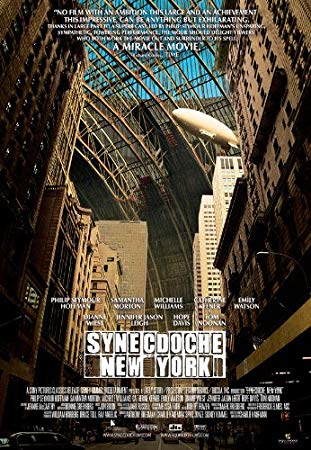
Saturday Matinee: Synecdoche, New York

Exploring Charlie Kaufman’s “Synecdoche, New York”: A Philosophical Analysis

By Jordan Siron

Source: Deathbed Decameron

PREFACE

“There are too many ideas and things and people. Too many directions to go. I was starting to believe the reason it matters to care passionately about something, is that it whittles the world down to a more manageable size.”

— Susan Orleans, Adaptation (written by Charlie Kaufman)

I’ve wrestled near-tirelessly with this analysis, as Synecdoche, New York is a unique beast. Standard film analysis won’t do, and far more capable minds have already broken down the film’s narrative, thematic, and technical components. This left me a little lost.

Should I discuss the film’s merits on a technical level? Should I address themes and how they are tackled via visual and narrative motifs? How much backstory should I present, or withhold? Should I focus on the unique structure of the film, which plays with our concept of time and how it is perceived as we age?

At the end of the day, I decided to throw my hands in the air and declare, “Fuck it!” What interests me most about the film — what I feel really makes it one of the most important films of modern cinema — is the philosophy at its core. After all, the conceit behind Synecdoche, New York is what endears the film to me over any other. It is as good a subject for analysis as any of the myriad options at my disposal.

I take for granted that you have seen the film prior to reading this. As such, I will not be providing a synopsis. I will be referring to characters as events as if you are already familiar with them. Should you have stumbled upon this and have yet to see the film, you can buy it via iTunes, Amazon.com, and elsewhere. Hell, you can probably torrent it.

I would also like to take a moment to send a shoutout to Mick over at Being Charlie Kaufman for sharing this piece with his audience. I love the site, and it means a lot to me. I cannot thank you enough! Any one looking for a wealth of information on Charlie Kaufman and his work, BCK is your best bet. It’s a veritable treasure trove.

The Philosophy of Synecdoche, New York:

Dethroning Solipsism, and Dispelling The Concept of “The Other”

I do believe you have a wound too. I do believe it is both specific to you and common to everyone. I do believe it is the thing about you that must be hidden and protected, it is the thing that must be tap danced over five shows a day, it is the thing that won’t be interesting to other people if revealed. It is the thing that makes you weak and pathetic. It is the thing that truly, truly, truly makes loving you impossible. It is your secret, even from yourself. But it is the thing that wants to live.”

— Charlie Kaufman, BAFTA Screenwriters Lecture 2011

Synecdoche, New York is a film that concerns itself with examining solipsism, and in disposing of the harmful concept of “The Other”. Solipsism is the belief that only one’s own mind is certain to exist; that one’s perception of reality and events is the only certainty, the only truth. As a philosophy, it is akin to Objectivism — the belief that the pursuit of one’s own self interest is the only moral obligation to which any human is bound.

Solipsism is a gross philosophy. It does not leave room for the understanding or concern of others. It is diametrically opposed to Altruism, which — while impractical to some extent — at least gives us something worthy to strive for. While one can argue against the practicality of Altruism, it’s hard to rationalize Objectivism and Solipsism as being inherently healthy life philosophies. While they may serve the individual, they do not foster the wellbeing of the human community writ large.

Now, all of that isn’t to say that individuals who prescribe to philosophies that place themselves at the center of their own universe are inherently bad. One can argue that such philosophies drive individuals towards great personal success, and through that success said individuals can turn around and provide aid of which they might not have otherwise been capable. There is a certain benefit to being concerned with one’s own self, but this dissection is not concerned with those few individuals who put their own universes in check before extending their helping hand. So it follows that Synecdoche, New York does not concern itself with such.

The film examines solipsism at its worst, demonstrating the dangers of such a philosophy through its chosen vehicle: Caden Cotard.

Solipsism As A Catalyst For Emotional Distance

As is often the case in Kaufman’s films, Caden is a hard protagonist to like. In fact, the more time we spend with him the harder it is to view him with even a modicum of sympathy. From the word go, we see that Caden is a fairly self-involved person. While his wife, Adele, wears herself ragged trying to support herself, their daughter, Olive, as well as Caden’s mounting insecurities, Caden seems concerned only with what exists within his own private universe.

We are introduced to Caden as he laments, as would  a broken record, his impending death. He constantly feels ill, and sees detritus in every newspaper headline or mail order magazine. He even occupies his time by re-staging the Arthur Miller classic Death of a Salesman, a play that concerns itself with an old nobody trying desperately to amount to some pre-conceived notion of success before the chance escapes him. Like Caden, the play’s protagonist, Willy Loman, is revealed to be a pathetic creature who chases self-satisfaction at the expense of his closest loved ones.

Willy Loman is revealed to be an adulterous, distant husband, and Caden is revealed to be something quite similar. While there are suggestions placed throughout the film that Caden is unfaithful to Adele (or at least capable of such infidelity), it is his “why me” woes that bind him to Loman. He is a man who is personally responsible for the deteriorating status of his marriage to Adele, and to his lack of fulfillment  as an artist, but he cannot see outside of himself in order to look upon the seeds he has sown. And, as we learn, the crops his selfishness yields are beyond poisoned.

When Sammy jumps to his death after Caden refuses him his right to fall in love with Hazel (mirroring Caden’s early attempt at suicide), Caden reacts shamefully. While every one involved with his production gathers around Sammy’s lifeless body to mourn, Caden screams at the deceased man for “getting it wrong”. After all, Caden did not jump to his death. He doesn’t even see Sammy as a fellow human being by this point, merely as a liability. His suicide was not a loss of life, but a hiccup in the production that created an issue of logistics for Caden.

Even more troubling is Caden’s inability to notice the looming apocalypse that will some day lay waste to New York, perhaps the entire world. As the film progresses, we start to see signs that all is not well in the real world. Army vehicles round up citizens. Gunfire and explosions can be heard in the distance, almost non-stop. Men and women walk the streets wearing gas masks, or leading one another around by leashes as if they were pets.

In one scene Caden leaves his warehouse/theatre for the night with Claire (his second wife/leading lady),and  he fails to notice a line of people standing outside. One man stops Caden to ask him when “it” will be finished, as “things are getting bad out here”. Caden assumes the man is anticipating his play; the man is actually referring to the life-sized recreation of New York City Caden is building within the warehouse. The people of New York are hoping to escape the impending calamity by seeking refuge within the safety of the warehouse. Caden, ever the self-important artist, simply assumes they are just anxious to behold his work.

This is very troubling, as it demonstrates Caden’s inability to see the decaying state of life outside of his own mind. He has every opportunity to save the people of New York, but he can’t be bothered to take notice of that fact. And, as the film reaches its conclusion, we see that Caden’s obsession with his own rational self-interest allows for millions of lives to be snuffed out when they might have been spared.

The film never really resolves this plot element, unfortunately. We see Caden accept that he is not unique, but we never see how he dealt with the realization that he could have saved all of those lives — or if he even has that realization at all. This might be my only valid complaint regarding the film, but it is forgivable. It is already quite dense, and I suppose there just wasn’t enough time to tackle that aspect.

Solipsism As A Catalyst For Sexism

As mentioned earlier, Caden does very little in the way of parenting. It is established that Adele tends to the physical and emotional needs to Olive while Caden soaks in self-pity. Caden offers his wife no means of validation, yet weakly begs for all that Adele can spare. He wants her to admire him as an artist, even at the cost of ignoring her own aspirations to be a painter.

For instance: when Adele opts to miss the opening night of his re-staging of Death of a Salesman, so that she can meet her own deadline, Caden sets up shop in the town called Passive Aggression. Add to that, Caden fishes for Adele’s admiration after she does finally attend the play.

When Adele stands by her principles and denies Caden that validation (as she sees no merit in re-staging other people’s plays, which we infer to be Caden’s schtick), he sulks about like a scorned child. And therein lies the ultimate issue between the two: Where Caden should be a partner to Adele, some one who reciprocates the support he receives, he is instead like another child for Adele to raise and nurture. This is a particularly poignant character flaw, as it reflects the all-too-common issue that husbands have with their wives — a difference in the sexes granted not by nature, but by privilege.

Gender becomes a very integral aspect of the film, as it ties so perfectly to Kaufman’s thesis regarding Solipsism. Caden is a man who wants the women in his life to be the driving forces behind his brilliance. They are instruments to him, when they should be people. We might call this affliction the Muse Dilemma — the pathological need to attribute any greatness in ourselves to a woman we place on a pedestal, woefully viewing Her as some divine influence through which we achieve our greatness. The trouble with this view is three pronged:

  • First: We diminish in ourselves the ability to create without some heavenly catalyst.
  • Second: We refuse to see that the Muse, herself, longs to achieve her own aspirations and desires. She does not exist to simply inspire greatness in us.
  • Third: Viewing women (any person, really, but for the sake of the themes of the film, women specifically) as vessels for our potential breeds a penchant for solipsist thinking. We rob them of their own identities. We humor the idea of women being “others”.

Taking the above into consideration, it should come as no surprise that the story demands that Caden see existence through the eyes of a woman — an “other”. Kaufman provides this opportunity for Caden’s growth brilliantly, in the form of Ellen Bascomb.

Ellen, we learn, is the cleaning lady who services Adele’s Manhattan loft. Through the machinations of the narrative, Caden finds himself stepping into Ellen’s shoes. While he does so with the surreptitious intention of getting re-connected with Adele (writing letters under Ellen’s identity, even basking in the smell of her bed sheets), there is something much more important taking place beyond his knowledge — as well as our own. There is a subtle transformation taking place. Caden is unwittingly evolving.

The full effects of Caden’s charade are not revealed to him, nor to us, until Millicent takes over as the director of his play. Through her God-like direction (delivered to Caden through an ear piece, serving as a wonderfully, thematically ironic metaphor for divine guidance), Millicent steadily leads Caden to shed his own persona while adopting Ellen’s. What comes to pass is a heartbreaking sequence in which we learn about Ellen who, up until now, has been an unseen “Other” merely used by Caden for his own agenda.

In one of the most beautifully sullen monologues in recent film history, Ellen tells us of her life of woes. She is stuck in an unfulfilling marriage, wed to a husband who looks at her as a burden. We learn that her life-long dream was to have a daughter with whom she could enjoy picnics akin to those Ellen herself enjoyed with her mother. She wanted the warmth of companionship, the fulfillment of a loving family. For whatever reason, Ellen and her husband, Eric, never had that child. So they grow old together, drifting further apart with each passing day.

Caden is moved to tears, feeling some one else’s pain for the first time in the film — perhaps in his entire life. He sees so much of his own woes are shared by Ellen. Where she was the overlooked wife, Caden was the husband doing the overlooking. Where Ellen longs for a daughter she never had, Caden longs for the daughter he felt had been stolen from him. In fact, this tie that binds reveals an interesting twist that can easily be missed.

(This is an especially poignant scene, as Caden — who has lost the ability to cry genuine tears without medical aid, as a side effect of his mysterious illness — is able to cry of his own volition. It isn’t until he feels the very real pain of another person that he can manage this feat.)

During Caden’s visit to a dying Olive, she refuses to forgive him — but for what? Olive claims that Caden betrayed the family by running off to have anal sex with his gay lover, Eric. This is important, as Caden had already been impersonating Ellen well before this point in the film. Eric is, of course, Ellen’s husband.

One might deduce that the reason Ellen never had a daughter was to do with Eric’s insistence on having anal sex with Ellen (potentially because he did not love her enough to participate in a deeper intimacy), and thus never affording the opportunity to conceive a child. Even though this scene takes place long before Caden’s self realization, the line between Ellen and Caden has blurred to the point that they are essentially the same person.

The Moral Of The Story

You have struggled into existence, and are now slipping silently out of it. This is everyone’s experience. Every single one. The specifics hardly matter. Everyone’s everyone.” Millicent Weems, Act III

Herein lies the existential rub of the film: Caden comes to discover that he is Ellen. So, too, is he Adele, and Hazel, and any number of persons who populate this earth. Now, that is not to say that he is physically these people. He is Caden, and they are Adele, or Hazel, or Ellen. They are individuals who, taken on their own, represent the whole of humanity. Kaufman is telling us that individuals are synecdoches of the human race — mere slivers of the greater whole. Caden suffers because others suffer, because that is the nature of a living being. His woes are specific to himself, but they are common of every one.

Every one gets sick. Every person has his/her heart broken, or dreams crushed. And, in the end, every one dies. Caden is not unique, so he should not look at his own circumstances as being as such.

While it may be easy to mistake this moral for cynicism, it is actually quite beautiful. In making this statement, Kaufman is telling us all that we should be as mindful of the problems of others as we are the issues that plague ourselves. It’s enticing to get lost in self pity, and even more attractive to pursue our own self interests, but there is very little good that can come from such behavior. Only by seeing ourselves in the eyes of “the other” can humanity’s redeeming qualities outweigh it’s ills.


Watch the full film here.

Saturday Matinee: Henry Fool

“Henry Fool” (1997) is an independent dark comedy written, produced and directed by Hal Hartley (b. 9/3/59). The plot centers on downtrodden garbage-man Simon Grim (James Urbaniak) who, with the encouragement of rebellious writer Henry Fool (Thomas Jay Ryan), becomes a celebrated poet. As Simon’s writing career ascends, Henry loses himself to drinking and hedonism until his mysterious past catches up to him and he needs Simon’s help. The film won the best screenplay award at the 1998 Cannes Film Festival and spawned two sequels: Fay Grim (2006) and Ned Rifle (2014).

Watch the full film here.