The Final Addiction

By Russ Bangs

Source: Volatility

A few statements from evolutionary biologists: “Immunization is also making once-rare or non-existent genetic variants of pathogens more prevalent ….…the vaccine quietly alters the genetic profile of the pathogen population ….the scientific community is becoming increasingly aware that vaccine resistance is a real risk….” 

I used to be suspicious of vaccines produced by corporations on a profit-seeking basis but was agnostic toward the idea of vaccination in principle. I hadn’t done deep research on the question. 

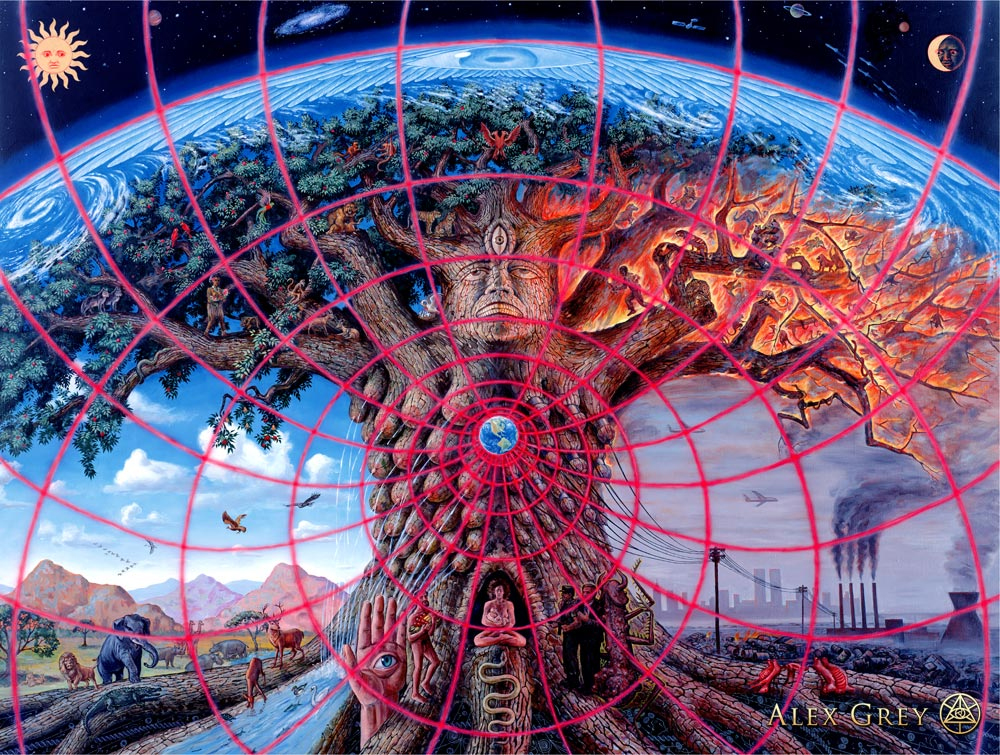
But since the Covidian assault forced me to research these most novel injections, the more I’ve learned the more I’m understanding vaccination as such to be part of the counterproductive idiocy of technocratic medicine. As everywhere else, the right path is to uphold and support natural health systems and balance them amid maximal natural biodiversity. As everywhere else, the Covidian terror-lockdown onslaught works to eradicate all natural balances in favor of stupid reductive violent technological interventions. 

Throughout its “Covid” assault the system has kept in place all its assaults on public health and biodiversity while maintaining its hostility to all reform. It continues with its commitment to the wholesale poisoning of the air, water, food and general environment with industrial and agricultural poisons. It continues with its systematic poisoning of our bodies and defacement of our genomes. With its factory farms, pesticides and genetic engineering processes it continues its relentless drive to wipe out antibiotics as a medically effective treatment. It continues its deliberate drive to maximize cancer and heart disease. 

The globalist system continues its ecocidal drives of deforestation, eradication of agroecology in favor of industrial agriculture, eradication of natural biodiversity, industrial mining, global heating and climate chaos, all toward the goal of discovering every novel pathogen still hidden amid the last crevices of wilderness and distributing it as globally as possible as fast as possible while also expanding the ranges and virulence of known pathogens. 

The system continues to force the most physically and psychologically unhealthy and disease-inducing mode of existence on all people, from the cosseted Western upper classes to the masses of the global South, always touting its nightmare vision of “life” as good and anyway unavoidable. It does all it can to generate maximum stress and anxiety. The criminals of the Covid regime often have openly confessed their goal of driving maximum irrational fear and stress in order to obtain compliance with lockdown decrees, superstitious rituals like face diapers, the medically worthless and counterproductive gene-altering injections. 

This exact same government-media system continues to reject with extreme hostility even such a modest reform as Medicare for All (in the US), while Western countries that have versions of national health systems are working to gut and abolish them. Meanwhile the most immediately murderous effect of the Covidian terror-lockdown assault has been to stampede and induce and force all health care systems to abdicate their rightful mission completely and surrender to chaos and misdirection of all their resources to their own version “Covid” hysteria and lunacy. Even the basic doctor-patient relationship, already fraught under the existing adverse conditions, is now subject to a whole new course of hoops and obstacles. 

The propaganda and lockdowns in themselves have been forced upon the people with the deliberate intent to depress immune functioning and demolish natural immune system health. Forced sedentary incarceration amid the worse polluted indoor air, the drive to exaggerate stress and anxiety, the evil agenda to keep people out of the wholesome outdoors, this ulterior agenda being highly evident from day one (“Stay at Home”), all these have none but bad psychological and physical results. The Covidian propaganda and lockdowns never could have had any effect but to depress immune functioning. This policy-induced demolition of our natural immune systems evolved over millions of years was always the intended goal of the entire fake pandemic campaign. Now the purpose of the injection campaign is to complete this immune destruction and render us physically addicted to artificial injections to prevent our becoming sick. 

The term “addiction” is not just metaphorical but clinically precise: Physically addictive drugs destroy natural systems and replace them with the drug’s own functioning so that in the absence of the drug the body becomes ill. In the same way the Covidian terror-lockdown-injection assault wants to destroy the human immune system and replace it with the injected gene-altering agent so that in the absence of regular injections we become sick and die. 

Even most critics of the MRNA mass experiment still are capable of thinking only in terms of massive violent interventions by institutions and remain in a state of contempt for the natural immune system in spite of the lip service they pay to it. 

(In the same way, mainstream climate-industrial activists are capable of reacting to the specter of intervention-driven climate change only with ever more radical, extreme, violent interventions like geoengineering, artificial carbon sequestration based on extreme-energy-extreme-maintenance technology, converting small portions of the industrial electricity maw to fake “renewables” like industrial wind, industrial solar, river-murdering hydroelectric, nukes and anything seeking artificially to “lower” global concentrations and temperatures. Any sane person concerned about the climate crisis knows there’s no question of lowering temperatures – several more degrees rise already is locked in. Rather, we think only in terms of not adding to the damage, not making it worse. So we say only – abolish emissions and stop destroying sinks. As for lowering the concentration, the only way this can be done which is not ecocidal in itself is to stop assaulting the ocean (the greatest sink of all) and let natural sinks – forests, wetlands, grasslands – resume their natural ranges. 

It’s no coincidence that all mainstream “environmentalists” are ardent Covidians, while many among the Covidian propagandists also are crusaders for technocratic climate interventions including the specter of “climate lockdowns”. Just as how lockdowns are designed to destroy human health while imposing totalitarian control and coercion, so they also would impose coercion and control while corporate and governmental ecocide continues unabated. 

Always, technocrats are technocrats are technocrats, and their only goal always is maximum ecocide and genocide. Any other goal their propaganda touts is never more than a pretext for mass murder.)  

Since the interventionist onslaught for which the original (objectively mild) “Covid” phenomenon was the pretext has proven to be such a total counterproductive disaster from any human point of view, what kind of omnicidal maniac does one have to be to call for doubling down on interventions to deal with escalated harms and dangers which have been caused 100% by the interventions themselves? All who are involved in the propaganda and administration of the injection assault are disease vectors in the same way rats are vectors of the fleas which are vectors of plague. Humanity must purge ourselves of such infinite psychopaths. 

In the end all technocrats are the same fanatical builders of the Tower of Babel, however much they squabble among themselves. The Tower itself has to be knocked down. 
Jeff Bezos Embodies the Cruel Autocracy of Neoliberal Capitalism

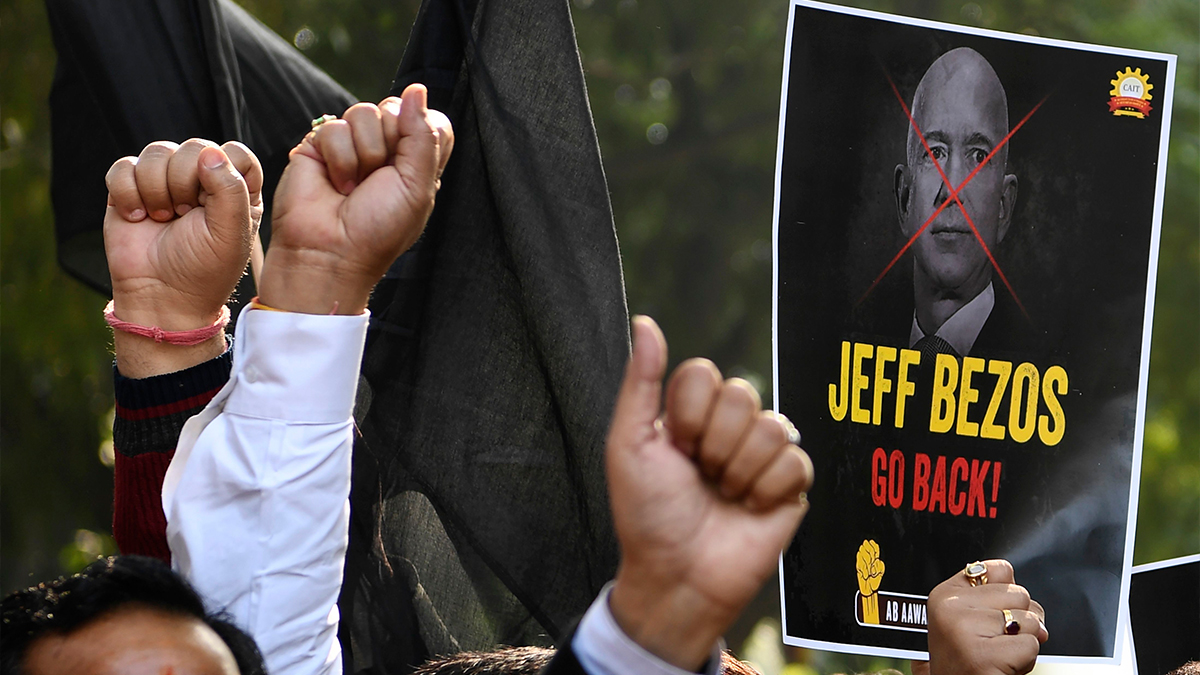
Amazon CEO and richest-man-in-the-world Jeff Bezos wants you to work as much as he does—for one millionth of the pay

By Branko Marcetic

Source: In These Times

“Is Jeff Bezos a horrible boss and is that good?” That was the question posed by Forbes magazine in 2013, a sentiment that helps explain why Amazon’s founder and CEO is detested by the Left for his oligarchic ambitions, while simultaneously admired by America’s capitalist class for his business success. Ironically, Bezos is also loathed by former President Donald Trump, while celebrated by many liberals for so-called resistance.

But with Bezos and his $115 billion fortune laying claim to the title of richest man on Earth, and with Amazon playing an increasingly influential role in public life, it is worth asking: What does Jeff Bezos stand for?

A gifted child born to a teen mom, Bezos grew up not knowing his biological father, who was once one of the top-rated unicyclists in Albuquerque, N.M. Instead, Bezos was raised by the man his mother soon married: Miguel Bezos, who had fled Cuba and the Communist revolution, which had shuttered the elite private Jesuit school he attended, as well as his family’s lumberyard.

Journalists have speculated whether Bezos’ near-pathological competitiveness is a product of his early abandonment, similar to that of fellow tech overlord Steve Jobs. No doubt equally formative was Bezos’ adoptive father, who told Brad Stone, author of The Everything Store: Jeff Bezos and the Age of Amazon, that their home life was ​“permeated” by complaints about totalitarian governments of both the Right and the Left.

Bezos envisioned the concept of an ​“everything store” while working for a Wall Street hedge fund in the 1990s. He opened Amazon in 1994 as an online bookshop, a pragmatic starting point. Bezos gave the company his own $10,000 cash injection, took out interest-free loans, and received $245,000 from his parents and family trust.

Many of Amazon’s controversial labor practices can be traced to these early years as a plucky start-up. Amazon’s small team ran on tireless ambition to live up to the company’s customer-focused promise — key to its eventual market domination. Stone reports that, to meet Bezos’ ​“get big fast” directive, employees devoted themselves completely, working long, unusual, frenzied hours. One early warehouse worker who biked to work simply forgot about his improperly parked car, eventually discovering it had been ticketed, towed and sold at auction.

Such a relentless pace is one thing for a small group of true believers but is quite another when applied to low-wage workers just making ends meet. By 2011, Amazon’s workplace culture became known through a series of headline-grabbing reports that have come to define its public image: badly paid, ceaselessly surveilled, overworked workers, struggling to maintain a breakneck pace.

Bezos created a culture in which everyone from the lowest peon to the highest-ranking executive is expected to match his own devotion, an approach that resulted in spectacular levels of staff turnover by the early 2000s. A declared enemy of ​“social cohesion,” Bezos pushed his underlings to reject compromise and instead fiercely debate and criticize colleagues when they disagreed. One former employee described it as ​“purposeful Darwinism.” Known for withering put-downs — ​“Are you lazy or just incompetent?” ​“Did I take my stupid pills today?”—Bezos also isn’t above pulling out his phone or, in some cases, simply leaving the room when an employee fails to impress.

The flipside of Bezos’ intellect is a cold, clinical approach to human relations. Bezos described himself as a ​“professional dater” during his Wall Street days, trying to improve what he called his ​“women flow” — a riff on the Wall Street term ​“deal flow.”

“He was not warm,” one person who knew Bezos during his Wall Street days told the East Bay Express in 2014. ​“It was like he could be a Martian for all I knew.”

Bezos’ pitiless leadership style bled out beyond the Amazon boardroom as he used the company’s growing market share to bully book publishers into his terms. The company launched the ​“Gazelle Project”—as in, go after publishers ​“the way a cheetah would pursue a sickly gazelle” — allowing Amazon to undercut its competition at the cost of little to no profit for smaller publishers.

As Amazon inched closer to Bezos’ original vision, it began lobbying efforts in 2000 and became more transparently political by 2011, spending millions to defeat an internet sales tax and playing hardball with state governments, threatening to shutter Amazon facilities if its wishes went unfulfilled. In 2013, Amazon began lobbying Congress to cut corporate taxes.

The same year, Bezos bought the Washington Post, invested in Business Insider and donated to the publisher of the libertarian magazine Reason. Though Bezos argues his purchase of the Post was motivated by ​“a love affair [with] the printed word” and a desire to support American democracy, others suspect Bezos’ interest in media is related to bad press following a scathing Lehman Brothers report in 2000, which sent Amazon’s stock price tumbling.

Leading up to the Post purchase, Bezos was increasingly displaying what early Amazon investor Nick Hanauer called his ​“libertarian politics.” In addition to spending $100,000 in 2010 on a campaign to defeat a proposed Washington state tax on high-income earners, Bezos put hundreds of thousands of dollars toward boosting charter schools and other neoliberal education reforms.

Bezos’ political involvement reached a new apogee in 2019 during the re-election bid of Seattle’s socialist city councilwoman, Kshama Sawant, who called Bezos ​“our enemy” and tried to pass a head tax to fund housing for those displaced by Amazon’s Seattle footprint. Amazon spent $1.5 million against Sawant and other progressive candidates, a record at the local level, with more than a dozen of the company’s executives contributing to Sawant’s opponent. (Sawant won re-election anyway.)

As for Bezos’ endgame? A Trekkie since childhood, he has long dreamed of funding space exploration, a mission pursued by other superrich moguls (such as Elon Musk) in the face of the climate emergency. Opening the doors of his secretive Blue Origin aerospace company to journalists for the first time in 2016, Bezos told the New York Times he envisioned a future of ​“millions of people living and working in space,” exploiting the natural resources of surrounding planets and rezoning Earth ​“as light industrial and residential.”

Ironically, as Bezos pours the wealth he wrung out of exhausted, low-wage Amazon workers into space exploration, Amazon is busy hastening the very planetary collapse Bezos claims he’s trying to prevent — by silencing workers who speak out against Amazon’s assistance to oil and gas companies.

Let’s imagine, however, that Bezos, who accumulates $9 million an hour, lived in a world with Bernie Sanders’ 8% wealth tax (just on fortunes over $10 billion). A single year would see $9 billion flow from Bezos’ treasure trove into government coffers, more than enough to cover the 10-year cost of Elizabeth Warren’s universal child care plan ($1.7 billion) and maintain safe drinking water under Sanders’ plan ($6 billion).

Bezos’ career is a testament to the cruel autocracy and senseless misallocation of resources that our neoliberal capitalist system enables. But his opulence also reveals that the wealth exists to build a fairer and more equitable society — if redistributed. Bezos may loathe social cohesion, but in a world organized around democracy rather than the whims of space-billionaires, it’s something we may well be able to achieve.

Where’s Dirk Gently When You Need Him?

By Erik Assadourian

Source: Resilience

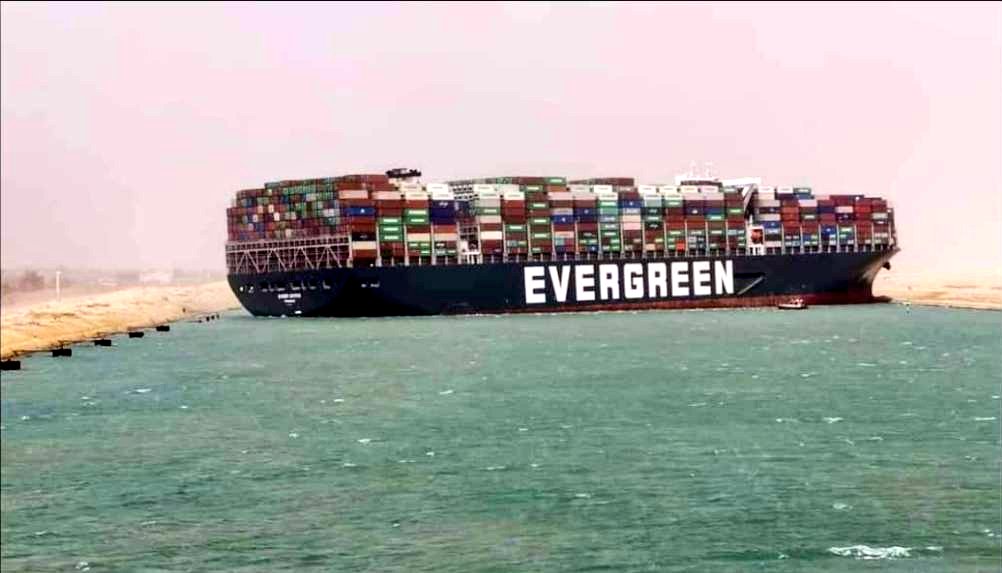
Did you hear? A supersized cargo ship got wedged in the Suez Canal on March 23rd? If you didn’t, you must do pretty well at avoiding the news, social media, and late night TV. But the short of it is: the Ever Given somehow lost control (sandstorm strength winds have been blamed, as have human errors) and crashed into the bank of the canal and lodged itself in.

So what? Is this really news? Or just a sensational story to distract us from the pandemic, which, one might argue, is itself a distraction from the rapid unraveling of Earth’s systems and thus human civilization? Perhaps. But then again perhaps not. Here’s why this incident is worth understanding.

First, a ship single-bowedly disrupted global trade for six days. It was finally freed on March 29th. However, there is now a backlog of over 300 ships while many ships rerouted around the Cape of Good Hope. The Suez Canal is part of a trade route that carries more than 10 percent of global trade, including 7 percent of the world’s oil. Each day 30 percent of the world’s shipping container freight moves through the canal. Thus it created backlogs in shipping (including some 200,000 live animals who could have overheated or run out of food). It raised the price of oil briefly. It created shortages in factories—not just of parts but of shipping containers. And of course, it felt like a freak occurrence. Last year, of the 18,840 ships that moved through the canal, there were no incidents.

But the main reason is because this is an excellent metaphor on how fragile our entire globalized system has become.

It makes you wonder where Dirk Gently is to help straighten all this out. If you haven’t heard of Gently, he is a holistic detective, who uses “the fundamental interconnectedness of all things” to find missing persons (and cats) and solve mysteries. In fact, the novel Dirk Gently’s Holistic Detective Agency includes him trying to figure out how a sofa got “irrevocably stuck” halfway up a staircase.

Similar story here: the Ever Given was jammed in tight—though fortunately with the help of the full moon and tides, unstuck without resorting to time travel (which was needed to free the errant sofa). And while the supernatural wasn’t at the root cause of this mishap as with the couch, instead of focusing just on the bad luck of a sandstorm (which are not uncommon in Egypt) combined with bad piloting, we should still investigate the root causes at play. So let’s peel back the layers one at a time.

Bigger is better!

At the surface, we might simply say the problem stems from the fact that we keep making bigger container ships. The Ever Given is a quarter mile long (one lap around a track or the height of the Empire State Building). And it weighs 220,000 tons and holds 20,000 containers (each 20-40 feet long). High oil prices (especially 2005-8), combined with cheap debt after the 2008 crash led shipping companies to invest in bigger and bigger ships. The Ever Given holds four times the cargo a ship carried in 2000. In fact, these containers were stacked so high that they acted like a giant sail and caught the intense winds that drove the Ever Given into the banks. So, yes, there’s more risk involved, but it’s cheaper to add more containers. To get as much on there as possible. Sometimes that means losing a load of containers to a storm or other incident (about 1600 containers are lost on average each year). Not to mention the fluke canal accident—not that this was a widely recognized risk. (However, this OECD report from 2015 did raise the challenges of burgeoning cargo ship sizes). But now this threat will need to be considered, including terrorists doing this intentionally to disrupt trade.

Now more concentrated!

But of course, looking holistically, let’s ask why do we even need these big ships? So, peeling another layer, we see that we have concentrated our manufacturing to a few major locations and promoted the consumer culture worldwide so we need to get goods of all types to rich Europeans, we need to get oil to run cars and planes in every country, we need to get livestock to the Middle East to feed this affluent desert population. Our globalized system depends on big old cargo ships. Even this incident is a reflection of our extreme globalization: the ship is owned by a Japanese company; run by a Taiwanese company (Evergreen); piloted by Indians; operating under a Panamanian flag; navigating through an Egyptian waterway, shipping brand name goods from all over the globe, and rescued by a Dutch salvage company. That’s kind of neat—a global Kumbaya moment—or a revelation of just how deeply aligned nations are in converting Earth’s forests, lands, water, and life into the latest in consumer products.

But wait, there’s more!

Peeling another layer, we find that the movement of all these consumer goods is driven by a culture fixated on growth, profit, and consumerism. We move factories to exploit cheaper labor, lax environmental rules; we spend $763 billion a year on advertising to convince people they need a new iPhone or a new car or a trip to wherever; we convert landscapes wholesale into resources; and we panic if our economies don’t grow. We’re trapped in a pursuit of material happiness, manipulated by the admen and politicians, driven now by our addictions to sweets, tobacco, alcohol, drugs, social media, and entertainment, to the point we’re “amusing ourselves to death.” But worse, we’re so amused we hardly even notice the death part any longer.

Free disconnect with every purchase!

And arriving at the inner layers of the onion, we find this: that our disconnection from the Earth is so deep, so profound, so complete, that we no longer even consider the planet in our decisions to manufacture items or ship them or buy them. We think instead about expanding our economies, upsizing our homes, upgrading our cars and phones, even stockpiling toilet paper (which again became a thing in the Suez Canal story as wood pulp supplies were potentially delayed). Even as scientists warn of ecological collapse, of cities lost to flooding seas, of regions abandoned due to perpetual drought, to the inevitable violence that all this will cause, to the countless species lost—many of whom we depend on directly for our survival—we focus on making memes, writing essays (guilty), and trying to live slightly-greener-around-the-edges-consumer-lifestyles.

Dealing with this metaphorical couch

Perhaps that’s why the struggling bulldozer became the source of so many memes. Except the most important one: The bulldozer as the environmental movement and the ship as Consumer Capitalism. Ultimately, trying to free the ship, or even convert it to run on green fuels or the latest in sail technology is treating the superficial layers. Instead, we need to dig deeper (yuk yuk). We need to re-regionalize production; reduce production; degrow our economies, find ways to disincentivize and discourage a consumer lifestyle; or better yet, make it clear that this whole culture of consumerism is suicidal and worse, anti-life, and must go in order to prevent future ship jams or far worse global disruptions. And even deeper, we need to reconnect people to the living Earth to make them understand that every sin against the planet, against other creatures, and against other humans who we exploit, we do to ourselves. That if we fail to change paths, we will run head first into the proverbial canal wall. And there will be no one to dig us out.

Viral Inequality: From Jeff Bezos to the struggle of Indian Farmers

Billionaires have profited enormously from lockdown, whilst mega corporations are buying out and shutting down independent stores and farms.

By Colin Todhunter

Source: OffGuardian

According to a new report by Oxfam, ‘The Inequality Virus’, the wealth of the world’s billionaires increased by $3.9tn (trillion) between 18 March and 31 December 2020. Their total wealth now stands at $11.95tn.

The world’s 10 richest billionaires have collectively seen their wealth increase by $540bn over this period. In September 2020, Jeff Bezos could have paid all 876,000 Amazon employees a $105,000 bonus and still be as wealthy as he was before COVID.

At the same time, hundreds of millions of people will lose (have lost) their jobs and face destitution and hunger. It is estimated that the total number of people living in poverty could have increased by between 200 million and 500 million in 2020. The number of people living in poverty might not return even to its pre-crisis level for over a decade.

Mukesh Ambani, India’s richest man and head of Reliance Industries, which specialises in petrol, retail and telecommunications, doubled his wealth between March and October 2020. He now has $78.3bn. The average increase in Ambani’s wealth in just over four days represented more than the combined annual wages of all of Reliance Industries’ 195,000 employees.

The Oxfam report states that lockdown in India resulted in the country’s billionaires increasing their wealth by around 35 per cent. At the same time, 84 per cent of households suffered varying degrees of income loss. Some 170,000 people lost their jobs every hour in April 2020 alone.

The authors also noted that income increases for India’s top 100 billionaires since March 2020 was enough to give each of the 138 million poorest people a cheque for 94,045 rupees.

The report went on to state:

…it would take an unskilled worker 10,000 years to make what Ambani made in an hour during the pandemic…and three years to make what Ambani made in a second.”

During lockdown and after, hundreds of thousands of migrant workers in the cities (who had no option but to escape the country’s avoidable but deepening agrarian crisis) were left without jobs, money, food or shelter.

It is clear that COVID has been used as cover for consolidating the power of the unimaginably rich. But plans for boosting their power and wealth will not stop there. One of the most lucrative sectors for these people is agrifood.

More than 60 per cent of India’s almost 1.4 billion population rely (directly or indirectly) on agriculture for their livelihood. Aside from foreign interests, Mukesh Ambani and fellow billionaire Gautam Adani (India’s second richest person with major agribusiness interests) are set to benefit most from the recently passed farm bills that will lead to the wholesale corporatisation of the agrifood sector.

CORPORATE CONSOLIDATION

A recent article on the grain.org website, ‘Digital control: how big tech moves into food and farming (and what it means)’, describes how Amazon, Google, Microsoft, Facebook and others are closing in on the global agrifood sector while the likes of Bayer, Syngenta, Corteva and Cargill are cementing their stranglehold.

The tech giants entry into the sector will increasingly lead to a mutually beneficial integration between the companies that supply products to farmers (pesticides, seeds, fertilisers, tractors, drones, etc) and those that control the flow of data and have access to digital (cloud) infrastructure and food consumers. This system is based on corporate centralisation and concentration (monopolisation).

Grain notes that in India global corporations are also colonising the retail space through e-commerce. Walmart entered into India in 2016 by a US$3.3 billion take-over of the online retail start-up Jet.com which, in 2018, was followed by a US$16 billion take-over of India’s largest online retail platform Flipkart. Today, Walmart and Amazon now control almost two-thirds of India’s digital retail sector.

Amazon and Walmart are using predatory pricing, deep discounts and other unfair business practices to lure customers towards their online platforms. According to Grain, when the two companies generated sales of over US$3 billion in just six days during a Diwali festival sales blitz, India’s small retailers called out in desperation for a boycott of online shopping.

In 2020, Facebook and the US-based private equity concern KKR committed over US$7 billion to Reliance Jio, the digital store of one of India’s biggest retail chains. Customers will soon be able to shop at Reliance Jio through Facebook’s chat application, WhatsApp.

The plan for retail is clear: the eradication of millions of small traders and retailers and neighbourhood mom and pop shops. It is similar in agriculture.

The aim is to buy up rural land, amalgamate it and roll out a system of chemically-drenched farmerless farms owned or controlled by financial speculators, the high-tech giants and traditional agribusiness concerns. The end-game is a system of contract farming that serves the interests of big tech, big agribusiness and big retail. Smallholder peasant agriculture is regarded as an impediment to be replaced by large industrial-scale farms.

This model will be based on driverless tractors, drones, genetically engineered/lab-produced food and all data pertaining to land, water, weather, seeds and soils patented and often pirated from peasant farmers.

Farmers possess centuries of accumulated knowledge that once gone will never be got back. Corporatisation of the sector has already destroyed or undermined functioning agrarian ecosystems that draw on centuries of traditional knowledge and are increasingly recognised as valid approaches to secure food security.

And what of the hundreds of millions to be displaced in order to fill the pockets of the billionaire owners of these corporations? Driven to cities to face a future of joblessness: mere ‘collateral damage’ resulting from a short-sighted system of dispossessive predatory capitalism that destroys the link between humans, ecology and nature to boost the bottom line of the immensely rich.

IMPERIAL INTENT

India’s agrifood sector has been on the radar of global corporations for decades. With deep market penetration and near saturation having been achieved by agribusiness in the US and elsewhere, India represents an opportunity for expansion and maintaining business viability and all-important profit growth. And by teaming up with the high-tech players in Silicon Valley, multi-billion dollar data management markets are being created. From data and knowledge to land, weather and seeds, capitalism is compelled to eventually commodify (patent and own) all aspects of life and nature.

Foreign agricapital is applying enormous pressure on India to scrap its meagre (in comparison to the richer nations) agricultural subsidies. The public distribution system and publicly held buffer stocks constitute an obstacle to the profit-driven requirements of global agribusiness interests.

Such interests require India to become dependent on imports (alleviating the overproduction problem of Western agricapital – the vast stocks of grains that it already dumps on the Global South) and to restructure its own agriculture for growing crops (fruit, vegetables) that consumers in the richer countries demand. Instead of holding physical buffer stocks for its own use, India would hold foreign exchange reserves and purchase food stocks from global traders.

Successive administrations have made the country dependent on volatile flows of foreign capital via foreign direct investment (and loans). The fear of capital flight is ever present. Policies are often governed by the drive to attract and retain these inflows. This financialisation of agriculture serves to undermine the nation’s food security, placing it at the mercy of unforeseen global events (conflict, oil prices, public health crises) international commodity speculators and unstable foreign investment.

Current agricultural ‘reforms’ are part of a broader process of imperialism’s increasing capture of the Indian economy, which has led to its recolonization by foreign corporations as a result of neoliberalisation which began in 1991. By reducing public sector buffer stocks and introducing corporate-dictated contract farming and full-scale neoliberal marketisation for the sale and procurement of produce, India will be sacrificing its farmers and its own food security for the benefit of a handful of unscrupulous billionaires.

As independent cultivators are bankrupted, the aim is that land will eventually be amalgamated to facilitate large-scale industrial cultivation. Indeed, a recent piece on the Research Unit for Political Economy site, ‘The Kisans Are Right: Their Land Is At Stake‘, describes how the Indian government is ascertaining which land is owned by whom with the ultimate aim of making it easier to eventually sell it off (to foreign investors and agribusiness). Other developments are also part of the plan (such as the Karnataka Land Reform Act), which will make it easier for business to purchase agricultural land.

India could eventually see institutional investors with no connection to farming (pension funds, sovereign wealth funds, endowment funds and investments from governments, banks, insurance companies and high net worth individuals) purchasing land. This is an increasing trend globally and, again, India represents a huge potential market. The funds have no connection to farming, have no interest in food security and are involved just to make profit from land.

The recent farm bills – if not repealed – will impose the neoliberal shock therapy of dispossession and dependency, finally clearing the way to restructure the agri-food sector. The massive inequalities and injustices that have resulted from the COVID-related lockdowns are a mere taste of what is to come.

The hundreds of thousands of farmers who have been on the streets protesting against these bills are at the vanguard of the pushback – they cannot afford to fail. There is too much at stake.

America Condemns One Violent Mob While Celebrating Another

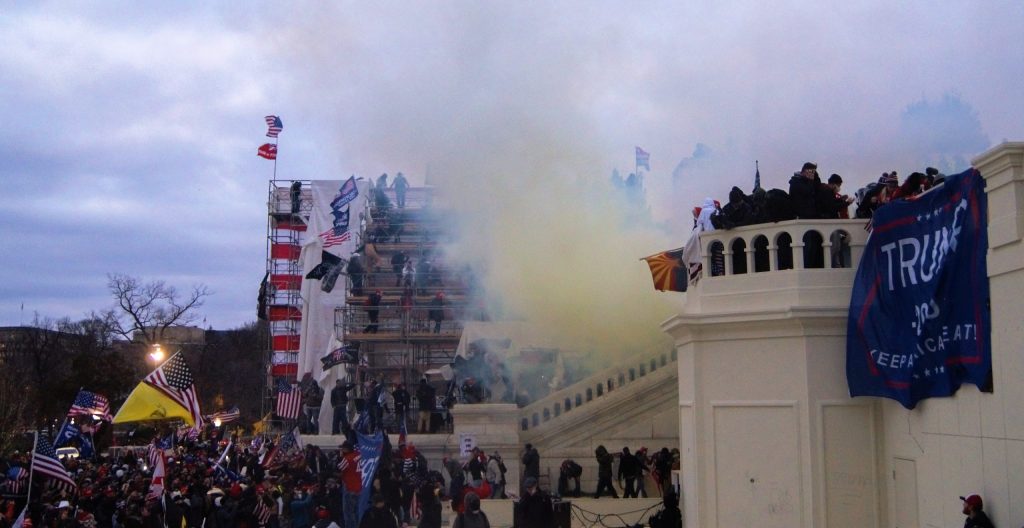
Tear gas being deployed outside the Capitol on January 6 as Trump supporters stormed the building. [Tyler Merbler / CC BY 2.0]

Where is the corporate media’s disgust for the courtesans of corporate destruction that wreak violence on Americans daily?

By Lee Camp

Source: ScheerPost.com

Most rational Americans have correctly criticized and denounced the violent insurrection in the Capitol last week. Those moments of attack by a racist, disgusting mob have not lacked for condemnation and denunciation. They were violent. They were reprehensible. They called for the killing of lawmakers, demanded the hanging of Congress members. The liberal media and even most of Fox News have not held their tongues when it comes to excoriating the morally bankrupt people who took part. And I agree with those thoughts.

BUT – why don’t we see an equal amount of disgust and condemnation for the violence done by our ruling class, the courtesans of corporate destruction?

Is allowing people to die or fall ill due to lead pipes in Flint, Chicago, Pittsburgh, and hundreds of other cities not violence?

Is allowing citizens to lose their lives to cancer from Teflon™ chemicals dumped in their water or preventable oil spills not violence?

Is allowing tens of thousands to die of preventable illnesses from our garbage healthcare system not violence?

Is allowing 15 million to lose their healthcare during a pandemic and therefore fear going to the hospital when they get sick not violence?

Is imprisoning millions of people for years for non-violent crimes not violence?

Is locking up political prisoners like Steven DonzigerMumia Abu-JamalReverend Pinkney, Julian Assange, Chelsea Manning, Leonard Peltier not violence??

Is dropping a bomb every 12 minutes on innocent people in countries thousands of miles away not violence??

Is allowing millions in this country to go hungry while we throw out 40% of all food not violence?

Is arresting people who try to feed those who are starving not violence?

Is allowing hundreds of thousands to go homeless, living under bridges or on benches or squatting in collapsing structures while this country has trillions of dollars and millions of empty houses —is that not violence?

Is arresting, beating, and persecuting those who try to give those people houses not violence? And bulldozing the homes — is that not violence?

Is causing the sixth great extinction, the mass death of half the world’s wildlife, in pursuit of corporate profit not violence?

Is causing the deaths of tens of thousands of Venezuelans via economic warfare not violence?

Is creating an opioid epidemic by pushing pills on desperate people, ultimately leading to the deaths of hundreds of thousands not violence?

And then arresting those who stand up and fight back against the pollutionagainst the pipelinesagainst the factory farmingagainst the war industry —IS—THAT—NOT—VIOLENCE?

Of course it is.

It’s violence on a breathtaking scale, far greater than what was done at the Capitol and far greater than any of us will witness in person. And yet large scale corporate-endorsed violence, death and destruction is not only allowable, it’s celebrated, it’s furthered, and promoted. Oil company documents show that they tell cities that oil spills are good for the economy. Other documents show that fossil fuel companies have known about the harm climate change would do since the 1970’s, but they simply saw it as the price of doing business. Corporate sacrifice zones like “Cancer Alley” in Louisiana are well known to be deadly to those who live there, yet it doesn’t matter to the corporations because their money will be green nonetheless. It doesn’t matter to the politicians because the poor who live in these sacrifice zones have no political power. The 40% of food that’s thrown out is not a secret. The subsidies paid to factory farms encourage them to produce heaping mountains of food and dairy and meat even if they can’t sell it all in our market economy. So they throw it out or bury it. Giving it to those in need would take too much time and effort.

Should the racist violent insurrectionists at the Capitol be punished? Absolutely. But so too should the bought-off politicians who do the bidding of our morally bankrupt corporate America. These politicians and the CEOs they serve are purveyors of violence. They trade in, produce, and reap violence. They sit on hordes of money—the obscene profit from feeding American lives into the death cult of unfettered capitalism.

Our mainstream media are blanketing the airwaves with talk of how the violent insurrectionists must be punished, and while they are not wrong, the criminal behavior those same talking heads and “reporters” ignore speaks volumes. All violence is not equal. Some of it is profitable and protected. Some of it is the American way.

Government propaganda: deflecting public attention from the most serious crimes of the oligarchy

By Carla Binion

Source: Intrepid Report

People of the U.S. often fail to notice the methods their own government uses to do what amounts to brainwashing them. The book Manufacturing Consent by Edward S. Hermann and Noam Chomsky details how U.S. corporate-controlled mainstream media outlets (today that includes mainstream TV “news” networks, most mainstream magazines, newspapers, etc.) act as propagandists. Another excellent source on U. S. media propaganda is Michael Parenti’s book, Inventing Reality.

When mainstream TV, magazines, newspapers and mainstream Internet sites all repeat the same false talking points over and over, they’re often deliberately attempting to brainwash, rather than inform, the public. Their motive is usually to gain mass public support for something that brings dishonest politicians and the oligarchy money and power. For example, they often propagandize the public to support illicit war for profit.

Today’s political propagandists pretend only the right wing criticizes them, but many on the left oppose misleading propaganda as well. I’m politically progressive, don’t like Biden or Trump because they are both far too right wing in my view. However, I think the extremist push to “get Trump” and paint him as inciting the January 6 protest are obvious efforts to manipulate the public’s thinking. Trump encouraged the protesters to “fight”, but to “fight” politically has traditionally been used to simply mean to battle verbally, to argue, or to boycott or strike. He didn’t specify or urge physical violence.

This opinion piece has nothing to do with minimizing the harm done by any actual violence on January 6. Violence should never be condoned and is a separate issue from protests in general. Instead this is about being aware of ways the U.S. government is now employing methods long used to promote propaganda, to discourage even peaceful protests, and to influence the public mind. The current government manipulation is a way of manufacturing consent, or as Michael Parenti called it, inventing reality.

What is the U.S. government likely to gain by manipulating the public into dropping their critical thinking skills and becoming lost in emotional rage, and by turning the public against protest and implying that all forms of dissent are possibly “insurrection” or sedition?  (1) The focus on Trump and January 6 turns the public’s attention away from the country’s many other problems, including the fact that we’re the world’s only advanced nation without an adequate healthcare system. It also distracts us from the urgent need for environmental reform. (2) If the powers that be can get most Americans to focus on only Trump, there will be no focus on the U.S. politicians responsible for turning the U.S. into an oligarchy, with much money funneled away from the middle class to the wealthiest one percent. [Source]    (3) If the powerful corrupt politicians can increase penalties for even peaceful protests, they’ll frighten and shame innocent people and prevent them from needed legitimate protesting, (4) If the public can be manipulated into believing that only right-wing racists and fascists refuse to accept government propaganda and authoritarianism, the left can be intimidated through guilt by association and through fear of being identified with the right wing.

People should walk the fine line between too much skepticism and not enough. Excessive suspicion is doubt not supported by evidence. Healthy skepticism is based on reality, including the U. S. government’s characteristic way of using disinformation to control public opinion throughout history. The thing that should give people pause and keep them aiming toward a balance of skepticism is the fact that the U.S. government has a long and well documented legacy of using widely-known propaganda techniques on the U.S. public. For anyone who doubts the U.S. government routinely propagandizes the public, at least read the two books mentioned above, which provide many additional reference sources and essentially prove this is true beyond any doubt. If the U.S. population likes to be maneuvered and more or less brainwashed by their own government, they’re free to do that. However, thoughtful skepticism, independent research and honest scrutiny are preferable.

Destroying The Web Of Life: The Destruction Of Earth’s Biodiversity Is Accelerating

By Robert J. Burrowes

In August 2010, the secretary-general of the UN Convention on Biological Diversity, Ahmed Djoghlaf, warned that ‘We are losing biodiversity at an unprecedented rate.’ According to the UN Environment Program, ‘the Earth is in the midst of a mass extinction of life’ with scientists estimating that ‘150-200 species of plant, insect, bird and mammal become extinct every 24 hours’ which is nearly 1,000 times the ‘natural’ or ‘background’ rate. Moreover, it ‘is greater than anything the world has experienced since the vanishing of the dinosaurs nearly 65m years ago.’ See ‘Protect nature for world economic security, warns UN biodiversity chief’.

Two months later, at the tenth meeting of the Conference of the Parties to the Convention on Biological Diversity, held from 18 to 29 October 2010, in Nagoya, Aichi Prefecture in Japan, a revised and updated Strategic Plan for Biodiversity, including the Aichi Biodiversity Targets, for the 2011-2020 period was adopted. See ‘Strategic Plan for Biodiversity 2011-2020, including Aichi Biodiversity Targets’.

You can read the 20 Aichi Biodiversity Targets on the Convention’s website. They were ambitious but represented a realistic assessment of what needed to be achieved by 2020 if national governments were to achieve the longer term goal of ‘Living in Harmony with Nature’ by 2050. The 2050 Vision for Biodiversity required ‘a significant shift away from “business as usual” across a broad range of human activities.’ See ‘Global Biodiversity Outlook 5’.

So how have we done in the past ten years?

In 2015, distinguished conservationists Professor Gerardo Ceballos, Anne H. Ehrlich and Professor Paul R. Ehrlich published their book titled The Annihilation of Nature: Human Extinction of Birds and Mammals which tells the story of humanity’s ‘massive and escalating assault on all living things on this planet’ precipitating what is now Earth’s sixth great mass extinction: ‘a time of darkness for our planet’s birds and mammals’.

Noting that the roots of this destruction ‘run deep through time’ with human hunting and other activities responsible for pushing populations of animals to extinction long before the agricultural revolution (which began about 10,000 years ago), they observe that the current collective assault on animals, plants and microbes has reached a level so horrendous that ‘any alarm call we might sound will be too faint to match the tragedy that is unfolding’. But while the decimation of life that is currently underway is being caused by Homo sapiens, the consequences of this decimation will also have impact on humanity itself because the life-forms being annihilated are ‘working parts of life-support systems on which civilization depends’.

Despite the impressive statistics that record the demise of life on Earth and the fundamental threat this extinction crisis poses, Cebellos and the Ehrlichs are well aware that the public and politicians generally are not reacting emotionally to this crisis as do those who are ‘deeply familiar with the impoverishment of nature’. They hope we can relate to the fate of the last Spix’s macaw, a male that searched fruitlessly for a mate until it disappeared from the savannah of northeastern Brazil in 2000.

And did you know that even the iconic African lion may be facing extinction in the wild? In 2015, as a result of decades of hunting, disease and habitat loss, only 23,000 lions remained in Africa’s vast savannahs: less than 10% of what roamed there in 1950. There are fewer lions today.

But separately from species extinctions, Earth continues to experience ‘a huge episode of population declines and extirpations, which will have negative cascading consequences on ecosystem functioning and services vital to sustaining civilization’. In a 2017 report, Professor Ceballos and his coauthors describe what they label ‘a “biological annihilation” to highlight the current magnitude of Earth’s ongoing sixth major extinction event.’ Moreover, local population extinctions ‘are orders of magnitude more frequent than species extinctions. Population extinctions, however, are a prelude to species extinctions, so Earth’s sixth mass extinction episode has proceeded further than most assume.’ See ‘Biological annihilation via the ongoing sixth mass extinction signaled by vertebrate population losses and declines’.

Beyond even this, however, many additional species are now trapped in a feedback loop that will inevitably precipitate their extinction as well because of the way in which ‘co-extinctions’, ‘localized extinctions’ and ‘extinction cascades’ work once initiated and as has already occurred in almost all ecosystem contexts. See the (so far) six-part series ‘Our Vanishing World’.

Have you seen a flock of birds of any size recently? A butterfly?

What Is Driving the Sixth Mass Extinction?

Homo sapiens. And the key tool is always destruction of habitat, whether on land or in the ocean.

Of course, particular human behaviours have a huge impact. Fighting wars (or even just wasting resources to manufacture weapons and other military infrastructure) is one (particularly given that the perpetual war in which the US is engaged is to secure resources and markets), destroying the climate is another and deploying 5G is yet another. But there are many other destructive human behaviours too.

Consider the forests. Just last year, 6.5 million hectares of pristine forest were cut or burnt down for purposes such as clearing land to establish cattle farms so that many people can eat cheap hamburgers, mining (much of it illegal) for a variety of minerals (such as gold, silver, copper, coltan, cassiterite and diamonds) and logging to produce woodchips so that some people can buy cheap paper (including cheap toilet paper). See ‘Our Vanishing World: Rainforests’.

One outcome of this destruction is that 40,000 tropical tree species are now threatened with extinction. In addition, rainforest destruction is also the primary cause of species extinctions globally given the number of species that live in rainforests. See ‘Global Assessment Report on Biodiversity and Ecosystem Services’.

Another outcome is that ‘the precious Amazon is teetering on the edge of functional destruction and, with it, so are we’. See ‘Amazon Tipping Point: Last Chance for Action’.

And in relation to another major habitat that is being destroyed, consider the world’s oceans. In summary, the oceans are warming, acidifying and deoxygenating; being contaminated with nuclear radiation, by offshore oil and gas drilling as well as oil spills; being damaged by deep sea mining; being polluted by industrial (including chemical) and farming wastes while being damaged in a myriad other ways and being overfished.

In short: the oceans are under siege on a vast range of fronts and are effectively ‘dying’. For a comprehensive 18-point summary, see ‘Our Vanishing World: Oceans’.

If you like, you can read comprehensive summaries of the fate of Earth’s birds and insects too. See ‘Our Vanishing World: Birds’ and ‘Our Vanishing World: Insects’.

What Is the State of Play in Early 2021?

In a report published by the Intergovernmental Science-Policy Platform on Biodiversity and Ecosystem Services (IPBES) in May 2020, the authors observe that ‘Nature is declining globally at rates unprecedented in human history – and the rate of species extinctions is accelerating, with grave impacts on people around the world now likely.’ With a total estimated number of animal and plant species on Earth of 8 million (of which 5.5 million are insect species), an accelerating daily extinction rate combined with an ongoing decline in ecosystem health, the report concludes that 1,000,000 species of life on Earth are threatened with extinction. See ‘Nature’s Dangerous Decline “Unprecedented”; Species Extinction Rates “Accelerating”’ and ‘A million threatened species? Thirteen questions and answers’.

And the latest edition of the Convention on Biological Diversity’s flagship publication ‘Global Biodiversity Outlook 5’ was published on 18 August 2020. It reports that ‘Humanity stands at a crossroads with regard to the legacy it leaves to future generations. Biodiversity is declining at an unprecedented rate, and the pressures driving this decline are intensifying. None of the Aichi Biodiversity Targets will be fully met.’

But this is an understatement, to put it politely.

In their commentary on this predicament in November 2020, scholars Ruchi Shroff and Carla Ramos Cortés note that ‘Despite wide-spread international calls to curb the sixth mass extinction, no single goal of the Convention of Biological Diversity’s Aichi Biodiversity Targets, for the second consecutive decade, have been met. In some cases, biodiversity loss has been made worse as no action has been taken to curb pesticide use, pollution, fossil fuels and plastics.’ See ‘The Biodiversity Paradigm: Building Resilience for Human and Environmental Health’.

But the destruction is far worse than suggested by this. Given, as already noted above, the ongoing destruction of rainforests and oceans, not to mention other habitats ranging from wetlands to deserts, the annihilation of life on Earth continues to accelerate with no indicators signaling that this destruction is being slowed in any way.

Therefore, destruction of biodiversity remains one of the four primary paths to human extinction (along with nuclear war, the deployment of 5G and the climate catastrophe).

Is It too Late to Do Anything?

It might be. As mentioned above: Because many species are now trapped in a feedback loop that will inevitably precipitate their extinction because of the way in which ‘co-extinctions’, ‘localized extinctions’ and ‘extinction cascades’ work once initiated, many further extinctions are now inevitable.

However, we can take action to save those individuals and species not yet trapped in a feedback loop and that might yet be saved. But if you wait for governments or corporations to act responsibly, you will wait in vain as the last 20 years has demonstrated.

So you have some powerful options to consider. The first, and most important, is to consider the ways in which you can reduce your own consumption. The planetary environment is only being destroyed so that governments and corporations can respond to consumer demand. Everything from military spending and war to the extraction and burning of fossil fuels are fundamentally driven by what you buy. And each and every item that you buy has a negative environmental impact. There are no exceptions.

If you reduce your own consumption and increase your self-reliance, you will reduce the burden that extraction, transport, manufacture and distribution of resources imposes on the natural environment resulting in the destruction of habitat and the annihilation of biodiversity.

One option to consider is ‘The Flame Tree Project to Save Life on Earth’ which outlines a graduated series of steps for reducing consumption and increasing self-reliance.

If you want to better understand why so many human beings are addicted to endless consumption, see ‘Love Denied: The Psychology of Materialism, Violence and War’. There is more detail on the origins of this behaviour in ‘Why Violence?’ and ‘Fearless Psychology and Fearful Psychology: Principles and Practice’.

If you are inclined to campaign to defend biodiversity in one context or another, whether by campaigning to end war, halt the climate catastrophe, stop the deployment of 5G or end wildlife trafficking for example, consider doing so strategically. See ‘Nonviolent Campaign Strategy’.

You might also consider signing the online pledge of ‘The People’s Charter to Create a Nonviolent World’.

Or, if the options above seem too complicated, consider committing to:

The Earth Pledge

Out of love for the Earth and all of its creatures, and my respect for their needs, from this day onwards I pledge that:

  1. I will listen deeply to children. See ‘Nisteling: The Art of Deep Listening’.
  2. I will not travel by plane
  3. I will not travel by car
  4. I will not eat meat and fish
  5. I will only eat organically/biodynamically grown food
  6. I will minimize the amount of fresh water I use, including by minimizing my ownership and use of electronic devices
  7. I will not own or use a mobile (cell) phone
  8. I will not buy rainforest timber
  9. I will not buy or use single-use plastic, such as bags, bottles, containers, cups and straws
  10. I will not use banks, superannuation (pension) funds or insurance companies that provide any service to corporations involved in fossil fuels, nuclear power and/or weapons
  11. I will not accept employment from, or invest in, any organization that supports or participates in the exploitation of fellow human beings or profits from killing and/or destruction of the biosphere
  12. I will not get news from the corporate media (mainstream newspapers, television, radio, Google, Facebook, Twitter…)
  13. I will make the effort to learn a skill, such as food gardening or sewing, that makes me more self-reliant
  14. I will gently encourage my family and friends to consider signing this pledge.

Conclusion

One species – Homo sapiens – is annihilating life on Earth, driving at least 200 species to extinction each day. In the time it took you to read this article, another species of life on Earth vanished into the fossil record.

This annihilation of life is driven by our over-consumption. As Mahatma Gandhi, already wearing his own homespun cloth, noted more than 100 years ago: ‘Earth provides enough for every person’s need but not for every person’s greed.’

Of course, many people around the world are not responsible for over-consuming; they live life on its margins, with barely enough to eat let alone thrive. And this reflects inequities built into a global economic system that prioritizes profit for the few, not resources for living for all.

So that means that the burden for reducing consumption must fall on those in industrialized societies who benefit from the maldistribution of planetary resources.

Ralph Waldo Emerson once noted that ‘The end of the human race will be that it will eventually die of civilization.’

If we are to prove him wrong, we do not have much time left.

This is because Homo Sapiens is a part of the web of life. And we are ruthlessly destroying that web.


Biodata: Robert J. Burrowes has a lifetime commitment to understanding and ending human violence. He has done extensive research since 1966 in an effort to understand why human beings are violent and has been a nonviolent activist since 1981. He is the author of ‘Why Violence?’ His email address is flametree@riseup.net and his website is here.

Bill Gates’ Global Agenda and How We Can Resist His War on Life

By Vandana Shiva

Source: resilience

The following excerpt is from Vandana Shiva’s new book Oneness vs. the 1% (Chelsea Green Publishing, August 31, 2020) and is reprinted with permission from the publisher.

In March 2015, Bill Gates showed an image of the coronavirus during a TED Talk and told the audience that it was what the greatest catastrophe of our time would look like. The real threat to life, he said, is ‘not missiles, but microbes.’ When the coronavirus pandemic swept over the earth like a tsunami five years later, he revived the war language, describing the pandemic as ‘a world war’.

‘The coronavirus pandemic pits all of humanity against the virus,’ he said.

In fact, the pandemic is not a war. The pandemic is a consequence of war. A war against life. The mechanical mind connected to the money machine of extraction has created the illusion of humans as separate from nature, and nature as dead, inert raw material to be exploited. But, in fact, we are part of the biome. And we are part of the virome. The biome and the virome are us. When we wage war on the biodiversity of our forests, our farms, and in our guts, we wage war on ourselves.

The health emergency of the coronavirus is inseparable from the health emergency of extinction, the health emergency of biodiversity loss, and the health emergency of the climate crisis. All of these emergencies are rooted in a mechanistic, militaristic, anthropocentric worldview that considers humans separate from—and superior to—other beings. Beings we can own, manipulate, and control. All of these emergencies are rooted in an economic model based on the illusion of limitless growth and limitless greed, which violate planetary boundaries, and destroy the integrity of ecosystems and individual species.

New diseases arise because a globalized, industrialized, inefficient agriculture invades habitats, destroys ecosystems, and manipulates animals, plants, and other organisms with no respect for their integrity or their health. We are linked worldwide through the spread of diseases like the coronavirus because we have invaded the homes of other species, manipulated plants and animals for commercial profits and greed, and cultivated monocultures. As we clear-cut forests, as we turn farms into industrial monocultures that produce toxic, nutritionally empty commodities, as our diets become degraded through industrial processing with synthetic chemicals and genetic engineering, and as we perpetuate the illusion that earth and life are raw materials to be exploited for profits, we are indeed connecting. But instead of connecting on a continuum of health by protecting biodiversity, integrity, and self-organization of all living beings, including humans, we are connected through disease.

According to the International Labour Organization, ‘1.6 billion informal economy workers (representing the most vulnerable in the labour market), out of a worldwide total of two billion and a global workforce of 3.3 billion, have suffered massive damage to their capacity to earn a living. This is due to lockdown measures and/or because they work in the hardest-hit sectors.’ According to the World Food Programme, a quarter of a billion additional people will be pushed to hunger and 300,000 could die every day. These, too, are pandemics that are killing people. Killing cannot be a prescription for saving lives.

Health is about life and living systems. There is no ‘life’ in the paradigm of health that Bill Gates and his ilk are promoting and imposing on the entire world. Gates has created global alliances to impose top-down analysis and prescriptions for health problems. He gives money to define the problems, and then he uses his influence and money to impose the solutions. And in the process, he gets richer. His ‘funding’ results in an erasure of democracy and biodiversity, of nature and culture. His ‘philanthropy’ is not just philanthrocapitalism. It is philanthroimperialism.

The coronavirus pandemic and lockdown have revealed even more clearly how we are being reduced to objects to be controlled, with our bodies and minds as the new colonies to be invaded. Empires create colonies, colonies enclose the commons of the indigenous living communities and turn them into sources of raw material to be extracted for profits. This linear, extractive logic is unable to see the intimate relations that sustain life in the natural world. It is blind to diversity, cycles of renewal, values of giving and sharing, and the power and potential of self-organising and mutuality. It is blind to the waste it creates and to the violence it unleashes. The extended coronavirus lockdown has been a lab experiment for a future without humanity.

On March 26, 2020, at a peak of the coronavirus pandemic and in the midst of the lockdown, Microsoft was granted a patent by the World Intellectual Property Organization (WIPO). Patent WO 060606 declares that ‘Human Body Activity associated with a task provided to a user may be used in a mining process of a cryptocurrency system….’

The ‘body activity’ that Microsoft wants to mine includes radiation emitted from the human body, brain activities, body fluid flow, blood flow, organ activity, body movement such as eye movement, facial movement, and muscle movement, as well as any other activities that can be sensed and represented by images, waves, signals, texts, numbers, degrees, or any other information or data.

The patent is an intellectual property claim over our bodies and minds. In colonialism, colonisers assign themselves the right to take the land and resources of indigenous people, extinguish their cultures and sovereignty, and in extreme cases exterminate them. Patent WO 060606 is a declaration by Microsoft that our bodies and minds are its new colonies. We are mines of ‘raw material’—the data extracted from our bodies. Rather than sovereign, spiritual, conscious, intelligent beings making decisions and choices with wisdom and ethical values about the impacts of our actions on the natural and social world of which we are a part, and to which we are inextricably related, we are ‘users.’ A ‘user’ is a consumer without choice in the digital empire.

But that’s not the totality of Gates’ vision. In fact, it is even more sinister—to colonise the minds, bodies, and spirits of our children before they even have the opportunity to understand what freedom and sovereignty look and feel like, beginning with the most vulnerable.

In May 2020, Governor Andrew Cuomo of New York announced a partnership with the Gates Foundation to ‘reinvent education.’ Cuomo called Gates a visionary and argued that the pandemic has created ‘a moment in history when we can actually incorporate and advance [Gates’] ideas…all these buildings, all these physical classrooms—why with all the technology you have?’

In fact, Gates has been trying to dismantle the public education system of the United States for two decades. For him students are mines for data. That is why the indicators he promotes are attendance, college enrollment, and scores on a math and reading test, because these can be easily quantified and mined. In reimagining education, children will be monitored through surveillance systems to check if they are attentive while they are forced to take classes remotely, alone at home. The dystopia is one where children never return to schools, do not have a chance to play, do not have friends. It is a world without society, without relationships, without love and friendship.

As I look to the future in a world of Gates and Tech Barons, I see a humanity that is further polarized into large numbers of ‘throw away’ people who have no place in the new Empire. Those who are included in the new Empire will be little more than digital slaves.

Or, we can resist. We can seed another future, deepen our democracies, reclaim our commons, regenerate the earth as living members of a One Earth Family, rich in our diversity and freedom, one in our unity and interconnectedness. It is a healthier future. It is one we must fight for. It is one we must claim.

We stand at a precipice of extinction. Will we allow our humanity as living, conscious, intelligent, autonomous beings to be extinguished by a greed machine that does not know limits and is unable to put a break on its colonisation and destruction? Or will we stop the machine and defend our humanity, freedom, and autonomy to protect life on earth?