How the Super-Rich Will Destroy Themselves

HangTheBankers

By Paul Buchheit

Source: Nation of Change

Perhaps they believe that their underground survival bunkers with bullet-resistant doors and geothermal power and anti-chemical air filters and infrared surveillance devices and pepper spray detonators will sustain them for two or three generations.

Perhaps they feel immune from the killings in the streets, for they rarely venture into the streets anymore. They don’t care about the great masses of ordinary people, nor do they think they need us.

Or do they? There are a number of ways that the super-rich, because of their greed and lack of empathy for others, may be hastening their own demise, while taking the rest of us with them.

1. Pandemic (Because of Their Disdain for Global Health)

“A year ago the world was in a panic over Ebola. Now it’s Zika at the gate. When will it end?” –Public health expert Dr. Ali Khan.

It could end with a global pandemic that spreads with the speed of the 1918 Spanish Flu, but with a virulence that kills over half of us, rich and poor alike. Vanderbilt University’s Dr. William Schaffner warned us a decade ago, “You’ve got to really invest vast resources right now to protect us from a pandemic.” Added infectious disease specialist Dr. Stephen Baum, “There’s nobody making vaccines anymore because the profitability is low and the liability is high.”

The flu is just one of our worries. It has been estimated that less than 10 percent of the budget for health research is spent on diseases that cause 90 percent of the world’s illnesses. According to a study in The Lancet, of the 336 new drugs developed in the first decade of this century, only four of them were for diseases impacting third-world peoples. World Health Organization director Margaret Chan lamented the long decades of disregard for the African-centered effects of the Ebola virus: “Ebola has historically been confined to poor African nations. The R&D incentive is virtually non-existent. A profit-driven industry does not invest in products for markets that cannot pay.”

The super-rich had better make sure their anti-chemical air filters are also anti-viral.

2. Terrorism (Because of Global Inequality)

In The Spirit Level, Richard Wilkinson and Kate Pickett document some of the most frightening effects of inequality: higher levels of crime and violence, impacting all classes of people.

Inequality is worst at the global level, and the victims of global greed are getting more violent. The World Protests report concluded that the most recent decade represents one of the most agitated periods in modern history — comparable to pre-Civil-War days, World War 1, and the Civil Rights era. According to expert Scott Atran, terrorism primarily appeals to young men who are bored and underemployed; for them, “jihad is an egalitarian, equal-opportunity employer.”

The terrorism of the future could easily take the form of the viral killers mentioned above. As Dr. Khan notes, “A deadly microbe like smallpox — to which we no longer have immunity — can be easily recreated in a rogue laboratory.”

3. Drought (Because of Their Denial of Environmental Destruction)

National Geographic’s 2012 Greendex Survey reveals a remarkable human response to environmental damage: “[Those] demonstrating the least sustainable behavior as consumers, are least likely to feel guilty about the implications of their choices for the environment.” Citizens of Mexico, Brazil, China, and India tend to be most concerned about climate change, pollution, and species loss, while American, French, and British consumers are more concerned about the state of the economy and the cost of energy and fuel.

Even worse than denial is the outright suppression of climate-saving technologies, as, for example, by the American Legislative Exchange Council (ALEC), which wants to charge the “freeriders” who install solar panels on their roofs.

The result of this environmental contempt, according to a Columbia University study, is the prospect of “drought beyond the sub-tropics and into the Northern Hemisphere mid-latitudes, regions of globally important agricultural production.”

The super-rich can while away the hours in their underground bunkers watching videos of the good old days when the earth was cool.

4. Atrophy (Because of the Debt-Induced Collapse of Innovation)

A Small Business Administration study found that only 2% of the Millennial Generation are entrepreneurs (self-employed or business owners), compared to 6.7% of Baby Boomers and 5.4% in Generation X. According to the Kauffman Foundation, 20- to 34-year-olds made up over a third of all new business startups in 1997, but less than a quarter of them today. The super-rich have manipulated the financial system to the point that would-be entrepreneurs, many of them young and deeply in debt, are unable or unwilling to take chances on new startups.

Yet on a global scale youth entrepreneurship is on the rise. America is exceptional in its entrepreneurial decline.

5. Decay (Because of Their Disregard for Our Crumbling Infrastructure)

The corporate elite may face further business collapse if they continue to ignore the breakdown in our nation’s infrastructure. The American Society of Civil Engineers estimates that every American household is losing $3,400 per year in disposable income due to infrastructure deficiencies.

The tens of billions of dollars already being paid for additional transportation and storage costs may not kill the capitalists, but the losses to China and other fast-developing nations will surely deflate their stock prices and their egos.

How the Super-Rich Could Help Themselves

Amidst all the talk of unity and prayer and peace, a solution exists: job opportunities and affordable housing. The super-rich could prolong life for all of us, including themselves, if they recognized the need to support a strong society. If not, they’ll be ensconced in their bunkers with their children at their sides, with nowhere to go and nothing to do.

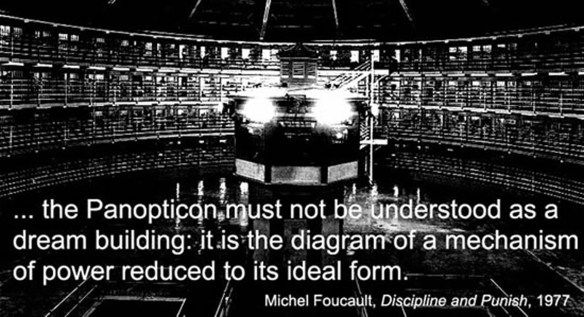
Media, Mind-Control, & Meditation: Plato’s E-Cave Panopticon and Beyond

panopticon-image

By Mankh (Walter E. Harris III)

Source: Axis of Logic

“Relax,” said the night man,
”We are programmed to receive.
You can check-out any time you like, 
But you can never leave!”

 – The Eagles, from “Hotel California”

In Plato’s Allegory of the Cave, people saw a shadow play on the wall and perceived it as reality. Today that Cave has morphed to provide umpteen TV channels and mini-screen gadgets; and the once sanctified living room cave has expanded into a free-range bubble of consciousness – heads bowed before an electronic altar, seemingly oblivious to the outside world.

“The “panopticon” refers to an experimental laboratory of power in which behaviour could be modified, and Foucault viewed the panopticon as a symbol of the disciplinary society of surveillance.”[1]

In Plato’s E-Cave, not only are the people watching a shadow play, they, and the shadows they watch, are being watched.

HyperNormalization
With a veneer of calm aplomb, the masses communicate 24-7, often in a frenetic urgency of the mundane, hence one interpretation of HyperNormalization. In all the years of overhearing cell-phone conversations in public, I can’t recall one snippet of philosophy or practical advice, rather stuff like, ‘yeah OMG I’ll get the chips!’ and ‘I’ll be there in like 30 seconds!’; if you’re old enough, you’d remember the days when, you got there when you got there! That said, a cell-phone can be a helpful even life-saving device.

The USEmpire election appears to have both proven and disproven the main theory of Adam Curtis’ fascinating new documentary “HyperNormalization.”

“Curtis argues that since the 1970s, governments, financiers, and technological utopians have given up on the complex “real world” and built a simple “fake world” that is run by corporations and kept stable by politicians.”[2]

The California cyber-tech-boom was a love-child of LSD-consciousness that found refuge in E-wizardy all the while looking to escape repressive politics. In his book “2030” Pepe Escobar describes it as: “Digital network capitalism would then shape post-modern globalization, from the New Economy before the end of the millennium to every digital wall to be broken beyond. California cosmology forged our world.”

According to Wikipedia:

“The term “hypernormalisation” is taken from Alexei Yurchak’s 2006 book Everything was Forever, Until it was No More: The Last Soviet Generation, about the paradoxes of life in the Soviet Union during the 20 years before it collapsed. A professor of anthropology at the University of California, Berkeley, he argues that everyone knew the system was failing, but as no one could imagine any alternative to the status quo, politicians and citizens were resigned to maintaining a pretence of a functioning society. Over time, this delusion became a self-fulfilling prophecy and the “fakeness” was accepted by everyone as real, an effect which Yurchak termed “hypernormalisation”.”[3]

First off, I see HyperNormalization as a half-truth because while the self-referential, gossipy world is fake, it is a veneer for a very real world of resource extraction and the violence perpetrated to maintain the status quo – and that is what the fakers ignore. As far as the election, many expected the Clinton dynasty to prevail as the corrupt, business as usual lesser of two evils. Breaking snooze: Where’s  the headline news that Melania Trump plans to focus on helping women and children?; I saw that mentioned on CNN’s Anderson Cooper 360, such a perfect antidote for Hillary’s loss and The Donald’s anti-feminist track record.

Even though WikiLeaks revealed the DNC (Democratic National Convention) was rigged against Sanders and leaks of Podesta/Clinton e-mails may have been proverbial straws for Hillary’s campaign camel, the prevailing media sentiment was that she would win – despite the fact that the day before the election some polls indicated a shrinking 3-4 point lead, thus with the typical margin of error, it was, in effect, tied. Yet the mass hyper-surprise!; and all that after the corporate media and comedy shows had simultaneously bashed Trump and given him more air-time than a kite on a windy day – both disdaining and elevating him, a media-mindfuck if ever there was one.

And there was little uproar when Gary Johnson and Jill Stein were excluded from debates and virtually banned from all corporate news, thus proving (if you didn’t know already) that it’s not a truly democratic election. Yet carry on we must and do the best we can with what we got, was the general sentiment, in other words, “the “fakeness” was accepted by everyone as real” aka HyperNormalization.

Yet the non-coastal, poor and middle America White working class (with sides of KKK and minorities!), which reportedly was the key demographic for The Don’s victory, was voting out of bare-bones needs; in effect they were not HyperNormalized. Then again, if Trump, who promises to challenge the status quo, caves-in to Deep State pressure, we will have an answer to an interesting article’s titular question: “President Trump: big liar going to Washington or Tribune of the People?”[4] And if that answer is the former, then the mostly White working poor will also have been duped/HyperNormalized.

You see, it’s hard to know what’s what; which all seems to prove HyperNormalization as the dominant societal charade; which screen is real, if any?

What you perceive is what you get
Another key phrase in Curtis’ documentary is “managed perception” – akin to Chomsky and Herman’s  “Manufacturing Consent: The Political Economy of the Mass Media” (1988) which showed how opinions and desensitized agreement to the status quo became a product to be mined and marketed. Witness CBS Chairman Les Moonves’ comment from February 2016:

“Man, who would have expected the ride we’re all having right now? … The money’s rolling in and this is fun. I’ve never seen anything like this, and this [is] going to be a very good year for us. Sorry. It’s a terrible thing to say. But, bring it on, Donald. Keep going.” [5] And, if i might satirically add, like an orangey topped Duracell battery, The Don does seem to have a lot of energy.

HyperNormalization is also akin to Sheldon Wolin’s theory  of “inverted totalitarianism,” where the faceless corporate machine wields so much entertainment and bureaucratic power that the people barely notice they are being played hook, line, and sinking feelings.

Some of Curtis’ info, however, is inaccurate or questionable. For examples, he blames the demise of the Occupy Movement on lack of vision and planning yet neglects to mention the FBI coordinated systemic crackdown on the ‘camps’ across the country. [6]

About Syria he says that President Bashar al-Assad retaliated with a “vengeful fury,” whereas Assad has defended his actions as self-defense for his people; numerous journalists back the Syrian President’s claim.

Post-election, I wonder: Why were so many liberals, lefties, and women more surprised that Trump won than that the DNC/HRC rigged it against Sanders? Were they simply feeling impotent due to HyperNormalized shadow play? Whatever the case, his victory revealed a crack in the smooth screen of HyperNormalization.

According to Patrick Caddell’s survey before the election, the populace seems to be hip to what’s happening:

“Powerful interests from Wall Street banks to corporations, unions and political interest groups have used campaign and lobbying money to rig the system for them. They are looting the national treasury of billions of dollars at the expense of every man, woman and child. AGREE = 81%; DISAGREE = 13%…

“The country is run by an alliance of incumbent politicians, media pundits, lobbyists and other powerful money interests for their own gain at the expense of the American people. AGREE = 87%; DISAGREE = 10%

The real struggle for America is not between Democrats and Republicans but between mainstream American and the ruling political elites. AGREE = 67%; DISAGREE = 24%.” [7]

This makes it seem it is the ‘how-to bring about change’ that is the deeper conundrum of the HyperNormalized world. Then again, people too often seem to have only their own best interests at heart. Approximately 90% of Americans want their food labeled so as to know if they contain GMOs etc. or not, yet hardly a peep out of anyone that climate change or the “environment” aka Mother Earth & Nature-beings were deliberately excluded as a main topic of the presidential debates. This makes it seem that, in general, Americans want clean food for themselves, they want a clean environment so they can go ‘play in the park’ by themselves. And that brings us to the Great Disconnect and Standing Rock.

Flow like water, be steady as a rock
Part of HyperNormalization is a disconnect from Nature and from being self- and community-guided, and therefore disconnected from the Original Peoples of Turtle Island. While many people are certainly aware of what’s happening with Standing Rock, the corporate media’s lack of attention, let alone empathy, fosters lack of concern for the outcome, lack of being outraged by the violent and racist treatment of those in prayer and peacefully protecting the main source of water for the Standing Rock Sioux and other Natives as well as approximately 17-million people downstream. The real-fake outrage is over the outcome of a fake election.

For many Native reservations where poverty and PTSD are prevalent, the people are anything but HyperNormalized; they are struggling to survive – as with Standing Rock, they are not asking for much: clean water and the space to live their lives with ancient traditions timelessly connected with the land, the water, the stones…

Plato, imagining a prisoner getting outside of the Cave, wrote: “Slowly, his eyes adjust to the light of the sun. First he can only see shadows. Gradually he can see the reflections of people and things in water and then later see the people and things themselves. Eventually, he is able to look at the stars and moon at night until finally he can look upon the sun itself .” [8]

Standing Rock is bringing people together, raising consciousness at many levels. As one example from a little over a week ago:

“In a “historic” show of interfaith solidarity, 500 clergy members prayed along the banks of North Dakota’s Cannonball River on Thursday where they “bore witness with the Standing Rock Sioux Nation,” which has faced intimidation, violence, and arrests for protecting their sacred land and water supply from the threats of a massive oil pipeline. According to the Episcopal News Service, “The interfaith group spent more than five hours on site, marching, singing hymns, sharing testimony, and calling others to join them in standing with the more than [300] tribes who have committed their support to the Sioux Nation as they protest the route of the Dakota Access Pipeline (DAPL).” [9]

This solidarity is in stark contrast with the election where a typically 51/49 system determines an outcome for a society literally programmed for exciting close-call winners – think sporting events,
reality shows, awards ceremonies.

Outside in and inside out
There are many ways to get outside the Cave. One of those is by going within. When I first started to meditate, as is common, I became aware of the constant chatter in my head and soon realized that the mind left unattended will rattle on endlessly. Meditation then showed me that once the chatter quiets, one then has access to other frequencies, other ‘channels’ – what happens then is a very personal matter yet also impersonal because one becomes connected with another source of thinking-seeing-feeling. Chatter, like cell-phones, has it’s usefulness, say, if you forgot to turn the stove off. My point to the personal anecdote is that the corporate media is too much chatter, endlessly looping itself. The gadgets, too, though useful, seem hard-wired for HyperNormalization.

Some of the chatter we must live with, yet by learning to follow our intuitions, listening to and connecting with Nature, talking with elders and little children we can better tune-out from the shadow-play, we can find new and ancient ways for more people – and that includes trees, rivers, etc. –  “to look at the stars and moon at night” and “look upon the sun itself.”

“Sin filo ya y derrotada se quejó: Soy más fuerte que ella, pero no le puedo hacer daño y ella a mi, sin pelear. me ha vencido.’”

“Without sharpness and defeated, it [the sword] complained: ‘I am stronger than the water, but I cannot harm her. And the water, without fighting, has conquered me.’” [10]

NOTES:
1.    Panopticism here and here.
2.    Ibid.
3.    HyperNormalization
4.    See here.
5.    “Les Moonves: Trump’s run is ‘damn good for CBS’”. See here.
6.    “Revealed: how the FBI coordinated the crackdown on Occupy
7.    “Patrick Caddell; The Pollster Who ‘Got it Right’
8.    “Allegory of the Cave
9.    “A Prayer for People and Planet: 500 Clergy Hold ‘Historic’ Mass Gathering for Standing Rock
10.    “Questions & Swords: Folktales of the Zapatista Revolution” as told by Subcomandante Marcos, Cino Puntos Press, El Paso, Texas, 2001, p.82.

To watch “HyperNormalization”, click here.

Mankh (Walter E. Harris III) is an essayist and resident poet on Axis of Logic. In addition to his work as a writer, he is a small press publisher and Turtle Islander. His new book of genre-bending poetic-nonfiction is “Musings With The Golden Sparrow.” You can contact him via his literary website.


Nonviolent Action: Why and How it Works

marcha_sal3

Nonviolent action is extremely powerful.

Unfortunately, however, activists do not always understand why
nonviolence is so powerful and they design ‘direct actions’ that are
virtually powerless.

I would like to start by posing two questions. Why is nonviolent action
so powerful? And why is using it strategically so transformative?

When an activist group is working on an issue – such as a national
liberation struggle, war, the climate catastrophe, violence against
women and/or children, nuclear weapons, drone killings, rainforest
destruction, encroachments on indigenous land – they will often plan an
action that is intended to physically halt an activity, such as the
activities of a military base, the loading of a coal ship, the work of a
bulldozer, the building of an oil pipeline. Their plan might also
include using one or more of a variety of techniques such as locking
themselves to a piece of equipment (‘locking-on’) to prevent it from
being used. Separately or in addition, they might use secrecy both in
their planning and execution so that they are able to carry out the
action before police or military personnel prevent them from doing so.

Unfortunately, the focus on physical outcomes (including actions such as
‘locking-on’ and its many equivalents), and the secrecy necessary to
carry out their plan, all functionally undermine the power of their
action. Why is this? Let me explain how and why nonviolent action works
so that it is clear why any nonviolent activist who understands the
dynamics of nonviolent action is unconcerned about the immediate
physical outcome of their action (and what is necessary to achieve
that).

If you think of your nonviolent action as a physical act, then you will
tend to focus your attention on securing a physical outcome from your
planned action: to prevent the military from occupying a location, to
stop a bulldozer from knocking down trees, to halt the work at an oil
terminal or nuclear power station, to prevent construction equipment
being moved on site. Of course, it is simple enough to plan a nonviolent
action that will do any of these things for a period of time and there
are many possible actions that might achieve it.

But if you pause to consider how your nonviolent action might have
psychological and political impact that leads to lasting or even
permanent change on the issue in question but also society as a whole,
then your conception of what you might do will be both expanded and
deepened. And you will be starting to think strategically about what it
means to mobilise large numbers of people to think and behave
differently.

After all, whatever the immediate focus of your action, it is only ever
one step in the direction of more profound change. And this profound
change must include a lasting change in prevailing ideas and a lasting
change in ‘normal’ behaviour by substantial (and perhaps even vast)
numbers of people. Or you will be back tomorrow, the day after and so on
until you get tired of doing something without result, as routinely
happens in campaigns that ‘go nowhere’ (as so many do).

So why does nonviolent action work?

Fundamentally, nonviolent action works because of its capacity to create
a favourable political atmosphere (because of, for example, the way in
which activist honesty builds trust), its capacity to create a
non-threatening physical environment (because of the nonviolent
discipline of the activists), and its capacity to alter the human
psychological conditions (both innate and learned) that make people
resist new ideas in the first place. This includes its capacity to
reduce or eliminate fear and its capacity to ‘humanise’ activists in the
eyes of more conservative sections of the community. In essence,
nonviolent activists precipitate change because people are inspired by
the honesty, discipline, integrity, courage and determination of the
activists – despite arrests, beatings or imprisonment – and are thus
inclined to identify with them. Moreover, as an extension of this, they
are inclined to change their behaviour to act in solidarity.

It is for this reason too that a nonviolent action should always make
explicit what behavioural change it is asking of people. Whether
communicated in news conferences or via the various media, painted on
banners or in other ways, a nonviolent action group should clearly
communicate powerful actions that individuals can take. For example, a
climate action group should consistently convey the messages to ‘Save
the Climate: Become a Vegan/Vegetarian’, ‘Save the Climate: Boycott
Cars’ and, like a rainforest action group, ‘Don’t Buy Rainforest
Timber’. A peace group should consistently convey such messages as
‘Don’t Pay Taxes for War’ and ‘Divest from the Weapons Industry’ (among
many other possibilities). Groups resisting the nuclear fuel cycle and
fossil fuel industry in their many manifestations should consistently
convey brief messages that encourage reduced consumption and a shift to
more self-reliant renewable energies. See, for example, ‘The Flame Tree
Project to Save Life on Earth’. Groups struggling to defend or reinstate indigenous sovereignty should convey compelling messages that explain what people can do in their particular context.

It is important that these messages require powerful personal action,
not token responses. And it is important that these actions should not
be directed at elites or lobbying elites. Elites will fall into line
when we have mobilized enough people so that they are compelled to do as
we wish. And not before. At the end of the Salt March in 1930 Gandhi
picked up a handful of salt on the beach at Dandi. This was the signal
for Indians everywhere to start collecting their own salt in violation
of British law. In subsequent campaigns Gandhi called for Indians to
boycott British cloth and make their own khadi (handwoven cloth). These
actions were strategically focused because they undermined the
profitability of British colonialism in India and nurtured Indian
self-reliance.

A key reason why Mohandas K. Gandhi was that rarest of combinations – a
master nonviolent strategist and a master nonviolent tactician – was
because he understood the psychology of nonviolence and how to make it
have political impact. Let me illustrate this point by using the
nonviolent raid on the Dharasana salt works, the nonviolent action he
planned as a sequel to the more famous Salt March in 1930.

On 4 May 1930 Gandhi wrote to Lord Irwin, Viceroy of India, advising his
intention to lead a party of nonviolent activists to raid the Dharasana
Salt Works to collect salt and thus intervene against the law
prohibiting Indians from collecting their own salt. Gandhi was
immediately arrested, as were many other prominent nationalist leaders
such as Jawaharlal Nehru and Vallabhbhai Patel.

Nevertheless, having planned for this contingency, under a succession of
leaders (who were also progressively arrested) the raid went ahead as
planned with hundreds of Indian satyagrahis (nonviolent activists)
attempting to nonviolently invade the salt works. However, despite
repeated attempts by these activists to walk into the salt works during
a three week period, not one activist got a pinch of salt! Moreover,
hundreds of satyagrahis were injured, many receiving fractured skulls or
shoulders, and two were killed.

But an account of the activists’ nonviolent discipline, commitment and
courage – under the steel-tipped lathi (baton) blows of the police – was
reported in 1,350 newspapers around the world. As a result, this
nonviolent action – which ‘failed’ to achieve the stated physical
objective of seizing salt – functionally undermined support for British
imperialism in India. For an account of the salt raids at Dharasana, see
Thomas Weber. ‘”The Marchers Simply Walked Forward Until Struck Down”:
Nonviolent Suffering and Conversion’

If the activists had been preoccupied with the physical seizure of salt
and, perhaps, resorted to the use of secrecy to get it, there would have
been no chance to demonstrate their honesty, integrity, courage and
determination – and to thus inspire empathy for their cause – although
they might have got some salt! (Of course, if salt had been removed
secretly, the British government could, if they had chosen, ignored it:
after all, who would have known or cared? However, they could not afford
to let the satyagrahis take salt openly because salt removal was illegal
and failure to react would have shown the salt law – a law that
represented the antithesis of Indian independence – to be ineffective.)

In summary, nonviolent activists who think strategically understand that
strategic effectiveness is unrelated to whether or not the action is
physically successful (provided it is strategically selected,
well-designed so that it elicits one or other of the intended responses,
and sincerely attempted). Psychological, and hence political, impact is
gained by demonstrating qualities that inspire others and move them to
act personally too. For this reason, among several others, secrecy (and
the fear that drives it) is counterproductive if strategic impact is
your intention.

If you are interested in planning effective nonviolent actions, a
related article also explains the vital distinction between ‘The
Political Objective and Strategic Goal of Nonviolent Actions’.

And if you are concerned about violent military or police responses,
have a look at ‘Nonviolent Action: Minimizing the Risk of Violent
Repression’.

For those of you who are interested in planning and acting strategically
in your nonviolent struggle, whatever its focus, you might be interested
in one or the other of these two websites: Nonviolent Campaign Strategy and Nonviolent Defense/Liberation Strategy.

And if you are interested in being part of the worldwide movement to end
all violence, you are welcome to sign the online pledge of ‘The People’s
Charter to Create a Nonviolent World’.

Struggles for peace, justice, sustainability and liberation often fail.
Almost invariably, this is due to the failure to understand the
psychology, politics and strategy of nonviolence. It is not complicated
but it requires a little time to learn.


Biodata: Robert J. Burrowes has a lifetime commitment to understanding and ending human violence. He has done extensive research since 1966 in an effort to understand why human beings are violent and has been a nonviolent activist since 1981. He is the author of ‘Why Violence?‘ His email address is flametree@riseup.netand his website is at http://robertjburrowes.wordpress.com

Robert J. Burrowes
P.O. Box 68
Daylesford
Victoria 3460
Australia
Email: flametree@riseup.net

Websites:
Nonviolence Charter
Flame Tree Project to Save Life on Earth
‘Why Violence?’
Nonviolent Campaign Strategy
Nonviolent Defense/Liberation Strategy
Anita: Songs of Nonviolence
Robert Burrowes
Global Nonviolence Network

10 Signs Of Our Global Awakening

trueworldorder-1024x531

By Paul A. Philips

Source: Activist Post

Since time immemorial, under the ruling thumb of the world’s dark overlords, humanity has been hacked, stymied, suppressed and coerced into submission through mind-controlling, soul-destroying atrocities. Those unable to see that just about every subject under the sun is a deception and how their family and friends are affected don’t yet realize the extent to which the dark overlords have us snugly stitched up.

However, alternative media sources tell us that people are awakening exponentially to the realization that they’re being stitched up and in the swathe of these awakened souls, more and more are playing their dutiful part in enlightening others.

So, here are 10 signs of our global mass awakening.

1. The fall and further fall of the mainstream media

Trust in the mainstream media has fallen to an all-time low and continues to plummet. Much of this has to do with an increasingly aware and disgruntled public: More and more people are able to discern a mainstream media totally lacking in integrity, thanks to the rising popularity of the independent/alternative media exposing the dishonesty.

Unlike the alternative/independent sources, the servile corporate-controlled mainstream media has been a highly effective tool used to manipulate the consensus reality of the masses for a number of powerful individuals having political and financial self-interests. A number of us know we have seen attempts by these elitist individuals controlling the mainstream media to thwart the rising popularity of the independent/alternative media through false, baseless accusations of ‘fake news.’  Indeed, it’s an attempt to discredit because it exposes the truth about the elite and reveals their hidden agendas….

Essentially, the unjust ‘fake news’ labelling of the independent/alternative media has backfired on the manipulators: Instead of achieving censorship it has given rise to further increasing support for the alternative/independent media, while the mainstream media has taken an even bigger fall. As many of us know, the real fake news exists in the mainstream media with its propaganda and mind control…

Given that these 2 paradigms cannot live side by side each other, which one will win the information war?

Besides the mainstream media, worldwide, an increasingly aware public show a growing distrust for Big Government and Big Business institutions from multiple polls.

The distrust and unpopularity implicitly expressed by the public on these crooked institutions with their resident crooks mainly come from the truth revelations put out by the alternative/independent media.

Further, this is what happens when Big Government and Big Business not only ignores the people’s voice in decision making, but also demonizes their dissension and public opinion, which only serves to fuel the public’s uprising.

3. Marches against Monsanto have intensified

There couldn’t be a better example of the public’s growing distrust in Big Business than Monsanto. As the years roll by marches against Monsanto from people of many different backgrounds all over the world have risen significantly and don’t look to be cooling down….

Although there are signs of Monsanto clawing back, in recent years earnings have plummeted. The earnings drop for the biotech company suggests a growing public disdain for their GM seeds as more and more people realize the dangers of GMO and its glyphosate herbicide.

More and more realize that Monsanto are out to patent, own and control every seed in the world. This threatens the destruction and diversity of every natural God-given seed….

4. Increasing health awareness

Although still very popular, people’s awareness of the dangers of fast food has increased, as indicated by recent erratic share prices in some of the major fast food corporations who’ve had to pull out all marketing stops to claw back on fallen share prices.

Reports indicate that last year people have shown more interest than ever in organic non-GMO healthier food options. Besides how these choices affect health, people’s increased interest and awareness has extended into concerns over the environment, animals and the workers involved in food production.

5. Increasing recognition of disinformation

People are increasingly seeing right through those various media sources with their dogmatic unhealthy skeptics, shills, trolls, pseudo-debunkers, controlled opposition agents, biasing, filtering and in-your-face lies intended to sell you the spin of disinformation to keep you ignorant, deceived and helplessly anesthetized in the matrix control system…

6. Increasing support for social media

The social media outlet has greatly contributed to our awakening. It has indeed provided a unique and effective platform for the people’s voice. No wonder the mainstream media and elitists are unpopular:  It has allowed us to spread the word on subjects such as PizzaGate and the Clinton conspiracies….

Along with the alternative/independent media, the explosive interest in the social media outlet has not only changed our views but also continues to redefine journalism and how information is shared. How this is redefining media is a subject for another piece.

Simple to say we’re in a golden age of alternative/independent and social media which has contributed greatly to our global awakening.

7. Changing viewpoint towards the ‘Conspiracy Theorist’

Another blatant indicator confirming our awakening is a change in how the term ‘Conspiracy Theorist’ is now generally viewed.

Used frequently over the years in mainstream media the term ‘Conspiracy Theorist’ was invented in the ’60s by the CIA (Crooks IAction). It has been used as a cover up to discredit those aware of the facts on how the dark overlords and their associates have been involved in criminal activity….

No longer generally viewed as a label to slap on crazy kooks believing Richard Nixon was a werewolf… etc… Conspiracy Theory has become more generally viewed as either conspiracy fact or at least something worth investigating rather than flatly dismissing.

For more on this see: 9 Indisputable Truths about “Conspiracy Theorists”

8. Increasing attempts to shut us up

Our global mass awakening has got the dark overlords greatly concerned as they question the effectiveness of their control systems over us. How can they deal with our awakening in growing overwhelming numbers?

Desperately, in cahoots with their associates, they’re throwing everything at us ranging from the grossly suppressive, the extremely petty, the violent and the ridiculous to try to shut us up and deny our self-expression, keep us mentally, spiritually and physically enslaved in the matrix controlling system.

9. Awakening through unknown/unforeseen processes

Our awakening goes beyond the specific and measurable: We cannot simply quantify our awakening: There are circumstances occurring on a spiritual level that go beyond our limited understanding. Such as, for example, claims have been made recently of energetic emissions from our galactic centre that could affect our spirituality and transform us….

10. Rise in local meet-up groups

As already mentioned, the Internet and social media has indeed been great for exchanging information to wake people up but what if these set ups become censored? Further, large groups, virtual or real, run the risk of infiltration for dumbing down and deliberate disinformation.

So the solution lies (in part) in the forming of local community-based in-person groups to cultivate the resistance and humanity; and local meet-up group numbers are already growing.

In conclusion

Will our mass awakening to the deception produce a turnaround — a world that makes a difference for everyone? A world where there are no predators, no controlling hierarchy, no blood-sucking vampiric slave-drivers at the top ruling the numerous enslaved at the bottom… no more fight for self-sufficiency because it’s already been achieved in the communities… etc.

It is up to us all to play our part.


You can read more from Paul A. Philips at his site NewParadigm.ws, where this article first appeared.

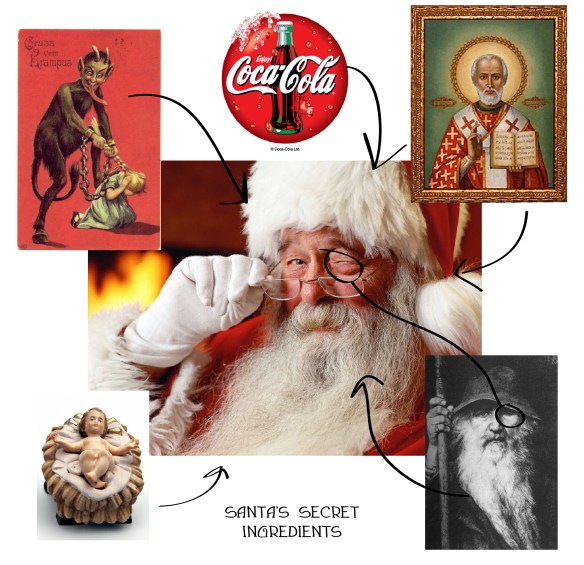
Santa, the Reindeer Shaman

origins-of-santa-claus-01

By Jerry B. Brown Ph.D. and Julie M. Brown M.A.

Source: Reality Sandwich

The following is excerpted from The Psychedelic Gospels by Jerry B. Brown, Ph.D. and Julie M. Brown, M.A., published by Inner Traditions. 

On Christmas Eve, when the streets are all covered with snow and a hush falls over the land, parents recite the story of Santa Claus to wide-eyed children. They discreetly wink as they tell the timeworn tale of a jolly old elf who is dressed all in red and white from his head to his toes. Miraculously, Santa travels around the world in one night, in a sleigh pulled by flying reindeer, stopping at each home to place gifts under the Christmas tree festively decorated in tinsel and colorful ornaments with a star on top.

How improbable! How curious! But what if this snow-white lie, which we dutifully recount each year, was grounded in an ancient reality whose roots reach back thousands of years to the vast forests of Siberia? What if the real story of Santa was even stranger than that of the commercial myth of Saint Nick, the little sleigh driver “so lively and quick”? What if it was stranger than most of us could ever imagine?

It was high in the Cairngorms in the heart of the Scottish Highlands that Julie first heard the true story of Santa Claus and his flying ­reindeer. Driving east from the Isle of Skye, where we spent our twenty-fifth anniversary, Julie and I stopped in Inverness, located at the north end of Loch Ness. From there, we followed route A9 as it twisted and turned up into Cairngorms National Park. After lunch in the alpine resort town of Aviemore, Julie made a few phone calls and found lodging at the Braeriach Guest House. Sitting on the banks of the River Spey in the quaint village of Kingcraig, this two-story stone-walled Victorian inn has five guest rooms, all furnished with wooden sleigh beds. The view from our bedroom window looked out past a flower garden to the fast-moving river, on to a wide pastoral valley dotted with black-and-white cows, and up to the peaks of the snow-capped mountains. Over tea that afternoon, we asked our innkeeper Fiona, a refugee from the hubbub of London, what we should see during our stay.

“Oh, my favorite place would be to visit the wild reindeer. When you return, you can have dinner at the Boathouse Restaurant, only a twenty-minute walk from here through the forest.”

The following morning we drove to the long wooden cabin that housed the Cairngorm Reindeer Center. There we met three other couples and our guides, Beth and William, who would lead us up into the mountains. Beth explained that the “reindeer were reintroduced into Scotland in 1952 by a Swedish reindeer herder, Mikel Utsi. Starting from a few reindeer, the herd has grown in numbers over the years and is currently held at between a hundred and thirty and a hundred and fifty by controlling breeding.”1 About fifty of these reindeer live in a natural environment in the forests and highland plateaus nearby. The region is rich with lichen, the chief food of reindeer.

After the orientation we drove in a car caravan up a steep, curvy road. After parking in a small clearing, everyone donned knee-high Wellington boots. It was a cold day, and the trail was wet and muddy from a drizzling rain. We were excited and a bit apprehensive at the thought of encountering creatures in the wild. As the trail opened onto a large pasture, bordered by a dense dark-green forest, the sun broke through the clouds and the rain lifted. As we shed our rain gear, Will put down the sack of food he had carried on his shoulder and instructed us how to behave around the reindeer—who were still nowhere to be seen. “You can pet them, even touch their noses, but not their antlers. They grow very fast, a couple of inches a week, and are very sensitive.”

Just then, Beth began bellowing loudly. It felt eerie to be huddled together on a chilly hilltop while our guide howled into the wilderness. It took a minute before we realized that she was rounding up reindeer. Suddenly, we saw a huge light-brown stag emerge from the woods. He strode majestically toward us, his giant antlers swaying to and fro. Another reindeer followed and then another, slowly walking toward us, a plodding procession of caribou.

As the males, females, and calves drew closer Beth began calling them by name: Sting, Marley, Cranna, Oryx, Gandhi, Magnus . . . Elvis. As the herd approached, Will opened the sack and scooped pellets of food into our hands, telling us to pick a reindeer and go up to him slowly with outstretched arms. I walked up to a large bull. He nuzzled his warm, silky nose into my palms, gently licking them clean. Julie stood back and observed. Soon, everyone was talking, smiling, and even giggling at the sheer delight of being in the presence of these gentle caribou.

Julie noticed an albino reindeer standing off to the side, away from the herd. She asked Beth why he did not join the group.

“Oh, him. Sircus is his name,” Beth replied. “He only takes food from me or Will. He’s a real loner.”

“Really? Do you know why?” Julie inquired.

“I think it’s because he loves mushrooms so much,” Beth said.

At the mention of mushrooms, Julie’s ears perked up. She glanced over at me with a knowing look. Aha, she thought.

“Now, don’t get me wrong,” Beth continued. “All reindeer love fly agaric, but for Sircus they are his favorite food, even more than lichen. Sometimes, during the summer mushroom season, he eats so many that he just stands there mesmerized, staring into the sun, swaying back and forth. That’s why his face is so blotched and pink. It’s sunburned.”

As Beth finished speaking, Sircus turned toward Julie and without hesitation walked up to her. He placed his soft muzzle into her palms and ate slowly, all the while looking into her eyes. Julie glanced toward me, her face beaming. She stood still for a long while, gently petting Sircus. Then, just as quickly as they had appeared, the reindeer turned and ambled back toward the forest. Sircus followed. Everyone was silent on the downhill walk back to the cars.

“Jer,” Julie said softly to me, taking my hand along the trail, “I swear I had a real connection with Sircus, as if we knew each other. Don’t you think it strange that I could have such a spiritual encounter with a reindeer?”

“Yes, you must be Saint Francis of the animals,” I said.

Julie laughed and nodded her head in affirmation.

Rudolph, the Red-Nosed Reindeer

Once back at the inn, I was tired from our excursion and lay down to take a nap. But when I happened to glance over at the bookshelf next to the bed, I noticed the Field Guide to Mushrooms of Great Britain. Soon, I was turning its richly illustrated pages. After finding Sircus’s favorite, the red-and-white Amanita muscaria, I eventually fell into a deep and restful sleep.

When I awoke, I carried the field guide downstairs, planning to show it to Julie. I found her sitting near a roaring fireplace. She was engaged in animated conversation about our reindeer adventure with the other houseguests: Anne and John, a well-groomed, middle-aged couple from Devon, whose English accent I could understand if I listened carefully, and Bonny and Sid, young punk bikers from Liverpool whom I could barely understand at all. No wonder George Bernard Shaw observed, “England and America are two countries separated by a common language.”

After Julie mentioned that the Reindeer Center rented the caribou out during the Yuletide season to pull sleighs bearing gifts for children across Great Britain, the conversation turned to Christmas and Santa Claus.

“Does anyone know what Santa has to do with Christmas, the birth of Jesus, and this?” I asked, opening the mushroom field guide and showing everyone the photo of the bright red Amanita mushroom covered with snowy white dots.

Before I could finish the sentence, I felt Julie’s two hands firmly tugging on my arm, as she said in her calming therapist’s voice, “Sorry to interrupt, honey, but if we don’t leave now, we won’t be able to walk to dinner and back before dark.”

We strolled under tall trees whose leaves sparkled in the late afternoon sunlight. The air carried a sweet scent of wildflowers. Soon we came to the rustic restaurant on the banks of an alpine lake. After finishing the delectable grilled trout fresh from the lake, Julie asked pointedly, “What were you thinking back there?”

“I was just trying to explain my theory of Santa Claus,” I said defensively.

“I . . .” “Come on. You know what I’m talking about,” Julie objected. “What about our vow of secrecy, the one we made to each other at the beginning of this trip? Right before I escorted you out the door, you were about to blurt out that we were searching for the psychedelic roots of Christianity. I need to know that you won’t go around talking to people about our work while we are on this research trip.”

“Okay, I promise,” I replied.

“Now, tell me,” Julie said with a sigh of relief, “what were you trying to say about Santa back there at the inn?”

“While most people think of Christmas in terms of the quintessential Christian celebration,” I began, “the truth is that nearly all of the symbols associated with Santa Claus are based on the shamanic traditions of pre-Christian Europe.”

“I always thought of shamanism as a tribal religion,” Julie said. “I certainly never thought of Santa as a shaman! What do you mean?”

Archaic Techniques of Ecstasy

The classic anthropological definition of shamanism comes from ­Mircea Eliade (1907–1986), who described it as “archaic techniques of ecstasy.” By “ecstasy” he was invoking the Greek term ekstasis, which literally means “to be outside oneself” and in this context figuratively means “flight of the soul.” In essence, shamanism refers to ancient methods for inducing the flight of the soul, for both the living and the recently deceased. One of the most concise descriptions of the ­universal ­foundations of shamanism is found in Peter Furst’s Hallucinogens and Culture. These foundations include “the skeletal soul of man and animal and the restitution of life from the bones; all phenomena in the environment as animate; [and] separability of the soul from the body during life.”

At the very center of these belief systems stands the persona of the shaman and his or her unique ecstatic experience. With the aid of spirit helpers he can travel to and intercede with the supernatural forces of the Upperworld and Underworld whose mystical geography he has traversed through training and trance. Frequently, although not always, his mastery comes from the use of sacred psychoactive plants, which serve both as a portal to other realms and as a source of transforming power or “soul stuff.” With the concept of “transformation” so fundamental to this worldview, it is easy to see why sacred plants with the power to radically alter consciousness and provide direct access to these supernatural realms would be universally revered in ancient religions. Throughout prehistory the religions of our ancestors were shamanistic.

“But how does shamanism work?” Julie asked.

Seeing a puzzled look on Julie’s face, I searched for an analogy.

“Imagine yourself,” I replied, “as a Koryak reindeer herder living a nomadic existence in the endless boreal forest belt of Siberia. You live in a world without maps, compasses, or clocks and certainly without GPS. Season upon season you travel with your clan and reindeer herd through a seamless landscape of green and brown forests sometimes interrupted by the blues and grays of lakes and rivers. Then one day you watch your favorite reindeer nibble on a bright red-and-white mushroom that popped up out of the moist ground overnight. Suddenly, the reindeer begins to cavort about in a very un-reindeer-like fashion. You try the mushroom and soon find yourself transported through magical landscapes filled with talking spirits who instruct you how to live well and prosper.”

Julie was listening intently as I asked her, “So what would you think about this world?”

“That it was showing me a spirit world that could help me thrive in the natural world,” Julie replied.

“Precisely,” I agreed, “and that’s the point. For tribal peoples, these supernatural realms were accessed through the shamanic flight of the soul. It’s only within the context of shamanism that we can understand the true origins of Santa Claus.”

Mushroom Rock Art of the Chukchi

Often overlooked and certainly overshadowed by Wasson’s cracking of the Soma code in the Rigveda is his equally surprising discovery of an ancient “Siberian fly-agaric complex” among the ancient indigenous peoples of the Arctic Circle. Peering deep into the wellsprings of time long before the Aryan invasion on the Indus Valley,* Wasson traced the roots of Aryan worship of the Soma mushroom back some six thousand years to the semi-nomadic reindeer herders of Eurasia known to anthropologists as the fathers of shamanism. Today there remain some three hundred thousand reindeer herders divided into thirty ethnolinguistic groups.

*According to the widely accepted Aryan invasion theory, between the fourth and second centuries BCE, several migrations occurred involving different Proto-Indo-Aryan groups from the steppes of central Asia toward the alluvial plains and valleys of northwest India. However, academics continue to debate whether the Indo-Aryans invaded and assimilated the less sophisticated Indus Valley cultures, or whether the Indo-Aryans moved in as the superior Indus Valley civilization was in a state of decline, adopting their mythologies and technologies. They inhabit three far-flung, forest-belt regions of Russia and Scandinavia. Among them are the Lapps and Nenets in the Far West; the Ostyak, Samoyed, and Vogul of the central tundra and taiga zones; and the Chukchi, Koryak, and Kamchadal who live in the extreme Far East of Russia.

When Wasson published Soma in 1968, he had to rely on secondhand data derived from folk tales and linguistic analysis and on the firsthand accounts of “explorers, travelers, and anthropologists” who visited these remote regions as far back as the late eighteenth century.4 At that time he was unaware of recent Russian archaeological expeditions that had found iconic evidence—dramatic images etched in stone—of the use of psychoactive mushrooms among the ancient Chukchi.

During field expeditions in 1967 and 1968, Russian archaeologist N. N. Dikov discovered numerous mushroom and reindeer petroglyphs (rock carvings dating from 1000 BCE) on the banks of the Pegtymel River in the Far Eastern Chukotka region, located across the Bering Sea from Alaska. These rock drawings graphically reflect the worldview of nomadic herders and their traditional shamanic practice of ingesting Amanita muscaria. Since that initial discovery, Russian researchers have identified more than two hundred similar compositions at rock art centers in northern Russian, mainly in areas inhabited by reindeer herders.

The central images of these carvings are reindeer and an increasing number of “incomparable” anthropomorphic images of people, mainly women, wearing huge mushroom-shaped hats or, in another interpretation, dancing women with mushrooms hovering over or emanating from the crowns of their heads.

The northern region where these figures are found is one where fly agaric thrive. In a later work, observing that these “doubtless” Amanita muscaria “mushrooms were much larger in scale than normal,” certainly when compared to the humanlike figures, Wasson concurs that this suggests “mushroom possession.” A common theme in these visions is the personification of the spirit (wapaq) of the mushroom as “little men or women.” The Koryak believe that the spirits residing in the fly agaric appear in the form of tiny mushroom folk who give instructions to the be-mushroomed person. One observer reports that among the Ob-Ungrians, “the mushroom eater enters the realm of the little people, talks with them, learns from them what he wishes to know—the future, the outlook for a sick person, etc.”

Santa, the Reindeer Shaman

“So are you saying that the story of Santa Claus originated with the reindeer herders?” Julie asked.

“Not at all,” I replied, “simply this: while most people think of Christmas in terms of the classic Christian holiday, the truth is that most of the symbols associated with Santa Claus are based on the religious traditions of pre-Christian Europe. In fact, every major meme of our modern myth of Santa Claus can be found in Wasson’s pioneering description of a Siberian fly agaric–reindeer culture.

“Convince me,” Julie insisted.

“Okay, I will,” I replied.

Flying Reindeer

In Soma, Wasson notes that “reindeer have a passion for mushrooms and especially for the fly-agaric, on which they inebriate themselves. Reindeer have a passion for urine and especially human urine. (When the human urine is impregnated with fly-agaric, what regal cate is there, to be served to a favored reindeer!)”9 In fact, some herders carry sealskins filled with their own urine to lure stray reindeer back to the herd.

Reindeer have a seminal place in the lives of these semi-nomadic herders as the primary source of useful everyday articles and of spiritual significance. Practically, the reindeer provide transporation by sleigh, food and milk, clothing, shelter in the form of skins for yurts, tools, and many other necessities. Spiritually, flying reindeer serve as guides for shamans, transporting them through the spirit world. The hundreds of flying reindeer megaliths found in Siberia and Mongolia offer graphic representations of myths and legends about winged reindeer who transport their ecstatic riders up into the highest branches of the Cosmic Tree, universally revered by ancient peoples as the Tree of Life.

Christmas Tree as Cosmic Tree

In addition to the nearly universal flood myth similar to the story of Noah in the Bible, many tribal cultures have a deep belief in a sacred Cosmic Tree. In the context of shamanism, this tree provides a cosmic axis around which the three planes of the universe revolve. Its roots run deep into the Underworld, its trunk holds Middle Earth, and its branches reach skyward into the Upperworld.

The birch, pine, cedar, and fir trees play a conspicuous role among Siberian cultures and serve as the nodal points for shamanism. But it was Wasson who first pointed out that birches and evergreens play an essential role in the life cycle of the fly agaric. This is because fly agaric has a symbiotic relationship with these trees in that its invisible spores colonize the host trees’ roots prior to the mushroom bursting into view aboveground as an early stage Amanita muscaria, wrapped in a pure white veil. As a result, tribespeople were amazed to witness how these mushrooms apparently sprang from the earth without any visible seeds in what appears to be a virgin birth.

Like the Cosmic Tree, the center point between heaven and earth, the North Star is also considered sacred. Among reindeer herders, it is also known as the “Immobile Star” or the “Pole Star,” because all the stars in the heavens revolve around it. Thus today we symbolically place a star at the tippy-top of the Christmas tree, and for this reason Santa makes his home in the North Pole.

Santa, the Archetypal Shaman

Our contemporary image of Santa Claus as a rotund, jolly, white-bearded fellow in a red suit (or robe) with white fir trim is a modern version of the archetypal Siberian mushroom shaman. In fact, even today some Siberian male shamans and female mushroom gatherers still dress in ceremonial red-and-white trimmed jackets when they go to gather the sacred mushrooms. The biochemical effects of Soma are most pleasant and transformative when the mushrooms are dried before consumption. For this reason, the shaman initially hangs the fresh fungi to dry in the branches of pine trees (like the colorful ornaments that decorate the Christmas tree).

After the mushroom harvest is complete, the shaman collects his gifts in a sack and places them on his sleigh, which a team of reindeer pulls back to his yurt (Santa’s sleigh full of toys, pulled by flying reindeer). A yurt is the nomad’s teepee-like dwelling typically made out of birch branches and reindeer hides. In winter, snow drifts can cover the yurt’s main entrance, so the shaman enters through the smoke hole at the top (Santa coming down the chimney) to deliver his gifts to appreciative clan members. To further dry the mushrooms, they string them up around the fireplace, and in the morning they awaken to a ritual feast of dried magic mushrooms (Christmas gifts placed in stockings over the fireplace). Once they ingest the mushrooms, the celebrants leave the physical plane and are transported to the mystical realms of the Cosmic Tree, guided by spirits that live within the mushrooms (Santa’s helpers, elves that live in the North Pole).

All of these Christmas themes include the image of Santa Claus: the Christmas tree, the flying reindeer pulling Santa’s sleigh, Santa coming down the chimney, the exchange of gifts—even the elves who live in Santa’s workshop at the North Pole.

Dusk was falling as we started to walk back around the lake toward the inn. The Santa Claus conversation had sparked Julie’s inquisitiveness. “What about the Christian Saint Nicholas?”

“To be sure, religious historians argue that many saints were simply Christian versions of earlier pagan gods, adapted by the church to encourage heathens to accept the new religion of Rome. It is said that Saint Nicholas’s legends were created mainly out of folk tales about the Teutonic god Hold Nickar, a malevolent water spirit who tips over boats and torments sailors, or even about Alte Hoerner, which stands for ‘Old Horney.’

Julie smiled at the sexual reference to Santa Claus.

“No, no, it’s not what you’re thinking. In old German, Alte Hoerner literally means ‘old horned one’ and in this case the ‘ancient horned god,’ referring to the headdress of reindeer antlers worn by Eurasian shamans. Later on, when pagan deities were demonized by the medieval church under Pope Gregory, the horned god of shamanism became the devil of Christianity. And ‘Santa’ became ‘Satan.’”

“Rings of Smoke through the Trees”

“Look, look around us!” whispered Julie. A low-hanging cloud was slowly creeping through the woods, completely encircling us in a ring of ghostly white gossamer. The mist moved silent as cat paws, covering the ground and the trunks of the trees in a blanket of clouds. The tops of trees stood bare, silhouetted against the gun-metal sky and the fading sun, silent sentinels of the forest.

“Jer,” Julie spoke, in hushed tones, “this is unearthly. All evening, we’ve been talking about the way of the shaman, portals between the worlds, about how all things are alive with spirit.”

“Look,” I said, patiently, “just because this rare cloud rolls in just as we were discussing shamanism doesn’t mean there’s a connection. You can’t prove that; no one can.”

“No, I can’t prove it,” Julie spoke quietly, “but think about what’s happened today! We came to the mountains for vacation, and I met Sircus, an albino, Amanita-loving reindeer, who walks up to me and peers into my soul. We spend the evening talking about mystical realms. And now all around us the forest is alive, as if the living spirit of nature was welcoming us to the world of the shaman . . . affirming our decision to retrace Wasson’s steps.”

I was about to object, but just then these lines from Led Zeppelin’s “Stairway to Heaven” ran through my head: “There’s a feeling I get when I look to the west/ And my spirit is crying for leaving. In my thoughts I have seen rings of smoke through the trees/ And the voices of those who stand looking. Ooh, it makes me wonder/ Ooh, it really makes me wonder.”

We stood silently in the middle of the mist-filled forest, wondering what the future would bring. At our next stop in Greece, the cradle of Western civilization, we walked among the monumental ruins of Eleusis, where rituals involving entheogens had been practiced for two thousand years.

Life on Earth is Dying

deadearth

By Robert J. Burrowes

On the day that you read this article, 200 species of life on Earth (plants, birds, animals, fish, amphibians, insects, reptiles) will cease to exist. Tomorrow, another 200 species will vanish forever.

The human onslaught to destroy life on Earth is unprecedented in Earth’s history. Planet Earth is now experiencing its sixth mass extinction event and Homo sapiens sapiens is the cause. Moreover, this mass extinction event is accelerating and is so comprehensive in its impact
that the piecemeal measures being taken by the United Nations, international agencies and governments constitute a tokenism that is breathtaking in the extreme.

And it is no longer the case that mainly ‘invisible’ species are
vanishing: those insects, amphibians and small animals about which you had never even heard, assuming they have been identified and given a name by humans.

You and I are on the brink of driving to extinction some of the most iconic species alive today. For a photo gallery of threatened species, some of which are ‘critically endangered’, see ‘World’s wildlife being pushed to the edge by humans – in pictures‘.

If you want to read more about some aspects of the extinction threat, you can do so in these recent reports: ‘World Wildlife Crime Report: Trafficking in protected species‘ and ‘2016 Living Planet Report‘ which includes these words: ‘The main statistic from the report … shows a 58% decline between 1970 and 2012. This means that, on average, animal populations are roughly half the size they were 42 years ago.’

And if you want to read just one aspect of what is happening in the world’s oceans, this recent UN report will give you something to ponder:
New UN report finds marine debris harming more than 800 species, costing countries millions‘.

Of course, some of what is happening is related to the ongoing climate catastrophe and there isn’t any good news on that front. See ‘What’s Happening in the Arctic is Astonishing‘.

But not everything that is going badly wrong is well known either. Did you know that we are destroying the Earth’s soil? See ‘Only 60 Years of Farming Left If Soil Degradation Continues‘.

And did you realise that even nitrogen is now a huge problem too? See ‘Scientists shine a spotlight on the overlooked menace of nitrogen‘.

Of course, military violence has devastating consequences on the Earth’s ecosystems too, destroying land, water and atmosphere (not to mention killing human beings) in the fight over resources. You will get no joy from the article ‘Iraq’s oil inferno – government inaction in the face of eco-terrorism
or the website of the Toxic Remnants of War Project. But every single aspect of military spending is ultimately used to destroy. It has no other function.

While 2.5 billion human beings do not have enough to eat. See ‘One in three people suffers malnutrition at global cost of $3.5 trillion a year‘.

As you read all this, you might say ‘Not me’! But you are wrong. You don’t have to be an impoverished African driven to killing elephants for their tusks so that you can survive yourself. You don’t have to be a farmer who is destroying the soil with synthetic poisons. You don’t have to be a soldier who kills and destroys or a person who works for a corporation that, one way to another, forces peasants off their land.

You just have to be an ‘ordinary’ person who pays your military taxes and consumes more than your share of world resources while participating without challenge in the global system of violence and exploitation managed by the global elite.

‘Why is this?’ you might ask.

This is because the primary driver of the human-induced mass extinction is not such things as some people hunting a particular lifeform to extinction, horrendous though this is. In fact, just two things drive most species over the edge: our systematic destruction of land habitat – forests, grasslands, wetlands, peatlands, mangroves… – in our endless effort to capture more of the Earth’s wild places for human use (whether it be residential, commercial, mining, farming or military) and our destruction of waterways and the ocean habitat by dumping into them radioactive contaminants, carbon dioxide, a multitude of poisons and chemical pollutants, and even plastic.

And do you know what drives this destruction of land and water habitats? Your demand for consumer products, all of which are produced by using land and water habitats, and the resources derived from them, often far from where you live. The most basic products, such as food and clothing, are produced on agricultural land, sometimes created by destroying rainforests, or taken from the ocean (where overfishing has savagely depleted global fish stocks). But in using these resources, we have ignored the needs of the land, oceans and the waterways for adequate regenerative inputs and recovery time.

We also participate, almost invariably without question or challenge, in the inequitable distribution of resources that compels some impoverished people to take desperate measures to survive through such means as farming marginal land or killing endangered wildlife.

So don’t sit back waiting for some miracle by the United Nations, international agencies or governments to solve this problem. It cannot happen for the simple reason that these organizations are all taking action within the existing paradigm that prioritizes corporate profit and military violence over human equity and ecological sustainability.

Despite any rhetoric to the contrary, they are encouraging
overconsumption by industrialized populations and facilitating the inequitable distribution of income and wealth precisely because this benefits those who control these organizations, agencies and governments: the insane corporate elites who are devoid of the capacity to see any value beyond the ‘bottom line’. See ‘The Global Elite is Insane‘.

If you want action on the greatest challenge human beings have ever faced – to avert our own extinction by learning to live in harmony with our biosphere and equity with our fellow humans – then I encourage you to take personal responsibility.

If you do, you need to act. At the simplest level, you can make some difficult but valuable personal choices. Like becoming a vegan or vegetarian, buying/growing organic/biodynamic food, and resolutely refusing to use any form of poison or to drive a car or take an airline flight.

But if you want to take an integrated approach, the most powerful way you can do this is to systematically reduce your own personal consumption while increasing your self-reliance. Anita McKone and I have mapped out a fifteen-year strategy for doing this in ‘The FlameTree Project to Save Life on Earth‘. You might also consider signing the online pledge of ‘The People’s Charter to Create a Nonviolent World‘  which obviously includes nonviolence towards our fellow species.

One of the hidden tragedies of modern human existence is that we have been terrorized into believing that we are not personally responsible. See ‘The Delusion “I Am Not Responsible“‘.

For a fuller explanation, see ‘Why Violence?‘ and ‘Fearless Psychology and Fearful Psychology: Principles and Practice‘.

It isn’t true but few people feel powerful enough to make a difference.

And every time you decide to do nothing and to leave it to someone else,  you demonstrate why no-one else should do anything either.

Extinction beckons. What will you do?


Biodata: Robert J. Burrowes has a lifetime commitment to understanding and ending human violence. He has done extensive research since 1966 in an effort to understand why human beings are violent and has been a nonviolent activist since 1981. He is the author of ‘Why Violence?‘ His email address is flametree@riseup.net and his website is at http://robertjburrowes.wordpress.com


Robert J. Burrowes
P.O. Box 68
Daylesford
Victoria 3460
Australia
Email: flametree@riseup.net

Websites:
Nonviolence Charter
Flame Tree Project to Save Life on Earth
‘Why Violence?’
Nonviolent Campaign Strategy
Nonviolent Defense/Liberation Strategy
Anita: Songs of Nonviolence
Robert Burrowes
Global Nonviolence Network

Neoliberalism: Serving the Interests of the International Business Elitists

41rnwuTZinL._SX332_BO1204203200_-201x300

By Edward S. Herman

Source: Dissident Voice

Mark Weisbrot, a co-director with Dean Baker of the Center for Economic and Policy Research (CEPR), has written an enlightening book that pulls together many of the analyses that CEPR has been producing over the past several decades. The book, Failed: What the “Experts” Got Wrong about the Global Economy, is important and useful because it provides an alternative framework of analysis to the one used by establishment experts, media and policy-makers. What is more, this alternative framework and description of reality is well supported by empirical evidence and is convincing. It is marginalized in the mainstream because it runs counter to the interests of the powerful, who over the past three decades, have successfully pushed for a neoliberal world order that scales back the earlier welfare state advances and pursues trickle-down economics and the well-being of the affluent.

In fact, an important feature of Weisbrot’s analysis is his recognition of the extent to which policy failures have flowed from biased analyses that serve a small elite and punish the majority, and that policy successes have often followed the loss of power by those serving elite interests. His first chapter is entitled “Troubles in Euroland: When the Cures Worsen the Disease,” whose central theme is that the long crisis and malperformance of Europe’s economies, and especially the weaker ones of Greece, Portugal, Spain and to a lesser extent, Italy, were in large measure the result of poor policy choices. The crisis, which dates back to 2008, was not due to high sovereign debt, which was only threateningly high in Greece, but rather the refusal of the policy-making “troika,” the European Central Bank (ECB), European Community and IMF, to carry out expansionary policies that would allow the poor countries to grow out of their deficit position.

The Fed met the U.S. crisis with an easy money program which, when combined with modest fiscal expansion efforts, quickly mitigated this crisis (although the fiscal actions fell short of what was needed for a full recovery). But the ECB refused to carry out a comparable expansion policy, and there was no Europe-wide fiscal program in the EU system. So the poor countries were forced to depend for recovery on an “internal devaluation” of cutbacks in mainly social budgets, given that external devaluations for individual countries were ruled out by the use of a common currency, the euro. This didn’t do the job, so the eurozone remained in a depressed state, even up to the present.

Weisbrot shows that this policy failure was deliberate, with the troika leaders–mainly the ECB–taking advantage of the weaker countries’ vulnerability to force on them structural and policy changes that served the interests of the international business elite. These changes, including cutbacks on public outlays for education, health care, social security, and poverty alleviation, mainly harmed ordinary citizens. So did the enforced pro-cyclical monetary and fiscal policies themselves, which produced a eurozone crisis of unemployment and foregone output that extended for six years and is still ongoing. Weisbrot points out that this policy and process was a notable application of Naomi Klein’s “shock doctrine,” according to which elites take advantage of painful developments (here macro-distress) to force policy changes that could not be obtained through a democratic process like a national political vote of approval. Weisbrot shows that the troika leaders were quite conscious of the fact that they were pursuing “reforms” that the public wouldn’t support outside of shock conditions.

This process rested on the undemocratic structure of macro-policy-making in the European community. One of neoliberalism’s instruments is an “independent” central bank, where independent means not subject to democratic control. The ECB meets that standard well, more so than the Fed; and in its statute the ECB is only required to meet a price stability objective, so it is free to ignore unemployment and even deliberately increase it. Neoliberal practice is also encouraged by the 1992 Maastricht Treaty, which placed ceilings on the size of budget deficits and total public debt (3 and 60 percent respectively). These unnecessary ceilings are often breached, but provide levers to put pressure on weaker countries.

The countries victimized by the ECB’s pressure for painful internal devaluation could in theory exit from the euro and rely on expansion via currency devaluation and newly feasible monetary and fiscal expansion. But the risks in the cutoff of aid and money market access and the turmoil in any transition are severe, and although Syriza was voted into power in Greece on an anti-austerity program and pledge, it did not see fit to exit. In this connection Weisbrot discusses the case of Argentina, which, in the midst of a calamitous recession in 2001-2002 did default on its large external debt, ended its peg of the peso to the dollar, froze bank deposit accounts, and installed controls over capital movements. This caused immediate chaos and a worsened crisis, but as Weisbrot stresses, after only a single quarter of further GDP decline (5 percent), freed of its externally imposed constraints, Argentina began its recovery, taking three and a half years to regain its pre-recession level of output, but with real growth of some 100 percent over the next 11 years. Greece, which had a peak GDP loss of 25 percent, and which is still mired in a badly depressed economy, could hardly have fared worse than Argentina if it had exited years ago. Whether that option should still be taken is debatable, and Weisbrot discusses the pros and cons without coming to a definite conclusion, but that an exit might well have a positive result is suggested by the Argentinian experience.

A major theme of Failed is the negative impact of neoliberalism on the growth of low and middle-income countries and the welfare of their people. A major chapter on “The Latin American Spring” features evidence that the triumph of neoliberalism in the years from 1980 to the end of the 1990s was a dismal economic and welfare failure, Per capita GDP growth fell from 3.3. percent per year, 1960-1980 to 0.4 percent 1980-2000, rising again to 1.8 percent in the years 2000-2014. The earlier period (1960-1980) was one of widespread government intervention in the interest of rapid economic development; the middle years were dominated by the triumph of neoliberalism, with widespread imposition of structural adjustment programs under IMF and World Bank auspices, lowering trade and investment barriers, and ruthlessly cutting back development and welfare state programs. The years 2000-2014 saw a resurgence of economic growth, but not up to the pre-Reagan years.

Weisbrot shows that the new spurt in economic growth was closely associated with the victory of leftist governments in quite a few Latin American states, starting in 1998, He also presents a great deal of evidence showing that the growth spurt resulted in major improvements in a range of human welfare indicators, like reduced infant mortality, poverty reduction, more widepread schooling, enlarged pensions, and greater income equality. Thus, for example, the Brazilian poverty rate, which had remained virtually unchanged in the eight neoliberal years before the victory of the Workers Party, saw a 55 percent drop in that rate during the years 2002-2013. Similar changes in this and other welfare measures took place in Ecuador, Bolivia and other Latin states that escaped the neoliberal trap. Although these changes brought improved lives and prospects to millions, Weisbrot points out that the U.S. mainstream has played dumb, refusing to feature and reflect on the significance of this widespread improvement in human welfare and its strange efflorescence associated with the decline in U.S. and IMF-World Bank influence in Latin America.

Weisbrot stresses the importance of democratization and policy space in these growth and welfare improvements. The ECB narrowed that policy space in the eurozone, making it difficult for national leaders to expand or otherwise help improve social conditions. This reflected the weakening of democracy in the eurozone, with the ECB, EC and IMF able to make decisions that local democratic governments would not be able to make. Similarly, the loss of power over Latin governments by the U.S. and IMF following the left political triumphs from 1998, and their record of anti-people actions and other policy failures, made for policy space. So also did the rise of China as an economic power, providing a market for Latin products and loans without political conditions. Weisbrot notes that the common orthodox position that the democratic West would be more likely to help poorer countries develop democracies as compared with what authoritarian China would likely do is fallacious. China lends widely without intervening politically. The United States has a long record of support of undemocratic regimes that will serve as its political instruments and/or provide a “favorable climate of investment.” (This writer’s The Real Terror Network was a dossier of U.S. support of National Security States in Latin America and of its active involvement in many counter-revolutionary “regime changes.”)

It is arguable that an unrecognized benefit of the Iraq and Afghanistan wars was their distracting U.S. officials from major efforts to halt the trend toward democratic government in Latin America, although their participation in the attempts at regime change in Venezuela and their successful support of an undemocratic coup in Honduras in 2009 shows that the longstanding anti-democratic policy thrust of the U.S. leadership is not dead. (Mrs. Clinton, of course, fully supported the Honduras coup. So we may see a more energetic pursuit of the traditional U.S. policy of hostility to democracy in Latin America with her election.)

Weisbrot stresses throughout the importance of per capita growth for improving the human condition. A problem with this premise is that the human race may be growing too fast for ecological survival. Weisbrot confronts this issue, arguing that while population growth is a definite negative productivity growth may on balance be a means of coping by increasing food output and lowering the cost of wind turbines, solar panels and other improvements. However, increases in incomes tend to increase the preference for meat, larger houses, and other resource depleters, so that productivity improvements may, on balance, place even more pressure on the environment.

Weisbrot is possibly over-optimistic on this front. But his book is rich in compelling analyses and data that show how the mainstream live in an Alice-In-Wonderland economic world and the important things we may do to escape that Wonderland.


Edward S. Herman is an economist and media analyst with a specialty in corporate and regulatory issues as well as political economy and the media. Read other articles by Edward.

Thanksgiving. A National Day Of Mourning.

By Mr. Militant Negro

Source: The Militant Negro

screenshot-318

This Thanksgiving, join me in celebrating but not in the traditional way you’re used to celebrating. In the video below, I suggest 2 ways of celebrating with The Standing Rock Sioux Nation, The Water Protectors and The Oceti Sakowin to show unity and solidarity.

Thanksgiving: A National Day Of Mourning.

Published on Nov 20, 2016


Unarmed #NoDAPL water protectors are currently being attacked by militarized police in North Dakota. They’re being sprayed with water in sub-freezing temperatures, hit with rubber bullets, and maced.

You can express outrage and demand cessation by calling any and all of the numbers below:

  • White House Situation Room – 202-456-9431
    • I was told they’re “monitoring the situation.” I asked that the White House actually intervene on behalf of water protectors.
  • Morton County Sherriff Department – 701-328-8118
    • I left a voicemail saying I’d encourage no one to ever visit North Dakota ever again if they keep attacking unarmed citizens.
  • Governor Dalrymple – 701-328-8118
    • Voicemail full; I was unable to leave a message
  • North Dakota National Guard – 701-333-2000
    • No answer outside of business hours
  • Army Corps of Engineers – 202-761-8700
    • I left a voicemail asking that they please take any and every action to ensure (1) no further harm to water protectors and (2) DAPL stop efforts to drill, for benefit of this land and all its people.

Please call. Please protest the abuse of people and earth for profit.

Your voice can make a difference.

Follow #NoDAPL on Twitter for up-to-the-minute information

https://twitter.com/MrNegroMilitant/status/800608499231236096

Standing Rock 11/20 LIVE Bridge Protest by Kevin Gilbertt Part VI #NoDAPL

From The Raw Story:

Broken treaties, cultural genocide and murder: Here are 5 ways the US has ‘given thanks’ to Native Americans

By 

The urban legend about Thanksgiving is that the Native Americans helped save the Pilgrims who had a rough start to their settlements. Once they had a bountiful harvest they invited their Native neighbors over for a nice dinner party to give thanks to them and to God. That story has been soundly refuted by actual accounts of the day, but for reasons passing in understanding, we still celebrate the holiday as we perceive it went down.

After that, however, the friendly relationship between Natives and white settlers was over, and what followed was 300 years of some of the most heartbreaking and disgraceful actions the United States has ever committed.

While there are hundreds, here are 5 huge ones:

1. Stolen Land

pipe

From the day we landed in 1492 until even today, Native Americans are still fighting over land rights.

A Proclamation was signed by King George III of England in 1763, prohibiting any English settlers from pushing further west than the Appalachian Mountains and anyone already there would be required to move back east. Even across the ocean the King knew there were tensions between Natives and settlers. Unfortunately, the King had no real way of enforcing it and 13 years later the Colonies filed the Declaration of Independence and the war with England was on.

One of the worst and most disgusting things happened in the 1829 decision by the Supreme Court in Johnson v. M’Intosh. The court ruled that the U.S. Government could sell Native American land to non-Native people out from under the tribes. Believe it or not, they were actually trying to.

The decision began a set of rulings under the Marshall Court that outlined what is now referred to as the “Doctrine of Discovery.” It’s basically a set of western laws that “allowed” the legal framework to take land from aboriginals living on it because it was “discovered” by a European Christian monarchs. The logical conclusion that you can’t discover something if someone already lives there was basically thrown out thanks to the Marshall Court.

Who knows why they even bothered with the paperwork, it isn’t like they were going to be stopped anyway.

2. Andrew Jackson

1b-002-ss-07-egander_lg

“This emigration should be voluntary, for it would be as cruel as unjust to compel the aborigines to abandon the graves of their fathers and seek a home in a distant land. But they should be distinctly informed that if they remain within the limits of the States they must be subject to their laws…” – President Andrew Jackson, State of the Union 1829

There were plenty of presidents that did horrific things to Native Americans, but for the most part Washington and Jefferson honored the idea of Native sovereignty. President Andrew Jackson did not.

On May 26, 1830 Congress passed the Indian Removal Act which gave the power to the President to “negotiate” the removal of all Native Americans and force them West of the Mississippi River. Jackson signed it into law and the farce of “negotiations” began.

In 1831, Georgia tried to pass a law that prevented Native Americans from being within the borders of their state. In 1833, Florida actually passed the same law. The Cherokees took Georgia to court and demanded an injunction to prevent the forced removal of the tribe from the state. In Cherokee v. Georgia The Supreme Court ruled that the tribal lands were not sovereign and were essentially a ward of the federal government.

But one year later in Worcester v. Georgia, a missionary working on Cherokee lands was arrested. He sued the State of Georgia claiming that the state had no legal authority on Native soil, that they were sovereign lands. The Supreme Court ruled that the tribes were sovereign and that Georgia had no legal authority.

You would have thought that the 1832 legal battle would have been the major way that the tribes were saved from governments violating laws and treaties left and right, but no. Jackson proposed to the Cherokees Tribe that they move to Oklahoma (then called Indian Territory). The Cherokee said no.

Jackson didn’t care. Between 1830 and 1850 he ordered the forced removal of the Cherokee, Chickasaw, Choctaw, Muskogee, Creek and Seminole people. It was called the Trail of Tears because so many people suffered from death, disease, starvation, exposure and more than 10,000 died on the way.

3. Re-Education and Cultural Genocide

Natives were considered savages when they fought back against the government attempting to steal their land, kill their people and force them to move. Those that were marched to what is now Oklahoma were considered the “5 Civilized Tribes” because they didn’t fight back the way many others did. They agreed to assimilate into some white culture for fear of being killed by the government.

But the U.S. government took it a step further when they started opening up boarding schools where Native children were sent and taught how to be Christian, relinquish their heritage, forget their traditions and act more “white.”

Richard Pratt was an Army Officer when he began building the schools that would teach Native children. He said he developed the idea while in “an Indian prison.” His philosophy, he described, was simple “Kill the Indian … Save the Man.” By killing the Native American traditions and upbringing in children, they hoped to begin ridding the country of what they considered to be the “savage” behavior.

Many of these children encountered what can only be described as abuse. They were beaten and put in isolation until they’d submit to the ways of white people.

4. Broken Treaties

Over 500 treaties were made with Native American tribes over the last several hundred years and over 370 of which had to do with land. All were broken or changed.

As CJ says in the video “How do you keep fighting these smaller injustices when they’re all from the mother of injustices?”

5. Murder

USA Committed Genocide Against Native Americans

Published on May 5, 2012

MICHAEL MOORE: It’s not envy, it’s war, and it is a class war, and it’s a war that has been perpetrated by the rich on to everybody else. I mean, the class war is one they started. The mistake they’ve made, just to deal with the racial part of this, is their boot has been on the necks of people of color since we began. This is a nation founded on genocide and built, built on the backs of slaves. Alright?
So, so we started with a racial problem. We went, we tried to actually eliminate one entire race, and then we used another race to build this country actually quite quickly as a new country into a world power. This country never would have had the wealth that it had had it not had slavery for a couple of hundred years. If it had had, if it had had to pay people, if it actually had to pay people to build America, you know, we might just be at that point in Utah where we’re joining the two rails together maybe at this point right now.

From the moment that Columbus “discovered” a place that already existed, Native Americans began to die. Whether from “Old World” diseases like small pox and measles, battles with government soldiers or outright murder, the population declined by 96 percent.

American historian David Stannard argued in his book American Holocaust that the annihilation of the Native Americans from 76 million on both American continents to just a quarter-million “in a string of genocide campaigns,” that killed “countless tens of millions” was by far the largest genocide in world history.

Sir Jeffrey Amherst, commander-in-chief of British forces in North America, wrote to Colonel Henry Bouquet at Fort Pitt:

“You will do well to try to inoculate the Indians [with smallpox] by means of blankets, as well as to try every other method, that can serve to extirpate this execrable race.”

The intentional use of “germ warfare” to “extirpate this execrable race” is nothing more than brutal, hateful and horrific mass murder. Our country should be ashamed.

Even hundreds of years later, tribes are still fighting many of these same battles. Just last month, the federal government raided a Native American university that was growing a legal hemp crop as part of a pilot project under the Farm Bill.

The Lakota Tribe has been particularly hard hit. They have been fighting to preserve their land against the threat of the Keystone XL pipeline which the tribe argues would have caused an increase in the number of health and safety problems.

They’ve also had run-ins with local law enforcement and liquor stores that locate just outside dry tribal lands. At the same time their children have experienced appalling and cruel racism and outright assault from fellow South Dakota residents.

What we owe the Native Americans is a more complicated question, but for sure it begins with a greater respect and extends well beyond the limited reparations we’ve given them over the years. Perhaps it begins with the reclaiming of holidays like Columbus Day and Thanksgiving which have done nothing but perpetuate stereotypes and gloss over the history of violence and broken promises.

Happy Native American Heritage Month!

Thank you  The Raw Story & 

picture-31

American Indian Activist Russell Means Powerful Speech, 1989

Published on Oct 22, 2013

Legendary Russell Means harshly criticizes the Bureau of Indian Affairs and Indian leadership of reservations. One of a kind, RIP November 10, 1939 — October 22, 2012

Russell was an Oglala Sioux activist for the rights of American Indian people. He became a prominent member of the American Indian Movement (AIM) after joining the organization in 1968, and helped organize notable events that attracted national and international media coverage.

Russell Means has lived a life like few others in this century — revered for his selfless accomplishments and remarkable bravery. He was born into a society and guided by a way of life that gently denies the self in order to promote the survival and betterment of family and community. His culture is driven by tradition, which at once links the past to the present.

Russell Means was once called the “biggest, baddest, meanest, angriest, most famous American Indian activist of the late 20th century.”

He led a 71-day armed standoff in 1973 against federal agents at Wounded Knee, a tiny hamlet in the heart of South Dakota’s Pine Ridge Reservation.

It is considered to be one of his most famous act of defiance, however, occurred at Wounded Knee on February 27, 1973. Responding to the numerous murders perpetrated by puppet tribal governments and the extreme conditions of oppression, the takeover at Wounded Knee revisited the sight of the American Indian massacre at the hands of U.S. soldiers in 1890.

Ever vigilant for his cause, Russell has been lauded by the international community for his tireless efforts.

Later, he used film as a vehicle for his advocacy, thus enabling him to use different means to communicate his vital truths. Through the power of media, his vision was to create peaceful and positive images celebrating the magic and mystery of his American Indian heritage.

In contemplating the fundamental issues about the world in which we live, he was committed to educating all people about our most crucial battle-the preservation on the earth.

Means joined “The Longest Walk” in 1978 to protest a new tide of anti-Indian legislation including the forced sterilization of Indian women. Following the walk, the U.S. House of Representatives passed a resolution saying that national policy was to protect the rights of Indians, “to believe, express and exercise their traditional religions, including but not limited to access to sites, use and possession of sacred objects, and the freedom to worship through ceremonials and traditional rites.”

Russell Means has been called the most famous American Indian since Sitting Bull and Crazy Horse by the Los Angeles Times and recognized as a natural leader with a fearless dedication and indestructible sense of pride.

He took pride in having instituted programs for the betterment of his people: notable, the Porcupine Health Clinic (the only non government funded clinic in Indian Country) and KILI radio, the first Indian owned radio station.

Today, one of his principle goals has been the establishment of a “Total Immersion School”, which is based on a concept created by the Maori people of New Zealand, where children are immersed in the language, culture, science, music and storytelling of their own people.

Russell wanted to adapt this total immersion concept to the Indian way of life and philosophy which is taught from a perspective that will nurture a new generation of proud children educated in the context of their own heritage.

Russell Means has devoted his life to eliminating racism of any kind, and in so doing he leaves a historical imprint as the most revolutionary Indian leader of the late twentieth century.

Russell’s commitment to uplift the plight of his people escalated when he served as director of Cleveland’s American Indian Center.

It was there he met Dennis Banks, co-founder of the American Indian Movement, and embarked upon a relationship that would rocket them both into national prominence.

“If I want my people to be free, Americans have to be free.” –Russell Means

‘America is a stolen country’

Published on Jan 2, 2015

Alcoholism, unemployment and suicide are problems associated with Native American reservations in the US. But a new generation of young activists are dedicating themselves to a brighter future. Benjamin Zand from the BBC’s Pop-Up team is on a reservation in South Dakota — in the heart of America’s midwest.

images amerikanska_folk american_holocaust_poster-p228161433202423678t5ta_400 5206879923_663d69d836 45fba1f5937b9e9d6c3d7a1105f0dfc6

Right now, here today, our Native American brothers & sisters are being persecuted for being who they are.

The Standing Rock Sioux And The Water Protectors

Published on Nov 20, 2016

The treatment of the Native American Tribes who are standing united to protect THEIR Tribal lands, THEIR drinking water supply AND THEIR sacred burial grounds, are unacceptable, disgusting, disappointing and inhumane.

For A History of Native Americans Protesting the Dakota Access Pipeline & A Timeline, visit….
http://www.motherjones.com/environmen…

It’s time we stand united with The Native American Tribal Nations. It’s time we stop celebrating Thanksgiving, a racists holiday that actually celebrates the massacre and genocide of 100 MILLION indigenous people.

https://twitter.com/MrNegroMilitant/status/799835277988610048

People Of Color all over The United States Of America should unite and stop celebrating a holiday that glorifies the massacre of human life.

Water Protectors. Black Friday. Charity. Kindness. Focus. Action.

Published on Nov 21, 2016

Welcome to My Monday morning rants, raves & concerns. This voice video contains My thoughts on a plethora of issues, all current events and subjects we SHOULD ALL be pondering.

This is a link to The Jedi Youtube Channel:
https://www.youtube.com/channel/UCBC3…

This is a link to the explanation where “Black Friday” comes from and what it means:
https://www.youtube.com/watch?v=N4O5_…

Stand In Solidarity With The Standing Rock Sioux, The Water Protectors and The Oceti Sakowin.

image3-1 themilitantblogheader