Three Paths

By Erik Lindberg

Source: Resilience

To have lost the godlike conceit that we may do what we will, and not to have acquired a homely zest for doing what we can, shows a grandeur of temper which cannot be objected to in the abstract, for it denotes a mind that, though disappointed, foreswears compromise.  But, if congenial to philosophy, it is apt to be dangerous to the commonwealth.  –Thomas Hardy

We have the choice of three paths into the future.  But choice is probably not the right word, for historical change is, at its most orderly, the result of action and reaction and reaction to that.  The word paths may in the same way be too tidy, for we are more likely to go crashing into the thickets than to follow the marked and warn paths that inhabit our imagination.

But here, in this brief exercise, I’m thinking about moral and cognitive maps and the way we might direct our ideals.   Perhaps, then, I may be forgiven these simplifications.  I am not making predictions about how the future might actually unfold; rather, I’m imagining the directions towards which we might cast our highest aspirations.

1) The Arc of History Bends towards Progress

Path 1 might be called the Liberal[i] Choice.  It follows the idea that a just and secure global order requires basic equality among all humans and all nations.  But equality is only a half of it: as important as the ideal of equality to the Liberal vision is the way equality might be achieved—namely by way of economic growth and increased overall wealth, which (the Liberal half-assumes and half-hopes) will be spread more equitably in the coming decades, allowing the impoverished to increase their standard of living faster than the already-prosperous will.  The Liberal vision imagines that Western and industrialized standards of living might be spread across the globe so that all people might enjoy electricity, paved roads, internet connection, urban anonymity, and (almost as human right) relief from the most difficult aspects of manual labor or subsistence farming, with the opportunity to become educated and free from the limiting prejudices of traditional societies.  It sees mobility, individualism, and choice as the hallmarks of this just and equitable society[ii], and imagines humanity becoming more cosmopolitan, tolerant, and secular, while earning its daily bread through endeavors deemed creative according to middle class values.[iii]

Liberals sometimes appreciate the link between economic growth or growing overall prosperity, on the one hand, and a tolerant and cosmopolitan global order, on the other.  This link is more implied than discussed (though it is also sometimes difficult to find policy makers discussing anything but economic growth).   But Liberals are mistaken to assume, as they often do, that education, mobility, and secular tolerance (along with the embrace of “free markets” and the cultivation of an entrepreneurial spirit) have themselves created economic growth and growing prosperity, and are wrong to imagine (as they do in a vague and image-filled sort of way) that Africa, Asia, and South America might join the Euro-American prosperous middle class once they free themselves from the train of ancient and venerable prejudices[iv] that stunt their progress.  Western prosperity, after all, is not a pretty thing if you look into it too much.

Liberals are likewise mistaken to believe that tolerance or peacefulness is a simple state of mind, or that they might be projected effectively with bumper-stickers, protest signs, and earth-tone sweaters, or that a Clinton regime would have somehow been less bloody than a Trump one, or, cum Sanders, that our unparalleled levels of consumption (i.e. prosperity) does not in fact require a menacing global military presence in addition to the manipulations of a multi-billion dollar marketing industry.  Peace does not come from virtuous mental states; it is instead the product of a delicate sociological balance that is absent in many parts of the world and that is disappearing in traditionally Liberal nations—and often for reasons that Liberals are hard-pressed to explain except by declaring that we need more Liberalism and its states of mind, backed by vague and increasingly incoherent policy objectives.  The tepid enthusiasm for the center left (in the U.S. last autumn or in France today[v]) may be a symptom of its incoherent and increasingly implausible vision.

2.  Power Realism[vi]

As I write these words, geo-political analysts are envisioning Russia and the United States on the verge of a new cold war.  Perhaps.  Regardless of how heated it becomes, the nature of this new East-West opposition, especially when compared to the previous one, is well worth noting.  Not only has the past ideological divide mainly disappeared, we might instead be struck by the way these global rivals are coming to resemble each other.  Never mind the possible scandals and whatever is at their root, the arrival of Trump represents what might hyperbolically be called Russianization of the U.S.  Like Putin, after all, Trump does not operate according to a myth of emancipation, but only according to the pursuit of national power.  Trump may not share Putin’s understanding that the source of power lies in resources (but perhaps he does), but his actions and his economic assumptions seem to concur with this view, as does the operating outlook that statecraft should work to corner as many remaining resources as possible.[vii]

Meanwhile, the rise of Trump and Trumpism in the U.S., as well as similar movements and sentiments in Western Europe, should in fact be attributed to the failure of the Liberal path and the decline of global economic growth—the end of one version of the “delicate sociological balance,” and the only version most of us can imagine (that gap in imagination is why I write).  Long term stagnation and the end of expansive bourgeois hope have worked to weaponize the “me first” attitude: under a neo-Liberal world order, self-interest was supposed to lead to a rising tide, but Power Realists have little need for any such benevolent apologia.  Now harnessed by belligerent nationalists, this attitude of economic competition is more and more likely to accept wide-scale inequality and is instead concerned to be on the winning side of a winner-take-all competition over the world’s remaining resources and comparative advantages.[viii]

To put this last point in another way, relatively few people have, at least until very recently, been willing to openly and consciously embrace the me-first belief-system of Power Realism, absent any accompanying narrative of emancipation.  But most of the West’s middle-class has long wanted, expected, and demanded in a way that effectively “chooses” a path of Power Realism and the international bullying it requires–far sooner, at least, than it would veer towards a lowering of any such demand and expectations.

Dead Ends

Liberals and Power Realists equally see the dead-end that the opposing path leads to.  But both are equally blind to, or at least resignedly sanguine about, the dead-end that their own path leads to.  Liberals correctly understand that the widespread global inequality that Power Realists appear ready to tolerate will lead to permanent war and conflict and perpetual assaults on national security by those left behind.

Meanwhile, Power Realists seem to understand[ix]  or sense (though they don’t openly articulate it in public) that the Liberal vision of 3% economic growth into perpetuity is a farce and a fantasy, and that the whole world will never live like we in Europe or America do.[x]  Our way of life may in fact depend, in the end, on the walls and borders that Liberals decry on “moral” grounds.  Insularity and defensiveness may be the required dispensation, as we choose our way of life over global equality.  Power Realists also intuit that most Liberals can be turned into Power Realists under increasingly common economic conditions.  The mere loss of expansive prospects is enough to turn many an Obama supporter into a Trump supporter.   Minor economic decline, even the absence of economic expansion, was all that it took.  Except for those prepared to blaze a new trail into uninhabited ideological wilds, Path 1 usually leads to Path 2 with the onset of only moderate duress.  Liberals mistakenly believe that hate is a prime driver[xi] of inequality or discrimination, and that it might be purged from the heart with an enlightened dose of Liberal hope.  This may occasionally be true, but hate is more the symptom and might inflict itself on anyone who has suffered repeated humiliations or degradation—or even the mere loss of unquestioned privilege.

Our current political conflicts, both domestic and international, can therefore be largely attributed to our adherence to these two merging paths—especially if we take into account our destabilized climate and resulting droughts in places like Syria and Somalia, in addition to all the other ways nations and peoples jostle for power and advantage.  Climate chaos and the resulting political chaos will be the most notable legacy of Liberal growth and the Power Realism that has begun to cruelly manage it.[xii]

Political conflicts are almost always presented as a battle of ideals (as with the American choice of freedom over tyranny during WWII[xiii]) with the implied presumption that we might choose peace and equality as discrete policies or national values, unconnected from our economic and consumptive being- in-the-world.  According to this battle of ideals, then, one side sees the world divided between a coalition of enlightenment, empathy, tolerance, and inclusion, opposed to uninformed bigotry and short-sighted selfishness.  As a bumper sticker I saw the other day smugly put it, “I think, therefore I’m Liberal.”  The other side sees a line dividing steadfast, uncompromising faithfulness and resolve from naïve and undiscerning acceptance and compromise, a line between strength and weakness, between realism and soft-headed idealism.

But our current global change and conflicts are better understood with concepts drawn from sociology or anthropology than from self-reassuring talking-points.   A stable social order requires what we might refer to as consent or “buy in,” perhaps a lessening of the inevitable tension between civilization and its discontents into a stable détente.  During the short Pax Americana, this consent has been purchased with the promise of expanding prospects for all, fueled by an economy that devoured its own resource base in a way that renders its continuation impossible.  The Liberal order replaced social bonds with growing possibility,[xiv] and required for its maintenance the fulfilled promise that every year would provide more and that every generation could expect distinct material improvements. [xv] This order had no plan for material contraction or the onset of limits, other than to declare in the face of reality that there are no limits to growth.

This lack of a plan for stasis, let alone degrowth, might explain the demise of what so many Liberals believed to be the arc of history.  We maintain our acquisitive and competitive values and the primacy of individual liberty.  But in the absence of the growth and opportunity that purchased consent, trust horizons shrink and we see a turn towards group identity (as an alternative to participation in some imaginary global civilization) and begin an openly hostile scramble for remaining pockets of wealth and privilege (in the absence of the promise that everyone might have more forever).  Globalist buy-in has no dependable currency.

Picture global conflict not as the fight between liberals and conservatives, between the enlightened and the ignorant, between moderates and fundamentalists.  Picture, instead, penniless children with their noses pressed against the candy store window, while entitled brats stuff their pockets full of unearned loot.[xvi]  Forget ideals and instead imagine repeated humiliation, envy, and frustration, broken promises and abortive ideals.  It is not some obscure “ideology of hate” or an unexplained failure of moderate pro-Western policies according to which the explosive vest is strapped on.  Nor can we explain as simple sexism the way Donald Trump’s gropings (and so much else) were so widely forgiven.  Far stronger than we tend to accept is the desire for purpose and belonging, and the desperate (and sometimes violent) search for renewed social bonds when the limitless world of boundless and bondless expansion flounders on the shoals of a finite planet.  We once lived in a world when there was little disbelief in face of the comforting contradiction that we might all somehow “get ahead.”  Now it is clear that only a few can actually do so.  It is this realization that creates nationalism, Brexit, right wing populism, hatred of immigrants, or “America First.”

3. A Third Way

The Liberal Dream is dying because the planet was never infinite and our potential never limitless–not because some bad-guy ignoramuses somehow got the upper hand.  A social order could never be maintained for long by the promise of more every year, while the tide can only rise so high before it washes all good fortune away.  The most direct and facile, yet brutal and likely, antithesis of Liberal Growthism is personified by Trump, Putin, or Le Pen today, Hitler, Mussolini and Franco in years past,[xvii] and can only lead to war and repression.[xviii]  Such rulers are what arise at the onset of Liberalism’s decline.  But they offer no real solution, only a quick reordering of hope and expectation into anger and hate—an ordering nonetheless.  Intoxicated by the thrill of an arms race, Power Realists ignore the fact that the oppression and forceful repression of at least half the world’s population is unsustainable, and that the immiseration it spreads will eventually inflict us all.  Liberals know this and are aghast at the rise of these values.  But they, in turn, are all too ready to ignore the fact that Liberal hope requires unsustainable growth and insulate themselves from the realization that our global climate crisis was not caused by nationalism or the greed of someone else.  It was caused by this same growth, which continues to demand levels of goods and services that are bringing our ecological systems to the point of collapse.

There is of course a third choice—one that is simple yet mainly unthinkable.  It sees with heart stopping clarity the dead-end towards which the other two paths lead and has math, science, and even hard-headed economic analysis[xix] on its side, not to mention a pretty solid interpretation of most of the world’s major religions.  But it is a choice that few appear prepared to adopt, even entertain.  It accepts the view that a secure and stable global order must be a relatively egalitarian one—that, according to one idiom, all God’s children deserve a fair share of the Earth’s bounty.  It understands that the 5% of the global population that the United States accounts for cannot continue to use a quarter or a fifth of the world’s energy and natural resources while emitting a similar proportion of carbon dioxide.

And here is where this path parts ways from any of the views normally deemed fit for polite company: for it does not believe that the rest of the world should be brought to our level; that would be ecological suicide.  For if the whole world were to live like Americans we would need an additional four to six Earth’s to supply the required energy and natural resources, and to absorb our terrible waste.  A transition to wind and solar power does not substantially change this equation, nor do all the most far-flung efficiencies that anyone might realistically imagine.

The path according upon which humanity has a chance to find a just and sustainable world requires what is unthinkable yet mathematically impeachable and morally imperative: that we in America and Europe live more like African villagers, Indian subsistence farmers, and South American peasants.[xx]  They must become our models for the triumph of human dignity and justice, not to mention sustainability.  We, who have the appearance, at least, of a choice, must choose this sort of radical simplicity, embrace the hard work and the community interdependence, and abandon dreams that we might live without limits and be or do anything we can imagine (that godlike conceit was forged under the illusion that we have an infinite universe at our disposal[xxi]).

This will never happen you say.  It is unrealistic.  People will never give up privilege unless they have to.[xxii]  Congratulations: you have just chosen Path 2.  But true enough, I can’t disagree, this skepticism is probably warranted, especially if the limits of human aspiration are to be pragmatic and strategic, if you can’t hope beyond the current political parties and already established life-paths for middle class people.  For there is no clear path from where we are to a world of radically simple sustainability, except the one paved with cataclysmic violence and bloodshed, in which we will eventually be forcefully taken to our knees.[xxiii]

But we might still stand up and declare, “this is the right path, this is what I support, this is where I will throw my energy.”  There is no reason why we must continue to choose Path 1 or Path 2, or accept it–no reason why we must continue to pretend that our way of life or our side of the ideological divide (give or take a few ideological tweaks) is just and sustainable.  There is no reason why we should continue to give our consent to the maintenance of either growth or inequality.   Let us openly and loudly declare our commitment to our own eventual material poverty, and in this declaration find moral and spiritual wealth.  Let us begin to proclaim the unthinkable and think it every day.


[i] By Liberals I mean philosophical Liberals, which has generally included many who are considered political conservatives.  Ronald Reagan was as much a Liberal as Bernie Sanders.  Donald Trump, however, may not be a Liberal.

[ii] To borrow Chris Smaje’s term, Liberals are “solutionist” when it comes to freedom and choice, unable to see that there are in it advantages and disadvantages, payoffs and collateral damage.

[iii] Where apps are “creative” but managing erosion on a hardscrabble farm is not.

[iv] And accept that loan from the IMF along with the accompanying “restructuring” and “reforms.

[v] Does anyone really embrace the vision of a Clinton or a Macron?  Or is it just a safe alternative to the alternative?

[vi] I am not suggesting that “Power Realists” are across the board more “realistic.”

[vii]http://www.resilience.org/stories/2017-01-24/donald-trump-and-economic-growth-a-brief-interregnum-on-growthism/

[viii] http://www.resilience.org/stories/2017-01-24/donald-trump-and-economic-growth-a-brief-interregnum-on-growthism/

[ix] I’m completely not sure about this.  Power Realists may be as Growthist as neo-liberals and certainly trumpet the ideals of economic growth.  But their rise, I would assert without much qualification, has been made possible by the ending of growth and their policies are suited to the end of a Growthist order.

[x] It is with some weariness that I feel compelled to provide evidence for this conclusion.   Either the idea that the Earth can provide enough resources for the rest of the world to live like us, or the idea that exponential growth remains a viable plan for the future, on their own, belie any mathematical conclusions. But the Liberal vision requires both.  A true Liberal paradise would require that we maintain 3% or so economic growth in the industrialized world, while the “developing” world grows even faster to catch up.  The main reason that this can’t work is, simply, that growth is tantamount to mass genocide followed by mass suicide.  For despite ballyhooed efficiencies and alleged “decoupling” no one has figured out to create more stuff for more people without using more natural resources.  There is no way to lift a 400 ton passenger airplane off the ground with a small ecological footprint or provide everyone with one-hundred horsepower personal transportation without making the planet unlivable.  If everyone were to live like Americans, we would require about 6 times the current amount of things like rubber, oil, timber, concrete, and iron ore.  Meanwhile 3% economic growth—the amount most Liberal economists believe is necessary to maintain our delicate sociological balance—means that the size of the economy (and the amount of natural resources it requires) will double every 23 years.  That means in 56 years, the natural resource requirements would be quadruple the current level.  This is not a viable path into the future.  These resources simply don’t exist, and attempting to squeeze them out of our planet would make it unlivable.  Past and current attempts may already have.  No wonder so many pro-growth technophiles look to outer space as the solution to humanity’s alleged need for growth—which begs the very basic existential question of why so many humans see this as a better plan than the unthinkable one I suggest below.  I review some of the fundamental problems of economic growth in http://www.resilience.org/stories/2017-02-22/economic-growth-a-primer/

[xi] What Jacques Derrida would have referred to as a “transcendental signifier,” a thing-in-itself, something that just is, which, like “evil,” not only needs no further explanation, but in fact shuns it.

[xii] As Michael Klare has recently noted more people are on the brink of starvation now than at any time since WWII.  http://www.resilience.org/stories/2017-04-21/climate-change-genocide/

[xiii] This “choice” is far better described with that word, and with the notion of “ideals,” than anything we encounter today.  However, the clean narrative of good vs evil has nevertheless been simplified, with the relation of national interests to resources and empire being erased from the picture, or perhaps overshadowed by the atrocities.

[xiv] http://www.resilience.org/stories/2017-01-17/the-growthist-self-growthism-part-3/

[xv] http://www.resilience.org/stories/2016-01-11/a-geo-physis-of-freedom/

[xvi] And then picture these same entitled brats with their noses pressed up against another window on some other day.

[xvii] As the US Joint Forces Command concluded in 2010, “A severe energy crunch is inevitable without a massive expansion of production and refining capacity. While it is difficult to predict precisely what economic, political, and strategic effects such a shortfall might produce, it surely would reduce the prospects for growth in both the developing and developed worlds. Such an economic slowdown would exacerbate other unresolved tensions, push fragile and failing states further down the path toward collapse, and perhaps have serious economic impact on both China and India. At best, it would lead to periods of harsh economic adjustment. To what extent conservation measures, investments in alternative energy production, and efforts to expand petroleum production from tar sands and shale would mitigate such a period of adjustment is difficult to predict. One should not forget that the Great Depression spawned a number of totalitarian regimes that sought economic prosperity for their nations by ruthless conquest.”  https://fas.org/man/eprint/joe2010.pdf, p.22 (emphasis added).

[xviii] Someone like Reagan is of great historical interest, what with his attempt to create a synthesis of the two, reflected in his soaring rhetoric, but paid for with massive debt and the strategic use of populist hate.

[xix] I am not, of course, referring to most mainstream economic analysis.  Economics as a discipline has been charged mainly with the task of figuring out how to grow the economy regardless of the consequences or the possibility.  By “hard-headed” I am thinking of the few economists who have escaped this Growthist ideology and follow what Charles Hall and Kent Klitgaard refer to as “biophysical economics.”

[xx] This point has been made most poignantly by Chris Smaje.  If you haven’t been reading his work, start now.  It’s among the most interesting in the “deep sustainability” world.  I need to further note that this current essay was motivated by Chris’s “Article 51” where he writes: “I’ve been accused before of irresponsibly wishing to lower the standard of living in the wealthier countries to the level of common misery experienced by humankind in general in relation to my remarks on immigration. On reflection, I’m happy to embrace that accusation, if I’m allowed a few extra lines of defence. I embrace it because, well, what’s the alternative? Historically, capitalist ideology has justified itself with aqueous metaphors of downward trickling and upwardly rising tides that benefit all. It’s become clear that these are mirages. So the argument against a fair global spread of economic resources then boils down essentially to the devil take the hindmost. I can’t justify that to myself ethically, and in any case I think that road leads to a still deeper mire of global misery.”  http://www.resilience.org/stories/2017-03-28/article-51/

Smaje consistently condenses complicated issues into digestible form without sacrificing the complexity.  I’m trying to recondense some of his thoughts—or my take on them—into my own idiom and may be justly accused of adding little to what he has already said.

[xxi] It’s a nice sentiment, and it’s everywhere.  The prevailing “moral” of 90% of the movies currently made for 5 year olds is that they can be who or whatever they want, if they only follow their dreams and “be themselves.”  I get where this is coming from, and can glimpse the cost of abandoning this fiction.  But we need to start considering the fact that it just isn’t true, and certainly can’t be, at least as currently understood, for 6 or 7 or 8 billion people.  It might be possible, for a while, for half a billion or so.  And then they are likely to kick and scream and pout when the promise turns out to have been false.

[xxii] And the ecological limits of the world will never appear to us as a “have to,” even though they most certainly are.

[xxiii] There are of course brave pioneers who have beaten a track in this direction—ones like Jim Merkel.  But the problem of a whole-society or whole-system transition has yet to be solved.

The Unifying Force of War Abolition

By David Swanson

Source: Let’s Try Democracy

Remarks at United National Antiwar Coalition in Richmond, Virginia, on June 18, 2017.

It’s not unusual for an activist, focused on one of the millions of worthy causes out there, to try to recruit other activists to that particular cause. That’s not exactly what I want to do. For one thing, if we are going to succeed we are going to have to recruit millions of new people into activism who are not now active at all.

Of course I do favor types of activism that eliminate the need for more activism, such as campaigns to make voter registration automatic or to index the minimum wage to the cost of living. But for the most part I want everyone to keep doing what inspires them. Only, I think I know a way to shift our emphases and unite out movements, a way that doesn’t usually occur to us.

It’s not unusual for an activist to think that their particular field is the unifying top priority.

For example:

If we don’t get the money out of politics how can we enact or enforce any laws not favored by money? We’ve legalized bribery for godsake! What else matters until we fix that?

Or:

If we don’t create credible democratic independent media, we can’t communicate. Door knocking can’t defeat television. We only know that Cindy Sheehan went to Crawford or Occupyers went to Wall Street because corporate television chose to tell us. Why have elections if we can’t tell the truth about the candidates?

Or:

Excuse me, the earth is cooking. Our species and many others are losing their habitats. If it’s not already too late, now is the time to decide whether we will have great grandchildren at all. If we don’t have any, what will it matter what kind of elections or television networks they have?

One can go on and on in this vein, as well as in claiming that one societal evil precedes and causes another. Racism or militarism or extreme materialism is the disease and the others are the symptoms.

All of this is also not exactly what I want to do. I want us to work on everything and use every means of unifying. I want us to recognize how each problem contributes to others and vice versa. Hungry scared people can’t end climate change. A culture that puts a trillion dollars a year into mass-killing of distant dark-skinned people can’t build schools or end racism. Unless we redistribute wealth, we cannot redistribute power. We can’t create media unless we have something important to say. We can’t protect the earth’s climate while steadfastly ignoring the top consumer of petroleum on earth because criticizing the military would be inappropriate. But we will go on ignoring it if we don’t create good media. We have to do it all, and there are various ways in which we can become more united, more strategic, and potentially more effective.

The way that I think we don’t pay enough attention to lies in developing a focus on complete and total war abolition, elimination of all weapons and militaries, all bases, all aircraft carriers, missiles, armed drones, generals, colonels, and if necessary all senators from Arizona.

Why war abolition? I’ll give you 10 reasons.

  1. It actually makes sense. The reasonable position of opposing some wars and cheering for others, but cheering for the troops even in the bad wars doesn’t attract a lot of energy because it doesn’t make any sense. Jeremy Corbyn just won votes by pointing out that wars generate terrorism, they are counter-productive on their own terms, endangering us rather than protecting us. They need to be replaced with diplomacy, aid, cooperation, the rule of law, the tools of nonviolence, the skills of de-escalation of conflict. Claiming that wars are sort of good but shouldn’t be overdone makes no sense at all — what is the point of them if not to win them? And if wars make murder OK, why is torture so unacceptable? And if bombs dropped by piloted planes are OK, what’s wrong with drones? And if Anthrax is barbaric, why are White Phosphrous and Napalm civilized? None of it makes any sense, which is one reason the top killer of U.S. troops is suicide. You know how to properly love the troops, end all war and give them life options that don’t make them want to kill themselves.
  2. Nuclear apocalypse is a growing danger on a par with climate chaos and will continue to grow unless war abolition succeeds.
  3. The biggest destroyer of water, air, land, and atmosphere that we have is militarism. It’s war or planet. Time to choose.
  4. War kills first and foremost by removing resources from where they are needed, including from famines and disease epidemics created by war. Any activism that seeks funding for any human or environmental needs has to look to ending war. It is where all the money is, more money every single year than could be taken once and only once from the billionaires.
  5. War creates secrecy, surveillance, classification of public business, warrantless spying on activists, patriotic lying, and illegal actions by secret agencies.
  6. War militarizes local police, making the public into an enemy.
  7. War fuels, just as it is fueled by, racism, sexism, bigotry, hatred, and domestic violence. It teaches people to solve problems by shooting guns.
  8. War divides humanity at a time when we must unite on major projects if we are to survive or prosper.
  9. A movement to abolish all war, all weapons, and all atrocities that flow out of war can unite opponents of the crimes of one government or group with the opponents of the crimes of another. Without equating all crimes with each other, we can unite as opponents of war rather than of each other.
  10. War is the primary thing our society does, it sucks down the majority of federal discretionary spending, its promotion permeates our culture. It is the very foundation of the belief that ends can justify evil means. Taking on the myths that sell us war as necessary or inevitable or glorious is an ideal way of opening our minds to rethinking what we’re doing on this little planet.

So let’s not work for an environmentally sensitive military into which women have the equal right to be drafted against their will. Let’s not oppose the weapons that are wasteful or don’t kill well enough. Let’s build a broad multi-issue movement in which one of the unifying factors is the cause of eliminating in its entirety the institution of organized mass murder.

The Globalisation of Bad Food and Poor Health: Sustainable Development or Sustainable Profits?

gmo_crops_genfood_735_350-400x190

By Colin Todhunter

Source: RINF

The proportion of deaths due to cancer around the world increased from 12 percent in 1990 to 15 percent in 2013. Globally, cancer is already the second-leading cause of death after cardiovascular diseases.

In India, government data indicates that cancer showed a 5 percent increase in prevalence between 2012 and 2014 with the number of new cases doubling between 1990 and 2013. The incidence of cancer for some major organs in India is the highest in the world. Reports have also drawn attention to rising rates of breast cancer in urban areas, and, in 2009, there was a reported increase in cancer rates in Tamil Nadu’s textile belt, possibly due to chemically contaminated water.

The increase in prevalence of diabetes is also worrying. By 2030, the number of diabetes patients in India is likely to rise to 101 million (World Health Organisation estimate). The number doubled to 63 million in 2013 from 32 million in 2000. Almost 8.2 percent of the adult male population in India has diabetes. The figure is 6.8 percent for women.

In India, almost 76,000 men and 52,000 women in the 30-69 age group died due to diabetes in 2015, according to the WHO. The organisation reports South-East Asia had a diabetic population of around 47 million, which is expected to reach 119 million by 2030.

new study in The Lancet has found that India and China continue to have the largest number of underweight people in the world; however, both countries have broken into the top five in terms of obesity.

India leads the world in terms of underweight people. Some 102 million men and 101 million women are underweight, which makes the country home to over 40 percent of the global underweight population.

Contrast this with India’s surge in obesity. In 1975, the country had 0.4 million obese men or 1.3 percent of the global obese men’s population. In 2014, it was in fifth position globally with 9.8 million obese men or 3.7 percent of the global obese men’s population. Among women, India is globally ranked third, with 20 million obese women or 5.3 percent of global population.

Although almost half the nation’s under-5s are underweight, the prevalence of underweight children in India is among the highest in the world; at the same time, the country is fast becoming the diabetes and heart disease capital of the world.

Many social and economic factors, including environmental pollution, poor working and living conditions, tobacco smoking, lack of income and economic distress, lack of access to healthcare and poverty, contribute to ill health and disease. However, conditions like cardiovascular disease and obesity have among other things been linked to sedentary lifestyles and/or certain types of diet, not least modern Western-style convenience food (discussed later).

Western junk food aside, it will be shown that even when we have access to sufficient calorific intake or seemingly nutritious and wholesome traditional diets, there is little doubt that due to the processes involved in growing and processing the food we eat, diet can be a (major) contributory factor in causing certain conditions and illnesses.

The junk food revolution, ‘free’ trade and poor health

The impact of the North American Free Trade Agreement on Mexico and the subsequent flood of cheap US processed food into the country has adversely affected the health of ordinary people. Western ‘convenience’ (junk) food has displaced more traditional-based diets and is now readily available in every neighbourhood. Increasing rates of diabetes, obesity and other health issues have followed. This report by GRAIN describes how US agribusiness and retailers have captured the market south of the border and outlines the subsequent impact on the health of Mexican people.

In Europe, due to the ‘harmonisation’ of food regulatory standards, the Transatlantic Trade and Investment Partnership (TTIP) could seriously impact the health of Europeans. Washington wants Europe to eliminate all restrictions on imports of food from the US and to adopt a US-style food supply regulatory regime, stripped of the precautionary principle. US corporations want to make it difficult for European consumers to identify whether what they’re eating is food that was produced using health-damaging practices that EU consumers are against, like GMOs, chlorine-washed chicken and meat from animals treated with growth hormone.

These types of trade agreements represent little more than economic plunder by transnational corporations. They use their massive political clout to author the texts of these agreements with the aim of eradicating all restrictions and regulations that would impede greater profits.

Western agribusiness, food processing companies and retail concerns are gaining wider entry into India and through various strategic trade deals are looking to gain a more significant footprint within the country. The Knowledge Initiative on Agriculture and the ongoing India-EU free trade agreement (like TTIP, both are secretive and largely authored by powerful corporations above the heads of ordinary people) talks have raised serious concerns about the stranglehold that transnational corporations could have on the agriculture and food sectors, including the subsequent impact on the livelihoods of hundreds of millions and not least the health of the public.

Western style fast-food outlets have already been soaring in number throughout the country. Pizza Hut now operates in 46 Indian cities with 181 restaurants and 132 home delivery locations, a 67 percent increase in the last five years). KFC is now in 73 cities with 296 restaurants, a 770 percent increase. McDonalds is in 61 Indian cities with 242 restaurants as compared to 126 restaurants five years back, a 92 percent increase). According to a study published in the Indian Journal of Applied Research, the Indian fast food market is growing at the rate of 30-35 percent per annum (see this).

Heart disease, liver damage, stroke, obesity and diabetes are just some of the diseases linked to diets revolving around fast-food. Frequent consumption of fast food has been associated with increased body mass index as well as higher intakes of fat, sodium, added sugars and sugar-sweetened beverages and lower intakes of fruits, vegetables, fibre and milk in children, adolescents and adults. Fast food also tends to have higher energy densities and poorer nutritional quality than foods prepared at home and in comparison with dietary recommendations (see this).

To further appreciate just how unhealthy even seemingly healthy food can be in well-stocked supermarkets, this report in The Guardian reveals the cocktails of additives, colourants and preservatives that the modern food industry adds to our food.

Moreover, in many regions across the globe industrialised factory farming has replaced traditional livestock agriculture. Animals are thrown together in cramped conditions to scale up production and maximise output at minimum cost. For example, just 40 years ago the Philippines’ entire population was fed on native eggs and chickens produced by family farmers. Now, most of those farmers are out of business. And because world trade rules encourage nations from imposing tariffs on subsidised imported products, they are forced to allow cheap, factory-farmed US meat into the country. These products are then sold at lower prices than domestic meat. There is therefore pressure for local producers to scale up and industrialise to compete.

Factory farms increase the risk of pathogens like E coli and salmonella that cause food-borne illness in people. Overuse of antibiotics can fuel the growth of antibiotic-resistant bacteria, the use of arsenic and growth hormones can increase the risk of cancer in people and crowded conditions can be a breeding ground for disease. And genetically modified animal feed is also a serious issue, leading to concerns about the impact on both animal and human health.

The green revolution, micronutrient deficient soil and human health

We often hear unsubstantiated claims about the green revolution having saved hundreds of millions of lives, but any short-term gains have been offset. This high-input petro-chemical paradigm helped the drive towards greater monocropping and has resulted in less diverse diets and less nutritious foods. Its long-term impact has led to soil degradation and mineral imbalances, which in turn have adversely affected human health (see this report on India by botanist Stuart Newton – p 9 onward).

Adding weight to this argument, the authors of this paper from the International Journal of Environmental and Rural Development state:

“Cropping systems promoted by the green revolution have increased the food production but also resulted in reduced food-crop diversity and decreased availability of micronutrients (Welch, 2002; Stein et al., 2007). Micronutrient malnutrition is causing increased rates of chronic diseases (cancer, heart diseases, stroke, diabetes and osteoporosis) in many developing nations; more than 3 billion people are directly affected by the micronutrient deficiencies (Cakmak et al., 1999; Welch, 2002; WHO, 2002; Welch and Graham, 2004). Unbalanced use of mineral fertilizers and a decrease in the use of organic manure are the main causes of the nutrient deficiency in the regions where the cropping intensity is high (Prasad, 1984; Welch, 1993, 2005).”

The authors imply that the link between micronutrient deficiency in soil and human nutrition is now regarded as crucial:

“Moreover, agricultural intensification requires an increased nutrient flow towards and greater uptake of nutrients by crops. Until now, micronutrient deficiency has mostly been addressed as a soil and, to a smaller extent, plant problem. Currently, it is being addressed as a human nutrition problem as well. Increasingly, soils and food systems are affected by micronutrients disorders, leading to reduced crop production and malnutrition and diseases in humans and plants (Welch et al., 1982; Welch and Graham, 2004). Conventionally, agriculture is taken as a food-production discipline and was considered a source of human nutrition; hence, in recent years many efforts (Rengel and Graham, 1995a, b; Cakmak et al., 1999; Frossard et al., 2000; Welch and Graham, 2005; Stein et al., 2007) have been made to improve the quality of food for the growing world population, particularly in the developing nations.”

Pesticides, the environment, food and health

Hand in hand with the practices outlined above has been the growth of the intensive use of chemical pesticides. There are currently 34,000 pesticides registered for use in the US. Drinking water is often contaminated by pesticides and more babies are being born with preventable birth defects due to pesticide exposure. Illnesses are on the rise too, including asthma, autism and learning disabilities, birth defects and reproductive dysfunction, diabetes, Parkinson’s and Alzheimer’s diseases and several types of cancer. The association with pesticide exposure is becoming stronger with each new study.

In Punjab, pesticide run-offs into water sources have turned the state into a ‘cancer epicentre‘, and Indian soils are being depleted as a result of the application of green revolution ideology and chemical inputs. India is losing 5,334 million tonnes of soil every year due to soil erosion because of the indiscreet and excessive use of fertilisers, insecticides and pesticides. The Indian Council of Agricultural Research reports that soil is become deficient in nutrients and fertility.

India is one of the world’s largest users of pesticides and a profitable market for the corporations that manufacture them. Ladyfinger, cabbage, tomato and cauliflower in particular may contain dangerously high levels because farmers tend to harvest them almost immediately after spraying. Fruit and vegetables are sprayed and tampered with to make them more colourful, and harmful fungicides are sprayed on fruit to ripen them in order to rush them off to market.

Consider that if you live in India, the next time you serve up a good old ‘wholesome’ meal of rice and various vegetables, you could be taking in half a milligram of pesticide also. That would be much more than what an average North American person would consume.

Research by the School of Natural Sciences and Engineering (SNSE) at the National Institute of Advanced Studies in Bangalore has indicated disturbing trends in the increased use of pesticide. In 2008, it reported that many crops for export had been rejected internationally due to high pesticide residues. Moreover, India is one of the largest users of World Health Organization (WHO) class 1A pesticides, including phorate, phosphorus, phosphamidon and fenthion that are extremely hazardous.

Kasargod in Kerala is notorious for the indiscriminate spraying of endosulfan. The government-owned Plantation Corporation of Kerala aerially sprayed the harmful pesticide on cashews for a period of over 20 years. Consequently, it got into rivers, streams and drinking water. Families and their children have been living with physical deformities, cancers and disorders of the central nervous system ever since.

Officials and the pesticide companies benefited from the spraying. At the time, cashew was grown without pesticides throughout Kerala, but the government-run plantation invested millions of rupees of public money in spraying the deadly pesticide. Endosulfen poisoning cases also emerged elsewhere, including Karnataka.

The SNSE notes that pesticide use across India has greatly increased over the years. This not only impacts the health of consumers but also the health of agricultural workers who are subject to pesticide drift and spaying, especially as they tend to wear little or no protection. Research by SNSE shows farmers use a cocktail of pesticides and often use three to four times the recommended amounts (see this).

Forced-fed development: who benefits?

If there are any beneficiaries in all of this, it is the pesticide manufacturers, the healthcare sector, especially private clinics and drug companies, and the transnational food and agribusiness companies, which now see their main growth markets in Asia, Africa and South America, where traditionally people have tended to eat food from their own farms or markets that sell locally-produced foods.

Of course, the commodification and privatisation of seeds by corporate entities, the manufacturing and selling of more and more chemicals to spray on them, the opening up fast food outlets and the selling of pharmaceuticals or the expansion of private hospitals to address the health impacts of the modern junk food system (in India, the healthcare sector is projected to grow by 16 percent a year) all amounts to the holy grail of neoliberal capitalism, GDP growth; which increasingly means a system defined by jobless growth, greater personal and public debt and massive profits for large corporations and banks.

While there are calls for taxes on unhealthy food and emphasis is placed on encouraging individual ‘lifestyle changes’ and ‘healthy eating’, it would be better to call to account the corporations which profit from the growing and production of health-damaging food in the first place and to get agriculture off the chemical treadmill.

Part of the solution entails restoring degraded soils. It also includes moving towards healthier and more nutritious organic agriculture, encouraging localised rural and urban food economies that are shielded from the effects of rigged trade and international markets and shying away from the need for unhealthy food-processing practices, unnatural preservatives and harmful additives.

In India, it also involves calling a halt to the programmed dismantling of local rural economies and indigenous agriculture under the guise of ‘globalisation’ for the benefit of transnational agribusiness and food retail corporations. And it entails placing less emphasis on a headlong rush towards urbanisation (and the subsequent distortion of agricultural production), while putting greater emphasis on localisation.


Related Article:

8 Critical Factors Behind Every Food Crisis


International Collaboration to End Violence


By Robert J. Burrowes

While much of the world is engulfed in violence of one sort or another
(whether violence in the home or on the street, exploitation, ecological
destruction or war), a global network of individuals and organizations
is committed to ending this violence in all of its manifestations.

With individual signatories in 100 countries and organizational
endorsements in 35 countries, each of these individuals and
organizations works on one or more manifestations of violence in their
locality and some of the organizations and networks have considerable
national or even international reach.

However, as you might understand, there is a great deal to be done and
the Charter network continues to expand as more people and organizations
are motivated to join this shared effort.

Here is an outline of what some of these individual signatories of ‘The
People’s Charter to Create a Nonviolent World‘ are doing. You are
welcome to join them.

A native of Iran, Professor Manijeh Navidnia was born in Tehran where
she attended school and university. She married in 1982 and had her
first child in 1985. Her original research interests were in social
science and sociology but after collaborating with the Islamic Azad
University, she became interested in strategic studies and most of her
research work and publications since then have focused on security. Her
first book in 2009 was particularly focused on ‘societal security’ and
her political engagements are designed to enhance international
cooperation across cultures.

Mahad Wasuge is a key figure at the Heritage Institute for Policy
Studies in Somalia. The Institute has recently published a shocking
report on ‘Somalia’s Drought Induced Crises: Immediate Action and Change
of Strategy Needed‘ in response to the ongoing drought in Somalia which threatens millions of people. ‘The ongoing drought in Somalia – referred to in the Somali
language as Sima, which means the leveler, ubiquitous or pervasive – has
enveloped the entire country. If rain does not arrive by mid April, and
if a massive humanitarian campaign is not mounted swiftly, the drought
could morph into an insidious famine that could devastate the country’:
hundreds of thousands of vulnerable men, women and children could starve
to death. Sadly, while awareness of the ongoing suffering and the
potential famine has been high, ‘the response of the international
community and the mitigation strategy by Somalia has been wholly
inadequate.’ Despite UN agencies raising over US$300 million, the
majority of the population across the country is not receiving basic
necessities. ‘Many pastoral communities have also lost 80 percent of
their livestock, escalating their vulnerability to an alarming and
perilous level.’

Ruth Phillips is the central figure in the initiative to create ‘an
ecological, co-housing village here on a fully restored, 17th century
chateau estate in rural France. The property lies in the heart of 30
acres of parklands and forests in the midst of quiet, deep-green nature,
surrounded by hills and mountains, forests and lakes. It is set in the
eastern Dordogne, one of most unspoilt regions of France’. They have
permission to create a permaculture village around the chateau for
residential and/or holiday use, with 23 houses blended into the natural
and historic landscape. Plans include the chateau ‘hub’ offering
education, leisure and cultural activities for residents and visitors; a
small restaurant; a multi-functional workshop space; the swimming pool;
a sauna and communal space, as well as large individual garden plots and
access to acres of forest and fields on the property. The site aims to
be a showcase for permaculture and sustainable living. Too good to be
true? Check out the Ecochateau website and email Ruth if you want to go there to stay for a while and help make their vision a more complete reality.

Burmese scholar and activist, Dr Maung Zarni has been indefatigable in
his efforts to raise awareness of the Burmese government’s genocidal
assault on the Rohingya Muslim population in Burma. He has also not
shied away from drawing attention to democracy icon Aung San Suu Kyi’s
complicity in this genocidal assault. While he has written many articles
on the subject, this two-minute video will give you a clearer sense of
Zarni, the compassionate scholar/activist: ‘Multiple Denials of
Myanmar’s Atrocity Crimes against Rohingyas prevent a peaceful
resolution’. For more, check out Zarni’s website.

In one of her public talks, Kathleen Macferran posed the question ‘Are we really safer when we put those who harm others behind bars and forget about them?‘ She explores
the idea of ‘turning our prisons into houses of healing and creating connections that lead to greater safety’ by having incarcerated men and women return to our communities as peacemakers.

Greg Kleven is a 68 year-old American living and teaching English in
Viet Nam. He was 18 years old when he went to Viet Nam as a soldier in
1967 ‘and thought that what I was doing was right. But after a few
months in country I realized that I had made a huge mistake. The war was
wrong and I should never have participated.’ After going home he had a
hard time adjusting back into society. ‘I couldn’t get the war out of my
mind.’ In 1988 he went back to Viet Nam as a tourist and realized he had
a chance ‘to make up for what I had done’. For the next two years he
helped organize ‘return trips for veterans who wanted to go back and see
Viet Nam as a country, not a war’. In 1990 he started teaching English
in Ho Chi Minh City and he has been doing it ever since. Greg shares the
passion to ‘some day put an end to all wars and violence in the world’.

Professor of Mathematical Analysis, Tarcisio Praciano-Pereira, reports
from Brazil that he is personally well but that living in Brazil is
‘very bad! I am 73 years old and I have suffered the dictatorship of
1964 when I was forced into exile. So I have a very clear picture of
what is going on here and this doesn’t make
me well because I know clearly the dangers we are facing. My life has
changed entirely, my intellectual production has dropped down because I
am all the time in the fight. I am seriously afraid! And I am not a
young boy anymore as I was in 1964.’ He advised the death of a judge of
the Supreme Court, who was overseeing a massive corruption investigation
into the state oil company, Petrobras, against the will of the ‘putsch
owners’ and conservative media outlet ‘Globo’. It is clear that the
possibility of crime in this death cannot be dismissed. Now they are
trying to replace the dead judge with the Justice Secretary ‘who is
nothing but a criminal. Please take a stand against this if you can.
Afraid is the right picture, friend! Yes, Fora Temer! Fora Temer, o
traira!’

Ending human violence requires courage, not to mention toughness and
determination, often in extraordinarily difficult circumstances.

For that reason, you might be sceptical about the prospects of achieving
it.

But if you wish to join the people above in working to create a world in
which peace, justice and ecological sustainability ultimately prevail
for all life on Earth, you can do so by signing the online pledge of
The People’s Charter to Create a Nonviolent World‘ and participating in
The Flame Tree Project to Save Life on Earth‘.

Can we do it? If we do not try, we will never know. And one day, fairly
soon now according to some climate scientists (and assuming we can avert
nuclear war in the meantime), homo sapiens sapiens will enter Earth’s
fossil record without even making a concerted effort to prevent it.


Biodata: Robert J. Burrowes has a lifetime commitment to understanding
and ending human violence. He has done extensive research since 1966 in
an effort to understand why human beings are violent and has been a
nonviolent activist since 1981. He is the author of ‘Why Violence?
His email address is flametree@riseup.net
and his website is at http://robertjburrowes.wordpress.com


Robert J. Burrowes
P.O. Box 68
Daylesford
Victoria 3460
Australia
Email: flametree@riseup.net

Websites:
Nonviolence Charter
Flame Tree Project to Save Life on Earth
‘Why Violence?’
Nonviolent Campaign Strategy
Nonviolent Defense/Liberation Strategy
Anita: Songs of Nonviolence
Robert Burrowes
Global Nonviolence Network

The Dance of Death

By Chris Hedges

Source: OpEdNews.com

The ruling corporate elites no longer seek to build. They seek to destroy. They are agents of death. They crave the unimpeded power to cannibalize the country and pollute and degrade the ecosystem to feed an insatiable lust for wealth, power and hedonism. Wars and military “virtues” are celebrated. Intelligence, empathy and the common good are banished. Culture is degraded to patriotic kitsch. Education is designed only to instill technical proficiency to serve the poisonous engine of corporate capitalism.

Historical amnesia shuts us off from the past, the present and the future. Those branded as unproductive or redundant are discarded and left to struggle in poverty or locked away in cages. State repression is indiscriminate and brutal. And, presiding over the tawdry Grand Guignol is a deranged ringmaster tweeting absurdities from the White House.

The graveyard of world empires — Sumerian, Egyptian, Greek, Roman, Mayan, Khmer, Ottoman and Austro-Hungarian — followed the same trajectory of moral and physical collapse. Those who rule at the end of empire are psychopaths, imbeciles, narcissists and deviants, the equivalents of the depraved Roman emperors Caligula, Nero, Tiberius and Commodus. The ecosystem that sustains the empire is degraded and exhausted. Economic growth, concentrated in the hands of corrupt elites, is dependent on a crippling debt peonage imposed on the population. The bloated ruling class of oligarchs, priests, courtiers, mandarins, eunuchs, professional warriors, financial speculators and corporate managers sucks the marrow out of society as its members retreat into privileged enclaves.

The elites’ myopic response to the looming collapse of the natural world and the civilization is to make subservient populations work harder for less, squander capital in grandiose projects such as pyramids, palaces, border walls and fracking, and wage war. President Trump’s decision to increase military spending by $54 billion and take the needed funds out of the flesh of domestic programs typifies the behavior of terminally ill civilizations. When the Roman Empire fell, it was trying to sustain an army of half a million soldiers that had become a parasitic drain on state resources.

The complex bureaucratic mechanisms that are created by all civilizations ultimately doom them. The difference now, as Joseph Tainter points out in “The Collapse of Complex Societies,” is that “collapse, if and when it comes again, will this time be global. No longer can any individual nation collapse. World civilization will disintegrate as a whole.”

Civilizations in decline, despite the palpable signs of decay around them, remain fixated on restoring their “greatness.” Their illusions condemn them. They cannot see that the forces that gave rise to modern civilization, namely technology, industrial violence and fossil fuels, are the same forces that are extinguishing it. Their leaders are trained only to serve the system, slavishly worshiping the old gods long after these gods begin to demand millions of sacrificial victims.

“Hope drives us to invent new fixes for old messes, which in turn create even more dangerous messes,” Ronald Wright writes in “A Short History of Progress.” “Hope elects the politician with the biggest empty promise; and as any stockbroker or lottery seller knows, most of us will take a slim hope over prudent and predictable frugality. Hope, like greed, fuels the engine of capitalism.”

The Trump appointees — Steve Bannon, Jeff Sessions, Rex Tillerson, Steve Mnuchin, Betsy DeVos, Wilbur Ross, Rick Perry, Alex Acosta and others — do not advocate innovation or reform. They are Pavlovian dogs that salivate before piles of money. They are hard-wired to steal from the poor and loot federal budgets. Their single-minded obsession with personal enrichment drives them to dismantle any institution or abolish any law or regulation that gets in the way of their greed. Capitalism, Karl Marx wrote, is “a machine for demolishing limits.” There is no internal sense of proportion or scale. Once all external impediments are lifted, global capitalism ruthlessly commodifies human beings and the natural world to extract profit until exhaustion or collapse. And when the last moments of a civilization arrive, the degenerate edifices of power appear to crumble overnight.

Sigmund Freud wrote that societies, along with individuals, are driven by two primary instincts. One is the instinct for life, Eros, the quest to love, nurture, protect and preserve. The second is the death instinct. The death instinct, called Thanatos by post-Freudians, is driven by fear, hatred and violence. It seeks the dissolution of all living things, including our own beings. One of these two forces, Freud wrote, is always ascendant. Societies in decline enthusiastically embrace the death instinct, as Freud observed in “Civilization and Its Discontents,” written on the eve of the rise of European fascism and World War II.

“It is in sadism, where the death instinct twists the erotic aim in its own sense and yet at the same time fully satisfies the erotic urge, that we succeed in obtaining the clearest insight into its nature and its relation to Eros,” Freud wrote. “But even where it emerges without any sexual purpose, in the blindest fury of destructiveness, we cannot fail to recognize that the satisfaction of the instinct is accompanied by an extraordinary high degree of narcissistic enjoyment, owing to its presenting the ego with a fulfillment of the latter’s old wishes for omnipotence.”

The lust for death, as Freud understood, is not, at first, morbid. It is exciting and seductive. I saw this in the wars I covered. A god-like power and adrenaline-driven fury, even euphoria, sweep over armed units and ethnic or religious groups given the license to destroy anything and anyone around them. Ernst Juenger captured this “monstrous desire for annihilation” in his World War I memoir, “Storm of Steel.”

A population alienated and beset by despair and hopelessness finds empowerment and pleasure in an orgy of annihilation that soon morphs into self-annihilation. It has no interest in nurturing a world that has betrayed it and thwarted its dreams. It seeks to eradicate this world and replace it with a mythical landscape. It turns against institutions, as well as ethnic and religious groups, that are scapegoated for its misery. It plunders diminishing natural resources with abandon. It is seduced by the fantastic promises of demagogues and the magical solutions characteristic of the Christian right or what anthropologists call “crisis cults.”

Norman Cohn, in “The Pursuit of the Millennium: Revolutionary Messianism in Medieval and Reformation Europe and Its Bearing on Modern Totalitarian Movements,” draws a link between that turbulent period and our own. Millennial movements are a peculiar, collective psychological response to profound societal despair. They recur throughout human history. We are not immune.

“These movements have varied in tone from the most violent aggressiveness to the mildest pacifism and in aim from the most ethereal spirituality to the most earth-bound materialism; there is no counting the possible ways of imagining the Millennium and the route to it,” Cohen wrote. “But similarities can present themselves as well as differences; and the more carefully one compares the outbreaks of militant social chiliasm during the later Middle Ages with modern totalitarian movements the more remarkable the similarities appear. The old symbols and the old slogans have indeed disappeared, to be replaced by new ones; but the structure of the basic phantasies seems to have changed scarcely at all.”

These movements, Cohen wrote, offered “a coherent social myth which was capable of taking entire possession of those who believed in it. It explained their suffering, it promised them recompense, it held their anxieties at bay, it gave them an illusion of security — even while it drove them, held together by a common enthusiasm, on a quest which was always vain and often suicidal.

“So it came about that multitudes of people acted out with fierce energy a shared phantasy which though delusional yet brought them such intense emotional relief that they could live only through it and were perfectly willing to die for it. It is a phenomenon which was to recur many times between the eleventh century and the sixteenth century, now in one area, now in another, and which, despite the obvious differences in cultural context and in scale, is not irrelevant to the growth of totalitarian movements, with their messianic leaders, their millennial mirages and their demon-scapegoats, in the present century.”

The severance of a society from reality, as ours has been severed from collective recognition of the severity of climate change and the fatal consequences of empire and deindustrialization, leaves it without the intellectual and institutional mechanisms to confront its impending mortality.

It exists in a state of self-induced hypnosis and self-delusion. It seeks momentary euphoria and meaning in tawdry entertainment and acts of violence and destruction, including against people who are demonized and blamed for society’s demise. It hastens its self-immolation while holding up the supposed inevitability of a glorious national resurgence. Idiots and charlatans, the handmaidens of death, lure us into the abyss.


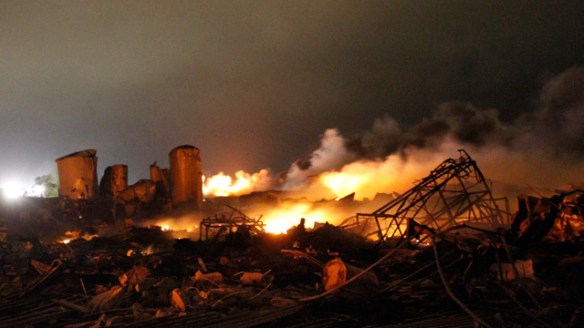
Long Buried Texas Fertilizer Plant Explosion Conspiracy Re-Emerges From Shadows Of Boston Bombing

The remains of a fertilizer plant after explosion in West, Texas

By Bernie Suarez

Source: Truth and Art TV

Sometimes conspiracies are truly forgotten when there are so many other state crimes and conspiracies to choose from. Such is the case with the Waco Texas fertilizer plant “explosion” of April 17, 2013. I’m talking about the Texas fertilizer plant explosion which was conveniently buried in the immediate aftermath of the April 15, 2013 Boston bombing. I’m sure many have forgotten about this event in the same way they don’t remember or have completely forgotten that two days earlier, on the very same day of the Boston bombing “event” a wave of bombings and shootings took place in Iraq just before their elections leaving at least 75 people dead and hundreds injured. The mainstream media conveniently gave little to no attention to this story as the Boston bombing event was selected as the featured story we were supposed to be thinking about at the time.

Meanwhile in Waco Texas 2 days later, on the evening of April 17th a fertilizer plant caught fire and was being consumed in flames when some 22 minutes later a mighty suspicious massive explosion took place; an explosion captured nicely on camera by nearby residents that was so loud and so bright that many have suspected it was some sort of missile strike. Sounds crazy? You decide:

Now let’s listen in to what Nevada Governor candidate at the time David Lory VanDerBeek had to say about this. The Governor candidate breaks down some of the features of this evidence very nicely showing you the trajectory of the energy being provided by the missile. After seeing this video no one should wonder why he had no chance at winning the governor race.

The plant was owned by Adair Grain Inc a family owned food plant which also goes by or is closely associated with “Texas Grain Inc” a competitor of Monsanto who had filed a lawsuit against Monsanto accusing Monsanto of artificially inflating the price of their Roundup herbicide. This additional explosion to this day is highly suspicious and now that the mainstream media is briefly covering this story it’s a good time to examine this event a bit more closely.

According to mainstream media sources the federal government “investigators” claim the factory was an explosion waiting to happen:

The source of the explosion was ammonium nitrate stored in a wooden container at the plant, investigators have said.

The ammonium nitrate detonated with the force of approximately 15,000 pounds to 20,000 pounds (6,800 kg to 9,100 kg) of TNT, according to federal officials.

But if we examine the explosion claim we must take into consideration that the Adair Grain fertilizer plant reported to the EPA a very different picture:

The fertilizer plant that exploded Wednesday night in West, Texas, reported to the Environmental Protection Agency and local public safety officials that it presented no risk of fire or explosion, documents show.

West Fertilizer Co. reported having as much as 54,000 pounds of anhydrous ammonia on hand in an emergency planning report required of facilities that use toxic or hazardous chemicals.

But the report, reviewed Wednesday night by The Dallas Morning News, stated “no” under fire or explosive risks. The worst possible scenario, the report said, would be a 10-minute release of ammonia gas that would kill or injure no one.

The second worst possibility projected was a leak from a broken hose used to transfer the product, again causing no injuries.

The plan says the facility did not have any other dangerous chemicals on hand. It says that the plan was on file with the local fire department and that the company had implemented proper safety rules.

ATF Chief investigator Rob Elder recently announced:

“the fire has been ruled as an incendiary. This means this fire was a criminal act”.

Elder then says that numerous evidences were taken into account including, witnesses, images and video footage. But was the video evidence really taken into account? Even more intriguing, Mr Elder has announced a $50,000 award for information leading to the capture of the arsonist so if anyone wants to take him on please do. I can’t help but to be reminded of the 1933 Reichstag fire false flag in Germany and how a patsy of choice was afterward chosen and executed in the period that followed.

Let’s consider some additional ironies and peculiar accounts surrounding this explosion. According to the reported investigation conclusions:

The explosion damaged an area measuring roughly the size of 37 city blocks, Elder said, and left a crater 93 feet (28 metres) wide by 12 feet (3.7 metres) deep.

The ammonium nitrate detonated with the force of approximately 15,000 pounds to 20,000 pounds (6,800 kg to 9,100 kg) of TNT, according to federal officials.

This conjures up memories of the government claims that on 9/11 WTC 7 was packed with “diesel fuel tanks” which they would then use in an attempt to sell the theory that office fires alone could destroy the building in the controlled demolition manner in which it was destroyed.

The problem with looking at the entire story, looking at all the evidence and then listening to the government “investigation” statements (or lack thereof) is that the whole story doesn’t fit like it should, and that alone should lead us to wonder, was the fertilizer plant purposely struck with a sophisticated military missile to send Texas Grain Inc a message? Can Ammonium Nitrate alone cause such a wide and deep crater in the damaged area? And is the quality, direction and trajectory of the explosion consistent with an explosion originating from the plant as the government would have you believe?

Suspicions run high that this was not only a classic military style (think 9/11 Pentagon style) attack on the plant but specifically this may have involved a new “Advanced Hypersonic Weapon” (AHW) developed by the Army in 2011 seen here. The video below explains this possibility more in-depth. Again, you decide.

When analyzing this let’s keep in mind that conspiracies are now the norm and today it is well within reason for any critical thinker to suspect government conspiracy as a reasonable possible explanation. It is also incumbent upon us to consider all evidence including the irony of this story being buried in the height of the Boston bombing event. That they are just now briefly talking about this explosion after 3 years of hiding the story is suspicious in itself. The multiple video analysis above demonstrating reasonable probability of a sophisticated military style missile strike should matter to everyone. If true, this constitutes another blatant murderous act of violence of our government against its own people potentially on behalf of its global organized crime cartel partner Monsanto who is known to work with Blackwater/XE.

Now that investigators are officially ruling this event as a “criminal act” it will be very interesting to see if they produce a patsy of their choice in the future (Reichstag fire style) to throw off anyone suspicious of government activity in this crime.

It sure does seem like a criminal act to my eyes, and as usual no one in the mainstream media or the usual pre-selected government “investigative” body is looking for or even suspecting that the plant was ultimately pulverized by a missile strike. We all know that government investigative bodies never even look for possibilities that imply that the State is involved in the crime. So this phony search including their phony $50,000 reward will never lead to any real justice.

Don’t think for a moment the ruling class wouldn’t commit a crime like this to protect their interest and send a message. These are ultimately the same people who funded the attacks in Iraq on April 15, 2013 and organized the Boston bombing “event” on the same day. In order for truth seekers to remain vigilant and to stay on top of government crimes and conspiracies they need to take events like this serious and do their own research. It’s not about being paranoid it’s about believing your own eyes and ears, looking for patterns, exercising critical thinking, and maintaining a clear overall awareness of the big picture.


I think therefore I am capital

ea35012b67112d2997cf0b42c21e2b928e14e6e4

By Jamie Goldrick

Source: Adbusters

In the worldview of the Cree, life is lived along a trail of experiences. Sharing experience with others is a result of the crossing of two life trails. Life is experienced as a tangled pattern of all beings. In this way, beings do not occupy one world, as in the Western sense: they inhabit their own relational field.

To the Cree, even the wind is alive. It interacts and has agency, and it has the capacity to come into contact with other beings and be affective. In this respect the wind too has the capacity to be alive as it can give shape to the world. For the Yukaghir in Siberia, Elk have the capacity to enter into personhood depending upon which relational field they enter.

In animist cosmology, objects can be ascribed personhood simply by the fact that they have potential to enter into relations with the environment and other living beings. According to Anthropologist Tim Ingold, “different creatures have different points of view of the world, because of different capabilities and perception they attend to the world in different ways”. Thus to the animist, life is lived through the relational field that objects enter into with each other. Regarding all beings and objects, we exist, therefore we are.

Edward Tylor coined the term animism in 1871. He used it to describe the idea that inanimate beings and objects were attributed with spirits. To Tylor, an evolutionist, this was just an aberration on the part of the animists, a “magical philosophy grounded in error” and nothing more than the simple mistake of a basic society on the path to modernity.

Steeped in the western philosophical tradition, Tylor naturally found focus in rational inquiry and scientific progress. He is a product of the Enlightenment, espousing such values as the natural rights of humans to life, liberty and property. Roy Porter, describing Immanuel Kant, observes:

For Kant enlightenment was man’s final coming of age, the emancipation of human consciousness from an immature state of ignorance and error. He believed that this process of mental liberation was actively at work in his own lifetime. The advancement of knowledge – understanding of nature, but human self-knowledge no less -would propel this giant leap forward.

Yet even to this day Enlightenment values have yet to break free from the shackles of Christianity, perhaps even the Classical Period that came before it as well. There are blind spots and limitations to rational inquiry and scientific progress. Our thinking is infected by it.

One such blind spot presumes a nature-culture divide, the notion that we are different than other sentient beings. In this worldview, animals exist as mere automata. They are machines without consciousness, all body and no mind, or to use Descartes’ famous cogito ergo sum, the definitive difference between us and all other beings on this planet is consciousness: I think, therefore I am.

Thus the environment, the humans who had yet to achieve enlightenment and the animals alike who inhabited it were objects to be manipulated and used by us, the subjects. This is the ontological basis that the West is built upon. It is the foundation that provides the philosophical conditions for capitalism to flourish. The gulf between what is theorized in the minds of men and what is a lived environmental reality was alluded to by one of the foundational thinkers of the Enlightenment, Adam Smith in The Wealth of Nations:

The same division that caused the social organism to grow also causes the individual worker to become impoverished …the man whose life is spent in performing a few simple operations generally becomes as stupid and ignorant as it is possible for a human creature to become.

The Wealth of Nations relied upon the bodily suffering of the disempowered to function at the expense of an abstract social body and to those in possession of the means of production. Written in 1776, things have somewhat changed in the past 240 years.

Briefly, it has been a long, arduous, and somewhat brutal journey for capital to the present day. Capital, in its search for surplus value, has penetrated through domestic markets, foreign markets, future markets, even now to our very sociality via the technological advances that have allowed for online social networking to occur. The collapse of the Bretton Woods agreement, which eliminated the gold standard, allowed the dollar to become symbolic and abstract, facilitating a new definition of economic worth, as evinced by the liberalization of capital markets, the emergence of futures markets, and the notorious derivatives. Economic value has become anthropocentric, a closed human based value system, abstracted from the material environment.

Take for example Google’s $66 billion turnover in 2014, Facebook’s 1.3 billion users, or Twitter’s initial stock market flotation of 23 billion. This value is located in the climate cooled data centers of financial institutions, abstracted from reality. This descent into the digital ether compounds as these abstract value systems begin to play a greater and more influential role in our lives. At a time when our relationship to nature urgently needs to be re-­examined, the gulf between nature and culture grows exponentially. Nature – earth’s ‘free gifts’ – becomes further objectified, commodified and excluded from our sense of being-in-the-world.

Maurizio Lazzarato notes that Neoliberalism relies on the individuality of its users, which has a profound effect upon our understanding of the new digital labor. To Lazzarato, digital labor functions by uniting and bringing together extreme individualization and dividuation (the collection of individuals’ idiosyncrasies into data banks) of individuals. The appendages of digital labor feed off our subjectivity and thus enslave us. As Marx argued, machinery enslaves and is manifested as a form of fixed capital. Today these machinic processes have invaded the daily. Lazzarato observes that we are currently enslaved by the mega-machine. Once our individual identity is stripped, a process called machinic enslavement, the individual is rendered as “a gear, a cog, a component part of business and financial assemblages”.

Today the circulation of capital is now the principal means of generating profit. Capital is reliant on human activity to function and flow. Immaterial capital flows are reliant on dividuals to •connect the circuits• between entities. This modern machinic enslavement does not subscribe to traditional categories of subject/object or human/machine binaries. The dividual does not stand by an external machine, for as Lazzarato notes “together they constitute a human machine apparatus in which humans are but recurrent and interchangeable parts of production and consumption. The individual is part of the machine: part-mineral, part-mind and integral to the functioning of modern day capitalism. By habitually updating a status, Googling a mundane thought, or checking into any given establishment, the bodily language of non-engagement now screams: I think, therefore I am capital.

Technology, paced by notions of progress and modernity, has always had an ambivalent place in Western discourse. The obsession with progress obfuscates the objective effects of technology. Technology once demarcated the distinction between work time and leisure time. According to E.P. Thompson: “Before the industrial revolution, time was task based, with the introduction of the machine to the factory floor, this brought the time-keeper, the informer and the fines.” Capital intensive machines had to be attended to round the clock to function. With the advent of the steam engine, the shift from organic to carbon power, a new proletariat was born. Today technology is once again blurring the boundaries by creating a social factory from out of our leisure and private time. History repeats itself, first as tragedy, second as farce. Innovation within the dominant paradigm of capitalism serves to innovate existing forms of domination. In this case, those who control the visions of the future control the present.

The predominant discourse of think therefore I am, and our obsession with progress blinds us to the realities of the day. We are within its apparatus when we work, or when we play, when reaching out to others, or solitarily in our own homes. What if we could see the true effects of this mega-machine? Strip away Cartesian subjectivity and take on the oft forgotten worldview of the animist. Proclaim “what manner are these things, part mineral, part mind that serve the few and enslave the many, while fouling the land, the water and the air! “We can no longer see objects as they truly exist in the world. To use Descartes’ term, now we are the automata, cogs and gears, the circuitry of the mega­ machine, assembled on the false logic of a nature/culture divide.

Set to the backdrop of species collapse, the disappearance of the rainforests, the acidification of the oceans, the mega-machine operates faster than ever before. The creatures outside look in, from person to machine, and then from human to person, and from person to machine again; but already it is impossible to say which is which….


-Jamie Goldrick is a filmmaker and contributing editor to Rabble magazine in Ireland.

Something Is Happening

collapse-era

By William Hawes

Source: Gods & Radicals

SOMETHING IS HAPPENING HERE, but you don’t know what it is: Do you? No one knows, really, as this something is still evolving. As we look back to 2016, though, it is abundantly clear that history has awoken from its slumber. We’ve had a couple events in the West last year: Brexit and Trump.

Politically-charged, dynamic events (as Alain Badiou might define them) have been rare in the West since the fall of the Berlin Wall and the disintegration of the USSR. Capitalism made it seem as if neoliberalism was winning in the 1990s, even as the US wantonly murdered in Iraq and took perverse pleasure in helping to dismember Yugoslavia, among other things.

In fact, one could argue there have only been four notable Western political events in the post-Cold War era: the 9/11 attacks, the 2003 protests against the Iraq War, the 2008 banking crisis and following protest movements of 2011 (Occupy and 15-M Movement), and the populist, anger-driven aforementioned events of 2016.

You see, authentic, spontaneous political events (in the form of uprisings or popular revolts against the elite) are a no-no in the West. History is supposed to have ended, remember? Max Weber called this the Iron Cage, and for good reason.

Now, though, the meaninglessness and rootlessness of our lives trapped inside the cage have become too obvious to ignore, for most of us. As each day passes, our political discourse glosses over how lazy, ignorant, mean-spirited, and numb our society has become. We import luxuries from all over the globe, but can’t be bothered to cook or grow our own food, assemble our own electronics, expand renewable energy projects, provide clean water to inner cities, organize high-speed transport, or educate our youth without drowning them in debt, etc.

So, many have lashed out against the system, and our more vulnerable members of society, in anger, defiance, out of sheer ignorance. Could it be because, deep down, we know how helpless, sheltered, and out-of-touch our society is, compared to the rest of the world? What are the root causes of this disintegration of public discourse?

One cause is our utter dependency on the capitalist system to clothe, feed, and shelter us. What we used to inherit from our mothers and fathers, important agricultural knowledge, artisanal and cultural wisdom, a sense of place and belonging, have all been traded in for money, the privilege to be exploited by capitalism, toiling in jobs that alienate us from ourselves, families, the Earth. Paper bills and electronic bank accounts are a pitiful substitute for self-reliance. This loss, this grief, isn’t allowed to be expressed in public. Logical positivism tells us that progress will prevail, the future will be better than the past, and anyone who thinks otherwise must be some sort of Luddite.

Since real income has fallen and social services have been slashed in the last 40-plus years, many have seen their loved ones’ lives cut short (lack of access to health care and quality food and produce, air and water pollution), their dreams defiled (steady jobs gone, factories shuttered), their entertainment homogenized and dangerous (sports mania has become normalized, “Go Team!”, alcohol, painkiller, and opiate addiction is rampant), their hopes for the future shattered (community and public space swallowed by corporations).

There are those, as well, still too plugged into the system (both Trump and Clinton voters), too attached to their gadgets, to the hum of their slave-labor appliances, to the glow emanating from their screens. They will cry incessantly about the turning away of Muslims from flights, but there is only silence for the millions killed abroad by the US war machine. Mainstream liberals are just as likely as the meanest, most selfish conservatives to fall prey to emotional pleas, demagoguery, and pathetic attempts to see themselves as victims in this Age of Anger.

The urge to resort to the myth of a righteous, homogenous, “pure” social group, to denigrate the other, is strong in such dire, despondent situations. In America, though, material poverty cannot be said to be the only, or even the main causal factor, behind this return of nativism and tribalism. Rather, it is undoubtedly a spiritual malaise that has swept over the West. Ever since the rise of the Industrial Revolution, it has been technology which has provided the underlying weltanschauung for our culture. Sprouting from this, an inhuman and Earth-destroying morality has formed. Jacques Ellul explains:

“A principal characteristic of technique … is its refusal to tolerate moral judgments. It is absolutely independent of them and eliminates them from its domain. Technique never observes the distinction between moral and immoral use. It tends on the contrary, to create a completely independent technical morality.” (1)

Thus, Western society, through the use of mass-produced electronics and disseminated in what some call our “Information Age”, has now seemingly accelerated the pace of change and ecological destruction beyond the scope of any group or nation which could possibly control it. We are then confronted with the thought that only an economic collapse or series of natural disasters could possibly provide the impetus for revolutionary change to occur. This only leaves us feeling helpless, depressed, and passive in the face of government oppression and capitalist exploitation.

Not only that, but capitalism has quite literally dulled our senses and disconnected us from our source of being, planet Earth. Don’t believe me? Read this amazing paper on how Polynesian wayfinders discovered islands thousands of miles apart without any modern technology. This is part of what Morris Berman means by Coming to our Senses. To re-establish our unity with nature, the Western notion of an ego-driven, domineering and reductionist search for truth, meaning, and creativity must be thrown out. Here, Berman invokes Simone Weil:

“‘decreate’ yourself in order to create the work, as God (Weil says) diminished Himself in order to create the world. It would be more accurate to say that you don’t create the work, but rather you step out of the way and let it happen.” (2)

This isn’t really discussed among wide swaths of leftists, the social-justice crowd, or with mainstream liberals. It’s anathema to a materialistic, dead world where freedom has been traded for comforting lies, money has been substituted for the ability to provide for ourselves and our communities, and the abundance and resiliency (truly a miracle!) of the Earth is taken for granted as we chase our next fix for consumer goods, our next chance for drugs or gadgets to dim our perception.

What you’re not supposed to say in public, of course, is that our world is falling apart, and we are doing nothing to stop it. The reactions are too raw, the reality too grim, even as we know, for example, that 10% or more of the total species on Earth will be gone by 2050.

Yet we can do something: there is an opening now in political discourse which has been previously denied to us. The Republican and Democratic parties have thoroughly delegitimized themselves by offering up Trump and Clinton as their figureheads: these were widely considered the most widely disliked candidates in recent memory, if not the history of our republic. There is room for Libertarians, Greens, and Socialists to gain power: yet only if they avoid their own regrettable sectarianism, organize, and promote an inclusive, broad-based platform.

To do so, citizens will have to gain some perspective on their lives. A slow pace of life needs to be seen as a virtue, not a sin: many on the right and left are quick to denounce the hedonism of the jet-setting, parasitic globalists, the Davos men; yet refuse to see their own lifestyles and actions as smaller examples of such outlandish consumption.

If we are open to life and our environment as part of a greater whole, an unfathomable mystery, we can refuse our culture’s siren songs of death, misery, and destruction. While modern technology can be useful if reined in by an Earth-conscious, responsible morality, some things are better left unknown, undiscovered, if it risks destroying the Earth in order to find the answer. Rather than running a cost/benefit analysis to determine the land’s worth, some aspects of the planet and the universe are better Left Sacred.

Also, acknowledging our mortality, and accepting the basic fact that death could come for you at any moment, can liberate our souls and propel them to unimaginable heights. Joe Crookston explains this quite well:

“And then when I turn dry and brown
I’ll lay me down to rest
I’ll turn myself around again
As part of an eagle’s nest
And when that eagle learns to fly
I’ll flutter from that tree
I’ll turn myself around again
As part of the mystery”


Notes:
1.) Ellul, Jacques. The Technological Society. Vintage Books, 1964. p. 97.
2.) Berman, Morris. Coming to Our Senses: Body and Spirit in the Hidden History of the West. Simon & Schuster, 1989. p. 337


William Hawes is a writer specializing in politics and environmental issues. His articles have appeared online at Global Research, Countercurrents, Dissident Voice, The World Financial Review, Gods & Radicals, and Counterpunch. He is author of the ebook Planetary Vision: Essays on Freedom and Empire. You can reach him at wilhawes@gmail.com