America Escalates its “Democratic” Oil War in the Near East

By Michael Hudson

Source: CounterPunch

The mainstream media are carefully sidestepping the method behind America’s seeming madness in assassinating Islamic Revolutionary Guard general Qassim Suleimani to start the New Year. The logic behind the assassination was a long-standing application of U.S. global policy, not just a personality quirk of Donald Trump’s impulsive action. His assassination of Iranian military leader Suleimani was indeed a unilateral act of war in violation of international law, but it was a logical step in a long-standing U.S. strategy. It was explicitly authorized by the Senate in the funding bill for the Pentagon that it passed last year.

The assassination was intended to escalate America’s presence in Iraq to keep control of the region’s oil reserves, and to back Saudi Arabia’s Wahabi troops (Isis, Al Quaeda in Iraq, Al Nusra and other divisions of what are actually America’s foreign legion), to support U.S. control of Near Eastern oil as a buttress of the U.S. dollar. That remains the key to understanding this policy, and why it is in the process of escalating, not dying down.

I sat in on discussions of this policy as it was formulated nearly fifty years ago when I worked at the Hudson Institute and attended meetings at the White House, met with generals at various armed forces think tanks and with diplomats at the United Nations. My role was as a balance-of-payments economist, having specialized for a decade at Chase Manhattan, Arthur Andersen and oil companies in the oil industry and military spending. These were two of the three main dynamics of American foreign policy and diplomacy. (The third concern was how to wage war in a democracy where voters rejected the draft in the wake of the Vietnam War.)

The media and public discussion have diverted attention from this strategy by floundering speculation that President Trump did it, except to counter the (non-)threat of impeachment with a wag-the-dog attack, or to back Israeli lebensraum drives, or simply to surrender the White House to the neocon hate-Iran syndrome. The actual context for the neocon’s action was the balance of payments, and the role of oil and energy as a long-term lever of American diplomacy.

The balance of payments dimension

The major deficit in the U.S. balance of payments has long been military spending abroad. The entire payments deficit, beginning with the Korean War in 1950-51 and extending through the Vietnam War of the 1960s, was responsible for forcing the dollar off gold in 1971. The problem facing America’s military strategists was how to continue supporting the 800 U.S. military bases around the world and allied troop support without losing America’s financial leverage.

The solution turned out to be to replace gold with U.S. Treasury securities (IOUs) as the basis of foreign central bank reserves. After 1971, foreign central banks had little option for what to do with their continuing dollar inflows except to recycle them to the U.S. economy by buying U.S. Treasury securities. The effect of U.S. foreign military spending thus did not undercut the dollar’s exchange rate, and did not even force the Treasury and Federal Reserve to raise interest rates to attract foreign exchange to offset the dollar outflows on military accounts. In fact, U.S. foreign military spending helped finance the domestic U.S. federal budget deficit.

Saudi Arabia and other Near Eastern OPEC countries quickly became a buttress of the dollar. After these countries quadrupled the price of oil (in retaliation for the United States quadrupling the price of its grain exports, a mainstay of the U.S. trade balance), U.S. banks were swamped with an inflow of  foreign deposits – which were lent out to Third World countries in an explosion of bad loans that blew up in 1972 with Mexico’s insolvency. This destroyed Third World government credit for a decade, forcing it into dependence on the United States via the IMF and World Bank.

To top matters, of course, what Saudi Arabia does not save in dollarized assets with its oil-export earnings is spent on buying hundreds of billion of dollars of U.S. arms exports. This locks them into dependence on U.S. supply of replacement parts and repairs, and enables the United States to turn off Saudi military hardware at any point of time, in the event that the Saudis may try to act independently of U.S. foreign policy.

So maintaining the dollar as the world’s reserve currency became a mainstay of U.S. military spending. Foreign countries would not have to pay the Pentagon directly for this spending. They simply finance the U.S. Treasury and U.S. banking system.

Fear of this development was a major reason why the United States moved against Libya, whose foreign reserves were held in gold, not dollars, and which was urging other African countries to follow suit in order to free themselves from “Dollar Diplomacy.” Hillary and Obama invaded, grabbed their gold supplies (we still have no idea who ended up with these billions of dollars worth of gold) and destroyed Libya’s government, its public education system, its public infrastructure and other non-neoliberal policies.

The great threat to this is dedollarization as China, Russia and other countries seek to avoid recycling dollars. Without the dollar’s function as the vehicle for world saving – in effect, without the Pentagon’s role in creating the Treasury debt that is the vehicle for world central bank reserves – the U.S. would find itself constrained militarily and hence diplomatically constrained, as it was under the gold exchange standard.

That is the same strategy that the U.S. has followed in Syria and Iraq. Iran was threatening this dollarization strategy and its buttress in U.S. oil diplomacy.

The oil industry as buttress of the U.S. balance of payments and foreign diplomacy

The trade balance is buttressed by oil and farm surpluses. Oil is the key, because it is imported by U.S. companies at almost no balance-of-payments cost (the payments end up in the oil industry’s head offices here as profits and payments to management), while profits on U.S. oil company sales to other countries are remitted to the United States (via offshore tax-avoidance centers, mainly Liberia and Panama for many years). And as noted above, OPEC countries have been told to keep their official reserves in the form of U.S. securities (stocks and bonds as well as Treasury IOUs, but not direct purchase of U.S. companies being deemed economically important). Financially, OPEC countries are client slates of the Dollar Area.

America’s attempt to maintain this buttress explains U.S. opposition to any foreign government steps to reverse global warming and the extreme weather caused by the world’s U.S.-sponsored dependence on oil. Any such moves by Europe and other countries would reduce dependence on U.S. oil sales, and hence on the U.S’s ability to control the global oil spigot as a means of control and coercion. These are viewed as hostile acts.

Oil also explains U.S. opposition to Russian oil exports via Nordstream. U.S. strategists want to treat energy as a U.S. national monopoly. Other countries can benefit in the way that Saudi Arabia has done – by sending their surpluses to the U.S. economy – but not to support their own economic growth and diplomacy. Control of oil thus implies support for continued global warming as an inherent part of U.S. strategy.

How a “democratic” nation can wage international war and terrorism

The Vietnam War showed that modern democracies cannot field armies for any major military conflict, because this would require a draft of its citizens. That would lead any government attempting such a draft to be voted out of power. And without troops, it is not possible to invade a country to take it over.

The corollary of this perception is that democracies have only two choices when it comes to military strategy: They can only wage airpower, bombing opponents; or they can create a foreign legion, that is, hire mercenaries or back foreign governments that provide this military service.

Here once again Saudi Arabia plays a critical role, through its control of Wahabi Sunnis which motivates terrorist jihadis willing to sabotage, bomb, assassinate, blow up and otherwise fight any target designated as an enemy of “Islam,” the euphemism for Saudi Arabia acting as a U.S. client state. (Religion really is not the key; I know of no ISIS or similar Wahabi attack on Israeli targets.) The United States needs the Saudis to supply or finance Wahabi crazies. So in addition to playing a key role in the U.S. balance of payments by recycling its oil-export earnings into U.S. stocks, bonds and other investments, Saudi Arabia provides manpower by supporting the Wahabi members of America’s foreign legion, ISIS and Al-Nusra/Al-Qaeda. Terrorism has become the “democratic” mode of today U.S. military policy.

What makes America’s oil war in the Near East “democratic” is that this is the only kind of war a democracy can fight – an air war, followed by a vicious terrorist army that makes up for the fact that no democracy can field its own army in today’s world. The corollary is that, terrorism has become the “democratic” mode of warfare.

From the U.S. vantage point, what is a “democracy”? In today’s Orwellian vocabulary, it means any country supporting U.S. foreign policy. Bolivia and Honduras have become “democracies” since their coups, along with Brazil. Chile under Pinochet was a Chicago-style free market democracy. So was Iran under the Shah, and Russia under Yeltsin – but not since it elected Vladimir Putin president, any more than is China under President Xi.

The antonym to “democracy” is “terrorist.” That simply means a nation willing to fight to become independent from U.S. neoliberal democracy. It does not include America’s proxy armies.

Iran’s role as U.S. nemesis

What stands in the way of U.S. dollarization, oil and military strategy? Obviously, Russia and China have been targeted as long-term strategic enemies for seeking their own independent economic policies and diplomacy. But next to them, Iran has been in America’s gun sights for nearly seventy years.

America’s hatred of Iran is starts with its attempt to control its own oil production, exports and earnings. It goes back to 1953, when Mossadegh was overthrown because he wanted domestic sovereignty over Anglo-Persian oil. The CIA-MI6 coup replaced him with the pliant Shah, who imposed a police state to prevent Iranian independence from U.S. policy. The only physical places free from the police were the mosques. That made the Islamic Republic the path of least resistance to overthrowing the Shah and re-asserting Iranian sovereignty.

The United States came to terms with OPEC oil independence by 1974, but the antagonism toward Iran extends to demographic and religious considerations. Iranian support of its Shi’ite population and those of Iraq and other countries – emphasizing support for the poor and for quasi-socialist policies instead of neoliberalism – has made it the main religious rival to Saudi Arabia’s Sunni sectarianism and its role as America’s Wahabi foreign legion.

America opposed General Suleimani above all because he was fighting against ISIS and other U.S.-backed terrorists in their attempt to break up Syria and replace Assad’s regime with a set of U.S.-compliant local leaders – the old British “divide and conquer” ploy. On occasion, Suleimani had cooperated with U.S. troops in fighting ISIS groups that got “out of line” – meaning the U.S. party line. But every indication is that he was in Iraq to work with that government seeking to regain control of the oil fields that President Trump has bragged so loudly about grabbing.

Already in early 2018, President Trump asked Iraq to reimburse America for the cost of “saving its democracy” by bombing the remainder of Saddam’s economy. The reimbursement was to take the form of Iraqi Oil. More recently, in 2019, President Trump asked, why not simply grab Iraqi oil. The giant oil field has become the prize of the Bush-Cheney post 9-11 Oil War. “‘It was a very run-of-the-mill, low-key, meeting in general,” a source who was in the room told Axios.’ And then right at the end, Trump says something to the effect of, he gets a little smirk on his face and he says, ‘So what are we going to do about the oil?’”

Trump’s idea that America should “get something” out of its military expenditure in destroying the Iraqi and Syrian economies simply reflects U.S. policy.

In late October, 2019, The New York Times reported that: “In recent days, Mr. Trump has settled on Syria’s oil reserves as a new rationale for appearing to reverse course and deploy hundreds of additional troops to the war-ravaged country. He has declared that the United States has “secured” oil fields in the country’s chaotic northeast and suggested that the seizure of the country’s main natural resource justifies America further extending its military presence there. ‘We have taken it and secured it,’ Mr. Trump said of Syria’s oil during remarks at the White House on Sunday, after announcing the killing of the Islamic State leader, Abu Bakr al-Baghdadi.” A CIA official reminded the journalist that taking Iraq’s oil was a Trump campaign pledge.

That explains the invasion of Iraq for oil in 2003, and again this year, as President Trump has said: “Why don’t we simply take their oil?” It also explains the Obama-Hillary attack on Libya – not only for its oil, but for investing its foreign reserves in gold instead of recycling its oil surplus revenue to the U.S. Treasury – and of course, for promoting a secular socialist state.

It explains why U.S. neocons feared Suleimani’s plan to help Iraq assert control of its oil and withstand the terrorist attacks supported by U.S. and Saudi Arabia. That is what made his assassination an immediate drive.

American politicians have discredited themselves by starting off their condemnation of Trump by saying, as Elizabeth Warren did, how “bad” a person Suleimani was, how he had killed U.S. troops by masterminding the Iraqi defense of roadside bombing and other policies trying to repel the U.S. invasion to grab its oil. She was simply parroting the U.S. media’s depiction of Suleimani as a monster, diverting attention from the policy issue that explains why he was assassinated now.

The counter-strategy to U.S. oil, dollar and global-warming diplomacy

This strategy will continue, until foreign countries reject it. If Europe and other regions fail to do so, they will suffer the consequences of this U.S. strategy in the form of a rising U.S.-sponsored war via terrorism, the flow of refugees, and accelerated global warming (and extreme weather).

Russia, China and its allies already have been leading the way to dedollarization as a means to contain the balance-of-payments buttress of U.S. global military policy. But everyone now is speculating over what Iran’s response should be.

The pretense – or more accurately, the diversion – by the U.S. news media over the weekend has been to depict the United States as being under imminent attack. Mayor de Blasio has positioned policemen at conspicuous key intersections to let us know how imminent Iranian terrorism is – as if it were Iran, not Saudi Arabia that mounted 9/11, and as if Iran in fact has taken any forceful action against the United States. The media and talking heads on television have saturated the air waves with warnings of Islamic terrorism. Television anchors are suggesting just where the attacks are most likely to occur.

The message is that the assassination of General Soleimani was to protect us. As Donald Trump and various military spokesmen have said, he had killed Americans – and now they must be planning an enormous attack that will injure and kill many more innocent Americans. That stance has become America’s posture in the world: weak and threatened, requiring a strong defense – in the form of a strong offense.

But what is Iran’s actual interest? If it is indeed to undercut U.S. dollar and oil strategy, the first policy must be to get U.S. military forces out of the Near East, including U.S. occupation of its oil fields. It turns out that President Trump’s rash act has acted as a catalyst, bringing about just the opposite of what he wanted. On January 5 the Iraqi parliament met to insist that the United States leave. General Suleimani was an invited guest, not an Iranian invader. It is U.S. troops that are in Iraq in violation of international law. If they leave, Trump and the neocons lose control of oil – and also of their ability to interfere with Iranian-Iraqi-Syrian-Lebanese mutual defense.

Beyond Iraq looms Saudi Arabia. It has become the Great Satan, the supporter of Wahabi extremism, the terrorist legion of U.S. mercenary armies fighting to maintain control of Near Eastern oil and foreign exchange reserves, the cause of the great exodus of refugees to Turkey, Europe and wherever else it can flee from the arms and money provided by the U.S. backers of Isis, Al Qaeda in Iraq and their allied Saudi Wahabi legions.

The logical ideal, in principle, would be to destroy Saudi power. That power lies in its oil fields. They already have fallen under attack by modest Yemeni bombs. If U.S. neocons seriously threaten Iran, its response would be the wholesale bombing and destruction of Saudi oil fields, along with those of Kuwait and allied Near Eastern oil sheikhdoms. It would end the Saudi support for Wahabi terrorists, as well as for the U.S. dollar.

Such an act no doubt would be coordinated with a call for the Palestinian and other foreign workers in Saudi Arabia to rise up and drive out the monarchy and its thousands of family retainers.

Beyond Saudi Arabia, Iran and other advocates of a multilateral diplomatic break with U.S. neoliberal and neocon unilateralism should bring pressure on Europe to withdraw from NATO, inasmuch as that organization functions mainly as a U.S.-centric military tool of American dollar and oil diplomacy and hence opposing the climate change and military confrontation policies that threaten to make Europe part of the U.S. maelstrom.

Finally, what can U.S. anti-war opponents do to resist the neocon attempt to destroy any part of the world that resists U.S. neoliberal autocracy? This has been the most disappointing response over the weekend. They are flailing. It has not been helpful for Warren, Buttigieg and others to accuse Trump of acting rashly without thinking through the consequences of his actions. That approach shies away from recognizing that his action did indeed have a rationale—to draw a line in the sand, to say that yes, America WILL go to war, will fight Iran, will do anything at all to defend its control of Near Eastern oil and to dictate OPEC central bank policy, to defend its ISIS legions as if any opposition to this policy is an attack on the United States itself.

I can understand the emotional response of yet new calls for impeachment of Donald Trump. But that is an obvious non-starter, partly because it has been so obviously a partisan move by the Democratic Party. More important is the false and self-serving accusation that President Trump has overstepped his constitutional limit by committing an act of war against Iran by assassinating Soleimani.

Congress endorsed the assassination of Soleimani as ordered by Trump (and his neocon advisor, Secretary of State Pompeo) and is fully as guilty as he is for having approved the Pentagon’s budget. This is due to the Senate’s removal of the amendment to the 2019 National Defense Authorization Act where Bernie Sanders, Tom Udall and Ro Khanna inserted an amendment in the House of Representatives version, explicitly not authorizing the Pentagon to wage war against Iran or assassinate its officials. When this budget was sent to the Senate, the White House and Pentagon (a.k.a. the military-industrial complex and neoconservatives) removed that constraint. That was a red flag announcing that the Pentagon and White House did indeed intend to wage war against Iran and/or assassinate its officials. Congress lacked the courage to argue this point at the forefront of public discussion.

Conclusion

First came the 9/11 attack (Sept 2001).

In the wake of this, Congress passed the 2002 Authorization Act. This authorized the President to move against Al Qaeda.

Fast forward to today: Suleimani and Iran were fighting AGANST Al Qaeda and its offshoot, ISIS/Daesh. Saudi Arabia had asked Suleimani (with U.S. approval) to help negotiate a peace, whereby the Saudi’s would stop backing ISIS. It was an official mission invited by Iraq to negotiate peace between Saudi Arabia, Iran and Iraq.

This infuriated the United States, which wanted a permanent warfare there as an excuse to occupy Iraq and prevent a Shi’ite Crescent linking Iran, Iraq, Syria and Lebanon, which incidentally would serve as part of China’s Belt and Road initiative. So it killed Suleimani to prevent the peace negotiation.

The implication is that the US wants a PERMANENT occupation of Iraq, which is needed to secure the US grab of Iraq’s oil and Syria’s oil, as well as to prevent any non-U.S. oil transit.

The question is, how to get the world’s politicians – U.S., European and Asians – to see how America’s all-or-nothing policy is threatening new waves of war, refugees, extreme weather and the disruption of the oil trade in the Strait of Hormuz. Ultimately, the aim is to ensure neoliberal dollarization is imposed on all countries to subsidize US imperial hegemony.

It is a sign of how little power exists in the United Nations that no countries are calling for a new Nurenberg-style war crimes trial following the assassination, no threat to withdraw from NATO or even to avoid holding reserves in the form of money lent to the U.S. Treasury to fund America’s military budget.


Notes.

[1] https://www.axios.com/trump-to-iraqi-pm-how-about-that-oil-1a31cbfa-f20c-4767-8d18-d518ed9a6543.html. The article adds: “In the March meeting, the Iraqi prime minister replied, ‘What do you mean?’ according to the source in the room. And Trump’s like, ‘Well, we did a lot, we did a lot over there, we spent trillions over there, and a lot of people have been talking about the oil.’”

[2] Michael Crowly, “‘Keep the Oil’: Trump Revives Charged Slogan for new Syria Troop Mission,” The New York Times, October 26, 2019. . The article adds: “‘I said keep the oil,’ Mr. Trump recounted. ‘If they are going into Iraq, keep the oil. They never did. They never did.’”

Human Extinction Now Imminent and Inevitable? A Report on the State of Planet Earth

By Robert J. Burrowes

There is a significant body of evidence that human extinction is now imminent; that is, it will occur within the next few years and possibly this year: 2020. There is also a significant body of evidence that human extinction is now inevitable; that is, it cannot be prevented no matter what we do.

There are at least four distinct paths to imminent (that is, within five years) human extinction: nuclear war (possibly started regionally), biodiversity collapse (already well advanced and teetering on the brink), the deployment of 5G (commenced recently) and the climate catastrophe. Needless to say, each of these four paths might unfold in a variety of ways.

In addition, it should be noted, there are other possible paths to extinction in the near term, particularly when considered in conjunction with the four threats just mentioned. These include the cascading impacts triggered by destruction of the Amazon rainforest (which is now imminent) particularly given its critical role in the global hydrological cycle, the rapidly spreading radioactive contamination of Earth, and geoengineering for military purposes (which has been going on for decades and continues).

Far worse, however, is the path to extinction that looms before us when we consider the impact of all seven of these paths in combination with the vast range of other threats noted below.

These interrelated threats have generated a shocking series of ‘points of no return’ (‘tipping points’) that we have already crossed, the mutually reinforcing set of negative feedback loops that we have already triggered (and which we will continue to trigger) which cannot be reversed in the short-term, as well as the ongoing synergistic impact of the various ‘extinction drivers’ (such as ongoing extinctions because dependent species have lost their resource species) we have set in motion and which cannot be halted irrespective of any remedial action we might take. Hence, taking into account all of the above factors, the prospects of averting human extinction are now remote, at best.

Why has this happened?

Because long-standing dysfunctional human behavior, which we have not even begun to recognize as the fundamental driver of this extinction crisis, let alone address, has now trapped us between a rock and a hard place.

On the one hand, we are trapped by our grotesquely dysfunctional parenting and education models that mass produce individuals who are terrified, self-hating and powerless (leaving them submissively obedient while unable to seek out and consider the evidence for themselves and take powerful action in response) and who, as a result of being terrorized during childhood, are now addicted to chronic over-consumption to suppress their awareness of their deep (and unconscious) emotional pain. See ‘Love Denied: The Psychology of Materialism, Violence and War’ and ‘Do We Want School or Education?’ with more detailed evidence in ‘Why Violence?’ and Fearless Psychology and Fearful Psychology: Principles and Practice’.

On the other hand, also as an outcome of our dysfunctional parenting and education models (as well as the political and economic systems these generate), we keep reproducing and remain trapped by the global elite, and its compliant international organizations (such as the United Nations), national governments and corporations, including its corporate media. This global elite is utterly insane (and, hence, devoid of such qualities as conscience, empathy, compassion and love) and intent on exploiting our desire to suppress awareness of our emotional pain by over-consuming in order to feed their insatiable desire for profit, power and privilege no matter the cost to humanity and Earth’s biosphere. See ‘The Global Elite is Insane Revisited’.

Hence, this article does two things.

First, in the hope of generating greater consideration of these two issues – imminence and inevitability of human extinction – I have presented in straightforward language and point form, a reasonable summary of the nature and extent of our predicament (which clearly indicates that we are on track for human extinction between now – January 2020 – and 2025), as well as citing the relevant scientific and/or other evidence that explains each problem in more detail.

And second, the article outlines a powerful series of actions and strategies that individuals as well as community groups, neighborhoods and action groups can take as part of a global effort to fight to avert human extinction even if, as mentioned above, it is now inevitable. See, for example, ‘Extinction Foretold, Extinction Ignored’ in which the ‘McPherson Paradox’, which explains one key reason why we are doomed to extinction, is explained.

The obvious question, which you might well ask me, is this: ‘If the overwhelming evidence that human extinction is now imminent and inevitable is incontrovertible, why are you suggesting that we “fight to avert human extinction”?’ And my answer is simply this: Because, as I have done for several decades, I am committed to trying to do this one key thing that feels worth doing. Moreover, I am also hopeful that a miracle or two might just occur if we humans commit ourselves fully to the effort. I am only too well aware that anything less than a full effort, as outlined below, will certainly fail. And we will virtually certainly fail anyway. But I would rather try, than give up. And you?

So, in noting the points below, each of which identifies one key way (or a set of related key ways) in which the Earth and its inhabitants were subjected to greater violence in 2019, it is painful to reflect that, as forecast this time last year and based on a clear understanding of the primary driver of human behavior – fear – that is generating this multifaceted crisis, 2019 was another year of vital opportunities lost when so much is at stake.

Because, in essence, whether psychologically, socially, politically, militarily, economically, financially, ecologically or in other ways, in 2019 humanity took more giant strides backwards while passing up endless opportunities to make a positive difference in our world.

Moreover, to highlight the dramatic nature of our failure, by the end of 2019, a substantial number of countries and regions of the world – notably including the Amazon basin, Australia, several countries in Central Africa, many European countries, Indonesia, Siberia and North America – had each experienced (and/or were still experiencing) a huge series of wildfires (or fires that were deliberately lit), many of them ‘out of wildfire season’ and breaking records for their ‘unprecedented’ destructive impact, demonstrating that the Earth is literally burning up. For just an overview, see NASA’s ‘Fire Information for Resource Management System’.

But this very visible symptom of our crisis masks a vast quantity of evidence, in many domains, that is virtually unknown but far more damaging.

One acknowledgment of this crisis in Earth’s biosphere was the fact that the Doomsday Clock of the Bulletin of the Atomic Scientists remains poised at just two minutes to midnight, the closest it has ever been to ‘doomsday’ (and equal to 1953 when the Soviet Union first exploded a thermonuclear weapon matching the US capacity and raising the spectre of nuclear war). See ‘It is now two minutes to midnight’.

This status reflects the perilous state of our world, particularly given the renewed threat of nuclear war and the ongoing climate catastrophe. It didn’t even mention the massive and unrelenting assault on the biosphere (apart from the climate) and the rapidly accelerating biodiversity crisis nor, of course, the ongoing monumental atrocities against fellow human beings.

So let me identify, very briefly, some of the more crucial backward steps humanity took during 2019 and, far too easily, unfortunately, forecast what will happen in 2020.

Some Key Lowlights of 2019

  1. The global elite, using key elite fora such as the Group of 30, the Trilateral Commission, the Bilderberg Group and the World Economic Forum, and despite much rhetoric to the contrary, continued to plan, generate and exacerbate the many ongoing wars, deepening exploitation within the global economy, climate and environmental destruction, and the killing and exploitation of fellow human beings in a multitude of contexts, in pursuit of greater elite profit, power and privilege. See, for example, ‘Who Is Really in Control of US Foreign Policy?’, Giants: The Global Power Elite and ‘The Global Elite is Insane Revisited’.
  2. International organizations (such as the United Nations, the World Bank and International Monetary Fund) and national governments and corporations used military forces, legal systems, police forces and prison systems – see ‘The Rule of Law: Unjust and Violent’ – around the world to serve the global elite by defending its interests against the bulk of the human population, including those individuals and organizations courageous enough to challenge elite profit, power and privilege who are being killed in record numbers. (See more in point 35 below.)
  3. $US1.8 trillion was officially spent worldwide on military weapons to kill fellow human beings and other lifeforms, and to destroy the biosphere. This is the highest official (because the figures are taken from ‘open sources’) annual military expenditure ever recorded and the second consecutive year in which an increase occurred. Apart from military spending, weapons transfers worldwide remained high and both the USA and Russia were ‘on a path of strategic nuclear renewal’. See ‘SIPRI Yearbook 2019: Armaments, Disarmament and International Security; Summary’.

However, as noted last year, so out-of-control is this spending that the United States government has now spent $US21trillion on its military in the past 20 years for which it cannot even account! That’s right, $US1trillion each year above the official US national budget for killing is ‘lost’. See Army General Fund Adjustments Not Adequately Documented or Supported, ‘Has Our Government Spent $21 Trillion Of Our Money Without Telling Us?’ and ‘The Pentagon Can’t Account for $21 Trillion (That’s Not a Typo)’.

There has been no progress reported in accounting for this ‘lost’ expenditure during the past year.

  1. Under the direction of the global elite (as explained above), the United States government and its NATO allies continued their perpetual war across the planet wreaking devastation on many countries and regions, particularly in the Middle East and Africa. See, for example, Towards a World War III Scenario: The Dangers of Nuclear War, Dirty Wars: The World is a Battlefield and ‘Understanding NATO, Ending War’.

As a result, whether in the US-sponsored and supplied Saudi Arabian war against Yemen which the UNHCR characterizes as the worst humanitarian disaster in the world – see ‘The Cost of Feeding Yemen as War Rages On’ – the result of the US use of depleted uranium on top of its other extraordinary military destruction of Iraq over the past 29 years – see ‘Depleted Uranium and Radioactive Contamination in Iraq: An Overview’ – or the complete dismemberment of Libya as a result of NATO’s bombing of that country and the subsequent assassination of its leader Muammar Gaddafi in 2011 – see ‘Endless War and Chaos in Libya’ – the United States and its NATO allies have continued their efforts to destroy entire countries (also including Afghanistan, among others), at staggering cost to their populations and environments, not because these countries posed a threat to security anywhere but in order to maintain geopolitical control and to facilitate the theft of their resources (mainly oil) at great profit to the global elite. See, for example, ‘Hillary Emails Reveal NATO Killed Gaddafi to Stop Libyan Creation of Gold-Backed Currency’.

Moreover, of course, the perpetually-profitable perpetual war, by definition, has no end. But it still isn’t quite acceptable to say, too publicly and loudly, that ‘The global elite has again used the United States military and its NATO allies to destroy Iraq/Afghanistan/Syria/… (or, as is now the case, to attack Iran) to make a profit’ so what can be passed off as an excuse must be manufactured and promulgated by the compliant corporate media. And, with a gullibly terrified human population disinclined to question authority, this isn’t a problem. The same unconvincing formula invariably works each time. For a fuller and insightful explanation of this point, see Edward Curtin’s article ‘The war hoax redux’.

Of course, Iran has long been in the crosshairs of the global elite because of its prodigious (and thus hugely profitable) oil reserves as well as the clear inclination of its leaders (both before and after the US-installed Shah) to make decisions in the interests of Iranians, including foreign policy decisions such as those related to defense and the role of nuclear weapons. Thus, the global elite ensured that the US Congress, via removal by the Senate of a provision ‘explicitly not authorizing the Pentagon to wage war against Iran or assassinate its officials’ in the recently passed National Defense Authorization Act, effectively ‘authorized’ President Trump to order the assassination of General Qassem Soleimani. See ‘America Escalates its “Democratic” Oil War in the Near East’. Soleimani was the head of Iran’s Quds Force, the foreign arm of the Islamic Revolution Guard Corps (IRGC), Iran’s elite military force. He was the key figure in the fight against terrorism in the Middle East, and his assassination was carried out in clear contempt of international law. See ‘Trump’s assassination of Soleimani: Five things to know’, ‘With Suleimani Assassination, Trump Is Doing the Bidding of Washington’s Most Vile Cabal’, ‘Why US assassinated General Qassem Soleimani’ and ‘US killing of Iran’s Qassem Soleimani “an act of war”’.

This assassination, of course, raises a heightened possibility of war – essentially, from the elite perspective, to achieve ‘regime change’ and capture control of Iran’s oil – in one or more guises possibly involving, as explained by Professor Michel Chossudovsky, the use of ‘tactical’ nuclear weapons, acts of political destabilization, confiscation of financial assets, extensive economic sanctions, electromagnetic and climatic warfare, environmental modification techniques, cyberwarfare as well as chemical and biological warfare. See ‘A Major Conventional War Against Iran Is an Impossibility. Crisis within the US Command Structure’ and ‘America, An Empire on its Last Leg: To be Kicked Out from the Middle East?’

Hence, much will depend on the Iranian response to the insanity of those attacking it, which will unfold as this article is being published. For further thoughtful analyses of this crisis, see ‘War With Iran’, ‘Iran vs. US – The Murder of General Qassem Suleimani’ and ‘On the Brink of War?’

  1. Not content with the devastating impact of the military violence it is inflicting already, during 2019 the global elite continued to plan how to cause more destruction in future. Key initiatives included ongoing work to employ advances in autonomous systems and artificial intelligence technologies that will undermine nuclear deterrence and increase the likelihood of nuclear escalation – see ‘A Stable Nuclear Future? The Impact of Autonomous Systems and Artificial Intelligence’ – and the decision in the United States to create a Space Force, a sixth branch of the US military forces, just two manifestations of this. See ‘The Very Bad Space Force Deal’ and ‘US Making Outer Space the Next Battle Zone – Karl Grossman’.

In its turn, the Russian government has developed and just deployed a hypersonic weapon that travels at Mach 27 and which makes the US missile defense installations in Europe ‘obsolete’. See ‘Avangard changes everything: What Russia’s hypersonic warhead deployment means for the global arms race’.

But other initiatives receiving renewed attention – ‘hypervelocity guns, particle beams and laser weapons onboard orbiting battle platforms with onboard nuclear reactors or “super” plutonium systems providing the power for the weapons’ – also enhance the threat that ‘Modern society would go dark’ in the words of Apollo astronaut Edgar Mitchell. Why? Because ‘any war in space would be the one and only. By destroying satellites in space massive amounts of space debris would be created that would cause a cascading effect and even the billion-dollar International Space Station would likely be broken into tiny bits. So much space junk would be created… that we’d never be able to get a rocket off the planet again because of the minefield of debris orbiting the Earth at 15,000 mph’. See ‘Trump Signs Measure Enabling Establishment of a U.S. Space Force’.

Of course, technological ‘advances’ in weaponry reflect retrograde steps in policy with the US Air Force Global Strike Command (AFGSC) – which includes 20 B-2 stealth bombers, 76 B-52 bombers and 450 Minuteman III intercontinental ballistic missiles together capable of delivering thousands of nuclear warheads – along with the U.S. Navy’s submarine-launched Trident ballistic missiles, are now ‘capable of extinguishing essentially all life on Earth within a matter of hours.’ See ‘The Air Force’s Global Strike Command Is Preparing For A Delivery Of New Nuclear Weapons’.

  1. Following the US withdrawal from the Anti-Ballistic Missile (ABM) treaty in 2002 and after withdrawing from the Joint Comprehensive Plan of Action (the ‘Iran nuclear deal’) and the Intermediate Nuclear Forces (INF) Treaty (which limited the deployment of intermediate range nuclear weapons) in 2018, the US government further and unilaterally signaled its intention to dismantle the little that remained of attempts during the Cold War and since that time to contain the threat of nuclear war by further acting in violation of the Outer Space Treaty of 1967 – see ‘Treaty on Principles Governing the Activities of States in the Exploration and Use of Outer Space, including the Moon and Other Celestial Bodies’ and ‘US Weaponizing Space in Bid to Launch Arms Race’ – as explained in the point above, and demonstrating its disinterest in extending New START: the sole remaining restraint on U.S.-Russian nuclear arsenals that caps deployed offensive strategic nuclear weapons to no more than 1,550 each. See ‘Russia says it’s already too late to replace new START treaty’ and ‘Global Zero Urges Trump to Accept Putin’s Offer on Nuclear Treaty’.

If you are in any doubt regarding the devastating consequences of nuclear war, you will find Professor Steven Starr’s thoughts – see ‘Nuclear Darkness, Global Climate Change and Nuclear Famine: The Deadly Consequences of Nuclear War’ – illuminating. In addition, the description by Lynn Eden in ‘City on Fire’ (based on her book Whole World on Fire: Organizations, Knowledge, and Nuclear Weapons Devastation) is compelling.

  1. Another substantial proportion of global private financial wealth – conservatively estimated by the Tax Justice Network in 2010 to already total between $US21 and $US32 trillion – has been invested virtually tax-free through the world’s still-expanding black hole of more than 80 ‘offshore’ tax havens (such as the City of London Corporation, Jersey, Guernsey, the Isle of Man, Bermuda, the Cayman Islands, Hong Kong, Nauru, St. Kitts, Antigua, Tortola, Switzerland, the Channel Islands, Monaco, Cyprus, Gibraltar and Liechtenstein). This is just financial wealth. Additionally, a large share of the real estate, yachts, racehorses, gold bricks and many other assets that count as non-financial wealth are also owned via offshore structures that make it impossible to identify their owners. See Tax Justice Network.

Tax havens are locations around the world where wealthy individuals, criminals and terrorists, as well as governments and government agencies (such as the CIA), banks, corporations, hedge funds, international organizations (such as the Vatican) and crime syndicates (such as the Mafia), can stash their money so that they can avoid laws, regulation and oversight and, very often, evade tax. See ‘Elite Banking at Your Expense: How Secretive Tax Havens are Used to Steal Your Money’.

Controlled by the global elite, Wall Street and other major banks manage this monstrous diversion of wealth under Government protection. ‘Their business is fraud and grand theft.’ Tax haven locations offer more than tax avoidance. ‘Almost anything goes on.’ It includes ‘bribery, illegal gambling, money laundering, human and sex trafficking, arms dealing, toxic waste dumping, conflict diamonds and endangered species trafficking, bootlegged software, and endless other lawless practices.’ See ‘Trillions Stashed in Offshore Tax Havens’.

  1. The world’s major corporations continued to inflict enormous ongoing violence (in a myriad of ways) in their pursuit of endless profit at the expense of living beings (human and otherwise) and Earth’s biosphere by producing and marketing a wide range of life-destroying products ranging from nuclear weapons and nuclear power to fossil fuels, junk food, pharmaceutical drugs (including health-destroying and sometimes life-destroying vaccinations: see, for example, ‘Vaxxed-Unvaxxed – The Science’), synthetic poisons and genetically mutilated organisms (GMOs).

These corporations include the following: weapons manufacturers, major banks and their ‘industry groups’ like the International Monetary Conference, asset management firms, investment companies, financial services companies, fossil fuel (coal, oil and gas) corporations, technology corporations, media corporations, major marketing and public relations corporations, agrochemical (pesticides, seeds, fertilizers) giants, pharmaceutical corporations (with their handmaidens in the medical and psychiatric industries: see ‘Defeating the Violence in Our Food and Medicine’ and ‘Defeating the Violence of Psychiatry’), biotechnology (genetic mutilation) corporations, mining corporations, nuclear power corporations, food multinationals and water corporations. You can see a list of the major corporations in this article: ‘The Global Elite is Insane Revisited’.

  1. More than two billion people continued to live under occupation, dictatorship or threat of genocidal assault often with the global elite sponsoring an oppressive national government or simply a local elite that exercises power irrespective of the government in office. See, for example, ‘500 Years is Long Enough! Human Depravity in the Congo’.
  2. 36,500,000 human beings (mainly in Africa, Asia and Central/South America) were starved to death in 2019.

Are we serious about ending these totally unnecessary deaths? Not even remotely, as thoughtfully explained by Professor George Kent in his article ‘Are We Serious About Ending Hunger?’

As Professor Kent notes: currently, around the world, ‘around 800 million people suffer from hunger’ and that ‘global efforts to end hunger have not been serious’: There has been ‘no substantial commitment of resources, no management group to control the process, no realistic timeline, and no means for mid-course corrections on the way to the goal. There [have been] no contracts with agencies that would work toward achievement of the goal…. hoping for the end of hunger won’t work. Hope is not a strategy.’ Moreover, ‘The UN system offers little more than vague aspirations.’

  1. 18,250,000 children were killed by adults in wars, by starving them to death, by denying them clean drinking water, and in a large variety of other ways.
  2. 8,000,000 children were trafficked into sexual slavery; executed in sacrificial killings after being kidnapped; bred to be sold as a ‘cash crop’ for sexual violation, to produce child pornography (‘kiddie porn’) and ‘snuff’ movies (in which children are killed during the filming); ritually tortured and murdered as well as raped by dogs trained for the purpose. See ‘Humanity’s “Dirty Little Secret”: Starving, Enslaving, Raping, Torturing and Killing our Children’.
  3. Hundreds of thousands of individuals were kidnapped or tricked into slavery, which now denies 46,000,000 human beings (more than at any time in human history) the right to live the life of their choice, condemning many individuals – especially women and children – to lives of sexual slavery, forced labor or as child soldiers. Needless to say, the global elite continues to expand this highly profitable business while its compliant governments do no more than mouth an occasional objection to the practice while doing nothing effective to actually end it, as was patently evident following disclosures about high-profile public figures during the year. See ‘The Global Slavery Index’. For one recent account of the life of a modern slave, see ‘My Family’s Slave’. And for an account of the involvement of public figures in sex slavery, see ‘Prince Andrew and Jeffrey Epstein: what you need to know’ and the other articles listed at the end of this one.
  4. Well over 100,000 people (particularly Falun Gong practitioners) in China, where an extensive state-controlled program is conducted, were subjected to forced organ removal for the trade in human organs. See Bloody Harvest and The Slaughter.
  5. 15,768,000 people were displaced by war, persecution or famine. There are now 70,800,000 people, more that half of whom are children and approximately 10,000,000 of whom are stateless, who have been forcibly displaced worldwide and remain precariously unsettled, usually in adverse circumstances. One person in the world is forcibly displaced every two seconds. See ‘Figures at a Glance’.
  6. Millions of people were made homeless in their own country as a result of war, persecution, ‘natural’ disasters (many of which, including hurricanes/cyclones and wildfires, were actually generated by dysfunctional human behavior rather than nature), internal conflict, poverty or as a result of elite-driven national economic policies. The last time a global survey was attempted – by the United Nations back in 2005 – an estimated 100 million people were homeless worldwide. In addition, as many as 1.6 billion people lack adequate housing (living in slums, for example). See ‘Global Homelessness Statistics’.
  7. Highlighting the unheralded biodiversity crisis on Earth, as a result of habitat destruction and degradation as well as a multitude of other threats, 73,000 species of life (plants, birds, animals, fish, amphibians, insects, reptiles and microbes) on Earth were driven to extinction with the worldwide loss of many of these species – and certainly including insects, birds, animals and fish – now at catastrophic levels. Tragically, many additional species are now trapped in a feedback loop which will inevitably precipitate their extinction as well because of the way in which ‘co-extinctions’, ‘localized extinctions’ and ‘extinction cascades’ work once initiated and as has already occurred in almost all ecosystem contexts. See the (so far) five-part series ‘Our Vanishing World’. Have you seen a flock of birds of any size recently? A butterfly?
  8. Separately from global species extinctions, Earth continued to experience ‘a huge episode of population declines and extirpations, which will have negative cascading consequences on ecosystem functioning and services vital to sustaining civilization. We describe this as a “biological annihilation” to highlight the current magnitude of Earth’s ongoing sixth major extinction event.’ Moreover, local population extinctions ‘are orders of magnitude more frequent than species extinctions. Population extinctions, however, are a prelude to species extinctions, so Earth’s sixth mass extinction episode has proceeded further than most assume.’ See ‘Biological annihilation via the ongoing sixth mass extinction signaled by vertebrate population losses and declines’ and ‘Our Vanishing World: Wildlife’.
  9. Wildlife trafficking, worth up to $20 billion in 2019, is pushing many endangered species to the brink of extinction. Illegal wildlife products include jewelry, traditional medicine, clothing, furniture, and souvenirs, as well as some exotic pets, most of which are sold to unaware/unconcerned consumers in the West although China is heavily implicated too. See, for example, Stop Wildlife Trafficking.
  10. 16,000,000 acres of pristine rainforest were cut or burnt down for purposes such as the following: acquiring timbers used in construction, clearing land to establish cattle farms so that many people can eat cheap hamburgers, clearing land to establish palm oil plantations so that many people can eat processed (including junk) foods based on this oil, clearing land to establish palm oil and soybean plantations so that some people can delude themselves that they are using a ‘green biofuel’ in their car (when, in fact, these fuels generate a far greater carbon footprint than fossil fuels), mining (much of it illegal) for a variety of minerals (such as gold, silver, copper, coltan, cassiterite and diamonds), and logging to produce woodchips so that some people can buy cheap paper, including cheap toilet paper. One outcome of this destruction is that 40,000 tropical tree species are now threatened with extinction. See ‘Our Vanishing World: Rainforests’, ‘Measuring the Daily Destruction of the World’s Rainforests’, ‘Estimating the global conservation status of more than 15,000 Amazonian tree species’ and ‘Half of Amazon Tree Species Face Extinction’.

Another outcome is that ‘the precious Amazon is teetering on the edge of functional destruction and, with it, so are we’. How long do we have? ‘The tipping point is here, it is now.’ Professor Thomas E. Lovejoy and his fellow researcher Carlos Nobre elaborate this point: ‘Bluntly put, the Amazon not only cannot withstand further deforestation but also now requires rebuilding as the underpinning base of the hydrological cycle if the Amazon is to continue to serve as a flywheel of continental climate for the planet and an essential part of the global carbon cycle.’ See ‘Amazon Tipping Point: Last Chance for Action’.

  1. Vast quantities of soil were washed away as we destroyed the rainforests, and enormous quantities of both inorganic constituents (such as heavy metals like cadmium, chromium, lead, mercury, nickel and zinc) and organic pollutants (particularly synthetic chemicals in the form of fertilizers, pesticides and herbicides) were dumped into the soil as well, thus reducing its nutrients and killing the microbes and earthworms within it. We also contaminated enormous quantities of soil with radioactive waste. See Soil-net, ‘Glyphosate effects on soil rhizosphere-associated bacterial communities’ and ‘Disposing of Nuclear Waste is a Challenge for Humanity’.

To briefly elaborate the evidence in relation to earthworms: Given ‘recent reports of critical declines of microbes, plants, insects and other invertebrates, birds and other vertebrates, the situation pertaining to neglected earthworms’ was evaluated in an extensive investigation recently undertaken by Robert J. Blakemore. His research demonstrated an 83.3 percent decline in earthworms in agrichemical farms – that is, those that use pesticides, herbicides and synthetic fertilizers – compared with farms utilizing organic methods. Why? Because ‘it is impossible to replace or artificially engineer the myriad beneficial processes and services freely provided by earthworms’ which includes extensive burrows in pastures enriched with soil organic matter that allow ingress of air & water and provide living space for other soil organisms. Moreover, given that ecological services overall have been given a median value of US$135 trillion per year, which is almost double the global economic GDP of around $75 trillion – see ‘Changes in the global value of ecosystem services’ and ‘Valuing nature and the hidden costs of biodiversity loss’ – Blakemore reaches an obvious conclusion: ‘Persistence with failing chemical agriculture makes neither ecological nor economic sense.’ See ‘Critical Decline of Earthworms from Organic Origins under Intensive, Humic SOM-Depleting Agriculture’.

Given that this multifaceted destruction of the soil fundamentally threatens the global grain supply, when the ability to grow, store and distribute grains at scale is a defining element of civilization, as Professor Guy McPherson eloquently explains it: ‘A significant decline in grain harvest will surely drive this version of civilization to the abyss and beyond.’ See ‘Seven Distinct Paths to Loss of Habitat for Humans’.

  1. Despite an extensive and ongoing coverup by the Japanese government and nuclear corporations, as well as the International Atomic Energy Agency (IAEA), vast amounts of radioactive waste were dumped into the biosphere from the TEPCO nuclear power plant at Fukushima in Japan including by discharge into the Pacific Ocean killing an incalculable number of fish and other marine organisms and indefinitely contaminating expanding areas of that ocean. See ‘Fukushima: A Nuclear War without a War: The Unspoken Crisis of Worldwide Nuclear Radiation’, ‘2019 Annual Report – Fukushima 8th Anniversary’, ‘Eight years after triple nuclear meltdown, Fukushima No. 1’s water woes show no signs of ebbing’ and ‘Fukushima’s Three Nuclear Meltdowns Are “Under Control” – That’s a Lie’.

But the challenges to be overcome in safely handling and, ultimately, safely storing the radiation hazards (such as the three melted nuclear reactors and the spent fuel rods) and the radioactive waste from the Fukushima disaster are monumental, as touched on in this article outlining the 40-year plan that the Japanese government hopes will delude us into believing will deal with the many components of this perpetual radioactive nightmare. See ‘Japan revises Fukushima cleanup plan, delays key steps’.

In addition, one critical legacy of the US military’s 67 secretive and lethal nuclear weapons tests on the Marshall Islands between 1946 and 1958 is the ‘eternally’ radioactive garbage left behind and now leaking into the Pacific Ocean. See ‘The Pentagon’s Disastrous Radioactive Waste Dump in the Drowning Marshall Islands is Leaking into the Pacific Ocean’.

Is other nuclear waste safely stored? Of course not! See, for example, ‘NRC admits San Onofre Holtec nuclear waste canisters are all damaged’, ‘USA’s Hanford nuclear site could suffer the same fate as Russia’s Mayak – or worse’ and, for a more comprehensive report, ‘The World Nuclear Waste Report 2019: Focus Europe’.

Of course, the Chernobyl nuclear catastrophe in 1986 continues to inflict extensive damage on the biosphere which you can learn more about from the research by Professor Kate Brown, author of Manual for Survival: A Chernobyl Guide to the Future‘Chernobyl Radiation Cover-Ups & Deadly Truth’, ‘UN and Western countries covered up the facts on the huge health toll of Chernobyl radiation’ and ‘Unreported Deaths, Child Cancer & Radioactive Meat: The Untold Story of Chernobyl’ – as well as the investigatory work of Alison Katz of Independent WHO: ‘Chernobyl Health Cover-Up, Lies by UN/WHO Exposed’.

  1. Human use of fossil fuels to power aircraft, shipping and vehicles as well as for industrial production and to generate electricity (among other purposes) released 10 billion metric tons (10 gigatons) of carbon dioxide into Earth’s biosphere, a 0.6% increase over 2018, with China’s monstrous CO2 emissions for 2019 totaling 2.6% greater than the previous year. See ‘Global Carbon Budget 2019’.

As one measure of their contempt for the utterly inadequate goals of the Paris climate agreement, and with government approval, ‘over 400 of the 746 companies on the Global Coal Exit List are still planning to expand their coal operations’. If built, these projects in 60 countries would add over 579 GW to the global coal plant fleet, an increase of almost 29%. See ‘Companies Driving the World’s Coal Expansion Revealed: NGOs Release New Global Coal Exit List for Finance Industry’ and ‘Proposed Coal Plants by Country’.

  1. 72 billion land animals (mainly chickens, ducks, pigs, rabbits, geese, turkeys, sheep, goats and beef cattle) were killed for food. In addition, between 37 and 120 billion fish were killed on commercial farms with another 2.7 trillion fish caught and killed in the wild. See ‘How Many Animals Are Killed for Food Every Day?’

Apart from that, more than 100 million animals were killed for laboratory purposes in the United States alone and there were other animal deaths in shelters, zoos and in blood sports. See ‘How Many Animals Are Killed Each Year?’

In addition, according to Humane Society International, about 100 million animals (particularly mink, foxes, raccoon dogs and rabbits) were bred and slaughtered in fur farms geared to supplying the fashion industry. In addition to farming, millions of wild animals were trapped and killed for fur, as were hundreds of thousands of seals. See ‘How Many Animals are Killed Each Year?’

  1. Farming of animals for human consumption released 7.1 gigatons of CO2-equivalent into Earth’s atmosphere; this represented 14.5 percent of all anthropogenic greenhouse gas emissions. About 44% of livestock emissions were in the form of methane (which was 44% of anthropogenic CH4 emissions), 29% as Nitrous Oxide (which was 53% of anthropogenic N2O emissions) and 27% as Carbon Dioxide (which was 5% of anthropogenic CO2 emissions). See ‘GHG Emissions by Livestock’.
  2. Human use of fossil fuels and farming of animals released more than 3.2 million metric tons of (CO2 equivalent) nitrous oxide (N2O) into Earth’s atmosphere. See ‘Nitrous oxide emissions’.
  3. Despite largely successful efforts by the elite-controlled IPCC to delude people into believing that the global mean temperature has increased by only 1.0 degree celsius, in fact, since the pre-industrial era (prior to 1750) greenhouse gas (GHG) emissions have already caused the global temperature to rise by about 1.73 degrees celsius. See ‘How much warmer is it now?’

Among a lengthy list of adverse outcomes, this has caused the melting of Arctic permafrost and undersea methane ice clathrates resulting in an incalculable quantity of methane being uncontrollably released into the atmosphere, including during 2019, with the quantity being released getting ever closer to ‘exploding’. See ‘Anomalies of methane in the atmosphere over the East Siberian shelf: Is there any sign of methane leakage from shallow shelf hydrates?’, ‘7,000 underground gas bubbles poised to “explode” in Arctic’, ‘Release of Arctic Methane “May Be Apocalyptic,” Study Warns’ and ‘Understanding the Permafrost-Hydrate System and Associated Methane Releases in the East Siberian Arctic Shelf’.

In fact, the methane threat is already so extreme that the forecast El Niño event for 2020 could be the catalyst to trigger huge methane releases from the Arctic Ocean precipitating human extinction this year. See ‘Very early warning signal for El Niño in 2020 with a 4 in 5 likelihood’ and ‘Extinction in 2020?’

  1. Glaciers and mountain ice fields – whether located in Greenland or other regions of the far north, the Himalaya, at the Equator, in southern latitudes or Antarctica – are all melting at unprecedented and accelerating rates, losing billions of tonnes of ice in 2019. For a discussion of the details and the implications of this, see ‘Our Vanishing World: Glaciers’.
  2. The ongoing destruction of Earth’s oceans continued unabated and accelerated in key areas.

An incalculable amount of agricultural poisons, fossil fuels and other wastes was discharged into the ocean, adversely impacting life at all ocean depths – see ‘Staggering level of toxic chemicals found in creatures at the bottom of the sea, scientists say’ – and generating ocean ‘dead zones’: regions that have too little oxygen to support marine organisms. See ‘Our Planet Is Exploding With Marine “Dead Zones”’.

In addition, however, another problem that has been getting insufficient attention is the result of the expanding impacts of the rapidly increasing levels of ocean acidification, ocean warming, ocean carbon flows and ocean plastics. Taken in isolation each of these changes clearly has negative consequences for the ocean. All these shifts taken together, however, result in a rapid and serious decline in ocean health and this, in turn, adversely impacts all species dependent on the ocean including fish, mammals and seabirds. Moreover, on top of these problems is the issue of oxygen availability given that oxygen in the air or water is of paramount importance to most living organisms. As the recently released report ‘Ocean deoxygenation: Everyone’s problem. Causes, impacts, consequences and solutions’ describes in some detail, oxygen levels are currently declining across the ocean, not just in ‘dead zones’.

And to elaborate the plastics problem briefly: at least 8 million metric tons of plastic, of which 236,000 tons were microplastics, was discharged into the ocean. So severe is the problem that there are now five massive patches of plastic in the oceans around the world covering large swaths of the ocean; the plastic patch between California and Hawaii is the size of the state of Texas. See ‘Plastic waste inputs from land into the ocean’ and ‘Plastics in the Ocean’.

  1. Earth’s fresh water and ground water was further depleted and contaminated.

The depletion is a primary outcome of the ongoing deforestation of the planet and is manifesting in several ways including as localized droughts, which are becoming increasingly common as a number of cities and regions around the world can attest. According to the World Resources Institute, half of the surface water in some countries – mainly in Central Asia and the Middle East – was depleted between 1984 and 2015, with agriculture using an average of 70% of the water. 36 countries are ‘extremely water-stressed’ and water is now a major factor in conflict in at least 45 countries. See ‘7 Graphics Explain the State of the World’s Water’.

Separately from depletion, fresh water was contaminated by bacteria, viruses and household chemicals from faulty septic systems; hazardous wastes from abandoned and uncontrolled hazardous waste sites (of which there are over 20,000 in the USA alone); leaks from landfill items such as car battery acid, paint and household cleaners; the pesticides, herbicides and other poisons used on farms and home gardens; radioactive waste from nuclear tests (some of it stored in glaciers that are now melting); and the chemical contamination caused by hydraulic fracturing (fracking) in search of shale gas, for which about 750 chemicals and components, some extremely toxic and carcinogenic like lead and benzene, have been used. See ‘Groundwater contamination’, ‘Groundwater drunk by BILLIONS of people may be contaminated by radioactive material spread across the world by nuclear testing in the 1950s’ and ‘Fracking chemicals’.

  1. The longstanding covert military use of geoengineering – spraying tens of millions of tons of highly toxic metals (including aluminium, barium and strontium) and toxic coal fly ash nanoparticulates (containing arsenic, chromium, thallium, chlorine, bromine, fluorine, iodine, mercury and radioactive elements) into the atmosphere from jet aircraft to weaponize the atmosphere and weather – in order to enhance elite control of human populations, continued unchecked. Geoengineering is systematically destroying Earth’s ozone layer – which blocks the deadly portion of solar radiation, UV-C and most UV-B, from reaching Earth’s surface – as well as adversely altering Earth’s weather patterns and polluting its air, water and soil at incredible cost to the health and well-being of living organisms and the biosphere. See ‘Geoengineering Watch’, including ‘Engineered Climate Cataclysm: Hurricane Harvey’.

For a discussion of the military implications of geoengineering, see ‘The Ultimate Weapon of Mass Destruction: “Owning the Weather” for Military Use’.

And for discussions of the research, and implications of it, by Dr. Dietrich Klinghardt and Dr. Stephenie Seneff (Senior Research Scientist at MIT), which considers damage to the biosphere and human health caused by the geoengineering release of a synthesized compound of nanonized aluminium and the poison glyphosate that creates a ‘supertoxin’ that is generating ‘a crisis of neurological diseases’, see ‘World-Renowned Doctor Addresses Climate Engineering Dangers’, Dr Stephenie Seneff, ‘Autism Explained: Synergistic Poisoning from Aluminum and Glyphosate’ and ‘Extinction is Stalking Humanity: The Threats to Human Survival Accumulate’.

  1. The incredibly destructive 5G technology, which a vast number of scientists (currently totaling more than 188,000 individuals and organizations from 203 nations and territories: see ‘International Appeal to Stop 5G on Earth and in Space’) are warning will have catastrophic consequences for life on Earth, is now being rapidly introduced without informed public consultation and despite ongoing protests around the world.

The following articles and videos will give you a solid understanding of key issues from the viewpoint of human and planetary well-being. See ‘5G Satellites: A Threat to all Life’, ‘5G Danger: 13 Reasons 5G Wireless Technology Will Be a Catastrophe for Humanity’, ‘5G Technology is Coming – Linked to Cancer, Heart Disease, Diabetes, Alzheimer’s, and Death’, ‘20,000 Satellites for 5G to be Launched Sending Focused Beams of Intense Microwave Radiation Over Entire Earth’, ‘Will 5G Cell Phone Technology Lead To Dramatic Population Reduction As Large Numbers Of Men Become Sterile?’, ‘The 5G Revolution: Millions of “Human Guinea Pigs” in Big Telecom’s Global Experiment’ and ‘5G Apocalypse – The Extinction Event’.

  1. As one outcome of our dysfunctional parenting model and political systems, fascism continued to rise around the world. See ‘The Psychology of Fascism’.
  2. Despite the belief that we have ‘the right to privacy’, privacy (in any sense of the word) was ongoingly eroded in 2019 and is now effectively non-existent, particularly thanks to Alphabet (owner of Google). Taken together, ‘Uber, Amazon, Facebook, eBay, Tinder, Apple, Lyft, Foursquare, Airbnb, Spotify, Instagram, Twitter, Angry Birds… have turned our computers and phones into bugs that are plugged in to a vast corporate-owned surveillance network. Where we go, what we do, what we talk about, who we talk to, and who we see – everything is recorded and, at some point, leveraged for value.’ Moreover, given Google’s integrated relationship with the US government, the US military, the CIA, and major US weapons manufacturers, there isn’t really anything you can do that isn’t known by those who want to know it. In essence, Google is ‘a powerful global corporation with its own political agenda and a mission to maximise profits for shareholders’ and it partly achieves this by expanding the surveillance programs of the national security state at the direction of the global elite. But Google isn’t alone and it isn’t just happening in the USA. See ‘Everybody’s Watching You: The Intercept’s 2019 Technology Coverage’, ‘Google’s Earth: How the Tech Giant Is Helping the State Spy on Us’, the articles by John W. Whitehead on ‘Surveillance’ and the documentary ‘The Modern Surveillance State’.
  3. The right to free speech, accurate information and conscience-based nonviolent activism was ongoingly eroded in 2019 as efforts, by governments and corporations particularly, to control speech, information and political action accelerated. Whether this took the form of censorship, restrictions on access or violent acts directed against those whose views or actions were seen as dangerous or wrong, Global Witness, Human Rights Watch and other organizations documented an endless series of setbacks for free speech and political activity in a wide variety of countries around the world with individuals and journalists imprisoned for telling the truth, nonviolent activists assaulted and killed, critics silenced by defamation laws or ‘disappearance’, and the closure of newspapers, television stations and the internet to prevent rapid promulgation of information, among other infringements. See, for example, ‘Free Speech’, ‘The supply chain of violence’, ‘Environmental activist murders double in 15 years’ and ‘Enemies of the State? How governments and businesses silence land and environmental defenders’.
  4. Believing that we know better than evolution, and following the birth in 2018 of the first gene-edited babies in China – see ‘Why we are not ready for genetically designed babies’ and ‘China’s Golem Babies: There is Another Agenda’ – in 2019, further human gene-editing was done as well as gene-editing experiments intended to explore possibilities for more complex gene-editing of humans. Why? According to the authors of one report: ‘To extend the frontier of genome editing and enable the radical redesign of mammalian genomes’ (emphasis added). This experiment allowed ‘for the simultaneous editing of >10,000 loci in human cells’. See ‘Enabling large-scale genome editing by reducing DNA nicking’.

Needless to say, at least some responsible scientists are well aware of the possibly horrific consequences of this technology in the hands of those without ethics and are calling for a moratorium of at least five years on heritable human gene editing to allow time ‘to engage in proactive, rather than reactive, discussions about the future of such technology’. Of course, despite the calls for caution, ‘some researchers are forging ahead’. See ‘NIH Director on Human Gene Editing: “We Must Never Allow Our Technology to Eclipse Our Humanity”’.

  1. Incalculable amounts of waste of every conceivable kind – including antibiotic waste, military waste, nuclear waste, nanowaste and genetically engineered organisms, including ‘gene drives’ (or ‘mutagenic chain reactions’) – were released into Earth’s biosphere, with an endless series of adverse consequences for life. See ‘Junk Planet: Is Earth the Largest Garbage Dump in the Universe?’

Not content to dump our junk on Earth, an incalculable amount of junk was also dumped in Space which already contains 100 trillion items of orbiting junk. See ‘Junk Planet: Is Earth the Largest Garbage Dump in the Universe?’ and ‘Space Junk: Tracking & Removing Orbital Debris’.

  1. Ongoing ‘visible’, ‘invisible’ and ‘utterly invisible’ violence against children – see Why Violence?’ and Fearless Psychology and Fearful Psychology: Principles and Practice’ – ensured that more people will grow up accepting (and quite powerless to challenge) our dysfunctional and violent world, as described above.
  2. The global elite’s corporate media, schooling and film/television industries continued to distract vast numbers of people from reality with an endless barrage of propaganda respectively labeled, depending on the context, ‘news’, ‘education’ and ‘entertainment’ ensuring that most people remain oblivious to our predicament, devoid of the capacities to investigate, comprehend and analyze this predicament as well as their own role in it, and to respond to this predicament powerfully. See, for example, ‘Media’s Deafening Silence on Latest from WikiLeaks about the Organisation for the Prohibition of Chemical Weapons Fake Douma Report Blaming Syria’, ‘Do We Want School or Education?’ and ‘The Most Important Free Press Stories of 2019’.
  3. Finally, as a direct outcome of these last two points but most tragically of all, virtually all of the individuals who self-identify as ‘activists’ continued to waste their time begging the global elite (or their agents) to fix one or other of our crises – starkly illustrated by those thousands of climate ‘activists’ who traveled to Madrid, mostly using fossil fuels, and then complained when the outcome was, predictably, pitiful: see the powerless civil society ‘Statement on COP25’ – despite the overwhelming evidence that the global elite will not take action to ‘fix’ any of these crises. See ‘Why Activists Fail’. And, for more detail in two key contexts, see ‘The Global Climate Movement is Failing: Why?’ and ‘The War to End War 100 Years On: An Evaluation and Reorientation of our Resistance to War’.

Moreover, even if it was inclined, the elite is now powerless to avert extinction given that, if we are to have any chance given the advanced nature of the crisis and the incredibly short timeframe, we must plan intelligently to mobilize a substantial proportion of the human population in a strategically-focused effort. Nothing else can work.

Highlights of 2019

But so that the picture is clear and ‘balanced’: were there any gains made against the onslaught outlined above, particularly given we were driven inexorably closer to extinction?

Considering the elite and its agents: Zero gains were made of which I am aware. I have found no record of official efforts during the year to plan for the development and implementation of a comprehensive, just and sustainable peace although there was plenty of rhetoric in some quarters, often by those without any actual power to make a difference.

Separately from this, there have been some minor activist gains: for example, some western banks and insurance companies are no longer financially supporting the expansion of the western weapons industry and the western coal industry, some superannuation (pension) funds have divested from weapons and fossil fuels, some rainforest groups have managed to save portions of Earth’s rainforest heritage, and activist groups continue to work on a variety of issues sometimes making modest gains.

In essence however, as you probably realize, many of the issues above are not even being tackled and, even when they are, activist efforts have been hampered by inadequate analysis of the forces driving conflicts and problems, limited vision (particularly unambitious aims such as those in relation to ending war and the climate catastrophe), and unsophisticated strategy (necessary to have profound impact against a deeply entrenched, highly organized and well-resourced opponent), with the endless lobbying of elite institutions, such as governments and corporations, despite this effort simply allowing the absorption and dissipation of our dissent, as is intended. As Mark Twain once noted: ‘If voting made a difference, they wouldn’t let us do it.’ Another problem was the failure to make the difficult decisions to model and promote necessary solutions that are ‘unpopular’.

Fundamentally, these ‘difficult decisions’ include the vital need to campaign for the human population, particularly in industrialized countries, to substantially reduce their consumption – by 80% – involving both energy and resources of every kind, while increasing our individual and community self-reliance, as the central feature of any strategy to curtail destruction of the environment and climate, to undermine capitalism and to eliminate the primary driver of war: violent resource acquisition from Middle Eastern and developing nations for the production of consumer goods for consumers in industrialized countries.

So here we stand at the brink of human extinction (with 200 species of life on Earth being driven to extinction daily) and most humans utterly oblivious to (or in denial of: see ‘The Psychology of Denial’) the desperate nature and timeframe of our plight. And the fundamental reason why this is the case is simple to identify: unconscious fear is making people, including activists, incapable of behaving sensibly in the crisis. Instead, people are doing what they were terrorized into doing as a child: obeying their parents, teachers, religious figures and, ultimately, the elite. Why? Because when the choice is between obedience on the one hand and punishment on the other, obedience almost invariably wins. And so now we obediently ask the elite, perhaps by lobbying one of their governments, to ‘fix’ things for us – to save the climate, to end war… – and meekly accept it when they ignore us or refuse. After all, that is what most parents and teachers do – ignore us or refuse us – and we have fearfully learned to ‘accept it’. Which is why the idea of behaving powerfully ourselves never really occurs to most people.

‘But I am not afraid’ you (or someone else) might say. Aren’t you? Your unconscious mind has had years to learn the tricks it needed when you were a child to survive the onslaught of the violent parenting and schooling you suffered – see Why Violence?’, Fearless Psychology and Fearful Psychology: Principles and Practice’ and ‘Do We Want School or Education?’ – among the many other possibilities of violence, including those of a structural nature, that you will have also suffered.

But your mind only learned these ‘tricks’ – such as the trick of suppressing awareness of your fear and hiding it behind the permitted and encouraged overconsumption: see ‘Love Denied: The Psychology of Materialism, Violence and War’ – at great cost to your functionality and it now diverts the attention from reality of most people so effectively that they cannot even pay attention to the obvious and imminent threats to human survival.

In any case, there is a simple test of whether or not you are afraid.

Responding Powerfully

If you feel able to act powerfully in response to this complex and multifaceted crisis, in a way that will have strategic impact, you are invited to join (but now using a substantially accelerated timeframe) those participating in ‘The Flame Tree Project to Save Life on Earth’, which outlines a simple plan for you to systematically reduce your consumption, by at least 80%, involving both energy and resources of every kind – water, household energy, transport fuels, metals, meat, paper and plastic – while dramatically expanding your individual and community self-reliance in 16 areas, so that all threats to the biosphere are effectively addressed.

If you are also interested in conducting or participating in a campaign to systematically address one of the issues identified above, you are welcome to consider acting strategically in the way that Mohandas K. Gandhi did. Whether you are engaged in a peace, climate, environment or social justice campaign, the 12-point strategic framework and principles are the same. See Nonviolent Campaign Strategy. And, for example, you can see a basic list of the strategic goals necessary to end war and halt the climate catastrophe in ‘Strategic Aims’.

If you want to know how to nonviolently defend against a foreign invading power or a political/military coup, to liberate your country from a dictatorship or a foreign occupation, or to defeat a genocidal assault, you will learn how to do so in ‘Nonviolent Defense/Liberation Strategy’.

If you are interested in nurturing children to live by their conscience and to gain the courage necessary to resist elite violence fearlessly, while living sustainably despite the entreaties of capitalism to over-consume, then you are welcome to make ‘My Promise to Children’.

To reiterate: capitalism, war and destruction of the biosphere are, fundamentally, outcomes of our dysfunctional parenting and education of children which distorts their intellectual and emotional capacities, destroys their conscience and courage, and actively teaches them to over-consume as compensation for having vital emotional needs denied. See ‘Love Denied: The Psychology of Materialism, Violence and War’.

This explains why Gandhi’s example, set more than 100 years ago, to minimize his own possessions and consumption as symbolized by his wearing of khadi, together with his observation ‘Earth provides enough for every person’s need, but not for every person’s greed.’ have never had the widespread impact that was needed to achieve some level of sustainability about the human presence on Earth. The dysfunctional emotional attachment to possessions and consumption is overwhelming for most people.

If your own intellectual and/or emotional functionality is the issue and you have the self-awareness to perceive that, and wish to access the conscience and courage that would enable you to act powerfully, try ‘Putting Feelings First’.

And if you want to be part of the worldwide movement committed to ending all of the violence identified above, consider signing the online pledge of ‘The People’s Charter to Create a Nonviolent World’.

In summary: if we do not rapidly, systematically and substantially reduce our consumption in several key areas and radically alter our parenting model, while resisting elite violence strategically on several fronts, Homo sapiens will enter Earth’s fossil record in 2020 or soon after. Given the fear, self-hatred and powerlessness that paralyses most humans, your choices in these regards are even more vital than you realize.

Or, if the options above seem too complicated, consider committing to:

The Earth Pledge

Out of love for the Earth and all of its creatures, and my respect for their needs, from this day onwards I pledge that:

  1. I will listen deeply to children (see explanation above)
  2. I will not travel by plane
  3. I will not travel by car
  4. I will not eat meat and fish
  5. I will only eat organically/biodynamically grown food
  6. I will minimize the amount of fresh water I use, including by minimizing my ownership and use of electronic devices
  7. I will not buy rainforest timber
  8. I will not buy or use single-use plastic, such as bags, bottles, containers, cups and straws
  9. I will not use banks, superannuation (pension) funds or insurance companies that provide any service to corporations involved in fossil fuels, nuclear power and/or weapons
  10. I will not accept employment from, or invest in, any organization that supports or participates in the exploitation of fellow human beings or profits from killing and/or destruction of the biosphere
  11. I will not get news from the corporate media (mainstream newspapers, television, radio, Google, Facebook, Twitter…)
  12. I will make the effort to learn a skill, such as food gardening or sewing, that makes me more self-reliant
  13. I will gently encourage my family and friends to consider signing this pledge.

Conclusion

Very soon now, the overwhelming evidence is that Homo sapiens will join other species that only exist as part of the fossil record. For other summaries of our predicament, see ‘Human Extinction by 2026? A Last Ditch Strategy to Fight for Human Survival’, ‘Doomsday by 2021?’ and ‘Extinction in 2020?’

Our chance of escaping this fate is now remote.

Which is why I am compelled to forecast the following: As is overwhelmingly demonstrated by any consideration of the historical evidence in relation to human behavior, fear will prevent the vast bulk of human beings considering the evidence offered above as well as that cited. Moreover, even among those who do consider it, few will have the capacity to act sensibly and powerfully in response, particularly given the comprehensive range of strategies in so many different contexts that are now necessary.

Hence, absent the intellectual and emotional capacities necessary to respond strategically to this complex and multifaceted crisis, human extinction will occur imminently.

Obviously, I hope I am wrong (and I will be doing everything I can to make it so).


Biodata: Robert J. Burrowes has a lifetime commitment to understanding and ending human violence. He has done extensive research since 1966 in an effort to understand why human beings are violent and has been a nonviolent activist since 1981. He is the author of ‘Why Violence?’ His email address is flametree@riseup.net and his website is here.

The Scourge of US Hostility to World Peace and Stability

By Stephen Lendman

Source: StephenLendman.org

The US is a warrior state, a global menace hostile to peace, stability, equity, justice, and the rule of law.

Its agenda is all about advancing its imperium by achieving control over nations and resources, especially their oil and gas.

Dollar hegemony is key. Maintaining it as the world’s reserve currency facilitates corporate takeovers, finances militarism, endless wars, and America’s global empire of bases.

Large dollar inflows into US Treasuries finance the nation’s budget deficit.

As long as world central banks buy US dollars and they dominate international trade, its hegemony is preserved.

De-dollarization, nations increasingly trading more in their own currencies, could undermine US imperial aims if the trend continues.

“Without the dollar’s function as the vehicle for world saving – in effect, without the Pentagon’s role in creating the Treasury debt that is the vehicle for world central bank reserves – the US would find itself constrained militarily and hence diplomatically constrained,” economist Michael Hudson explained.

Russia, China, Iran and other nations the US doesn’t control threaten dollar hegemony, the source of its strength on the world stage.

Soleimani was assassinated because of his success in combatting US-supported ISIS and other terrorists, undermining its regional imperial aims.

In Iraq on a peace mission, according to its PM Mahdi, not plotting imminent attacks on US regional interests as Trump falsely claimed, Hudson explained the following:

“(E)very indication is that he was in Iraq to work with that government seeking to regain control of the oil fields that President Trump has bragged so loudly about grabbing.”

Along with maintaining dollar hegemony, controlling Middle East and global energy resources are key US imperial objectives.

Without them, its hegemonic aims are undermined — furthered by endless wars and other hostile actions, its key strategies.

Independent nations controlling their own hydrocarbon resources are targeted by the US for regime change, including Russia, China and Iran.

For the Islamic Republic, wanting its government replaced by pro-Western puppet rule is also about eliminating Israel’s main regional rival.

Netanyahu, other regime hardliners, and their Jewish state counterparts need the US to wage its wars. Achieving Israeli regional hegemony depends on it.

Trump overstepped by assassinating Soleimani and Iraqi deputy PMU head Muhandis, connected to the country’s military.

His action backfired, uniting tens of millions of Iranians, Iraqis, others in the region and elsewhere against the menace that the US poses.

US troops occupy Iraq to control the country and its oil. Expelling them, if things turn out this way, would eliminate this lever of control.

It’s why policymakers in Washington are resisting Baghdad’s demand to leave, things uncertain so far whether they’ll stay or go.

By letter on Monday, US Task Force Iraq commander General William Seely discussed “measures to ensure that the movement (of US forces) out of Iraq is conducted in a safe and efficient manner,” adding:

They’ll “be reposition(ed) over the course of the coming days and weeks to prepare for onward movement.”

Not so, according to US war secretary Mark Esper, indicating no preparations for “movement out of Iraq…no decision whatsoever to leave” the country, adding:

Seely’s letter is “inconsistent with where we are right now.” Joint Chiefs Chairman Mark Milley said “(i)t shouldn’t have been sent.”

Trump warned Baghdad of sanctions “like they’ve never seen before” if US forces are expelled from the country — what Iraqi parliamentarians voted for, PM Mahdi supporting their demand.

According to the CIA-connected Washington Post, the Trump regime began drafting possible sanctions on Iraq, citing anonymous sources.

Separately on Monday, Russia and China blocked a US sponsored Security Council statement to condemn last week’s storming of Baghdad’s heavily fortified Green Zone by angry Iraqis in response to the Trump regime’s assassination of Soleimani and Muhandis.

This action more greatly destabilized the region already embroiled in multiple US wars of aggression.

Do its hardliners have another one in mind against Iran? Will the Trump regime strike a nation able to retaliate strongly against US regional interests and its allies?

Year 2020 began with a bang. It’s an ominous sign for what may lie ahead in the new year and beyond.

The Incredible Belief That Corporate Ownership Does Not Influence Media Content

By Alison Rose Levy

Source: FAIR.org

As Sen. Bernie Sanders (CJR8/26/19) has recently noted, corporate ownership of media interferes with the core societal function of the press: reporting and investigating key issues at the intersection of public need and governance. And nowhere is that more critical than when it comes to climate. Due to their corporate conflicts of interest, trusted news authorities have diverted us from our primary responsibility—assuring a viable habitat for our children and grandchildren.

As a journalist who has worked both inside and outside of establishment media, I see influence as embedded in a corporate media culture rather than in isolated cases of CEO dictates. It happens in little ways, such as how an interviewer frames a question, and in big ways, like the decision to exclude a topic, a person or a group of people from the airwaves.

Like most US companies, news organizations are hierarchies, which people who have worked in corporate offices can readily understand. Given that “90% of the United States’ media is controlled by five media conglomerates,” the top executive at many news outfits is likely the CEO of a multinational corporation. The word comes down from the business execs to the company’s division chiefs, as seen in countless movies (like the 1976 classic Network). This was how it was when I worked on primetime national news at CBS in the 1990s.

On the inside, it wasn’t easy to see organizational bias, when job security and team work required overlooking it. The response to the heavily promoted primetime news pairing of two well-known anchors exemplified how news personnel learn to toe the line. The two anchors had zero chemistry, but no one mentioned it, as if an unwritten code had been instantly internalized. This dragged on for two years, pulling down the network’s ratings.

Higher-ups would never offer editorial staff direct input on content. That’s what the executive and middle management were for. Would these managers confide to their staff that the big guns gave them a certain direction? No. Whatever it was, they would present it as their own, and it would be adopted.

Within this culture, controlling the content goes on in whispers, frowns, headshakes and decisions made behind closed doors. If anyone strays into a verboten zone, as I did when I proposed a feature about Native Americans, those in the know privately communicate the ethos that is expected and allowed. “We never put American Indians on air because they talk too slow,” a producer explained.

Despite such experiences, when I left CBS, I respected the many producers with whom I’d worked, many of whom are still employed at the various networks. That work experience honed editorial judgment in ways impossible to measure, for which I am infinitely grateful. It also showed me that organizational agendas and values can trump claims to objectivity.

Reporting from Independent Media

Yet over a decade later, working in progressive online media, I was still astonished that several major stories I covered, were anywhere from underplayed to entirely absent from establishment news.

When I began to cover fracking in New York state in 2009, at first both 60 Minutes (11/14/10) and the New York Times (11/27/0910/29/11) covered it as a Hatfield/McCoy feud between upstate rural neighbors, rather than as an invasive industrial activity with a host of health and environmental repercussions.

During the critical years of the major fracking buildout from 2005 to 2016, the  New York Times gave a prominent environmental platform to self-declared “climate champion” Andrew Revkin, whose reporting FAIR (Extra!2/10) called “a source of some comfort—and crowing—for the climate change denial crowd.” His pro-industry stance on fracking and naysaying on methane impacts condoned an industrial expansion that has produced far-reaching environmental damage.

The Times’ Ian Urbina (6/25/11)  did invaluable reporting on fracking’s faulty economic model. But in 2013, the paper of record closed its environmental desk, even as   Inside Climate News (1/11/13) was reporting that “worldwide coverage of climate change continued a three-year slide.”

MSNBC show hosts like Rachel Maddow and Chris Hayes rarely covered fracking, instead letting gas and oil industry ads reassert claims of safety. Nonprofit environmental groups, leading activists, along with a growing body of independent journalists filled the media void, including my own reporting at Huffington PostAlterNet and EcoWatch.

The TTP

In 2014, I began to report on the Transpacific Partnership (TTP) and other concurrent global trade agreements, which are often characterized as core to President Barack Obama’s “legacy” (e.g., New York Times6/14/15Washington Post6/24/15). The agreement’s full provisions were never revealed to the public prior to the June 2015 vote granting absolute trade authority to Obama—authority that would have passed to Trump if the agreement had been ratified in late 2016, as Obama hoped.

In conducting multiple interviews with trade analysts, as well as following the protests in Europe and the resulting leaks of the contents, I learned from  trade analyst William Waren (Connect the Dots,  1/28/15) that even prior to the TPP’s  passage and ratification, plans were underway for the buildout of  fracking, gas and oil, and coal trade and global export freed by its anticipated passage.

Nothing within the unenforceable Paris Agreement would have prevented it. In fact, the Paris Agreement provisions were nonbinding, while the trade agreements that were being secretly negotiated concurrently, including the Trade in Services Agreement(TiSA), were designed to be binding, to “effectively trump whatever commitment is made in Paris,” Waren revealed on Connect the Dots (12/9/15).

Further, the TPP’s planned instatement of an international corporate tribunal with international legal authority over all nations would have mortally injured global democracies. In 2016, Mark Ruffalo summed up what was at stake in the fight: Expanding the Investor-State Dispute Settlement (ISDS) provisions in NAFTA via TPP

would block worldwide environmental and social progress while empowering corporations to undermine existing climate and environmental policies.

As we witness the Trump administration’s deconstruction of US environmental regulatory infrastructure—appointment by appointment, policy by policy—let’s appreciate that in defeating TPP and associated trade deals (thanks to the work of grassroots organizers and independent media), Americans dodged a bullet.

If the US had passed the TPP as planned during the 2016 lame duck session of Congress, both the US and all co-signers (a total of 12 countries) would have been contractually bound to a wholesale takedown of environmental regulations and economic barriers to fossil fuel development—as well as the loss of any right to challenge corporate rule or prevent health and environmental impacts. The climate impacts of the intended gas and oil buildout would likely have been devastating and decisive.

Nevertheless, the forward drive to pass the TPP occurred in a near void of corporate coverage. What had been negotiated behind closed doors with multinational corporations remained their business secrets. Prior to its authorization in June 2015, no mainstream outlet thoroughly investigated and disclosed the TPP’s provisions. Obama’s most memorable pro-TPP television appearance was singing about it with Jimmy Fallon.  FAIR (6/11/16) called the enthused Vox coverage (6/10/16) of Obama’s performance

a borderline parody of everything wrong with corporate-owned “new media”: What we have here is a Comcast-funded website plugging a Comcast-owned TV show to promote a trade deal aggressively lobbied for by Comcast.

Both the New York Times and its liberal economist columnist, Paul Krugman, covered the TPP infrequently. Krugman (10/6/15) professed he was a “lukewarm opponent” of it, and minimized its importance. “We’re not talking about a world-shaking deal here,” he wrote (3/11/15) three months before the Senate granted Obama the authority to sign the final agreement without further consultation or deliberation.

Prior to the vote, a college friend of the MSNBC host Chris Hayes assured me that Hayes, a former environmental reporter for The Nationwould be deeply concerned about these trade deals. I was dubious, but she was insistent. With the contact she provided, I sent all of my TPP research and sources on to Hayes. I received no response.

Rather than cover the TPP, MSNBC went on to fire Ed Schultz, the sole show host who covered trade agreements. (Sadly, the 64-year-old Schultz died in 2018.) In surveying TPP coverage, Media Matters(2/4/15) found that Schultz was the exception in a near-total blackout by all three major networks. Week after week, Hayes and other MSNBC hosts devoted airtime to meticulously dissecting far more minor concerns.

As in any large organization, the firing and hiring of staff speaks volumes to surviving staff members about the owners’ priorities. The unseen casualties among reporters of integrity, and the disservice to journalism, cannot be overestimated. Those working in corporate media get the message without anyone having to tell them, and highly paid show hosts have the most to lose.

The press’ mission is to inform the citizenry and flag abuses to power, not promote special interests. When citizens blind themselves to a news organization’s corporate entanglements, and trust the outlet to be truthful anyway, it is, to put it mildly, extraordinarily naïve.

It’s not about whether or not the public has access to a private conversation or confidential memo sent to editorial with a corporate dictate. The evidence is what’s given airtime and what isn’t over many years.

Was it just happenstance that MSNBC, for example, failed to cover the TPP after firing Ed Schultz? Comcast, the owner of MSNBC, sat at the table behind closed doors during the five-year long negotiations of the TPP’s specific trade provisions.

Have MSNBC or any of its competitors uncovered Comcast’s agenda for the trade agreements? What if concerns over intellectual property rights, for example, made it a corporate mission to pass a deal that also happened to radically hasten the climate tipping point? Should any company have that much power?

No business, no matter how sizeable, should have the right to subvert the actions and political choices necessary to address climate, as well as the activated movement capable of assuring that at long last we do what needs to be done. The only sane response is to support the movement, and the independent media outlets that provide a platform for ideas, facts, studies, polls, policy initiatives and disclosures outside the corporate media frame—and to overhaul the media to address this unfair use of public airwaves for gain and compromise as the world burns.

The Gulag of the Mind

By Charles Hugh Smith

Source: Of Two Minds

There are no physical barriers in the Gulag of the Mind–we imprison ourselves, and love our servitude. Indeed, we fear the world outside our internalized gulag, because we’ve absorbed the narrative that the gulag is secure and permanent.

We’ve also absorbed the understanding that escape will be punished. Dissent will quickly be suppressed or vilified, and the dissenter socially and economically marginalized.

In a peculiarly human pathology, we now believe the exact opposite of reality: our abuser is our savior, we’re getting wealthier when in fact we’re getting poorer, the government will always save us, even though the government is the problem, not the solution, and we’re entitled to all sorts of good things even as the entire system clings to a veneer of normalcy that is increasingly difficult to maintain.

We dare not realize the crises we’re about to face are novel, and the thinking of the past is worse than useless, as doing more of what’s failed is about to bear real consequences that cannot be papered over.

Michael Grant described this clinging to the past in his excellent account The Fall of the Roman Empire:

There was no room at all, in these ways of thinking, for the novel, apocalyptic situation which had now arisen, a situation which needed solutions as radical as itself. (The Status Quo) attitude is a complacent acceptance of things as they are, without a single new idea.

This acceptance was accompanied by greatly excessive optimism about the present and future. Even when the end was only sixty years away, and the Empire was already crumbling fast, Rutilius continued to address the spirit of Rome with the same supreme assurance.

This blind adherence to the ideas of the past ranks high among the principal causes of the downfall of Rome. If you were sufficiently lulled by these traditional fictions, there was no call to take any practical first-aid measures at all.

The Gulag of the Mind is constructed of both traditional fictions–that all the looming crises can be solved by repeating what worked in the past 50 years– and the new ones of virtual signaling–that publicly signaling our virtuous convictions is magically equivalent to actually solving problems, as if our problems are all nothing but a scarcity of virtuous convictions rather than real-world crises that will require immense fortitude and sacrifice to weather, much less resolve.

The Gulag of the Mind depends on technology–or more precisely, on a magical thinking faith that technology will always effortlessly save us: some new form of magic will manifest at the moment of need and we won’t have to change anything in our lifestyle or our corrupt power structure.

In the Gulag of the Mind, a perversion of justice passes for real justice: there are two sets of laws and two levels of enforcement: the wealthy and powerful escape justice while commoners are given life-crushing prison sentences for Drug Gulag offenses, and their vehicles and belongings are confiscated for being too poor to pay the state’s onerous penalties and fees.

Befuddled and blind, we wander toward the cliff without even seeing it, focusing on our little screens of entertainment and self-absorption. The bottom of the cliff beckons, and filled with the magical sense of security bestowed by the Gulag of the Mind, we imagine we can walk on air and escape unhurt.

Our Vanishing World: Rainforests

By Robert J. Burrowes

Rainforests are a crucial feature of Earth’s biosphere. Apart from being critical to Earth’s climate and vital carbon sinks, the major player in Earth’s hydrological (water) cycle, a massive producer of oxygen and home to most of the world’s species, rainforests are the home of a large indigenous human population. They are also the source of many vital resources, including medicines, used by humans around the world.

However, the vast range of ecological services that rainforests have provided ongoingly for the 400 million years of their existence, and which have been critical to the survival of homo sapiens since we first walked the Earth 200,000 years ago, are not measured and valued by accountants and economists: Have you ever seen a balance sheet or set of national accounts that includes an entry for ‘Value of ecological services taken from nature and on which life and our entire production of goods and services depend’?

Because these services have been available without the need for human management or intervention, and given the primitive conception of accounting and economics that humans use, the ecological services of rainforests are given no monetary value. Hence, essential ecological services are treated as worthless by virtually everyone in the industrialized world. As a result, modern industrialized humans have decided to systematically destroy the rainforests in order to extract a vast amount of short-term profit for the benefit of a few and the temporary satisfaction of many. So if we do not value ecological services such as oxygen and water generation as well as climate and weather-moderating capacities, what is it that we do value by destroying rainforests?

A small proportion of rainforest is logged to provide attractive rainforest timbers – such as teak, mahogany, ebony and rosewood – for a variety of decorative purposes, including making furniture, which can last hundreds of years.

However, a much wider range and vastly greater quantity of rainforest trees are cut or burnt down for purposes such as the following: acquiring timbers used in construction, clearing land to establish cattle farms so that many people can eat cheap hamburgers, clearing land to establish palm oil plantations so that many people can eat processed (including junk) foods based on this oil, clearing land to establish palm oil and soy bean plantations so that some people can delude themselves that they are using a ‘green biofuel’ in their car (when, in fact, these fuels generate a far greater carbon footprint than fossil fuels), mining (much of it illegal) for a variety of minerals (such as gold, silver, copper, coltan, cassiterite and diamonds), and logging to produce woodchips so that some people can buy cheap paper, including cheap toilet paper.

In essence then: We trade the essential life-giving and sustainably-available ecological services of Earth’s rainforests, also home to indigenous peoples and countless wildlife, for hamburgers and other processed junk foods, carbon-intensive ‘biofuels’, paper and some building and furniture materials, as well as some minerals. Obviously, some humans are far from clever at ‘making deals’.

But if you think that is bad, consider this: ‘by one estimate, a hectare of livestock or soy is worth between $25 and $250, while the same hectare of sustainably managed forest can yield as much as $850’ harvesting, depending on the location, such products as medicinal plants, rubber, nuts and fruits while benefitting from a range of ecotourism services and research opportunities. See ‘Rainforest on Fire: On the Front Lines of Bolsonaro’s War on the Amazon, Brazil’s Forest Communities Fight Against Climate Catastrophe’. Of course, you have to know how to manage the forest sustainably to yield this much income but that sort of intelligence is rare and invariably escapes those focused on destruction for short-term profit.

So how bad is this rainforest destruction? Well, worldwide we are currently destroying rainforests for these unsustainable and mainly short-term products at the rate of 80,000 acres each day. See ‘Measuring the Daily Destruction of the World’s Rainforests’.

Moreover, beyond the devastating impact this has on indigenous peoples, forcing increasing numbers of them to leave their destroyed homes in the rainforest to try to survive elsewhere, this rainforest destruction is also the key driver of species extinctions globally with one million species of life on Earth threatened with extinction. As reported in the recent Global Assessment Report on Biodiversity and Ecosystem Services researched and published by the Intergovernmental Science-Policy Platform on Biodiversity and Ecosystem Services (IPBES) – the scientific body which assesses the state of biodiversity and the ecosystem services this provides to society – ‘Nature is declining globally at rates unprecedented in human history. The IPBES Global Assessment ranks, for the first time at this scale, the 5 direct drivers of change in nature with the largest global impact. So what are the culprits behind nature’s destruction?’ Number 1. on the IPBES list is ‘Changes in land and sea use, like turning intact tropical forests into agricultural land’.

Let me briefly illustrate the nature and extent of this destruction by discussing rainforests in just three locations (the Brazilian Amazon, the Democratic Republic of the Congo and Indonesia/West Papua) where the destruction of rainforest was greatest in 2018 – see ‘The World Lost a Belgium-sized Area of Primary Rainforests Last Year’ – and which are representative of elsewhere around the planet where even World Heritage listed areas are ongoingly under threat.

The Brazilian Amazon

While the Amazon in South America occurs in several countries, two-thirds of it lie within the borders of Brazil. Unfortunately, since his fraudulent election in 2018, the neofascist, corrupt and insane president Jair Bolsonaro – see the definition of sanity, which Bolsonaro does not come close to meeting, in ‘The Global Elite is Insane Revisited’ – has promptly eliminated years of painstaking effort by committed indigenous and environmental activists to convince previous governments to protect the Brazilian Amazon from the worst corporate and other depredations.

For just a taste of the documentation on Bolsonaro’s actions in accord with elite interests and to the detriment of indigenous and environmental well-being, see ‘Bolsonaro Caps Natives’ Lands, Pleasing Farmers in One of First Acts’, ‘Rainforest on Fire: On the Front Lines of Bolsonaro’s War on the Amazon, Brazil’s Forest Communities Fight Against Climate Catastrophe’, ‘Bolsonaro’s Clearcut Populism. “The Barbarism has Begun”’, this report from Amazon Watch: ‘Complicity in Destruction II: How northern consumers and financiers enable Bolsonaro’s assault on the Brazilian Amazon’ and ‘Amazon Deforestation Accelerating Towards Unrecoverable “Tipping Point”’.

The key drivers of rainforest destruction in the Amazon are soy production and cattle ranching. Brazilian soy accounted for 14.3% of the country’s total exports, generating $31.0 billion in 2017, while cattle exports accounted for about $5.4 billion. Because Brazil leads the world in exports of both of these commodities, it is the world market for these products that is driving these industries to aggressively expand activities to the detriment of the rainforest and indigenous peoples.

But the Amazon is huge, you might say: Does it matter if we destroy some of it for soy and cattle farming? Well, one recent study suggested that deforestation of 20–25% of the Amazon would be the tipping point beyond which it would cease to be a functioning rainforest ecosystem and this, as you might expect, would be catastrophic. Moreover, recent severe droughts appear to be ‘the first flickers of this ecological tipping point’ suggesting that it is already imminent. See ‘Amazon Tipping Point’.

So, to reiterate, the key driver of rainforest destruction in the Brazilian Amazon is consumer-generated demand for certain products in other parts of the world. And while the US and European countries play critical roles in destruction of the Amazon, China is the largest importer of agricultural products from Brazil so its government and consumers are complicit too. For example, as China’s demand for Brazilian soy surges due to the trade war between the United States and China, ‘it could drive further ecological catastrophe: 13 million hectares (50,000 square miles) in the Amazon and Cerrado could ultimately be cleared to meet this additional demand.’ See ‘Complicity in Destruction II: How northern consumers and financiers enable Bolsonaro’s assault on the Brazilian Amazon’.

The point then, is this: governments and ordinary people (in their role as consumers) in other parts of the world can play a vital role in defending the Amazon and its indigenous peoples – see, for example, Brazil’s Indigenous People Articulation – by choosing what they buy from Brazil. Boycotting rainforest timber, beef and soy bean products are powerful options to consider. But don’t forget, there is no point simply identifying and boycotting Brazilian timbers, beef and soy beans. If you want impact on the total market (to prevent one country’s timber, beef and soy beans being substituted for another’s), then you must boycott them all (unless you can clearly identify the source of the product as local and sustainable). Obviously, this takes commitment. The future of the Amazon depends largely on enough of us making that commitment.

The Democratic Republic of the Congo in Central Africa

The rainforests of the Congo Basin in central Africa are the second largest on Earth. Much of this rainforest lies within the borders of the Democratic Republic of the Congo, crippled by corrupt government for decades and a new president elected earlier this year who has inherited a corrupt and inefficient state apparatus. See ‘Democratic Republic of the Congo: Overview of corruption and anti-corruption’.

Unfortunately, therefore, rainforests in the Congo have long been under siege on several fronts. With rebel soldiers (such as the Rwanda-backed M23), miners and poachers endlessly plundering inadequately protected national parks and other wild places for their resources, illegal mining is rampant, over-fishing a chronic problem, illegal logging (and other destruction such as charcoal burning for cooking) of rainforests is completely out of control in some places, poaching of hippopotami, elephants, chimpanzees and okapi for ivory and bushmeat is unrelenting (often despite laws against hunting with guns), and wildlife trafficking of iconic species (including the increasingly rare mountain gorilla) simply beyond the concern of most people.

The Congolese natural environment – including the UNESCO World Heritage sites at Virunga National Park and the Okapi Wildlife Reserve, together with their park rangers – and the indigenous peoples such as the Mbuti (‘pygmies’) who live in them, are under siege. In addition to the ongoing mining, smaller corporations that can’t compete with the majors, such as Soco, want to explore and drill for oil. For a taste of the reading on all this, see ‘Virunga National Park Ranger Killed in DRC Ambush’, ‘The struggle to save the “Congolese unicorn”’, ‘Meet the First Female Rangers to Guard One of World’s Deadliest Parks’ and ‘The Battle for Africa’s Oldest National Park’.

Unfortunately too, as with rainforests elsewhere, ‘What Happens in the Congo Basin Doesn’t Stay in the Congo Basin’: it impacts on regions across Africa playing a part, for example, in recent droughts in Ethiopia and Somalia causing millions of people to depend on emergency food and water rations. See ‘Congo Basin Deforestation Threatens Food and Water Supplies Throughout Africa’.

As with the Amazon, you have some powerful options to consider if you want to save the Congolese rainforests and their indigenous peoples. Again, refusing to buy rainforest timbers, conflict minerals and wildlife products is a good start but remember that key minerals in your computer and mobile phone are illegally sourced from the Congo so your thoughtful consideration of minimizing how many of these devices you own can play a part too. For a fuller account of this exploitation and its destructive impact on the rainforests and its indigenous peoples, with references to many other sources, see ‘500 years is long enough! Human Depravity in the Congo’.

Indonesia and West Papua

Indonesia has the most extensive rainforest cover in Asia – and is home to hundreds of distinct indigenous languages and over 3,000 animal species including Sumatran tigers, pygmy elephants, rhinoceros and orangutans – but the forests are being systematically degraded and destroyed. Rainforest cover has steadily declined since the 1960s when 82 percent of the country was covered with forest; it is less than 50 percent today. The rainforest is being destroyed by logging, mining, large-scale agricultural plantations (especially for palm oil), colonization, and subsistence activities like shifting agriculture and cutting for fuelwood. Much of the remaining cover consists of logged-over and degraded forest although large areas, including of the island of Kalimantan/Borneo (shared with Malaysia and Brunei), have been stripped bare.

Logging for tropical timbers and pulpwood (to make paper) is the biggest cause of rainforest destruction in the country where as much as 75 percent of the logging is illegal. Indonesia is the world’s largest exporter of tropical timber, which generates more than $US5 billion annually. And more than 48 million hectares (55 percent of the country’s remaining rainforests) are concessioned for logging. Destruction of the rainforest in Indonesia has opened up some of the most remote places on Earth to development: as rainforests in less remote locations have been decimated, timber corporations have stepped up practices on the island of Kalimantan/Borneo and the occupied West Papau, where great swaths of forests have been cleared in recent years. In fact, 20 percent of Indonesia’s logging concessions are in West Papua, despite ongoing resistance by West Papuans.

Unfortunately, the fastest and cheapest way to clear rainforests for plantations is by burning. Hence, every year ‘hundreds of thousands of hectares go up in smoke as developers and agriculturalists feverishly light fires before monsoon rains begin to fall. In dry years – especially during strong el Niño years – these fires can burn out of control for months on end, creating deadly pollution that affects neighboring countries and causes political tempers to flare’. See Indonesian Rainforests’.

Mining operations, including for coal, also have a devastating impact on the rainforests and their peoples. See ‘New report exposes World Bank links to destructive coal mining in Indonesia’. By far the worst of these projects, however, is the gigantic gold, silver, and copper mine in occupied West Papua, run by Freeport-McMoRan. As widely documented, the mining company has dumped appalling amounts of waste into local streams, rendering downstream waterways and wetlands ‘unsuitable for aquatic life’. Relying on large payments to Indonesian police and military officers, the mining operation is ‘protected’; this has resulted in many West Papuans being killed.

The waste from the mine, estimated by Freeport at 700,000 tons each day, covers several square miles and Government surveys have found that tailings from the mines have produced levels of copper and sediment so high that almost all fish have disappeared from vast areas of wetlands downstream from the mine.

Like other powerful corporations in Indonesia (and elsewhere), Freeport-McMoRan is well aware that there is little official interest in its abuses of local people and the environment as long as corrupt officials are given sufficient incentive to ignore them. As elsewhere in many parts of the world, therefore, corporate access to resources includes serious human rights abuses and persistent conflicts between companies and local communities which is ignored by corrupt politicians. See Indonesian Rainforests’.

Apart from the rainforest itself and the millions of people who live in them, destruction of the rainforest threatens the habitat of iconic species like Sumatran tigers and orangutans, as well as many others, and plays a part in destroying the climate too.

But the damage does not stop with the issues noted above. Forests across the world are being destroyed to make fabrics for clothing we wear every day. Fabrics like rayon, viscose and modal are all made from trees and, every year, more than 120 million trees are cut down to make clothing. This is done by companies such as Forever 21, Under Armour, Foot Locker, Prada Group and Michael Kors. You can join the Rainforest Action Network in campaigning to get these laggard companies to adopt responsible sourcing policies for their forest-based fabrics. See ‘Does your clothing contain rainforest destruction?’

Bizarrely, while its incredible rainforests, along with its coral reefs and beaches, play a part in attracting tourists from across the world to see Indonesia’s charismatic native species – such as orangutans, Sumatran tigers, Komodo dragons, whale sharks, sea turtles and manta rays – and to experience its adventure and dive destinations, this tourism also contributes significantly to the destruction as rainforests make way for tourist facilities.

So, as with Brazil and the Congo, you can boycott rainforest products from Indonesia and other countries where rainforests are being destroyed. Along with suggestions made earlier, responsible choices about the clothing you wear and the tourist destinations you choose (or boycott) will all make a difference.

The ‘Big Picture’ Fight for the Rainforests: What can we do?

A great deal. Halting rainforest destruction might be a complex undertaking but it is imperative if we are to have any prospect of preserving life on Earth. So I hope that you will consider the many options I have offered above and those I mention now and do as many as you can, even if you are already working on other critical issues such as the climate and the struggle to end war and the threat of nuclear war.

If you want easy options, you can support the campaign efforts of organizations that defend rainforests, indigenous peoples and wildlife such as the Rainforest Action Network, the Rainforest Information Centre, the Rainforest 4 Foundation and Rainforest Rescue which work closely with indigenous and local communities while campaigning against the governments and corporations destroying rainforests, as well as the banks and insurance companies that support this destruction.

If you recognize the pervasiveness of the fear-driven violence in our world, which also drives the massive over-consumption of resources by people in industrialized countries – see ‘Love Denied: The Psychology of Materialism, Violence and War’ – then consider addressing this directly starting with yourself – see ‘Putting Feelings First’ – and by reviewing your relationship with children. See ‘My Promise to Children’ and ‘Nisteling: The Art of Deep Listening’.

If you want to understand and address the fundamental cause of violence in our world, see Why Violence? and Fearless Psychology and Fearful Psychology: Principles and Practice.

If you wish to campaign strategically in support of indigenous peoples and local communities in their struggles to halt the destruction of Earth’s rainforests. See Nonviolent Campaign Strategy.

The governments and corporations that profit from the destruction of the rainforests are deeply entrenched and not about to give way without strategically focused campaigns to make it untenable and unprofitable for them to do so. This will include convincing key personnel, whether company directors of corporations involved in rainforest destruction, cargo ship owners, trade unionists (in many industries) and the many other agents involved in the rainforest destruction-to-customer supply chain, as well as ordinary consumers of rainforest products, to make conscious choices about the products they supply, use and/or buy. So strategy is imperative if we are to get corrupt and/or conscienceless governments and corporations, as well as people further removed from the source of the destruction, to end their role in rainforest destruction before it is too late.

The big deforestation drivers are timber, palm oil, cattle and soy while mining, oil drilling, clothing and dam construction all play significant roles too, depending on the country. And, as reported by the CDP (formerly the Carbon Disclosure Project): ‘The ABCD (The Archer Daniels Midland Company [ADM], Bunge, Cargill and Louis Dreyfus Company) trader companies have a large impact on countless commodity supply chains. For example, they represent up to 90% of the global grain trade. With a wide array of clients that go from Nestlé to McDonald’s, their role in managing deforestation risk is crucial’ and, so far, grossly inadequate. See ‘Revenue at risk: Why addressing deforestation is critical to business success’ which contains a long list of hundreds of companies (on pages 39-46) which are making zero effective effort to end their rainforest-destroying business practices.

Given the strategic sophistication necessary to tackle this complex problem effectively, if you want to view a 15 minute video of (or read a couple of short articles about) the inspirational Melbourne Rainforest Action Group (MRAG) that successfully led a national campaign from 1988 to 1991 to halt imports of rainforest timber into Australia, you can view it here: ‘Time to Act’.

In those cases where corrupt elites control or occupy countries, such as those controlling Brazil, the Democratic Republic of the Congo and West Papua, it might be necessary to remove these corrupt governments as part of the effort – see Nonviolent Defense/Liberation Strategy – thus helping to restore the political space for local populations to defend rainforests and their rights.

You might also consider joining the global network of people resisting violence in all contexts by signing the online pledge of The Peoples Charter to Create a Nonviolent World.

But if you do nothing else while understanding the simple point that Earth’s biosphere, including its rainforests, cannot sustain a human population of this magnitude of whom more than half endlessly over-consume, then consider accelerated participation in the strategy outlined in The Flame Tree Project to Save Life on Earth.

Or, if none of the above options appeal or they seem too complicated, consider committing to:

The Earth Pledge

Out of love for the Earth and all of its creatures, and my respect for their needs, from this day onwards I pledge that: 

  1. I will listen deeply to children (see explanation above)
  2. I will not travel by plane
  3. I will not travel by car
  4. I will not eat meat and fish
  5. I will only eat organically/biodynamically grown food
  6. I will minimize the amount of fresh water I use, including by minimizing my ownership and use of electronic devices
  7. I will not buy rainforest timber
  8. I will not buy or use single-use plastic, such as bags, bottles, containers, cups and straws
  9. I will not use banks, superannuation (pension) funds or insurance companies that provide any service to corporations involved in fossil fuels, nuclear power and/or weapons
  10. I will not accept employment from, or invest in, any organization that supports or participates in the exploitation of fellow human beings or profits from killing and/or destruction of the biosphere
  11. I will not get news from the corporate media (mainstream newspapers, television, radio, Google, Facebook, Twitter…)
  12. I will make the effort to learn a skill, such as food gardening or sewing, that makes me more self-reliant
  13. I will gently encourage my family and friends to consider signing this pledge.

Feeling overwhelmed? Still prefer something simpler?

I wish I could, in all sincerity, offer you that option. If it were still 1990, I would. But the time for simple actions to make a difference is long past and time is now incredibly short. See ‘Human Extinction by 2026? A Last Ditch Strategy to Fight for Human Survival’.

In essence, you have a choice: understand and act on the crucial importance of rainforests before we destroy their integrity and lose them completely. Or help to accelerate the human rush to extinction as a consequence of failing to do so.


Biodata: Robert J. Burrowes has a lifetime commitment to understanding and ending human violence. He has done extensive research since 1966 in an effort to understand why human beings are violent and has been a nonviolent activist since 1981. He is the author of Why Violence? His email address is flametree@riseup.net and his website is here.
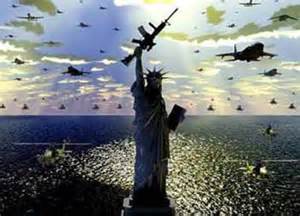
 

Iran goes for “maximum counter-pressure”

A U.S. Air Force B-52H Stratofortress aircraft assigned to the 20th Expeditionary Bomb Squadron taxis for takeoff on a runway at Al Udeid Air Base, Qatar, May 12, 2019. U.S. Air Force photo by Staff Sgt. Ashley Gardner

By Pepe Escobar

Source: Information Clearing House

Sooner or later the US “maximum pressure” on Iran would inevitably be met by “maximum counter-pressure”. Sparks are ominously bound to fly.

For the past few days, intelligence circles across Eurasia had been prodding Tehran to consider a quite straightforward scenario. There would be no need to shut down the Strait of Hormuz if Quds Force commander, General Qasem Soleimani, the ultimate Pentagon bête noire, explained in detail, on global media, that Washington simply does not have the military capacity to keep the Strait open.

As I previously reported, shutting down the Strait of Hormuz would destroy the American economy by detonating the $1.2 quadrillion derivatives market; and that would collapse the world banking system, crushing the world’s $80 trillion GDP and causing an unprecedented depression.

Soleimani should also state bluntly that Iran may in fact shut down the Strait of Hormuz if the nation is prevented from exporting essential two million barrels of oil a day, mostly to Asia. Exports, which before illegal US sanctions and de facto blockade would normally reach 2.5 million barrels a day, now may be down to only 400,000.

Soleimani’s intervention would align with consistent signs already coming from the IRGC. The Persian Gulf is being described as an imminent “shooting gallery.” Brigadier General Hossein Salami stressed that Iran’s ballistic missiles are capable of hitting “carriers in the sea” with pinpoint precision. The whole northern border of the Persian Gulf, on Iranian territory, is lined up with anti-ship missiles – as I confirmed with IRGC-related sources.

We’ll let you know when it’s closed

Then, it happened.

Chairman of the Chiefs of Staff of the Iranian Armed Forces, Major General Mohammad Baqeri, went straight to the point; “If the Islamic Republic of Iran were determined to prevent export of oil from the Persian Gulf, that determination would be realized in full and announced in public, in view of the power of the country and its Armed Forces.”

The facts are stark. Tehran simply won’t accept all-out economic war lying down – prevented to export the oil that protects its economic survival. The Strait of Hormuz question has been officially addressed. Now it’s time for the derivatives.

Presenting detailed derivatives analysis plus military analysis to global media would force the media pack, mostly Western, to go to Warren Buffett to see if it is true. And it is true. Soleimani, according to this scenario, should say as much and recommend that the media go talk to Warren Buffett.

The extent of a possible derivatives crisis is an uber-taboo theme for the Washington consensus institutions. According to one of my American banking sources, the most accurate figure – $1.2 quadrillion – comes from a Swiss banker, off the record. He should know; the Bank of International Settlements (BIS) – the central bank of central banks – is in Basle.

The key point is it doesn’t matter how the Strait of Hormuz is blocked.

It could be a false flag. Or it could be because the Iranian government feels it’s going to be attacked and then sinks a cargo ship or two. What matters is the final result; any blocking of the energy flow will lead the price of oil to reach $200 a barrel, $500 or even, according to some Goldman Sachs projections, $1,000.

Another US banking source explains; “The key in the analysis is what is called notional. They are so far out of the money that they are said to mean nothing. But in a crisis the notional can become real.  For example, if I buy a call for a million barrels of oil at $300 a barrel, my cost will not be very great as it is thought to be inconceivable that the price will go that high.  That is notional.  But if the Strait is closed, that can become a stupendous figure.”

BIS will only commit, officially, to indicate the total notional amount outstanding for contracts in derivatives markers is an estimated $542.4 trillion. But this is just an estimate.

The banking source adds, “Even here it is the notional that has meaning.  Huge amounts are interest rate derivatives. Most are notional but if oil goes to a thousand dollars a barrel, then this will affect interest rates if 45% of the world’s GDP is oil. This is what is called in business a contingent liability.”

Goldman Sachs has projected a feasible, possible $1,000 a barrel a few weeks after the Strait of Hormuz being shut down. This figure, times 100 million barrels of oil produced per day, leads us to 45% of the $80 trillion global GDP. It’s self-evident the world economy would collapse based on just that alone.

War dogs barking mad

As much as 30% of the world’s oil supply transits the Persian Gulf and the Strait of Hormuz. Wily Persian Gulf traders – who know better – are virtually unanimous; if Tehran was really responsible for the Gulf of Oman tanker incident, oil prices would be going through the roof by now. They aren’t.

Iran’s territorial waters in the Strait of Hormuz amount to 12 nautical miles (22 km). Since 1959, Iran recognizes only non-military naval transit.

Since 1972, Oman’s territorial waters in the Strait of Hormuz also amount to 12 nautical miles. At its narrowest, the width of the Strait is 21 nautical miles (39 km). That means, crucially, that half of the Strait of Hormuz is in Iranian territorial waters, and the other half in Oman’s. There are no “international waters”.

And that adds to Tehran now openly saying that Iran may decide to close the Strait of Hormuz publicly – and not by stealth.

Iran’s indirect, asymmetric warfare response to any US adventure will be very painful. Prof. Mohammad Marandi of the University of Tehran once again reconfirmed, “even a limited strike will be met by a major and disproportionate response.” And that means gloves off, big time; anything from really blowing up tankers to, in Marandi’s words, “Saudi and UAE oil facilities in flames”.

Hezbollah will launch tens of thousands of missiles against Israel. As Hezbollah’s secretary-general Hasan Nasrallah has been stressing in his speeches, “war on Iran will not remain within that country’s borders, rather it will mean that the entire [Middle East] region will be set ablaze. All of the American forces and interests in the region will be wiped out, and with them the conspirators, first among them Israel and the Saudi ruling family.”

It’s quite enlightening to pay close attention to what this Israel intel op is saying. The dogs of war though are barking mad.

Earlier this week, US Secretary of State Mike Pompeo jetted to CENTCOM in Tampa to discuss “regional security concerns and ongoing operations” with – skeptical – generals, a euphemism for “maxim pressure” eventually leading to war on Iran.

Iranian diplomacy, discreetly, has already informed the EU – and the Swiss – about their ability to crash the entire world economy. But still that was not enough to remove US sanctions.

War zone in effect

As it stands in Trumpland, former CIA Mike “We lied, We cheated, We stole” Pompeo – America’s “top diplomat” – is virtually running the Pentagon. “Acting” secretary Shanahan performed self-immolation. Pompeo continues to actively sell the notion the “intelligence community is convinced” Iran is responsible for the Gulf of Oman tanker incident. Washington is ablaze with rumors of an ominous double bill in the near future; Pompeo as head of the Pentagon and Psycho John Bolton as Secretary of State. That would spell out War.

Yet even before sparks start to fly, Iran could declare that the Persian Gulf is in a state of war; declare that the Strait of Hormuz is a war zone; and then ban all “hostile” military and civilian traffic in its half of the Strait. Without firing a single shot, no shipping company on the planet would have oil tankers transiting the Persian Gulf.


False-Flagging the World to War: A Gulf of Tonkin Incident in the Gulf of Oman

By Timothy Alexander Guzman

Source: Silent Crow News

Washington is playing false flag again, but this time, in the Gulf of Oman as Washington has accused Iran of attacking two commercial tanker ships from Japan and Norway while tensions in the region are at an all-time high. Why would Iran attack commercial tankers in the Gulf of Oman belonging to Norway and the other to Japan in the first place?  Keep in mind that just hours before, Prime Minister Shinzo Abe of Japan and the Iranian Supreme Leader Ayatollah Ali Khamenei were going to meet in an attempt to ease the ongoing crisis between Iran and the U.S. The Wall Street Journal reported that “The attacks, including on a Japanese tanker, came just hours before Prime Minister Shinzo Abe of Japan met in Iran with Iranian Supreme Leader Ayatollah Ali Khamenei to try to ease the standoff.” the report also said that “Mr. Abe has attempted to work as a mediator between Washington and Tehran, but Mr. Khamenei dismissed Mr. Abe’s effort, darkening prospects for dialogue. “We don’t believe these words at all because honest negotiations will not come from an individual such as [President] Trump.” An ABC news report stated that Secretary of State Mike Pompeo introduced Washington’s assessment that basically declared Iran is guilty as charged:

“It is the assessment of the United States government that the Islamic Republic of Iran is responsible for the attacks that occurred in the Gulf of Oman today. This assessment is based on intelligence, the weapons used, the level of expertise needed to execute the operation, recent similar Iranian attacks on shipping, and the fact that no proxy group operating in the area has the resources and proficiency to act with such a high-degree of sophistication”

Pompeo also said that the U.S. “will defend its forces, interests and stand with our partners and allies to safeguard global commerce and regional stability.”So what proof does Washington have? The report from ABC news said that “Some of the intelligence that Pompeo referred to includes overhead images taken by a U.S. Navy P-8 surveillance craft that shows Iranians on small boats alongside the Kokuka Courageous attempting to remove an unexploded mine that they had previously attached to the ship, a U.S. official told ABC News. While the images themselves weren’t disclosed, the descriptions suggested that the Iranians were attempting to remove evidence that would link them directly to the tanker attacks.”

Scripted: The Gulf of Tonkin and the Gulf of Oman

It is the same script that was once used on August 2nd, 1964 in what was to become the ‘Gulf of Tonkin Incident’ which based on a false claim of an alleged attack by North Vietnam on a U.S. ship, the USS Maddox. Washington’s official story was that North Vietnamese torpedo boats had launched an “unprovoked attack” against the U.S.S. Maddox that was allegedly on “routine patrol” but the truth was that it was engaged in intelligence-gathering and that it was involved in coordinated attacks on North Vietnam by both the South Vietnamese navy and the Laotian air force. Then two days later, North Vietnamese PT boats allegedly launched a “deliberate attack” on two U.S. destroyers, the USS Maddox and the USS Turner Joy with 22 torpedoes but it was all a lie. There was no evidence to suggest that there was an attack or any damage by North Vietnam. However, US Congress wanted retribution against North Vietnam so they passed The Tonkin Gulf Resolution a couple of days later which gave President, Lyndon B. Johnson authority to enter Vietnam’s civil war and give its full support to South Vietnam. The resolution stated that “Congress approves and supports the determination of the president, as commander in chief, to take all necessary measures to repel any armed attack against the forces of the United States and to prevent further aggression.” The Vietnam War lasted for about 10 years costing the lives of 55,000 US soldiers and roughly 3 million Southeast Asians including men, women and children.

The recent incident in the Gulf of Oman resembles the Gulf of Tonkin Incident. On August 5th, 1964, The New York Times published ‘The President Acts’ and stated the following:

President Johnson went to the American people last night with the somber facts of an enlarging crisis in Vietnam. He announced new steps in reply to “open aggression on the high seas.”. Air action by the United States is being executed against North Vietnam gunboats and supporting installations.

The President will put to the Congress a resolution expressing our united determination in support of the cause of freedom in Southeast Asia: He will put this grave situation before the Security Council of the United Nations. He has sought—and received—from Senator Goldwater, the Republican nominee for President, the assurance of bipartisan support in this critical hour.

The attack on one of our warships that at first seemed, and was hoped to be, an isolated incident is now seen in ominous perspective to have been the beginning of a mad adventure by the North Vietnamese Communists. After offensive action against more vessels of our Navy the President has backed up with retaliatory fire the warnings that North Vietnam chose frequently to ignore

Johnson called on congress to declare that “The United States regards as vital to its national interest and to world peace the maintenance of international peace and security in Southeast Asia” according to a Politico article titled ‘Congress approves Gulf of Tonkin Resolution: Aug. 7, 1964′ stated that “The resolution gave the president the right to “take all necessary measures to repel any armed attack against the forces of the United States and to prevent further aggression.” LBJ gave a speech following the Gulf of Tonkin Incident:

My fellow Americans: – As President and Commander in Chief, it is my duty to the American people to report that renewed hostile actions against United States ships on the high seas in the Gulf of Tonkin have today required me to order the military forces of the United States to take action in reply.

The initial attack on the destroyer Maddox, on August 2, was repeated today by a number of hostile vessels attacking two U.S. destroyers with torpedoes. The destroyers and supporting aircraft acted at once on the orders I gave after the initial act of aggression. We believe at least two of the attacking boats were sunk. There were no U.S. losses.

The performance of commanders and crews in this engagement is in the highest tradition of the United States Navy. But repeated acts of violence against the Armed Forces of the United States must be met not only with alert defense, but with positive reply. That reply is being given as I speak to you tonight. Air action is now in execution against gunboats and certain supporting facilities in North Viet-Nam which have been used in these hostile operations.

In the larger sense this new act of aggression, aimed directly at our own forces, again brings home to all of us in the United States the importance of the struggle for peace and security in southeast Asia. Aggression by terror against the peaceful villagers of South Viet-Nam has now been joined by open aggression on the high seas against the United States of America.

The determination of all Americans to carry out our full commitment to the people and to the government of South Viet-Nam will be redoubled by this outrage. Yet our response, for the present, will be limited and fitting. We Americans know, although others appear to forget, the risks of spreading conflict. We still seek no wider war.

I have instructed the Secretary of State to make this position totally clear to friends and to adversaries and, indeed, to all. I have instructed Ambassador Stevenson to raise this matter immediately and urgently before the Security Council of the United Nations. Finally, I have today met with the leaders of both parties in the Congress of the United States and I have informed them that I shall immediately request the Congress to pass a resolution making it clear that our Government is united in its determination to take all necessary measures in support of freedom and in defense of peace in southeast Asia.

I have been given encouraging assurance by these leaders of both parties that such a resolution will be promptly introduced, freely and expeditiously debated, and passed with overwhelming support. And just a few minutes ago I was able to reach Senator Goldwater and I am glad to say that he has expressed his support of the statement that I am making to you tonight.

It is a solemn responsibility to have to order even limited military action by forces whose overall strength is as vast and as awesome as those of the United States of America, but it is my considered conviction, shared throughout your Government, that firmness in the right is indispensable today for peace; that firmness will always be measured. Its mission is peace

Washington released a video claiming that Iran’s Revolutionary Guard Corps (IRGC) removed an unexploded mine from one of the two tankers. Last Thursday, Navy Captain Bill Urban, a spokesman for the US military’s Central Command, said in a statement “At 4:10pm local time (00:10 GMT) an IRGC Gashti Class patrol boat approached the M/T Kokuka Courageous and was observed and recorded removing the unexploded limpet mine from the M/T Kokuka Courageous.”

The New York Times headlined with ‘Trump Accuses Iran in Explosions That Crippled Oil Tankers’ detailing what Trump had said in relation to the Gulf of Oman incident “Well, Iran did do it,” the president said in a telephone interview on “Fox & Friends” in his first comments since the ships were damaged. “You know they did it because you saw the boat. I guess one of the mines didn’t explode and it’s got essentially Iran written all over it.” The New York Timesweighed in on the accusation by claiming that Iran’s proxy groups have increased attacks in the region, in a way siding with Trump:

In fact, some Iranian proxy groups in the region have stepped up attacks lately. The Houthi faction in Yemen, which has been supported by Iran, has attacked Saudi oil pipelines and other targets. Just this week, a Houthi missile slammed inot the arrival halls of a Saudi airport, injuring 26 people, according to Saudi news. The Houthis reported launching a drone attack on the same airport on Friday but the Saudi military said it intercepted five Houthi drones and the airport was operating normally 

According to The New York Times one of the Japanese operators said that the tanker was hit by a flying object not by a limpet mine:

Doubts about the American version of Thursday’s events were raised by the Japanese operator of one of the damaged tankers, which said that it was attacked by air. “Our crew said that the ship was attacked by a flying object,” said Yutaka Katada, the president of the operator, Kokuka Sangyo 

Washington’s Hit List: Iran

It’s no secret that Trump is in the pockets of Israel and Saudi Arabia but that’s beside the point, the deep state insiders and the Military-Industrial Complex have been wanting a war with Iran since the Iranian Revolution of 1979 which ousted the U.S. backed dictator, Mohammad Reza Pahlavi also known as the Shah of Iran. But there are a number of reasons why the U.S. wants a war with Iran, one of them being the fact that Iran has dropped its use of the U.S. dollar in trade with several key countries including Russia and China disrupting the petrodollar system. Israel also plays an important part by having the ambitions of becoming the “Greater Israel” in the Middle East, but Iran and its allies including Syria, Hezbollah, Lebanon and the Palestinians are preventing that from happening.  If Israel can succeed in pushing the U.S. to attack Iran and destabilize the country as they did with Iraq, then managing the Middle East in its entirely would allow the Zionist state to expand on more Arab territory (Trump recently declared Syria’s Golan Heights as a part of Israel). Then Israel will become a major power in the Middle East armed with nuclear weapons, sort of a mini-empire with teeth.

However, the U.S., Israel and the Gulf States will have their hands tied when it comes to Iran’s military capabilities that includes an estimated 534,000 active personnel and an additional 350,000 reservists in the army, air force, navy and the Islamic Revolutionary Guard Corps (IRGC). It is also worth mentioning that Iran has the manpower which is close to 40 million eligible men and women who would unite no matter what side of the political spectrum they are on. They would rally around the Iranian flag and fight for their homeland. One certainty the U.S. and its allies would face is a nation that has much more people and a land mass that is at least four times larger than Iraq. According to Global Firepower Index, a military website ranked Iran at No. 13 out of 136 countries. Iran has more than 500 aircraft, 1,634 combat tanks, 2,345 armored fighting vehicles and 398 Naval assets including 34 submarines and 88 vessels. Iran recently produced an air defense system called the Khordad 15 that is “capable of tracking and shooting down six targets at the same time. The weapon was rolled out amid growing tensions around the Persian Gulf” according to a report by RT.com. The report said that “Iran unveiled its new domestically-designed air defense missile system Khordad 15 on Sunday. Equipped with long-range Sayyad 3 missiles, it can shoot down enemy jets and combat drones at a range of 120 kilometers, Defense Minister Brigadier General Amir Hatami said.” 

The U.S. war machine’s main objective is to destabilize and destroy Iran as a country so that the U.S., the Gulf states and especially Israel can dominate the Middle East and its oil supplies. It will also be a bonus for the Military-Industrial Complex who will profit from what will become a long-term war.