Neoliberalism: Serving the Interests of the International Business Elitists

41rnwuTZinL._SX332_BO1204203200_-201x300

By Edward S. Herman

Source: Dissident Voice

Mark Weisbrot, a co-director with Dean Baker of the Center for Economic and Policy Research (CEPR), has written an enlightening book that pulls together many of the analyses that CEPR has been producing over the past several decades. The book, Failed: What the “Experts” Got Wrong about the Global Economy, is important and useful because it provides an alternative framework of analysis to the one used by establishment experts, media and policy-makers. What is more, this alternative framework and description of reality is well supported by empirical evidence and is convincing. It is marginalized in the mainstream because it runs counter to the interests of the powerful, who over the past three decades, have successfully pushed for a neoliberal world order that scales back the earlier welfare state advances and pursues trickle-down economics and the well-being of the affluent.

In fact, an important feature of Weisbrot’s analysis is his recognition of the extent to which policy failures have flowed from biased analyses that serve a small elite and punish the majority, and that policy successes have often followed the loss of power by those serving elite interests. His first chapter is entitled “Troubles in Euroland: When the Cures Worsen the Disease,” whose central theme is that the long crisis and malperformance of Europe’s economies, and especially the weaker ones of Greece, Portugal, Spain and to a lesser extent, Italy, were in large measure the result of poor policy choices. The crisis, which dates back to 2008, was not due to high sovereign debt, which was only threateningly high in Greece, but rather the refusal of the policy-making “troika,” the European Central Bank (ECB), European Community and IMF, to carry out expansionary policies that would allow the poor countries to grow out of their deficit position.

The Fed met the U.S. crisis with an easy money program which, when combined with modest fiscal expansion efforts, quickly mitigated this crisis (although the fiscal actions fell short of what was needed for a full recovery). But the ECB refused to carry out a comparable expansion policy, and there was no Europe-wide fiscal program in the EU system. So the poor countries were forced to depend for recovery on an “internal devaluation” of cutbacks in mainly social budgets, given that external devaluations for individual countries were ruled out by the use of a common currency, the euro. This didn’t do the job, so the eurozone remained in a depressed state, even up to the present.

Weisbrot shows that this policy failure was deliberate, with the troika leaders–mainly the ECB–taking advantage of the weaker countries’ vulnerability to force on them structural and policy changes that served the interests of the international business elite. These changes, including cutbacks on public outlays for education, health care, social security, and poverty alleviation, mainly harmed ordinary citizens. So did the enforced pro-cyclical monetary and fiscal policies themselves, which produced a eurozone crisis of unemployment and foregone output that extended for six years and is still ongoing. Weisbrot points out that this policy and process was a notable application of Naomi Klein’s “shock doctrine,” according to which elites take advantage of painful developments (here macro-distress) to force policy changes that could not be obtained through a democratic process like a national political vote of approval. Weisbrot shows that the troika leaders were quite conscious of the fact that they were pursuing “reforms” that the public wouldn’t support outside of shock conditions.

This process rested on the undemocratic structure of macro-policy-making in the European community. One of neoliberalism’s instruments is an “independent” central bank, where independent means not subject to democratic control. The ECB meets that standard well, more so than the Fed; and in its statute the ECB is only required to meet a price stability objective, so it is free to ignore unemployment and even deliberately increase it. Neoliberal practice is also encouraged by the 1992 Maastricht Treaty, which placed ceilings on the size of budget deficits and total public debt (3 and 60 percent respectively). These unnecessary ceilings are often breached, but provide levers to put pressure on weaker countries.

The countries victimized by the ECB’s pressure for painful internal devaluation could in theory exit from the euro and rely on expansion via currency devaluation and newly feasible monetary and fiscal expansion. But the risks in the cutoff of aid and money market access and the turmoil in any transition are severe, and although Syriza was voted into power in Greece on an anti-austerity program and pledge, it did not see fit to exit. In this connection Weisbrot discusses the case of Argentina, which, in the midst of a calamitous recession in 2001-2002 did default on its large external debt, ended its peg of the peso to the dollar, froze bank deposit accounts, and installed controls over capital movements. This caused immediate chaos and a worsened crisis, but as Weisbrot stresses, after only a single quarter of further GDP decline (5 percent), freed of its externally imposed constraints, Argentina began its recovery, taking three and a half years to regain its pre-recession level of output, but with real growth of some 100 percent over the next 11 years. Greece, which had a peak GDP loss of 25 percent, and which is still mired in a badly depressed economy, could hardly have fared worse than Argentina if it had exited years ago. Whether that option should still be taken is debatable, and Weisbrot discusses the pros and cons without coming to a definite conclusion, but that an exit might well have a positive result is suggested by the Argentinian experience.

A major theme of Failed is the negative impact of neoliberalism on the growth of low and middle-income countries and the welfare of their people. A major chapter on “The Latin American Spring” features evidence that the triumph of neoliberalism in the years from 1980 to the end of the 1990s was a dismal economic and welfare failure, Per capita GDP growth fell from 3.3. percent per year, 1960-1980 to 0.4 percent 1980-2000, rising again to 1.8 percent in the years 2000-2014. The earlier period (1960-1980) was one of widespread government intervention in the interest of rapid economic development; the middle years were dominated by the triumph of neoliberalism, with widespread imposition of structural adjustment programs under IMF and World Bank auspices, lowering trade and investment barriers, and ruthlessly cutting back development and welfare state programs. The years 2000-2014 saw a resurgence of economic growth, but not up to the pre-Reagan years.

Weisbrot shows that the new spurt in economic growth was closely associated with the victory of leftist governments in quite a few Latin American states, starting in 1998, He also presents a great deal of evidence showing that the growth spurt resulted in major improvements in a range of human welfare indicators, like reduced infant mortality, poverty reduction, more widepread schooling, enlarged pensions, and greater income equality. Thus, for example, the Brazilian poverty rate, which had remained virtually unchanged in the eight neoliberal years before the victory of the Workers Party, saw a 55 percent drop in that rate during the years 2002-2013. Similar changes in this and other welfare measures took place in Ecuador, Bolivia and other Latin states that escaped the neoliberal trap. Although these changes brought improved lives and prospects to millions, Weisbrot points out that the U.S. mainstream has played dumb, refusing to feature and reflect on the significance of this widespread improvement in human welfare and its strange efflorescence associated with the decline in U.S. and IMF-World Bank influence in Latin America.

Weisbrot stresses the importance of democratization and policy space in these growth and welfare improvements. The ECB narrowed that policy space in the eurozone, making it difficult for national leaders to expand or otherwise help improve social conditions. This reflected the weakening of democracy in the eurozone, with the ECB, EC and IMF able to make decisions that local democratic governments would not be able to make. Similarly, the loss of power over Latin governments by the U.S. and IMF following the left political triumphs from 1998, and their record of anti-people actions and other policy failures, made for policy space. So also did the rise of China as an economic power, providing a market for Latin products and loans without political conditions. Weisbrot notes that the common orthodox position that the democratic West would be more likely to help poorer countries develop democracies as compared with what authoritarian China would likely do is fallacious. China lends widely without intervening politically. The United States has a long record of support of undemocratic regimes that will serve as its political instruments and/or provide a “favorable climate of investment.” (This writer’s The Real Terror Network was a dossier of U.S. support of National Security States in Latin America and of its active involvement in many counter-revolutionary “regime changes.”)

It is arguable that an unrecognized benefit of the Iraq and Afghanistan wars was their distracting U.S. officials from major efforts to halt the trend toward democratic government in Latin America, although their participation in the attempts at regime change in Venezuela and their successful support of an undemocratic coup in Honduras in 2009 shows that the longstanding anti-democratic policy thrust of the U.S. leadership is not dead. (Mrs. Clinton, of course, fully supported the Honduras coup. So we may see a more energetic pursuit of the traditional U.S. policy of hostility to democracy in Latin America with her election.)

Weisbrot stresses throughout the importance of per capita growth for improving the human condition. A problem with this premise is that the human race may be growing too fast for ecological survival. Weisbrot confronts this issue, arguing that while population growth is a definite negative productivity growth may on balance be a means of coping by increasing food output and lowering the cost of wind turbines, solar panels and other improvements. However, increases in incomes tend to increase the preference for meat, larger houses, and other resource depleters, so that productivity improvements may, on balance, place even more pressure on the environment.

Weisbrot is possibly over-optimistic on this front. But his book is rich in compelling analyses and data that show how the mainstream live in an Alice-In-Wonderland economic world and the important things we may do to escape that Wonderland.


Edward S. Herman is an economist and media analyst with a specialty in corporate and regulatory issues as well as political economy and the media. Read other articles by Edward.


The Age of Disintegration

images

Neoliberalism, Interventionism, the Resource Curse, and a Fragmenting World

By Patrick Cockburn

Source: TomDispatch.com

We live in an age of disintegration. Nowhere is this more evident than in the Greater Middle East and Africa. Across the vast swath of territory between Pakistan and Nigeria, there are at least seven ongoing wars — in Afghanistan, Iraq, Syria, Yemen, Libya, Somalia, and South Sudan. These conflicts are extraordinarily destructive. They are tearing apart the countries in which they are taking place in ways that make it doubtful they will ever recover. Cities like Aleppo in Syria, Ramadi in Iraq, Taiz in Yemen, and Benghazi in Libya have been partly or entirely reduced to ruins. There are also at least three other serious insurgencies: in southeast Turkey, where Kurdish guerrillas are fighting the Turkish army, in Egypt’s Sinai Peninsula where a little-reported but ferocious guerrilla conflict is underway, and in northeast Nigeria and neighboring countries where Boko Haram continues to launch murderous attacks.

All of these have a number of things in common: they are endless and seem never to produce definitive winners or losers. (Afghanistan has effectively been at war since 1979, Somalia since 1991.) They involve the destruction or dismemberment of unified nations, their de facto partition amid mass population movements and upheavals — well publicized in the case of Syria and Iraq, less so in places like South Sudan where more than 2.4 million people have been displaced in recent years.

Add in one more similarity, no less crucial for being obvious: in most of these countries, where Islam is the dominant religion, extreme Salafi-Jihadi movements, including the Islamic State (IS), al-Qaeda, and the Taliban are essentially the only available vehicles for protest and rebellion. By now, they have completely replaced the socialist and nationalist movements that predominated in the twentieth century; these years have, that is, seen a remarkable reversion to religious, ethnic, and tribal identity, to movements that seek to establish their own exclusive territory by the persecution and expulsion of minorities.

In the process and under the pressure of outside military intervention, a vast region of the planet seems to be cracking open. Yet there is very little understanding of these processes in Washington. This was recently well illustrated by the protest of 51 State Department diplomats against President Obama’s Syrian policy and their suggestion that air strikes be launched targeting Syrian regime forces in the belief that President Bashar al-Assad would then abide by a ceasefire. The diplomats’ approach remains typically simpleminded in this most complex of conflicts, assuming as it does that the Syrian government’s barrel-bombing of civilians and other grim acts are the “root cause of the instability that continues to grip Syria and the broader region.”

It is as if the minds of these diplomats were still in the Cold War era, as if they were still fighting the Soviet Union and its allies. Against all the evidence of the last five years, there is an assumption that a barely extant moderate Syrian opposition would benefit from the fall of Assad, and a lack of understanding that the armed opposition in Syria is entirely dominated by the Islamic State and al-Qaeda clones.

Though the invasion of Iraq in 2003 is now widely admitted to have been a mistake (even by those who supported it at the time), no real lessons have been learned about why direct or indirect military interventions by the U.S. and its allies in the Middle East over the last quarter century have all only exacerbated violence and accelerated state failure.

A Mass Extinction of Independent States

The Islamic State, just celebrating its second anniversary, is the grotesque outcome of this era of chaos and conflict. That such a monstrous cult exists at all is a symptom of the deep dislocation societies throughout that region, ruled by corrupt and discredited elites, have suffered. Its rise — and that of various Taliban and al-Qaeda-style clones — is a measure of the weakness of its opponents.

The Iraqi army and security forces, for example, had 350,000 soldiers and 660,000 police on the books in June 2014 when a few thousand Islamic State fighters captured Mosul, the country’s second largest city, which they still hold. Today the Iraqi army, security services, and about 20,000 Shia paramilitaries backed by the massive firepower of the United States and allied air forces have fought their way into the city of Fallujah, 40 miles west of Baghdad, against the resistance of IS fighters who may have numbered as few as 900. In Afghanistan, the resurgence of the Taliban, supposedly decisively defeated in 2001, came about less because of the popularity of that movement than the contempt with which Afghans came to regard their corrupt government in Kabul.

Everywhere nation states are enfeebled or collapsing, as authoritarian leaders battle for survival in the face of mounting external and internal pressures. This is hardly the way the region was expected to develop. Countries that had escaped from colonial rule in the second half of the twentieth century were supposed to become more, not less, unified as time passed.

Between 1950 and 1975, nationalist leaders came to power in much of the previously colonized world. They promised to achieve national self-determination by creating powerful independent states through the concentration of whatever political, military, and economic resources were at hand. Instead, over the decades, many of these regimes transmuted into police states controlled by small numbers of staggeringly wealthy families and a coterie of businessmen dependent on their connections to such leaders as Hosni Mubarak in Egypt or Bashar al-Assad in Syria.

In recent years, such countries were also opened up to the economic whirlwind of neoliberalism, which destroyed any crude social contract that existed between rulers and ruled. Take Syria. There, rural towns and villages that had once supported the Baathist regime of the al-Assad family because it provided jobs and kept the prices of necessities low were, after 2000, abandoned to market forces skewed in favor of those in power. These places would become the backbone of the post-2011 uprising. At the same time, institutions like the Organization of Petroleum Exporting Countries (OPEC) that had done so much to enhance the wealth and power of regional oil producers in the 1970s have lost their capacity for united action.

The question for our moment: Why is a “mass extinction” of independent states taking place in the Middle East, North Africa, and beyond? Western politicians and media often refer to such countries as “failed states.” The implication embedded in that term is that the process is a self-destructive one. But several of the states now labeled “failed” like Libya only became so after Western-backed opposition movements seized power with the support and military intervention of Washington and NATO, and proved too weak to impose their own central governments and so a monopoly of violence within the national territory.

In many ways, this process began with the intervention of a U.S.-led coalition in Iraq in 2003 leading to the overthrow of Saddam Hussein, the shutting down of his Baathist Party, and the disbanding of his military. Whatever their faults, Saddam and Libya’s autocratic ruler Muammar Gaddafi were clearly demonized and blamed for all ethnic, sectarian, and regional differences in the countries they ruled, forces that were, in fact, set loose in grim ways upon their deaths.

A question remains, however: Why did the opposition to autocracy and to Western intervention take on an Islamic form and why were the Islamic movements that came to dominate the armed resistance in Iraq and Syria in particular so violent, regressive, and sectarian? Put another way, how could such groups find so many people willing to die for their causes, while their opponents found so few? When IS battle groups were sweeping through northern Iraq in the summer of 2014, soldiers who had thrown aside their uniforms and weapons and deserted that country’s northern cities would justify their flight by saying derisively: “Die for [then-Prime Minister Nouri] al-Maliki? Never!”

A common explanation for the rise of Islamic resistance movements is that the socialist, secularist, and nationalist opposition had been crushed by the old regimes’ security forces, while the Islamists were not. In countries like Libya and Syria, however, Islamists were savagely persecuted, too, and they still came to dominate the opposition. And yet, while these religious movements were strong enough to oppose governments, they generally have not proven strong enough to replace them.

Too Weak to Win, But Too Strong to Lose

Though there are clearly many reasons for the present disintegration of states and they differ somewhat from place to place, one thing is beyond question: the phenomenon itself is becoming the norm across vast reaches of the planet.

If you’re looking for the causes of state failure in our time, the place to start is undoubtedly with the end of the Cold War a quarter-century ago. Once it was over, neither the U.S. nor the new Russia that emerged from the Soviet Union’s implosion had a significant interest in continuing to prop up “failed states,” as each had for so long, fearing that the rival superpower and its local proxies would otherwise take over. Previously, national leaders in places like the Greater Middle East had been able to maintain a degree of independence for their countries by balancing between Moscow and Washington. With the break-up of the Soviet Union, this was no longer feasible.

In addition, the triumph of neoliberal free-market economics in the wake of the Soviet Union’s collapse added a critical element to the mix. It would prove far more destabilizing than it looked at the time.

Again, consider Syria. The expansion of the free market in a country where there was neither democratic accountability nor the rule of law meant one thing above all: plutocrats linked to the nation’s ruling family took anything that seemed potentially profitable. In the process, they grew staggeringly wealthy, while the denizens of Syria’s impoverished villages, country towns, and city slums, who had once looked to the state for jobs and cheap food, suffered. It should have surprised no one that those places became the strongholds of the Syrian uprising after 2011. In the capital, Damascus, as the reign of neoliberalism spread, even the lesser members of the mukhabarat, or secret police, found themselves living on only $200 to $300 a month, while the state became a machine for thievery.

This sort of thievery and the auctioning off of the nation’s patrimony spread across the region in these years. The new Egyptian ruler, General Abdel Fattah al-Sisi, merciless toward any sign of domestic dissent, was typical. In a country that once had been a standard bearer for nationalist regimes the world over, he didn’t hesitate this April to try to hand over two islands in the Red Sea to Saudi Arabia on whose funding and aid his regime is dependent. (To the surprise of everyone, an Egyptian court recently overruled Sisi’s decision.)

That gesture, deeply unpopular among increasingly impoverished Egyptians, was symbolic of a larger change in the balance of power in the Middle East: once the most powerful states in the region — Egypt, Syria, and Iraq — had been secular nationalists and a genuine counterbalance to Saudi Arabia and the Persian Gulf monarchies. As those secular autocracies weakened, however, the power and influence of the Sunni fundamentalist monarchies only increased. If 2011 saw rebellion and revolution spread across the Greater Middle East as the Arab Spring briefly blossomed, it also saw counterrevolution spread, funded by those oil-rich absolute Gulf monarchies, which were never going to tolerate democratic secular regime change in Syria or Libya.

Add in one more process at work making such states ever more fragile: the production and sale of natural resources — oil, gas, and minerals — and the kleptomania that goes with it. Such countries often suffer from what has become known as “the resources curse”: states increasingly dependent for revenues on the sale of their natural resources — enough to theoretically provide the whole population with a reasonably decent standard of living — turn instead into grotesquely corrupt dictatorships. In them, the yachts of local billionaires with crucial connections to the regime of the moment bob in harbors surrounded by slums running with raw sewage. In such nations, politics tends to focus on elites battling and maneuvering to steal state revenues and transfer them as rapidly as possible out of the country.

This has been the pattern of economic and political life in much of sub-Saharan Africa from Angola to Nigeria. In the Middle East and North Africa, however, a somewhat different system exists, one usually misunderstood by the outside world. There is similarly great inequality in Iraq or Saudi Arabia with similarly kleptocratic elites. They have, however, ruled over patronage states in which a significant part of the population is offered jobs in the public sector in return for political passivity or support for the kleptocrats.

In Iraq with a population of 33 million people, for instance, no less than seven million of them are on the government payroll, thanks to salaries or pensions that cost the government $4 billion a month. This crude way of distributing oil revenues to the people has often been denounced by Western commentators and economists as corruption. They, in turn, generally recommend cutting the number of these jobs, but this would mean that all, rather than just part, of the state’s resource revenues would be stolen by the elite. This, in fact, is increasingly the case in such lands as oil prices bottom out and even the Saudi royals begin to cut back on state support for the populace.

Neoliberalism was once believed to be the path to secular democracy and free-market economies. In practice, it has been anything but. Instead, in conjunction with the resource curse, as well as repeated military interventions by Washington and its allies, free-market economics has profoundly destabilized the Greater Middle East. Encouraged by Washington and Brussels, twenty-first-century neoliberalism has made unequal societies ever more unequal and helped transform already corrupt regimes into looting machines. This is also, of course, a formula for the success of the Islamic State or any other radical alternative to the status quo. Such movements are bound to find support in impoverished or neglected regions like eastern Syria or eastern Libya.

Note, however, that this process of destabilization is by no means confined to the Greater Middle East and North Africa. We are indeed in the age of destabilization, a phenomenon that is on the rise globally and at present spreading into the Balkans and Eastern Europe (with the European Union ever less able to influence events there). People no longer speak of European integration, but of how to prevent the complete break-up of the European Union in the wake of the British vote to leave.

The reasons why a narrow majority of Britons voted for Brexit have parallels with the Middle East: the free-market economic policies pursued by governments since Margaret Thatcher was prime minister have widened the gap between rich and poor and between wealthy cities and much of the rest of the country. Britain might be doing well, but millions of Britons did not share in the prosperity. The referendum about continued membership in the European Union, the option almost universally advocated by the British establishment, became the catalyst for protest against the status quo. The anger of the “Leave” voters has much in common with that of Donald Trump supporters in the United States.

The U.S. remains a superpower, but is no longer as powerful as it once was. It, too, is feeling the strains of this global moment, in which it and its local allies are powerful enough to imagine they can get rid of regimes they do not like, but either they do not quite succeed, as in Syria, or succeed but cannot replace what they have destroyed, as in Libya. An Iraqi politician once said that the problem in his country was that parties and movements were “too weak to win, but too strong to lose.” This is increasingly the pattern for the whole region and is spreading elsewhere. It carries with it the possibility of an endless cycle of indecisive wars and an era of instability that has already begun.


Patrick Cockburn is a Middle East correspondent for the Independent of London and the author of five books on the Middle East, the latest of which isChaos and Caliphate: Jihadis and the West in the Struggle for the Middle East(OR Books).

Positively Thriving Through the Collapse of Civilisation

permaculture1

By Open

Source: ZenGardner.com

Have you ever watched something happening in slow motion? You can quite clearly see the end result, but nevertheless, you can’t quite believe in your mind what your eyes are seeing. Like when the twin towers ‘collapsed’. The demolition was happening there right in front of you, but you had to pinch yourself to make sure you weren’t just dreaming. I feel exactly that way about modern society right now. The collapse is already happening, but in slow motion, so you can’t quite believe the entirety of it. What will it look like as the ‘buildings’ topple? More importantly, how can we not only survive the shift, but positively thrive in it?…

Slow motion free fall

Have you seen the film “Collapse” yet? It’s a grounded, real and at times very emotive interview with the late whistle-blower Michael C Rupert. I believe everybody on the planet should watch it (I’ve included it below). You hear the calling of a soul, put here for a purpose. Never so clearly have I witnessed a man express so eloquently, the destiny that drew him here.

He sums up so marvelously the reason why society is going to collapse. Let me correct myself: why it is already collapsing, just that it’s in slow motion, and not everyone has yet pinched themselves out of the dream that prevents them seeing the reality of it.

Society is built on the foundation of ‘infinite growth’, the need to continuously expand in order to service a surging ocean of debt. It depends on the ever burgeoning exploitation of natural resources. Which is why governments and corporations are more concerned with the last pockets of oil under the pole, rather than the ice on top of it. It’s why they’re stripping the tar from the sand, and fracking the earth into oblivion. Therein lies the problem. That’s why society is already in a state of slow motion free fall. Because we live on a planet of finite resources, and the two ends no longer meet. We’ve built foundations on sand and now the tide is fast flowing in.

Nevertheless, I am an optimist. Where others might slip into fear, I see the light shining through the shadows. There’s a way to survive what is to come. No, there’s a way to positively thrive in it!

Thriving the meltdown

You first have to accept what you see. That’s a challenge in itself. Watch the film, especially towards the end, because it’s fascinating. The interviewer suggests all manner of information can be presented to support the view you want to put across (like the ‘debate’ on global warming for example). And he’s right. But that’s not what Michael is about and neither am I. For me, and for others I work with, the debate is not necessary – such intellectual pontification is a pointless waste of time. We’ve already seen the towers collapsing. I can feel the energies of higher benevolence instigating the collapse mechanism. The earth needs to be saved from the wanton, consumeristic destruction. The debate – if ever there was one – is over. And until you can see through the veil, there’s nowhere to begin. So my first suggestion – assuming you feel any resonance with me – is to work to see past the veil into what is surely now taking place: collapse of the civilisation we currently depend upon.

When this lands for you, you’ll realise like the Hopi Elders, that the only way to prosper through this collapse, is by spiritual means. This will be a ‘war’ of the spiritual through the material. Not fighting. Rather breaking through the sense of physical disempowerment into the liberation of the spirit. The expression of the boundless, unlimited you, and watching this miraculous nature shine out into the world. Trusting that your every step will be supported. Not in the way your ego might want. It won’t deliver the physical outcome you desire. It’ll deliver much more than that: as the old skin peels off, a metamorphosis into an interconnected, interdimensional way of being – The rise of the Divine Human.

But yes, at this time we are physical beings too. And we’ll need a platform from which to unveil our divine being at the heart of every man, woman and child. Just as the dragonfly stands on the leaf, peels off the old skin and unfolds its wings in the sunlight before taking flight, so we’ll need a stable background to help people learn to fly.

What does that mean exactly?

It means we have to bring as swift an end to the system as possible. It’s gobbling up precious resources and energy, ridiculously wasting them on idle rubbish, mindless entertainment and hopeless addiction. We have to ween ourselves off this crutch through non-compliance with the corporations that would try to bolster it – those that would like to keep mankind dwelling in the murky depths of the pond, rather than flying liberated above it.

Discovering how less is more

We have to spend our time and money wisely now: to invest in ourselves and our future (especially since paper money will lose its value); to gather together the resources and communities that can help one another out as society steadily pulls itself apart. Even if you continue to work in the matrix, you can still prepare. And don’t worry, you have time, if you begin now. Society will not collapse in one fell swoop. It will be a steady degradation. It’s happening now. It’s just that most haven’t clicked yet as to what’s going on. So you’ve got time to gather together, share ideas, support and suggestions about what might work best. You can start growing your own food and collect a reserve of essentials to tide you through difficult times.

That’s the inspirational idea behind Transition Towns, which have been springing up and thriving all around the world for several years now. It’s about supporting local skills, already developing the web of a local support and resource mechanism. Even if it’s just a micro community of a few neighbours and friends, it will make all the difference as the globalised structure fractures.

In the film below, Michael shares a poignant and prophetic example of the fate of two countries – North Korea and Cuba – that both suffered through the collapse of the iron curtain: affected because they were both dependent on Soviet oil, just as the civilised world is right now.

The North Korean approach was to centralise resource, for government to control everything, like the collectivised food supply and nationalised energy. Communism? It sounds suspiciously like the leading western ‘democracies’ to me. And what was the result? Starvation on a massive scale. Cuba on the other hand encouraged people to come together in local communities, to grow their own food in their own back gardens, thus consuming a fraction of the energy. They no longer have the paraphernalia of modern society – a blessing – and the people positively thrived by needing less, discovering that less is more.

Some will say we can use unlimited supplies of ‘free energy’. Whilst we may benefit from new technologies that could come through, what we have to realise is how hopelessly dependent the current system is on oil. How will all those fossil fuel engines be replaced? Where will the resources come from to build the new machines, gadgets and widgets? Whatever technology we discover to tide us through, it is my strong assertion that we need to get used to consuming less, using wisely the resources we currently have…

Even if you new the world was to end tomorrow, would you plant that apple tree today? Would you live wisely, with compassion and a soft footprint on the earth? It is these souls that will ascend through the collapse of the old world. This is the new consciousness which will thrive as the old is peeled away.

Pinch yourself awake

The universe is a flowing ocean of energy. Humanity – spurred by an Interdimensional Intervention – has built a dam and tried to contain it in some eddy current. And we’ve turned a blind eye as the realigning energy of higher dimensional forces and devic consciousness now comes in to break apart the false reality fabric over time.

This shift and cleansing process that is beginning will be unlike any other to have taken place on earth. Why? Because Gaia has released her karma. She needed the control mechanism too, in order to experience being fully accepting and forgiving of those that would disrespect her. But she’s processed that constriction now and needs it no longer. Thus the ‘matrix’ no longer has a foundation. It will be peeled off over time. There will be no place for the old human consciousness, which will be shed with the skin too. Instead, will incarnate the new human consciousness – Divinicus Cometh – to thrive through this cleansing process which has now begun.

The renewed human spirit is meant to ride this realigning wave, rather than try to manipulate it. Because anything that tries to control something else, ultimately ends up controlling only itself. So we need to learn to ride the wave of the soul once more. To listen to it and above all, feel it coursing through our veins, respond to its direction. We need to master the inner alchemy of change. There’s two streams of consciousness within you. Which do you identify with: the sense of separation, the fear and contraction? or do you penetrate that, soften through it and flow with your eternal spirit?Right now too many are still caught ‘rabbit like’ in the car headlamps as the slow motion tsunami approaches them. Hoping, pretending, that they’re just in a dream and when they wake up, all will be okay, the car won’t really be careering towards them. But by then, it’s too late.

I urge you then to watch the film, pinch yourself awake, but then let the soul inspire you to make new choices in this new multidimensional landscape. And if you can’t yet clearly hear the soul and follow its guidance through every choice, then I would suggest that’s the best place to begin. Here’s the documentary and afterwards, if you’d like help with the soul guidance part, feel free to get in touch.

from my heart to yours

Open
(on behalf of Openhand)

Saturday Matinee: September 11 – The New Pearl Harbor

hqdefault

VIDEO: The Unspoken Truth on 9/11: “September 11 – The New Pearl Harbor”

Review of documentary by Massimo Mazzucco.

By David Ray Griffin

Source: GlobalResearch.ca

There have been several good films and videos about 9/11. But the film by award-winning film-maker Massimo Mazzucco Released in 2013 is in a class by itself.

For those of us who have been working on 9/11 for a long time, this is the film we have been waiting for.

Whereas there are excellent films treating the falsity of particular parts of the official account, such as the Twin Towers or WTC 7, Mazzucco has given us a comprehensive documentary treatment of 9/11, dealing with virtually all of the issues.

There have, of course, been films that treated the fictional official story as true. And there are films that use fictional stories to portray people’s struggles after starting to suspect the official story to be false.

But there is no fiction in Mazzucco’s film – except in the sense that it clearly and relentlessly exposes every part of the official account as fictional.

Because of his intent at completeness, Mazzucco has given us a 5-hour film. It is so fascinating and fast-paced that many will want to watch it in one sitting. But this is not necessary, as the film, which fills 3 DVDs, consists of 7 parts, each of which is divided into many short chapters.

These 7 parts treat Air Defence, The Hijackers, The Airplanes, The Pentagon, Flight 93, The Twin Towers, and Building 7. In each part, after presenting facts that contradict the official story, Mazzucco deals with the claims of the debunkers (meaning those who try to debunk the evidence provided by the 9/11 research community).

The Introduction, reflecting the film’s title, deals with 12 uncanny parallels between Pearl Harbor and September 11.

The film can educate people who know nothing about 9/11 (beyond the official story), those with a moderate amount of knowledge about the various problems with the official story, and even by experts. (I myself learned many things.)

Mazzucco points out that his film covers 12 years of public debate about 9/11. People who have been promoting 9/11 truth for many of these years will see that their labors have been well-rewarded: There is now a high-quality, carefully-documented film that dramatically shows the official story about 9/11 to be a fabrication through and through.

This is truly the film we have been waiting for.

Part I

Part II

Part III

The National Endowment for Democracy: Not National and Not for Democracy

ned

By Tony Cartalucci

Source: New Eastern Outlook

Using a front to hide illegal or immoral activities has been a feature of human criminality since the beginning of human civilization itself. Facades, both ideological and economical, have helped criminal enterprises conceal the true nature of their activities for centuries.
In ages past, organized religion would often take systems of legitimate philosophy and spirituality, and transform them into a means of organizing the masses for the benefit of an elite few, often those heading empires, kingdoms, or nation-states. More recently, patriotism and now the notion of “democracy” have been used successfully by similar cadres of special interests to conceal their self-serving agendas behind notions likely to recruit support from large segments of a population that would otherwise be disinterested.

There is no example of this more transparent than that of the US National Endowment for Democracy (NED). According to its own website, it claims:

The National Endowment for Democracy (NED) is a private, nonprofit foundation dedicated to the growth and strengthening of democratic institutions around the world. Each year, NED makes more than 1,200 grants to support the projects of non-governmental groups abroad who are working for democratic goals in more than 90 countries.

“The growth and strengthening  of democratic institutions around the world” sounds noble enough. One would expect, then, that the NED would be led by a collection of some of the most notable activists involved in the empowerment of “the people.” Instead, upon NED’s board of directors, we find people representing corporate-financier interests notorious for instead, exploiting and subjugating “the people.”

Unfortunately, for those receiving the millions upon millions of dollars the NED hands out annually to “nongovernmental organizations” (NGOs) around the world, few bother to actually check who it is underwriting their daily activities, and fewer still have the integrity to both turn down the money let alone inform the people they claim to represent just who is attempting to reach into their respective nations and subvert their political systems, and to what end.

Quite literally, each and every member of the NED’s board of directors represents Fortune 500 corporations, insidious corporate-financier funded policy think-tanks, and a wide variety of other obvious conflicts of interest unbecoming of an organization truly interested in, “the growth and strengthening of democratic institutions around the world.” 

NED: Who’s Who

The worst part of NED’s activities worldwide and the fact that allegedly liberal progressive NGOs are taking money from them and aiding and abetting their agenda, is the fact that the background of NED’s board of directors is posted directly on NED’s own website. This means recipients of NED cash either recklessly didn’t bother to look into the organization sponsoring them, or simply do not care about the compromised nature of their sponsors.

For example, Marilyn Carlson Nelson (NED secretary) is co-CEO of one of the largest privately held companies in the world, Carlson Holdings operating hotels around the world. She also serves on the board of Exxon Mobil and chairs the U.S. Travel and Tourism Advisory Board. She alone represents such a tangled web of compromising and conflicting interests, it calls into question the integrity and true agenda of NED.

Carlson Nelson’s company, Carlson Holdings, deals in hotels, yet she concurrently sits on a government board under the International Trade Administration which makes decisions and policies on behalf of the US that directly benefits private industry specifically like that of Carlson Holdings. Her position upon Exxon Mobil’s board of directors is also troublesome. Exxon, a gargantuan multinational corporation, conducts business around the world and by necessity, requires political (and military) interventions to enter into and overwhelm those few remaining markets it has yet to dominate.

Carlson Nelson’s role in the NED, then, could be (and is) easily abused to subvert foreign governments that pose barriers to Carlson Holdings or Exxon, and put into power opposition parties that would deal in favor of such multinations – all under the guise of “the growth and strengthening of democratic institutions around the world.” 

Other NED board members representing compromising corporate-financier special interests include Marne Levine (Facebook, Coo, Instagram), Mark Ordan (WP Glimcher – real estate), and with Carl Gershman, Princeton Lyman, Stephen Sestanovich, and Melanne Verveer serving as members of the Council on Foreign Relations (CFR) – a corporate-financier funded think-tank representing the collective economic and geopolitical ambitions of Wall Street, London, and Brussels’ most powerful special interests.
The CFR’s corporate sponsors include Bank of America, Chevron, Citi, Exxon, Goldman Sachs, JP Morgan, PepsiCo, Shell Oil, Coca-Cola, BP, Google, Lockheed Martin, AT&T, Boeing, Facebook, DynCorp, Northrop Grumman, Pfizer, Raytheon, Microsoft, and Merck – a virtual who’s who of abusive special interests plaguing the world with socioeconomic disparity, compromising “free trade” deals, and driving conflicts ranging from “color revolutions” and proxy wars to full-scale invasions and decade-long occupations.

NED – which poses as a liberal-progressive organization – includes a surprising number of right-wing Neoconservatives (Neocons). This includes Vin Weber, a Bush-era Neocon who strongly advocated the invasion and occupation of Iraq – a war now revealed to have been predicated on an intentional lie regarding Iraq’s supposed chemical and biological weapons program.

Weber is a partner at the public strategy firm, Mercury. There, he consults and lobbies for multinational corporations, governments, and corporate-funded foundations including Microsoft, Visa, Pfizer, AT&T, Ebay, the Ford Foundation, pharmaceutical firm Gilead, NBC, the government of Qatar, and many others.

For what reason would NED include a pro-war corporate lobbyist on its board of directors if not for the fact that NED itself is but a facade for carrying out pro-corporate-financier agendas under the guise of promoting “democracy” around the world?

Other Neocons populating NED’s board of directors includes Elliot Abrams, Francis Fukuyama, Zalmay Khalilzad,  and Will Marshall. One pro-war Neocon could have been an anomaly – five begins to fit a pattern. It should be noted that NED’s subsidiary, Freedom House, also hosts corporate lobbyists and pro-war Neocons as well, including Kenneth Adelman.

NED Funds Your Local “Pro-Democracy Activists,” But Who Funds NED? 

One of NED’s subsidiaries, Freedom House, is admittedly funded by multinational corporations including AT&T, defense contractors BAE Systems and Northrop Grumman, industrial equipment exporter Caterpillar, tech-giants Google and Facebook, and financiers including Goldman Sachs.

NED itself – according to a 2013 disclosure (.pdf) – is funded by among others, Chevron, Coca-Cola, Goldman Sachs, Google, Microsoft, and the US Chamber of Commerce.

What do these corporations have to do with “the growth and strengthening of democratic institutions around the world?” 

The US Chamber of Commerce in particular is also heavily involved in post-regime change operations carried out by the US government either through direct military conflict or proxy wars and “color revolutions,” being the first to appear in front of new proxy governments to establish Western corporate-financier hegemony over newly “opened” market space.

NED’s individual donors also are telling. They include Frank Carlucci of the notorious Bush-family linked equity firm, the Carlyle Group. There is also former NED board member Kenneth Duberstein, a board member of defense contractor Boeing, big oil’s ConocoPhillips, and the Mack-Cali Realty Corporation. Duberstein also served as a director of Fannie Mae until 2007. He too is a CFR member as are two of the companies he chairs, Boeing and ConocoPhillips.

Also listed as an individual donor to NED is Neocon Paula Dobriansky – a trustee at NED’s subsidiary Freedom House, as well as former US Secretary of State Condoleezza Rice who served during the Bush administration.

Supposedly liberal-progress NGOs around the world taking money from corporate-financiers, warmongers, and right-wing ideologues embodies perfectly the notion of a fraudulent front used to conceal criminal intentions under the guise of a noble cause.

How it Works: A Case Study 

The Southeast Asian state of Thailand is currently gripped by a long-running political crisis centered around Thailand’s indigenous institutions and political order, and that of US-backed proxy Thaksin Shinawatra. Shinawatra himself was – like NED individual donor Frank Carlucci, a member of the Carlyle Group. Before becoming prime minister in 2001, Shinawatra would pledge to his friends in the US business community that he would use his office to serve as a “matchmaker” between Wall Street and Thailand’s people and resources.

Upon taking office, he would carry out a series of abusive and unpopular moves including the commitment of  Thai troops to America’s illegal invasion and occupation of Iraq, the hosting of the CIA’s abhorrent rendition program on Thai soil, and an attempt to ram through a US-Thai free trade agreement in 2004 without parliamentary approval.

In 2006, Shinawatra would ultimately be ousted from power by the Thai military. Since then, he has been represented by some of the largest lobbying firms in Washington, including by the above mentioned Freedom House trustee Kenneth Adelman. However, that is not the limit to which the NED has helped prop up Shinawatra’s political front in Thailand.

The NED also funds a myriad of “NGOs” in Thailand aimed specifically at undermining Thailand’s institutions – most notably the military, monarchy, courts, and even the economy itself. These are included on a long list on NED’s own website and include:

  • Thai Poor Act;
  • Thai Civil Rights and Investigative Journalism;
  • Thai Volunteer Service;
  • Makhampom Foundation;
  • Cafe Democracy;
  • Media Inside Out Group;
  • ENLAWTHAI Foundation;
  • Human Rights Lawyers Association and;
  • Foundation for Community Educational Media

It should be noted that in recent years, NED has become as ambiguous as possible about listing which NGOs it specifically funds – while NGOs in Thailand receiving NED funding regularly attempt to conceal NED funding and have been caught on several occasions outright lying about it.

For instance, while NED lists “Foundation for Community Educational Media,” it actually includes organizations like Thai Netizen and Prachatai – two entwined media fronts who have habitually covered up their foreign funding all while asking for donations locally.

Such behavior indicates that NGOs like Thai Netizen and Prachatai are fully aware of the impropriety they are a party to.

Each and every NED-funded NGO in Thailand is currently engaged in daily attacks against the current government, and serves a direct supporting role in bolstering opposition fronts directly tied to the ousted regime of Thaksin Shinawatra. “Human rights lawyers” underwritten by NED regularly represent US-backed agitators rounded and charged for various crimes while media fronts like Prachatai churn out a daily tidal wave of disinformation in support of US interests both in Thailand and across Asia.

Legitimate grassroots campaigns such as opposition to foreign multinational agribusiness and attempts to impose genetically modified organisms (GMOs) upon Thai agriculture receive little to no support from this milieu of US-funded fronts. Likewise, pragmatic and constructive opposition to current government policies done within a framework of cooperating with government agencies to arrive at compromises are also ignored entirely by NED’s networks.

NED’s various fronts are solely focused on pressuring the government into arranging elections and giving America’s proxies, Thaksin Shinawatra and his political allies, another opportunity at seizing power.

Shinawata, once back in power, and after sufficiently diminishing the power of Thailand’s existing political order, would return to destructive pro-US policies ranging from “free trade” with Wall Street special interests to supporting America’s unending wars worldwide. His regime would also likely mobilize Thailand’s population and resources on behalf of Washington’s proxy war with China – costing Thailand a valuable trade and military partner along with peace and stability across Asia.

When political instability surfaces around the world – opposition forces mobilizing in the streets and over the airwaves must be carefully scrutinized. Determining from where they receive their funding and political support is essential in determining whether these opposition forces are legitimate or the manufactured pawns of Western corporate-financier special interests being funded through fronts like the National Endowment for Democracy – a front that is private – not national, and that is for corporate-financier special interests – only under the guise as being “for democracy.”


Obama’s Rape of Libya Part II

13_14_Hillary_Libya-300x233

By Stephen Lendman

Source: SteveLendmanBlog

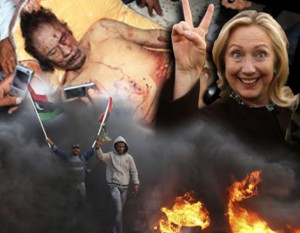
In 2011, he and then secretary of state Hillary Clinton bore full responsibility for the rape and destruction of Libya, transforming Africa’s most developed country into a cauldron of endless violence, instability, turmoil and unspeakable human suffering – the aftermath of all US imperial wars.

They flagrantly violated international, constitutional and US statute laws – attacking another country threatening no others, killing tens of thousands of noncombatant men, women, children, the elderly and infirm.

They were warned in advance of chaotic conditions following an attack but went ahead anyway. They knew extremist groups would flourish in its aftermath – ISIS, Al Qaeda and others Washington supports.

Libya today has no central authority. Based in Tripoli, US-installed puppet rule (the so-called Government of National Accord – GNA) controls one small part of the country – a rival Benghazi government, disparate groups and tribes most of it.

Endless violence, disorder, human deprivation and misery reflect daily life – the legacy of America’s “humanitarian intervention” and “responsibility to protect” – code language for naked aggression, war OF terror on humanity, the horror no one can imagine without experiencing it firsthand.

Last year, war correspondent Jon Lee Anderson said “(t)here is no overstating the chaos of post-Qaddafi Libya.” Various elements compete for control. “Armed militias roam the streets…(N)early a third of the country’s population has fled across the border to Tunisia.” Others head for Europe – treated with disdain and internment under concentration camp conditions on arrival.

No country may attack another except in self-defense and only if authorized by Security Council members. In 2007, candidate Obama, a one-time University of Chicago Law School senior lecturer, said the following:

“The president does not have power under the Constitution to unilaterally authorize a military attack in a situation that does not involve stopping an actual or imminent threat to the nation.”

He’s terror-bombed seven countries and used terrorist foot soldiers to do his dirty work since taking office. He repeatedly lied to the public about his actions.

Time and again he’s proved lawless, ruthless and never to be trusted. Raping Libya a second time has nothing to do with protecting America’s “national security interests” or restoring stability to a war-torn country – everything to do with US imperial viciousness.

Obama saying the United States, Europe and other countries “have a great interest in seeing stability in Libya because the absence of stability has helped to fuel some of the challenges that we’ve seen in terms of the migration (sic) crisis in Europe and some of the humanitarian tragedies that we’ve seen in the open seas between Libya and Europe” ignored America’s responsibility for transforming a stable nation under responsible leadership into dystopian hellishness.

He massacred Libyans mercilessly while claiming he “did the right thing (by) preventing what could have been…a bloodbath in Libya…”

On Tuesday, he lied calling indefinite aggression a “30-day mission” – on the phony pretext of combating the scourge of ISIS Washington created and supports.

He’s raped Libya since 2011, new terror-bombing continuing where earlier assaults left off, virtually certain to go on indefinitely, perhaps with varying degrees of intensity, supplemented with US and other NATO special forces on the ground operating covertly.

His tenure ends in January. If Hillary succeeds him, perhaps she’ll turn the entire region and beyond ablaze.


Stephen Lendman lives in Chicago. He can be reached at lendmanstephen@sbcglobal.net. His new book as editor and contributor is titled “Flashpoint in Ukraine: US Drive for Hegemony Risks WW III.”

http://www.claritypress.com/LendmanIII.html

Related Article: Libya: The US is now bombing a state it has already destroyed

#Brexit confirms: the neoliberal center cannot hold

eu-broken1-701x351

By Jerome Roos

Source: ROAR Magazine

The post-Brexit pandemonium has less to do with Britain’s relationship to Europe than it has with elites losing control over the monsters they have created.

Britain finds itself in a general state of pandemonium. The UK is in the midst of a full-blown constitutional crisis, Prime Minister David Cameron has resigned, and both the country’s governing party and the opposition are in the throngs of a fierce internal power struggle.

As the cheerleaders of the leave campaign dither with no clear plan on how to move forward, the financial consequences continue to ripple through the City: within days, the pound collapsed to its lowest level since 1985, the government’s credit rating was slashed by two full points, and world markets were sent into a tailspin, with a record $3 trillion shaved off stock values on Friday and Monday alone. As if things could not get any worse, recent days have also seen reports of an epidemic of hate crimes spreading across the UK.

Reading the headlines, one could easily be forgiven for experiencing the creeping sensation of living through the postmodern equivalent of the apocalypse: the financial press is providing minute-to-minute coverage of the “battering” of world markets; liberal establishment columnists repeatedly declare this to be Britain’s and Europe’s “worst crisis” since the Second World War; and the New York Times has already held Brexit up as the telltale sign of a world order that is slowly falling apart.

To top it all off, a hysterical Tony Blair took to the same pages last weekend to make a desperate plea in defense of globalization and for more of his failed Third Way recipe, proclaiming in characteristic platitudes that “the center must hold” ­— as if Yeats’ “blood-dimmed tide” and “mere anarchy” were about to be loosed upon the world once more.

The immediate cause for all the commotion is clear: Cameron’s risky bet to hold a referendum on Britain’s EU membership has backfired disastrously. The unexpected victory for the leave camp has shaken both Unions to their very core, dividing left and right on either side of the Channel and burning all bridges between them. There is no denying the historic nature of these developments; the world is a different place after last Thursday, and it is clear that Europe and Britain now find themselves in uncharted territory.

Yet the unspeakable truth is that, at a deeper level, the financial fallout and political pandemonium of recent days has less to do with Britain’s place in Europe than it has with the widening gulf between political elites and European citizens more generally. While racism and anti-immigrant sentiment have been central to the leave campaign from the very start, it is difficult to believe that all 52 percent of Britons who voted leave are committed fascists. Many of these people are ordinary working class folks who are simply fed up with the erosion of their living standards, the disintegration of their communities, and the lack of responsiveness of their political representatives and the unaccountable technocracy that has “taken control” over their lives. Brexit was first and foremost a political statement by the dispossessed and disempowered.

The reason this statement has proven so explosive is because the referendum happened to sit on the convergence point of a number of profoundly unstable social and political fault-lines, all of which were shaking well before Brexit, all of which would have trembled even in the absence of Brexit, and all of which will continue to quake and thunder for a very long time after Brexit. It is highly unlikely that a victory for remain would have produced a very different outcome in the long run — it would certainly not have stemmed any of the discontent, pacified any of the social tensions, or resolved any of the political conflicts that underlie the referendum’s shock outcome.

While Brexit clearly hands victory to the bigots of UKIP and the Tory right, a victory for remain would simply have perpetuated the anti-democratic neoliberal masochism that produced the motivation for people to align themselves with these bigots in the first place. In this light, we have to stop seeing the rabid nationalism of the far-right and the neoliberal cosmopolitanism of the pro-EU camp as polar opposites — in reality, the former is the logical outgrowth of the latter; its deformed Siamese twin in flesh and blood. The only thing the pro-EU camp was able to offer British voters was a continuation of the structural conditions that led to Brexit, combined with fanatical fear-mongering over the consequences of that outcome.

Ultimately, the British vote to leave the EU, whether it eventually materializes or not (and there is no guarantee that it will), is symptomatic of a much deeper and much more debilitating crisis: a structural crisis of democratic capitalism that has in recent years evolved from a global financial crisis into a deepening legitimation crisis of the political establishment, which is now in turn exploding into a full-blown crisis of governability of the existing social and political order. The fault-lines currently opening up in British and European politics would have eventually laid waste to the stability of the continent’s postwar order regardless of the outcome of this particular referendum. Brexit will simply speed up that ongoing process of political decomposition.

It is important to remember in this respect that David Cameron did not call this referendum because he truly cared about the opinion of ordinary people on the EU. Like Alexis Tsipras last year, he called the referendum in a risky and desperate gambit to keep his flailing party together — to silence the Tories’ eurosceptic right wing, disarm the constant backbencher challenges to his leadership, and inoculate the government against future defections to UKIP. This vote was never really about the EU; it was about one of the figureheads of Europe’s crumbling neoliberal center trying to reassert his hold over a party that was once the stable bedrock of the UK’s landed aristocracy and its metropolitan bourgeoisie, but that is now rapidly disintegrating in the face of a resurgent reactionary right.

The ongoing coup against Jeremy Corbyn similarly has little to do with Europe. As an article in the Telegraph from June 13 confirms, Labour MPs and the Blairite wing of the party have been plotting an anti-Corbyn revolt for weeks, if not months, aiming to bring down their leftist leader in “a 24-hour blitz” after the referendum, regardless of its outcome. Again, this is not about the EU; it is about the incompetent lackeys of a crumbling neoliberal center trying to reclaim their hold over a party that was once Europe’s most enthusiastic cheerleader of neoliberalism, financialization and overseas military intervention, but that is now rapidly disintegrating — or realigning itself — in the face of an insurgent “hard” left.

In this respect, Blair’s apocalyptic reference to Yeats in his New York Times opinion piece was awkwardly on point: things are falling apart; the center cannot hold. This is the crux of the matter, and it helps explain the hysterical doomsday discourse of the centrist establishment: their globalized post-democratic fantasy world is crumbling before their very eyes, as their once-passive voter-cum-consumer base is suddenly gobbled up and mobilized by a motley crew of “angry populists” who thrive on the electoral spoils of a crippling legitimation crisis and feast on the popular discontent sowed by years of austerity and decades of neoliberal restructuring.

The answer to the steady disintegration of the established political order clearly cannot be more of the same. Against Blair’s hopeless cries that “the center must hold”, and against the thinly-veiled conspiracies of his neoliberal acolytes in Parliament — who are now closing in on Jeremy Corbyn in a last-ditch attempt to reclaim the Labour Party and destroy from within, once and for all, the only political force that could possibly pose an electoral counterweight to the far-right in this defining moment in British history — against all of these turncoats, the left must stand firm and insist: the center will fall.

But to avoid ceding the resulting void to the racists and reactionaries, the weakened and dispersed forces of the left will need to rally in face of the historic battles now coming their way. Despair as one may, this means the choice is now fairly straightforward: it’s Corbyn or nothing. Not because the embattled Labour leader will bring democratic socialism or fully automated luxury communism to a newly independent Britain, but because this decent, principled leftist is now the only bulwark still standing between ordinary working people of all colors, and the monsters that are about to be unleashed on them.

About the author:

Jerome Roos is the founder and editor of ROAR Magazine, and a researcher in International Political Economy at the European University Institute. For more on his research and writings, visit jeromeroos.com.

Government, Terrorism, Money, Education and Other Important Discussions

images

By Phillip J. Watt

Source: The Mind Unleashed

The elite power structure – which uses the monetary system, war, false flags and the monopolized media as their primary mechanisms of control – has infiltrated every major government of the Western World. How do we know this? It’s simple; if they hadn’t been hijacked, then governments would have already begun a process of revolutionizing the way in which our societies are organized so that it benefits all of us, not just a select few.

The US Presidential race and two of its candidates have shown a small amount of hope for real change in America, something that not just its citizens desperately need, but the entire world too. Once the game is changed in the US – so that the government no longer works for those in control of the multinational and banking corporations – it will undoubtedly reverberate around the world.

Clinton is obviously a mouthpiece of the status quo and therefore cannot be trusted to enact real change. After all, she is an oligarch. On the other hand, Sanders and Trump appear to be anti-establishment, but are they really? It’s difficult to really know, because they could be controlled opposition. Yet even if they are separate to the existing order, can we really trust that they’ll do the job that the world’s peoples, and the environment, truly need?

Actions always speak louder than words, so regardless of the rhetoric of Trump and Sanders, does their policy agenda actually align to the truths that have been exposed by the many independent social researchers who are doing a wonderful job for the betterment of humanity?

Read below and decide for yourself.

The Real Policies for Change

This list is by no means exhaustive, but it reflects the fundamental shifts that we should be implementing in the short term to move into a new era of health and prosperity for humanity, and the environment we inhabit. In other words, these changes are the first essential steps if we want to overcome the dysfunction and deception that plague the hearts and minds of the people, as well as the systems that guide our collective activity.

If a political party or politician does not discuss these topics in general, then they are not aligned to the changes that we need, and therefore true progress. This is most likely because of two reasons; ignorance and/or corruption.

In any case, the exact way forward in each area is of course open for debate, but there must be an open and transparent dialogue held among the people. Simply, we all need to understand not just the issues, but the potential solutions to them.

This is obviously happening within conscious circles and progressive movements, however it’s not yet active within the mainstream mentality. This is just more evidence which illustrates that our politicians have failed us; that’s because it’s their job to bring these issues to the light of day so that everybody can participate in their resolution, if they so choose.

1. Monetary Policy: The way the economy is designed must rid society from the saturation of debt, move beyond indebtment to the oligarchs, cease the creation of fake currency by banks, overcome economic slavery by making the currency supply one of value and guarantee that local economies prosper.

2. Taxation Policy: The tax burden put on the people and the evasion of tax by multinational corporations needs to be resolved. One such method is abolishing all taxes and implementing a 2% debit-transaction taxso that citizens pay less tax, all individuals and businesses pay their fair share and there is an abundance of revenue to heal the wounds of a decaying society.

3. Budgeting Policy: Government revenues must be effectively and efficiently utilized to ensure the development of robust social services, increased wealth equality, the eradication of poverty, widespread sustainable practices, appropriate national defense programs and necessary infrastructure.

4. Defense and Foreign Policy: With unjust wars and false flag terrorism being the norm of the 21st Century, any decision to go to war must be sanctioned by the people via referendum. The reasons must be transparentally documented and validated as based in truth. All events at home and abroad that impact the decision-making of defense and foreign relations must be subject to robust and open investigations. Because national security is the first priority, all international relations should be treated diplomatically as the first line of defense.

5. Media Policy: The way in which information is disseminated throughout society must not be managed by monopolies, or a government. Media must be an open source platform where independent investigations are implemented and presented without bias. Any monopoly on the media must be disassembled so that the populace has unrestricted access to all the information necessary for the health and well-being of each individual and the community as a whole.

6. Education Policy: The way in which our children are educated is an indoctrination into the status quo, particularly economically and politically. The education system must therefore ensure that all children exercise their right to gain access to information that will help them to grow into healthy, happy and honorable adults, as well as question the way in which we organize society so that we can evolve it in alignment with our needs.

7. Governmental Policy: The amalgamation of government and business needs to be dissected. Politicians and bureaucrats are servants of the people and therefore must be representative of the needs and wants of the people. Moreover, government intervention of individual liberty and the free market must be also reduced.

8. Energy Policy: There is no longer any need to rely on fossil fuels, so creating the energy that society needs must be replaced with renewable resources – such as solar, air, water, wave, plant and free-energy technologies. Energy must also be made cheaply available to the public.

9. Health Policy: All foods and so-called medicines which impact the long-term health of the people must be labelled appropriately. Health programs that support emotional, psychological, philosophical, physical, spiritual, social and behavioral vitality must also be deeply embedded into schooling and other educational platforms. Holistic and preventative approaches to dis-ease must also be brought to the forefront of health education instead of relying on a symptomatic and prescriptive medical framework.

10. Medicine Policy: The pharmaceutical monopolies must be transformed into meeting the needs of the people, not shareholders and their profits. All natural and cheap remedies to disease – such as plant-based medicines and meditation – must be fully documented and reincorporated back into health education.

11. Housing Policy: Every person has a right to live in safe, comfortable and affordable housing. No individual should be homeless, unless by choice. Employment and Housing Policy must also be designed to ensure that the purchase of land is affordable and achievable for all.

12. Food Policy: The damaging impacts of industrial agriculture on earth’s natural systems, as well as the erosion of local economies (which is the direct result of trade agreements that primarily benefit the multinationals), needs to be reversed. One such way is by replacing it with a localized/regionalized Permaculture model where individuals and communities are supported to grow their own produce. This will help to increase local employment, as well as reconnect people to nature, the food they eat and their health requirements. In addition, all foods must be properly labelled and contain no toxic ingredients. GMOs must also be abandoned and organic foods must be readily available.

13. Water Policy: All citizens have a right to access safe and clean water. They should be supported to capture their own water needs. Where this is not possible, no toxins such as fluoride will be added to the water supply.

14. Animal Policy: All animal agriculture systems must respect the health and happiness of those animals. They must not subject them to any conditions in which they consistently suffer. One particular approach would be to incorporate it into a widespread permaculture model, in which animals are treated humanely.

15. Environmental Policy: Any practice that is environmentally unsustainable and negatively impacts the health and diversity of our natural systems is to be transformed into the opposite. The increasing extinction of animal and plant life must be reversed, as well as the trends of deforestation, ocean acidification and desertification.

16. Drug Policy: The war-on-drugs has been an epic failure because it has generated more crime, addiction, mental health problems and sent the market underground. It has also stigmatized the natural right to explore one’s own body and consciousness. The therapeutic and developmental aspects of so-called illegal drugs must be holistically researched so that society can be educated on both their positive and negative impacts. All illegal substances must be made legal, as they have begun to do in some countries, and a thoroughly-informed society must have safe access to pure substances for their own therapeutic, developmental and leisurely needs.

17. Sovereignty Policy: All citizens have natural rights, some of which have eroded through the recent policies of Western Governments. One example is privacy and another is the right to protest. This stripping of our rights needs to immediately stop and all rights aligned with natural law are to be reintroduced. No flesh and blood person should be treated as a legal fiction that works for a corporation impersonating as a government. This means that no legislation can impede on the natural laws that all individuals have a right to exercise.

18. Immunization Policy: All vaccines must be robustly studied independent of the pharmaceutical industry and the results made available to the public. All previous disease and death resulting from vaccines must also be publicly available. None will contain any ingredients other than to immunize against a specific disease. In addition, no child or adult will be forced or coerced into taking vaccines; every person must have their natural right to choose intact.

19. Atmospheric Policy: All geoengineering and chemical spraying programs are to immediately cease. The impacts that these programs have already had on the health of humanity, as well as the environment, must be holistically investigated and reversed.

20. Social Security Policy: Pensioners, people with a disability and other persons who require financial support must be treated with respect and must be able to comfortably live above the poverty line. Where possible, they will be supported to increase their education, training and skills so that they reenter the workforce. There should also be widespread volunteering programs with inherent incentives so the knowledge, skills and services of the elderly can be utilized for the benefit of the community.

Further Thoughts

There are many more areas that need to evolve, but its important to focus on the priorities in such as short piece. No doubt, many of you reading this would have been shocked and confused by some of the information herein. You might have even rejected elements to it, because it might have seemed too conspiratorial or challenging to believe. That’s okay; every single one of us who have woken up to these realities felt the same the first time we heard them too.

In any case, if you’d like to do follow up research, the links provided above will help you to initiate the process. Go deep too; it’s only when we individually undertake our own independent and robust research that we can come to a solid understanding of the true state of the world. The tip of course is to not be fooled by the propaganda narratives of the matrix-media and ensure we undertake research through the independent channels and progressive social researchers.

Furthermore, the above plans of attack are designed for the short to mid term. This does not discount the deeper agenda of moving from an economy of scarcity, to one of abundance. There are many models to achieve this, such as several resource-based economies, but until we build the foundations and start moving in that direction we have to work with what’s in front of us, right now.

In addition, of course it’s necessary to build new systems outside of the existing model to make the old ones redundant, yet we still need to use the systems that we’ve got and aim to transform society from within. After all, a balanced and holistic approach, is always the right approach.

Final Thoughts

Never has a government exposed all of the above issues. They might touch on some of them to some degree, but unfortunately we don’t have so-called leaders who actually call out the real challenges that we collectively face. There’s no doubt that some politicians know about these actualities, but the reality is they don’t publicly disclose it in fear of losing their credibility, or their livelihood.

But things are changing. Not only are more and more people joining the awakening community by educating themselves and taking action in response to these dysfunctions, but there are also political parties forming who dare to expose these truths to their audience and design robust policies in response. One such group is The Australian Sovereignty Party (ASP); in fact, many of the links above will direct you to the policies they’ve designed to rectify the failures of past governments.

Many parties around the world could learn a thing or two from this political force.

If you’re Australian, I highly encourage you to read the policy material at their website and join if their ethos resonates with you. Any person from around the world can join as an affiliate member too, so anyone is more than welcome to sign up to learn about how a true political party works. In addition, share this article and the ASPs progressive policies among your friends and family so that the momentum builds to bring Australians (and others) up-to-date with a political outfit that actually represents the real needs of you, me and all of us.

If you also believe in transforming our world into a better place, then at the very least research their policies. I know you’ll be pleasantly surprised (view their website here and follow them on facebook here). Furthermore, following is an interview I did with the President of the ASP, Daniel Huppert. In it he discusses many of the issues found in this article and the ASPs policy response to them. Enjoy.


ABOUT THE AUTHOR

Phillip J. Watt lives in Australia. His written work deals with topics from ideology to society, as well as self-development. Follow him on Facebook or visit his website.