Written in History: The Death of America’s Hyper-Power Fantasy

By Martin Sieff

Source: Strategic Culture Foundation

In 1987, Paul Kennedy, a British professor of history at Yale University, unleashed a political and intellectual firestorm with the publication of his great (677-page) book, “The Rise and Fall of the Great Powers.” Kennedy produced a magisterial overview of the competition for global power over the past 500 years from 1500 AD to the present.

Kennedy proposed the thesis that any power that achieved, imagined it had achieved or sought to achieve and maintain a dominant hyper-power role of global dominance was doomed to lose it and then rapidly decline in overall power, wealth, prosperity and influence.

Kennedy argued – with a wealth of detail drawn from different nations over his vast period of half a millennium – that the very attempt to achieve and maintain such power forced every nation that attempted it into a ruinous pattern of strategic overstretch.

This demanded every major global empire in their turn to devote ruinously far too many economic resources to unproductive military power and ever more costly global commitments and conflicts.

The more ambitious the commitments, the quicker came military defeat, economic ruin and national collapse, Kennedy documented.

Kennedy published his book however at exactly the wrong moment for its abundantly documented conclusions and arguments to be taken seriously in the United States. The Cold War was just ending. The heroic actions of the Russian people in rejecting communism and leading in the dismantling of the Soviet Union were being misinterpreted as an eternal and lasting victory for the United States and for the forces of free market capitalism and minimum government regulation.

Kennedy was therefore subjected to a furious firestorm of abuse, especially from the emerging neoconservatives who under President George W Bush succeeded in imposing their reckless policies on nations across the Middle East and Eurasia. Kennedy, unlike his enraged critics was a gracious and tolerant gentleman as well as great scholar and took the firestorm in his stride.

Now more than 30 years after Kennedy published his great work, we can see how prescient, wise and visionary it truly was.

In 2016 President Donald Trump was elected on a platform of dealing with domestic crises raging from economic ruin and impoverishment to an out of control drug and opioid abuse epidemic and the collapse of law and order across the long US land border with Mexico.

That outcome provided telling testimony to the previous US policies of wasting at least $2 trillion on entirely unsuccessful nation-building and government-toppling projects ranging from Iraq to Afghanistan and since extended into such nations as Ukraine, Syria, and Libya

All the national pathologies of bankruptcy, exhaustion, decline and ever spreading human misery that Kennedy in his book traced in previous empires can now be clearly delineated in the policies of the post-Cold War United States.

The bottom line lesson to be drawn from Kennedy’s great book that so outraged neoconservatives at the time was a simple and stunning clear one: Unipolar Moments are just that and nothing more. They last for moments not ages.

Instead, the very attempt to maintain a unipolar moment of apparent global supremacy by any power automatically instead will raise up a host of challenges to that power that will rapidly exhaust and then doom it.

Kennedy traced this process of inexorable over – commitment and decline in 17th century Habsburg Spain. He followed it again in 18th century Bourbon France. He documented it once more in the rise, pride and inevitable fall of the British Empire and in the rash German attempts to create dominant global empires in both world wars of the 20th century.

A generation before Kennedy published his great work, British historian Correlli Barnett, focusing only on the British Empire, published in 1972 his own classic “The Collapse of British Power.” Barnett focused on a one, single unipolar moment – the 1920s and 1930s when the British ruling class, like their American successors today imagined that they were the divinely-appointed global policeman charged by Providence with maintaining their own conceptions of right and wrong over the whole world.

The British at least were reluctantly forced to cede independence to their vast global territories. It is doubtful whether the American people will be so lucky: The US Deep State establishment and their tame, unthinking media puppets remain blindly committed to inflexible expansion, conflict and strategic gambling with the peace and even survival of the world.

Thirty years after his magnum opus was published, Paul Kennedy’s message of warning remains unheeded. America’s Unipolar Moment is long since dead and gone. America’s pretensions to rule supreme as the world’s unchallenged hyper-power have become a dangerous and unsustainable fantasy.

A wakening to sanity is long overdue and the hour is late: National catastrophe can be the only other outcome.

America’s Social Depression Is Accelerating

By Charles Hugh Smith

Source: Of Two Minds

We need to value honesty above optimism. Once we can speak honestly, there is a foundation for optimism.

Beneath the rah-rah statistics of “the greatest economy ever,” the social depression is accelerating. The mainstream is reluctantly waking up to the future of the American Dream: downward mobility for all but the top 10% of households. A 2015 Atlantic article fleshed out the zeitgeist with survey data that suggests the Great Middle Class/Nouveau Proletariat is also waking up to a future of downward mobility: The Downsizing of the American DreamPeople used to believe they would someday move on up in the world. Now they’re more concerned with just holding on to what they have.

I have been digging into the financial and social realities of what it takes to be middle class in today’s economy for years: Are You Really Middle Class?

The reality is that the middle class has been reduced to the sliver just below the top 5%–if we use the standards of the prosperous 1960s as a baseline.

The downward mobility isn’t just financial–it’s a decline in political power, control of one’s work and income-producing assets. This article reminds us of what the middle class once represented: What Middle Class? How bourgeois America is getting recast as a proletariat.

The costs of trying to maintain a toehold in the upper-middle class are illuminated in these recent articles on health and healthcare–both part of the downward mobility:

Health Care Slavery and Overwork

How a toxic workplace could, literally, destroy your health

We’re afraid our work is killing us, and we are right

This reappraisal of the American Dream is also triggering a reappraisal of the middle class in the decades of widespread prosperity: The Myth of the Middle Class: Have Most Americans Always Been Poor?

Downward mobility excels in creating and distributing what I term social defeat: In my lexicon, social defeat is a spectrum of anxiety, insecurity, chronic stress, powerlessness, and fear of declining social status.

Downward mobility and social defeat lead to social depression. Here are the conditions that characterize social depression:

1. High expectations of endless rising prosperity have been instilled in generations of citizens as a birthright.

2. Part-time and unemployed people are marginalized, not just financially but socially.

3. Widening income/wealth disparity as those in the top 10% pull away from the shrinking middle class.

4. A systemic decline in social/economic mobility as it becomes increasingly difficult to move from dependence on the state (welfare) or one’s parents to financial independence.

5. A widening disconnect between higher education and employment: a college/university degree no longer guarantees a stable, good-paying job.

6. A failure in the Status Quo institutions and mainstream media to recognize social recession as a reality.

7. A systemic failure of imagination within state and private-sector institutions on how to address social recession issues.

8. The abandonment of middle class aspirations by the generations ensnared by the social recession: young people no longer aspire to (or cannot afford) consumerist status symbols such as luxury autos or homeownership.

9. A generational abandonment of marriage, families and independent households as these are no longer affordable to those with part-time or unstable employment, i.e. what I have termed (following Jeremy Rifkin) the end of work.

10. A loss of hope in the young generations as a result of the above conditions.

The rising tide of collective anger arising from social depression is visible in many places: road rage, violent street clashes between groups seething for a fight, the destruction of friendships for holding the “incorrect” ideological views, and so on. I Think We Can Safely Say The American Culture War Has Been Taken As Far As It Can Go.

A coarsening of the entire social order is increasingly visible: The Age of Rudeness.

Depressive thoughts (and the emotions they generate) tend to be self-reinforcing, and this is why it’s so difficult to break out of depression once in its grip.

One part of the healing process is to expose the sources of anger that we are repressing. As psychiatrist Karen Horney explained in her 1950 masterwork, Neurosis and Human Growth: The Struggle Towards Self-Realization, anger at ourselves sometimes arises from our failure to live up to the many “shoulds” we’ve internalized, and the idealized track we’ve laid out for ourselves and our lives.

The recent article, The American Dream Is Killing Us does a good job of explaining how our failure to obtain the expected rewards of “doing all the right things”(getting a college degree, working hard, etc.) breeds resentment and despair.

Since we did the “right things,” the system “should” deliver the financial rewards and security we expected. This systemic failure to deliver the promised rewards is eroding social mobility and the social contract while generating frustration, anger, etc.

We are increasingly angry at the system, but we reserve some anger for ourselves, because the mass-media trumpets how well the economy is doing and how some people are doing extremely well. Naturally, we wonder, why them and not us? The failure is thus internalized.

One response to this sense that the system no longer works as advertised is to seek the relative comfort of echo chambers–places we can go to hear confirmation that this systemic stagnation is the opposing political party’s fault.

We don’t just self-sort ourselves into political “tribes” online– we are congregating in increasingly segregated communities and states:.

Americans are moving to communities that align more with their politics. Liberals are moving to liberal areas, and conservatives are moving to conservative communities. It’s been going on for decades. When Jimmy Carter was elected in 1976, 26.8% of Americans lived in landslide counties; that is counties where the president won or lost by 20% of the vote.

By 2004, 48.3% of the population lived in these counties. This trend continues to worsen. As Americans move to their preferred geographic bubbles, they face less exposure to opposing viewpoints, and their own opinions become more extreme. This trend is at the heart of why politics have become so polarizing in America.

We’re self-sorting at every level. Because of this, Americans are only going to grow more extreme in their beliefs, and see people on the other side of the political spectrum as more alien.”

Part of the American Exceptionalism we hear so much about is a can-do optimism: set your mind to it and everything is possible.

The failure to prosper as anticipated is generating a range of negative emotions that are “un-American”: complaining that you didn’t get a high-paying secure job despite having a college degree (or advanced degree) sounds like sour-grapes: the message is you didn’t work hard enough, you didn’t get the right diploma, etc.

It can’t be the system that’s failed, right? I discuss this in my book Why Our Status Quo Failed and Is Beyond Reform: the top 10% who are benefiting mightily dominate politics and the media, and their assumption is: the system is working great for me, so it must be working for everyone. That’s the implicit narrative parroted by status quo mouthpieces.

The inability to express our despair and anger generates depression. Some people will redouble their efforts, others will seek to lay the blame on “the other” (some external group) and others will give up. What few people will do is look at the sources of systemic injustice.

Perhaps we need a national dialog about declining expectations, rising inequality and the failure of the status quo that avoids the blame-game and the internalization trap (i.e. it’s your own fault you’re not well-off).

We need ways to express our resentment, anger, despair, etc. that are directed at the source, the complex system we inhabit, not “the other.” We need to value honesty above optimism. Once we can speak honestly, there is a foundation for optimism.

Once We Awaken

By Rudy Avizius

Source: OpEdNews.com

Do you get a sense, that something is wrong
like that dissonance, that does not belong

As we move through the journey of life, many people are experiencing a sense of dis-ease, that something is off-kilter, that the narratives we are receiving do not match the reality we are experiencing. There is great hope in this knowledge because once one recognizes this dissonance the process of awakening begins.

Deep down way inside, you may have suspicions
that much what we’re told, are but veiled omissions

The narratives are controlled by a small handful of people who determine what issues and discussions we should be examining. As we watch the main stream news and follow social media, the news and discussions we see are mostly spectacle designed to boost ratings with little or no coverage of the real issues such as: our wars without end, corporate and big money control of government and media, or anything critical of the powers that be. Most of the journalists we see on the main stream media are basically celebrity faces who no longer practice journalism, but are simply parroting what those in power want them to say with little effort made to investigate and corroborate the stories. There is great hope in recognizing this knowledge, as it allows one to view the narratives more critically and to filter out what does not resonate with them.

Why do we listen, to those who would divide
those who leave us empty, with our humanity denied

  • Both of the main stream political parties support the Military/Industrial/Security Complex.
  • Both of the main stream political parties support the multiple simultaneous wars and occupations of other nations.
  • Both of the main stream political parties support a foreign policy of economic and military sanctions on nations that wish to pursue paths that do not fit interests of the global central banking system.
  • Both of the main stream political parties support their corporate donors over their constituents.
  • Both of the main stream political parties voted to extend the surveillance of citizens.
  • Both of the main stream political parties have made little or no attempt to stop the flood of big money into political campaigns.

However, the powers that be are very successful at projecting that there is a real difference between the two political parties. Both political parties are successful in getting people to fight each other over social issues that in the big picture are really not the key issues. Then, as long as the people are focused on fighting each other, those who orchestrated this fight enjoy the benefits of this effective diversion, keeping people from paying attention to the criminal syndicate that has taken over the government. There is great hope in recognizing this old divide and conquer tactic because once one does recognize it, one can stop fearing or hating “the other” and recognize that we have far more in common than what is dividing us. We can stop with name calling and finger pointing, and instead engage in meaningful conversations.

Why listen to those, with so little to tell
the very same ones who, have so much to sell

So many listen to the main stream media where sensationalism such as murders, car crashes, kidnappings, sex scandals and the like dominate the content. This is the same media where 90% of the media is owned by 6 corporations. One does not need a PhD to understand that this concentration of control over the narrative that people experience is not a positive development. Those that control the news keep the masses living in fear. This fear can take many forms, but often it is physical, economic, or social.

This is the same media that now has 36% of its hourly content filled with commercials. The fact that people are recognizing this is good news because they will become more discerning about who they give their money to. They will start to question whether they really need that product or service, or do they just want it.

Once we will awaken, things won’t be the same
we will manifest, an end to their game

Once we will awaken, the angels will observe
as those with dark souls, we’ll no longer serve

Our current political system has been totally corrupted by those with vast accumulations of money. This cuts across all ideologies and political party lines. This system of legal bribery has even been ratified by the highest court in the land which opened the floodgates to even more money corroding our system. How can someone represent you when they are being paid millions to represent others? What we need now goes beyond simple reforms and enters the realm of transformational change. Many articles and videos (mostly those in the alternative media space) connect these dots so that more and more people are becoming aware. This awareness or awakening is a critical step as it opens up the possibility for transformational change to take place.

The changes we are seeking will not take place from the top down, they will take place from the bottom up. Those who benefit from the current paradigm have little motivation to implement meaningful changes. Once we are ready to accept our own roles in this process, we will realize that what needs to happen is that we have to change ourselves. Once we stop playing their game of competing with each other, we will start cooperating instead. Local, self sufficient, and resilient communities will spring up like wild flowers in a field where they grow much of their own food, start their own currencies, and their citizens will stop buying from the big corporations, instead they will patronize their local businesses.

The current system of how we create and distribute money is at the very heart of most of the problems we face. It is absolutely amazing that people will work a significant portion of their lives away to earn money, and yet have only the most elementary understanding of how our debt based monetary system works. What does debt based monetary system mean? When was the last time your main stream media covered this? When was the last time your school taught you this? Why is this information withheld?

This debt based monetary system perpetuates and amplifies the inequalities of how Earth’s abundant resources are distributed. Our very existence on this planet is being threatened as unlimited economic growth within a finite biosphere remains the current paradigm. Until we move to a totally new monetary system, we are only hacking away at branches, and not getting to the root of the problem. There can be no effective transformation of our societies until this happens.

The models for a new monetary system are already in place. However the private individuals who have been given the monopoly power to create money and are benefiting from the current system will fight to make sure that knowledge of these systems does not spread widely. Those benefiting from the current system will work hard to make sure it stays firmly entrenched. When was the last time you heard a corporate media network discuss monetary reform?

Once we have local control of moneyfood productionenergy generation,and governance, the current paradigm of corporate and big money control of our systems will simply become obsolete. It will simply fade into oblivion as it becomes less and less relevant. There will be no need to confront the system. Once we awaken and change our ways, we will “manifest an end to their game”.

Those who sell their souls, for their daily bread
may not take the time, to think of what’s ahead

There have always been those who would sell their souls and use the excuse “it’s my job” to justify their actions. From those who tortured Jesus to more modern times with concentration camp guards to even more currently the mercenaries who were hired to confront those seeking to protect their water supplies from pipeline companies.

Think about this, these mercenaries are people who left the communities they pledged to “protect and serve” to answer a call to “protect and serve” corporate interests in another community, while these same corporate interests were placing local people’s water supplies at serious risk.

These mercenaries were the tip of the spear, there were many behind the scenes who acted as enablers for their behaviors. There were the corporate executives, prosecutors, judges, minor bureaucrats, and politicians without whose support, such injustices could never take place. Those who served helping these forces have “sold their souls for their daily bread.”

“It was my job” is not an acceptable response when it curtails the access of life sustaining necessities of fellow human beings.

It is very easy to develop an “I see nothing” attitude, or to allow oneself to be silenced by monetary gain by “playing along” with those who control and manipulate the system. It is time to witness, it is time to speak up, it is time to resist when you see injustice taking place.

Those that are insatiable, always seeking moar
ever quite so willing, to send others to war

Why do we accede, to their self served schemes
rather than just simply, following our dreams

Once we awaken we will no longer serve those who think only of themselves and their own self serving schemes. YOU can start making a huge difference by the way you spend YOUR money. Think about this, when you give your money to someone or some corporation, as you are transferring some of your your power to them. Is this really something you wish to do?

Do you shop at a local merchant or do you save that 35 cents by buying from Amazon? Do you give a percentage of every purchase to the big banks by using credit cards or do you pay in cash? Do you buy animal products humanely produced? Do you buy organic food or food produced using chemicals that threaten our ecosystem (and your health?) Do you bank at a “too big to fail bank” or a local community bank or Credit Union? Sometimes the lowest price or convenience is not the best buy and can carry an even higher unseen cost.

As we develop our own resilient local communities and economies, our dependencies on the corporate model will be reduced, weakening their tight grip on us. Mother Teresa once said “I alone cannot change the world, but I can cast a stone across the waters to create many ripples.”

Once we will awaken, we will clearly see
many of the others, who’ve also broken free

This is the best part of the awakening process. It is easy to think that the problems we face are overwhelming and that nothing can be done. The powers that be want us to think that way. Yet as we awaken, it becomes very clear that there are so many more of us that feel this same way than we originally believed. Once we awaken we become aware of others who have broken free. It is very empowering once we realize we are not alone. A critical mass is forming. It turns out that it takes only 10% of a population to bring about real changes.

We live in a world of abundance. There is enough air, water, and food for every person, animal, and plant on the planet. We have the resources and ability to make our existence here a paradise, to continue to develop socially, intellectually, emotionally, and spiritually. It is within our power to create a true golden age on this blue oasis floating through space and attain wondrous levels of development on a personal, family, community, regional, and global level while creating this paradise.

The War to End War 100 Years On: An Evaluation and Reorientation of our Resistance to War


By Robert J. Burrowes

British author and social commentator H.G. Wells may have coined the expression that originally popularized World War I as The War that Will End War, as his book, based on articles written during that vast military conflict, was titled. In any case, in one version or another, the expression was one of the most common catchphrases of the Great War of 1914-1918 and has survived as an expression, often used with a grimace of sarcasm, ever since.

As we commemorate the passing of the 100th anniversary of the armistice ending ‘the war to end war’, one can only marvel at how wrong humans can be sometimes. Not content with the violence inflicted during World War I, humans used the twentieth century to systematically decimate human and other life as violence and war raged across the planet with an increasingly massive and sophisticated armory. In fact, by mid-century, in a tribute to their technological ingenuity and psychological dysfunctionality, humans had invented a weapon that could destroy life on Earth.

And by the beginning of the 21st century, humans were living in the era of perpetual war against life – see ‘Humanity has wiped out 60% of animal populations since 1970, report finds’ and Living Planet Report 2018: Aiming Higher’ – with war also the largest contributor to the climate catastrophe: ‘Not only is the Pentagon the single largest industrial consumer of fossil fuels, but fighter jets, destroyers, tanks and other weapons systems emit highly toxic, carbon-intensive emissions, not to mention the greenhouse gases that are released from the detonation of bombs. How quickly the world forgot the toxic legacy of Saddam Hussein’s oil fires!’ See War and Climate Change: Time to Connect the Dots’.

So advanced is our war against life that human extinction is now imminent. See ‘Human Extinction by 2026? A Last Ditch Strategy to Fight for Human Survival’.


Resisting war historically

Of course, the failure to end war has not been the outcome of lack of effort. And while there have been many efforts focused on ending a particular war, efforts directed at ending a particular aspect of war (such as the use of a type of weapon), and efforts aimed at preventing a type of war (such as ‘aggressive war’ or nuclear war), there have also been ongoing efforts to achieve ‘the holy grail’: to end war itself.

These attempts have included ongoing grassroots mobilization by anti-war organizations spawned by World War I (such as the Women’s International League for Peace and Freedom founded in 1915 and War Resisters’ International founded in 1921) and many equivalents since that time, official attempts to outlaw war such as the Kellogg-Briand Pact that outlawed war in 1928 but has been ignored ever since – see League of Nations ‘Treaty Series’ vol. XCIV, 1929, p. 63 – and institutional efforts to prevent it, particularly by establishment of the League of Nations in 1920 and its successor the United Nations in 1945, both also readily ignored or manipulated.

Separately from the above, however, there has been a long history of nonviolent activism to end wars and this has been conducted by individuals and groups all over the world. Undoubtedly the most effective anti-war movement in history was that undertaken in response to the US war against Vietnam, Cambodia and Laos. Inspired and supported by the nonviolent resistance of the civilian population, and building on the long history of resistance to war within the military – see, for example, The Soldiers’ Strikes of 1919 – there was widespread nonviolent resistance undertaken by US troops and conscripts to end the US war against Vietnam, Cambodia and Laos from 1968 until it ended in 1975.

If you like, you can read detailed descriptions of the systematic and ongoing resistance (nonviolent and otherwise) within the US military, in many forms, which progressively incapacitated the US Army, Marine Corps, Navy and Air Force during the last years of the war, forcing the US out of Vietnam, Cambodia and Laos. See Soldiers in Revolt: GI Resistance During the Vietnam War and Self-Destruction: The Disintegration and Decay of the United States Army during the Vietnam Era with a summary of the first book in ‘Antiwar Resistance Within the Military During the Vietnam War’ and a review of it in ‘The soldiers’ revolt in Vietnam: Rebellion in the ranks’.

For a documentary account of the conscientious objection by more than half a million US conscripts to military service in South East Asia during this period, which overwhelmed the legal system making prosecutions beyond a token few impossible and, combined with soldier resistance and civilian efforts, forced Presidents Johnson and Nixon to curtail plans to escalate the war and make plans to end it, see the forthcoming film The Boys Who Said NO!


Reanalysing the Cause of War to Reorient our Resistance

So, if we are to use this 100th anniversary to renew our struggle to end war and to work effectively to achieve that purpose, then clearly we need to reassess our analysis of the cause(s) of war so that we understand the problem more precisely, and then use this revised analysis to guide the development and implementation of a strategy that addresses the cause(s). Of course, I am not suggesting that ending war will be easy, even with a sound analysis and a comprehensive strategy. But at least it will be feasible.

Before proceeding, I would like to record my own passion for this subject. I lost two great uncles to World War I: Tom Farrell was killed in action at Gallipoli and Les Burrowes was a victim of ‘shell shock’ – later labeled post-traumatic stress disorder – after being wounded in action three times at Gallipoli and then dying prematurely some years after the war.

My father served in World War II as a coastwatcher and both of his brothers, including his twin, were killed. I am named after my father’s older brother. Bob died when the Japanese POW ship Montevideo Maru was torpedoed by the USS Sturgeon on 1 July 1942. 1,053 Australian POWs died that night. And my father’s twin, Tom, died when his Beaufort Bomber was shot down on 14 December 1943 killing the entire crew.

So my childhood is dotted with memories of occasional commemorations of war which, for me, always ended with the same question: Why? But not just ‘why war?’ Given other manifestations of violence I observed around the world during my childhood, including exploitation of peoples in Africa, Asia and Central/South America as well as destruction of the environment, the deeper question was always my focus: ‘Why violence?’

Well, despite considerable research over three decades, I was never content with any version of the answer to this question that I found. Consequently, 14 years in seclusion with Anita McKone ‘taking our own minds apart’ finally gave me the answer I wanted. In ugly detail. If you would like to read this answer, which explains the unrelenting ‘visible’, ‘invisible’ and ‘utterly invisible’ violence that adults inflict on children and the enormous lifetime damage (including the legacy of unconscious fear, self hatred and powerlessness) that this causes, you can do so in Why Violence?’ with our process described in Fearless Psychology and Fearful Psychology: Principles and Practice.

Needless to say, understanding a problem makes developing a strategy to address it far easier (which does not mean that the problem is easy to resolve). However, it is also the case that violence has many manifestations – notably including war, violence against huge sectors of the human population in various contexts (ranging from violence against women and indigenous peoples to military occupations and dictatorships), economic exploitation and destruction of the biosphere – and tackling each of these effectively requires its own sophisticated nonviolent strategy.

This is partly because certain manifestations of violence are structural – see ‘Violence, Peace, and Peace Research’ – or cultural – see ‘Cultural Violence’ – as Professor Johan Galtung describes these terms, and they originated long ago and have been recreated and ‘built-in’ over successive centuries.

However, it is important to understand that the nature of any given structure or cultural symbol/process reflects the psychology of those who create and/or maintain it. That is, it is dysfunctionalized human beings who create and maintain dysfunctional (that is, violent and/or exploitative) structures and cultures.

So, for example, while the origin of capitalism can be explained in terms of the development of economic structures and processes that took place over preceding centuries (in a particular socio-political-legal setting), fundamentally the exploitative nature of capitalism is a direct outcome of the badly damaged psychology of those men who progressively created it and now those men (and some women) who maintain it, expand it and primarily benefit from the manner in which it exploits most others.

And if those men and women were not psychologically damaged by the violence they suffered during childhood, then they would devote their efforts to creating egalitarian economic structures and processes that benefited everyone equally and nurtured the biosphere. In short, a human being who is psychologically whole regards the idea of killing or exploiting a fellow human being as deplorable. This is not a moral stance. It is a psychological outcome for the child who is parented lovingly: such parenting produces compassionate identification with others (and, in fact, everything that lives and the biosphere as a whole).

The same reasoning applies to the institution of war particularly as it has evolved and is now conducted by western nations, led by the US, and their allies such as Israel. War is a method of conducting conflict. It has a great many components including elites who promote war-for-profit by using various channels such as ‘think tanks’, the corporate media, government propaganda and education systems to call for and ‘justify’ it, political processes to order it, legal processes to defend it (including against those who take nonviolent action against it), military command, control and communication structures to plan and implement it, corporations employing a labor force to manufacture weapons and other hardware to be used in it, military personnel to deploy and fire the weapons, and citizens willing to pay taxes (or too scared to resist doing so) to finance it.

But at every level of the institution of war, and despite vast advances in peace, conflict and nonviolence theory and practice during the past 60 years, it requires individuals who were terrorized during their childhood into believing that killing fellow human beings is an appropriate way to deal with conflict (or, a variation, that killing human beings is a reasonable way to earn a wage or make a profit). And because they are so psychologically damaged and now deeply embedded within the institution of war, consideration of alternatives to violence is only tokenistically contemplated, if at all (with occasional exceptions by those whose conscience survived the childhood violence they suffered). If you like, you can read a little more about how childhood violence creates insane individuals who perpetuate violence and war in articles such as ‘The Global Elite is Insane Revisited’ but there is plenty more on that website.

In essence, if most human beings were not so psychologically damaged by the violence inflicted on them during childhood (leaving them unconsciously terrified, self-hating and powerless), there would be a mass uprising against the barbarity of war: the large-scale industrial slaughter of people like you.


So what are we to do?

Well, if we consider war as an outcome not of political and economic differences manifesting as military violence but, fundamentally, as an outcome of psychological dysfunctionality preventing intelligent resolution of conflict, then our strategy for ending war can acquire a sophistication it must otherwise lack. Put simply, by understanding the psychological roots of violence we can develop and implement a strategy that intelligently addresses these, both in the short and medium terms.

So how do we tackle, strategically, the interrelated set of problems that constitute the institution of war?

If your primary interest is focusing on war itself, check out the Nonviolent Strategy Wheel which simply illustrates the 12-point strategic framework necessary to conduct an effective nonviolent campaign and then consider the basic list of 35 strategic goals necessary to end war. Choose one or a few goals appropriate to your circumstances and conduct a strategically-oriented nonviolent campaign, as explained on the same website, to achieve those goals.

If you are concerned that you need some form of military defense against those who might attack your country, it is actually strategically superior to use a strategy of nonviolent defense, which is explained in detail in The Strategy of Nonviolent Defense: A Gandhian Approach and presented more simply in Nonviolent Defense/Liberation Strategy. In fact, this strategic framework can be used to plan and implement a nonviolent strategy to defend against a foreign invading power or a political/military coup, to liberate your country from a dictatorship or a foreign occupation, or to defeat a genocidal assault.

As an aside, if your preferred focus is the climate catastrophe, some other assault on the biosphere or a social justice campaign of any kind, the Nonviolent Strategy website will assist you to develop a comprehensive and focused strategy.

When conducting any campaign, keep in mind a clear understanding of ‘Nonviolent Action: Why and How it Works’ and remember the distinction between The Political Objective and Strategic Goal of Nonviolent Actions’. By keeping these points in mind, your campaign (including each of your tactics) will be focused for strategic impact.

If your interest in ending war is more focused on undermining it at its source, consider making ‘My Promise to Children’ and nisteling, whenever appropriate, to children too. See ‘Nisteling: The Art of Deep Listening’.

This will mean that any children in your life are supported, at least by you, to become self-loving and powerful individuals who are immune to the seductions and indoctrination of those who advocate and make war while developing the capacity to pursue life-enhancing behavioral options when dealing with conflict.

If parenting children in this manner feels beyond you, consider allowing yourself the time to heal from the violence that you have suffered throughout your life. See Putting Feelings First’.

And don’t forget: while depending on our psychological dysfunctionality to accept, finance and conduct war as a means of dealing with conflict, at its most mundane level, war is a conflict over resources, particularly fossil fuels, strategic minerals and fresh water, and it is our consumption of these, in all of those products (such as meat and cars) and services (like airline flights) that we buy, that fuels the wars conducted in our name while also destroying the biosphere in various other ways. (If you want to understand the psychological origin of this obsession with material goods, see ‘Love Denied: The Psychology of Materialism, Violence and War’.) In short, there is no point deluding ourselves that we can subvert this violent world order without substantially reducing our consumption on all fronts.

So another way you can have strategic impact in undermining the institution of war (and capitalism), while slowing destruction of the biosphere, is to join those participating in ‘The Flame Tree Project to Save Life on Earth’. The Flame Tree Project outlines a simple plan for people to progressively reduce their consumption, by at least 80%, involving both energy and resources of every kind – water, household energy, transport fuels, metals, meat, paper and plastic – while dramatically expanding their individual and community self-reliance in 16 areas.

You might also be interested in signing the online pledge of ‘The People’s Charter to Create a Nonviolent World’ where the names of many people who are working to end war (and other violence) are already listed.

Ending war is not impossible. Far from it, in fact. But it is going to take a phenomenal amount of intelligent strategic effort, courage and commitment.


Biodata: Robert J. Burrowes has a lifetime commitment to understanding and ending human violence. He has done extensive research since 1966 in an effort to understand why human beings are violent and has been a nonviolent activist since 1981. He is the author of ‘Why Violence?’ http://tinyurl.com/whyviolence His email address is flametree@riseup.net and his website is here. http://robertjburrowes.wordpress.com

Robert J. Burrowes
P.O. Box 68
Daylesford, Victoria 3460
Australia

Email: flametree@riseup.net

Websites:
Nonviolence Charter
Flame Tree Project to Save Life on Earth
‘Why Violence?’
Feelings First
Nonviolent Campaign Strategy
Nonviolent Defense/Liberation Strategy
Anita: Songs of Nonviolence
Robert Burrowes
Global Nonviolence Network

Whither Russiagate?

By Philip Giraldi

Source: OffGuardian

Two years have passed since the 2016 presidential election. Allegations that foreign interference had influenced the result, perhaps decisively, began to surface even as the last ballots were being counted. Against all odds underdog Donald J. Trump had been elected president and the Establishment, which denigrated him throughout the campaign, had to find a scapegoat to explain their failure to elect the preferred candidate. The scapegoat turned out to be Russia.

The Robert Mueller led inquiry into the election has been running since May 2017. It has been tasked with determining whether the Trump campaign colluded corruptly with the Russian government to influence the outcome of the election. It has worked hard to delegitimize the president without that being its stated objective and has had a certain measure of success in doing just that.

But apart from a couple of low-level convictions for perjury, Mueller has come up with nothing that convincingly demonstrates that Moscow had some kind of plan to disrupt the elections and thereby damage American democracy. There was, to be sure, some Russian government sponsored probing and what might be described as attempted influencing, but that is what intelligence agencies do to justify their existence. The worst culprit when it comes to election interference worldwide is undoubtedly America’s own Central Intelligence Agency, which has been doing just that since 1947. But apart from some low-level activity, there has been nothing to suggest some kind of grand design orchestrated by Russian President Vladimir Putin to overthrow or cast into confusion the American government.

No one should ever let a good story line go to waste, so the U.S. mainstream media has bought into the proposition that Russia did both interfere in and influence the result of the election based on the assumption that where there is smoke there must be fire with little in the way of evidence being provided. Some media outlets have maintained that the margin of victory for Trump was actually “made in Russia,” meaning that he is ipso facto Moscow’s puppet. It should be noted that this is the same media that embraced Saddam Hussein’s weapons of mass destruction and transatlantic gliders back in 2002 and the Syrian use of chemical weapons more recently, suggesting that the relationship between demonstrated facts and what comes out in the reporting is very tenuous.

To keep the story fresh, both government and the media have now been suggesting that there has already been an attempt by Russia to interfere in the 2018 midterm election which will take place on Tuesday. The New York Times describes an “elaborate campaign of ‘information warfare’ to interfere.” On October 19th, federal prosecutors charged Elena Alekseevna Khusyaynova of St. Petersburg Russia, a woman whom they labeled the project’s “chief accountant.” She allegedly managed a budget to “sow division and discord” in the lead-up to the voting. The Times goes on to describe how “She bought internet domain names and Facebook and Instagram ads and spent money on building out Twitter accounts and paying to promote divisive posts on social media.”

And the list of culprits has also been expanded to include China and Iran, if one goes by PBS’s coverage of the story. One would not be surprised to see North Korea added to the list, as it is convenient to keep all of one’s enemies in one place, all on the march to destroy American democracy and its political institutions before the GOP and Democrats finally get around to doing it.

One might easily regard the never ending Russiagate saga as a bit of an amusement, but there are actually real-life consequences to corrupting the popular sentiment in a large and powerful nuclear armed nation like the United States by constantly discovering new enemies to stimulate the selling of newspapers and television ad time. At a minimum, phony threat accusations create paranoia and also mistrust in the institutions that are supposed to be protecting the country.

And there are also other less tangible consequences, namely that the constant crying wolf over the Russians and Chinese corrupting America’s political system actually does tell the voters that their vote does not matter as outside forces beyond their control will determine the result anyway.

Stephen Cohen, professor of Russian studies at Princeton University, has been arguing for some time that the pursuit of Russiagate and the various delusions that have become attached to it is doing grave damage not only to the bilateral relationship between Moscow and Washington but also to perceptions of the state of the U.S. political system. His latest article in The Nation entitled Who is really undermining American democracy? has as a sub-heading “Allegations that Russia is still ‘attacking’ US elections, now again in November, could delegitimize our democratic institutions.”

Cohen argues plausibly how the “undermine American democracy” meme may itself erode confidence in U.S. political institutions because if the trick of claiming outside interference can to be used successfully once it will be used again even after Trump is gone. If there are claims by losing candidates that Russia or some other foreign power interfered in the midterm this week it will inevitably jumpstart a witch hunt to find those congressmen who were “helped.” The legitimacy of congress itself will be in question.

Cohen also argues that “Russiagate has revealed the low esteem that many U.S. political-media elites have for American voters—for their ability to make discerning, rational electoral decisions, which is the bedrock assumption of representative democracy… Presumably this is a factor behind the current proliferation of programs—official, corporate, and private—to introduce elements of censorship in the nation’s ‘media space’ in order to filter out ‘Kremlin propaganda.’ Here, it also seems, elites will decide what constitutes such ‘propaganda.’”

It is the ultimate irony that the most powerful and least threatened country in the world – the United States of America-runs on fear. The obsession with possible foreign interference in U.S. elections reflects the fundamental insecurity of the elites that actually manipulate the system to benefit themselves and their constituencies. If the midterm results do not satisfy the Establishment and the “foreign menace” again is surfaced as causative it will, in truth, be the beginning of the end for American democracy as mistrust of the integrity of the government institutions will continued to be eroded. The alternative? Tell Robert Mueller to put his cards on the table and prove what is being generally accepted as true regarding Russia or fold up his tent and go home because he is no longer need.

Democrats rally to defend fired Attorney General Sessions, Special Counsel Mueller

By Tom Eley

Source: WSWS.org

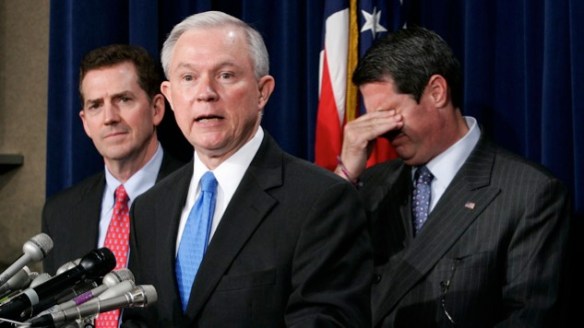
The Democrats and their fake “left” allies held war-mongering demonstrations in a number of cities on Thursday in defense of the fired far-right attorney general, Jeff Sessions, and the anti-Russia investigation being conducted by Special Counsel Robert Mueller.

Wednesday’s ouster of Sessions and his replacement by Trump ally Matthew G. Whitaker has brought forth a wave of condemnation from Democratic Party figures and their media allies, including the New York Times and Washington Post, asserting that the move is the prelude to Trump’s closing down of the Justice Department probe into allegations of Russian “meddling” in the 2016 elections and possible collusion by the Trump campaign.

Trump had repeatedly denounced Sessions for having recused himself from the Russia investigation in March of 2017, leaving Deputy Attorney General Rod Rosenstein, a defender of the investigation, in overall charge of its conduct. Whitaker, a former US attorney and now acting attorney general and therefore responsible for overseeing the Mueller probe, is on record criticizing Mueller and suggesting that the Justice Department could cut off funding for his office.

Mueller’s investigation has been at the center of a McCarthyite-style campaign against Russia spearheaded by the intelligence agencies and the Democratic Party, based on fabricated claims that Russian President Vladimir Putin interfered in the presidential election to undermine the candidacy of Democrat Hillary Clinton and boost Trump. It has been used as a weapon in the drive by the Democrats and sections of the military/intelligence establishment to force Trump to adopt a more aggressive posture against Moscow and in the war for regime-change in Syria.

To the extent that the Democrats oppose the right-wing Trump administration, it is on this entirely reactionary basis. In the lead-up to Tuesday’s midterm elections, they not only called no demonstrations, they were entirely silent on Trump’s fascistic attacks on immigrants, his deployment of troops to the border against the caravan of Central American asylum seekers, and his pledge to overturn the 14th Amendment guarantee of birthright citizenship—a cornerstone of the Bill of Rights.

Following the election, in which the Democrats won control of the House of Representatives, the party leadership called repeatedly for bipartisan unity and collaboration with Trump, underscoring their essential agreement with his policies of war, austerity and repression. It was only when Trump fired Sessions, a right-wing anti-immigrant zealot, that they swung into action, reviving their denunciations of Trump as a stooge of Putin.

The aim of shifting the Trump administration to a war footing against Russia has been achieved to the extent that there is now a substantial risk of nuclear conflict between the US and the second-leading nuclear power. War could quickly erupt in a number of flash points, especially Syria, where Russian soldiers, sailors and airmen carry out combat operations within miles of their American counterparts, as well as US-allied Islamist proxies armed by Saudi Arabia.

Though promoted in the media and sponsored by over 50 Democratic Party-linked organizations, including MoveOn.org, the rallies on Tuesday were small, reflecting the lack of support in the general population for the anti-Russia crusade. The protests were notable primarily for their unvarnished right-wing and neo-McCarthyite character.

Two of the largest were in Washington DC and New York City, which each drew roughly 1,000 demonstrators, many of whom held hammer and cycle posters with Putin’s image. Sessions began his career as a segregationist in Jim Crow Alabama and went on to become a right-wing Republican senator from the state. Mueller, for his part, was director of the FBI from 2001 to 2013, during which time he helped institute mass domestic surveillance and other sweeping attacks on democratic rights linked to the so-called “war on terror.”

At the Washington demonstration, Democratic Congressman Jamie Raskin led those in attendance in a round of applause for Sessions. Randi Weingarten, president of the American Federation of Teachers, appealed to the military against Trump, declaring, “You are the defenders of our democracy,” and led a chant of “protect Mueller.”

In defending Sessions, the Democrats and their allies are rallying around the most rightwing attorney general in American history, who, prior to joining the Trump cabinet, had won a well-earned reputation as a bitter opponent of civil rights. As attorney general, Sessions will primarily be remembered for the persecution of immigrants, most notably the separation of immigrant children from their parents and their imprisonment in detention camps built in the desert.

The task of spearheading the attack on immigrants and democratic rights will now fall, pending the installation of a permanent attorney general, to Whitaker, who has boasted that he interprets the Constitution from a biblical standpoint. His very first act as head of the Department of Justice was to issue, in conjunction with the Department of Homeland Security, a directive stripping the right to asylum from anyone who enters the US over the Mexican border and has not first gained legal status—a move that is tantamount to abolishing the right to asylum, which is guaranteed under international and US law.

This move, a new landmark in the attack on immigrants, due process and basic democratic rights, has been virtually ignored by the media and the Democratic Party. It was not mentioned in the press release calling Thursday’s demonstration, nor by speakers at the demonstrations in Washington and New York.

Time to Wake Up: the Neoliberal Order is Dying

By Jonathan Cook

Source: CounterPunch

In my recent essay, I argued that power in our societies resides in structure, ideology and narratives – supporting what we might loosely term our current “neoliberal order” – rather than in individuals. Significantly, our political and media classes, who are of course deeply embedded in this neoliberal structure, are key promoters of the very opposite idea: that individuals or like-minded groups of people hold power; that they should, at least in theory, be held accountable for the use and misuse of that power; and that meaningful change involves replacing these individuals rather than fundamentally altering the power-structure they operate within.

In other words, our political and media debates reduce to who should be held to account for problems in the economy, the health and education systems, or the conduct of a war. What is never discussed is whether flawed policies are the fleeting responsibility of individuals and political parties or symptoms of the current neoliberal malaise – manifestations of an ideology that necessarily has goals, such as the pursuit of maximised profit and endless economic growth, that are indifferent to other considerations, such as the damage being done to life on our planet.

The focus on individuals happens for a reason. It is designed to ensure that the structure and ideological foundations of our societies remain invisible to us, the public. The neoliberal order goes unquestioned – presumed, against the evidence of history, to be permanent, fixed, unchallengeable.

So deep is this misdirection that even efforts to talk about real power become treacherous. My words above and below might suggest that power is rather like a person, that it has intention and will, that maybe it likes to deceive or play tricks. But none of that is true either.

Big and little power

My difficulty conveying precisely what I mean, my need to resort to metaphor, reveals the limitations of language and the necessarily narrow ideological horizons it imposes on anyone who uses it. Intelligible language is not designed adequately to describe structure or power. It prefers to particularise, to humanise, to specify, to individualise in ways that make thinking in bigger, more critical ways near-impossible.

Language is on the side of those, like politicians and corporate journalists, who conceal structure, who deal in narratives of the small-power of individuals rather than of the big-power of structure and ideology. In what passes for news, the media offer a large stage for powerful individuals to fight elections, pass legislation, take over businesses, start wars, and a small stage for these same individuals to get their come-uppance, caught committing crimes, lying, having affairs, getting drunk, and more generally embarrassing themselves.

These minor narratives conceal the fact that such individuals are groomed before they ever gain access to power. Business leaders, senior politicians and agenda-setting journalists reach their positions after proving themselves over and over again – not consciously but through their unthinking compliance to the power-structure of our societies. They are selected through their performances in exams at school and university, through training programmes and indentures. They rise to the top because they are the most talented examples of those who are blind or submissive to power, those who can think most cleverly without thinking critically. Those who reliably deploy their skills where they are directed to do so.

Their large and small dramas constitute what we call public life, whether politics, world affairs or entertainment. To suggest that there are deeper processes at work, that the largest of these dramas is not really large enough for us to gain insight into how power operates, is to instantly be dismissed as paranoid, a fantasist, and – most damningly of all – a conspiracy theorist.

These terms also serve the deception. They are intended to stop all thought about real power. They are scare words used to prevent us, in a metaphor used in my previous post, from stepping back from the screen. They are there to force us to stand so close we see only the pixels, not the bigger picture.

Media makeover

The story of Britain’s Labour party is a case in point, and was illustrated even before Jeremy Corbyn became leader. Back in the 1990s Tony Blair reinvented the party as New Labour, jettisoning ideas of socialism and class war, and inventing instead a “Third Way”.

The idea that gained him access to power – personified in the media narrative of the time as his meeting with Rupert Murdoch on the mogul’s Hayman Island – was that New Labour would triangulate, find a middle way between the 1 per cent and the 99 per cent. The fact that the meeting took place with Murdoch rather than anyone else signalled something significant: that the power-structure needed a media makeover. It needed to be dressed in new garb.

In reality, Blair made Labour useful to power by re-styling the turbo-charged neoliberalism Margaret Thatcher’s Conservative party of the rich had unleashed. He made it look compatible with social democracy. Blair put a gentler, kinder mask on neoliberalism’s aggressive pursuit of planet-destroying power – much as Barack Obama would do in the United States a decade later, after the horrors of the Iraq invasion. Neither Blair nor Obama changed the substance of our economic and political systems, but they did make them look deceptively attractive by tinkering with social policy.

Were the neoliberal order laid bare – were the emperor to allow himself to be stripped of his clothes – no one apart from a small psychopathic elite would vote for neoliberalism’s maintenance. So power is forced to repeatedly reinvent itself. It is like the shape-shifting Mystique of the X-Men films, constantly altering its appearance to lull us into a false sense of security. Power’s goal is to keep looking like it has become something new, something innovative. Because the power-structure does not want change, it has to find front-men and women who can personify a transformation that is, in truth, entirely hollow.

Power can perform this stunt, as Blair did, by repackaging the same product – neoliberalism – in prettier ideological wrapping. Or it can, as has happened in the US of late, try a baser approach by adding a dash of identity politics. A black presidential candidate (Obama) can offer hope, and a woman candidate (Hillary Clinton) can cast herself as mother-saviour.

With this model in place, elections become an illusory contest between more transparent and more opaque iterations of neoliberal power. In failing the 99 per cent, Obama so woefully voided this strategy that large sections of voters turned their back on his intended successor, the new makeover candidate Hillary Clinton. They saw through the role-playing. They preferred, even if only reluctantly, the honest vulgarity of naked power represented by Trump over the pretensions of Clinton’s fakely compassionate politics.

Unstable politics

Despite its best efforts, neoliberalism is increasingly discredited in the eyes of large sections of the electorate in the US and UK. Its attempts at concealment have grown jaded, its strategy exhausted. It has reached the end-game, and that is why politics now looks so unstable. “Insurgency” candidates in different guises are prospering.

Neoliberal power is distinctive because it seeks absolute power, and can achieve that end only through global domination. Globalisation, the world as a plaything for a tiny elite to asset-strip, is both its means and its end. Insurgents are therefore those who seek to reverse the trend towards globalisation – or at least claim to. There are insurgents on both the left and right.

If neoliberalism has to choose, it typically prefers an insurgent on the right to the left. A Trump figure can usefully serve power too, because he dons the clothes of an insurgent while doing little to actually change the structure.

Nonetheless, Trump is a potential problem for the neoliberal order for two reasons.

First, unlike an Obama or a Clinton, he too clearly illuminates what is really at stake for power – wealth maximisation at any cost – and thereby risks unmasking the deception. And second, he is a retrograde step for the globalising power-structure.

Neoliberalism has dragged capitalism out its nineteenth-century dependency on nation-states into a twenty-first ideology that demands a global reach. Trump and other nativist leaders seek a return to a supposed golden era of state-based capitalism, one that prefers to send our children up chimneys if it prevents children from far-off lands arriving on our shores to do the same.

The neoliberal order prefers a Trump to a Bernie Sanders because the nativist insurgents are so much easier to tame. A Trump can be allowed to strut on his Twitter stage while the global power-structure constrains and undermines any promised moves that might threaten it. Trump the candidate was indifferent to Israel and wanted the US out of Syria. Trump the president has become Israel’s biggest cheerleader and has launched US missiles at Syria.

Faustian pacts

The current power-structure is much more frightened of a left insurgency of the kind represented by Corbyn in the UK. He and his supporters are trying to reverse the accommodations with power made by Blair. And that is why he finds himself relentlessly assaulted from every direction – from his political opponents; from his supposed political allies, including most of his own parliamentary party; and most especially from the state-corporate media, including its bogus left-liberal elements like the Guardian and the BBC.

The past three years of attacks on Corbyn are how power manifests itself, shows its hand, when it is losing. It is a strategy of last resort. A Blair or an Obama arrive in power having already made so many compromises behind the scenes that their original policies are largely toothless. They have made Faustian pacts as a condition for being granted access to power. This is variously described as pragmatism, moderation, realism. More accurately, it should be characterised as betrayal.

It does not stop when they reach high office. Obama made a series of early errors, thinking he would have room to manoeuvre in the Middle East. He made a speech in Cairo about a “New Beginning” for the region. A short time later he would help to snuff out the Egyptian Arab Spring that erupted close by, in Tahrir Square. Egypt’s military, long subsidised by Washington, were allowed to take back power.

Obama won the 2009 Nobel peace prize, before he had time to do anything, for his international diplomacy. And yet he stepped up the war on terror, oversaw the rapid expansion of a policy of extrajudicial assassinations by drone, and presided over the extension of the Iraq regime-change operation to Libya and Syria.

And he threatened penalties for Israel over its illegal settlements policy – a five-decade war crime that has gone completely unpunished by the international community. But in practice his inaction allowed Israel to entrench its settlements to the point where annexation of parts of the West Bank is now imminent.

Tame or destroy

Neoliberalism is now so entrenched, so rapacious that even a moderate socialist like Corbyn is seen as a major threat. And unlike a Blair, Obama or Trump, Corbyn is much harder to tame because he has a grassroots movement behind him and to which he is ultimately accountable.

In the US, the neoliberal wing of the Democratic party prevented the left-insurgent candidate, Bernie Sanders, from contesting the presidency by rigging the system to keep him off the ballot paper. In the UK, Corbyn got past those structural defences by accident. He scraped into the leadership race as the token “loony-left” candidate, indulged by the Labour party bureaucracy as a way to demonstrate that the election was inclusive and fair. He was never expected to win.

Once he was installed as leader, the power-structure had two choices: to tame him like Blair, or destroy him before he stood a chance of reaching high office. For those with short memories, it is worth recalling how those alternatives were weighed in Corbyn’s first months.

On the one hand, he was derided across the media for being shabbily dressed, for being unpatriotic, for threatening national security, for being sexist. This was the campaign to tame him. On the other, the Murdoch-owned Times newspaper, the house journal of the neoliberal elite, gave a platform to an anonymous army general to warn that the British military would never allow Corbyn to reach office. There would be an army-led coup before he ever got near 10 Downing Street.

In a sign of how ineffectual these power-structures now are, none of this made much difference to Corbyn’s fortunes with the public. A truly insurgent candidate cannot be damaged by attacks from the power-elite. That’s why he is where he is, after all.

So those wedded to the power-structure among his own MPs tried to wage a second leadership contest to unseat him. As a wave of new members signed up to bolster his ranks of supporters, and thereby turned the party into the largest in Europe, Labour party bureaucrats stripped as many as possible of their right to vote in the hope Corbyn could be made to lose. They failed again. He won with an even bigger majority.

Redefining words

It was in this context that the neoliberal order has had to play its most high-stakes card of all. It has accused Corbyn, a lifelong anti-racism activist, of being an anti-semite for supporting the Palestinian cause, for preferring Palestinian rights over brutal Israeli occupation. To make this charge plausible, words have had to be redefined: “anti-semitism” no longer means simply a hatred of Jews, but includes criticism of Israel; “Zionist” no longer refers to a political movement that prioritises the rights of Jews over the native Palestinian population, but supposedly stands as sinister code for all Jews. Corbyn’s own party has been forced under relentless pressure to adopt these malicious reformulations of meaning.

How anti-semitism is being weaponised, not to protect Jews but to protect the neoliberal order, was made starkly clear this week when Corbyn criticised the financial elite that brought the west to the brink of economic ruin a decade ago, and will soon do so again unless stringent new regulations are introduced. Useful idiots like Stephen Pollard, editor of the rightwing Jewish Chronicle, saw a chance to revive the anti-semitism canard once again, accusing Corbyn of secretly meaning “Jews” when he actually spoke of bankers. It is a logic intended to make the neoliberal elite untouchable, cloaking them in a security blanket relying on the anti-semitism taboo.

Almost the entire Westminister political class and the entire corporate media class, including the most prominent journalists in the left-liberal media, have reached the same preposterous conclusion about Corbyn. Whatever the evidence in front of their and our eyes, he is now roundly declared an anti-semite. Up is now down, and day is night.

High-stakes strategy

This strategy is high stakes and dangerous for two reasons.

First, it risks creating the very problem it claims to be defending against. By crying wolf continuously about Corbyn’s supposed anti-semitism without any tangible evidence for it, and by making an unfounded charge of anti-semitism the yardstick for judging Corbyn’s competence for office rather than any of his stated policies, the real anti-semite’s argument begins to sound more plausible.

In what could become self-fulfilling prophecy, the anti-semitic right’s long-standing ideas about Jewish cabals controlling the media and pulling levers behind the scenes could start to resonate with an increasingly disillusioned and frustrated public. The weaponising of anti-semitism by the neoliberal order to protect its power risks turning Jews into collateral damage. It makes them another small or bigger drama in the increasingly desperate attempt to create a narrative that deflects attention from the real power-structure.

And second, the effort to stitch together a narrative of Corbyn’s anti-semitism out of non-existent cloth is likely to encourage more and more people to take a step back from the screen so that those unintelligible pixels can more easily be discerned as a smoking gun. The very preposterousness of the allegations, and the fact that they are taken so seriously by a political and media class selected for their submissiveness to the neoliberal order, accelerates the process by which these opinion-formers discredit themselves. Their authority wanes by the day, and as a result their usefulness to the power-structure rapidly diminishes.

This is where we are now: in the final stages of a busted system that is clinging on to credibility by its fingernails. Sooner or later, its grip will be lost and it will plunge into the abyss. We will wonder how we ever fell for any of its deceptions.

In the meantime, we must get on with the urgent task of liberating our minds, of undoing the toxic mental and emotional training we were subjected to, of critiquing and deriding those whose job is to enforce the corrupt orthodoxy, and of replotting a course towards a future that saves the human species from impending extinction.

Western Media Attacks Critics of the White Helmets

By Rick Sterling

Source: Dissident Voice

Introduction

The October 16 issue of NY Review of Books has an article by Janine di Giovani titled “Why Assad and Russia Target the White Helmets“. The article exemplifies how western media promotes the White Helmets uncritically and attacks those who challenge the myth.

Crude and Disingenuous Attack

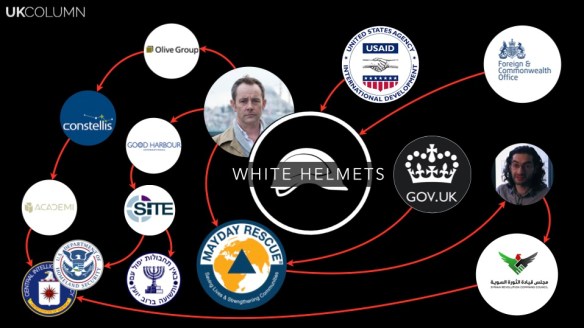
Giovani’s article attacks several journalists by name. She singles out Janine di Giovani and echoes the Guardian’s characterization of Beeley as the “high priestess of Syria propaganda”. She does this without challenging a single article or claim by the journalist. She might have acknowledged that Vanessa Beeley has some familiarity with the Middle East; she is the daughter of one of the foremost British Arabists and diplomats including British Ambassador to Egypt. Giovanni might have explored Beeley’s research in Syria that revealed the White Helmets founder (British military contractor James LeMesurier) assigned the name Syria Civil Defence despite the fact there is a real Syrian organization by that name that has existed since the 1950’s. For the past several years, Beeley has done many on-the-ground reports and investigations in Syria. None of these are challenged by Giovanni. Just days ago Beeley published a report on her visit to the White Helmets headquarters in Deraa.

Giovanni similarly dismisses another alternative journalist, Eva Bartlett. Again, Giovanni ignores the fact that Bartlett has substantial Middle East experience including having lived in Gaza for years. Instead of objectively evaluating the journalistic work of these independent journalists, Giovanni smears their work as “disinformation”. Presumably that is because their work is published at alternative sites such as 21st Century Wire and Russian media such as RT and Sputnik. Beeley and Bartlett surely would have been happy to have their reports published at the New York Review of Books, Newsweek or other mainstream outlets. But it’s evident that such reporting is not welcome there. Even Seymour Hersh had to go abroad to have his investigations on Syria published.

The New McCarthyism

Max Blumenthal is another journalist singled out by Giovanni. Blumenthal is the author of three books, including a New York Times bestseller and the highly acclaimed “Goliath: Life and Loathing in Greater Israel”. Giovanni describes his transition from “anti-Assad” to “pro-Assad” and suggests his change of perspective was due to Russian influence. She says, “Blumenthal went to Moscow on a junket to celebrate RT’s tenth anniversary. We don’t know what happened during that visit, but afterwards, Blumenthal’s views completely flipped.” Instead of examining the facts presented by Blumenthal in articles such as “Inside the Shadowy PR Firm that’s Lobyying for Regime Change in Syria“, Giovanni engages in fact-free McCarthyism. Blumenthal explained the transition in his thinking in a public interview. He also described the threats he experienced when he started to criticize the White Helmets and their public relations firm, but this is ignored by Giovanni.

Contrary to Giovanni’s assumptions, some western journalists and activists were exposing the White Helmets long before the story was publicized on Russian media. In spring 2015 the basic facts about the White Helmets including their origins, funding and role in the information war on Syria were exposed in my article “Seven Steps of Highly Effective Manipulators“. The article showed how the White Helmets were a key component in a campaign pushing for a “No Fly Zone” in Syria. It confirmed that the White Helmets is a political lobby force.

In spring 2016, Vanessa Beeley launched a petition “Do NOT give the Nobel Peace Prize to the White Helmets“. That petition garnered more support than a contrary petition urging the Nobel Prize committee to give the award to the White Helmets. Perhaps because of that, the petition was abruptly removed without explanation from the Change.org website. It was only at this time, with publicity around the heavily promoted nomination of the White Helmets for a Nobel Peace Prize that RT and other Russian media started to publicize and expose the White Helmets. That is one-and-a-half years after they were first exposed in western alternative media.

White Helmets and Chemical Weapons Accusations 

Giovanni ignores the investigations and conclusions of some of the most esteemed American journalists regarding the White Helmets and chemical weapons incidents in Syria.

The late Robert Parry published many articles exposing the White Helmets, for example “The White Helmets Controversy” and “Syria War Propaganda at the Oscars“. Parry wrote and published numerous investigations of the August 2013 chemical weapons attack and concluded the attacks were carried out by an opposition faction with the goal of pressuring the US to intervene militarily. Parry also challenged western conclusions regarding incidents such as April 4, 2017 at Khan Shaykhun. Giovanni breathlessly opens her article with this story while Parry revealed the impossibility of it being as described.

Buried deep inside a new U.N. report is evidence that could exonerate the Syrian government in the April 4 sarin atrocity and make President Trump look like an Al Qaeda dupe.

Legendary American journalist, Seymour Hersh, researched and refuted the assumptions of Giovanni and the media establishment regarding the August 2013 chemical weapons attacks near Damascus. Hersh’s investigation, titled “The Red Line and Rat Line“, provided evidence the atrocity was carried out by an armed opposition group with active support from Turkey. A Turkish member of parliament provided additional evidence. The fact that Hersh had to go across the Atlantic to have his investigation published suggests American not Russian disinformation and censorship.

In addition to ignoring the findings of widely esteemed journalists with proven track records, Giovanni plays loose with the truth. In her article she implies that a UN investigation blamed the Syrian government for the August 2013 attack. On the contrary, the head of the UN investigation team, Ake Sellstrom, said they did not determine who was responsible.

We do not have the evidence to say who did what ….The conflict in Syria is surrounded by a lot of rumors and a lot of propaganda, particularly when comes to the sensitive issue of chemical weapons.

First Responders or Western Funded Propagandists?

Giovanni says, “But the White Helmets’ financial backing is not the real reason why the pro-Assad camp is so bent on defaming them. Since 2015, the year the Russians began fighting in Syria, the White Helmets have been filming attacks on opposition-held areas with GoPro cameras affixed to their helmets.”

In reality, the ‘White Helmets” have a sophisticated media production and distribution operation. They have much more than GoPro cameras. In many of their movie segments one can see numerous people with video and still cameras. Sometimes the same incident will be shown with one segment with an Al Qaeda logo blending into the same scene with a White Helmets logo.

Giovanni claims “The Assad regime and the Russians are trying to neutralize the White Helmets because they are potential witnesses to war crimes.” However, the claims of White Helmet “witnesses” have little credibility. The White Helmet “volunteers” are paid three times as much as Syrian soldiers. They are trained, supplied and promoted by the same western states which have sought to regime change in Syria since 2011. An example of misleading and false claims by a White Helmets leader is exposed in Gareth Porter’s investigation titled “How a Syrian White Helmets Leader Played Western Media” . His conclusion could be directed to Giovanni and the NYReview of Books:

The uncritical reliance on claims by the White Helmets without any effort to investigate their credibility is yet another telling example of journalistic malpractice by media outlets with a long record of skewing coverage of conflicts toward an interventionist narrative.

When the militants (mostly Nusra/al Qaeda) were expelled from East Aleppo, civilians reported that the White Helmets were mostly concerned with saving their own and performing publicity stunts. For example, the photo of the little boy in east Aleppo looking dazed and confused in the back of a brand new White Helmet ambulance was essentially a White Helmet media stunt eagerly promoted in the West. It was later revealed the boy was not injured, he was grabbed without his parent’s consent. Eva Bartlett interviewed and photographed the father and family for her story “Mintpress Meets the Father of Iconic Aleppo Boy and says Media Lied About his Son“.

A Brilliant Marketing Success

The media and political impact of the White Helmets shows what money and marketing can do. An organization that was founded by a military contractor with funding from western governments was awarded the Rights Livelihood Award. The organization was seriously considered to receive the 2016 Nobel Peace Prize just three years after its formation.

The Netflix infomercial “The White Helmets” is an example of the propaganda. The scripted propaganda piece, where the producers did not set foot in Syria, won the Oscar award for best short documentary. It’s clear that lots of money and professional marketing can fool a lot of people. At $30 million per year, the White Helmets budget for one year is more than a decade of funding for the real Syrian Civil Defence which covers all of Syria not just pockets controlled by armed insurgents.

Unsurprisingly, it has been announced that White Helmets will receive the 2019 “Elie Wiesel” award from the heavily politicized and pro-Israel Holocaust Memorial Museum in Washington. This, plus the recent “rescue” of White Helmets by the Israeli government, is more proof of the true colors of the White Helmets. Vanessa Beeley’s recent interview with a White Helmet leader in Deraa revealed that ISIS and Nusra terrorists were part of the group “rescued” through Israel.

The Collapsing White Helmets Fraud

Giovanni is outraged that some journalists have successfully challenged and put a big dent in the White Helmets aura. She complains, “The damage the bloggers do is immense.”

Giovanni and western propagandists are upset because the myth is deflating. Increasing numbers of people – from a famous rock musician to a former UK Ambassador – see and acknowledge the reality.

As described in Blumenthal’s article, “How the White Helmets Tried to Recruit Roger Waters with Saudi Money“, rock legend Roger Waters says:

If we were to listen to the propaganda of the White Helmets and others, we would encourage our governments to start dropping bombs on people in Syria. This would be a mistake of monumental proportions…

Peter Ford, the former UK Ambassador to Syria, sums it up like this:

The White Helmets are jihadi auxiliaries… They are not, as claimed by themselves and by their supporters… simple rescuers. They are not volunteers. They are paid professionals of disinformation.

Giovanni claims her article is a “forensic take down of the Russian disinformation campaign to distort the truth in Syria.” In reality, Giovanni’s article is an example of western disinformation using subjective attacks on critics and evidence-free assertions aligned with the regime change goals of the West.