If the Facts Come Out, it Could Spell the End for Joe Biden

By Ray McGovern

Source: Consortium News

The Joe Biden-friendly Establishment media has mounted a full-court press to “prove” that Biden is, well, not a crook.

The stakes are extremely high, Biden is vulnerable, and media players are using to a faretheewell the old adage about the best defense being a good offense.  The New York Times, The Washington Post, and The Wall Street Journal are desperately trying to steal the ball and get ahead in the publicity game.  But time is about to run out, and pre-emptive propaganda is unlikely to snatch victory out of the jaws of defeat. IF the facts do come out and IF they are reported, Biden’s presidential hopes may suffer a mortal blow.

When the corruption in which the former Vice President and his son Hunter were involved in Ukraine becomes more widely known, the press wants to be in position to “show” that it’s all the fault of President Donald Trump and his lawyers for trying to derail Biden’s candidacy by exposing him.  If past is precedent, the media will largely succeed.  The question is whether enough people will, nevertheless, be able to see through this all-too-familiar charade.

In an interview with The National Interest, Joe Lauria put this episode in context:

“’It was in February [2014] when Yanukovych was overthrown, and just a few months later (in May), Joe Biden’s son and a close friend of John Kerry’s stepson, they both join the board of this Ukrainian gas company. And the name of that was Burisma Holdings,’” said Joe Lauria, editor of Consortium News and a former correspondent for the Wall Street Journal. “’So just after an American-backed coup, you have Joe Biden’s son Hunter Biden and this John Kerry family friend joining the board of probably the largest private gas producer in Ukraine. They installed the new government, and as the bounty of this coup, Joe Biden’s son personally profited. He would not have gotten that job if Yanukovych was still in power,’” Lauria told The National Interest.”

Will U.S. voters have any way of putting these dots together, and also in discerning, for example, how much truth there may be in charges that Vice President Biden pressed hard for the ouster of Ukraine’s Prosecutor General, Viktor Shokin, who was canned after investigating corruption at Burisma Holdings Ukrainian gas company of which Hunter Biden was a board member?

In this video Biden admits on the record to essentially using a billion dollar line of credit as a bribe to get the prosecutor fired.

If the truth does come out, no one will have to rely on remarks from the likes of Rudy Giuliani, one of Trump’s lawyers, who has called the episode “an astounding scandal of major proportions.”  That may be hyperbole but, still, the damage to Biden could be fatal.

And so, damage control is in full swing today at the Times, the Post, the Journal and other “usual suspects,” with the  Times winning the laurels with its Editorial Board, no less, weighing in with “What did Trump tell Ukraine’s president?” There have also been op-eds by Max Boot, Jennifer Rubin, Anne Applebaum, Greg Sargent and (my favorite), George T. Conway III and Neal Katyal at the Post, whose headline is: “Trump has done plenty to warrant impeachment. But the Ukraine allegations are over the top.”

That title is correct.

The Struggle for Peace in Afghanistan: Is Community Engagement the Key?

By Robert J. Burrowes

I have just read a superb book by Mark Isaacs, an Australian who has documented several years of effort by a group of incredibly committed young people in Afghanistan to build peace in that war-torn country the only way it can be built: by learning, living and sharing peace.

The book, titled The Kabul Peace House: How a Group of Young Afghans are Daring to Dream in a Land of War, records in considerable detail the struggle, both internal and external, to generate a peaceful future in Afghanistan. Some might consider this vision naive, others courageous, but few would doubt the simple reality: it is slow, daunting, incredibly difficult, often saddening, frightening, infuriating or painful, sometimes uplifting or hilarious and, just occasionally, utterly rewarding.

This is a human story written by a person who knows how to listen and to observe. And because the subject is about a group of ordinary Afghans and their mentor doing their best in the struggle to end one of the longest wars in human history, it is a story that is well worth reading.

This story is embedded in a combination of (brief) historical background on Afghanistan’s longstanding and central role in imperial geopolitics (including during ‘The Great Game’ of the 19th century) and more recent history on the progressive modernity of Afghanistan prior to the Soviet invasion in 1979 which was followed by an ongoing and multifaceted war in which the United States has played the most damaging role since its invasion of the country in 2001. But the background also includes a description of the ethnic diversity throughout the country, the role of religion and gender relations (and the challenges these social parameters present), as well as commentary on the social, economic and political regression as a result of the war’s many adverse impacts. So the book weaves a lot of strands into a compelling story of nonviolent resistance and regeneration against almost overwhelming odds.

However, that is not all. Given that all of the Afghans in this visionary community have each been traumatized by their unique experience of war, the book doesn’t shy away from describing the challenges this presents both to them personally and to the community, including its mentor and even some of the community’s many international visitors.

Most of the community members – whether Pashtun, Hazara, Uzbek, Turkmen, Tajik, Sayyid, Pashai… – have suffered serious loss during the war, especially those members who have had family and other relatives killed, or worse. Worse? you might ask. What is worse than death? Well, after reading this book, you will better understand that the context and the manner of death mean a great deal psychologically. None of the victims of this war died peacefully in their sleep after long and meaningful lives and this is just one part of the psychological trauma suffered by so many in this particular community but also in wider Afghan society.

So what does this community in Kabul do? Well, throughout its evolution and many manifestations, the community has done many things including run a variety of projects intended to foster understanding, cooperation and learning: nurture mutual respect among the diversity of people that constitute its membership, teach some of its members to read and write and facilitate learning opportunities in other contexts, teach the meaning and practice of nonviolence, give street kids the chance to learn skills that will make them employable, make duvets to give to people who go cold in Afghanistan’s freezing winters, teach and practice permaculture, organize protests against the war (including by flying kites instead of drones), and generally working to create a world that is green, equal and nonviolent.

If you think this sounds all good and straightforward, given slowly spreading acceptance of such ideas elsewhere (in some circles at least), then you might have underestimated their radical nature in a society in which ideas about nonviolence, equality and sustainability have, for the most part, not been previously encountered and have certainly not taken root. Isaacs records the observations of the group’s mentor on these subjects: ‘Over the years I have seen how the volunteers have changed within their personal lives, even if it means distancing themselves from the traditions of their own family…. But on a public level it’s much slower.’

This is understandable. As Isaacs notes, even in ordinary conversation and group discussions, ‘the weight of resistance, the taboos and the self-censorship’ made an impact on him. In a culture in which, in 2015, a woman in her twenties was stoned, her body run over by a car and then dumped in a river and set on fire because a mullah falsely accused her of burning the Quran, there is a long way to go.

One of the things that I found most compelling about the book is the occasional ‘biography’ of one of the community’s main characters. Given pseudonyms to avoid possible adverse repercussions, these stories provide real insight into the lives of certain community members and their struggle to leave home (in some cases), to join the community, to find their place within it and gain acceptance by the other members.

Some, like Hojar, are more outspoken and this, for a woman, is unusual in itself. Hojar is deeply aware of the gender inequality and violence against women in Afghanistan and will talk about it. This inspires other women, like Tara, who have not experienced this outspokenness before.

But Hojar’s life had started differently, in the mountains where, as a teenager, she was getting up at 3am to start baking bread for her four snoring brothers before milking the goats and sheep. ‘I am not a woman’, she thought, ‘I am a slave’. Fortunately and unusually, Hojar’s parents supported her desire to not marry at 13 or 15, but to continue her education and follow her dreams. It’s a long, painful, terrifying and fascinating journey but Hojar ended up in this novel community experiment in Kabul where her now college-educated talent was highly valued and put to wonderful use. She has my utmost admiration.

Unlike Hojar, other community members, like Horse, originally a shepherd in the mountains, are more circumspect on gender equality and other issues. But this doesn’t mean that Horse is not active, at times playing roles in the networking team, the accounts team and, particularly, as coordinator of the food cooperative which provided monthly gifts of food to the impoverished families of one hundred children who studied at the community’s street kids school. If you think raising donations to pay for this food was easy, particularly given the community decision to avoid the international aid sector to try to encourage Afghans to help their fellow Afghans, when more than half of the population lived below the poverty line and unemployment was at 40%, you will find it compelling to read how the teenaged Horse struggled with the monumental range of challenges he faced in that particular role. He has my admiration too.

Insaan, a doctor who mentors the community, provides a compelling story as well. Originally from another country, in 2002 a consultation with a patient at his successful medical practice inspired him to depart some time later. After spending more than two years in Pakistan, working with refugees from Afghanistan, he went to Afghanistan in 2004 to work for an international NGO in public health education in its central mountainous region.

His ongoing experience in this role, however, taught him that every problem the villagers faced had its origins in the war. And this underpinned his gradual transformation from health professional to peace activist. He discovered Thoreau, Gandhi and King, among others, and ‘became convinced of the power of love’. By 2008, Insaan had initiated his first multi-ethnic live-in community (although he did not live in it himself) in the mountains but in 2011, when his house was deliberately burned down, he departed for Kabul determined to restart the peace work he had begun in the mountains.

Starting with three young people who accompanied him from the mountains, the first manifestation of a live-in peace community in Kabul was soon underway. Endlessly paying attention, trying to provide guidance, reconcile those in conflict, and even withstanding threats of violence, Insaan’s love has undoubtedly been the glue that has held the growing and evolving community together. But not without cost. At times, Insaan has struggled, emotionally and otherwise, to survive in this perpetual war zone as the key figure holding this loving experiment together. He is a truly remarkable human being.

And it is because of the trauma that he and each of the other community members has suffered, that I hope that, in future, they can somehow dedicate time to their own personal, emotional healing. See ‘Putting Feelings First’ and ‘Nisteling: The Art of Deep Listening’. There is no better investment for any human being than to spend time consciously focusing on feeling the fear, pain, anger and sadness that we are taught and terrorized into suppressing during childhood (so that we become the obedient slaves that our society wants). Given the extraordinary violence that the people of Afghanistan have suffered and are still suffering, the value of making this investment would be even greater.

Anyway, if you want to read an account of the deeply personal human costs of war, and what one community is doing about it, read this book. It isn’t all pretty but, somehow, this remarkable community, through all of its manifestations over many years, its successes and failures, manages to inspire one with the sense that while those insane humans who spend their time planning, justifying, fighting and profiting from wars against people in other countries, those people on the receiving end of their violence are capable of visioning a better tomorrow and working to achieve it. No matter how difficult or how long it takes. Moreover, we can help too. See Nonviolent Campaign Strategy.

So allow yourself to be inspired by a group of young people, each of whom has lived their entire life in a country at war both with itself and with foreign countries, but has refused to submit to the predominant delusion that violence is the way out.


Biodata: Robert J. Burrowes has a lifetime commitment to understanding and ending human violence. He has done extensive research since 1966 in an effort to understand why human beings are violent and has been a nonviolent activist since 1981. He is the author of Why Violence? His email address is flametree@riseup.net and his website is here.

Offering Choice but Delivering Tyranny: The Corporate Capture of Agriculture

By Colin Todhunter

Source: Off-Guardian

Many lobbyists talk a lot about critics of genetic engineering technology denying choice to farmers. They say that farmers should have access to a range of tools and technologies to maximise choice and options.

At the same time, somewhat ironically, they decry organic agriculture and proven agroecological approaches, presumably because these practices have no need for the proprietary inputs of the global agrochemical/agritech corporations they are in bed with.

And presumably because agroecology represents liberation from the tyranny of these profiteering, environment-damaging global conglomerates.

It is fine to talk about ‘choice’ but we do not want to end up offering a false choice (rolling out technologies that have little value and only serve to benefit those who control the technology), to unleash an innovation that has an adverse impact on others or to manipulate a situation whereby only one option is available because other options have been deliberately removed. And we would certainly not wish to roll out a technology that traps farmers on a treadmill that they find difficult to get off.

Surely, a responsible approach for rolling out important (potentially transformative) technologies would have to consider associated risks, including social, economic and health impacts.

Take the impact of the Green Revolution in India, for instance. Sold on the promise that hybrid seeds and associated chemical inputs would enhance food security on the basis of higher productivity, agriculture was transformed, especially in Punjab. But to gain access to seeds and chemicals many farmers had to take out loans and debt became (and remains) a constant worry.

Many became impoverished and social relations within rural communities were radically altered: previously, farmers would save and exchange seeds but now they became dependent on unscrupulous money lenders, banks and seed manufacturers and suppliers. Vandana Shiva in The Violence of the Green Revolution (1989) describes the social marginalisation and violence that accompanied the process.

On a macro level, the Green Revolution conveniently became tied to an international (neo-colonial) system of trade based on chemical-dependent agro-export mono-cropping linked to loans, sovereign debt repayment and World Bank/IMF structural adjustment (privatisation/deregulation) directives.

Many countries in the Global South were deliberately turned into food deficit regions, dependent on (US) agricultural imports and strings-attached aid.

The process led to the massive displacement of the peasantry and, according to the academics Eric Holt-Giménez et al, (Food rebellions: Crisis and the hunger for Justice, 2009), the consolidation of the global agri-food oligopolies and a shift in the global flow of food: developing countries produced a billion-dollar yearly surplus in the 1970s; they were importing $11 billion a year by 2004.

And it’s not as though the Green Revolution delivered on its promises.

In India, it merely led to more wheat in the diet, while food productivity per capita showed no increased or even actually decreased (see New Histories of the Green Revolution by Glenn Stone). And, as described by Bhaskar Save in his open letter (2006) to officials, it had dire consequences for diets, the environment, farming, health and rural communities.

The ethics of the Green Revolution – at least it was rolled out with little consideration for these impacts – leave much to be desired.

As the push to drive GM crops into India’s fields continues (the second coming of the green revolution – the gene revolution), we should therefore take heed. To date, the track record of GMOs is unimpressive, but the adverse effects on many smallholder farmers are already apparent (see Hybrid Bt cotton: a stranglehold on subsistence farmers in India by A P Gutierrez).

Aside from looking at the consequences of technology roll outs, we should, when discussing choice, also account for the procedures and decisions that were made which resulted in technologies coming to market in the first place.

Steven Druker, in his book Altered Genes, Twisted Truth, argues that the decision to commercialise GM seeds and food in the US amounted to a subversion of processes put in place to serve the public interest.

The result has been a technology roll out which could result (is resulting) in fundamental changes to the genetic core of the world’s food. This decision ultimately benefited Monsanto’s bottom line and helped the US gain further leverage over global agriculture.

We must therefore put glib talk of the denial of technology by critics to one side if we are to engage in a proper discussion of choice. Any such discussion would account for the nature of the global food system and the dynamics and policies that shape it. This would include looking at how global corporations have captured the policy agenda for agriculture, including key national and international policy-making bodies, and the role of the WTO and World Bank.

Choice is also about the options that could be made available, but which have been closed off or are not even considered. In Ethiopia, for example, agroecology has been scaled up across the entire Tigray region, partly due to enlightened political leaders and the commitment of key institutions.

However, in places where global agribusiness/agritech corporations have leveraged themselves into strategic positions, their interests prevail. From the false narrative that industrial agriculture is necessary to feed the world to providing lavish research grants and the capture of important policy-making institutions, these firms have secured a thick legitimacy within policymakers’ mindsets and mainstream discourse.

As a result, agroecological approaches are marginalised and receive scant attention and support.

Monsanto had a leading role in drafting the WTO Agreement on Trade-Related Aspects of Intellectual Property Rights to create seed monopolies. The global food processing industry wrote the WTO Agreement on the Application of Sanitary and Phytosanitary Measures.

Whether it involves Codex or the US-India Knowledge Initiative on Agriculture aimed at restructuring (destroying) Indian agriculture, the powerful agribusiness/food lobby has secured privileged access to policy makers and sets the policy agenda.

From the World Bank’s ‘enabling the business of agriculture’ to the Gates Foundation’s role in opening up African agriculture to global food and agribusiness oligopolies, democratic procedures at sovereign state levels are being bypassed to impose seed monopolies and proprietary inputs on farmers and to incorporate them into a global supply chain dominated by powerful corporations.

We have the destruction of indigenous farming in Africa as well as the ongoing dismantling of Indian agriculture and the deliberate impoverishment of Indian farmers at the behest of transnational agribusiness. Where is the democratic ‘choice’?

It has been usurped by corporate-driven Word Bank bondage (India is its biggest debtor in the bank’s history) and by a trade deal with the US that sacrificed Indian farmers for the sake of developing its nuclear sector.

Similarly, ‘aid’ packages for Ukraine – on the back of a US-supported coup – are contingent on Western corporations taking over strategic aspects of the economy. And agribusiness interests are at the forefront. Something which neoliberal apologists are silent on as they propagandise about choice, and democracy.

Ukraine’s agriculture sector is being opened up to Monsanto/Bayer. Iraq’s seed laws were changed to facilitate the entry of Monsanto.

India’s edible oils sector was undermined to facilitate the entry of Cargill. And Bayer’s hand is possibly behind the ongoing strategy to commercialise GM mustard in India. Whether on the back of militarism, secretive trade deals or strings-attached loans, global food and agribusiness conglomerates secure their interests and have scant regard for choice or democracy.

The ongoing aim is to displace localised, indigenous methods of food production and allow transnational companies to take over, tying farmers and regions to a system of globalised production and supply chains dominated by large agribusiness and retail interests. Global corporations with the backing of their host states, are taking over food and agriculture nation by nation.

Many government officials, the media and opinion leaders take this process as a given. They also accept that (corrupt) profit-driven transnational corporations have a legitimate claim to be owners and custodians of natural assets (the ‘commons’).

There is the premise that water, seeds, food, soil and agriculture should be handed over to these conglomerates to milk for profit, under the pretence these entities are somehow serving the needs of humanity.

Ripping land from peasants and displacing highly diverse and productive smallholder agriculture, rolling out very profitable but damaging technologies, externalising the huge social, environmental and health costs of the prevailing neoliberal food system and entire nations being subjected to the policies outlined above: how is any of it serving the needs of humanity?

It is not. Food is becoming denutrified, unhealthy and poisoned with chemicals and diets are becoming less diverse. There is a loss of plant and insect diversity, which threatens food security, soils are being degraded, water tables polluted and depleted and millions of smallholder farmers, so vital to global food production, are being pushed into debt in places like India and squeezed off their land and out of farming.

It is time to place natural assets under local ownership and to develop them in the public interest according to agroecological principles. This involves looking beyond the industrial yield-output paradigm and adopting a systems approach to food and agriculture that accounts for local food security and sovereignty, cropping patterns to ensure diverse nutrition production per acre, water table stability and good soil structure. It also involves pushing back against the large corporations that hold sway over the global food system and more generally challenging the leverage that private capital has over all our lives.

That’s how you ensure liberation from tyranny and support genuine choice.


Colin Todhunter is an independent journalist who writes on development, environmental issues, politics, food and agriculture. He was named in August 2018 by Transcend Media Services as one of 400 Living Peace and Justice Leaders and Models in recognition of his journalism. 

Pentagon Joins the War on Alternative Media

By Kurt Nimmo

Source: Another Day in the Empire

Fake news is so threatening to America’s national security, the Pentagon’s DARPA research agency has announced it will launch a project to repel “large-scale, automated disinformation attacks,” according to Bloomberg.

The Defense Advanced Research Projects Agency wants custom software that can unearth fakes hidden among more than 500,000 stories, photos, video and audio clips. If successful, the system after four years of trials may expand to detect malicious intent and prevent viral fake news from polarizing society.

As usual, a translation is in order. DARPA is working on a system that will prevent news and analysis contrary to the establishment narrative from rising above the mosh pit that is the lower depths of social media.

U.S. officials have been working on plans to prevent outside hackers from flooding social channels with false information ahead of the 2020 election. The drive has been hindered by Senate Majority Leader Mitch McConnell’s refusal to consider election-security legislation. Critics have labeled him #MoscowMitch, saying he left the U.S. vulnerable to meddling by Russia, prompting his retort of “modern-day McCarthyism.”

It should be obvious there isn’t any “election-security.” Even with alleged Russian interference—which has zero credibility and is remarkably evidence-free—can’t overcome the fact the election system is rigged in favor of the establishment’s handpicked “public service” careerists. Bernie Sanders knows about this and Tulsi Gabbard is learning.

No amount of “fake news” will change or even marginally impact the system. An astute eleven-year-old, after examining the evidence or lack thereof, would conclude the Russians are not hijacking elections. That job is left up to the DNC, RNC, and the corporate propaganda media.

President Donald Trump has repeatedly rejected allegations that dubious content on platforms like Facebook, Twitter and Google aided his election win. Hillary Clinton supporters claimed a flood of fake items may have helped sway the results in 2016.

Hillary Clinton followers are simply sore losers. In order to push the fallacy we live in a pluralistic democracy, the state provides the appropriate cover to effectively obfuscate the “deep fake” that is performed every election cycle.

This cover allowed Donald Trump to win the election. Trump didn’t collude with the Russians, he didn’t need to. He took advantage of the widespread discontent of the American people and promised the Make America Great Again.

Beyond Trump’s egotistical flourishes and daily tweet diatribes against enemies real and imagined, he has done little to move the MAGA agenda forward. He is little different than his predecessors—the national debt is in the stratosphere, the wars continue and expand, and the Federal Reserve scam of pumping up the stock market to make it appear all’s well while facilitating the upward shift of wealth to the elite.

But never mind that.

“Where things get especially scary is the prospect of malicious actors combining different forms of fake content into a seamless platform. Researchers can already produce convincing fake videos, generate persuasively realistic text, and deploy chatbots to interact with people. Imagine the potential persuasive impact on vulnerable people that integrating these technologies could have: an interactive deepfake of an influential person engaged in AI-directed propaganda on a bot-to-person basis,” Andrew Grotto at the Center for International Security at Stanford University told Bloomberg.

Because “vulnerable people” are supposedly at risk, the state and its agencies are prepared to implement some sort of fantastical (and likely ineffectual) AI solution to stop unacceptable content from going viral.

The target is not Russians per se, it’s millions of American citizens the state and its secret political police, the FBI, are attempting to prevent from participating in social media and the larger political discussion that is ostensibly democratic but is, in fact, a form of hippodroming, that is to say rigging the political process for a favored outcome by the fixers.

Meanwhile, the state and its Silicon Valley partners are picking off targets one by one, the latest victim being Daniel McAdams at the Ron Paul Institute. His account was permanently suspended for the crime of criticizing Sean Hannity.

“They said I would not be reinstated. My crime? I called Sean Hannity ‘retarded.’ But do a Twitter search on use of the term and you will see its use millions of times with impunity,” McAdams emailed Robert Wenzel after the suspension.

The corporate propaganda media has marginalized dozens of people and ruined careers and reputations by characterizing them as white nationalists, peddlers of fake news and conspiracy theories, and now, directly from the FBI, as national security threats, evil conspiracy-bearing domestic terrorists bent on filling every American head with the illusion of “deep fakes,” fomenting and spreading lies, misinformation, participating in Russian collusion, and keeping company with bad actors (paid agents or dupes for Russia) steering the nation into a white supremacist nightmare.

I was wrong about Hillary. I thought she’d win the election hands-down with the help of the Deep State and its media. I’m making another prediction, but I could be wrong again.

Donald Trump will be roundly defeated next November.

If Democrats take control of the House and Senate, we will witness an inquisition against those of us not on-narrative, beginning with revenge exacted on hardcore MAGA supporters. How effective this jihad is will remain to be seen.

As we have witnessed over the last few months, the state is serious about taking back the narrative and disallowing any contrary narratives put out by “bad actors,” largely libertarians like Daniel McAdams, dissidents on the “New Right,” and disillusioned former MAGAites opposed to endless war and a bankster-dominated state drifting into total authoritarian control freak mode.

EMPIRES ARE A SECRET UNTIL THEY START FALLING

By Margaret Flowers and Kevin Zeese

Source: Popular Resistance

In the past, we have written about the 2020s as a decade when the United States Empire will end. This is based on Alfred McCoy’s predictions (listen to our interview with him on Clearing the FOG). Sociologist and peace scholar John Galtung believes US Empire will fall much faster, losing world dominance by 2020. Much of what he predicted when he said this in 2016 is happening now. In particular, there is a rise in “reactionary fascism” or a desire to go back to the “good old days,” the cost of maintaining the empire is taking an increasing economic toll and other countries are starting to rebuke the US, both its requests for military assistance and its unfair economic demands.

What this means for people in the United States and around the world depends on whether we can build a mass popular movement with the clarity of vision, skills, and solidarity necessary to navigate what is and will surely be a turbulent period. There are no guarantees as to the outcome. Failure to act could result in a disastrous scenario – at best, that the US will continue to try to hold onto power by waging economic and military warfare abroad weakening the economy at home and undermining necessities such as housing, healthcare, education and the transition to a Green economy. At worst, as Galtung describes, there could be “an inevitable and final war” involving nuclear weapons.

When Empire Is In Decline

Alfred McCoy says that it is only when empires are in decline that people begin to recognize they live in an empire and start to talk about it. While discussion of empire hasn’t broken into the corporate media, it is certainly happening in the independent media. A concerted effort by a popular movement could bring it to the fore, just as Occupy changed the political dialogue about wealth inequality and the power of money. People in the US need to face some stark realities when it comes to declining US global power.

For starters, the United States does not currently have the capacity to wage a “Great Power Conflict” even though that is the goal of the national security strategy. The loss of its manufacturing base and lack of access to minerals necessary for producing weapons and electronics means the US does not have the resources to fight a great war. Much of the US’ manufacturing has been outsourced to other countries, including those targeted by US foreign policy. Resources necessary for weapons and electronics are in China, Afghanistan, the Democratic Republic of the Congo and Venezuela. It’s no surprise that the US is maintaining a military presence in Afghanistan, has increased its presence in Africa through AFRICOM and is struggling to wrest control of Venezuela.

Despite these attempts, the US is not having success. There is no military solution for the US in Afghanistan. As Moon of Alabama explains, the Taliban has taken control of more territory than it has had since the US started the war and has no reason to negotiate with the US. He advises, “The U.S. should just leave as long as it can. There will come a point when the only way out will be by helicopter from the embassy roof.”

Alexander Rubinstein writes the failures in Afghanistan can be attributed to Zalmay Khalilzad, currently the US Special Representative for Afghanistan Reconciliation. Khalilzad has led US foreign policy in Afganistan and Iraq since the presidency of George W. Bush, and before that worked with Carter’s National Security Advisor Zbigniew Brzezinski, who provided crucial support for the Mujahideen to draw the Soviet Union into a quagmire. The writing is on the wall that the US must leave Afghanistan, but that is unlikely to happen as long as people such as Khalilzad and Elliott Abrams, who has a similar ideology, are in charge.

As the US-led coup in Venezuela continues to fail due to a lack of support for it within the country, resilience to the effects of the unilateral coercive economic measures (sanctions) and exposure of attempts to create chaos and terror by paramilitary mercenaries, the US grows increasingly desperate in its tactics. There has already been a failed assassination attempt against President Maduro, a US freight company tied to the CIA has been caught smuggling weapons and the US and its Puppet Guaido have been implicated in a terrorist plot as the failed coup enters a more dangerous phase. This week, the Organization of American States voted to invoke a treaty, the Inter-American Treaty of Reciprocal Assistance (TIAR), which would allow military intervention. Mexico strongly opposed that possibility. This comes as Venezuela has strengthened troops at the Colombian border after discovering terrorist training camps on the Colombian side. With allies such as Russia and China, an attack on Venezuela would not only hurt the region but could go global.

Despite the Asian Pivot under President Obama during his first administration and Secretary of Defense Mark Esper’s comment this week that the US is directing a lot of energy toward China, analysts predict the US will fail to achieve dominance in the Asia-Pacific. China is purchasing weapons from Russia that are superior to US systems, is strengthening its military coordination with Russia through drills and is expanding its global ties through the Belt and Road Initiative. Matthew Ehret writes in Strategic Culture, “Those American military officials promoting the obsolete doctrine of Full Spectrum dominance are dancing to the tune of a song that stopped playing some time ago. Both Russia and China have changed the rules of the game on a multitude of levels….”

Protests in Hong Kong, as we described in a recent newsletter, are being used to stoke greater anti-China sentiment in the US. As often occurs, the sophisticated propaganda arm of US-backed color revolutions excites leftist activists, but each day it becomes clearer just how deep the US’ influence is. K. J. Noh provides a helpful guide – a list of seven signs a protest is not a popular progressive uprising. One sign is Hong Kong protesters are supporting a bill in the US Congress, the so-called “Hong Kong Human Rights and Democracy Act.” The bill would allow the United States to sanction Hong Kong officials.

Andre Vltchek attended a recent protest and interviewed some of the participants. He found the democracy protesters have little grasp on the oppression Hong Kongers faced under British colonization, they attack anyone who disagrees with them and they are destroying public infrastructure. One of the protest leaders, Joshua Wong, is openly meeting with figures connected to US regime change efforts, and NED-backed organizations are planning an anti-China protest in Washington, DC on September 29. Their new propaganda symbol is a Chinese flag with a Swastika on it. No surprise that was evident at the protests in Hong Kong this weekend.

The US is already at war with China with battlefronts on trade and the Asian Pacific. The propaganda around Hong Kong showing prejudice against China is part of manufacturing consent for the conflict between the US and China, which will define the 21st Century. US militarism is also escalating to involve space. This week, the US conducted its first space war game and Putin warned of a space arms race.

Our Tasks as Activists

It was good news this past week that President Trump asked John Bolton, a white supremacist neocon who disrupted any attempts at negotiation, to resign from his position as National Security Adviser. Glen Ford of Black Agenda Report writes, “Every sane person on the planet should be glad to see Bolton go.” But, even with Bolton gone, the US War Machine will rage on with bi-partisan support. Whether Trump starts to live up to his campaign rhetoric of non-intervention remains to be seen. The appointment of Michael Kozak as the new US envoy to Latin America is a bad sign.

Almost two centuries of Manifest Destiny that went beyond North America to spread US Empire across the globe will not end overnight. It will take a concerted effort to build a national consensus against the dominant ideologies of white supremacy and US exceptionalism to change the course of US foreign policy. Fundamental tasks of that effort include education, organizing and mobilizing. Below are some examples of each.

Education:

The Palestinian Great March of Return, a weekly nonviolent protest in Gaza demanding the right of return granted by the United Nations, continues and each week Israelis injure and murder unarmed Palestinians. Abby Martin and Mike Prysner of The Empire Files produced an excellent documentary about it, “Gaza Fights For Freedom,” and are touring the country to raise awareness. Listen to our interview with Abby Martin on Clearing the FOG. Find a showing near you or organize one.

The United States uses unilateral coercive measures (sanctions) that are illegal under international law to wage war on other countries. The Treasury Department currently lists 20 countries sanctioned by the US, but the US also uses threats of sanctions to wield power. Sanctions are warfare, even though they are not commonly viewed that way. They result in the suffering and death of mostly civilians. Kevin Cashman and Cavan Kharrazian explain how sanctions work, why they violate international law and how they threaten global stability.

Organizing:

Alison Bodine and Ali Yerevani encourage activists to avoid the organizing pitfall of getting caught up in debates about the internal politics of countries targeted by US imperialism. Our tasks, as citizens of imperialist countries, are to stop our governments from intervening in the affairs of other countries and demand they respect international law. We also have a task of building solidarity with civilians of other countries. It will require a global mass movement to address major issues such as the climate crisis, wealth inequality, colonization, and violence.

Citizen to citizen diplomacy is critical in building this mass movement and solidarity. Ann Wright, retired from the military and State Department, writes about the challenges of citizen to citizen diplomacy as she tours Russia. Ajamu Baraka, national organizer of Black Alliance for Peace, reminds us that war and militarism are class issues in his address to an international meeting of trade unions held in Syria.

We are strong believers in breaking out of the confines of the narrative presented by corporate media about countries outside the US. Our trips to Iran and Venezuela this year were invaluable learning experiences. We hope to visit more targeted countries. An effort that came out of these trips is the new Global Appeal for Peace, first steps toward creating an international network to complement the more than 120 non-aligned movement countries that are resolved to respect international law and sovereignty and take action to create peace and prevent the catastrophic climate crisis. Sign on to this effort at GlobalAppeal4Peace.net.

Mobilizing:

The People’s Mobilization to Stop the US War Machine and Save the Planet starts next weekend. On Saturday night, Black Alliance for Peace is sponsoring a discussion, “Race, Militarism and Black Resistance in the ‘Americas’” in the Bronx. On Sunday we will rally and march to the UN with Embassy Protectors, Roger Waters and many more. On Monday night, we have a special solidarity night at Community Church of New York. Registration is required as there will be high-level representatives of impacted countries speaking about the challenges they face. Click here to register.

Rage Against the US War Machine will take place October 11 and 12 in Washington, DC. This is the second annual event organized by March on the Pentagon. Click here for details.

We also ask you to join the Embassy Protectors Defense Committee. Sign the petition to drop the Trump administration’s charges against us for protecting the Venezuelan Embassy this spring. We are facing up to a year in prison and exorbitant fines even though it was the US State Department that violated the Vienna Convention by raiding the embassy in May. We will tour Northern California in October and are planning more tours to raise awareness that the struggle to end the US  coup and interventions in Venezuela continues.

John Galtung predicts that the fall of the US Empire could have a devastating impact on domestic cohesion in the United States. As the US loses its position of global supremacy, we have an opportunity to fundamentally reshape what we as a nation represent. We can become cooperative global citizens in a world free of oppression, violence, and poverty if we do the work of joining in international solidarity for these goals.

Freedom Rider: Hollywood Propaganda Attack on Venezuela

By Margaret Kimberly

Source: Black Agenda Report

The US is starving and killing Venezuelans in real life and, for your family’s viewing pleasure, on television screens.

“Imperialism is quite bipartisan and liberal Hollywood never saw propaganda it didn’t want to hype.”

“The military intervention of #Venezuela, put ‘on the table’ by @realDonaldTrump and his gang of fanatic supremacists, is supported by the gringo propaganda machine. Here is a fragment of their ‘cultural offerings.’”— Ernesto Villegas, Venezuela Minister of Culture

Americans are loathe to think of themselves as being propagandized.  The idea is inconsistent with notions of exceptional goodness and superiority that are constantly evoked in this country. But government propaganda does not work in a vacuum. It is bolstered by the corporate media and that includes the entertainment industry.

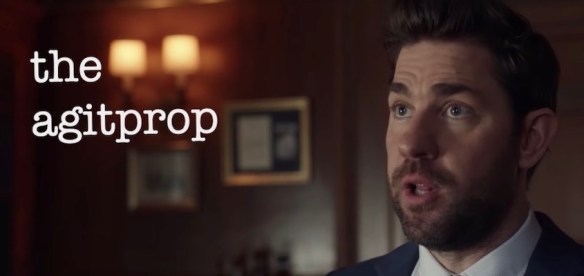
The latest in the story of fictitious CIA agent Jack Ryan is a case in point. The Ryan character appeared in five different feature films before moving to the small screen via Amazon Prime Video. The new season premieres in November and in this latest incarnation Ryan fights to prevent a nuclear armed Venezuela .

The upside down presentation is typical of the perversion of truth so prevalent in the United State. This country is the only one to have used nuclear weapons and still possesses more than any other. It is the United States that recently withdrew unilaterally from decades old nuclear agreements with Russia. Yet Hollywood has woven a tale of Russia, the country which wanted to keep the non-proliferation agreements, as a villain giving nuclear weapons to Venezuela.

“Government propaganda is bolstered by the entertainment industry.”

Venezuela is the victim of United States aggression in reality and now on the screen. The doctrine of “maximum pressure” has killed 40,000 Venezuelans through sanctions that have deprived that nation of food and medical care. That proof of U.S. aggression is known only to those who access independent media sources. The corporate media, even those who are allegedly liberal, parrot Donald Trump administration talking points, even if they otherwise deride the president and his team. Imperialism is quite bipartisan and liberal Hollywood never saw propaganda it didn’t want to hype.

Of course liberals who are usually overcome by Trump derangement syndrome are happy to go along with aggression schemes. Very few Democrats have expressed opposition to the anti-Venezuelan plots hatched by Trump. There is indeed foreign policy collusion but it doesn’t exist in a relationship with a foreign government. The determination to support American hegemony is an important part of the elite consensus.

That obvious truth is also disappeared and is not to be discussed in what passes for polite and “serious” company. According to myth, America is a classless, post-racial meritocracy and accepting of every political viewpoint. Of course it is anything but. The hierarchies are rigid and tenaciously defended.

“The corporate media, even those who are allegedly liberal, parrot Donald Trump administration talking points.”

Propaganda delivered via popular entertainment plays a particularly insidious role in this process. The goal is to change minds and ensure support for any act the government should choose to make. If this particular iteration of the Jack Ryan story isn’t challenged then no act or aggression will be challenged either.Media imagery is very powerful, that is why governments work so closely with corporate media to present their narratives.

Mace Neufeld  created the Jack Ryan film franchise. In 2014 he received a lifetime achievement award from the Israeli Film Festival. Curiously, the event wasn’t held in Israel at all. Instead Beverly Hills was the venue. Neufeld’s co-honoree was Arnon Milchan, a former Mossad operative who parlayed that career into producing hit films such as Twelve Years a Slave.

Israel isn’t alone in this regard. The CIA and the Pentagon both have film liaison offices . Movie credits often end with thanks to the department of defense. That always means that the plot line is approved by the military and the surveillance state.

“Movie credits often end with thanks to the department of defense.”

This grotesque lying on a mass scale cannot be ignored. The propagandists know that repetition plays a huge role in the process of indoctrination. For years Venezuela has been used as a bogeyman to convince people in this country to act against their own interests. “Socialism doesn’t work, just look at Venezuela,” is a statement made to end discussion of free health care or college education or housing or anything else that people need and want. After the 100th New York Times article which says nothing about the U.S. attack but points out that Venezuelans are hungry, the job has been done. Venezuela is now so thoroughly demonized that only a small number of people will come to its defense or even question their government’s policy against that nation.

“Venezuela is now so thoroughly demonized that only a small number of people will come to its defense.”

In 2002 and 2003 the president, the corporate media, and members of Congress all claimed that Iraq possessed chemical weapons. They wanted to make a case for war and they succeeded. Nearly 20 years later there has been no explanation or apology from the guilty parties. The same people claimed that Syria had chemical weapons and advocated for a larger war there. It isn’t hard to believe that a lie about chemicals or nukes in Venezuela could be used to do the same thing if that is what the establishment desired.

Entertainment isn’t harmless. That is why the ruling clique work together to ensure that they all stay on message. They haven’t spent millions of dollars honing the false message that Venezuela is a failed state with evil leadership for no reason. Venezuela’s culture minister, Ernesto Villegas, hits the nail squarely on the head when he describes this latest insult as “crass war propaganda masquerading as entertainment.”  If the U.S. should take military action or continue its regime change efforts, the plot will have succeeded. A few well informed people will speak out but the masses will either support an atrocity or ignore any horror that their leadership cares to visit upon the Venezuelan people. Washington and Hollywood are still working hand in hand.


Margaret Kimberley’s Freedom Rider column appears weekly in BAR, and is widely reprinted elsewhere. She maintains a frequently updated blog as well at http://freedomrider.blogspot.com . Ms. Kimberley lives in New York City, and can be reached via e-Mail at Margaret.Kimberley(at)BlackAgendaReport.com.

Suddenly West is Failing to Overthrow “Regimes”

By Andre Vltchek

Source: New Eastern Outlook

It used to be done regularly and it worked: The West identified a country as its enemy, unleashed its professional propaganda against it, then administered a series of sanctions, starving and murdering children, the elderly and other vulnerable groups. If the country did not collapse within months or just couple of years, the bombing would begin. And the nation, totally shaken, in pain, and in disarray, would collapse like a house of cards, once the first NATO boots hit its ground.

Such scenarios were re-enacted, again and again, from Yugoslavia to Iraq.

But suddenly, something significant has happened. This horrific lawlessness, this chaos stopped; was deterred.

The West keeps using the same tactics, it tries to terrorize independent-minded countries, to frighten people into submission, to overthrow what it defines as ‘regimes’, but its power, its monstrously destructive power, has all of a sudden become ineffective.

It hits, and the attacked nation shakes, screams, sheds blood, but keeps standing, keeps proudly erect.

What we are experiencing is a great moment in human history. Imperialism has not yet been defeated, but it is losing its global grip on power.

Now we have to clearly understand ‘Why?’, so we can continue our struggle, with even greater determination, with even greater effectiveness.

First of all, by now we know that the West cannot fight. It can spend trillions on ‘defense’, it can build nuclear bombs, ‘smart missiles’ and strategic warplanes. But it is too cowardly, too spoiled to risk the lives of its soldiers. It either kills remotely, or by using regional mercenaries. Whenever it becomes clear that the presence of its troops would be required, it backs up.

Secondly, it, the West, is totally horrified of the fact that there are now two super-powerful countries – China and Russia – which are unwilling to abandon their allies. Washington and London do all they can to smear Russia and to intimidate China. Russia is being provoked continuously: by propaganda, by military bases, sanctions and by new and newer bizarre mass media inventions that depict it as the villain in all imaginable circumstances. China has been provoked practically and insanely, ‘on all fronts’ – from Taiwan, Hong Kong, Tibet and the so-called ‘Uyghur Issue’, to trade.

Any strategy that could weaken these two countries, is applied. Yet, Russia and China do not crumble. They do not surrender. And they do not abandon their friends. Instead, they are building great railroads in Africa and Asia, they educate people from almost all poor and desperate countries, and stand by those who are being terrorized by both North America and Europe.

Thirdly, all the countries in the world are now clearly aware of what would happen to them, if they give up and get ‘liberated’ by the Western empire. Iraq, Honduras, Indonesia, Libya and Afghanistan, are the ‘best’ examples. Submitting themselves to the West, countries can only expect misery, absolute collapse and the ruthless extraction of their resources. The poorest country in Asia – Afghanistan – has totally collapsed under NATO occupation.

The suffering and pain of the Afghan and Iraqi people is very well known to the citizens of Iran and Venezuela. They are not giving up, because no matter how tough their life is under sanctions and the West-administered terror, they are well-aware of the fact that things could get worse, much worse, if their countries were to be occupied and governed by the Washington and London-injected maniacs.

And everyone knows the fate of the people living in Palestine or Golan Heights, places which have been overrun by the closest ally of the West in the Middle East, Israel.

Of course, there are other reasons why the West cannot get any of its adversaries to kneel.

One is – that the toughest ones are left. Russia, Cuba, China, North Korea (DPRK), Iran, Syria and Venezuela are not going to run away from the battlefield. These are the most determined nations on earth. These are the countries that have already lost thousands, millions, even tens of millions of their people, in the fight against Western imperialism and colonialism.

If one is following the latest attacks of the West carefully, the scenario is pathetic, almost grotesque: Washington and often the EU, too, are trying hard; they are hitting, they are spending billions of dollars, using the local mercenaries (or call it ‘local opposition’), and then they quickly withdraw after wretched but anticipated defeat. So far, Venezuela has survived. Syria survived. Iran survived. China is fighting horrible Western-backed subversions, but it is proudly surviving. Russia is standing tall.

This is a tremendous moment in human history. For the first time, Western imperialism is being not only defeated, but fully unveiled and humiliated. Many are now laughing at it, openly.

But we should not celebrate, yet. We should understand what and why this is happening, and then continue fighting. There are many, many battles ahead of us. But we are on the right track.

Let them try. We know how to fight. We know how to prevail. We have already fought fascism in many of its forms. We know what freedom is. Their ‘freedom’ is not our freedom. Their ‘liberty’ is not our liberty. What they call ‘democracy’ is not how we want our people to rule and to be ruled. Let them go away; we, our people, do not want them!

Freedom Rider: Protest and the Corporate Media

By Margaret Kimberly

Source: Black Agenda Report

The corporate media are steadfast partners with the United States government and faithfully follow the party line on foreign policy issues.

“The networks and the newspapers can seldom be believed.”

Corporate media always let us know who is in with the in-crowd and who is on the outs with the United States government. They don’t do so with any transparency, but by promoting some stories and disappearing others. They give great attention to events that they believe are advancing U.S. interests. The invisibility treatment goes to those who tell inconvenient truths and defy American dictates.

Protests in Hong Kong against the Chinese government and in Moscow against the Russian government are covered extensively. But only those who know where to look are aware that the #NoMoreTrump campaign in Venezuela drew thousands of people into the streets of Caracas. Likewise only the most discerning are aware that Haitians are part of the Venezuela story. Their corrupt leadership stole millions of dollars that the pre-sanctions Venezuela government set aside for the benefit of the Haitian people. Thousands of Haitians expressed their anger in the only way they can, with sustained mass demonstrations.

“Only those who know where to look are aware that the #NoMoreTrump campaign in Venezuela drew thousands of people into the streets of Caracas.”

The bias isn’t confined to the global south. The yellow vest protests continue throughout France after nearly one year with no sign of letting up, but media coverage has diminished. Of course, even in this instance there is a pecking order. The yellow vests get some attention but African immigrants protesting their plight in France receive hardly any.

The corporate media are steadfast partners with the United States government and faithfully follow the party line on foreign policy issues. They may provide hours of coverage to protests in Hong Kong but won’t mention that the organizers meet with State Department officials. They don’t bother to tell the history of Hong Kong and how it was stolen by the British during the Opium Wars. Hong Kong is part of China and it is up to that government to make decisions about its future. It is indeed suspicious when “pro democracy” demonstrators wave the American flag and the Union Jack.

“The yellow vest protests continue throughout France after nearly one year with no sign of letting up.”

The story of the Moscow protests is similar. Alexei Navalny is once again the leader. He is supported by Mikhail Khodorkovsky, a former oligarch now living in exile after Vladimir Putin imprisoned him for 10 years. Khodorkovsky uses his remaining wealth to further many anti-government actions. This easily verified fact is seldom mentioned when American media tell the story.

The reporting about these manipulated protests is blatant in its disregard for the truth. Yellow vest protesters have been shot in the eyes by police bullets and hundreds have been injured. The Moscow police release most arrested protesters within a day, and unlike in France no one has lost an eye.

The yellow vests put Emanuel Macron on the ropes and he is unlikely to be re-elected. The depth of anger directed at the neo-liberal schemes which tear at the French safety net is clear and his political viability is in doubt. But the Moscow protests orchestrated by a media savvy movement are of far less significance. There is no indication that they have moved beyond a core group of Vladimir Putin opponents or that they reflect the ideology of the nation at large.

“It is indeed suspicious when “pro democracy” demonstrators wave the American flag and the Union Jack.”

Russians were very angry when Putin proposed raising the retirement age, a quite logical response to neo-liberal mischief. But there is no indication that the inability of his opponents to get on the ballot for Moscow municipal elections is a cause for concern among the masses of people.

In Hong Kong the hand of the United States government and its NGOs is obvious. Following the money shows who is leading the less than spontaneous demonstrations. In Moscow the new neo-liberals want to replace the old ones and do so at the urging of people who would attack Russian sovereignty vis a vis the United States.

China and Russia are full of contradictions that cause confusion among the uninformed. Neither country is democratic in the way that Americans understand but, then again, their country isn’t either. The important point is that they are viewed as enemies by a nation which isn’t satisfied unless all others are allies, lap dogs or utterly destroyed.

Every act condoned by the U.S. is a sign of desperation, including threats to physically blockade Venezuela, or goading subservient allies like the U.K. to seize Iranian oil tankers, and now to making it appear that those labeled adversaries are endangered by street protests. The tanker has now sailed on after Iran proved that it wouldn’t be intimidated and can play the same game. Nicolas Maduro is still the president of Venezuela and all the attempts of the U.S. and the cheer leading of friends in media won’t change that fact.

“The task is to oppose U.S. interventions and to defend the rights of all people to practice self-determination.”

Trump administration “maximum pressure” has led to China buying Venezuela’s oil and Iran leaving the nuclear power agreement that allies wanted to preserve. American foreign policy victories exist only as propaganda. The ship, like the seized Iranian oil tanker, has sailed and they are left with lies spread by a compliant media. As always, beware when the designation of friends and foes come from the networks and the newspapers. They can seldom be believed.

One need not like or dislike targeted foreign leaders in order to understand what is happening. The hegemon is in trouble and has picked a foolish trade fight with China which has been no more successful than any other policy decision. The task is to oppose U.S. interventions and to defend the rights of all people to practice self-determination. Supporting faux democracy movements will not lead to justice. Every effort to disrupt the world order just leads to more defeats for the U.S. and that is the best outcome of all.


Margaret Kimberley’s Freedom Rider column appears weekly in BAR, and is widely reprinted elsewhere. She maintains a frequently updated blog as well at http://freedomrider.blogspot.com . Ms. Kimberley lives in New York City, and can be reached via e-Mail at Margaret.Kimberley(at)BlackAgendaReport.com.