
Bureaucratic Insanity is Yours to Enjoy

1980

Reposted below is Dmitry Orlov’s review of the new publication from Club Orlov Press: “Bureaucratic Insanity: The American Bureaucrat’s Descent into Madness” by Sean J. Kerrigan.

By Dmitry Orlov

Source: ClubOrlov

In contemporary United States a child can be charged with battery for throwing a piece of candy at a schoolfriend. Students can be placed in solitary confinement for cutting class. Adults aren’t much better off: in 2011 the Supreme Court decided in 2011 that anyone the police arrest, even for an offense as minor as an unpaid traffic ticket, can be strip-searched. These acts of official violence are just the tip of the iceberg in our society.

The number of rules and laws to which Americans, mostly unbeknownst to them, are subject, is hilariously excessive. But what makes this comedy unbearable is that these rules and laws are often enforced with an overabundance of self-righteous venom. Increasingly, contemporary American bureaucrats—be they police, teachers or government officials—are obsessed with following strict rules and mercilessly punishing all those who fail to comply (unless they are very rich or politically connected).

In so doing, these bureaucrats have become so liberated from the constraints of common sense that the situation has gone far beyond parody and is now a full-blown farce. Consider this recent news story involving a Virginia sixth-grader, the son of two schoolteachers and a member of the school’s program for gifted students. The boy was targeted by school officials after they found a leaf, probably a maple leaf, in his backpack. Someone suspected it to be marijuana. The leaf in question was not marijuana (as confirmed by repeated lab tests). End of story, wouldn’t you think?

Not at all! The 11-year-old was expelled and charged with marijuana possession in juvenile court. These charges were eventually dropped. He was then forced to enroll in an alternative school away from his friends, where he is subjected to twice-daily searches for drugs and periodic evaluation for substance abuse problems—all of this for possession of a maple leaf.

“It doesn’t matter if your son or daughter brings a real pot leaf to school, or if he brings something that looks like a pot leaf—okra, tomato, maple, buckeye, etc. If your kid calls it marijuana as a joke, or if another kid thinks it might be marijuana, that’s grounds for expulsion,” the Washington Post cheerfully reassures us.

A reasonable school official would recognize the difference between a technical violation caused by an oversight and a conscious attempt to smuggle drugs into the school. But school officials were intent on ignoring their own better sense, instead favoring harsh punishments.

In his new book, Bureaucratic Insanity: The American Bureaucrat’s Descent into Madness, Sean Kerrigan documents dozens of eyebrow-raising examples in which America’s rule-enforcers perversely revel in handing out absurd and unfair punishments for minor infractions. They demand total and complete submission, driven by a perverse compulsion to “put us in our place” and to “teach us a lesson.” They mercilessly punish even the most inconsequential transgressions in order to maximize our terror and humiliation.

When Sean first began following this story several years ago, he became mesmerized by this bizarre carnival of unreason. “Where is all this pent-up rage coming from?” he wondered, “and why is it being directed toward the weakest and most vulnerable members of society?” And then news stories like those mentioned above grew more and more common. Eventually, he started compiling a list of the most egregious abuses, trying to detect patterns, searching for some explanation for why your average garden-variety bureaucrat has morphed into a monster and has started to take sadistic pleasure in the suffering of innocent people.

Some people might argue that this kind of behavior is the result of political correctness gone amok. Others point to the irrational fear of terrorism and mass shootings. Yet others might think that it has to do with the bureaucrats’ fear of losing their jobs—merely for failing to comply with the exact letter of some rule. While there may be some truth to each of these explanations, they are far from adequate. Many of these bureaucratic abuses have nothing to do with political constraints on free speech, or with guns or terrorism, and in most cases the bureaucrats have the power to minimize harm, but instead they choose to maximize it.

In looking closer at each individual instance, it became clear that most of the offending bureaucrats weren’t even attempting to use their judgment but were mindlessly following written rules. Even in the most nurturing and humanistic professions—teachers and physicians—their practitioners have been robotized to such an extent that they now perform a very narrow range of actions. Thanks to all the progress in IT, their work is now quite detached from physical reality. Much of their work now consists of monotonously, mindlessly pounding at the computer keyboard. Consequently, a large portion of their waking lives has taken on an ethereal, pointless quality. Even teachers, who once had a relatively free reign in forming the minds of the next generation, are now forced to behave like machines, teaching to standardized tests and working a grueling average of 53 hours a week.

The psychological effects of this pressure have been profound. Minus the opportunities to make their own decisions and to see those positive effects of their efforts, their work has become personally meaningless, alienating, depersonalizing and psychologically damaging. As a result of this damage, American bureaucrats, although they may look like mild-mannered professionals, have become prone to sudden bouts of aggressive, sadistic behavior. They are unable to act out their repressed rage in any socially acceptable way other than by doling out punishments, fines, rejections, expulsions and other forms of objective, systemic violence.

The road to hell is paved with good intentions, and rest assured that this is all being done for our own good. The purpose of all of these rules and laws, from the perspective of the American system of governance, is to maximize control over everything that can be controlled and to micromanage every possible detail of our lives—in order to make them better! From student testing all the way to global trade, those in leadership positions are trying to centralize as much authority as possible in order to maximize efficiency, profit, American power… while minimizing our dignity, well-being and happiness. Oops!

In his book Bureaucratic Insanity, Sean traces the development of this trend from the early years of the industrial revolution to the modern day, from its initial appearance in factory life and in the military, to it later metastasizing to the office, and now taking over America’s schools. He argues persuasively, based on a careful and thorough review of literature in history, philosophy, psychology, anthropology and social criticism, that the average American bureaucrat is literally, clinically insane. The average American bureaucrat has a warped perception of reality and an intense, repressed self-hatred. Their only way to vent their rage is by punishing others using bureaucratic methods. They demand absolute conformity because it is their only way to give their meaningless lives some semblance of meaning. They suppress all thoughts that might lead them to discover the true nature of their condition, because that would cause them to spiral down into outright schizophrenia.

The book concludes with an assessment of what we can do to insulate ourselves from this seemingly unstoppable trend, and of how we can reinvigorate our lives by giving it real meaning.
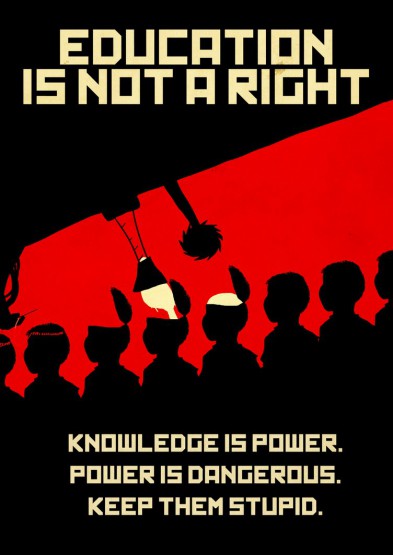
 

How the Government is Manipulating America’s Youth

anti_public_education_propaganda_by_8manderz8-d5xz1cj

By Ryan Christian

Source: Waking Times

Few would disagree that this country’s school system is, at best, behind the times; at worst, stifling unique perspectives and creativity, and effectively the future. With all that we have discovered about the way the mind works, and how each child learns in their own specific way, in their own time, it should be clear to all that each child has a special unique way of seeing the world that should be celebrated instead of suppressed or controlled. Yet our school system continues to use standardized testing and conformation techniques designed to mold each distinct and thriving individual into yet another perfectly conformed subservient consumer.

To some, this may seem outlandish, because why would the government desire to stifle the growing minds of its people and force what could be the next Einstein, the next Michelangelo or Bob Dylan to see the world their way; the next outside the box thinker who breaks the mold and leads this struggling society toward salvation? Why would they desire to take that potential “mold-breaker” and place them squarely back inside the box, destined for life in retail sales, or something else as benign and in service of the Empire’s “greater good?”

There are many answers that could be given to that question, yet the ultimate end-goal is always control. A docile, unified populace, all conformed and aligned in their perspectives, is much easier to manipulate toward a specific agenda than those such as independent journalists or other critical thinkers who will question the choices of the nation’s leaders, as was the hope of the founding fathers when envisioning the American republic that never came to pass. The success of the nation is something no doubt desired by the majority of Americans, but not at the deceptive and forceful expense of our children’s creativity; their future.

Make no mistake, true innovation has always come from those pushing the boundaries; those widely considered “crazy” by the masses, until it is realized that they were trailblazers, creators, true pioneers of the human mind and what it could be capable of. Sadly, this realization all to often happens after one is long dead, and those who once chose to cast stones, now enjoy the fruits of their struggles.

Today’s school system effectively puts an end to any such “unauthorized” thinking. It dictates how each child thinks, acts and sees the world, and it is very much by design. The government has made no secret about the fact that they consider one of their largest problems to be “conspiracy theorists” or what some are actively attempting to label the “Alt-Right” despite the fact that much of the alternative media no longer identifies with any of their faux political parties. It has even gone as far as to label “bloggers” or independent journalists such as Luke Rudkowski from We Are Change, as “domestic terrorists,” for simply exercising his constitutional rights, and providing the American people with the Truth about this country’s less than honorable foreign policy.

Even if one disagrees with his perspective of the truth, it is still his right as an American to speak out. Yet in today’s police state, the Truth can be a very dangerous thing, and that is made all the more clear with every attempt to cast doubt on what the rest of the world now knows to be true; to cast doubt on anyone spreading that Truth. Those choosing to seek answers for the people in this society of questions, should be the embodiment of what this country used to stand for, and what is now a word that has been so diluted and overused that is has largely lost its meaning in today’s America: freedom.

It is all too easy to put the issue of our failing school system on the back-burner, while this country ‘s news feed is dominated with police shootings, the US government’s ISIS boogeyman, and a circus of an election that has become a world-wide laughingstock. Yet it is important to realize that this is the next generation of Americans that are being carefully constructed like some kind of “build-your-own-American” program. Much of what is seen in the news could very well be designed to keep everyone focused elsewhere while the nation’s youth is programmed to compliance.

As unsettling as it might be to consider that one’s government might be conducting such a sinister operation, two things must be considered: First, is that this country has a very clearly documented history of conducting exactly this type of mind-altering control experimentation on those willing and unwilling alike; it’s just that we like to think that the worst of our checkered past is somehow from a different America that we have grown away from. Yet sadly, deep down, most know that is not the case. Secondly, many of those conducting such invasive experiments, to some degree, have convinced themselves that what they are doing is for the greater good of the American people. The question we all must ask ourselves, is at what point did this arbitrary idea of the “greater good” begin to supersede our rights as Americans, and as human beings?


Ryan Cristian is the author of website, The Last American Vagabond.

Either Reverse All the Perverse Incentives or the System Will Implode

By Charles Hugh Smith

Source: Of Two Minds

Every perverse incentive is the cash cow for a vested interest or cartel.

I hope it’s not a great shock to discover all the incentives in our status quo are perverse: those who rig the financial system while creating zero real value, jobs, goods or services reap all the big profits; those who take near-zero responsibility for their own health are subsidized by those who take responsibility for their own health; those who try to start enterprises and hire workers are saddled with endless regulations, junk fees and taxes while those who game the system to get welfare (household or corporate) skim the cream for doing nothing for their community or for the nation.

Systems in which all the incentives are perverse implode under their own weight. Those who struggle to pay the mounting costs of Imperial Over-Reach, crony-capitalism and all the skimmers and scammers eventually go bankrupt or quit in disgust, while the army of state dependents and cronies explodes higher.

It has taken decades for the incentives to become so perverse, so we no longer notice the perversity or the pathological consequences.

High-frequency traders and financiers with the ready ear of well-paid political lackeys, stooges, toadies and sycophants run never-lose skimming operations and pay lower tax rates than self-employed and small business owners.

Corporations have increased their share prices not by earning more money by producing more goods and services but by borrowing cheap money from the Federal Reserve and buying back outstanding shares.

Corporations pay less tax if they move production overseas and keep their profits in other countries.

If I wreck one vehicle after another due to reckless irresponsibility, what happens to my insurance premiums? They skyrocket, of course, reflecting the higher risks that result from my behavior and poor choices. Nobody thinks safe drivers should subsidize irresponsible drivers.

But if I wreck my health by recklessly pursuing risky behaviors, I pay the same as people who are careful “drivers” of their health. What sort of incentives does this system generate?

If I want to buy an over-priced home, the system is loaded with incentives to encourage that potentially poor financial decision. But if I want to launch a small enterprise, the incentives are all perverse: steep upfront fees, taxes from the first dollar, and in many cases, fees and taxes on revenues, regardless of whether I am making a profit or losing my shirt.

Corporate profits have soared as financialization and rigging the system have paid much higher returns than risking capital in new goods and services.

corp-profits3-16d

The incentives for home ownership have turned the bottom 90% into debt-serfs in servitude to banks while the top 5% own income-producing assets and businesses.

ownership-assets2-16

Larded with the most perverse incentives possible, the U.S. healthcare system in the final stages of maximum costs, just before it implodes:

US-healthcare4

It’s not hard to design positive incentives. For example:

1. Make preventative care essentially free to everyone ($5 co-pay) but weight the risks and costs created by irresponsible behaviors that ruin health. Reward those who take responsibility for their health by reducing the premiums they pay.

2. Tax all profits on securities held less than a day at 95%. Raise corporate taxes generated by financial activities to 50%, and lower the corporate tax rate on profits earned from producing domestic goods and services to zero.

3. Lower the tax for the first $25,000 earned by small enterprises to zero. Limit total government fees to 5% of revenues for all businesses up to $10 million in annual revenues.

4. Phase out the mortgage interest deduction. Limit mortgage interest deductions to the first $100,000 of mortgage debt.

5. Eliminate the personal income tax (and the need to file a return) for every household with income of $100,000 or less.

6. Automatically sunset every government regulation. Make city, county, state and federal governments renew every regulation every few years via a majority vote or it vanishes from the law books.

7. Make every politician wear a NASCAR-style jacket plastered with the names and logos of their corporate, union and financier contributors. The California Initiative to make this a reality is seeking signatures of registered California voters. Since politicians are owned, let’s make the ownership transparent.

8. Treat drug abuse and addiction as medical conditions rather than crimes.

9. Eliminate the Federal Reserve and its free-money for financiers perverse incentives for debt-serfdom and financial plundering.

10. Eliminate all student loans and debts. Make colleges compete for students on a cash-only basis.

As you no doubt noticed, every perverse incentive is the cash cow for a vested interest or cartel. That’s why the perverse incentives will endure until the system implodes under their pathological weight.

Public School or Prison? Here Are 10 Ways It’s Hard To Tell

sprongg-700x466

By Alice Jones Webb

Source: The Mind Unleashed

Every weekday morning, from September through June, parents across the country get up earlier than they want to, rush like crazy, wrangle kids into appropriate clothing, and wait in exhausting drop-off lines to get their children to school on time. Why? Because punctuality is a virtue? Or because they are afraid of getting in trouble?

In big cities and small communities, the same routine is repeated with minor variations. Small children and near adult adolescents will spend the majority of their waking hours somewhere they would rather not be. But few people question the set-up. Parents send their kids to school with the best of intentions, wanting to produce happy, healthy, productive adults. Public school is supposed to be for their own good. Very few question its necessity and virtue. No one questions the fact that our country’s public schools are looking less and less like places of learning and more and more like places of detention (and I don’t mean The Breakfast Club type either).

When you stop and think about it (which few people actually do), our public schools have more in common with our prison system than any parent would care to admit. Most of us are products of the system and will defend its honor and integrity like sufferers of severe Stockholm Syndrome. So let me break it down into a list of glaring similarities that even those of us who went to public school can easily understand.

1. Both School and Prison Take Away Freedom. To get into prison, a person has to be convicted of a crime (although all of us know that prisons are full of people convicted of pretty bogus crimes… just stick with me). Children in school are only guilty of the crime of being children. Since school attendance is compulsory, children, much like criminal prisoners, don’t get to choose whether they get locked up for seven or more hours a day. They are forced to go to school by strict truancy laws until they are at least 16, at which point their youth has already been squandered inside constrictive cinder block walls.

2. Both School and Prison use Security as a Means of Control. Prisons and public schools both use metal detectors, surveillance cameras, police patrols, drug-sniffing dogs, and lock downs to create a facade of greater security. In most elementary schools, there is an emphasis on moving students from location to location in a rigidly ordered manner. The straight line of silent children walking with hands behind their backs look frighteningly like lines of prisoners. The strict codes of conduct used in the majority of schools, as well as the consistent use of handcuffs and pepper spray on unruly high school students, work together to condition young people to the cultural normalcy of over-policing.

Stay in line. Do as you’re told. Don’t make trouble. These are the messages we send to both our prisoners and our school children. But it’s okay. It’s for their own good.

3. Both Schools and Prisons Serve Undesirable Food. The cafeterias in public schools are scarily similar to prison cafeterias, often even sharing the same menus. Unappetizing, bland, processed meals with little nutritional value are the norm in both institutions. And bringing a lunch from home is banned in many school districts. Add in the armed security guards that patrol most public school lunch rooms and a casual observer might not be able to tell the difference.

4. Both Schools and Prisons Enforce Strict Dress Codes. Like prisons, some schools obligate their students to wear uniforms, limiting self-expression, and encouraging a herd mentality that makes control easier (for safety’s sake, of course). But even in schools without required uniforms, strict dress codes are generally in place. Failure to tuck in a shirt tail can land a student in detention. Donning a blouse that doesn’t adequately cover a girl’s shoulders could get her sent home. Sometimes the dress code guidelines are so arbitrary and so strictly detailed, it seems like they are in place just to get students in trouble. In 2008, Gonzales High School in Texas made the national news for requiring dress code violators to wear actual prison jumpsuits. It’s like officials want the students to seem like criminals. Perhaps it makes the policing of students at their own hands seem more justified.

5. Both Students and Prisoners are Tracked. Many prisons use electronic bracelets or other tracking devices to keep track of prisoners’ locations. Many schools are doing the same thing. ID badges with built-in RFID chips can track the location of a child wherever they are wearing it, and many schools require ID badges to be worn during school hours. Some schools have even started using fingerprints and iris scanners to keep track of their prisoners… I mean students.

6. Both Schools and Prisons Have Armed Guards. Often referred to as SROs (school resource officers), most school buildings are patrolled by armed police officers. They are generally uniformed and carry pepper spray, tasers, and batons that they can use on students should the need arise. These officers police hallways and lunchrooms, administer searches of children’s lockers and school bags, and man the TSA-style checkpoints at the entrances to the buildings our children enter to learn.

7. Both Schools And Prisons do not Allow Anger. Although anger is a justifiable emotion toward constrictive and oppressive political structures, neither students nor prisoners have the power to express their emotions. In prison, angry convicts are locked away in solitary confinement, their movements and small remaining freedoms restricted for safety’s sake. In public school, anger is interpreted as a failing of the individual rather than the system that creates it. There, anger is seen as “disruptive behavior” or “cognitive impairment” or a “social or learning disability”. Often the angry student is marginalized by placement in special education classes, enrolled in “alternative schools”, or medicated to control their disruptions, all of which are just differing forms of confinement.

8. Both Students and Prisoners are Forced to Work. The scene of the prison chain gang in striped clothing, hacking away at rocks and debris is one that most people have seen in old films. Today’s prisoner work force looks a little different, with prisoners wearing orange jumpsuits and doing highway clean-up minus the bulky steel chains. Students are often forced to work, too. Sometimes they are forced to work cleaning up school grounds as a disciplinary action. But in some school systems, volunteer work or “community service” is required each year for a passing grade. Interesting to note that “community service” is frequently doled out as punishment to citizens convicted of minor crimes, but our children are only guilty of being kids.

9. Both Schools and Prisons Follow Strict Schedules. A rigid schedule of walking, eating, learning, exercise, and bathroom use is followed in both institutions. It doesn’t matter when you have to pee, or need to stretch your legs, or want a breath of fresh air. Those things can only be done during allotted times defined by those in authority.

10. Both Schools and Prisons Have Zero-Tolerance Policies. Most public schools now have policies of zero-tolerance when it comes to violence, bullying, drug possession, etc. Interestingly, much of the verbiage in our schools’ disciplinary policies come straight from the nation’s “War on Drugs” (which is directly responsible for the vast majority of our country’s prisoners). Zero-tolerance policies require harsher penalties for sometimes minor classroom offenses and often result in law enforcement being called in to handle school disciplinary actions. The result has been what many refer to as the “School-to-prison pipeline”. The policies make criminals out of students, pushing kids out of the classroom and into the criminal justice system at alarming rates. At least the transition will be easy. Those school children have already spent the majority of their lives in a system that matches the penitentiary where they’ll be spending most of the rest of it.

With such dark and intimidating surroundings, focusing on learning becomes difficult. It’s no wonder most kids don’t want to go to school. When you’re treated like a prisoner, it’s easy to feel like one.

About the Author

Alice Jones Webb is a writer, homeschooling mother of four, black belt, autodidact, free-thinker, avid reader, obsessive recycler, closet goth, a bit of a rebel, but definitely not your typical soccer mom. You can usually find her buried under the laundry and also on Facebook, Twitter, and her blog, DifferentThanAverage.com, where she blogs about bucking the status quo.

Seeking the True Path

thelesseroftwoevils_e2e98a_4912688

Cartoon by Loren Fishman. See more of his work at https://humoresquecartoons.com

Robert J. Burrowes

One of the more subtle manifestations of the intimate link between
(unconscious) human emotions and behaviour is illustrated by the simple
concept of choice and how this is so often reduced to a dichotomy
between two bad options. In such circumstances, most people choose
whatever they consider to be ‘the lesser evil’.

But how often are there only two options, even if they appear ‘good’ and
‘bad’? Frankly, I cannot think of one circumstance in which my choices
are limited to two, however good or bad they appear to be.

Why does this belief in just two options arise?

When we are born, our evolutionary inheritance includes a phenomenally
powerful capacity to feel a complex range of emotions. However, because
what sociologists refer to as ‘socialization’ (a process by which babies
and children are supposedly taught the ways of their society) is
actually a process of terrorizing babies and children into suppressing
their awareness of these emotions so that they can be forced to conform
to societal ‘norms’ (no matter how dysfunctional), the disastrous
outcomes of ‘socialization’ are obscured. If you wish to read more about
the terrorization of children, you can do so in ‘Why Violence?‘ and
Fearless Psychology and Fearful Psychology: Principles and Practice‘.

This terrorizing of babies and children takes many forms but one of the
most common ways it occurs is through simply telling a child what they
must do under threat of punishment for non-compliance which all parents,
teachers, religious figures and other adults do routinely. This
imperative to obey will always run counter to the child’s own Self-will.
Why is this? Because every single human baby is genetically programmed
to follow their own Self-will, not to obey the will of another.

This individual Self-will is generated by the integrated sense of how to
behave in response to the mental and physical feedback – including
feelings, thoughts, memory, conscience, sensory perception (sight,
smell, sound, touch, taste), truth register, intuition… – which each
person receives and which their mind processes and integrates to
crystallise the precisely appropriate behaviour in any given
circumstance.

But once a child is routinely terrorized into submitting to the will of
another – no matter how benign either the person giving the instruction
or the instruction itself – they lose trust and faith in their own
capacity to decide on a course of action and undertake it powerfully.
They are now adrift without clear internal guidance and, as they grow
up, they are now readily vulnerable to the ‘persuasion’ of others
whether it be the opinion of someone else, the advice of an ‘expert’ or
the inanity of an advertisement for a commercial product.

Adrift from their own unique and powerful internal mental processor –
with its emotional, intellectual, sensory, intuitive, memory, conscience
and other components – they are the victim of their own fear of being
disobedient, wrong, in the minority, isolated … if they follow their own
Self-will.

Unconsciously, the child feels trapped. They are terrified to do what
they want without permission (which is routinely denied) but
unconsciously angry about this (because they have been scared out of
being openly angry at their parents and teachers) which usually
manifests as something powerless such as resentment.

What does the child do in this circumstance? Obey the parent/teacher or
attempt to follow their own Self-will and risk (and probably receive)
punishment for doing so? What is the ‘good’ option here? Or is the child
faced with a choice between two evils and must try to choose the
‘lesser’ one? In the words of Anita McKone: ‘It feels like you must
either put up with abuse or die.’

Routine abuse of the child in this manner by their parents, teachers and
other adults throughout their early life leaves virtually all adults
with an unconscious belief that life is a series of choices between
‘lesser evils’ with an occasional ‘good’ choice allowed in limited
circumstances. We might choose our meal, the color and style of our
clothing, what film to watch and other such trivia. But what of anything
important? No way!

Most people end up believing that there are only ever two choices on
anything that matters and neither is particularly desirable.
Unconsciously, they feel trapped and it makes no sense when they are
told that they have many options from which to choose. This is not their
experience and it just feels untrue. They will endlessly choose the
lesser evil of two bad options on virtually everything that matters in
their life and accept the trinket ‘goods’ they are allowed to choose,
such as the nature of their hairstyle.

Long before adulthood, the child accepts a lifepath of conformity to the
most mundane human existence imaginable: school, work, the occasional
holiday, illness and death. A life never lived.

In essence, the terrorized child, now an adult, never looks beyond the
choices given, even when both are ‘bad’ or one is trivially ‘good’.

Most people have no sense of their own Self-will in the profound sense,
no faith in where this Self-will might take them if followed and, if
they could/can feel it, no courage to do what their Self-will tells
them.

The tragedy of virtually every human life is that they never seek out
what was taken from them as a child: the Self-will that would guide them
unerringly to seek out and become everything they were born to be. They
are so full of fear, self-hatred and powerlessness as a result of the
violence they suffered as a child, that they endlessly settle for ‘the
lesser evil’ on anything important and settle for trinkets in the form
of ‘good’: the choice of ice-cream flavour, the color of their socks,
the novel to read, the holiday destination.

Is there a way out? Yes, but it requires you to feel your fear, anger,
sadness and other feelings at what has happened to you until you are
powerful enough to reject both/all ‘bad’ options and to refuse the
trinkets that parody ‘good’. And to ask ‘What do I want?’ It is only by
consciously and deliberately rejecting all ‘lesser evil’ options that
the magnificent array of incredible opportunities which you have never
contemplated/discovered will open before you to choose as you wish.

And that is why it is so difficult. You must have the courage to cut
off, without the option of turning back, all options that do not give
you what you need. This is because what matters is not whether you get
what you need in the short term, but whether you live your truth, no
matter how difficult this might be in the immediate sense.

It is the fear of burning all bridges that holds us back because, as a
child, we were too scared to walk out on those who told us, one way or
another, that we had no choice but to suffer their abuse or die.

But the more bridges you burn, the more magnificent will be the vista of
undreamt opportunities that will open before you. And you will wonder
why you never considered/saw them before. Imagine if everyone had the
courage to burn the bridges of fear and to set out on their own unique
path.

And to experience the sheer joy of living powerfully in every moment of
their life.

But our own personal effort does not need to exclude the possibility of
making it easier for others in future too. So if you would like to
participate in the ongoing effort to create a world in which living
powerfully is more possible for each of us, you are welcome to consider
signing the online pledge of ‘The People’s Charter to Create a Nonviolent World‘.

If people are not afraid of violence, they are genuinely free to seek
their true path.


Biodata: Robert J. Burrowes has a lifetime commitment to understanding and ending human violence. He has done extensive research since 1966 in an effort to understand why human beings are violent and has been a nonviolent activist since 1981. He is the author of ‘Why Violence?‘ His email address is flametree@riseup.netand his website is at http://robertjburrowes.wordpress.com

Robert J. Burrowes
P.O. Box 68
Daylesford
Victoria 3460
Australia
Email: flametree@riseup.net

Websites:
Nonviolence Charter
Flame Tree Project to Save Life on Earth
‘Why Violence?’
Nonviolent Campaign Strategy
Nonviolent Defense/Liberation Strategy
Anita: Songs of Nonviolence
Robert Burrowes
Global Nonviolence Network

Punishment is Violent and Counterproductive

stpp

By Robert J. Burrowes

Punishment is a popular pastime for humans. Parents punish children. Teachers punish students. Employers punish workers. Courts punish lawbreakers. People punish each other. Governments punish ‘enemies’. And, according to some, God punishes evildoers.

What is ‘punishment’? Punishment is the infliction of violence as revenge on a person who is judged to have behaved inappropriately. It is a key word we use when we want to obscure from ourselves that we are being violent.

The violence inflicted as punishment can take many forms, depending on the context. It might involve inflicting physical injury and/or pain, withdrawal of approval or love, confinement/imprisonment, a financial penalty, dismissal, withdrawal of rights/privileges, denial of promised rewards, an order to perform a service, banishment, torture or death, among others.

Given the human preoccupation with punishment, it is perhaps surprising that this behaviour is not subjected to more widespread scrutiny. Mind you, I can think of many human behaviours that get less scrutiny than would be useful.

Anyway, because I am committed to facilitating functional human behaviour, I want to explain why using violence to ‘punish’ people is highly dysfunctional and virtually guarantees an outcome opposite to that intended.

Punishment is usually inflicted by someone who makes a judgment that another person has behaved ‘badly’ or ‘wrongly’. At its most basic, disobedience (that is, failure to comply with elite imposed norms) is often judged in this way, whether by parents, teachers, religious figures, lawmakers or national governments.

But is obedience functional or even appropriate?

Consider this. In order to behave optimally, the human organism requires that all mental functions – feelings, thoughts, memory, conscience, sensory perception (sight, sound, touch, smell, taste), truth register, intuition… – must be developed and readily involved, without interference, in our life. If this happens, then all of these individual functions will play an integrated role in determining our behaviour in any given circumstance. This is a very sophisticated mental apparatus that has evolved over billions of years and if it was allowed to function without interference in each individual, human beings would indeed be highly functional.

So where does obedience fit into all of this? It doesn’t. A child is genetically programmed to seek to meet their own needs, not obey the will of another. And they will behave functionally in endeavouring to meet these needs unless terrorized out of doing so. Moreover, they will learn to meet their own needs, by acting individually in some circumstances and by cooperating with others when appropriate, if their social environment models this.

However, if a child is terrorized into being obedient – including by being punished when they are not – then the child will have no choice but to suppress their awareness of the innate mental capacities that evolved over billions of years to guide their behaviour until they have ‘learned’ what they must do to avoid being punished. For a fuller explanation of this, see ‘Why Violence?’ and ‘Fearless Psychology and Fearful Psychology: Principles and
Practice’.

Unfortunately, as you can probably readily perceive, this process of terrorizing a child into suppressing their awareness of what they want to do so that they do what someone else directs is highly problematical. And it leads to a virtually infinite variety of dysfunctional
behaviours, even for those who appear to have been successfully ‘socialized’ into performing effectively in their society. This is readily illustrated.

Perhaps the central problem of terrorizing individuals into obedience of conventions, commands, rules and the law is that once the individual has been so terrorized, it is virtually impossible for them to change their behaviour because they are now terrified of doing so. If the obedient behaviours were functional in the circumstances then, apart from the obviously enormous damage suffered by the individual, there would be no other adverse social or environmental consequences.

Unfortunately, when all humans have been terrorized into behaving dysfunctionally on a routine basis (in the Western context, for example, by engaging in over-consumption) then changing their behaviour, even in the direction of functionality, is now unconsciously associated with the fear of violence (in the form of punishment) and so desirable behavioural change (in the direction of reduced consumption, for example) is much more difficult. It is not just that many Western humans are reluctant to reduce their consumption in line with environmental (including climatic) imperatives, they are unconsciously terrified of
doing so.

By now you might be able to see the wider ramifications of using violence and threats of violence to force children into being obedient. Apart from terrorizing each child into suppressing their awareness of their innate mental capacities, we create individuals whose entire (unconscious) ‘understanding’ of human existence is limited to the notion that violence, mislabeled ‘punishment’, drives socialization and society.

As just one result, for example, most people consider punishment to be appropriate in the context of the legal system: they expect courts to inflict legally-sanctioned violence on those ‘guilty’ of disobeying the law. As in the case of the punishment of children, how many people ask ‘Does violence restore functional behaviour? Or does it simply inflict violence as revenge? What do we really want to achieve? And how will we achieve that?’

Fundamentally, the flaw with violence as punishment is that violence terrifies people. And you cannot terrorize someone into behaving functionally. At very best, you can terrorize someone into changing their behaviour in an extremely limited context and/or for an extremely limited period of time. But if you want functional and lasting change in an individual’s behaviour, then considerable emotional healing will be necessary. This will allow the suppressed fear, anger, sadness and other feelings resulting from childhood terrorization to safely resurface and be expressed so that the individual can perceive their own needs and identify ways of fulfilling them (which does not mean that they will be obedient). For an explanation of what is required, see ‘Nisteling: The Art of Deep Listening’ which is referenced in ‘My Promise to Children‘.

So next time you hear a political leader or corporate executive advocating or using violence (such as war, the curtailment of civil liberties, an economically exploitative and/or ecologically destructive initiative), remember that you are observing a highly dysfunctionalized individual. Moreover, this dysfunctional individual is a logical product of our society’s unrelenting use of violence, much of it in the form of what is euphemistically called ‘punishment’, against our children in the delusional belief that it will give us obedience and hence social control.

Or next time you hear a public official, judge, terrorist or police officer promising ‘justice’ (that is, retribution), remember that you are listening to an emotionally damaged individual who suffered enormous violence as a child and internalized the delusional message that ‘punishment works’.

You might also ponder how bad it could be if we didn’t require obedience and use punishment to get it, but loved and nurtured children, by listening to them deeply, to become the unique, enormously loving and powerful individuals for which evolution genetically programmed them.

I am well aware that what I am suggesting will take an enormous amount of societal rethinking and a profound reallocation of resources away from violent and highly profitable police, legal, prison and military systems. But, as I wrote above, I am committed to facilitating functional human behaviour. I can also think of some useful ways that we could allocate the resources if we didn’t waste them on violence.

If you share this commitment and working towards this world appeals to you too, then you are welcome to consider participating in the fifteen-year strategy outlined in ‘The Flame Tree Project to Save Life on Earth‘ and to consider signing the online pledge of ‘The People’s Charter to Create a Nonviolent World‘.

Punishment can sometimes appear to get you the outcome you want in the short term. The cost is that it always moves you further away from any desirable outcome in the long run.


Biodata: Robert J. Burrowes has a lifetime commitment to understanding and ending human violence. He has done extensive research since 1966 in an effort to understand why human beings are violent and has been a nonviolent activist since 1981. He is the author of ‘Why Violence?‘ His email address is flametree@riseup.netand his website is at http://robertjburrowes.wordpress.com

Robert J. Burrowes
P.O. Box 68
Daylesford
Victoria 3460
Australia
Email: flametree@riseup.net

Websites:
Nonviolence Charter
Flame Tree Project to Save Life on Earth
‘Why Violence?’
Nonviolent Campaign Strategy
Nonviolent Defense/Liberation Strategy
Anita: Songs of Nonviolence
Robert Burrowes
Global Nonviolence Network

The real Hunger Games: the Capitalist recipe to maximise profits while ‘having fun’

peacekeeper

By Sky Wanderer

Source: Investment Watch

Introduce a political economy upon the arbitrary axiom that Capitalism is the one and only economic system for mankind, and introduce a narcissistic moral philosophy that you as a Capitalist represent unsurpassable objective moral virtues.

You as a Capitalist hire politicians to implement policy as per your moral and economic philosophy and redefine ‘democracy’ as the political system to sustain Capitalism. Then from such position of self-established authority, abolish unions and all labour-representation, thus force your employees into a race-to-the-bottom contest to compete for jobs by accepting lower and lower wages.

Give decent jobs and benefits to only those who belong to your noble circles. For everyone else reintroduce slavery in the form of “workfare”. The goal is that you pay the lowest wages for jobs done by the fittest slaves, who will survive the contest. If you wish, you can call the contest “real Hunger Games”.

To speed up the process, extend the race-to-the-bottom into global scope so that you will have access to the cheapest and fittest labour everywhere on the planet. Never mind that your slaves will have to live out of a suitcase and every time when you lay them off and labour demand calls them elsewhere, they will have to relocate to yet another continent.

To further accelerate the process, make good use of your 3rd-world colonies, your Mideast colonising wars and your secretly sponsored mercenaries (ISIS). Via your “leftist” assistants, organise a massive refugee crisis to import the cheapest possible workforce via your war-refugees and economic migrants. These migrants are the fittest contestants who – glad just to escape your bombs – will worship you as their saviours and will work for you for literally zero payment. The migrants will not only boost your profits to sky-high levels but will rapidly pull down the overall wages of your domestic employees.

Meanwhile keep increasing the prices so your slaves can’t pay for food, energy, heat and shelter from their next-to-zero incomes. If some of them attempt to survive by taking bank-loans to acquire shelter, education and meet other basic needs, but they can’t repay the loans from their low incomes, you can just evict them from their homes via your banks.

When you made them homeless this way, make sure their ugly presence won’t spoil the beauty of your city. Install pretty anti-homeless spikes, so when they crush onto the pavement they will die, and you can just collect their bodies. To project your capitalist moral virtues into eternity, incorporate the beauty of your anti-homeless spikes into the modern concept of art and beauty.

Introduce private banking to enable yourself to creating new money when you wish. This way you can easily indebt the entire society, soon you can even purchase the whole planet.

Meanwhile dismantle public healthcare, so those of your slaves who are still alive but get sick, will die without treatment. Eliminate (privatise) all affordable public services, destroy the public sphere, abolish all public spaces and welfare benefits. To have a dandy excuse for such policy, make sure to keep the country in ever increasing debt by taking countless £ billions of government loans, and transfer the responsibility of these odious debts onto your slaves. Refer to these debts as the reason for the crisis, then refer to the crisis as the reason for these debts, then refer to the debts and the crisis as the reason for austerity and spending cuts. Then you can increase the public debt again and continue the same loop ad infinitum.

Make sure your very own mainstream media and academia would never reveal the truth that the never-ending crisis and mass-unemployment are due to your private banking and debt- and profit-mongering dysfunctional capitalist system, and keep the real disastrous indicators of the state of economy in secret.

Instead of admitting the truth, use the divide et impera strategy to make your victims blame themselves and one another. To increase the fun, produce reality shows where the still active part of your slaves will blame the disabled and the unemployed, meanwhile make the local poor blame the immigrant poor for the overall misery that you inflicted. Then establish offices where the local poor dressed as fancy clerks will evict the immigrant poor, meanwhile watch how all of them are begging for their lives until they give up and commit suicide.

Enjoy!

The Crisis in Education Is That the Super Wealthy Corporate Education System Wants to Destroy Public Schools

privatizing-public-schools

By Diane Ravitch

Source: OpEdNews.com

It has become conventional wisdom that “education is in crisis.” I have been asked about this question by many interviewers. They say something like: “Do you think American education is in crisis? What is the cause of the crisis?” And I answer, “Yes, there is a crisis, but it is not the one you have read about. The crisis in education today is an existential threat to the survival of public education. The threat comes from those who unfairly blame the school for social conditions, and then create a false narrative of failure. The real threat is privatization and the loss of a fundamental democratic institution.”

As we have seen again and again, the corporate education industry is eager to break into U.S. public education and turn it into a free marketplace, where they can monetize the schools and be assured of government subsidization. On the whole, these privatized institutions do not produce higher test scores than regular public schools, except for those that cherry-pick their students and exclude the neediest and lowest performing students. The promotion of privatization by philanthropies, by the U.S. Department of Education, by right-wing governors (and a few Democratic governors like Cuomo of New York and Malloy of Connecticut), by the hedge fund industry, and by a burgeoning education equities industry poses a danger to our democracy. In some communities, public schools verge on bankruptcy as charters drain their resources and their best students. Nationwide, charter schools have paved the way for vouchers by making “school choice” non-controversial.

Yes, education is in crisis. The profession of teaching is threatened by the financial powerhouse Teach for America, which sells the bizarre idea that amateurs are more successful than experienced teachers. TFA — and the belief in amateurism — has also facilitated the passage of legislation to strip teachers of basic rights to due process and of salaries tied to experience and credentials.

Education is in crisis because of the explosion of testing and the embrace by government of test scores as both the means and the end of education. The scores are treated as a measure of teacher effectiveness and school effectiveness, when they are in fact a measure of the family income of the students enrolled in the school. The worst consequence of the romance with standardized testing is that children are ranked, sorted, and assigned a value based on scores that are not necessarily scientific or objective. Children thus become instruments, tools, objects, rather than unique human beings, each with his or her own potential.

Education is in crisis because of the calculated effort to turn it into a business with a bottom line. Schools are closed and opened as though they were chain stores, not community institutions. Teachers are fired based on flawed measures. Disruption is considered a strategy rather than misguided and inhumane policy. Children and educators alike are simply data points, to be manipulated by economists, statisticians, entrepreneurs, and dabblers in policy.

Education has lost its way, lost its purpose, lost its definition. Where once it was about enlightening and empowering young minds with knowledge, exploring new worlds, learning about science and history, and unleashing the imagination of each child, it has become a scripted process of producing test scores that can supply data.

Education is in crisis. And we must organize to resist, to push back, to fight the mechanization of learning, and the standardization of children.


Diane Ravitch is a historian of education at New York University. Her most recent book is Reign of Error: The Hoax of the Privatization Movement and the Danger to America’s Public Schools.  Her previous books and articles about American education include: The Death and Life of the Great American School System: How Testing and Choice Are Undermining EducationLeft Back: A Century of Battles Over School Reform, (Simon & Schuster, 2000); The Language Police: How Pressure Groups Restrict What Students Learn (Knopf, 2003);The English Reader: What Every Literate Person Needs to Know (Oxford, 2006), which she edited with her son Michael Ravitch. She lives in Brooklyn, New York.