America’s Rich Are Completely Losing Touch With Reality — and That’s a Really Bad Sign

By Shaun Bradley

Source: AntiMedia

The divide between wealthy and working class has grown wider each year since the last financial crisis, but this disconnect is about much more than just money or politics. The super-rich, in particular, have become completely detached from the everyday problems facing millions of their fellow citizens. Instead of recognizing the urgency of the current situation and contributing to solutions that help empower all members of society, the focus for many has shifted toward simply indulging in the present moment and increasing luxury. This kind of self-centered worldview has emerged throughout history and typically thrives most when decadent empires start to crumble.

Right now, the average person is forced to worry about central banks devaluing their currencies, corrupt bureaucrats eroding their civil liberties, and an economy on life support. Meanwhile, a faction of affluent individuals has committed themselves to avoiding the turmoil around them, instead choosing to obsess over life extension, genetic manipulation, and creating luxurious doomsday plans. Those people who have the crucial intellect, resources, and influence needed to implement real change are consumed with self-interest to the point of total apathy towards the future.

One of the more disturbing trends has been a rise in interest regarding something called parabiosis. This practice involves blood transfusions between the young and old in an attempt to slow the aging process. The procedure has been studied in the past but has always been met with moral and scientific criticism. Recently, however, a California start-up called Ambrosia began offering clients the opportunity to purchase the blood of someone under the age of 25 for a mere $8,000.

The process gained attention after Paypal co-founder Peter Thiel came out in support of further research during an interview:

“I’m looking into parabiosis stuff, which I think is really interesting. This is where they did the young blood into older mice and they found that had a massive rejuvenating effect. And so that’s … that is one that … again, it’s one of these very odd things where people had done these studies in the 1950s and then it got dropped altogether. I think there are a lot of these things that have been strangely underexplored.”

The blood used for these transfusions is often purchased from blood banks without informing the original donors. Popular high-school blood drives could soon have a whole new incentive to encourage students to participate. Any possible medical advancements that can help improve the lives of sick people should be explored, but for a private business to benefit directly from the generosity of others without their consent is a bit unnerving.

The question of whether this treatment is effective or not is almost a secondary issue to the ethical one. What does it show about our society when the priority of so many is not building a better world for the next generation but, rather, appeasing their egos by desperately clinging to their youth? The similarity to vampirism can’t be overlooked and may be another sign that, in the end, the truth is stranger than fiction.

The super-wealthy who can see the dangers facing the world are also fine with hitting the eject button to their own private bunkers in a worst-case scenario. The prepping community that was once isolated to ‘conspiracy theorists’ and survivalist groups has now been adopted by the 1%. Several billionaires have even gone so far as to buy entire islands to guarantee they won’t be swept up in the panic of the masses.

Tim Chang, the managing director at a financial firm called the Mayfield Fund, spoke to a reporter at the New Yorker about some of the conversations going on in these circles:

“There’s a bunch of us in the Valley. We meet up and have these financial-hacking dinners and talk about backup plans people are doing. It runs the gamut from a lot of people stocking up on Bitcoin and cryptocurrency, to figuring out how to get second passports if they need it, to having vacation homes in other countries that could be escape havens…I’ll be candid: I’m stockpiling now on real estate to generate passive income but also to have havens to go to….I kind of have this terror scenario: ‘Oh, my God, if there is a civil war or a giant earthquake that cleaves off part of California, we want to be ready.’ ”

While the ideas of democratic socialism have spread throughout the country, it’s clear that extreme individualism has developed on the other side. The majority of those with the means to care for themselves and their families have abandoned any connection to the rest of society. As long as the impact of the coming upheaval doesn’t affect them directly, it appears the fate of the rest is irrelevant.

The mentality of the nation has transitioned from proactive to reactive, with a sense of inevitability about the ultimate outcome we’re all facing. There is almost no effort to openly discuss the growing prospect of a civil war or severe economic breakdown, even as it grows more plausible in the minds of those paying attention. This obsession on the part of the super-rich for god-like control over their destinies only shows the fear that overwhelmingly dictates their choices. Maybe the modern day peasants of society should simply heed the advice of Marie Antoinette and eat cake while the world burns.

Three Paths

By Erik Lindberg

Source: Resilience

To have lost the godlike conceit that we may do what we will, and not to have acquired a homely zest for doing what we can, shows a grandeur of temper which cannot be objected to in the abstract, for it denotes a mind that, though disappointed, foreswears compromise.  But, if congenial to philosophy, it is apt to be dangerous to the commonwealth.  –Thomas Hardy

We have the choice of three paths into the future.  But choice is probably not the right word, for historical change is, at its most orderly, the result of action and reaction and reaction to that.  The word paths may in the same way be too tidy, for we are more likely to go crashing into the thickets than to follow the marked and warn paths that inhabit our imagination.

But here, in this brief exercise, I’m thinking about moral and cognitive maps and the way we might direct our ideals.   Perhaps, then, I may be forgiven these simplifications.  I am not making predictions about how the future might actually unfold; rather, I’m imagining the directions towards which we might cast our highest aspirations.

1) The Arc of History Bends towards Progress

Path 1 might be called the Liberal[i] Choice.  It follows the idea that a just and secure global order requires basic equality among all humans and all nations.  But equality is only a half of it: as important as the ideal of equality to the Liberal vision is the way equality might be achieved—namely by way of economic growth and increased overall wealth, which (the Liberal half-assumes and half-hopes) will be spread more equitably in the coming decades, allowing the impoverished to increase their standard of living faster than the already-prosperous will.  The Liberal vision imagines that Western and industrialized standards of living might be spread across the globe so that all people might enjoy electricity, paved roads, internet connection, urban anonymity, and (almost as human right) relief from the most difficult aspects of manual labor or subsistence farming, with the opportunity to become educated and free from the limiting prejudices of traditional societies.  It sees mobility, individualism, and choice as the hallmarks of this just and equitable society[ii], and imagines humanity becoming more cosmopolitan, tolerant, and secular, while earning its daily bread through endeavors deemed creative according to middle class values.[iii]

Liberals sometimes appreciate the link between economic growth or growing overall prosperity, on the one hand, and a tolerant and cosmopolitan global order, on the other.  This link is more implied than discussed (though it is also sometimes difficult to find policy makers discussing anything but economic growth).   But Liberals are mistaken to assume, as they often do, that education, mobility, and secular tolerance (along with the embrace of “free markets” and the cultivation of an entrepreneurial spirit) have themselves created economic growth and growing prosperity, and are wrong to imagine (as they do in a vague and image-filled sort of way) that Africa, Asia, and South America might join the Euro-American prosperous middle class once they free themselves from the train of ancient and venerable prejudices[iv] that stunt their progress.  Western prosperity, after all, is not a pretty thing if you look into it too much.

Liberals are likewise mistaken to believe that tolerance or peacefulness is a simple state of mind, or that they might be projected effectively with bumper-stickers, protest signs, and earth-tone sweaters, or that a Clinton regime would have somehow been less bloody than a Trump one, or, cum Sanders, that our unparalleled levels of consumption (i.e. prosperity) does not in fact require a menacing global military presence in addition to the manipulations of a multi-billion dollar marketing industry.  Peace does not come from virtuous mental states; it is instead the product of a delicate sociological balance that is absent in many parts of the world and that is disappearing in traditionally Liberal nations—and often for reasons that Liberals are hard-pressed to explain except by declaring that we need more Liberalism and its states of mind, backed by vague and increasingly incoherent policy objectives.  The tepid enthusiasm for the center left (in the U.S. last autumn or in France today[v]) may be a symptom of its incoherent and increasingly implausible vision.

2.  Power Realism[vi]

As I write these words, geo-political analysts are envisioning Russia and the United States on the verge of a new cold war.  Perhaps.  Regardless of how heated it becomes, the nature of this new East-West opposition, especially when compared to the previous one, is well worth noting.  Not only has the past ideological divide mainly disappeared, we might instead be struck by the way these global rivals are coming to resemble each other.  Never mind the possible scandals and whatever is at their root, the arrival of Trump represents what might hyperbolically be called Russianization of the U.S.  Like Putin, after all, Trump does not operate according to a myth of emancipation, but only according to the pursuit of national power.  Trump may not share Putin’s understanding that the source of power lies in resources (but perhaps he does), but his actions and his economic assumptions seem to concur with this view, as does the operating outlook that statecraft should work to corner as many remaining resources as possible.[vii]

Meanwhile, the rise of Trump and Trumpism in the U.S., as well as similar movements and sentiments in Western Europe, should in fact be attributed to the failure of the Liberal path and the decline of global economic growth—the end of one version of the “delicate sociological balance,” and the only version most of us can imagine (that gap in imagination is why I write).  Long term stagnation and the end of expansive bourgeois hope have worked to weaponize the “me first” attitude: under a neo-Liberal world order, self-interest was supposed to lead to a rising tide, but Power Realists have little need for any such benevolent apologia.  Now harnessed by belligerent nationalists, this attitude of economic competition is more and more likely to accept wide-scale inequality and is instead concerned to be on the winning side of a winner-take-all competition over the world’s remaining resources and comparative advantages.[viii]

To put this last point in another way, relatively few people have, at least until very recently, been willing to openly and consciously embrace the me-first belief-system of Power Realism, absent any accompanying narrative of emancipation.  But most of the West’s middle-class has long wanted, expected, and demanded in a way that effectively “chooses” a path of Power Realism and the international bullying it requires–far sooner, at least, than it would veer towards a lowering of any such demand and expectations.

Dead Ends

Liberals and Power Realists equally see the dead-end that the opposing path leads to.  But both are equally blind to, or at least resignedly sanguine about, the dead-end that their own path leads to.  Liberals correctly understand that the widespread global inequality that Power Realists appear ready to tolerate will lead to permanent war and conflict and perpetual assaults on national security by those left behind.

Meanwhile, Power Realists seem to understand[ix]  or sense (though they don’t openly articulate it in public) that the Liberal vision of 3% economic growth into perpetuity is a farce and a fantasy, and that the whole world will never live like we in Europe or America do.[x]  Our way of life may in fact depend, in the end, on the walls and borders that Liberals decry on “moral” grounds.  Insularity and defensiveness may be the required dispensation, as we choose our way of life over global equality.  Power Realists also intuit that most Liberals can be turned into Power Realists under increasingly common economic conditions.  The mere loss of expansive prospects is enough to turn many an Obama supporter into a Trump supporter.   Minor economic decline, even the absence of economic expansion, was all that it took.  Except for those prepared to blaze a new trail into uninhabited ideological wilds, Path 1 usually leads to Path 2 with the onset of only moderate duress.  Liberals mistakenly believe that hate is a prime driver[xi] of inequality or discrimination, and that it might be purged from the heart with an enlightened dose of Liberal hope.  This may occasionally be true, but hate is more the symptom and might inflict itself on anyone who has suffered repeated humiliations or degradation—or even the mere loss of unquestioned privilege.

Our current political conflicts, both domestic and international, can therefore be largely attributed to our adherence to these two merging paths—especially if we take into account our destabilized climate and resulting droughts in places like Syria and Somalia, in addition to all the other ways nations and peoples jostle for power and advantage.  Climate chaos and the resulting political chaos will be the most notable legacy of Liberal growth and the Power Realism that has begun to cruelly manage it.[xii]

Political conflicts are almost always presented as a battle of ideals (as with the American choice of freedom over tyranny during WWII[xiii]) with the implied presumption that we might choose peace and equality as discrete policies or national values, unconnected from our economic and consumptive being- in-the-world.  According to this battle of ideals, then, one side sees the world divided between a coalition of enlightenment, empathy, tolerance, and inclusion, opposed to uninformed bigotry and short-sighted selfishness.  As a bumper sticker I saw the other day smugly put it, “I think, therefore I’m Liberal.”  The other side sees a line dividing steadfast, uncompromising faithfulness and resolve from naïve and undiscerning acceptance and compromise, a line between strength and weakness, between realism and soft-headed idealism.

But our current global change and conflicts are better understood with concepts drawn from sociology or anthropology than from self-reassuring talking-points.   A stable social order requires what we might refer to as consent or “buy in,” perhaps a lessening of the inevitable tension between civilization and its discontents into a stable détente.  During the short Pax Americana, this consent has been purchased with the promise of expanding prospects for all, fueled by an economy that devoured its own resource base in a way that renders its continuation impossible.  The Liberal order replaced social bonds with growing possibility,[xiv] and required for its maintenance the fulfilled promise that every year would provide more and that every generation could expect distinct material improvements. [xv] This order had no plan for material contraction or the onset of limits, other than to declare in the face of reality that there are no limits to growth.

This lack of a plan for stasis, let alone degrowth, might explain the demise of what so many Liberals believed to be the arc of history.  We maintain our acquisitive and competitive values and the primacy of individual liberty.  But in the absence of the growth and opportunity that purchased consent, trust horizons shrink and we see a turn towards group identity (as an alternative to participation in some imaginary global civilization) and begin an openly hostile scramble for remaining pockets of wealth and privilege (in the absence of the promise that everyone might have more forever).  Globalist buy-in has no dependable currency.

Picture global conflict not as the fight between liberals and conservatives, between the enlightened and the ignorant, between moderates and fundamentalists.  Picture, instead, penniless children with their noses pressed against the candy store window, while entitled brats stuff their pockets full of unearned loot.[xvi]  Forget ideals and instead imagine repeated humiliation, envy, and frustration, broken promises and abortive ideals.  It is not some obscure “ideology of hate” or an unexplained failure of moderate pro-Western policies according to which the explosive vest is strapped on.  Nor can we explain as simple sexism the way Donald Trump’s gropings (and so much else) were so widely forgiven.  Far stronger than we tend to accept is the desire for purpose and belonging, and the desperate (and sometimes violent) search for renewed social bonds when the limitless world of boundless and bondless expansion flounders on the shoals of a finite planet.  We once lived in a world when there was little disbelief in face of the comforting contradiction that we might all somehow “get ahead.”  Now it is clear that only a few can actually do so.  It is this realization that creates nationalism, Brexit, right wing populism, hatred of immigrants, or “America First.”

3. A Third Way

The Liberal Dream is dying because the planet was never infinite and our potential never limitless–not because some bad-guy ignoramuses somehow got the upper hand.  A social order could never be maintained for long by the promise of more every year, while the tide can only rise so high before it washes all good fortune away.  The most direct and facile, yet brutal and likely, antithesis of Liberal Growthism is personified by Trump, Putin, or Le Pen today, Hitler, Mussolini and Franco in years past,[xvii] and can only lead to war and repression.[xviii]  Such rulers are what arise at the onset of Liberalism’s decline.  But they offer no real solution, only a quick reordering of hope and expectation into anger and hate—an ordering nonetheless.  Intoxicated by the thrill of an arms race, Power Realists ignore the fact that the oppression and forceful repression of at least half the world’s population is unsustainable, and that the immiseration it spreads will eventually inflict us all.  Liberals know this and are aghast at the rise of these values.  But they, in turn, are all too ready to ignore the fact that Liberal hope requires unsustainable growth and insulate themselves from the realization that our global climate crisis was not caused by nationalism or the greed of someone else.  It was caused by this same growth, which continues to demand levels of goods and services that are bringing our ecological systems to the point of collapse.

There is of course a third choice—one that is simple yet mainly unthinkable.  It sees with heart stopping clarity the dead-end towards which the other two paths lead and has math, science, and even hard-headed economic analysis[xix] on its side, not to mention a pretty solid interpretation of most of the world’s major religions.  But it is a choice that few appear prepared to adopt, even entertain.  It accepts the view that a secure and stable global order must be a relatively egalitarian one—that, according to one idiom, all God’s children deserve a fair share of the Earth’s bounty.  It understands that the 5% of the global population that the United States accounts for cannot continue to use a quarter or a fifth of the world’s energy and natural resources while emitting a similar proportion of carbon dioxide.

And here is where this path parts ways from any of the views normally deemed fit for polite company: for it does not believe that the rest of the world should be brought to our level; that would be ecological suicide.  For if the whole world were to live like Americans we would need an additional four to six Earth’s to supply the required energy and natural resources, and to absorb our terrible waste.  A transition to wind and solar power does not substantially change this equation, nor do all the most far-flung efficiencies that anyone might realistically imagine.

The path according upon which humanity has a chance to find a just and sustainable world requires what is unthinkable yet mathematically impeachable and morally imperative: that we in America and Europe live more like African villagers, Indian subsistence farmers, and South American peasants.[xx]  They must become our models for the triumph of human dignity and justice, not to mention sustainability.  We, who have the appearance, at least, of a choice, must choose this sort of radical simplicity, embrace the hard work and the community interdependence, and abandon dreams that we might live without limits and be or do anything we can imagine (that godlike conceit was forged under the illusion that we have an infinite universe at our disposal[xxi]).

This will never happen you say.  It is unrealistic.  People will never give up privilege unless they have to.[xxii]  Congratulations: you have just chosen Path 2.  But true enough, I can’t disagree, this skepticism is probably warranted, especially if the limits of human aspiration are to be pragmatic and strategic, if you can’t hope beyond the current political parties and already established life-paths for middle class people.  For there is no clear path from where we are to a world of radically simple sustainability, except the one paved with cataclysmic violence and bloodshed, in which we will eventually be forcefully taken to our knees.[xxiii]

But we might still stand up and declare, “this is the right path, this is what I support, this is where I will throw my energy.”  There is no reason why we must continue to choose Path 1 or Path 2, or accept it–no reason why we must continue to pretend that our way of life or our side of the ideological divide (give or take a few ideological tweaks) is just and sustainable.  There is no reason why we should continue to give our consent to the maintenance of either growth or inequality.   Let us openly and loudly declare our commitment to our own eventual material poverty, and in this declaration find moral and spiritual wealth.  Let us begin to proclaim the unthinkable and think it every day.


[i] By Liberals I mean philosophical Liberals, which has generally included many who are considered political conservatives.  Ronald Reagan was as much a Liberal as Bernie Sanders.  Donald Trump, however, may not be a Liberal.

[ii] To borrow Chris Smaje’s term, Liberals are “solutionist” when it comes to freedom and choice, unable to see that there are in it advantages and disadvantages, payoffs and collateral damage.

[iii] Where apps are “creative” but managing erosion on a hardscrabble farm is not.

[iv] And accept that loan from the IMF along with the accompanying “restructuring” and “reforms.

[v] Does anyone really embrace the vision of a Clinton or a Macron?  Or is it just a safe alternative to the alternative?

[vi] I am not suggesting that “Power Realists” are across the board more “realistic.”

[vii]http://www.resilience.org/stories/2017-01-24/donald-trump-and-economic-growth-a-brief-interregnum-on-growthism/

[viii] http://www.resilience.org/stories/2017-01-24/donald-trump-and-economic-growth-a-brief-interregnum-on-growthism/

[ix] I’m completely not sure about this.  Power Realists may be as Growthist as neo-liberals and certainly trumpet the ideals of economic growth.  But their rise, I would assert without much qualification, has been made possible by the ending of growth and their policies are suited to the end of a Growthist order.

[x] It is with some weariness that I feel compelled to provide evidence for this conclusion.   Either the idea that the Earth can provide enough resources for the rest of the world to live like us, or the idea that exponential growth remains a viable plan for the future, on their own, belie any mathematical conclusions. But the Liberal vision requires both.  A true Liberal paradise would require that we maintain 3% or so economic growth in the industrialized world, while the “developing” world grows even faster to catch up.  The main reason that this can’t work is, simply, that growth is tantamount to mass genocide followed by mass suicide.  For despite ballyhooed efficiencies and alleged “decoupling” no one has figured out to create more stuff for more people without using more natural resources.  There is no way to lift a 400 ton passenger airplane off the ground with a small ecological footprint or provide everyone with one-hundred horsepower personal transportation without making the planet unlivable.  If everyone were to live like Americans, we would require about 6 times the current amount of things like rubber, oil, timber, concrete, and iron ore.  Meanwhile 3% economic growth—the amount most Liberal economists believe is necessary to maintain our delicate sociological balance—means that the size of the economy (and the amount of natural resources it requires) will double every 23 years.  That means in 56 years, the natural resource requirements would be quadruple the current level.  This is not a viable path into the future.  These resources simply don’t exist, and attempting to squeeze them out of our planet would make it unlivable.  Past and current attempts may already have.  No wonder so many pro-growth technophiles look to outer space as the solution to humanity’s alleged need for growth—which begs the very basic existential question of why so many humans see this as a better plan than the unthinkable one I suggest below.  I review some of the fundamental problems of economic growth in http://www.resilience.org/stories/2017-02-22/economic-growth-a-primer/

[xi] What Jacques Derrida would have referred to as a “transcendental signifier,” a thing-in-itself, something that just is, which, like “evil,” not only needs no further explanation, but in fact shuns it.

[xii] As Michael Klare has recently noted more people are on the brink of starvation now than at any time since WWII.  http://www.resilience.org/stories/2017-04-21/climate-change-genocide/

[xiii] This “choice” is far better described with that word, and with the notion of “ideals,” than anything we encounter today.  However, the clean narrative of good vs evil has nevertheless been simplified, with the relation of national interests to resources and empire being erased from the picture, or perhaps overshadowed by the atrocities.

[xiv] http://www.resilience.org/stories/2017-01-17/the-growthist-self-growthism-part-3/

[xv] http://www.resilience.org/stories/2016-01-11/a-geo-physis-of-freedom/

[xvi] And then picture these same entitled brats with their noses pressed up against another window on some other day.

[xvii] As the US Joint Forces Command concluded in 2010, “A severe energy crunch is inevitable without a massive expansion of production and refining capacity. While it is difficult to predict precisely what economic, political, and strategic effects such a shortfall might produce, it surely would reduce the prospects for growth in both the developing and developed worlds. Such an economic slowdown would exacerbate other unresolved tensions, push fragile and failing states further down the path toward collapse, and perhaps have serious economic impact on both China and India. At best, it would lead to periods of harsh economic adjustment. To what extent conservation measures, investments in alternative energy production, and efforts to expand petroleum production from tar sands and shale would mitigate such a period of adjustment is difficult to predict. One should not forget that the Great Depression spawned a number of totalitarian regimes that sought economic prosperity for their nations by ruthless conquest.”  https://fas.org/man/eprint/joe2010.pdf, p.22 (emphasis added).

[xviii] Someone like Reagan is of great historical interest, what with his attempt to create a synthesis of the two, reflected in his soaring rhetoric, but paid for with massive debt and the strategic use of populist hate.

[xix] I am not, of course, referring to most mainstream economic analysis.  Economics as a discipline has been charged mainly with the task of figuring out how to grow the economy regardless of the consequences or the possibility.  By “hard-headed” I am thinking of the few economists who have escaped this Growthist ideology and follow what Charles Hall and Kent Klitgaard refer to as “biophysical economics.”

[xx] This point has been made most poignantly by Chris Smaje.  If you haven’t been reading his work, start now.  It’s among the most interesting in the “deep sustainability” world.  I need to further note that this current essay was motivated by Chris’s “Article 51” where he writes: “I’ve been accused before of irresponsibly wishing to lower the standard of living in the wealthier countries to the level of common misery experienced by humankind in general in relation to my remarks on immigration. On reflection, I’m happy to embrace that accusation, if I’m allowed a few extra lines of defence. I embrace it because, well, what’s the alternative? Historically, capitalist ideology has justified itself with aqueous metaphors of downward trickling and upwardly rising tides that benefit all. It’s become clear that these are mirages. So the argument against a fair global spread of economic resources then boils down essentially to the devil take the hindmost. I can’t justify that to myself ethically, and in any case I think that road leads to a still deeper mire of global misery.”  http://www.resilience.org/stories/2017-03-28/article-51/

Smaje consistently condenses complicated issues into digestible form without sacrificing the complexity.  I’m trying to recondense some of his thoughts—or my take on them—into my own idiom and may be justly accused of adding little to what he has already said.

[xxi] It’s a nice sentiment, and it’s everywhere.  The prevailing “moral” of 90% of the movies currently made for 5 year olds is that they can be who or whatever they want, if they only follow their dreams and “be themselves.”  I get where this is coming from, and can glimpse the cost of abandoning this fiction.  But we need to start considering the fact that it just isn’t true, and certainly can’t be, at least as currently understood, for 6 or 7 or 8 billion people.  It might be possible, for a while, for half a billion or so.  And then they are likely to kick and scream and pout when the promise turns out to have been false.

[xxii] And the ecological limits of the world will never appear to us as a “have to,” even though they most certainly are.

[xxiii] There are of course brave pioneers who have beaten a track in this direction—ones like Jim Merkel.  But the problem of a whole-society or whole-system transition has yet to be solved.

Another Unsolvable Issue for Americans

Mass Incarceration, Prison Labor in the United States

By John Stanton

Source: Dissident Voice

The Federal Prison Industries (FPI) under the brand UNICOR operates approximately 52 factories (prisons) across the United States. Prisoners manufacture or assemble a number of products for the US military, homeland security, and federal agencies according to the UNICOR/FPI website.  They produce furniture, clothing and circuit boards in addition to providing computer aided design services and call center support for private companies.

UNICOR/FPI makes its pitch for employing call center support personnel to firms thinking about off-shoring their call center functions. The logic is that, hey!, they may be prisoners, but it’s keeping the jobs in the USA that matters. Fair enough. That approach cuts out the middleman though, those Americans desperate for any kind of work but, through no fault of their own, are not behind prison bars and employable by UNICOR/FPI.

Sure, it seems a heartless statement and there are any number of angles to take on why the USA is the world’s number one incarcerator: Capitalism, racism, social and political injustice, a pay-as-you-go legal system, bone-headed policy makers, prison lobbyists, the death penalty, employment/unemployment, drugs, gangs, costs/prices and a host of behavioral, psychological and environmental issues that I have missed.

Inevitably the black hole that is money eventually sucks in and corrupts everyone from those in local communities desperate for the work a prison facility provides to those investors who profit from the prison industry. They earn their livelihoods and take their profits from the misery and labor squeezed from their human property — those prisoners who self-destructed and others who are serving terms way too long for the crime committed.

For the Love of Money

From October 2016 through March 2017, UNICOR/FPI sold $252,414,987 million worth of goods and services.

The prison labor industry is very keen on promoting its role in assembling the US military’s widely used Single Channel Ground and Airborne Radio System (SINCGARS). In January defense contractor Harris Corp. was awarded a $403 million contract by the US Defense Logistics Agency for spare parts supporting tactical radio systems, which includes SINCGARS.

UNICOR/FPI is a major supplier of SINCGARS radios, mounts, antennas, and installation and repair kits and when hard-mounted, our SINCGARS equipment meets rigorous military standards for shock and vibration in aircraft and tactical vehicles, such as Bradley’s and Humvees. Through our nationwide network of factories and trained technicians, we have successfully met aggressive production and distribution needs for this crucial communication equipment in Middle East military operations.

Some of the purchases by the US Department of Defense include $14.8 million for electronic components, $887 thousand for communications equipment, $26.7 million for office furniture, $27.1 million for special purpose clothing and $7.5 million for body armor. The Department of Homeland Security spent $372,255 on administrative support. The Executive Office of the US President spent $389 for signs and identification plates.

Fight Fire with Inmates

According to a Mother Jones article in 2015 somewhere between 30 and 40 percent of California’s forest firefighters are state prison inmates with some 4,000 working at any one time on fire lines. So dependent on the inmates was California that prison reforms that would see the release of some of the incarcerated firefighters were put on hold for fear of losing the manpower to fight California blazes. Then California attorney general Kamala Harris, now a US Senator, was behind the effort to keep the “cheap” firefighters behind bars,

Prison reform advocates have raised concerns that the state is so reliant on the cheap labor of inmate firefighters that policymakers may be slow to adopt prison reforms as a result. The concern was magnified last fall, when lawyers for state Attorney General Kamala Harris argued that extending an early prison-release program to “all minimum custody inmates at this time would severely impact fire camp participation—a dangerous outcome while California is in the middle of a difficult fire season and severe drought.” Harris has since said she was “troubled” by the argument, and the state has ruled that minimum custody inmates, including firefighters, are eligible for the program so long as it proves not to deplete the numbers of inmate firefighters.

US Immigration and Customs Enforcement detains women, men, children, and LGBTQI individuals in over 200 county jails and for-profit prisons, according to the grass roots group CIVIC. Some of these individuals include legal permanent residents with longstanding family and community ties, asylum-seekers, and victims of human trafficking.

It was former President Bill Clinton (Democrat) who started to load up detention centers and jails with immigrants, CIVIC noted.

In 1996, President Bill Clinton signed the Antiterrorism and Effective Death Penalty Act (AEDPA) and the Illegal Immigration Reform and Immigrant Responsibility Act (IIRIRA), which doubled the number of people in immigration detention from 8,500 each day in 1996 to 16,000 in 1998. Today, the detention population has increased fourfold to approximately 34,000 individuals each day, due in part to a congressionally mandated lock-up quota.

President Donald Trump’s (Republican) animosity to immigrants is well known. He and his aptly named attorney general Jefferson Beauregard Sessions will make sure detention centers and prisons are overfilled with men, women and children from Mexico, Central and South America. Trump and Session’s maniacal quest wage war on crime, drugs and terrorism will likely ensure that many thousands more will find themselves locked away and working for UNICOR/FPI or lining the pockets of private prison company owners.

Immigrants Too

The non-profit group Towards Justice reported that a lawsuit is moving forward pitting private prison corporation against immigrants who were forced into labor while in detention.

For the first time in history, a federal court allowed a class of immigrant detainees to jointly proceed with forced labor claims against the country’s second-largest private prison provider. Judge Kane in the District of Colorado certified a class of between 50,000 and 60,000 current and former immigrant detainees held at GEO’s Aurora, Colorado detention facility since 2004. These individuals, some of whom were found to legally reside in this country after months in detention, allege that they were forced to clean the detention center without pay and under threat of solitary confinement. This practice allowed GEO to reduce labor costs at the Aurora facility, where it employs just one custodian to maintain a detention center that houses up to 1,500 people at a time.

Everyone Has Their Hands in the Pie

In January 2017, the Prison Policy Initiative (prisonpolicy.org) worked up a study titled Following the Money of Mass Incarceration. It shines the light on some of the unsettling reasons why the USA will never be able to reduce its reliance on mass incarceration. Those who depend on money that the prison industry provides will never give it up. It’s not just private companies but local communities, bondsmen, unions all the way up to the US Department of Defense who collect fees or purchase UNICOR/FPI products and services at dirt cheap prices.

Bail bond companies that collect $1.4 billion in nonrefundable fees from defendants and their families actively work to block reforms that threaten its profits, even if reforms could prevent people from being detained in jail because of their poverty. Specialized phone companies win monopoly contracts and charge families up to $24.95 for a 15-minute phone call. Commissary vendors that sell goods to incarcerated people — who rely largely on money sent by loved ones — is an even larger industry that brings in $1.6 billion a year. 38 towns and cities in the U.S., more than 10% of all revenue is collected from court fines and fees. In St. Louis County, five towns generated more than 40% of their annual revenue from court fines and fees in 2013.

The over-incarceration of Americans is just one more vexing issue, piled on many—Afghanistan, Syria, education, Trump/Clinton’s health care, taxes–in which US citizens find themselves trapped and unable to reach across the pro/con divide and cause change.

Our Political Parties Are Obsolete

By Charles Hugh Smith

Source: Of Two Minds

When the parties do finally implode, the general mood will be: good riddance.

History informs us that once something is obsolete, it can disappear far faster than anyone expected. While we generally think of obsoleted technologies vanishing, social and political systems can become obsolete as well.

Should a poor soul who entered a deep coma a year ago awaken today, we must forgive his/her astonishment at the political wreckage left by the 2016 election. The Democratic Party, a mere year ago an absurdly over-funded machine confident in an easy victory in the presidential race, is now a complete shambles: its leadership in free-fall, its Fat-Cat donors disgusted, and its demented intoxication with pinning collaboration with Russia on the Trump camp eroding whatever feeble legacy legitimacy it still holds. What the party stands for is a mystery, as its Elites are clearly beholden to insiders, special interests and Corporate donors while glorifying the worst excesses of globalism and the National Security State’s endless war on civil liberties.

The newly awakened citizen would also marvel at the chaotic war zone of the Republican Party, in which the Insider Warlords are battling insurgent Outsiders, while the same Elites that fund the Democratic machine are wondering what they’re buying with their millions of dollars in contributions, for it’s unclear what the Republican Party stands for: it’s for Small Government, except when it’s for Bigger Government, which is 95% of the time; it’s for more law enforcement and the militarization of local police, and more intrusion into the lives of the citizenry; it’s for stricter standards for welfare, except for Corporate Welfare; it’s for tax reform, except the thousands of pages of give-aways, loopholes and tax breaks for the wealthy and corporations all remain untouched, and so on: a smelly tangle of special interests masked by a few sprays of PR air freshener to the millions left behind by the globalization that has so enriched Corporate America and the class of financier-owners, bankers, insiders and technocrats–the same group that funds and controls both political parties.

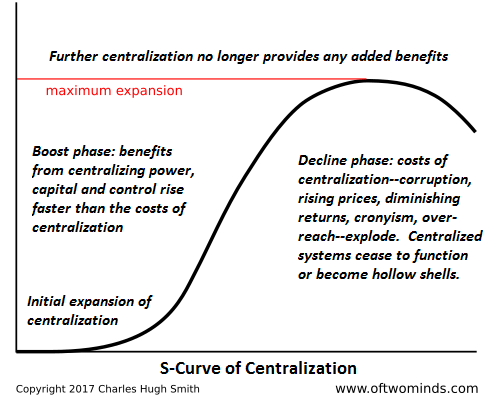
Political parties arose to consolidate centralized control of the central state.We have now reached the perfection of this teleology: the political elites and the financial elites are now one class. In our pay-to-play “democracy,” only the votes of wealth and institutional power count.

As I have often noted here, the returns on centralization are diminishing to less than zero. The initial returns on centralizing capital, production and social-political power were robust, but now the centralized cartel-state is eating its own tail, masking its financial bankruptcy by borrowing from the future, and cloaking its political bankruptcy behind the crumbling facades of the legacy parties.

Now that technology has enabled decentralized currency, markets and governance, the centralized political parties are obsolete. They are the political equivalent of buggy whips, and those holding tight to the fantasy that their current dissolution will magically be transformed into unity by some future leadership will be disappointed.

The fragmentation of the political parties is not temporary–it is permanent. As I discussed yesterday, political and social fragmentation are the consequence of economic fragmentation–these are self-reinforcing dynamics, as fragmentation in one feeds fragmentation in the others.

Those who have gotten rich inside the bloated machinery of the parties will never accept their era has ended. The dreams of private jets and millions of dollars in contributions die hard. But the voters and donors are both waking up to the cold reality that the parties are nothing but wealth distribution machines that sluice millions from financial elites to various political elites.

All the legacy claims of both parties ring false; neither party gives a hoot about the working class, small business or civil liberties. Their entire game plan is to whip up hot-button social issues to distract a fragmented citizenry and arouse last-gasp emotional loyalty to empty slogans.

Is it any wonder that people are abandoning both parties and claiming Independent status? All the core systems of the nation are failing, visibly, painfully, badly, and yet all the parties can dredge up is more of the same and TINA–there is no alternative.

The citizen who just awakened also awakened to the truth: the legacy parties have no solutions; their game plan is to milk the system as long as they can before it collapses in a rotten heap of corruption, fraud, collusion, debt and profiteering that benefits the few at the expense of the many.

When the parties do finally implode, the general mood will be: good riddance. A centralized spoils system is no longer a viable way to govern the nation. Political systems everywhere are facing a choice: Decentralize or die.

Now Just Five Men Own Almost as Much Wealth as Half the World’s Population

By Paul Buchheit

Source: CommonDreams

Last year it was 8 men, then down to 6, and now almost 5.

While Americans fixate on Trump, the super-rich are absconding with our wealth, and the plague of inequality continues to grow. An analysis of 2016 data found that the poorest five deciles of the world population own about $410 billion in total wealth. As of 06/08/17, the world’s richest five men owned over $400 billion in wealth. Thus, on average, each man owns nearly as much as 750 million people.

Why Do We Let a Few People Shift Great Portions of the World’s Wealth to Themselves? 

Most of the super-super-rich are Americans. We the American people created the Internet, developed and funded Artificial Intelligence, and built a massive transportation infrastructure, yet we let just a few individuals take almost all the credit, along with hundreds of billions of dollars.

Defenders of the out-of-control wealth gap insist that all is OK, because, after all, America is a ‘meritocracy’ in which the super-wealthy have ‘earned’ all they have. They heed the words of Warren Buffett: “The genius of the American economy, our emphasis on a meritocracy and a market system and a rule of law has enabled generation after generation to live better than their parents did.”

But it’s not a meritocracy. Children are no longer living better than their parents did. In the eight years since the recession the Wilshire Total Market valuation has more than TRIPLED, rising from a little over $8 trillion to nearly $25 trillion. The great majority of it has gone to the very richest Americans. In 2016 alone, the richest 1% effectively shifted nearly $4 trillion in wealth away from the rest of the nation to themselves, with nearly half of the wealth transfer ($1.94 trillion) coming from the nation’s poorest 90%—the middle and lower classes. That’s over $17,000 in housing and savings per lower-to-middle-class household lost to the super-rich.

A meritocracy? Bill Gates, Mark Zuckerberg, and Jeff Bezos have done little that wouldn’t have happened anyway. ALL modern U.S. technology started with—and to a great extent continues with—our tax dollars and our research institutes and our subsidies to corporations.

Why Do We Let Unqualified Rich People Tell Us How To Live? Especially Bill Gates! 

In 1975, at the age of 20, Bill Gates founded Microsoft with high school buddy Paul Allen. At the time Gary Kildall’s CP/M operating system was the industry standard. Even Gates’ company used it. But Kildall was an innovator, not a businessman, and when IBM came calling for an OS for the new IBM PC, his delays drove the big mainframe company to Gates. Even though the newly established Microsoft company couldn’t fill IBM’s needs, Gates and Allen saw an opportunity, and so they hurriedly bought the rights to another local company’s OS — which was based on Kildall’s CP/M system. Kildall wanted to sue, but intellectual property law for software had not yet been established. Kildall was a maker who got taken.

So Bill Gates took from others to become the richest man in the world. And now, because of his great wealth and the meritocracy myth, MANY PEOPLE LOOK TO HIM FOR SOLUTIONS IN VITAL AREAS OF HUMAN NEED, such as education and global food production.

—Gates on Education: He has promoted galvanic skin response monitors to measure the biological reactions of students, and the videotaping of teachers to evaluate their performances. About schools he said, “The best results have come in cities where the mayor is in charge of the school system. So you have one executive, and the school board isn’t as powerful.”

—Gates on Africa: With investments in or deals with MonsantoCargill, and Merck, Gates has demonstrated his preference for corporate control over poor countries deemed unable to help themselves. But no problem—according to Gates, “By 2035, there will be almost no poor countries left in the world.”

Warren Buffett: Demanding To Be Taxed at a Higher Rate (As Long As His Own Company Doesn’t Have To Pay) 

Warren Buffett has advocated for higher taxes on the rich and a reasonable estate tax. But his company Berkshire Hathaway has used “hypothetical amounts” to ‘pay’ its taxes while actually deferring $77 billion in real taxes.

Jeff Bezos: $50 Billion in Less Than Two Years, and Fighting Taxes All the Way 

Since the end of 2015 Jeff Bezos has accumulated enough wealth to cover the entire $50 billion U.S. housing budget, which serves five million Americans. Bezos, who has profited greatly from the Internet and the infrastructure built up over many years by many people with many of our tax dollars, has used tax havens and high-priced lobbyists to avoid the taxes owed by his company.

Mark Zuckerberg (6th Richest in World, 4th Richest in America) 

While Zuckerberg was developing his version of social networking at Harvard, Columbia University students Adam Goldberg and Wayne Ting built a system called Campus Network, which was much more sophisticated than the early versions of Facebook. But Zuckerberg had the Harvard name and better financial support. It was also alleged that Zuckerberg hacked into competitors’ computers to compromise user data.

Now with his billions he has created a ‘charitable’ foundation, which in reality is a tax-exempt limited liability company, leaving him free to make political donations or sell his holdings, all without paying taxes.

Everything has fallen into place for young Zuckerberg. Nothing left to do but run for president.

The False Promise of Philanthropy 

Many super-rich individuals have pledged the majority of their fortunes to philanthropic causes. That’s very generous, if they keep their promises. But that’s not really the point.

American billionaires all made their money because of the research and innovation and infrastructure that make up the foundation of our modern technologies. They have taken credit, along with their massive fortunes, for successes that derive from society rather than from a few individuals. It should not be any one person’s decision about the proper use of that wealth. Instead a significant portion of annual national wealth gains should be promised to education, housing, health research, and infrastructure. That is what Americans and their parents and grandparents have earned after a half-century of hard work and productivity.

Putin, Xi Message To Trump: US Unipolar World Is Over

By Finian Cunningham

Source: Information Clearing House

The US’ strategy has been to isolate Russia internationally. Evidently, it is Washington that is becoming more isolated on the global stage. This week in the run-up to the G20 summit in Germany, the reverse in fortunes could not be more glaring.

While North Korea was openly defying Washington with a breakthrough ballistic missile test, and US President Donald Trump was embroiled in his usual juvenile tweeting antics, Russia and China’s leaders were proudly consolidating their strategic alliance for a new multipolar global order.

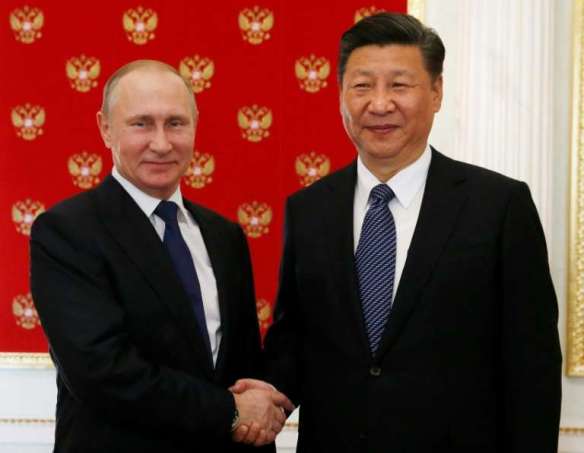
Western media won’t acknowledge as much, but the meeting this week in Moscow between Putin and Xi Jinping was of historical importance. We are witnessing a global transition in power. And for the common good.

Russian President Vladimir Putin and his Chinese counterpart Xi Jinping bond through an apparent deep sense of mutual respect and wisdom about the political challenges facing today’s world. The two leaders have met on more than 20 occasions over the past four years. President Xi referred to Russia as China’s foremost ally and said that in a topsy-turvy world the friendship between the two was a source of countervailing stability.

On the breaking news of North Korea’s successful test launch of its first Intercontinental Ballistic Missile (ICBM), both Putin and Xi called for calm restraint. By contrast, US President Trump took to Twitter to taunt Kim Jong-Un. “Does this guy not have anything better to do with his life?” said Trump in words that could apply more pertinently to the American president.

Then the US and its South Korea ally also launched their ballistic missiles in a military drill aimed as a show of strength to Pyongyang. Kim Jung-Un responded that the ICBM was a “gift for the American bastards” on their Fourth of July Independence Day holiday and that there would more such gifts on the way.

Rather than escalating tensions, Putin and Xi put forward the eminently reasonable proposal that North Korea should freeze its missile tests and the US should likewise halt its military exercises on the Korean peninsula. All sides must convene in negotiations with a commitment to non-violence and without preconditions to strive for a comprehensive settlement to the decades-old dispute.

The contrast in Putin and Xi’s dignified, intelligent response with that of Trump’s petulance is clear proof of Russia and China showing real global leadership, whereas the Americans are just part of the problem.

But the Korean drama was only one illustration this week of how American ambitions of unipolar dominance have become redundant.

The G20 summit prelude of Putin hosting Xi in Moscow was followed by the Chinese president making a state visit to Germany on Wednesday two days before the gathering in Hamburg. Xi and German Chancellor Angela Merkel reportedly signed new trade deals between the world’s two leading export economies.

“Relations between China and Germany are at their historic best,”said Michael Clauss, Germany’s ambassador to Beijing. “The economic and political dynamic from a German perspective is moving toward the east.”

Of significance too was news this week the European Union is preparing to finalize a major trade pact with Japan.

It is also significant that Japan’s Prime Minister Shinzo Abe called on China and Russia to help mediate the Korean crisis immediately following Pyongyang’s ICMB test launch.

Evidently, Japan, despite being an ally of Washington, is reaching out to a multilateral solution as proposed by Moscow and Beijing.

In so many ways, therefore, whether on matters of security or trade and economy, the world appears to be moving inexorably toward a multipolar format as the most appropriate response to challenges.

Not so from the American point of view, especially under Donald Trump’s leadership. All nations seem to be nothing more than a footstool for the “exceptional” Americans who feel entitled to hector and browbeat everyone else to get what they want.

America’s isolation in the world was glimpsed at the G7 summit earlier this year in May when the other nations awkwardly diverged from Trump on his decision to withdraw the US from the global climate accord. Two months on, the isolation of Washington is even more vivid on the world stage as G20 leaders gather in Hamburg this weekend.

A Bloomberg News headline put it succinctly: ‘Trump risks uniting Cold War allies and foes against him’.

Trump’s quest for “America First” through trade protectionism and his narrow-minded unilateralism toward issues of global security have put America out on a limb as far as the rest of the world is concerned.

Where is the American “team player”, the supposed “leader of the free world”? All the self-proclaimed virtues are being seen for what they always were: overblown, pretentious and vainglorious bombast.

America is seen as nothing more than a selfish, hulking giant. Its trade imbalances with the rest of the world are not because of “rotten deals”, as Trump would have it, but rather because the American economy has ruined itself over many decades. The off-shoring of jobs by American corporations and gutting of American workers with poverty wages are part of it.

When America now talks about upholding international law and security, the rest of the world just laughs with bitter irony. The wars across the Middle East and the sponsoring of terrorism are largely US products of criminal regime-change intrigues. Who is this deluded head-case in Washington?

The same deluded head-case that has “beautiful chocolate cake” with China’s president in a Florida beach resort, and then proceeds to slap sanctions on China and make provocative military incursions on its territory. It’s not just Trump. It’s the whole American political leadership. The American ruling class has become so blinded by hubris that it can’t even see how the world it claims to dominate is collectively shutting the door on it and walking away.

Washington has no answers for today’s world challenges. Because simply put, Washington is the source of many of today’s problems. It has not even the modesty to acknowledge its responsibility. The only thing the US seems capable of is to make current problems fiendishly worse. The Korean crisis is an object lesson.

Presidents Putin and Xi are not scheming to usurp world domination, as Washington would have us believe. Only in Washington would a vision for a multipolar, more democratic global order be construed as something threatening and sinister. That’s because American ambitions of unipolar “full spectrum dominance” are actually threatening and sinister.

The world can be thankful it has genuine leaders in Putin and Xi who are forging ahead to create a multipolar global order. Fortunately, the strategic alliance between Russia and China is underpinned by a formidable military capability. Joint naval exercises this month carried out in the Baltic Sea are a vital insurance policy to back up what Moscow and Beijing are increasingly bold enough to say to the Americans.

That message, as Putin and Xi effectively gave to Trump this week, is that American ambitions of world domination are no longer acceptable and no longer tenable. Washington’s days of bullying the world with its moralizing hypocrisy and military aggression are over.

It Is Bettter to Light One Candle than to Curse the Darkness

hqdefault

By Harvey Lothian

Source: Dissident Voice

The world is in bad shape. Every reasonably intelligent, aware, objective person in the world knows, if only intuitively, that something is very, very wrong. There should not be this many armed conflicts, this much anger, this much violence, this much unemployment and underemployment, this much debt, this much homelessness, hunger, poverty, this ever widening gap between the income and wealth of the super rich and everyone else, and this much distrust in government and politicians. The future does not look good; a financial crisis and a socioeconomic collapse are just around the corner. Another World War or innumerable smaller wars seem almost certain.

Things are dark everywhere in the world, except in the offices and homes of the wealthy and highly connected people of the world. They control the world. There are no genuine democracies in the world, only oligarchies and dictatorships. The wealthy classes have never had it better. Never in recorded history has this class had higher income and wealth compared to the average working family. Oxfam reported that the richest 50% of the people own over 99% of the world’s wealth, the richest 1% of the world’s population hold over 50% of the world’s wealth, and the richest 62 people in the world has as much wealth as the poorest half of the global population, about 3.6 billion people.

Rich people’s insatiable greed has brought the world to this lamentable state. Make no mistake about it, the greed of the wealthy classes and their flunkies are responsible for the wretched state of the world today. We, the masses of the world, believed their lies because we are decent trusting people. We did not believe anyone would tell us such monstrous lies. The wealthy classes did, then they had us go to war against other innocent trusting people around the world while they looted the assets of our countries and stole our future. They have left us nothing but our confusion as to why our lives are going down the drain when we believed and tried our best to be patriotic citizens of our country. Our confusion is rapidly turning to anger as we learn more details about how the wealthy classes and leaders have deceived us, betrayed us, and ruined our lives. They have used us in the most despicable of ways; they used our trust, and naivety to rob and violate us to our very core, by destroying our lives and our hope and dreams for a better future for ourselves and our children.

To put this insanity in clear perspective, consider the following. Reliable U.N. agencies estimate that 32,000 children die around the world every day from hunger and hunger related diseases. They die because their parents do not have enough money to feed them a nourishing diet. Billions of people around the world live on one to three dollars a day, so we can safely say that if these 32,000 children’s parents earned $3 a day these children would not die. A tiny $96,000 a day given to these children’s parents, in wages for work performed, would save these children from what is apparently a painful death. That is $35,040,000 per year to save 32,000 innocent children, or, $1,095 per year to save one child. According to Forbes magazine there are 1,810 billionaires in the world worth a total of $6.5 trillion. Why do 32,000 children die every day from hunger and hunger related diseases, 224,000 every week, 11,648,000 every year when there is enough food to feed them and enough money to buy that food? Because we live in a totally insane world where accumulating wealth is more important to some that feeding hungry children.

There is no way out of the insane economic house of cards the rich have built except total collapse. The rich made that inevitable when they relentlessly incurred ever increasing amounts of federal debt, in our name, as they continually sent our well paying jobs to low wage countries making it impossible for us to reduce that debt through our taxes. They got super rich, we lost our good jobs and had enormous amounts of new debt piled on to us. This is not sustainable, the house of cards must eventually collapse. Or, our insane leaders will try to turn the world into one huge war zone.

We, the decent, sane people of the world now have an important decision to make; we can continue to curse the darkness the insane wealthy people of the world have created with their insane endless pursuit of more wealth, or, we can begin lighting candles by seeking and employing methods of solidly uniting us so we can defeat our common enemy and move us to a better way of living together. If we do not have a clear picture in our minds of how we want to live together in peace and harmony chaos will occur when the socio economic system collapses. We have to know where we are going, or we are lost.

Where do we want to go? The answer is obvious; we are all human beings, we all sprang from the same source, we are all brothers and sisters and all have exactly the same innate needs for food, water, shelter, warmth, sleep, social order, safety, security, stability, employment, a sense of belonging and love, and the opportunity to develop to our fullest potential. Simply put. we want and need to live in a world where countries are at peace with each other while we live in peace and harmony with each other in our country and we have the opportunity to lead decent normal lives while developing to our fullest potential.

The only way out of the horrendous mess of the collapsing house cards the greedy people have erected is if a vast majority of people around the world solidly unite as brothers and sisters under the motto, “All for one, one for all.” After the collapse occurs no one must be left without the necessities of life. Brothers and sisters take care of each other.

No kind of violence can be tolerated after the house of cards collapses. Violence breeds violence and solves no important long term problems. Brothers and sisters are not violent with each other.

Can we, the people of the world, do this? Can we solidly unite, watch out for each other, protect each other and help those in need? The alternative is too awful to think about. So, we must try. If we try we may succeed. It would be a wonderful world if we cared about others as much as we cared about ourselves; if we were all brothers and sisters. It is time to start lighting candles and stop cursing the darkness. Love thy neighbour as thyself. Or, at least try to do it.


Harvey Lothian is a 79-year-old and living on the Sunshine Coast of BC, Canada. His passions since a teenager have been history, politics, economics, sociology, social psychology, learning, traveling and reading. In recent years he has come to understand what Plato meant when he said all dogs have the soul of a philosopher.

Do Psychopaths Run the World?

what-people-think-psychopaths-are-streetdemocracy

By Nick Parkins

Source: Waking Times

“Our society is run by insane people for insane objectives. I think we’re being run by maniacs for maniacal ends and I think I’m liable to be put away as insane for expressing that. That’s what’s insane about it.” ~John Lennon (1940-1980), English singer and songwriter

Lennon and others externalise the apparent paranoia that wells up inside us. “The world has gone mad!” More often than not we partition this voice off, content to view the world as others prescribe it. But who are these others, and what do they want?

The term psychopath is often criminally misjudged, thanks largely to unhelpful portrayals of sick, twisted and violent psycho-character types in the popular media. This has led, by way of public ignorance, to the common belief that the psychopath has no function, role or place in open society. A swift offload that allows us, the apparent sane majority, to circumvent our worst fears.

Any notion that the psychopath is incapable of functioning in open society is, according to M.E. Thomas1 – a self-confessed sociopath – flawed. The question is not the capacity to function, but rather what capacity or form that function takes. As Thomas says, psychopaths and sociopaths share an intertwined clinical history; both can function, they just do so differently. And though we are left to muse on what mask that function may take, in many social situations they excel.

Competition Wins Out

Jean-Baptiste de Lamarck was a French biologist who advocated a theory of evolution widely rebuked in establishment circles. Lamarck’s major work was published in the same year Charles Darwin was born – who would go on to supplant Lamarck’s theory 50 years later. In Lamarck’s world cooperation prevailed over Darwinian competition as the driving mechanism of evolution.

According to authors G. Greenberg and M.M. Haraway,2 it was Darwin’s view that served to reflect and sustain a Victorian society tied to free market, capitalist and imperial values. His model supported a dog-eat-dog, life is hard, code of practice; the scientific valediction of the natural world as played out on a brutal, cold and insensitive landscape. Arguably the perfect environment for the aspiring modern day psychopath, and a prevailing view that the poet Tennyson described as nature, red in tooth and claw.

Snakes & Ladders

Although diagnosing definitive psychopathy in individuals remains somewhat of a grey area, attempts have been made to categorise psychological traits that set psychopathic personalities apart. Most prominent is the diagnostic check-list devised by renowned Canadian psychologist Robert Hare that is used to determine a categorical diagnosis of clinical psychopathy, or at best a category score.

According to Hare’s list, psychopaths display superficial charm, unbridled ego, and pathological lying and cold, calculated cunning to entrance their prey. They are often impulsive and irresponsible, and exhibit an absence of empathy and remorseless lack of guilt. These and other attributes, such as criminal versatility and a marked capacity to manipulate, deceive and control, mark them out as dangerous. These are traits that enable psychopaths to move into high-ranking positions of power and influence.

“We know much less about corporate psychopathy and its implications,” explains New York psychologist Paul Babiak, “in large part because of the difficulty in obtaining the active cooperation of business organisations for our research.”3 A dilemma that Hare disclosed to Jon Ronson, author of The Psychopath Test. “Prisoners are easy,” states Hare. “They like meeting researchers. It breaks up the monotony of their day. But CEOs, politicians…”4 According to Hare, these sharks are a different kettle of fish.

A rare study on psychopathy in the workplace conducted by Babiak, Neumann and Hare5 suggests that 1 in 25, or 4 per cent, of corporate executives display significant personality traits typical of psychopathy – an incidence four times that estimated in the general population. The study supports the claim that psychopaths can and in fact do achieve high ranking corporate status. We are left to speculate, but Hare concedes Wall Street may harbour 1 in 10 attracted to lucrative watering holes that are poorly regulated.6Factor this in and it’s not hard to see how the very lifeblood and identity of corporations and financial institutions can often run cold.

Arguably most startling, the study indicates that despite being classed as substandard managers, team players and attracting poor performance appraisals, executives that met the clinical threshold of psychopath were valued by their immediate superiors as creative and innovative, as good communicators and strategic thinkers.

In short, they may not always fly under the radar. Despite the blips, it is clear to American psychiatrist Hervey Cleckley7 that psychopaths possess the communication, persuasion and interpersonal skills to override any negative impacts on their career. A finding supported by the Babiak study: “some companies viewed psychopathic executives as having leadership potential, despite negative performance reviews and low ratings on leadership and management by subordinates.”8 According to the authors, this shows a proficiency to manipulate decision makers, a point made by psychologist Dennis Doren who observed in institutions the psychopath’s unerring ability to seek out and foster relationships with those of highest authority and demonstrate tremendous skill at influencing them.9

In many instances the chameleon-like ability of the psychopath to mimic its surroundings by reading and influencing colleagues through the art of deception, be it through self promotion or subtle persuasion, allows the snake charmer to hide his true skin and pass unchecked through social customs. Studies suggest psychopathy, in body or by proxy, can entrench itself at the top, but is this phenomenon relatively isolated, or has this scenario over the course of human history always prevailed?

As Above, So Below

As vice president and director of Governance Studies at the Brookings Institution, Darrell West analyses business and law school curricula, specifically, according to West “because business and law schools train the leaders of tomorrow.”10 In the course of his research West reviews course syllabi and conducts interviews with faculty members. He has also surveyed data on business and law school student perceptions. What he found was troubling.

“The social responsibility of business is to increase its profits,” states West, taking his lead from the title of a 1970 New York Times magazine article written by the highly-influential American economist and statistician, Milton Friedman. The article was unequivocal: according to Friedman, maximising shareholder value was a company’s sole responsibility.11

“Many schools do not require stand alone courses that provide broad conceptions on the purpose of the corporation in society,” says West. Of those that do, “many focus on the purpose of the corporation, with emphasis on how to maximise shareholder value, especially in law schools.”12 Instruction therefore is key, notes West, and will colour a student’s view of the world. In fact, West concludes, “business school surveys show that after completing school, students are more likely to see shareholder value as the most important goal of the corporation.”13

It was not that Friedman was a prophet. In hindsight, according to West, he helped shape the outlook of numerous business leaders, academics, and thought-leaders that ultimately served to affect America’s modern sense of purpose of the corporation. An inherent identity that helps shape the way business and law school students view their, often times, lack of responsibility to society even today.

In the real world, inevitable coldly-calculated equations play out on the one side to maximise profit and on the other to minimise loss. And like most mathematical equations they make little or no sense to the layman.

“Can you buy what you already own?” This was the equation facing all concerned when Canadian-based Nautilus Minerals Inc. purchased the licence in 2011 from the “Independent State of Papua New Guinea” (PNG) to mine deep-sea vent fields in sovereign waters off the country’s coastline. The answer, morally, of course, is no.

According to Sir Julias Chan, current Governor of New Ireland province in PNG, ethics are an intangible commodity, and unlike cold hard currency rarely stack up. “First, the state cedes exploration and production rights to foreign companies for next to nothing,” says Chan. In the case of PNG 10,000 kina, equivalent to US$4,000. “For this pittance, the foreign developer gets full control of all the wealth that can be taken from the ground.”14

“The next step is for the state to seek equity in the project, usually 30 percent in a mining project and 22.5 per cent in an oil or gas project,” explains Chan. “The state has ‘given away’ the entire resource to a foreign company, and now returns to buy what was already legally its own property, for a 30 percent interest in the project.” To PNG this meant 300 million kina, or US$118 million. “And, to do so, the state usually takes out a commercial loan rate that puts the country further into debt at high interest.”15 Today a common event whereby the state acts to castrate itself and its people to high finance.

Joel Bakan is a professor of law at the University of British Columbia, Canada. While those that run corporations are for the most part, good, moral people, says Bakan, the duty of the corporate executive is to the corporation’s business interests first and foremost. “The money they manage is not theirs,” explains Bakan. “They can no sooner use it to heal the sick… or buy a villa in Tuscany.” In the corporate world, good people are encouraged to behave badly. In fact, the sum of corporate parts are “singularly self interested and unable to feel genuine concern for others in any context. The corporation, like the psychopathic personality it resembles, is programmed to exploit others for profit.”16

Under such terms it is not difficult to envisage how a system can soon come to value and mimic its most deviant parts. Equally, how the parts over time can come to be shaped by the whole.

It’s Behind You

According to philosopher and author Aaron James, while the psychopath feigns moral action as a tool to manipulate others, the arsehole could well be a butt of equal contention. Unlike the prototypical psychopath, says James, the arsehole “traffics in and is moved by moral justification,” which leads to an “entrenched sense of special entitlement.”17

The perfect example, according to James, is Apple founder Steve Jobs who saw his sole obligation to society as implicitly tied to producing the products his consumers desired. James notes what Jobs’s best friend, Jony Ive, once told Business Insider: “when he’s frustrated… his way to achieve catharsis is to hurt somebody. And I think he feels he has a liberty and license to do that,” said Ive. “The normal rules of social engagement, he feels, don’t apply to him.”18

Worryingly, James says, “the arsehole’s reasoning is shaped by the moral justification his surrounding culture makes available to him.”19 For instance, according to Hare, many white-collar criminals are psychopaths. “They flourish because the characteristics that define the disorder are actually valued,” asserts Hare. “When they get caught, what happens? A slap on the wrist, a six-month ban from trading, [oh] and don’t give us the $100 million back.”20

Accordingly, not only does corporate culture control net arsehole production, but the quality of butt-heads produced. And, depending on the culture, says James, “an arsehole can be better or worse behaved than a psychopath.”21 A consoling thought.

Arguably it is no more comforting to know that the psychopath you had fingered all along is really an arsehole nurtured by a system that is, by way of inherent nature, socially deviant. If the reasoning of a typical arsehole is moved by moral justification, taken from his surrounding environment, then the ability of a psychopathic culture and/or system to shape its own governing class is implied.

They Gave Us Their Mind

The enduring strength of psychopathy lies in its ability to manipulate how others perceive it. But the innate ability of the psychopath or the system to shape our perceptions is not, in itself, entirely the reserve of the clinical psychopath.

We all play our part in the masquerade. Many of us partake in cosmetic enhancements and props that support our ego’s waltz through this porcelain world. Whatever the score, the Hare check-list has a number picked out for us all. In its pursuit of ultimate control, this is the greatest achievement of psychopathy; after all, what better way to predict by response a person or group, than to give them your mind?

The competitor’s urge to win at all cost is certainly pervasive. So, too, the trend of irresponsibility, most evident in the compensation culture that has crept into the social mindset, thanks to laws that restrict a person’s capacity to develop by way of ethics and moral concepts of right and wrong. How can you take responsibility for thoughts and concepts that are not your own? In the broad, rules and regulations teach us to hand over our power, a transaction that re-enforces itself in society according to Thomas. She says that given the choice between having power and giving it up to a ‘trusted’ entity, people often choose to give it up rather than take the responsibility that comes with it.22

In its apparent, endless quest to reinvent society in its own image, psychopathy perhaps has more than one expression. Recent research into social media habits throws up disturbing correlations between heavy Facebook use and socially aggressive narcissism. In one study users that scored highly on a Narcissistic Personality Inventory questionnaire, reports Damien Pearse, “had more friends on Facebook, tagged themselves more often and updated their news-feeds more regularly.” The research, the report states, “comes amid mounting evidence that young people are becoming increasingly narcissistic, and obsessed with self-image and shallow friendships.”23

In the same breath the media have ‘jokingly’ jumped on those abstaining from Facebook as highly suspicious and suspect – they could have something to hide. Facebook use is, of course, prevalent and ‘normal’.

An infinite number of media streams exist that entice us to see our reflection, drawing us into powerful undercurrents, and buffeting us from one bank to the next. We surface only to take breath, disorientated and confused, disconnected from our natural cues. But perhaps that’s the idea. Certainly it is the innate need to control and the power to wield it, at whatever cost, and without care, that fractures the pathological mind from the rest of us.

The God Complex

“Those who rise to power in the corporatocracy, are control freaks, addicted to the buzz of power over other human beings.” ~Bruce Levine, social critic & psychologist

In a competitive world there will always be those who actively seek out, justify or embrace traits of psychopathy as a route to success. For a surgeon, a cold detachment and cool head has its place. But glorifying the psychopath is a perilous path to tread. According to psychologist Linda Mealey, competition only serves to increase the use of antisocial and Machiavellian strategies and counteracts any increase in pro-social behaviour after success.

Spiralling societal separation, and re-enforcing detachment, sets a dangerous precedent, what James refers to as a sense of “entitlement born of cosmic grandiosity.”24 He cites oil baron John D. Rockefeller who viewed his wealth not in some Wild West American capitalist context that gave him free rein, but unapologetically, by divine right: “God gave me my money,”25 said Rockefeller.

This sense of divine entitlement, being chosen, as apart from society, has deeply disturbing parallels to contemporary wealth.

Jeff Greene is a multi-billionaire property investor and entrepreneur, and owns reportedly America’s most expensive home. Greene, who made his fortune betting on sub-prime mortgages, says Americans need to have “less things”: “America’s lifestyle expectations are far too high and need to be adjusted, so we have less things and a smaller, better existence,” lectured the 60-year old, who lets out the $195 million palatial estate in Beverly Hills to royal families and international dignitaries for hundreds of thousands of dollars a month.26

At its heart, assuming it had one, departments within the system, be they political, corporate or financial, select by lineage this mind; one willing to create, support and maintain it. “Figures such as J.P. Morgan, Randolph Hearst, and Mayer Rothschild,” argues author Stefan Verstappen, “are professional psychopaths that reach the pinnacle of the financial stage where they cause no less misery and destruction as their political counterparts.”27

As a result, examples of psychopathic conduct in high office are commonplace. Robert Kirkconnell is a decorated US Air Force combat veteran of 27 years, and an outspoken critic of the US government MK-ULTRA program that conducted a battery of callous psychological or ‘mind control’ tests on its own citizens. In American Heart of Darkness, Kirkconnell charges the presidential Rockefeller Commission, set up to investigate the CIA’s activities, which he says funded the program. Kirkconnell no longer sees his home as a constitutional republic, but as a pathocracy run by psychopaths.

Contagious Psychopathic Worldviews?

“I had to win at all costs, sometimes allowing the costs to flow unchecked, just to see the volume of my power.” ~M.E. Thomas

“Power is all I have ever really cared about in my life,” states Thomas. “Physical power, the power of being desired or admired, destructive power, knowledge, invisible influence. I like people enough that I want to touch them, mould them, ruin them,” says Thomas. “I want to exercise my power.”28 It’s nothing personal. It’s dietary. The idea of ruining people, she says, is simply delicious.

Thomas is not unique. The psychopath invariably plays with its food. In the process actively seeking to visit misfortune or suffering on others. Thomas regards herself as a white tiger – a beautiful and exotic pet but inherently dangerous. And whilst in her own words she considers herself tamed, inside she continues to grapple with a primal urge to destroy.

This mindset is not lost on society. In fact, it is a worldview captured succinctly in Michael Ellner’s personal state of the world address: “Just look at us,” he asks. “Everything is backwards, everything is upside down. Doctors destroy health, lawyers destroy justice, psychiatrists destroy minds, scientists destroy truth, major media destroys information, religions destroy spirituality and governments destroy freedom.” You can see his point. But to what extent does this world talked of by Ellner stem solely from blind pursuit of power and profit?

Is there a hidden systemic malevolence that creates fear and uncertainty; the chaos to warrant this chase? Is the malevolent mist, that evil intent we ascribe to heinous acts and misdeeds, illusory, an epiphenomena, a by-product of the psychopath brain? Or is it real, autonomous, and guiding the program? And does this distinction matter? Does it help us interpret, say, the rise in chronic illness, its origins and how the healing profession has become, as critics claim, a public relations buzz-term; managing symptoms for profit?

The world of Kirkconnell swings into focus. Are we all victims of systemic programming; of disorientation; an imbalance the predator incites in us to maintain and enforce its position and status?

Like a god, so much of what psychopathy is and does hides in plain sight. The psychopath appeals to its prey’s sense of empathy and faith in humanity. He is the blank slate onto which people project their hopes and ideals.

This realisation must dawn if we are to expose systemic psychopathy and confront wildly sinister possibilities, not least the darker identities and underlying motives upon which it is based.

Darwin Dorr is the director of research into psychopathology at Wichita State University, Kansas. “The majority of paedophiles are psychopathic,” says Dorr, “or at least manifest to a significant degree the psychological characteristics of psychopathy.”29

Such ties that bind power to its perversions are historic, endemic and persist to this day. Investigations surrounding an elite Sydney paedophile ring are only the tip of a cold and callous iceberg that threatens to sink a titanic raft of untruths. In the UK, the reputation of once respected DJ, television presenter, and establishment confidante, Jimmy Savile, sank when his penchant for children, dead bodies, and satanic rituals and foreplay was disclosed to a shocked population.

Questions are now being asked outside UK Home Office circles and its curious taste for celebrity trash cans. All of a sudden the term psychopath seems no longer sufficient. Are such people, the system they represent, and the entities they mimic and worship, beyond a check-list? Certainly UK and wider establishment attempts to stymie the truth only serve to disclose further the covert means and amoral control by which psychopathy operates as an integral part of the system.


Nick Parkins has a master’s degree in philosophy of the mind and likes to live outside the box. To read his work, or if you have a strange or unexplained experience you would like him to cover visit www.nickparkins.co.uk.

The above article appeared in New Dawn 152 (Sept-Oct 2015).

If you appreciate this article, please consider a digital subscription to New Dawn.

Footnotes

  1. M.E. Thomas, Confessions of a Sociopath: A Life Spent Hiding In Plain Sight, Crown Publishing Group, 2013
  2. G. Greenberg, M.M. Haraway, Comparative Psychology: A Handbook, Garland Reference Library of Social Science, Routledge, 1998
  3. P. Babiak, C.S. Neumann, R.D. Hare, “Corporate psychopathy: Talking the walk,” Behavioural Sciences and the Law, at http://web.natur.cuni.cz/~houdek3/papers/Babiak et al 2010.pdf
  4. J. Ronson, The Psychopath Test: A Journey Through the Madness Industry, Picador, 2011
  5. P. Babiak, C.S. Neumann, R.D. Hare, op. cit.
  6. R. Hare, www.hare.org/comments/comment2.html
  7. H.M. Cleckley, The Mask of Sanity: An Attempt to Clarify Some Issues About the So Called Psychopathic Personality, Mosby, 1976
  8. P. Babiak, C.S. Neumann, R.D. Hare, op. cit.
  9. B.J. Board, K. Fritzon, “Disordered personalities at work,” Psychology, Crime and Law, Vol. 11(1), 17-32, with reference to D. Doren, Understanding and Treating the Psychopath, Wile, 1987
  10. D. West, “The purpose of the corporation in business and law school curricula,” Governance Studies at Brookings, www.brookings.edu/~/media/research/files/papers/2011/7/19 corporation west/0719_corporation_west.pdf
  11. M. Friedman, “The Social Responsibility of Business is to Increase its Profits,” New York Times Magazine, 13 September 1970
  12. D. West, op. cit.
  13. D. West, op. cit.
  14. “PNG Leadership has been poor steward of resources,” The National, 20 April 2011, www.roland-seib.de/05/Seib-Pressespiegel-1.5.11.pdf
  15. Ibid.
  16. J. Bakan, The Corporation: The Pathological Pursuit of Profit and Power, Free Press, 2004
  17. A. James, “Ass-holes: a theory,” Nicholas Brealey Publishing, 2013
  18. D. Love, “16 Examples of Steve Jobs being a jerk,” Business Insider, 25 October 2011, www.businessinsider.com/steve-jobs-jerk-2011-10
  19. A. James, op. cit.
  20. R. Hercz, “Psychopaths among us,” www.hare.org/links/saturday.html
  21. A. James, op. cit.
  22. M.E. Thomas, op. cit.
  23. D. Pearse, “Facebook’s dark side: study finds link to socially aggressive narcissism,” The Guardian, 17 March 2012, www.theguardian.com/technology/2012/mar/17/facebook-dark-side-study-aggressive-narcissism
  24. A. James, op. cit.
  25. www.bartleby.com/73/1207.html
  26. J. Christie, “Multi-billionaire who gave a lecture about American’s ‘needing to have less things and live a smaller existence’ owns a staggering FIVE mansions…”, Daily Mail, 24 January 2015
  27. S. Verstappen, Defense Against the Psychopath: A Brief Introduction to Human Predators, Woodbridge Press, 2011
  28. M.E. Thomas, op. cit.
  29. D. Dorr, “The pedophile as psychopath,” 1998, in T. Millon, E. Simonsen, & M. Birket-Smith (Eds.), Psychopathy: Antisocial, Violent, and Criminal Behavior, 304-320, Guilford Press
  30. P. Gilbert, “An introduction to the theory and practice of compassion-focused therapy and compassionate mind training for shame based difficulties,” The Compassionate Mind Foundation, www.compassionatemind.co.uk/downloads/training_materials/1.Workbook_2010.pdf
  31. P. Gilbert, op. cit.